




Abstract
In this interpretative case study, the researchers examined the democratic and multicultural beliefs and related practices of 11 preservice social studies teachers in the northeastern United States. They collected interview, observation, and classroom artifact data throughout the participants’ teacher preparation experience. Using Banks’s typology of citizenship as the theoretical framework, this study found: (1) Most of the participants had clear definitions of democratic citizenship, but only a few had a specific focus on critical multiculturalism. (2) Participants with strong content knowledge and social justice beliefs were better able to enact classroom-based multicultural democratic education. This study illuminates the need to prepare beginning teachers to teach for a multicultural view of democratic citizenship through building on their prior beliefs and supporting their use of justice-oriented practice.
Keywords
United States President Donald Trump’s use of the phrase ‘very fine people on both sides’ to describe a 2017 clash between White supremacists and counter-protesters in Charlottesville, Virginia, put forth publicly the idea that White supremacism should be a legitimate ideological view within the civic discourse of the United States. To some Americans, this language appeared unusual (especially for a president). However, Trump (and others in his administration with similar views) had simply brought to light the persistent White supremacy that has permeated U.S. society, including its government (Jung et al., 2011; Mills, 2003; Rosa and Bonilla, 2017; Sensoy and DiAngelo, 2012), since its founding. In the global context, Trump’s words reverberate as other nations are faced with significant challenges brought on by rapid globalization and the rise of national populism. Specifically, in many democratic states, xenophobia has targeted migrant, immigrant, and refugee groups, and it has driven contentious political debates (such as Brexit or increasing support for far-right parties like the National Front in France and the Freedom Party in Austria).
In true democratic societies, all citizens must be afforded equal civic rights and privileges with equitable policies to ensure fairness. However, we currently live during an enduring national and global crisis of democracy, where minoritized groups lack the same civic rights and privileges, and dominant groups are intentionally and systematically removing the minoritized groups’ political rights (Levitsky and Ziblatt, 2018) and intentionally designing policies that favor dominant groups (Jung et al., 2011). People of color and migrants continue to face widespread discrimination in many developed democratic nations (Tisdale, 2018). Democratic governments must take action to ensure that racially, ethnically, religiously, and linguistically marginalized groups are structurally included in their governments and societies. Yet, for this to occur, it is the citizens who must demand justice within their democratic governments.
Schools, along with families, are where democratic citizens first begin to develop their understandings of citizenship and, thus, are also where they may develop their understandings of equity and justice as it relates to government. With this in mind, we sought to understand how preservice secondary social studies teachers were learning to teach for what Banks (2017) called transformative citizenship, where citizens work to ‘implement and promote policies, actions, and changes that are consistent with values such as human rights, social justice, and equality’ (p. 367). In these troubling times, transformative citizenship offers a possible strategy for helping the people actualize a democracy that is multicultural and truly for all. Moreover, the social studies classroom is the school subject most explicitly focused on citizenship education. As such, we situate this study within the preparation of social studies teachers. Concurrently, we argue that all teachers should be teaching citizenship and, as a result, the findings of this study can inform the teaching of democracy and justice in other subject areas. In this study, we asked the following questions: What are beginning teachers’ beliefs about citizenship education and democracy? Do those beliefs include critical and multicultural views of citizenship? How, and to what extent, are their classroom practices aligned with transformative citizenship education?
Theoretical framework
Scholars have conceptualized different types of citizenship and have described the democratic actions that accompany each type (Castro, 2013; Levinson, 2014; Westheimer, 2015; Westheimer and Kahne, 2004). Collectively, their work is well represented within Banks’s (2017) typology of citizenship, which we use as a theoretical framework for this study. Banks conceived four interrelated and additive types of citizenship: failed, recognized, participatory, and transformative. Failed citizenship is experienced by individuals and groups who have highly ambivalent feelings toward the nation-state on account of being structurally excluded from it. Effectively, such individuals look upon politicians and the political system unfavorably and, as a result, have lower levels of civic participation. Recognized citizenship is experienced by those whose identities are legitimized by the state, thus providing them with full rights and the opportunity to participate in democracy at various levels. Recognition by the state comes with the potential to develop strong attachments to and identities within the nation-state. Banks (2017), however, argued that recognized citizens may often be nonparticipants in political acts; they view participation as unnecessary because they feel structurally represented. Participatory citizens are more engaged than recognized citizens; however, they typically take minimal political actions, such as voting in national or local elections or voting to actualize existing laws and conventions. Such individuals can (and do) exercise considerable political power and often ‘view their culture and the culture of the nation-state as synonymous’ (p. 371). For this reason, the interests of marginalized groups are often viewed by participatory citizens as ‘special interests’. Therefore, participatory citizenship effectively maintains the status quo and functions as a form of conservative-values-based citizenship (Castro, 2013).
Transformative citizenship occurs when citizens, as individuals or in groups, take action to disrupt inequitable power relations (Banks, 2017). Transformative citizens seek to implement and promote policies, actions, and changes that are consistent with values such as human rights and social justice, which at times necessitate resistance to existing national, state, and local laws and customs. This idea strongly aligns with Westheimer’s (2006) notion of ‘democratic patriots’, who are committed to the welfare of their fellow citizens, rather than individual leaders. Yet, schools have historically engendered uncritical fidelity to leaders rather than the welfare of citizens (Banks, 2017; Sensoy and DiAngelo, 2012). It is our view that classrooms can foster transformative citizenship and be places where justice and equity are promoted, which ultimately supports the nation in its missions toward becoming truly democratic.
To ground Banks’s (2017) work within classroom practice, we used Marri’s (2005) framework of classroom-based multicultural democratic education (CMDE), which seeks to work toward transformative civic ends. CMDE consists of three key components: critical pedagogy, building of community, and use of disciplinary content. Critical pedagogy within CMDE takes a critical view of citizenship education, acknowledging that the common good ‘might be “more good” for some than for others’ (Vinson, 2001: 71), while centralizing the experiences of diverse (and often marginalized) groups in the curriculum. Through it, students are encouraged to become change agents for social equity (Marri, 2005). Building community necessitates that teachers create a climate of mutual respect and provide deliberate and frequent opportunities for cross-cultural group interactions among students, allowing students to see their relationships and interests as intertwined and feel empowered to act on one another’s behalf (Carpenter, 2006). Teachers should use disciplinary content to support students’ understanding of the ‘codes needed to participate fully in the mainstream of American life’ (Delpit, 1988: 296), as well as the knowledge needed to critique and transform the norms underlying American life (Marri, 2005). Overlapping with critical pedagogy, the CMDE requires that teachers’ content knowledge be inseparable from issues of equity. Further, the content that teachers use should expand to narratives that positively affirm students’ identity development and counter oppression within a particular discipline (Blevins et al., 2020; Branch, 2004).
In conjunction with Marri’s CMDE framework, we use the work of Martell (2017) and Martell and Stevens (2017) to better understand how teachers enact (or do not enact) critical pedagogies to advance multicultural and democratic thinking in their classroom. In their work, Martell and Stevens have identified a common division between teachers who see their role as working against prejudice and individual discrimination, which they labeled tolerance-oriented, and teachers who generally see their role as working against inequity and systemic oppression, which they labeled as equity-oriented. In this study, we use those same potential divisions and apply them to an examination of the teachers’ practices.
Literature review
Since the publishing of Marri’s (2005) CMDE framework, there have been several key studies on democratic education within the social studies classroom in the United States and Canada (we have chosen to limit the review to these areas, since multicultural and citizenship education varies dramatically across nation-states). These studies have generally focused on two separate, but related, topics: the role of social studies in preparing students for democratic participation and the role of social studies in preparing students for more equitable multicultural societies. However, few of these studies have examined the intersection of teaching for democratic participation and teaching for critical multiculturalism within teacher preparation programs. Additionally, we know little about how justice-oriented teachers developed their beliefs or try to enact those beliefs in practice from (Barton and Avery, 2016), beyond the fact that they usually do not receive much support in how to teach for equity and justice (Kohli et al., 2015; Zeichner, 1993).
Civics for democratic participation
Researchers have found that students are more likely to be asked to learn and recall civic knowledge, rather than have opportunities to practice the skills that citizens need to engage in democracy (Kahne et al., 2006; LeCompte and Blevins, 2015). However, Hess and McAvoy (2014) argued that the civics classroom should be a space to model the types of deliberation necessary for citizens within a democratic society. Levinson (2014) asserted that students must specifically participate in collective, systematic societal changes and build a sense of civic efficacy through action civics. Westheimer (2015) agreed that, under certain circumstances, teachers are able to facilitate conversations about controversial topics that model the types of conversations that democratic citizens must regularly engage in. Yet, he also observed that teaching context may limit teachers’ willingness to hold politically relevant discussions.
Civics for critical multiculturalism
Another line of research has highlighted that social studies teachers often avoid civics issues related to racism and other forms of oppression (Busey and Mooney, 2014; King and Chandler, 2016), and the civic experiences of people of color, women, and other minoritized groups are relatively absent from their classrooms (Vickery, 2015). Yet, Marri (2005) and Westheimer (2015) argued that, to be prepared for life in a democratic and multicultural society, students must regularly focus their social studies learning on issues of equity and justice.
Several studies have examined teachers who intentionally and regularly engage their students in critical and multicultural issues related to civics, especially in contexts that have larger populations of students of color or newcomer students (Blevins et al., 2020; Hilburn, 2015; Journell and Castro, 2011; Parkhouse, 2018). Journell and Castro’s (2011) study found that providing ‘marginalized students with the opportunity to see themselves as active participants in the political process [is] an essential ingredient in the realization of full democratic citizenship’ (p. 16). Hilburn (2015) demonstrated that immigrant students’ participation in and perspective on civics lessons led to an enriched experience in areas such as critical civic discourse among students in the class. Parkhouse (2018) revealed critical pedagogies of naming, questioning, and demystification led students to a more critical civic consciousness and increased their ‘power to act on the world’ (p. 289), while Blevins et al. (Blevins et al., 2020) found preservice teachers’ political clarity and knowledge of counter-narratives afforded their students opportunities to ‘wrestle with dissonance’ (p. 42) and understand how discrimination underpins government responses to natural disasters. In a study of 100 teachers and their students, Hamm et al. (2018) found that there was little teacher or student knowledge of specific cultural groups or practices or the role of language as a vehicle for cultural enhancement and preservation, and this resulted in quite superficial understandings of the intersection between multiculturalism and citizenship.
Citizenship education and teacher preparation
The ability of teachers to enact pedagogies that support students’ democratic participation begins in teacher preparation. Hess (2002) found that certain preparation programs better supported teachers’ use of successful deliberation around the controversial issues in their classrooms. In contrast, Journell (2013, 2017) found that preservice teachers’ preparation to engage in informed discussion of current political issues was limited in relation to political news or political science knowledge.
Several studies focused on the role of teacher preparation programs and multicultural citizenship education. In these studies, the researchers suggest that the most successful programs would intentionally create regular spaces for preservice teachers to develop their beliefs about both democracy and critical multiculturalism, and include opportunities for preservice teachers to regularly engage in self-examination related to race and ethnicity (Barton, 2012; Branch, 2004; Castro, 2014; Kenyon, 2019; Knowles and Clark, 2018). Moreover, preservice teachers benefited from a more developed notion of critical citizenship, which came directly from deliberation on social justice issues in their preparation programs (Castro, 2013, 2014).
Yet, other studies revealed that that while teachers may value multicultural citizenship or express beliefs in equity, they often struggle to integrate those ideas into their own practices (Blevins et al., 2020; Castro et al., 2012; Knowles, 2019; Marri, 2005; Mathews and Dilworth, 2008). These studies also generally found that simply having multicultural- or equity-oriented beliefs rarely ensured classroom enactment of critical or multicultural citizenship education. The most successful preservice teachers had strong beliefs in equity and multiculturalism paired with a regular opportunity to practice using pedagogical tools aligned with those beliefs. Yet, none of these prior studies have specifically examined how preservice teachers attempted to enact teaching for transformative citizenship in their classrooms. This study attempts to build on that previous work by focusing specifically on how teachers learn to teach democracy and critical multiculturalism as overlapping and interdependent.
Research design
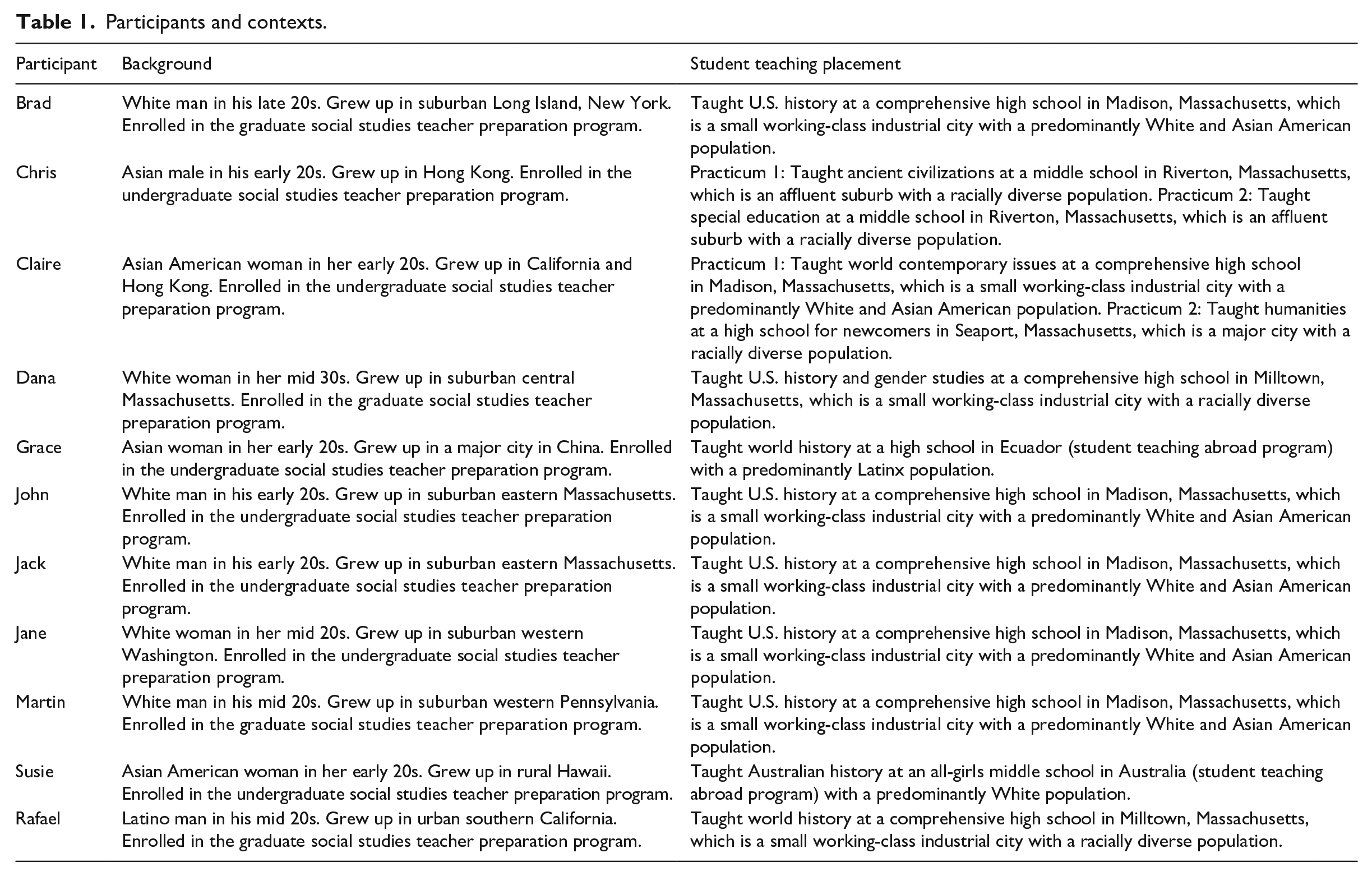
The 11 participants in this study were enrolled in a secondary social studies education program at a large private university in the northeastern United States. As preservice teachers, they were recruited from the university’s social studies methods courses. The program had a stated mission of preparing teachers who foster students’ development as citizens in a culturally diverse and democratic society. The faculty of the program coordinated the methods courses to regularly embed activities to the overlapping concepts of democratic citizenship, critical multiculturalism, and social justice. Multiple courses including the teaching of Banks (2017) citizenship typology. We selected participants who expressed a preference for democratic education and social justice, and were willing to participate in the study. Seven participants were undergraduate-level teacher candidates and four were graduate-level teacher candidates. Two participants identified as Asian American women, one as an Asian woman, one as an Asian man, one as a Latino man, two as White women, and four as White men; they ranged in age from early 20s to mid 30s. The participants completed their student teaching in various contexts spanning from urban to suburban schools with racially and economically diverse or segregated student populations. Descriptions of the participants and their school placements are listed in Table 1.
Participants and contexts.
Data collection
This study used an interpretative case study design. We collected data through interviews, observations, and classroom artifacts. We collected interview and observation data at two points during the participants’ student teaching practica: By collecting interview and observation data once near the beginning and once near the end, we were able to track changes over time, especially changes in the ways that participants described their beliefs and classroom practices, as well as the ways they employed practices within the classroom. Interviews were conducted using a structured protocol designed by the research team (See Table 2 for key interview questions). Each interview was audio recorded and lasted approximately 60 minutes. When scheduling classroom observations, we asked students to choose lesson topics that related to social justice, if possible, as that was the focus of our study. Classroom observations were conducted using a uniform protocol that facilitated the collection of detailed notes on classroom activities and layout, including minute-by-minute description of dialog and teaching practices, along with detailed diagrams of classroom setup. Classroom observations were audio recorded and lasted between 45 and 60 minutes, depending on the length of the class periods at the participants’ schools. During each classroom observation, artifacts were collected in the form of teacher-created materials, such as digital slideshows and student handouts. These artifacts were used to gain a better understanding of how the teacher envisioned the lesson and how it was implemented in practice. The artifact collection also allowed us to ensure that we did not miss any components of the lesson that may not have been noticed during classroom observation transcripts or observation notes.
Key interview questions.
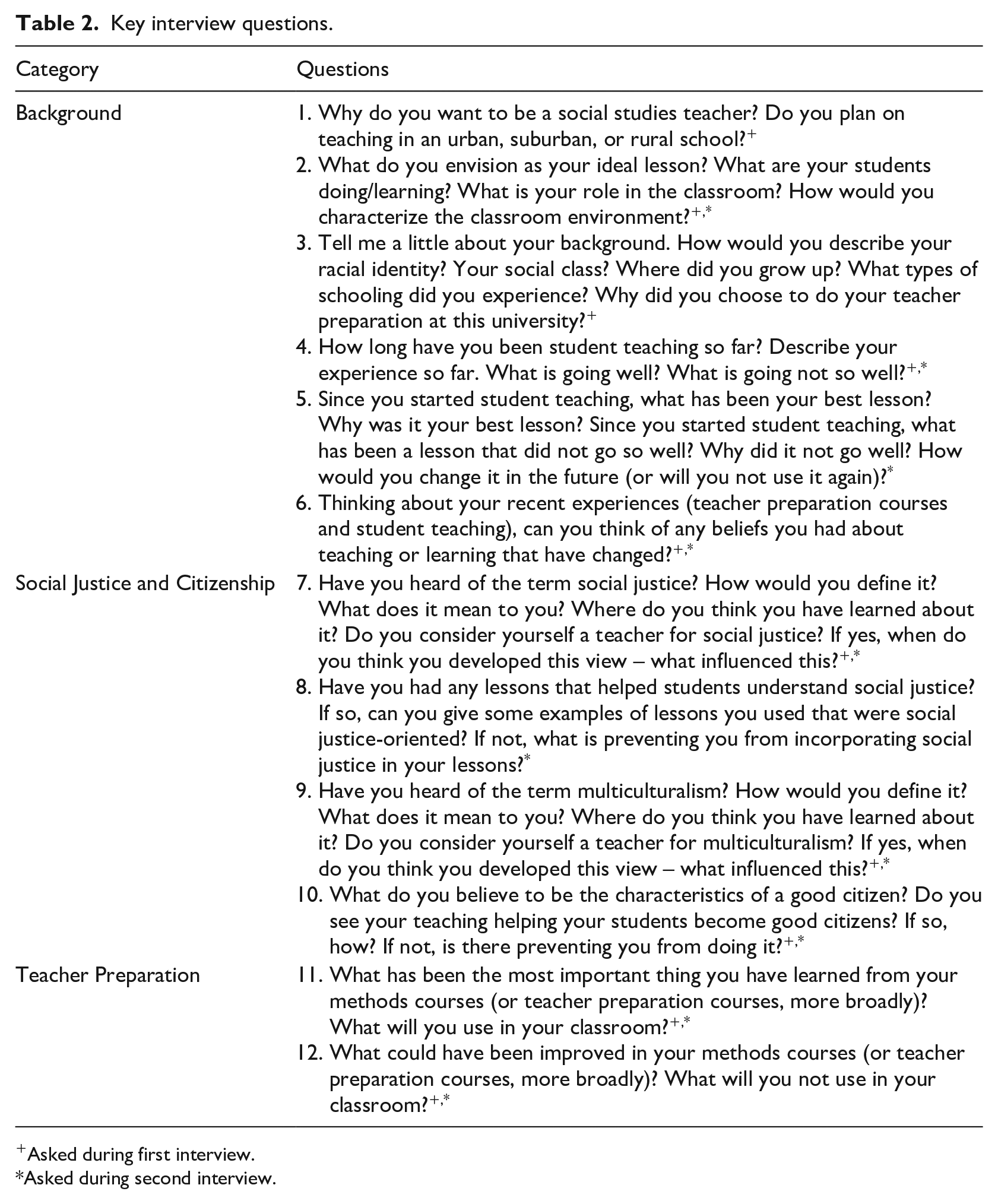
Asked during first interview.
Asked during second interview.
Data analysis
The data analysis comprised four phases: (a) becoming familiar with the data, (b) making and testing assertions within each case, (c) searching for themes and building descriptions of each case, and (d) engaging in a cross-case analysis. In the first phase of analysis, we passed through the data three times. We initially focused on the data within each participant’s case. Next, we read all the data chronologically. Then, we examined the data based on type. The research team moved to the creation of a priori codes based on our theoretical framework and research questions.
In our analysis, we primarily relied on the interview data to answer our research question on the participants’ beliefs about citizenship education and democracy. We primarily relied on the observation and artifact data to answer on research questions on whether the teachers’ classroom practices were aligned with transformative citizenship education. However, in some cases, we also used the participants’ descriptions of their practice as additional data to support answering the second research question.
Guided by the work of Miles and Huberman (1994), we began an initial coding of the data. During this process, we used in vivo codes in an attempt to capture the participants’ own sense-making. To ensure a level of intercoder reliability, we coded one interview and one observation together. Then, we assigned certain cases to each researcher, and we individually coded interviews, observations, and artifacts from our assigned cases using qualitative data analysis software. As we coded each case, we reevaluated and revised our codes on an iterative basis, frequently checking in with each other to ensure consensus about codes. After this first round of formal coding, we compared our codes to the data to determine whether or not to modify, eliminate, or combine any codes.
In the second phase of analysis, the research team used the work of Erickson (1986) as a guide for the generating and testing of assertions within each case. As individual researchers, we examined the coded data and began generating assertions within each case. Then, we came together as a research team, compared the assertions that we generated, and tested those assertions against the data corpus. We then removed any assertions that lacked an evidentiary warrant.
In phase three, we explored the participants’ individual experiences to identify major themes within each case. Guided by the work of Yin (2018), we then built case descriptions based on these major themes and shared descriptions among the research team. Using a thematic analysis, we began searching for major themes across the data within a single case. Finally, during the last phase of analysis, we used Stake’s (2006) process of cross-case analysis. Reading across the cases’ data, we sorted the evidence based on our assessment of their importance (high, middle, low) in relation to each emerging theme. This allowed us to identify themes across cases and sort evidence based on importance to support our cross-case findings.
Findings
Beliefs about citizenship
Citizenship as transformative
While all the participants in this study had developed definitions of democratic citizenship, only four participants (Claire, Dana, Jane, and Susie) included a specific focus on achieving social justice and disrupting inequitable social power relationships. Dana said, A good citizen is somebody who is aware of what is going on in their communities [and] the intersection of others, including other races, classes, religions. . . . A good citizen would evaluate how they feel about how those [people] are being treated or opportunities they are given and whether that is a just action in society. (Interview, May 8, 2018)
Jane said that while ‘there are many ways to be a good citizen’, it was important that citizens strive for ‘equity among all people’ (Interview, March 1, 2018). According to Jane, because citizens exhibited these qualities, this revealed the extent to which citizens were informed and cared about participating in their communities. Claire said, I think being a good citizen involves being self-aware of where you stand in a society . . . being aware of your own identity . . ., [and] strive to have a better understanding of the system, and who they are, and how do they influence one another. (Interview, January 17, 2018)
Susie said that a good citizen ‘is someone who acts in the interest of others and takes action to support their beliefs’ (Interview, April 22, 2019). She later added that it included a commitment to social justice. All of these participants’ definitions focused on social identities and working for greater equity in society.
Citizenship as participatory
Other participants, however, defined citizenship as strictly participatory, and not necessarily transformative or justice-oriented. These participants did believe that citizens should exercise their political power, but they did not mention whether or not social justice should be the aim of such agency or how it could be channeled to cultivate the agency of fellow citizens. Moreover, they tended to believe in using official government channels to make change, rather than acting against the system. Martin said that ‘a good citizen, first and foremost, is one who seeks out information’ and participates in their civic duty, ‘potentially outside the realm of voting’ (Interview, June 3, 2018). Similarly, Rafael said that a good citizen must be informed and active in creating change: I always tell [students], “You need to be informed, this is affecting you, if you don’t like it, then what are you going to do about it? . . . You should be writing a letter to your congressman, or blowing up their phone, or calling them out through a hashtag. . . . Use the tools that are available to you.” (Interview, May 29, 2018)
Grace said, ‘A good citizen should be very active about their civic duties. For example, like voting and should be able to express their opinions’ (Interview, October 19, 2018). Chris said, Being a good citizen means [not] being blind to the shortcomings of a country, where there are shortcomings. I think it’s important to know that and to be mindful of that when we consider citizenship and our civic duties, and those civic duties do involve, you know, calling out politicians, protesting where there is a need, voting especially. (Interview, October 31, 2018)
Unlike Dana, Jane, Susie, and Claire, whose view of citizenship extended to being informed for the purpose of social equity, Chris, Grace, Martin, and Rafael saw citizenship as being informed primarily for the purpose of changing one’s personal circumstances.
Citizenship as recognized
Three participants defined citizenship as recognized (rather than participatory or transformative), which aligned with what Westheimer and Kahne (2004) called personally responsible citizenship. For example, John said, ‘A good citizen is someone who understands the world around them and understands the effect that they [and] that world events can have on their own personal life’ (Interview, October 26, 2018). Jack said citizenship is ‘be[ing] a productive member of society’ (Interview, October 24, 2017). Brad said citizenship is ‘know[ing] how our current political system works . . . [and how to] make their own opinion’ (Interview, May 1, 2017). All three participants had definitions that did not include references to equity or justice, and they did not include a view that citizens must be active participants in democracy. Rather, they focused on knowing how government functions and participating as productive members of society or forming their own opinions about government.
Practices related to citizenship
Strong classroom-based multicultural democratic education practices
All of the participants in this study wanted their students to develop as citizens; however, some were more equity-oriented (Martell, 2017; Martell and Stevens, 2017) than others and focused on critical multiculturalism and social action in their teaching. Therefore, we argue that these participants were strongly aligned with, or working toward, Marri’s (2005) concept of CMDE. As Marri argued, teachers cannot truly enact multicultural democratic education unless they are helping students develop a critical view of citizenship. Teachers, through community building and the development of disciplinary knowledge, help students realize that citizenship may unfairly benefit some people over others, which in turn supports students’ abilities to critique and transform societal norms.
Regarding Jane, Claire, Dana, and Susie, their teaching practices strongly, and most consistently, reflected elements of CMDE. For instance, Susie’s lessons demonstrated a critical approach to teaching Australian history. Susie taught an inquiry-based lesson on eugenics and the intentional ‘breeding out’ of Aboriginal children by the Australian government. At one point, during a whole-class reading, she led the class in questioning the concept of ‘White Man’s Burden’:
How many of you know what a ‘burden’ is?
It’s like something that weighs you down.
Right, so in his poem he’s talking about how White men feel like they have this responsibility to go ‘fix’ people around the world, which is of course super racist . . . because you’re telling someone that their culture is wrong. . . . So this philosophy comes up a lot when we’re thinking about how we treat Indigenous people. (Observation, October 30, 2017)
In another lesson, Susie discussed with her students the controversy surrounding Australia Day by featuring a video with a panel of Indigenous and White Australians discussing its complex and troubling history, during which the following exchange occurred:
Okay, so, I learned that Australia Day celebrates the arrival of the first [British] fleet. . . . Why would that be controversial?
It’s only celebrating the British White people and it’s not celebrating the owners of the land.
Why might some people see it as only celebrating our European history?
Because . . . the day that we celebrate Australia Day was the day that the Aboriginal culture didn’t last, but started to fade away. (Observation, November 16, 2017)
After this exchange, Susie offered examples for how Aboriginal people have sustained their culture in current day Australia and asked her students to consider the importance of increasing Indigenous voter turnout in Australian elections. One student said during this discussion, ‘It’s especially important for our Indigenous [people] to vote because they need to acknowledge our Indigenous heritage and voting is the way to do it’ (Observation, November 16, 2017). By naming racism and highlighting the history and contemporary experiences of Indigenous Australians with her European Australian students, Susie exemplified some of the critical-pedagogical aspects of CMDE.
Claire’s lessons also acknowledged and condemned historical and contemporary instances of oppression. She wanted students to see that oppression based on ethnic or religious identity continues to occur. For example, while teaching a lesson about the Holocaust, she asked her students to react to a video about a mass shooting that had recently occurred at the Tree of Life synagogue in Pittsburgh (Observation, December 6, 2018). Next, Claire drew connections to President Trump’s xenophobic messaging about a so-called ‘caravan’ of Honduran migrants approaching the United States. While not directly comparing recent events to the Holocaust, Claire wanted her students to see where the fear of others originates and how it could lead to groups being targeted. Furthermore, she wanted to show how we could be seeing the seeds of future violence in events in our current time. In this, albeit in a small way, she modeled how instantiations of social injustice warrant resistance—a powerful message given her students’ immigrant backgrounds.
Working at a school that specifically served newcomers, Jane encouraged her students to question traditional interpretations of U.S. history when she taught a lesson on women’s suffrage through an intersectional and contemporary lens. At one point, she had students analyze a political cartoon of the Seneca Falls Convention, after which she pointed out to the students how only White women were featured in the drawing, despite the conference including women of color (Observation, March 6, 2018). She then pointed out how this narrative was perpetuated by the students’ textbook, highlighting how it only mentions White women fighting for women’s suffrage. In groups, the students were then tasked with annotating a speech by Sojourner Truth, which Jane bookended with a discussion on broader issues of race, gender, religion, and sexual orientation. Jane made the point to her students that Sojourner was faced with the challenge of balancing her identity as both a woman and a Black woman advocating for change, an idea that several of her students could identify with. Through this lesson, Jane challenged the ‘notion that traditional interpretations [of content] are universalistic’ (Marri, 2005: 1040), a key component of CMDE.
Dana taught her students about transformative social action. During her unit on the U.S. Civil Rights Movement, Dana led the students in a discussion of Black Lives Matter and introduced a framework for understanding and enacting social change. During a review lesson, her students were tasked with placing pivotal events (e.g. sit-ins, the Freedom Rides) of the movement via sticky notes along a ‘Stages of Social Protest’ spectrum posted throughout the room, after which they were asked to defend their choices (Observation, March 16, 2018). Dana, by teaching about and for social action, demonstrated a crucial aspect of CMDE and may have planted seeds for transformative citizenship.
Emerging classroom-based multicultural democratic education practices
Martin, Brad, Rafael, and Grace exhibited emerging CMDE practices, albeit different from the practices exhibited by Jane, Claire, Dana, and Susie. Martin, Brad, and Grace engaged their students in analyzing societal norms, but they did not take a critical multicultural approach. Rafael highlighted underrepresented perspectives in his lessons, but he did not engage students in active critique. During one of his lessons, Martin prompted his students through historical case studies to take a stance on whether the Electoral College limits or strengthens democracy. During a class debate, one of his students argued that the Electoral College limited democracy, saying that ‘ultimately, it comes down to [the elector’s] pick’ (Observation, April 26, 2017), so the electors must choose fairly if the Electoral College is to function as intended. Coincidentally, one of Brad’s lessons centered on evaluating the fairness of the Electoral College. Upon noticing that most students were critical of the system, he prompted them to consider the disadvantages of direct democracy, to which a student replied, ‘People with poor knowledge on government and politics are allowed to vote’ (Observation, April 26, 2017). Although Martin’s and Brad’s lessons lacked a multicultural focus and broached issues of equity in more political terms than social, their practices encouraged students to deliberate and critique the norms underlying U.S. representative democracy. Along these same lines, Grace centered a lesson on the question: How have different stigmas contributed to the spread of AIDS? After the students read several historical sources in groups, Grace brainstormed with the entire class ways that society could combat stigmas and discrimination (Observation, October 19, 2018). In this, while she does have students think about society, her focus was primarily on individual prejudices, rather than larger social inequities.
Unlike the lessons from the above participants, Rafael’s observed lessons were primarily teacher-centered with few links to issues of social justice and equity. Nevertheless, we argue that he was working toward CMDE based upon his descriptions of practice and his espoused desire to do so from the interview data. For example, as a student teacher, Rafael described his unit on the Mexican-American War. He explained how he, as a Latino man, encouraged his students, many of whom identified as Latinx, to analyze several primary sources from the perspective of Mexicans during the American invasion. Rafael said the following about the lesson’s success: They were able to see how this hasn’t gone away, this second-class status of being this first and then American second. So, it was good, and they also brought up the whole rhetoric against Mexicans by the [current] president, so they were able to make that connection of immigration and the president, using them as scapegoats in general. (Interview, May 4, 2017)
Lessons like this reveal how Rafael understood his curriculum served as a means to validate his students’ lived experiences and engender empathy for those whose experiences might differ from the students’ own experiences. Although Rafael’s lessons were devoid of discussions of how to combat the rhetoric he describes, they may be preparing students for responsible living within a multicultural democracy.
Lack of classroom-based multicultural democratic education practices
Although John, Jack, and Chris, exhibited some of the ‘community’ and ‘disciplinary’ aspects of CMDE throughout their observed lessons, we argue that these participants were not aligned with or working toward CMDE, since they had missed numerous opportunities to link their lessons to social equity and critical multiculturalism. John, Jack, Chris, generally wanted students to understand multiple perspectives, but in an equity-neutral way. For example, Jack’s assigned project on post-Napoleonic Europe encouraged students to consider several political ideologies, but not evaluate their merits, let alone through the lens of equity (Classroom Artifact, November 15, 2017). Regarding John, he explained to his students that his concern was that their work exemplified ‘mastery of the topic’ (Observation, November 15, 2017). Likewise, in Chris’s lesson about Mesopotamia, students learned about the system of trading and bartering, but they were not encouraged to consider how certain groups may have been advantaged or disadvantaged by the system (Observation, November 11, 2018).
John’s lessons especially stand out for their missed opportunities to focus on social equity or critical multiculturalism. For instance, during a lesson about Jewish people in Ancient Rome, John’s opening slide posed the question, ‘How were the Jewish people treated in Rome?’ (Observation, December 5, 2017). He had students read a Roman historian’s view of the era and then share what they learned from the document. John wrote the following student response on the board at one point: ‘Jewish people were treated poorly. Romans were trying to build on people’s land’ (Observation, December 5, 2017). He ended the discussion by highlighting that each group had very different perspectives of the period. This topic was touched upon again during a class in which John was reviewing lessons for an upcoming test:
So, during this revolt. Do you remember this? This was in the reading. The Roman emperor was trying to take away the Jewish people’s land and trying to disperse them and get them out of Judea. . . . So, the final result was that they were all kicked out of Judea and forced to disperse into other parts of the empire. . . . So, did the Jewish people ever get religious freedom? In Rome?
No. They were being slaves.
No, they didn’t get religious freedom. Everyone got this one? (Observation, December 5, 2017)
Here, John had numerous opportunities to discuss discrimination and anti-Semitism more deeply, but he did not capitalize on those opportunities. Rather, he seemed focused on students merely understanding that Romans discriminated against Jewish people, not really discussing what that discrimination was rooted in, how similar discrimination persists today, or how it could be reduced or prevented. For Jack, John, and Chris, the acquisition of mainstream academic knowledge was an end in and of itself; their lessons lacked the transformative knowledge needed to critique mainstream norms (Marri, 2005), which effectively promoted limited forms of citizenship.
Discussion
Ultimately, we found that the participants’ beliefs and subject matter knowledge, rather than their school contexts, were the strongest influence on their ability to implement CMDE during their preservice years. The disparity between John’s and Jane’s practices, in particular, underscores this point as both participants were teaching in the same school, yet they diverged greatly regarding the promotion of transformative civic ideals. Moreover, disparity existed between other participants who worked in similar contexts. We do not mean to suggest that the participants’ contexts are unimportant or that they bear no influence on teachers’ curricular-instructional decisions but that the depth of their subject matter knowledge and their commitment to their beliefs appeared to have a greater impact on their progress toward CMDE; these two influences in tandem, we contend, cultivated participants’ civic imaginations (Jenkins et al., 2020), or their capacity to imagine alternatives to inequitable social, economic, and political conditions. Accordingly, this capacity enabled teachers to begin to enact alternatives to institutional norms that would otherwise encourage and uphold the educational status quo. Implications from these findings, which are interwoven in the following subsections, are instructive for better understanding how we might support the development of teachers’ CMDE practices at the preservice and inservice levels.
Teachers’ beliefs about (and commitment to) equity
Despite attending the same preparation program focused on democratic citizenship, critical multiculturalism, and social justice (one that include a specific focus on fostering transformative citizenship), there were key differences in the ability of the participants to enact CMDE practices during student teaching. The participants with beliefs about citizenship as transformative or justice-oriented were more likely to successfully enact CMDE regularly. Since these participants’ broader beliefs centered on equity, we contend they were less likely to separate their views of social justice and democratic citizenship. Additionally, they were more likely to challenge themselves to focus their civics-related lessons on helping students understand, and hopefully deconstruct, social inequity. Consider Jane, Dana, Claire, and Susie, who were among the most successful at enacting CMDE practices as student teachers; citizenship, for them, generally entailed a responsibility to work toward ‘actualiz[ing] justice and equality within most nation-states’ (Banks, 2017: 369). At the same time, several participants with participatory-oriented democratic beliefs exhibited emerging CMDE practices in their lessons. Martin and Grace, for example, did not explicitly link citizenship to equity, but they did often broach multicultural, social justice-related topics in their lessons.
Ultimately, we found the practices that most aligned with (or were making progress toward) CMDE were more likely a result of participants having well-developed beliefs about, and commitments to, social justice and equity, even if not linked explicitly to citizenship. Their beliefs exhibited an emerging political clarity (Blevins et al., 2020), in that the participants were conscientious of how hegemonic ideology and systems privilege dominant groups, along with their agency to transform such systems. In contrast, the participants who made little progress toward CMDE, generally lacked well-developed beliefs about social justice and equity.
These results add depth to the research on social studies teachers’ purposes, which has demonstrated there is a strong link between teachers’ long-term commitments and their practices (Barton and Avery, 2016). At the preservice level, this underscores the importance of social studies teacher preparation programs centering their civics-related coursework and, more broadly, their foundational and methodological courses on social justice. It also confirms previous research showing that teacher preparation coursework must also focus on the teachers’ own identities (Barton, 2012; Branch, 2004; Castro, 2014; Kenyon, 2019; Knowles and Clark, 2018). We agree that teachers’ lived experiences with injustice, or what Kenyon (2019) called ‘their own moments of troubled belonging’ (p. 55), may in part account for teachers’ receptiveness to CMDE practices. In this study, the strongest CMDE teachers were all women and two were Asian American. They routinely connected their lived experiences to their reasons for teaching for transformative citizenship. Their justice-oriented beliefs coupled the practices that they were exposed to in their teacher preparation courses appeared to have a strong influence on their teaching. In many ways, reflection on their lived experience, having firm justice-oriented beliefs, and well-developed pedagogical tools were the three legs that held up the stool of transformative citizenship education.
Teachers’ transformative academic knowledge
CMDE necessitates two domains of knowledge: mainstream academic and transformative academic (Marri, 2005). The former posed no issue for the participants in this study, as they all possessed an adequate knowledge of dominant narratives within the school curriculum. The absence of the latter, however, proved to be another barrier for participants’ enactment of CMDE. Transformative academic knowledge reflects teachers’ understanding of narratives and lines of inquiry that ‘have created major shifts in disciplinary understanding’ (Wineburg, 1997: 259). Such knowledge is multi-ethnic in nature (Branch, 2004), encompassing narratives that critique hegemonic practices and positively affirm the identities and ‘the unique experiences of linguistically and culturally diverse communities’ (Blevins et al., 2020: 36). Of the participants who were not making progress toward CMDE, we found their lack of transformative academic knowledge played a significant role.
Several studies have found that university coursework focused on the history of nondominant groups can play a major role in fostering transformative content knowledge. For instance, a teacher, who majored in ethnic studies and was exposed to a litany of counternarratives in that coursework, was better able to teach that content than peers (Branch, 2004). Likewise, Blevins et al. (2020) found an exemplary preservice social studies teacher had deepened her transformative academic knowledge through coursework that centered ‘subjugated stories’ (40). In this study, we found the opposite is also true. When teachers have very few courses focused on the histories or experiences of nondominant groups, and lack transformative academic knowledge, they struggle to teach about nondominant groups in practice, or worse, they may not see that content even related to the topics that they are teaching.
However, as powerful as such coursework can be, we maintain that it is neither realistic nor practical for university professors to bear sole responsibility for increasing prospective teachers’ transformative academic knowledge. Support for social justice teaching, particularly within the contexts of democratic citizenship education, must extend beyond teacher preparation programs. As most teachers receive little support in teaching for equity and social justice (Kohli et al., 2015; Zeichner, 1993), we argue that schools must better support teachers across content areas by centering their professional development on the intersection of the transformative subject matter knowledge of their specific subjects and citizenship education. Finally, we would suggest that the work of Banks (2017) and Marri (2005) offers excellent frameworks for helping teachers think about their democratic beliefs and related citizenship education practices in their classrooms. These frameworks could serve as a tool to help teachers assess the type of democratic thinking that they teach most often and what methods they use (or do not use) in their practice.
Conclusion
This study illuminates the need to prepare teachers to not only help their students become change agents, but also encourage their students to question for what and for whom they are pursuing change. To an extent, Brad, John, and Jack exemplified teaching for citizenship, but without an explicit focus on social equity or justice. Without such a focus on the teaching of democratic citizenship, teachers may be preparing future generations of citizens who are unable to detect the problematic view that White supremacist ideology has a legitimate place in the civic discourse of the United States. Such oversight stands only to provoke a form of repressive tolerance (Bronner, 2014), in which citizens falsely equivocate bigotry with intelligence and believe that the content of speech is secondary to the right of speech. If unable to challenge this, future generations may be bound to ‘the ignorant prejudices of those that preceded them’ (p. 36). When citizenship education does not center on equity and critical multiculturalism, it not only normalizes White supremacy, but also does not give students the tools they need to undo White supremacy. While Brad, John, and Jack described a general commitment to democracy and social justice at the beginning of the study, they never developed a critical lens on their work, which ultimately led to them enacted pedagogies that never asked students to challenge the status quo.
Additionally, we argue that Claire, Dana, Jane, and Susie, through their connection with citizenship and social justice, and their use of CMDE practices, were best prepared to support their students’ citizenship education in these complex times. By intentionally challenging their students to consider how race and other social identities influence who has power in society (and how they use that power), they are preparing citizens to rebuild a democracy that is multicultural and truly for all. They take citizenship education further than those teachers who center their work on participation, and they are learning how to ask students to question structural inequity built into the system.
Footnotes
Declaration of conflicting interests
The author(s) declared no potential conflicts of interest with respect to the research, authorship, and/or publication of this article.
Funding
The author(s) received no financial support for the research, authorship, and/or publication of this article.
