




Abstract
This study explores how teacher educators promoted Israeli Arab student teachers’ civic engagement through a multifaceted service-learning program. They worked on a project named ‘Challenges’ that supported service-learning, and provided knowledge about societal issues and Palestinian heritage. Qualitative interviews were conducted with 17 teacher educators. Additionally, 1608 freshmen students answered a questionnaire about their level of agreement with different reasons for, and objections to, volunteering, which was used as a measure of civic engagement. Among the students, 853 participated in the project, and 755 were not exposed to it yet. Scholarships were awarded to 399 students for their service and 109 expected one. Working as a team, the teacher educators achieved a system-wide change within the Arab teacher education curriculum. Participating students’ knowledge and civic engagement increased. Their level of agreement with reasons for volunteering was higher than that of students who were not exposed to the project yet and were not expecting a scholarship.
Introduction
A sense of solidarity motivates individuals to become active citizens, engage in political activism and volunteer. However, ethnic minorities and other unprivileged groups may feel alienated from the hegemonic culture and refrain from civic engagement (Banks, 2017). This state of affairs is typical of Arabic speaking minorities in Israel (Abu-Saad, 2019). 1 Citizenship education can either exacerbate the minorities’ alienation and resulting exclusion from civic engagement and political influence, or it can increase the students’ awareness and encourage their community and political involvement (cf. Abu-Saad, 2019; Agbaria and Pinson, 2019; Banks, 2017; Bartolomé, 2004; Cohen, 2019; Freire, 1970). However, the enacted curriculum and practiced pedagogies that aim to increase students’ active citizenship are under-studied (Cohen, 2019). The current study explores Israeli Arabic speaking teacher educators’ attempts to increase student teachers’ awareness of their societal, cultural and national identities and encourage their civic engagement through a service-learning program they devised collaboratively. They offered the program to all first-year student teachers in initial Arabic speaking teacher education programs. The study is significant in view of the paucity of studies dealing with practiced pedagogy on the one hand (Cohen, 2019), and the relatively large scale of the program and its non-selective nature on the other hand. As such, it may be relevant for other educational systems that wish to increase social awareness and encourage civic engagement of marginalized groups.
Below, we refer to Banks’s theory of citizenship as the theoretical framework for our study and address the role that education can play in promoting students’ citizenship. Then, we describe service learning as a means through which educators can encourage students’ civic engagement and transform their citizenship. Finally, we present the context in which the service-learning program was created, and address the question: How did the SCI program affect Arabic speaking student teachers’ knowledge about their society and their civic engagement?
Theoretical background
Citizenship and education
Citizenship is a complex and multifaceted concept that deals with the relationship between individuals and their state. Marshall (1964) describes three aspects of citizenship: civil, political, and social. The civil aspect includes individual rights and equality, the political aspect emphasizes participation in political processes, and the social aspect involves participation in cultural communities and civic engagement. Expanding Marshall’s (1964) conceptualization of citizenship to include a group’s cultural and democratic rights, Banks (2008, 2017) identifies four citizenship types: 1. ‘Participatory citizenship’ is characteristic of citizens who identify with the state’s ethos and values. They feel they can be influential and actively participate in their state’s social and political life. Participatory citizenship is more prevalent among dominant groups. 2. ‘Recognized citizenship’ refers to the legal status awarded to individuals or groups by the state, which allows them to participate in social and political life. However, due to their marginalization, the minority groups’ level of involvement may be significantly lower. 3. ‘Failed citizenship’ may come about as a result of marginalization, unjust treatment, conflicting values, as well as conflicting national and cultural affinities. Citizens whose citizenship is failed may feel alienated or have ambivalent feelings toward their state. If they become socially involved, their activities are restricted to the communities with which they are affiliated. 4. ‘Transformative citizenship’ is practiced by citizens who act to change their society and achieve social justice and equity. Although the four types of citizenship can be conceptually distinguished, in reality they overlap and are interrelated in a dynamic way. Nonetheless, they are useful conceptual tools for citizenship education.
In societies in which failed citizenship prevails, educational systems have contradictory roles. On the one hand, they are designed and monitored by the state’s powerful groups to reproduce current social stratification. On the other hand, it is through education that members of marginalized groups gain awareness of their identities and the forces that shape the society in which they live (Banks, 2017). Citizenship education is a political and ethical act through which civil organizations and activists define themselves as actors and claimants of rights and responsibilities for the quality of life of minority groups. Kymlicka (2010) calls this process ‘citizenisation’, which is the transforming of hierarchical relationships (both vertical, between members of minorities and the state, and horizontal among the members of different groups) by fostering new civic identities and affording a space to solve contentious issues between the minority and majority groups. During this process, both groups need to change. Members of the minority groups need to become aware of their marginalization, whereas members of the majority group have to allow for the minority groups’ full participation in democratic life, while still maintaining their distinct ethnic and cultural identities (Banks, 2016).
Teachers can encourage political activism (‘transformative citizenship’) aimed at promoting equity and social justice (Banks, 2017). To do so, they themselves must be well-educated. Therefore, teacher education has a significant role in counteracting failed citizenship and encouraging civic engagement (Bartolomé, 2004). To be influential, teacher educators need to collaborate and use effective pedagogical tools.
Service learning in teacher education as a tool to improve civic engagement
Service learning is a pedagogical method that combines community service with students’ accumulation of practical experience, reflection, and academic learning (cf. Bhargava and Jerome, 2020; Birdwell et al., 2013; Folgueiras et al., 2020; Mtawa and Fongwa, 2022). It is located on a continuum between internship and volunteering (Salam et al., 2019). Volunteering serves the purpose of contributing to its beneficiaries, whereas internship serves the purpose of educating interns as service providers and enabling them to acquire practical skills. The service component emphasizes citizens’ responsibilities (Birdwell et al., 2013), thus it may be viewed also as being located on a continuum between volunteering and civic action. Volunteering is an individual, apolitical activity that aims to benefit others out of compassion, whereas civic action is a social activity that aims to change society. As such, it expresses a ‘maximal’ notion of citizenship, aiming at the public good, promoting inclusion, and strengthening social bonds and mutual responsibility (Wahrman and Hartaf, 2021). However, the distinction between them is often blurred and is dependent on the degree to which the activity is contested or politicized (Evers and von Essen, 2019).
In teacher education, service learning can help teacher educators prepare prospective teachers who either belong to marginalized groups themselves or who will work with marginalized students and communities. During service learning, teacher educators provide prospective teachers with knowledge about the communities they serve. The prospective teachers develop critical stances to enable the identification of and resistance to any unjust treatment toward their future pupils and communities. This course of action is often referred to as adopting a ‘critical pedagogy’ (Freire, 1970).
Furthermore, prospective teachers develop appreciative attitudes toward cultural diversity that will help them support the maintenance of minority groups and develop their cultural identities and heritages (Bartolomé, 2004; Ladson-Billings, 1995). The latter point requires that prospective teachers view cultural diversity and multilingualism as an asset, and not just as a starting point from which pupils are assimilated into the dominant culture (Paris, 2012).
Service-learning nurtures a sense of civic responsibility and social awareness that are essential for participatory and transformative citizenship. When prospective teachers encounter real problems, they try to apply their theoretical knowledge and thinking skills to address them and often collaborate with other peers. Such experiences not only deepen their learning, but also promote thinking, problem-solving skills, moral reasoning, and teamwork (Salam et al., 2019). Students who participated in service-learning had positive attitudes toward this learning experience and its effect on their professional, social, and moral development (Folgueiras et al., 2020). Mitchell (2015) found that service-learning had long-term effects on students’ commitments to active citizenship, as reflected in their career choices, political activism, and volunteering. Students’ commitments to long-term volunteering are enhanced when their areas of interest correspond to the service they provide, when they enjoy and feel satisfied with their work, and when they feel they belong to the community that they serve and believe that their service will result in a better future for their society (Stukas et al., 2016). In contrast with volunteering, that does not involve in monetary rewards, students with restricted resources may require financial support to devote their time to service learning (Burke and Bush, 2013).
Service-learning is associated with benefits for faculty members too: It improves teacher educators’ teaching, professional knowledge, and sense of self-efficacy (Salam et al., 2019). Nonetheless, it also increases teacher educators’ workload significantly. Teacher educators need to act as a mediator between service-learning sites, academic institutes, and students’ needs and preferences. In addition, they have to monitor student teachers’ work and provide emotional and cognitive support. Otherwise, student teachers may prefer to maintain their beliefs in the justice of the current political system and attribute marginalized groups’ difficulties to inherent inferiority (Bartolomé, 2004). Therefore, providing service-learning opportunities to student teachers could also result in teacher educators’ burnout if their work is unsupported (Salam et al., 2019).
The context of the study
The Arabic speaking educational system and the civics curriculum
The population of the State of Israel is around nine million inhabitants; approximately 74% of whom are Hebrew-speaking Jews, 21% are citizens and residents of any religion other than Jewish who speak Arabic as their first language, while the remaining 5% are defined as ‘others’ (Central Bureau of Statistics, 2019). The Arabic speaking group’s identity is multifaceted and complex. It comprises diverse religious, ethnic, national, and citizenship aspects that vary among individuals and sub-groups (Omar, 2017). Most of Israel’s Arabic speaking population has Israeli citizenship, but some only have permanent resident status. About 85% are Muslim, 7.5% are Christian, and 7.5% are Druze (Central Bureau of Statistics, 2019). Some view the Druze as an ethnic minority, in addition to being a distinct religion. There are also diverse ethnic groups within the Arab Muslim majority. The dominant national identity is Palestinian (Arar, 2012).
There are significant differences between the Arabic-speaking minority and the Hebrew-speaking majority in terms of employment, living conditions, economic status, and educational achievements (Weiss, 2019). These are the result of the entrenched discrimination in resource allocation and the dominant culture’s negative attitudes toward the minority sector (Arar et al., 2017; Blass, 2017; Kasir and Yashiv, 2020).
The public educational system in Israel is divided into four smaller sub-systems named ‘streams’ (zramim, in Hebrew). The language of instruction is Hebrew in three of these sub-systems (Hebrew secular, Hebrew religious, and Hebrew ultra-orthodox) and Arabic in the fourth. Most Arabic speaking children study in the public Arabic speaking sub-system. Its existence has the potential to preserve and develop students’ cultural identities. Furthermore, Israeli Law recognizes parents’ rights to acquaint their children with their unique language, culture, historical heritage, and entitlement to equal civil rights. Nonetheless, the Arabic speaking system’s civic studies curriculum supports the Jewish ethno-national nature of the state. The curriculum pays scant attention to the social and civic issues that are relevant to Arabic speaking society, and there is no recognition of the Palestinian national identity (Abu-Saad, 2019; Agbaria, 2015; Pinson, 2020).
Agbaria and Pinson (2019) noted that high school civics teachers in the Arabic-speaking sub-system tend to circumvent the official curriculum and discuss the Palestinian nationality and societal issues with their students. However, this is not a widespread phenomenon among Arabic- speaking teachers. The ongoing surplus of teachers in the Arabic-speaking system, as well as the lack of occupational alternatives, disempowers teachers who are anxious to retain their job and unwilling to confront the government (Agbaria, 2011). Therefore, Arabic-speaking teachers refrain from political involvement inside, as well as outside, their classrooms. These circumstances may contribute to failed citizenship among both teachers and students.
The Challenges project
When faced with the growing concerns over the poor achievements of Arabic-speaking students, the Israeli Ministry of Education set up a committee in 2015 to discuss a program for improving the initial preparation of Arabic speaking teachers who are viewed as the ones responsible for the achievements of the Arabic speaking students. The committee identified four themes, or areas for intervention: Arabic language, academic literacy, school practice, and civics, that is, the society, culture and identity (SCI) theme. Concerning the latter area, the committee noted that Arabic speaking student teachers had little acquaintance with their own history and cultural heritage, and with the demographic characteristics of their society and its needs, and at the same time they also lacked civic engagement (Avgar and Herman, 2017). It recommended allocating a budget to improve teacher education in all four themes, which was accepted.
As part of Government Resolution 922 from December 30, 2015 (Prime Minister’s Office, 2015) that allocated a budget for the development of Arab society, the Ministry of Education devised a 3-year intervention project known as ‘Challenges’ (Etgrarim, in Hebrew) in each of the teacher education colleges that have Arabic speaking initial teacher education programs (10 out of the current 21 colleges). Each college appointed a theme coordinator for each area of intervention and a supervisor for the entire project. As part of the supervisors and coordinators’ job remit, they formed five inter-institutional teams (one team of coordinators for each of the four intervention themes and a supervisors’ team). Each team had one or two facilitators that supported its work. The teams met regularly at the MOFET Institute, 2 which is a nonprofit organization established by the Ministry of Education to provide professional learning and development opportunities for teacher educators.
In this study, we explore how the coordinators of the ‘Society Culture and Identity’ (SCI) theme increased their student teachers’ awareness of societal issues and encouraged their civic engagement, through a service-learning program they developed in their inter-institutional team. In the local context, this question is interesting since the Challenges project is a unique example in which the Israeli Ministry of Education encouraged increasing societal and political awareness within the Arabic speaking sub-system. At a broader level, this study may be useful to other educational systems that wish to encourage civic engagement of marginalized groups through large scale and non-selective programs.
Method
This is a mixed-method study (Plano Clark and Creswell, 2008). The qualitative part comprises interviews with SCI coordinators and college supervisors. The quantitative part is a questionnaire distributed to first-year graduates (the study group) at the end of their first year of study and to first-year, freshman students (who served as the comparison group) at the beginning of their academic year.
Qualitative data
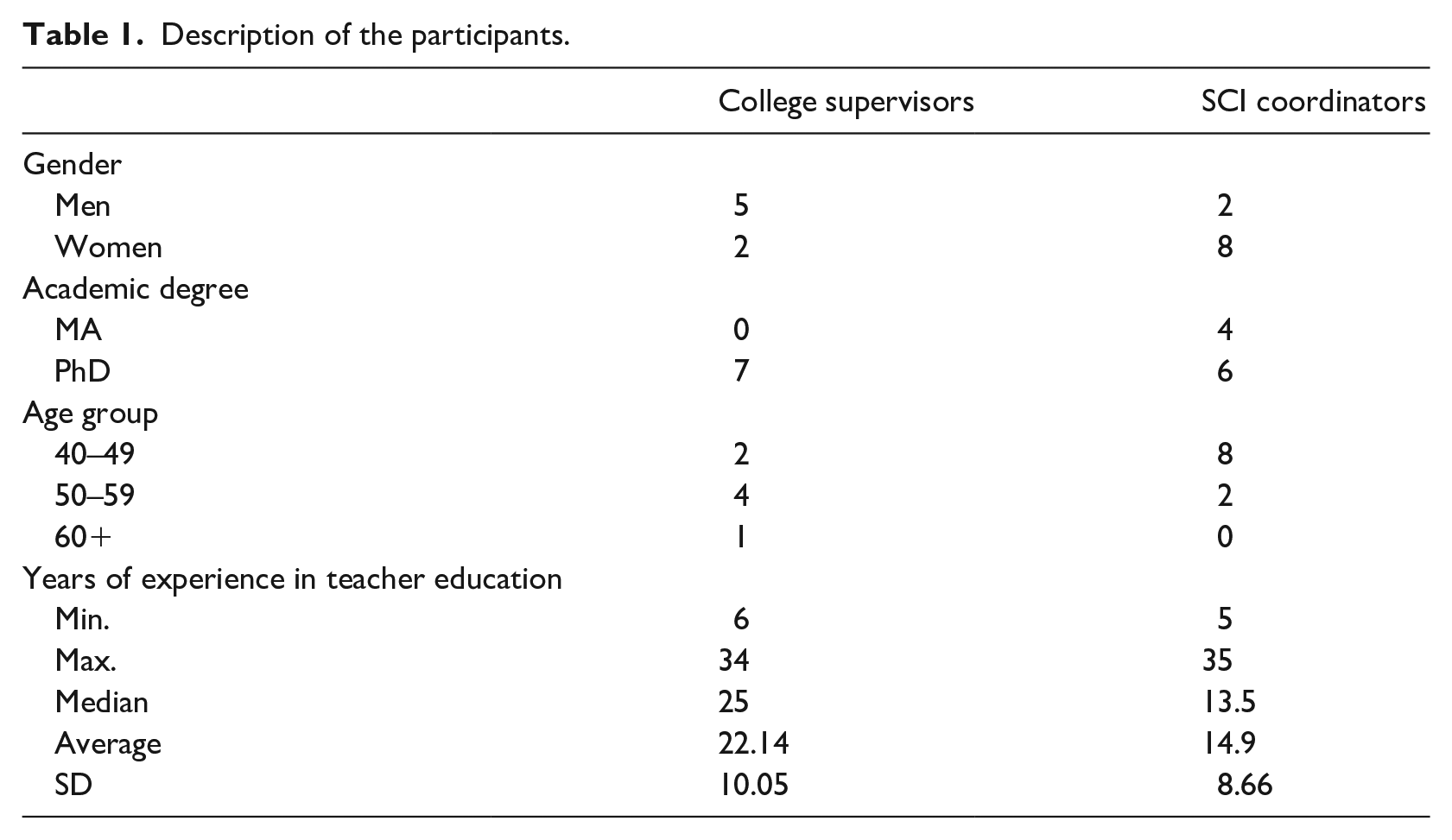
Interviews were held with two groups: the colleges’ project supervisors and the SCI coordinators immediately after their final meeting of the project’s third year. Each group had one participant from each of the project’s colleges. Table 1 describes the interviewees. Of the 10 college supervisors, seven (five males and two females) participated in the supervisors group interview. Two additional females had dual roles as college supervisors and SCI coordinators. They were interviewed with the SCI coordinators’ group and appear only once in Table 1, in the SCI coordinators’ column. One male did not attend the meeting and was not interviewed. As for the SCI coordinators’ group, nine participants, eight females and one male attended the final meeting and participated in the interview. An additional male was individually interviewed. As could be expected, the college supervisors are older and more experienced than the SCI theme coordinators, and have higher academic degrees
Description of the participants.
The SCI coordinators were asked to describe their students’ knowledge about Arabic-speaking societies, cultural heritage, and social involvement before the project started, the goals they set for themselves, their activities during the project, their main achievements, and difficulties, the scholarships’ effects and their recommendations for the future. The supervisors, who coordinated all four themes of the project within their respective colleges, were asked the same questions about the entire project. Only data that are relevant to the SCI theme are used. The interviewer, who was unfamiliar with the participants, assured them that their identities would be kept anonymous, and emphasized that frank and critical feedback was crucial for future improvements. The group interview with the SCI coordinators lasted 3 hours, whereas the interview with the projects’ college supervisors lasted just over 1 hour. The individual interview with one of the SCI theme coordinators lasted 20 minutes. The interviews were audio recorded and transcribed. All the quotes are ascribed to pseudonyms.
Thematic analysis was used to analyze the interviews (Braun and Clarke, 2006). In the first phase, we extracted excerpts that referred to the students’ pre-project knowledge, participants’ goals and work methods, as well as significant achievements and challenges. In the second phase, we triangulated the information from the two sources. Throughout this process, discussions were held to ensure credibility and achieve consensus.
In order to learn about the service-learning sites, we used a database the SCI coordinators prepared. The database included over 100 volunteering sites and was available to the student teachers to choose from.
Quantitative data
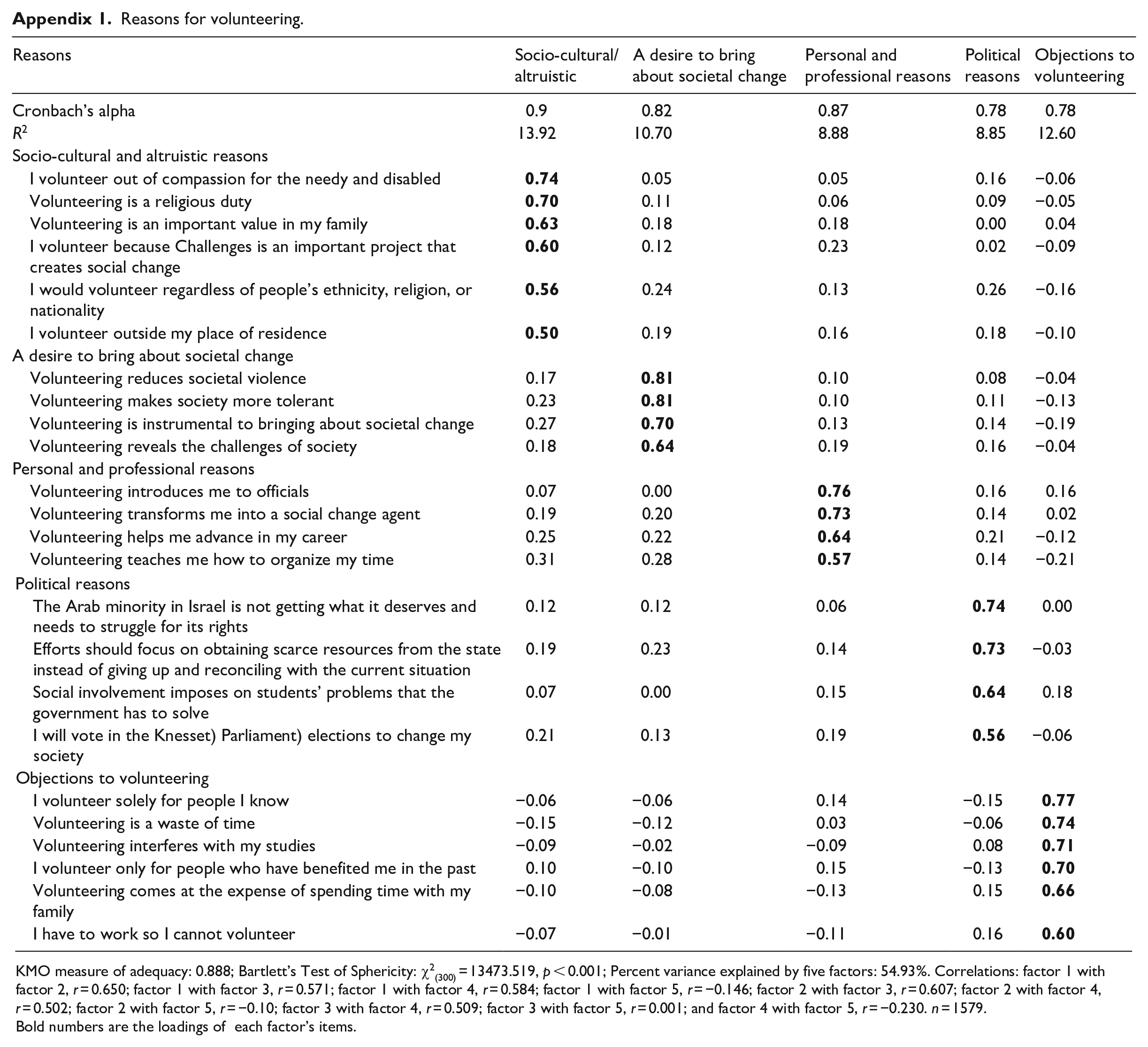
The participants in the quantitative study consist of two student cohorts: A. the study group—853 first-year graduates who participated in the SCI program and completed the questionnaire at the end of the year. B. Seven hundred fifty-five freshmen students at the beginning of their study year, who were not yet exposed to the SCI program (the comparison group). Scholarships were awarded to 399 students in the study group for their service, and 109 students in the comparison group were expecting to be awarded one. The participants answered a questionnaire on their level of agreement with different reasons for volunteering. Agreement with the different reasons was interpreted as an indication of pro-civic engagement attitudes. The study group completed the questionnaire at the end of their first academic year, whereas the comparison group answered it 5 months later, at the beginning of their first academic year. The questionnaire had 51 Likert-type 5-point-scale questions (where 1 is ‘strongly disagree’ and 5 is ‘strongly agree’). To condense the amount of data into a representative set of factors, we used Principal Component Factor analysis, with Kaiser’s criterion and Varimax rotation. This left 24 items, which resulted in five factors with good Cronbach’s alpha reliabilities (ranging from 0.78 to 0.90) and explained 54.94% of the variance in the students’ responses. Correlations between the factors ranged from −0.146 to 0.650, indicating good discriminant validity. The factors, items’ loadings, and inter-factor correlations are presented in Appendix 1. The factors are: 1. Socio-cultural and altruistic reasons (6 items, e.g. ‘I volunteer because it is part of my civic responsibility’); 2. A desire to bring about societal change (4 items, e.g. ‘Volunteering makes society more tolerant’); 3. Personal and professional reasons (4 items, e.g. ‘Volunteering helps me advance in my career’); 4. Political reasons (4 items, e.g. ‘Volunteering is a tool of the struggle against discrimination’), and 5. Objections to volunteering (6 items, e.g. ‘Volunteering is not the way to solve problems’). We used two-way ANOVA to examine the SCI program and the scholarships’ effects on students’ attitudes toward volunteering.
Authors’ positioning
The first author was a co-facilitator of the SCI coordinators team. This author was familiar with the coordinators’ work but had no authority relations with the participants, who were employed by their respective colleges. The second author worked as a researcher at MOFET and had no previous acquaintance with the participants. She conducted the interviews to minimize the effects that any personal relations of the coordinators with the first author could have had.
Findings
The research question was: how did the SCI program influence student teachers’ awareness of societal issues and motivation for civic engagement? To answer this question, the findings are presented in five sections: 1. Students’ pre-project knowledge about Arab society and culture, and attitudes toward civic engagement and volunteering. 2. The SCI coordinators’ actions during the intervention and the difficulties they had to address. 3. Qualitative data relating to the SCI program’s effects on the students’ knowledge, attitudes toward volunteering and civic engagement. 4. Qualitative data about the scholarships’ effects on students’ motivations to volunteer. 5. Quantitative data about the combined effects of the SCI program and the scholarships on students’ motivations to volunteer. The last two sections were added since some of the students received a scholarship for their service. Quotes of college supervisors and SCI coordinators are intertwined as they complement each other.
Students’ pre-project knowledge about Arab society and culture, and attitudes toward civic engagement and volunteering
Before the project, some colleges had courses dealing with Islamic culture and Arab history, but these had little effect on the students: The whole subject of acquaintance with the culture, heritage assets that are associated with Arab culture. . . these things were extremely minor. The students. . . were unaware of these things. (Joseph, coordinator).
The SCI coordinators and college supervisors describe the students as female adolescents who have very little autonomy: I see very strong expressions of regression. My father believed in studies, the importance of studies many years ago. Today, I see female students who marry at a very young age, and start bearing children without having a say in the matter. Not even about the date of the wedding. It is set in the midst of the examination period. (Haneen, coordinator)
They rarely leave their closed neighborhoods, are unaware of their society and its history, and are uninterested in cultural activities.
We. . . told them that there are many NGOs not just here in Israel but also abroad that work in refugee camps, and they did not know what refugee camps are! I am talking about the Palestinian population that lives inside the borders of Israel. Out of 140 female students. . . no one was ever in a refugee camp. . . They think that Christians came from Europe. “They conquered us,” and they do not know that they are. . . from here. . . It took me a lot of time to convince them to go to the theatre because they never were in a theatre. . . and it worries me. This generation will educate. . . and lacks many tools. (Amir, college supervisor)
The students were not involved in social activism unless it was compulsory. Some colleges did not even have a social involvement unit on their campus. Other colleges demanded that all students perform social service, but they did not receive support from the academic staff: They had social involvement, each [student] decided where to go for 60 hours, but it did not have [academic] continuity. It did not have a purpose (Hadil, college supervisor).
The SCI coordinators’ actions during the intervention and the difficulties they had to address
The coordinators formed courses that dealt with societal, cultural, historical, and civic issues: We talked about Arab society in all its components, the structure of the society, the. . . national, religious, political, and personal identity, the feeling of belonging to the society, citizenship, and residency. . . The subjects of culture, art, music, folklore, theater, and films were taught by another teacher. (Jessamine, coordinator)
In contrast to other courses that were previously taught, these courses tried to nurture the students’ personal involvement, interest, and sense of belonging: [A student] brought her grandmother to talk about wedding ceremonies. . . and we recorded it. . . and that created a competition between them. . . Another one chose to talk about her village. . . They all live next to each other, but no one. . . knew why. . . it is so named, what is special about it, what population it has, the historical background. (Haneen, coordinator)
The coordinators paid close attention to diversifying teaching methods by exposing the students to different forms of art, meetings with inspiring people, and conducting tours that introduced the students to expanding circles of belonging: The very ability to take our students, who do not go out so much due to tribal sensitivity, to visit nearby localities [is significant]. . . There are people who have no idea what happens. . . three kilometers away. . . [Visiting] all sorts of places in the north was like the air they breathe. . . because they feel separated. . . We are in the south, and we do not exactly belong, and we are not exactly like the other Arabs. (Ilham, coordinator)
The courses also dealt with sensitive issues, tried to empower their students and encourage critical thinking: We have a women’s football workshop. It empowers the students [since they are] Bedouin students and most of them are unable [meaning – are not allowed] to do sports. . . We invited a family lawyer [to talk about] domestic violence, and now we take the students to a play. . . about the way Bedouin society treats intellectually disabled people. . . They just tie them in chains at the yard. . . and the gender issue and many other issues that are taboo. . . they are not discussed. (Joseph, coordinator). This is the opportunity, in academia, to talk about social change. . . what we wish to preserve. . . but also to improve, like women’s rights (Ilham, coordinator).
Some of the courses dealt with the Jewish-Palestinian conflict, helping the students get acquainted with both narratives and cultures: I am enabling the students to hear the two narratives, because the whole aim is really to live together. . . Each side has its own story. . . These are different stories that each side narrates in a self-serving manner. . . but that should not prevent them meeting and living together (Reina, coordinator).
The SCI coordinators established ‘Social Involvement’ units in colleges, where none had existed previously. Overall, the students volunteered in more than 100 sites. They included teaching hospitalized children, tutoring children in community centers, volunteering as guides in an Arab-Jewish youth movement, helping battered women in shelters, teaching at boarding schools for the blind and for at-risk adolescents and more. Most of these sites were within Arabic speaking communities, but they were previously unfamiliar to the students: ‘I introduced them to the Animal Welfare Association. They had never heard of it before’ (Haneen, coordinator). Some sites served both Arabic and Hebrew speaking populations and a few sites were within Hebrew speaking communities. The variety of sites enabled the student teachers to choose the sites that were best for them: I really invest in the project. I don’t just go and [say] “I’m here to help you.” We map the sites’ needs, and then, under my supervision, we build a project according to our students’ strong points and the site’s needs. If I’m good at music, then my project is music. If I’m good at illustrating stories and the site needs it, then we do it. So, we are really trying to adapt ourselves. . . and leave our mark. (Jessamine, coordinator)
Motivating students to participate was a difficult task that required preplanning: Within Bedouin society, different [sensitive] social aspects prevail. . . [such as] for whom one volunteers [and] from which family [they are]? They know each other and it is very sensitive (Ilham, coordinator).
The coordinators monitored the students’ work. Sometimes, they had to mediate between the students and their service sites: Wherever they had incidents - I was there. I talked, clarified matters, and transferred [students]. We constantly have transfers. . . and dropping out (Warda, Coordinator).
The coordinators also devised workshops where students could reflect on their experiences: During the workshop, I try to follow everybody and address their needs, to let them have a smooth induction into the volunteering sites so that the conflicts to which they are exposed become sites of learning and empowerment, and indeed. . . they feel strong and empowered. (Waffa, coordinator) I managed to produce something that also addresses their needs as students. . . for example, a time management workshop, handling stress and tensions, as well as things that were related to civic action and volunteering. They were combined (Amina, coordinator).
Preparing the courses, motivating the students and supporting them were challenges that required much time and hard work. The coordinators felt that their work was not adequately recognized, and that they had to perform a huge amount of bureaucratic work they perceived as mistrustful and even insulting: The [financial] audit was extremely insulting. They inspected minute details. I am an organized person and everything is in order by me. . . but this was unjustifiable. . . I worked twenty weekly hours for the audit. This suspiciousness is futile. (Warda, coordinator)
An additional challenge was the lack of participation of other teacher educators from their colleges: Today I experience some distance between the academic institutions and society, and I think they should be connected through the people who are the teacher educators, the lecturers. (Haneen, coordinator)
The SCI program’s effects on students’ knowledge about their society, civic engagement and identity
According to the college supervisors and SCI coordinators, the SCI program increased the students’ awareness of the existence of other communities and their interest in learning about them. This was particularly important for their future as teachers, since teachers often work in communities that are different from their own.
It was very interesting for students to hear about each other, it created networking within the group, and I am very happy because. . . when they enter school in another village it would encourage them to get to know the people who live there. (Haneen, coordinator) Getting to know students from other colleges opens up new vistas for them, really exposes them to other cultures, and that is exactly part of the identity and society course’s goals. Not just to know one’s own identity, but also to respect the other’s, and for respecting them one has to know them, to know it exists. (Ali, college supervisor)
The college supervisors and SCI coordinators also believe that the accumulation of knowledge, experiences, and reflection consolidates the students’ national and civic identities: I think. . . that the great quality of this course is the ability to say that Arab identity combines. . . “Palestinian Arab” and “Israeli Arab citizens”. . . with all of its complexities, conflicts, splits, spectrum, and extremism. . . Conceptualizing this experience, that is full of conflicts and tensions, and all kinds of feelings that they do not even know how to express. . . This conceptualization calms them and clears up emotional and cognitive space for learning. (Reina, coordinator).
The scholarships’ effects on students’ motivations to volunteering
The SCI coordinators were in charge of scholarship distribution to the students who participated in service learning. They believe the scholarships had two complementary effects: In the beginning, it enabled the students who came from poor homes to support themselves. Later, after the students experienced the emotional rewards and understood the importance of their work, they became fully committed. Some of the students continued to volunteer without external incentives: We have several circles of volunteering that are just admirable. Once they are ‘infected,’ it is much beyond the scholarship, beyond their obligation. (Rana, coordinator) Second year students told us [that] they continue to volunteer after what they experienced during the first year. . . how it [volunteering] empowered them. (Waffa, coordinator)
The SCI coordinators had to address several difficulties concerning the scholarships. In the beginning, scholarships were too low to attract students: I had to convince students. Even though they need the money they say. . . it is too many hours. (Waffa, coordinator).
Administrating the scholarships was an additional burden that involved tiresome bureaucracy: There is a sense of [a] lack of trust. . . Prove you are doing this and prove you are doing that. It drains our energy. (Amina, coordinator)
Moreover, payments were long overdue: ‘Scholarships were delayed for a year’ (Hadeel, a college supervisor). Finally, the coordinators did not have enough resources to award scholarships to all those who requested them. As a result, the coordinators had to try finding additional resources for funds, and thinking of other solutions: We are trying to find scholarships here and there, at the municipality and different organizations. . . so I hope we will succeed to raise enough for the scholarships. . . Now we are trying to award academic credit points for students’ volunteering. . . that will help to push them in the beginning to try to taste what engagement and volunteering are. Later they continue on their own. (Jessamine, coordinator)
The interaction between the SCI program and the scholarships’ effects
To examine the combined effects of service learning and the scholarship on the students, a two-way ANOVA on each of the five reasons scales was performed (see Table 2).
Project and scholarship effects on students’ reasons for volunteering.
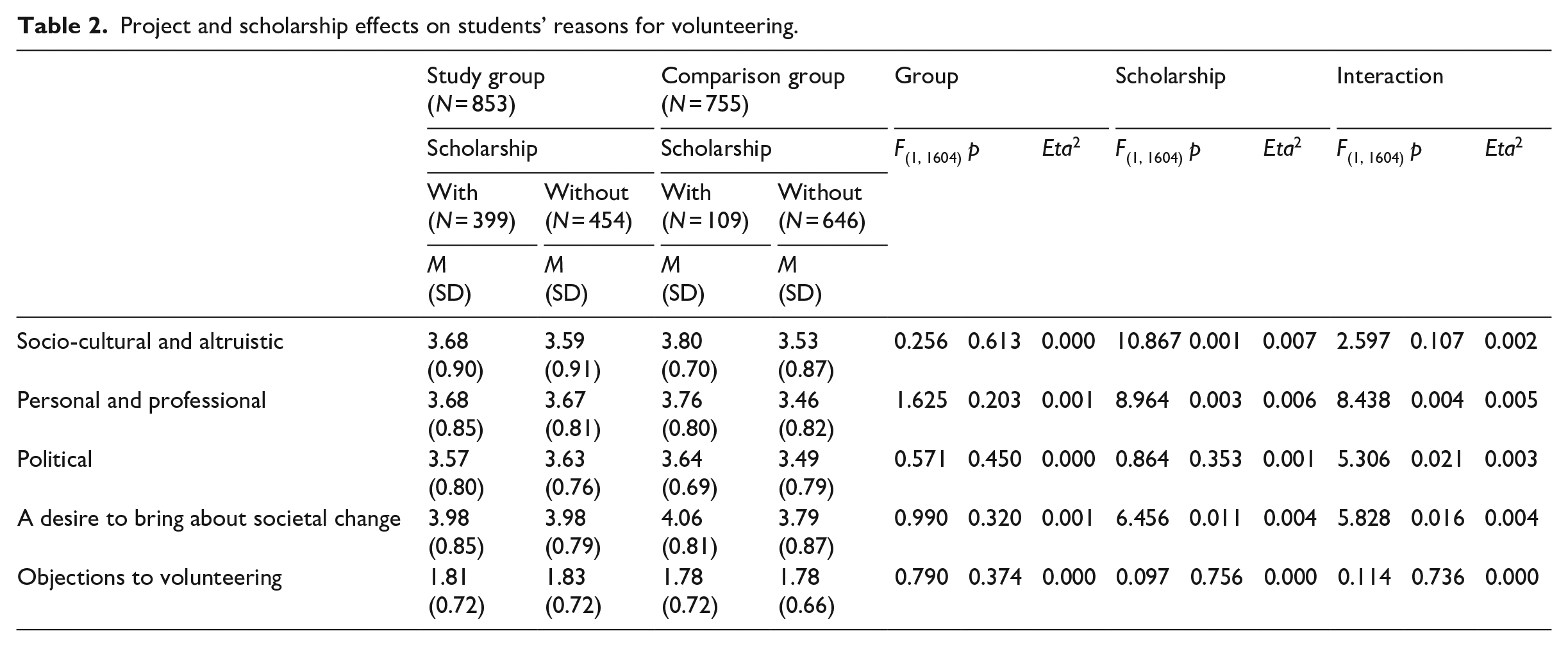
Agreement with the four reasons for volunteering and disagreement with the objections were regarded as positive attitudes toward social involvement. Students’ mean agreement with the four reason scales ranged from moderate (3.46) to high (4.06) on the five-point scale. The objections to volunteering were low, ranging from 1.78 to 1.83.
The scholarships increased the participants’ willingness to volunteer for three reasons: Socio-cultural and altruistic motives, a desire for personal-professional development, and a desire to bring about societal change. In addition, a significant interaction effect was found in three of the pro-volunteering motives scales: a desire for personal-professional development, a desire to bring about societal change, and for political involvement to meet the needs of Arab society. The level of agreement with these reasons was lower among the comparison group students, who were not expecting a scholarship, than among those who expected one. The latter group’s level of agreement was similar to that of the study groups. Therefore, it seems that scholarships increased the willingness to volunteer, particularly in students who were not yet exposed to the SCI program.
Discussion
The current study aimed to evaluate the extent to which the ‘Challenges’ project increased Arab student teachers’ knowledge about their society and the level of their civic engagement. At the beginning of the project, Arabic-speaking teacher educators (i.e. SCI theme coordinators and college supervisors) found that Arabic speaking student teachers in Israel lack knowledge about their society and interest in their cultural heritage. They believed that these limitations impede the student teachers’ abilities to educate the next generation. As part of the ‘Challenges’ project, the SCI theme coordinators devised academic courses that dealt with societal, cultural, historical, and civic issues. They provided student teachers with opportunities for learning through service learning programs. Student teachers who chose to participate in the service-learning program received academic and emotional support in college workshops that were set up specifically for this purpose and tailored to the students’ needs and interests.
The SCI theme coordinators and project supervisors believe that the SCI program managed to change the students’ attitudes toward active civic engagement. A questionnaire survey found that the students’ motivations toward volunteering ranged from moderate to high. The level of agreement with reasons to volunteer among first-year graduates exposed to the project was higher than the level of freshmen students who were not yet exposed to the SCI program and did not expect a scholarship. Scholarships increased the beginning student teachers’ willingness to volunteer, but did not affect the first-year graduates. It seems that exposure to the SCI program strengthened the students’ intrinsic motivations to volunteer and reduced the power of the monetary reward.
In Israel, Arabic speaking minorities do not identify with the Jewish national state. Current Israeli politics emphasize the state’s Jewish character, whereas Arab and Palestinian identities lack official recognition, and Arabic speaking citizens are discriminated against (Pinson, 2020). This situation is often associated with failed citizenship (Banks, 2017). In the case of Arab student teachers, the situation is aggravated by cultural norms that limit activities to their immediate surroundings and an economic vulnerability that deters them from confronting the state (Agbaria, 2011). The SCI theme teacher educators opted to develop ‘an active notion of citizenship that includes community engagement, a sense of solidarity and volunteering’ (Birdwell et al., 2013, p. 185), strengthening a ‘maximal’ notion of citizenship (Wahrman and Hartaf, 2021) in relation to the (mainly) Arabic speaking communities.
The courses the SCI theme coordinators created attempted to encourage appreciative attitudes toward Arab and Palestinian cultural heritages (Bartolomé, 2004; Ladson-Billings, 1995; Paris, 2012). They tried to help students acquire more knowledge of Arabic speaking communities within Israel and to a lesser extent - of Jewish societies too. They dealt with sensitive, taboo, and contested issues such as discrimination against women, the exclusion of individuals with special needs, and violence. Thus, the SCI program was not content with ‘doing good for disadvantaged people’ (Jerome, 2012, p. 67). It provided knowledge and stimulated critical analysis of power relations within Arabic speaking communities, and the Israeli society at large (Freire, 1970).
Traditionally, donations and volunteering in Arabic speaking communities were largely informal and rooted in religion. The family and the clan were, and still are major sources of support and security networks (Payes, 2005). During the last decades, Palestinian Arab civic organizations have increasingly been important in addressing societal and political issues, and their struggle for equality has been gaining public acknowledgment (Jamal, 2017). The ‘Challenges’ project exposed the students to societal issues and civic organizations. By tailoring the service to the students’ interests, and positioning this as a contribution to the society to which they belong, the teacher educators empowered the student teachers and increased the probability that they would continue to volunteer over a long period. This prediction is consistent with the supervisors and coordinators’ observations that some students continued volunteering even after their formal service learning was over, and with the survey findings that show that student teachers’ pro-civic engagement attitudes and motivations to volunteer increased. Expanding student teachers’ social engagement beyond their close communities is a necessary step toward participatory citizenship (Banks, 2017).
The scholarships had significant effects on student teachers’ initial willingness to volunteer. This led to their exposure to the benefits of service learning. In 2013, Birdwell and his colleagues raised the dilemma whether volunteering should be compulsory within the framework of citizenship education. On the one hand, such an obligation could expose all students to the benefits of service learning, whereas on the other hand, it could have a demotivating effect. The dilemma is exacerbated further by the fact that volunteering is less prevalent among individuals of lower socio-economic background, either because they are unwilling to volunteer or cannot afford it (Burke and Bush, 2013). The result is that those who could benefit most from the increased awareness and the empowerment involved in service learning are excluded (Birdwell et al., 2013). This study shows that scholarships can encourage volunteering without the demotivating effects of being forced to do so.
The results of this study are in line with other studies that found that service learning has positive effects on participants (Folgueiras et al., 2020; Mitchell, 2015; Stukas et al., 2016). Nonetheless, Mtawa and Fongwa (2022) warn that higher education institutions that provide service learning programs should be aware of power relations and that the needs and voices of beneficiary communities and organizations should be taken into account. Otherwise, service learning may become exploitative, using the beneficiaries’ needs and knowledge as resources for their students’ learning, without adequately responding to host communities. In the end, such behavior could strengthen feelings of distrust and alienation between academic institutions and communities, instead of strengthening their bonds and collaboration. The SCI theme coordinators in this study invested efforts in finding matches between volunteering sites’ needs and student teachers’ personal skills and preferences. However, this time-consuming task needs to start from scratch every year, and there is no guarantee for continued collaboration. Working closely over a long period with volunteering sites is a necessary pre-condition for 3.0 teacher education programs. In such programs, student teachers and teacher educators work together with communities and civic organizations for democracy and social justice, realizing that educators have societal roles in addition to those concerning their students and educational institutions (Bhargava and Jerome, 2020; Kretchmar and Zeichner, 2016).
To conclude, the current study built on previous studies that showed that service learning could increase participants’ active civic engagement. Its contribution lies in demonstrating the positive effects in a large and non-selective group of student teachers, all of whom belong to marginalized minorities. From a practical point of view, this study suggests that scholarships are a feasible means to increase both the motivation to volunteer and the participation of unprivileged students in service learning programs. Finding individually suitable sites for volunteering, working with them over long period and handling the scholarships’ administration placed a heavy burden on teacher educators. It is therefore recommended that teacher education institutions provide them with adequate assistance and support (Salam et al., 2019).
It is beyond the capacity of the ‘Challenges’ project to consolidate the different communities that make up the Arabic speaking population in Israel into a single Palestinian identity, or to change Israeli society to become fully democratic and egalitarian, while maintaining the minorities’ ethnic and cultural identities (Banks, 2015). It remains to be seen whether the student teachers’ increased social awareness and engagement persists and develops into participatory or transformative citizenship.
This study’s limitations are its short period and the limited number of indicators of change. Future studies would explore the SCI program’s long-term effects. More fundamental questions that need to be answered in the future are: can a real transformative effect be achieved without the full support and participation of all academic staff, and not just of those responsible for citizenship education? Should the Challenges SCI program be restricted to Arabic speaking minorities, or is collaboration with the Jewish majority essential to bring about change? Can a program delivered by teacher education colleges that are closely connected to and financed by the Israeli Ministry of Education encourage transformative citizenship? If not, would participatory citizenship suffice? These questions are relevant not only to the Israeli case, but to any country that deals with majority—minorities relations.
Footnotes
Appendix
Reasons for volunteering.
| Reasons | Socio-cultural/altruistic | A desire to bring about societal change | Personal and professional reasons | Political reasons | Objections to volunteering |
|---|---|---|---|---|---|
| Cronbach’s alpha | 0.9 | 0.82 | 0.87 | 0.78 | 0.78 |
| R 2 | 13.92 | 10.70 | 8.88 | 8.85 | 12.60 |
| Socio-cultural and altruistic reasons | |||||
| I volunteer out of compassion for the needy and disabled |
|
0.05 | 0.05 | 0.16 | −0.06 |
| Volunteering is a religious duty |
|
0.11 | 0.06 | 0.09 | −0.05 |
| Volunteering is an important value in my family |
|
0.18 | 0.18 | 0.00 | 0.04 |
| I volunteer because Challenges is an important project that creates social change |
|
0.12 | 0.23 | 0.02 | −0.09 |
| I would volunteer regardless of people’s ethnicity, religion, or nationality |
|
0.24 | 0.13 | 0.26 | −0.16 |
| I volunteer outside my place of residence |
|
0.19 | 0.16 | 0.18 | −0.10 |
| A desire to bring about societal change | |||||
| Volunteering reduces societal violence | 0.17 |
|
0.10 | 0.08 | −0.04 |
| Volunteering makes society more tolerant | 0.23 |
|
0.10 | 0.11 | −0.13 |
| Volunteering is instrumental to bringing about societal change | 0.27 |
|
0.13 | 0.14 | −0.19 |
| Volunteering reveals the challenges of society | 0.18 |
|
0.19 | 0.16 | −0.04 |
| Personal and professional reasons | |||||
| Volunteering introduces me to officials | 0.07 | 0.00 |
|
0.16 | 0.16 |
| Volunteering transforms me into a social change agent | 0.19 | 0.20 |
|
0.14 | 0.02 |
| Volunteering helps me advance in my career | 0.25 | 0.22 |
|
0.21 | −0.12 |
| Volunteering teaches me how to organize my time | 0.31 | 0.28 |
|
0.14 | −0.21 |
| Political reasons | |||||
| The Arab minority in Israel is not getting what it deserves and needs to struggle for its rights | 0.12 | 0.12 | 0.06 |
|
0.00 |
| Efforts should focus on obtaining scarce resources from the state instead of giving up and reconciling with the current situation | 0.19 | 0.23 | 0.14 |
|
−0.03 |
| Social involvement imposes on students’ problems that the government has to solve | 0.07 | 0.00 | 0.15 |
|
0.18 |
| I will vote in the Knesset) Parliament) elections to change my society | 0.21 | 0.13 | 0.19 |
|
−0.06 |
| Objections to volunteering | |||||
| I volunteer solely for people I know | −0.06 | −0.06 | 0.14 | −0.15 |
|
| Volunteering is a waste of time | −0.15 | −0.12 | 0.03 | −0.06 |
|
| Volunteering interferes with my studies | −0.09 | −0.02 | −0.09 | 0.08 |
|
| I volunteer only for people who have benefited me in the past | 0.10 | −0.10 | 0.15 | −0.13 |
|
| Volunteering comes at the expense of spending time with my family | −0.10 | −0.08 | −0.13 | 0.15 |
|
| I have to work so I cannot volunteer | −0.07 | −0.01 | −0.11 | 0.16 |
|
KMO measure of adequacy: 0.888; Bartlett’s Test of Sphericity: χ2(300) = 13473.519, p < 0.001; Percent variance explained by five factors: 54.93%. Correlations: factor 1 with factor 2, r = 0.650; factor 1 with factor 3, r = 0.571; factor 1 with factor 4, r = 0.584; factor 1 with factor 5, r = −0.146; factor 2 with factor 3, r = 0.607; factor 2 with factor 4, r = 0.502; factor 2 with factor 5, r = −0.10; factor 3 with factor 4, r = 0.509; factor 3 with factor 5, r = 0.001; and factor 4 with factor 5, r = −0.230. n = 1579.
Bold numbers are the loadings of each factor’s items.
Declaration of conflicting interests
The author(s) declared no potential conflicts of interest with respect to the research, authorship, and/or publication of this article.
Funding
The author(s) disclosed receipt of the following financial support for the research, authorship, and/or publication of this article: This research was funded by the MOFET Institute, Tel Aviv, Israel.
