




Abstract
This paper examines the written reflections of 30 Canadian undergraduate students who participated in an international field course focusing on migration and human rights in Mexico. It endeavors to understand how the students reconciled their thoughts and feelings about trauma and oppression in an intercultural setting. Borrowing Foucault’s ‘ethic of discomfort’, which emphasizes the proactive and transformative potential of discomfort in education, the paper extends existing scholarship in teaching and learning around study abroad and social justice by focusing on ethically complex situations in the field. The findings reveal that while preparation for unprecedented and unforeseeable scenarios during an international field course was challenging for faculty, exposing students to the realities of migration ultimately facilitated learning.
Keywords
Introduction
We are standing along the muddy bank of the Suchiate River, a conspicuous group of Canadian and Mexican faculty and students on a hot Sunday morning in June. Sweat trickles down our faces. It mixes with layers of potent mosquito repellent and sunscreen, stinging our eyes as we observe our surroundings. Beside us is the bridge connecting Talismán Chiapas, Mexico with El Carmen San Marcos, Guatemala. Here official business takes place: passports are stamped, customs duties are collected and a long queue of people await documentation to enter Mexican territory. Under the bridge, unofficial business takes place as people and goods move freely back and forth between the two countries. On the Guatemala side of the river, a man is paid by another to strip down to his underwear and transport merchandise by wading through the rapids. The man eventually emerges from the river and walks past us carrying an enormous mesh sack of soccer balls on his back. His quadriceps are well developed from what looks like a lifetime of moving against Suchiate’s powerful current. We divert our gaze away from his nakedness in an attempt to shield what remains of his dignity, but it is too late for that. As the man collects his clothing from nearby bushes and departs, a family makes its way across the river on a raft attached to a rope. Dad, mom and two little girls carrying pink backpacks exit the raft. They smile at us and say ‘buenos días’ as they walk by. The family approaches the two heavily armed state police officers who guard the entrance to the riverbank, hands them money and keeps walking. They are in Mexico now. Their journey has begun. The clandestine yet highly visible binational connections between the two countries produce a palpable contrast of legality and illegality that can be disturbing to observers. Soon our conscience weighs on us more heavily than the thick humidity. We shouldn’t be here. We have seen too much.
Since 2015, I (Stacey Wilson-Forsberg) have organized and led a biennial international field course at Wilfrid Laurier University in partnership with the Instituto Tecnológico y de Estudios Superiores de Monterrey (Tec de Monterrey) that immerses students in the lived experiences of migrants transiting through and stranded in Mexico. In 2019, my co-author Richelle Monaghan accompanied me to assist the third cohort of students. During the 5-week course, the undergraduate students learn about the historical reasons behind the economic and social dislocations of Central American (and more recently African and Caribbean) migrants, barriers to their mobility and integration, and the potential for serious human rights violations along their journeys. They spend half of the course time in the classroom with Mexican faculty co-author Diana Correa Corrales and her students at our partner university Tec de Monterrey Mexico City campus. Here Canadian and Mexican students discuss the state of migration in Mexico and meet with guest speakers from the United Nations High Commission for Refugees (UNHCR), Médecins Sans Frontières (MSF), and the Mexican National Human Rights Commission. The Canadian students spend the remainder of the time in the field at migrant shelters and despensas comunitarias [food banks] where they observe their surroundings, interact with migrants and service providers, and document the migrants’ stories. While not given academic credit for the experiential learning part of the course, some of the Mexican students accompany their Canadian peers to field visits where they provide simultaneous interpretation of discussions
Undergraduate students are often attracted to the perceived risks of studying in a volatile setting such as Mexico, but once there they become overwhelmed and frightened by what they see, hear, and experience. As one student put it ‘here it seems as if you’re either a vulnerable person or you’re taking advantage of a vulnerable person. It’s almost a guessing game, you look around and guess who’s who’ (Student participant Neala, 2019). In addition, students may encounter mental health challenges upon their return to Canada, since re-entry is sometimes more challenging than the study abroad experience itself. We teach our students that learning occurs at the edge of their comfort zone; the more discomfort they feel in their surroundings, the more they question who they are and what they believe in; the more they will learn. But how much discomfort is too much? This paper seeks to extend existing scholarship in teaching and learning around international field courses and social justice by focusing on an ‘ethic of discomfort’ (Foucault, 1979 reprinted 1994). It is guided by three research questions: (1) Should faculty attempt to shield students from cruel realities and unfortunate circumstances that are beyond our control when leading international field courses? (2) How can we better understand and support the ‘re-entry’ experiences of students when they return from international field courses? And (3) How much academic and personal learning take place outside of their comfort zones while in the field? The paper uses the written reflections of three cohorts of undergraduate students (N = 30) who participated in HR365 Migration and Human Rights in Mexico in 2015, 2017, and 2019 to examine how the students handled discomforting experiences in ethically complex situations. Our findings and discussion will be relevant to university faculty and administrators who seek to develop and lead international field courses in the future.
An ethic of discomfort
A growing body of research on university study abroad programs demonstrates that optimal learning takes place beyond the student’s comfort zone (Benham Rennick and Desjardins, 2013; Curran et al., 2019; Dorsett et al., 2019; Trilokekar and Kukar, 2011; Wilson-Forsberg et al., 2018). It further demonstrates how some students use varied psychological strategies to navigate cultural differences and disorientation to advance along the intercultural learning continuum, while others remain at the same level of intercultural learning or regress (Mitchell and Paras, 2018). This paper broadens the scope of study abroad literature in higher education beyond the acquisition of intercultural competence, to teaching and learning about human rights and social justice in an intercultural setting. For this we borrow Foucault’s ‘ethic of discomfort’, which emphasizes the proactive and transformative potential of discomfort in education. In his 1979 essay (re-printed in 1994), Foucault advised readers: ‘never to consent to being completely comfortable with one’s own presuppositions—To be very mindful that everything one perceives is evident only against a familiar and little known horizon’ (p. 448). In questioning one’s assumptions, an ethic of discomfort is similar to Mezirow (1991), transformational learning paradigm, which is built into the evaluation and assessment of many international field experiences (see Curran et al., 2019, especially Glass, 2019). However, we interpret an ethic of discomfort as having more potential to bring about social change. The theory moves learners beyond the internal process of making meaning out of experiences and questioning assumptions about prior experiences (Cranton, 2006) to using discomfort to unsettle a comfortable narrative around a specific social issue (Beaumont, 2017). An ethic of discomfort, therefore advocates the application of an ethos of disruption in an attempt to unsettle certainties (Beaumont, 2017). With respect to the theme of our field course: the plight of irregular migrants in Mexico, the goal of this 5-week experience is ‘not to find unknown facts and make them something known, but rather, to seek out the ways in which the poorly known became poorly known to begin with’ (see Beaumont, 2017: 49).
Since a major purpose of social justice education (both at home and abroad) is to unsettle cherished beliefs about the world, education specialists argue that experiencing some discomfort is not only unavoidable, but may be necessary and ethical (Berlak, 2004; Harrell-Levy et al., 2016; Zembylas, 2012, 2015, 2017). An ethic of discomfort, therefore, invites faculty and students to critique their deeply held assumptions about themselves and others by positioning themselves as witnesses (as opposed to spectators) to social injustices (Boler and Zembylas, 2003). This transformational potential of discomfort, however, appears to contradict the trend toward university campuses as ‘safe spaces’ that seek to protect students from psychological harm (Lukianoff and Haidt, 2015; Wilson, 2015). There is often an expectation that there should be a frame of classroom safety when engaging social justice issues (Jansen, 2009). However, beyond not reminding minority students of the oppression and marginalization they experience on a daily basis (Arao and Clemens, 2013) and notifying students of the potential adverse emotional consequences of forthcoming content in lectures through ‘trigger warnings’ (Boysen, 2017), it is not always clear what this safe classroom space entails. Proponents argue that safe spaces on campus (both physical and virtual) allow members of marginalized groups to participate in academic settings without becoming emotionally dysregulated (Carter, 2015; Stokes, 2014). However, others worry that safe spaces prevent students from developing the requisite level of psychological resilience to be able to confront uncomfortable situations when they emerge into the wider world (Bellet et al., 2020; Dickinson and Dickinson, 2015; Fuller et al., 2016; Lukianoff and Haidt, 2015; Walker et al., 2006). According to Zembylas (2017), ‘there are no safe classroom spaces, if one considers that conditions of power and privilege always operate in them. . . Safety cannot be constructed, then, as the absence of discomfort; similarly, experiencing discomfort should not be confused with the absence of safety’ (p. 9). The goal of educators should be to open up a much needed learning space in the classroom to engage students in critical inquiry regarding their values and beliefs (Zembylas, 2017). A safe space or classroom, therefore, is not about the absence of discomfort, but rather it is a way of thinking, feeling and acting that fosters students’ critical rigor (Davis and Steyn, 2012).
Within this context it is important to acknowledge that there is a difference between students self-selecting to be exposed to uncomfortable experiences in an international field course and students being traumatized by unexpected experiences in a classroom of a required course. In this paper we therefore endeavor to understand: What happens when students elect to study a sensitive topic in an intercultural context? How do they reconcile their thoughts and feelings about trauma and oppression in an intercultural setting? How do we as faculty reconcile university safe spaces with the potential emotional distress experienced by students in the field? And how can we support those students upon their return?
International field courses are most often led by an individual faculty member with a small group of university students for a period of 2–6 weeks (Tuma, 2007). Since they are shorter in length than other study abroad programs, field courses create greater and more accessible opportunities for students to travel and study internationally (Pandit, 2009). They are particularly helpful when attempting to attract students who have not elected to study abroad in the past and can be used to recruit new students into the academic program (Mullens et al., 2012). In their 2012 survey of faculty-led field courses within American departments of geography, Mullens, Bristow, and Cuper documented several benefits for students, including (1) building on these short-term international experiences by pursuing additional international activities after the field course concludes (see Lewis and Niesenbaum, 2005); (2) increasing intercultural and linguistic awareness (see Zamastil-Vondrova, 2005); (3) expanding and deepening worldviews (see Higgitt, 1996); (4) enhancing empathy toward others (see Tueth and Wikle, 2000); and (5) fostering shared appreciation among students and between students and faculty as they study and live together in unfamiliar locations (as cited in McKinney, 2019; Mullens et al., 2012).
Nevertheless, international field courses—especially those conducted in the Global South—are more complex and demanding to administer than traditional study abroad and service learning programs (Keese and O’Brien, 2011). These courses also involve a different host of ethical dilemmas since the faculty leader carries the enormous responsibility of protecting the physical and mental well-being of students while in the field (Niehaus et al., 2022). While they may be experts in the local culture and language, faculty are unlikely to have adequate preparation and mental health training to respond to some of the distressing situations in which students find themselves (Niehaus et al., 2022). Furthermore, international field courses that go beyond intercultural learning by immersing students in social research with vulnerable populations, involve more ethical complexity because the faculty leader cannot control what research participants divulge or the circumstances in which the research is conducted. As noted by several scholars, moreover, field courses in disadvantaged locations always carry the risk of reproducing the dominant representations which reinforce inequality and asymmetric power relations (Vibert and Sadeghi-Yekta, 2019). Great care is needed by the faculty leader to ensure that the visit does not simply confirm shallow views and stereotypes of the communities in question or validate the faculty leader’s own views on the topic of study (Newstead, 2009).
Although not student-centered, a second body of academic literature focuses on the personal and professional impact of conducting research on sensitive questions with vulnerable and marginalized populations (see Adonis, 2020; Benoot and Bilsen, 2016; Bowtell et al., 2013; Brannan, 2014; Broussine et al., 2014; DeLuca and Maddox, 2016; Killian, 2008). Vicarious trauma is defined as ‘the negative transformation in the helper that results from empathetic engagement with trauma survivors and their trauma material, combined with a commitment or responsibility to help them’ (Pearlman and Caringi, 2009, p. 202). For many researchers working with traumatized populations, feelings of guilt and privilege almost inevitably become part of the research process (DeLuca and Maddox, 2016). These emotions can be amplified when researchers value reflexivity in research relationships, and care deeply about research participants’ interests (Pillow, 2003; Sampson et al., 2008) leading to a corresponding sense of indebtedness or obligation (Snow, 1980). In this respect, researchers—and in this case, student researchers—can be exposed to vicarious trauma through empathetic engagement with participants (Pihkala, 2020; Salston and Figley, 2003). Regardless of preparation and training in the classroom, students may be unprepared for the overwhelming level of emotion that emerges while listening to people’s stories (Jeftić, 2020). In short, like the muddy bank of the Suchiate River, the teaching and learning terrain of international field courses can rapidly shift, potentially increasing discomfort for all involved.
Setting, data, and methods
Over the past two decades, evolutions in global migration patterns have turned Mexico from a country of origin of migration to a transit country for migrants from Central America and beyond. Most people arrive in the southern state of Chiapas across the Suchiate River from Guatemala. They then attempt to make the 2655 km journey to the Mexico-U.S. border on foot and on the tops of freight trains, stopping at migrant shelters for respite along the way (Basok and Rojas Wiesner, 2018; Candiz and Bélanger, 2018). Although Mexican authorities frame migration policies as protecting migrants by keeping them off of freight trains not designed for passengers and fighting criminal groups that violate migrant rights, in practice the policies have used U.S. assistance to advance migration control and management in the region (Marchand, 2017; Olayo-Mendez, 2018; Rojas Wiesner and Basok, 2020; Wilson-Forsberg and Parra, 2022). With migration controls becoming increasingly more strict and harsh over the past few years, people are attempting to move through longer, more dangerous routes increasing their vulnerability to exploitation and violence (Brigden, 2018; Canales Cerón and Rojas Wiesner, 2018). Mexico’s Human Rights Commission estimates that more than 20,000 Central American migrants are kidnaped for ransom each year (Comisin Nacional de los Derechos Humanos [CNDH], 2011). In 2010, 72 migrants were massacred by a drug cartel in San Fernando, Tamaulipas, which triggered the decision to formalize non-governmental migrant shelters along the main migrant routes (Olayo-Méndez, 2017). At the time of our international field course in 2015, 2017, and 2019, there were approximately 100 shelters across Mexico offering meals, beds, advocacy, and a variety of services to migrants and refugee claimants. The shelters often assist researchers to build relationships with migrants and many are willing to educate groups of students about forced migration and human rights.
The findings presented in this paper are based on the written reflections of three cohorts of Wilfrid Laurier University undergraduate students (N = 30) who participated in the HR365 Migration and Human Rights in Mexico field course in 2015, 2017, and 2019. At the time of their participation, 25 students were completing the second or third year of the Human Rights undergraduate degree program, and five were completing degrees in Social Work, Global Studies, Criminology and Business respectively. Each cohort of students was exposed to different experiences depending on the political, economic, and social context of that time. The first cohort of students (2015, N = 9, an ethnically diverse group of five men, four women) witnessed a mobile population transiting through Mexican territory on a freight train known as la Bestia [the Beast]. The students spent time at three migrant shelters and at despensas comunitarias [food banks] along the railway lines where they tossed bags of food and bottled water at the passing freight trains. Although fleeing violence and economic insecurity in Central America, the word ‘refugee’ was not mentioned by the people they interviewed. After 2015, increasingly restrictive policies thwarted the northern journeys of migrants, and more people began applying for refugee status in Mexico (see Basok and Candiz, 2020). The second cohort of students (2017, N = 14, a less ethnically diverse group of 1 man, 13 women) had the opportunity to sit down in shelters and spend longer periods of time with people awaiting refugee status. Shelters were now offering longer-term lodging and the migrant population was becoming more diverse with new arrivals from the Caribbean and Sub-Saharan Africa. Claims submitted to Mexico’s under-resourced and overwhelmed refugee protection system doubled from 2017 to 2018, from 14,596 to 29,623 (United Nations High Commission for Refugees [UNHCR], 2019), and then doubled again to 70,302 in 2019 (Comision Mexicana de Ayuda a Refugiado [COMAR], 2020). In June 2019, Mexico’s López Obrador administration avoided a 5%–25% tariff on all Mexican goods entering the United States by securing its northern and southern borders with 21,500 soldiers from the National Guard and increasing apprehensions and deportations of irregular migrants in its territory (Marchand, 2021; REDODEM, 2020). It is within this context that the third cohort (2019, N = 12, an ethnically diverse group of two men, 10 women) of students arrived in Mexico to participate in the field course. While given less opportunity to interview migrants and refugee claimants than the 2017 cohort, the 2019 cohort participated in more debriefing sessions and elaborated much more in their written reflections, resulting in a greater quantity and quality of data from these students than the previous cohorts. Additional time spent on critical reflection was possible in 2019 because of the presence of two faculty leaders rather than one.
Each cohort was asked to write a pre-departure reflection about their goals and expectations for the course, both at the academic and personal level. They were responsible for a series of reports written in the field, which captured reflections on their daily experiences in Mexico and specifically on their feelings following conversations with migrants and refugee claimants. Upon their return to Canada, the students prepared a detailed re-entry report where they reflected on the overall field course experience. Research Ethics Board clearance and written consent from the students (all of whom are now alumni) was received to use their reflections as data and direct quotations were verified for accuracy. The qualitative data were coded by the lead author following pre-existing codes derived from the learning objectives and the literature described in the previous section. Given the a priori nature of the codes, data analysis consisted of overlaying the pre-existing categories/codes on top of the data collected from the students and looking for ways in which the data did not fit these categories (Miles and Huberman, 1994).
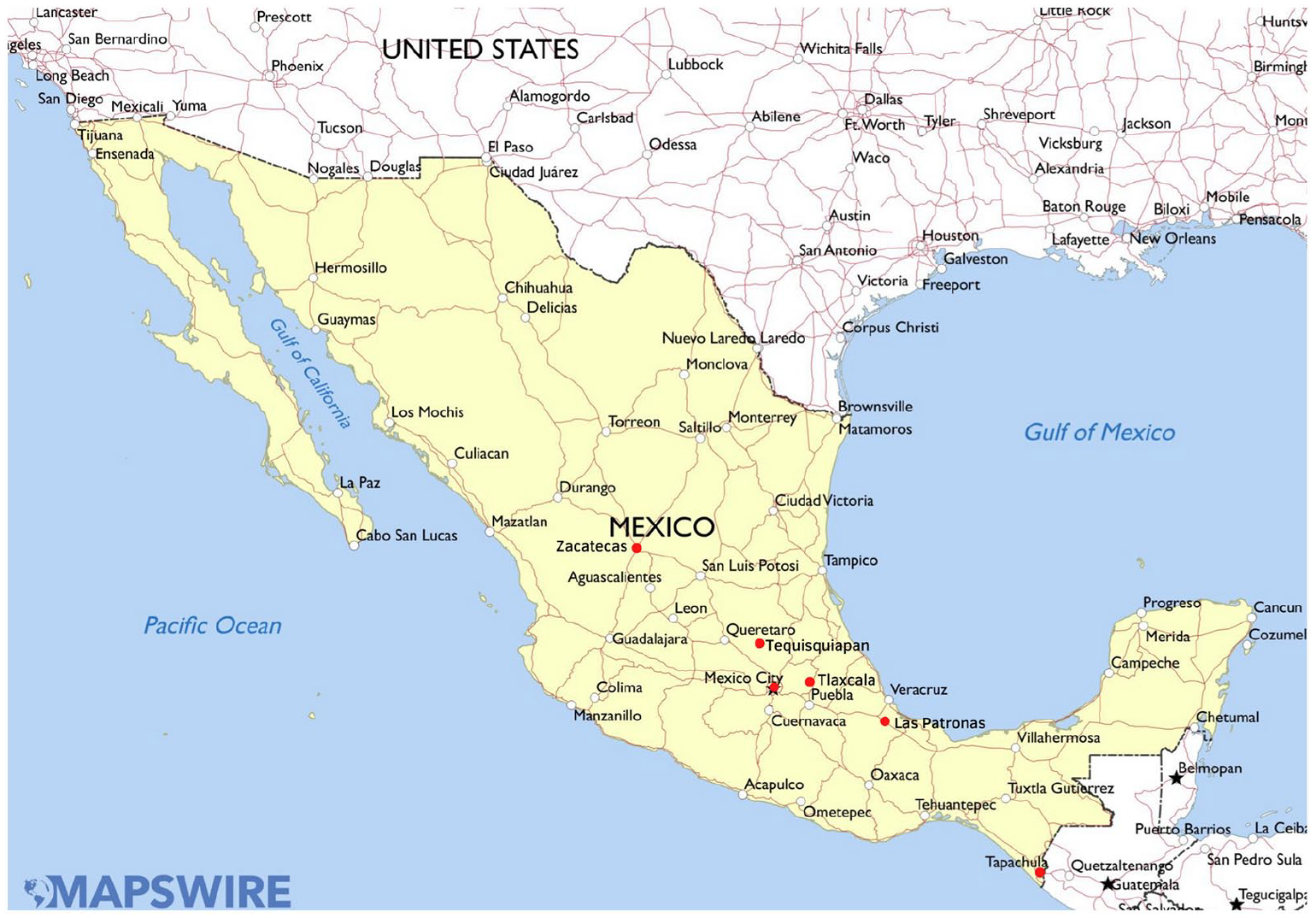
Location map of Mexico. MapsWire https://mapswire.com/countries/mexico/
Findings
In response to the three research questions guiding this paper, our findings are divided as follows: (1) Witnessing a Cruel Reality in a Volatile Context, (2) Re-Entry, and (3) Transformation. The first theme is organized around specific memorable events that stood out in the students’ written reflections. The 2015 cohort of students focused on observations of passing freight trains and interviews with migrants in transit, while warm interactions and unknown fates were described by the 2017 cohort. Two situations preoccupied the 2019 cohort of students: the unexpected presence of children and their visit to the Mexico-Guatemala border (Tapachula and Ciudad Hidalgo) where migrant journeys through Mexican territory begin.
Witnessing a cruel reality in a volatile context
Students in human rights and social justice programs learn through lectures, readings, and audio-visual materials that human rights are violated and international law is difficult to enforce. They might have the opportunity to complete a local community-service learning placement for more hands-on learning, but rarely get the opportunity to experience this reality in an international context. In the brief pre-departure orientation sessions and in the Mexican classroom setting, faculty attempted to prepare students to anticipate poverty, oppression, and desperation amongst the migrant population. However, our findings suggest that we did not adequately prepare the students for their emotional reactions to this reality. Furthermore, with socio-political circumstances constantly shifting on the ground, both students and faculty were often caught off guard by the experiences that awaited them.
La Bestia
In 2015, as many as half a million Central American migrants, including thousands of unaccompanied minors hopped aboard freight trains colloquially known as ‘La Bestia’, or the Beast, on their journey to the United States (Dominguez Villegas, 2015). They undertook this journey despite increased migration controls and security enforcement by the Mexican government (with U.S. financial assistance). The trains, which run along multiple lines, carry products north for export. As there are no passenger railcars, migrants must ride atop the moving trains, facing physical dangers that range from amputation to death if they fall or are pushed (Dominguez Villegas, 2015). During this journey, they are exposed to extreme heat and cold and go for long periods of time without sleeping or eating. Students in the 2015 cohort were given the opportunity to visit the shelter of Las Patronas in rural Veracruz to assist with the distribution of food to people traveling atop the railcars. In the quotation that follows, a student named Jess describes the food distribution exercise: Words cannot explain the feeling that occurred while I lifted my arm with a bag of food and someone grabbed it. I take bag after bag and throw it on the train and then there is a moment when I look up and the man grabbing the bag makes contact with my hand. I feel his warm hand grazing across mine. I let go of the food and see his face travelling, riding into the evening on a freight train. . . (Jess, cohort 2015)
While only one student appeared to struggle with the ethics around feeding the hungry as a mere ‘band aid solution’ to a big problem and one more picked up on the environmental impact of distributing plastic bags, bottles, and cans to be discarded in massive quantities along the rail tracks, most of the students in this cohort focused on the dangers of riding the freight trains. In the quotations that follow, students react to observing and interacting with people injured by security guards and by concrete posts set up along the railway lines to deter people from climbing onto the moving trains: My heart sank when I saw the man get thrown from the top of the Bestia. It was like he was falling from the train in slow motion. The security guard was dressed in black and his face was covered with a mask. He had an automatic weapon at his side, but thankfully didn’t use it. Instead he picked up the guy and threw him off the train. What is wrong with these people? We thought he was dead but we were too far away to help him. But he got up and was able to walk. (Adel, cohort 2015)
The realization that the state or private railway company (it was unclear who was actually responsible for security on the freight trains) would throw people off the moving train with no hesitation shocked the students to their very core. Later at Las Patronas, they were able to speak with a young man who had hit his head on one of the concrete posts: I was taken back when one young guy showed up at the breakfast table. He had a deep bloody gash in the back of his head from hitting the concrete post when leaning back to see if his friend was behind him. I was surprised at how calm he was after the ordeal. He told me he was 17 and travelling alone. This is when I started crying, because I couldn’t believe he was on his own and just seeing him bleeding everywhere made me want to comfort him. He asked me why I was crying. At the time all I could say was that there’s something in my eye, but I was heartbroken. (Naima, cohort 2015)
While students wrote about how rewarding these experiences were, they acknowledged that they were not prepared to be immersed in such unpredictable circumstances. Learning from discomfort is woven through these reflections in a tangible way through witnessing brutality around the freight trains, but also more subtly. Encountering injured migrants at a single point in time in these precarious situations produced stereotypical (or at the very least one-dimensional) portrayals of their lived experiences, making it difficult for the students to really capture the migrants’ stories. While at the shelters, the first cohort of students also came to the uncomfortable realization that human rights often exist in an ethical gray zone. For example, migrants perform different social scripts to elicit and evade recognition or to obtain support for their journeys. In this respect, they will tell whatever stories the student interviewers want to hear (see Brigden, 2018). The migration terrain in Mexico and elsewhere, moreover, is deeply complex where the line between assisting people on the move and smuggling them is often blurred. Migrant shelters were presented by the faculty leader as spaces for recuperation and solidarity to prepare for the journey ahead, but the uncomfortable reality is that they are also spaces where tensions occur daily between humanitarianism and human smuggling (see Doering-White, 2018).
An unknown fate
Reflections from the 2017 cohort of students largely revolved around warm interactions with migrants at shelters in Mexico City and Querétaro and the sadness of not knowing what would happen to them after they parted ways. These students were able to spend enough time at the shelters to get to know the guests. Consequently, their written reflections described building relationships of trust with migrants and refugee claimants and the pressing need to challenge stereotypes about migrants’ presumptive illegality and criminality. Saying goodbye to new friends knowing that they could be deported, detained, and even killed as they awaited asylum in Mexico or risked the journey to the United States, were thoughts that introduced an uncomfortable sense of futility in the well-intentioned students. Patrick, for example, spent time with a 19 years-old named Melvin: I managed to speak in relative privacy with a young man named Melvin, only accompanied by a translator. What I learned was heartbreaking, but largely emblematic of the situation which plagues many Central Americans. In writing this now, I continue to hope with all of my heart that this young man receives the refugee status that he seeks. (Patrick, cohort 2017)
Katelyn, for her part, described her desire to stay at the shelter as: ‘I really didn’t want to leave. I just wanted to talk to Luis more, because I knew we wouldn’t ever meet again in the future’. While Sharyne’s words perhaps best captured the group sentiment ‘it was never easy to not know what happens next’. One particular student, Mikayla, was deeply touched by her meeting with Joseling, a transgendered woman from Honduras who had been kidnaped, drugged and forced into prostitution by a drug cartel in the city of Guadalajara: I was able to talk, cry and share a connection with Joseling that day that I did not expect to gain from this trip. I believe that there is a reason I was given the privilege of sharing that experience with Joseling. I pray she will be able to stay in Mexico City and that the horrors she experienced are now behind her. I hope that her story will reach others within the community and out of it, and that her experience, strength and hope can impact others the way it has impacted me. (Mikayla, cohort 2017)
All of these reflections demonstrate discernible feelings of human warmth, compassion, and fear of the unknown. While outside of the scope of this paper, it is worthwhile to note that these feelings persisted well after the field course ended. They were on full display as the 2017 cohort of students gathered to raise money for migrant shelters following a devastating earthquake in Mexico City in September 2017, just once month after the course had concluded. Their initiative was indicative of the attachments they formed while in Mexico.
Unfortunate surprises
The 2019 cohort of students found themselves in the middle of a messy geo-political situation as the U.S. Trump administration pressured Mexico’s López Obrador to implement hasty and arguably, ruthless, migration controls. At this time (June 2019) we were invited by the Catholic Dioses of Zacatecas to spend the day at a new migrant shelter that housed families. We were told that at the time of our visit most of the guests at the shelter were adults and some unaccompanied teenagers. Once inside the heavily guarded facility, not only were we met with 40 small children, we also came to the gradual realization that it was not a shelter, but rather, a temporary detention center for families about to be deported to Guatemala under the new migration agreement reached with the United States: When we got out of the taxi, we were greeted by the blazing desert heat and a police car which guarded the fenced-off compound (I feel gross using the term compound, but on first glance it honestly looked like a prison). We were expecting to see 97 adults and teens but instead we saw over 100 people, all families, most notably children. They were dressed in soiled clothing, many without shoes, many sick. (Neala, cohort 2019)
The students (and faculty) were ill-prepared to interact with children and did not have university research ethics clearance to speak with them. However, they quickly and naturally handled the unexpected situation by playing tag, duck-duck-goose, and making paper boats and airplanes: As I helped one little girl make a paper boat I noticed that her long hair was dirty and matted. It looked like it hadn’t been brushed in weeks. I asked her (in Spanish) if it would be okay if I helped her with her hair and she said ‘yes’. I tried my best to brush her hair out with my fingers and braided it to keep it neater. As I fixed her hair she told me that she was here alone with her father. They had been travelling for two weeks (Skye, cohort 2019).
Another student, Neala, was deeply impacted by the look given to her by one girl as the group was leaving the facility: When were leaving, I locked eyes with a girl. She was older than the rest (maybe 12), and there was something about her look that I couldn’t shake. She understood something the rest didn’t. I can’t say exactly what it was but there was this desperation in her eyes for us not to go. Her distractions were leaving and yet again she was faced with the reality that she’d be going right back to the hell she was so hopeful to leave. (Neala, cohort 2019)
As noted, these families were about to be deported and realizing this, the students struggled to come to terms with their time at the facility. They questioned their feelings toward the children and wondered if they would have seen them differently knowing they were about to be deported: Walking out of what I believed was a shelter to learn that it was a detention facility was a shocking revelation. It made me wonder—would I have treated the situation differently had I known prior to arriving that it was a detention centre? Would I have felt guilt and pity for these families and their situations? However, these feelings are ineffective and harmful in a situation such as this. (Madi, cohort 2019)
The students also acknowledged asymmetric power relations between them and the families and wondered if they unknowingly participated in the detention and deportation process simply by being present: I felt like we were the outliers in the equation, but at the same time as observers we were inadvertently participants in the daily operations of Mexican migration officials. Not that there was anything we could’ve done. Not that I expected us to do anything either. Observing it all and letting it all settle within my mind was unbelievably overwhelming. (Neala, cohort 2019)
It was also evident that the students were attempting to apply theory and practice learned in the university classroom to the reality unfolding on the ground. Having purchased 40 pairs of shoes for the children after their visit, Madi’s reflection demonstrated a deep awareness of unconscious assumptions about poverty, inequity, and discrimination. After some soul searching about whether purchasing the shoes was the right thing to do, given everything she had learned about social work practice, she concluded that she needed to do what felt right in the moment: We noticed the children did not have shoes so we measured their feet and bought shoes for them, but we never asked the parents or the children whether that is what they really needed. Perhaps our time and money could have been better used elsewhere. Maybe we were so excited to have our saviour moment that we didn’t stop to ask. So as to not fall into extreme guilt and regret, I am going to have to remind myself that we did what we felt was right in the moment and whether or not the shoes were what they necessarily needed the most, it is still safer for the children to have the shoes when they run and play in unsanitary conditions. (Madi, cohort 2019)
As illustrated by the narratives around unfortunate surprises, learning was enriched when students took the time to reflect upon the ethical dilemmas that arose when they attempted to apply what they had learned in the classroom to the turbulent situation on in the field. In the case of Zacatecas, the students witnessed first-hand how government policy can play out so horribly on the ground. While this knowledge was foreign to most of the students, they were not in the position to actively contest it.
A visit to the starting line
The second circumstance that tested the 2019 cohort’s ability to adapt and persevere was a visit to the Suchiate Region of Chiapas. At this time, soldiers were arriving to fortify the border and large white buses departed the migration facility in Ciudad Hidalgo every hour to repatriate people to the Guatemala side of the river (regardless of whether they were Guatemalan, Honduran, or even Haitian). Students described feelings of impotence and indignity when meeting migrant families, who in this setting, were not in shelters but camped in open plazas. ‘Seeing these families lying on the bare concrete in the main square in such unbearable heat just waiting for the next step was unimaginable. After being outside for just barely an hour, I had had enough’. (Tori, cohort 2019) The Suchiate River, which is the starting line for migrants’ journeys through Mexico, was the last segment of the 5-week field course. All of the stories the students’ had heard and everything they had seen culminated at that muddy riverbank.
When we stood at the shores of the river I reflected on all the stories I had heard and the trauma I knew had been experienced at this location. I cannot even imagine the desperation the people crossing this river as migrants would feel. Knowing that some of the people we were seeing on that river could potentially be trafficked, kidnapped, or killed along their journey was incredibly hard to come to terms with. (Lindsay, cohort 2019)
The combination of witnessing illegal and unscrupulous activities along the border and reflecting on their 5-week experience was overwhelming and disorienting for many of the students. As described in the previous section, the presence of children at the border crossing made the situation that much more disturbing: Something that absolutely destroyed me psychologically was seeing the little girls cross that river. They were dressed so nicely and looked so happy to be departing on this adventure with their parents. Seeing them begin their journey I couldn’t shake the vision of the other young girls we’ve met along our journey. My mind immediately went back to a conversation I had with one migrant father in the deportation compound who told us, ‘the journey is dangerous, especially for the children, especially for the young girls’. (Neala, cohort 2019)
Psychological distress notwithstanding, the experiences and reflections of the third cohort of students allowed them (more so than the previous cohorts) to begin to move beyond merely scratching the surface of migration in Mexico to exposing the problematic nature of top-down migration policies on the ground, socioeconomic realities, and the questionable separation between humanitarian shelter and punitive detention.
Re-entry
Much has been written in the study abroad literature about the challenges associated with returning home after an international experience. Upon their return to Canada, students who participated in the migration field course were confronted with the ‘reverse culture shock’ that is common for returning sojourners. As noted by Rachel: When we attended the pre-departure meetings, and throughout the trip, the shock of returning home was constantly mentioned. We discussed it often, and it was always a thought in the back of my mind. I never really expected it to happen though. . .but it did. (Rachel, cohort 2019)
While still in Mexico, faculty discussed potential ambivalence of friends and family once home and we worked with the students to come up with short ‘elevator speeches’ to be able to quickly and concisely articulate their experiences to different audiences. We also developed an opinion piece for newspapers so friends and family could quickly read about the students’ experiences. Nevertheless, coming home was not easy. The findings in these sections highlight the frustrations of not being able to tell their stories and feelings of guilt and anger upon their return.
They don’t understand
Being met with disinterest and ambivalence by family and friends when returning from an international experience is often lamented by students in the study abroad literature (Christofi and Thompson, 2007). As international researchers we (the co-authors of this paper), have struggled with these feelings for many years, so it was not surprising to see the reflections woven through the data. The students came home. They tried to make sense of everything they saw in Mexico by talking about it. They urged friends and family to interrogate their own assumptions about migrants to change the comfortable narrative around illegality, but nobody listened. One student, Aiden, expressed frustration at convincing friends and family to do their part as Canadian citizens by pushing the federal government do more about the situation in Central America and Mexico: Since returning I have been constantly talking about my experiences and the current situation in Mexico and Central America. The most difficult thing I find sometimes is to try get them to care about the issue like I do and get them to understand that Canada has a role to play in the situation. It’s frustrating when they answer back after everything I explained to them with ‘okay’ or ‘wow Canada is such a great country compared to them. . .’ (Aiden, cohort 2019)
The two quotations that follow exemplify the words of almost all of the students who participated in the field course as they attempted to describe their experiences and emotions to loved ones but could not move them beyond ‘surface talk’: If things reminded me of Mexico and I went to explain these connections, I found that often people were not really as interested. . .. Moving beyond this surface talk about the weather has been very difficult because I have found that people do not really know what to ask about or don’t stay long enough for me to get into the important stuff. They don’t understand how hard it was to go to migrant shelters and listen to the heart breaking stories. They don’t understand the ongoing and constant frustration that I felt at what I saw and what I heard. (Lyndsay, cohort 2019) I’ve found it difficult articulating what we saw and experienced in Mexico. I’m still having a hard time processing what happened. I just don’t feel satisfied with the ‘tacos were great’ answer. It feels like such an injustice to our trip and the many friends we’ve met along the way not to share their difficult yet important stories. (Neala, cohort 2019)
Guilt and anger
In silently reconciling everything they had experienced in the field, the students questioned their own embedded assumptions about right and wrong, which led to a sense of disequilibrium or ‘misalignment’. This in turn led to feelings of guilt as they struggled to re-establish equilibrium in their understanding of events: I spent the first week home floating. I was exhausted, detached and confused. I was able to follow up with some of the migrants we talked to; but hearing about their days while I was sitting on a patio enjoying a Caesar seemed unfair. It all seemed misaligned. I didn’t feel the drive and passion I felt while in Mexico. Starting each morning early, keeping busy and involved. Mentally, emotionally and physically I was all in for five weeks. I came home and felt like I had to shut it off in many ways. (Emily, cohort 2017)
Others did not express guilt, but rather anger at the overarching social, political, and economic structures that allow such widespread marginalization and oppression to occur: My mind gets locked on the faces of some of the people we crossed paths with. I don’t think I feel guilty that I’m here and they’re there, rather I feel angry at how cruel and complex these oppressive systems are. I want to be strong and knowledgeable so I can do the best I can in this field in the future, but I feel utterly perplexed which frustrates me incredibly. As a result, I’ve found it difficult to carry out conversations about what happened in Mexico with friends and family. (Neala, cohort 2019)
Writing down their thoughts and feelings helped the students come to terms with the trauma they had witnessed and experienced vicariously, along with staying in touch with each other. There was clearly value in experiencing discomfort together as a group and supporting each other in vulnerable moments. Madi, for example emphasizes in this quotation, the positive effects of camaraderie while in Mexico: Something that really shocked me in Mexico was the change in my mental health. When at home, I am typically very anxious, but I felt no anxiety our entire time in Mexico. I think our group was a major factor in making me feel so comfortable and happy. It was incredibly therapeutic to be able to sit with these people at any time of day and share our lives with each other. (Madi, cohort 2019)
In this respect, the mere act of parting ways with each other and returning to summer jobs once back in Canada, was in itself painful. Strengthening re-entry support at the university is logistically challenging because most international field courses run in the summer months and students do not return to campus after the trip. However, we need to do better. Throughout the Covid19 pandemic lockdowns of 2020/21 faculty and staff have learned to use virtual meeting platforms. While they cannot take the place of more intimate face-to-face meetings, they can be used to continue reflecting and debriefing with the students as a group upon their return.
Transformation
Twenty-five of the 30 students (83%) who participated in the migration field course indicated in their written reflections that they had at least one experience in Mexico that they perceived contributed to a profound change in the way they saw the world around them. Students used words like ‘awe-inspiring’, ‘life changing’, ‘dramatically changed’, and ‘eye opening’, to describe transformative experiences in the academic and personal spheres of their lives. Reflections below provide snapshots of the course’s impact on their academic learning and personal growth. At a personal level, for example, Dammee remarked that ‘my reality has changed and I look back and see that the old me’s perception of security was actually as fluid and changeable as the river’. (Dammee, cohort 2015). And both Rachel and Tori (cohort 2019) remarked that the experience allowed them to open up personally, begin to share their feelings with peers and to build relationships through humility and compassion. Others, like this quotation by Emily, described an academic transformation upon learning about migration and human rights in Mexico: The time I spent in Mexico, put a face on migration and drove a bulldozer through all the stereotypes. It opened my eyes. I sat and listened to stories in awe at first, and then filled with anger not long after, now I want to learn more at graduate school. . . We were told we had one job when we came back to Canada: to shatter that narrative. To educate people around us. I hope I can take the stories of those like Marlon and Ariel and use them to demonstrate how important it is to care, to discuss and to take action. (Emily, cohort 2017)
Several students reflected on the significance of the field course in narrowing down or confirming their career paths. For example: I think this trip popped a bubble in my life that definitely needed popping. For the past couple of years, I have known I wanted to do social work related to working with refugees and immigrants, but I don’t think I fully knew what that meant. Now, I feel like my passion is even greater for working with this group of people and I can say that it is definitely what I want to do post university. (Madi, cohort 2019)
Lastly, in the quotation that follows, Caitlyn describes ‘discomfort’ as having transformed her into a different person: I feel like a piece of pottery. Before I went on the trip, without realizing it, I had been formed into a piece that was similar to everyone else’s in Canada. When I returned I broke, because of everything I witnessed and learned. Slowly the pieces began to fit back together, but there are many that no longer fit together anymore. I am no longer comfortable in the life I had. But I do not want this feeling of discomfort to ever go away. If I go back to living the same life I had before then what I learned on the trip was for nothing. So I need to forget about trying to fit the pieces of broken pottery back together and just make a completely new pot. (Caitlyn, cohort 2015)
Discussion and conclusion
Consistent with the scholarly literature on study abroad outcomes, the 30 students were immersed in an unfamiliar culture, a new language, and were confronted with different social norms, personal safety concerns, and a new diet that, while delicious, resulted in numerous visits to the clinic. Within this intercultural context that required constant adjustment, they witnessed and heard stories of grave human rights abuses, causing them to question everything that was familiar, legal, and correct about the international human rights regime. The students’ discomforting experiences in ethically complex situations were consistently captured in their reflections on witnessing inhumanity. Among other experiences, the students described people being thrown off moving trains, listening to migrants’ stories without knowing how those stories ended, and a whole range of nefarious activities along the Mexico-Guatemala border. Their narratives highlight the challenges faculty face in providing comprehensive preparation for unprecedented and unforeseeable scenarios during international field courses. Woven throughout the written reflections are feelings of astonishment, anger, helplessness, and remorse, but also gratitude and hope as the students interacted with individuals and organizations who treat migrants with dignity and compassion. It is also important to emphasize that the people they met along the way had hope despite such situations of uncertainty. Migrants regularly exercise agency and resistance in spite of a broader discourse that constructs them as passive and broken victims (Wilson-Forsberg and Parra, 2022). Some of the students remarked that they were impressed by the sheer determination of their new friends to find work, achieve refugee status in Mexico, or to re-unite with family in the north.
Our findings suggest that most of the students underwent a profound transformation, although beyond their written reflections, such transformation is notoriously difficult to measure. The data are also limited by a potential researcher-instructor bias in that students might have written what they thought faculty wanted to read in a class assignment. Furthermore, the findings come with the caveat that so much of the learning that occurred in Mexico might be attributed to each student’s personality and individual psychological resilience. Those students who adapted and flourished when confronted with discomfort in Mexico would likely do so regardless of the supports made available to them. Whether teaching in the field in an intercultural context or in a Canadian classroom, it can be difficult for educators to comprehend why some young adults grow and thrive when placed in uncomfortable situations, and others do not. As noted by Glass (2019) moreover, ‘while some scholars remain positive about the capacity for short-term study abroad to foster transformative learning environments. . ..such claims are not supported by extensive research evidence’ (p. 242). Like Glass, we cannot offer extensive research evidence, but believe the rich reflections of the students still have a great deal of merit. In accordance with the course learning objectives, students came away from this experience with a heightened sensitivity to the plight of migrants, and the ability to articulate and debunk some of the common myths about Mexican immigration and Mexico as a society.
Our findings confirm that international field courses focusing on human rights and social justice education cannot shelter students from the realities of poverty, oppression, and marginalization. Any attempts to shield students from reality will ultimately hinder their learning. If the phenomena of human mobility in Mexico (and around the world) is dangerous then we always have something to do to try and make it less dangerous for all involved. In this respect, the experiences endured by these students should not lead to apathy, but rather ‘hyper and pessimistic activism’ (Beaumont, 2017). Furthermore, while it is possible to control circumstances on the ground by staying on the well-beaten tourist track or moving within a specific social segment of society in what is called the ‘island model’ of international field course delivery (Glass, 2019), any attempt to control circumstances in a human rights/social justice course would be futile. The shifting socio-political terrain of Mexico makes measuring the effectiveness of our field course that much more difficult, with learning outcomes evolving during each cohort. Our findings are consistent with Owen and Sotoudehnia’s (2019) conclusion that ‘field courses, while carefully curated, remain more or less open to the unintended, unscripted, and spontaneous. This unintentional learning in relatively uncontrolled public places is regarded as one of the most valuable elements of the field experience’ (p. 218).
International field courses in the Global South are risky endeavors. If students are looking for trouble in Mexico they surely will find it! Therefore faculty must prioritize the safety and wellness of students above anything else. This is a huge responsibility to put on one person’s shoulders. However, in response to university administrators who might question why we need to place students in potentially unsafe locations, keeping students safe and respecting their emotions does not necessarily imply that an experience should also be free of stress and discomfort (Zembylas, 2017). Some would argue for the complete cessation of Global North universities conducting field courses in the Global South due to safety concerns and unequal power relations between students and local communities (see Vilbert and Sadeghi-Yekta; Newstead, 2009; Patel, 2015). But it is precisely in these disadvantaged and unequal locations where silenced voices need to be heard the most. Faculty and students need to carefully reflect on the ethics of spending time with, observing, and telling the stories of vulnerable people in the Global South. However, we cannot let these critical reflections lead us to a state of not being able to make any representations at all. Returning to Foucault’s ethic of discomfort, when considering study abroad opportunities, universities therefore must confront the practices that have become comfortable including aversion to risk and the insistence on safe spaces. We need to begin to facilitate ways to think about these international experiences differently because we cannot advocate for human rights at an international level if we keep students safe in classrooms where their presuppositions are never challenged or criticized. This course created spaces for students to listen to migrants’ stories and to share thoughts and feelings with their peers. It also immersed students in a reality that most Canadians, and even most Mexicans, are not aware of. In reflecting on these stories and experiences through written journals and daily debriefings with faculty, the students began to critically engage with their own feelings as well as the unspoken norms and power dynamics that govern their lives. In this respect they embraced an ethic of discomfort and ultimately benefited.
Footnotes
Acknowledgements
The author(s) wish to acknowledge the beautifully written reflections of former Laurier students who participated in the HR365 Migration and Human Rights in Mexico Field Course. We would especially like to acknowledge the detailed reflections of Neala Hayratiyan, which are cited heavily throughout the article. The authors thank Dr. Oliver Masakure and Dr. Andrew Robinson at Wilfrid Laurier University, and the peer reviewers for their thoughtful comments and suggested revisions. We further acknowledge Drs. Iván Francisco Porraz Gómez and Abbdel Camargo Martínez at El Colegio de la Frontera Sur Unidad Tapachula for facilitating our tour of the border region.
Declaration of conflicting interests
The author(s) declared no potential conflicts of interest with respect to the research, authorship, and/or publication of this article.
Funding
The author(s) received no financial support for the research, authorship, and/or publication of this article.
