




Abstract
In preparing generations for the future, schools fulfill a qualification and a civic task: providing youngsters knowledge and skills for the labor market, and equipping them to navigate democracy and society. Little research has considered how schools combine these tasks, particularly in relation to schools’ student composition in terms of socioeconomic (dis)advantages across vocational and academic tracks, the focus of this study. By means of a unique, combined dataset, qualification and civic outcome indicators of 101 Dutch secondary schools were examined. Results showed that schools’ qualification and civic outcomes were more positively related in academic than in vocational tracks, possibly informed by schools’ student composition: the role of student composition was stronger in academic than vocational tracks for both qualification and civic outcomes. This is discussed in relation to schools’ role in mitigating versus reproducing societal inequalities.
Introduction
In preparing generations for the future, schools fulfill multiple educational tasks. Schools have a qualification task, which concerns teaching youngsters skills that prepare for further education or the labor market. Fulfilment of this task can refer to students’ successful transfer to the next grade, for example, or to students’ scores on central exams that are necessary for degree obtainment. Additionally, schools’ civic task refers to their role in providing youngsters with opportunities to become equipped for participation in democracy and society in general (Van de Werfhorst, 2014). This can concern students’ knowledge of democracy, or their intentions and sense of efficacy for democratic participation. Moreover, schools can form an emancipatory vehicle for equal opportunities and for optimizing selection relative to youngsters’ preferences and talents (Van de Werfhorst, 2014).
Schools’ fulfilment of their qualification and civic task can foster individuals’ and societies’ prospects. Qualification relates to individuals’ economic security and prosperity (Krueger and Lindahl, 2001), while civic outcomes concern individuals’ democratic representation and political efficacy later in life (Bovens and Wille, 2010; Jennings and Niemi, 2015). Moreover, at a societal level, schools’ fulfilment of both tasks respectively matters for economic growth and national welfare (e.g. Owens, 2004; Psacharopoulos and Patrinos, 2004) and democratic stability and legitimacy (e.g. Papaioannou and Siourounis, 2008). While a great body of research addresses what schools can do to fulfill the qualification task well (e.g. Hattie, 2008; Marzano, 2003) and while research on fulfilment of schools’ civic task is gradually increasing (Isac et al., 2014; Campbell, 2019), there is less attention for the fact that schools have to combine these two tasks (Van de Werfhorst, 2014).
This calls for attention. It leaves unaddressed whether schools face a potential trade-off between both tasks in terms of the teaching resources they can allocate to each. If these two tasks are hard to combine, i.e. are negatively related, fulfilment of one corresponds with less teaching resources left for the other, affecting students’ learning opportunities in either of both domains. Moreover, learning in schools can be stratified by students’ background, both for qualification education and civic education (e.g. Sirin, 2005; Hoskins et al., 2017). When both tasks combine well for schools, i.e. are positively related, students’ qualification prospects may correspond with the quality of their preparation to navigate democracy, and as such, schools may reproduce not only economic/occupational but also political hierarchies. Only by researching schools’ fulfilment of both tasks at once, can such scenarios be examined.
This underscores the need for insight in the relation between schools’ fulfilment of both tasks, that is whether both relate in a positive or negative direction. It could be expected that schools’ fulfilment of their qualification task corresponds positively with their fulfilment of the civic task, possibly because both domains are not as strongly demarcated, and schools’ investments in students’ learning experiences in one domain may strengthen or spill over to the other domain (Biesta, 2010). If schools invest in students’ literacy, for example, this may benefit students’ civic outcomes too, as some argue that civic processes contain a strong linguistic component (Eidhof et al., 2017). The few studies on the relation between schools’ qualification and civic outcomes show mixed findings, even when including outcomes related to but different from qualification or civic outcomes: most suggest a positive relation (e.g. Dronkers and Warnaar, 1999; Eidhof et al., 2017), yet other studies suggest a negative relation that resonates more with a trade-off relation between both tasks (e.g. Hofman et al., 1999; Pollock and Winton, 2012), and others find no relation between both types of outcomes (e.g. Gray, 2004; Van der Wal and Waslander, 2008). Given these findings, we expect the relation to be positive, yet the inconsistencies motivate further research on the relation between schools’ qualification and civic outcomes.
To do this well, we also reflect on factors that inform schools’ qualification and civic outcomes and thus potentially shape the relation between both. Two such factors stand out. First, schools’ fulfilment of both tasks is likely entangled with the relative socioeconomic (dis)advantage of schools’ student compositions (Pacheco and Plutzer, 2008; Perry and McConney, 2010). Second, schools’ provision of education in both domains differs between vocational and academic tracks (e.g. Brunello and Checchi, 2007; Nieuwelink et al., 2019), especially in strongly tracked educational systems. Drawing from theory on tracking in each separate domain, a broader understanding can be achieved of the role of tracking for schools’ fulfilment of both tasks: whether the differences in education between tracks allow for an easier combining of both tasks in academic versus vocational tracks or vice versa. In addition, by considering both the role of schools’ student composition and tracking, we can assess whether the role of student composition for qualification and civic outcomes differs between tracks. As these relations are positioned at the school level, we focus our research on this level. In sum, our research questions are (1) to what extent are qualification and civic outcomes related at the school level, and (2) to what extent are outcomes in both domains explained by schools’ student composition and tracking?
This study focuses on the Netherlands. The Dutch educational system is highly stratified and characterized by early tracking (OECD, 2016), meaning that students are assigned to different educational tracks already at 11–12 years of age. Students receive advice regarding a track orientation by the end of primary school, informed by standardized test assessments and teachers’ observations. Students enter a (preliminary) track orientation in the first year of secondary education. Some schools offer only one track orientation, while others offer multiple tracks, yet less often within the same classroom. As such, the education students receive is tied to the track they pursue, already during lower secondary education. In the Netherlands, a relation has been found between the relative (dis)advantage in schools’ student compositions and educational tracks (Van de Werfhorst et al., 2015). Moreover, the Dutch government has further formalized schools’ civic task within its stratified, tracked educational system. This formal establishment of schools’ civic task resonates with trends across Europe (Eurydice, 2012, 2017). This makes the Netherlands exemplary for examining the relation between both domains, and to examine the role of two factors for these domains: schools’ student composition and tracking.
The role of schools’ student composition
Schools’ student composition refers to ways in which students bring the (in)direct effects of parental economic, social, or cultural capital to school, which relates to their learning outcomes. Regarding qualification, students’ parental resources can affect their achievements, and this likely translates into a positive relation between schools’ student composition and schools’ qualification outcomes once aggregated. A well-established link has been found between students’ scholastic outcomes and their socioeconomic background (Sirin, 2005; White, 1982) like parental education (Tieben and Wolbers, 2010). Moreover, researchers have identified peer effects, showing that schools’ socioeconomic student composition positively impacts the average level of achievement in schools, while controlling for individual socioeconomic resources (Perry and McConney, 2010; Van Ewijk and Sleegers, 2010).
Parental capital can play a similar role in the civic domain. Students’ socioeconomic status has been linked to resources that are relevant for democratic forms of citizenship (Brady et al., 1995; Pacheco and Plutzer, 2008). Parents foster children’s civic knowledge, engagement, or efficacy through political socialization (Jennings et al., 2009). Previous research identified relations between parental education and students’ political knowledge (McIntosh et al., 2007) or voting intentions (Munniksma et al., 2017). Hence it can be expected that an advantaged student composition informs schools’ (aggregated) outcomes, both in the qualification and the civic domain.
The role of tracking
In addition to schools’ student composition, tracking potentially shapes the relation between schools’ qualification and civic outcomes. Tracking means that schools are organized into different educational tracks: students are generally placed in one track type, leading to a particular form of qualification that could be broadly categorized as either vocational or academic. For schools’ qualification and civic outcomes, tracking is relevant to consider as differences between tracks have previously been found. For qualification outcomes, it is known that achievement inequality between tracks is greater in highly stratified educational systems (Pfeffer, 2008; Schütz et al., 2008; Van de Werfhorst and Mijs, 2010). Regarding the civic domain, previous research has shown that students in academic tracks (vs their vocational peers) score higher on democratic knowledge (Maslowski et al., 2010; Munniksma et al., 2017), report more democratic behavior (Netjes et al., 2011), and express stronger intentions to participate in democracy (Kranendonk et al., 2019).
Differences between tracks in terms of qualification and civic outcomes could be attributed to the kind of qualification and civic education that is provided in each track. Vocational secondary education generally leads to different qualifications than academic secondary education in terms of the kind of higher education students can pursue, also in the Netherlands (Brockmann et al., 2008). Moreover, in some countries, teaching resources may be greater in academic than vocational schools (Brunello and Checchi, 2007), and teachers in academic tracks may on average have higher expectations, which can affect students’ qualification outcomes (Stevens and Vermeersch, 2010). For civic outcomes, studies suggest that the experienced frequency and kind of civic education differs between academic and vocational tracks (Ten Dam and Volman, 2003; Leenders et al., 2008; Nieuwelink et al., 2019).
Additionally, differences between tracks in qualification and civic outcomes could be attributed to relatively disadvantaged student compositions in vocational versus academic tracks (a selection effect). Social background is an important determinant for students’ placement in tracks (Brunello and Checchi, 2007). In the Netherlands, for example, research shows that advantaged student compositions are overrepresented in academic (compared to vocational) tracks (Van de Werfhorst et al., 2015). Relating this selection-effect to schools’ qualification and civic outcomes, it is likely that schools’ student composition explains the positive difference between vocational and academic tracks in both qualification and civic outcomes of schools.
This relation between student composition and tracking can be further examined, by considering whether they interact. Several studies have examined whether the role of students’ background advantage was stronger or weaker across tracks. Regarding qualification, for example, Brunello and Checchi (2007) found that the role of family background was smaller in vocational as opposed to academic tracks. They attributed this to more effective curricula in terms of preparation for future training in vocational tracks. Regarding civic outcomes, research by Nieuwelink et al. (2019) suggests that learning opportunities on democratic citizenship were more commonly experienced in academic than vocational education. Also, studies show that some civic learning opportunities may enforce the role of family background, as privileged students may be more likely to engage in youth councils or other democratic activities (Matthews, 2001). If civic learning opportunities are more likely offered in academic than vocational education, and if participation in these opportunities is informed by family background, then the impact of student composition on civic outcomes may be greater in academic versus vocational tracks.
The aforementioned studies provided insight in the role of student composition and tracking in schools’ qualification and civic outcomes and the relation between both. As student composition was found to be positively related to both qualification and civic outcomes of schools, this may correspond to a positive relation between schools’ qualification and civic outcomes. Moreover, if this role of student composition is greater in academic compared to vocational tracks, the relation between qualification and civic outcomes of schools may also be more positive in academic than vocational tracks: the potentially confounding role of student composition, positively associated with both qualification and civic outcomes of schools, will then be greater in academic tracks. Together, this has resulted in the following hypotheses:
H1: Schools’ qualification and civic outcomes are positively related at the school level.
H2: Schools’ qualification and civic outcomes are more positively related in academic than vocational tracks.
H3: Student composition advantage is positively related with schools’ qualification and civic outcomes.
H4: Student composition advantage explains the positive difference between vocational and academic tracks in schools’ qualification and civic outcomes (selection effect).
H5: The relation between student composition advantage and schools’ qualification and civic outcomes is stronger in academic compared to vocational tracks.
Methods
Data
School-level data from multiple sources was combined. Firstly, civic outcomes were measured using the Dutch sample of the 2016 International Civic and Citizenship Education Study, abbreviated ICCS (Munniksma et al., 2017; Schulz et al., 2018). This survey measures youngsters’ knowledge, attitudes and skills regarding a variety of civic and political issues (Schulz et al., 2018). The sample in each participating country was determined using two-staged clustering, where schools were selected based on a proportionate-to-size probability, after which a classroom of students was randomly selected within each school (Schulz et al., 2018). For the Netherlands, data was gathered between February and April 2016, which resulted in a representative sample of 2812 students in the second year of secondary education (equivalent to eighth grade, average age = 14), from 123 classrooms in 123 Dutch secondary schools (Munniksma et al., 2017). In this study, all individual data was aggregated to the level of tracks within schools, based on an average of 24 students per classroom (SD = 5). Following Schulz et al. (2018), school-level weighting was applied to correct for sampling deviations.
Secondly, qualification outcomes were measured through 2016 data of the Dutch Inspectorate of Education (IoE), which contains multiple performance indicators for Dutch secondary schools (Dutch Inspectorate of Education, 2017). The IoE data contains indicators of all Dutch schools regarding students’ success, distinguishing between tracks. Third, data from Statistics Netherlands (SN, the Dutch national statistical office, 2020) was added to assess schools’ student composition in terms of socioeconomic (dis)advantages. Students who were enrolled in the 2015–2016 year in either a vocational or academic track of the participating ICCS schools were included and information on their background was aggregated to the level of track within schools. The three datasets were combined via two-step, anonymous linking. Not all of the initial 123 ICCS schools could be matched to both IoE and SN data, hence the final dataset contains a total of 101 schools, of which 53 represent vocational education and 48 academic education.
Variables
Dependent variables
Qualification outcomes
Three indicators for qualification performance were used from the Dutch Inspectorate of Education, concerning the school year 2015–2016. For each school, the percentage of students who successfully transferred to the next grade was included, both for schools’ lower and upper secondary education grades. These percentages depend on students’ achievements on core subjects like languages and mathematics. Thirdly, schools’ average central exam grade (for each track) was included. In the final year of Dutch secondary education, students in every track take separate nationally standardized exams which allows for comparison between schools, within tracks. These three indicators are among the key indicators of school quality for the Dutch Inspectorate of Education. Following an exploratory factor analysis, there was minimal support for one dimension of qualification school performance based on these three indicators, nor were the indicators strongly related (for all three combinations, r ≤ 0.23, p < .05). This signals that the three indicators represent different aspects of qualification outcomes, and were hence included separately.
Civic outcomes
Schools’ civic outcomes were measured based on three indicators for democratic citizenship, all from ICCS 2016. Following previous conceptualizations of citizenship (Munniksma et al., 2017; Schulz et al., 2018), the selected indicators focus on knowledge regarding democracy and citizenship, (intended) democratic behavior, and reflection (on self-efficacy). Firstly, regarding civic knowledge, students were asked 87 adjudicated multiple-choice questions regarding democracy and civil society. Following item response theory, students’ answers on these questions resulted in five estimate scores that indicated students’ civic knowledge (Köhler et al., 2018), of which an average was used in the current study (α = .98). After aggregation to the school level, a higher score indicates a higher average civic knowledge score among schools’ students.
Secondly, intended democratic participation was measured by three questions. Students were asked whether, as an adult, (s)he thinks (s)he will vote in both local and national elections, and whether s(he) will get information about candidates before voting in an election. For each of these three activities, students chose between ‘I would certainly not do this’, ‘I would probably not do this’, ‘I would probably do this’, and ‘I would certainly do this’. Item response theory with weighted likelihood estimates resulted in one scale (Köhler et al., 2018), with a high reliability in the Dutch sample, α = .83 (Munniksma et al., 2017). After aggregation to the school level, a higher score indicates stronger average intentions for democratic participation among schools’ students.
Thirdly, regarding civic self-efficacy, students were asked to indicate how well they thought they would do on several activities, like ‘organize a group of students in order to achieve changes at school’, or ‘stand as a candidate in a school election’. Students answered by choosing between ‘not at all’, ‘not very well’, ‘fairly well’, and ‘very well’. Item response theory with weighted likelihood estimates resulted in one scale (Köhler et al., 2018), also with a high reliability in the Dutch sample, α = .84 (Munniksma et al., 2017). After aggregation to the school level, a higher score indicates a stronger average sense of civic efficacy among the schools’ students.
Independent variables
Student composition: Average parental education
Schools’ average parental education was calculated using data from Statistics Netherlands. For each student, the highest educational attainment level of both parents was selected. In case of missing data for one parent, the educational attainment level of the other parent was used. Statistics Netherlands provides 18 categories to capture all levels of the Dutch educational system, ranging from no primary education (recoded as 1) to doctorate’s degree (recoded as 18). For each school, the average (highest) parental education level was calculated, where a higher value indicates a higher average education level. Initially, schools’ student composition in terms of average household income was also included (using data from Statistics Netherlands, measured via households categorizations as percentile groups in terms of their disposable income). However, given multicollinearity concerns relative to average parental education (VIF > 9), household income was excluded from the analyses.
Student composition: Household social benefits support
Schools’ average household social benefits support was measured using data from Statistics Netherlands. This was included as the negative effects of, for example, parental job loss on students’ achievements are not entirely captured by factors like household income (e.g. Stevens and Schaller, 2011). For each household, social benefits dependency has been expressed as a percentage of the full household income. For each school, this resulted in an average percentage of household social benefits support, where a higher value indicates a higher average support in the school’s student composition.
Student composition: Proportion of students with a migration background
Schools’ proportion of students with a migration background was included as a control variable, using data from Statistics Netherlands. We include migration background as previous research has shown that it can impact students’ qualification outcomes while controlling for socioeconomic factors (Heath and Brinbaum, 2014), and that it has been linked to differences in political knowledge (Abendschön and Tausendpfund, 2017), civic attitudes and intentions, for example regarding voting intentions (Munniksma et al., 2017), or societal interest (Geboers et al., 2015). Given these findings, we include the proportion of students with a migration background as a control variable, to assess the role of the other student composition variables well. Following SN’s guidelines, a student who is born abroad, or born in the Netherlands with at least one parent who has been born abroad, is considered to have a migration background. For each school, this resulted in a proportion of students with a migration background, where a higher value indicates a greater proportion.
Tracks
Schools were categorized as either vocational or academic, in line with the track that students in the ICCS 2016 sample pursued. In the Dutch education system, secondary schools offer education in one or more tracks. Students start in a track in the first year of secondary education, and often classrooms are formed on the basis of tracks, particularly in later years of secondary education. Therefore, as the ICCS 2016 sample in each school concerned one classroom, the track in each school was often homogenous. Vocational track types were coded 0 versus academic track types coded 1. ICCS classrooms with mixed tracks (i.e. students who pursue vocational or academic education in the same classroom) were excluded from the study, due to the low number (N = 4). Descriptive statistics of all variables are included in Appendix 1.
Analysis
In order to test the hypotheses, two steps of analysis were conducted. The relations between the qualification and civic indicators were analyzed through Pearson’s bivariate correlations. Secondly, to examine the role of student composition and tracking, Multivariate Multiple Regression (MMR) analyses were conducted with the three qualification and three civic indicators as dependent variables, using Stata 16. The primary reasons to opt for MMR instead of six separate multiple regression analyses is to control for correlated residuals of the dependent variables, to reduce the risk of an inflated alpha-level given multiple analyses, and to assess the relative contribution of multiple independent variables on all dependent variables (Dattalo, 2013). The suitability of MMR was tested via Pillai’s trace which supported the use of a MMR analysis. Given concerns regarding some statistical assumptions, robust standard errors were used in the MMR, via Kolev’s SUREGR module (2021). Checking the role of three outlier cases by excluding them from the MMR results, conclusions regarding the hypotheses remained the same. All independent continuous variables in the MMR analyses were z-standardized. In order to ensure the generalizability of the ICCS classrooms’ variables to all students in that schools’ similar track, correlations between ICCS and SN variables on comparable student composition factors were checked. Results showed strong, positive correlations between ICCS and SN variables (relevant bivariate correlations, at least r ≥ .69, p < .001), and generalizability was hence supported.
Results
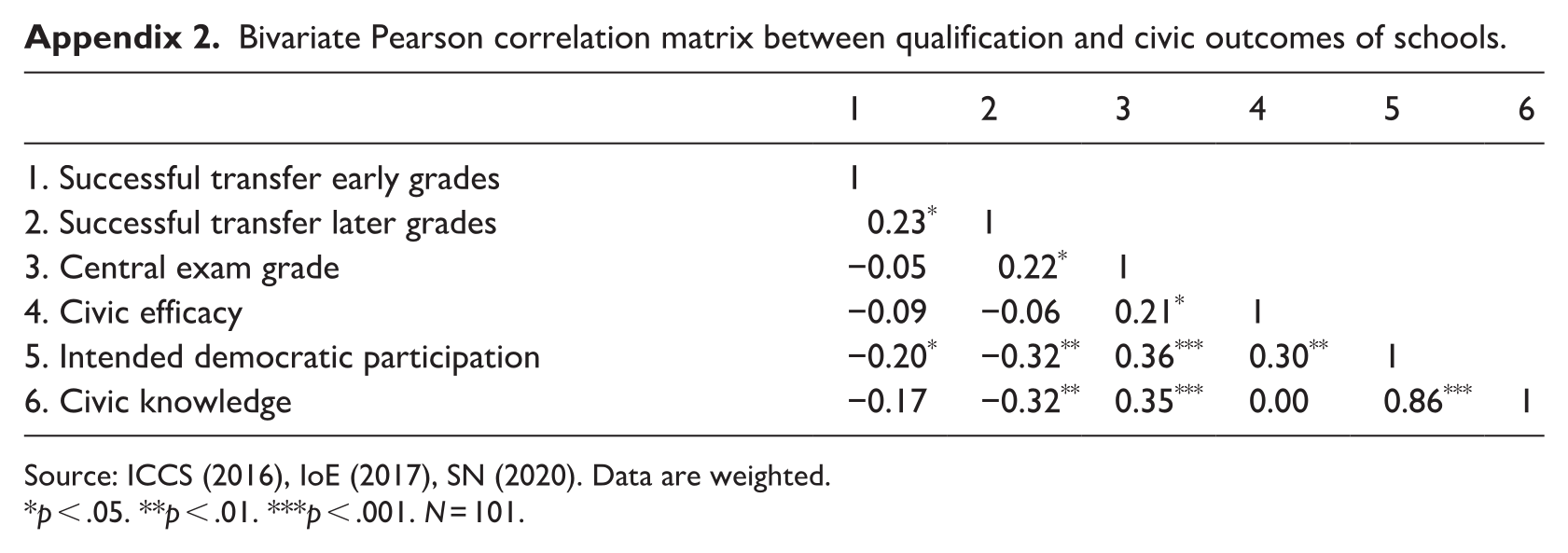
Bivariate correlations between schools’ qualification and civic outcomes were conducted to test Hypothesis 1, concerning the expected positive relation between schools’ qualification and civic outcomes (also reported in Appendix 2). Considering all schools, some qualification and civic indicators are significantly related, yet both in positive and negative directions. Schools’ average percentage of successful transfers in early grades is negatively related to schools’ average intended democratic participation (r = −.20, p < .05), and schools’ average percentage of successful transfers in later grades is negatively related to their average intended democratic participation (r = −.32, p < .01) and their average civic knowledge score (r = −.32, p < .01). In contrast, schools’ average central exam grade is positively related to average civic efficacy (r = .21, p < .05), intended democratic participation (r = .36, p < .001), and civic knowledge (r = .35, p < .001). This leaves Hypothesis 1 partly supported: depending on the indicators, schools’ qualification and civic outcomes are both negatively and positively related.
Table 1 shows the bivariate correlations between qualification and civic outcomes for vocational and academic tracks, to test Hypothesis 2; that the relations between schools’ qualification and civic outcomes are on average more positive in academic compared to vocational tracks. In vocational tracks, only average central exam grade is positively related to average civic knowledge. In contrast, in academic tracks, the average percentage of successful transfers in later grades is positively related to average civic knowledge, and average central exam grade is positively related to average civic efficacy, intended democratic participation and civic knowledge. When distinguishing between tracks, all significant relations between schools’ qualification and civic outcomes are positive, and more so in academic than vocational tracks. This supports Hypothesis 2. Subsequently, the difference in the correlations when considering all schools versus either vocational or academic tracks motivates to examine the role of student composition and tracking.
Bivariate Pearson correlation matrix between qualification and civic outcomes of schools with vocational versus academic tracks.
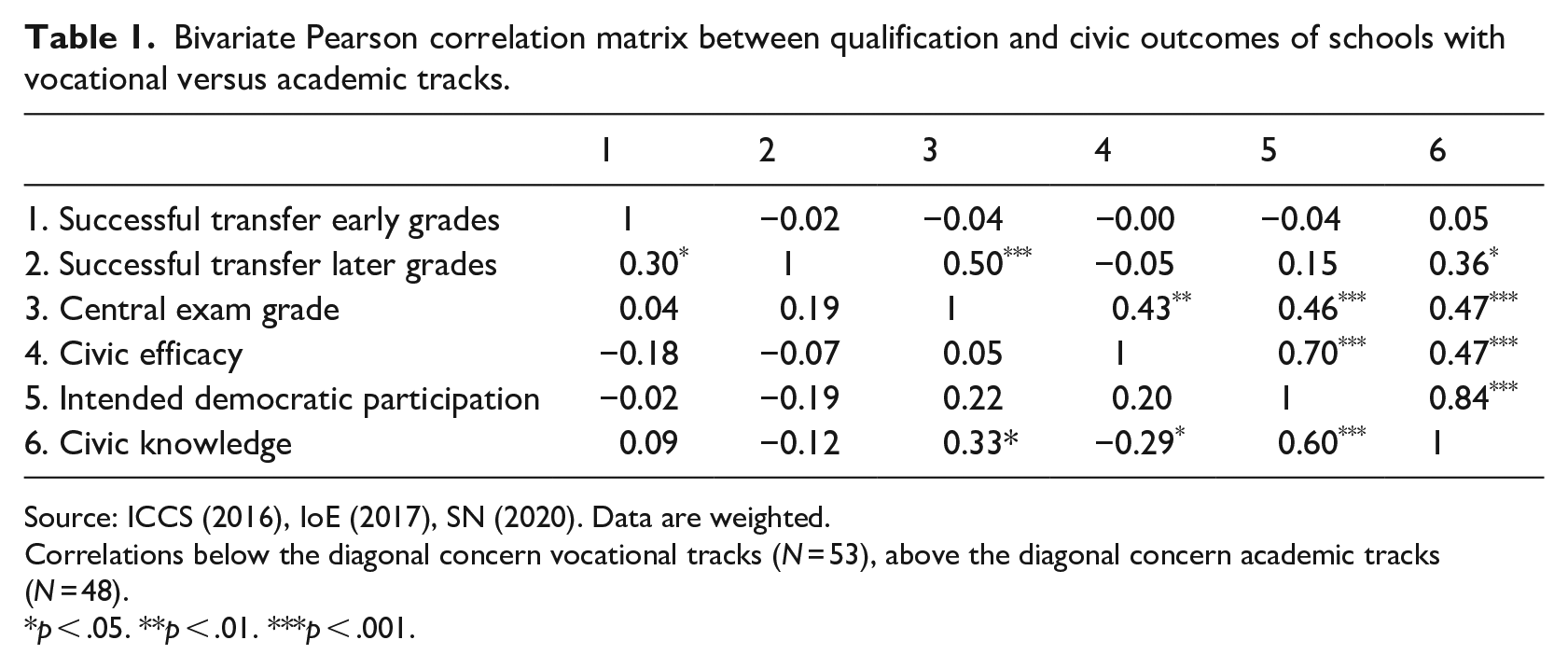
Source: ICCS (2016), IoE (2017), SN (2020). Data are weighted.
Correlations below the diagonal concern vocational tracks (N = 53), above the diagonal concern academic tracks (N = 48).
p < .05. **p < .01. ***p < .001.
Table 2 displays the MMR results. To test Hypothesis 3, that student composition advantage positively associates with schools’ qualification and civic outcomes, Model 1 contains the main effects of all student composition factors. The coefficients of determination display great variety among the six outcome variables: inclusion of the indicators in Model 1 explains little to moderate parts of the variance in schools’ qualification outcomes, yet moderate to much of the variance in schools’ civic outcomes. Hence, schools’ civic outcomes are somewhat better explained by student composition than schools’ qualification outcomes, yet for all outcomes student composition plays a role.
Multivariate multiple regression models predicting qualification and civic outcomes of schools.
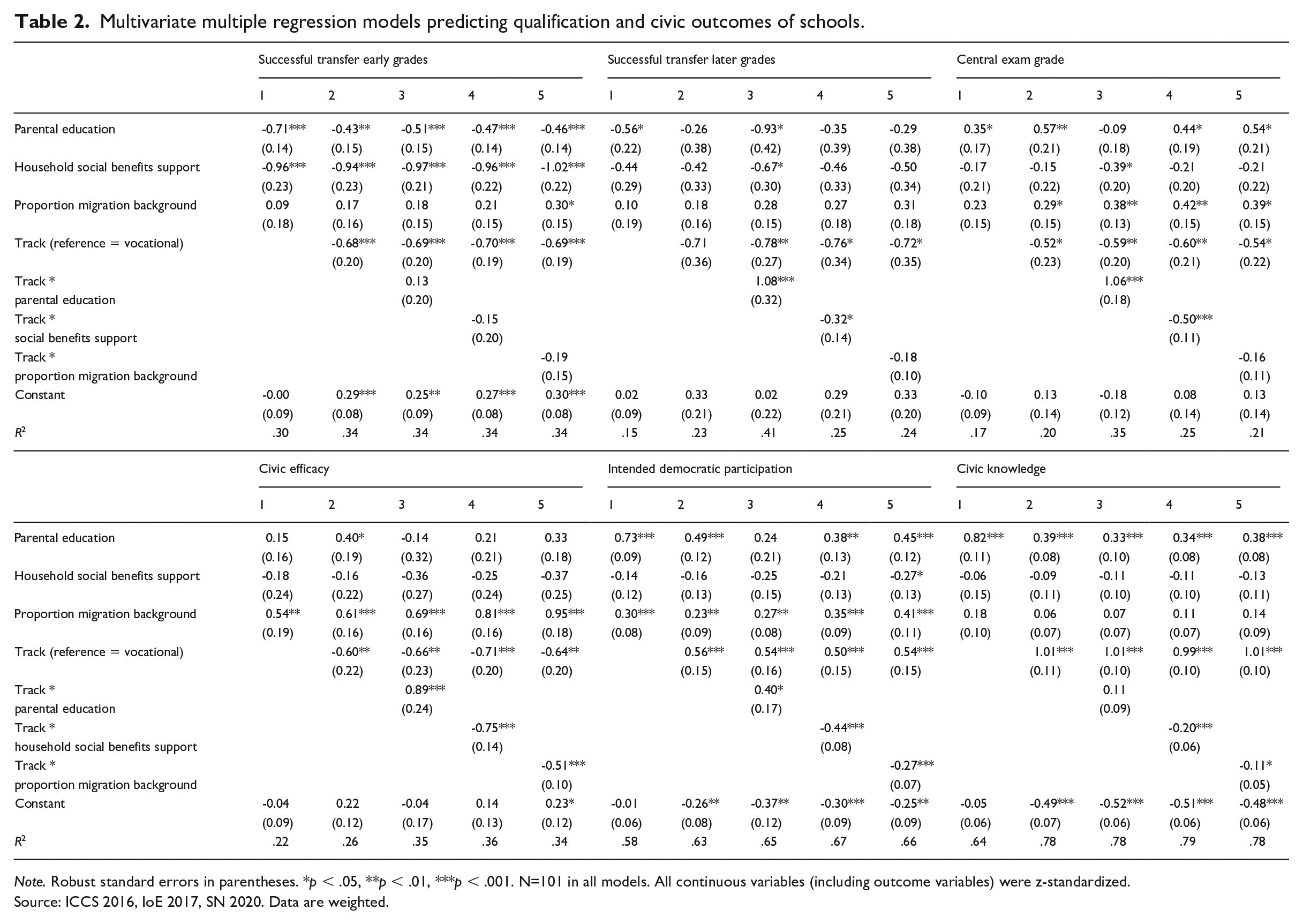
Note. Robust standard errors in parentheses. *p < .05, ** p < .01, ***p < .001. N=101 in all models. All continuous variables (including outcome variables) were z-standardized.
Source: ICCS 2016, IoE 2017, SN 2020. Data are weighted.
Regarding schools’ qualification outcomes, parental education and (household) social benefits support yield significant results in Model 1. Unexpectedly, a student composition with a relatively high average parental education predicts lower percentages of successful transfer in both early and later grades. This is not in line with Hypothesis 3. However, expectedly, a student composition with a relatively high average parental education predicts a higher central exam grade. Also as expected, schools with a relatively high percentage of students from households that receive social benefits are more likely to have a lower percentage of students who successfully transfer in early grades. This supports Hypothesis 3. Turning to schools’ civic outcomes, highest parental education yielded positive outcomes in intended democratic participation and civic knowledge; schools where parental education is relatively high, are more likely to have stronger average intended democratic participation and higher average civic knowledge outcomes. Household social benefits support yielded no significant results for schools’ civic outcomes. In Model 1, we also controlled for the proportion of students with a migration background, and in schools with a higher proportion of students with a migration background, the average reported civic efficacy and participation was higher (et ceteris paribus). Together, Hypothesis 3 is partly supported by these results: a relatively advantaged student composition in terms of socioeconomic indicators is positively related to primarily schools’ civic outcomes, and inconsistently to qualification outcomes.
In Model 2, the distinction between vocational and academic tracks is added to test Hypothesis 4, that the impact of student composition advantage explains the positive difference between vocational and academic tracks in both qualification and civic outcomes of schools. Adding tracks to the model leads to an increase of 3%–14% points of explained variance in each outcome, which suggests that differences between vocational and academic tracks cannot be fully attributed to a selection effect in terms of student composition. A closer examination of tracks’ main effects confirms this. With the exception of Model 2 for successful transfer to later grades, for all qualification indicators, outcomes are higher in vocational than in academic tracks when keeping (interactions with) student composition factors constant. For the percentage of successful transfers in early grades, the coefficient for average parental education diminishes. Considering later grades, the role of parental education shrinks and becomes insignificant. This suggests that in academic tracks, parents are on average higher educated. At the same time, for central exam grade, the role of parental background has become stronger: keeping track constant, schools whose students on average have higher educated parents tend to have higher average central exam grades, yet higher average parental education is more common in academic than vocational tracks, which is likely why the role of parental education was less strong in Model 1. We controlled here for the proportion of students with a migration background, which positively predicts central exam grades in Model 2: schools with a higher proportion of students with a migration background are more likely to have a higher average exam grade (other things being equal). This means that within vocational or within academic tracks, schools with a higher average proportion of students with a migration background have higher central exam grades, holding constant on other socioeconomic composition variables.
Turning to the results of Model 2 for civic outcomes, civic efficacy is on average stronger in vocational tracks, whereas intended democratic participation and civic knowledge are on average lower in vocational compared to academic tracks (while keeping the other variables constant). For civic efficacy, parental education yields a positive result in Model 2 as opposed to Model 1, and controlling for schools’ proportion of students with a migration background, this similarly increases in Model 2. Thus, when keeping track constant, average parental education of schools’ student composition positively relates to schools’ average civic efficacy, and the role of the proportion of students with a migration background is somewhat stronger for civic efficacy when we consider it within either vocational or academic tracks. For intended democratic participation, the predictive value of parental education and migration background decreases when taking tracks into account. For civic knowledge, the role of parental education decreases. This suggests that student compositions with a relatively high average parental education level are overrepresented in academic schools, where intended democratic participation and civic knowledge are higher than in vocational schools.
The findings of Model 2 compared to Model 1 partly support the selection effect as proposed in Hypothesis 4. Many of the significant effects as found in Model 1 change once track is controlled for, which suggests that student composition differs across tracks. At the same time, the inclusion of track yielded significant results for each of the six outcomes while controlling for (interactions with) all student composition factors, which suggests that the difference between vocational and academic track entails more than a mere selection effect in terms of schools’ student composition.
The next step is to test Hypothesis 5, stating that the relation between student composition and schools’ qualification and civic outcomes is stronger in academic than vocational tracks. Models 3–5 contain the interaction effects between track and each student composition factor. For qualification outcomes, four interaction effects were found, illustrated in Figure 1a to 1d. For schools’ percentage of successful transfers in later grades, the negative role of parental education was stronger in vocational tracks and positive in academic tracks (1a), and the negative role of social benefits support was stronger in academic than vocational tracks (1b). For schools’ central exam grade, the overall positive role of parental education was negative in vocational tracks, yet positive in academic tracks (1c), and the negative role of social benefits support was stronger in academic than vocational tracks (1d).
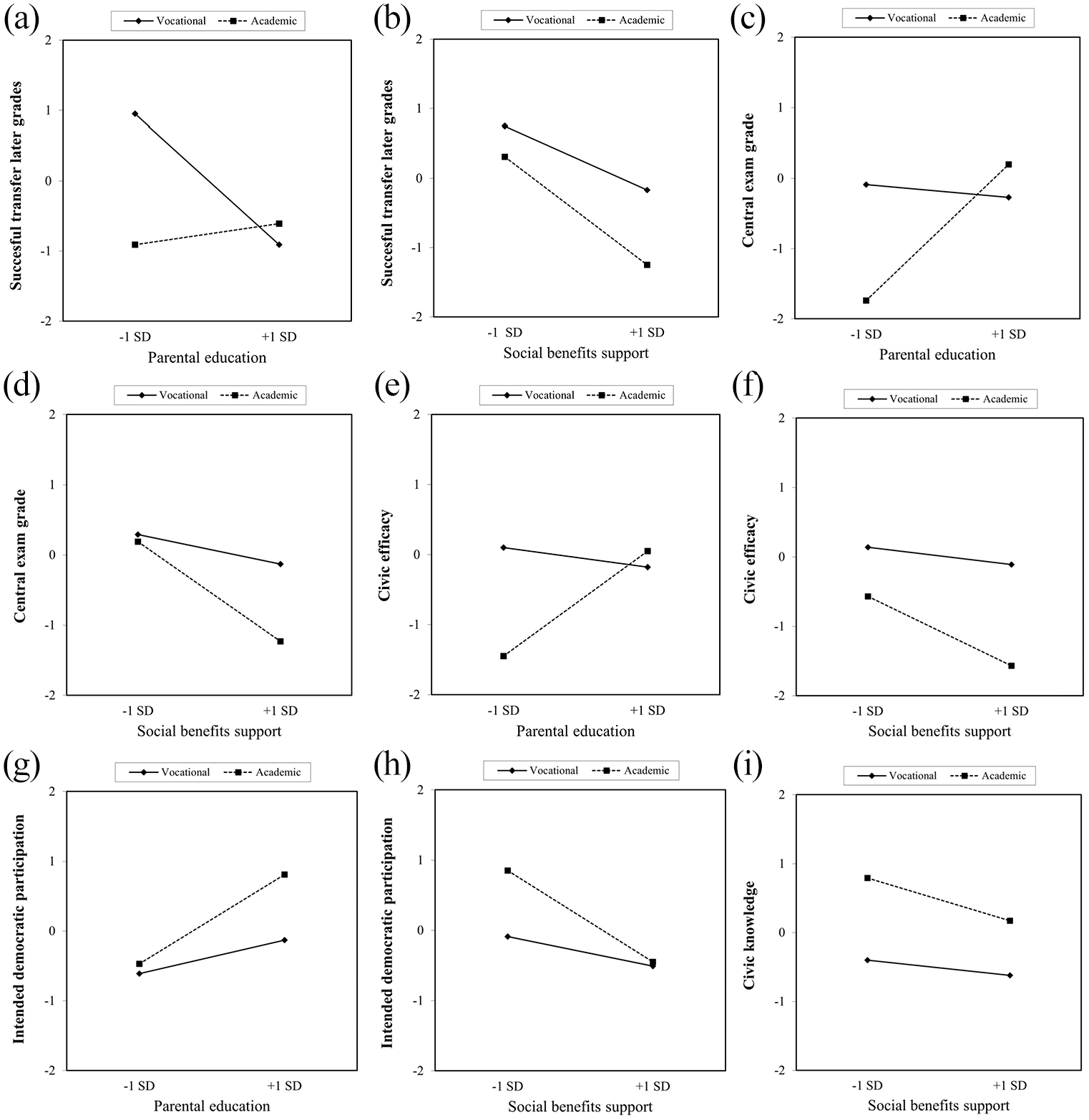
Estimated interaction effects for schools’ student composition factors and track on schools’ qualification and civic outcome indicators.
For civic outcomes, eight interaction effects were found (see Figure 1e–1i). For civic efficacy, the role of parental educational was stronger and only positive for academic tracks compared to vocational tracks (1e) and the positive role of independence of social benefits support (1f) was stronger in academic compared to vocational tracks. We controlled for the role of migration background in schools’ civic efficacy, which was stronger in vocational tracks. For intended democratic participation, the positive role of parental education (1g) and independence of social benefits support (1h) was greater in academic than in vocational tracks (as a control, the role of migration background was greater in vocational than academic tracks). For civic knowledge, the positive role of independence of social benefits support was greater in academic than in vocational tracks (1i) (and including migration background as a control shows that its role was slightly stronger in vocational than academic tracks). Considering the visualizations in Figure 1a to 1i, eight of the nine depicted interaction effects display that the role of student composition is stronger in academic compared to vocational tracks. Moreover, six of the nine interaction effects suggest that the difference between vocational and academic tracks is smaller in schools with more socioeconomically advantaged student compositions. Based on this, overall, the patterns support Hypothesis 5.
Discussion
This study examined the relation between schools’ qualification and civic outcomes and to what extent schools’ student composition and tracking shape these outcomes. Three qualification indicators (percentage of successful transfers in lower and upper secondary grades and average central exam grade) and three civic indicators (civic efficacy, intended democratic participation, and civic knowledge) were considered in 101 Dutch secondary schools with different student composition factors across vocational and academic tracks. Results showed both negative and positive relations between qualification and civic indicators, which motivated further examination of student composition and tracking. Student composition accounted for a significant part of the variance in all six indicators, indicating that schools with relatively advantaged student compositions were more likely to have higher average central exam grades, reported civic self-efficacy, participation, and knowledge. When controlling for (interaction with) student composition, a difference between vocational and academic schools was found for all outcomes: Unexpectedly, academic (compared to vocational) tracks showed on average lower qualification outcomes, and lower civic efficacy yet higher intended democratic participation and civic knowledge. This could be due to the fact that the qualification indicators were standardized for each track, as opposed to outcome measurements like PISA or TIMSS, where students are scored on the same test. The findings suggest that differences between tracks could partly but not fully be attributed to differences in schools’ student composition, and that tracking also informs a difference in schools’ qualification and civic outcomes beyond student composition, which could correspond with findings on track differences in terms of educational provision (e.g. Brunello and Checchi, 2007; Ten Dam and Volman, 2003). Moreover, the relation between schools’ student composition and qualification and civic outcomes of schools was stronger in academic than vocational tracks, which resonates with our discussion of previous research (Brunello and Checchi, 2007; Matthews, 2001; Nieuwelink et al., 2019).
Evaluating these findings, several limitations require mention. The relation between schools’ qualification and civic outcomes was only examined at the school and not student level, due to linking restrictions. The possibility exists that the strength and direction of the relation between civic and qualification outcomes differ between student and school level, due to different—possibly interacting—mechanisms at both levels (Snijders and Bosker, 1999). Our school level insights motivate further research to untangle these mechanisms thoroughly.
A second limitation concerns the fact that this study only indirectly examined whether student composition and tracking shaped the relation between schools’ qualification and civic outcomes; the extent to which both factors explained variety in schools’ qualification and civic outcomes was used to infer how this confounds the relation between these outcomes. The stronger relations between qualification and civic outcomes in academic (versus vocational) tracks can hence not certainly be attributed to schools’ student composition, although the findings of our multivariate multiple regression analysis do suggest this. In aiming to expand research on schools’ fulfilment of multiple educational tasks, further methodological sophistication would contribute to the ability to capture why some domains relate, as opposed to predicting the outcomes of both domains.
Taking these limitations into account, the current study has contributed in several ways. Firstly, by uniquely combining three representative datasets with information on schools’ qualification and civic outcomes, these findings add to the scarce body of research on the relation between schools’ fulfilment of different educational tasks. Secondly, the current study examined to what extent this relation could be shaped by the relative socioeconomic advantages of schools’ student compositions across tracks, which was supported by the findings. This means that the insights of this study have implications for another vital function of education, namely the provision of equality of opportunity. The current findings show that in the Netherlands, schools’ qualification and civic outcomes are more positively related in academic than in vocational tracks and that schools’ student compositions likely play a role in this. The difference between vocational and academic tracks is greater depending on schools’ socioeconomic student compositions, demonstrating that the role of parental resources remains important. This is particularly evident in the civic domain, in spite of the desirability of smaller differences between tracks given the principle of equal citizenship that is so central to democratic notions of justice (Dahl, 2007; Miller, 1999). In light of the role of both parental resources and tracking, and the increasing attention to schools’ civic task across European countries (Eurydice, 2012, 2017), schools’ role in reproducing or mitigating educational hierarchies across tracks may be expanding also explicitly toward the civic domain. Practically, this warrants educational policymakers to remain aware that schools’ fulfilment of each educational task across tracks should not be considered in a vacuum: the combination of fulfilment of different tasks gives insight in the accumulation of learning inequalities that are otherwise discussed separately, leaving the gravity of their accumulation unaddressed. This also calls for a closer examination of this combination: educational inequalities are present in the Netherlands, and further research can contribute to untangling what shapes whether schools and tracks provide qualification and citizenship equally well, and equally for all.
Footnotes
Appendices
Bivariate Pearson correlation matrix between qualification and civic outcomes of schools.
| 1 | 2 | 3 | 4 | 5 | 6 | |
|---|---|---|---|---|---|---|
| 1. Successful transfer early grades | 1 | |||||
| 2. Successful transfer later grades | 0.23 * | 1 | ||||
| 3. Central exam grade | −0.05 | 0.22 * | 1 | |||
| 4. Civic efficacy | −0.09 | −0.06 | 0.21 * | 1 | ||
| 5. Intended democratic participation | −0.20 * | −0.32 ** | 0.36 *** | 0.30 ** | 1 | |
| 6. Civic knowledge | −0.17 | −0.32 ** | 0.35 *** | 0.00 | 0.86 *** | 1 |
Source: ICCS (2016), IoE (2017), SN (2020). Data are weighted.
p < .05. **p < .01. ***p < .001. N = 101.
Acknowledgements
The authors would like to thank dr. Ineke van der Veen for her help with the combining of different data sources, ODISSEI for the generous Microdata Access Grant with which this study was partially funded, and Statistics Netherlands and the Dutch Inspectorate of Education for the opportunity to use their data sources. An earlier version of the article was presented at the Seventh annual conference on Citizenship Education at Roehampton University in London, UK. The authors would like to thank the participants of this meeting, and editor Lee Jerome and two anonymous referees from Education, Citizenship and Social Justice for their comments and suggestions.
Declaration of conflicting interests
The author(s) declared no potential conflicts of interest with respect to the research, authorship, and/or publication of this article.
Funding
The author(s) disclosed receipt of the following financial support for the research, authorship, and/or publication of this article: This work was supported by the Dutch Inspectorate of Education (https://english.onderwijsinspectie.nl/); and Open Data Infrastructure for Social Science and Economic Innovations (ODISSEI) in the Netherlands ( ).
).
Data availability statement
The data that support the findings of this study are subject to third party restrictions. Restrictions apply to the availability of these data, which were used under license for this study.