




Abstract
Collectives form nonequilibrium social structures characterized by volatile dynamics. Individuals join or leave. Social relations change quickly. Therefore, unlike engineered or ecological systems, a resilient reference state cannot be defined. We propose a novel resilience measure combining two dimensions: robustness and adaptivity. We demonstrate how they can be quantified using data from a software-developer collective. Our analysis reveals a resilience life cycle (i.e., stages of increasing resilience are followed by stages of decreasing resilience). We explain the reasons for these observed dynamics and provide a formal model to reproduce them. The resilience life cycle allows distinguishing between short-term resilience, given by a sequence of resilient states, and long-term resilience, which requires collectives to survive through different cycles.
When the CEO of a major Swiss telecommunication provider was asked about the long-term goal of his company, he replied, “Still being in the market in 5 years.” This statement could well serve as a shorthand description of resilience. Being there in 5 years means that the company has the ability to either withstand shocks or recover from them if they could not be avoided. Disruptions can result, for instance, from competitors, legal regulations, technological innovations, and so on. What makes them shocks is their unpredictability. Hence, to cope with the unforeseeable and to adapt to any changes quickly is a core element of resilience.
Instead of companies, in this article we focus on informal collectives, which refers to informal groups of interrelated individuals who pursue a collective goal and are embedded into an environment (Hoegl & Gemuenden, 2001; Ostrom, 2009). Unlike hierarchical organizations or companies, informal collectives self-organize their activities around a varying number of members. We denote them simply as “collectives” herein. Our running example is a team of developers of the open-source software project Gentoo, which we introduce later.
The resilience of informal collectives is a challenging scientific problem because we need to integrate resilience concepts from social psychology and individual psychology, on the one hand, and from ecology, engineering, and mathematics (Hosseini et al., 2016) on the other. This requires clarifications about the terminology. Although resilience is a topic in various scientific disciplines, its precise meaning differs across and sometimes even within these disciplines (Baggio et al., 2015; Fraccascia et al., 2018). To start with psychology, resilience has been a topic of interest in various domains, including developmental (Masten, 2014), clinical (Mancini & Bonanno, 2006), disaster (Norris et al., 2008), and organizational psychology (Kašpárková et al., 2018). Resilience is usually defined as an individual’s ability to do well in the face of adversity, tragedy, or stressors (Khurana et al., 2022; R. Newman, 2005). Their stability is indicated by the fact that they can master these challenges and still are “there” despite a very demanding life (Kirmayer et al., 2009). Resilience can improve the mental health of individuals by reducing rates of depression, anxiety, and posttraumatic stress disorder (Connor & Davidson, 2003). By successfully living through disruptions, individuals can achieve personal and professional growth (Caza & Milton, 2012; Richardson, 2002). Various articles have highlighted the importance of ordinary processes in enhancing an individual’s resilience (Bonanno, 2004; Masten, 2001; Richardson, 2002) through, for example, an optimistic attitude or self-confidence.
Moving the perspective from the individual to the group level, we see that the social embedding of individuals (e.g., supportive family, relationships, and communities) further enhance resilience. Psychological mechanisms, such as group identity, help to stabilize the group once individuals identify themselves with the group and derive a sense of self-worth from their membership. Specifically, individuals strive for a feeling of shared identity (van Zomeren et al., 2008) that provides emotional benefits and fulfills their “need to belong” (Severt & Estrada, 2015). Social creativity is involved in developing social substructures, such as in-groups nested inside a larger out-group, to ensure “distinctiveness” (Tajfel & Turner, 1979) and to stabilize larger groups (Bezouw et al., 2021).
Group cohesion (i.e., the degree to which group members are attracted to each other and are motivated to stay together) is positively related to group stability because members are more committed to the group and less likely to leave (Severt & Estrada, 2015). Group stability is further promoted by creating a sense of predictability and order. Social norms to regulate individual behavior and shared expectations about how group members should behave (Sherif, 1948) play an important role. Effective conflict resolution is essential for reaching consensus and group harmony (Wall et al., 1987).
These psychological mechanisms to enhance group stability are complemented by insights from social-network analysis. We name just the “big four”: reciprocity, transitivity, popularity, and homophily. These concepts help to explain how social networks are structured and kept stable. Reciprocity refers to the transformation of one-sided relationships into balanced, reciprocal bonds; transitivity reinforces a group’s structure by favoring new relationships between members through shared acquaintances; popularity means that those who are already well connected in a group are likely to attract even more connections, stabilizing the network around them; and homophily explains how individuals who are more similar tend to form more cohesive groups (Stadtfeld et al., 2020). Moreover, smaller groups are more stable (Akçay, 2018; Carley, 1991) because they can better utilize these mechanisms. On the other hand, it was shown that “weak ties” to individuals outside a group may foster efficient communication (Granovetter, 1973; Hansen, 1999) but can destabilize the group (Carley, 1991).
Our own contribution starts from the observation that these research strands mostly aim to explain group stability rather than group resilience. We miss the dynamic perspective of how groups respond to shocks and overcome adverse situations. To address this research gap, we aim at a more formal approach. At this point, resilience concepts developed in engineering or the natural sciences come into play. In ecology, for example, a system is said to be resilient if, after a perturbation, it returns to a previously assumed stable state (Grodzinski et al., 1990; Gunderson, 2000). This idea borrows from classical mechanics and thermodynamics with their definitions of equilibrium states as minima of some potential energy. Collectives, however, are inherently open nonequilibrium social systems. Stationary states in nonequilibrium can be kept only if they are constantly maintained, and collectives are no exception. Their resilient state has to be actively managed. Otherwise, it dissolves over time like any other ordered state.
We argue that the difficulties of tackling the resilience of collectives with a formal approach result from two dynamical problems. The first is the fast and continuing change within collectives, and the second is the additional feedback cycle resulting from their response to changes induced by themselves. Most collectives have in common that they are very volatile. They may experience fast changes in their structure (e.g., in the number of individuals and their relations), fluctuating task volumes or frequent interruptions, constant environmental impacts, and so on. This volatility makes them different from, for example, engineered systems, which are built to last. The common notion of resilience for engineered artifacts, such as bridges, is illustrated in Figure 1a. A bridge is planned for a defined functionality (e.g., a given number of cars per hour passing the bridge). This functionality remains as long as no critical shocks appear either caused by internal malfunction (e.g., lack of maintenance) or external disruptions (e.g., an earthquake). If the shock happens, the bridge’s functionality is partially or entirely destroyed. Nonetheless, the bridge can be rebuilt, recovering the functionality and often even improving it.
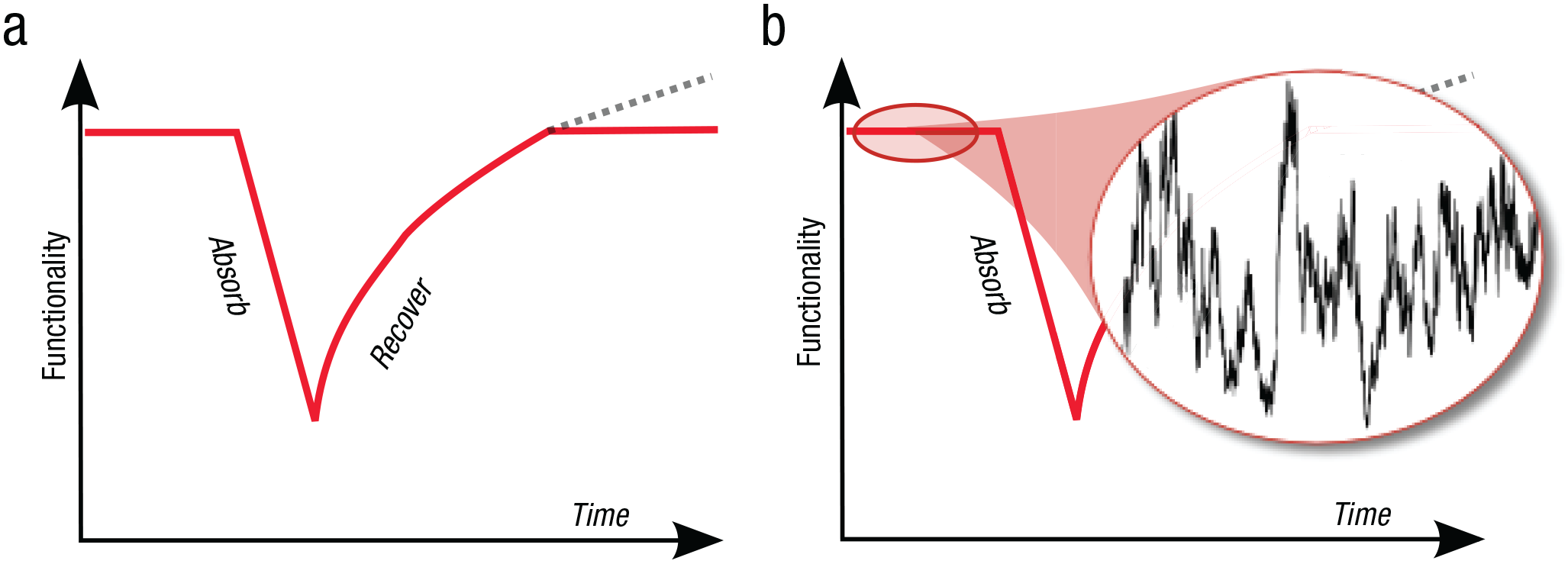
Problems defining a reference state for resilience understood as the ability to absorb shocks and to recover: (a) engineered system (e.g., a bridge) and (b) social system (e.g., a collective).
The assumption underlying Figure 1a is a known reference state (i.e., the planned functionality) that remains relevant over time. For highly volatile systems, shown in Figure 1b, we cannot define such a reference state, partly because it is hardly quantifiable and partly because it is constantly changing. This implies that we are also unable to specify what we mean by a “shock.” Unlike the bridge, in which shocks result in a measurable dropdown of functionality, we always have shocks of varying sizes. The ability to recover is not restricted to the aftermath of a breakdown. Instead, it requires a continuous effort from the collectives to adapt to all sorts of challenges. Most importantly, the recovery is not an external intervention like the repair of a bridge but the result of an internal response of the collectives. Consequently, we need a new and dynamic approach to the resilience of such social systems.
A New Resilience Measure
Describing robustness and adaptivity
We propose that resilience
We identify robustness as the ability of a collective to withstand a specific type of shock unscathed. Different types of shocks require different types of robustness. If it were possible to define some “functionality” as in Figure 1a, robustness would quantify the strength of a shock that the collective can absorb before its functionality is impaired.
Collectives can function only if they build on social structures. In the example of a software-developer team, these structures are reflected by their work relations, communication channels, and so on. These structural features can be represented by a social network. Links in this network are time stamped, directed, and weighted (Gote et al., 2021), and multiple relationships can be captured by multiedge (Casiraghi et al., 2017) and multilayer (Garas, 2016) networks. This social network evolves if nodes or links are added or deleted or links are rewired. Collectives utilize this social structure for their activities, as exemplified in Figure 2. A well-maintained social network will allow developers to, for example, write more code, fix bugs faster, and reduce coordination overhead. Network science provides a large family of measures to quantify the robustness of networks against a variety of shocks such as node or edge removal by means of different centrality measures (M. Newman, 2018).
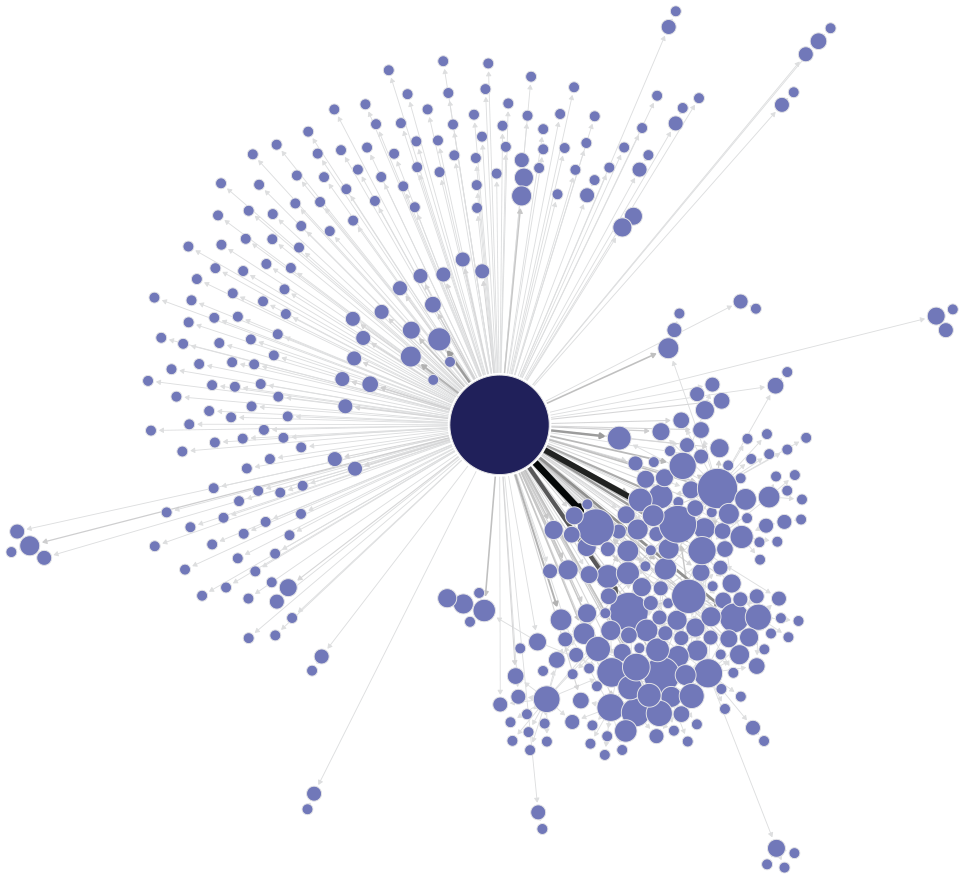
Network of task assignments between Gentoo developers in September 2007. A node’s size and color intensity are proportional to its degree.
Although the interpretation of robustness becomes intuitive when representing the collective’s structure as a network, defining adaptivity remains a challenge. As the dynamic component of resilience, adaptivity captures the ability of the collective to recover from shocks. Hence, a direct measurement would require isolating a collective under different shocks to observe its response. Adaptivity, however, cannot be reduced to the recovery from a breakdown. It requires a continuous effort from the collectives to adapt to all sorts of challenges. Specifically, recovery is not based on an external intervention such as the repair of a bridge but becomes the result of an internal response of the collectives.
Therefore, we propose to proxy adaptivity by the propensity of a collective to change. In essence, propensity describes the ability of the collective to attain different states (Schweitzer et al., 2021), which is not trivial to operationalize. One way to measure this ability is potentiality (Zingg et al., 2019), which quantifies how many different states become potentially available in a given situation. This strongly depends on existing constraints for the collective. We have developed stochastic models to encode such constraints into network ensembles (Casiraghi & Nanumyan, 2021) that make it possible to calculate these states. Knowing these states, however, does not imply predicting the future. Rather, it means knowing which options a collective has to escape from an impaired situation. The more options there are, the more likely it should be able to recover from a shock (e.g., by rearranging its structure or incorporating new individuals).
Composing resilience from robustness and adaptivity
To answer the question of how the resilience of collectives depends on their robustness and their adaptivity, we come up with a proposal rather than with a formal definition. The proposal is informed by the following arguments. Ideally, a maximally resilient system would have maximal robustness (i.e., it could withstand any shock) and maximal adaptivity (i.e., if a shock impacts the system, it will always recover). That means resilience P should increase both with robustness R and adaptivity A:
This choice requires a more intricate relation between robustness R and
Region (1) is characterized by a low resilience because the robustness and propensity to change are both low. Hence, there is nothing to build on, and the collective has only a few alternatives to change. This is a bad situation for the collective.
Region (2) is characterized by a high robustness, which implies a solid, structured social network. It can hardly be destroyed but also hardly be changed. If a collective in Region (2) would still change, it risks losing its robustness. Thus, in Region (2) the propensity to change should be low to keep this state and achieve a high resilience.
Region (3) is also characterized by a high robustness, but the high propensity to change increases the risk to lose this robustness. Therefore, such states have low resilience and are bad for a collective. Moreover, if the propensity to change needs to be high because a collective needs many different options to adapt to a shock, the high robustness could even work against the necessary change. Again, this means a lower resilience.
Region (4) is characterized by a low robustness. The collective has nothing to lose, and alternative states will be better. The high propensity to change enables the collective to reach these alternative states. Therefore, a collective in Region (4) has a high resilience.
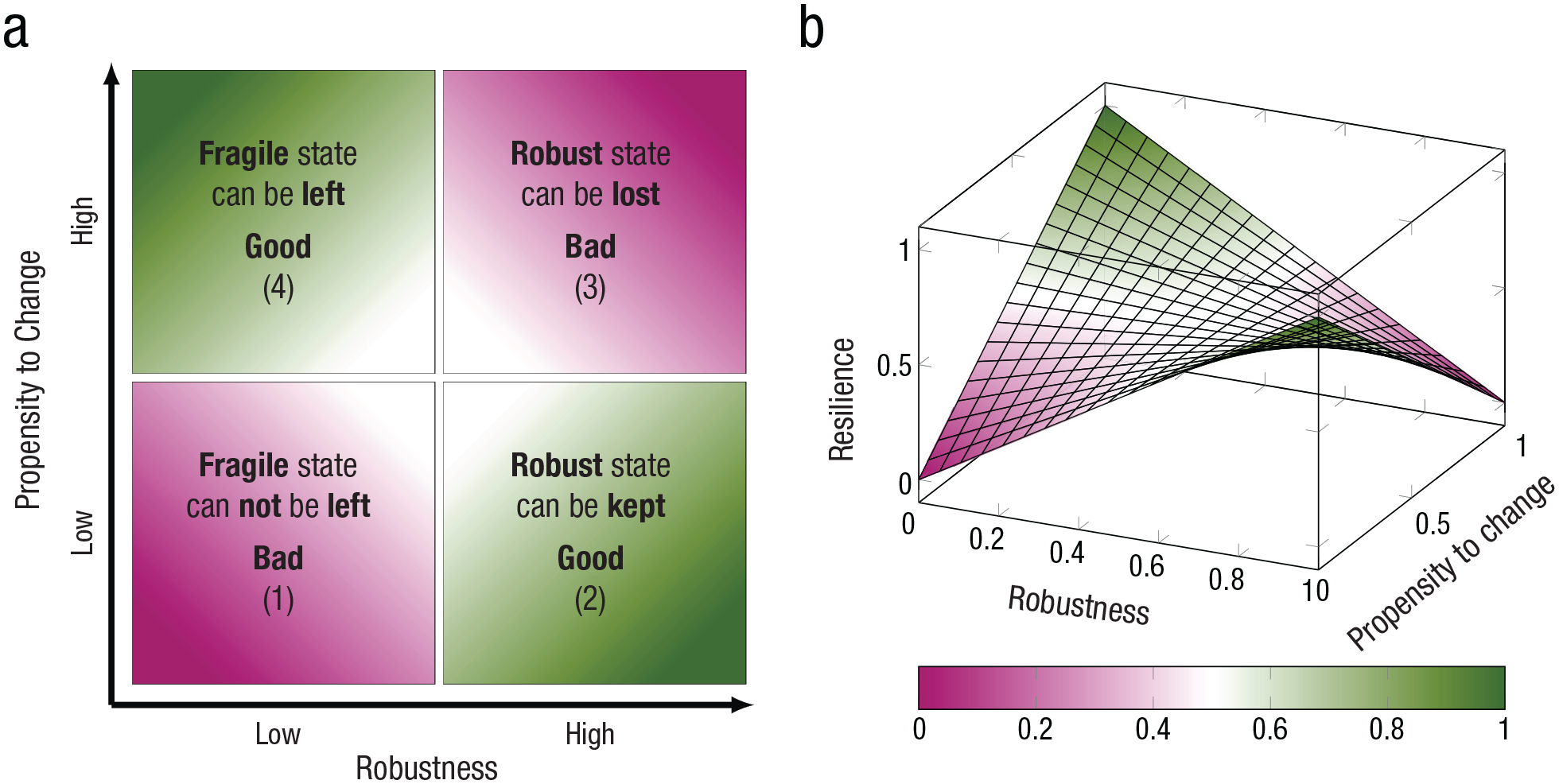
Resilience P as a function of robustness R and adaptivity proxied by propensity to change
To formalize the relations postulated, we propose quantifying resilience as the convex combination of R and

This formulation assumes that R and
To summarize, adaptivity as proxied by a collective’s propensity to change
A formal model to build up resilience
We now proceed in two directions. First, we study a formal model of generating resilience from robustness and adaptivity. This will result in hypotheses for the behavior of collectives. Second, in the next section, we test these hypotheses using data from a team of software developers.
From the above discussion, it becomes clear that robustness has to lead the improvement of the resilience of collectives because all further activities depend on the existing social network. At the same time, maintaining the social network also requires adaptivity. New nodes have to be integrated. Links have to be rewired or reinforced. Therefore, the dynamics of robustness R and adaptivity proxied by
Both r and a require a positive maintenance term. On the other hand, both cannot grow infinitely but are bound to a maximum value that depends on the system under consideration. Therefore, a negative decay term must be considered. In the case of robustness, too much propensity to change could destroy a resilient state. Therefore, large values of a should lead to a decrease in r. Further, robustness can be established and increased only on the basis of the existing structure. Thus, robustness has a positive impact on its own growth. In addition, the ability to change requires functionality and, therefore, a certain level of robustness. These considerations lead directly to
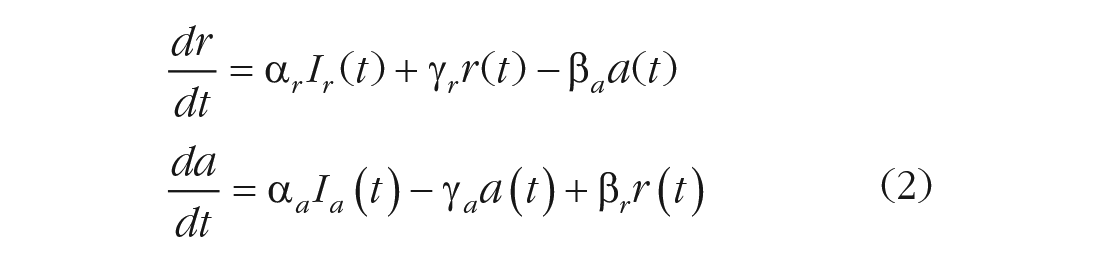
where the parameters

Eventually, the impact of robustness on its further increase is not a constant but a nonlinear function of r,
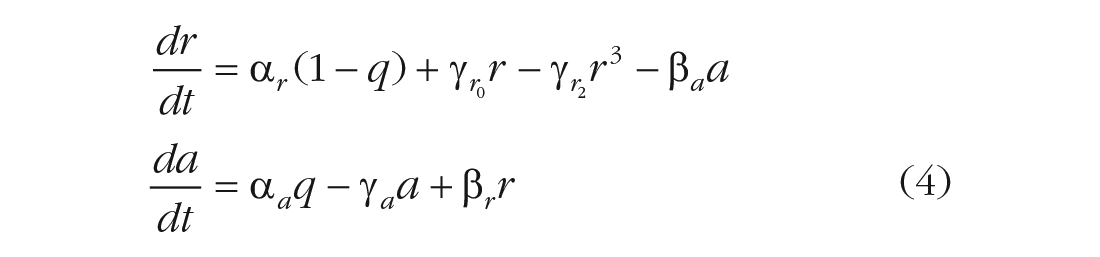
Table 1 provides an overview of the parameters and their respective interpretation. Moreover, we created an interactive website 2 that enables users to explore the impact of each parameter on the coupled dynamics.
Explanation of the parameters in Equation 4
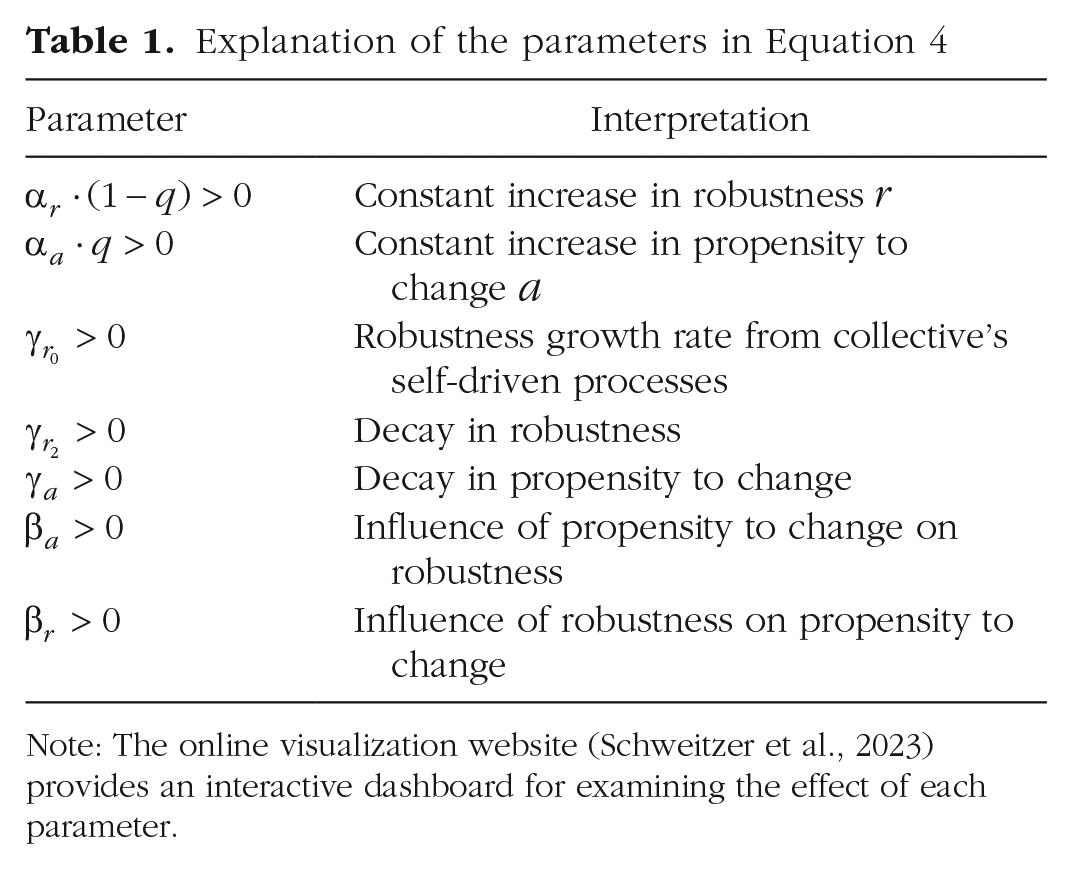
Note: The online visualization website (Schweitzer et al., 2023) provides an interactive dashboard for examining the effect of each parameter.
Figure 4 demonstrates that the formal model defined in Equation 4 generates distinct trajectories in the phase space of R and
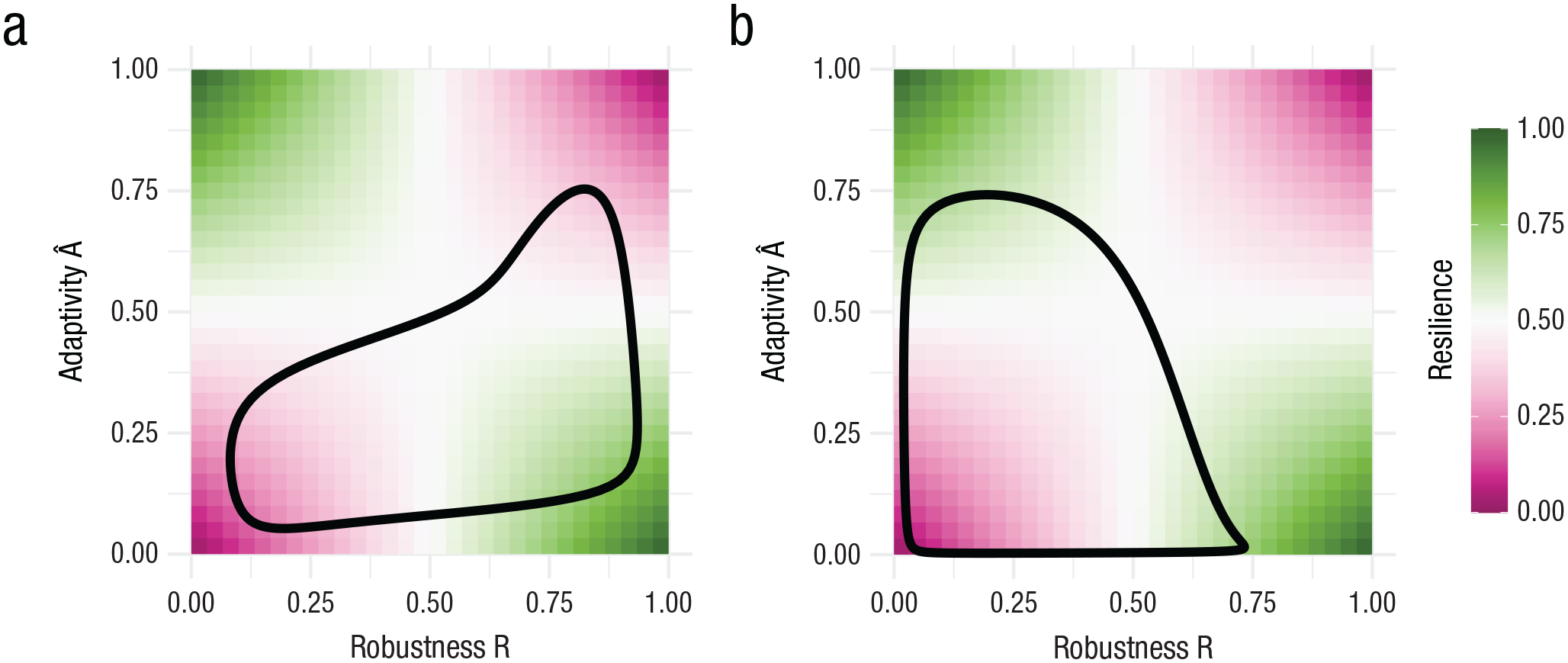
Resilience trajectory in the phase space of R and
Starting from Region (2), in Figure 4a, robustness remains high, but the propensity to change further grows such that Region (3) is reached. In this region, resilience is low because the robust social structure is at risk of being lost: The propensity to change to alternative states is too large, and too little attention is spent to maintain the current state. Consequently, a failure follows, and the trajectory returns to the initial Region (1), where the robustness and propensity to change are both low. There, a new life cycle could start.
In Figure 4b, starting from Region (2), robustness decreases at the expense of
These two scenarios are different in their sequence of resilient (△) and nonresilient (∆) states. Figure 4a follows
Resilience at Work: an Application
Measuring resilience for a collective
To demonstrate the applicability of our resilience model, we analyze data from the bug-handling collective of Gentoo, a computer operating system based on the Linux kernel. Between October 2004 and March 2008, a central developer named Alice in the literature (Garcia et al., 2013; Zanetti et al., 2013) became the most central figure in this collective (see also Fig. 2). She assigned most bug reports to other developers for a while but left the project suddenly in March 2008. Her unforeseeable dropout was a severe shock for the collective, which struggled for several years to restore a comparable level of operation. Zanetti et al. (2013) studied how different network measures reflect the dropout of Alice, whereas Casiraghi et al. (2021) developed a load-redistribution model of task reassignments to study the likelihood of team failure. For us, the recorded data, containing 45,086 task assignments between 8,591 developers from January 2003 to October 2008, allows studying the resilience of the collective during this period. Such data can be extracted directly from online sources with state-of-the-art data-mining tools such as git2net (Gote et al., 2019).
First, we construct a social network from the available interaction data, where nodes indicate developers and directed links task assignments. Because this network changes daily, we use a 30-day sliding window for aggregation. Applying our quantitative model for resilience requires operationalizing the two main factors, robustness and adaptivity, for this network. In accordance with Zanetti et al. (2013), we quantify robustness, the structural component, as the ability of the collective to withstand the loss of developers. The more centralized the collective, the more fragile it is against the loss of important members. In network terms, R is large if the nodes in the network have a similar degree. That means everyone in the collective processes roughly the same number of tasks either by solving or reassigning them, and nobody gets overloaded. We operationalize such a measure as the complement of the normalized degree centralization (Wasserman & Faust, 1994), that is, the extent to which the total number of connections in a network are concentrated around a few key nodes.
The propensity to change, our proxy for the dynamic component of resilience, is measured as the difference between the number of developers actively assigning tasks in a given time window and the same number computed half a year before. If this difference increases, more developers become potentially involved in bug handling. Thus, the workload is better balanced, alternative members for task processing are available, and the time to process them becomes shorter (Zanetti et al., 2013).
The results in Figure 5 reveal the following scenario of how this collective copes with change. Initially,
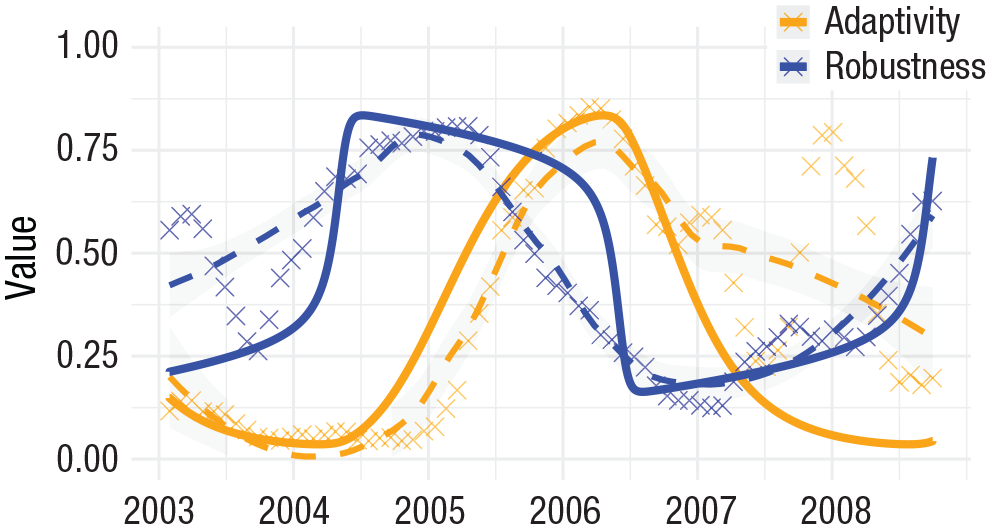
Robustness R and adaptivity proxied by
Our attention shall focus on the time interval after 2004 when robustness started to decrease. According to our operationalization, this indicates that the task assignment became more centralized. It was the time when the developer Alice started to assign most of the tasks. Interestingly, this concentration led to an increase in
Discussion
Explaining the failure in Gentoo
The findings from our case study are remarkable in different respects. First, in Figures 4 and 5 we observe a life cycle (i.e., the resilience of the collective first increases to decrease afterward rapidly). After returning to the initial low resilience state, the collective starts to consolidate again by building up robustness and adaptivity. Our formal model is compatible with such a life-cycle behavior. As a deterministic model, however, it is not suited to forecast unforeseeable perturbations such as the temporary suspense of the central developer in 2007. We note deviations between the model and the data during this period, but eventually the life-cycle dynamics dominate.
Second, thanks to our dynamic-resilience concept, we can understand the reasons behind the life cycle. These are the adaptive processes inside the collective that push it out of the resilient state and eventually cause the failure. This is reminiscent of self-organized criticality, a dynamic phenomenon in nonequilibrium complex systems and networks (Kuehn, 2012; Watkins et al., 2016) in which feedback processes drive a system into unstable states. However, different from mechanical or physical systems, the dynamics approaching the critical state are not universal but depend on the goal of the collective and the social mechanisms at work.
Specifically, the two states of high resilience for the collective are of different natures. The state with high robustness in Region (2) is characterized by balanced interactions between developers, who were all similarly involved in assigning, redistributing, and solving tasks. However, little changes to the social network occurred because strategies to integrate new developers were missing. Following the advent of Alice, the collective evolved to a second resilient state in Region (4). In this state, adaptivity increased because more developers were involved in solving the tasks, and new members could be quickly and easily integrated into the organizational structure. However, the effort to assign tasks became more centralized, and links that had become redundant disappeared from the social network. Therefore, robustness decreased, and an increase in adaptivity eventually destroyed the previous resilient state.
This development reflects an internal reorganization in the workflow. With Alice as the central developer, the collective obtained a hierarchical organization. It became highly efficient regarding the task assignments but also highly vulnerable because the collective depended on a single individual (i.e., adaptivity has lead to intended as well as unintended consequences). The intended one was the increased efficiency in utilizing the workforce, thanks to the central developer. The unintended one was the increased dependency on this central developer, causing the unnoticed erosion of robustness.
The life cycle observed allows us to characterize resilience in a more general manner. Collectives could be seen as resilient only if they follow more than one round of the life cycle. This denotes a higher order, or long-term, resilience. A first-order, or short-term, resilience in contrast refers to only one cycle. There, we already observe resilient states of the collective that can last for a long time but are eventually destroyed by the adaptive dynamics. Long-term resilience addresses the question of how a collective is able to cope with a collapse. The collective of the Gentoo developers was able to recover, albeit on a longer time scale that is not covered in our data set. But other software-development projects were not able to build up this long-term resilience and disappeared after a few years (Avelino et al., 2019; Coelho & Valente, 2017).
Comparison with existing approaches
Our analysis clarifies why existing resilience concepts cannot provide a comparable, quantifiable insight into the failure of the developer collective. They largely miss the coupling between structure and dynamics, expressed in the nonlinear relation between robustness and adaptivity. Instead, they treat these dimensions as independent, or, more often, focus only on robustness and stability.
In fact, many network models that could in principle be applied to the developer collective are prime examples of such lopsided resilience concepts (Burkholz et al., 2016; Casiraghi & Schweitzer, 2020; Cohen et al., 2000; Garcia et al., 2013; Kitsak et al., 2018). They capture only the robustness of the networks but leave out the ability of the network to respond. Adaptivity, which we have identified as the second dimension of resilience, is often discussed only as a synonym for dynamics (e.g., as a relaxation process after a perturbation; Grodzinski et al., 1990; Wang et al., 2022). What we need instead are models for the adaptive capacity that can also reflect the volatility of collectives. Such an adaptive capacity can be expressed, for instance, in terms of the ability to learn and store knowledge, the ability to anticipate and plan for disruptive events, the level of creativity in problem-solving, or the dynamics of organizational structures (Folke et al., 2002; Lee et al., 2013; Smit & Wandel, 2006). Some of these aspects have been assessed through survey research designs. Examples are learning capability (Chiva et al., 2007), situational awareness, creativity (McManus et al., 2007), or the fluidity of structures (Goggins & Valetto, 2014).
The problem in measuring adaptive capacities is usually operationalization. Moreover, in most approaches a formal relation between adaptivity and robustness is missing to understand resilience fully. We wish for measures that can be automatically and instantaneously calculated on the basis of available data about collectives to monitor resilience continuously. In contrast, almost every existing resilience measure is based on an ex-post evaluation. This approach may help us to understand why some failures have happened, but it is not sufficient to see them coming.
It is one of the main achievements of our framework that it allows precisely this: quantification, monitoring, and early warning in the case of risky situations. Moreover, the concepts of robustness and adaptivity underlying our resilience approach also allow a better understanding of the reasons for decreasing resilience. Still, we have to keep in mind that resilience is a system-specific response to a specific shock, necessitating contextualization for particular collectives. Therefore, specific measures must be developed with concrete collectives and data in mind. Ideally, these measures should capture microprocesses that generate social resilience, paving the way for mechanism design to improve resilience in collectives.
