




Abstract
The successful introduction of public policies to prompt behavior change hinges on the degree to which citizens endorse the proposed policies. Although there is a large body of research on psychological determinants of public policy acceptance, these determinants have not yet been synthesized into an integrative framework that proposes hypotheses about their interplay. In this article, we develop a review-based, integrative public-policy-acceptance framework that introduces the desire for governmental support as a motivational foundation in public-policy acceptance. The framework traces the route from problem awareness to policy acceptance and, ultimately, policy compliance. We propose this relationship to be mediated by a desire for governmental support. We integrate numerous key variables assumed to qualify the relationship between problem awareness and the desire for governmental support, such as control attributions, trust, and value fit, as well as the relationship between the desire for governmental support and policy acceptance, such as perceived policy effectiveness, intrusiveness, and fairness. We exemplify the use of the proposed framework by applying it to climate policies.
Wherever we turn, we encounter public policies designed to address societal problems by adjusting human behavior. These policies manifest in various forms, including regulations, educational campaigns, incentives (e.g., taxation and subsidies), or, more recently, behavioral interventions like nudges (Thaler & Sunstein, 2021) and boosts (Grüne-Yanoff & Hertwig, 2016; Hertwig & Grüne-Yanoff, 2017). Public endorsement plays a crucial role in successfully implementing public policies: Only public policies accepted by a critical mass, at least in democratic countries, are politically feasible. Policymakers will likely be hesitant to implement policies not supported by the majority of the public (Cullerton et al., 2016; Howes et al., 2017; Steg et al., 2006). Measuring whether a policy has the backing of a critical mass of the population is important feedback to determine whether the policy is ripe for introduction. Moreover, in parallel to research on attitude-behavior consistency (e.g., Ajzen & Fishbein, 1970; Fazio, 1990; Fazio & Williams, 1986; Fishbein & Ajzen, 1975; Kraus, 1995; Strack & Deutsch, 2004), public-policy acceptance may facilitate compliance with the encouraged behavior, 1 which in turn affects the policy’s success. Acceptance drives people’s motivation to initiate and maintain a desired behavior despite negative costs (e.g., giving up the freedom of choice). Thus, measuring anticipated public-policy acceptance is of interest to policymakers because, in addition to determining the policy’s feasibility, it also gives an indication of whether people will comply with that policy. Understanding when and why people accept public policies is essential to developing politically feasible and successful public-policy interventions. This article summarizes and synthesizes relevant empirical work on psychological determinants for public-policy acceptance conducted so far and offers an integrative framework to predict policy acceptance.
Prior psychological research has proposed various relevant factors determining public acceptance of public-policy interventions. These determinants are multifaceted, encompassing sociological and psychological factors such as personal attitudes and beliefs as well as sociodemographics (Hagman et al., 2015; Jung & Mellers, 2016; Loibl et al., 2018; Reisch & Sunstein, 2016; Steg et al., 2011; Sunstein et al., 2019; Tannenbaum et al., 2017). This body of literature further indicates which policy qualities are associated with increased citizen acceptance. These include the policy’s effectiveness in addressing the target problem (Bang et al., 2020; Bergquist et al., 2022; Bos et al., 2015; Cornwell & Krantz, 2014; Djupegot & Hansen, 2020; Gold et al., 2023; Mantzari et al., 2022; Petrescu et al., 2016; Promberger et al., 2012; Reynolds et al., 2020) and transparency regarding the goal and the mechanisms eliciting behavior change (de Fine Licht, 2014; Gold et al., 2023; Jung & Mellers, 2016; Sunstein et al., 2019), as well as the questions of how fair and costly versus beneficial (financially and psychologically) the desired behavior change is perceived to be by the target person (Bergquist et al., 2022; Bos et al., 2015; Huber et al., 2020; Rodriguez-Sanchez et al., 2018). Beyond psychology, researchers on policy instruments in the field of political science have investigated and classified the different mechanisms of public-policy interventions into different policy types (Doern, 1981; Doern & Phidd, 1983; Hood, 1986, 2007; Howlett, 1991, 2019; Salamon & Lund, 1989). These taxonomies (such as the influential Taxonomy of Substantive Policy Instruments by Hood, 1986; see Howlett, 2004) provide orientation to policymakers regarding the policies’ effectiveness. However, these taxonomies are typically descriptive and do not include an explicit psychological foundation regarding public-policy acceptance from a citizen’s perspective. The present article aims to help build a theoretical framework to provide such a foundation.
Whereas previous scientific work has mostly focused on a selected and diverse set of psychological determinants when examining public-policy acceptance, a few studies have structured and related the determinants, including individual dispositions, personal attitudes, and beliefs, as well as policy perceptions (Diepeveen et al., 2013; Hansen & Jespersen, 2013; Huijts et al., 2012; Jung & Mellers, 2016). For example, Diepeveen et al.’s (2013) review of public-health policies shows that public acceptance varies depending on the behavioral context (tobacco use, alcohol consumption, diet, physical activity), type of intervention (classified by level of intrusiveness and stage of implementation), and characteristics of the target person (i.e., whether individuals engage in the target behavior, gender, and age). They concluded that people accept interventions more when they address others rather than themselves; they also found higher support for the least intrusive policies (which are often less effective). Further review-based work on nudging acceptance by Hansen and Jespersen (2013) offers guidelines for practitioners to facilitate the responsible use and effective implementation of public policies. To understand and prevent manipulation of customer choice, the researchers developed a theoretical framework demonstrating the interrelations between the nudges’ transparency level and their mechanisms to elicit behavior change (i.e., System 1 nudges and System 2 nudges) across various domains. Jung and Mellers (2016) investigated whether acceptance of nudges as a public-policy tool depends on individual dispositions (i.e., individualism, conservatism, desire for control), nudge perception (e.g., autonomy-threatening, paternalistic), nudge type (i.e., System 1 vs. System 2), and framing (personal vs. societal). Further significant work has been conducted by Huijts et al. (2012), who elaborated and modeled the relevant psychological factors influencing energy technology acceptance, including norms, trust, control beliefs, awareness of consequences, and attitudes toward the technology. There is limited scientific work that integrates key predictors of public-policy acceptance across policy types and decision-making contexts. Tackling this gap, we reviewed and synthesized the determinants empirically studied so far.
Synthesizing the relevant policy-acceptance determinants, we identified a quintessential motivational component underlying citizens’ acceptance of public policies that has not yet been addressed with sufficient clarity or detail: Do people actually want support from the government in a given problem domain of interest? We argue that to understand better when and why people accept public policies, it is essential to differentiate between people’s general motivation to seek governmental support in a certain domain and their evaluation of specific policy intervention proposals in that domain. 2 Whereas the policy qualities relevant to policy acceptance have received much attention in recent years, little explicit attention has been paid to people’s general desire for governmental support and its drivers. This is surprising, given that the desire for support appears to be an essential signifier of and prerequisite for accepting specific policies. For instance, without a motivation to seek governmental support, specific policy qualities such as effectiveness or transparency may not matter as much in determining people’s evaluations as when the motivation to seek governmental support is high. For example, Arad and Rubinstein (2018) found that some people opposed the automatic enrollment in a savings program that they otherwise would have engaged in had it not been formulated by the government. One primary objective of this review article is to explicate the central and hitherto overlooked role of the motivational component—that is, desire for governmental support 3 —in modeling public-policy acceptance.
Method
To identify the relevant predictors for public-policy acceptance, we reviewed empirical studies on Google Scholar and American Psychological Association (APA) PsycInfo databases, entering the following search terms: “public polic*,” “intervention*,” “measure*,” “nudg*,” “behavioral intervention*,” “support,” “accept*,” “endors*,” “attitude,” “compliance,” “comply,” “behavior*” OR “behaviour*,” “decision” OR “choice,” “seek*” OR “desire,” “help,” “intervention,” “government*,” “political,” “public,” “determinant*,” “predictor*.” First, we screened the resulting abstracts to estimate the article’s relevance regarding this article’s aim. Second, on the basis of these results, we entered more specific search terms to identify the determinants and their interrelations. In total, we selected 105 peer-reviewed empirical studies to use for our review.
We then integrated the predictors conceptually into a concise framework that is easy to communicate and expandable for future research. This framework is introduced next. In doing so, we elaborate on the crucial role of people’s motivation to desire governmental support in a particular domain. Moreover, we categorized determinants into support-seeking characteristics, which shape people’s general motivation to desire governmental support, and perceived policy qualities, which shape people’s policy-specific attitudes. Finally, we illustrate the application of our framework in the context of proenvironmental behavior and discuss how the framework can be optimally tested with the help of powerful multilevel approaches.
An Integrative Public-Policy-Acceptance Framework
The Integrative Public-Policy Acceptance (IPAC) framework, in a nutshell, seeks to explain people’s (or citizens’) acceptance of a given public policy of interest from a set of psychological predictors and their interplay. Hence, the immediate focus here is at the level of concrete policy measures (and not entire programs of policies or general beliefs regarding the optimal extent of governmental intervention). As summarized in Figure 1, the framework proposes a main link from problem awareness to public-policy acceptance (and, ultimately, policy compliance), which is assumed to be mediated by the desire for governmental support. Moreover, this main link is further shaped and qualified by various support-seeking characteristics (such as the attribution of responsibility) and perceived policy qualities (such as perceived effectiveness and intrusiveness).
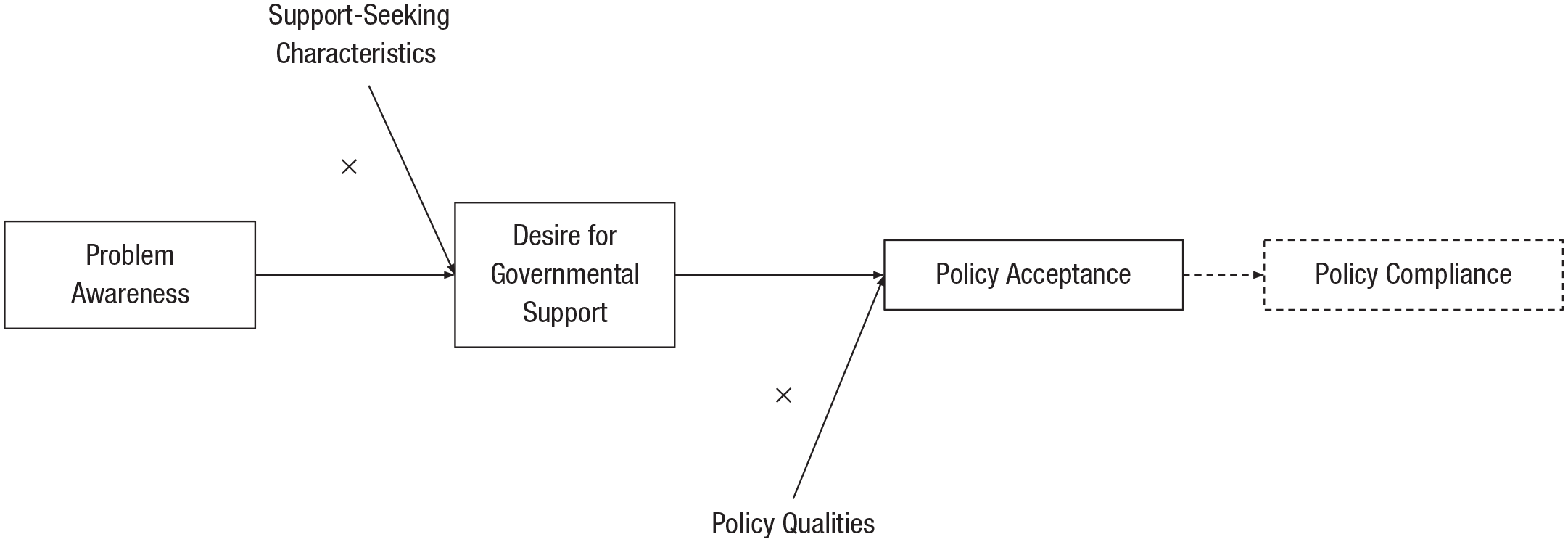
The Integrative Public-Policy Acceptance (IPAC) framework. Problem awareness predicts policy acceptance, which in turn predicts policy compliance. The desire for governmental support mediates the positive relationship between problem awareness and policy acceptance. Support-seeking characteristics shape the link between problem awareness and the desire for governmental support. Next to an averaged direct effect of support-seeking characteristics on the desire for governmental support, we assume that support-seeking characteristics interact with problem awareness predicting the desire for governmental support (depicted with an “×”). Perceived policy qualities shape the link between the desire for governmental support and policy acceptance. Similarly, next to a direct averaged effect of policy qualities on policy acceptance, we assume that policy qualities interact with the desire for governmental support predicting policy acceptance (depicted with an “×”; see text for details).
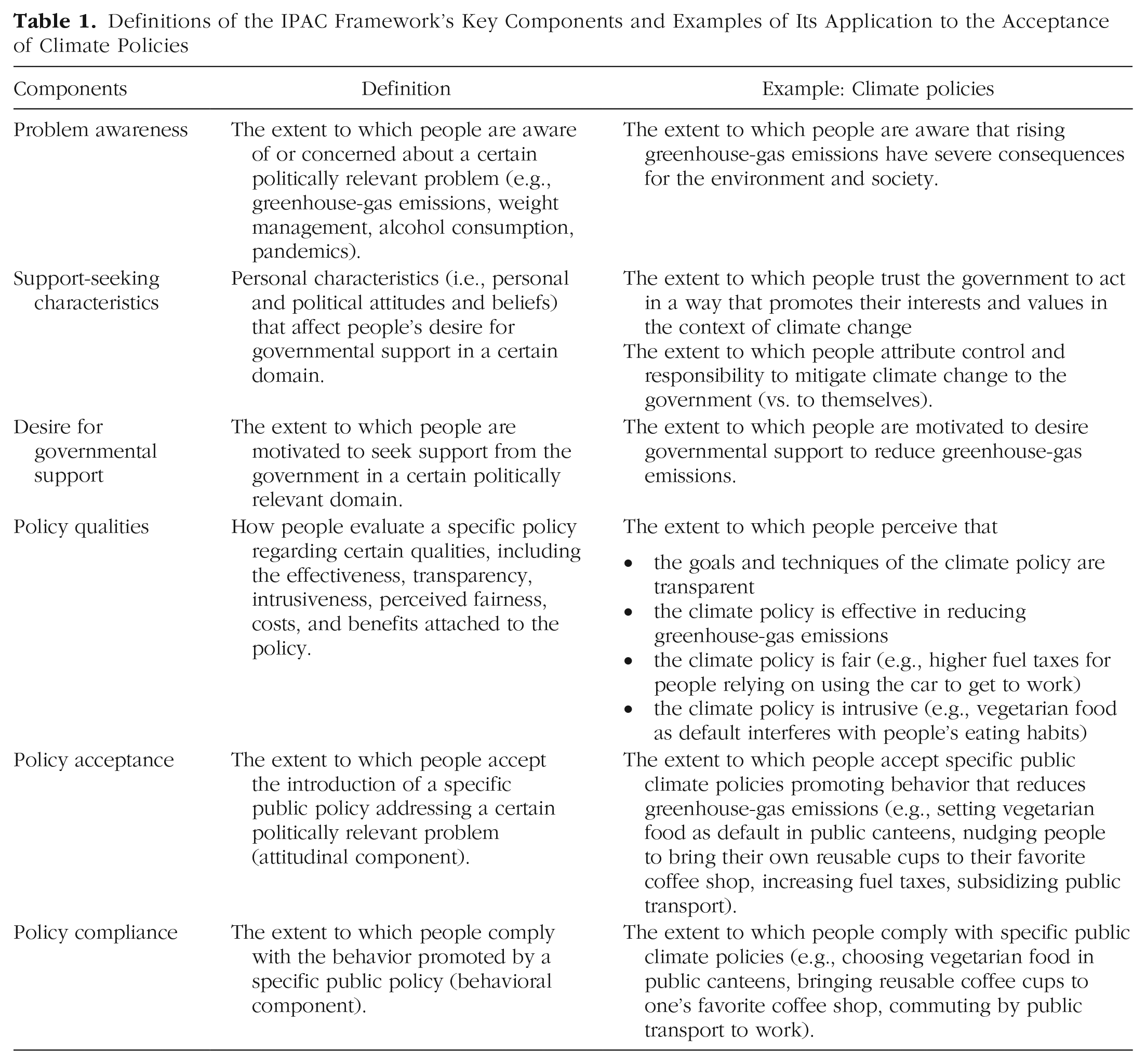
In the next section, we outline the links described in the IPAC framework and give examples of support-seeking characteristics and perceived policy qualities. We begin with problem awareness predicting policy acceptance (the attitudinal component) and, ultimately, compliance (the behavioral component). Next, we describe the interplay of key concepts that determine and shape policy acceptance. In doing so, we highlight the different strands of research on which our integrative framework builds. In Table 1, we provide a definition of the framework’s key components and illustrate how to apply them to investigate climate-policy acceptance.
Definitions of the IPAC Framework’s Key Components and Examples of Its Application to the Acceptance of Climate Policies
Problem awareness and policy acceptance (and compliance)
Across decision-making domains, empirical research has shown that problem awareness in a domain (e.g., greenhouse-gas emissions, weight management, alcohol consumption, pandemics) is a key predictor of policy acceptance (Kallbekken & Sælen, 2011; Karlsson et al., 2020; Österberg et al., 2014; Poortinga et al., 2004; Stern et al., 1999; Stoutenborough et al., 2013; Van der Pligt, 1996). For example, a longitudinal study on changes in alcohol policies and public opinions in Finland (Österberg et al., 2014) demonstrates that the more citizens became aware of the increasing alcohol problem in their country, the more strongly they favored restrictive policies. Policy acceptance and compliance research in the domain of the COVID-19 pandemic also points to a crucial role of problem awareness (Harper et al., 2021; Lewandowsky et al., 2021). Recent work by Lewandowsky et al. (2021) on public acceptance of privacy-encroaching policies countering COVID-19 spread shows how the perceived risk of COVID-19 infections predicted greater acceptance of location-tracking strategies to monitor people’s distancing behavior. Similarly, a meta-analysis identified climate-change concerns, risk perceptions, and perceived seriousness as robust predictors of public opinion about climate taxes and laws (Bergquist et al., 2022). Further evidence comes from a study on public acceptance of environmental taxes by Kallbekken and Sælen (2011). They found beliefs about consequences for the environment (followed by consequences for others and oneself) to be a relevant predictor for the acceptance of fuel taxation. A large body of empirical evidence thus points to the role of problem awareness in predicting public-policy acceptance. 4
Though not the focus of the present article on policy acceptance, our framework can be easily expanded to incorporate policy compliance (see dashed line in Fig. 1), such that higher policy acceptance is associated with higher compliance. This positive relationship derives from established prior research on attitude-behavior consistency (see the meta-analysis by Kraus, 1995), with stronger attitudes (here, higher acceptance ratings) more accurately predicting compliant behavior compared with weaker attitudes (e.g., Fazio & Williams, 1986). It is also consistent with a number of more fine-grained models spelling out how and when attitudes predict behavior (e.g., Ajzen, 1991; Fazio, 1990; Fishbein & Ajzen, 1975; Strack & Deutsch, 2004), including the influential sociopsychological theory of reasoned action (Fishbein and Ajzen, 1975) and later the modified theory of planned behavior (Ajzen, 1991) as well as the related technology acceptance model (Davis, 1989). These models show people’s behavior to be predicted by their intention to perform the behavior, which in turn is predicted by attitudes toward the behavior and subjective norms (and perceived behavioral control, in the theory of planned behavior). In the IPAC framework, policy acceptance represents the attitude component, and policy compliance is the enactment of behavior consistent with the policy.
However, we assume the relationship between acceptance and compliance is not perfect. We know from attitude-behavior research that the degree to which attitudes predict behavior varies widely and depends on boundary conditions (Kraus, 1995; McEachan et al., 2011; Sheeran & Webb, 2016; Wicker, 1969). Applied to the present context, people may show high acceptance but not behave compliantly if, for example, barriers such as low accessibility prevent them from doing so (e.g., protective face masks are hard to get or too expensive). The link between acceptance and compliance may also be ambiguous because people sometimes comply despite low acceptance (e.g., because of coercion or strong social norms). 5
Desire for governmental support
Our framework introduces a motivational, yet underresearched, component that we believe is essential to study public-policy acceptance: people’s desire for governmental support. We assume that the more aware citizens are of a problem in a particular domain (e.g., pollution, poverty, homelessness, obesity), the more strongly they will want support from the government in that domain. And the stronger their desire for governmental support, the more likely they will accept public policies as supporting tools. Integrating people’s desire for governmental support as the connecting link between problem awareness and policy acceptance raises new and exciting research questions that embrace when, why, and by whom people accept public policies. For example, why would people, aware and concerned about a particular societal problem, refuse to allow the government to intervene? What role does the identity of the support-giver play? When will people who want the government to act in a particular domain also endorse a specific policy addressing that domain?
The question of whether people actually want support from the government has been mostly overlooked in public-policy-acceptance research. Here, we argue that people’s motivation to seek governmental support may constitute a central, proximal predictor for public-policy acceptance. Considering this component more explicitly than before may, among other things, help us to understand better (a) the conditions under which problem awareness translates into policy acceptance, (b) the role of various support-seeking characteristics such as control attributions or trust in the government, and (c) the conditions under which policy qualities such as perceived effectiveness, transparency, or fairness may matter most. The central, relaylike function of this proposed component is illustrated in Figure 1. For instance, problem awareness may have a reduced impact on policy acceptance if support-seeking characteristics are low, and this may manifest in a low desire for governmental support. Likewise, without a general motivation to seek governmental support for a particular problem to begin with, specific policy qualities may not be as critical for determining the level of acceptance. To understand policy acceptance, it therefore seems important to differentiate between factors that impact people’s more general motivation to seek support and those that impact the acceptance of specific policies.
A series of empirical studies by Arad and Rubinstein (2018) suggested the relevance of the desire for governmental support in policy acceptance. They report that several participants rejected a governmental intervention embracing automatic enrollment to encourage savings, even though they would have engaged in the prompted behavior if the government had not formulated it. The researchers interpreted the finding as reactance effects in response to the pressure to behave in a particular manner. They further indicated that 14% to 25% of the participants opposed any governmental intervention. With variance by country and by specific intervention, a commonly expressed opinion was that it is not the government’s business to interfere in the private domain. The findings by Arad and Rubinstein (2018) support our idea that linking problem awareness directly to the acceptance of specific public policies misses one crucial component: people’s general attitudes toward governmental support. Interestingly, when the researchers compared policy acceptance with presenting either the government or employers as the source of implementation, Americans and Israelis indicated higher acceptance for the same policies when implemented by employers. Work by Osman et al. (2018) further points to lower support for policies when the government is the source of implementation compared with experts. Apparently, whether or not citizens accept a policy intervention does not solely depend on their evaluation of the intervention itself. It also depends on the agent behind the intervention.
Components affecting the main link
Having introduced the desire for governmental support as a key component, we now outline how the main mediation pathway in our model may be shaped by a set of support-seeking characteristics on the one hand and a set of public-policy qualities on the other (see Fig. 1). Prior research has mostly investigated support-seeking characteristics and policy qualities as proximal predictors of policy acceptance. However, we believe these proximal relationships sometimes obfuscate a theoretically more interesting interplay between problem awareness, support-seeking characteristics, desire for governmental support, and policy qualities in predicting policy acceptance.
Figure 2 illustrates how the overall (i.e., direct) relationship between a given component, such as trust in the government (see Fig. 2a) or policy effectiveness (see Fig. 2b), though positive, may result from its interplay with the components from the main link in the framework (problem awareness and desire for governmental support, respectively). In the following, we outline the support-seeking characteristics and the perceived policy qualities that the existing literature has shown to be important in determining public-policy acceptance. For each component, we describe how it interacts with the main link in our framework.
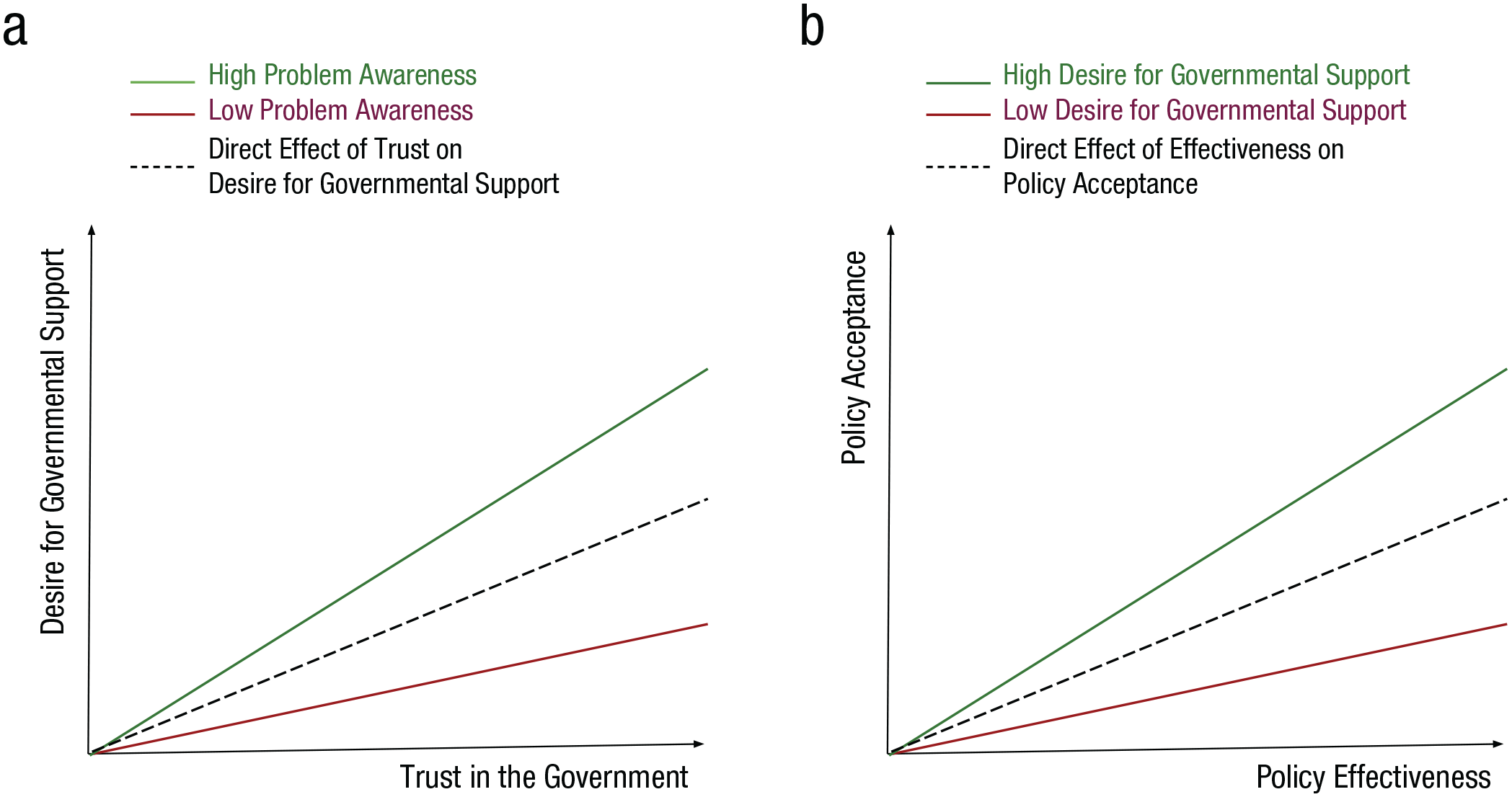
Examples of the presumed interplay between problem awareness and trust in the government as a support-seeking characteristic (a) and between the desire for governmental support and perceived policy effectiveness as a policy quality (b). In (a), trust in the government is assumed to show an overall positive relationship with the desire for governmental support (the direct effect). However, trust in the government becomes a more decisive factor when there is high rather than low problem awareness in a given policy area of interest, with highest desire for governmental support emerging from the combination of high problem awareness and high trust. In (b), perceived policy effectiveness is assumed to show an overall positive relationship with public-policy acceptance (the direct effect). However, effectiveness becomes a more decisive factor in determining acceptance when there is a high rather than low desire for governmental support in the area of interest, with highest acceptance levels emerging for the combination of high desire for governmental intervention and high perceived effectiveness.
Support-seeking characteristics
What aspects of people’s thinking and feeling lead them to seek governmental support? Given that prior research has paid little explicit attention to people’s general desire for governmental support and its drivers, we focus on identifying what we believe are the key candidates from the reviewed literature. We propose a set of individual characteristics—that is, personal and political attitudes and beliefs—that affect people’s motivation to seek support in a certain domain. These are referred to as support-seeking characteristics. We now lay out the role of beliefs about control and responsibility, political orientation, trust in the government, and value fit and how they may affect the relationship between problem awareness and the desire for governmental support.
Control attribution
Weiner’s (1995) theory of performance-related attribution and Rotter’s (1966) attribution of control emphasized the importance of attributing events to external or internal causes and their perceived controllability. Rotter (1966) discussed how control beliefs determine whether people view a particular event as within their control (internal locus of control) or subject to control by external factors (external locus of control). Previous research has suggested that control beliefs play a significant role in determining when people seek governmental support. For example, the compensatory control theory (Kay et al., 2008) classifies the experience of personal control as a central human motivation. It posits that formal social systems, such as religion and government, can provide specific structures and rules by which individuals gain control. Kay et al. (2008) showed that lower perceived personal control was associated with stronger support for governmental control in a cross-national study. Wnuk et al. (2020) supported the assumptions of the compensatory control theory. They found that a lack of personal control is positively associated with the acceptance of COVID-19 tracking technologies.
Control beliefs also play a crucial role in predicting policy acceptance in the environmental domain. Ajzen’s theory of planned behavior (1991) incorporates individuals’ perceived behavioral control, or the degree to which they believe they are capable of performing a certain behavior, as a predictor of behavioral intention and actual behavior. Botetzagias et al. (2015) applied the theory of planned behavior to predict recycling intention and found perceived behavioral control to be the most important predictor. Similarly, Liu et al. (2016) investigated the effectiveness of driving-restriction policies in encouraging commuters to use public transportation and found that perceived behavioral control was a critical precondition for the policies’ success. Recent work by Kukowski et al. (2023) reveals that people who struggle with controlling their meat consumption are more willing to relinquish control to the government and accept government intervention to achieve their goal.
These researchers studied control beliefs as proximal predictors of policy acceptance, but in our framework we propose control attribution to shape the relationship between problem awareness and the motivation to seek governmental support, advancing the acceptance of specific public policies. Thus, the extent to which higher problem awareness predicts a stronger desire for governmental support depends on whether people attribute the control to solve the problem internally or externally (i.e., to the government).
Responsibility attribution
Closely related to the work on control beliefs in the context of public-policy acceptance is whether people feel responsible for a certain problem themselves or see the responsibility as resting with others instead (e.g., the government). For example, a recent online study by Yun et al. (2019) found that Canadians who attributed the causes of physical inactivity internally (vs. externally or both internally and externally) were less supportive of policies to address this problem. Similarly, Mazzocchi et al. (2015) found that individuals who attributed blame for high obesity rates to external factors, such as the excessive availability of unhealthy foods, supported policies addressing such factors more. Although most studies focus on the direct link between responsibility attribution and policy acceptance, as argued above, we propose that the desire for governmental support is an important factor that precedes policy acceptance. Research suggests that individuals who attribute responsibility for their failures externally are more likely to seek help (Tessler & Schwartz, 1972).
We suppose that responsibility attribution shapes the relationship between problem awareness and the motivation to desire governmental support. To understand when and why people desire government intervention in a certain context (e.g., weight management), researchers should consider the extent to which people attribute responsibility for the problem internally (e.g., “I am too lazy to prepare healthy meals regularly”; “I should get more exercise”), or externally (e.g., “proper regulations should make healthy food more appealing and affordable”).
To whom people attribute control and responsibility for a certain event also depends on individual factors like political orientation. There is substantial empirical evidence across various decision-making contexts that political orientation needs attention in determining public-policy support (e.g., Gunarathne et al., 2020; Milner et al., 2019; Ramos et al., 2020; Yun et al., 2019). For instance, in a series of studies on the support for environmentally friendly airports, Milner et al. (2019) found conservatives to be less supportive than liberals. Information about the political party behind the airport proposal mediated this effect. Also, in the domain of physical inactivity, when Yun et al. (2019) examined how political affiliation affects policy support, conservatives (compared with liberals or centrists) showed less support. Importantly, the researchers found that conservatives who perceive the responsibility to solve physical inactivity as a private issue (internal attribution) showed lower support for all proposed interventions. More conservative citizens are more concerned about the state interfering with their decisions and privacy. As conservatives generally tend to preserve traditional values and ideas and to be critical of new developments, it seems plausible that they are more skeptical about governmental interventions and less willing to give up control and responsibility to the government.
Trust in the government
The relationship between problem awareness and desire for governmental support may further be influenced by the extent to which people trust the intervening agent—the government. That is, how much do they believe that the government will act in a way that promotes their welfare, even though the government’s actions are beyond their control (see Schilke et al., 2021)? Compared with control beliefs and political orientation, which both generally display characteristics shaping the proposed link between awareness of consequences and desire for governmental support, trust in the intervening agent clearly depends on who the agent is. Across decision-making domains and countries, empirical studies show that trust in the government and governmental institutions is essential for successful policy implementation (Evers et al., 2018; Eykelenboom et al., 2019; Harring & Jagers, 2013; Lewandowsky et al., 2021; Osman et al., 2018; Rodriguez-Sanchez et al., 2018; Sunstein et al., 2018, 2019). For example, a mixed-method systematic review and meta-analysis on the acceptability of a tax on sugar-sweetened beverages revealed public distrust of the government—besides perceived effectiveness, economic and socioeconomic benefit—to be an essential predictor (Eykelenboom et al., 2019). Similarly, in a comprehensive cross-country study on nudging acceptance by Sunstein et al. (2019), the authors found that countries with higher trust in their government are more supportive of governmental nudge interventions. Harring and Jagers (2013) used the value-belief-norm theory to test factors influencing support for proenvironmental policy and demonstrated improved predictive power by supplementing factors, including political or interpersonal trust. Incorporating these empirical findings into the IPAC framework, higher trust in the government can strengthen the relationship between problem awareness and desire for governmental support, promoting policy acceptance (see Fig. 2a). For instance, high problem awareness may be largely irrelevant to people’s desire for the government to intervene if they do not trust the government. Our conceptual framework suggests that the coexistence of both problem awareness and trust is necessary for the motivation for intervention to emerge.
Value fit
The extent to which people believe that the government will promote their interests and values in a certain domain also depends on how well the intentions of the public policies match the individual’s political views and personal values. Personal values shape our attitudes and choices in everyday life, including our approval and disapproval of political action. Schwartz (1994) defined values as “desirable transsituational goals, varying in importance, that serve as guiding principles in the life of a person or other social entity” (p. 21). The value-belief-norm theory (Stern, 2000; Stern et al., 1999) combines various theories and constructs, including Schwartz’s theory of universal human values (Schwartz, 1992, 1994), the Norm-Activation Model (Schwartz, 1977), and the new environmental paradigm (Dunlap & Van Liere, 1978). Empirical research based on the value-belief-norm theory confirms that values, compared with worldviews and environmental concerns, predict personal norms, intentions, and policy acceptance the best (Steg et al., 2011). For nudge interventions, citizens tend to reject those nudges they perceive as inconsistent with the prevailing values and interests (Sunstein et al., 2018). As with trust in the agent, the degree of value fit depends on who the agent is. The better the government’s intentions in power match the individual’s political views and personal values, the more willing the individual is to seek governmental support. Value fit, as a support-seeking characteristic, strengthens the relationship between problem awareness and the desire for governmental support. Problem awareness and value fit need to coexist to some extent so that a desire for governmental support can emerge.
Importantly, citizens may perceive contradicting problems within the same domain, especially when investigating policy acceptance in highly controversial contexts like abortion rights or social equality for lesbian, gay, bisexual, transgender, and queer or questioning people. Whether people wish the government to intervene in a domain may then be shaped by how well people think their values are reflected (i.e., “instantiated”; Maio & Haddock, 2010; Ponizovskiy, 2022) in the policies proposed by the government.
Perceived policy qualities
In contrast to support-seeking characteristics, which are personal characteristics shaping people’s motivation to seek governmental support in a particular domain, policy qualities address the specific qualities of a certain intervention. In the IPAC framework, we propose that policy qualities affect the relationship between the desire for governmental support and policy acceptance. Our literature review revealed several policy qualities important for policy acceptance: effectiveness, intrusiveness, transparency, and fairness. 6 Although previous literature has primarily studied these qualities as proximal determinants of policy acceptance, we argue that there is a theoretically important interplay with the desire for governmental support such that the effect of positive qualities (such as effectiveness and fairness) should be augmented. In contrast, the effect of negative qualities (such as intrusiveness and costs) should be buffered with increasing levels of the desire for governmental support.
Effectiveness
Across various decision-making contexts, including health, finances, and environment, numerous studies show the perceived effectiveness of a policy to be one of the strongest determinants for its acceptability (Bang et al., 2020; Bergquist et al., 2022; Bos et al., 2015; Cornwell & Krantz, 2014; Djupegot & Hansen, 2020; Gold et al., 2023; Hagmann et al., 2019; Mantzari et al., 2022; Pechey et al., 2014; Petrescu et al., 2016; Promberger et al., 2012; Reynolds et al., 2020; Zverinova et al., 2014). For example, in a discrete choice experiment in the United Kingdom on public acceptability of policies to reduce alcohol consumption, participants were randomly presented with a choice set varying the type of policy (minimum unit pricing for alcohol, reducing the number of alcohol retail outlets, or regulating alcohol advertising), the intensity of the policy (low, medium, high), and the effectiveness of the policy (in terms of the expected outcomes of the reduced alcohol-related crimes, alcohol-related hospital admissions, and heavy drinkers; Pechey et al., 2014). When participants considered information on the expected effectiveness of the policies, most of them then chose any given policy over the status quo. Likewise, for the environmental domain, a systematic review with secondary data analyses by Zverinova et al. (2014) concluded that people’s willingness to pay for a climate policy is strongly associated with its perceived effectiveness and probability of success. In a recent systematic review of experimental evidence across policy domains, including health, environment, education, and gun control, Reynolds et al. (2020) found that communicating the evidence of policy effectiveness to the participants increased their acceptance levels by approximately 4%, stressing the essential role of effectiveness in public-policy acceptance. As discussed, we maintain that the overall positive relationship between effectiveness and acceptance should be magnified by the desire for governmental support, yielding a synergistic interaction (see Fig. 2b).
Intrusiveness
The degree of government coercion or interference is an issue that has long been studied and discussed in political-instruments research (e.g., Doern, 1981; Doern & Phidd, 1983). It is, furthermore, a central issue in major economic debates of the last century (Hayek, 1978; Keynes, 1936). Preserving self-determined decision-making is an important value for most people in Western countries. When interventions are perceived to interfere with the public’s freedom of choice, they are likely to be rejected by the citizens (Diepeveen et al., 2013; Djupegot & Hansen, 2020; Evers et al., 2018; Hagmann et al., 2018; Huber et al., 2020; Jung & Mellers, 2016; Sunstein et al., 2018). Highly intrusive policies (i.e., policies that strongly engage in the citizen’s daily life) can be easily perceived as a threat to the target’s autonomy and evoke reactance effects (Brehm & Brehm, 2013; Evers et al., 2018). Empirical research has shown that policy intrusiveness is associated with significantly lower public acceptance across policy types and decision-making domains (Diepeveen et al., 2013; Djupegot & Hansen, 2020; Evers et al., 2018; Hagmann et al., 2018). For example, Hagmann et al. (2018) studied public acceptance of taxes, labels, and nudges directed at reducing sugar consumption and found acceptance to vary depending on the extent to which the measure interfered with the target’s everyday life. Taxes and portion-size reduction, which displayed the most intrusive policies, were accepted the least, whereas labeling and public health campaigns were accepted the most. In addition, the review on health-related policy acceptance by Diepeveen et al. (2013) also revealed lower public support for more intrusive policies, with lower support for taxation and restrictions and higher support for educational campaigns.
Our framework suggests an interplay between the desire for governmental support and intrusiveness. People should become more willing to accept policies of a more intrusive nature as the desire for government intervention increases, resulting in rising thresholds for what is considered unacceptable governmental action. In other words, the desire for governmental intervention should exert a buffering effect on the overall negative effect of intrusiveness on public-policy acceptance (see Fig. S1 in the Supplemental Material available online). For instance, realizing that a vexing societal problem such as climate change or social inequality may not go away easily and cannot be mitigated through reliance on individual responsibility or free-market forces alone may result in a stronger wish for the government to actively step in with appropriate measures (e.g., higher taxes, more severe product standards, or bans and prohibitions). This hypothesis also provides a temporal and longitudinal lens accounting for shifting calls for governmental action over time: Specifically, increases in the desire for governmental support in a given policy area (as induced, for instance, through political debate and agenda setting) may result in people becoming more accepting of policies they previously considered intrusive; conversely, decreases in the desire for governmental support may result in people becoming less accepting of existing strong government intervention.
Transparency
Across various decision-making domains, public policies receive higher approval when the goal they pursue and the ways they prompt behavior change are transparent to the target person (de Fine Licht, 2014; Gold et al., 2023; Jung & Mellers, 2016; Sunstein et al., 2018). Highly nontransparent interventions that people cannot process consciously, such as subliminal advertising and visual illusions to reduce speeding (Jung & Mellers, 2016), may easily be perceived as manipulative by the public. Among nudges, those that prompt deliberative processes (System 2 nudges), like educational nudges providing problem-specific information, receive more support from citizens compared with nudges that elicit more automatic responses (System 1 nudges), like defaults (Jung & Mellers, 2016; Reisch & Sunstein, 2016; Sunstein et al., 2018). Sunstein et al. (2019) conclude that “most citizens will disapprove of nudges that have illicit motivations; violate rights; are inconsistent with the interests and values of most choosers; that suffer from an absence of transparency; that count as manipulative; and that take people’s property without their explicit consent” (p. 23). As with effectiveness, the average positive relationship between transparency and acceptance, we assume, becomes stronger with an increasing desire for governmental support.
Fairness, costs, and benefits
The perceived fairness of a public policy plays a central role in anticipating its acceptance (Bergquist et al., 2022; Bos et al., 2015; Huber et al., 2020; Kim et al., 2013). For instance, in a survey-embedded experiment (Huber et al., 2020), perceived fairness, next to effectiveness and intrusiveness, emerged as a central predictor of public support for different environmental policies implemented to reduce vehicle emissions. In fact, fairness has been found among the key policy-specific predictors for policy acceptance in the context of climate-change taxes and laws (see meta-analysis by Bergquist et al., 2022). Moreover, fairness has been identified as the strongest predictor of acceptance of policies aimed at promoting healthy food choices (see conceptual framework by Bos et al., 2015). It is important to note that fairness judgments crucially hinge on which distributive-justice principle or norm (i.e., equity, equality, or need) is applied in a given context (Deutsch, 1975). This may be the primary reason why the same public-policy measure may be viewed as fair by some and unfair by others, often along political divides. Distributive fairness, which deals with the fair distribution of outcomes, needs to be distinguished from procedural fairness, which refers to equality of the process generating the outcome, such as the decision-making process of implementing the measure (Tyler & Smith, 1998). Ideally, then, a sophisticated assessment of the perceived fairness component in the IPAC framework would jointly consider both the distributive and procedural aspects of fairness.
However, the subjective perception of fairness may be biased by self-interest (Rodriguez-Lara & Moreno-Garrido, 2012) and personal costs. Unsurprisingly, policies associated with few personal or collective benefits or high costs (financially or psychologically; e.g., effort) are more likely to be rejected (de Groot & Schuitema, 2012; Hagmann et al., 2019; Rodriguez-Sanchez et al., 2018; Schuitema et al., 2010). For instance, work by Hagmann et al. (2019) shows that public support for carbon taxes was reduced when a low-cost green-energy default nudge was introduced, but this effect disappeared when the perceived economic costs of the tax were minimized and, additionally, when the lower effectiveness of the default nudge was highlighted. Studies have further demonstrated that policies prompting a particular behavior change receive less approval from individuals who enjoy and engage in these behaviors (Sunstein et al., 2019). Here, the psychological costs to change the behavior are obviously higher than stopping a less enjoyable behavior. Again, we assume that the established overall positive effect of benefits becomes more pronounced and that the negative effect of costs becomes alleviated as people harbor a strong rather than weak desire for governmental support.
Conceptualizing further sources of variation
Variation by decision-making domain
On the basis of the literature review, we suggest that considering factors such as problem awareness and support-seeking characteristics may help us to understand how the acceptance of policies varies by the decision-making domain they are implemented in. For example, in the health domain, Diepeveen et al. (2013) found that antismoking interventions received the highest public approval compared with similar interventions addressing alcohol consumption, diet, and physical activity. The authors explain these findings, to some extent, by citizens’ awareness of the serious consequences associated with smoking—which suggests that these results may be connected to problem awareness as the entry point in our framework. Similarly, Reynolds et al. (2019) found that policy acceptance varied across domains, with tobacco-use interventions being more acceptable than alcohol and snack-consumption interventions. Whereas nudge interventions receive relatively high support overall in the health domain (Reisch et al., 2017), they are less accepted in the financial domain (Gold et al., 2023). Presumably, then, people seem to hold varying beliefs regarding the extent to which various spheres of life require policy support. From the vantage point of our framework, such variability across domains (while keeping the policy constant) may best be understood as resulting from the interplay of problem awareness, control beliefs, and possibly other factors in shaping the desire for governmental support in a given domain. In any case, a more precise understanding of the proximal and distal determinants of these domain-level differences (possibly also including political socialization and culture-historical roots) seems an intriguing avenue for future research.
Variation by policy type
Policy acceptance further varies by policy type, with highest approval for information-based interventions, such as educational campaigns, and significantly lower approval for price-based interventions, like taxation (Diepeveen et al., 2013; Hagmann et al., 2018; Petrescu et al., 2016). Behavioral interventions, such as nudges, are generally well accepted across various countries (Bauer et al., 2021; Hagman et al., 2015; Jung & Mellers, 2016; Reisch et al., 2017; Reisch & Sunstein, 2016; Reynolds et al., 2019; Sunstein et al., 2018), especially when compared with traditional price-based interventions. The reviewed literature suggests that the different types of policies can be assigned to certain combinations of policy characteristics, which entail a trade-off (e.g., Arad & Rubinstein, 2018; Diepeveen et al., 2013): Less intervening policies (such as nudges and educational campaigns) are generally perceived as less intrusive and costly but also less effective compared with more intervening interventions (such as taxation and regulations). From our framework, the observed policy-specific variations in public-policy acceptance can be best understood as resulting from the interplay between people’s desire for government intervention and the policy qualities that affect the acceptance of a given policy.
The IPAC framework allows us to compare differences in public-policy acceptance across domains and policies (see also the section that follows outlining a multilevel approach). Moreover, by including policy-level measures of perceived qualities as well as domain-level measures of the desire for governmental intervention, researchers can investigate the extent to which such variation at the policy-type or policy-domain level may be parsimoniously accounted for (i.e., reduced to) by such model components. For instance, are the observable differences between nudges, taxation, and law mostly mediated by their different profiles regarding central perceived public-policy qualities such as effectiveness, transparency, intrusiveness, and fairness? To what extent can differences between domains (Diepeveen et al., 2013; Gold et al., 2023; Reynolds et al., 2019) be accounted for by differences in people’s desire for the government to support citizens in a given domain or in regard to a given problematic behavior of interest? It is our hope that the proposed framework is one step toward connecting these seemingly diverse areas of research more closely with each other.
Public-Policy Acceptance as a Bridge Connecting the Individual and the System Level
A recent debate concerning the role of behavioral science in public policy by Chater and Loewenstein (2022) criticizes a prevailing focus on solving political problems by introducing interventions changing individual behavior (referred to as adopting an i-frame) rather than by addressing the system in which individuals operate (referred to as an s-frame; see Chater & Loewenstein, 2022). In light of the relevance of this debate, we briefly situate the IPAC framework here: In our perspective, policy acceptance is at the intersection of the individual level and the political system, as citizens’ demand for governmental intervention and the respective approval or disapproval of certain policies may bring about systemic changes (e.g., the introduction of new regulations). In other words, acceptance is an important bridge connecting the individual with the system level because it assigns a political role to the individual for initiating and advancing system-level change. Using the IPAC framework to examine when and why citizens accept a particular policy allows researchers to focus on this political function of individuals in driving systemic change while also considering underlying psychological facilitators and barriers.
Our framework is useful for addressing that public policies should enable societal change (e.g., toward sustainability) as it can model the determinants for accepting s-frame interventions such as regulations and incentives. Moreover, it can help identify possible avenues for communicating and promoting s-frame solutions for policymakers. To give a concrete example: Using the IPAC framework, behavioral scientists could examine how support-seeking characteristics and policy qualities interact in shaping the acceptance of i-frame versus s-frame interventions. As laid out above, citizens usually perceive regulations (vs. nudges) as more restrictive for their everyday life but also as more effective in solving the addressed political problem, presenting a trade-off (e.g., Arad & Rubinstein, 2018; Diepeveen et al., 2013). Our framework holds that this balance may tilt more strongly in favor of regulations to the extent that the desire for governmental intervention increases (because of both the stronger weighing of differences in policy effectiveness and the buffering against the negative effect of intrusiveness). Thus, raising problem awareness while strengthening trust in the government next to other support-seeking characteristics may be particularly important stepping stones for promoting the acceptance of the s-frame type of policies. 7
Testing the IPAC Framework
So far, the components of our framework are modeled on carefully reviewed empirical studies and established models on predictors of attitudes and behaviors. Most of the reviewed empirical work is cross-sectional in design. Cross-sectional studies provide a useful starting point to test the IPAC framework, as they allow inferences about covariation among variables and the strength of such relationships (Burkley & Blanton, 2008), often with high statistical power. Simple cross-sectional studies, however, are limited in a number of ways. In the following, we discuss alternative useful research designs for testing the hypotheses from the IPAC framework (or related questions regarding public-policy acceptance): experiments, field experiments, longitudinal studies, and multilevel designs. Each of these improves on the typical cross-sectional design in unique ways while having specific advantages and limitations. We hence believe that public-policy-acceptance research of this kind will advance fastest through a combination of such approaches.
Experimental approaches, field experiments, and longitudinal designs
To further draw causal conclusions for specific proposed relationships in the IPAC framework, the determinants of interest could be manipulated in an experimental setting. For example, Arad and Rubinstein (2018) manipulated the degree of policy effectiveness to study its effects on the acceptance of behavioral interventions. Focusing on our proposed main link (problem awareness predicts desire for governmental support, which in turn predicts policy acceptance and compliance), one could manipulate problem awareness by providing two groups with different sets of information on a certain issue that is not obviously concerning to most people (e.g., an article indicating that drinking one glass of red wine per day has a positive effect on health, vs. an article indicating negative consequences for health, vs. a control group without any intervention) and then test how the different levels of problem awareness affect the desire for governmental support.
One limitation of this approach is that only one causal link can be investigated in a given setting. To test the framework more comprehensively, a causal-chain approach could be applied (e.g., Spencer et al., 2005). For instance, a research program manipulating problem awareness in a given setting would next attempt to manipulate the desire for governmental intervention with suitable paradigms (e.g., presenting selective examples of how governmental intervention has helped vs. harmed solving societal problems in the past) to establish mediation, or to jointly manipulate a predictor (e.g., problem awareness) and moderator variable (e.g., control attributions) in the framework to test for moderation.
A second limitation is the typical trade-off of high internal validity for drawing causal conclusions against aspects affecting the external validity of the research (e.g., artificial nature of stimuli, lack of representativeness or relevance; Campbell, 1957; Lin et al., 2021). One potential remedy may lie in field experiments conducted in naturalistic settings. However, in light of the nature of public policy, it may be challenging, and often not feasible, to manipulate the variables of interest in real-world policymaking contexts involving political stakeholders such as city, regional, or national governments or other political agents and institutions. (Perhaps this type of field research may be easier to conduct in organizational settings.)
A second promising but challenging approach to combining the potential for causal inference with high external validity is longitudinal research design. Longitudinal approaches can be used to test causal-ordering assumptions by quantifying the over-time effects of the key framework components (Burkley & Blanton, 2008; Roth & MacKinnon, 2012). For instance, research may track changes in problem awareness, desire for intervention, and policy acceptance for a given issue over time. The cross-lagged effects from at least three (appropriately timed) measurement occasions may be harnessed to examine the assumed mediation longitudinally. Moreover, intensive longitudinal data (Bolger & Laurenceau, 2013), such as those collected via experience-sampling, can yield important additional insights. In a typical experience-sampling study, participants are repeatedly asked to report their feelings, thoughts, and behaviors regarding a certain research question right in their natural environments and over time (e.g., Conner et al., 2009; Hofmann & Patel, 2015). This method has, for instance, been applied to study everyday dynamics in political trust (Baumert et al., 2017) and may be particularly useful in studying how political processes—such as a political scandal, or an announcement of a new policy proposal—interact with the psychological variables in the IPAC framework, such as the evaluation of policy qualities or trust in the agent.
Multilevel approach
The above-mentioned approaches typically zoom in on a narrower set of policy measures and domains (e.g., manipulating awareness in one domain of interest; tracking public-policy acceptance toward one policy measure over time). They are, therefore, limited in terms of comprehensiveness or generalizability. It may be useful to complement these approaches with a powerful multilevel approach to studying public-policy acceptance across policy types and domains, as well as other sources of variability. Though correlational in nature, multilevel modeling allows researchers to unite multiple levels of analysis (or sources of variability) relevant to the study of public-policy acceptance comprehensively within one statistical framework and with high statistical power. These levels may include the policy level, the policy area or domain level, the person or dispositional level, and even higher-order levels such as group or party membership and the cultural or national level in which citizens are embedded. Specifically, the power of the multilevel design stems from the repeated observations and the combination of levels of analysis. A multilevel approach takes care of dependencies among the clustered data and, among other things, allows the researcher to gauge how much variability in the dependent outcome is due to each level of analysis (such as type of policy measures, policy area, and dispositional influences), and to determine the joint influence of each predictor of interest as well as cross-level interactions on the outcome (e.g., Snijders & Bosker, 2011). The approach is highly flexible, so different hierarchical models of interest may be the focus of interest.
We will use the example of climate policy to illustrate how the multilevel approach could be harnessed to study variability in public-policy acceptance. Starting with simple designs, a straightforward two-level design may focus on various types of policy measures (e.g., information campaigns, nudges, incentives, bans) in one given policy domain of interest (e.g., meat consumption) nested in participants. In such a design, only variability at the concrete policy level (Level 1) and at the individual level (Level 2) is implemented, but not variability between policy domains (hence this level is skipped). Another version of a two-level design is one in which one and the same policy type, perhaps taxation, is examined across a large range of policy domains (e.g., meat consumption, energy consumption, air travel). Here, policy domains represent Level 1 and individuals Level 2, and no separate policy level of analysis is introduced. Needless to say, the first design’s focus will be on how different public-policy measures are accepted on the basis of policy-level determinants and their interplay with dispositional variables. In contrast, the second design’s focus will be on how domain-related aspects (such as a desire for governmental support in that domain) and their interplay with dispositional variables shape the acceptance of taxation in those domains.
From here, it is easy to see how a more complete design allows better integration of questions pertaining to the specific policy level, the policy-domain level, and the individual level. This three-level design is illustrated in Figure 3. This example illustrates how researchers can apply the IPAC framework to study the acceptance of various climate policies in multiple environmental domains (see Table 1). At the highest level of the design, participants provide demographic or dispositional information, such as gender, age, political affiliation, and general level of trust in the government. At the domain level (Level 2), participants indicate their concern about five different environmental decision-making areas (meat consumption, car use, electricity consumption, traveling by plane, water consumption) and their problem awareness, desire for governmental support, and any further domain-related measures. For each domain, participants are presented at Level 1 with statements representing three different public-policy interventions (nudges, incentives, and laws) and asked to indicate the extent to which they would accept each policy (the dependent outcome). Also at Level 1 are measures regarding the perceived qualities of each policy, such as effectiveness, transparency, and fairness. Multilevel analyses, including multilevel path analysis, can then be used to test the mediation and moderation predictions of the framework (e.g., Preacher et al., 2010). As mentioned above, a multilevel perspective allows the researcher to extend the IPAC framework toward even higher levels of analysis, such as addressing cultural- or national-level differences (e.g., country-specific differences in political systems and culture). In summary, we believe that even more complex frameworks of public-policy acceptance, such as the IPAC framework, can be tested with a combination of sophisticated experimental and correlational approaches.
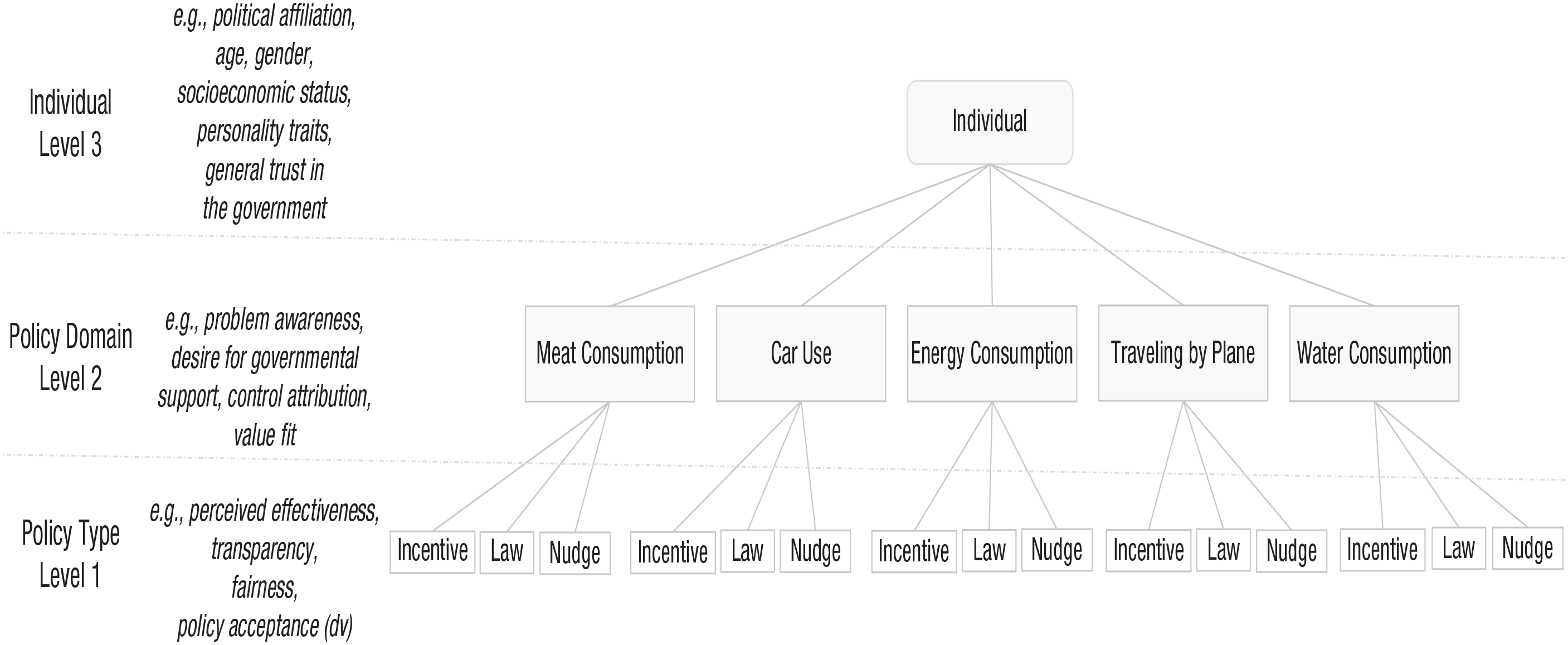
Example of a multilevel design to study the acceptance of climate policies. In this example, three policy tools (incentive, law, and nudge) are nested within each of the five policy domains in climate policy (e.g., meat consumption, car use), and each individual provides information on all five domains. The italicized constructs provide examples for measures at each level of analysis. For instance, participants evaluate each policy’s qualities, such as perceived effectiveness, in a given domain and rate their acceptance of each policy (the dependent variable, dv). At Level 2, they indicate their desire for governmental support for each policy domain; at the individual level, they indicate their (dispositional) political affiliation. Note that only one individual of the entire sample is shown in this example and that even higher levels of analysis (e.g., group, nation) are possible (see text for details).
General Discussion
The main objective of this review article is to provide an integrative framework for understanding when and why people accept public policies across different decision-making contexts. Anticipating public-policy acceptance is crucial to develop politically feasible and effective public-policy interventions. At the same time, explaining policy acceptance is a challenging task because of the complex interactions of various factors jointly determining citizens’ acceptance levels. We sought to identify the most relevant key psychological determinants of public-policy acceptance, to specify how they may be interrelated, and to integrate them into a unified, applicable framework of public-policy acceptance (Fig. 1).
Moreover, we introduced a hitherto overlooked motivational component as an essential proximal predictor of public-policy acceptance: people’s desire for governmental support. We conceptualized it as the missing link connecting problem awareness with policy acceptance: All else being equal, the more aware citizens are of a given societal problem, the more they should desire the government to do something about it, and the more they desire governmental support, the more readily they should accept policies targeting the problem. However, this is only the base of the framework: We further posited that support-seeking characteristics, including control and responsibility beliefs, trust in the government, and political orientation, shape the relationship between problem awareness and people’s motivation to seek support from the government. Additionally, we assumed that the overall positive effect of policy-specific qualities such as perceived effectiveness, transparency, and fairness may depend on people’s desire for governmental support, whereas the overall negative effect of policy-specific qualities such as intrusiveness or personal costs may be buffered by it. In sum, knowing whether people are aware of a certain problem and whether they are motivated to seek support from the government to address that problem may help us better understand how key psychological determinants further shape public-policy acceptance.
Extending the IPAC framework
The IPAC framework is applicable to research questions on different levels of analysis: Besides studying individual differences in policy acceptance at the micro level (e.g., differences in how people responded to restrictions during COVID-19, such as mask mandates), differences at the macro level, such as country- or culture-specific influences, can also be studied. Similarities within social systems, like similar ways of responding to contexts, processing information, and interpreting the meanings of events, evoke differences between social systems in values, beliefs, and behaviors, thereby defining culture (Smith et al., 2013). When we applied the proposed framework, we could identify cross-cultural differences in the acceptance of and compliance with public-policy interventions. For instance, researchers may be interested in studying and comparing public-policy acceptance in societies that differ with respect to their collectivistic versus individualistic views (as identified by Hofstede, 2001) or in their political values and governmental structures (e.g., mask adherence in Japan vs. in the United States). Using the framework to study specific proposed interrelations for extremist groups might further reveal fruitful insights for acceptance research. For example, when we think about conspiracy theorists denying the existence of COVID-19, they probably oppose governmental interventions in this context in such a generalized way that solely enhancing the interventions’ qualities (e.g., devising more transparent, effective, beneficial, and less intrusive policies) would not change their reactant attitudes and behaviors toward restrictions related to COVID-19. One probably has to intervene at earlier stages in the framework to elicit changes and tackle support-seeking characteristics, such as strengthening people’s trust in the government.
Depending on the research objective, this integrative acceptance framework allows future research to add or focus on specific factors presumed to predict policy acceptance and compliance. This also includes field-experimental tests of certain model pathways. For instance, to scrutinize the proposed impact of control beliefs on the desire for governmental support, researchers could experimentally examine how the relationship between problem awareness and desire for governmental support is shaped when experimentally highlighting high versus low degrees of internal control ascription or, relatedly, high personal self-efficacy versus high collective self-efficacy (Fritsche et al., 2018) for a given societal problem of interest.
The broader underlying argument regarding control beliefs may deserve some further attention at this point. Internal attribution of control, personal autonomy, and self-efficacy are all considered hallmarks of good psychological functioning and individual well-being (Bandura, 1982; Ryan & Deci, 2000). However, when viewed through the lens of policymaking, overly high levels of internal control and associated beliefs may be in tension with what may, according to our analysis, be the optimal psychological basis for desiring and accepting effective public policy—that is, realizing that one cannot solve the problem on one’s own and that, instead, the best solution to many vexing problems (such as climate change, the obesity epidemic, inadequate retirement savings, and so forth) may lie in substantive public policymaking that tackles the structural roots of these problems.
For many members of our discipline, this message regarding some of our most established constructs and interventions may not be digested easily. However, as has been repeatedly argued (e.g., Chater & Loewenstein, 2022; Shove, 2010), psychology’s overly strong focus on individual-level solutions and interventions, including those aimed at encouraging control, self-efficacy, and individual lifestyle changes, may, somewhat ironically, undermine support for public-policy solutions at the systems level that are more intrusive but also more effective and transformative (Chater & Loewenstein, 2022; Hagmann et al., 2019). The present framework helps to interlink the individual and the system frame of analysis by providing several clues as to the psychological foundations for a strong desire for governmental intervention (with potentially transformative effects). From this perspective, helping citizens and public policymakers gain a well-calibrated sense of the things that lie within citizens’ own possibilities and the things that might be better addressed at a structural level could be an important step in the struggle for societal welfare and crisis solving.
Though speculative at this point, further insights regarding the desire for governmental support may be gleaned from attachment research (e.g., Bowlby, 1978) on the quality of people’s relationship with the state. Perhaps there are parallels to interpersonal attachment styles (e.g., secure, preoccupied, dismissing, disoriented) that undergird or go beyond the trust component in our framework. In a study on mobility and security of citizenship for resettled young people from refugee backgrounds, Nunn et al. (2016) concluded that stable citizenship increases the individual’s feeling of security by offering a secure base that allows them to participate in social and political situations. Individuals with a more secure attachment to the government might be more likely to wish for and endorse political interventions than individuals with a more dismissing attachment style. Furthermore, we believe there are many useful threads with regard to certain areas in organizational psychology. Applying the framework to organizations by swapping “citizens” with “employees” and “the government” with “the management” may reveal interesting parallels between areas and also stimulate new questions and answers regarding, for instance, the factors determining whether employees accept a newly proposed company policy as part of its organizational-change process.
Finally, if one thinks of policy acceptance as a more dynamic process, people’s experiences with certain policies might reflect back on earlier stages of the IPAC framework—that is, on the trust in and desire for government intervention. Here, unexpected positive experiences with implemented policies may increase people’s trust in the government, whereas unexpected disappointing or even frustrating experiences may generate distrust. Suppose free public transport was introduced to reduce greenhouse-gas emissions, but unexpectedly led to high burdens for individuals (such as crowded trains, long delays, missed appointments). In such instances people might perceive the government as incompetent or hasty, and the result might be a reduced desire for further government intervention. Thus, the IPAC framework could be extended by drawing a feedback loop from compliance to support-seeking characteristics and the desire for government intervention. Future research is needed to test such feedback mechanisms.
Limitations
The reviewed empirical studies focused mainly on a selected set of policy-acceptance determinants in specific behavioral contexts, mostly in the health and environmental domain. We have outlined here various methodological approaches on how this may be achieved in a way that balances internal and external validity—that is, by relying on a combination of experimental methods, field experiments, and longitudinal designs. Regarding generalizability, because policy acceptance varies depending on the decision-making context and the policy type (Diepeveen et al., 2013; Gold et al., 2023; Reynolds et al., 2019), the framework should be applied across various decision-making contexts and public policies. The multilevel approach may provide an ideal basis for accomplishing this even within a single undertaking.
Moreover, the framework provides only a first step for categorizing the key determinants of public-policy-acceptance research into support-seeking characteristics and policy qualities. Given that we are the first to explicitly ask which variables may shape the desire for governmental support (such as trust in the government) and how the desire for governmental support may, in turn, interact with policy qualities, we centered our discussion on those constructs from the literature for which a compelling case can be made while attempting to suggest potential for integration of other factors, such as policy-domain-level effects. Future research is needed to scrutinize and advance this suggested distinction and to clarify potential overlap and redundancies among constructs.
Conclusion
We have offered an integrative, review-based framework to facilitate the investigation of predictors for the acceptance of public-policy interventions, as well as the interrelations of such predictors, across intervention types and decision-making domains. The framework introduces the desire for governmental support as an integral motivational component linking problem awareness and policy attitudes. The novel link evokes new and exciting research questions on when, why, and by whom people endorse public policies. This framework demonstrates how support-seeking characteristics and policy qualities may shape the relations between awareness, desire for governmental support, policy acceptance, and (ultimately) compliance. The illustrated insights may enrich existing evidence-based guidelines on increasing the likelihood of successful policy implementation.
Supplemental Material
sj-docx-2-pps-10.1177_17456916231180580 – Supplemental material for When and Why Do People Accept Public-Policy Interventions? An Integrative Public-Policy-Acceptance Framework
Supplemental material, sj-docx-2-pps-10.1177_17456916231180580 for When and Why Do People Accept Public-Policy Interventions? An Integrative Public-Policy-Acceptance Framework by Sonja Grelle and Wilhelm Hofmann in Perspectives on Psychological Science
Supplemental Material
sj-pdf-1-pps-10.1177_17456916231180580 – Supplemental material for When and Why Do People Accept Public-Policy Interventions? An Integrative Public-Policy-Acceptance Framework
Supplemental material, sj-pdf-1-pps-10.1177_17456916231180580 for When and Why Do People Accept Public-Policy Interventions? An Integrative Public-Policy-Acceptance Framework by Sonja Grelle and Wilhelm Hofmann in Perspectives on Psychological Science
Footnotes

References
Supplementary Material
Please find the following supplemental material available below.
For Open Access articles published under a Creative Commons License, all supplemental material carries the same license as the article it is associated with.
For non-Open Access articles published, all supplemental material carries a non-exclusive license, and permission requests for re-use of supplemental material or any part of supplemental material shall be sent directly to the copyright owner as specified in the copyright notice associated with the article.
