




Abstract
Self-control denotes the ability to override current desires to render behavior consistent with long-term goals. A key assumption is that self-control is required when short-term desires are transiently stronger (more preferred) than long-term goals and people would yield to temptation without exerting self-control. We argue that this widely shared conception of self-control raises a fundamental yet rarely discussed conceptual paradox: How is it possible that a person most strongly desires to perform a behavior (e.g., eat chocolate) and at the same time desires to recruit self-control to prevent themselves from doing it? A detailed analysis reveals that three common assumptions about self-control cannot be true simultaneously. To avoid the paradox, any coherent theory of self-control must abandon either the assumption (a) that recruitment of self-control is an intentional process, or (b) that humans are unitary agents, or (c) that self-control consists in overriding the currently strongest desire. We propose a taxonomy of different kinds of self-control processes that helps organize current theories according to which of these assumptions they abandon. We conclude by outlining unresolved questions and future research perspectives raised by different conceptions of self-control and discuss implications for the question of whether self-control can be considered rational.
Keywords
Self-control denotes the ability to resist temptations and override impulsive or habitual responses to render behavior consistent with superordinate long-term goals or social norms (Inzlicht et al., 2021; Vohs & Baumeister, 2017). 1 Deficient self-control has been associated with a wide range of harmful behaviors such as unhealthy eating habits, lack of exercise, insufficient academic effort, substance use, and impulsive aggression (Duckworth, Taxer, et al., 2019; Kotabe & Hofmann, 2015; Nielsen et al., 2019). Despite the relevance of self-control for adaptive behavior and mental health, and despite impressive research efforts, the cognitive and neural mechanisms underlying self-controlled behavior remain a matter of intense debate.
On the one hand, dual-systems theories conceive of self-control as the suppression of an “impulsive” by a “deliberative” or “reflective” system (Deutsch et al., 2017; Grayot, 2019; Hofmann, Friese, & Strack, 2009; McClure et al., 2004). Alternatively, it has been suggested that self-controlled behavior does not reflect a struggle between competing impulsive and reflective systems but rests on a value-based decision process, whereby a unitary valuation system integrates short- and long-term gains and costs of choice options into a common value signal that determines behavioral choice (Berkman, Hutcherson, et al., 2017; Hare et al., 2009; Kable & Glimcher, 2007; Krönke, Wolff, Mohr, et al., 2020). Another controversy concerns the highly influential view of self-control as a limited “willpower” resource (Baumeister et al., 2018) that gets depleted by the effortful inhibition of unwanted desires and impulses. This view has been challenged on both empirical (Friese et al., 2018; Job et al., 2010, 2013) and theoretical grounds (Inzlicht et al., 2014; Lurquin & Miyake, 2017), and it has alternatively been proposed that the recruitment of self-control is often an automatic and effortless response to motivational conflicts rather than an effortful mobilization of willpower or inhibitory control (Fujita, 2011; Gillebaart & de Ridder, 2015).
Here we argue that beneath such debates lies a more fundamental conceptual paradox that is inherent in the very concept of self-control, understood as a set of strategies that individuals intentionally recruit to override a transiently more attractive desire when it stands in conflict with a currently less attractive superordinate or long-term goal. Although this paradox has occasionally been discussed in philosophical action theories (Barnes, 2019; Bermúdez, 2018b; Mele, 2013; Sripada, 2014), to the best of our knowledge it has been almost completely neglected in psychology and cognitive neuroscience. This is quite remarkable not only because of its relevance for philosophical analyses but also its profound implications for psychological theories of self-control. In particular, how one resolves this paradox has implications for (a) the debate surrounding dual-systems theories of self-control, (b) the question of whether self-control is an intentional process or an automatic response to goal-desire conflicts, (c) the relation between interventive and preventive forms of self-control, and (c) the normative question of whether and in what sense self-control can be considered rational.
The aim of the current analysis is to raise awareness for often left implicit assumptions underlying the concept of self-control and show why these assumptions, when taken together, raise a conceptual paradox. On the basis of a detailed analysis of possible resolutions of the willpower paradox, we propose a taxonomy of different forms of self-control that helps to organize current theories according to which assumptions about self-control they maintain and which they abandon. For each resolution and the corresponding theories we discuss key unresolved questions and outline perspectives for future research. Finally, we discuss implications of our analysis for the philosophical debate about whether and in which sense self-control can be considered rational and address the question of whether the summary concept self-control should be functionally decomposed into a set of specific mechanisms.
The Willpower Paradox
Self-control comprises a variety of cognitive mechanisms that serve to support the pursuit of superordinate long-term goals when they conflict with otherwise stronger desires or transiently more rewarding goals (Duckworth, Taxer, et al., 2019, p. 374). These strategies include response inhibition (Berkman et al., 2011; Krönke et al., 2018; Wolff et al., 2016), control of selective attention (Friese et al., 2010; Harris et al., 2013; Mischel et al., 1972), volitional down-regulation of craving (Hofmann, Friese, & Roefs, 2009; Kober et al., 2010; Kruschwitz et al., 2018), episodic future thinking (Peters & Büchel, 2011; Schacter et al., 2017), and the generation of anticipatory emotions to increase the salience of future outcomes (Kotabe et al., 2019; Kruschwitz et al., 2018). The common function of these strategies is to override a desire or motivational tendency that would otherwise, without the exertion of self-control, determine behavioral choice. A prototypical example is a person who intends to stick to a healthy diet but is tempted by the sight and smell of a tasty hamburger. Unless the person succeeds in recruiting self-control when they are tempted—so the assumption goes—the current desire will determine behavior, and the person will choose the immediate reward because the desire for the hamburger is the strongest motivational force at the moment of choice (otherwise, self-control would not be needed in the first place).
This concept of self-control as a means to override a currently stronger desire to render behavior congruent with long-term goals has been termed “synchronous self-control” in philosophy (Sripada, 2014) and “interventive self-control” in psychology (Hofmann & Kotabe, 2012) and is the form of self-control that has received the most attention in empirical research. 2 However, plausible as it may appear, synchronous self-control raises a seemingly simple yet fundamental question. If, at the moment of decision, a person comes to the conclusion that—all things considered—a desire (e.g., to eat a hamburger) is the most preferred option and subjectively more valuable than a superordinate goal (e.g., to lose weight or to stay healthy), what could then be the motivational basis for the self-initiated recruitment of self-control? In other words, why would one be motivated to intentionally override one’s strongest desire to render behavior congruent with a long-term goal that is less preferred and considered less valuable than the competing desire? Conversely, on the other horn of the dilemma, if the long-term health goal is stronger (more preferred, more valuable) than one’s current desire for a hamburger, there appears to be no need for self-control in the first place because the health goal would determine behavioral choice anyway. In short, it appears paradoxical to say that a person most strongly desires to enact a specific behavior (eat a hamburger) and at the same time most strongly desires to prevent themselves from enacting the behavior by recruiting self-control (for a philosophical exposition of this conceptual paradox, see Sripada, 2014).
One might object that our exposition of the willpower paradox rests on an overly static and unrealistic conception of self-control as referring to a single binary choice between a goal and a desire, whereas in reality behavioral choices are dynamic processes that unfold over more or less extended time. According to a dynamic view, evidence for competing motivational or response tendencies is sampled and accumulates until a decision or response threshold is reached (Berkman, Hutcherson, et al., 2017; Harris et al., 2013; Krajbich et al., 2012). Because this process is inherently noisy, the strength of competing goals and desires may fluctuate until one motivational tendency exceeds a decision threshold (Ratcliff et al., 2016; Turner et al., 2019). However, although such a dynamic perspective is a more realistic conception of behavioral choice, it does not eliminate the willpower paradox. In fact, the question of what motivates the recruitment of self-control can be raised at each time step during an unfolding evidence-accumulation process. That is, at any given point during the waxing and waning of competing desires and goals, either the desire or the long-term goal will be the strongest motivational force, even though neither of the two may have yet superseded a decision or response threshold. We can thus reiterate the paradox at each time step of the decision process: When at a time t the motivational strength of the desire is larger than that of the long-term goal, there is no motivational basis for intentionally recruiting self-control; conversely, when the motivational strength of the long-term goal at time t is larger than that of the desire, self-control appears superfluous.
The remainder of this article is structured as follows. We first make explicit three basic assumptions about self-control and behavioral choice that are implicit in the informal example of self-control described above and that—when taken together—give rise to the willpower paradox. Next we describe three possible resolutions of the willpower paradox, each of which results from abandoning one of the three assumptions and corresponds to a particular class of self-control theories. We then discuss theoretical and empirical challenges faced by each resolution, outline implications for future research, and discuss whether recent evidence that self-control may have an intrinsic value might suggest a fourth resolution of the willpower paradox. Finally, we outline implications of our analysis for the question of whether self-control can be considered rational and whether it constitutes a unitary or nonunitary construct.
Three Possible Resolutions of the Willpower Paradox
Whether a theory of self-control raises the conceptual paradox outlined above depends critically on which assumptions one makes about the nature of self-control and behavioral choice. More specifically, we argue that it is the conjunction of three common assumptions, which are often left implicit or even taken as self-evident, that give rise to the willpower paradox.
Intentionality assumption. The recruitment of self-control strategies is an intentional, self-initiated and deliberate process.
Unitary-agent assumption. Persons are unitary agents in the sense that when intentionally choosing actions or cognitive strategies, their choices are determined by which option has the highest subjective expected utility of all options considered at the moment of choice.
Synchronicity assumption. Self-control serves to override one’s currently strongest (most preferred) desire, that would otherwise determine behavioral choice, in favor of a currently weaker (less preferred) superordinate or long-term goal.
Each of these assumptions has been explicitly endorsed or implicitly assumed in a wide range of prominent theories of decision-making and self-control.
Self-control is usually defined as “the self-initiated regulation of thoughts, feelings, and actions” (Duckworth, Taxer, et al., 2019, p. 374) and “the deliberate, conscious, effortful subset of self-regulation” (Baumeister et al., 2016, p. 351), in line with the first assumption. Accordingly, it is assumed that the recruitment of self-control involves a “decision to inhibit or to override an unwanted behavior” (Hofmann, Friese, & Strack, 2009, p. 165) and that the mobilization and allocation of control strategies is the result of “a value-based decision process” (Shenhav, 2017, p. 148).
The second assumption restates the premise of expectancy-value theories of intentional action, according to which intentional agents make behavioral choices that maximize subjective expected utility at the moment of choice (Bermúdez, 2018b). 3 The unitary-agent assumption is closely related to the view expressed in recent theories in behavioral economics and decision neuroscience that behavioral choices rest on the computation of a common value signal. According to this view, for each currently considered option a subjective value is calculated by integrating and weighting its attributes (e.g., expected monetary, social, or other gains and losses; congruency with personal values or moral standards; temporal delay; probability; required effort; and opportunity costs), and the option that is most highly valued at the moment of choice is enacted (Bartra et al., 2013; Berkman, Hutcherson, et al., 2017; Clithero & Rangel, 2014; Hare et al., 2009, 2011; Kable, 2014; Kable & Glimcher, 2007, 2010; Krönke, Wolff, Mohr, et al., 2020; Levy & Glimcher, 2012). All other potentially relevant factors (e.g., the current focus of attention, individual attitudes, beliefs, and learning history) affect behavioral choice by influencing the weight of value-relevant attributes during the computation of the common value signal.
The third assumption restates standard definitions of self-control given in many prominent theories of self-control, according to which self-control consists in overriding a currently stronger desire in favor of a superordinate or long-term goal. For instance, in one of the earliest integrative theories of volition and self-control, Kuhl (1987) noted:
When a mismatch between the strength of the current intention and that of competing tendencies is detected (indicating that the current intention is insufficiently strong) [emphasis added], a self-regulatory process is activated that increases the strength of the current intention by selectively processing information that supports it. (p. 288)
Likewise, in the influential strength model of self-control, the function of self-control is seen in that “the self alters its own behavioral patterns so as to prevent or inhibit its dominant response [emphasis added]” (Muraven & Baumeister, 2000, p. 247). Analogously, in an authoritative review, Duckworth, Taxer, et al. (2019) defined self-control “as the self-initiated regulation of thoughts, feelings, and actions when enduringly valued goals conflict with momentarily more gratifying [emphasis added] goals” (p. 374). Likewise, in a computational model of self-control, Turner et al. (2019) assumed that “self-control is greatest when a LL [later larger] choice is made despite the subjective valuation of the SS [sooner smaller] alternative being larger [emphasis added] than the LL alternative” (p. 14). Of note, the same assumption is contained in standard definitions of a partly overlapping construct, cognitive control, the most fundamental function of which is to enable us “to select a weaker, task-relevant response (or source of information) in the face of competition from an otherwise stronger [emphasis added], but task-irrelevant one” (E. K. Miller & Cohen, 2001, p. 170).
Despite the widespread acceptance of these three assumptions in theories of decision-making and self-control, and despite the fact that these assumptions are implicit in prototypical depictions of self-control such as our introductory example, our key point is that, when taken together, they have the paradoxical implication that a person exerting self-control assigns the highest subjective expected utility to a current desire while at the same time assigning the highest utility to the intention to override this desire in favor of a (currently less preferred) goal. Note that we do not claim that it is paradoxical to have multiple conflicting goals. Rather, our point is that if a person desires two things at the same time, it is paradoxical to state that a person who most strongly desires to perform an action A at the same time most strongly desires to recruit self-control to prevent themselves from doing A. Either the person assigns the highest expected utility to a current desire, in which case there is no motivational basis for the intention to override this desire, or the person assigns the highest expected utility to a long-term goal, in which case self-control is superfluous.
Consequently, to avoid the willpower paradox, one must abandon at least one of the three assumptions. In the following sections, we outline three possible resolutions of the willpower paradox, each of which results from abandoning one of the assumptions. This analysis reveals that different concepts and corresponding theories of self-control can be classified depending on which assumption they reject (for a schematic overview, see Fig. 1). Note that it is not our aim to provide a comprehensive review of the empirical evidence for each class of theories. Rather, the purpose of this article is to make explicit that the three assumptions—when taken together—imply a conceptual paradox and to show how abandoning at least one of these assumptions leads to different possible conceptions of self-control, which can be related to different classes of self-control theories. 4 To develop our argument, we first describe each resolution, citing supporting evidence for the corresponding theories. We then discuss theoretical and empirical challenges faced by each resolution and outline implications for future research.
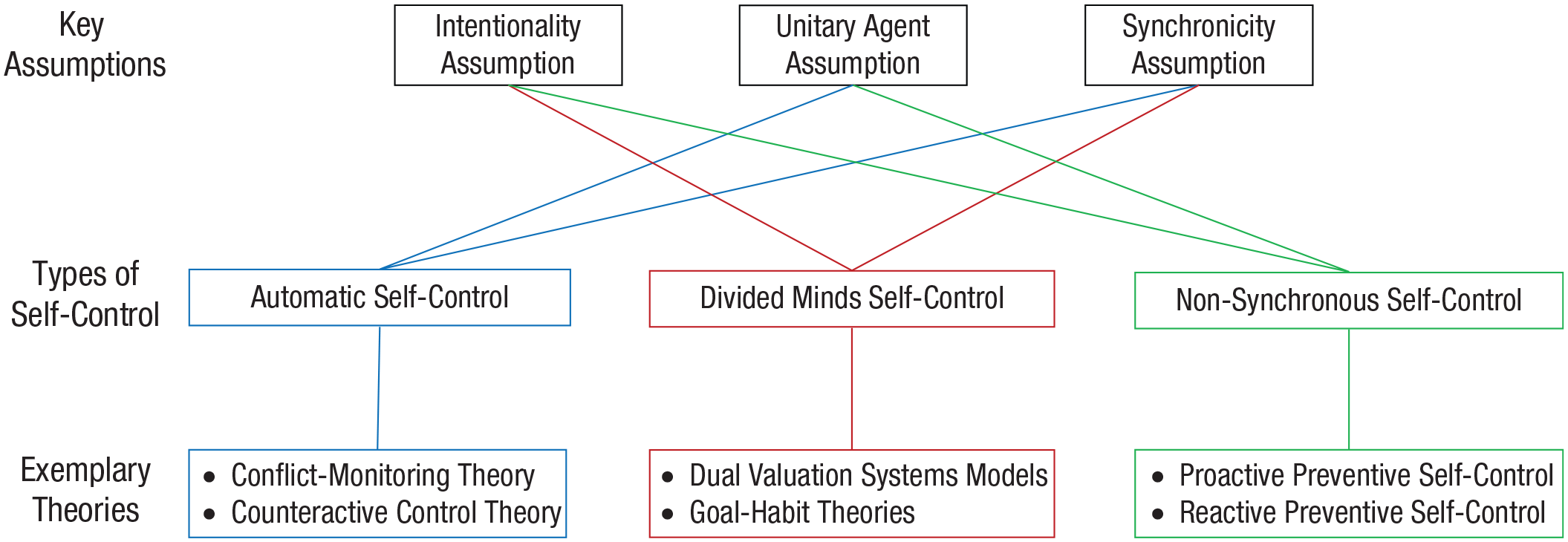
Schematic overview of the three resolutions of the willpower paradox that result from abandoning one of three basic assumptions about behavioral choice and self-control while retaining the other two assumptions.
Resolution 1: nonintentional (automatic) self-control
A first possible resolution of the willpower paradox is to abandon the assumption that the recruitment of self-control is an intentional process. We conceive of behaviors and mental processes as intentional if they are motivated by and selected on the basis of the subjective value and probability of their anticipated outcomes (i.e., their subjective expected utility). For instance, an action such as flipping a light switch can be considered intentional if it is motivated by the anticipation of a desired outcome (that the light turns on) and the person expects that the action will bring about the desired goal state. Analogously, the recruitment of a self-control strategy can be considered intentional if it is motivated by the anticipation of a desired outcome (e.g., an increased probability of attaining a long-term goal) and the person expects that self-control will help to bring about this outcome.
To abandon the intentionality assumption means to conceive of the recruitment of self-control as a process that is automatic in the sense that it is triggered by the detection of a conflict or by other causal factors (e.g., external cues, a particular framing of options, a spontaneous thought, contextual primes such as a health-related movie), without an intervening value-based decision and without an explicit intention to recruit self-control. Such causal factors may, for instance, direct attention toward future outcomes (e.g., health) and thereby increase their impact on behavioral choice. However, the critical point is that the recruitment of the self-control promoting process itself (e.g., the focusing of attention on long-term outcomes) does not depend on a value-based decision. 5
Abandoning the intentionality assumption avoids the willpower paradox because it is not paradoxical to state that an automatically triggered self-control process (e.g., a cue-triggered shift of attention) helps to override a competing desire, even if this desire is more preferred than a superordinate goal at the moment at which the self-control process is triggered. Because automatic self-control processes are neither mediated by a value-based decision nor motivated by their subjective expected utility, they avoid the paradoxical implication of an agent who simultaneously most strongly desires to execute a behavior and most strongly desires to not execute the behavior. In conclusion, if one abandons the assumption that the recruitment of self-control rests on an intentional value-based choice, one can retain the assumption that self-control serves to override an agent’s strongest desire in favor of a currently weaker goal. 6
Conflict-monitoring theory
Although the recruitment of self-control is often conceived as an intentional, self-initiated, deliberate, conscious, and effortful process (Baumeister et al., 2016; Duckworth, Taxer, et al., 2019) that rests on a value-based decision (Kool et al., 2017; Kotabe & Hofmann, 2015; Shenhav, 2017; Shenhav et al., 2013; Westbrook & Braver, 2015), a number of theories in experimental psychology, cognitive neuroscience, and social psychology have endorsed the idea that self-control processes may be triggered automatically. An early version of this idea can be found in Narciss Ach’s classical theory of volition, in which he assumed that a conflict between an intention and a habitual response triggers automatically, without intervening deliberation, an enhanced exertion of “volitional effort” (Ach, 1910). A modern variant of this idea can be found in the initial formulation of the conflict-monitoring theory (Botvinick et al., 2001). The key assumption is that the detection of a conflict between competing action tendencies triggers an increased recruitment of cognitive control that enhances the impact of currently active goals or task sets on information processing and response selection. Consistent with this assumption, in reaction-time tasks involving response conflicts (e.g., Stroop or flanker tasks), interference from competing responses is often reduced in trials immediately after a response conflict, which suggests that conflicts automatically trigger the recruitment of enhanced control (the so-called conflict-adaptation effect; e.g., Egner & Hirsch, 2005; Fischer et al., 2008; Gratton et al., 1992; Kerns et al., 2004; Scherbaum et al., 2011; Stürmer et al., 2002). The conflict-monitoring theory has instigated an enormous amount of research that is beyond the scope of this article (for reviews and critical discussions, see Braem et al., 2019; Egner, 2007; Mansouri et al., 2017; Scherbaum et al., 2012; Schmidt, 2013, 2019). The important point for the current discussion is that in the computational implementation of the initial conflict-monitoring model (Botvinick et al., 2001) the recruitment of control did not depend on the expected utility of the to-be-supported goal but was directly triggered by the detection of a response conflict. 7
Counteractive-control theory
Although the conflict-monitoring theory has been mostly applied to response conflicts in simple reaction-time tasks, theories of self-control likewise postulate that the detection of a conflict between a goal and a desire is a trigger condition for the recruitment of self-control (Kotabe & Hofmann, 2015; Myrseth & Fishbach, 2009). Although awareness of a goal-desire conflict may induce a deliberate decision to recruit self-control to override the unwanted desire, research on the counteractive-control theory (Fishbach et al., 2010; Myrseth et al., 2009; Trope & Fishbach, 2000; Zhang & Fishbach, 2010) has yielded evidence that the recruitment of self-control can also be an automatic response to a goal-desire conflict. The key assumption of this theory is that a conflict between a goal and a temptation triggers self-control processes that asymmetrically shift motivation, thereby strengthening goal pursuit and decreasing the motivational strength of a temptation. Such asymmetric shifts in motivational strength may initially rest on conscious, deliberative processes, but the repeated mobilization of self-control in a given goal context may lead to the formation of direct associations between tempting stimuli and the superordinate goals they threaten, as well as to the formation of inhibitory links between goal representations and temptations. These facilitative and inhibitory associations can automatize, such that they are activated unconsciously, effortlessly, and without mediation by a value-based decision (Fishbach et al., 2003). As a result, self-control is no longer a motivated process but an automatic response to conflict that biases the decision process toward cognitions that promote superordinate or long-term goals.
In support of this assumption, studies have shown that temptations (when primed by respective stimuli) automatically trigger thoughts about higher order, long-term goals. For example, in a study using a sequential priming paradigm, participants recognized goal-related words faster when these followed a subliminally presented temptation-related word (Fishbach et al., 2003). In contrast, higher order goals do not increase the accessibility of temptation-related thoughts. On the contrary, activating a higher order goal that a person is committed to inhibits the accessibility of alternative goals (Shah et al., 2002). This speaks to the biased nature of conflict-induced self-control processes favoring superordinate goals over immediate desires and differentiating successful self-controllers from those frequently failing in self-control. In line with this assumption, as compared to successful dieters, those who frequently fail in their dieting attempts do not exhibit such automatic goal-activation when confronted with tempting food (Papies et al., 2008a, 2008b). Supporting the notion of automaticity, the described processes reportedly emerge even under cognitive load and appear not to require working memory (Fishbach & Shen, 2014).
In conclusion, the central point for the current discussion is that dropping the assumption that self-control is an intentional and value-based process avoids the willpower paradox. If the recruitment of control is caused automatically by the detection of conflicts or by situational cues, it is no longer paradoxical to assume that self-control serves to override a short-term desire that is currently stronger than a superordinate goal. In philosophical theories of self-control, this corresponds to the suggestion that “all exercises of synchronic self-control are non-actional . . . because there is no suitable strongest desire to set up an exercise of actional synchronic self-control” (Kennett & Smith, 1997, p. 128).
Resolution 2: divided minds and dual systems
The second possible resolution of the willpower paradox retains the intentionality and synchronicity assumptions but abandons the assumption that persons are unitary agents whose choices rest on the computation of a common value signal that integrates multiple attributes of all currently considered options into a “common currency” (Berkman, Hutcherson, et al., 2017; Kable, 2014; Levy & Glimcher, 2012). As explained above, when the unitary-agent assumption is combined with the assumption that self-control is an intentional (value-based) process that serves to override one’s currently strongest desire, it raises the willpower paradox, because either the highest expected utility is assigned to the satisfaction of a current desire (in which case there is no motivational basis for the intention to override this desire) or the highest expected utility is assigned to the superordinate goal (in which case self-control is superfluous).
The second resolution of the willpower paradox abandons the unitary-agent assumption and conceives of persons as “divided minds” consisting of dual valuation and control systems (e.g., Evans, 2019; Evans & Stanovich, 2013; Hofmann, Friese, & Strack, 2009; Kahneman, 2011; Lindgren et al., 2019; Loewenstein, 1996; McClure & Bickel, 2014; Metcalfe & Mischel, 1999; Strack & Deutsch, 2004; Volkow & Baler, 2015). One system is seen as governing the selection and control of actions by deliberative processes, long-term goals, and anticipated future outcomes. The second system mediates either impulsive or habitual responses, which are based on current desires or direct stimulus-response associations, respectively. Dual-systems theories can avoid the willpower paradox if they attribute the intentional recruitment of self-control exclusively to the system that mediates future-directed thinking and anticipations of long-term outcomes, whereas the competing behavioral tendency that evokes a self-control conflict is attributed to a separate impulsive or habitual system. This assumption circumvents the paradoxical implication of a unitary agent who, when intentionally exerting synchronous self-control, most strongly desires to execute a behavior while simultaneously most strongly desiring not to execute the behavior; or, to put it in more functional terms, it circumvents the implication that a unitary valuation system simultaneously assigns the highest subjective utility to a current desire and to the goal to override this desire.
The controversy between unitary agent and divided-mind conceptions of self-control can be traced back to contrasting views of willpower and weakness of will in ancient Greek philosophy. In Plato’s Protagoras, Socrates rejects the possibility of weakness of will as knowingly acting against one’s overall judgment of what is best. He considered it impossible that someone who judges an action—all things considered—as bad nevertheless chooses to perform the action. Rather, at the moment of choice, persons must believe that the action is good for them. Consequently, for Socrates weak-willed behavior reflects the fact that an individual miscalculates the overall pleasures and pains associated with the outcomes of a choice. Accordingly, he considered self-control as being synonymous with rational choice, in which an agent correctly evaluates the subjective utility of action outcomes. Socrates can thus be considered a historic forerunner of modern theories postulating a unitary agent whose choices rest on the calculation of a common value signal that integrates short- and long-term gains and losses of choice options. In contrast, in the Republic, Plato defended a divided-mind view and proposed that intentional actions may be caused by other types of motivation in addition to judgments about what is good or bad. He thus conceived of self-control in terms of a conflict between the rational and irrational parts of the soul. Weak-willed behavior results if the irrational parts of the soul dominate choice, whereas self-controlled behavior is governed by the rational part of the soul. Accordingly, Plato conceived of self-control as a deliberate exercise of willpower by the rational part of the soul to down-regulate desires evoked by the irrational part of the soul.
In contemporary psychology of self-control, there is a wide variety of dual-systems theories that differ with respect to the functional characterization of the two systems, their mode of interaction, and their neural basis (Evans, 2019; Evans & Stanovich, 2013; Kahneman, 2011). For our current argument, we focus on two general classes of dual-systems theories: dual-valuation-system theories, which postulate separate reflective and impulsive valuation systems; and goal-habit theories, which postulate separate control systems mediating goal-directed actions and habitual responses. Both classes of theories can avoid the willpower paradox, albeit for partly different reasons. 8
Dual valuation systems
Theories postulating dual valuation systems assume that a reflective (“deliberative,” “cold,” “cognitive”) system mediates the computation of the subjective utility of goals and actions based on deliberative judgments about the subjective probability and expected value of anticipated future outcomes (Hofmann, Friese, & Strack, 2009; Lindgren et al., 2019; Loewenstein, 1996; McClure & Bickel, 2014; Metcalfe & Mischel, 1999; Strack & Deutsch, 2004; Volkow & Baler, 2015). This system is assumed to operate in a slow, controlled, and resource-demanding manner. By contrast, the impulsive (“hot,” “emotional,” “visceral”) system mediates automatic affective responses and the activation of behavioral impulses by current desires and the prospect of an immediate reward. Impulses are defined as urges to perform a certain behavior (e.g., to act on a temptation). They are evoked when a motivational state (e.g., a current desire that elicits a craving for nicotine) co-occurs with relevant stimuli with a strong incentive value (e.g., a pack of cigarettes) that elicit the prospect of a short-term gratification. In addition to the expected short-term gratification of satisfying an immediate desire, the impulse to give into a temptation may also be strengthened by additional factors such as the convenience of a behavior or social pressure. It is assumed that the impulsive system comprises innate or learned associations between stimuli, responses, and rewards; requires few attentional resources; and operates independently from a person’s conscious goals and expectancies (Hofmann, Friese, & Strack, 2009). Self-control conflicts emerge when the two systems generate inconsistent value signals, because the reflective system computes value signals on the basis of anticipated long-term consequences, whereas the impulsive system is myopic with respect to future outcomes and assigns values to actions on the basis of current needs and the previous learning and reinforcement history.
In support of dual-systems models it has been shown that individual differences in cognitive-control capacities moderate the relative impact of automatic affective reactions and reflective processes on behavioral choice. High control competencies related to executive attention, inhibitory control, and affect regulation promoted self-controlled choices by reducing the influence of automatic affective reactions to tempting stimuli (e.g., candies) and increasing the relative impact of explicit dietary goals (e.g., to reduce sugar consumption) on behavior (candy consumption; Hofmann et al., 2008, 2012; Hofmann, Friese, & Roefs, 2009). This indicates that control processes recruited by the reflective system reduce the impact of automatic valuations by the impulsive system and thereby enhance the impact of long-term goals (see also Wolff et al., 2016).
Further evidence for dual valuation systems stems from studies that used functional MRI to examine brain activation in intertemporal choice tasks, in which participants made choices between smaller-sooner and larger-later rewards (e.g., $5 now vs. $40 in 6 weeks). Initial studies (McClure et al., 2004, 2007) showed that brain regions in the mesolimbic dopamine system involved in reward processing (ventral striatum and medial orbitofrontal cortex) were predominantly activated when choices involved immediate rewards. By contrast, activations in regions involved in cognitive control (lateral prefrontal and posterior parietal cortex) were independent from the delay of the reward. Moreover, choices of later-larger rewards were associated with relatively larger activity in frontoparietal compared with limbic regions. These findings were interpreted as evidence for the competition between an impulsive system that discounts future rewards steeply and assigns disproportionate high value to immediate rewards and a reflective system that discounts delayed rewards only minimally and mediates farsighted choices. Consistent with this interpretation, a more recent study (Turner et al., 2019) found that when participants chose larger delayed rewards, activity in the frontoparietal control network increased with increasing attractiveness of the sooner-smaller reward (i.e., with an increasing need for self-control). Moreover, reduced activation in prefrontal brain regions involved in inhibitory control was associated with an increased propensity to commit daily self-control failures as assessed via experience sampling (Berkman et al., 2011; Krönke et al., 2018; Krönke, Wolff, Shi, et al., 2020; Lopez et al., 2014).
Although later we discuss evidence suggesting that (contrary to dual-systems models) choices rest on a common neural value signal (Hare et al., 2009, 2011; Kable & Glimcher, 2007, 2010), the important point for our current argument is that dual-systems theories can avoid the willpower paradox, provided they make the additional assumption that only the reflective system has the capacity to mobilize self-control, whereas the impulsive system has no access to self-control processes. If one assumes that the motivation to recruit self-control exclusively derives from the goal that is assigned the highest subjective utility based on value computations of the reflective system, one can maintain both the intentionality and synchronicity assumption without raising a conceptual paradox. Whereas in a unitary-agent account, self-control that is both intentional and synchronous implies that the agent most strongly prefers to execute a behavior and simultaneously most strongly prefers not to execute the behavior, this implication is avoided by dividing the agent into subsystems, each of which may assign different utilities to current desires and long-term goals. Even though the goal, which is assigned the highest subjective utility by the reflective system, may be motivationally “weaker” than the competing desire, it is not paradoxical to assume that this goal can motivate the intentional (value-based) recruitment of self-control to override a desire that would otherwise determine behavioral choice. 9
In a similar vein, philosophical accounts of synchronous self-control have proposed that divided-minds theories can avoid the willpower paradox, provided they make the additional assumption that self-control rests on proprietary strategies that are exclusively available to and controlled by a reflective or deliberative system (Altehenger, 2021; Sripada, 2014).
Goal-directed versus habit systems
A second class of dual-systems theories that avoid the willpower paradox distinguishes between systems mediating goal-directed (outcome-based) actions and systems mediating habitual responses. Habitual responses are usually defined as behaviors that (a) are acquired through repeated execution and/or reinforcement of actions under invariant stimulus conditions that lead to stable stimulus-response associations, (b) are activated by stimulus contexts or conditioned cues independently from goals or anticipated outcomes, and (c) are insensitive to rapid changes of response-outcome contingencies or outcome values (e.g., a reinforcer devaluation; Carden & Wood, 2018; K. J. Miller et al., 2019; Seger, 2018; Wood & Rünger, 2016). 10 Thus, self-control conflicts may arise when a stimulus context activates a habitual response that is incompatible with a person’s goals or outcome valuations and that would control behavior unless the goal-directed system intervenes and recruits cognitive control to override the habitual response (Evans & Stanovich, 2013).
Theories postulating distinct goal-directed and habitual systems are supported by evidence from animal research and neuroimaging studies in humans that indicate that the two types of behavior depend on distinct yet interacting neural circuits (Burton et al., 2015; Yin & Knowlton, 2006). Goal-directed behavior has been attributed to an “associative” loop that connects the prefrontal cortex with regions in the dorsomedial striatum, including the caudate nucleus. Habitual behavior is mediated by a “sensorimotor” loop that connects the somatosensory and motor cortex with the medial and posterior putamen (Amaya & Smith, 2018; Ceceli & Tricomi, 2018; Seger, 2018). Consistent with this distinction, the acquisition of a habitual response via extended training was associated with decreasing brain activation in prefrontal areas and associative basal ganglia regions involved in goal-directed control and with increasing activation (Tricomi et al., 2009) and connectivity (Zwosta et al., 2018) in the sensorimotor network.
Like dual-valuation-systems theories, theories postulating distinct goal-directed and habitual systems can maintain both the intentionality assumption and the synchronicity assumption without raising the willpower paradox. If the recruitment of self-control is exclusively controlled by the goal-directed system (and the intention to exert self-control derives its motivational force from the goal that is currently assigned the highest expected utility), and if habitual responses are triggered by a stimulus without mediation by a value-based decision process, it is no longer paradoxical that self-control may help to override an otherwise stronger habitual response. The reason is that there is simply no competing behavioral tendency that is assigned a higher subjective utility than the goal that motivates the recruitment of self-control.
It should be noted that habits may not exclusively be triggered by direct stimulus-response associations that result from mere frequent repetitions of a behavior in a stimulus context (K. J. Miller et al., 2019). Rather, it has been suggested that habits may also develop via a process in which the reward value of response outcomes is conditioned onto context cues accompanying those rewards. With sufficient repetition, such context cues acquire the power to trigger habitual responses (Wood & Neal, 2007; Wood & Rünger, 2016). With respect to the willpower paradox, the important point is that such theories also avoid the willpower paradox because they assume that such a “motivated cuing” of habits does not involve value-based decisions mediated by the goal-directed system. Instead, habitual responses rest on the cumulated (“cached”) reward value of states and actions rather than explicit representations of action-outcome contingencies. Consequently, like dual valuation systems, this view of habits circumvents the paradoxical implication of a unitary valuation system that simultaneously assigns the highest utility to an action and to the intention to prevent executing this action.
Resolution 3: nonsynchronous self-control
The third resolution retains the intentionality assumption and the unitary-agent assumption but abandons the synchronicity assumption. According to this resolution, intentional self-control in a unitary agent can consist only in the use of preventive self-control strategies (Hofmann & Kotabe, 2012). These strategies are recruited either before a self-control conflict is encountered, or, if a conflict has been encountered, before an emerging competing desire has become the strongest motivational force. We thus distinguish between two forms of preventive self-control. Proactive preventive self-control strategies are recruited in advance of an anticipated temptation and serve to avoid self-control conflicts altogether or, if that is not possible, to at least restrict the space of one’s future behavioral options or increase the cost of yielding to a future temptation. We distinguish these strategies from reactive preventive self-control, which consists in the precautionary down-regulation of an already emerging desire. 11
Proactive preventive self-control: precommitment, resistance to reconsideration, and implementation intentions
A paradigmatic example of proactive preventive self-control are precommitment strategies, which serve to reduce the likelihood that one will yield to an anticipated future temptation (Duckworth et al., 2016; Kuhl & Goschke, 1994; Kurth-Nelson & Redish, 2012; Soutschek et al., 2017; Studer et al., 2019). In the most extreme case, one can try to prevent self-control conflicts altogether by avoiding situations involving an anticipated temptation, or, if this is not possible, to restrict the space of one’s future behavioral options. The classical example for the latter strategy is Homer’s Ulysses who, in anticipation of the Sirens—dangerous creatures who lured sailors with their enchanting voices to shipwreck on the rocky coast of their island—had himself tied to the mast to prevent himself from giving into the temptation elicited by the Sirens’ song. A more mundane example is the person who knows that they will desperately crave candies late at night and therefore refrains from buying unhealthy snacks in the afternoon to prevent themselves from yielding to the temptation at night.
Precommitment strategies do not always succeed in completely avoiding temptations or making indulgence impossible but often merely increase the cost incurred by giving into a future temptation. For instance, the strategy of not buying candies at daytime to ensure that one sticks to a healthy diet when desperately craving sweets late at night may not eliminate the opportunity to walk to a nearby gas station selling candies until late at night but imposes an additional cost on indulgence in terms of time and effort. Likewise, telling your friends about your dieting plans will impose a cost on indulgence in terms of social embarrassment. An important implication is that precommitment will work only when one succeeds in increasing the cost of indulgence up to a point such that the overall subjective utility of the short-term reward will be lower than that of the long-term goal at the moment of choice.
Precommitment exemplifies a remarkable cognitive capacity of humans to anticipate their own future motivational states and take preventive measures to restrict the space of their future behavioral options. Of note, evidence indicates that precommitment decisions do not recruit the prefrontal-parietal control network typically activated by inhibitory control but are specifically associated with activation in the lateral frontopolar cortex (Crockett et al., 2013; Soutschek et al., 2017), a higher order cognitive region involved in prospection, counterfactual thinking, and metacognitive processes (Duverne & Koechlin, 2017; Soltani & Koechlin, 2021).
With respect to the willpower paradox, the important point is that precommitment strategies are recruited when an expectancy-value deliberation still assigns the maximum expected utility to a long-term goal. At this moment, the desire that would normally elicit a preference for a short-term reward and lead to a self-control failure is not yet present but merely anticipated. Consequently, a long-term goal can motivate the recruitment of preventive strategies to avoid a temptation or prevent oneself from giving into a future temptation without raising the willpower paradox.
A further preventive strategy is resistance to reconsideration (i.e., the attempt to avoid reevaluating one’s earlier decisions and commitments). Once one starts to reconsider a previous decision or commitment when being confronted with a temptation elicited by a current desire, it is likely that one will revise one’s earlier choice. This simply follows from the fact that a key feature of a self-control conflict is precisely that the short-term desire does transiently become a stronger motivational force than the long-term goal and may thus cause a preference reversal. For instance, reconsidering my earlier decision to prevent myself from eating candies when experiencing an intense craving for chocolate late at night bears the risk that I come to the conclusion that walking to a store selling candies at night is the most valuable option at this moment. Thus, reconsidering the subjective expected utilities of the short- and long-term rewards during a self-control conflict will often result in a self-control failure.
Consequently, when a future temptation cannot be avoided by a precommitment decision or if the additional cost imposed on indulgence does not suffice to make it the less preferred option at the moment of choice, preventive self-control will be effective only if one resists reconsideration. In philosophical action theory, Bratman (1987, 2009) has argued that resistance to reconsideration is a genuine consequence of committing oneself to future-directed intentions, which promotes persistence in the pursuit of long-term goals in the face of competing motivational tendencies (cf. Holton, 2009).
One effective strategy that helps to increase the threshold for reconsidering a previous commitment is the formation of implementation intentions (Achtziger et al., 2008; Bieleke et al., 2021; Eder, 2011; Gollwitzer, 1999; Gollwitzer & Oettingen, 2013; Wieber et al., 2015). Implementation intentions denote “if-then” plans that specify under which conditions intended actions are to be executed. By establishing such if-then plans, individuals pass the execution of behavior over to situational cues. For example, a dieter may plan that if they are in a restaurant, then they will order a salad instead of a steak. As a consequence, even if there might be more tempting dishes on the menu, the goal-conducive behavior is supposed to be triggered quasi-automatically by the situational context (the “if” part of the implementation intention). An impressive body of research documents that this specific form of planning indeed promotes the realization of intentions in laboratory tasks and supports goal striving in the face of real-life temptations, as indicated, for instance, by the promotion of healthy behavior and reduced procrastination in academic contexts (for reviews, see Bieleke et al., 2021; Gollwitzer & Sheeran, 2006). The effects of implementation intentions are mediated by a range of mechanisms, including more efficient perceptual processing of information specified in the “if” part of the intention, enhanced accessibility of opportunities, and automated activation of goal-directed responses (Bieleke et al., 2021).
Implementation intentions should not be confused with automatic self-control as described in Resolution 1. The function of implementation intentions is to promote the quasi-automatic triggering of an intended action by stimulus conditions specified in the “if” part of the intention. For example, a dieter may plan that if they are in a restaurant, then they will order a salad instead of a steak. Consequently, even if there might be more tempting dishes on the menu, the goal-conducive behavior is supposed to be triggered quasi-automatically by the situational context. Thus, by “delegating control to the environment” and promoting the quasi-automatic initiation of self-controlled behavior, implementation intentions render synchronous self-control superfluous (Bieleke et al., 2021; Gollwitzer, 1999; Gollwitzer & Bargh, 2005). However, in contrast to the automatic recruitment of self-control as described in Resolution 1, the initial formation of an implementation intention is usually the result of a deliberate choice and therefore constitutes an intentional self-control strategy, even though it serves to subsequently promote the automatic realization of self-controlled behavior.
Reactive preventive self-control: precautionary down-regulation of emerging desires
Proactive preventive self-control strategies avoid the willpower paradox because they are intentionally recruited at a time when a temptation has not yet emerged but is merely anticipated to emerge in the future. Thus, a long-term goal that is assigned the highest expected utility can motivate proactive preventive self-control strategies because there is no current desire that is more preferred. However, preventive self-control can also be exerted in a reactive manner when a conflicting motivational tendency already emerges and starts to challenge a previously formed intention. As long as the motivation to execute the prior intention is still stronger than the competing motivational tendency, the perception of the emerging conflict can induce the intentional mobilization of self-control to down-regulate the emerging urge and to prevent it from overruling the currently dominant goal. Like a totalitarian leader who uses the state’s power to silence oppositionist movements, self-control might be mobilized to prevent emerging conflicting motivational tendencies from threatening a previously set intention. 12 The intentional recruitment of reactive preventive self-control does not raise the willpower paradox because it occurs at a stage of an emerging conflict when the long-term goal is still the strongest motivational tendency with the highest subjective utility.
Phenomenologically, reactive preventive self-control is the form of nonsynchronous self-control that comes closest to what has been termed “interventive” self-control (Hofmann & Kotabe, 2012). It is typically exerted during a temptation episode in close proximity to possible indulgence and when an urge is actually felt and not merely anticipated. However, we argue that it should nevertheless be considered a preventive self-control strategy because it is exerted when the long-term goal is still the dominant motivational tendency and serves to prevent an emerging desire from becoming the strongest motivational tendency and causing a preference reversal.
Compared with other preventive strategies, reactive preventive self-control operates on a much shorter time scale. The underlying mechanisms thus likely differ qualitatively from those mediating proactive preventive strategies. In particular, reactive preventive self-control requires mechanisms that continuously monitor emerging conflicting urges (like a dictator’s surveillance agencies). Recent evidence from studies combining functional neuroimaging with smartphone-based ecological momentary assessment of daily self-control failures have indeed shown that self-control depends on the efficient functioning of brain systems involved in conflict and performance monitoring and the detection of errors (including the anterior midcingulate cortex, presupplementary motor area, and anterior insula). Individuals who showed low error-related activation in these brain regions in a Stroop-like conflict task were more prone to commit self-control failures in their daily lives (Krönke et al., 2018; Overmeyer et al., 2021). Of note, activation in these brain areas predicted individual differences in real-life self-control over and above self-reported trait self-control (Krönke et al., 2018). These findings are consistent with the assumption that continuous efficient monitoring of emerging conflicts is an important precondition for mobilizing self-control in a timely manner to be able to down-regulate emerging conflict-laden desires before they supersede a long-term goal.
In conclusion, we propose that reactive preventive self-control—like automatic self-control described in Resolution 1—is triggered by the detection of a conflict between a long-term goal and an emerging short-term urge. However, reactive preventive self-control differs in important respects from automatic self-control. Whereas Resolution 1 rests on the assumption that self-control strategies can be triggered automatically by a conflict, even when a competing desire is already stronger than the to-be-supported superordinate goal, reactive preventive self-control can be initiated intentionally as long as the competing desire has not yet become the strongest motivational tendency.
Discussion
Our aim was to show that the common assumption that interventive self-control strategies are recruited intentionally to override unwanted desires, which are currently stronger than a superordinate or long-term goal, raises a conceptual paradox. More specifically, we have argued that this paradox is the consequence of the conjunction of three widespread assumptions about self-control and behavioral choice, which cannot all be true simultaneously. To avoid the paradox, coherent theories of self-control must therefore reject either the intentionality assumption that the recruitment of self-control is an intentional process that is motivated by the subjective expected utility of recruiting self-control, or the unitary-agent assumption that persons are unitary agents who choose the behavioral option that has the highest overall subjective expected utility at the moment of choice, or the synchronicity assumption that self-control serves to override a desire that is currently stronger than a superordinate or long-term goal. Note that these resolutions are not mutually exclusive but rather represent three possible forms of self-control that may well coexist and that are recruited depending on the type of conflict, situational context, and individual learning history.
Up to this point we have made explicit how the willpower paradox arises and how possible resolutions of the paradox can be mapped to general classes of self-control theories, citing mostly supporting evidence. In the following sections, we discuss key theoretical and empirical challenges faced by each resolution, outline perspectives for future research, and discuss more general implications for the concept of self-control and the question of whether and in what sense self-control can be considered rational.
Evaluation of Resolution 1: nonintentional self-control
The first resolution maintains the unitary-agent and synchronicity assumptions but abandons the assumption that the recruitment of self-control is an intentional process that rests on a value-based decision and rather conceives of self-control as an automatic process that is triggered by conflicts, external cues, or other causal factors.
Phenomenological challenges
A challenge for the automaticity resolution derives from the observation that exercising self-control is often experienced subjectively as an intentional, self-initiated effort to resist temptation. For the automaticity resolution this raises the question of how to account for the fact that self-control is often accompanied by a distinctive agentic quality and feeling of effort. One possible explanation could be that such phenomenological manifestations do not reflect the intentional exertion of control but the perception of a conflict. The simultaneous activation of two action tendencies with similar strength may evoke the subjective feeling of an internal struggle between a goal and the lure of an immediate reward and explain why self-control episodes feel effortful, agentic, and intentional, even if the recruitment of self-control is automatic. Moreover, the specific phenomenological quality of self-control may arise because one feels that one is about to override a strong desire in the service of a long-term goal that may be more entrenched in a network of self-relevant norms and moral values, and this may be experienced subjectively as the victory of one’s genuine “self” over unwanted impulses (cf. Berkman, Hutcherson, et al., 2017). Testing this assumption would require experimental designs that manipulate conflict strength independently from the degree of effort required to exert self-control.
The generality challenge
Although we pointed to evidence that self-control processes can under certain circumstances be triggered automatically, it is unlikely that all instances of self-control are nonintentional in the sense of not being mediated by a value-based choice. As noted earlier, many prominent self-control theories assume that the recruitment of self-control strategies is something that we usually bring about intentionally; is self-initiated, deliberate, and conscious (Baumeister et al., 2016; Duckworth, Taxer, et al., 2019); and is the result of a “decision to inhibit or to override an unwanted behavior” (Hofmann, Friese, & Strack, 2009, p. 165). Likewise, a key assumption in recent theories of cognitive control, notably the expected value of control theory (Shenhav, 2017; Shenhav et al., 2013; Silvestrini et al., 2022), is that the mobilization and allocation of control strategies is the result of a value-based decision-making process, whereby costs and benefits of control are integrated into an estimate of its expected value (Kool et al., 2017; Westbrook & Braver, 2015). The assumption that individuals intentionally choose to exert willpower is further supported by the fact that such choices are often taken as indicating which goals persons consider as most important for their core values, self-concept, and identity, as postulated in the identity-value model of Berkman and colleagues (Berkman et al., 2017a). Thus, although automatic self-control provides a tenable resolution of the willpower paradox, the generality of this resolution is limited because in many instances of goal-desire conflicts the recruitment of self-control appears to be an intentional and deliberate process.
Implications for future research
For theories abandoning the intentionality assumption it will be important to obtain further evidence under which conditions the recruitment of self-control can occur automatically and to specify in more detail in what sense self-control can be automatic. So far, empirical evidence for automatic self-control stems mainly from laboratory experiments demonstrating that response conflicts in interference tasks can trigger the mobilization of enhanced cognitive control (for reviews, see Botvinick et al., 2004; Braem et al., 2019; Egner, 2007; Mansouri et al., 2017) and that temptation-related stimuli can automatically activate representations of superordinate goals (Fishbach et al., 2003, 2010; Myrseth et al., 2009). For theories abandoning the intentionality assumption it will thus be important to obtain converging evidence for the automatic recruitment of self-control using a wider range of experimental paradigms, in particular tasks involving conflicts between long-term goals and immediate desires or cravings. This appears particularly important given that the evidence for the conflict-triggered mobilization of control in simple response-time tasks has become the target of empirical and methodological critiques (for a review, see Schmidt, 2019).
The feature of automatic self-control that is critical for avoiding the willpower paradox is that the recruitment of self-processes is nonintentional in the sense that it does not rest on a value-based decision. Thus, the key empirical challenge is to show that self-control can be triggered directly by conflicts without mediation by an evaluation of its expected value. One way to obtain such evidence might be to investigate whether self-control processes can be activated by conflicts even under high cognitive load, which should limit the possibility to engage in deliberative processes (cf. Fishbach & Shen, 2014). Another possibility might be to examine whether self-control processes can under certain circumstances be recruited in the absence of activation in brain regions encoding expected value of control. This will be particularly challenging, however, given that regions such as the anterior cingulate cortex appear to be involved both in the detection of conflicts and the evaluation of the costs of effortful control (Botvinick & Braver, 2015; Westbrook et al., 2019; Yee & Braver, 2018; Yee et al., 2021).
A further point of relevance for future research on automatic self-control concerns the fact that automaticity is a multidimensional construct that can refer to whether a process is unconscious, effortless, stimulus-triggered, or independent from anticipated outcomes (Moors, 2016). These different criteria for automaticity can dissociate. For instance, a process may be triggered by a stimulus but nevertheless depend on a prior intention, a process may be effortless although being initiated intentionally, or a process may run off unconscious but nevertheless be modulated by goals (Goschke, 2003; Hommel, 2000, 2019; Moors & De Houwer, 2006). Consequently, the view of automatic and intentional processes as a dichotomy of two distinct types of processes has been replaced by models that assume that intentions “configure” response dispositions and modulate their readiness to be triggered when execution conditions are satisfied (Bargh, 1989; Goschke, 2003, 2013; Hommel, 2000, 2019). Of note, this view of “conditional automaticity” relates to the concept of implementation intentions we discussed above in the context of Resolution 3. There we focused on implementation intentions as a means to prevent reconsideration and to promote the automatic triggering of an intended behavior when its execution conditions are met. However, it is also conceivable that persons form implementation intentions that refer to the recruitment of self-control itself. For example, a dieter might form the plan “If I feel tempted by an unhealthy treat then I will stop and first count backward for 30 seconds,” and this strategy may be activated automatically when facing the temptation and help to down-regulate the desire.
Finally, it would be important to investigate how automatic self-control emerges and how people acquire the ability to mobilize self-control automatically. One possibility would be to conduct learning experiments to examine whether and under which conditions the mobilization of self-control processes becomes automatic or habit-like with extended practice. For instance, to our knowledge it has not been investigated experimentally whether repeatedly associating temptation-eliciting stimuli with primes that activate superordinate goals leads to the formation of automatic links between temptations and goals as postulated in the counteractive-control theory (Fishbach et al., 2010). Likewise, one could investigate whether participants who repeatedly exert self-control when making intertemporal choices gradually develop a habit-like disposition to recruit control when being confronted with conflicts between immediate and delayed rewards. A particularly strong test of Resolution 1 would be to demonstrate that such a habit-like disposition to recruit control transfers to contexts in which it may even be advantageous to choose immediate rewards.
Evaluation of Resolution 2: divided minds and dual systems
The second resolution abandons the unitary-agent assumption and postulates distinct systems mediating either impulsive versus reflective valuations or goal-directed versus habitual behavior. This allows maintaining the intentionality and the synchronicity assumption while avoiding the willpower paradox, provided one makes the additional assumption that the recruitment of self-control is exclusively mediated by the reflective or goal-directed system.
The asymmetrical-control challenge
Dual-systems theories have been the target of a range of general theoretical critiques that are beyond the scope of this article (De Houwer, 2019; Evans, 2019; Goschke, 2003, 2013; Grayot, 2019; Hommel, 2019; Melnikoff & Bargh, 2018a, 2018b; Pennycook et al., 2018). A central challenge for dual-systems theories as a possible resolution of the paradox is that they avoid the paradox only if they make the additional assumption that only the reflective system has exclusive access to self-control strategies and that it recruits these strategies to selectively support goals that are motivated by expected utilities computed by the reflective system. Conversely, it must be assumed that the competing impulsive or habitual responses are generated by separate systems that have no access to self-control strategies. These assumptions require independent justification, however, because it is prima facie not obvious why a current desire may not also trigger self-control. This appears conceivable especially when a desire does not automatically activate an impulsive response tendency but merely increases the subjective value of an immediate reward and thereby activates a respective short-term goal. It is an open question whether such short-term goals may motivate the recruitment of self-control strategies that may, for instance, serve to suppress thoughts about the adverse long-term consequences of satisfying an immediate desire.
Moreover, there is evidence that self-control can under certain circumstances even be undermined by deliberative reasoning. This research suggests that individuals who find ways to justify or rationalize impulsive choices to reduce feelings of guilt are more prone to give in to temptations (De Witt Huberts et al., 2013). Thus, self-control failures may result not only from a lack of deliberation but also from deliberation that generates reasons for why a smaller short-term reward should be preferred over a larger long-term reward. This raises the question: Under which conditions and based on which evaluations does the reflective system “decide” whether to recruit self-control to strengthen a long-term goal or whether to generate reasons to justify indulgence? In essence, we are back at facing the willpower paradox, albeit now with respect to the reflective system rather than the person conceived as a unitary agent. Thus, for dual-valuation-system theories to qualify as a tenable resolution of the willpower paradox, it will be critical to obtain further evidence about whether and under which conditions the impulsive system may also have access to self-control processes and under which conditions reflective processes are recruited to undermine rather than support self-controlled behavior.
The goal-dependent habit challenge
With respect to the second class of dual-systems theories, which postulate distinct goal-directed and habit systems, it is important to note that they avoid the willpower paradox only if habitual responses are indeed independent from goals and outcome valuations. If this assumption holds, it is not paradoxical to state that self-control is recruited intentionally to override an otherwise dominant habitual response because the response is not an outcome- and value-based action and there is thus no competing response that is assigned a higher subjective utility than the goal that motivates the recruitment of self-control. However, this assumption has recently been challenged, and it has been argued that many instances of seemingly habitual behavior do in fact depend on goals and are sensitive to changes in the reward value of action outcomes (Hogarth, 2020; Kruglanski & Szumowska, 2020). For instance, there is evidence that insensitivity of well-practiced responses to outcome devaluation (as a critical indicator of habits) may reflect attachment to a different goal or dysfunctions in goal-directed control rather than habitual behavior (de Wit et al., 2018). Although this does not exclude the possibility of value-free and goal-independent habits that are acquired through the repeated strengthening of stimulus-response associations (K. J. Miller et al., 2019), the evidence for value-free habits in humans appears less compelling than often assumed (De Houwer et al., 2018). Thus, for goal-habit theories to qualify as a tenable resolution of the willpower paradox, it will be critical to obtain more convincing evidence that habitual responses in humans are (at least under certain circumstances) independent from goals and outcome valuations.
Implications for future research
For dual valuation systems a key question for future research concerns the ongoing debate about whether behavioral choice is the outcome of a competition between a reflective and an impulsive valuation system or whether behavioral choices rest on a common value signal that is computed by a unitary valuation system (Berkman et al., 2017a, 2017b; Berkman, Hutcherson, et al., 2017; O’Leary et al., 2017; Shenhav, 2017; Sklar & Fujita, 2017).
As mentioned, neuroimaging findings on neural correlates of intertemporal choices (McClure et al., 2004, 2007) were initially interpreted as strong evidence for distinct impulsive and reflective valuation systems in reward-related “limbic” brain areas and prefrontal-parietal control regions, respectively. However, subsequent studies found that activity in so-called limbic brain areas is not specifically elicited by the prospect of an immediate reward but tracks the subjective value of both immediate and (discounted) delayed rewards, and no evidence was found for an impulsive system that disproportionally values immediate reward (Kable, 2014; Kable & Glimcher, 2007, 2010). Meta-analyses of neuroimaging studies likewise suggest that the ventromedial prefrontal cortex encodes a common value signal that integrates multiple attributes of choice options and correlates with subjective preferences as revealed in behavioral choices (Bartra et al., 2013; Berkman, Hutcherson, et al., 2017; Clithero & Rangel, 2014; Hare et al., 2009, 2011; Kable, 2014; Kable & Glimcher, 2007, 2010; Krönke, Wolff, Mohr, et al., 2020).
In light of these findings, it has been suggested that self-control does not reflect the suppression of an impulsive by a reflective system but rather rests on the modulation of a common value signal by anticipated long-term outcomes. In line with this idea, it has been shown that individuals in whom value signals in the ventromedial prefrontal cortex are strongly modulated by long-term (relative to short-term) outcomes make more self-controlled choices in laboratory tasks (Hare et al., 2009, 2011) and commit fewer daily self-control failures during real-life conflicts (Krönke, Wolff, Mohr, et al., 2020). From this perspective, any process that increases the weight of future outcomes in the value-integration process (e.g., a cue-induced focusing of attention on long-term consequences) will enhance the likelihood of a self-controlled (farsighted) choice (Berkman, Hutcherson, et al., 2017; Hare et al., 2009, 2011; Kable & Glimcher, 2007; Krönke, Wolff, Mohr, et al., 2020).
Given the available evidence, it would be premature to predict which type of theory will ultimately turn out to be a more realistic account of value-based choice and self-control. With respect to the willpower paradox, the important point is that if theories postulating a common value signal should turn out to be a better account of behavioral choice (or if divided-mind theories would fail as a resolution of the willpower paradox for the reasons discussed above), the only remaining options to avoid the paradox would be to abandon either the intentionality or the synchronicity assumption and thus adopt Resolution 1 (automatic self-control) or Resolution 3 (nonsynchronous control).
Evaluation of Resolution 3: nonsynchronous self-control
If one wants to maintain both the intentionality assumption and the assumption of a unitary agent (or a unitary valuation system), one must reject the synchronicity assumption, according to which self-control serves to override one’s currently strongest (most preferred) desire. We distinguished between proactive preventive strategies, which serve to avoid temptations or increase the cost of indulgence, and reactive preventive strategies, which serve to down-regulate emerging desires to ensure that a superordinate goal stays the dominant motivational tendency. Both forms of preventive self-control avoid the willpower paradox because they are initiated before a desire has become the strongest motivational tendency.
Diachronic selves, control dilemmas, and the metacontrol challenge
As noted above, if the cost imposed on indulgence by a precommitment decision does not suffice to make the tempting option the less preferred option at the moment of choice, preventive self-control will be effective only if the person resists reconsideration and thereby avoids the risk of a preference reversal. To date little is known about the mechanisms and conditions that determine whether precommitment decisions do or do not become the subject of reconsideration and when previously formed goals determine action selection without a reevaluation of their subjective value (cf. Hayden & Niv, 2021).
This question relates to a more general challenge for Resolution 3 that we term the “metacontrol problem” of preventive self-control. Although Resolution 3 is compatible with the assumption of a unitary valuation system, it can also be interpreted as a special instance of a divided-mind account. In contrast to the dual-systems theories we discussed in the context of Resolution 2, which focus on synchronous conflicts between competing valuation or control systems within a person at a given moment in time, preventive self-control involves diachronic conflicts between one’s current preferences and the preferences of one’s past or future self. The function of preventive strategies can thus be considered to make binding decisions for one’s future self or stick to commitments made by one’s past self. 13
This interpretation of preventive self-control as a diachronic conflict between preferences of one’s current and future self makes particularly obvious why preventive self-control poses a metacontrol challenge. The reason is that successful resistance to reconsideration may lead to choices that do not reflect what one would judge to be the best option had one considered all options at the moment of choice. A central feature of self-control conflicts is that an unbiased (re)consideration of one’s current preferences would lead to a preference reversal (i.e., a self-control failure) because an immediate desire or temptation does have the highest subjective utility at the moment of choice. Consequently, when an implementation intention or a commitment that has been formed by an agent’s earlier self successfully prevents the agent from reconsidering preferences, this bears the risk of promoting overly rigid persistence even in situations in which it would be adaptive to abandon prior commitments to satisfy an important immediate desire, exploit an unexpected reward opportunity, or respond to a sudden threat. 14
Resistance to reconsideration thus confronts agents with a “control dilemma” that raises a fundamental metacontrol problem (Eppinger et al., 2021; Goschke, 2003, 2013; Goschke & Bolte, 2014, 2017). On the one hand, attaining long-term goals requires a persistent commitment and the ability to shield goals from transient changes of motivational states. On the other hand, unexpected changes of external conditions (e.g., reward contingencies) or internal states (e.g., vital needs) may afford that one abandons prior commitments and revises preferences. Agents must thus not only decide which action is best suited to attain a goal but also when it is adaptive to ignore unexpected changes, resist reconsideration, and shield goals from competing motivations and when it is better to respond to a change by abandoning prior commitments, reconsidering preferences, and exploring alternative options. Thus, preventive self-control strategies aimed at shielding goals and preventing reconsideration confront agents with the metacontrol problem of how to decide whether to stick to commitments of one’s past self even when a current desire has become a more preferred option.
Such metadecisions pose a nontrivial computational challenge. In changing and uncertain environments, it is usually impossible to constantly evaluate the expected values and probabilities of all short- and long-term outcomes of all behavioral options given limited time, incomplete information, and scarce computational resources. Moreover, forming a stable commitment to an intention functions precisely to prevent agents from reevaluating the costs and benefits of competing goals and desires to avoid a premature preference reversal, which raises the question of how an agent can decide whether to resist reconsideration without reconsidering in the first place. 15 Feasible solutions of such metacontrol problems must therefore rely on learning processes that enable agents to infer from prior experience in which contexts it is adaptive (and maximizes reward in the long run) to stick to prior commitments and when it is more adaptive to adjust preferences more myopically in light of one’s current motivational state. Initial computational-modeling studies indicate that experience-based learning in conjunction with Bayesian inference may provide a basis for solving such metacontrol problems (Markovic et al., 2021). However, we are not aware of any attempts to date to apply such models to the domain of self-control, and it will thus be a key challenge for theories favoring Resolution 3 to apply such models to preventive self-control and test them empirically.
Implications for future research
In contrast to proactive preventive self-control, reactive preventive self-control processes are intentionally recruited within a temptation episode when a long-term goal is still the most preferred option but the person anticipates that an emerging desire will at some point supersede the goal and therefore decides to down-regulate the desire. In contrast to proactive precommitment strategies, reactive preventive self-control operates at much shorter time scales and when a competing desire is already emerging. A main challenge for future research will thus be to develop experimental paradigms that allow examining the fine-grained time course of competing motivational tendencies in parallel with the recruitment of self-control processes. One promising avenue is the use of continuous measures such as mouse tracking (Dshemuchadse et al., 2013) or eye tracking (Steimke et al., 2016), which allow examining the dynamics of evidence accumulation and the integration of choice attributes. For instance, a study using mouse tracking in a dietary-choice task revealed that the tastiness of food items is processed earlier than healthfulness and that individual differences in self-control could partly be accounted for by the relative speed with which tastiness and healthfulness were processed (Sullivan et al., 2015). Another study using a multi-attribute drift-diffusion model to fit data from a dietary-choice task showed that prime stimuli, which supposedly activating dietary goals, influenced the decision process by modulating the strength and timing of taste and health attributes during the evidence-accumulation process (Sullivan & Huettel, 2021). Moreover, in a study using a computational model that sampled reward and delay information stochastically on a moment-by-moment basis it was shown that, as preferences for the choice alternatives evolved, asymmetric lateral inhibition was triggered, which accounted for the contribution of frontoparietal control regions to intertemporal choices (Turner et al., 2019). In conclusion, the combination of dynamic measures and computational models appears to be a promising approach to investigate when reactive preventive self-control is recruited during an emerging conflict and thereby to provide evidence for a key mechanism postulated in Resolution 3.
Intrinsic value of self-control: a possible fourth resolution?
We discussed three resolutions of the willpower paradox, each of which abandons one of three basic assumptions about behavioral choice and self-control. So far, our analysis has been based on the widely shared conception of self-control as a means to an end (i.e., as a set of cognitive strategies that serve to render behavior consistent with long-term goals). According to this view, people engage in self-control merely to achieve their long-term goals, not to engage in self-control for its own sake. Consequently, the motivation to intentionally recruit self-control derives entirely from the subjective expected utility of the to-be-supported long-term goal. Therefore, it is paradoxical to state that an agent assigns the highest subjective expected utility to a current desire and at the same time assigns the highest expected utility to the goal to override this desire. This paradox becomes even more obvious when considering that many current models of self-control in psychology, behavioral economics, and cognitive neuroscience postulate that the exertion of self-control is intrinsically effortful and costly and something people try to avoid (Kool & Botvinick, 2013, 2014; Shenhav et al., 2013, 2017; Westbrook et al., 2021). This makes it even harder to understand why a person should intentionally recruit (intrinsically costly) self-control strategies to override a desire that is currently more preferred than a long-term goal.
However, these considerations also suggest that there may be a fourth resolution of the willpower paradox that rests on the assumption that self-control can—under certain circumstances—have an intrinsic value that is independent from the utility of the long-term goal it is supposed to support. Consistent with this possibility, everyday observations suggest that people sometimes choose (and seem to enjoy) tasks or activities that require cognitive control and the exertion of cognitive or physical effort (e.g., solving difficult intellectual problems, engaging in physical exercise). This calls into question that self-control is always aversive and costly but indicates that it may also be experienced as intrinsically rewarding and valuable (Inzlicht et al., 2018).
The possibility that self-control may be intrinsically rewarding has important implications for the willpower paradox. If self-control were not exclusively motivated by the expected utility of the to-be-supported goal but had an intrinsic value, it is conceivable that the integration of the two sources of subjective value suffice to motivate the intentional recruitment of self-control, even if a competing desire is currently more preferred than the superordinate goal. Thus, even when a person values an immediate temptation (e.g., watching TV) more than a superordinate goal (e.g., studying to pass an important exam) at a particular moment, the intrinsic value of self-control may motivate them to intentionally recruit self-control to keep themselves from giving in to the temptation.
In line with this view, we recently obtained the first empirical evidence that people can learn to value the engagement in tasks requiring effortful control as intrinsically rewarding (Clay et al., 2022). Using the so-called learned-industriousness paradigm (Eisenberger, 1992), we showed that monetary reward that was made contingent on mobilized cognitive effort (as assessed via cardiovascular measures) in a working-memory task requiring cognitive control induced a preference for more demanding cognitive tasks in a subsequent transfer phase. Importantly, participants chose cognitively more demanding tasks even though they were fully aware that they would no longer receive an extrinsic reward. This indicates that even after a brief learning phase in which participants received an effort-contingent reward, they assigned an intrinsic value to the recruitment of cognitive control that could not be explained by the expectancy of an extrinsic reward for good performance or attaining the task goal.
Another possibility how self-control can become inherently rewarding involves self-evaluation processes that refer to self-control-related “higher order” goals. For example, a person may endorse the higher order goal of being a farsighted, moral, or rational person (Berkman et al., 2017b). Such higher order goals may result in positive self-evaluations when exerting self-control and thereby add an inherent value to self-control that is independent from the value of the goal self-control is supposed to support. In philosophy this idea is related to the concept of “second-order desires” or “higher order volitions” that define which first-order desires a person prefers to have (e.g., “I want to be a person that obeys moral rules”; “I want to be a person that makes rational choices”; Frankfurt, 1971). An example for behaviors that require sacrificing short-term rewards but result in a positive self-evaluation because of a higher order goal are voluntary donations to charity. People who donate to charity can legitimately feel good about themselves as generous persons. This reward from donating has been termed “warm glow” and documented in increased neural activity in the caudate and nucleus accumbens, as well as subjective satisfaction, when people make a voluntary donation compared with mandatory taxation (Harbaugh et al., 2007). Such higher order goals need not increase the subjective utility of a “first-level” goal but confer utility to the exertion of self-control itself and thereby increase its inherent value. Applied to the willpower paradox, this means that the value derived from such self-control-related higher order goals—especially when combined with the subjective utility of the to-be-supported first-order goal—may suffice to motivate the intentional recruitment of self-control, even if a momentary desire is currently more preferred than the long-term goal that self-control is supposed to support.
Further research is required to obtain empirical evidence for this hypothesis and to demonstrate that an intrinsic value of self-control promotes more farsighted behavior in typical self-control conflicts. The abovementioned research (Clay et al., 2022) documented that rewarding cognitive effort can increase its intrinsic value and makes people more likely to choose effortful tasks in a transfer phase. However, we do not yet know whether such an effect would also emerge when choosing a long-term option is repeatedly followed by an immediate reward (e.g., in the form of social approval). Future research is also required to elucidate the mechanisms and boundary conditions of the role of an intrinsic value of self-control. For example, it is an open question whether it involves the actual experience of pleasure (i.e., corresponding to liking according to Berridge & Robinson, 2003) or rather dopamine-mediated wanting in anticipation of reward. Irrespective of these unresolved questions, the possibility that self-control may have an intrinsic value is an option (arguably the only option) that allows maintaining all three assumptions while nevertheless avoiding the willpower paradox.
Philosophical implications: (how) can self-control be rational?
Although the focus of this article has been on psychological theories of self-control, a secondary aim was to promote closer contact between empirical research and the philosophical literature on self-control. Our analysis of the willpower paradox and possible resolutions does in fact raise fundamental issues that go beyond empirical questions and relate to the normative question of whether and in what sense self-control can be considered rational. A thorough discussion of this complex theme is beyond the scope of this article, and we only briefly outline the nature of the problem (for an in-depth discussion and selection of relevant articles from philosophy and behavioral economics, see Bermúdez, 2018b).
In psychological discussions of self-control, it is usually taken for granted that self-control is adaptive and rational because it promotes farsighted choices and helps to resist transient temptations that often have adverse personal consequences and lead to massive societal costs. However, our analysis of the willpower paradox reveals that it is far from clear whether and in what sense self-control can be considered rational. According to normative rationality standards of classical expected-utility theory, a rational decision maker should choose the option (from the set of all options currently considered) that maximizes subjective expected utility at the moment of choice (termed the “time separability” of preferences; Bermúdez, 2018b; McClennen, 1990). In the simplest case, utility can be defined as an option’s subjective value weighted by the probability that the expected outcome can be attained (Von Neumann & Morgenstern, 1944). From this perspective, all three possible concepts of self-control we described violate prescriptive rationality standards.
First, automatic self-control is by definition nonrational because it does not rest on an evaluation of its expected utility but is triggered by causal factors without a mediating value-based decision (it thus corresponds to what has been termed “nonactional” self-control in philosophical theories; Kennett & Smith, 1997, p. 128). Note that this does not exclude that self-control may be adaptive for attaining long-term goals or maximizing reward. However, although automatic self-control may support the pursuit of long-term goals that are rational in their own right, its recruitment cannot be considered rational because it is caused without deliberation by nonintentional mechanisms.
Second, with respect to the dual-systems resolution, it is usually assumed that the reflective system operates according to principles that approximate prescriptive rationality standards (within the constraints set by limited time, scarce computational resources, and incomplete knowledge; Simon, 1957). By contrast, the impulsive system is often seen as the source of biased judgments and irrational choices (Ariely, 2009; Sutherland, 2013). From this perspective, it appears rational that the reflective system can recruit self-control strategies to delay gratification and override the “irrational” choices promoted by the impulsive system (Hassin et al., 2010; Mischel et al., 2011). However, there is evidence that reflective processes can lead to epistemic distortions and are often used to justify maladaptive choices and decisions that violate normative rationality standards (De Witt Huberts et al., 2013; Mercier & Sperber, 2011). Conversely, it has been argued that the impulsive system actually serves adaptive functions and reflects the rational usage of scarce cognitive resources when time is limited (Griffiths et al., 2015; Lieder & Griffiths, 2019). For instance, there is evidence that heuristics underlying fast judgments and impulsive choices constitute adaptive strategies that often lead to approximately rational decisions in real-life environments (Gigerenzer & Brighton, 2009; Gigerenzer & Todd, 1999). The impulsive system may thus be an adaptation to contexts, in which a slow, exhaustive, and unbiased evaluation of options would not be feasible (Milli et al., 2021). This implies, however, that overriding the impulsive system is not rational per se but can under certain circumstances lead to behavior that is not in the best interests of an agent. Reiterating our previous discussion of control dilemmas and metacontrol problems, rational agents face an anticipation-discounting dilemma (Goschke, 2013): Although the pursuit of long-term goals requires self-control to suppress current needs, it would hardly be adaptive if an agent were to use “willpower” to suppress vital needs completely or delay gratification forever. Rather than attributing rationality exclusively to the reflective system, the critical question is how agents solve the metacontrol problem to arbitrate between the two systems in a context-sensitive and adaptive manner (Eppinger et al., 2021).
Finally, with respect to the third resolution, resistance to reconsideration also raises intricate questions concerning the rationality of self-control. Resisting reconsideration means that one sticks to a prior commitment even in the face of potentially significant changes in one’s motivational state or external reward contingencies. We suggested specifically that implementation intentions may help to prevent an agent from reevaluating preferences to avoid acting on the currently strongest desire that would—had one reconsidered one’s options—outweigh prior commitments. However, sticking to a previous choice and prior preferences although a competing desire is currently the most preferred option violates the time separability of preferences as a normative axiom of classical expected-utility theory because the person will not maximize subjective expected utility at the moment of choice. Given that a rational decision maker should base choices exclusively on the subjective utilities computed at the moment of choice, thus disregarding prior intentions or commitments (Bermúdez, 2018a), the question is in what sense can it be rational to exercise self-control to resist a current temptation (for a detailed discussion, see Bermúdez, 2018b).
One possible answer to this question may derive from the concept of choice bundling (Ainslie, 2005, 2020; Ashe & Wilson, 2020). Bundling has been described in behavioral economics as a strategy that serves to reduce discounting of delayed rewards and supports self-controlled choices by aggregating a series of individual intertemporal decisions (e.g., Should I eat that hamburger now?) into a categorical choice of a behavioral pattern (e.g., Should I eat a hamburger three times a week for the next 10 years?). In a single-choice situation, it is often perfectly rational to choose the short-term reward (e.g., the hamburger) because it is the most preferred option at the moment of choice and the adverse long-term consequences of this single instance of indulgence are negligible (such cases have been termed “epsilon-cost temptation”; cf. Myrseth & Fishbach, 2009). Therefore, bundling choices and making a decision about an extended behavioral pattern across a larger set of future opportunities increases the overall subjective value of the long-term outcome and frees the agent from the requirement to reconsider the pros and cons of each individual choice. Consistent with this idea, it has been shown that participants who make choices between a smaller-immediate and larger-later reward option preferred options with larger delayed rewards when they were asked to choose multiple options at once compared with participants choosing each option individually (Read et al., 1999). Further indirect support for the effectiveness of choice bundling stems from studies of related concepts such as personal rules (Bénabou & Tirole, 2004) and the construal-level theory of self-control (Fujita & Carnevale, 2012) (for a review, see Ashe & Wilson, 2020). In conclusion, resisting reconsideration and overriding one’s currently most preferred desire can be considered rational if one frames the choice as one that affects an extended behavioral pattern across a series of choices and choosing the self-controlled pattern maximizes reward in the longer term (Ainslie, 2020; Weirich, 2018).
Although a more detailed discussion of this theme is beyond the scope of this article, the foregoing considerations show that our analysis of the willpower paradox is of relevance for normative questions concerning the rationality of self-control. An implication of our analysis is that refined normative concepts may be required that account for the rationality of self-control from a broader perspective that goes beyond isolated single choices. It is noteworthy in this context that the fourth proposed resolution of the willpower paradox, according to which self-control has an intrinsic value, may be the one that can best be reconciled with normative rationality standards of expected-utility theory: According to this account it can be rational to override a current desire with a higher expected utility than a to-be-supported superordinate goal, provided the subjective utility of the superordinate goal in conjunction with the intrinsic value of self-control supersedes that of the desire.
Summary and Conclusions
In this article we have argued that three widely held and intuitively plausible assumptions about self-control, when adopted in conjunction, raise a conceptual paradox. It is generally assumed that self-control is required, when an otherwise stronger desire would determine behavior and lead to an impulsive choice unless the person recruits self-control strategies that help to suppress and override the desire. However, as we have shown, the idea that an agent, whose behavioral choices rest on their subjective expected utility, intentionally recruits self-control to override a current desire that is motivationally stronger (is more preferred, has a higher subjective utility) than a superordinate or long-term goal describes an impossible concept of self-control. More specifically, this concept of self-control raises the question of how an agent can most strongly desire to enact a behavior and simultaneously most strongly desire to recruit self-control to prevent enacting the behavior: Either the desire is stronger than the superordinate goal at the moment of choice, which leaves no motivational basis for the intention to override the desire, or the superordinate goal is stronger than the competing desire, which renders self-control superfluous.
We have outlined three resolutions of the willpower paradox that abandon either the intentionality, unitary-agent, or synchronicity assumption. The merit of our analysis lies in the fact that it makes explicit which theoretical commitments one has to accept when adopting a particular conceptualization of self-control. If one conceives of self-control as a process that serves to override the currently strongest desire of a unitary agent, whose choices are determined by which option is assigned the highest expected utility of all currently considered options, one must conceive of self-control as an automatic process rather than as an intentional (value-based) process. If, in contrast, one conceives of self-control as an intentional process that serves to override one’s currently strongest desire, one must accept some version of a divided-minds or dual-systems theory. Finally, if one conceives of self-control as being intentionally initiated by a unitary agent whose behavior is determined by which option is assigned the highest subjective expected utility at the moment of choice, one must abandon the synchronicity assumption and instead conceive of self-control in terms of preventive strategies. The only possible concept of self-control that may actually allow maintaining all three assumptions and thus constitutes a possible fourth resolution of the willpower paradox is one that postulates that self-control may have an intrinsic value (Clay et al., 2022).
A more general implication of the current analyses is that the different classes of self-control theories that correspond to the three resolutions of the willpower paradox should not be considered mutually exclusive. As the foregoing discussion of challenges and limitations of each resolution has shown, it is unlikely that one class of theories suffices as a comprehensive resolution of the willpower paradox. For instance, although automatic self-control avoids the paradox, it is unlikely that self-control is always triggered automatically. Rather, the recruitment of control will often be intentional and based on a value-based decision, which suggests that either divided-mind concepts or preventive forms of self-control are needed to account for all instances of self-control.
A second general implication concerns the nature of the construct self-control. Although we consider the summary term self-control still useful because the different forms of self-control we discussed as resolutions of the willpower paradox all serve the common function to render behavior congruent with superordinate goals in the face of conflict, our analysis adds support to the view that self-control does not denote a unitary construct or a homogeneous class of processes (Inzlicht et al., 2021; Kotabe & Hofmann, 2015). For instance, we discussed evidence that preventive precommitment strategies recruit brain areas that are distinct from areas mediating inhibitory control and the down-regulation of desires and that, even within the class of preventive self-control, proactive and reactive strategies operate on different time scales and involve very different processes. This suggests that self-control is a summary term that can be functionally decomposed into a set of distinct mechanisms that all may support self-controlled and future-directed behavior (see Fig. 1): Automatic self-control processes as specified in conflict-monitoring and counteractive-control theories that modulate value-integration processes by directing attention to long-term outcomes, inhibitory control processes that serve to intentionally overrride competing desires or habits as assumed in dual-systems theories, as well as a variety of (proactive and retroactive) preventive self-control strategies that serve to avoid temptations increase the cost of indulgence, or prevent reconsideration.
