




Abstract
Psychologists have studied the ancient concept of wisdom for 3 decades. Nevertheless, apparent discrepancies in theories and empirical findings have left the nomological network of the construct unclear. Using multilevel meta-analyses, we summarized wisdom’s correlations with age, intelligence, the Big Five personality traits, narcissism, self-esteem, social desirability, and well-being. We furthermore examined whether these correlations were moderated by the general approach to conceptualizing and measuring wisdom (i.e., phenomenological wisdom as indexed by self-report vs. performative wisdom as indexed by performance ratings), by specific wisdom measures, and by variable-specific factors (e.g., age range, type of intelligence measures, and well-being type). Although phenomenological and performative approaches to conceptualizing and measuring wisdom had some unique correlates, both were correlated with openness, hedonic well-being, and eudaimonic well-being, especially the growth aspect of eudaimonic well-being. Differences between phenomenological and performative wisdom are discussed in terms of the differences between typical and maximal performance, self-ratings and observer ratings, and global and state wisdom. This article will help move the scientific study of wisdom forward by elucidating reliable wisdom correlates and by offering concrete suggestions for future empirical research based on the meta-analytic findings.
As the world becomes more complex and polarized, and the future of humanity more uncertain, it is increasingly clear that people need more than just knowledge, intelligence, or skill to manage the challenges and failings of modernity. People must navigate through a sea of information, misinformation, and disinformation; balance seemingly contradictory goals (e.g., protecting vulnerable people vs. sustaining the economy during a pandemic); and effectively collaborate to reach working agreements with people who hold divergent viewpoints and values. Some scholars have suggested that the problems facing the world today call for more wisdom (e.g., Sternberg et al., 2019). However, before wisdom can be deployed to solve the world’s problems, a better understanding of the construct is needed. Since antiquity, wisdom has been defined in a multitude of distinct but related ways by traditions around the world (e.g., Edmondson & Woerner, 2019). In recent decades, wisdom has drawn the attention of psychologists, who have begun to study the construct scientifically (e.g., Sternberg & Glück, 2019). One challenge facing the scientific study of wisdom is how wisdom ought to be defined and measured. Here, we propose to advance the contemporary scientific understanding of wisdom through a meta-analytic review of its correlates.
Interest in the psychological study of wisdom has accelerated since the 1980s. A search of the PsycINFO database revealed that, prior to the 1980s, hardly any published journal articles had “wisdom” as a keyword (under 10 publications per decade). The 1980s saw the publication of 28 studies with “wisdom” as a keyword. Whereas early research focused on laypeople’s conceptions of wisdom, the year 1990 saw the publication of the first formal definition and psychological measure of wisdom (Smith & Baltes, 1990). The number of publications on wisdom subsequently increased to 73 in the 1990s and soared to 375 in the next decade. From 2010 to today, a total of 720 articles on wisdom have been published, with most years tallying over 60 publications. However, despite the increasing vibrancy of this field of inquiry, wisdom research has largely proceeded without a common definition of the construct. Indeed, in the 30 years since the first explicit definition of wisdom was published, there have been almost as many conceptualizations of wisdom as there have been teams of wisdom researchers. Each conceptualization of wisdom, in turn, has given rise to a distinct approach to operationalizing the construct. The divergence in how wisdom is conceptualized and operationalized partly explains the inconsistencies in findings related to wisdom (c.f., Glück, 2018). In an attempt to resolve the differences in conceptualizations of wisdom and to unify the field, a group of wisdom researchers formed a task force in 2019 and collectively agreed on a common model of wisdom that defined wisdom as morally grounded reasoning and problem-solving in situational domains that have the potential to affect other people (see also Aldwin, 2009; Grossmann et al., 2020; Jeste et al., 2010). According to this model, a wise person considers multiple perspectives, balances different viewpoints, integrates opposing views, engages in reflection, adapts their problem solutions to each specific problem context, and demonstrates intellectual humility. Importantly, these meta-cognitive characteristics of wisdom are grounded in moral aspirations. That is, a wise person’s thoughts and decisions are motivated by their desires to balance their self-interests with the interests of others, to pursue the truth, and to acknowledge the shared humanity among in-group and out-group members (Grossmann et al., 2020).
This consensual model of wisdom, however, is only a beginning. Many fundamental issues remain to be solved (e.g., Aldwin et al., 2020; Glück, 2020a; Sternberg, 2020), including the apparent discrepancies among wisdom measures in their associations with other psychological and demographic variables, which contribute to the ambiguity in the nomological network of wisdom. To address this ambiguity, we propose that meta-analyses of the extant empirical findings on wisdom correlates could provide valuable insights.
Therefore, in this study, we meta-analyzed the findings on wisdom correlates, focusing on variables that can help portray who wise individuals are and whether they live a good life. Specifically, we examined wisdom’s relationships with age, intelligence, personality constructs (more specifically, the Big Five traits, narcissism, self-esteem, and social desirability), and well-being. These variables have also received the most theoretical and empirical attention in wisdom research. We believe that beyond informing future researchers in their selection of wisdom measures and interpretation of study results, findings from the current study can deepen the understanding of wisdom and its nomological network. In this article, we start by briefly reviewing the commonly adopted conceptualizations of wisdom, distinguishing between conceptualizations of performative and phenomenological wisdom, as well as the theoretical and empirical correlates of wisdom. We then meta-analytically summarize the correlations between wisdom on the one hand and age, intelligence, the Big Five traits, narcissism, self-esteem, social desirability, and well-being on the other. Finally, we end by discussing what the findings imply for future wisdom research.
Conceptualizations and Operationalizations of Wisdom
Of the various conceptualizations of wisdom, there are two main meta-theoretical communities. One meta-theory conceptualizes wisdom in cognitive terms (i.e., as the process and product of cognition), whereas the other sees wisdom as a constellation of characteristics of the person. The first community, which began with the work of a research group led by Paul Baltes at the Max Planck Institute for Human Development in Berlin (commonly known as the “Berlin group”), defined wisdom as expertise in the fundamental pragmatics of life (Baltes & Smith, 1990; Baltes & Staudinger, 2000). Drawing from psychological research on expertise, the Berlin group argued that the domains requiring wisdom present problems that are ill-defined and open-ended. Such problems are distinct from the problems commonly found in other domains of expertise, which usually have unambiguously correct answers. Solving problems in the wisdom domain therefore requires more than the domain-relevant knowledge identified by research on other kinds of expertise; it requires qualities that are unique to the wisdom domain. Specifically, in addition to the factual and procedural knowledge (heuristics) about the human condition and how to live a good life, expertise in the wisdom domain requires the consideration of context, tolerance of different values, and the ability to manage uncertainty. On the basis of the qualities they see as essential for solving problems in the wisdom domain, the Berlin group developed the Berlin wisdom paradigm, which assesses individuals’ wisdom-related performance on five criteria (summarized in Table 1). Specifically, the Berlin wisdom paradigm presents participants with difficult hypothetical situations (e.g., “A 15-year-old girl wants to get married right away. What could one take into consideration and do?”) and asks participants to respond by thinking aloud as they work through the problem. Trained coders then rate the resulting open-ended responses on the five criteria just described.
A Summary of Commonly Used Wisdom Measures
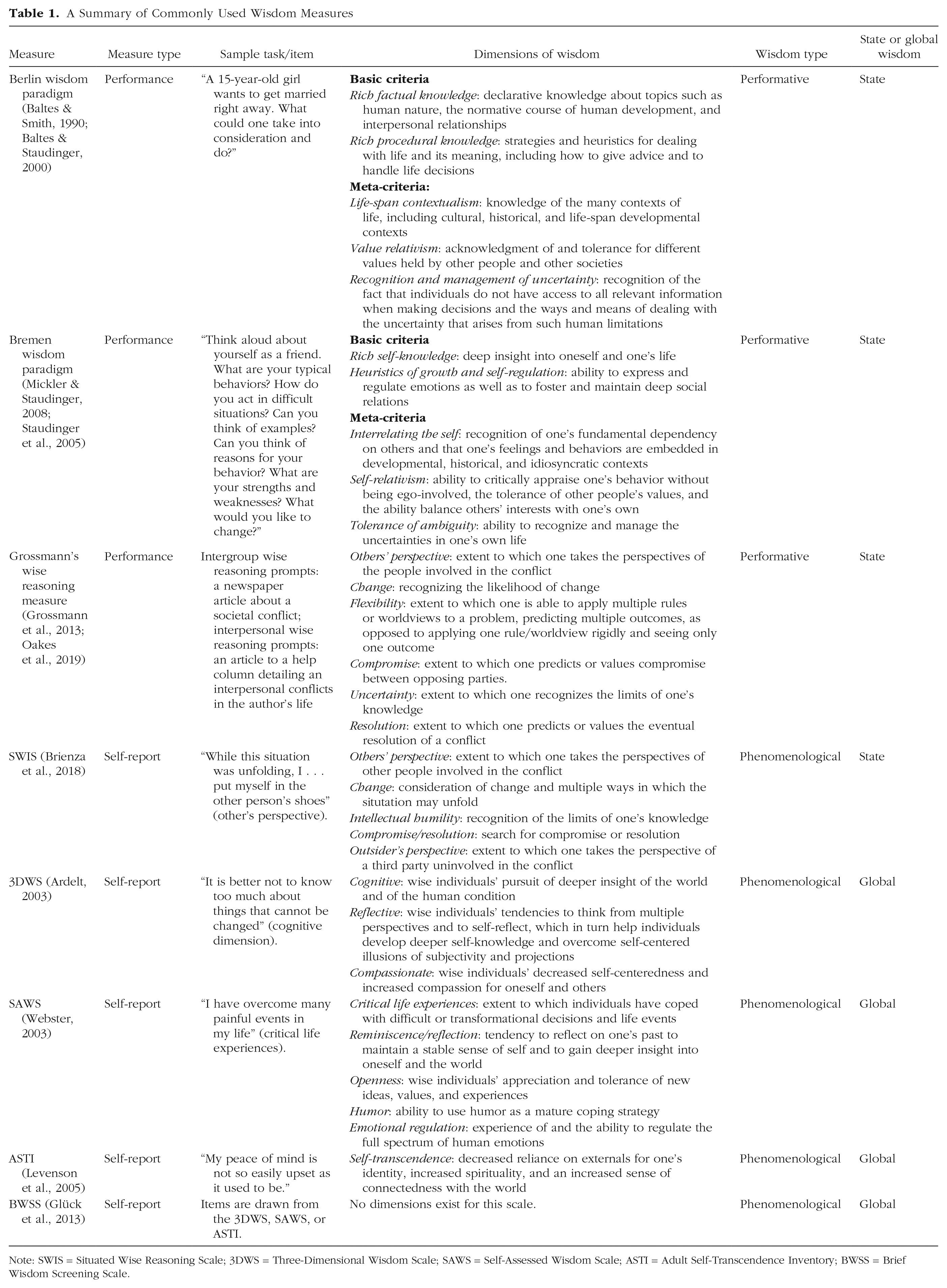
Note: SWIS = Situated Wise Reasoning Scale; 3DWS = Three-Dimensional Wisdom Scale; SAWS = Self-Assessed Wisdom Scale; ASTI = Adult Self-Transcendence Inventory; BWSS = Brief Wisdom Screening Scale.
The Berlin wisdom paradigm assesses general wisdom or a person’s insight into life in general. Evidence suggests, however, that general wisdom is distinct from personal wisdom, which refers to insight into one’s own life (e.g., Huynh et al., 2017; Kross & Grossmann, 2012). As an extension to the Berlin wisdom paradigm, the Bremen wisdom paradigm was developed to assess personal wisdom along an analogous set of criteria (Mickler & Staudinger, 2008; Staudinger et al., 2005). The criteria are summarized in Table 1. Like the Berlin wisdom paradigm, the Bremen wisdom paradigm requires trained coders to rate the five personal wisdom criteria. Because the original Berlin and Bremen wisdom paradigms are labor-intensive, they are often costly and impractical to administer to large samples of participants. In an effort to reduce the cost of these measures, some studies have opted to use written responses in lieu of interviews involving think-aloud responses. In addition, studies have recruited untrained or “naive” raters who rely on their own implicit theories of wisdom to provide one global wisdom rating to each written response (e.g., Fournier et al., 2018; Weststrate et al., 2018). Research has shown moderate-to-large correlations between ratings provided by naive and trained raters on the Berlin and Bremen wisdom paradigms (Glück, 2018; Staudinger et al., 1992), suggesting that the naive rating approach is a valid way to assess wisdom performance.
Integrating the Berlin group’s emphasis on expert knowledge with models that view wisdom as a later stage in cognitive development, the wise reasoning approach conceptualized wisdom as a set of reasoning strategies for facing personal and social conflicts (Grossmann et al., 2013; Oakes et al., 2019). The wise reasoning approach defined wisdom not as static knowledge but as dynamic strategies tailored to the specifics of each conflict that can be applied across a wide variety of conflicts and domains. There are currently two approaches to measuring wise reasoning. The first approach, Grossmann’s wise reasoning measure, is a performance measure. It assesses wise reasoning by presenting participants with vignettes that describe either interpersonal or intergroup conflicts. Unlike the prompts used in the Berlin wisdom paradigm, these vignettes contain more contextual information about the conflicts in question, making them suitable for assessing participants’ abilities to appreciate the nuances of situations and to use their knowledge in dynamic ways. After reading the vignettes, participants are asked to describe how they imagine the conflict would subsequently unfold and why. Participants’ responses are rated by trained coders on six dimensions (Table 1).
The second approach to measuring wise reasoning, the Situated Wise Reasoning Scale (SWIS; Brienza et al., 2018), is a self-report measure that allows the assessment of state-level wise reasoning. The SWIS first invites participants to recall a difficult conflict with a close friend. To facilitate recall, participants are asked to provide a description of the conflict, including the date and time of the conflict as well as their thoughts and emotions during it. After this, participants fill out a 21-item scale, consisting of five dimensions (Table 1), that assesses the extent to which they engaged in wise reasoning during the conflict. Because the SWIS assesses the extent to which participants engage in wise reasoning during a real personal conflict, it is less prone to the response biases, such as socially desirable responding (Brienza et al., 2018), to which global self-report measures are vulnerable. The SWIS also distinguishes state from global wise reasoning, providing a tool for examining intraindividual variability in wise reasoning across situations. Using the SWIS, wise reasoning has been demonstrated to vary substantially across situations, and state-level wise reasoning has been demonstrated to incrementally predict outcomes beyond global wise reasoning (Brienza et al., 2018). These findings suggest that to accurately capture a person’s general level of wisdom, multiple assessments of state-level wisdom may be necessary (Grossmann et al., 2020; Grossmann, Kung, & Santos, 2019).
Despite disagreements over the specific dimensions that constitute wisdom, the Berlin and Bremen wisdom paradigms and the wise reasoning approach all emphasize the role of cognition. According to these conceptualizations of wisdom, wisdom can exist outside of the person (e.g., in religious texts or more mundanely, in participants’ solutions to hypothetical dilemmas). Other wisdom researchers disagree with this view of wisdom and instead conceptualize wisdom as a constellation of relatively stable characteristics of the person, including tendencies in cognition, motivation, emotion, and behavior (Ardelt, 2004a, 2004b; Ardelt et al., 2019; Webster, 2019). This meta-theoretical perspective has given rise to three commonly used self-report measures of wisdom: the Three-Dimensional Wisdom Scale (3DWS; Ardelt, 2003), the Self-Assessed Wisdom Scale (SAWS; Webster, 2003), and the Adult Self-Transcendence Inventory (ASTI; Levenson et al., 2005). Drawing from early research on implicit theories of wisdom (Clayton & Birren, 1980), the 3DWS operationalizes wisdom as an integration of cognitive, reflective, and compassionate personality qualities (Ardelt, 2003; Ardelt et al., 2019). The SAWS was developed on the basis of the definition of wisdom as “the competence in, intention to, and application of critical life experiences to facilitate the optimal development of self and others” (Webster, 2007, p. 164). The SAWS focuses on five interrelated qualities (i.e., critical life experience, reminiscence/reflection, openness, humor, and emotional regulation) that were identified in the literature as being characteristic of wise individuals (Table 1; Webster, 2003, 2007). Unlike the 3DWS and the SAWS, which conceptualize wisdom as an integration of multiple characteristics of a person, the ASTI assesses wisdom through a single component: self-transcendence, which entails a decreased reliance on externals for one’s identity, increased spirituality, and an increased sense of connectedness with the world (Levenson et al., 2005). Although self-transcendence may not be entirely equivalent to wisdom, it is nevertheless considered to be a critical component (Jennings et al., 2006; Levenson et al., 2005).
To empirically identify the commonality among the 3DWS, the SAWS, and the ASTI, Glück and colleagues (2013) factor-analyzed all items from the three measures and identified one common factor. They then selected 21 items that had the strongest correlations with the common factor and created the Brief Wisdom Screening Scale (BWSS). However, Glück and colleagues (2013) acknowledged that although the BWSS may be useful as an efficient screening measure for wisdom, its content as well as the common factor that it assesses do not have a theoretical grounding. The BWSS thus cannot provide insight into characteristics that may be essential to wisdom; it “does not represent any particular theory of wisdom or allow for an analysis of facets of wisdom” (Glück et al., 2013, p. 12).
Performative versus phenomenological wisdom
The two main meta-theoretical approaches to conceptualizing wisdom gravitate toward different methods of assessment. Conceptualizations of wisdom that emphasize its cognitive aspects tend to give rise to performance measures in which wisdom is demonstrated in specific products (i.e., solutions to difficult problems that call for wisdom) that are then socially evaluated. Performative wisdom, as captured by extant performance wisdom measures, is state-like and scenario-specific. Evidence suggests that performative wisdom is context-dependent (e.g., Pasupathi et al., 2001), although it also shows some degree of consistency, as indicated by the adequate-to-high Cronbach’s alphas for the Berlin wisdom paradigm and Grossmann’s wise reasoning measures across different scenarios (Grossmann et al., 2013; Staudinger et al., 1997, 1998; Staudinger & Pasupathi, 2003). Furthermore, performative wisdom likely captures an individual’s maximal, rather than typical, level of wisdom, because prompts of performance wisdom measures are designed to be difficult and challenge participants to give their best effort. Performative wisdom thus entails the successful execution of one’s potential for wisdom, which is subsequently acknowledged by other people.
Self-report wisdom measures, on the other hand, capture phenomenological wisdom. Unlike performative wisdom, which is manifested in products that are socially evaluated, phenomenological wisdom entails the subjective experience of one’s cognition, motivations, and emotions as wise. Phenomenological wisdom is more likely to capture one’s typical, rather than maximal, level of wisdom, because its assessment invokes the recalling of one’s daily experiences rather than one’s performance under challenge. It should be noted that among the measures of phenomenological wisdom, the SWIS is distinct from the other measures in that it is designed to assess state-level wisdom, whereas most of the other phenomenological wisdom measures assess wisdom at a global (as opposed to state) level. Nonetheless, because there is no reason to believe that the situational contexts of the conflicts assessed by the SWIS demand participants to exert their full effort in thinking and behaving wisely, the SWIS is more likely to assess one instance of typical, rather than maximal, wisdom. We thus consider the SWIS to be a measure of phenomenological wisdom that captures one’s typical level of subjectively experienced, rather than socially evaluated, wisdom.
Wisdom measures therefore differ from each other both conceptually and methodologically. These differences may contribute to the low correlations observed among wisdom measures: Although wisdom measures are positively correlated with each other, the correlations usually range from .20 to .40, much lower than would be expected of measures of the same construct (e.g., Glück et al., 2013). Relatedly, different measures of wisdom seem to suggest different sets of wisdom correlates, resulting in ambiguities in terms of the nomological network of wisdom. To shed light on the divergence and ambiguities apparent in the literature, we therefore propose to use the meta-analytical technique to identify the similarities and differences among wisdom measures in terms of their correlates. Specifically, we first examined the overall correlation between wisdom and each of its potential correlates. We then examined whether the variability among the correlations found in different studies could be explained by the broad categorization of wisdom measures into measures of performative versus phenomenological wisdom. Finally, we examined the extent to which the remaining variability could be explained by how each wisdom measure was uniquely associated with the wisdom correlates.
Which People Are Wise? Demographic, Cognitive, and Personality Correlates
Wisdom and age
In laypeople’s implicit theories, old age is one of the characteristics associated with wisdom (e.g., Clayton & Birren, 1980). Across studies, most wisdom nominees tend to be above 50 years of age (e.g., Bluck & Glück, 2005). However, although most wisdom researchers believe that life experience, when actively reflected on, can lead to growth in wisdom, chronological age by itself does not automatically guarantee wisdom. Indeed, the majority of published studies reported nonsignificant correlations between age and wisdom (e.g., Ardelt, 2010; Cheraghi et al., 2015; Grossmann, Sahdra, & Ciarrochi, 2016; Grossmann & Kross, 2014; Jennings et al., 2006; Levenson et al., 2005; Mansfield et al., 2010; Neff et al., 2007; Pasupathi & Staudinger, 2001; Staudinger & Baltes, 1996; Taylor et al., 2011; Webster, 2003; Webster, Westerhof, & Bohlmeijer, 2014; Zacher et al., 2013, 2015). However, the empirical evidence is not always consistent, with some studies observing negative correlations (e.g., Ardelt, 2016; Ardelt & Jeste, 2018; Glück et al., 2013; Mehl Chadwick, 2008) and others observing positive correlations (e.g., Beaumont, 2011; Glück et al., 2013; Grossmann et al., 2013; Le & Levenson, 2005; Ruiselová et al., 2012; Webster, 2013; Webster et al., 2018; Zacher et al., 2013).
Although longitudinal studies have not yet examined this question, cross-sectional evidence suggests that the relationship between wisdom and age may not be the same across the life span. For instance, old age may be associated with a decline in wisdom, as individuals become less open-minded and as the ability to solve problems declines with fluid intelligence (e.g., Glück, 2019). Empirical evidence on the nonlinear relationship between age and wisdom, however, does not always converge, with some studies suggesting a positive quadratic relationship (Brienza et al., 2018) and others suggesting a negative quadratic relationship (e.g., Ardelt et al., 2018; Webster, Bohlmeijer, & Westerhof, 2014). Therefore, to address the discrepant findings on the relationship between age and wisdom, we first meta-analytically summarized the observed correlations between wisdom and age. We then explored whether the summary correlations differed for participants of different age groups. Specifically, we examined the correlations between age and wisdom for younger, middle-aged, and older adults. We chose to examine these age groups because most studies testing the curvilinear relationship between age and wisdom seemed to have found quadratic relationships in which young adulthood, middle age, and old age showed different associations between age and wisdom. We would like to note, however, that given that all primary studies included in the meta-analyses are cross-sectional in design, we were not able to control for cohort effects.
Wisdom and intelligence
Although agreeing that intelligence is not sufficient for wisdom, laypeople and wisdom researchers alike consider the abilities to solve problems and to learn from experience, both hallmarks of intelligence (e.g., Gottfredson, 1997; Nisbett et al., 2012), to be important for wisdom. Intelligence could allow for more efficient gathering and utilization of information, which in turn could lead to better decision-making. Intelligence could also allow for more effective learning from past experiences. Different components of intelligence (i.e., fluid and crystallized) have been theorized to be related to wisdom in different ways. Specifically, fluid intelligence is thought to enable individuals to think complexly, whereas crystallized intelligence is thought to be more related to the wisdom-related factual and procedural knowledge that result from thinking complexly about life and one’s experiences (Glück, 2020b). The advantages afforded by high levels of intelligence could thus support both the development and the manifestation of wisdom. Wisdom, however, entails much more than intelligence. For instance, it is not obvious that intelligence should be associated with aspects of wisdom that entail the recognition and management of uncertainty, perspective-taking, prosociality, and moral aspirations (e.g., compassion and the pursuit of compromise and conflict resolution). The correlation between intelligence and wisdom should therefore be positive but small in magnitude. This expectation is consistent with empirical observations to date: Both self-report and performance measures of wisdom have demonstrated significant correlations with intelligence, with larger correlations for crystallized than fluid intelligence (e.g., Glück et al., 2013; Grossmann et al., 2012; Mickler & Staudinger, 2008; Pasupathi & Staudinger, 2001; Staudinger et al., 1997).
However, findings regarding the relationship between wisdom and intelligence are not always consistent. Although reports of negative associations between wisdom and intelligence are rare (cf., Glück et al., 2013; Grossmann et al., 2012), many studies have found nonsignificant correlations between the constructs (e.g., Fournier et al., 2018; Glück et al., 2013; Greaves et al., 2014; Grossmann et al., 2012). In this article, we attempted to move beyond the discrepant findings of individual studies and quantitatively summarize the correlation between intelligence and wisdom across studies. We then explored factors that could explain the discrepant findings. Specifically, we hypothesized that intelligence would be more strongly correlated with performative wisdom than with phenomenological wisdom. This is because performative wisdom entails the successful demonstration of one’s maximal level wisdom in the face of challenge, often in the form of reasoning and problem-solving, and is thus more likely to engage one’s maximal level of cognitive ability in the process. Phenomenological wisdom, on the other hand, entails one’s typical, rather than maximal, level of wisdom and often encompasses motivational, emotional, and behavioral aspects of wisdom, for which intelligence may be less relevant. We thus examined the type of wisdom (i.e., performative and phenomenological) as a moderating variable on the correlation between wisdom and intelligence. We also examined whether the relationship between intelligence and wisdom differed among wisdom measures. Finally, we examined whether the correlation between wisdom and intelligence was moderated by the type of intelligence assessed (i.e., crystallized and fluid), given that most extant research on the relationship between intelligence and wisdom tends to distinguish between the crystallized and fluid components of intelligence (e.g., Mickler & Staudinger, 2008; Pasupathi & Staudinger, 2001; Staudinger et al., 1997) and that, as discussed previously, these components have been theorized to relate to wisdom in different ways (Glück, 2020b).
Wisdom and the Big Five traits
Across conceptualizations of wisdom, characteristics such as flexible thinking, willingness to engage with different ideas and perspectives, and tolerance of uncertainty and ambiguity are all essential aspects of wisdom. These characteristics are in part predicted by the personality trait of openness. Most theories of wisdom therefore consider openness to be a correlate of wisdom. Indeed, across measures, wisdom has often been found to positively correlate with openness (e.g., Brienza et al., 2018; Glück et al., 2013; Kunzmann & Baltes, 2003; Le, 2005; Levenson et al., 2005; Mickler & Staudinger, 2008; Pasupathi & Staudinger, 2001; Staudinger et al., 1997; Weststrate, 2017; Zacher et al., 2015), although the correlation has not always been found to be significant (e.g., Brienza et al., 2018; Greaves et al., 2014; Zacher et al., 2015). In the current study, we propose to quantitatively summarize the relationship between openness and wisdom. Given the agreement among wisdom researchers that openness should positively predict wisdom, we expected the correlations between the constructs to be positive for performative wisdom, phenomenological wisdom, and each wisdom measure.
Unlike openness, there is much less theoretical and empirical support for postulating the associations between wisdom on the one hand and the Big Five traits of extraversion, agreeableness, conscientiousness, and emotional stability (reverse-scored neuroticism) on the other. High levels of these traits are considered adaptive and so should positively associate with wisdom when it is conceptualized as a constellation of adaptive characteristics of the person (i.e., phenomenological wisdom). Of the four traits, agreeableness may be the most relevant to wisdom because it may partly capture the prosocial aspirations of wise individuals. Some scholars have also speculated that a threshold level of emotional stability may be necessary for wisdom (Staudinger et al., 2005). It is unclear how extraversion and conscientiousness would be associated with wisdom aside from their general adaptiveness. The empirical evidence for the associations between the four adaptive traits and wisdom is not consistent (e.g., Levenson et al., 2005; Neff et al., 2007; Weststrate, 2017; Zacher et al., 2015), which we hoped to clarify by meta-analytically summarizing the observed correlations. We expected stronger correlations between these traits and phenomenological wisdom because many measures of phenomenological wisdom reflect conceptualizations of wisdom as an adaptive constellation of personal characteristics, and we expected weaker or no correlations between these traits and performative wisdom because there is a lack of theoretical associations between these constructs.
Wisdom, narcissism, and self-esteem
Although wisdom may be positively predicted by some personality characteristics, others may be antithetical to it. Narcissism can be considered one of the antitheses to wisdom. Whereas wise individuals are humble, compassionate, and self-transcendent (e.g., Ardelt, 2003; Baltes & Staudinger, 2000; Brienza et al., 2018; Levenson et al., 2005; Mickler & Staudinger, 2008; Sternberg, 2004), narcissistic individuals are grandiose, dominant, and characterized by a sense of entitlement and superiority (e.g., Paulhus & Williams, 2002; Raskin & Hall, 1979). According to some, narcissism may be the developmental opposite of wisdom in the sense that individuals begin life preoccupied with self-interests and proceed to transcend such narcissistic tendencies through psychological maturation, for which the attainment of wisdom is an endpoint (Kohut, 1966). Although there has yet to be longitudinal studies examining this topic, cross-sectional findings are consistent with this idea, showing that older individuals are more likely to show tendencies that are closer to wisdom and further away from narcissism. Specifically, one study found that adults score significantly higher than adolescents on the recognition and management of uncertainty dimension of the Berlin wisdom paradigm (Pasupathi et al., 2001), suggesting that those later in development are less self-assured and more intellectually humble. Another study found that older adults scored higher on the compassionate dimension of the 3DWS (Ardelt et al., 2019), suggesting that they value others’ interests and perspectives more highly than younger adults do. Despite the theoretical relevance of narcissism to wisdom, however, only a few empirical studies have examined the two constructs in tandem. Using the meta-analytical approach, we propose to summarize the extant evidence to glean a more reliable depiction of the empirical relationship between narcissism and wisdom.
Although wise individuals do not self-enhance like narcissistic individuals, they should not self-deprecate or have low self-esteem. Indeed, as a positive developmental endpoint, wisdom should be positively associated with other adaptive constructs, such as self-esteem. Guided by this speculation, we also meta-analyzed the relationship between wisdom and self-esteem to test the hypothesis that, unlike narcissism, wisdom adaptively leads to high levels of self-esteem in ways that do not involve self-enhancement.
Wisdom and social desirability
Wise individuals should have accurate understandings of their limitations and present themselves authentically to other people (Baltes & Staudinger, 2000; Brienza et al., 2018; Glück, 2018; Mickler & Staudinger, 2008 c.f., Taylor et al., 2011). Individuals who are unwise, on the other hand, may be less perceptive of their limitations and more likely to manage impressions. This creates a potential paradox for self-report measures: Because wise individuals are more aware of their limitations, they may be less likely to rate themselves favorably on self-report measures of wisdom; in contrast, foolish individuals who are less perceptive of their limitations may be more likely to rate themselves as wise on self-report measures of wisdom because of their lack of insight (Glück, 2018). The paradox implies that high scores on self-report wisdom measures may be difficult to interpret. Whether and the extent to which a wisdom measure is affected by this paradox may be indicated by its correlation with social desirability measures, with positive correlations suggesting that the paradox is in effect.
In an attempt to overcome the self-report paradox, phenomenological wisdom measures have incorporated reverse-scored items that would appear innocuous or even desirable to individuals who are less wise (e.g., “ignorance is bliss” of the 3DWS). Although such efforts might be effective at mitigating the self-report paradox of wisdom to some extent, measures of phenomenological wisdom nonetheless tend to correlate with measures of social desirability (e.g., Glück et al., 2013). However, the extent to which each of these measures is associated with social desirability and its dimensions is inconsistent across studies (e.g., Ardelt, 2011, 2016; Brienza et al., 2018). Thus, to gain better estimates of the association between each phenomenological wisdom measure and social desirability, we quantitatively summarized the extant studies. We hoped that the results of such comparisons would inform future researchers of the merits and caveats of using each phenomenological wisdom measure.
Does Wisdom Predict a Good Life? Wisdom and Well-Being
Because wisdom is often considered one of the ideal endpoints of human development, it is important to clarify whether wisdom indeed fulfills this expectation and brings about well-being by acting as a guide to “living a good life.” The answer to this inquiry partly depends on how “a good life” or well-being is defined. Hedonic well-being involves pleasure and happiness in life and is commonly operationalized as life satisfaction accompanied by the presence of positive affect and the absence of negative affect (Ryan & Deci, 2001). Eudaimonic well-being involves adjustment, growth, and the fulfillment of one’s potential and is commonly operationalized using Ryff’s (1989) Psychological Well-Being Scale. Notably, Disabato and colleagues (2016) demonstrated in a large-scale cross-cultural study that measures of hedonic and eudaimonic well-being formed a single overarching factor rather than two distinct but related factors of well-being. The same study also found that measures of hedonic and eudaimonic well-being showed very similar relationships with other constructs, including curiosity, gratitude, hope, grit, and an orientation to find happiness through meaning and the fulfillment of one’s potential (Disabato et al., 2016).
However, the distinction between hedonic and eudaimonic well-being may still be meaningful for wisdom research, not only because wisdom is theorized to have different associations with the two types of well-being but also because such a difference has often been found empirically. Specifically, the relationship between wisdom and hedonic well-being is theorized to involve multiple pathways (Ardelt et al., 2019; Weststrate & Glück, 2017a). On the one hand, self-perceived wisdom-fostering experiences are likely to be upsetting (Weststrate et al., 2018), challenging one’s previous assumptions about the world and catalyzing new understandings and insights in the process. This suggests that, at least in the short term, wisdom may be negatively associated with hedonic well-being. On the other hand, wise individuals, enabled by their insights into the world as well as the human condition, can better manage difficult situations and are more likely to appreciate and savor positive experiences (Weststrate & Glück, 2017a). From this perspective, wisdom may enhance hedonic well-being. Theories behind most measures of phenomenological wisdom view wisdom as an adaptive configuration of personal characteristics that affords equanimity and preservation of inner peace and well-being (Ardelt, 2019). Phenomenological wisdom, therefore, is expected to be positively associated with hedonic well-being, especially with the life-satisfaction dimension. Theories behind performative wisdom, however, do not draw the same connections between wisdom and hedonic well-being.
In wisdom research, eudaimonic well-being is sometimes further decomposed into two components: adjustment and growth (Staudinger & Kunzmann, 2005). Adjustment refers to individuals’ successful adaptation to societal expectations and structures as well as the successful fulfillment of their social roles; it is the normative developmental pathway. Adjustment is typically operationalized via the autonomy, environmental mastery, self-acceptance, and positive relationship dimensions on Ryff’s psychological well-being scale. Growth refers to the tendency to be open to nonnormative experience and to go beyond conventional societal requirements and expectations. It is most commonly operationalized via the personal growth and purpose in life dimensions of Ryff’s psychological well-being scale (Ardelt et al., 2019; Mickler & Staudinger, 2008 cf., Weststrate & Glück, 2017a; Zacher & Staudinger, 2018). Whereas only phenomenological wisdom is thought to be associated with the adjustment aspect of eudaimonic well-being, both performative and phenomenological wisdom are thought to positively predict the growth aspect of eudaimonic well-being because personal growth and fulfillment are essential to wisdom according to most conceptualizations of wisdom. Empirical findings on wisdom’s association with hedonic and eudaimonic well-being, however, are not always consistent. In the current study, we attempted to clarify these relationships by meta-analytically summarizing the empirical findings. We also examined whether phenomenological and performative wisdom showed the same kinds of relationships with the two types of well-being and their dimensions as theories have suggested.
The Current Study
As we have reviewed, although researchers agree on the general definition of wisdom as an integrated excellence in mind and virtue, much remains to be reconciled. In an attempt to elucidate the nomological network of wisdom, we meta-analyzed the correlations between wisdom on the one hand and age, intelligence, the Big Five personality traits, narcissism, self-esteem, social desirability, and well-being on the other. We further examined whether these correlations were moderated by the broad categories of phenomenological versus performative wisdom and by different ways of operationalizing wisdom. Using multilevel meta-analytical techniques, we ventured to investigate the following questions and hypotheses:
How is wisdom correlated with chronological age? Are the correlations the same or different for younger adults (age 18–30), midlife adults (age 30–60), and older adults (over 60 years of age)? We hypothesized that wisdom would show a near-zero correlation with age but that the correlation between wisdom and age would be significantly moderated by the age range of the participants.
How is wisdom correlated with intelligence? Are the correlations the same or different for crystallized and fluid intelligence? We hypothesized that wisdom would show a small positive correlation with intelligence and that this correlation would be stronger for performative wisdom than for phenomenological wisdom. In addition, we hypothesized that wisdom would be significantly correlated with both crystallized and fluid intelligence; however, we did not have a hypothesis regarding whether these correlations would significantly differ in strength.
How is wisdom correlated with each of the Big Five traits? We hypothesized that wisdom would show the strongest correlation with openness and that this correlation would be significant for both performative and phenomenological wisdom as well as for each wisdom measure. We hypothesized that phenomenological wisdom would be positively correlated with each of the adaptive Big Five traits (i.e., agreeableness, emotional stability, extraversion, and conscientiousness), whereas performative wisdom would not.
How is wisdom correlated with narcissism and self-esteem? We hypothesized that wisdom would be negatively correlated with narcissism but positively correlated with self-esteem.
How is wisdom correlated with social desirability? Are the correlations the same or different for impression management and self-deception? Which wisdom measures are most strongly associated with impression management? Which wisdom measures are most strongly associated with self-deception? We set out to examine these questions without hypotheses.
Is wisdom differentially correlated with hedonic and eudaimonic well-being? Are the correlations different for the subcomponents of hedonic well-being (e.g., life satisfaction, positive affect, and negative affect) and eudaimonic well-being (i.e., adjustment and growth)? We hypothesized that phenomenological wisdom would be positively correlated with hedonic well-being and that this correlation would be stronger than that for performative wisdom. We hypothesized that both phenomenological wisdom and performative wisdom would be positively correlated with eudaimonic well-being. Finally, we hypothesized that the correlation between wisdom and eudaimonic well-being would be stronger for the growth component than for the adjustment component.
We hope that by clarifying the nomological network of wisdom the field can arrive at a clearer understanding of the construct itself. Furthermore, we hope that clarifying the correlates of different wisdom measures will help researchers to make more informed choices about the measures that are the most suitable for their research questions. We note, however, that given the fact that most extant empirical research on wisdom was conducted in Western, educated, industrialized, rich, and democratic (Henrich et al., 2010) countries, the generalizability of the meta-analytic findings to other cultures might be limited.
Method
Inclusion criteria
To be included in any of the meta-analyses, a study needed to have measured wisdom using one of the following measures: the 3DWS, the SAWS, the ASTI, the SWIS, the BWSS, the Berlin wisdom paradigm, the Bremen wisdom paradigm, and/or Grossmann’s wise reasoning measure. In addition, from the data and statistics available, we needed to be able to record or compute Pearson’s r, or an effect size that was convertible to it, between a wisdom measure and a variable of interest. Variables of interest included age, intelligence, the Big Five traits, self-esteem, social desirability and/or at least one of its dimensions (i.e., impression management and self-deception), and well-being. Because we were primarily interested in whether wisdom predicted global, rather than state, well-being, studies were excluded if they reported only the correlations between wisdom and state-level well-being (i.e., well-being within a day or during a specific event). When statistics from the same sample of participants were reported more than once, we ensured that any given effect size from the same sample was included only once in the meta-analysis. If an effect size was reported multiple times across overlapping but nonidentical samples of participants, we included the effect size based on the most comprehensive sample.
Gathering studies
We gathered studies in four phases. In the first phase, we searched the PsycINFO database following the guidelines outlined in the Preferred Reporting Items for Systematic review and Meta-Analysis (Moher et al., 2009), in which we used the search term “(su(wisdom) AND (age)) AND la.exact(“ENG”)” for English articles that had wisdom and age as keywords, “(su(wisdom) AND ((intelligence) OR (cognit*))) AND la.exact(“ENG”)” for English articles with wisdom, intelligence, and cognit* as keywords, “(su(wisdom) AND (personality)) AND la.exact(“ENG”)” for English articles with wisdom and personality as keywords, and “(su(wisdom) AND (well-being)) AND la.exact(“ENG”)” for English articles with wisdom and well-being as keywords. The initial searches were conducted on September 18, 2017, November 22, 2017, November 22, 2017, and September 18, 2017, respectively. For each search, we examined the abstracts of all the records identified by the search to determine their relevance. We then downloaded the full texts of the relevant articles, assessed their eligibility on the basis of the inclusion criteria, and coded the eligible articles.
In the second phase of the search, we engaged in a “snowballing” process in which we perused the reference lists of the articles coded in the first phase and downloaded the articles with titles that appeared relevant for our purpose. In the third phase, to catch unpublished studies as well as studies that were missed by the literature search and the snowballing process, we solicited relevant effect sizes through calls of submissions. We first contacted prominent wisdom researchers individually for unpublished effect sizes as well as published ones in their work that they believed we overlooked. We then made a general call for submissions via psychology research listservs pertinent to wisdom research, including that of the wisdom research community, the Association of Research in Personality, the European Association of Personality Psychology, and the Society for the Study of Human Development. In the final phase, following the exact same procedures outlined in the first phase, the PsycINFO database searches were updated on September 13, 2021, to capture journal articles and dissertations published since September 18, 2017. The information flow and the number of articles reviewed at each phase are summarized in Figure 1.
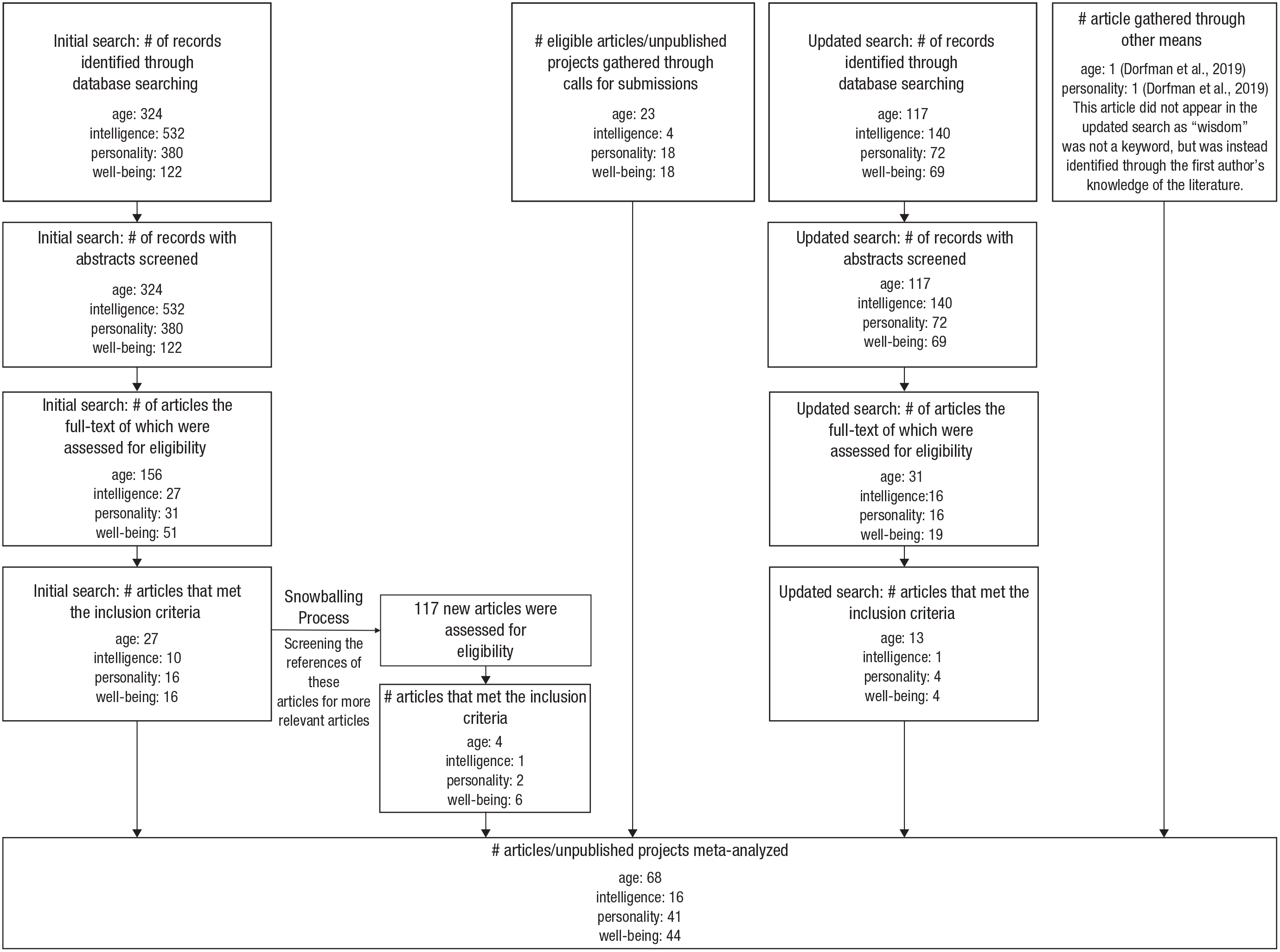
Information flow of the meta-analyses.
In total, we coded 68 articles and unpublished projects for the meta-analysis of wisdom and age, 16 for wisdom and intelligence, 41 for wisdom and personality constructs (including the Big Five traits, narcissism, self-esteem, and social desirability), and 44 for wisdom and well-being. Notably, some of the articles initially gathered through the well-being search also reported correlations between wisdom and self-esteem. Likewise, there were articles initially gathered through other searches that reported correlations between wisdom and social desirability. In all of these cases, we have coded the relevant effect sizes regardless of the search through which they were initially gathered.
Coding studies
The first and second authors independently evaluated the studies for eligibility on the basis of the inclusion criteria and independently coded all eligible articles. Any discrepancies between the authors were successfully resolved through discussions and revisiting the articles. Tables 1S-4S of the Supplemental Material present a summary of the effect sizes, sample sizes, and measures of all studies meta-analyzed.
Effect size
The effect sizes meta-analyzed were bivariate Pearson’s r values. In cases in which only Student’s t values were available, we recorded and converted them to Pearson’s r values. All submitted effect sizes were Pearson’s r values. In cases in which the effect sizes were reported only for the subscales of a wisdom measure, the subscale effect sizes were converted into Fisher’s z values and averaged to yield one effect size for the full scale. The averaged Fisher’s z was then converted to Pearson’s r to be used in the meta-analysis. For well-being, the signs of the correlations between wisdom and negative affect were reversed such that positive correlations reflect a positive relationship between wisdom and well-being.
Sample size
The sample size associated with each Pearson’s r was recorded. Missing data in an original study sometimes led to a range of sample sizes being reported for its correlation tables. In these cases, we coded the median of that range as the sample size.
Publication status
We coded each study as either published or unpublished. Published studies are those that appeared in peer-reviewed journals, whereas unpublished studies included theses, dissertations, conference presentations, and unpublished manuscripts.
Year
We coded the year in which the published studies were published or the year to which the unpublished studies were ascribed by their authors.
Wisdom measure
We coded the specific wisdom measure(s) used as one of the 3DWS, the ASTI, the SAWS, the SWIS, the BWSS, the Berlin wisdom paradigm, the Bremen wisdom paradigm, and Grossmann’s wise reasoning task.
Type of wisdom
We coded the 3DWS, the ASTI, the SAWS, the SWIS, and the BWSS as measures of phenomenological wisdom, and the Berlin wisdom paradigm, the Bremen wisdom paradigm, and Grossmann’s wise reasoning task as measures of performative wisdom.
Age
We coded the age of the sample as its mean chronological age.
Age range
The age range of a participant sample was coded as “life span” if the age of the sample ranged from late adolescence/early adulthood to old age, “young” if (MAge + 1 SDAge) was less than 30, “old” if (MAge − 1 SDAge) was more than 60, and “middle age” if the age range did not fall into “young,” “old,” or “life span.”
Gender balance of the sample
The gender balance of each sample of participants was coded as the proportion of females over males in the sample, ranging from 0 (all-male sample) to 1 (all-female sample).
Type of intelligence measures
To examine the moderating effect of the type of intelligence, we categorized intelligence measures as measures of fluid, crystallized, or general intelligence. Fluid intelligence measures included processing speed measures, digit span tests, Raven’s Progressive Matrices and its variants, trail-making tests, digit symbol substitution tests, inductive reasoning tests, block design tests, and letter series tests. Crystallized intelligence measures included the comprehension subtests from the Wechsler Adult Intelligence Scale (WAIS) and its variants, vocabulary subtests from the WAIS and its variants, similarities subtests of the WAIS, multiple-choice word tests, and practical-knowledge questionnaires (akin to the knowledge subtest of the German WAIS). General intelligence measures were those that estimated g using a mixture of fluid and crystallized intelligence items. Scores of general intelligence measures were not or could not be decomposed into the fluid and crystallized subcomponents. Examples of such measures included the International Cognitive Ability Inventory (Condon & Revelle, 2014) as well as variants of the Wonderlic Personnel Test (Wonderlic, Inc, 2000).
Social desirability and its subcomponents
We categorized measures of social desirability as assessing overall social desirability, the self-deception subcomponent, and the impression management subcomponent. An effect was coded as describing the correlation between wisdom and overall social desirability if the measure of social desirability did not distinguish between the subcomponents or if correlations were reported only for the whole scale. Measures of self-deception and impression management included the self-deception and impression management subscales of the Balanced Inventory of Desirable Responding (Paulhus, 1984), respectively.
Type of well-being and their subcomponents
We categorized well-being measures as hedonic or eudaimonic. Hedonic well-being measures included measures of subjective well-being, measures of happiness, measures of positive affect, measures of negative affect, and measures of life satisfaction. We reversed the signs of the correlations between wisdom and negative affect such that positive correlations indicated decreasing levels of negative affect with increasing levels of wisdom. Eudaimonic well-being measures included Ryff’s psychological well-being measure and its subscales (Ryff, 1989), measures of purpose in life, measures of personal mastery, measures of life engagement, measures of ego integrity, measures of posttraumatic growth, and measures of flourishing. Measures constituting the subcomponents of hedonic and eudaimonic well-being are detailed in Table S4.
Analytic approach
The majority of the studies that we gathered reported multiple effect sizes for the same relationship between wisdom and a criterion variable. The conventional approach of aggregating effect sizes from the same study could not be reasonably applied in the current study because of the heterogeneity among wisdom measures (e.g., Glück, 2018). We therefore used the multilevel meta-analytic approach to account for the common variance among effect sizes that were based on the same sample of participants. Specifically, the multilevel model allowed effect sizes to vary between participants (sampling variance; Level 1), within studies (Level 2), and between studies (Level 3; Assink & Wibbelink, 2016). All analyses were conducted in the R software environment (Version 3.6.1; R Core Team, 2019). We used the packages dplyr (Wickham et al., 2020), dmetar (Harrer et al., 2019), metafor (Viechtbauer, 2010), and psych (Revelle, 2019). We conducted moderation analyses (a) when the heterogeneity among the effect sizes was statistically significant or (b) when sampling variance accounted for less than 25% of the total variance (Assink & Wibbelink, 2016; Hunter & Schmidt, 1990). Moderating variables were tested one at a time. Categorical moderators (i.e., publication status, wisdom measure type, wisdom measure, age range, intelligence type, subcomponents of social desirability, types of well-being, and subcomponents of hedonic and eudaimonic well-being) were entered as dummy codes, whereas continuous moderators (i.e., gender balance) were centered at the grand mean. The data and R scripts can be found on the OSF at https://osf.io/h48pm. Following the recommendation that the magnitude of effect sizes should be interpreted in the context of the subdiscipline (e.g., Schäfer & Schwarz, 2019), we interpreted the magnitude of the correlations in accordance with findings in personality/social psychology, in which small, medium, and large effects are r = .10, r = .20, and r = .30, respectively (e.g., Funder & Ozer, 2019; Gignac & Szodorai, 2016; Richard et al., 2003).
Results
Publication bias and preliminary analyses
We examined three indicators for each of the meta-analyses that we conducted to assess whether publication bias strongly influenced the results (Table 2). First, we examined funnel plot symmetry for each meta-analysis (see Fig. S1 in the Supplemental Material available online). Because the extant Egger’s test of the metafor package was not designed for multilevel meta-analyses, we followed the practice of Zhou and colleagues (2019) and conducted manual Egger’s tests to examine the moderation of the effect sizes by their corresponding inverse sampling errors. If publication bias were present, the moderation should be statistically significant and negative, where lower precision (i.e., smaller sample sizes and larger sampling errors) is associated with larger effect sizes. As shown in Table 2, the moderation was not significant for six of the 12 meta-analyses conducted, showing no evidence of publication bias in these cases. For the remaining six out of 12 meta-analyses in which the moderation was significant, five (openness, conscientiousness, self-esteem, social desirability, and eudaimonic well-being) showed a positive association between precision and effect size. This was contrary to the prediction based on the presence of publication bias, in which the moderation was expected to be negative in direction. For neuroticism, the moderation was negative in direction; however, given that neuroticism is negatively correlated with wisdom (Table 3), a negative association between precision and effect size in this case indicated that greater precision was associated with stronger effects, which was again to the contrary of the direction predicted by publication bias. We argue that the funnel asymmetry in these meta-analyses was more likely due to true, systematic heterogeneity among the effect sizes than to publication bias. In these meta-analyses, larger studies were less likely than smaller studies to have administered performative wisdom measures. In these meta-analyses, performative wisdom showed weaker correlations than phenomenological wisdom, thus explaining the association between sample size and effect size. We therefore argue that the funnel plot asymmetries in these meta-analyses should not be taken as evidence for the presence of publication bias.
Assessment of Publication Bias
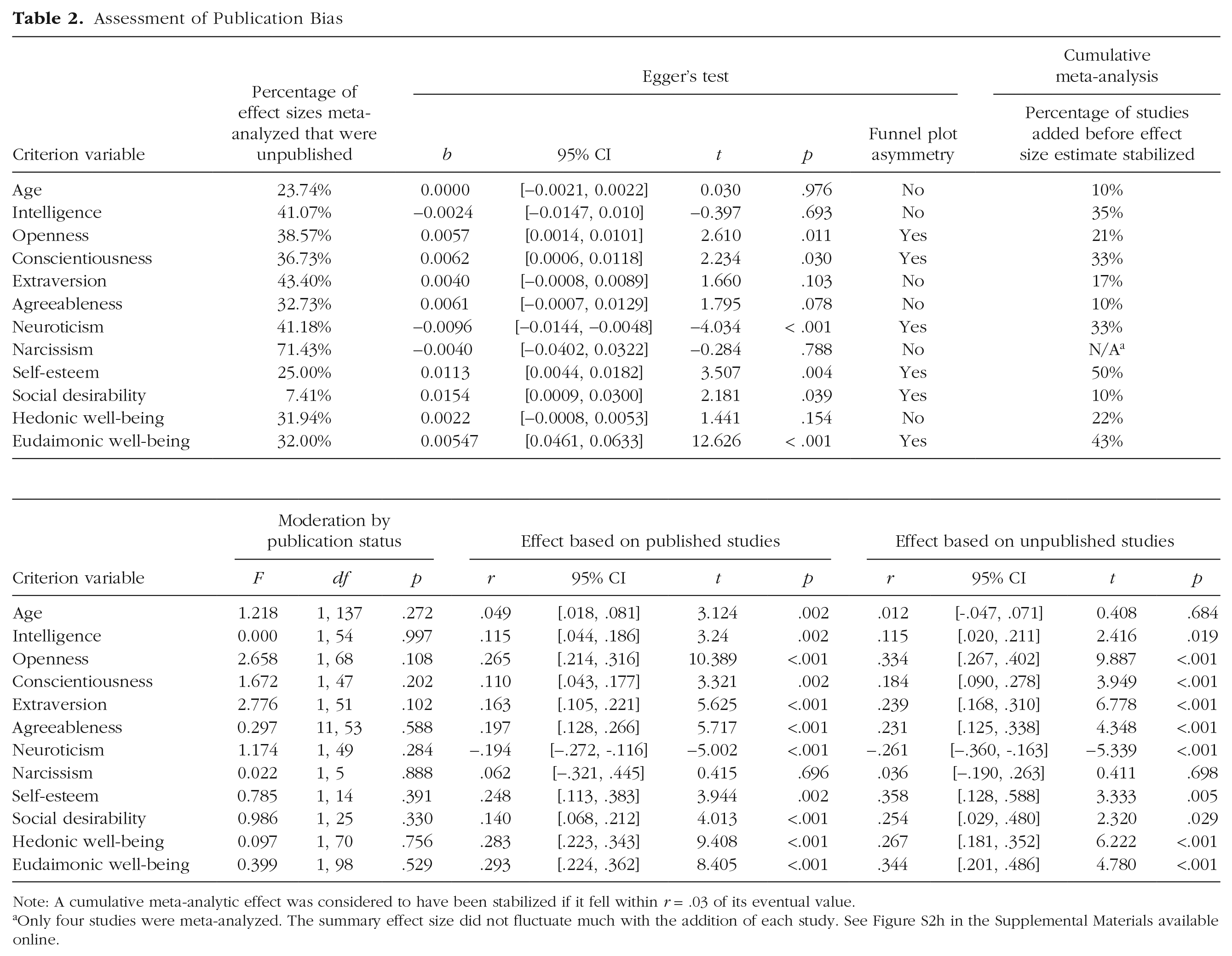
Note: A cumulative meta-analytic effect was considered to have been stabilized if it fell within r = .03 of its eventual value.
Only four studies were meta-analyzed. The summary effect size did not fluctuate much with the addition of each study. See Figure S2h in the Supplemental Materials available online.
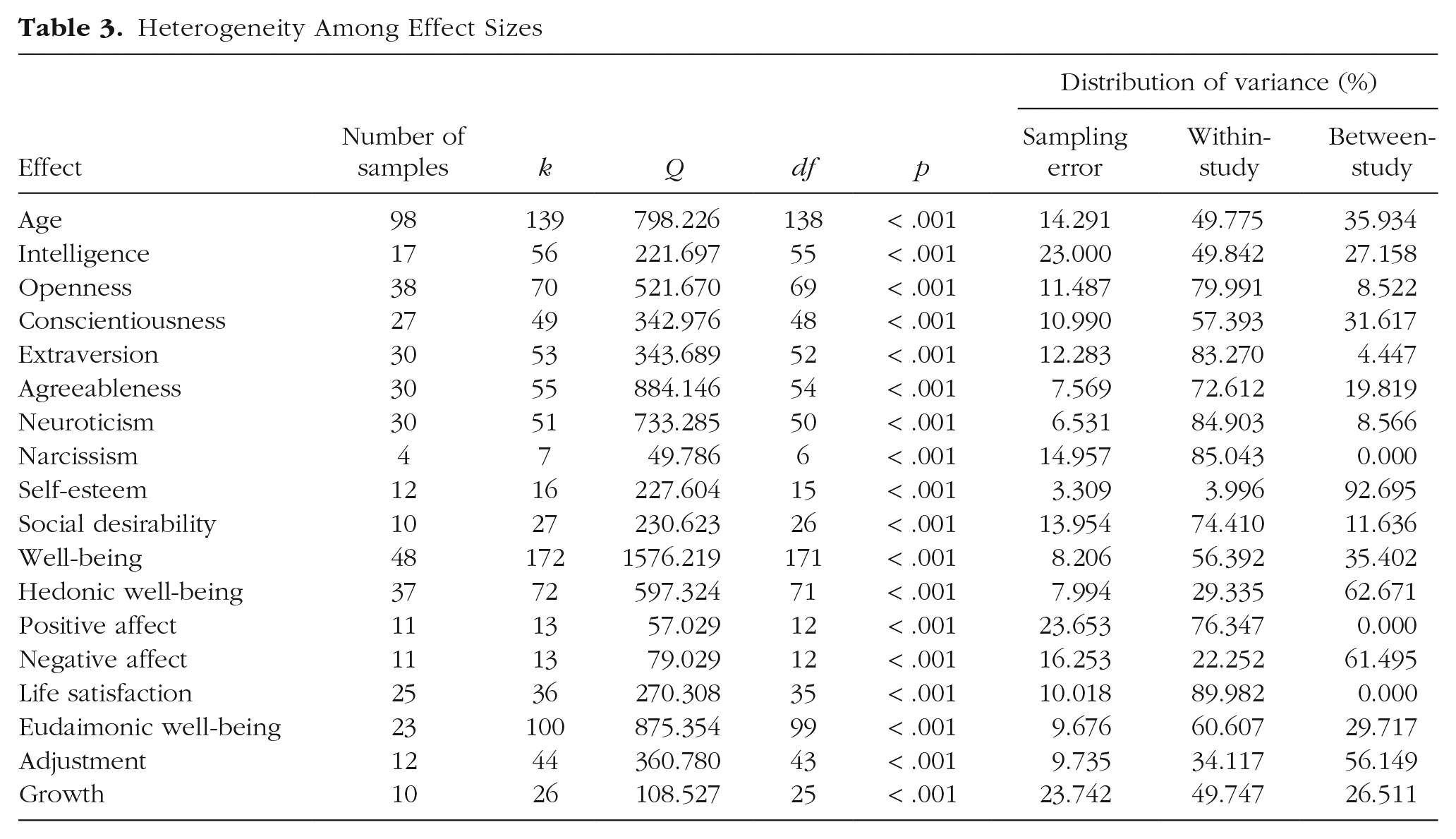
Heterogeneity Among Effect Sizes
Second, we conducted cumulative meta-analyses to determine whether smaller studies increased the summary effect sizes of the meta-analyses, an indication of the influence of publication bias. Forest plots of the cumulative meta-analysis for each of the meta-analyses that we conducted are depicted in Figure S2 in the Supplemental Material, and the results of the cumulative meta-analyses are presented in Table 2. As can be seen, for most of the meta-analyses that we conducted, the summary effect sizes stabilized around their eventual values (i.e., falling within .03 of the eventual values) after around one third of the studies were added, showing no evidence of publication bias. For the cumulative meta-analyses of wisdom’s correlations with self-esteem and eudaimonic well-being, the summary effect sizes did not stabilize around their eventual values until considerably more studies were added. However, in these cases, the summary effect size decreased with the addition of smaller studies rather than increased as would be predicted by the presence of publication bias, possibly for the same reason that caused the funnel plot asymmetries in these meta-analyses. In sum, although the cumulative meta-analyses showed that sample size was positively and systematically related to effect size in some of the meta-analyses that we conducted, such positive relationships were not in line with predictions based on the presence of publication bias.
Third, we examined whether publication status significantly moderated the correlations between wisdom and the criterion variables of interest. We found that a substantial portion of the effect sizes meta-analyzed came from unpublished studies, ranging from 7.41% to 71.43% across meta-analyses and exceeding 20% for most. As can be seen in Table 2, publication status was not a significant moderator in any of the meta-analyses that we conducted, suggesting that the summary effect sizes based on the published studies did not significantly differ from those based on the unpublished studies. After examining all three indicators of publication bias, we concluded that publication bias was unlikely to have strongly influenced any of our results. We now turn our attention to the respective meta-analyses while noting that heterogeneity among effect sizes was high enough to warrant an examination of moderators in all of these meta-analyses (Table 3).
Wisdom and age
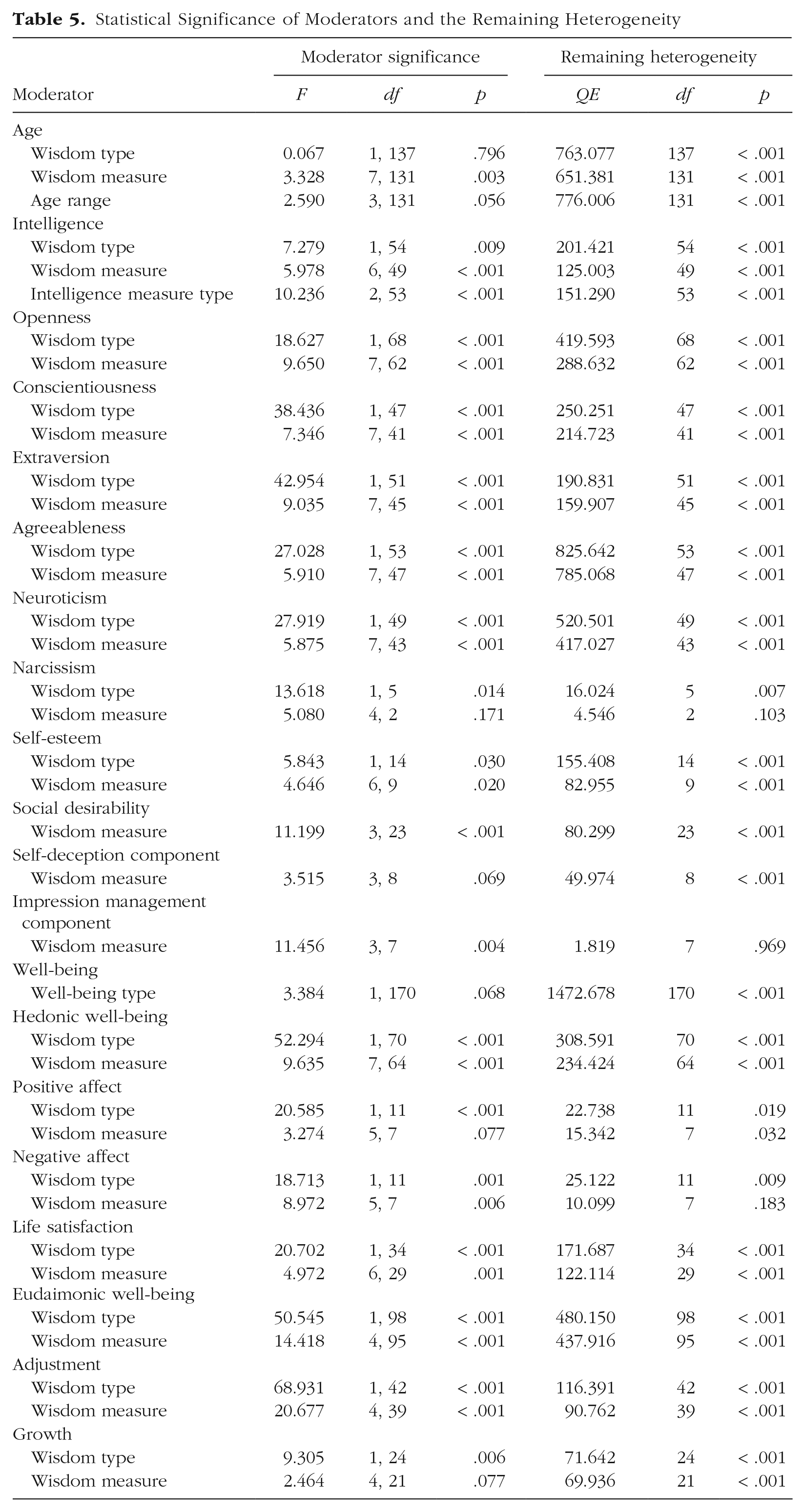
Although we found a statistically significant but practically trivial correlation, r = .04, 95% confidence interval (CI) = [.01, .07], t = 3.00, p < .01, between age and wisdom across all measures of wisdom (Table 4), the size of which is consistent with the speculation of most wisdom researchers that old age itself does not guarantee wisdom, the overall correlation was significantly moderated by both wisdom type and wisdom measure (Table 5). Most of the wisdom measures were not significantly correlated with age, except for Grossmann’s wise reasoning measure, which showed a small positive correlation (Table 4). The age range of the participant samples also moderated the correlation between wisdom and age (Table 5). Specifically, age showed a significant negative correlation with wisdom among old participant samples, r = −.11, 95% CI = [−.23, −.00], t = −1.98, p = .50, which was significantly different from that of the life-span participant samples (p < .01) and the young participant samples (p < .05) but did not significantly differ from that of the middle-aged participant samples.
Overall Effect Sizes and Effect Sizes by Moderators

Note: 3DWS = Three-Dimensional Wisdom Scale; ASTI = Adult Self-Transcendence Inventory; SAWS = Self-Assessed Wisdom Scale; BWSS = Brief Wisdom Screening Scale; SWIS = Situated Wise Reasoning Scale.
Statistical Significance of Moderators and the Remaining Heterogeneity
Wisdom and intelligence
Although we found a small positive correlation between intelligence and wisdom (Table 4), this correlation was moderated by wisdom type, wisdom measure, and intelligence type (Table 5). Performative wisdom was significantly and positively correlated with intelligence, r = .15, 95% CI = [.09, .21], t = 5.22, p < .01, whereas phenomenological wisdom was not (Table 4). At the level of wisdom measures, only the Berlin wisdom paradigm, a performative measure of wisdom, was significantly correlated with intelligence, r = .22, 95% CI = [.17, .28], t = 7.99, p < .01 (Table 4). Although wisdom was significantly correlated with both crystallized intelligence measures, r = .21, 95% CI = [.15, .28], t = 6.80, p < .01, and fluid intelligence measures, r = .07, 95% CI = [.00, .13], t = 2.11, p = .04, the correlation with the former was significantly stronger (p < .01; Table 4).
Wisdom and the Big Five personality traits
We found a large positive correlation between wisdom and trait openness, r = .29, 95% CI = [.25, .33], t = 14.49, p < .01, consistent with the findings of numerous previous studies (e.g., Brienza et al., 2018; Glück et al., 2013; Kunzmann & Baltes, 2003; Le, 2005; Levenson et al., 2005; Mickler & Staudinger, 2008; Pasupathi & Staudinger, 2001; Staudinger et al., 1997; Webster, Bohlmeijer, & Westerhof, 2014; Weststrate, 2017; Zacher et al., 2015). The overall effect was moderated by both wisdom type and wisdom measure (Table 5). Openness was more strongly correlated with phenomenological wisdom, r = .34, 95% CI = [.29, .39], t = 14.41, p < .01, than with performative wisdom, r = .18, 95% CI = [.11, .24], t = 5.25, p < .01. Openness was also correlated with every wisdom measure except Grossmann’s wise reasoning measure (Table 4). Interestingly, although a phenomenological wisdom measure, the SWIS significantly differed from all other phenomenological wisdom measures, except the ASTI, in its correlation with openness but did not significantly differ from the Berlin and Bremen wisdom paradigms. This may be because the SWIS, unlike other phenomenological wisdom measures, assesses state wisdom, which may attenuate its association with global tendencies such as trait openness.
Wisdom showed very similar relationships with traits conscientiousness, extraversion, agreeableness, and neuroticism. Although the overall correlations between wisdom and each of these traits were significant (Table 4), they were significantly moderated by wisdom type and wisdom measure (Table 5). Specifically, phenomenological wisdom was significantly and positively correlated with conscientiousness, r = .20, 95% CI = [.15, .26], t = 7.46, p < .01, extraversion, r = .26, 95% CI = [.21, .30], t = 11.62, p < .01, and agreeableness, r = .28, 95% CI = [.21, .34], t = 8.92, p < .01. Conscientiousness, extraversion, and agreeableness also significantly and positively correlated with each of the phenomenological wisdom measures at a moderate level, except in the case of conscientiousness and the SWIS (Table 4). Neuroticism showed a moderate negative correlation with phenomenological wisdom, r = −.30, 95% CI = [−.36, −.23], t = −9.35, p < .01, and significantly correlated with all phenomenological wisdom measures except the SWIS (Table 4). Performative wisdom, however, did not significantly correlate with any of these traits, nor did any performative wisdom measure (Table 4). Because phenomenological wisdom measures and the Big Five trait measures were all self-reported, we explored whether and to what extent the shared method variance among these measures could have inflated the correlations among them in supplementary analyses below.
Wisdom, narcissism, and self-esteem
Surprisingly, on the basis of six effect sizes from four samples of participants that we meta-analyzed (Table 3), narcissism was not found to be correlated with wisdom (Table 4). Although wisdom type did significantly moderate the correlation between narcissism and wisdom (Table 5), neither phenomenological nor performative wisdom was significantly correlated with narcissism (Table 4). None of the wisdom measures correlated with narcissism (Table 4). We explore possible explanations for these unexpected findings in the Discussion.
Although wisdom showed an overall significant positive correlation with self-esteem (Table 4), moderation analyses suggested that this correlation was entirely driven by phenomenological wisdom (Tables 4 and 5). As can be seen in Table 4, self-esteem correlated highly with all measures of phenomenological wisdom except the SWIS, with which it did not correlate. Performative wisdom and its measures, however, did not correlate with self-esteem.
Wisdom and social desirability
Correlations with social desirability have been reported only for phenomenological wisdom measures. Phenomenological wisdom measures showed a small positive overall correlation with social desirability (Table 4); however, the choice of wisdom measure significantly moderated wisdom’s correlations with social desirability and the impression management subcomponent but not with the self-deception subcomponent (Table 5). Of the phenomenological wisdom measures (Table 4), the 3DWS positively and moderately correlated with social desirability, r = .27, 95% CI = [.20, .34], t = 8.04, p < .01, and both of its subcomponents, r = .28, 95% CI = [.10, .45], t = 3.62, p < .01, and r = .26, 95% CI = [.19, .33], t = 8.55, p < .01, for self-deception and impression management, respectively. The ASTI positively correlated with social desirability, r = .26, 95% CI = [.14, .39], t = 4.27, p < .01, and the impression management subcomponent, r = .18, 95% CI = [.03, .33], t = 2.80, p = .03. The SAWS showed a small positive correlation with social desirability, r = .10, 95% CI = [.01, .19], t = 2.35, p = .03, but its correlations with the subcomponents did not reach significance. The SWIS was the only phenomenological wisdom measure included in the meta-analysis that had nonsignificant, near-zero correlations with social desirability and its subcomponents.
Wisdom and well-being
Wisdom researchers often distinguish between hedonic and eudaimonic forms of well-being. However, evidence suggests that hedonic and eudaimonic well-being measures exhibit indistinguishable patterns of association with some variables (Disabato et al., 2016). We therefore examined whether hedonic and eudaimonic well-being are distinct in their associations with wisdom by examining whether well-being type was a significant moderator of the correlation between wisdom and well-being. We found that well-being type did not moderate wisdom’s correlations with well-being (Table 5). Hedonic well-being showed a moderate-to-large positive correlation with wisdom, r = .26, 95% CI = [.21, .30], t = 10.44, p < .01, whereas eudaimonic well-being showed a large positive correlation, r = .31, 95% CI = [.26, .36], t = 11.54, p < .01, although the difference between them was not statistically significant. Nonetheless, given that wisdom has been theorized to have distinct associations with hedonic and eudaimonic well-being (e.g., Ardelt, 2019) and given the general interest in distinguishing between the two types of well-being in empirical wisdom research, we decided to meta-analyze wisdom’s correlations with the two types of well-being and their subcomponents separately.
Wisdom and hedonic well-being
We found a moderate-to-large positive correlation between wisdom and hedonic well-being. Both wisdom type and wisdom measures significantly moderated the correlation between wisdom and hedonic well-being (Table 5). Although both statistically significant, phenomenological wisdom had a large positive correlation with hedonic well-being, r = .33, 95% CI = [.29, .36], t = 16.51, p < .01, whereas performative wisdom had a small positive correlation, r = .08, 95% CI = [.02, .15], t = 2.44, p = .02 (Table 4). Phenomenological wisdom measures all showed moderate-to-large correlations with hedonic well-being, whereas the Berlin wisdom paradigm was the only performative wisdom measure to show a significant positive correlation with hedonic well-being, r = .10, 95% CI = [.02, .18], t = 2.40, p = .02 (Table 4).
Wisdom and subcomponents of hedonic well-being
Positive affect
Only phenomenological wisdom was significantly correlated with positive affect, r = .24, 95% CI = [.17, .32], t = 7.25, p < .01, and this correlation was significantly different from that between performative wisdom and positive affect (Table 4), as was indicated by the significant moderation by wisdom type (Table 5). Phenomenological wisdom measures, except the SWIS, had moderate correlations with positive affect, whereas none of the performative wisdom measures correlated with positive affect (Table 4). However, moderation by wisdom measure was not statistically significant (Table 5).
Negative affect
Unlike in previous analyses in which we reverse-scored the correlations between wisdom and negative affect, we omitted the reverse-scoring here for the ease of interpretation, such that a positive correlation indicated the presence of more negative affect at higher levels wisdom. Both wisdom type and wisdom measure were significant moderators (Table 5). As can be seen in Table 4, phenomenological wisdom had a significant negative correlation with negative affect, r = −.26, 95% CI = [−.34, −.19], t = −7.55, p < .01. At the level of the wisdom measures, only two of the three phenomenological wisdom measures (i.e., the 3DWS and the BWSS) significantly correlated with negative affect. Performative wisdom showed no significant correlation with negative affect, nor did any of its measures.
Life satisfaction
Both wisdom type and wisdom measure were significant moderators for the correlation between wisdom and life satisfaction (Table 5). As can be seen in Table 4, phenomenological wisdom showed a large positive correlation with life satisfaction, r = .30, 95% CI = [.26, .34], t = 13.93, p < .01, with all phenomenological wisdom measures included in the meta-analysis showing statistically significant, moderate-to-large positive correlations. Performative wisdom and its measures, on the other hand, did not significantly correlate with life satisfaction.
Wisdom and eudaimonic well-being
We found a large positive correlation between wisdom and eudaimonic well-being (Table 4). The correlation between wisdom and eudaimonic well-being was significantly moderated by both wisdom type and wisdom measure (Table 5). Both phenomenological and performative wisdom showed significant positive correlations with eudaimonic well-being, r = .38, 95% CI = [.32, .43], t = 14.72, p < .01, and r = .11, 95% CI = [.04, .18], t = 3.13, p < .01, respectively, with the correlation being stronger for phenomenological wisdom. Of the wisdom measures included in this meta-analysis, all significantly correlated with eudaimonic well-being except for the Bremen wisdom paradigm (Table 4).
Wisdom and aspects of eudaimonic well-being
Past wisdom research has distinguished between the adjustment and growth aspects of eudaimonic well-being and has found that wisdom was more strongly associated with the growth aspect than with the adjustment aspect (e.g., Wink & Staudinger, 2016). We therefore examined wisdom’s correlations with adjustment and growth separately. Adjustment was assessed via the autonomy, environmental mastery, positive relations, and self-acceptance subscales of Ryff’s psychological well-being scale, whereas growth was assessed via the personal growth and purpose in life subscales (e.g., Ardelt et al., 2019; Mickler & Staudinger, 2008 cf., Weststrate & Glück, 2017a; Wink & Staudinger, 2016; Zacher & Staudinger, 2018).
Adjustment
The correlation between wisdom and adjustment was moderated by both wisdom type and wisdom measure (Table 5). Specifically, phenomenological wisdom was significantly and positively correlated with adjustment, r = .41, 95% CI = [.36, .47], t = 14.60, p < .01. Each of the phenomenological wisdom measures included in the meta-analysis was also positively and significantly correlated with adjustment (Table 4). However, the correlations were not significant for performative wisdom or for any of the performative wisdom measures (Table 4).
Growth
The correlation between wisdom and the growth aspect of eudaimonic well-being was moderated by wisdom type but not by wisdom measure (Table 5). As can be seen in Table 4, both phenomenological and performative wisdom were significantly and positively correlated with the growth aspect of eudaimonic well-being, r = .39, 95% CI = [.32, .47], t = 10.81, p < .01, and r = .23, 95% CI = [.14, .32], t = 5.28, p < .01, respectively, although the correlation was significantly larger for the former. All of the wisdom measures in this meta-analysis showed significant positive correlations with the growth aspect of eudaimonic well-being that ranged from moderate to large in size (Table 4).
Wisdom and gender
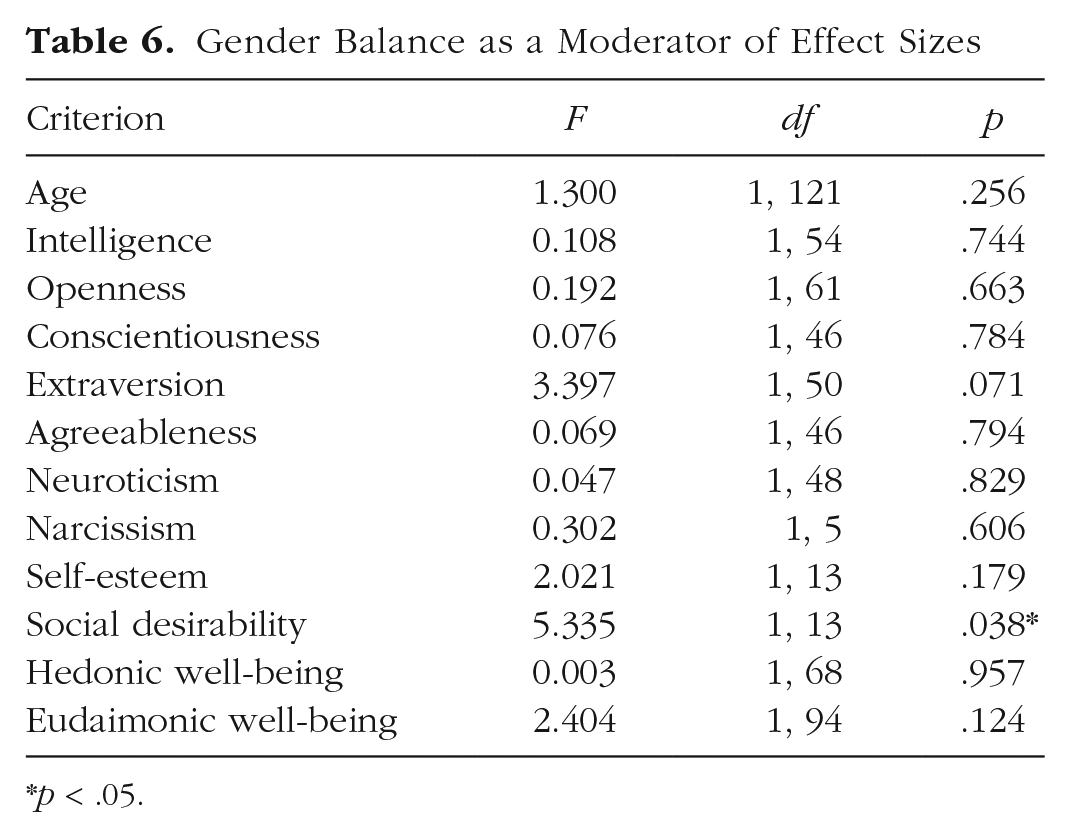
We investigated whether the correlations between wisdom and the constructs of interest were moderated by gender. Specifically, we examined whether the gender composition (i.e., percentage of female participants in the sample) of the samples significantly moderated any of the correlations. We found that for the majority of the relationships examined, gender composition of the sample was not a significant moderator (Table 6). However, gender composition did significantly moderate the correlation between wisdom and social desirability, b = −0.10, SE = 0.05, 95% CI = [−0.20, −0.01], where b indicates the change in r when the percentage of female participants in a sample increases by 10. The findings suggest that the correlation between wisdom and social desirability was lower for women than for men.
Gender Balance as a Moderator of Effect Sizes
p < .05.
Supplementary analyses
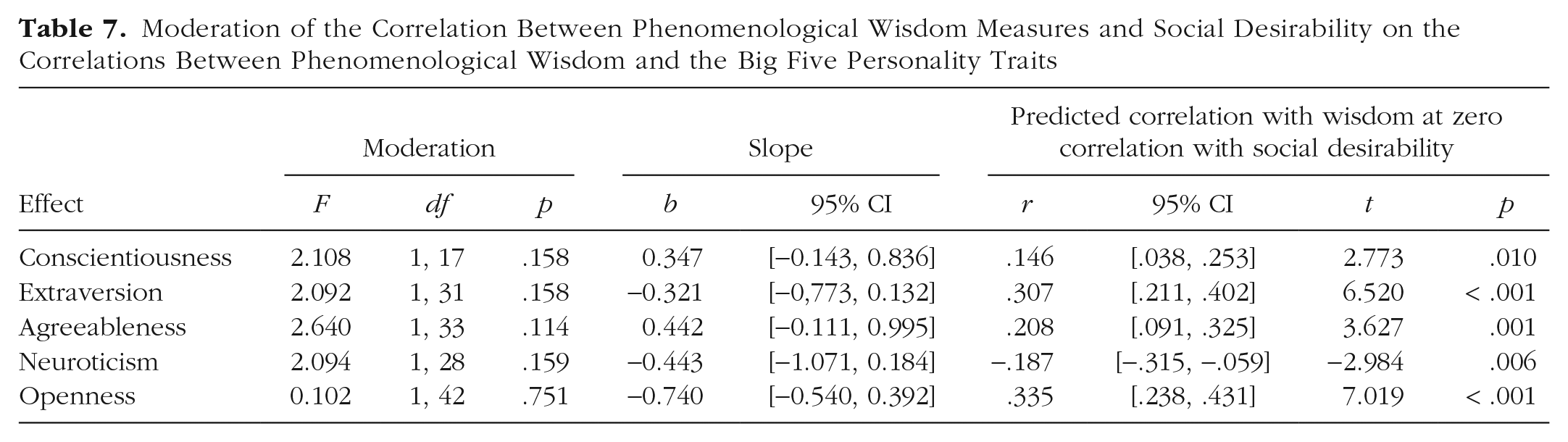
We conducted exploratory analyses to examine whether the correlations between phenomenological wisdom on the one hand and the Big Five personality traits on the other were inflated by the shared method variance of their measures. Specifically, we tested whether a wisdom measure’s correlation with social desirability moderated the correlation between that measure and one of the Big Five traits. We grand-mean-centered the summary correlations between each wisdom measure and social desirability (as presented in Table 4) to create the moderator variable. Note that it was not possible to use the correlations reported in individual studies because very few studies reported these correlations along with correlations between phenomenological wisdom and the Big Five traits. As can be seen in Table 7, the correlation with social desirability did not moderate the correlation between phenomenological wisdom and any of the Big Five traits. As shown by the intercepts, when the correlation between phenomenological wisdom measures and social desirability was zero, phenomenological wisdom was still significantly correlated with each of the Big Five personality traits. These findings suggest that shared method variance could not explain the correlations between phenomenological wisdom and the Big Five personality traits. However, because we estimated the correlation between social desirability and each phenomenological wisdom measure from a relatively small number of studies, we recommend caution in interpreting these results.
Moderation of the Correlation Between Phenomenological Wisdom Measures and Social Desirability on the Correlations Between Phenomenological Wisdom and the Big Five Personality Traits
Discussion
By meta-analyzing the extant literature, we summarized wisdom’s correlations with age, intelligence, the Big Five traits, narcissism, self-esteem, social desirability, and well-being. Although phenomenological and performative approaches to conceptualizing wisdom have their distinct correlates, both are correlated with openness, hedonic well-being, and eudaimonic well-being, especially the growth aspect of eudaimonic well-being. Transcending differences in conceptualizations and operationalizations of wisdom, these commonalities may reflect the fundamental characteristics of wisdom that are shared across theoretical perspectives. Specifically, wisdom entails being flexible in one’s thinking, the tendency and willingness to take on different ideas and perspectives, and an orientation toward exploration, psychological growth, and personal fulfillment. Furthermore, the results suggest that wisdom may indeed predict a good life, both in the hedonic and eudaimonic sense. Although not all forms of wisdom predict lives that are affectively positive, wiser individuals are ultimately happy, perhaps suggesting that wisdom may enable one to find contentment in life regardless of objective circumstances and one’s affective reactions to them. Importantly, the commonalities that we have identified through meta-analyses empirically corroborate earlier work (Glück, 2018; Grossmann et al., 2020) in showing that the diverse theoretical traditions and measurement approaches are not to be taken as an indication that the construct of wisdom lacks validity; instead, they should be seen as attempts that, although each incomplete and imperfect on their own, capture different aspects of the same phenomenon. We believe that these findings will in turn help future efforts at designing wisdom measures by providing more reliable estimates of wisdom correlates that will help with the evaluation of convergent and discriminant validity.
Beyond the common correlates, however, the meta-analytic results paint two distinct portraits for phenomenological and performative wisdom. The portrait for phenomenological wisdom is one of adaptation and adjustment. Individuals who experience wise cognition, motivation, emotion, and behavior are uniquely more likely to report higher self-esteem, more positive affect, less negative affect, and greater life satisfaction and have an adaptive profile of personality traits, in which agreeableness, extraversion, and conscientiousness are high and neuroticism is low. As suggested by results of the supplementary analyses, this positive association between phenomenological wisdom and adjustment cannot be fully explained by methodological artifacts such as socially desirable responding. Instead, echoing previous theorizing (e.g., Ardelt, 2019), we argue that these correlations are at least in part substantive and reflect the nature of wisdom as subjectively experienced by individuals.
However, when wisdom is judged by other people through wisdom-relevant products, as is the case with performative wisdom, it is not associated with most of the indicators of adaptation. Intelligence, a cognitive ability, is relevant to at least some (i.e., the Berlin wisdom paradigm), although not all, indicators of performative wisdom. Notably, the association between intelligence and wisdom is the strongest for crystallized intelligence. Taken together with the findings that performative wisdom correlated with openness and the growth aspect of eudaimonic well-being, it appears that in the eyes of the beholder, wisdom entails not only one’s orientation toward thinking wisely but also one’s competence at doing so. We argue that, rather than being contradictory, the findings for phenomenological and performative wisdom are complementary to one another. Perhaps analogous to the distinction in creativity research between “little-c” creativity, or the everyday, subjectively defined form of creativity, and “big-C” creativity, or the consensually recognized form of creativity (e.g., Simonton, 2017), phenomenological wisdom may capture the everyday experiences of wisdom, but whether these subjective experiences are recognized as wise by other people is a different question, which is in turn captured by performative wisdom.
Surprisingly, neither phenomenological nor performative wisdom correlated negatively with narcissism, which should be theoretically antithetical to wisdom. For phenomenological wisdom, one possible explanation of the nonsignificant correlation may be that although narcissism may decrease the endorsement of communal items in self-report wisdom measures, it may enhance the endorsement of agentic items. This is because narcissists have been shown to have overly positive perceptions of their agentic traits (e.g., intelligence, creativity, adjustment) but have accurate perceptions of their low levels of communal traits (e.g., care, compassion, and morality; Carlson & Khafagy, 2018). The lack of significant correlation with performative wisdom is hard to explain because performative wisdom measures are unlikely to have been strongly affected by self-enhancement. Because very few studies have measured wisdom alongside with narcissism, the estimates of the current meta-analysis may not be reliable, and it is possible that a clearer pattern of the relationship between the two constructs will emerge after more empirical research. We suggest that, given its theoretical relevance, future research should look more into the relationship between wisdom and narcissism, and associations with narcissism may offer an opportunity to evaluate the validity and comprehensiveness of wisdom measures.
Reconciling the two forms of wisdom
Results of the current study necessitate a better understanding of the differences between phenomenological and performative wisdom. We speculate that three potential sources of these differences may be (a) the distinction between typical and maximal performance, (b) the distinction between self-ratings and other-ratings, and (c) the distinction between global and state wisdom.
Typical versus maximal performance
In the context of wisdom, maximal performance refers to how wise one can be, whereas typical performance refers to how wise one is in daily life. Maximal performance is episodic and is typically elicited when individuals know that their performance will be evaluated and so exert their full effort (Sackett et al., 1988). Although these conditions for maximal performance are not explicitly expressed in the instructions of performative wisdom measures, performative wisdom measures can reasonably be seen as measures of maximal, rather than typical, performance. This is because most extant measures of performative wisdom, especially those involving interviews with experimenters, press participants to think more thoroughly about the dilemmas through a series of standard questions. In addition, the task of working through challenging dilemmas in a lab setting may itself be enough to suggest evaluation to participants. Responding to phenomenological wisdom measures, on the other hand, typically entails recalling how one typically behaves in the past, across many situations. Even when phenomenological wisdom measures assess state-level wisdom, as is the case with the SWIS, it is likely that they capture typical, rather than maximal, performance, because there is no reason to believe that the situational contexts elicit full effort in these cases. The discrepancies between performative and phenomenological wisdom may therefore be exaggerated by the fact that one assesses maximal performance whereas the other assesses typical performance. This implies that the discrepancies may be reduced if performative wisdom can be compared to maximal levels of phenomenological wisdom and vice versa. Because no extant phenomenological wisdom measures assess maximal performance and no performative wisdom measures assess typical performance, the development of these scales may constitute promising areas of future research.
Self-ratings vs. other-ratings
Another source of difference between phenomenological and performative wisdom may be the fact that phenomenological wisdom is experienced, whereas performative wisdom is evaluated. All extant performative wisdom measures entail the evaluation of products of wisdom (i.e., participants’ attempts at thinking through a challenging dilemma), whereas phenomenological wisdom measures entail reporting one’s subjective experience of wisdom-related cognitions, motivations, emotions, and behaviors. A high correspondence between the two forms of wisdom therefore entails the successful translation of one’s subjective experience of wisdom into products of wisdom, which are then recognized by other people. It is conceivable that several factors may affect the success of this process, such as ability and knowledge. A high correspondence between subjective (phenomenological) measures and objective (performative) measures also implies a high level of self-knowledge accuracy. Because accurate self-knowledge is regarded as an essential aspect of wisdom (Mickler & Staudinger, 2008), it is possible that the discrepancy between phenomenological and performative wisdom is reduced for wise individuals, a possibility to be examined by future research.
Global versus state wisdom
In this meta-analytic study, we categorized measures of wisdom as capturing either phenomenological or performative wisdom. Phenomenological and performative wisdom are not only theoretically distinct but are also consistent with how wisdom measures cluster together in principal component analysis (e.g., Dong & Fournier, 2022). However, there are other distinctions among the wisdom measures. For instance, wisdom measures also differ in whether they assess state or global wisdom. Specifically, all performative wisdom measures included in this meta-analysis are measures of state wisdom because they assess wisdom performance in one or a few instances. Of the phenomenological wisdom measures, only the SWIS assesses state wisdom, whereas all other phenomenological wisdom measures included in this study assess global wisdom. It is conceivable that some of the differences between phenomenological and performative wisdom are attributable to the state versus global wisdom distinction. The moderate correlations among state wisdom in different situations (Brienza et al., 2018) may explain why performative wisdom measures showed more divergent patterns of correlations than phenomenological wisdom measures. State wisdom also only moderately correlates with global wisdom (Brienza et al., 2018), which may partly explain the finding that the SWIS was unlike the rest of the phenomenological wisdom measures in its correlations with many of the variables examined (i.e., conscientiousness, neuroticism, self-esteem, and negative affect).
The distinctions that we have observed between phenomenological and performative wisdom in the current study may therefore be due to a variety of reasons beyond disagreements among conceptualizations of wisdom. The assessment of typical versus maximal performance, the source of judgment (self vs. others), and the assessment of state versus global wisdom likely all contributed to the divergence between phenomenological and performative wisdom in their relationships with other variables. These factors should be taken into consideration when designing future empirical studies of wisdom.
Implications
The findings of the current study allow us to make a few suggestions for future research. The first of these suggestions concerns the selection of the proper wisdom measure(s) to administer in empirical studies. Although some studies have employed a battery of wisdom measures, encompassing measures of both phenomenological and performative wisdom to comprehensively assess the construct (e.g., Dong & Fournier, 2022; Weststrate et al., 2018; Weststrate & Glück, 2017b), such an approach is time-consuming, resource-intensive, and infeasible in many circumstances. Researchers are therefore faced with the decision of choosing one or a few wisdom measures to administer. In many cases, this decision seems to have been made based on the researchers’ knowledge of and familiarity with specific measures, rather than on a systematic evaluation of all available measures given one’s research goals, which can obfuscate the relationships of interest.
Based on the insights gained from the current study, we propose that the following questions should be considered when selecting wisdom measures for a study. First, one should identify the form of wisdom that should be assessed given the research question. Phenomenological wisdom may be more relevant for some research questions (e.g., whether one’s self-perception of one’s wisdom agrees with the perceptions of other people), whereas performative wisdom may be more relevant for other research questions (e.g., whether wisdom predicts more negotiation successes). In addition, it is important to consider whether state wisdom or global wisdom is more relevant. If one is interested in the relationships between wisdom and other variables in specific contexts, then it is more appropriate to administer state measures of wisdom. Conversely, if one is interested in assessing wisdom as a stable characteristic, then one can either administer global measures of wisdom or administer state measures of wisdom multiple times and use the average of states to approximate global wisdom. Second, it is important to consider the content of wisdom measures and how that may affect the results of the study. Ideally, the wisdom measure(s) chosen for a study should be relevant to the research question, but not so much so as to share common dimensions with other variables in the study. For instance, the SAWS showed the highest meta-analytic correlation with trait openness; however, this is likely because openness constitutes one dimension of the SAWS. Thus, if wisdom is to be examined in relation to openness, it may be advisable to avoid using the SAWS as the measure of wisdom because it may artificially inflate the relationship between the constructs.
Limitations
The current study has several limitations. First, despite our best effort to gather relevant studies, it is unlikely that we have gathered all. Studies that were not in PsycINFO would have escaped the initial literature search. If these studies were not cited by one of the coded studies or submitted by their authors in response to our calls, then they would not have been included in the meta-analyses. Furthermore, some authors did not respond to our requests for submissions, so we were unable to obtain the relevant effect sizes that were not reported in the articles we gathered. There could also be relevant, unpublished data that were not submitted in response to our call. Given that the effect sizes meta-analyzed in the current study are only a subset of all relevant effect sizes, the results of the meta-analyses we present are only approximations of the true associations between wisdom and the criterion variables. Although we have no reason to believe that there were systematic differences between the studies included in the meta-analysis and those that were not, it is possible that the inclusion of additional studies would change the results of the meta-analyses. The results and conclusions of the current study should therefore be viewed as preliminary evidence, rather than final verdicts, on wisdom’s correlations with age, intelligence, the Big Five traits, narcissism, self-esteem, social desirability, and well-being.
Second, our meta-analyses were unable to address the more nuanced associations between wisdom and the criterion variables. For instance, previous studies have shown that the association between age and wisdom changes with age (e.g., Ardelt et al., 2019; Brienza et al., 2018; Webster, Westerhof, & Bohlmeijer, 2014). Although we have offered some preliminary evidence for this postulation by examining the moderating role of age range on the correlation between wisdom and age, the meta-analytic data and technique did not allow us to evaluate whether the association between age and wisdom followed a curvilinear relationship. Likewise, many researchers consider intelligence to be a necessary but not sufficient condition for wisdom (e.g., Glück, 2017; Grossmann et al., 2020; Staudinger & Pasupathi, 2003), which has already received some empirical support (Dong & Fournier, 2022; Glück & Scherpf, 2022); however, we were unable to examine this postulation in the current study. Therefore, although the study provides insights into the rudimentary, linear relationships between wisdom and criterion variables, it is insufficient for a full understanding of these relationships.
Third, because of the small numbers of effect sizes and samples of participants, it was impossible to examine the interactions between the moderators reliably, leading us to decide against conducting such analyses in the current study. Moderators were tested one at a time and independently from each other. This meant that we were unable to address questions such as whether age range moderates the association between age and wisdom differently for different measures of wisdom or whether phenomenological and performative wisdom were differentially associated with crystallized and fluid intelligence. These questions are important and should be addressed by future meta-analytical attempts as more primary studies accumulate.
Fourth, we could not address the moderating role of culture in wisdom’s association with the criterion variables. This was primarily because of the difficulty in appropriately coding the culture of participant samples, as most samples included a mixture of ethnicities, indicating that they may not be uniform in culture. Moreover, most of the samples were collected in Europe and North America. Because other cultures were underrepresented, estimated cultural effects were unlikely to be reliable or accurate. Although the current study could not examine culture as a moderating variable, evidence suggests that culture may indeed play a moderating role in wisdom’s correlation with other variables (e.g., Grossmann et al., 2012). To date, relatively few studies have examined whether the correlates of wisdom change across cultures, a gap that should be addressed by future studies.
Conclusion
Summarizing 30 years of empirical wisdom research, this study is the first to provide meta-analytic insights into the correlates of wisdom. It demonstrates that despite differences in conceptualizations of wisdom and in measurement approaches, wisdom is robustly associated with constructs such as openness, hedonic well-being, and eudaimonic well-being. The current study is furthermore an attempt to understand and reconcile the difference between phenomenological and performative wisdom. It will help move the field forward by elucidating reliable effects and by offering concrete suggestions for future empirical research based on the meta-analytic findings. With the current study serving as a foundation, future research may also begin to investigate the mechanisms linking wisdom and its correlates.
Supplemental Material
sj-pdf-1-pps-10.1177_17456916221114096 – Supplemental material for Thirty Years of Psychological Wisdom Research: What We Know About the Correlates of an Ancient Concept
Supplemental material, sj-pdf-1-pps-10.1177_17456916221114096 for Thirty Years of Psychological Wisdom Research: What We Know About the Correlates of an Ancient Concept by Mengxi Dong, Nic M. Weststrate and Marc A. Fournier in Perspectives on Psychological Science
Footnotes
Acknowledgements

Transparency
Action Editor: Tina M. Lowrey
Editor: Klaus Fiedler
References
Supplementary Material
Please find the following supplemental material available below.
For Open Access articles published under a Creative Commons License, all supplemental material carries the same license as the article it is associated with.
For non-Open Access articles published, all supplemental material carries a non-exclusive license, and permission requests for re-use of supplemental material or any part of supplemental material shall be sent directly to the copyright owner as specified in the copyright notice associated with the article.
