




Abstract
In the study of consciousness, qualia, the individual subjective experience, is neglected. It remains impenetrable because the objective perspective used for scientific investigations misses its subjective nature. In 1974, Thomas Nagel suggested that studying qualia requires an “objective phenomenology method” whose goal would be to describe the subjective character of experiences in an independent manner. We introduce a corresponding theoretical and experimental framework based on the “idiosyncrasy principle.” Accordingly, subjectivity depends on the idiosyncratic composition of physical properties to qualia. This allows conceptualizing an idiosyncratic transfer function between the world and its representation. The main challenge in delineating such a transfer function is to come up with an objective measure for another person’s perspective. Numerosity, as opposed to other perceived contents of the physical world, allows reporting subjective experience in an objective manner. On the basis of this unique attribute of numerosity, we suggest a tentative neurocognitive research plan aimed at delineating such idiosyncratic transfer functions, permitting one person to adopt the perspective of another and linking qualia to its mechanism.
The most baffling question for the scientific study of consciousness is qualia, the conscious experience. Nevertheless, there is a gap in the scientific exploration of consciousness between the study of the mechanism and qualia itself. Although the mechanism is theorized in tangible and measurable concepts (Koch et al., 2016; LeDoux et al., 2020; Mashour et al., 2020; but see Revach & Salti, 2021), qualia is often referred to as a “metaphysical phenomenon” (Chalmers, 2017). As a result, qualia is often neglected. In fact, in a seminal article that established the scientific study of the neural correlates of consciousness (NCC), Crick and Koch (1990) advised leaving the question of qualia aside “at the moment.” In fact, Dennett (2018a) argued for an equivalence between qualia and its underlying mechanism. Accordingly, it is only the lack of our understanding of the mechanism that makes us mystify qualia. Thus, Dennett argued that once the physical mechanism is understood, qualia would be explained in physical terms. However, this remains controversial.
Chalmers (2017) coined the term the “hard problem” to describe the gap in understanding the conversion of the physical world to qualia. To elaborate, the “gap” entails the lack of a scientific explanation for the subjective aspects of consciousness and how it feels for one to experience the physical aspects of the world. Chalmers differentiated it from what he referred to as the easy problems of consciousness (e.g., the ability to attend, to discriminate, to integrate information, to access and report mental and internal states). According to Chalmers, all of these questions could be approached in a traditional scientific manner because they all concern functions and performance. Conversely, subjective experience is irreducible to functions and performance because it relates to the way it feels to have this experience. Or, as Nagel (1974) phrased it, “an organism has conscious mental states if and only if there is something that it is like to be that organism—something it is like for the organism” (p. 323). Both Dennett and Chalmers, for opposing reasons, claim that qualia could not be studied in a scientific manner.
What prevents qualia from being approached like any other scientific problem? Nagel (1974) suggested that the point of view that other scientific problems require is a distant one that allows different researchers to reach the same conclusions regarding a studied phenomenon, although each of them approach it from a different perspective. In contrast, Nagel elucidated the inherent difficulty in studying the subjective experience objectively, namely that the essence of subjective experience lies with its connection to a single point of view. Therefore, an objective query would omit the crux of the studied phenomenon. Nagel suggested a different approach to bridge the explanatory gap. Accordingly, a new methodology should be formulated, one whose goal would be “to form new concepts and devise a new method—an objective phenomenology not dependent on empathy or the imagination” (p. 329). Nagel himself acknowledged that, “Though presumably it would not capture everything, its goal would be to describe, at least in part, the subjective character of experiences in a form comprehensible to beings incapable of having those experiences” (p. 329). We would like to suggest such a new methodology.
In developing a scientific approach to study qualia one can theoretically envision a transfer function between the physical world and subjective experience as
We suggest that qualia is underlined by an “idiosyncrasy principle.” Accordingly, qualia depends on an idiosyncratic composition of physical properties: the individual transfer function between the world and its mental representation. Alas, coming up with such a transfer function, to decipher another person’s qualia, is problematic because there is no objective measure for another person’s perspective. We need language (or any other reporting method) to communicate our subjective experience. However, in most contents of qualia, there is no way to objectively convey subjectivity (e.g., the experience of a rose’s redness might differ between two people, although both call it “red”; see Jackson, 1982). Nevertheless, there is a unique case of physical content for which an objective measure could exist—numerosity, the subjective experience of quantity.
“Approximate number, much like color or shape, is a basic feature of the environment to which animals appear wired to attend to” (Dehaene & Brannon, 2011, p. 268). In the study of numerical cognition, nonsymbolic object arrays (e.g., dot arrays) are briefly presented to an observer without allowing for sufficient time to count the objective number of objects. In contrast, this research is focused on the subjective experience of the number of objects—this could be inferenced by enumeration tasks (DeWind et al., 2020; Katzin et al., 2020) or by comparison tasks (Gebuis & Reynvoet, 2012; Piazza et al., 2004). Like other basic perceptual features, this subjective experience is affected by fundamental physical properties such as the area this array occupies, its density, and more (as we review later; for taxonomy, see also Salti et al., 2017). These properties modulate and bias numerosity. Interestingly, however, numerosity differs from other contents of qualia in one important way. As opposed to other perceived contents of the physical world, we can report the experience of numerosity in an objective manner (e.g., two observers may look at the same dot array and assess its quantity very differently and report different numerosities). This allows one person glimpsing the subjective experience of another.
One of the fundamental physical properties that affects numerosity is the shape of the convex hull (CH). The CH is the smallest convex polygon containing all objects in the array (see Fig. 1). In the field of geometric probability, the relations between the number of dots in an array and the number of vertices of the CH (i.e., its shape) have been established (Buchta, 2009). Although the shape of the CH does not allow a one-to-one prediction of the number of dots in an array, it does allow for an approximation of the general quantity (Katzin et al., 2020). This approximation corresponds to the seminal behavioral findings of enumeration. Up to the quantity of four, at which the CH shape is highly predictive, enumeration is fast and accurate (i.e., subitizing). Above four, at which the CH shape predicts an expanding range of quantities, enumeration is slower and less accurate. Moreover, behavioral results show that manipulating the shape of the CH affects the numerosity judgment of an array (Katzin et al., 2020). Likewise, DeWind et al. (2020) reported that the orientation of items in an array affects numerosity. Accordingly, the more coherent the orientation is (most stimuli pointing in the same direction), the larger the numerosity appears to be. Numerosity seems like a promising realm to devise approximate transfer functions between the physical and the subjective experience for different individuals. Accordingly, an individual transfer function would be tailored for each observer, creating an idiosyncratic weighing of physical properties for each observer to fit their experience. Such an attempt would correspond to Nagel’s suggestion to try to come up with an “objective phenomenology method.”
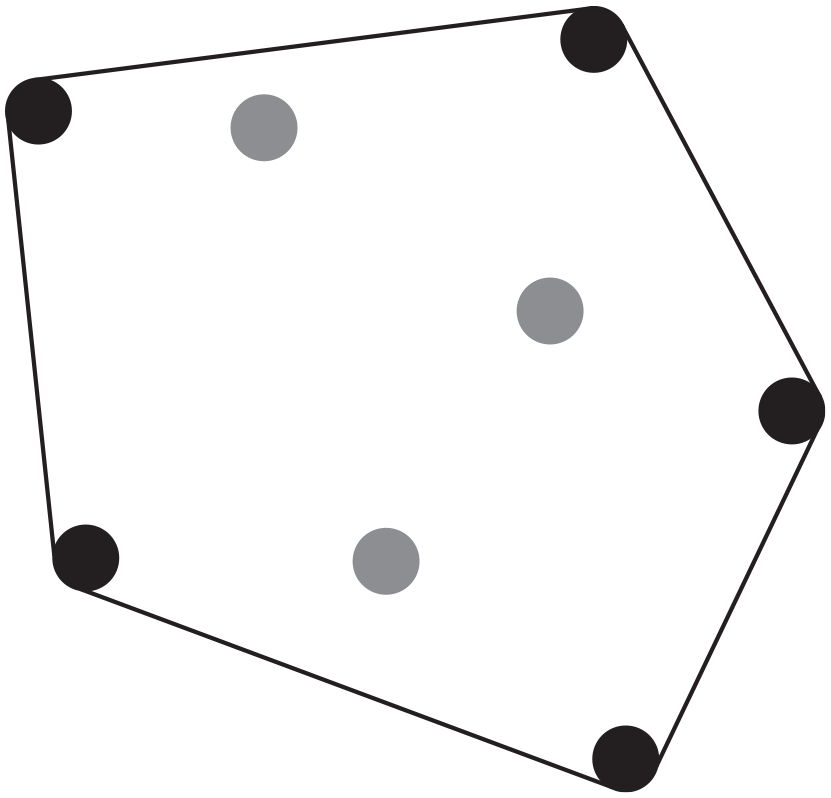
An array of dots. The dots defining the convex hull and the convex hull vertices are black.
Numerosity gives a unique opportunity to apply the idiosyncrasy principle in practice. This would allow creating an approximate description of qualia (Nagel, 1974) and the consideration of a neurocognitive mechanism that could produce it. We acknowledge that numerosity represents only a narrow portion of qualia. However, characterizing the complementary mechanism for numerosity could serve as a first step in delineating the characteristics of a general mechanism for qualia. Most cognitive and neurocognitive theories focus on the conscious/unconscious dichotomy (Förster et al., 2020; LeDoux et al., 2020; but see Haynes, 2009; Salti et al., 2015) and design complementary experiments. These experiments try to extract NCC by comparing the neural activity correlated with seen versus unseen near-threshold stimuli, regardless of specific contents (Revach & Salti, 2021). Conversely, the idiosyncrasy principle focuses on content and therefore requires a shift in the conventional contrast.
Here we describe a possible research plan that utilizes numerosity to study qualia. The first step would include mapping of individual transfer functions between a numerical array and its numerosity (see Fig. 2). Intersections between different individuals’ transfer functions would indicate that they have a similar subjective experience of different objective quantities. It could also portray the distance between different subjective experiences for the same objective quantity. Once individual transfer functions are delineated, adjustments could be made to the physical properties of a specific dot array in such a manner that would allow one observer to experience the numerosity of the other observer (see Fig. 3).
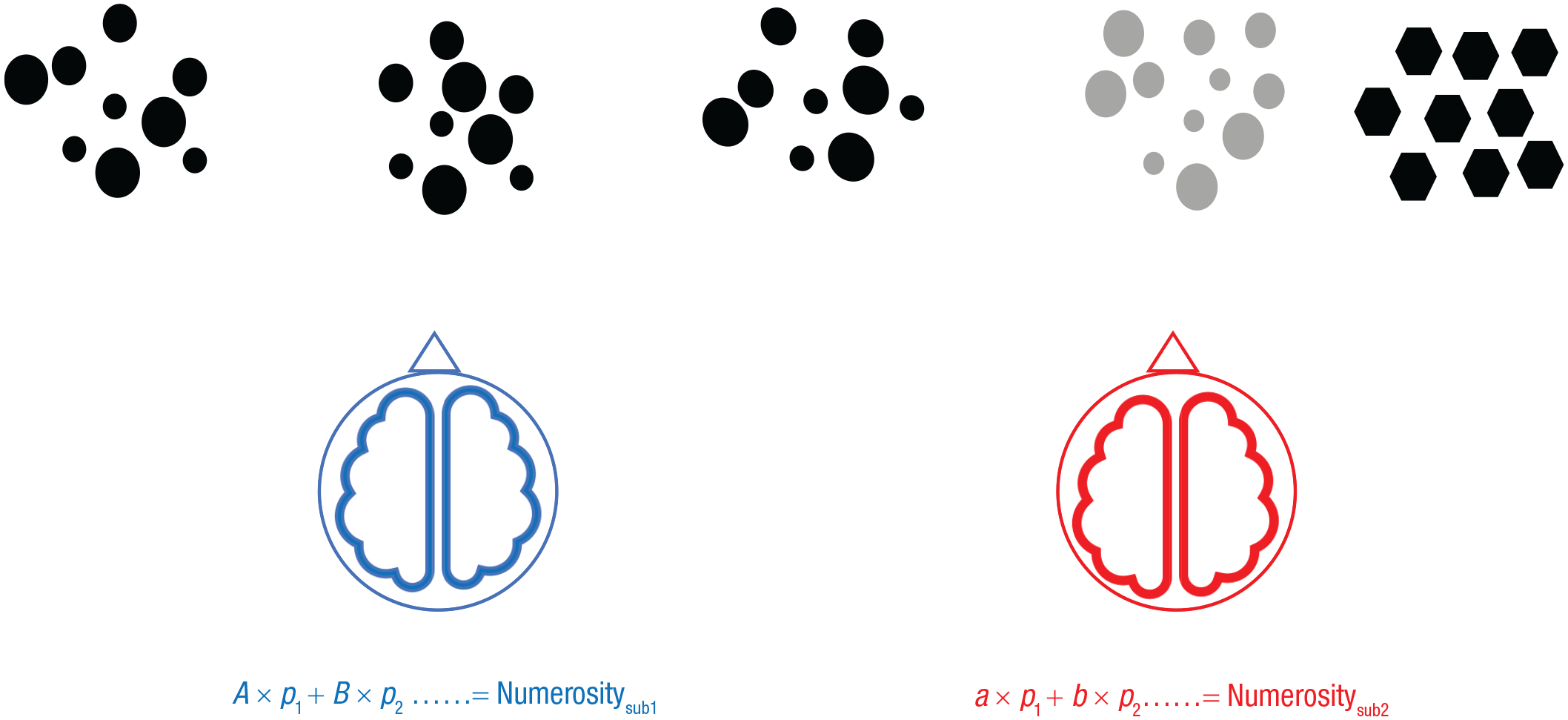
Hypothetical transfer functions mapping dot arrays to numerosity. The hypothetical transfer functions rely on the idiosyncratic composition of weighted physical properties, such as the convex hull shape and area, dot orientation and contrast, and so on.
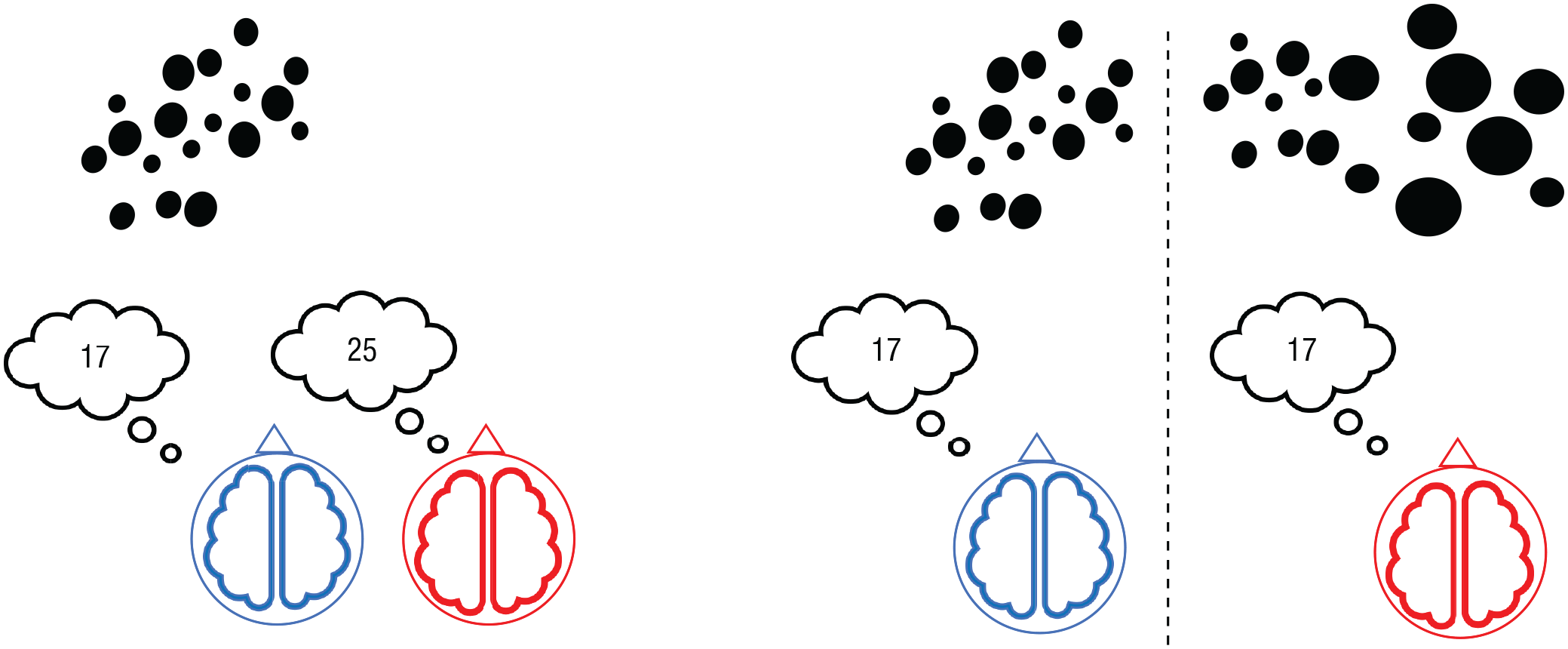
Possible response to dot arrays. In response to a dot array with 18 dots, the blue observer might report “17,” whereas the red observer reports “25.” On the basis of the translational function between the blue and the red observers’ idiosyncratic transfer functions, a modified dot array could be presented to the red observer. This should allow the red observer to experience the blue observer’s numerosity.
The next step would be to examine the reflection of the transfer function on brain activity. Two approaches could be adopted; a spatially resolved approach (functional MRI; Friston et al., 1998) and a temporally resolved approach (Salti et al., 2015). With the spatially resolved approach, we expect that the weights of the different physical properties that are portrayed in the transfer function would be reflected in activations in corresponding brain regions (see Fig. 4).
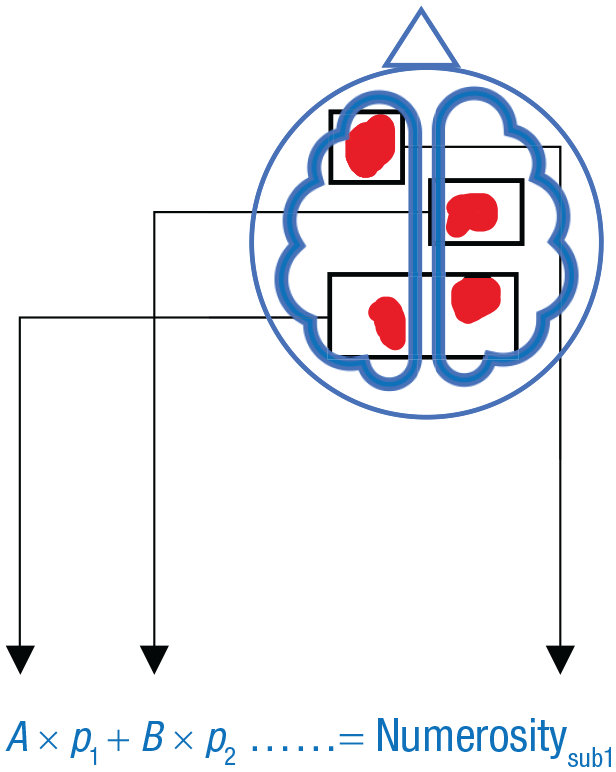
Transfer function correlated with brain activity. Various properties are aggregated and weighted into the neural correlate of the transfer function, recruiting different brain areas.
A temporally resolved approach combined with multivariate classification analysis would reveal the temporal dynamics of the transfer function as reflected in the brain. Multivariate analysis takes into account patterns of information that are present across multiple magnetoencephalography/electroencephalography (M/EEG) sensors over time. Accordingly, for each time sample a separate algorithm is trained to classify the different levels of the various physical properties. For example, the classifiers would be trained on the shape of the CH (e.g., having three, four, or five vertices), and the fit of the classifiers’ predictions would be tested. The different algorithms classifying accuracy for the various physical properties across time would reveal the neural dynamics of the transfer function (for an example, see Salti et al., 2015). A possible pattern is depicted in Figure 5.
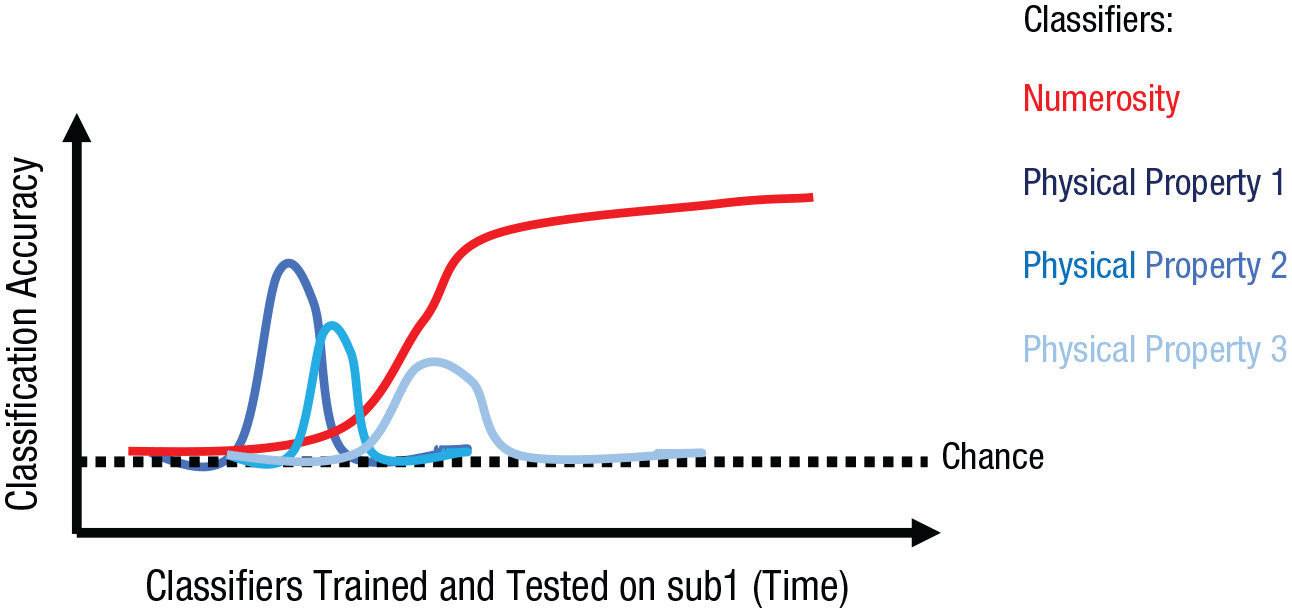
One possible representation of the temporal dynamics of the classification accuracy (based on M/EEG signals) for the various physical properties and numerosity. In this representation, different brain processes underlying the various physical properties are temporally differentiated in some cases and overlap in others. Classification accuracy of numerosity rises gradually with the aggregation of the various physical properties.
On the one hand, the brain data would converge and support the behavioral results; on the other hand, the data would potentially provide insights regarding a general mechanism of qualia that supports different contents beyond numerosity. Moreover, the results could also contribute to discussions in the study of consciousness such as the long-lasting dispute concerning the timing of conscious access (Förster et al., 2020; Mashour et al., 2020).
To sum up, the idiosyncrasy principle complies with Nagel’s suggested framework. It aims to study qualia on an individual basis. When considering other contemporary fields of research, we can see more and more of them leaning toward individual-based research. For example, in the medical field we see the recognition of the benefit of personalized treatments (Hamburg & Collins, 2010), and in the educational field we see the realization that a personalized educational approach holds abundant prospects (Tetzlaff et al., 2021). It is baffling that such an approach was not taken so far in the study of the most personal, qualia.
The benefits of studying qualia on an individual basis are manifold. First, it allows a direct glimpse into qualia, following Chalmers’s concerns. Second, it also allows a new approach to study the mechanism that underlies qualia and corresponds to Dennett’s suggestion that understanding the mechanism that underlies qualia will promote the understanding of qualia itself. However, there are conceptual and motivational differences between Dennett’s approach and our approach.
Dennett (2018b) suggested that to study consciousness one should characterize the observer’s “heterophenomenological” world. The heterophenomenological world includes the exhaustive information that could be gathered about the observer that includes her/his explicit beliefs (percepts) and physiological and neurological responses. Faithful to his conceptual approach that qualia is a “distraction” from the “hard question of consciousness” (Dennett, 2018a), Dennett did not distinguish between qualia and its underlying mechanism. In fact, Dennett suggested there is no need to make direct reference to qualia per se. Moreover, Dennett’s approach did not supply any new tangible predictions. The idiosyncrasy principle embraces the premise that qualia and the mechanism that underlies qualia itself are interweaved. Nevertheless, it acknowledges the difference between the mechanism and its product. We suggest that determining the boundaries and the characteristics of qualia would help in understanding the yielding mechanism. Moreover, our theoretical approach is complemented with a feasible method that allows testing it and, more importantly, refuting it.
To conclude, we suggest that researchers studying consciousness should consider an additional path. Rather than describing the redness of red, we suggest starting with the “seventhness” of seven. We put forward the idiosyncrasy principle that allows developing a general tool for understanding the qualia of any individual. We suggest it would be possible to demystify qualia using numerosity in the first step, hopefully paving the way for broader conclusions about subjectivity in general.
Footnotes
Acknowledgements
We thank Dominique Lamy, Lionel Naccache, and Desiree Meloul for their useful advice and Aaron Schurger for his enriching and enlightening comments. We wrote this manuscript in loving memory of our friend and colleague Sebastien Marti, whose ideas and thoughts keep echoing and inspiring us.
Transparency
Action Editor: Laura A. King
Editor: Laura A. King
Authors’ Contributions
M. Salti and D. Bergerbest contributed equally to this manuscript. Both authors approved the final manuscript for submission.
