




Abstract
Harvard psychiatrist Chester Pierce’s conception of “subtle and stunning” daily racial offenses, or microaggressions, remains salient even 50 years after it was introduced. Microaggressions were defined further by Sue and colleagues in 2007, and this construct has found growing utility as the deleterious effects of microaggressions on the health of people of color continues to mount. Many studies seek to frame microaggressions in terms of a taxonomic analysis of offender behavior to inform the assessment of and interventions for the reduction of racial microaggressions. This article proposes an expansion and refinement of Sue et al.’s taxonomy to better inform such efforts. We conducted a review of published articles that focused on qualitative and quantitative findings of microaggressions taxonomies (N = 32). Sixteen categories of racial microaggressions were identified, largely consistent with the original taxonomy of Sue et al. but expanded in several notable ways. Building on our prior research, other researchers supported such new categories as tokenism, connecting via stereotypes, exoticization and eroticization, and avoidance and distancing. The least studied categories included the denial of individual racism from Sue et al., and newer categories included reverse-racism hostility, connecting via stereotypes, and environmental attacks. A unified language of microaggressions may improve understanding and measurement of this important construct.
Almost 50 years ago, Chester Pierce described “subtle and stunning” daily racial offenses, known as microaggressions, and suggested therapeutic processes to address the deleterious effects that these acts had on the health and well-being of targeted groups (Pierce, 1970). Pierce’s seminal description of the construct of microaggressions laid the groundwork for Sue, Capodilupo, and colleagues (2007), who defined racial microaggressions as subtle, daily, and unintentional racial slights committed against members of racialized groups. As described by Pierce and Sue et al., this phenomenon is similar to what has been termed everyday racism (Essed, 1991) and is characterized by small instances of discrimination that are routine and chronic. Despite an apparent overall decline in overtly offensive racist actions, these aggressive slights toward targeted racial or ethnic groups persist and have been found to correlate to aggressive tendencies in offenders (Williams, 2021). Further, the frequency and impact of microaggressions may increase with the intersectionality of gender, sexual orientation, and additional stigmatized identities (Capodilupo et al., 2010; Weber et al., 2018).
In the wake of Sue et al.’s (2007) description and taxonomy of racial microaggressions, there has been a surge of qualitative, quantitative, and theoretical work that has expanded our understanding of the nature, experience, and consequences of microaggressions across multiple groups (Sue & Spanierman, 2020; Wong et al., 2014). However, the development of a consensus lexicon within the field has been limited by competing proposals; multiple overlapping categories have been suggested that have varied degrees of empirical support (e.g., Huynh, 2012; J. A. Lewis & Neville, 2015; Nadal, 2011; Torres-Harding et al., 2012). In this article, we reexamine and revise the taxonomy proposed by Sue and colleagues in an effort to consolidate and integrate the qualitative and quantitative research stimulated by early work. We hope that this proposal of a common language serves to further research and understanding and better facilitate communication around racial microaggressions and interpersonal expressions of racism. The further use of the term microaggression in this article is intended to describe racial microaggressions unless otherwise noted.
Causes and Maintenance of Microaggressions
In agreement with a large number of other scholars, Sue and Spanierman (2020) noted that people “inherit” biases from their parents, grandparents, and other ancestors. For many, this inheritance may lead to conscious or unconscious racism or pro-White views that are expressed regularly through everyday encounters as microaggressions. Because of the subtle and covert nature of microaggressions, they are sometimes minimized as simple cultural missteps or racial faux pas. Microaggressions, however, are not innocuous errors; rather, they are a form of oppression that reinforces unjust power differentials between groups, whether or not this was the conscious intention of the offender (Williams, 2020). Pathological stereotypes are the product of legitimizing myths (Sidanius et al., 1992; Williams et al., 2012) that reflect and reinforce existing power structures and underlie microaggressive acts. The enactment of microaggressions, in turn, reinforces unfair pathological stereotypes about people of color and may communicate othering and exclusion (Sue, Capodilupo, et al., 2007). This reinforcement of a power differential contributes heavily to the maintenance of microaggressions because it favors the in-group, and, in an effort to retain the extant power structure, out-group members are punished socially when they challenge microaggressions. Furthermore, however “unintentional” the offense may be does not absolve its damaging effects, and some have even argued that deliberate forms of bigotry are more effectively managed by targets than those forms that are said to be unintentional or unconsciously racist (Salvatore & Shelton, 2007; Sue & Spanierman, 2020).
Harms of Microaggressions
The cumulative daily stress caused by discrimination-related stressors, including microaggressions (Pierce, 1970), has been reliably associated with negative physical and emotional health outcomes. Multiple studies have indicated significant associations between experiencing microaggressions and higher levels of depression (Huynh, 2012; Nadal, Griffin, et al., 2012), anxiety (Williams et al., 2018), posttraumatic stress disorder (Williams et al., 2018), impaired psychological well-being (Forrest-Bank & Cuellar, 2018; Hurd et al., 2014), and decreased self-esteem (Donovan et al., 2013; Nadal, Wong, et al., 2014). In a study of cognition and prejudice, Black and Latino/Latina participants in the subtle-racism condition performed worse on a Stroop interference task than did those in the overt-racism condition (Murphy et al., 2013), highlighting the insidious manner in which microaggressions can affect the thinking process. Overt or microaggressive discriminatory stress is also associated with adverse physical outcomes, including hypertension (Din-Dzietham et al., 2004), hypothalamic-pituitary-adrenal (HPA) axis dysfunction (Jackson et al., 2010), and higher body mass index (Brody et al., 2018; Keith et al., 2017). In one study among American Indians with type 2 diabetes mellitus, the experience of microaggressions was positively correlated with a history of heart attack and prior-year hospitalizations (M. L. Walls et al., 2015).
The harms of microaggressions can also be systemic, and there are downstream, consolidating, and concentrating effects that are irrevocably damaging and increasingly visible in the current political climate. Sue and Spanierman (2020) and others have drawn attention to the increasing normalization of racist views, particularly since the 2016 U.S. national election (Bursztyn et al., 2017, 2020). Other work has noted how implicit biases contribute to dangerous and deadly circumstances such as police brutality (Alang et al., 2017), biased judicial rulings (Clair & Winter, 2016; Gamblin et al., 2021), or suboptimal medical care (Spencer & Grace, 2016). Likewise, microaggressions in judicial systems, education, health care, and other domains have downstream effects on racialized individuals, contributing to negative outcomes. For example, microaggressions by teachers toward students can result in disengagement from educational advancement, and microaggressions by health-care providers can lead to poor health when people of color fail to return for routine preventative care (e.g., Steketee et al., 2021; Williams & Halstead, 2019).
Microaggressions are also damaging to young people and adults alike, and the context of students of color in academic settings is particularly salient. School campuses in the United States have long been recognized as sites that magnify racial tensions that are present in the broader society (Hurtado, 1992; Williams, 2019), and young people may be exposed to microaggressions at school quite frequently (Suárez-Orozco et al., 2015). Studies have demonstrated a significant relationship between microaggressions and psychological distress (Robinson-Perez et al., 2019), increased substance use (T. T. Clark et al., 2015; Pro et al., 2017), delinquency (De Coster & Thompson, 2017), and decreased academic success (Ackerman-Barger et al., 2020; Johnson-Ahorlu, 2013). Among students, depression symptoms have been found to mediate a relationship between racial microaggressions and suicidality (e.g., O’Keefe et al., 2015), elevating the seriousness of the consequences of daily microaggressions. Overall, as the negative effects of microaggressions have become increasingly clear, a clear need emerged for an ability to better name these subtle insults and thus begin to mitigate their harm.
Classifications of Microaggressions and Scales
Sue et al. (2007) proposed the following nine categories of racial microaggressions: (a) assumptions that a person of color is not a true American, (b) assumptions of lesser intelligence, (c) statements that convey colorblindness or denial of the importance of race, (d) assumptions of criminality or dangerousness, (e) denials of individual racism, (f) promotion of the myth of meritocracy, (g) assumptions that one’s cultural background and communication styles are pathological, (h) being treated as a second-class citizen, and (i) having to endure environmental messages of being unwelcome or devalued. Numerous researchers have examined these categorizations since this taxonomy was proposed and have found generally similar groupings based on qualitative and factor-analytic studies. (Sue et al. also proposed the “form” categories microassaults, microinsults, and microinvalidations; these categories are not addressed in this study.)
For example, Smith, Allen, and Danley (2007) identified two major themes of microaggressions from interviews of Black male college students at predominantly White institutions: (a) anti-Black male stereotyping and marginality and (b) hypersurveillance and control. A. E. Lewis et al. (2000) identified academic stereotyping, behavioral stereotyping, pressures or expectations to assimilate, White ignorance and interpersonal awkwardness, and White resentment and hostility about affirmative action.
The groupings from Sue et al. (2007) also form the basis of several validated scales for the assessment of microaggressions (Wong et al., 2014).
The Racial and Ethnic Microaggressions Scale (Nadal, 2011) includes dimensions described as Assumptions of Inferiority (assumptions about being poor or unsuccessful), Second Class Citizen and Assumptions of Criminality (in which others exhibit fear and avoidance), Microinvalidations (being told not to talk about race or racism), Exoticization/Assumptions of Similarity (stereotyped beliefs about cultural practices or appearance), Environmental Microaggressions (being portrayed positively in the media and prominent positions), and Workplace and School Microaggressions (feeling ignored or unwelcome in academic and professional settings).
Torres-Harding et al. (2012) developed the Racial Microaggressions Scale (RMAS) for which exploratory- and confirmatory-factor analyses yielded six dimensions of racial microaggressions: Invisibility (feeling devalued or ignored), Criminality (stereotyped as a criminal or threatening), Low-Achieving/Undesirable Culture (viewed as incompetent and dysfunctional, and any success is perceived to be due to unfair advantage), sexualization (oversexualized or eroticized), Foreigner/Not Belonging (viewed as an immigrant or not a “true” American), and Environmental Invalidations (negative environmental messages about an individual’s race).
Huynh (2012) developed the Ethnic Microaggressions Scale (EMA) to measure ethnic microaggressions in Latino/Latina and Asian American youth. This scale included three subscales—Denial of Racial Reality (dismissive toward racism), Emphasis on Differences (questions about ethnic origins), and Negative Treatment (being treated as inferior)—and measured the frequency and stated stressfulness for microaggressions believed to be especially pertinent to Asian Americans and Latino/Latinas.
J. A. Lewis and Neville (2015) developed the Gendered Racial Microaggressions Scale for Black Women, which includes four factors: Assumptions of Beauty and Sexual Objectification (focused on appearance and sexual objectification), Silenced and Marginalized (being unheard and unseen in professional settings), Strong Black Woman Stereotype (being seen as sassy, independent, and assertive), and Angry Black Woman stereotype (being perceived as angry or told to calm down).
In the same vein, Keum et al. (2018) developed the Gendered Racial Microaggressions Scale for Asian American Women (GRMSAAW), which includes the subscales Ascription of Submissiveness (expectations of being compliant and submissive), Assumption of Universal Appearance (comments that Asians look alike), Asian Fetishism (sexual curiosity and expectations of receptivity to advances), and Media Invalidation (Asians excluded in the media or shown as stereotypical).
There has also been nascent work in understanding microaggressions from the offender’s perspective.
Using a diverse sample of students, Mekawi and Todd (2018) developed the Acceptability of Racial Microaggressions Scale (ARMS) on the basis of how acceptable it is for White individuals to say different types of racially microaggressive statements. The ARMS comprises four categories: Victim Blaming (criticizing minorities for social problems and pathologizing on the basis of stereotypes), Color Evasion (denying the importance of race and focusing on shared humanity), Power Evasion (assertions that racism and White privilege are not problems), and Exoticizing (sexualized and objectified notions about different minority groups).
Kanter et al. (2020) developed a similar scale called the Cultural Cognitions and Attitudes Scale (CCAS) on the basis of a person’s self-reported likelihood of engaging in microaggressions within several specific contexts. An exploratory and confirmatory factor analysis of a large White student sample identified four categories: Colorblindness (focusing on common human experiences and belief in meritocracy), Negative Attitudes (hostile and critical attitudes toward people of color), Objectifying (focusing on the racially specific features of the person of color), and Avoidance (physical distancing and avoidance of difficult conversations about race).
Focus of This Study
In the second edition of Sue and Spanierman’s Microaggressions in Everyday Life (2020), the authors revisited their original taxonomic structure and called for a renewed focus on identifying and deconstructing microaggressions toward the health and well-being of all target groups and for the well-being of those who deliver microaggressions. Given both the overlap and differences found in the many categorical studies of microaggressions in light of this renewed call to action, it may be time to reexamine and synthesize the research to date. The aim of this study is to better understand microaggressions and their place within a continuum of racial offenses. As the field moves toward the development of effective tools for the reduction of racial microaggressions, a revised taxonomy that accounts for recent developments across the literature and is easily operationalized may have great utility. This article seeks to update Sue and colleagues’ taxonomy of racial microaggressions through a review of the expanding literature that has similarly examined these issues, building on recent work focused on microaggressions experienced by Black students on predominantly White college campuses (Williams et al., 2020).
Although some scholars have explored the unique microaggressions experienced by those with intersectional identities (e.g., Weber et al., 2018), the current study focuses on racial microaggressions. This study does not include LGBTQ microaggressions because the categories identified in the intersectional literature either specify established racial microaggressions that occur within LGBTQ spaces or are LGBTQ-specific microaggressions that occur within people-of-color spaces. A review of microaggressions affecting LGBTQ people can be found in Nadal (2013).
Method
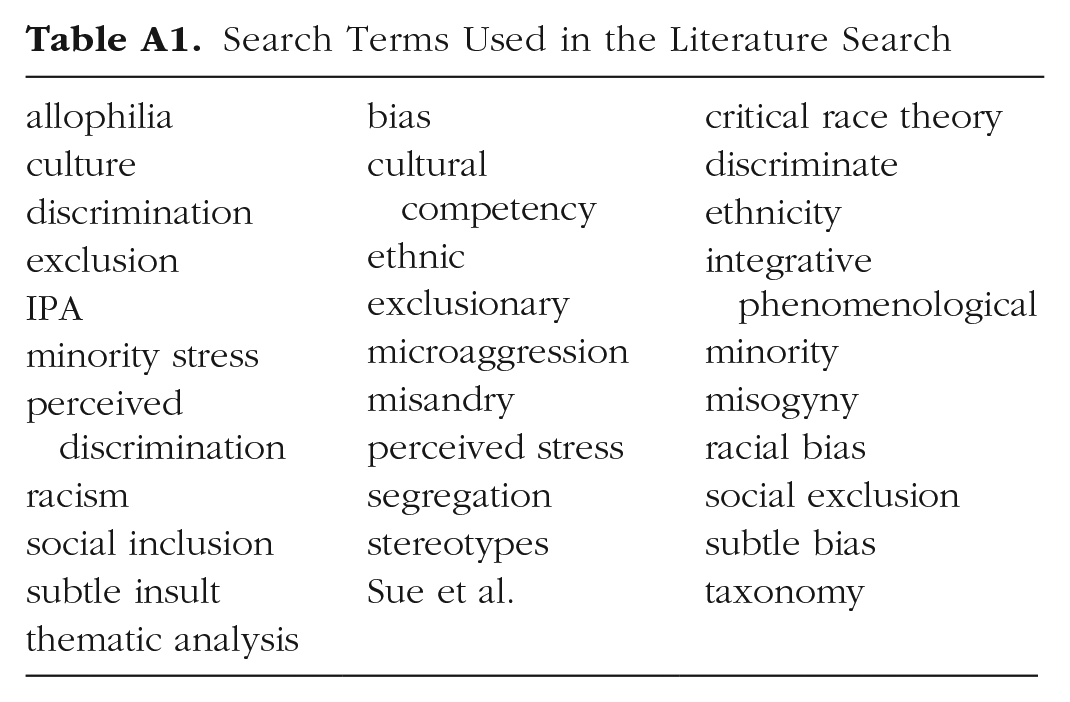
An extended literature search was conducted using relevant search engines and databases, including Google Scholar, Proquest, and PsycInfo. Studies were included for further analysis if they were (a) experimental in nature and featured microaggressions as a primary outcome or predictor, (b) were qualitative and took an integrative phenomenological or other related analytical approach to categorizing microaggressions, or (c) took a taxonomic approach to microaggressions by analyzing new data. Search terms were used separately and in combination with each other and are included in Appendix A.
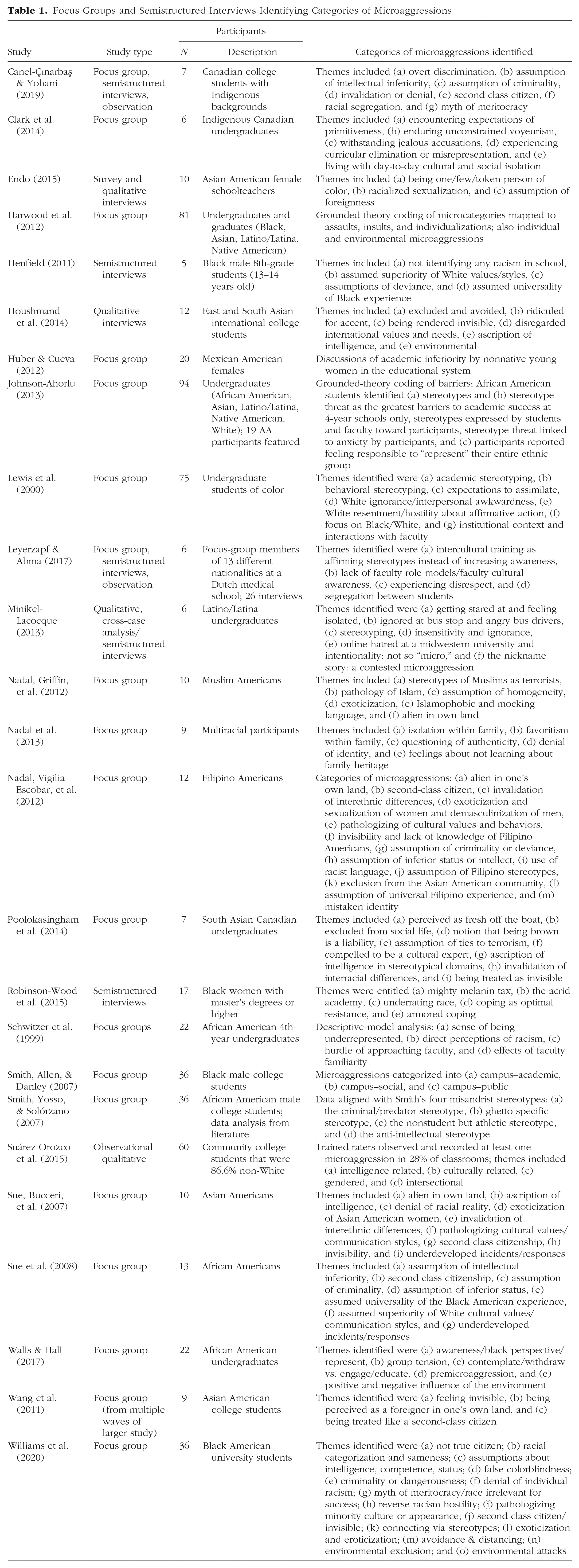
This search resulted in 61 studies on microaggressions and the effects of microaggressions on health, mental health, or academic outcomes. Of those studies, 19 studies discussed health outcomes related to microaggressions. Of the remaining 42 studies, 32 studies (not including Sue and colleagues’ foundational article) took a taxonomic/categorical approach to assessing microaggressions. The authors used an iterative approach to classify each of the categories in each of the final studies. This process proceeded in three stages. First, after a close reading and discussion of the themes present across articles, one author selected 16 tentative categories that appeared to capture the range. Next, each author independently sorted the variables in each study according to those 16 categories, which allowed for an initial test of both comprehensiveness (i.e., whether categories remained that could not be captured within these categories) and parsimony (i.e., whether all 16 categories were used when sorting into the proposed categories). In the final stage, ratings were compared across all three sets of coding, and iterative discussion and recoding occurred until consensus was reached. These categories are summarized in Table 1 and Table 2 for qualitative and quantitative studies, respectively.
Focus Groups and Semistructured Interviews Identifying Categories of Microaggressions
Quantitative Studies Identifying Categories of Microaggressions
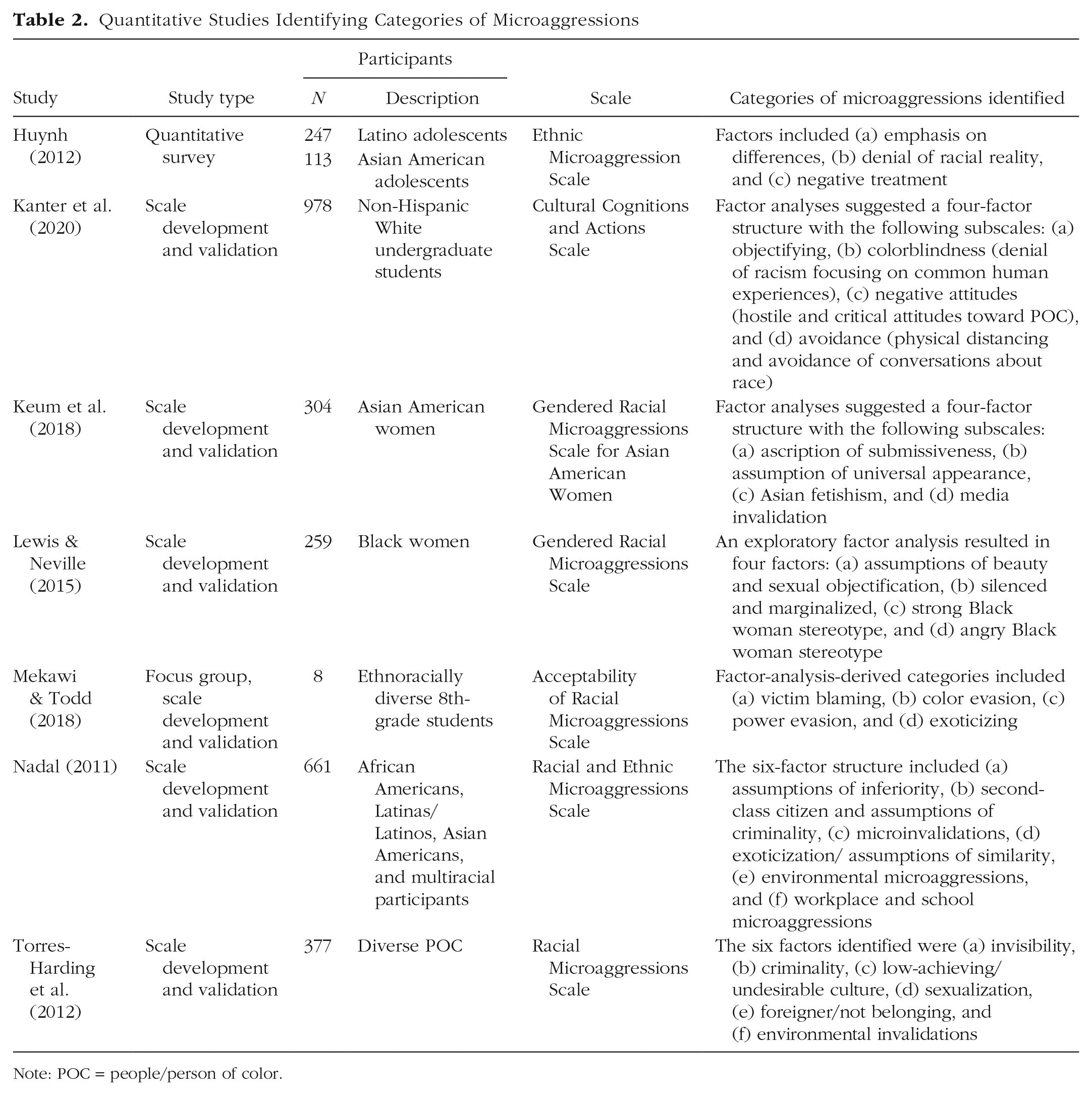
Note: POC = people/person of color.
Results
There were 16 categories in the final taxonomy based on the review of studies that derived categories of microaggressions. The descriptions for each category were developed by reviewing the literature and carefully considering and discussing the composite themes through the same iterative process used to identify categories. Categories noted in the literature were not used if they did not focus on microaggressions (e.g., blatant, overtly racist behaviors or consequences to the victims of the act). The definitions we derived do not wholly constitute perfect composite definitions from all of the reviewed literature because not all reported categories were in exact alignment across studies. Nonetheless, a complete list of all studies in which the category (or a highly similar category) was included can be found in Table 3. The following section describes the 16 resultant categories.
Categories of Microaggressions
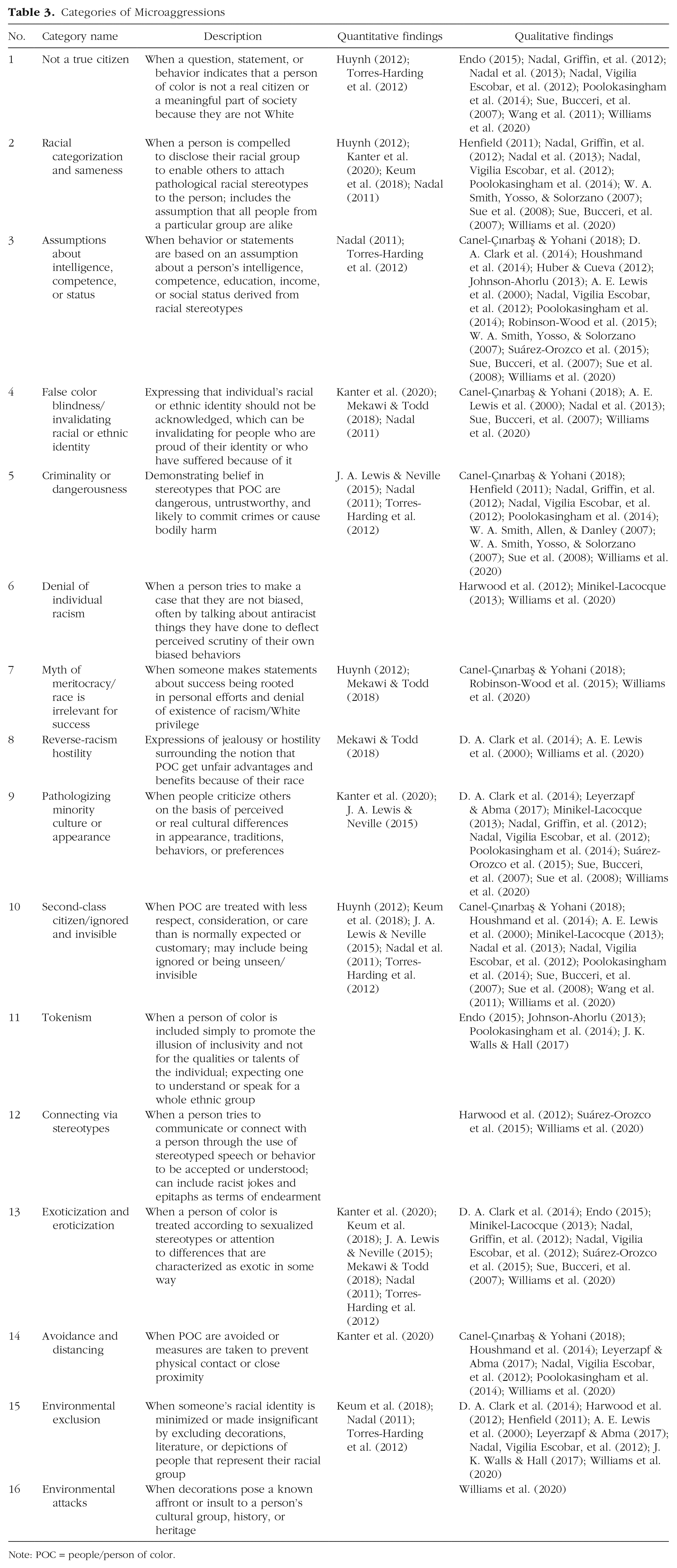
Note: POC = people/person of color.
1. Not a true citizen
This type of microaggression, first described by Sue et al. (2007) as “alien in [one’s] own land,” is based on assumptions that the target is not a “true American,” reinforcing notions that non-Whites are probably immigrants and thus not legitimate citizens or a meaningful part of the larger society. It communicates exclusion and lack of belonging that can make people of color feel like outsiders. This type of microaggression was most often described in relation to the experiences of Asian and Latino/Latina Americans (e.g., Wang et al., 2011) but has also been reported by African Americans (Williams et al., 2020). There is evidence that these type of microaggressions are common among those with Middle Eastern and North African heritage as well, although this link is understudied and may be conflated with anti-Muslim religious microaggressions (e.g., Husain & Howard, 2017).
2. Racial categorization and sameness
This category is intended to describe the microaggressions that occur when a person of color is compelled to disclose their racial identity to others (Williams et al., 2020), which may expose them to the expression of pathological stereotypes based on that identity (see the next category). Assumptions that people of a given race are all alike similarly applies (e.g., assumed universality of the Black American experience; Sue et al., 2008). The threat of exposure to harmful stereotypes and their application to the self may serve to disconnect individuals from their actual heritage or lived experience, internalize false attributes regarding one’s heritage, or force unwanted traits or group responsibility to an individual.
Microaggressions of forced racial categorization are experienced by people of color as being squeezed into a one-size-fits-all box that overlooks the complexity of a person’s identity. Individuals who identify as biracial or multiracial may struggle to feel accepted and experience identity confusion; they may also experience social pressure to identify with a single, foreclosed identity (Williams et al., 2018). Intersectional experiences of people of color who also possess a marginalized gender identity, sexual orientation, or religion may also be ignored or minimized.
3. Assumptions about intelligence, competence, or status
This category is intended to include any positive or negative ascriptions of intellectual abilities, competence, education, or social standing on the basis of racial assumptions. One common phenomenon encountered in the focus-group study of African American college students by Williams et al. (2020) was counterstereotypical surprise or assumed exceptionalism (e.g., “You’re not like other Black people”). Many people of color report that they encounter disbelief when they demonstrate academic excellence or express professional career ambitions (Canel-Çınarbaş & Yohani, 2018; Robinson-Wood et al., 2015). However, reverse assumptions are often made about people of Asian heritage; others assume they are smart, studious, and good at math and science (e.g., Poolokasingham et al., 2014; Sue, Bucceri, et al., 2007).
4. False color blindness/invalidating racial or ethnic identity
Color blindness includes statements that indicate a person does not want to acknowledge race and instead focus on shared humanity (Sue et al., 2007). People of color may welcome the idea that they could be treated equally by others rather than being racialized. However, they do not actually believe that their race is unseen or unnoticed by those individuals professing color blindness. For this reason, the category is renamed here as “false color blindness” to highlight the various examples in the data and the literature in which color blindness functionally prevents honest discussions about important racial issues, such as when people of color try to express something about their racial or ethnic experience but are invalidated by “color-blind” statements.
5. Criminality or dangerousness
This microaggression occurs when someone demonstrates a belief in or otherwise acts on stereotypes that people of color are dangerous, untrustworthy, or likely to commit crimes or cause bodily harm. It could also include concerns about being treated badly by people of color (i.e., verbal aggressions) leading to emotional harm. African American and Latino American males tend to be victims of these types of microaggressions most often, and sometimes law enforcement is involved (i.e., Smith, Allen, & Danley, 2007). This assumption of criminality extends beyond a concern that a man of color will engage violently; there is a reciprocal belief that the criminality of men of color is to blame, even when they are the ones being harmed. For example, when African American men are victims of homicide, jurors express less empathy and a greater assumption that the victim was at fault in some way than when the victim is White (Girgenti-Malone, 2019).
6. Denial of individual racism
In contrast to false color blindness, this type of microaggression occurs when a person asserts a lack of racial bias, generally in response to perceived scrutiny of their behavior. This assertion may be expressed through one’s friendship or social connections with other people of color or elaborating on past antiracist things that the person has done. Although described at length by Sue et al. (2007), no validated measures focus on this facet of microaggressions. Minikel-Lacocque (2013) described this as “the contested microaggression.” When used as a response to criticism, it can be invalidating to people of color who are trying to draw attention to a problematic behavior. Victims of microaggressions will expend cognitive resources questioning and analyzing the experience to ensure that what happened cannot be explained by anything other than racism (Essed, 2002). This can make it very frustrating when people call into question the veracity of the event because the individual has gone through that process already.
7. Myth of meritocracy/race is irrelevant for success
This microaggression occurs when people deny the ongoing existence of systemic racism or harmful discriminatory behavior, specifically in regard to personal achievement or barriers to achievement. They embrace the myth of meritocracy and the notion that the determinants of success are unequivocally rooted in personal efforts, refuting that White privilege is an unearned benefit resulting in tangible differences in outcomes at a personal or societal level (Canel-Çınarbaş & Yohani, 2018; Robinson-Wood et al., 2015).
8. Reverse-racism hostility
This microaggression includes expressions of jealousy or hostility surrounding the notion that people of color get unfair advantages and benefits because of their race. These expressions are often coupled with assertions that Whites are being treated unjustly and are suffering as a result. Often embedded in this sentiment is that idea that people of color are undeserving of success. This category is represented by Smith, Yosso, and Solórzano’s (2007) conceptualization of White resentment and hostility about affirmative action. This category is applicable in other cultures and countries as well. D. A. Clark et al. (2014) described the theme “withstanding jealous accusations” in relation to Indigenous people in Canada. This category does not have a prominent focus in any measures of experiences of microaggressions, but it is a subscale of the ARMS.
9. Pathologizing minority culture or appearance
This microaggression occurs when people of color are criticized because of real or perceived cultural differences in appearance, traditions, behaviors, or preferences. Also embedded in this sentiment is the idea that Whiteness is preferred, and consequently there is something negative or shameful about a non-White identity (Leyerzapf & Abma, 2017; Minikel-Lacocque, 2013; Suárez-Orozco et al., 2015). Hence, microaggressions may include statements that advance pronouncements of apparent Whiteness as complimentary. However, people of color often find such statements to be upsetting and insulting (Williams et al., 2020).
10. Second-class citizen/ignored and invisible
This microaggression captures situations in which people of color are treated with less respect, consideration, or care than is normally expected or customary. This category is meant to include both the experience of being treated as a “second-class citizen” (e.g., the preferential treatment of White individuals; Sue et al., 2007) and the experience of being ignored, unseen, or invisible.
11. Tokenism
Tokenism is defined here as when a person of color is included simply to promote the illusion of inclusivity, not in the interest of true diversity or for the qualities or talents of the individual. It is also manifested in the automatic homogenization of diverse groups and their members on the basis of race and/or the expectation that an individual’s views will represent the views of their perceived group (Nadal, 2011; Weber et al., 2018).
12. Connecting via stereotypes
Many people of color describe awkward situations in which White people attempt to communicate or connect through the use of stereotyped speech or behavior, believing that it will help them be accepted or understood. This category can include using racial jokes or even racist epitaphs to try to fit in or as terms of endearment (Nadal, Vigilia Escobar, et al., 2012). This category of microaggressions is not well-represented in any validated measures, although people of color have noted this problem in various contexts (e.g., Harwood et al., 2012). For example, Endo (2015) described situations in which Asian American respondents described being asked to teach their friends Vietnamese words or asked what to order in a Korean restaurant.
13. Exoticization and eroticization
This occurs when a person of color is treated according to sexualized stereotypes or perceived differences are characterized as exotic in some way. Many Blacks have also shared microaggressions they have experienced surrounding their hair and the frustration they have felt when someone asked them pointed questions about it or attempted to touch it (e.g., Williams et al., 2020). Asian women have also described situations in which they felt exoticized (Sue, Bucceri, et al., 2007). These types of microaggressions were not described in Sue et al.’s (2007) original taxonomy but are represented in most of the validated measures of microaggressions and many qualitative studies as well (D. A. Clark et al., 2014; Endo, 2015; Minikel-Lacocque, 2013; Nadal, Griffin, et al., 2012; Nadal, Vigilia Escobar, et al., 2012; Suárez-Orozco et al., 2015).
14. Avoidance and distancing
This microaggression occurs when people of color are avoided or measures are taken to prevent physical contact or close proximity (Canel-Çınarbaş & Yohani, 2019; Houshmand et al., 2014; Kanter et al., 2017; Leyerzapf & Abma, 2017; Nadal, Vigilia Escobar, et al., 2012; Poolokasingham et al., 2014). This includes the exclusion of members of targeted groups through physical distancing. It can also include avoiding close relationships and difficult discussions about race.
15. Environmental exclusion
Certain microaggressions that are more apparent on systemic and environmental levels have been defined previously as “environmental microaggressions” (Sue et al., 2007). Environmental exclusion is a microaggression that occurs when someone’s racial identity is minimized or made insignificant by excluding depictions, art, or literature that represents their racial group. It can also be used to describe situations in which entire categories of people are not present in the environment.
Harwood et al. (2012) further described segregated spaces as a form of environmental microaggression, particularly with respect to nonvoluntary segregated dormitory living groups, which can communicate to students of color that they do not belong and contribute to feeling unwelcome.
16. Environmental attacks
This category is intended to describe situations in which decorations or depictions pose a known affront or insult to a person’s cultural group, history, or heritage (e.g., buildings named after slave owners, Confederate monuments, Columbus Day). We split this category from the larger category of environmental microaggressions to capture these particularly hurtful and often frightening depictions (e.g., Desai & Abeita, 2017; Murty & Vyas, 2017), which have been an ongoing source of consternation, public attention, and institutional resistance (Crowe, 2018).
Discussion
Subtle forms of racism, such as microaggressions, can be difficult to identify, quantify, and rectify because of their nebulous and unnamed nature. Although racial maltreatment exists on a continuum of discriminatory action ranging from gross and intentional to tiny unconscious slights (Garcia & Johnston-Guerrero, 2015), there is a need for a unified language in the study of the experience of this form of covert racism if people are to actively identify and confront microaggressions when they occur. The burgeoning research on the topic of microaggressions, although important in identifying the vast scope and depth of the problem, has made it increasingly difficult to identify such a unified language that integrates multiple studies into a coherent framework. This review of the extant literature, and new research on the topic, identified 16 common categories of microaggressions as experienced by people of color.
These categories are consistent with the original taxonomy of Sue et al. (2007) but expand it in several notable ways. First, several of the categories from Sue et al. have been slightly revised or redefined to take into consideration new data and themes that have emerged, including alien in own land, which is now represented by two categories, not a true citizen and forced racial categorization, and environmental microaggressions, which have been distinguished as environmental exclusions and environmental attacks. In addition, several new categories are defined that were not well represented by Sue et al. but were observed by multiple other researchers. These categories include tokenism, connecting via stereotypes, exoticization and eroticization, and avoidance and distancing (Williams et al., 2020).
It is worth noting that a number of the studies examined here included themes of blatant racism that were far more severe than what most would consider a microaggression (e.g., Córdova & Cervantes, 2010; Houshmand et al., 2014; Minikel-Lacocque, 2013). As this field evolves, it is increasingly important to set clear boundaries between where microaggressions end and overt racism begins. In addition, several studies included categories that centered on the experience or result of microaggressions (stereotype threat, isolating one’s self, coping strategies, etc.; e.g., Johnson-Ahorlu, 2013; Robinson-Wood et al., 2015; Schwitzer et al., 1999), and although these categories are important, they do not constitute microaggressions per se. This deficiency perhaps underscores the need for more precise language to discuss the nature, experience, and impact of microaggressions.
It was clear that some types of microaggressions were better represented in the literature than others. The most studied categories of microaggressions were assumptions about intelligence, competence, or status and second-class citizen/ignored and invisible; the least studied categories were reverse-racism hostility, denial of individual racism, and connecting via stereotypes. Environmental attacks were the least represented among any of the categorical studies of microaggressions that we reviewed (Williams et al., 2020), although this type of microaggression has been described in several other types of studies of microaggressions (e.g., Desai & Abeita, 2017; Murty & Vyas, 2017); because this category has been studied more, we may find other examples of a more systemic nature that could fit here (e.g., gerrymandering school-district lines, putting police at polling locations to frighten Black voters). These less studied categories signal areas in need of further research and, for the most part, problematic areas that are not currently being captured by existing measures of microaggressions.
This study is not without limitations. Although we sought to develop a revised taxonomy by accounting for ethnically diverse cohorts described in the literature, the review was not completely exhaustive across disciplines. Future work on this topic may result in an updated taxonomy that accounts for the increasing intersectionality of marginalized identities such as gender, sexual orientation, or religious identification. For example, Donovan and colleagues (2013) assessed the intersectionality of race and gender among female graduate and postgraduate students, and Weber and colleagues (2018) interviewed graduate students that identified as sexual minorities.
Conclusion
In the absence of an adequate classification or understanding of the elusive dynamics of subtle racism, the risk remains that microaggressions will continue to harm the lives and standard of living of people of color without adequate attention or understanding. Whereas previous studies have either embraced the taxonomy developed by Sue and colleagues or proposed a novel taxonomy unique to specific data, this study synthesizes the Sue framework in concert with the contributions of other researchers. A unified language of microaggressions may better allow for improved measurement of this construct in both qualitative and quantitative studies. It may also lead to a better public understanding of microaggressions, such that aggressors might improve their ability to both note and accurately self-report their behavior with a better understand of resulting negative social outcomes. It may similarly support recipients of repeated microaggressions and reduce the burdensome expectation to “prove” the validity of their perceptions and experiences (Banks, 2014).
The updated categorizations presented here may be seen as a holistic accounting of the diversity of racial microaggressions. It is hoped that this comprehensive taxonomy may support efforts to develop a unified language among researchers of microaggressions, thereby advancing the study of prejudice, racism, and the social harms that they entail.
Footnotes
Appendix A
Search Terms Used in the Literature Search
| allophilia | bias | critical race theory |
| culturediscriminationexclusionIPAminority stressperceived discriminationracismsocial inclusionsubtle insultthematic analysis | cultural competencyethnicexclusionarymicroaggressionmisandryperceived stresssegregationstereotypesSue et al. | discriminateethnicityintegrative phenomenologicalminoritymisogynyracial biassocial exclusionsubtle biastaxonomy |
Transparency
Action Editor: Laura A. King
Editor: Laura A. King
