




Abstract
Belief in conspiracy theories—such as that the 9/11 terrorist attacks were an inside job or that the pharmaceutical industry deliberately spreads diseases—is a widespread and culturally universal phenomenon. Why do so many people around the globe believe conspiracy theories, and why are they so influential? Previous research focused on the proximate mechanisms underlying conspiracy beliefs but ignored the distal, evolutionary origins and functions. We review evidence pertaining to two competing evolutionary hypotheses: (a) conspiracy beliefs are a by-product of a suite of psychological mechanisms (e.g., pattern recognition, agency detection, threat management, alliance detection) that evolved for different reasons, or (b) conspiracy beliefs are part of an evolved psychological mechanism specifically aimed at detecting dangerous coalitions. This latter perspective assumes that conspiracy theories are activated after specific coalition cues, which produce functional counterstrategies to cope with suspected conspiracies. Insights from social, cultural and evolutionary psychology provide tentative support for six propositions that follow from the adaptation hypothesis. We propose that people possess a functionally integrated mental system to detect conspiracies that in all likelihood has been shaped in an ancestral human environment in which hostile coalitions—that is, conspiracies that truly existed—were a frequent cause of misery, death, and reproductive loss.
Conspiracy theories are omnipresent among members of modern and traditional societies (West & Sanders, 2003). A common definition of conspiracy theory is the conviction that a group of actors meets in secret agreement with the purpose of attaining some malevolent goal (e.g., Bale, 2007). Contrary to the view that belief in such theories is pathological (Hofstadter, 1966), large portions of the human population believe conspiracy theories. In 2004, 49% of New York City residents believed the U.S. government to be complicit in the 9/11 terrorist attacks (Sunstein & Vermeule, 2009). In addition, in a nationally representative sample of the U.S. population, 37% answered “agree” to the following statement: “the Food and Drug Administration is deliberately preventing the public from getting natural cures for cancer and other diseases because of pressure from drug companies.” Another 31% answered “neither agree nor disagree,” and only 32% disagreed with this statement (Oliver & Wood, 2014). Belief in conspiracy theories is thus a widespread societal phenomenon and has increasingly drawn the research attention of social scientists (for overviews, see Brotherton, 2015; Douglas, Sutton & Cichocka, 2017; van Prooijen, 2018). This research focused predominantly on the direct, proximate mechanisms underlying conspiracy beliefs but ignored the distal, evolutionary roots and functions of such beliefs. The aim of the current contribution is to fill this void.
We pursue the following more specific goals. First, we conceptualize conspiracy theories and identify the psychological mechanisms that interact to characterize belief in such theories. Second, to assess the core question of why conspiracy theories are widely believed, we place the key findings of this growing research domain within the context of evolutionary psychology. Through a synthesis of the empirical literature with theoretical insights from evolutionary, social, and cultural psychology, we put forward two rival hypotheses. The first, called the by-product hypothesis, argues that conspiracy theories are a by-product of a suite of cognitive mechanisms (e.g., pattern perception, agency detection) that evolved for different reasons. The second hypothesis, which we label the adaptive-conspiracism hypothesis, stipulates that conspiracy thinking is an adaptive feature of the human coalitional mind that evolved (a) to alert ancestral humans to the possibility that others were forming dangerous coalitions against them and (b) to stimulate appropriate actions to fend off such threats. Finally, on the basis of our line of reasoning, we generate novel predictions about potential mediators and moderators of conspiracy beliefs.
What Is a Conspiracy Theory?
Although the definition provided above is rather general, here we explicate the specific underlying features of conspiracy theories. We argue that a conspiracy theory contains at least five critical ingredients. First, conspiracy theories make an assumption of how people, objects, or events are causally interconnected. Put differently, a conspiracy theory always involves a hypothesized pattern (see Shermer, 2011; Whitson & Galinsky, 2008). Second, conspiracy theories stipulate that the plans of alleged conspirators are deliberate. Conspiracy theories thus ascribe intentionality to the actions of conspirators, implying agency (Douglas, Sutton, Callan, Dawtry, & Harvey, 2016; Imhoff & Bruder, 2014). Third, a conspiracy theory always involves a coalition, or group, of actors working in conjunction. An act of one individual, a lone wolf, does not fit the definition of a conspiracy theory (van Prooijen & van Lange, 2014). Fourth, conspiracy theories always contain an element of threat such that the alleged goals of the conspirators are harmful or deceptive (Hofstadter, 1966). Sometimes, people may suspect others to conspire toward benevolent goals (e.g., secretly preparing a surprise party), but that is not how conspiracy theories are commonly conceptualized. Fifth, and finally, a conspiracy theory always carries an element of secrecy and is therefore often difficult to invalidate. Conspiracy theories that turn out true—such as Watergate or the Iran-Contra scandal—are no longer conspiracy “theories.” Hence, in judging the validity of conspiracy theories, there is always room for error.
People hold many beliefs that share some of the key elements of conspiracy theories, such as supernatural beliefs. Indeed, conspiracy theories and supernatural beliefs are positively correlated (Darwin, Neave, & Holmes, 2011; Swami et al., 2011). What distinguishes conspiracy theories from supernatural beliefs is that they necessarily involve a coalition element of deceptive or potentially dangerous other human beings acting in unison (Bale, 2007). If one sees a collection of nonhuman stimuli grouped together—an unusually shaped collection of trees, rocks, mountains, stars, or the like—pattern perception and agency detection may provide people with mystical experiences, spirituality, religious revelations, and the desire to perform sacred rituals. For conspiracy theories to occur, however, these nonhuman stimuli need, at the very least, to be connected to the real or suspected presence of a coordinated group of deliberate actors. Unlike other forms of beliefs, a hostile coalition is a prerequisite of any conspiracy theory (van Prooijen & van Lange, 2014).
Browsing through the Internet, one can find many lay theories that fit the key ingredients of a conspiracy theory (patterns, agency, coalitions, threats, secrecy). They usually involve powerful groups such as societal leaders, governmental institutions (e.g., secret services), influential branches of industry (e.g., oil companies, the pharmaceutical industry), or stigmatized minority groups (e.g., Muslims, Jews). Besides the context of citizens’ perception of geopolitical events, conspiracy theories emerge frequently in the microlevel setting of organizations, as employees often suspect their managers of conspiring toward evil goals such as pursuing their self-interest at the expense of employees and the organization (van Prooijen & de Vries, 2016). Belief in conspiracy theories is also common in non-Western cultures; for instance, in rural parts of various African countries (e.g., Mozambique, Nigeria, Tanzania), large portions of citizens believe conspiracy theories that involve malpractice of societal elites, sorcery or witchcraft by enemy groups, and hostile Western plots (West & Sanders, 2003). Furthermore, although the term conspiracy theory may sometimes be used to invalidate legitimate accusations of corruption (for an example, see Ferguson & Beresin, 2017), not all conspiracy theories are irrational. Recent history is replete with examples of actual conspiracies in politics (Watergate), organizations (e.g., corporate corruption), and science (e.g., the Tuskegee Syphilis Experiment).
Despite the variety of conspiracy theories, however, belief in such theories seems to reflect one more general conspiratorial mind-set. For instance, belief in one conspiracy theory is an excellent predictor of belief in different, unrelated conspiracies (Douglas & Sutton, 2011; Goertzel, 1994; Lewandowski, Oberauer, & Gignac, 2013; Swami et al., 2011; van Prooijen, Krouwel, & Pollet, 2015). Even mutually incompatible conspiracy beliefs—such as the belief that Princess Diana staged her own death and the belief that she was murdered—are positively correlated (.14 < rs < .26 in Wood, Douglas, & Sutton, 2012). These insights suggest that although there are many different conspiracy theories, belief in such theories is grounded in the same underlying psychology.
Conspiracy Theories as Evolutionary By-Products
Evolutionary psychologists draw a distinction between adaptations and by-products as different results of evolutionary processes (Buss, Haselton, Shackleford, Bleske, & Wakefield, 1998). Adaptations are functional solutions to problems of survival and reproduction that evolved through natural selection because they provided better survival prospects than alternative solutions in ancestral environments. In contrast, by-products do not solve adaptive problems and have no functional properties but are carried along with other mechanisms that do have adaptive features. For instance, the umbilical cord evolved as a solution to the problem of providing nutrients from the mother to the fetus in her womb; the belly button is a by-product of this adaptation and carries no function in and of itself.
Likewise, it may be possible that conspiracy theories are merely by-product beliefs. A crude version of the by-product hypothesis suggests that conspiracy theories are epiphenomena, emerging from a large brain capable of thinking, reasoning, and gossiping. The more sophisticated version asserts that the mind consists of various psychological mechanisms that evolved for different purposes. Recall that conspiracy theories contain several key components, such as pattern recognition, agency detection, and threat management. When assessed separately, each of these mechanisms has broader functionality than conspiracy detection. Jointly, however, as by-products, they might cause humans to be susceptible to conspiracy theories. Here we review how these mechanisms are empirically related to belief in conspiracy theories.
Pattern perception
One key element of any conspiracy theory is pattern perception, an assumption about how people and events are causally connected (Shermer, 2011; Whitson & Galinsky, 2008). Pattern recognition is a basic feature of an adaptive human ability for associative learning. Understanding the world by identifying cause and effect helped our ancestors to recognize threats and opportunities, to foresee the consequences of their actions, and to strategically adjust their behavior to fit the demands of the situation. Whereas many of the patterns that people perceive are real and functional to internalize (e.g., if one eats contaminated food, one might get ill; if one hits an enemy, that enemy might hit back), people sometimes mistakenly perceive patterns that do not exist (Gilovich, Vallone, & Tversky, 1985).
Such illusory pattern perception is a result of the evolved human tendency to make sense of the world and, by extension, could produce a sensitivity to conspiracy theories. The human mind is equipped to look for existing patterns because establishing the true causal relations between people, events, and other important stimuli is indispensable for survival. The errors that may occur in this cognitive process—that is, finding patterns that are in fact illusory—lead to all kinds of seemingly irrational beliefs. For instance, paranormal beliefs are associated with a decreased ability to recognize randomness (for a review, see Wiseman & Watt, 2006). The relationship between paranormal beliefs and illusory pattern perception occurs only in regular population samples, not in highly educated samples of university students—which in all likelihood is due to students’ relatively strong analytic-thinking skills, which may override their intuitions (Blagrove, French, & Jones, 2006).
Biases in pattern perception are empirically related to conspiracy theories. For instance, people who believe in conspiracy theories overestimate the probability that events are connected (Brotherton & French, 2014). Furthermore, belief in conspiracy theories is associated with a tendency to perceive patterns in random or chaotic stimuli, notably random coin flip strings and unstructured modern art paintings (.22 < rs < .45 in van Prooijen, Douglas, & De Inocencio, 2018; see also Whitson & Galinsky, 2008). We should note, however, that this relationship does not emerge under all circumstances (Dieguez, Wagner-Egger, & Gauvrit, 2015), which may be (as with paranormal beliefs) due to sampling differences (e.g., pattern perception might not predict conspiracy theories among highly educated people; see Blagrove et al., 2006). These findings suggest that conspiracy theories may be a nonadaptive consequence of biases in the evolved cognitive capacity for pattern perception.
Agency detection
A second psychological mechanism that may produce conspiracy beliefs is agency detection. Agency detection refers to humans’ evolved capacity to recognize the motives and intentions behind others’ actions. Agency detection is closely associated with theory-of-mind adaptations—that is, the basic capacity to understand what others are thinking and feeling (Baron-Cohen, 1997). Agency detection, as well as theory of mind, enabled ancestral humans to understand the (benevolent or hostile) motives behind each other’s actions and thereby facilitated empathy with tribe members’ mutual needs and desires, cooperation, and common norms of conduct. Although agency detection evolved mainly to regulate the social life of humans, sometimes people detect agency where none exists. For instance, people overattribute human motives and intentions to their pets, plants, and electronic devices (i.e., anthropomorphism; Epley, Waytz, & Cacioppo, 2007).
Could a hyperactive agency-detection system produce conspiracy beliefs as a by-product? Conspiracy theories assume evil schemes that are intentional and planned in advance by a group of intelligent actors in every single detail. Conspiracy theories thereby often overestimate the power, evil intentions, and capacity of foresight among the alleged conspirators and underestimate the role of accidents, human error, and chance (e.g., Shermer, 2011). Various studies indeed support a link between hyperactive agency detection and conspiracy theories. For instance, increased conspiracy belief is associated with increased anthropomorphism and with related measures assessing people’s tendency to overascribe intentionality to inanimate objects (.16 < rs < .42 in Douglas et al., 2016; Imhoff & Bruder, 2014). Evidence further suggests that theory-of-mind mechanisms predict conspiracy beliefs. Specifically, the ability to read people’s emotions from their eyes predicts belief in conspiracy theories, provided that there are threat cues in the environment (van Prooijen & van Dijk, 2014).
As with pattern perception, agency detection increases people’s sensitivity to many forms of belief. Religious beliefs that involve anthropomorphized, moralizing gods are grounded in people’s tendency to make sense of their social and physical environment through agency detection (e.g., Atran & Henrich, 2010). In addition, various other forms of supernatural belief—such as belief in ghosts and the related belief in the ability of living people to get into contact with the souls of deceased people—imply agency detection (Shermer, 2011). Such agency detection can be increased by threat cues. It has been noted that belief in moralizing, personified gods increases when people are uncertain about the future (Hogg, Adelman, & Blagg, 2010). In sum, when establishing the causes of events, people have a tendency to detect agency, which may sometimes be accurate and sometimes not. Hyperactive agency detection may facilitate conspiracy thinking as a nonfunctional consequence.
Threat management
The by-product hypothesis suggests that conspiracy theories are nonfunctional consequences of a threat-management system. Evolutionary models emphasize that people evolved adaptations to survive, stay healthy, and reproduce despite the threats that were posed by the physical and social environment. One implication is that people have found ways to cope with stimuli in their environment that pose a direct threat to their well-being, health, and safety. Specifically, Neuberg, Kenrick, and Schaller (2011) proposed that people possess a threat-management system, which enables them to quickly recognize threatening stimuli in their environment and cope with these stimuli through a functional response. Neuberg and colleagues argue that this threat-management system consists of two subsystems. One is the disease-avoidance system, which is associated with cognitions, emotions, and behaviors that are functional to avoid contact with dangerous pathogens. The second subsystem is the self-protection system, which is designed to quickly recognize and anticipate direct threats to people’s physical integrity.
The threat management system manifests itself in people’s responses to a range of potentially threatening stimuli. For instance, people have an inborn fear of various dangerous animals and quickly recognize them in their environment. One study reveals that snakes and spiders are more easily recognized, and more effectively capture people’s attention, than flowers or mushrooms (Öhman, Flykt, & Esteves, 2001). Likewise, people easily recognize angry human faces. This finding is specific, however, to angry male faces, which is consistent with the assertion that males’ expressions of anger are stronger diagnostic cues than females’ expressions of anger for possible physical danger to the perceiver (Becker, Kenrick, Neuberg, Blackwell, & Smith, 2007). Besides the dangers of animals or human males, another possible source of threat comes from potentially hostile coalitions.
After recognizing cooperative alliances, people readily associate such coalitions with danger. Studies reveal that people more easily associate aversive, dangerous stimuli with other groups (referred to as “out-groups” in the psychological literature) as opposed to one’s own group (e.g., Olsson, Ebert, Banaji, & Phelps, 2005). Furthermore, danger-cues elicit increased vigilance particularly in the context of out-group men (McDonald, Navarrete, & Van Vugt, 2012; Navarrete, McDonald, Molina, & Sidanius, 2010). Likewise, a conditioned fear response after associating human faces with unpleasant stimuli (i.e., mild electric shocks combined with a short burst of uncomfortable noise) was resistant to extinction only in the context of out-group male faces—not in the context of male faces from one’s own group or female faces (Navarrete et al., 2009). Human beings have evolved to be vigilant toward all kinds of threats, and conspiracy theories may be a by-product of this threat-management system.
Alliance detection
By definition, a conspiracy is a coalition of people cooperating toward a common goal (Bale, 2007). For people to detect conspiracies, therefore, they need to be able to detect coalitions of people that cooperate with one another. Consistently, evolutionary theorizing asserts that people evolved an alliance-detection system to quickly recognize coalitions of mutually cooperating individuals (Kurzban, Tooby, & Cosmides, 2001). This alliance-detection system is conceptually broader than the assertion that people evolved a functional tendency to believe conspiracy theories about enemy alliances: The alliance-detection system also evolved to recognize friendly alliances because these may help in providing food, shelter, and mates (see also Pietraszewski, Cosmides, & Tooby, 2014; Tooby & Cosmides, 1988). Nevertheless, the capacity of human beings to detect which individuals are cooperating with one another constitutes an indispensable element of their tendency to infer conspiracy theories when such alliances seem suspect or dangerous. The by-product hypothesis asserts that as a nonfunctional extension of human coalitional psychology, people sometimes believe that hostile coalitions are teaming up against them.
Empirical evidence suggests that people indeed automatically detect cooperative coalitions. For instance, in a political context, people spontaneously categorize other people on the basis of their party preferences (Pietraszewski, Curry, Petersen, Cosmides, & Tooby, 2015). Furthermore, cues suggesting that people cooperate with one another tend to override many other salient perceptual cues that frequently form the basis for social categorizations. A case in point is race: Whereas in baseline conditions people have a tendency to classify people according to differences in race, this tendency is strongly reduced when additional cues suggest interracial cooperative alliances (e.g., verbal allegiance cues such as “us” versus “them” or visual appearance cues such as shared shirt color; see Kurzban et al., 2001). In sum, people have mental modules in place that enable them to quickly detect cooperative alliances, both friendly and hostile ones.
Critical assessment
In the present section, we examined the possibility that conspiracy theories are by-products of psychological mechanisms—notably pattern perception, agency detection, alliance detection, and threat management—that evolved for different purposes. We have shown theoretically and empirically that each of these mechanisms is associated with a heightened sensitivity to conspiracy theories. Does this mean that conspiracy beliefs are merely epiphenomena, derived from these evolved psychological mechanisms without having any functional relevance per se?
We propose that the by-product hypothesis suffers from one major weakness: Assuming that conspiracy theories are a by-product of other adaptations implies that conspiracies either do not exist or did not constitute significant selection pressures influencing ancestral humans’ genetic fitness. It is well known, however, that conspiracies often do exist: Throughout history, people formed coalitions that secretly planned to harm others and subsequently carried out these plans. One might reason that actual conspiracies in modern societies—e.g., corporate corruption, or political conspiracies—often have no straightforward influence on the reproductive opportunities of individual citizens, who are shielded from these power holders in large states and well protected by a strong rule of law. The central question for the possible adaptive qualities of conspiracy theories, however, is how actual conspiracies influenced the lives of ancient hunter-gatherers during the millennia when many of these psychological traits evolved. As such, finding that basic psychological mechanisms facilitate conspiracy beliefs does not preclude the possibility that a predisposition to believe such theories is a functional solution to a specific adaptive problem that humans have faced throughout evolutionary history: the danger of real conspiracies forming against them.
Adaptive-Conspiracism Hypothesis
We now explore the alternative hypothesis that believing in conspiracy theories is an adaptive feature of the human coalitional mind. The adaptive-conspiracism hypothesis asserts that the human tendency to believe conspiracy theories is not a by-product of (a) a large neocortex that is capable of sophisticated reasoning or (b) psychological mechanisms such as pattern recognition and agency detection that evolved for different purposes. Instead, conspiracy theories uniquely helped ancestral humans to navigate their social world better and anticipate and overcome imminent dangers in their environment. Specifically, we reason that in an environment in which coalitional violence—that is, violence committed by actual conspirators occurring both within and between groups—was a common cause of death and reproductive loss, it may have been adaptive for people to be suspicious of the possibility that other people were forming malevolent conspiracies against them or their group. Detecting and possibly overrecognizing secret conspiracies before they strike may motivate a suite of emotional and behavioral responses to mitigate such threats, including taking defensive actions (e.g., migrating elsewhere) or offensive actions (e.g., a preemptive strike).
Consistent with this line of reasoning, error-management theory posits that human beings will be biased in predictable ways when the costs of false positives are unequal to the costs of false negatives. Although error-management theory was initially developed to explain male and female choices in sexual behavior and commitment in close relationships (Haselton & Buss, 2000), such an asymmetry also exists in the potential costs associated with false positives and false negatives in the context of threats that may exist in people’s physical environment (Neuberg et al., 2011). Mistaking a stick for a snake is relatively harmless in that it produces only unnecessary avoidance behaviors. Mistaking a snake for a stick, on the other hand, can be lethal.
We propose that the same logic applies to conspiracy theories specifically, provided that the ancestral environment contained sufficient dangerous coalitions to render overrecognition of hostile conspiracies adaptive. We depict the logic of error-management theory as applied to conspiracy theories in Figure 1. Although conspiracy theories are closely associated with coalitional conflict, one distinct feature of conspiracy theories is secrecy: Perceivers merely suspect a hostile coalition preparing malevolent action. People may thus make mistakes by over- or underrecognizing conspiracies. Although both types of mistakes involve certain costs, error-management theory would predict that underrecognizing conspiracies becomes more costly (and overrecognizing conspiracies less costly) to the extent that the dangers of real conspiracies increase.
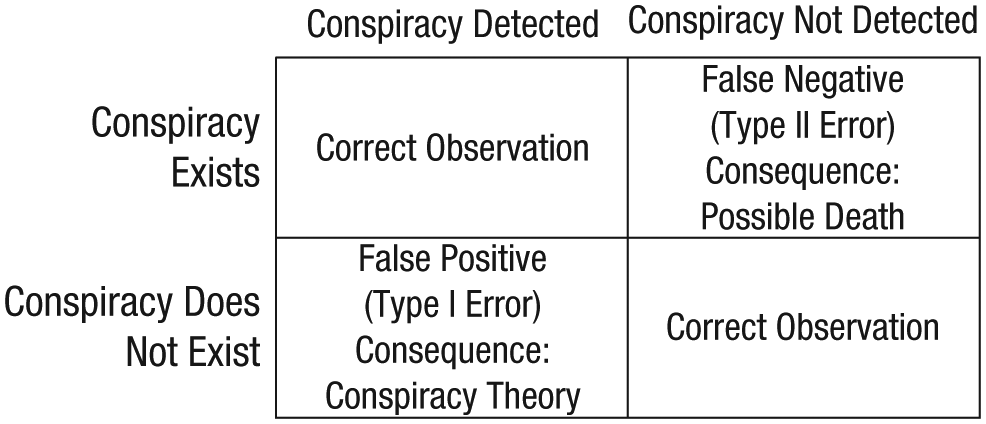
Error-management theory in the context of belief in conspiracy theories.
More specifically, detecting a conspiracy where in fact none exists may involve a range of possible costs, including reputation damage, social exclusion, or harming innocent people that could be useful cooperation partners. Many of these costs depend on a range of social parameters, however: For instance, conveying conspiracy theories has little reputational consequences if a group majority is willing to believe in them. Furthermore, although spreading false rumors may decrease the social standing of an individual, social exclusion would be a less realistic consequence in ancient hunter-gatherer societies: A deviant group member also needed to be considered harmful, or at least insufficiently beneficial, to the group (Kurzban & Leary, 2001). Finally, although in modern times conspiracy theories can carry a social stigma (Harambam & Aupers, 2015), using the label “conspiracy theory” does not decrease people’s belief in it (Wood, 2016). This suggests that the possible reputational consequences of conspiracy theories do not discourage people from believing in them.
The costs of overrecognizing conspiracies are complex because they depend on a range of social parameters, but the costs of failing to detect a conspiracy that actually exists can be relatively straightforward. By definition, actual conspiracies secretly plan to harm people, for instance by stealing resources or women, exploitation, raiding, killing, or, at the extreme, genocide. Underrecognizing conspiracies may therefore translate to major costs for victimized individuals or groups. Balancing the trade-off between costs of over- and underrecognizing conspiracies, we tentatively conclude that, particularly in an environment in which dangerous conspiracies are omnipresent, error-management theory would predict an adaptive human predisposition to be suspicious of possible conspiracy formation even when this increases the chance of false positives. Put differently, people err on the side of caution, thus overrecognizing coalitional dangers through quick mental calculations gauging the likelihood of hostile conspiracies.
This line of reasoning would suggest that the psychological processes underlying conspiracy theories are an integral part of an adaptive human coalitional psychology with the aim of detecting secret and dangerous coalitions and assessing the costs and benefits of particular strategies to counter such threats (Tooby & Cosmides, 2010). If this is true, then conspiracy theories are reliably triggered by cues in the social environment that—directly or indirectly—suggest a heightened risk of coalitional aggression or exploitation. Once a conspiracy has been detected, people should then show adaptive responses to deal with such secret and hostile coalitions. In short, being suspicious of conspiracies would have given early humans an edge in the competition over reproductive resources.
We argue for the adaptive nature of conspiracy beliefs by evaluating the evidence for a number of propositions that follow from the assertion that belief in conspiracy theories is part of an adaptive human coalitional psychology designed to deal with the realistic threat of coalitional violence among ancestral humans. These propositions are based on common requirements that a psychological mechanism must meet to qualify as an adaptation, including its complexity, universality, domain specificity, interactivity, efficiency, and functionality (Schmitt & Pilcher, 2004). In Table 1, we summarize the propositions and falsifiable predictions that follow from these requirements if a tendency to believe conspiracy theories indeed has been an adaptive feature of ancestral humans.
Requirements of Psychological Adaptations, Propositions for the Adaptive-Conspiracism Hypothesis, and Predictions
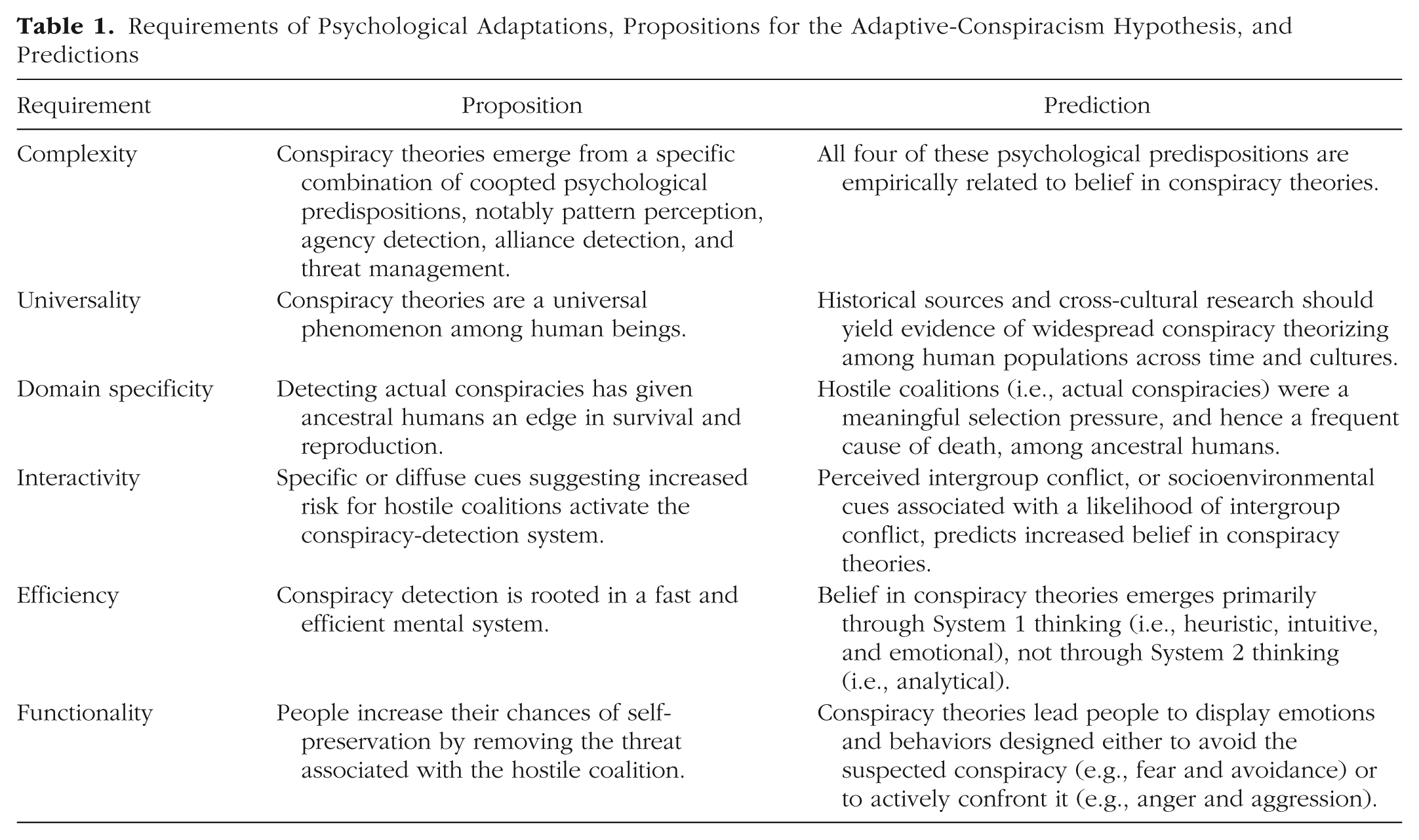
Regarding the first criterion, a unique feature of a psychological adaptation is its complexity: Adaptations are typically complex and sometimes emerge as the result of the interplay of traits that evolved for different purposes but work together to deal with novel adaptive challenges (also referred to as exaptations; see Andrews, Gangestad, & Matthews, 2002; Schmitt & Pilcher, 2004). A classic example is bird feathers, which initially evolved for thermoregulation of the body but later on obtained a new function, aiding in flight. Likewise, the psychological mechanisms that we discussed earlier—pattern perception, agency detection, alliance detection, and threat management—may have different functionality than triggering conspiracy beliefs per se. But once they are in place and working in combination, natural selection may have contributed to the development of a more specialized psychological mechanism to recognize and manage true conspiracies. Thus, the fact that these psychological mechanisms initially evolved for different purposes does not preclude the possibility that they were subsequently coopted into an integrated functional system to detect conspiracies. Indeed, our conceptual definition suggests that beliefs qualify as conspiracy theories if—and only if—these mechanisms operate in concert.
If conspiracy theories were adaptive for ancestral humans, then susceptibility to such theories needs to be universal among humans. Individual and cultural variation may exist in the activation of conspiracy thinking—as is the case with many psychological adaptations, from dangerous-animal-detection systems to mate preferences (Buss, 2009)—but we should find substantial evidence for conspiracy theorizing across different human societies, from modern societies to traditional, small-scale societies (Proposition 1: universality). In addition, we need to show that actual conspiracies were a major liability to the life, safety, and reproductive opportunities of ancient hunter-gatherers. Put differently, our model makes assumptions of characteristics of the ancestral environment that would allow a human psychology specifically designed to detect and deal with conspiracies to evolve (Proposition 2: domain-specificity).
Furthermore, if susceptibility to conspiracy theories is an adaptive feature of the human coalitional mind, it follows that humans must have evolved psychological mechanisms to swiftly detect conspiracy formation in their environment. For such a system to work, it must respond appropriately to cues that were statistically associated with the actual presence of dangerous conspiracies in ancestral environments. Put differently, people should become more susceptible to conspiracy theories if confronted with either specific (Proposition 3) or diffuse (Proposition 4) cues suggesting coalitional dangers (i.e., interactivity). Moreover, conspiracy detection may be expected to be a fast and efficient system. This would imply that heuristic or intuitive thinking (System 1) and not effortful, deliberative thinking (System 2) should be associated with increased conspiracy beliefs (Proposition 5: efficiency). Finally, for conspiracy beliefs to be adaptive, they need to produce counterstrategies aimed at dealing effectively with presumed conspiracies (Proposition 6: functionality). The adaptive-conspiracism hypothesis is summarized in Figure 2. In the following, we critically examine the evidence for each of these six propositions.
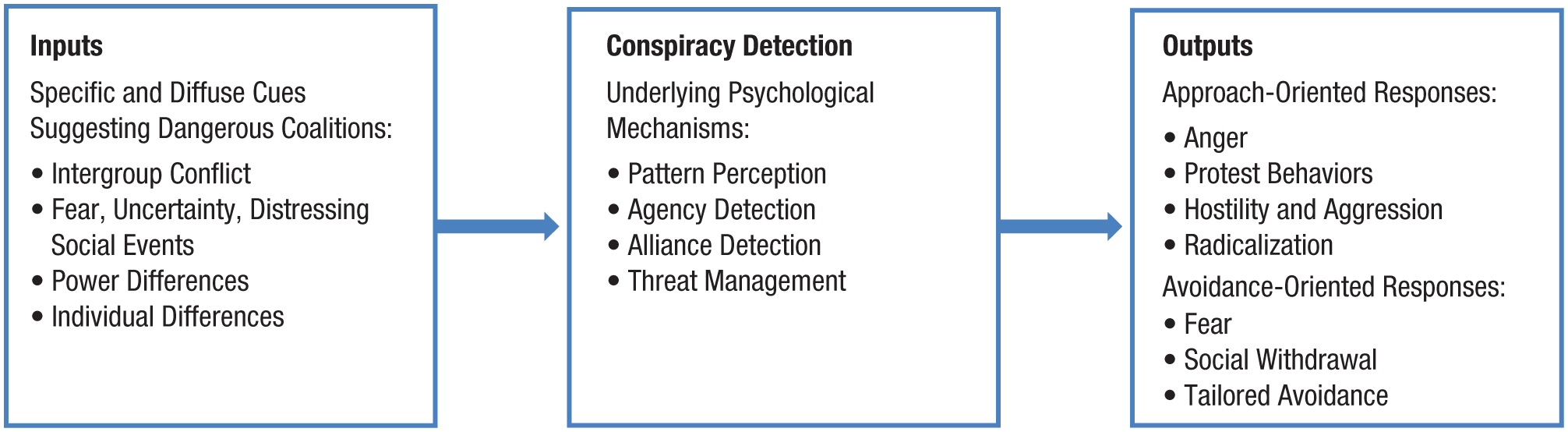
The adaptive-conspiracism hypothesis.
Before reviewing the evidence, we should stress that this model does not assert that conspiracy theories are currently adaptive. The adaptive-conspiracism hypothesis asserts that susceptibility to conspiracy theories were functional in ancestral human environments in which there may have been frequent, deadly conspiracies at work. That does not mean that conspiracy theories are of equal benefit to humans in complex, modern societies. The fast and easy transmission of information about bad events occurring far away—such as signs of climate change in the Arctic or a plane crash in Colombia—may set off the conspiracy-detection system even when there is little evidence that such events actually threaten a perceiver’s own welfare. Correspondingly, in modern environments, perceiving conspiracies may involve different costs and benefits than in ancestral environments (e.g., different implications for one’s status within a group). This idea, the mismatch between small-scale ancestral environments and large-scale modern environments (Li, van Vugt, & Colarelli, 2018), suggests that although conspiracy thinking was functional in an ancestral world, conspiracy theories may no longer be adaptive, or may sometimes even be maladaptive, in modern, complex environments in which these conspiracy-detection mechanisms are misfiring.
Are conspiracy theories universal?
The first proposition pertains to the universality of conspiracy theories. The available evidence suggests that conspiracy theories are not restricted to any particular culture or time period. Although it is perhaps easier nowadays to find or disseminate specific conspiracy theories through the Internet, and conspiracy theories may be subject to cultural transmission over the course of generations (e.g., anti-Semitic conspiracy theories), for the present purposes it is relevant to note that conspiracy theories have been widespread throughout human history. For instance, during the times of the crusades, persecution of Jewish people was frequently inspired by the belief that there was a conspiracy between Jews and Muslims to keep Christians out of the Holy Land (e.g., Pipes, 1997). Even earlier, in 64 C.E., the great fire of Rome took place. A common conspiracy theory among Roman citizens was that emperor Nero and his loyal servants had deliberately initiated the fire in order to rebuild the city according to his own vision and that Nero was singing while Rome was burning (Brotherton, 2015). Finally, many wars and crimes against humanity were fueled by conspiracy theories (Pipes, 1997).
Empirical research data support the view that conspiracy theories were common before people had access to modern communication technologies. Uscinski and Parent (2014) analyzed a total of 104,803 letters sent to the New York Times and the Chicago Tribune between 1890 and 2010 for conspiratorial content. The conclusion that emerged from their data was that the level of conspiratorial content in the letters was remarkably stable over time, which speaks against the assertion that conspiracy theories are somehow characteristic for our modern, digital society.
The vast majority of contemporary research on conspiracy theories has been conducted in Western societies, revealing substantial evidence for conspiracy theorizing among ordinary, nonpathological citizens (e.g., Oliver & Wood, 2014; Sunstein & Vermeule, 2009; Swami et al., 2011; van Prooijen et al., 2015). Yet conspiracy beliefs are not limited to Western cultures. People from different cultures believe different conspiracy theories, of course, but evidence for substantial conspiracy theorizing is found around the globe, such as in Eastern Europe (Golec de Zavala & Cichocka, 2012), Indonesia (Mashuri & Zaduqisti, 2013), Malaysia (Swami, 2012), various African countries (West & Sanders, 2003), and the Muslim world within the Middle East (Gentzkow & Shapiro, 2004). Thus far, no study has managed to identify a culture in which conspiracy beliefs are nonexistent.
Critical assessment
Are some cultures more susceptible to conspiracy theories than others? Our line of reasoning does not imply that all individuals or cultures endorse conspiracy theories to an equal extent. Instead, we expect that the susceptibility of individuals and cultures to conspiracy beliefs varies with specific, recurrent cues that serve as reliable inputs for conspiracy detection, such as the presence of a sizeable, powerful enemy group that is deemed to pose a threat to citizens’ well-being. Our model would predict, on the basis of the interactivity requirement (to be discussed later), that cultural differences in susceptibility to conspiracy theories exist, particularly in the context of coalitional violence, exploitation, or other forms of intergroup conflict (e.g., warfare or civil unrest, high- vs. low-trust cultures, variations in power distance between elites and masses).
A crucial question is whether conspiracy thinking is also prevalent in small-scale hunter-gatherer societies, which are arguably the best models of ancestral human group life (Buss, 2015; von Rueden & van Vugt, 2015). Ethnographic evidence indicates that conspiracy theories are highly prevalent among citizens of third-world countries (West & Sanders, 2003), and anthropologists have observed conspiracy theories among current hunter-gatherers such as the Yanomamö (e.g., allegations that a different tribe committed sorcery to harm their tribe; Chagnon, 1988). Indeed, witchcraft beliefs are common among traditional societies, and such beliefs frequently combine superstition with conspiracy theories (i.e., witchcraft is often assumed to be committed in secret, by members of enemy groups; West & Sanders, 2003).
Nevertheless, we are not aware of research that has systematically investigated conspiracy theories across hunter-gatherer societies around the world. Such research could more explicitly examine the costs and benefits of believing conspiracy theories in such societies, the prevalence of conspiracy theories, and the specific contents of such theories. Quite plausibly, members of hunter-gatherer societies assume relatively small conspiracies (e.g., suspicions of enemy villages colluding in secret) compared with citizens of large states (e.g., grandiose theories of how government agencies deceive the public). Even in the face of these qualitative differences, however, we propose that all conspiracy theories possess the same basic structure: suspicions that a group of actors secretly colludes to commit harm.
How dangerous were actual conspiracies in ancestral societies?
For conspiracy beliefs to be adaptive, the domain-specificity requirement (Proposition 2) assumes that actual and dangerous conspiracies constituted meaningful selection pressures among ancestral humans. To examine the validity of this assumption, we start with the general observation that coalitions are inherent to the social life of human beings and that coalitions emerge both within and between human groups (Tooby & Cosmides, 2010; Van Vugt & Kameda, 2013). Within-group coalitions are a common feature of traditional societies. Present-day hunter-gatherers frequently have a reverse-dominance hierarchy in place that controls the behavior of dominant individuals. Strong coalitions keep overbearing individuals in check, and sometimes they are punished (including death) or excluded (Boehm, 1993). Coalitions are also formed for between-group aggression—for example, to go on raids to kill members of rival groups or steal valuable resources (e.g., food, women). Coalitions also regulate the social life of one of our closest genetic cousins, the chimpanzee. Male chimpanzees sometimes join forces to depose the alpha, thereby increasing their access to resources and females. Likewise, coalitions are formed to go on border patrols to attack members of other groups that encroach on their territory (Wrangham, 1999).
One central motive for violent intergroup conflict in humans is establishing dominance over rival groups. Such intergroup dominance increases the fitness of the individuals in the stronger groups at the expense of the weaker group because it increases the dominant group’s territory, its access to natural resources, and its mating opportunities (McDonald et al., 2012). Another key motive for violent intergroup conflict among hunter-gatherers is revenge. They occasionally attack neighboring villages with revenge killing raids, inspired by, for instance, sexual jealousy, revenge for lethal casualties suffered in the past, allegations of sorcery, and long-lasting conflicts (i.e., blood feuds) that escalated over the course of generations (e.g., Chagnon, 1988). These raids typically take the form of a surprise attack at dawn by a group of 10 to 20 men, killing the first few inhabitants of the enemy village that they encounter and then retreating before the victimized group can get organized and fight back (see also Walker & Bailey, 2013). As a consequence of this strategy, the risk for casualties among the attacking coalition is relatively low.
How dangerous were actual conspiracies in ancestral times? Although it is impossible to answer this question with complete certainty, various sources of information suggest that one of the most lethal acts that conspiracies can plan in secret—coalitional aggression and violence—may have been a common cause of death, selecting for counteradaptations to fend off such threats. One source of information stems from current hunter-gatherer societies. In studies of the Yanomamö people in the Amazon, between 22% of total deaths (Walker & Bailey, 2013) and approximately 30% of all adult male deaths (Chagnon, 1988) are reportedly due to coalitionary killing, usually in the form of violent raiding groups attacking a neighboring Yanomamö village. Even more violent are the Waorani people of Ecuador, where rates of up to 64% of all deaths within the total population (i.e., including men, women, and children) have been ascribed to coalitionary killings—and 42% of all deaths are caused by coalitions of Waorani killing other Waorani (Beckerman et al., 2009).
Admittedly, the Waorani constitute a relatively extreme case, and many foraging societies elsewhere in the world are more peaceful. There is ongoing debate among anthropologists regarding the exact level of violence in traditional societies (Fry & Söderberg, 2013; Knauft, 1991). Nevertheless, death through coalitional violence appears to be much more common in hunter-gatherer societies than in modern societies. Walker and Bailey (2013) conducted an ethnographic study among 11 traditional societies in South America and found that an average of 30% of the adult population dies violently, the majority through raids and ambushes. Other samples, ones that are not restricted to South America but include traditional societies around the world, show a somewhat more moderate picture; even in these data, however, an average of 14% of the total population of traditional societies worldwide dies through coalitional violence (Bowles, 2009).
Of course, ethnographic analyses of contemporary traditional societies should be interpreted with caution, given that it is unclear how representative such societies are for the life of ancient hunter-gatherers. Bowles (2009), however, compared findings among current traditional societies using bioarcheology—the scientific discipline that seeks to investigate the origins of human behavior by analyzing the skeletal remains of fossilized hunter-gatherers. The Bowles study reveals that 14% of deaths within current traditional societies are due to coalitional violence, and 14% of the skeletal remains that were found at archeological sites show evidence of death due to coalitional violence. The percentage of violent deaths varies substantially per location, and the prevalence of lethal intergroup conflict depends on geographical and climatological factors that, for instance, increase resource scarcity (Lambert, 2002). These results are compatible with the anthropological findings described above and suggest that although the rates of coalitional killings varied widely in ancient tribes around the world, on average, coalitional violence was a frequent cause of death (Van Vugt, 2009).
For our present purposes, it is noteworthy that Bowles (2009) calculated, using evolutionary simulation models, that even in the face of high variability, these killing rates are statistically sufficient to meaningfully shape the process of natural selection. Put differently, in this challenging ancestral environment, (groups of) people that more effectively managed the dangers of enemy coalitions would have better prospects of surviving and reproducing. Although this is often interpreted as evidence for the evolved function of within-group cooperation, it is also plausible that a tendency to be suspicious of the formation of secret and antagonistic coalitions—that is, conspiracies—could have evolved in this context. Such a hyperactive conspiracy-detection system could activate outputs, in terms of emotions or behaviors that are functionally relevant for mitigating such threats such as moving elsewhere, forming a countercoalition, or organizing a preemptive strike (see Böhm, Rusch, & Gürerk, 2016; Van Vugt, De Cremer, & Janssen, 2007).
Critical assessment
Any proposition about ancestral life necessarily has to be examined with secondary sources of evidence, such as current hunter-gatherers, nonhuman primate societies, or skeletal remains. This is an unavoidable limitation of this part of our analysis. For instance, it is hard to establish to what extent within-society versus between-society coalitional violence (i.e., war) in ancestral times contributed to the psychological basis for conspiracy beliefs. Furthermore, anthropologists have argued that many instances of violence in hunter-gatherer societies might originate from personal disputes instead of hostile coalitions (Fry & Söderberg, 2013). Personal disputes notwithstanding, however, a substantial portion of violence among early humans (Bowles, 2009) as well as chimps (Wrangham, 1999) is likely due to coalitions, which is consistent with the idea that conspiracy theories are grounded in an evolved human coalitional psychology. In the following, we more directly examine the role of coalitional and intergroup conflict in conspiracy theories.
Detection of dangerous coalitions
The third proposition is that conspiracy theories should be strongly associated with recurrent cues that suggest the realistic presence of a sizeable, powerful, and hostile coalition. One recurrent feature would be intergroup conflict. The present-day analogy of ancestral coalitional violence is warfare. Pipes (1997; p. 179) noted that most, if not all, contemporary wars are characterized by strong mutual suspicion and conspiracy theories about the enemy group on both sides of the conflict. Moreover, he noted that conspiracy theories are particularly characteristic for the extremist, totalitarian regimes that our world has seen in the past century and that have been responsible for a large portion of the intergroup violence and killing in recent history. Consistently, people at the ideological extremes are more likely than moderates to believe conspiracy theories (Bartlett & Miller, 2010; van Prooijen et al., 2015).
Social-psychological theories have established two complementary processes that characterize intergroup conflict: Strong feelings of cohesion within one’s own group, as reflected in nationalism and feelings that one’s own group is superior compared with other groups, and derogation of different groups, as reflected in prejudice, hostility, and feelings of intergroup threat (e.g., Tajfel & Turner, 1979). Both processes have been associated with conspiracy theories in empirical research. When a group is under threat, only people who feel included in the group display increased belief in conspiracy theories (e.g., van Prooijen, 2016; van Prooijen & van Dijk, 2014). Furthermore, collective narcissism—that is, the feeling that one’s own group is superior—inspires conspiracy beliefs about a rival group (Cichocka, Marchlewska, Golec de Zavala, & Olechowski, 2016). In addition, studies conducted in Indonesia reveal that identification with the Muslim community predicts belief in the conspiracy theory that the Western world introduced terrorism in Indonesia, but only among participants who perceived Western people as threatening to their Islamic identity (Mashuri & Zaduqisti, 2013). Finally, major predictors of anti-Semitism are the extent to which Jews are perceived as threatening to the perceivers’ own country and, correspondingly, belief in conspiracy theories about Jews (Golec de Zavala & Cichocka, 2012). Taken together, these findings support the idea that conspiracy theories are triggered by the presence of powerful out-groups in combination with a strong group identity (see also Van Prooijen & Van Dijk, 2014).
The crucial role of intergroup conflict in activating conspiracy theories is also suggested by research on relatively powerless, vulnerable groups in society. Consistent with the idea that conspiracy theories are an adaptive response to the presence of formidable out-groups, stigmatized minority groups have been found to be highly susceptible to conspiracy theories. For instance, African Americans are particularly likely to believe conspiracy theories that involve a White plot designed to harm or kill members of the African American community (e.g, Thorburn & Bogart, 2005). Belief in these conspiracy theories is mediated by perceived system blame—that is, the extent to which African Americans attribute the problems that their community faces to hostile intergroup behavior such as racism and discrimination (Crocker, Luhtanen, Broadnax, & Blaine, 1999). Apparently, conspiracy theories flourish particularly among cohesive minority groups that are marginalized by the dominant majority coalition. These findings are consistent with the idea that the existence of a powerful group increases conspiracy theories among members of competing, less powerful groups.
Finally, various individual difference-variables link intergroup conflict to conspiracy theories. Many of the cues that people encounter in everyday life are ambiguous and may be interpreted in a hostile, neutral, or benevolent manner depending on stable, internal dispositions (Buss, 2009). Thus, individuals who have a predisposition to link ambiguous social cues to intergroup conflict—such as social-dominance orientation or right-wing authoritarianism—are more likely to believe conspiracy theories. Various studies provide qualified support for this prediction. Swami (2012) found that both of these individual-difference variables predicted belief in conspiracy theories about Jewish people among Muslims in Malaysia. Abalakina-Paap, Stephan, and Gregory (1999) found significant relations of right-wing authoritarianism with belief in specific conspiracy theories (e.g., about the Kennedy assassination, the United Nations, and the like), but not with generalized conspiracy mentality, that is, a stable disposition to perceive a world full of conspiracies (see also Imhoff & Bruder, 2014; Swami, 2012). The dispositional tendency to perceive intergroup conflict hence predicts belief in conspiracy theories, but only insofar as these conspiracy theories describe the specific threat embodied by identifiable, powerful groups.
Critical assessment
Although the findings in the literature thus far provide support for the prediction that conspiracy theories are rooted in perceptions of intergroup conflict, future research will need to complement these findings with more sophisticated, preregistered research designs and openly accessible data. For instance, at present no study is investigating this prediction through a longitudinal design using a pre- and postconflict measure of conspiracy theorizing. Moreover, little is known about the types of conflict that are most likely to instigate conspiracy theorizing and whether different types of conflict lead to different conspiracy theories. Although intergroup conflict implying direct physical danger for group members (e.g., war) stimulates conspiracy theories about the antagonistic group (Pipes, 1997), so does conflict driven by ideological differences (e.g., Democrats vs. Republicans; Uscinski & Parent, 2014). These considerations suggest promising research challenges to further establish the relationship between intergroup conflict and belief in conspiracy theories.
Socio-ecological conspiracy cues
Our fourth proposition is that, besides direct intergroup conflict cues, indirect, socio-ecological cues associated with intergroup conflict also increase conspiracy beliefs. In ancestral environments, intergroup conflict and coalitional violence were particularly likely during periods of adversity, such as food scarcity or extreme climate conditions, such as droughts or floods (Lambert, 2002). Such resource-threat cues may increase vigilance toward the possibility of coalitional dangers, in the form of conspiracy theories. In modern environments, threatening societal circumstances—such as floods or famines—still increase the likelihood of intergroup conflict (Hogg, 2007; Tajfel & Turner, 1979). These propositions are consistent with the insight that conspiracy theories are the result of a basic sense-making process in uncertain or fearful circumstances (Hofstadter, 1966; see also Bale, 2007). Particularly in the face of collective threats—natural disasters, economic crises, and the like—conspiracy theories will flourish, as these theories help citizens to make sense of such events by blaming them on the deliberate actions of enemy groups.
Empirical research reveals that a high-impact, threatening societal event, such as the assassination of a president, results in stronger conspiracy beliefs than a similar but less influential event (e.g., the president survives an assassination attempt; McCauley & Jacques, 1979). These effects are attributable to people’s sense-making motivation (van Prooijen & van Dijk, 2014). More generally, feelings of a lack of control (Whitson & Galinsky, 2008; van Prooijen & Acker, 2015), feelings of powerlessness (Abalakina-Paap et al., 1999), or feelings of uncertainty (van Prooijen, 2016; van Prooijen & Jostmann, 2013) have been found to stimulate the mental sense-making processes that are associated with conspiracy theories. Consistent with our line of reasoning, these sense-making processes predict conspiracy theories only when hostile coalitions are salient (Marchlewska, Cichocka, & Kossowska, 2018). These findings suggest a prominent role for feelings of vulnerability when predicting conspiracy theories.
Furthermore, various individual-difference variables (e.g., paranoia, distrust, and antisocial tendencies) predispose people to interpret ambiguous social signals as threatening or hostile (Kramer, 1998). Correspondingly, research has revealed relationships between conspiracy beliefs and numerous relevant variables (.10 < |rs| < .48), including interpersonal paranoia (Darwin et al., 2011), narcissism (Cichocka, Marchlewska, & Golec de Zavala, 2016), generalized distrust (Abalakina-Paap et al., 1999; Goertzel, 1994), trait anxiety (Grzesiak-Feldman, 2013), disagreeableness (Swami et al., 2011), and Machiavellianism (i.e., the extent to which people are willing to exploit others for personal gain; Douglas & Sutton, 2011). In sum, the research reported here supports the assertion that conspiracy theories are activated after diffuse, socio-environmental cues suggesting an increased likelihood of intergroup conflict.
Critical assessment
At present, little is known about functional differences between different types of threats. Are some threats more likely than others to elicit conspiracy theorizing, and do they elicit different or similar conspiracy theories than other threats (e.g., wars or natural disasters)? Although we consider it possible that the type of threat matters, at present we have insufficient empirical or theoretical basis to make specific predictions about how type of threat may activate conspiracy beliefs differently. Instead, we propose that threat cues automatically trigger the human coalitional mind to make quick mental calculations about the likely presence of hostile conspiracies.
Efficiency of conspiracy beliefs
Our analysis implies that cues suggesting dangerous coalitions should activate the conspiracy detection system automatically, leading to a quick assessment of the likelihood of dangerous conspiracies in the direct social environment. Indeed, if a human tendency to believe in conspiracy theories is adaptive, one may expect it to be a fast and efficient system (Tooby & Cosmides, 2015). Our fifth proposition therefore is that the processes underlying conspiracy detection are triggered automatically and quickly by specific threats and emotions, without requiring much deliberate thought.
The apparent articulate nature of certain conspiracy theories notwithstanding, empirical research data support the idea that conspiracy theories emerge through heuristics and intuitive mental processes. In a study by Swami, Voracek, Stieger, Tran, and Furnham (2014), analytic thinking decreased people’s tendency to believe conspiracy theories and intuitive thinking predicted increased belief in conspiracy theories. Likewise, van Prooijen (2017) found that lower education predicted increased conspiracy belief, a finding that was partially mediated by lower analytic-thinking skills. Furthermore, analytic-thinking skills are not enough to promote skepticism toward conspiracy theories: A deliberate motivation to be rational and base assumptions on evidence is also critical (Ståhl & van Prooijen, 2018). The evidence that is currently available suggests that conspiracy theories emerge from fast and efficient mental operations (System 1) and not from complex, deliberate mental operations (System 2).
Critical assessment
In everyday life, many conspiracy theories seem quite articulate, which suggests that higher-order cognitive processes are part of conspiracy theorizing. Once people are deeply invested in a specific conspiracy theory (e.g., the 9/11-truth movement), they typically have a large number of seemingly persuasive arguments to support their theories (Clarke, 2002). Integrating this observation with the empirical findings reviewed here, we suspect that conspiracy theories initially emerge from heuristics, intuition, or strong emotions. Once formed, these suspicious feelings may be rationalized into sophisticated theories that are difficult to disprove. Future research may more extensively test the automaticity of human conspiracy detection. For instance, our line of reasoning would suggest that activation of System 1 processes increases suspicious feelings of other groups—a hypothesis that is closely associated with the common finding that cognitive load increases stereotyping (e.g., Gilbert & Hixon, 1991).
Counterstrategies against conspiracies
Our final proposition stipulates that after detecting a conspiracy, humans exhibit responses aimed at nullifying the threat. Given the ubiquity and potential impact of conspiracies, it stands to reason that ancestral humans would have evolved a suite of strategies to mitigate conspiracy threats. Such reactions may come with a specific physiological, emotional, and behavioral signature. For instance, people suspecting a conspiracy could effectively cope by showing “approach” reactions such as anger, hate, or hostility or by developing a more formidable countercoalition. Alternatively, they could mitigate the threat of a possible conspiracy by showing fear and escape responses (avoidance responses). In the following, we review evidence for these distinct functional responses to conspiracy theories and when they are likely to occur.
Avoiding conspiracies
If a conspiracy is being formed, one self-preserving response is to actively try and avoid the dangers associated with it. Suspecting powerful conspiracies may therefore trigger a host of negative emotions that promote avoidance motivations and behaviors. In ancestral times, these avoidance-oriented responses would have been life-saving in the face of an actual conspiracy by, for instance, stimulating people to migrate to a safer area. We therefore expect that powerful conspiracies trigger avoidance-oriented responses.
One emotion that is typically associated with conspiracy belief is fear (e.g, Grzesiak-Feldman, 2013), and fear generally tends to predict avoidance-oriented behavioral reactions (Elliot & McGregor, 1999). We therefore expect that people attempt to escape from the dangers entailed by the suspected conspiracy. One source of evidence supporting this comes from studies showing conspiracy beliefs to be correlated with social and political withdrawal behaviors. For instance, beliefs about governmental conspiracies are associated with feelings of alienation from the government (Abalakina-Paap et al., 1999; Goertzel, 1994). Jolley and Douglas (2014b) experimentally manipulated belief in conspiracy theories and tested the causal effects of such beliefs on withdrawal behaviors. In one study, they found that belief in conspiracy theories shaped withdrawal from politics, as reflected in a decreased willingness to display political behaviors (e.g., voting).
In addition, conspiracy theories elicit strategies designed to avoid the specific conspiracy. In one study, participants were randomly assigned to conditions in which they were exposed to information suggesting the validity or invalidity of antivaccine conspiracy theories. This manipulation influenced participants’ willingness to have a fictitious child vaccinated, suggesting a specific motivation to avoid the dangers entailed by the suspected conspiracy (Jolley & Douglas, 2014a). Likewise, belief in a climate conspiracy decreased participants’ willingness to reduce their carbon footprints, suggesting that people’s strategies are functionally related to the specific threat (Jolley & Douglas, 2014b; van der Linden, 2015). Finally, a common conspiracy theory among the African American community in the United States is that birth control is a form of Black genocide. Studies reveal a surprisingly high number of African Americans who believe this conspiracy theory and who respond by avoiding contraceptives (Thorburn & Bogart, 2005). Although these latter examples arguably are not functional behaviors from the perspective of modern society, they do suggest that people actively attempt to avoid the dangers entailed by the suspected conspiracy—which is a functional response in an ancestral environment characterized by real conspiracies.
Approaching conspiracies
An alternative way of functionally responding to a suspected conspiracy is to actively confront it. For instance, one might peacefully try to reason with the suspected conspiracy, or one might form a countercoalition and commit a preemptive strike. These approach-oriented responses can effectively decrease the dangers associated with the conspiracy under some circumstances, such as when one is able to quickly mobilize a countercoalition that is at least as strong as the suspected conspiracy. Some of these active, approach-oriented reactions may be relatively peaceful. For instance, conspiracy theories increase protest intentions in order to change the status quo (Imhoff & Bruder, 2014). Likewise, conspiracy theories predict motivations to uncover and expose the suspected conspiracy, as suggested by an increased support for democratic principles (Swami et al., 2011) and a call for greater transparency (Clarke, 2002).
In addition to these relatively benign reactions, however, conspiracy theories often are associated with angry, hostile reactions. Hofstadter (1966) noted that conspiracy theories are mostly believed by people who show hostility and exaggerated suspiciousness toward others. Likewise, various authors argued that conspiracy theories allow people to ventilate their anger by blaming others for their own disadvantaged position (Abalakina-Paap et al., 1999; Goertzel, 1994). Although behavioral data are scarce in this research area, it is likely that belief in conspiracy theories sometimes stimulates aggression. Recall historical observations that most wars and large-scale intractable conflicts were characterized, and inspired, by conspiracy theories about the enemy group at both sides of the conflict (Pipes, 1997). As a case in point, it is well known that Josef Stalin regularly ordered people to be executed because of suspicions that they might be conspiring against him and his administration.
In addition, conspiracy theories are associated with ideological belief systems that promote hostility toward different groups. Specifically, conspiracy theories are empirically related with populism, political extremism, and religious fundamentalism (Bartlett & Miller, 2010; van Prooijen et al., 2015). Although there currently are no direct causal data available revealing whether conspiracy beliefs cause extremism or vice versa, the findings by Bartlett and Miller (2010) suggest that conspiracy theories contribute to the violent tendencies of various extremist groups. They specifically reason that conspiracy theories are a “radicalizing multiplier” (p. 4) that influences the internal dynamics of such groups. On the basis of a qualitative analysis of many radical groups in society, these authors conclude that conspiracy theories “hold extremist groups together and push them in a more extreme and sometimes violent direction” (p. 5). In sum, the evidence currently available supports the assertion that conspiracy theories are associated with approach-oriented reactions as reflected in violent or nonviolent confrontational actions designed to neutralize the suspected conspiracy.
Critical assessment
Although the research findings reviewed here are consistent with our model, many of these findings are correlational, precluding solid statements about cause and effect (e.g., Abalakina-Paap et al., 1999; Goertzel, 1994; Imhoff & Bruder, 2014; Swami et al., 2011; van Prooijen et al., 2015). To establish with more certainty that detecting conspiracies causes functional approach- or avoidance-oriented responses, researchers could manipulate belief in conspiracy theories in experimental settings (Jolley & Douglas, 2014b). Examining the consequences of conspiracy detection should not be restricted to perceptions or intentions. Behavioral data are necessary to establish whether belief in conspiracy theories indeed promotes aggressive, approach-oriented strategies toward the suspicious coalition or promotes increased avoidance-oriented behaviors (van der Linden, 2015). Furthermore, physiological data may help determine whether conspiracy detection elicits the stress response of the sympathetic nervous system, as well as the release of stress hormones (e.g., cortisol) that prepares an organism to either freeze, fight, or fly.
Furthermore, research has not yet established what moderating variables determine these reactions to suspected conspiracies. One could predict that relative power differences between groups play a role. If a relatively powerless individual faces a powerful conspiracy (e.g., the pharmaceutical industry), avoidance might be more likely; however, if one sees opportunities to form a countercoalition that effectively confronts a suspected conspiracy (e.g., voting for a populist party that seeks confrontation with the “corrupt elites”), approach-oriented responses might be more likely. Finally, it is possible that people can spread conspiracy theories strategically to mobilize action against different groups. Given the current state of affairs in this research domain, assertions about such moderators remain speculative.
Conclusion
In this section we reviewed the hypothesis that conspiracy theories evolved as a functional response to the presence of real, hostile coalitions in ancestral human environments. We evaluated evidence for six propositions that follow from this adaptation hypothesis. Support for these propositions emerges from multiple sources, including psychology, anthropology, history, and political science. We therefore conclude tentatively that the psychological mechanisms associated with conspiracy theories have been coopted in a more specialized psychological adaptation that is part of the human coalitional mind (see Tooby & Cosmides, 2010). Of course, we must be cautious in our conclusions, because most of the studies we have cited come from modern complex societies and have not specifically tested an adaptationist account of conspiracy beliefs. Nevertheless, the evidence that is presently available is consistent with the idea that belief in conspiracy theories is rooted in an evolved psychology to protect against powerful and potentially hostile coalitions.
Conclusions, Implications, and Future Research
The adaptive-conspiracism hypothesis asserts that belief in conspiracy theories emerges from a natural, inborn suspiciousness of potentially dangerous coalitions. Consequently, we assume that conspiracy theories have been directly adaptive for ancestral humans to navigate their social world, which was characterized by frequently recurring coalitional dangers. Yet we also considered an alternative by-product hypothesis that (a) the human tendency to perceive conspiracies is a by-product of other psychological adaptations and (b) conspiracy beliefs have no adaptive qualities.
Although it is currently impossible to exclude the by-product hypothesis with hard empirical data, we propose that a model assuming directly adaptive qualities of conspiracy theories is more plausible in light of the evidence reviewed in the current article. The tendency to form groups and coalitions—and engage in violent conflict with different groups or coalitions—has characterized human social behavior for more than 2 million years and also characterizes the behavior of close genetic cousins, such as chimpanzees (Wrangham, 1999). The core question, therefore, is whether the suspicious feelings about other groups that are at the root of conspiracy beliefs may have provided early humans a selection advantage. Given the realistic dangers of hostile coalitions in an ancestral environment, along with the life-saving functionality of detecting conspiracies before they strike, conspiracy beliefs are likely to have been adaptive among ancient hunter-gatherers.
Even when conspiracy theories have been adaptive in ancestral times, in modern times conspiracy theories often have harmful consequences, eliciting poor health choices (e.g., refusing vaccines), climate-change skepticism, intergroup conflict, aggression, and radicalization (Brotherton, 2015; Douglas et al., 2017; van Prooijen, 2018). Scientific study of this phenomenon is thus necessary because it may inform policymakers and other societal stakeholders about how to reduce conspiracy beliefs among the public. Although the scientific study of conspiracy theories is an emerging research domain in the social sciences, in terms of theory development, it is still in its infancy. One of the aims of the current article was to illuminate the distal, evolutionary roots and potential functions of conspiracy theories by integrating key findings within this research domain with insights drawn from evolutionary psychology and anthropology. In the following, we highlight a number of unresolved issues and give suggestions for future research to provide a starting point for an evolutionary approach to understand the human tendency to believe conspiracy theories.
Prominence of coalitional dangers
Given that the main assumptions of our model are based on a link between conspiracy beliefs and the prominence of coalitional dangers, a future research program may directly focus on this link. For instance, it might be reasoned that extensive social networks mitigate ancestral humans’ vulnerability to hostile coalitions because of the capacity to quickly and effectively organize a countercoalition. Our evolutionary model thus predicts that strong social networks, network size, or even organizational skills decrease susceptibility to conspiracy theories. Moreover, conspiracy beliefs may be fueled by competence assumptions about the suspected coalition. Although perceivers may rate suspected conspiracies as low on morality, they are likely to rate them relatively high on agentic traits (e.g., intelligence; power) because coalitions are more dangerous to the extent that they are more competent.
Likewise, some individuals face threatening coalitions more realistically than others, at all levels of society. For instance, societal turmoil and frequent violent conflict between subgroups are highly likely to stimulate conspiracy theories (Pipes, 1997). Our model would suggest that belief in conspiracy theories is particularly strong among the relatively “weak” and vulnerable subgroups because the dangers of the hostile coalition are lower for the dominant groups. Furthermore, these processes may also extrapolate to high-power individuals: Dictators in politically unstable countries are more likely to face a violent revolution than democratically elected officials in politically stable countries, and it might thus be reasoned that dictators entertain stronger conspiracy beliefs toward their followers than legitimate leaders who were elected through a democratic process.
Gender
Should we expect gender differences in conspiracy theorizing? It is hard to predict whether men or women are more susceptible to conspiracy beliefs. On the one hand, one might reason that men in particular should be susceptible to conspiracy theorizing because they were more likely to be killed by hostile coalitions than women (Van Vugt, 2009). Likewise, in contemporary traditional societies, raiding groups are much more likely to kill men than to kill women (e.g., Walker & Bailey, 2013). On the other hand, although the majority of victims of coalitional violence in traditional societies are male, this does not mean that the female body count is negligible. In their analysis of 11 South American traditional societies, Walker and Bailey found that 31% of the casualties resulting from coalitional violence were female. Furthermore, coalitional aggression by other groups often implied an additional predicament that was unique to women, which was the possibility of abduction, rape, and forced marriage in an enemy society (Chagnon, 1988). This creates selection pressure on women to be suspicious of conspiracies as well. An important element of female genetic fitness is reproductive choice, along with committed male partners that are willing to invest time and resources in their joint offspring (Trivers, 1972). There is indeed no clear evidence for a gender effect in conspiracy theories: In most studies that test for the effects of gender, men and women are about equally likely to believe conspiracy theories (e.g., Darwin et al., 2011; Douglas et al., 2016; Jolley & Douglas, 2014b; van Prooijen & Acker, 2015; van Prooijen et al., 2015).
A number of different predictions about the role of gender follow from our analysis, however. First, people are likely to assume that a dangerous conspiracy consists mostly of men. Recall that people associate danger with out-group men in particular, not out-group women (McDonald et al., 2012; Navarrete, McDonald, Molina, & Sidanius, 2010), and consistently, coalitional aggression among hunter-gatherers is typically committed by men (e.g., Chagnon, 1988; Van Vugt et al., 2007). To conduct a thought experiment in the context of conspiracy theories, of what subdivision of a national secret service agency would citizens be more suspicious—a subdivision that consisted mostly of men or a subdivision that consisted mostly of women? Although it seems less obvious to expect gender differences in the extent to which people detect conspiracies, it is plausible that female versus male conspiracies are treated differently. Future research may test this “male conspiracy” hypothesis.
Second, it is likely that men’s and women’s responses to conspiracy detection are functionally different: Women may lean more toward avoidance-oriented reactions and men may lean more toward approach-oriented reactions. This idea is consistent with the insight that men are more likely than women to engage in intergroup hostility (i.e., the male-warrior hypothesis; Van Vugt et al., 2007), suggesting gender-specific responses to conspiracy beliefs.
Conspiracy theories and pathology
Modern conspiracy theories vary in their plausibility. Although some conspiracy theories that one can find on the Internet are theoretically possible, and sometimes even plausible, other conspiracy theories are highly implausible (e.g., that the world is ruled by alien lizards disguised as humans). Excessive conspiracy theorizing is common among paranoid schizophrenics, a pathology with a genetic basis (Harrison & Weinberger, 2005). What does such genetic pathology imply for our analysis? Note that the adaptive-conspiracism hypothesis is not designed to explain potential pathologies. Genetic mutations can be dysfunctional, and pathological paranoia is unlikely to be adaptive. More relevant for our line of reasoning is the empirical finding that large numbers of ordinary citizens believe in a consistent set of conspiracy theories with common themes related to health and safety (Oliver & Wood, 2014; Sunstein & Vermeule, 2009). The adaptation hypothesis presented here addresses the question of why conspiracy theories are a widespread and culturally universal phenomenon among large groups of citizens that show no sign of mental illness.
Final conclusions
Modern humans are highly susceptible to conspiracy theories, even when there is little direct evidence to support them. Why are conspiracy theories so widespread and influential among regular citizens? The present review compared a by-product explanation with an adaptive explanation. The by-product hypothesis suggests that conspiracy theories originate from the interaction between a set of psychological mechanisms that are nonspecific for conspiracy theories. The adaptive-conspiracism hypothesis suggests that conspiracy beliefs have the properties of a psychological adaptation that is functionally designed to deal with specific, recurrent dangers posed by hostile coalitions in human evolutionary history. In an ancestral environment in which humans were frequently confronted with coalitional violence, it may have paid to be suspicious of powerful, potentially hostile coalitions. We propose that conspiracy theories are widespread because in the evolutionary history of our species, it was adaptive to hold these beliefs. Whether it is still adaptive for humans in the modern world to be overly susceptible to conspiracy theories remains to be seen.
Footnotes
Action Editor
Timothy McNamara served as action editor and Robert J. Sternberg served as editor-in-chief for this article.

Declaration of Conflicting Interests
The author(s) declared that there were no conflicts of interest with respect to the authorship or the publication of this article.