



Abstract
Background:
There has been a surge in female incarceration in the United States in the last decade, and research indicates that women who are incarcerated are among the most likely to experience poor health outcomes. Physical activity is known to improve health and research that has explored women’s physical activity in incarcerated settings has been mostly conducted in prisons, with little research in jail populations.
Objectives:
This project explores jail staff perceptions of differences in access to physical activity between women and men incarcerated in a US jail to identify potential administrative barriers to providing equitable access to physical activity for those incarcerated.
Design:
A qualitative descriptive approach utilizing interviews was used.
Methods:
Semi-structured interviews focusing on perceptions of how incarcerated individuals at the coed jail participate in physical activity were conducted with 10 correctional staff at the jail. Interview data were analyzed using a thematic analysis approach in order to extract emergent and prominent themes.
Results:
Jail staff unanimously agreed on the value and importance of physical activity during incarceration, but expressed challenges related to providing access to physical activity. Those challenges were organized into three salient themes that have a large impact on access to physical activity while incarcerated in jail: Staffing and Jail Layout, Employment Opportunities for People Incarcerated, and Choices and Motivations of Incarcerated People, all of which were heavily influenced by gender.
Conclusion:
Importantly, the themes identified above are contextualized within a gendered organizations and managerial framework for corrections that increases administrative burdens and gender inequality and decreases attention on the health and well-being of those incarcerated as well as those that work within correctional settings.
Introduction
Conditions of incarceration have been shown to negatively impact the health of those who are incarcerated, including exacerbating health issues that existed prior to incarceration. As explained by Nowotny, 1 incarcerated populations not only “import” poor health into carceral settings, but the conditions of incarceration, particularly in the United States, directly and indirectly influence both individual- and population-level health outcomes. Specifically, research has demonstrated that physical inactivity during incarceration is common and may be more pronounced for certain groups (i.e., women, older people).2–5 Physical activity is associated with many health benefits such as improved cardiovascular functioning, weight control, reduction in stress and mental health conditions such as depression and anxiety, and improved sleep.6–10 As such, people who are incarcerated and are physically inactive may experience poorer health outcomes.
Most research on health and physical activity within incarcerated populations is specific to US prisons (versus jails). Prisons are long-term facilities in which people serve sentences exceeding a year, thereby providing a more stable research population. In contrast, US jails are short-term facilities in which people are not yet sentenced or are serving sentences less than a year; and given the short-term nature of incarceration in jails, these facilities are anticipated to have fewer resources to offer opportunities for physical movement. Research investigating health and physical activity in US jails is increasing. Trotter et al. 11 investigated social determinants of health within a jail population and found that individuals incarcerated in jail experience issues with obesity, heart health, sleep quality, and mental health at rates significantly higher than in the general population. Additionally, Camplain et al.2,12 found that over half of women surveyed in a coed jail reported anxiety (65%) and/or depression (62%) and that approximately half of those who attended allotted recreation time—time dedicated to physical activity—were sedentary during that time. Women mostly cited equipment and clothing-related barriers to being physically active during rec time (i.e., not having appropriate footwear for vigorous physical activity).
A systematic review of women’s physical activity while incarcerated (in prisons) identified a number of factors, including time conflicts, strict security, staffing shortages, space limitations, and lack of motivation, that inhibit women from engaging in physical activity while in prison. 13 Additionally, carceral institutions are frequently designed and built for male populations, with little consideration for differences in gender-based health needs, in spite of the fact that there has been a 700% increase since 1980 in the number of women imprisoned in the United States—a rate double that of men.14,15
In the small body of literature devoted to women’s physical activity in correctional settings, lack of motivation to engage in physical activity is common.12,16,17 Lack of motivation is often the theme assigned to women’s responses indicating they do not feel like engaging in physical activity or they are too tired to do so. In light of what is known about health disparities within the context of incarceration, these sentiments may be indicators of mental health conditions such as depression and anxiety, as well as poor sleep quality, rather than a motivational issue. Lack of motivation is likely an oversimplified explanation for why women do not engage in physical activity while incarcerated, and this study attempts to uncover additional, structural-level barriers that might contribute to this apparent lack of motivation.
Previous research also indicates that employment is a significant variable in levels of physical in/activity in carceral environments. Various jobs for people who are incarcerated exist within individual facilities and can enable people to fill the time with a purpose, earn compensation, and have more opportunities for physical movement.18–20 Most jobs in jail settings contribute to the day-to-day functioning and maintenance of the facility: grounds work, maintenance, custodial, laundry, and kitchen duties are common. Some scholars have criticized the exploitative nature of labor in carceral institutions, given the substandard rates of compensation—averaging 14 cents to every $1.41 made by free people, 21 along with lax regulations around safety standards and workplace.22–25 Other research indicates that people who have a job while incarcerated have lower recidivism rates and have more job skills and employment opportunities once released.20,26
While centering incarcerated peoples’ voices is instrumental to carceral research, there is also a unique perspective offered by correctional line staff working within US jails and prisons. Correctional officers are uniquely positioned to describe the day-to-day functioning of a jail environment, given their up-close surveillance and control of jailed people. They are able to speak to observed patterns of behavior and social dynamics among incarcerated people, and to the lived experiences of enacting policies and procedures created by jail administration, making their viewpoints particularly important. Scholars have noted the direct impact that correctional officers can have on shaping the environment and culture within the institution. 27 Additionally, correctional staff’s insights into jail life can be particularly meaningful as studies have indicated that officers possess significant discretionary power within the facility, which in turn influences access to services and the overall health and behavior of people who are incarcerated.16,27,28 The current study sought to explore what administrative barriers might exist, from the perspective of correctional staff, to providing equitable access to physical activity for people incarcerated in a US jail. While this research takes place in the United States and is contextualized by US carceral policies and practices, findings from this study can inform and impact incarceration research and practice worldwide.
Methods
The current study is one phase of a multiyear project funded through the National Institutes of Health that investigates gender-based differences in opportunities for physical activity within a coed jail in the US southwest. This phase utilized a qualitative descriptive approach through interviews with jail staff as one method to understand physical activity and sedentary behavior of people incarcerated in a county jail. Correctional staff perceptions of physical activity opportunities within a carceral facility helps to identify administrative barriers to providing incarcerated people with equal access to opportunities to be physically active. The next steps in the study include interviews with incarcerated persons and a longitudinal cohort study that follows people who have been incarcerated over the course of a year after release from jail, to determine health-related outcomes of short-term incarceration. This research was reviewed and approved by the Institutional Review Board at Northern Arizona University (Project # 2171602). The reporting of the study conforms to the COREQ statement. 29
Facility description
The participating US-based coed jail houses individuals that have been detained by law enforcement and are currently awaiting legal proceedings or have been found guilty of a crime and are serving a sentence that is less than 1 year. On average, the facility holds 535 individuals within 22 housing units and features an outdoor recreation and indoor dayroom space. The outdoor recreation area is designed to provide people incarcerated with a secure environment for physical activity. This space includes concrete flooring and concrete walls. The area is under supervision by detention officers during designated recreation time. Each housing unit includes a day room, which serves as a common space for people incarcerated. The day room is equipped with seating arrangements and tables, providing a communal setting for people incarcerated to engage in various activities such as reading, playing games, watching TV, or other social activities.
The jail is located in a rural county in the southwest region of the United States and has a diverse incarcerated population. Approximately 80% of individuals incarcerated in the jail are male. Similarly, approximately 80% of the incarcerated population is non-Hispanic white, with about 13% identifying as Hispanic/Latino(a), 5% as American Indian or Alaska Native, and 3% as black (internal report). Additionally, upon intake, almost 25% were unsheltered before incarceration and had no primary health care provider, just under 20% were uninsured and reported a health concern, over 30% were unemployed, and approximately 50% reported moderate-to-high risk for mental health conditions and substance use disorder (internal report). Capturing data on the average length of stay in the facility is difficult as the population changes daily, but the estimated median length of incarceration in the facility around the time of the research was 44 days with a range from 1 to 701 days. Nationally, the average number of days spent in jail is approximately 30. 30 Additionally, employment within the facility for those who are incarcerated is limited to those who meet specific security classifications (nonviolent offenders) and safety requirements (medical clearance). As such, only about 10% of the incarcerated population meet those requirements for work eligibility. Given the small numbers of women incarcerated at the facility at any point in time, it is likely that only a small number meet the eligibility requirements for work. For example, the partnering jail averages 75–95 females at any one time, with roughly 10% (less than 10) qualifying for work eligibility.
Participants and procedure
From May 2023 to October 2023, semi-structured interviews with correctional staff were conducted by trained research team members (ES, JL, and RC). Training included in-depth involvement in the development of interview questions and pilot-testing the interview questions with other members of the research team to assess flow, fluidity, and length. Using a purposive sampling technique, an e-mail invitation that included information about the study including the goal of the research, what it would entail, and how the data would be used was sent to all (approximately 135) correctional staff employed at the jail. Inclusion criteria for participation was anyone 18 or older who was employed at the jail, in any position or rank, at the time of inquiry. There were no exclusion criteria as we hoped to cast a wide net to gain insight from several different perspectives within the facility.
The e-mail included a link to register for a 60-min Zoom interview, and all interview scheduling was handled by the research team. Participation in the interviews was completely voluntary. The initial e-mail yielded seven correctional staff volunteers who agreed to be interviewed. An additional follow-up e-mail recruited three more staff volunteers. Recruitment efforts continued while the coding of earlier interviews was underway. Saturation was reached after 10 interviews. Interviews were scheduled outside of participants’ work hours and were recorded and transcribed using Rev transcription service. Before participation in the interviews, the interviewer introduced themselves and explained the purpose of the study. Then, all participants were read the informed consent form and each provided verbal consent to participate in the study and have it recorded. This method of consent was IRB approved (Project # 2171602) and was consistent with Zoom interview protocol where research participants face minimal risk for participating. Interviewers took field notes as they were completing the interviews and every participant was provided with a $25 e-gift card once they completed the interview to compensate them for their time.
Interview protocol
Fifteen questions were included in the interview. The interview focused on correctional staff’s perceptions of how incarcerated individuals at the coed jail participate in physical activity, the factors affecting the physical activity environment, and their suggestions for managing changes within the jail’s organizational structure. Staff were asked what an average day in the jail looks like, what opportunities for physical activity or sedentary behavior exist for incarcerated individuals (in housing units, the dayroom, and during outdoor recreational time), and what work and/or program related opportunities exist for incarcerated individuals; and were given an opportunity to provide personal views on the significance or effects of physical activity in correctional environments. See Supplemental Appendix A for the full interview instrument.
Process for collaboration with jail administrators
Jail command staff were collaborative partners throughout the development and implementation of the project. They primarily assisted with the recruitment of interview participants by sending employees an invitation to participate in the study via e-mail. To ensure jail staff did not feel coerced into participating, all subsequent communications went through the research team. Additionally, findings from the current study were discussed with jail administrators leading to a collaborative process to develop recommendations. These recommendations incorporate insights and feedback from the interviewees, researchers, and administrators.
Analytical approach and data analysis
The research team collected interview data until the point where it was determined that no new information was being ascertained, otherwise known as the point of saturation. We followed work by Weller et al. with regard to saturation being determined relative to the exhaustion of salient themes, or themes that are the most important or meaningful. 31 Thematic analysis, a technique to systematically organize and produce meaning across data, was used as an analytic strategy due to the applied nature of the work.32,33 The research team took an inductive and experiential approach to the data, letting the participants’ words drive the coding process (versus researcher-defined concepts or codes). 32 Interviews with correctional staff were recorded and transcribed and then coded using NVivo (Lumivero, versions 1.7.2 and 12), a qualitative analytic software package. The coding process involved four researchers (MB, ES, JL, and KCG) and each transcript was analyzed by two coders. Beginning with two transcripts, the four coders reviewed the text and assigned initial codes. After each of the four coders coded their first assigned transcript, they met to discuss, refine, and organize codes, and through this process created a shared codebook. The process was repeated three times during the coding process, and new codes were added to the existing codes. New codes were combined and renamed according to what was agreed upon by the team. Once all transcripts were coded with the flexible codebook, themes related to administrative barriers to providing equal access to physical activity opportunities were extracted.
Results
Ten semi-structured interviews were completed with the correctional staff at the jail. Four men and six women who held the positions of detention officers and program and administrative staff were interviewed. They had varying levels of experience in the facility, from less than a year to over 10 years in corrections; some of the interviewees held multiple positions at the facility over the course of their career (Table 1). It is worth noting that no individuals in higher positions within the jail organizational hierarchy (i.e., lieutenants, captains) volunteered to be interviewed, and as such, the interviews reflect the perspectives of line staff within the institution exclusively.
Study participant demographics.
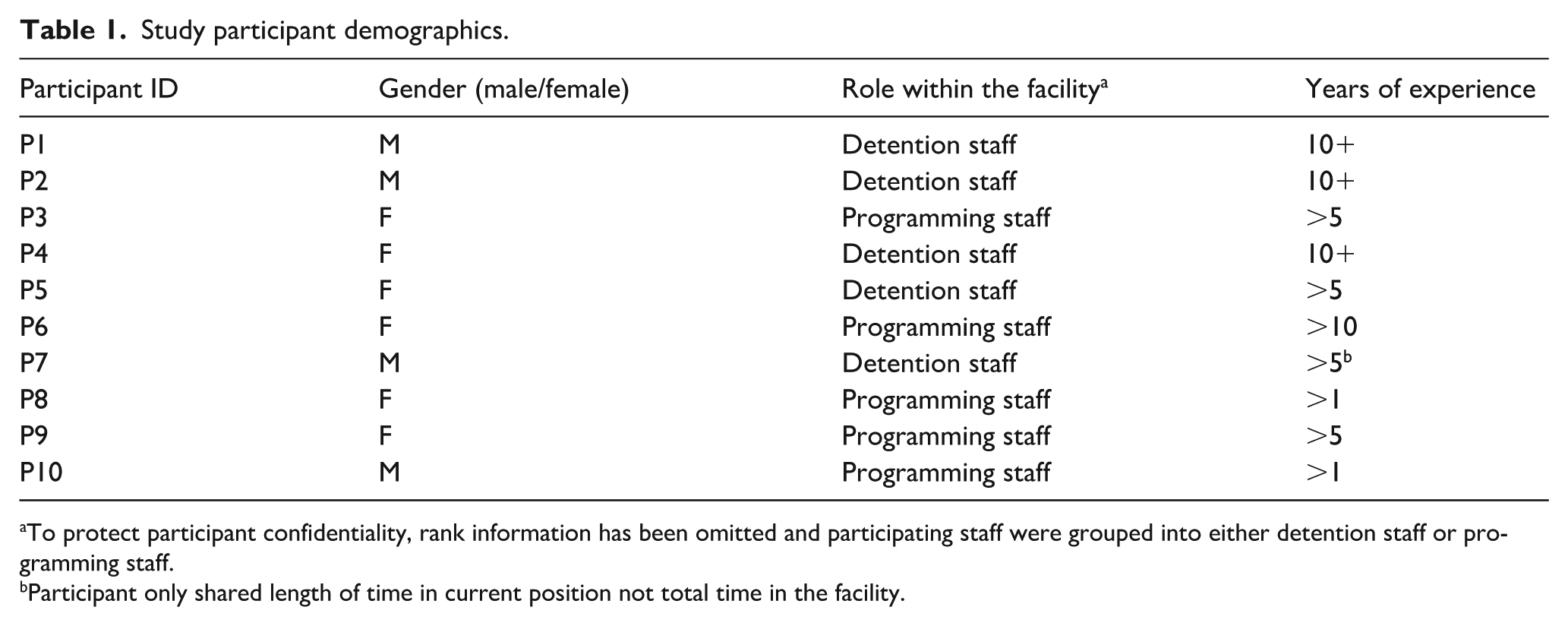
To protect participant confidentiality, rank information has been omitted and participating staff were grouped into either detention staff or programming staff.
Participant only shared length of time in current position not total time in the facility.
Overall, correctional staff discussed three primary methods of physical activity for people incarcerated: (1) recreation (rec) time held in an outdoor recreation yard; (2) employment within the jail; and (3) activity in one’s dorm or in the communal dayroom. Administratively, jail staff control access to rec time and employment; however, more discretion is available to correctional staff when making decisions about exercise in the dayroom or in cells. With regard to employment, only those who meet certain security classification and safety requirements are eligible for employment opportunities within the jail, such as being charged with a nonserious/nonviolent offense(s) and receiving medical clearance. Working across the three ways to be physically active while incarcerated, jail staff shared their perceptions of what they think promotes and hinders incarcerated peoples’ physical activity. Staff were prompted to reflect on gender-based differences in access to and engagement in physical activity, and they repeatedly mentioned gender as impactful in differential access to and engagement in physical or sedentary activity; the unique coed structure of jails, compared with prisons, was specifically focused on within the interviews.
Three prominent themes were identified and include Staffing and Jail Layout, Employment, and Choices and Motivations, all of which were heavily influenced by gender.
Staffing and jail layout
Low staffing levels were identified as the “biggest roadblock” to providing access to physical activity via rec time. Interviewees reported that there must be adequate staffing to ensure safe movement between the cell block and the rec yard, as well as adequate staffing to supervise rec time participants (in addition to those who opt out and remain in the housing unit). While understaffing is certainly not a new issue—staffing issues are a persistent problem in correctional settings across the United States34,35—it is a problem whose cause exceeds the scope of this study. Staff who were interviewed recognized an additional element linked to staffing that may impact equitable access to rec time: The coed jail houses significantly less women than men on an average day, with approximately 85% of the jailed population being men, similar to most short-term detention facilities, and thus, fewer staff are needed to facilitate movement from the women’s dorm to the rec yard. This may make limited access to rec time due to low staffing a more pronounced problem for men in the facility.
“We have four [units] that are fully all men. And then we have one [unit] that’s all women. So with men, it’s harder to get them out for rec and be able to make time for it. Whereas the females, if we have three officers in that unit, then we just have one of them take the females to rec for an hour.”
Jail staff also expressed that the physical layout of the jail created more opportunities for rec time for women versus men because the women’s dorm is closer to the rec yard.
“I think that the women get a little bit more [of an] opportunity to go outside, just because of the design of the building. It’s a little bit easier to move 20 females right next door than it is to move 40 males down the fire escape, to three security doors, to get to the rec yard”
Additionally, every staff member interviewed acknowledged the value of physical activity while incarcerated, and many problematized the ways in which staffing and resource shortages prevented them from providing more rec time opportunities for incarcerated people.
“If we had all the resources in the world, that would be nice if they could go out every day and just even get some sunshine.”
Further, jail staff acknowledged that the indoor space constraints, lack of equipment available in the rec yard, and lack of instructor-facilitated, movement-based programming, might serve as barriers to physical activity, while simultaneously voicing their understanding of the security and logistical barriers to providing such equipment or programming in a short-term carceral environment.
“Even when we get them outside to rec, it’s like look at [what] are your options. You can run around and play. . . wall ball, racquetball. . . but that’s it. There is no bike riding. At our current facility, we don’t have any equipment.” “There’s not much room to do anything inside. I mean, unless we have a gym, but that’s out of the question. That’s a prison, not a jail.” “They need the opportunity to be active instead of just laying in bed. I would say 70% of their time they lay in bed. And they would go outside in a heartbeat if the opportunity was there. They need something, maybe a little class, maybe an exercise class.” “I think, to really be successful, that [initiatives to increase physical activity in jail] actually has to be utilized into the design of the jail itself, or the building itself, so that people that are incarcerated can be moved to and from safe environment to safe environment, to conduct division.”
Employment
All correctional staff interviewed attested to the gendered nature of employment opportunities inside of the jail, with women being eligible to work solely in the laundry room, while men are eligible to work in the kitchen, on facilities crews that provide custodial and maintenance service within the jail, on road clean-up crews, for fleet services, and during special off-site events (e.g., county fair). It was explained that in a coed facility, jail policy dictates that women and men be kept separate and since there are not enough women housed in the jail who are work-eligible to fulfill kitchen and other job functions, men are able to work an array of jobs while women work in the laundry room. The majority of staff that were interviewed perceived that men’s jobs were more physically demanding. Staff specified women sat a lot while doing their laundry job duties, and staff often directly compared the physical demands of laundry, which most classified as low, to the physical demands of kitchen workers, which most classified as high.
“[Laundry jobs entail] folding, standing, not doing much other than you’re in one position. [In the kitchen], you’re busy all the time. You’re either standing there doing this or you’re sweeping that, or you’re cleaning that, or you’re washing dishes. Big time difference. Girls just kind of sit there or stand there.”
A few staff identified the physical nature of doing laundry for the entire jail population, and in contrast to the above, perceived the physical activity/exertion related to this job was likely comparable to the men’s jobs.
“[All of the jobs in the facility] have pretty good element of physical exertion to them. Throwing all those orange clothes and towels in and out of dryers and washers all in their own way. They definitely have physical aspects to them.”
Importantly, staff also shared that men who work in the kitchen get rec time daily while on breaks, as well as additional food. In contrast, one staff member mentioned that they try to take women laundry workers outside for lunch once a month.
“The worker dorm, which is all male, they work in the kitchen and then they also get rec time. They also get double trays of food. . .The men work in the kitchen and the females do the laundry and the females do not get rec time or an extra tray of food.”
Choices and motivations
Jail staff in many ways control access to physical activity opportunities for incarcerated people, but they do not control if and how people incarcerated engage in physical activity if given the option to do so. This is an important distinction, and jail staff offered their observations and perceptions related to incarcerated people’s choices to engage in movement, frequently speculating about motivational factors that may influence these decisions.
In reference to engagement in physical activity undertaken while in housing units or in the dayroom, in which there is opportunity to exercise that is not moderated or facilitated by staff, many staff who were interviewed commented that they generally observed men choosing more vigorous forms of activity such as weightlifting and calisthenics while in these spaces, whereas women engaged in activities like walking or yoga. Staff differed in their assessments of whether men or women prefer to work out in groups, with some observing that women are more likely to engage in group-based physical activities and others observing men being more likely to do physical activity in groups.
“Men usually stay within their cells by themselves. Women stay in the cells with a group of women. . .They’ll [women] also do yoga together out in the day room. Men are more isolated whereas women tend to cling to each other.” “From what I see, most of the females don’t do a lot. They might walk around the room in a circle and they keep track of how many laps they do. The men do a lot more. I’ll see them walking and running up and down the stairs and doing push-ups and sit-ups, and a lot of times they have groups that they’re doing it in.” “I see the men are more active. You see them walking around the day room doing pushups, sit-ups. Whereas the females, they like to chitter chatter in the day room, have their cup of coffee. . .”
It should be noted that the above quotes draw out some gendered language used by staff in their descriptions of how incarcerated people interact related to physical activity. The notion of “cling[ing] together” to explain women’s choices to be in a group seems to be juxtaposed to men’s perceived independence; and women’s act of engaging in conversation (“chitter chatter”) and the related socioemotional benefits yielded by such relationality are discussed differently than men’s more active engagement in physical movement.
One participant perceived that for men, being included in certain social groups within the jail population was dictated by physical fitness such that men’s social groups were organized by their interest to engage in exercising. On the contrary, social groups for women were more often linked to sedentary behavior.
“The men usually fall into social groups where it’s a requirement that they need to be physically fit and active and PT [physically train] throughout the day. You don’t usually see that in the women’s dorms or the women’s unit, but the opportunity is still there.” “The women are very social, so they’re usually sitting around with each other playing games, board games, watching TV, talking. Sometimes they’re doing each other’s hair.”
Concepts of motivation and mental health were mentioned by many staff members when describing gender differences in physical activity and sedentary behavior of incarcerated people. For example, many staff perceived that men, compared with women, chose to make more of the opportunities to be physically active provided to them, and believed men to be more creative in exercise activities. Simultaneously, staff speculated that women in the facility have higher rates of depression that inhibit engagement in movement.
“[One] observation is that the men are much more creative in their physical exertion—in creating ways to be active, for pushups and sit-ups and crunches and creating ways to do exercises.” “Women are more depressed, so we see a lot more of them laying down and wanting to be left alone. Whereas the men, they’ve just accepted their [situation]—‘Hey, you know what? I got caught. I’ll try and make the most of it.’”
Many staff expressed empathy and understanding related to the confines of incarceration and associated deprivations of exposure to the outdoors, and how that can impact mental health, in turn reducing people’s motivation to be physically active. Staff affirmed that incarcerated people do request more opportunities to receive outdoor rec time, and stated their understanding that physical activity, particularly when done outdoors, can boost mood and improve health.
“It’s just like [it is with] the rest of us. The more physically active we are, the easier it is for us to deal with stress. In their case, they’re in the most stressful situation a human being can be in. If we could have something like an aerobics class, it would be better for them.” “You can tell those [people] might be a little depressed because all they want to do is sleep. And the more I think about it, I’d probably want to sleep too if I was in jail because jail’s no fun.” “We work in a very negative, depressed environment, and for them to be able to actually work out, get their mind right, keep their mind busy, [it] keeps them from going on to suicide watch or [having] those thoughts in their head to act out., I think it keeps them very meditated. . .I think their ability to utilize the outside rec yard more efficiently would be better for our sake of detention.” “They don’t even get out of bed. They sleep 24 hours, but they are severely depressed too. I’ve seen drugs just take people and really change their minds into being lazy. And they don’t want to do anything. . . I’ll go to them and say, ‘Please try it.’ And then they start working, and it’s like, ‘Hey, I feel better. Now, I want to go do this. I’m up. I’m writing my family. I’m calling my family.’ So, yes, physical activity makes a huge difference.”
The final quote also draws attention to one staff member’s perceptions and potential conflation of mental health and substance use issues in relation to limited movement, which is interpreted as laziness. The statement reflects commonly accepted societal understandings of addiction, depression, and motivation. Additionally, staff observed sedentary behaviors by choice in both men and women when in the rec yard or dayroom, but how they described that behavior differed: “Most of the guys just want to lean against the wall, and either enjoy the sunlight, or enjoy the shade.” “Females would like to[exercise] in a group. They’re not the most socially functioning individuals, sometimes, so they can’t get it together enough to do some physical exercise.”
Finally, it is worth noting that staff varied in their assessments of incarcerated peoples’ motivation to work—the last key avenue through which incarcerated people access opportunities for physical movement—sometimes voicing conflicting perceptions of whether jailed people “want to work” within the same interview. Staff connected motivation to work with motivation for physical activity repeatedly, conflating those who did not choose (or were not eligible for) the worker program with those who “don’t want to do anything.” Additionally, multiple staff interviewed highlighted an additional incentivizing factor to participating in the jail worker program: a reduction in time served.
“. . .[A] lot of times they’re eligible for two-for-ones, meaning for every day they spend inside the worker program, it takes a day off their full sentence. So it incentivizes them to not just work, but to not try and get out of it as it were.”
Legislation governing the operation of jails in the state where this research was conducted corroborates the description of “double time,” in which each day a sentences individual works is counted as 2 days served toward ones’ sentence, effectively reducing the time serves by up to 50% (ARS 31-144).
Discussion
While interviews with jail staff yielded a rich dataset with a number of insights, two of the above themes—that is, low staffing levels and the physical layout of the jail, along with differential opportunities for employment—emerged as the most salient administrative barriers to equitable physical activity during incarceration. As the findings indicate, each of these themes has a different impact on women and men incarcerated in the facility. Similarly, descriptions by staff of individual-level choices and motivation of incarcerated people to be physically active, whether at work, during scheduled rec time, or during unstructured free time, were highly structured around gender as well, and consideration of perceptions held by staff members is important when analyzing access to physical activity opportunities for people incarcerated.
Scholars have articulated that carceral institutions are gendered organizations in that they are derived from social structures that are heavily reliant upon masculinized realities. 36 This is demonstrated through the hierarchical management and para-military structure within jails and prisons, but can also be seen in training, policy, work responsibilities, culture, and discourse within these institutions.36–38 Findings from the current study elucidate the manifestation of gendered carceral institutions through jail staff perceptions of differential opportunities for physical activity for men and women in jail. In particular, findings highlight the ways in which jail policies and discourse among staff reflect gendered organizational logic, which serves to reproduce social stratification by gender and subsequently disenfranchise women who are incarcerated. In this way, the impact of gendered organizations is not just felt and experienced by those that work within it, but extends to have ramifications for those the organization serves.
Though past literature has indicated that women are less likely to have opportunities to engage in physical activity while incarcerated, staff insights about the physical layout of this specific jail—with the sole women’s dorm being closest to the rec yard, and the relatedly lower number of staff required to facilitate rec time for women—offered a more nuanced perspective. That said, while several staff suggested it is conceivably easier to offer rec time to females in the jail because of these logistical realities, few suggested that this is what happens in practice. In fact, many staff repeatedly voiced their view that there is “no difference” in the level of rec time made available to men versus women. Furthermore, staff suggested that rec time was increasingly rare for both men and women, given pervasive and global staffing shortages and layout of the jail. It should be noted that a new jail, with a much-improved design and layout, was recently built in the same geographical area. Both jails will continue to house incarcerated people, but the new facility creates more options to increase access to recreation time and physical activity, according to administrators in the jails. The next step in the research project, involving interviews with men and women detained at both facilities, will likely fill in gaps of understanding as to how frequently men versus women are offered rec time, what kinds of activities they undertake when they attend, and how the layout of the jail impacts these activities.
That said, there are concrete differences in the types of jobs offered to men and women held in the jail, and in the intensity of physical activity entailed in that work. As noted, women are only eligible to work in the laundry room—work that is rated as moderate in intensity per the widely accepted Compendium of Physical Activity. 39 Laundry work and kitchen work have the same metabolic equivalents as indicated by the Compendium of Physical Activities and thus require a similar level of intensity of physical activity. 39 However, kitchen duties in the jail also include unloading inventory from a delivery truck, which can be classified as moderate or vigorous intensity.
Although most kitchen duties men participate in as part of their work duties are rated as moderate intensity, men have more diverse work opportunities, not only in the kitchen, that are physically demanding. Thus, women are not given the same opportunity as men to be in movement while working. Martinez-Merino et al. 13 argue that this distribution of labor is normative across jails and prisons and that women’s assignment to traditionally feminine forms of work while incarcerated (i.e., laundry over road clean-up crews or fleet services) functions as an additional form of punishment that reifies gender norms, serving to “domesticate” women. Additionally, if one of the primary benefits of employment during incarceration is to equip people with transferable job skills, males are arguably given positions wherein more job skills might be obtained (e.g., car maintenance for county vehicles, food safety and preparation). Considering the restrictions of the internal policy of keeping men and women separate, and the disparity in the number of men versus women in custody at any given point in time, there may be creative solutions that could be implemented to ensure women are given equitable work opportunities (and thereby also be given more opportunities to move their bodies regularly). For example, there may not be enough work-eligible women to staff the kitchen, but perhaps there are road crew projects that require fewer people to complete, which could be assigned to an assembled all-female crew.
It is important to note that the above recommendations stem from the interviews with line staff and researcher insight. To broaden the scope of the recommendations and better understand logistical barriers to implementation, the research team collaborated with jail administrators to refine further recommendations. Jail command shared they have been successful in efforts to increase staffing and are currently experiencing full staffing levels since the completion of data collection. This is due in part to concentrated advocacy leading to the passage of state-level legislation that increased the spending cap for county Sheriff’s offices, which in turn allowed jails to offer hiring bonuses, incentivizing new hires to accept these positions. Regarding employment opportunities offered to incarcerated women and men, during the COVID-19 pandemic jail command staff report having attempted an all-female kitchen crew, but stated that the women experienced physical limitations related to some of the more physically demanding tasks of the job, such as lifting heavy items off of supply trucks. They emphasized past efforts to have women work in the kitchen in the newly designed jail, which opened after data collection was completed—but given the small number of women incarcerated (compared to men), and the even smaller number of women who qualify to work while incarcerated, there were never enough women to consistently and fully operate the kitchen service. There were similar issues expressed with the jobs outside of the jail such that to qualify for those positions, people incarcerated in the facility must be sentenced to county jail (an already small proportion of those incarcerated) and the requirement that all workers reside in the same dorm for procedural efficiency and safety (i.e., they have to be searched every time they return to the jail). Again, due to the limited number of women who qualify for work, command staff relayed that they cannot dedicate a whole dorm only to women who qualify for those jobs. It was also mentioned that jail command attempted to extend work certification programs (i.e., food handler’s card), typically offered to men in the kitchen, to incarcerated women, and while these initial efforts were unsuccessful, again due to the limited number of women that could take part, jail administration continues to explore ways to make this opportunity available to women.
Administrative barriers and facilitators: implications for future research and practice
Jail staff unanimously agreed that under ideal conditions they would like to offer more recreation opportunities and articulated a clear understanding of the health benefits—physical, mental, and emotional—that accompany engagement in physical activity. But ideal conditions, such as ample staffing and easy-to-navigate building layouts, are virtually nonexistent in United States correctional facilities and staff often emphasized policy and compliance related to the ways in which they are able to promote access to physical activity. This can be placed within the context of the increased reliance on a “managerial” framework within corrections. Correctional managerialism, seen as a byproduct of neoliberalism ideology, centralizes the correctional system as a business and underscores accountability, benchmarks, and evidenced metrics as indicators of effectiveness. 40 As scholars have noted, this business-model shift in corrections has produced some unwanted and unexpected outcomes including movement away from rehabilitative approaches that center the health and well-being of those incarcerated as well as staff that feel scrutinized, evaluated, and de-valued with emphasis being placed on compliance rather than genuine outcomes.41,42
Throughout the interviews with staff and the subsequent conversations with jail administrators, all were empathetic to conditions of confinement and voiced their support for offering additional opportunities to be physically active while noting the ways they are constrained by structural factors, many of which are inherent in a managerial model. In this way, the issues identified in this paper point to a problematic system, not problematic people, administrators, or employees. For example, many staff attested to and were sensitive of the mental health challenges that individuals bring with them into the jail, and which are exacerbated by the deprivations of incarceration, and some acknowledged that these challenges seemed greater for women. Simultaneously, staff discussed motivational disparities between women and men, often linking mental health conditions to limited motivation to engage in physical activity. This finding aligns with past research that identifies lack of motivation as a primary contributor to differences in physical activity among women and men while incarcerated,12,16,17 but also offers additional insight by staff that contextualizes the relationship between motivation and mental health for those incarcerated. Additionally, some staff’s characterization of women’s and men’s activity choices support traditional gender roles and stereotypes, which reflect masculine realities that are common within gendered organizations.
Furthermore, jail staff repeatedly referenced the physical design and layout of the jail as a barrier to regular and equitable offering and attendance of rec time, and discussed how the lack of equipment on the rec yard led to sedentary behavior among incarcerated people who do attend rec time. This highlights the challenging reality that in the United States, jails have historically been constructed with incapacitation and retribution in mind, over and above aims of rehabilitation or desistance; and that they were not designed to be coed and thus are not structured to accommodate gendered differences in the needs of the incarcerated. While the research team acknowledges the significant financial burden of retrofitting historical jail buildings and/or constructing new rec yards or buildings in their entirety, staff repeatedly pointed to the need for innovative jail design that is thoughtfully structured in ways that support the health of the humans—male and female—detained within. A physical jail design that counters the managerial framework, and instead focuses on rehabilitative outcomes and is strength- and community-focused, could lead to better outcomes not only for those incarcerated but also for those who work within these facilities. 43 As noted earlier, the community partner for this project has recently constructed a secondary jail facility, which staff reported would address some of these concerns, with notably improved, better equipped and easier to access rec yards.
Limitations
Although this study offers novel contributions to the study of equitable access to physical activity in US coed jail settings, several limitations should be acknowledged. Ten jail employees participated in the interviews, and while saturation of new information was reached, generalizability from this sample is limited. Participation in the study took place outside of work hours, so it is possible that the low response rate was because of time constraints or limitations. The incentive was also moderate, and it is possible that staff were hesitant to volunteer for an interview directly related to their employment. Future research that depends on correctional staff participation should consider these limitations and think creatively about workarounds to increase participation rates.
The rural US southwest location of the facility offers a unique setting for the research, but findings could be strengthened by including additional sites and comparing rural versus urban settings, which may have different policies and protocols around recreation time and employment opportunities for people who are incarcerated. Additionally, a comparison to carceral systems outside of the United States would further extend the applicability of the findings. This study also utilized jail staff perceptions of physical activity opportunities for those incarcerated to explore administrative barriers to providing equitable access to physical activity. Interviewing people who are incarcerated about their experiences with physical activity is a logical, needed, and planned next step to supplement the information provided by staff. Additionally, objective measures of physical activity such as heart rate monitors or direct observation would help confirm personal accounts of physical activity engagement, but restrictions associated with carceral settings make that difficult.
Conclusion
Findings from this study underscore how administrative barriers in the United States, particularly staffing shortages, facility design, and gendered employment practices, intersect with broader organizational logics to shape access to physical activity during incarceration. While staff expressed strong support for recreation and recognized its benefits, their accounts reveal the ways in which gendered structures and managerial priorities constrain equitable opportunities, often reproducing disparities that disadvantage incarcerated women. It is likely that these findings have extended applicability outside of the US carceral system as gendered and managerial correctional frameworks exist worldwide. Ultimately, the results suggest that structural reforms in jail design, staffing models, and work assignments—guided by a commitment to equity rather than efficiency alone—hold the potential to foster healthier, more rehabilitative environments for both incarcerated people and staff.
While the insights and themes outlined above, revealed through interviews with jail staff, are highly valuable to our unfolding understanding of barriers and facilitators of physical activity during short-term incarceration, the next step for the project will be to interview individuals recently released from incarceration, who can speak directly to their experiences of physical in/activity in jail. We aim to center their voices and experiences in forthcoming publications.
Supplemental Material
sj-pdf-1-whe-10.1177_17455057261416302 – Supplemental material for Access to physical activity among people incarcerated: Jail staff perceptions of gender, work opportunities, and physical space
Supplemental material, sj-pdf-1-whe-10.1177_17455057261416302 for Access to physical activity among people incarcerated: Jail staff perceptions of gender, work opportunities, and physical space by Brooke de Heer, Sara J. Shuman, Meredith Brown, Megan Marshall, Elizabeth J. Schmitter, Javier Lopez, Travis Pinn, Kate Compton-Gore, Linnea Evans and Ricky Camplain in Women's Health
Footnotes
Acknowledgements
We would like to thank the staff at the Detention Center for sharing their experiences and knowledge with our research team. We would also like to thank Captain Rich Martin and Ms. Beya Thayer for their support and continued partnership.

Ethical Considerations
This research was reviewed and approved by the Institutional Review Board at Northern Arizona University (Project # 2171602). Insights from this article represent jail staff perceptions of physical activity opportunities for incarcerated people. The perceptions represented within this manuscript may differ from the lived realities that incarcerated people experience.
Consent to participate
All interview participants provided verbal consent to participate in the research. This method of consent was consistent with Zoom interview protocol where research participants face minimal risk for participating. Verbal consent was approved by the the Institutional Review Board at Northern Arizona University (Project # 2171602).
Consent for publication
Not applicable.
Author contributions
Funding
The authors disclosed receipt of the following financial support for the research, authorship, and/or publication of this article: This research was funded by the Southwest Health Equity Research Collaborative at Northern Arizona University (U54MD012388), which is sponsored by the National Institute on Minority Health and Health Disparities (NIMHD).
Declaration of conflicting interests
The authors declared no potential conflicts of interest with respect to the research, authorship, and/or publication of this article.
Data availability statement
The data analyzed during the current study are available from the corresponding author on reasonable request.
Supplemental material
Supplemental material for this article is available online.
References
Supplementary Material
Please find the following supplemental material available below.
For Open Access articles published under a Creative Commons License, all supplemental material carries the same license as the article it is associated with.
For non-Open Access articles published, all supplemental material carries a non-exclusive license, and permission requests for re-use of supplemental material or any part of supplemental material shall be sent directly to the copyright owner as specified in the copyright notice associated with the article.
