



Abstract
This article examines the connection between creative practices and processes of healing and scarring and proposes that creative outcomes can be understood as evidence of healing. We understand scars as embodying both cultural narratives of beauty and health, and personal identities in continual transformation. To achieve this, we develop an interdisciplinary approach which combines notions of ‘creative well-being’ with concepts derived from ‘Health Humanities’. We propose that engaging with creativity can contribute to generating healthier and happier lives, and that through creative practices people can find ways to ascribe meaning to their lived processes. The analysis is centred on breast scars, from both breast cancer and cosmetic surgeries. It situates breasts in Western societies, as a cornerstone of femininity with significant symbolic weight. We present examples of creative practice – including ceramics, sculpture, tattooing, storytelling, reflective writing and performing arts – to illustrate how they have supported women’s healing processes. In doing so, we present the stories of women who do not hide their breast scars but rather, in accordance with their values and beliefs, negotiate and ascribe meaning to them, through modes of embellishment, or by using them as inspiration for creative processes.
Plain language summary
This article accounts for the voices of women who have gone through processes that left them with scars in their breasts. It aims to provide a space for these stories to be heard and use them as argument to highlight the important role that creativity can play in the fostering of wellbeing. Departing from existing research, this project focuses on the scars themselves and the creative processes that lead these women to understand the scars as part of their new identity. The choices each of these women made were in line with their values and beliefs, sometimes confronting what is considered as ‘normal’ within society and leading them to individual paths of meaning-making of their lived experiences.
‘Scars are like the lines on the stump of a tree; they show how much you have lived’. Isabel
Introduction
In this article, we present and discuss the stories of five women living with breast scars, emphasising the role that creativity had in the embodiment of these scars and the discourses that underpinned these processes. Our aims are to make visible and account for the voices of these women and to engage ideas from design anthropology and creative practices to identify a new perspective on health which is based in practical applications of creativity. 1 In doing so, we seek to ground breast scars in everyday modes of meaning, value and knowing. To achieve this, we use as scaffolding what Crawford et al. have portrayed as one of the fundamental concerns that link the healthcare disciplines and the humanities: the notion of meaning. As they express it, ‘matters are made meaningful when people understand and make sense of their actions, feelings, and thoughts’, acknowledging the processual nature of meaning making, as a ‘continuous interpretative process which is informed by the individual’s prior knowledge, experience, emotions, beliefs, and attitudes’. 2 Locating our discussion at this intersection between healthcare and the humanities, we adopt a processual approach drawn from phenomenological anthropology, 3 and we engage phenomenological terminology to understand creativity both as a characteristic of everyday life which draws on our biographical experience and knowledge, and as an approach to a mode of healing and well-being.
Creativity, well-being, and health
The notion of creative health embraces activities that can enhance health and well-being in both direct and indirect ways and includes participation in creative activity, be it formally or informally. Evidence from the All-Party Parliamentary group on Arts, Health, and Well-being (UK) 4 and the World Health Organization 5 suggests that the arts can have a positive impact on both mental and physical health and well-being, while also mitigating the social determinants of health and increasing equity. ‘Creativity can stimulate imagination and reflection, encourage dialogue with the deeper self and enable expression; change perspectives; contribute to the expression of identity; provoke cathartic release; provide a place of safety and freedom from judgement; yield opportunities for guided conversations; increase control over life circumstances; inspire change and growth; engender a sense of belonging; prompt collective working; and promote healing’. 4 Creativity not only involves visual and performing arts, dance, film, literature, music and singing but also embraces, for example, crafts, gardening, the culinary and digital arts. Viewed as part of a broader prevention and early intervention strategy, creative health approaches can even help to save money in health and social care and generate a social return on investment.4-7
In 2014, in the United Kingdom, the All-Party-Parliamentary Group on Arts, Health and Well-being presented an inquiry report entitled Creative Health: The Arts for Health and Well-being. 4 This report aimed to improve awareness of the benefits that art can bring to health and well-being. ‘It represents the findings of two years of research, evidence-gathering and discussion with patients, health and social care professionals, artists and art administrators, academics, people in local government, ministers, other policy members and parliamentarians from both Houses of Parliament. (. . .) It sets out a comprehensive set of evidence and numerous examples of practices which demonstrate the beneficial impact of the Arts’. Its key messages are: ‘The Arts can keep us well, aid our recovery and support longer lives better lived. The Arts can meet major challenges facing health and social care. The Arts can help save money in the health service and social care’. Indeed, this view is represented across various disciplines, including psychology where, for example, Stickley et al. noted ‘it has been argued that the Arts are biologically evolved propensities of human nature and that their fundamental features helped early humans adapt to their environment and reproduce successfully over generations’. They pointed out that ‘[a]rtistic expressions have been considered inseparable from the psyche’ and emphasise the historical depth of such interpretations whereby ‘[t]he link between creative expression as psychological wellbeing was formally recognised early in the 19th Century when artistic expressions were used to interpret the unconscious mind’. 8
More recently, in their book Salud Creativa (Creative Health) Martínez et al. explained that one of their goals is to create a multidisciplinary collaboration and a ‘commitment to create ways of thinking and practicing that go beyond the scope of any single academic discipline or practice, and that engage with the arts to enable new ways of creating, sensing and working with possibilities’. 1
In this interdisciplinary spirit, in this article, we focus on creative processes associated with women’s breast scars. This example brings the effectiveness of creative health practices powerfully into focus because it foregrounds breasts and acknowledges their symbolic import in Western femininities. As feminist art therapy scholar Susan Hogan proposes, it can be helpful for practitioners in the field of arts and health to understand bodies as ‘symbolic signifiers’ to account for bodies as contested sites and as being ‘imbued with’ cultural and historical values. 9 However, breasts are also implicated in how the body is experienced phenomenologically, and we interpret this through the concept of embodiment ‘to understand the body as a living, dynamic unity (. . .) which continually informs and shapes being and experience’. 10 Indeed as has been demonstrated through an existing phenomenological analysis of the diversity of body experiences and responses of 19 women after ‘being scarred’ from breast cancer treatment by Slatman, 11 and using Fernandez’s argument, ‘one may experience one’s objectified body in a positive light’. 12
There is a significant body of research into the effects of the arts on health and well-being. This is well documented by others, both historically 13 and as the field evolves1,9 Reid-de Jong, an academic and a person who had a mastectomy, has written two articles on mastectomy tattoos.14,15 Her objective is to present mastectomy tattoos ‘as an alternative body project to breast reconstruction as a practice of self-care’, and she indicates that ‘some women are challenging post-mastectomy bodies as abject bodies’. 15 When reviewing literature on the topic, Reid-de Jong found that some of the motivations women have to be tattooed are improving body image and heightening feeling of control to regain a sense of beauty, identity and agency. 14 From another view point, Doh and Pompper, 16 critical of the ‘pink ribbon’ imagery and the ‘model-perfect representations’ of the body, drew attention to the SCAR project (Surviving Cancer: Absolute Reality Project), in which, photographs of women who had gone through cancer surgeries were posted on a Facebook page to give visibilisation to the effects that breast cancer has on bodies and to provide a space of support. Doh and Pompper specifically emphasised the association of breasts with femininity and the harm this brings to women after having a mastectomy: ‘breast are so integrated with a woman’s gender identity that mastectomy means renegotiating their sense of themselves as women’. 16 Putting visibility and understanding body changes after mastectomy in the forefront, Sabo and Thibeault 17 explored the meaning women give to the experience of breast cancer after viewing their sculpted torsos and suggest that ‘active engagement in art through the use of one’s body has the potential to open the door to healing, the generation of meaning and a reaffirmation of self’. 17 As the other articles, their call is for taking into consideration the use of different forms of artistic processes in research, as ‘a way of enhancing our understanding of the impact of diseases such as cancer on the psychological health and well-being of cancer survivors’, 17 and ‘advocate for a more realistic understanding of the cancer experience’ 17 by increasing awareness of breast cancer and social injustice and eliminating socially constructed myths. As explained by Jay, the photographer who took the posted photos for the SCAR project, these were about opening up dialogue about things many of us are afraid of and are not able to discuss. 18
The research discussed above thus demonstrates the application of creative practices as a tool for healing and well-being. Building on this, we shift the emphasis to focus on the intrinsic healing power of creativity, 2 defined as the use of imagination or original ideas to create something, and art as the expression or application of these skills. 19 In doing so, we draw on selected existing work which engages with breasts and scarring through personal narrative and as a mode of contestation and healing, in a context where dominant medicalised narratives view scarring as a process that can lead to adverse effects on patients, as well as psychological effects, as noted earlier. As Fernandez 12 outlines, science tends to render illness ‘thematic’ through the use of ‘objective, quantifiable data’ and thus reify disease ‘as a distinct entity residing in, but in some way separated from, the one who is ill’. Yet he suggests, patients encounter ‘illness in its immediacy’ and do so in the everyday, rather than in the scientific realm, and therefore the body is experienced and given meaning within the specificity of life and the social relations it entails. Our aim is to situate breast scars in everyday life and to show how each woman’s creative process has helped them incorporate them to their lived body and how their previously ‘transparent’ and ‘healthy’ body turned into a positively rendered ‘dys-appearing body’. 12 In this context, the work of Jo Spence, Rosy Martin and Terry Dennet stands out: photographers and photo-therapists Spence and Martin blend personal narrative with their collaborative creative photography practice to ‘reframe’ identity, 20 while Dennet reflects on Spence’s ‘auto-therapy’ and use of the mirror and photography in the wake of her breast cancer diagnosis. 21 Indeed, Spence’s collaborative work around breast cancer can be seen as a powerful use of feminist creative practice aiming at contesting and reframing medicalised identities.
Inspired in part by these feminist art therapy practices, Martinez et al. have proposed ‘creativity as a way to generate care, well-being and health’. 1 They integrated concepts of contingency, improvisation and creativity, derived from phenomenologically oriented design and futures anthropology.3,22,23 Within this conceptual framework, human creativity is understood as ongoing within everyday life, 3 underpinning how people improvise in the contingent circumstances they encounter as everyday life unfolds into inevitably uncertain futures. It is through these ongoing, sometimes performative, but often nearly invisible or unnoticed improvisatory actions that incremental change occurs. Similarly, in the field of health humanities, arts-based healthcare activities are adopted to foster health and well-being, to explore ‘how arts and humanities knowledge and practice can inform and transform healthcare, health and well-being’ 2 and how individuals attribute meaning to their processes of health and disease. Meaning can be articulated verbally or expressed through movement, art, sculpture, performance, thinking or writing. 2
These perspectives share a common understanding of creativity as a process, rather than as an outcome represented by a fixed product. In this article, we specifically highlight these processes of creativity and reframing, revealing how women’s stories, and their reflective process, emerge as part of their healing in alignment with Ganzevoort’s suggestion that stories integrate life events to create personal identities. 24
Methodology
This article draws upon a qualitative observational approach which is attentive to the detail of women’s biographical experiences. Following standards in anthropology, we focus on a small sample of five women’s accounts. For context, for readers who are more accustomed to larger sample sizes, significantly impactful anthropological studies of biographical experience have in other cases involved samples of even one 25 or two research participants. 26 Our intention is not to make an in-depth analysis or to draw conclusions, but to present the creative processes as a perspective based not on solutions, but on possibilities, that can help women look at their scars in novel ways, 1 and that can shift the medical approach from a curing to a healing perspective.
This article originated from the research undertaken by one of the authors (NMF) for her PhD thesis (https://bmjopen.bmj.com/content/12/10/e060935), in which she interviewed women diagnosed and treated for breast cancer in Spain. The two main topics on these interviews were the lived experience of being diagnosed with breast cancer and a description of these women’s interactions with health professionals. The participants were recruited using snowball sampling. 27 These interviews were undertaken in Spanish and transcribed by the author. Antonia was approached through a referral by one of the participants from the original research group because of her mastectomy tattoos. She was not included in the original research as she was neither diagnosed nor treated in Spain. Four of the vignettes (Marina, Antonia, Isabel and Paloma) were composed from fragments of the transcripts of the interviews which were selected because they represented the creative process. The texts of the vignettes were subsequently edited for clarity, making some corrections that we consider do not undermine or alter the meaning of the participant’s discourse, following recommendations from authors like Camas and Garcia (https://memoriahistorica.dival.es/wp-content/uploads/AAFF-libro-Etnografia-duna-exhumacio.pdf) or Bernal and Corballán (https://mirandamemoria.es/wp-content/uploads/2020/12/Esclavos-del-franquismo-Trabajos-forzados.pdf). Both English and Spanish versions were sent to the women participants to approve, and they agreed that they represented the issues they had wanted to address. Amparo wrote her vignette in English, with a deliberate focus on the creative process itself. Personal information is only revealed in the vignettes where the participants have explicitly agreed. The women’s surgical procedures all took place between 13 and 4 years ago. While this could be seen as a limitation by readers seeking direct comparison of women’s experiences within a narrow timescale, we were instead concerned with ensuring that each of the women’s accounts were gathered at a point after they have achieved habituation of their bodily changes, as ‘body image changes over time and stabilizes between ten months and three years post-surgery’. 11 Methodologically this meant ensuring that participants memories of their creative processes were accurately described and verified with them.
We use narratives through a Narrative Medicine approach, defined by Charon as ‘as a medicine practised with the narrative competencies to recognize, absorb, interpret and be moved by the stories of illness’, 28 an approach, which acknowledges the centrality of storytelling in healthcare, within a narrative theory framework. 29 Just as stories of illness ‘[offer] us detail, emotions, phrasings and imagery from an individual perspective’ 30 we highlight how the narratives of creative expressions can convey rich and personal messages and promote well-being.
As noted in the Creative Health: The Arts for Health and Wellbeing Inquiry Report, 4 when commissioned to develop a set of evidence-based actions aimed at improving well-being, the New Economics Foundation ‘took wellbeing to mean feeling good and functioning well, and devised '“five ways to wellbeing”, recommending that we connect; be active; take notice; keep learning; give’. 4 A sixth action, to be creative, was proposed later by Out of The Blue, a health service that provides creative interactions for people with mental health needs. Within this definition, there is a conviction that it is possible to bring well-being about intentionally, though a combination of will and technique. This report frames well-being in three dimensions: personal, cultural and social. The personal dimension refers to confidence and self-esteem, meaning and purpose, reduced anxiety and increased optimism. The cultural dimension adds coping and resilience, capability and achievement, personal identity, creative skills and expressions and life skills. On the social dimension, the report lists belonging and identity, sociability and connections, bonding and social capital, reducing social inequalities and reciprocity.
The stories
Marina: the power within a piece of art
Marina describes herself as a multidisciplinary artist, feminist and activist. She is the president and founder of a collective for artists who have been diagnosed with cancer and is a breast cancer patient herself. She defines both medicine and the art market as being framed by the patriarchy and calls for a rethinking of the place of illness in art, as a generative and life-promoting practice.
Marina was diagnosed when she was 37 years old and experienced part of her process in isolation during the COVID pandemic. After her first mastectomy, her doctors advised her to have her other breast removed, which she did, and then she had a breast reconstruction.
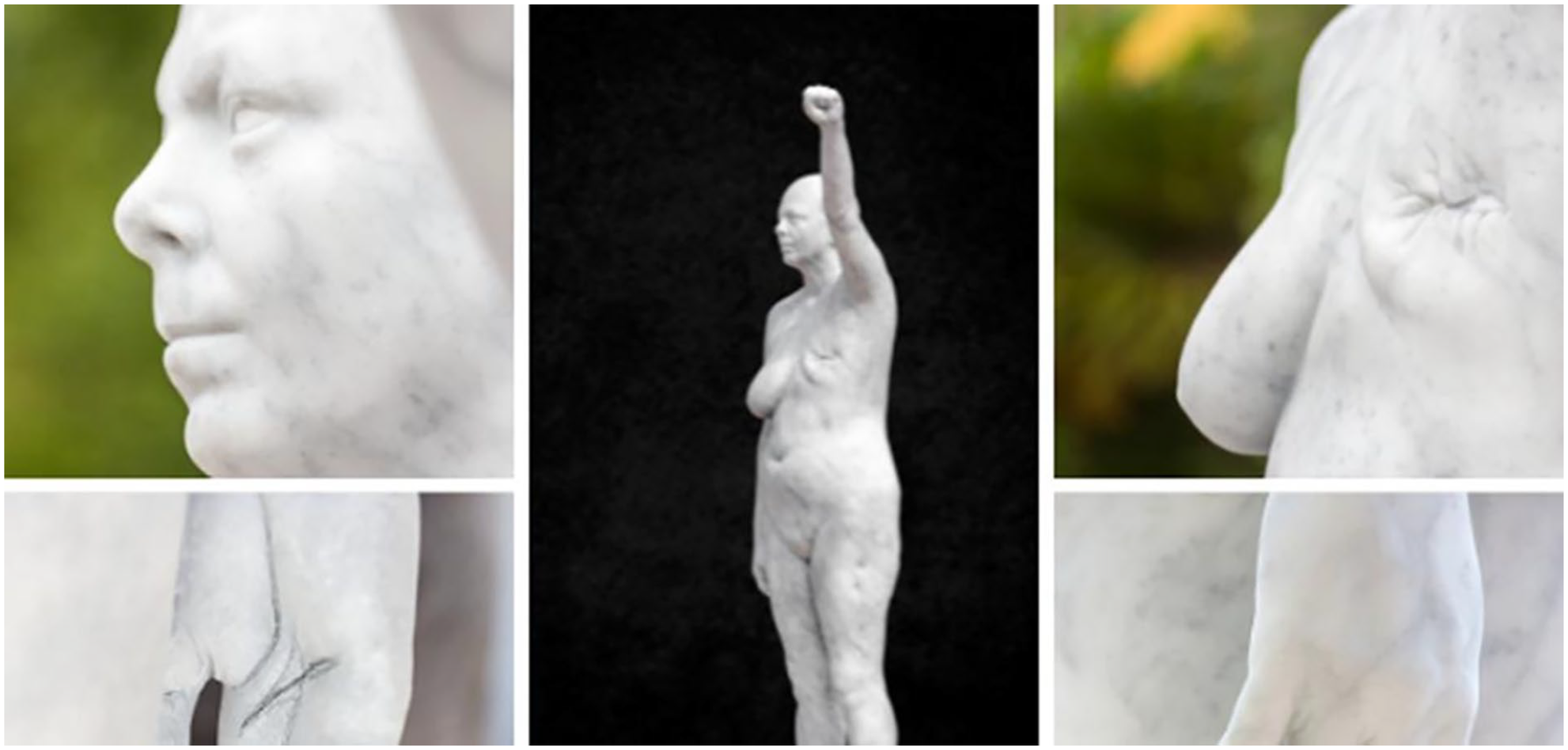
She said that when she was diagnosed, she felt as if she would never be cured: ‘I will have another self. It is as having two lives: The one I had until now, as a healthy person, and the one I will have from now on and to the end of my days as someone ill. And I must mourn my old me and can’t ignore that I have a chronic illness’. She described her mastectomy scar as ‘horrible, I had skin hanging’, and recounted how she ‘made an artistic piece about this, positioning my fingers inside the scar- just as in Caravaggio’s painting The incredulity of Saint Thomas. The piece of skin reminded me of the absence of the breast’. She next channelled her feelings by making a sculpture, telling in her words how (Figure 1):
Being able to look at my mastectomy scar was the hardest part of the process. The bathroom had turned into a monster. I tried to avoid showering, as I didn’t want to see myself in the mirror, not even with a side glance. I hadn’t come to terms with my image, but being an artist, I accepted it through art. I was constantly hiding myself; I was ashamed to open my shirt and fearful of my partner’s reaction. It was then that I decided to make a sculpture. I asked myself, how could I put together all the emotions and experiences I had gone through into a single image? It occurred to me to register the footprint of the illness on my own body. I arranged for someone to scan my body. It was the perfect moment: I had gone through chemotherapy, radiation, and a mastectomy. As the scanner traced my body with its white light, David Bowie’s song ‘Heroes’ played in the background. I took off my clothes in front of a stranger; it was also the first time my partner saw me naked. I wanted to document every mark left by the illness. As at first I could not raise my arm because they had removed all my lymph nodes, and this was one of my major worries, I wanted to show myself in a very feminist posture: with my raised arm, raising the wound; a totally contradictory gesture: from vulnerability to strength. I was feeling like shit, but I had to go on. What I initially lived as punishment gradually transformed into assimilation and acceptance through art. The digital scan was used as a model for a sculpture crafted from Carrara marble—the same material used to make classical sculptures of perfect bodies- preserving a patriarchal notion of beauty that I strongly reject. For the tittle I chose ‘Intra-Venus’, a tribute to Hanna Wilke and her posthumous work, blending ‘intravenous’ as a symbol of nutrition for patients and ‘Venus’ the goddess of love and beauty. The sculpture broke conventional norms and was placed at the Town Hall. I have had a range of reactions, from ‘How do you dare to show yourself like this’ or ‘women don’t like to be seen like that’, to praise. I’ve learned of women affected by breast cancer who brought their children to view the sculpture, using it to start difficult conversations about their own process. This is the immense power of art. It was then that I recognised the absence of representation for breast cancer and that I realised how powerful a piece of art can be. It makes visible non-normative bodies, but not only of women. Trans people have told me they see in it a half and half body. It opens-up so many prisms!
Antonia: I like what I am showing
Antonia, now 54, was first diagnosed with breast cancer when she was 31. She underwent a tumour resection followed by radiotherapy. Her second diagnosis, a primary tumour on the same breast, was when she was 38, shortly after she had given birth and stopped breastfeeding; she decided to have a bilateral mastectomy. Her third diagnosis, at 45, required lymph node surgery, chemotherapy and radiotherapy because of lymph node metastases. Antonia recounted that:
Going through the mastectomy was hard, but it was something I had to do, it made sense. If there is something rotten, you cut it off. I felt comforted knowing that if they cut and kept cutting, I was going to be OK; even more so than by doing chemotherapy or radiotherapy, which on the one hand cures you, but on the other harms you.
Her decision not to go through breast reconstruction shocked the medical staff. As she described it:
While I was still in the recovery suite, someone came to offer me an external prosthesis and I was very offended by this. First, because they never asked me what I wanted to do, if I wanted the prosthesis or not, but even more so for her to enter my room offering me something I didn’t want. And, by the horror in her face when she realized I was leaving the hospital with a flat chest, as if this was an abomination. I never saw it that way. In fact, I feel very sexy when I look in the mirror. I don’t remember seeing my mastectomy scars after the surgery as something terrible. I must say that the tattoos helped me a lot: Years after the surgery, I asked my daughter to sketch drawings over my scars; I photographed them and took them to a tattoo artist. This changed my life. The tattoos fulfil the same role as breasts: the fact of being naked and that you like what you are showing. In a way, you want to be seen, you like being seen, and you are not bothered by being seen. For some time, I stopped going topless on the beach, because I didn’t want to make other people feel uncomfortable with my scars, but after getting my tattoos, this allowed my daughter and her friends to look at my flat chest as something natural. She often asks me to show them the tattoos. When I walk topless at the beach, people don’t even turn around to look at me, or if they do, they are not scared. They stop and tell me: how beautiful, I like it! (Figure 2)
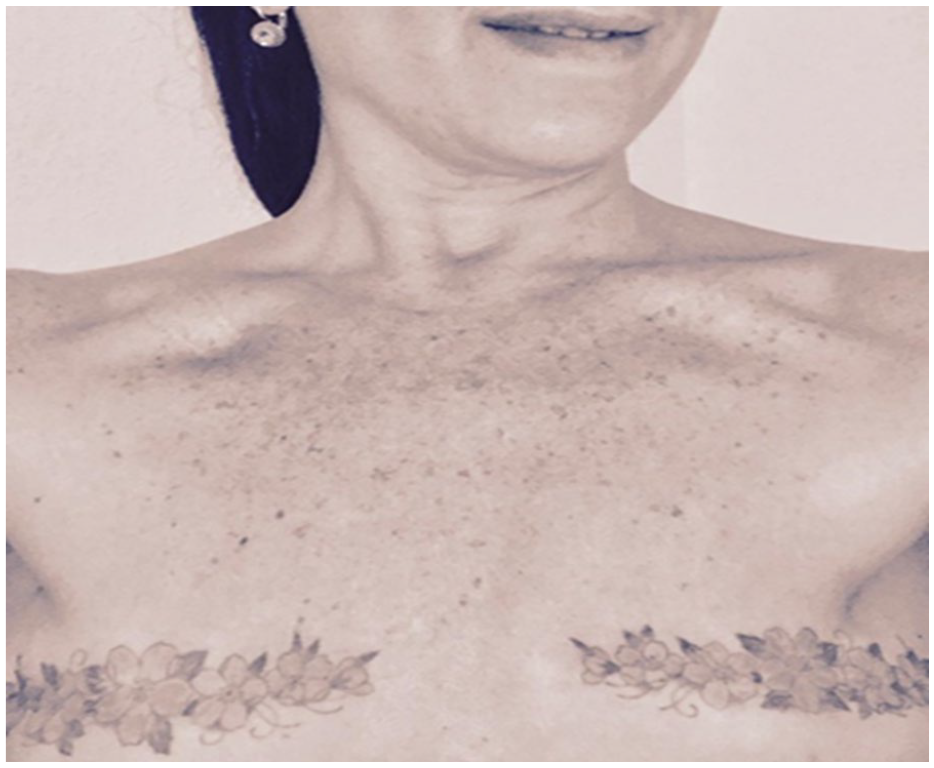
With permission of Antonia.
Isabel: the pride of absence
Isabel is 67 years old, she is a writer and activist, and was diagnosed with two primary breast cancers, one at 52 and another 3 years later. Following the first diagnosis, she had a unilateral mastectomy followed by chemotherapy and radiotherapy. After the mastectomy, Isabel recalled thinking ‘it would have been worse if it had been an arm’, since she felt breasts had an aesthetic, rather than functional purpose. When she investigated reconstructive surgery options, Isabel found that the smallest prosthesis was twice the size of her remaining breast. She determined not to undergo additional surgical procedures merely for aesthetic purposes and to instead be tattooed on her surgical scar. She had a second mastectomy after her next diagnosis, this time followed by a unilateral breast reconstruction, since she wanted to keep her tattoo of a salamander, which she explained was a protective charm in Polynesian culture:
Behind it lies a discourse: My body may be different, but I not only allow you to look at it—I invite you to do so, which is why I adorn it. Rather than you feeling it is brutal, I embellish it. People see what is there, not what is not, I place presence where there is absence, challenging the notion of beauty that society has imposed upon us. We’ve been lied to about beauty—bodies do not have to conform to a standardised ideal: size 38, 1.70 metres tall, blond, straight-haired, and blue-eyed. It so happens the person I like is a short, curvy woman with dark hair and a crooked smile. When there is a body that is different, especially if it is mutilated, there is a tendency to look with a side glance, with a little perversion, there is never a clean gaze- one without concealment. My invitation is a plea for a normalisation of all bodies, particularly those that are different or imperfect; that is what the tattoo does for me. The tattoo is not there to cover the scar, it is there to embellish the area.
When contemplating a title for a photography exhibition of women with mastectomies, one option considered was ‘We are still women’. However, Isabel expressed that not having one breast did not make her less of a woman and suggested the title The Pride of Absence: ‘I don’t take pride in having lost a breast’, she explained, ‘but I do take pride in being able to show my body without this part.’ (Figure 3).

Photograph showing her tattoo, from the exhibition Pride of Absence (El orgullo de la ausencia). With permission of Isabel. Photographer: Judith Vizcarra Puig.
Amparo: unexpected material-led catharsis
In 2016, I underwent a double mammoplasty and breast reconstruction to address complications originating from PIP breast implants which were made from a gel incompatible with and toxic to the human body. Discovering that I was one of over 500,000 women worldwide affected by these implants brought socially, physically and emotionally interrelated layers of discomfort. Coping with this realisation required a range of scarring processes, creating marks of healing that have over time allowed me to trace back the origins of these breast-related wounds. To face these discomforts, to unpack their complexities, massage their knots and to ultimately wear the scars with appreciation. My creative responses to scarring were led mostly by a visceral and intuitive emotional process. Seeking a new hobby two years later, a friend introduced me to ceramics while enjoying food, drinks, and a chat. These meetings had some similarities with the sewing circles I grew up with, where the women in my family came together to talk about life while keeping their hands busy and their gaze focused on making crafts. This combination of creative action, hand motion, material engagement and personal sharing within a safe social space left in me tangible and intangible feelings of wellbeing that drew me closer to ceramics to continue experimenting with, to express aspects of my personal politics (https://dra.revistas.csic.es/index.php/dra/article/view/598),
28
particularly regarding beauty standards embodied in breasts. During the early days of this material exploration, I was by my kitchen bench attempting to do a pinch bowl; miscalculating the thickness of the bowl walls and the weight of the stoneware clay, a hole ripped at its bottom. To continue working with what had formed instead of starting from scratch, following the process and the material, I added half a sphere at the bottom to cover the whole. As I thought about doing this, I decided to point the sphere outwards to play with the bowl’s stability. The bottom point sticking out worked as an axis that tilted the bowl to its sides generating moves. The improvised addition of the half sphere brought an efficient closure to the whole, a surprise shape, a sense of fun with the added movement and a rebelliousness in challenging the conventional stability and shape of a functional bowl. After it dried and with closer observation, I thought that the half sphere at the bottom looked like a nipple in relation to the bowl as a boob. Making this association explicit led me to explore making these as boobs no longer as an improvised adjustment to the broken clay, but intentionally. The intention was to continue learning about ceramics in a playful, relaxing, unrestricted way, without many expectations. Until the bulk boobs around me became a loud realisation of the cathartic process I had been involved into when making these without planning or being fully aware while it developed. Once I had this clarity, I opened The vulnerability of the material became a constant lesson about detachment, and an opening of possibilities to consider forms for repair. This led me to explore the Japanese technique of Kintsugi. The golden traces marking the points of contact of previously broken pieces and celebrating the story and the recovered boob shape and ceramics function. Which became another design-led metaphor for me to make broader sense of my breast healing process, its scars and their reconstructed physical, cultural and emotional meanings (Figure 4).

@Tetamatters visual and material process.
Paloma: channelling emotions through performing arts
Paloma is a 52-year-old actress working in theatre. Breast cancer diagnosis has been part of her family history: her mother, sister, grandmother and two aunts had cancer. Her older sister’s diagnosis at 43, and subsequent death 2 years later, had a profound effect on Paloma: ‘I was in shock, I felt abandoned’.
Her own diagnosis came at 41, 15 years after her sister’s death, and Paloma believed her cancer was brought about by her overwhelming guilt over a situation relating to her partner, which had manifested as a physical sensation, like an electric shock running through her body. One year later, she learned she had a breast tumour.
During her sister’s treatment, which did not work and only made her sicker, Paloma looked for alternative therapies, convinced that if she was diagnosed herself, she would approach it differently. As she put it:
I was sure that I would do nothing. My brother says it is fear, but I know it is a serene and tranquil decision taken from my conscience. There was fear, but it was the fear of dying, as my sister, because of the treatments […] I was being seen by the same doctor who treated my sister, and he himself had had breast cancer. He suggested removing both breasts, the uterus, and the ovaries; he did not want to see another sister die. For me, doing what he was telling me meant death. Maybe not physical, but spiritual. With the support of my doctor, I decided to explore alternative options for three months, after which the follow-up examinations showed negative results. I continued for a year and a half, but then the cancer appeared on the mammogram again. I left for another country, without ever telling my family about the cancer. I knew I would not be able to handle all the pressure. I looked for ways to channel my emotions, because I know that not expressing them makes me sick. As an actress, I have developed ways to experience my emotions and not let them hurt me. I developed a method to apply dramatic art in a therapeutic way, to myself and with my students.
In 2019, Paloma underwent a radical mastectomy, opting out of chemotherapy, radiotherapy and reconstructive surgery. All tests for metastases were negative, and she remained healthy 3 years later.
Paloma believes in the transformative potential of theatre to engage with the subconscious and effect profound change. ‘Theatre specifically was born in the form of rituals destined to restructure and balance our subconscious and thus our lived experiences. There are movements, sounds, vibrations, shapes, and colours which enter in dialogue with our body to harmonise it’.
She viewed art as both a reflection of life and a means of navigating its complexities, as she expressed it: ‘Art is the art of living; Art is the art of dying. Art is health, and if I am alive, it is in part thanks to Art’.
Paloma writes a blog where she aims to normalise the image of women who have only one breast or none. In Figure 5, a painting was made on her scar, applying the principles of Kintsugi, which she explained as follows:
True perfection flows from wounds and imperfections. There is no point in feeling shame and hiding our wounds, when enhancing them makes us stronger. I now have a scar where there once was a breast, a symbol of a battle fought in my body, which I can choose either to hide turning it into a weakness, or to which I may apply the principles of Kintsugi: Embrace it and transform it into one of my strong spots. That is the way I ‘repair with gold’ the scar that my breast left me when it went away.

Las chicas del can can. Paloma Mozo. Photography and painting by Nieves García.
Discussion
In the previous sections, we have presented the stories of women with breast scars who chose not to hide them, but to negotiate with them, by embellishment or by using them as inspiration for creative processes, in ways that foreground their own values and beliefs. By doing so, they have used creativity as a process that, through imagination and reflection, has enabled expression, control over circumstances, encouraged dialogue and provided a safe space free from judgement. The women heard in this article have taken decisions that do not comply with the norms of society. They did not follow treatment or medical advice without questioning them, and they chose not to hide their scars, but to wear them with pride. This article argues that one of the ways these women created meaning and new narratives regarding these scars was through creative processes. Behind their tattoos, the boob-resembling ceramics, the sculpture and the performance, there is a discourse that challenges ‘western assumptions about normative female bodies’, 15 the idea that bodies of women who have gone through mastectomies are ‘no longer in harmony with personal or societal expectations’, 15 and assumptions regarding their invisibility, passivity, and the un-gaze-worthy status of scar tissue. 16 In the case of Isabel, the referred episode about taking pride in being able to display her body despite the absence of one breast can be interpreted from a phenomenological point of view as a positive example of a ‘dys-appearing body’, 12 and how creativity can enable expressions of new identities. Even though a chest or a breast with scars may not comply with the current societal definition of ‘normality’ or ‘beauty’, what these five stories and the articles reviewed intend to do is provide a space for new definitions and different gazes as well as for embracing differences.
The women represented in this article experienced and performed creativity with their scars differently. As the neurologist Oliver Sacks has suggested while ‘biologically, physiologically, we are not so different from each other; historically, as narratives, we are each of us unique’. 31 Moreover, as Aramburu noted, ‘the sick body is in process, processing crisis and trauma, which results in various phases or stages of its transformation’. 32 In his book El Mundo Millás García 33 has suggested that writing both opens and cauterises the wound, since it is only when the scar is integrated that it can start to heal. We argue that healing came upon the creative process: Marina’s story exemplifies how it was only when she started thinking creatively and planning her sculpture that she was able both to see and show her post-mastectomy body. Moreover, when displayed at the City Hall, the sculpture became a referral and a point of departure for the healing process of some of the women who visited it, ascribing a social role to creativity, as mentioned before. On the one hand, after her mastectomy, Isabel recalls thinking: ‘it would have been worse if it had been an arm’; on the other hand, Marina’s feeling after being diagnosed was that she would never be cured: ‘I will have another self. It is as having two lives: The one I had until now, as a healthy person, and the one I will have from now on and to the end of my days as someone ill. And I must mourn my old me and can’t ignore that I have a chronic illness’. Reid-de Jong noted that ‘many participants expressed deep dissatisfaction when they first saw their chest following a mastectomy’, 14 which is mirrored in Marina’s vignette: ‘My scar was horrible, there was skin hanging. I made an artistic piece about this, positioning my fingers inside the scar- just as in Caravaggio’s painting The incredulity of Saint Thomas. The piece of skin reminded me of the absence of the breast’. However, Antonia’s feeling was different: ‘Going through the mastectomy was hard, but it was something I had to do, it made sense’. To her, removing both her diseased breasts made logical sense. Despite many comments from health staff and people around her, she told us she remained unperturbed by societal norms and embraced her post-mastectomy body with confidence and self-assurance, finding empowerment and sensuality when she looked at herself in the mirror: ‘I don’t remember seeing my mastectomy scars after the surgery as something terrible’.
The creative process
One example of the benefits of engaging in art can be found in Sabo’s article, “I am still who I was” Creating meaning through engagement in art. 17 Here, the authors recollect the impressions of two breast cancer survivors who had their torso sculpted by an artist. Some of their observations on the experiences of the women were a sense of ownership, understood as the capacity to make decisions about their body, acceptance of difference, becoming comfortable with their body, changes in body consciousness, acknowledgement and acceptance, shifting understanding, and taking control of decisions. In the following section, we expand on Sabo’s argument that ‘one form of self-actualisation leading to the generation of meaning following illness may take place through creative activity’. 17
In this article, we have described different creative processes: being tattooed, sculpting, ceramic making, expression of emotions through drama and reflective writing.
Antonia walks comfortably topless on the beach, and Isabel poses for photographs, both displaying their tattoos, while creating points of resonance with other people who have gone through similar situations. As Reid-de Jong 15 proposed, we can interpret their being tattooed over a mastectomy site as a way of ‘challenging hegemonic gender discourses of the female breast and patriarchal ideas of beauty post mastectomy’. 15 Isabel told the interviewer: ‘Rather than allowing my body to be perceived as brutal or lacking, I embellish it. I place presence where there is absence, challenging the notion of beauty that society has imposed upon us.’
Reid-de Jong suggests that, just as historically people who had tattoos were considered ‘not to be conforming to societal norms by pushing its boundaries’, 14 the participants on her study, just like the women who shared their stories with us, may feel they have broken societal paradigms given that they ‘refused the recommendation for breast reconstruction opting for something more novel’. 14 The choosing of the tattoos encompasses a process that symbolises what is meaningful and what embodies aspects of the women’s identity. 13 By choosing for their tattoos a protective charm (Isabel), or the drawings of her daughter (Antonia), they were ‘redefining beauty on their own terms and according to their own individual taste’, 15 reclaiming their bodies and redefining concepts of self. 15
For Marina, similarly to what Sabo concludes, ‘active engagement in art through the use of one’s body has the potential to open the door to healing, the generation of meaning, and a reaffirmation of self’. 17 By re-examining her body through art, she had the opportunity to reflect on her cancer experience, gendered self and embodied meaning. 17
Paloma’s creative process is very personal, and there is little academic literature on the use of drama therapy in breast cancer, but Mattsson-Lidsle et al. reported that drama exercises gave women an opportunity to ‘confront their hidden thoughts and feelings and to express them’. 34
Some of the observations on Timmons and MacDonald’s 35 research on the effect of engaging with ceramics for people with long-term physical problems can be used to understand Amparo’s creative process, especially the concept of flow, which they define as ‘psychological state that occurs when a person is so involved in an occupation that he or she forgets everything except what he or she is doing, and the perception of time is altered’. 35 They also stated that ‘clay offers an opportunity for creativity, imagination and expression’ 35 and suggested that ‘clay has often been used as a metaphor for the human body (. . .) clay may be viewed symbolically as the raw material of one’s life, and through the process of taking a raw material and processing, assembling, and forming it, clients can do the same with their lives’. 35 Moreover, in Amparo’s story, we find metaphors for the creation of a new self (‘to continue working with what had formed instead of starting from scratch’) and embracing imperfection and vulnerability through her encounter with Kintsugi. Amparo’s title for her vignette, Unexpected material-led catharsis, describes the process she went through to come to terms with the changes in her breasts and underscores creativity as a path for emotional release.
Our process of research and the women’s stories cannot be separated; through the act of retelling their experiences, the participants gained a deeper understanding of their own narratives and enabled them to release built-up tension. For instance, Amparo’s engagement with ceramics allowed her to explore the emotions that had been part of her embodied experience of seeing and feeling her breasts scar to engage in intuitive formations and write about it; similarly, Antonia’s participation in the interviews provided her with a safe and supportive space to discuss topics she had never touched with anyone else.
By listening to the voices of the women who told us their stories – and who had made these stories visible and material through creative arts, photography, performance, sculpture and ceramics – we have invited readers to witness the dynamics through which scars were transformed into forms of beauty. We have shown how scars, usually perceived as disruptions to bodies and identities, can be reimagined and utilised as sources of beauty and empowerment. These adorned scars tell powerful stories, and challenge stereotypes of beauty, providing spaces to show bodies that are different and sharing with readers a diverse range of decision-making pathways; they were harnessed to achieve what de Noronha 36 sees as dismantling our understanding of the limits of the body, health, sexuality and identity and can be conceptualised as a mode of reframing in the sense developed by Martin and Spence. 20
As noted at the beginning of this article, there is a powerful literature which engages with creativity and women’s health in the fields of health humanities and feminist art therapy scholarship. Here, we have further introduced the design anthropological concepts of creativity, contingency and improvisation,1,23 and we now outline what they contribute to understanding processes of identity and healing in relation to the stories we have related. When faced with the medicalisation of their breasts, and the need for surgical interventions, each of the women encountered a shift in the confidence they had earlier felt in their identities and in bodies. The always contingent nature of the circumstances in which they lived, and which are usually obscured from us by a sense of familiarity, became visible and obvious. Design anthropologists look to the ways in which people improvise to be able to move forward in contingent circumstances, which in the stories told above had led to each woman’s body being defined by a mode of difference which made her unique. Each woman improvised to engage with and harness these changes visually, materially and corporeally. These modes of improvisation also led the women to create new modes of being for themselves, which allowed them to continue their life paths. While creative processes may have moments of punctuation, for instance as ceramics are shown or shared, or where sculpture is exhibited or performances are staged, the creativity of life is ongoing, unstopping and such creative practices become woven through it. Moreover, these improvisatory practices served to emphasise visibility, as seen in the decision of Isabel and Antonia to tattoo their scars ‘to put presence where there was absence’ and ‘to invite people to look directly’ and to deflect the shock they had initially sensed.
Art not only contributes to the healing processes of individuals, but also of society. Artists like Hanna Wilke, Audre Lorde, Beatriz da Costa, Susan Sontag and Anna Halprin, whose story of an ‘exorcism’ of her illness through dance we can parallel to Paloma’s narrative, made their cancer process visible through art. 37 In the 1970s, art was alive and present as a tool to promote awareness and research on AIDS and connected it to society (see, e.g. the movie Angels in America). Creativity acts upon the social determinants of health and increases equity. Just as Audre Lorde did through her writings, fight against established notions of beauty and patient’s autonomy, and give emotions a voice to be recognised, respected and turned into helpful advice, 38 these women with breast scars are promoting change by making their scars visible, by normalising the option of not going through a reconstructive surgery or wearing a prosthesis. They are challenging stereotypes for themselves and for others to consider the many ways there are to confront the outcomes of breast surgeries.
Art contributes to the healing of society when a wound that exists and many people want to keep covered is exposed (. . .) (Paloma)
Conclusion
The women whose experiences we have shared dared to challenge the established concept of beauty, some by opting out of reconstructive surgeries after cancer, others by deciding to remove prostheses instead of keeping them, and others displaying the effects of treatment on their bodies. They embellished their torsos with tattoos and their ceramics with gold, embracing difference. This article looked at breast scars with a non-medicalised view, shifting away from concepts of shame, hiding, removal and discarding. Five women that used creative practices to turn what can be often considered ‘unattractive’ into natural, to put presence where there was absence, to mend instead of discard and to redefine their own sense of health and well-being. Women who transformed shame into pride and turned their pain into art that can be shared. The exploration of these narratives leads us to connect concepts of anthropological design of creativity, contingency and improvisation to better understand the process of meaning making through arts, embraced by Health Humanities and to highlight the importance of promoting creative health on the path to the construction of a new identity and well-being in the healing processes of breast scars. They have found a form of self-actualisation leading to the generation of meaning following illness that took place through creative activity. 17
In presenting these stories, we aim to support the growing evidence that argues in favour of art and creativity as paths to healing. We echo Sabo and Thibeault’s argument that ‘as a methodological approach, Art may be instrumental in eliciting a new understanding of self by bridging the gap between stigma and social acceptance’. 17 Art reshapes thoughts, perceptions and gives space for a new reality (or what Launer 39 and Charon 28 would call a new story); art transcends boundaries and forges connections. 17 We advocate for a change in the way society at large, and especially health professionals, view scars.
