



Abstract
Background:
Researchers and participants who are members of minoritized populations experience negative psychosocial and wellness outcomes like burnout. Burnout may manifest uniquely for Black women in academia conducting research with Black women participants navigating similar sociocultural contexts.
Objectives:
This article qualitatively interprets our experiences as 15 Black women scholar-practitioners at a midwestern university conducting community-engaged research. We discuss our experiences of care and burnout while working to reduce opioid use disparities among Black women community members as we simultaneously navigate multilevel challenges in academia.
Design:
We employ collaborative autoethnography, an autobiographical writing method, using a Black feminist framework and intersectionality methodology.
Methods:
We are 15 Black women researcher-subjects on the REFOCUS study—a mixed-methods National Institute on Health-funded project examining nonmedical prescription opioid misuse among Black Kentuckians. We examined a series of multigenerational sista circles and individual journal entries we completed to understand the multilevel power dynamics impacting our individual and collective work, burnout, and care.
Results:
Themes were: (1) “I see me in you”: Research with Black Women, (2) “Pervasive, cellular, and epigenetic”: Burnout Experiences; (3) “Taxing but rewarding”: The Price We Pay to See an Outcome, and (4) “Thank God for the collective”: Complexities of Caring Through the Process.
Conclusion:
We highlight the importance of continued efforts to address workload inequities among Black women in academia, particularly for those working to combat health disparities among Black women or within Black communities. We make recommendations for structural, institutional, and interpersonal steps to improve the support of Black women across career stages.
Plain language summary
We discuss our experiences as a multigenerational collective of Black women researchers conducting substance use research among Black women reporting opioid misuse. We conducted a Black feminist collaborative autoethnography, which allowed us to become “researcher-subjects.” As researcher-subjects, we examined our burnout and care reflections from multigenerational conversations and individual reflections. We make several recommendations across structural, institutional, and interpersonal levels to better support Black women working to reduce health disparities in Black communities.
Introduction
Storytelling is integral to Black women’s onto-epistemologies and autoethnography because it evokes our lived realities in a way that is deeply Black feminist,1,2 so we begin this autoethnography integrating that tradition. This article started with an idea I (Magic, PhD candidate) presented during a lab meeting. Our collective of 15 Black women scholar-practitioners in multiple roles (e.g., graduate students, clinicians, faculty members, researchers, and early-career professionals) contemplated how we could use data from Diamond’s (professor and PI) R01-funded project titled REFOCUS (Research Examining Factors Associated with Opioid Use Disorders Among Underserved African Americans) to address the aims and scope of this special issue on “Who Cares for Black Women in Health and Health Care.” Three hundred twenty-five Black women reporting opioid misuse comprised the project’s sample. Surely, there was a way we could honor their stories of burnout and self-care. We hoped to amplify their unique stories of burnout and self-care—particularly because we learned that many of our participants cared for other Black women based on our interactions with them during recruitment and data collection. However, after Nessa (PhD student) clarified details regarding this Special Issue on Who Cares for Black Women in Health and Health Care, we realized our primary qualitative and quantitative data collection on Black women REFOCUS participants did not directly fit. We knew from our interactions with REFOCUS participants that the women served others and uniquely navigated self-care and burnout, among other topics relevant to the Special Issue. However, our data at the time of this article did not allow for a comprehensive examination of their stories based on interview and survey instrument limitations.
I (Magic, PhD candidate) felt frustration and sadness in the room after rigorous data collection and community outreach, emotionally laborious yet rewarding conversations with each other and participants, and several article rejections. We were exasperated as Black health disparities researchers traversing what Settles et al. 3 call “epistemic exclusion and scholar devaluation” (p. 493). Researchers and faculty from marginalized groups, particularly women of color, report experiences of otherness and alienation in academia, whereby our credibility as scholars who produce knowledge is undermined. 3 Those in power intentionally seek to sabotage our research endeavors, challenge our professional competency, and discredit our scholastic achievements. 3 Yet, many silently expect Black scholars to engage in “invisible labor” (e.g., diversity and inclusion efforts, recruitment, service projects) that often goes unnoticed by leadership who influence tenure and promotion.3 –5 The sabotage of Black professionals in academia harms our career trajectories, opportunities for diverse and positive racial climates in programs, and emotional and physical well-being when our scholarship is overlooked and unacknowledged.4,6
Matching the widespread underrepresentation of Black academics, 7 works published by Black researchers on substance use are few. I suspect this is because our innovative research approaches and persistence in identifying intersectional oppression as a health determinant are at times dismissed.5,8,9 When our work is viewed as unconventional, it can be overlooked and unacknowledged as impactful for the populations we serve. At times, navigating the confusing terrain of invisibility as legitimate scholars and hypervisibility as a collective of Black women studying substance use posed mental (e.g., anxiety, identity-based stress, depression, imposture syndrome, low work satisfaction) and physical (e.g., fatigue, headaches, disrupted sleep) ailments.
Then it dawned on me. It was our collective’s commitment to Black feminist praxis—a shared love and devotion for our participants and their healing from the effects of opioid misuse–that simultaneously prevented us from seeing ourselves as ideal research subjects. Could it also represent Superwoman Schema (SWS) components—specifically, a drive to succeed and an obligation to help others? 10 I considered both Black feminism and SWS as possibilities. I asked the collective, “What if we write about ourselves?”
We spent the remainder of the lab meeting developing a plan for this collaborative Black feminist autoethnography. Studies show that burnout, compassion fatigue, and vicarious trauma may accompany the success of individuals conducting community-engaged research.11,12 Since we share some identities with the participants in our study, we questioned how our burnout might differ from that of non-Black women researchers conducting community-engaged substance use research. We developed the research question: What are the experiences of Black women in academia navigating burnout and care while conducting substance use research with Black women? We (the collective) are this autoethnography’s researchers and the subjects (i.e., participants).
A brief introduction to the collective
Table 1 provides our positionalities. We are a collective of 15 Black women affiliated with a predominantly White institution. Ten of us received Master’s and/or Doctoral degrees from our institution, and three are currently completing graduate degrees. Diamond (professor and REFOCUS PI) and Pearl (professor and REFOCUS Co-I) advised and hooded/will hood many of us, among other roles, as part of the same department. All other collective members received mentorship and supervision from Diamond and Pearl.
Positionality statements.
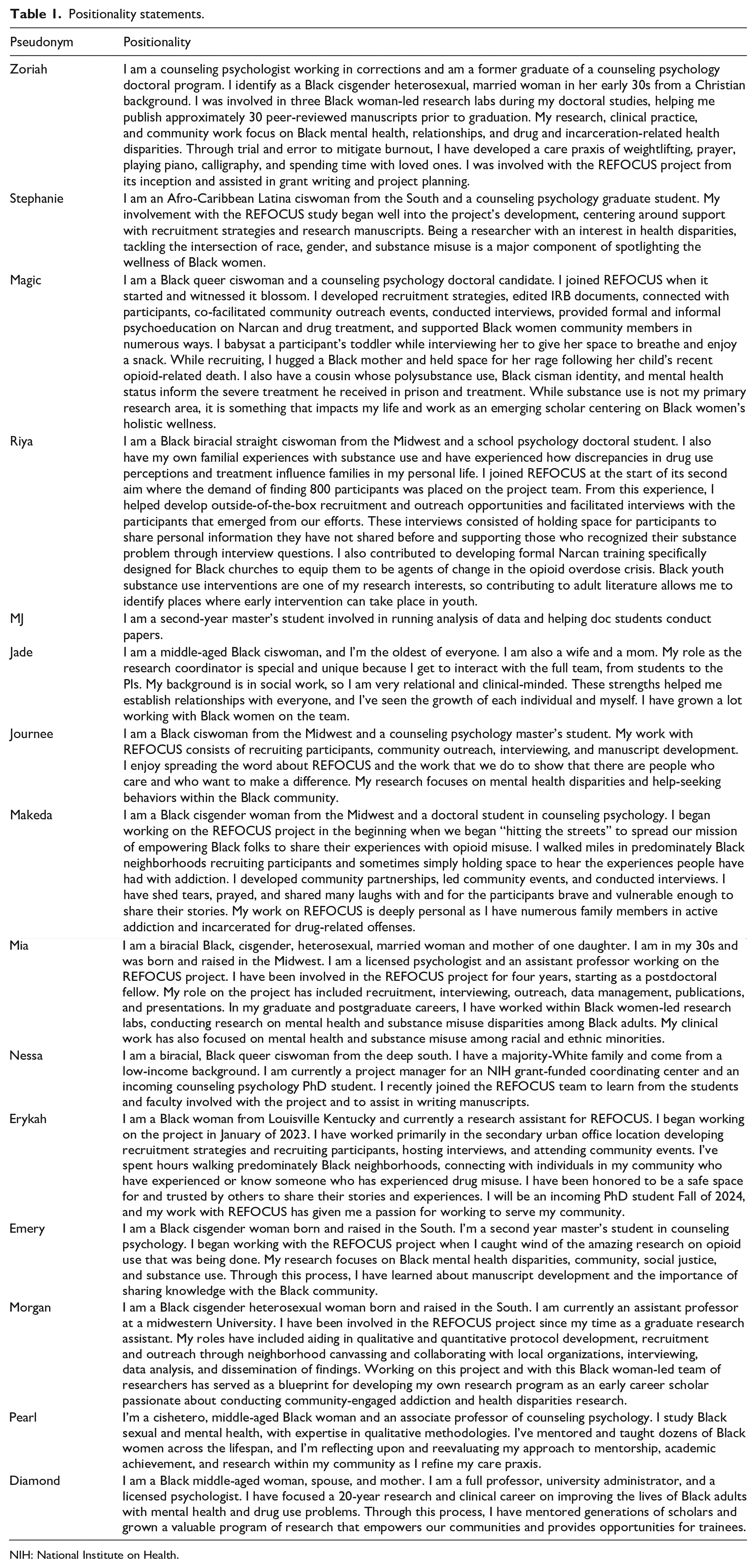
NIH: National Institute on Health.
Institutional setting
Our institution graduated its first Black woman, Dr. Joyce Hamilton Berry, PhD in 1970. 13 Interviews with Dr. Berry highlight how resolving disparities in her community and forging a path for Black women motivated her to persist in higher education despite barriers. 14 Fifty years later, Dr. Berry and other Black women’s persistence in desegregating institutions, confronting institutional norms that may harm Black women, and acquiring positions of influence resulted in Black women’s increased enrollment and graduation from PhD programs. Notably, the first Black woman in our department earned tenure in 1998, nearly three decades after Dr. Berry earned her PhD.
We continue their foremothers’ work by transforming their communities through scholar-activism, research, and addressing contemporary manifestations of gendered racism. However, our success is not without challenges to our wellness. Black women students and faculty report inadequate care and protection (e.g., being physically attacked), sickness due to identity-related stress in the workplace, unwelcomed aesthetic changes (e.g., hair loss), and discriminatory bullying that causes mental health challenges, including suicidality.6,15 –18 These threats to safety and livelihood, combined with our commitment and investment in community transformation through research, inform burnout and the necessity of a diverse care praxis. We use this autoethnography to reflect on our experiences of burnout and care in academia while working on REFOCUS.
Research setting
REFOCUS is a mixed-methods National Institute on Health R01 project examining nonmedical prescription opioid misuse among Black Kentuckians. At the time of this article, we interacted with 325 Black women participants through data collection and community outreach. In 2022, only 312 Black PIs—the least funded of all races and ethnicities—received a Type 1 research project grant or R01-equivalent compared to 3007 Asian PIs, 637 Hispanic PIs, 6981 White PIs, and 951 PIs of unknown racial or ethnic identity.
19
These numbers were not aggregated by gender. Considering these statistics, REFOCUS is a monumental achievement—particularly for its primary investigator (Diamond). After four submissions across 4 years, REFOCUS received funding:
I dreamed of being able to do this project. Being from an urban southern city, my husband and I saw firsthand how our neighborhoods were drastically impacted by drug misuse. I wanted to use my educational privilege to focus on research that could help save lives in our communities.
In this context, saving lives referred to the national opioid crisis, which disproportionately impacts Black Americans. 20 Opioid overdose-related deaths tripled for Black women from 2015 to 2021. 21 REFOCUS presented us with a unique opportunity to examine how structural, social, and cultural factors impact Black women’s opioid misuse and overdose rates. This examination necessitated an intersectional approach that accounted for how racism, sexism, and classism converged to affect health outcomes associated with their misuse and barriers to treatment.22,23 Concurrently, REFOCUS forced us as researchers to acknowledge and reconcile how the same systems permeated our work with participants and each other in ways that influenced our wellness.
Black feminist framework
Several Black women scholars8,24,25 consider wellness a Black feminist pursuit. Accordingly, we must contend with how intersectional oppression impacts our burnout and care—particularly as a collective caring for other Black women’s health and drug treatment. We ground our autoethnography in Black feminism as a critical framework critiquing how interrelated systems form a matrix of domination 24 over Black women’s existence. Patricia Hill Collins identified four interrelated domains of power (i.e., structural, disciplinary, hegemonic, and interpersonal) that maintain intersecting systems of oppression unique to Black women. Academia and Western science (structural domain) pose challenges to research conducted by and on Black women as individuals navigating oppressive policies and procedures (disciplinary domain) and controlling images (hegemonic domain) perpetuated by systems at large and individuals (interpersonal domain). 24
Specific to the hegemonic domain, the SWS 10 is one of the numerous gendered racialized controlling images (e.g., Strong Black Woman, 26 Sisterella Complex 27 ) perpetuated by systems and reinforced as lateral oppression among Black women. In attempts to counter gendered racial stereotypes depicting Black women as lazy or uneducated (e.g., Welfare Queen 24 ), some Black women endorse components of SWS, including (1) emotional suppression, (2) presenting an image of strength, (3) resistance to vulnerability, (4) succeeding despite limited resources and (5) helping others at the expense of self. 8 While SWS is, in essence, a survival mechanism to combat gendered racism, it has negative mental, physical and relational health outcomes for Black women who endorse these tenets in their everyday lives.
Black feminism also contextualizes how we empower, love, and care for each other and research participants despite opposing socio-structural forces like divisive policies limiting Black women in the community from accessing knowledge and resources within academia. 24 By relying on Black feminism within this autoethnography, we demonstrate the utility of intersectional Black feminist approaches to public health work by and for Black women.28,29
Method
Haynes and colleagues’ intersectionality methodology (IM) 30 is appropriate for this autoethnography because of its Black feminist philosophical underpinnings and cultural relevance to Black women. The following IM features informed our autoethnographic process broadly and established methodological rigor: (1) Centering ourselves as Black women researcher-subjects; (2) using a critical lens via Black feminism to examine micro/macro-level power relations impacting burnout and care; (3) addressing power in our research process with each other and with Black women reporting opioid misuse; and (4) bringing our complex identities to the forefront of our reflections (i.e., departing from a single-axis (e.g., race-only or gender-only) analyses). 31
Collaborative autoethnography is an academic writing style that details and co-interprets multiple individuals’ lived experiences. 32 Autoethnography aligns with Black feminism and IM because it invites creativity, reflexivity, and social critique into Black women’s writing. 32 Specifically, collaborative autoethnography allows Black women to “write ourselves into existence” (p. 4) by co-narrating our experiences and reflections. 32 Our reflections enliven this article as a multigenerational and multidisciplinary collective united by REFOCUS.
Procedure and analytic process
The autoethnography procedure spanned 2 weeks in March 2024. We co-constructed a semi-structured interview protocol for sista circles (i.e., focus groups) and individual journal entries. Our reflections were this autoethnography’s primary artifact.33,34 Next, we scheduled and completed four virtual multigenerational sista circles led by Magic. The sista circles were audio-recorded and averaged 60 min and included questions such as “What experiences have you had with burnout as a Black woman researcher, scholar, REFOCUS staff member, or doctoral student?” and “How has it impacted you to see the care/wellness practices, or lack thereof, of Black women on this project who are at the same and/or different levels than you?” In the spirit of Johnson’s 33 sista circle guidelines, our conversations were spiritual, supportive, encouraging, and familiar through our use of Black English Vernacular and appearances, ranging from fluffy robes to athletic wear post-exercise. 33 We also completed open-ended individual journal entries. Journal entries allowed for private individual reflection on the interview protocol. Additionally, journal entries enabled us to respond to the questions without being unconsciously influenced by the power dynamics inherent to our collective. All artifacts were transcribed for data analysis.
Our analytic process involved uncovering memories, exploring our emotions, engaging current literature, and completing systematic introspection. 35 We used abductive (i.e., theory-driven via Black feminism and data-driven) thematic analysis to develop themes from the transcripts for readers interested in where our experiences converge. For Black women readers, our musings likely do not feel like new information; instead, our themes may confirm realities many Black women academics intimately know. 36 The student authors led the following thematic analysis steps: (1) familiarizing themselves with the data, (2) creating initial codes at both semantic and latent levels, , (3) generating initial themes, (4) developing and reviewing themes, (5) refining, defining, and naming themes, and (6) writing up the findings. 37 In step 5, students triangulated the themes with all remaining authors. Empathic resonance shared between us rather than saturation confirmed our sample size. We deemed our findings trustworthy based on credibility, transferability, dependability, and confirmability36,37 grounded in the IM features for methodological rigor. We consulted JARS reporting guidelines. 38
Results
Our reflections comprised four themes discussed below: (1) “I see me in you”: Research with Black Women, (2) “Pervasive, cellular, and epigenetic”: Burnout Experiences; (3) “Taxing but rewarding”: The Price We Pay to See an Outcome, and (4) “Thank God for the collective”: Complexities of Caring Through the Process.
“I see me in you”: research with Black women
Riya (PhD student) commented, “Every time I’m with a Black woman participant, it feels different. The conversation is deeper. It’s more therapeutic. It feels more like therapy instead of, ‘Oh, you’re sitting down and doing research.’” We nodded and agreed, stating, “Mm-hmm.” Jade (Research Coordinator) elaborated,
The more comfortable women get, the more layers they release. We got down to root issues, and once women were comfortable, they would share everything. It never failed; at the end of each interview, they would say, “This is the first time I’ve ever talked about this stuff.”
We used healing interview techniques with participants that situated them as the experts instead of us.
39
However, creating safe and healing environments for soliciting participants’ stories started before conducting interviews and required intentional engagement and relationship-building during recruitment. Magic (PhD candidate) reflected on establishing trust and rapport with participants. She discussed how her privilege as a researcher and an advanced degree holder pursuing a PhD prevented Black women community members from fully trusting her:
I’m from here and have family here. I had to buy myself back into the community because I’ve acquired some privilege that now makes me feel inaccessible. I’m like, “Nah! I pull up at Indi’s the same way y’all do!” There’s so much of me before the degrees that’s still here.
Magic used Indi’s, a popular soul food restaurant, as a cultural symbol representing her continued engagement with local cultural delicacies. During recruitment, we used our native accents and Black vernacular and referenced our engagement with popular Black businesses, events, and music to increase rapport. Magic reflected,
Y’all remember the mother at the house whose daughter died from an overdose? She screamed at us about our research and said, “Y’all don’t want to help nobody! You didn’t help my daughter!” Then she got really understanding and thankful for us. That’s when it made sense to me.
Experiencing the mother’s pain toward research and health institutions for mishandling her daughter’s substance dependency assisted Magic in her understanding of how deeply Black women experience researcher mistrust. Instead of continuing recruitment, Magic walked with the mother and listened to her story. Prioritizing care over research outcomes, their interaction ended with an embrace and resource sharing. Similarly, Mia (assistant professor) shared the importance of providing time and space for participants to share about their opioid misuse: “It was very obvious that this was the first time they disclosed something to anyone. Having that space and allowing them to do that was a big deal. Sometimes, they spent three hours telling their story.”
Makeda (PhD student) stated,
It’s hard and emotional. I think about who I need to be for them. I think about when Magic and I did interviews with two Black women our age [twenties], and one literally couldn’t walk—having to hold space and figure things out for her.
The participant Makeda discussed had an abdominal injury connected to traumatic events that limited her walking ability. Supporting her consisted of ensuring the research facility was accessible, guiding her steps by holding her hands and finding comfortable, supportive seating for her interview. Makeda continued,
Then, coming together for the older generation of Black women when we weren’t reaching them and saying, “What do we have to do?” OK, put them in the position of our aunts or grandmothers. We aren’t the experts, and we need their wisdom. We’ve adopted so many strategies so Black women don’t feel like they’re dumping their hard or traumatic experiences and leaving.
Honoring elders, practicing authenticity, and engaging in disclosure were a few of the strategies we used in addition to empowering participants:
I also think about how you have to make sure they leave empowered and knowing they did something life changing. Leaving interviews or recruitment and being extremely sad is very hard because it’s like. . . I see me in you. There’s literally nothing separating my experience from yours.
Several participants’ opioid misuse narratives featured violence, trauma, and grief. We honored and expressed gratitude for their courage and vulnerability—whether recruiting or interviewing—in sharing their stories with us, coupled with encouragement and affirmations. Simultaneously, witnessing sisters hurting pained us because we saw ourselves in them.
Diamond (professor and PI) responded,
Going back to why I do what I do, you all have seen the church we grew up in and went to that neighborhood for recruitment. When Jade [research coordinator] and I say we’re not going to ask y’all to go any place we don’t go or have not been, it’s true because those were the places we lived. I totally resonate with you about how one decision in my life could have made the difference between being the PI or a participant [in this study]. Particularly, seeing Black women and mothers is a humbling experience for me. When I witness an interview, I thank them wholeheartedly for participating.
Childcare often presented a concern for Black mothers interested in participating in the study. Some mothers brought friends to sit with their children or asked if they could keep their children with them while participating. They made way for us despite childcare challenges because they believed in REFOCUS. Because we valued their participation and understood their sacrifices, we were flexible in meeting participants where they were. Journee (master’s student) added,
It’s emotional to hold space for women talking about experiences they haven’t shared with others. Holding space for them to share their story gives them power. It’s rewarding to know they feel like they’re making an impact. It’s also disheartening hearing their stories and knowing that they didn’t realize what they were getting into with opioid use.
While working with Black women participants aligns with our desire to support our community, our team recognized the emotional toll of listening to participants’ stories of loss, grief, and shame. Zoriah (PhD-level early career professional) summarized the paradox of our work sharing,
Vicarious intra-racial trauma is real and can change how you see yourself, others, and the world. Helping people who look like you can be rewarding and challenging. Substance use and trauma work requires sitting with people and their pain. Black women’s painful experiences frequently resembled mine. So, this work requires boundaries and self-care. It really showed me that if those boundaries are not in place, I will be vulnerable to many issues that I’m fighting against that hinder my ability to stay connected to myself, loved ones, and the work I love.
“Pervasive, cellular, and epigenetic”: burnout experiences
Magic (PhD candidate) asked the collective, “What does burnout look like for you right now?” On a cellular level, many women reported mental and physical symptoms of burnout. Erykah (master’s student) responded, “It’s feeling exhausted, unmotivated, and lethargic even after a full night’s rest. When I’m burnt out, I tend to talk less, sleep more, and isolate myself.” MJ (PhD student) said, “Burnout for me is a lack of motivation. It feels like I hit a wall.” Nodding in agreement, Morgan (assistant professor) added,
That energy and enthusiasm for work kinda dissipate if I’m overwhelmed with too much for too long. The stuff that normally gives me joy, excitement, and energy feels like dread.
Jade (research coordinator) shared her experiences of burnout as the project coordinator:
Burnout is real for me because I’m the research coordinator and a full-time interviewer. That position requires recruiting, talking to community leaders, and building relationships. I’m operating as a research coordinator to help schedule, keep up with daily functioning, and do what team members are doing. Because this is a research study, it’s driven by outcomes and results. The burnout for me is the level of performance I have to keep up with. It’s draining physically and mentally.
Burnout also appeared to be a pervasive phenomenon within the collective. Often, Black women working in academia maintain multiple roles.
40
Jade’s quote captured the rigor and burnout associated with meeting the performance markers of an R01 project while managing two jobs. Pearl (professor and Co-I) noted,
Many of you have multiple roles—not just all the roles that come with being a graduate student but your familial and social roles, and that’s a human experience. But the expectation placed on Black women to be able to do it all flawlessly. . . I bought into that WHOLESALE, and that has not served me well! The burnout came from thinking I had to be exceptional at everything that I did.
Stephanie (PhD student) shared how observing her peers’ research productivity despite their multiple roles contributed to her burnout. She said, “I’m grappling with thoughts like, do I deserve rest? Because I feel like I haven’t put out as many publications as Magic and others.” In this vulnerable moment, Stephanie acknowledged productivity guilt catalyzed by social comparison. By not producing as many publications as her all-but-dissertation peers, Stephanie struggled to feel worthy of rest. Zoriah (PhD-level early career professional), who worked in multiple research labs during her doctoral studies shared her drive to become an exceptional scholar. She acknowledged how being a Black woman informed her belief systems and, in turn, influenced how she navigated academia:
To overcome barriers of racism, sexism, heterosexism, etc., we truly believed we had to work twice and sometimes three times as hard as our peers to be successful. This meant weekend data collection, late nights analyzing quantitative and qualitative data, weekly lab meetings, multiple paper revisions, and more, all in one week!
Indeed, Black women in academia, corporate settings, and leadership roles often report working exponentially harder to receive a portion of the visibility and recognition of their non-Black women peers.
41
Although we asserted and reminded each other of our inherent worth, many of us adopted components of the SWS to survive. We concurrently subverted these roles to achieve success and experienced burnout. Zoriah continued:
We were working on numerous projects simultaneously to keep the pipeline hot. I realize that the lack of breaks and self-care contributed to burnout. I’m also realizing in hindsight that while barriers exist, some of the pressure we felt was self-inflicted and reinforced because we wanted to be EXCEPTIONAL scholars. We wanted to combat implicit biases and stereotypes that we were lazy, unmotivated, uneducated, all the negative things. This required us to navigate internalized gendered racial stereotypes.
While sitting with Zoriah’s statement, Nessa (PhD student) took a few deep breaths and shared her experience listening to Diamond and Pearl discuss burnout:
I was thinking about how their stories of burnout don’t necessarily match what I see. I can imagine the mentors are tired, but actually hearing their stories is different. I’ve always had this mindset that once I get insert-any-future-goal-here, I can breathe. Once I graduate with my master’s, I can breathe. Once I get into a PhD program, I can breathe. Once I get my PhD, I’ll breathe, and then I get a job and—but then. . . I get those things and I can’t breathe still. I see my elders have those things, and they are still out of breath. I’m just sitting here thinking, is having a moment to breathe and rest even a thing for Black women?
Nessa perceived her mentors as constantly in motion, striving to attain their next goal despite being tired and already having numerous responsibilities. However, students learned that part of their mentors’ drive stemmed from their desire to provide financial, educational, and other resourceful provisions for mentees (e.g., program funding, traveling stipends, writing retreats, conferences, meals) and Black women staff as well as equitable resources to research participants. Epigenetics can speak to how symptoms of burnout can be inherited generationally despite our well-meaning intentions to care for others and create a legacy. Pearl (professor and co-PI) exclaimed,
Burnout has been pervasive and cellular! It’s been epigenetic because I’m carrying so many people who invested in me, and I feel their distress in mine. I’m striving wholeheartedly not to pass that on, but probably not doing the job I need to when I’m burnt out, right?
Additionally, Diamond (professor and PI) outlined a paradoxical circumstance where some forms of care, like taking extended breaks, could have life-altering effects on those supported by her grants. She shared,
What drives me is creating spaces like our lab for trainees. For years, I’ve fully funded four or more Black students and Black female staff because of the grants I’ve written and the sacrifices, time away from family, and limited sleep. However, when the grants, jobs and funding run out. . . what does that mean for students, staff, and their families?
“Taxing but rewarding”: the price we pay to see an outcome
While it was clear that we valued our work with each other and Black women in the community, we traversed a sensitive path between our research’s taxing and rewarding components. Diamond shared,
I feel like I’m in a hamster wheel, literally. . . and I’m exhausted. Part of the pressure for me is the “What’s next? What’s the next R01?” I feel like not writing that next grant would do a disservice to the almost 700 Black Americans that we’ve reached so far and our presence in our communities because people are hungry for the caring and compassionate work we’re doing.
Caring and compassionate work in REFOCUS included educating participants on Narcan and overdose, sharing community resources (e.g., childcare, job and housing services, therapy and treatment), and offering self-care tips and encouragement. Diamond’s commitment to scholar-activism and community-engaged research simultaneously served her community and contributed to exhaustion. From the research assistant and interviewer perspective, Riya (PhD student) added:
We really are holding places of care and compassion. We’re sometimes women’s first experience unpacking [opioid misuse and substance dependency]. When you drive home from our secondary site for that hour and 10 minutes, you have to be like, “Man, today was heavy. Let me leave this in my car because I can’t take it with me!” Especially for us [students/research assistants] with boots on the ground, hiking through snow, winter, ice, heat, fire! Burnout comes from being out in these streets, doing everything you can, 110%. We’ll do all that sometimes and not get participants or any calls. I really want to make sure we emphasize that. Everybody’s like, “Oh, all you gotta do is go out in the community.” No. That’s not it.
Riya’s quote illustrated the team’s commitment to recruitment and data collection. Our celebration of scheduling or completing a single interview was often accompanied by discouragement on weeks when recruitment efforts, participant referrals, or participant interactions were not as successful as planned. Pearl (professor and Co-I) responded,
I was just thinking about how the RAs [research assistants] hold space for the participants, and then where do you put that after? The PI and Co-I hold space for the RAs—where do they put that after? And seeing the circularity of Black women’s emotional capacity and not wanting to dump on each other. Everybody talked about emotional restriction, but then there’s the, “You know. . . I noticed so-and-so ain’t alright.” I always think about our responsibility to each other. This paper feels like an outlet for some of that, and I think other Black women who read it need to see it, too.
Although proud of the faculty and students, Jade (research coordinator) reflected on how the performance expectations of academia made her concerned for our well-being:
Academia has a level of expectation that sometimes pushes people beyond limits in my eyes. I think the expectations with academia are unhealthy. You’re expected to perform at a certain level without considering pausing for life. And then there’s that, “Hey, you put yourself in the situation, you knew what you were getting into” kinda thinking, but I do get concerned about my sisters, how much time they’re putting into this work and how much what they’re doing is driven by a performance expectation rather than their passion for it.
It was difficult for Jade to determine when faculty and students led with passion rather than performance. We likely used our passion and success to mask or disregard performance expectations and burnout symptoms. Stephanie (PhD student) stated,
There have been moments where I felt there wasn’t a level of authenticity from us that I wanted to hear publicly versus what I’ve heard in private. Sometimes multigenerational conversations sound like a women’s empowerment brunch, and I’m like, there’s some authenticity here. . . but I want more. We see their [faculty and staff] success, but we always hear they are tired.
Stephanie likely recognized in the collective what Hine
41
calls a culture of dissemblance or the creation of “an appearance of openness and disclosure that shields the truth of Black women’s inner lives”
21
(p. 912). Shielding ourselves to protect and/or present the image of success likely disconnected us from each other. In truth, we were “bone-weary tired”
42
and often hesitant to admit the fullness of our exhaustion until recently. Students especially felt segmented from faculty. For example, Makeda (PhD student) discussed the disharmony she experienced as a student divesting from success guidelines she perceived to burn out Black women:
It’s been hard for me because I feel like I’ve been given this blueprint for the only way I’m going to be successful as a Black woman, but all directions lead to me being burnt out. Then if I say I’m not going to show up like that, I’m looked at sideways or, you know, “Well, how are you going to survive?” or “You can’t do it,” or “You don’t really want it,” when I do, and I’m actually just trying to show up in decolonized ways.
The “blueprint” Makeda referred to were success guidelines Black women faculty and senior graduate students consciously or unconsciously modeled and/or expected students or junior faculty to adhere to. In Black Women, Ivory Towers, Harris described blueprints as performance tools Black women use in higher education. 43 Historically, blueprints helped our foremothers transform Black women’s future in higher education and research. Blueprints historically and presently not only provide guidelines for success, belonging, and survival but also contribute to burnout. 44
Some students, including Makeda, experienced the “blueprint” as law with ramifications should one choose to show up differently. Interestingly, students did not worry about disappointing White individuals. Instead, they feared that the mentors who passed down the “blueprint” would judge them or be disappointed if they chose different paths to success. Several Black women scholars note the consequences of bearing one’s full self in academic spaces.15,44 Following the “blueprint” can benefit social mobility within the academy but may result in losing authenticity. 45 Unfortunately, the threat of within-group exile complicated authenticity for some students—particularly when their chosen care strategies and approach to academia differed from their mentors.
At this point in the conversation, we felt the cyclical and intergenerational weight of our burnout, as Journee named the complexity of our work: “There’s this cycle of how it feels good to hold space for others. But then, seeing where they stand. . .It gets complicated.” As licensed and future psychologists, we loved prioritizing Black women in research and practice. However, we struggled to reconcile our burnout. Nessa (PhD student) pleasantly added,
Something I find very valuable is that we’re giving ourselves grace, which goes against all the systems that Pearl and Zoriah named. The level of our work is still so amazing! Listen. . . We are “WERKING”! So, it’s awesome to see our high-quality work, that we care for each other, that we care for our communities, and that we are doing all the things. That shows me what’s possible when you’re intentional in your work and have strong leaders and peers who set the tone.
Morgan (assistant professor) added context for what it took for us to demonstrate what Nessa mentioned. She added,
And being able to now really lean into wellness and set boundaries. . . It wasn’t always like that. We probably wouldn’t be where we are today if we weren’t once living with that sense that we couldn’t lean into those things when this project took off. I’m sitting with a sense of humility and gratitude towards Diamond and Pearl for how you worked yourselves to the bones to even get us to this point.
Indeed, each of us experienced necessary growth since starting the project. Diamond and Pearl’s sacrifices in 2017 provided a research environment led by and created for Black scholars at a predominantly White institution. This environment created spaces for us to care through our burnout.
“Thank God for the collective”: complexities of caring through the process
“Thank God for the Collective” refers to how we cared for ourselves while experiencing burnout. Notably, we primarily learned care from our collective. Emery, a master’s student balancing graduate school, research, and a full-time job, said, “It was actually y’all who told me how I never get a chance to sit still, and that really opened my eyes.” Emery initiated a new holistic care regimen following her call-in from the collective. Diamond (professor and PI) reflected on a recent care experience following surgery,
You all took care of me. In my other roles, even though folks knew I had surgery and needed 48 hours of recovery, they did not care. I still got phone calls and text messages about things that were not emergencies and was forced to put out fires. But my team of Black women held things down. Caring for one another is inherent in this collective. It doesn’t have to be spoken on; it’s understood.
Magic (PhD candidate) reflected on similar expectations from others (e.g., students she taught and supervisors at her practicum site) early in her graduate training when she had a stroke at age 24. Pearl and Diamond encouraged (and lovingly forced) her to rest and care for her health: “When I had my stroke, I remember Diamond and Pearl being so adamantly like, sit your ass down and take care of yourself! As well as the team.” MJ (PhD student) nodded, “Yes, because I reach out and help alleviate any stress I can for y’all.”
Pearl followed up, highlighting the importance of permitting oneself to practice self-care:
I’m in the recovery process from burnout and hoping for the ability to model that it’s OK to take the time you need. It’s OK to ask people for space, set boundaries, receive help, cry, emote in whatever way—it might not be cry, it might be a cuss out with safe people, with people who care about you. I think those are some of the Black feminist praxes. . . Being OK with rage!
Erykah (PhD student) responded by sharing how the collective’s Black feminist praxes (e.g., subverting and divesting from stereotypes, boundary setting, asking for help, having fun, critical consciousness development) positively influenced her:
Working alongside you all has allowed me abundant growth that I would not have experienced anywhere else. The support I’ve received is a big reason I believe I have accomplished my goals thus far.
To conclude, Zoriah (PhD-level early career professional) acknowledged how important a Black woman-affirming space was for her, naming that the collective’s self-care varied. She stated,
The community we’ve built is a form of collective care; it’s healing to my soul. At the same time, I observed different work boundaries and varying levels of personal self-care ranging from non-existent to excessive. . . At the “highest” level [faculty, early career], I think it’s important to model self-care because you’re older, more experienced, and being watched by younger scholars. Acknowledging that your self-care is lacking is a great teaching moment. For the folks in the “middle” [postdocs, advanced doctoral students], I think it’s OK to remember that some things academic elders do may not work for you—and it’s OK to do differently. This does not make you less intelligent, resilient, or capable. At the “lowest” level [newer doctoral students, master’s level students], I think it’s important to observe, learn from other’s mistakes, and take heed to useful advice; it’s OK to do what they encourage and not what they do.
Discussion
Our reflections are consistent with those of other Black women in academia and research5,6,15,16 and revealed four themes describing (1) the pleasantries and difficulties of researching Black women, (2) our burnout experiences, (3) complications associated with research as a labor of love, and (4) how we take care of ourselves.
Our work with Black women reporting opioid misuse necessitated intentionality, humility, care, and respect. We developed research environments using interview techniques and principles 39 that helped Black women feel safe enough to reveal their interiority. While our shared identities as Black women facilitated rapport and trust with participants, other social locations—specifically our education and [perceived] socioeconomic statuses—posed challenges. Several structural factors historically and presently merge to create circumstances limiting Black women’s access to education and economic stability. 24 Members of our collective and research participants came from neighborhoods and living environments impacted by oppressive disciplinary policies and practices like redlining that decreased our community capital and education access. On average, Black Americans are more likely than their racial counterparts to occupy neighborhoods with low community capital and, of relevance, high drug prevalence. 39 Our collective circumvented educational, environmental, and financial challenges to acquiring college degrees which afforded economic and social mobility and privilege.
Despite not feeling different than our participants in some respects, our education and socioeconomic status shifted our approximation to power in ways that required leveraging to uplift participants. Leveraging our privilege was not without complications while doing fieldwork. The historical upward economic and social mobility of Western-educated, middle-class Black people informs “Black Excellence” tropes and divergence between Black women in the community and those in academia. 43 As women who “made it,” participants viewed us as more trustworthy than White researchers 46 but still questioned our motives, cultural insight, and perhaps allegiance to Blackness. Thus, our recruitment and interviewing required self-disclosure and transparency to re-establish our connections to participants and our shared communities.
Following healed connections, participants shared their stories of loss, grief, shame, and lack of basic needs and support for their opioid use concerns. While we enjoyed interviewing and empowering participants, holding space as part of our healing methodological approach significantly contributed to our burnout and exhaustion. Vicarious trauma and/or secondary traumatic stress from hearing participants’ and each other’s stories possibly compounded our pre-existing burnout symptoms.11,12 The added labor Black women engage in to heal their communities through research while surviving academia often goes undiscussed or erased.46 –48 As a result, our consistent research activism and work are sometimes unacknowledged or unaccounted for in tenure dossiers, job promotions, and internship and scholarship applications.46,47,49
We experienced physical, mental, emotional, and intergenerational symptoms of burnout. While our reports of burnout mimic previous findings,11,12,50 our experiences differed from those of non-Black women researchers in that we negotiated gendered racial schemas that complicated our relationships with research, workplace performance, care, and each other. Regarding gendered racial schemas, the SWS pervaded all our reflections. Black women are often the Superwomen of their peers, families, and communities. Among our participants, SWS emerged in how they prioritized and cared for their children. Participants were incredible mothers despite life and opioid misuse, yet they lacked compassion for themselves. For our collective, SWS emerged in our scholarship and service. Within our collective, we have over 232 publications, 40 grants, 29 awards, 11 fellowships, and several service commitments, all with pending additions. Yet, many of us had imposter syndrome51,52 that we managed through hyperproductivity.4,45
Our reflections also reveal a complex relationship with respectability politics—political strategies historically developed by Black elitists to demonstrate an ability to “align with mainstream White, heterosexual, Judeo-Christian, middle-class values [. . .] to lessen discrimination and prejudice” 53 (p. 421). Our collective reported exposure to and/or engagement in respectability politics. Some of us subverted or deliberately used respectability politics to undermine systems, while others stated interest or commitment to divesting from respectability politics, albeit at different levels. A few things were true. First, respectability politics assisted our foremothers and us in some ways. Second, respectability politics were not always successful and contributed to negative outcomes like burnout.
Encouraging each other’s work and wellness while warning each other of potential implications was complex. This dynamic was particularly complicated between Black women with generational differences or differential access to power. To manage this and other challenges (e.g., SWS), we successfully found ways to practice self-care that we shared with each other and participants. Learning from each other was vital to our wellness and demonstrated the power of Black women’s collective wisdom. 24 Despite the intensity of our burnout, we showed up for each other and offered care. This autoethnography even represented one form of care—critical reflection 23 —by which we noted and discussed our emotional and sensory experiences of burnout. Like many others, this strategy is part of the Black feminist tradition and aided our ability to humanize each other and our participants. 24
Limitations and implications
One may argue the experiences mentioned herein are uniquely our own and may not represent others’ experiences. 54 However, while this autoethnography focused on Black women affiliated with one research lab at a predominantly White midwestern university, we expect our group’s sentiments are experienced among other Black women at other institutions in different geographic regions based on our shared group identities. Additionally, some autoethnographies have been considered therapeutic due to authors’ experiential knowledge rather than critical and analytic in nature. 54 Our goal is to provide both. We hope to evoke emotion and introspection regarding our collective experiences as Black women scholars as well as demand change in how we interface and interact with power, or a lack thereof, in our lives as academics. We conclude with calls to action to benefit Black women in academic institutions and those participating in our research.
Existing support for Black women in academia and community includes workshops, mentorship programs, and diversity initiatives. 55 While helpful, these supports tend toward a familiar yet redundant style that leaves several needs unaddressed. 43 Institutions and community programming must demonstrate true allyship for Black women by enacting palpable and equitable changes to policies and procedures that maintain racist and sexist beliefs.4,40
Our reflections on academia show that Black women balance mentorship, research, administrative roles, and roles outside of academia. We felt taxed by the numerous demands for our time and frustrated by reviews that marginally accounted for our work with participants and daily activism as Black women working with Black women. As part of anti-oppressive policies in higher education, Black women must receive equitable pay to support their living expenses and a full life (i.e., having basic needs met along with additional finances supporting wellness and joyful living) and culturally tailored resources at their institutions. 56
Regarding research, due to the sensitive nature of the work and cultural mistrust among Black communities, 57 it is integral that Black women researchers are present and visible at institutions to promote safety, trust, and care for Black women participants. Our work is limited without the support of funding mechanisms—particularly when our research includes purchasing items for participants (e.g., care packages) or hiring individuals to manage research project roles (e.g., a research team member whose only job is to interview participants or connect participants with community resources). Accordingly, funders should prioritize the equitable funding of Black women researchers transforming their communities. Further, scholarships/fellowships and start-up packages must acknowledge and sufficiently support projects using intersectional and community-based 58 methodologies by providing flexible performance markers. 43
Conclusion
We conclude with notes for Black women. Our results demonstrate the utility of collective coping for navigating and overcoming burnout. For Black women, we recommend individual and collective self-reflection via intra- and multidisciplinary accountability groups to identify how our habits and endorsement of survival schemas may contribute to burnout and diminish our wellness. Several Black women provide Black feminist and womanist resources for Black women, including strategies for minimizing burnout, improving wellness outcomes, and navigating intersectional oppression (see Table 2 for examples and text references). We should also reference bell hooks’ 59 love ethic to love each other. A love ethic resembles hugging after hard truths, celebrating big and small wins, rest, and joy. Last, we encourage Black women to remember we “may feel wilted for a moment, but [we] will bloom” 60 (p. 411). —Dr. Pearis Jean.
Black feminist and womanist wellness strategies for Black women.

This is not an exhaustive list of strategies or references. We encourage readers to add to this list and incorporate/reference other mediums (e.g., music, art, podcasts, and more).
Supplemental Material
sj-pdf-1-whe-10.1177_17455057241299213 – Supplemental material for “You said burnout? Whew, chile!” A multigenerational collaborative autoethnography on the complexities of burnout and care among Black women researching substance use
Supplemental material, sj-pdf-1-whe-10.1177_17455057241299213 for “You said burnout? Whew, chile!” A multigenerational collaborative autoethnography on the complexities of burnout and care among Black women researching substance use by Natalie Malone, Kaylee A Palomino, Valerie PA Verty, Mona KM Goggins, Jasmine K Jester, Brittany Miller-Roenigk, Paris Wheeler, Jardin Dogan-Dixon, Mekaila Keeling, Kendall A McCleod, India McCray, Zoe A Sigola, Jovonna D Atkinson, Candice N Hargons and Danelle Stevens-Watkins in Women’s Health
Footnotes
Acknowledgements
We extend our heartfelt gratitude to the 325 Black women participants who generously shared their stories with us at the time of the article and the 75 additional Black women who will in the future. Their invaluable contributions have enriched our research. We also thank Dr. Shemeka Thorpe for her insightful feedback.
Declarations

Supplemental material
Supplemental material for this article is available online.
References
Supplementary Material
Please find the following supplemental material available below.
For Open Access articles published under a Creative Commons License, all supplemental material carries the same license as the article it is associated with.
For non-Open Access articles published, all supplemental material carries a non-exclusive license, and permission requests for re-use of supplemental material or any part of supplemental material shall be sent directly to the copyright owner as specified in the copyright notice associated with the article.
