



Abstract
Background:
Menstruators facing period poverty often struggle with menstrual hygiene and waste management, which can result in harmful short- and long-term health outcomes such as urinary tract infections, yeast infections, and vulvar contact dermatitis. Research indicates that 42% of menstruators in the United States have difficulty affording period products. Traditional methods of distributing period products through social services may unintentionally undermine menstruators’ agency, leading to disempowerment and inefficient resource allocation. Period product pantries are a novel approach aimed at addressing period poverty, inequity, and inadequate menstrual health education in the United States.
Objectives:
This paper aims to examine the development, organization, and implementation of two distinct period product pantry networks in Ohio and New York. It seeks to compare the advantages and challenges of grassroots versus nonprofit-led models and to provide practical insights for future pantry operators.
Design:
The study examines two models of period product pantries: a grassroots effort led by three local residents in Ohio and an initiative spearheaded by a nonprofit organization in New York. The design includes a comparative analysis of both models’ organization, funding methods, and operational structures.
Methods:
The authors gathered data on the construction, operation, and usage of two pantry networks, focusing on factors such as accessibility, community engagement, and sustainability. The study employed a combination of qualitative methods, including interviews with organizers, and a review of organizational documents to analyze the effectiveness and scalability of each model.
Results:
Both pantry networks increased accessibility to period products in low socioeconomic neighborhoods, which are disproportionately affected by period poverty. The grassroots model, while resource-limited, fostered strong community ties and local engagement. The nonprofit-led model benefited from dedicated staff and a more stable funding structure but faced bureaucratic challenges. Despite their differences, both models demonstrated the potential to empower menstruators by preserving their dignity and autonomy.
Conclusions:
Period product pantries represent an innovative and equitable approach to addressing period poverty and inequity. The analysis of the two models offers valuable insights for organizations and individuals interested in establishing similar initiatives. While each model has its unique benefits and challenges, both are effective in empowering menstruators and providing accessible menstrual hygiene products to those in need.
Registration:
Not applicable.
Plain language summary
Period product pantries are a new way to help people who can’t afford period products and don’t have enough education about menstrual health in the U.S. Many people who experience period poverty, or trouble getting products like pads and tampons, also face barriers to staying clean and managing period waste. This can cause health issues like infections. About 42% of people who get periods in the U.S. say they’ve had trouble paying for these products. Period product pantries are different from older methods of getting free products, like through social services, because they let people get what they need without feeling embarrassed or losing their sense of control. This paper looks at two types of period pantries: one started by three local people in Ohio and another run by a nonprofit group in New York. Both help people in neighborhoods where it’s hard to afford period products. The paper talks about how these pantries were set up, how they are funded, and what worked well or didn’t. The goal is to show how these pantries can be a good, fair way to help people while giving advice to others who might want to start their own pantries.
Introduction
One-fourth of the world’s population menstruate and do not have adequate access to the period products they need. 1 Period poverty is defined as the lack of access to period products, menstrual health education, hygiene facilities, and menstrual waste management. 2 Lack of access to period products can lead to harmful short- and long-term health problems including urinary tract infections, yeast infections, and vulvar contact dermatitis 3 ; school absences, missed hours at work, social isolation, stigma, and depression. 4 Period poverty does not only affect the global south, 5 but 42% of menstruators in the United State have struggled to afford period products at some point. 6 While individual states have passed legislation to increase access to free period products in schools, 60% of students rarely or never find free period products in schools or public bathrooms. 7 Menstrual health education is a key component of health and is needed for menstruators to make informed decisions about their bodies 5 but not enough is being done in the United States. An astounding 74% of menstruating high school students had questions about their periods. 8
Period products cost an average of $20 per month. 5 Like many necessities, period products are growing increasingly inaccessible due to rising costs. 5 Yet, unlike other necessities there are few social services providing free or low-cost period products. In many states, high costs are compounded by period products being taxed as nonessential goods, unlike other essential hygiene products like toilet paper. 9 Additional factors include the “pink tax,” a markup of 13% goods and services marketed toward women. 10 Menstruators who receive government assistance cannot use the Supplemental Nutrition Assistance Program or the Special Supplemental Nutrition Program for Women, Infants, and Children programs to purchase period products. 11 More recently, the COVID-19 pandemic caused many social services to expand to connect communities to resources that were otherwise out of reach, providing food, toiletries, monetary assistance, period products, and other basic necessities. However, many of these programs are being discontinued. 12
To address period poverty in their local communities, the authors of this paper created period product pantries similar to free little libraries. The period product pantry model was developed specifically to empower menstruators through (1) providing education and (2) maintaining their autonomy to choose which products are right from them. The model also preserved their dignity by keeping the process: (1) anonymous, (2) prerequisite free, (3) documentation free, and (4) without gatekeeping. The period product pantries are small cabinets that operate based on the “take what you need, leave what you can” philosophy. Science-based educational material in the pantries helps menstruators make informed choices about which products to choose and reduces the social stigma surrounding menstruation.
The purpose of this is a perspective article which aims to discuss the free period product pantry model of distribution. Since period product pantries are a novel method for addressing period product insecurity, there is no academic literature on their efficacy, implantation, or outcomes. Therefore, we will explore the literature on food pantries in addition to period product pantries as a proxy for evaluating: (1) efficiency, (2) equity, and (3) potential to reduce stigmatization around menstruation. Because period product pantries are a new method of period product distribution, we will first describe how two different organizations created and operate their period product pantries as well as lessons learned.
Pantry method of distribution
There is a long history of social service providers giving goods or services without consulting social service users, providing little choice or agency to those they serve. 5 This results in inefficient use of limited resources and disempowers users by stripping them of their autonomy. 13 Period product pantries and food pantries seek to empower those they serve by: (1) including them in the decision-making process, (2) decreasing barriers to access, and (3) protecting user’s anonymity. Free food pantries are small, unmonitored structures containing food, not to be confused with food banks, which are organizations that collect and distribute free food during specific hours via face-to-face interactions that may require a motor vehicle, documentation, 14 and may have rationed amounts of food. 15
Choice is a key component to the pantry method of distribution for both food and period products as they seek to include those they serve in the decision-making process. Nonprofit social service providers, such as housing support shelters, who provide period products use a method of distribution more similar to food banks,16,17 with predetermined product kits or rationed period products that can be as few as two pads per month. 18 Evidence shows predetermined kits or rationed food 19 or period products 13 leads to wasted items that users do not like, know how to use, or when it comes to food know how to incorporate into their lifestyle. Whereas pantries are located in public places, users to do not have to interact with others for use, can request items anonymously, and generally get what they need in a short amount of time. Furthermore, the public placement of period products helps to destigmatize menstruation and promote menstrual equity while encouraging dialog in a public forum.
Social service programs that provide food or other essential needs often require an application that takes time to process, includes identification requirements, and has restrictions to access. 20 These measures act as barriers to those who are not citizens, have immediate needs, or are on the edge of insecurity.14,21 The accessible nature of pantries allows people to access services when they are in unexpected precarious situations such as an irregular financial shortage or an unexpected menstrual cycle. The fixed hours associated with food banks are a barrier for those who work during food bank hours of operation, do not have reliable transportation, 21 or for those who must spend considerable amounts of time waiting in unpredictably long lines for services, decreasing anonymity and increasing stigmatization.22,23 The pantry model allows for more equitable access without gate keeping, providing resources when someone is in need.
Period product pantries challenge the taboo of speaking openly and publicly about menstruation. Unmonitored product choice offers empowerment through not concealing products or using gate keeping, unlike social services such as shelters where menstruators must ask individuals in charge for period products. 13 Brightly colored pantries are located in public spaces where anyone can access educational material and are labeled with language and messaging that promotes period positivity and menstrual equity.
Like free little food pantries, free period product pantries are not a panacea that will solve hunger or menstrual equity in the United States alone. There are limitations to this model of distribution. For example, while pantries are stocked daily, they may not have the exact product that a user wishes to have, requiring a user to return later. However, there is also a deficiency of food banks and social service providers that distribute period products and frequently run out of products.
Pantry organizations and operations
We will be discussing the Free Flo Box (FFB) and Capital Region Menstrual Health (CRMH) period product pantries. FFB is a grassroots nonprofit located in Dayton, Ohio that operates two pantries. FFBs mission is to offer free period products and education to menstruators facing period product insecurity. Their goal is to empower menstruators and uphold their dignity and autonomy by respecting their agency in choosing the products that best suit their needs. The first FFB pantry was created by authors JG and EG with a subsequent pantry created by AL. CRMH is a nonprofit social service initiative through Cornell Cooperative Extension (CCE), in Schenectady and Albany New York, and New York State Public Health Corps Fellows. CRMH is dedicated to promoting menstrual equity by bringing period products directly into under-resourced communities through a network of trusted community-based organizations and our period pantries. CJ and BW created CRMH pantries after learning about FFB pantries through Instagram. Both organizations created pantries in low socioeconomic neighborhoods, which statistically experience higher rates of period poverty than higher socioeconomic neighborhoods. 13
Free Flo Box
Location background
FFB was created in March 2022 in response to period poverty within the United States, and specifically Dayton, Ohio. 24 Dayton is a car-dependent city, but the neighborhoods where the pantries are located, South Park and St. Anne’s Hill neighborhoods, are some of its most walkable in the city with frequent foot traffic between various residential neighborhoods and the downtown area. 25 South Park and St. Anne’s Hill are slowly gentrifying, but border lower-income neighborhoods, and are flanked by several social services offices. 26 Social services offices include religious and government organizations and provide services such as housing, food, and clothing. Mass transit options are very limited. Dayton has been decreasing in population since the 1980s as manufacturing plants have closed. 27 Pantries are well suited for this environment because they are located where menstruators reside, decreasing the barrier of transportation. Pantries located in suburbs with high socioeconomic status residence and poor mass transit may see less use due to the distance from lower socioeconomic status areas and those they serve. 13
The state of Ohio repealed its sales tax on period products in April 2020. This sales tax has long been granted to other necessities such as groceries, prescription drugs, and hygiene items such as toilet paper but not period products. 28 Period products are supposed to be available in all public schools in Ohio. 29 However, discussions with local school employees suggest students must request period products in-person from school nurses due to limited funding. This practice can stigmatize low-income students who access period products from nurse’s offices and increase time away from class. 30 The nearby University of Dayton has period products available in a limited number of bathrooms and at student service centers on campus. While these efforts have helped address period poverty, the high demand for the pantries’ products highlights the continued need for increased access to period products.
Construction
FFB pantries were constructed by EG and AL. See Figure 1 for a picture of FFB pantries. Both FFB pantries were built using wood with large plexiglass doors to allow people to see what’s inside without having to open the box. The roofs were built with a long overhang to keep products dry, should the door be left ajar during rain. The sides of the pantries were painted with chalkboard paint to facilitate interaction with local community. FFB pantries were placed in locations accessible via the sidewalk but on private property that prevented the need for city approval. Gender neutral colors and images were used for maximal inclusivity because not all menstruators identify as women or like the color pink.

Free Flo Box pantries.
Stocking pantries
FFB pantries are stocked with tampons, pads, and menstrual cups in a full range of absorbencies and sizes. Table 1 describes the contents of FFB pantries. The quantity and variety of products was chosen strategically so that there is enough of each product for at least one person’s monthly cycle. When FFB began, one pantry was emptied of all contents on several occasions. After keeping the pantry fully stocked daily, emptying events stopped possibly because users knew the pantry was going to be a reliable source of period products. FFB provides paper lunch bags for menstruators to carry their products. FFB pantries are stocked at least daily, JG and AL, since the pantries are located near their homes. Product utilization is recorded on a shared Google Sheets.
Panty contents.
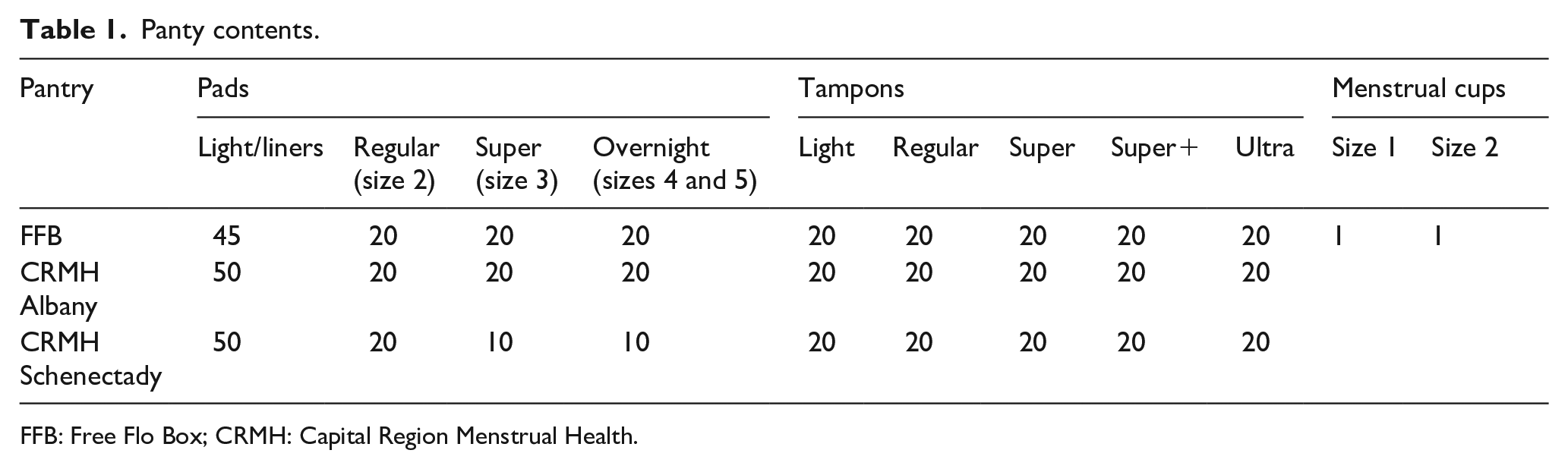
FFB: Free Flo Box; CRMH: Capital Region Menstrual Health.
Since opening, the FFB has received several requests to open additional pantries; however, due to the high demand for period products, limited time, and limited resources, FFB has not able to open more. To open additional pantries new organizer(s) would need to contribute a considerable amount of time and funding needed to build, maintain, and stock a pantry since FFB currently does not have an excess of period products.
Requests for products not stocked in FFB pantries are made via note cards in the pantry. Figure 2 is an example of our request card. On request cards users can indicate their choice of cloth pads, period underwear, teen sized menstrual cups, as well as a space for them to write in other items. Users identify on the request cards if they would like to communicate with FFB organizers about their request via either text, email, or writing notes on the request card. When a request is ready for pick up, it is placed in a bag, labeled, and left on the porch of the pantry organizers house in an area that is not visible from the street. The entire request process is anonymous unless the patron decides to identify themselves.

Request cards.
Education
Infographics flyers (Figure 3) have information about the menstrual cycle, female reproductive anatomy, the different types of period products, how to use menstrual cups and period underwear, and about FFB, including how to donate. Free downloadable versions of the inforgraphics are available on the FFB website (https://freeflobox.wixsite.com/freeflobox). Understanding the menstrual cycle and female reproductive anatomy is a pillar of menstrual hygiene management and helps empower menstruators with the knowledge they need to manage their periods and make informed decisions on their bodies. Infographics also describe how to use menstrual cups and period underwear since these are less common period products. FFB has a demonstration menstrual cup screwed to the inside pantry to show users what a menstrual cup looks like. Since FFB provides Saalt brand (Saalt Co., Boise, ID, USA) menstrual cups that come in cloth bags, users are otherwise unable to see what they look like. The demonstration cup was placed after hearing that users were confused about what was in the cloth bags. We hope to add another infographic on how to care for your vagina, including when to talk to a healthcare provider about health concerns and hygiene. We feel this information is important based on the number of requests received for feminine wipes, Monistat® (Prestige Consumer Healthcare, Irvington, NY, USA), Midol® (Bayer, Leverkusen, Germany), and douches.

Infographics.
Donations
Community support
The neighborhoods where FFB pantries are located have strong senses of community. Neighbors support FFB in three ways: (1) direct donation of period products, (2) purchasing products via registries, (3) monetary donations, and (4) by volunteering. FFB only takes products that are individually wrapped, or in their original packaging and unopened. A link to the FFB registry is available via a QR code on the outside of the pantry and through an FFB Linktree (Linktree, Melbourne, VIC, Australia) connected to FFB social media accounts. If neighbors choose to donate money, they do so online recurring donations. A QR code donations to FFB is located on the outside of the pantry. See FFB Instagram account @FreeFloBox for links to FFB registries and the FFB Linktree.
Partnerships
FFB has received grants as well as partnered with local organizations and period product companies to help stock pantries. Grants and partnerships were essential when the FFB was first created, before regular sources of donations were established. Partnering with a local period poverty 501c3 nonprofit gave FFB 501c3 standing until FFB was large enough to become its own 501c3 in 2024. Period product companies and organizations provide FFB with free menstrual cups from Equal Period and free or discounted period underwear from Goat Union (Goat Union, Atlanta, GA, USA).
Monetary donations
Monetary donations come from four main sources: (1) unsolicited donations, (2) solicited one time or recurring donations, (3) grants, and (4) fundraising. FFBs largest source of funding is from donations solicited by posts on social media especially in, active neighborhood groups on Facebook. Social media posts educate the community by providing information about period poverty, reproductive health, FFB pantry utilization, donations from period product companies and nonprofits, events, information about period poverty, and about current product needs. FFB applies for grants through nonprofits and period product companies in addition to receiving grant funding from period product partner organizations. FFBs largest source of funding is from donations solicited by posts on social media especially in, active neighborhood groups on Facebook. FFB has held two fundraising events and plans to hold fundraising events quarterly, which will make these events the single largest source of funding.
Utilization
FFB utilization is discussed in greater detail in a subsequent publication in this journal. Live FFB pantry utilization can be seen via links from FFB Instagram account (@FreeFloBox) and website (https://freeflobox.wixsite.com/freeflobox). Table 3 shows a brief overview of average monthly usage and cost by product type. At the time of publication, FFB has provided over 45,800 products with an average 1,833 products per month. Pads are the most frequently used product with an average of 1,072 pads and 702 tampons. On average 31 menstrual cups are provided monthly for a total of 736 cups, which diverts 14,500 tampons per cycle from landfills (20 tampons/1 cup). Period underwear is most often provided by request with over 500 pairs having been provided. When period underwear is stocked, it is almost always taken within 2 days.
Capital Region Menstrual Health
Locations background
Albany is the capital city of New York State and is located on the banks of the Hudson River and amid the largest cities in the Northeast. 31 Schenectady is a small city located approximately a 20-min drive from Albany. Like Dayton, Albany has experienced significant financial hardships at the beginning of the 21st century, including a loss in employment opportunities that led to a population decline by approximately one-third since 1950. 32 Both Albany and Schenectady are actively trying to revitalize with a focus on their downtown areas.
Albany and Schenectady are both characterized as car-dependent cities with bus mass transit in the city centers.33,34 The walkability and access to mass transit make Albany and Schenectady ideal for pantry placement. The period pantries are placed at host social service organizations, such as food pantries and shelters for those experiencing homelessness that are in low socioeconomic neighborhoods. New York state repealed its sales tax on period products in 2016 35 among other period poverty elimination efforts. 36
Construction
CRMH operates seven period pantries in Albany and Schenectady, New York. CRMH pantries are housed in waterproof newspaper vending machines with plexiglass windows (Figure 4). Pantries are an appropriate height for people who are wheelchair users, or short in stature. All pantries were painted in bright colors, with the words FREE and PERIOD PANTRY in bold lettering. Each pantry is located at a “host” organization that manages the day-to-day operations of their pantry. Table 2 describes each pantry including location, date opened, and host organizations. Partnerships with host organizations have been initiated by both CRMH and host organizations. CRMH developed a Memorandum of Understanding signed by themselves and the host organizations, which states that host organizations must be able to manage the period pantry and are responsible for keeping the pantry stocked with products provided by CRMH. After the pantry was installed, CRMH provided the organizations with enough products to stock the pantry and a spreadsheet for product tracking.

CRMH used newspaper pantry.
CRMH pantry locations.

SiCM: Schenectady Community Ministries; CRMH: Capital Region Menstrual Health.
Stocking pantries
Period products provided by CRMH are stocked weekly by host staff or CRMH. Host organizations track their product usage and share these data monthly by email. CRMH checks-in with organizations biweekly to ensure they have enough period products. CRMH stocks the same period products as FFB, plus disposable incontinence underwear. See Table 1 for full pantry contents.
Education
Laminated educational flyers that show how products are used and how often products should be changed are available in pantries, but CRMH does not provide a demonstration menstrual cup. CRMH holds in-person, age-appropriate educational sessions where school-aged children of all genders learn about menstruation and period products through anatomy coloring pages and by making bracelets that reflect the phases of the menstrual cycle. Menstrual hygiene management resources, including fact sheets, recommended health organizations, and guides for menstrual advocacy, are posted on CRMHs website. (https://schenectady.cce.cornell.edu/health-wellness/capital-region-menstrual-health) and via social media (Instagram @capitolregionmh).
CRMH has participated in advocacy for accessible period products in New York State and is mentioned in NY J01047, a bill memorializing May 28, 2023, as Menstrual Hygiene Day in the State of New York. For the occasion, they were invited to speak at the New York State Capitol and meet with legislators about the importance of providing free menstrual products in all public spaces.
Donations
CRMH exists under a parent 501c3 organization, CCE, where CRMH operators, CJ, BW, and AR are paid New York State Public Health Corps Fellows. CRMH accepts product donations through in-person product drop-offs, period product registries, monetary donations, period product drives, events, and from period product companies. Period products are not accepted at pantries to prevent people from leaving used or opened period products. Monetary donations come from fundraising events and online donations via a CRMH Linktree, website, and social media. Like FFB, CRMH has held two fundraising events. CRMH receives menstrual cups from Equal Period and purchases period underwear from The Period Company at a discounted rate, which have been essential in stocking the pantries with sustainable period products. Grants are by far the largest source of funding for CRMH. The Pad Project Organization awarded CRMH the “Pads Across America” grant that provided $2,900.
Utilization
Pantry usage varies by location due to the difference in foot traffic between social services organizations. The Schenectady Community Ministries pantry in Schenectady, located at a food pantry and community health hub, has the highest usage. To date, CMRH has given away over 100,000 period products. CRMH provides an average of 3,209 products costing $633.75 per month. Table 3 shows the breakdown of usage between Albany and Schenectady pantries and by product type. CRMH has only provided a small number of menstrual cups due to their high cost and CRMH is concerned that unhoused menstruators may not be able to boil their menstrual cups between menstrual cycles. Unlike FFB, CRMH uses QR codes for request, instead of note cards. With this method, CRMH has not received any requests, possibly due to users’ lack of access to smartphones. CRMH has received verbal suggestions from users when stocking the pantries for items such as more absorbent overnight pads.
Average monthly pantry use.

FFB: Free Flo Box; CRMH: Capital Region Menstrual Health.
Discussion
FFB and CRMH offer two approaches to operating period product pantries. FFB is a grassroots nonprofit that began with a horizontal partnership with a 501c3, whereas CRMH has a vertical partnership with a parent 501c3. With a horizontal partnership FFB organizers can be deeply involved in the running of each pantry that requires significant levels of time and commitment. Pantry organizers stock the pantries, fulfill requests, and raise donations. Since FFB pantry organizers are unpaid volunteers and not associated with a large organization with establish support, it has been more difficult for FFB to establish reliable streams of donations, create new pantries, and attain visibility in the community. After about 2 years of growth and establishing resources within the community FFB was able to become a 501c3, which required $700 and a board of at least three members. FFB has had requests to open additional pantries; however, organizers are unable to take on further responsibility, especially with limited resources of time and money. Additionally, high product demand coupled with high product costs limits the free period pantry model.
CRMH is one facet of a large, established organization CCE that had existing financial supporters and was able to pay the salaries of CRMH pantry organizers. CCE established relationships within the community helped CRMH quickly gain visibility in their community and raise funds for their pantries. As paid employees, pantry organizers were able to dedicate more time to pantries than if they were volunteers, as in the FFB model, enabling CRMH to run numerous pantries in collaboration with host organizations. CRMH maintained a vertical hierarchy with host organization in which the day-to-day operation of pantries was handled by host organizations, making it more difficult for CRMH to monitor individual pantry use, but allowed for a greater number of pantries to be in operation and reach more menstruators.
Reusable period products
Reusable products, such as menstrual cups, have the power to help alleviate period poverty for many menstruators. For this reason, FFB has made stocking reusable period products a priority. CRMH has found some difficulty in stocking reusable products due to their high cost and limited inventory. Reusable products have a high up-front cost but can eliminate the need to purchase future products, saving money in the long run and ending the cycle of period poverty. This high up-front cost makes them unattainable for low-income period product insecure menstruators who can otherwise only afford short-term solutions such as pads and tampons. Partnering with reusable period product companies and nonprofits made stocking reusables possible. Reusable products tend to be more environmentally friendly compared to disposable products. While reusable products are not right for everyone, we strive to educate users and make them available to those who would like to try them. Unhoused menstruators may face barriers to utilizing reusable products due to their inability to sanitize menstrual cups by boiling them between cycles or wash reusable period underwear between uses. FFB and CRMH believe menstruators should be able to choose if reusable products are right for them regardless of their housing status.
Conclusion
Period product pantries are a new way of combating period poverty. Pantries deviate from previous methods of supplying products via social service organizations and mailed period product kits. The advantage of period pantries is that users can choose which and how many products they would like. When choosing the best model of distributing period products in a given area, it is important to consider accessibility and if the surrounding area has menstruators experiencing period poverty. Distributing products through nonprofit social services may be more advantageous in areas where there is low foot traffic, car dependence, or if the nonprofit is located in an area that is far away from those is who are in need. It is important to consider these factors when deciding on a method for distribution.
There is a dire need for increased access to period products. Utilization of pantries in FFB and CRMH have shown that period product pantries are an innovative, accessible, and more equitable method to give menstruators agency to make decisions about their own reproductive health. However, period product pantries will not end period product insecurity alone. Period product pantries such as FFB and CRMH are limited by the number of individual volunteer pantry managers or host organizations who have the free time to perform all of the duties described above to run this service. The prospect of taking on such a large time and labor commitment can be daunting, especially if period product pantries are meant to be a long-term solution to local period poverty. Despite the many advantages of period product pantries over previous methods of alleviation, such as anonymity and being able to choose your own products, some may still internalize stigma by having to rely on donations to meet their menstrual needs. FFB and CRMH receive many of their products for free or at a considerably reduced rate than what would be offered to individual menstruators facing period poverty. Further, the free availability of reusable products to menstruators who may have never been able to afford to try them also helps to address menstrual inequality long term. However, this may do little to resolve desperately needed structural changes to ensure affordability of menstrual products for everyone. Legislation further improving access to products, menstruation education, and the destigmatization of menstruation are needed to ensure dignity, autonomy, and equity for menstruators.
Footnotes
Acknowledgements
The Free Flo Box would like to acknowledge Goat Union, Sophene Avedissian at Equal Period, and the Pad Project. Goat Union is an inclusive period underwear company who has helped them provide over 500 pairs of period underwear. Sophene is the founder of Equal Period and tirelessly strives to provide free menstrual cups, without her FFB would not be able to keep our pantries stopped with menstrual cups. The Pad Project supported the FFB when they were first starting out and helped connect them to other menstrual organization including CRMH. CRMH would like to acknowledge Period Co., Market 32, Aunt Flo, and Saalt for donating and providing products. Without the support of these amazing organizations, we would not be able to do what we do.
