



Abstract
Background:
Despite the high cost of low birth weight and the persistent challenge of racial inequities affecting the Arab American community, there has been limited research to identify and examine risk factors for these inequities with validated data on Arab American ethnicity and recent population stressors.
Objectives:
This study examined whether the 2016 presidential election is associated with low birth weight among non-Hispanic White, Arab American, Hispanic, and non-Hispanic Black women.
Design:
This population-based study of singleton births in Michigan (2008–2017) used an algorithm to identify mothers who were of Arab descent.
Methods:
We used logistic regression to estimate odds ratios and 95% confidence intervals for the association between race/ethnicity and the odds of low birth weight. We examined whether these associations differed before and after the 2016 presidential election and according to maternal education.
Results:
There were 1,019,738 births, including 66,272 (6.5%) classified as low birth weight. The odds of having a low-birth-weight infant were higher among all minority women compared to non-Hispanic White women. The association was similar before and after the 2016 presidential election and stronger among women with higher levels of education.
Conclusion:
This is the first study to estimate low birth weight among Arab American women in the context of political events. There are opportunities for future studies to discuss this issue in depth.
Plain language summary
There have been only a few studies that investigated the relationship between political stress and infant outcomes for Arab Americans in Michigan. This study examined whether the 2016 presidential election is associated with low birth weight among non-Hispanic White, Arab American, Hispanic, and non-Hispanic Black women. The authors used singleton births in Michigan from 2008 to 2017 and an Arabic/Chaldean algorithm to identify mothers who were of Arab descent. Minority women were more likely to have low-birth-weight infants compared to non-Hispanic White women. There was no difference in this when comparing results before and after the 2016 presidential election. Importantly, the study showed that the differences in low birth weight were strong among women with higher levels of education.
Introduction
Despite extensive research comparing birth outcomes among racial and ethnic groups, 1 Arab American women are often missed in the discourse because they are classified as non-Hispanic White. 2 Prior studies have shown higher levels of chronic diseases among Arab American women compared to non-Hispanic White women.3,4 However, less is known about the occurrence of low birth weight (LBW; less than 2500 g at birth) in this population.5–9
Racial and ethnic inequities in birth outcomes may be attributable to population stressors such as wars or political events,10,11 but studies exploring the fundamental causes of these inequities are limited and inconsistent. For instance, a study of Arab Americans in California reported a 34% higher occurrence of LBW following the 11 September 2001 attacks, 12 but a study in Michigan 1 showed no change in LBW associated with the attacks. Recent studies have shown that the stress surrounding presidential elections may be associated with a higher occurrence of preterm birth among Latina 13 and immigrant Hispanic and Muslim populations, 14 but there have been no studies to examine whether Arab American women are more likely to experience adverse birth outcomes associated with presidential elections.
Demographic and social factors may exacerbate or buffer health inequities, such as LBW, across populations. For instance, population density and social networks at least partially explain the differences in LBW between White, Black, and Hispanic women.10,15 Also, LBW varies by indicators of socioeconomic status (SES), such as education. 2 Furthermore, racial and ethnic differences are found at every level of SES. 16
Despite the high cost of LBW 17 and the persistent challenge of racial inequities affecting the Arab American community, 18 there has been limited research to identify and examine risk factors for these inequities with validated data on Arab American ethnicity and recent population stressors. We, therefore, conducted a population-based cohort study in Michigan to describe LBW occurrence across populations and to examine whether the 2016 presidential election is associated with changes in the frequency of LBW among non-Hispanic White, Arab American, Hispanic, and non-Hispanic Black women. We also examined whether any inequities in LBW across race/ethnicity vary according to education.
Methods
Study population
We conducted a population-based cohort study using birth records on singleton births between 2008 and 2017 in Michigan obtained from the state’s Division for Vital Records and Health Statistics department. As Arab ethnicity is not routinely recorded in vital statistics records, we used a validated name algorithm 19 to identify mothers who were likely of Arab descent rather than classifying ethnicity based on self-report alone. This algorithm has been used extensively to study Arab health,20–23 and it has a positive predictive value of 91%. 19
Birth weight and covariates
The main outcome of interest was LBW, defined as a gestational weight less than 2500 g. The primary predictor was the mother’s race and ethnicity based on the race, Hispanic ethnicity, and ancestry recorded on the birth certificate as well as Arab ethnicity as indicated by the validated name algorithm. Race/ethnicity was categorized as non-Hispanic White, non-Hispanic Black, Hispanic, Arab American, and non-Hispanic Asian. All other races, including unknown, were excluded from the analysis due to small numbers. A priori, we selected the following covariates as potential confounders: mother’s age at birth (<20, 20–29, 30–35, ⩾35 years); marital status (never married, married, or separated, divorced/widowed); mother’s education (<12, 12, 13–15, 16+ years); currently smokes (yes/no); hypertension (pre-pregnancy or gestational); diabetes (pre-pregnancy or gestational); pre-eclampsia; and if the mother received Women, Infants, and Children (WIC) support. We also describe the sample in terms of fathers’ age (<20, 20–29, 30–35, ⩾35 years) and education (<12, 12, 13–15, 16+ years). Delivery variables included parity (first birth versus second or more), pay source (private insurance, Medicaid, or other), less than four prenatal visits, birth season, infant sex, and gestational weight. We classified birth season as winter (December to February), spring (March to May), summer (June to August), and fall (September to November). All covariates were derived from the birth certificate data.
Statistical analysis
We described the distribution of the mothers’ and fathers’ characteristics and delivery experiences using counts and percentages by race/ethnicity categories. Results were deemed statistically significant at a p value of <0.05. We used logistic regression to estimate odds ratios (ORs) and 95% confidence intervals (CIs) for the association between race/ethnicity and the odds of LBW, adjusting for factors selected a priori as potential confounders based on the literature. First, we examined whether there were racial/ethnic differences in LBW from 2009 to 2017, adjusting for mother’s age, current smoking, season, prenatal care visits, presence of medical risk factors, WIC status, mother’s education, and marital status. Second, we examined the association between race/ethnicity and LBW comparing the year before the 2016 US presidential election (November 2015 to October 2016) and the year after the election (November 2016 to October 2017), adjusting for the same confounders. Third, we examined whether the association between race/ethnicity and LBW varied by education (⩽12 years versus >12 years) using an interaction term in a model including the same confounders as the earlier analyses, and we estimated the associations between race/ethnicity and LBW for low (<12 years) and high (>12 years) education after adjusting for confounders. All analyses were conducted using SAS software, version 9.4. 24
Results
There were 1,019,738 births, including 66,272 (6.5%) classified as LBW. Arab American mothers have similar age distributions compared to non-Hispanic Whites. Approximately 16% of Arab American mothers were 35 years of age or older compared to 9.6% of non-Hispanic Black, 12.7% of Hispanics, and 22.8% of Asian mothers (Table 1). Arab American mothers were more likely to be currently married (91.4%) compared to other racial and ethnic groups except for Asian Americans (91.9%). Arab American mothers also were less likely (81.1%) to have 12 or more years of education compared to non-Hispanic White (90.9%) and Asian (94.7%) mothers. All results were statistically significant at the p < 0.05 level.
Characteristics of mothers and fathers for singleton infant births in Michigan, 2008–2017, N = 1,019,738.

All results were statistically significant at the p < 0.05 level.
WIC: Women, Infants, and Children.
The presence of any of the following: hypertension (pre-pregnancy or gestational), diabetes (pre-pregnancy or gestational), or pre-eclampsia.
Missing values: WIC (24,923), father’s age (148,915), and father’s education (154,735).
Table 2 presents the characteristics of the mothers’ delivery experiences. Compared to non-Hispanic White (36.6%) and Asian (20.7%) mothers, Arab Americans were more likely (53.7%) to receive Medicaid. Giving birth to a baby weighing less than 2500 g was similar among Arab American (5.4%) and non-Hispanic White (5.2%) mothers. All results were statistically significant at the p < 0.05 level.
Characteristics of mothers’ delivery experience in Michigan, 2008–2017, N = 403,662.

All results were statistically significant at the p < 0.05 level.
MD: Medical doctor; DO: Doctor of osteopathic medicine.
The number of prenatal visits was missing for 23,173 records.
Table 3 presents the association between race/ethnicity and the odds of having an LBW infant for the entire study period, as well as before and after the 2016 presidential election. Compared to non-Hispanic White mothers, the odds of having an LBW infant were 18% higher among Arab American mothers (95% CI: 1.13–1.24), 75% higher among Asian mothers (95% CI: 1.67–1.84), and 2.06-fold higher among non-Hispanic Black mothers (95% CI: 2.02–2.11). These associations were similar for births in the year before the 2016 US presidential election (November 2015 to October 2016) and the year after the election (November 2016 to October 2017).
Adjusted odds ratios (ORs) and 95% confidence intervals (CIs) for the association between race/ethnicity and the odds of low birth weight, Michigan 2008–2017, N = 1,019,738.
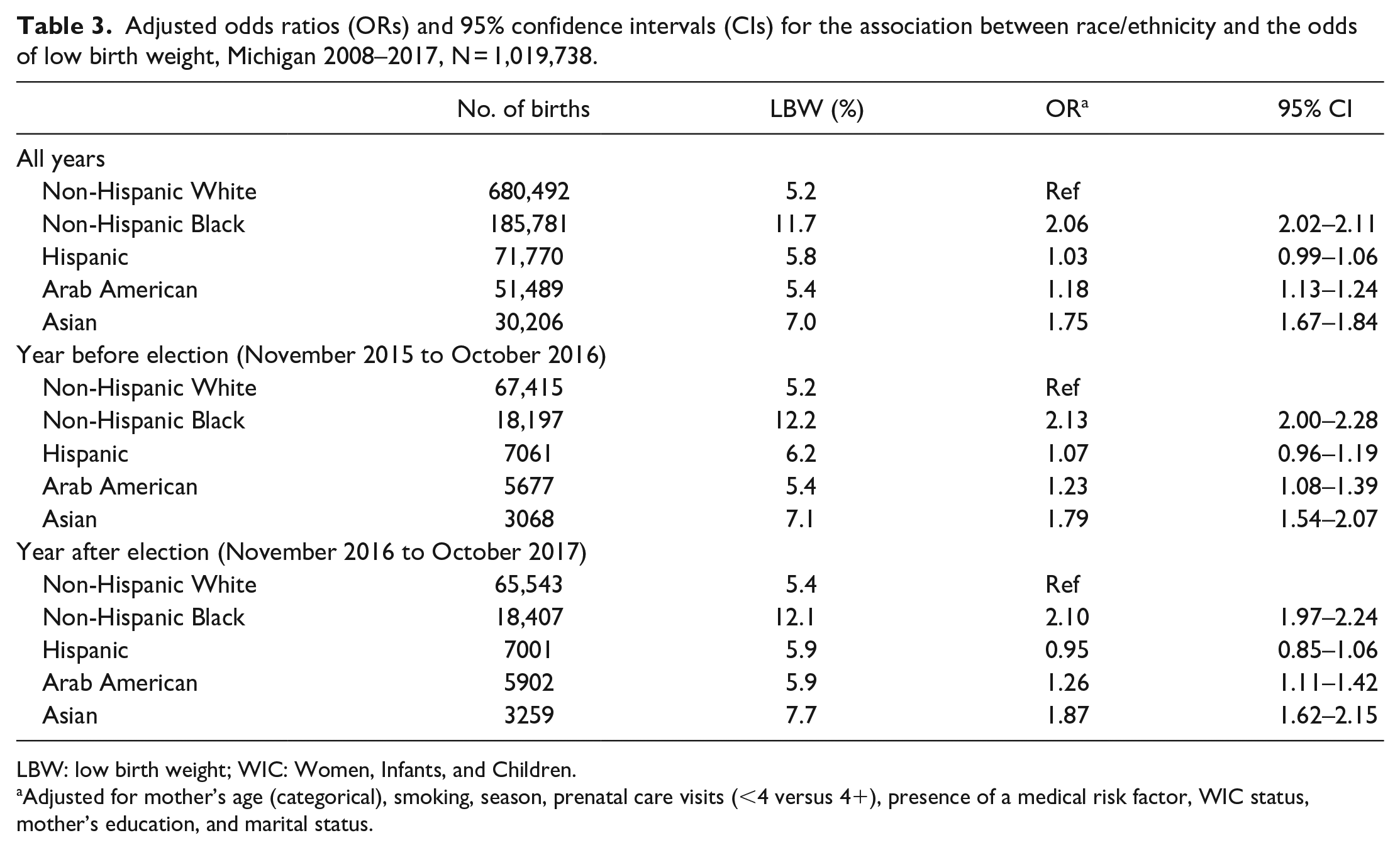
LBW: low birth weight; WIC: Women, Infants, and Children.
Adjusted for mother’s age (categorical), smoking, season, prenatal care visits (<4 versus 4+), presence of a medical risk factor, WIC status, mother’s education, and marital status.
Among mothers with 12 or fewer years of education, the odds of LBW were higher among non-Hispanic Black, Asian, and Arab American women compared to non-Hispanic White women, and these associations were stronger among mothers with more than 12 years of education (Table 4). The p value for interaction was statistically significant for each race/ethnicity.
Odds ratios (ORs) and 95% confidence intervals (CIs) for the association between race/ethnicity and the odds of LBW stratified by education, Michigan 2008–2017, N = 1,019,738.

LBE: low birth weight; WIC: Women, Infants, and Children.
Adjusted for mother’s age (categorical), smoking, season, prenatal care visits (<4 versus 4+), presence of a medical risk factor, WIC status, and marital status.
Discussion
In this population-based study of singleton births in Michigan, the odds of having a low-birth-weight infant were higher among non-Hispanic Black, Asian, and Arab American women compared to non-Hispanic White women. This association persisted even after accounting for potential confounding factors. The association was similar before and after the 2016 presidential election and stronger among women with higher levels of education.
Several studies have examined racial/ethnic differences in birth outcomes,1,5–10,12–15,25,26 with a focus on Arab American women,5,7–9,12 and a few have examined whether the stress of the 11 September 2001 attacks6,12 or presidential elections13,14 play a role.
Two prior studies examined whether the September 2001 terrorist attacks were associated with higher odds of LBW among Arab Americans. A study based in California 11 reported that Arab Americans, but not other groups, experienced higher odds of LBW following the attacks, whereas a study based in Michigan 3 reported no differences in LBW in the year following the attacks compared to the same 6 months in the previous calendar year. This is consistent with our study results showing that the frequency of LBW among Arab Americans in Michigan was similar before and after the 2016 presidential election.
In addition, two recent studies examined whether the 2016 presidential election is associated with preterm birth. One national, population-based study found that Latina women were more likely to have a preterm birth after the election relative to before the election. 13 The other study found that the rate of preterm birth among women living in New York from the Middle East and North Africa was higher after the 2016 inauguration compared to before the inauguration. 27 Neither of these studies examined LBW, so our results could not be directly compared. However, we speculate that like California, Arab American women who live in New York may not live in as densely populated ethnic enclaves as they do in Michigan. Therefore, both the study in California and New York found differences in birth outcomes after a significant event, whereas our study, where Arab Americans are densely populated, did not find a difference in LBW when comparing the times before and after the 2016 presidential election.
In addition to sociopolitical stressors, education also influences LBW. In a meta-analysis, higher maternal education was protective against LBW, 28 but we found that the differences in LBW were stronger among women with higher education. Future studies should explore the interactions between ethnicity, education, and LBW.
Community-based organizations such as Arab Community Center for Economic and Social Services (ACCESS) 29 were formed to address the social, economic, health, educational, employment, and other needs of Arab enclaves. ACCESS provides assistance and outreach to the ~350,000 Arab Americans who live in Detroit and surrounding neighborhoods. ACCESS is an example of how an organization can help an ethnic enclave to buffer some of the stressors that may negatively affect health by providing resources such as social support, health care, and education.
This study had strengths and limitations. One strength is that we used a validated surname list and 10 years of data for a sufficient sample size and to observe changes over time. We also used the most recently available data and compared Arab Americans to not only Whites but also other racial and ethnic groups. Although 10 years of data were analyzed, a limitation may be that we needed data beyond 2018 to observe an association between presidential elections and LBW by race/ethnicity, especially given the political events that occurred from 2019 to the beginning of 2021 surrounding the response to the 2020 presidential election results and the days leading up to the inauguration of Joe Biden in January 2021. Another limitation is that the dataset did not include variables about self-perceived discrimination, other stressors, or acculturation, which also may affect the association between LBW and Arab ethnicity.
Conclusion
This is the first study to estimate LBW among Arab American women in the context of political events. Future studies might examine this association using qualitative methods to better understand the influence of political events on maternal and child health among Arab American women.
Supplemental Material
sj-docx-1-whe-10.1177_17455057231178118 – Supplemental material for Politically related stress and low-birth-weight infants among Arab, Asian, Hispanic, non-Hispanic Black, and non-Hispanic White women in Michigan
Supplemental material, sj-docx-1-whe-10.1177_17455057231178118 for Politically related stress and low-birth-weight infants among Arab, Asian, Hispanic, non-Hispanic Black, and non-Hispanic White women in Michigan by Florence J Dallo, David R Williams, Julie J Ruterbusch, Murray A Mittleman, Kwame S Sakyi, Elizabeth Mostofsky, Asmaa Rimawi, Xianggui Qu, Todd G Reid and Kendra Schwartz in Women’s Health
Footnotes

References
Supplementary Material
Please find the following supplemental material available below.
For Open Access articles published under a Creative Commons License, all supplemental material carries the same license as the article it is associated with.
For non-Open Access articles published, all supplemental material carries a non-exclusive license, and permission requests for re-use of supplemental material or any part of supplemental material shall be sent directly to the copyright owner as specified in the copyright notice associated with the article.
