



Abstract
This study investigates the way(s) teachers and students from international degree programs at a Finnish university negotiate the roles of languages in the internationalisation of higher education and the interplay between interculturality, language and identity in relation to such roles. The data include focus group discussions with teachers and students, students’ online forum entries and group discussion reports. The participants assigned contradictory and fluid roles to languages for ‘doing’ interculturality, including: English as full or partial enabler; Finnish as (in-)dispensable; Other foreign languages as hindrance. The authors identified potentially problematic identities such as ‘partial speakers’ and ‘owners’ of Finnish. The participants who displayed a specific form of open-ended interculturality tend to perceive the fluid or partial roles of languages and identities, which exposes a greater complexity of multilingualism. The authors recommend universities to promote a common but diverse ownership of languages to encourage stronger internationalisation.
Keywords
Introduction
The internationalisation of Higher Education (HE) in non-anglophone countries has generated the use of multiple languages for communication both in and out of the classroom among teachers, international students and local 1 students (all referred to as ‘actors’ in the paper). Some countries such as Finland (Northern Europe, European Union, approximately 5.5 million inhabitants) have opted to use English as a medium of instruction in international programs (Ota, 2018; Rose and McKinley, 2018), often alongside local language(s). The expansion of English in Finnish education could perhaps be connected to generally high levels of fluency in this language among the population since, according to Peterson and Beers Fägersten (2024), Nordics are among the most proficient (‘non-native’) English speakers in the world.
Although the use of English in international programs in the Nordic countries has increased in the last decades (Wächter and Maiworm, 2014), it is not new. English has been promoted by the American and British governments worldwide since the 1940s with the aim of expanding their influence in e.g., Europe (Phillipson, 2017). English started to be used in university teaching-learning in Finland in the 1990s and its status was ratified in 2004 through the renewed University Law (Saarinen, 2012). Although HE institutions in Finland have mainly been officially monolingual Finnish, Swedish (Finland’s two official languages) or bilingual Finnish-Swedish, the legislative reforms have allowed institutions to add other languages more freely than in other countries (Saarinen and Taalas, 2017; Ylönen, 2014). Adopting English served, among others, the objective of internationalising Finnish HE through facilitating the mobility of local students and attracting international students and faculty (MoEC, 2009). It is relevant to point out that attracting international students relates to the Internationalization-at-Home goal of developing intentional intercultural learning among international and local students (Nilsson, 2003), who can engage by using local and foreign languages. In this study, we adopt Dervin’s (2024) understanding of (glocalised) internationalisation of higher education as a concept that is understood differently across contexts because it is influenced by global and local discourses, ideologies and ways of putting it in practice by means of English and other languages.
In the Finnish context and in countries where English is adopted as a medium of instruction for international programs, universities have encountered some language challenges in their process of internationalisation. For instance, several studies have described concerns about some teachers’ proficiency in English (see Tuomainen, 2018) and difficulties for international students to learn Finnish (Mathies and Karhunen, 2021), which seems to create intercultural imbalances between local and international students and teachers in English, Finnish or both languages. Other studies have identified challenges with tensions between Finnish and English in HE (Darling, 2021), English and other languages (Dervin and Hahl, 2024), limiting the use of students' and teachers' own languages to communicate in HE (Darling and Dervin, 2023). In other contexts, researchers have examined competing identities related to the local language(s) and English (see Gu and Lee, 2019; Larrinaga and Amurrio, 2015).
Although research has been done on internationalisation and its relation to languages and identities as well as language and interculturality, the focus on the explicit interplay between all these factors is still underexplored in the literature. We argue that problematising and analysing these three interconnected and often interchangeable concepts (interculturality, identity and language) together can help us understand further dynamics of inclusion/exclusion and equality/inequality in HE (Dervin and Jackson, 2018). Thus, the present study aims to investigate the way teachers and (local and international) students perceive and negotiate the roles of languages in the internationalisation of HE and specific types of interplay between interculturality, language and identity. We also maintain that this approach can enhance our understanding of implicit and sometimes ignored inclusions and exclusions caused by multifaceted and contradictory voices about multilingualism, identity and interculturality. The research is guided by the following questions:
How do students and teachers negotiate and (re-)position the roles of different languages for ‘doing’ interculturality within internationalisation in HE?
What kind of interplay between interculturality, language and identity emerge in the discourses related to the identified roles?
Literature review section
The interplay between (solid-liquid) interculturality, language and identity
Studying the interplay between interculturality, language and identity in the internationalisation of HE opens different doors to understanding how individuals engage in intercultural encounters (Baker, 2016). To begin, it is important to highlight that we understand ‘culture’ as the result of individuals’ creation and negotiation of meanings in their interactions (Holmes and Dervin, 2016), which is complexified by specific socio-economic-political and ideological contexts and power differences (among other things, see Dervin, 2025). Secondly, it is important to establish that the concept of interculturality is not fixed and it has been understood and approached in different ways by researchers and educators in different parts of the world and in different languages. In what follows, we first define diverse approaches to interculturality (named solid and liquid) and its relation to language and identity, followed by the authors’ positioning.
Dervin (2011) proposed a critical and constructivist approach to interculturality that he called liquid, inspired by the sociologist Zygmunt Bauman and his paradigm of liquidity and solidity to describe European modern and postmodern times, respectively (Bauman, 2004). We adhere to the liquid approach to interculturality here that consists of the dynamic interplay between knowledge, society and intersubjectivities (Dervin, 2011). We adopt the conceptualisation of intersubjectivities from Gillespie and Cornish (2010) as the variety of relations between perspectives from individuals, groups or discourses, which can be implicit or explicit. This leads to participation in relationships creating identity (Julé, 2003). In contrast to liquid interculturality, Dervin (2011) also proposed but not adhered to a solid approach. Although this perspective of interculturality (solid interculturality) has been highly criticised, some researchers have adopted an essentialist, ‘solid’ large cultures approach when they explore interculturality. This approach aims to describe and separate, for example, ethnic or national groups to explain and predict their behaviours and attitudes (Holliday and Macdonald, 2020). The solid approach is linked to an acculturation view that individuals can swing back and forth between and perform ‘cultures’ (often viewed as static national entities and characteristics) leading to what is said by individuals taken as the only and absolute truth of their reality (Dervin, 2011). We recognise and accept that individuals can use solid identities to adapt or distance themselves from others and vice versa (Dervin, 2009). The potential lack of criticality of this solid approach might not consider the construction and performance of, for example, cultures and identities, which are linked to a given context and the negotiation among, for example, individual and institutional discourses. It is crucial to stress that this approach often disregards the influence of language(s) on individuals’ intercultural interactions (Dervin, 2009).
Shifting the focus to the contemporary theorising of globalisation claims that the notion of national identity has debilitated (Blasco, 2003) – an argument which closely matches the approach of liquid interculturality. Instead, the concept of ‘global culture’ is said to have arisen and does not have ties with any specific place or period of time (Ladegaard and Jenks, 2015). The growing interconnectedness of individuals from different contexts is also viewed as having led to ‘a world of sameness’ and the death of cultural diversity (Hannerz, 2001), which resembles the approach of solid interculturality through an essentialised view of a ‘global culture’ where uniformity and detachment from a specific context and time is the norm. This approach to interculturality appears faulty as it does not consider the negotiation of individuals’ practices with others in their daily intercultural encounters in a globalised and diverse world. We note that it cannot but make what they do and say together diverse, see hyperdiverse (Dervin and Tan, 2022; Ladegaard, 2007; Ladegaard and Jenks, 2015). Furthermore, Holmes and Dervin (2016) point out that it is crucial to understand how language in communication is influenced by histories, geographies, forms of languages, religions/worldviews, multiple identities, social classes, economics, power and belonging (amongst others), which influence people’s intersubjectivities. Moreover, Holmes and Dervin (2016) argue that we need to consider how political, economic and organisational structures (such as universities) can prefer and promote (a) specific language(s).
In sum, we adhere to Dervin’s (2011) liquid approach and we expand our understanding of interculturality in this study as the ‘never-ending process of encounters between people of different origins, nationalities and languages (amongst others), whose ideological worlds, mediated through complex [multifaceted] languages, need to be renegotiated to cross over to each other when they meet… Interculturality is as complex, unpredictable and uncontrollable as humanity and sociality themselves’ (Dervin, 2023a: p. 9). Interculturality also focuses on the multifaceted relation to intersubjectivity and interactional/economic-political contexts (Dervin, 2023a, 2025; Lavanchy et al., 2011), which results in and connects to identities being (partly) negotiated through languages. We find important to stress that we conceive of identities and languages as intrinsic parts of interculturality, thus (at times) resulting in these concepts being interchangeable. Nevertheless, it is important to understand the role of language and identity through diverse approaches to interculturality.
As for the Western concept of identity, it has been conceptualised in diverse ways in research. For Dervin and Jackson (2018) an individual’s identity (ies) correspond(s) to unstable processes that are not always in control of the speaker as it is influenced by elements such as the context, ethnicity, nationality, gender, social class and the way individuals are shaped by the language(s) they speak (amongst others). The authors also argue that identity can result in conflictive and unequal power relations, which can lead to discrimination. These identities continue evolving through linguistic performances in their contact with others in given communities (Dervin and Jackson, 2018). Therefore, it is crucial to identify how identity is (per-)formed through mechanisms such as indexicality, which relies strongly on associations between language and identity. These elements are firmly established in beliefs about the type of individual that speak a language with certain characteristics such as accent or grammatical structures (Bucholtz and Hall, 2010). For Bucholtz and Hall (2010), indexical processes happen at all levels of linguistic structures that produce identity discursively. Nevertheless, identity is negotiated, which implies that speakers need to negotiate the way they want to be perceived by avowing an identity as well as their counterpart needs to grant or contest such identity (-ies) (Kim and Ebesu Hubbard, 2007). An individual can use a specific language, dialect, sociolect or communication style as a powerful way to perform the identity they wish to project (Dervin and Jackson, 2018). Finally, it is important to note that identity is also co-constructed by ascriptions, which are defined as characteristics that are assigned to a group by other individuals (Collier and Thomas, 1988). According to Dervin and Jackson (2018), some of the elements that can influence ascriptions can be the language(s) individuals use, accents, ethnicity and communication style (among others). The term ‘contested identity’ describes situations where elements of an individual’s identity are not (fully) accepted among the people they are interacting with.
In short, in this paper, our understanding of identity is as an unstable process influenced by languages and other elements, which need to be negotiated among individuals (Dervin and Jackson, 2018). For example, when teachers, international and local students meet in Finnish HE, they negotiate implicitly or explicitly identities and the roles of languages. This perspective on identity is in line with our take on liquid interculturality.
The multifaceted and contradictory roles of multilingualism and identity in the internationalisation of HE
Substantial research has focused on the uses of Finnish official academic language(s), for example, Finnish and Swedish, along with English as the language used for the internationalisation of HE (Saarinen, 2012; Saarinen and Rontu, 2018). In Finland, English has been described as synonymous with foreign languages, possibly implying the institutional willingness to promote other languages (Saarinen, 2012). Saarinen (2012) pointed out that using English as a synonym for foreign languages might be caused by the unwillingness to address the importance of English in HE and its potentially detrimental effects on other languages. In relation to this, a study of the language policies in the 13 Finnish universities found that only the University of Helsinki explicitly addressed the fact that the increased influence of English as a foreign language could be detrimental for the first and other languages of their users (Ylönen, 2014).
English is the medium of instruction of international programs in Finland and it is also often used to communicate between teachers, local and international students (referred to as actors in what follows) outside the classroom. It is necessary to consider how the use of languages is influenced by the interplay of power positions among the actors and the identities individuals perform when using these languages in interaction (Otsuji and Pennycook, 2010; Risager, 2016). Previous studies found that English and other languages play different roles in the internationalisation of HE based on language policies, national languages and the linguistic repertoires of the actors (Lau and Lin, 2017; Ylönen and Kivela, 2011). In this paper, we adopt the traditional definition of first languages (L1) (see Risager, 2016) as those that were used at home, school or other environments in the early stages of life. We understand second languages (L2) as languages learned later in life (Mauranen, 2018). Nevertheless, we acknowledge that these definitions of L1 and L2 might be a bit mechanical because languages are seen as separated. Furthermore, this approach does not necessarily consider how identity and interculturality influence speakers’ perceptions of what they consider to be their L1 or L2 languages and if others approve of them as ‘authentic speakers’ of these languages.
In the context of internationalisation of HE, most of the studies we found around language and identity addressed interculturality in an implicit manner and fewer do it in an explicit way using approaches such as Dervin’s (2011) solid and liquid interculturality. The following selected studies published internationally have dealt with issues around the roles of language, the connection between language and identity as well as the relation between language, identity and interculturality. In the very specific context of our paper, Finland, Lindström and Sylvin (2014) studied the perceptions of local students and staff members as regards majority and minority languages and English in Finnish HE. The findings revealed that some staff members found tensions between the language policies and the linguistic practices needed to support different types of fields of study. They reported that international staff are expected to learn a local language within 3 years, but this does not often materialise as English is used between them and locals (and institutions do not follow-up on their progress or use learning local languages as criteria for e.g. promotion). Darling (2020) focused on international students’ perceptions of the language ideologies at a Finnish university. She found that the students perceived that their university supported the development of their language proficiencies in English as the academic language, Finnish as L2 for (societal) integration purposes while other languages were perceived as a ‘hobby’. In addition, most of these international students had not considered using their other languages in HE. In another study, Darling (2021) identified that teachers recognised and encouraged the use of international students’ languages in teaching situations in HE. Some of these teachers considered Finnish a disturbance from international students’ studies, while others considered it a bridge to gainful employment and efficient citizenship. Finally, some of these teachers considered that English might be a threat to the national languages. In a very different and larger context, mainland China, Ou et al. (2023) found that, although university policies supported the use of English to teach in the classroom, students used different languages in their intercultural encounters based on the linguistic repertoires of the actors participating in their interactions. Nonetheless, some students attempted to use Chinese with their instructors, which was denied by the latter because it was against the policies.
Research on the relation between language and identity in other Chinese contexts (Gu and Lee, 2019) identified that local students in English medium programs displayed ambivalent identities related to languages. Some students perceived their identity as a ‘grind’ and ‘elite’ when using Chinese as a medium of instruction, and as ‘someone without sufficient language and content knowledge foundation’ when taking courses and studying teaching materials in English. In the Basque-Spanish context, Larrinaga and Amurrio (2015) examined teachers and researchers’ identities in the local Basque and national Spanish language, as well as in English. Some older participants displayed a professional identity as ‘pioneers and loyal to the Basque language’, while younger participants had a ‘professional bilingual identity that integrated Basque and Spanish’ for teaching. Finally, Akkakoson (2019) found that local students in international programs in Thai HE, did not consider English a main determinant of their identity as they did not have a sense of ownership of this language. Instead, they considered that their national language boosted their own identity.
In another paper about the Chinese context, Ou and Gu (2021) identified unbalanced power relationships between local and international (‘native-English-speaking’) students. The first were in a ‘vulnerable’ position as L2 English speakers in intercultural communication in front of the latter, which was justified as a natural relation caused by the imagined identity they gave to ‘all’ international students as ‘native’ or ‘almost native English speakers’. Furthermore, the researchers identified that intercultural encounters facilitated a reciprocal socialisation in Chinese and English among internationals and local students, which allowed locals to construct a ‘multilingual Chinese identity’ and a door for interculturality. In the Japanese context, Hori et al. (2025) observed that some international students constructed diverse identities such as ‘multilingual identities’ through Japanese, English and Mandarin, reflecting solid and liquid approaches to interculturality. Interestingly, one participant stated that ‘non-Asian’ students were perceived as speakers who could not pronounce Japanese correctly and they were mocked by others. Another participant mentioned that English labelled international students as ‘foreigners’ and Japanese positioned this participant (a non-speaker) as a ‘receiver’ of the power this language gave to its ‘users’ (speakers of Japanese). Lastly, in the South African context, Parmegiani (2010) found that some local university students did not consider having an identity as ‘owners of English’ as it was affiliated considerably by inheritance and in some cases by belonging to certain racial groups. Some students considered that English gave them a higher level of expertise when writing an assignment and helped them to move through socio-economic rankings, which created power relations between L1 (owners of English) and L2 English speakers in regard to academic and economic success.
The findings of these selected previous studies identified the roles of multilingualism, the relation between language and identity, and their influence in power relationships among speakers in diverse contexts. Although this is not directly related to the topic of this paper, the burning issue of (post-) colonialism is evident in the treatment of English in many of the aforementioned contexts of study.
Method
This qualitative case study analyses the discourses of actors from the context of English international bachelor’s and master’s programs at a Finnish university (see Zhou, Y. & Creswell, 2012). The students and teachers from the international bachelor’s program had frequent teaching-learning interactions inside and outside of the classroom. The students from the international master’s programs took part in an introductory course that covered the themes of integration in higher education, academic culture and career planning. Author 1 served as an instructor in the international bachelor’s program as well as in the introductory course of the international master’s programs.
Data and research participants
Information about data sets.
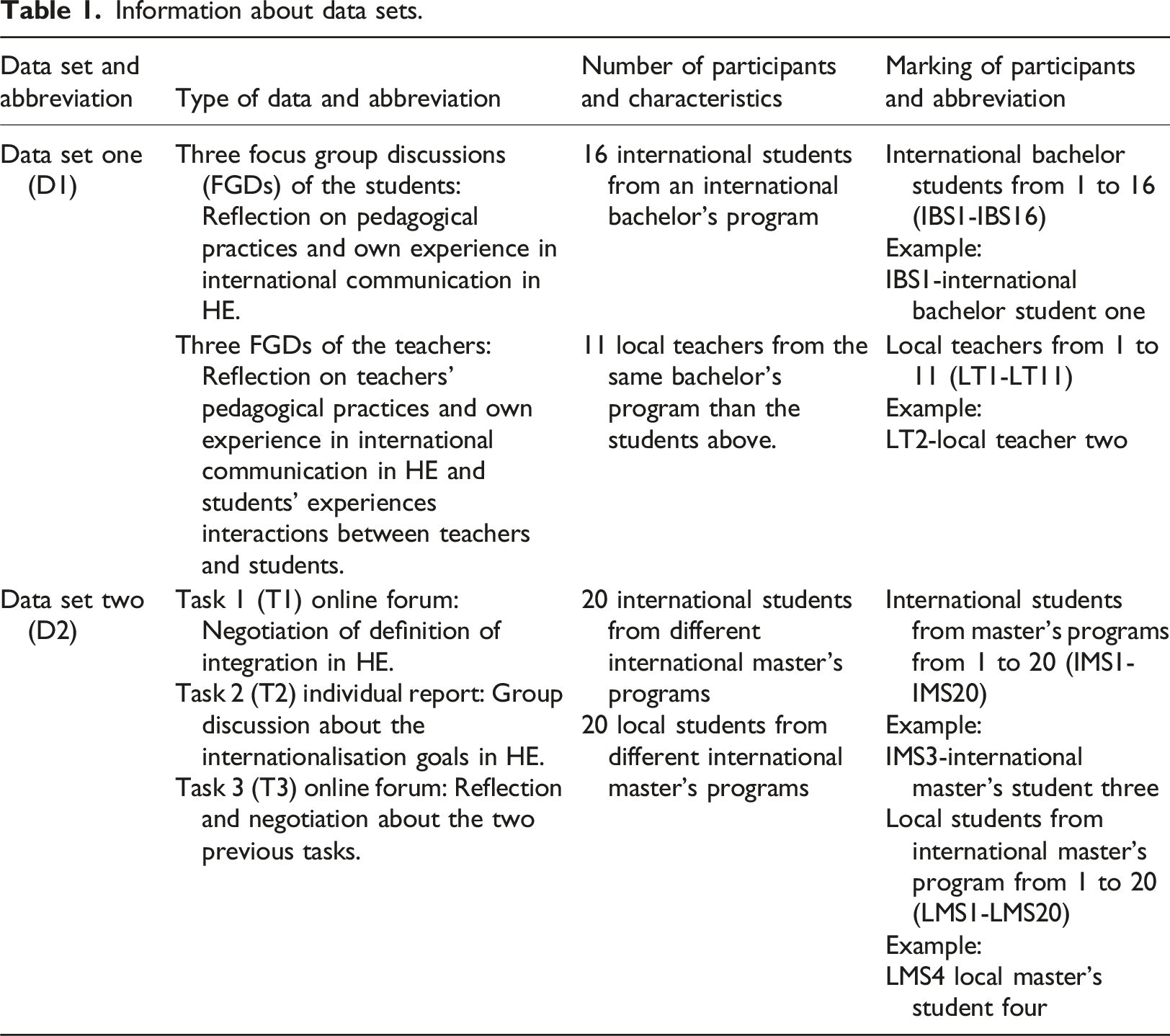
The second set of data (D2) contains three sets of materials (tasks) from 40 master’s students who self-identified as ‘international’ or ‘local’ students: The first task (T1) consisted of writing an entry in an online asynchronous forum where students had read and reflected on the definition of integration proposed by the UK Council for International Student Affairs (Spencer-Oatey et al., 2014). Then, students negotiated their understandings of this concept through comments on each other’s posts (40 posts). The second task (T2) was an individual report from online group discussions among five students where they discussed the university’s internationalisation goals, which included language goals (40 reports). The third task (T3) consisted of students’ written reflections and online asynchronous discussion with peers around the concept of integration and the internationalisation goals (40 reflections).
Table 1 presents the two data sets, types of data, number of participants and characteristics, marking of participants and abbreviations.
Data analysis
The FGDs of the actors of D1 were done in English, recorded and transcribed verbatim. The word length of the students’ FGDs was around 2500 words in total, while the teachers’ FGDs consisted of around 4400 words. D2 was based on three tasks that were written in English over a period of 1 month and divided into two groups (local and international masters’ students). As such we did not look for connections between tasks from D2 as produced by a single student. Instead, we analysed each task independently as snapshots of dynamic interactions among students in a specific context and moment in time. D1 and D2 were analysed independently through qualitative coding, which consisted of becoming familiar with the data and coding in numerous cycles to identify themes (e.g. Braun and Clarke, 2013). We did not aim to identify the more widespread discourses about the roles of languages. Instead, in this paper, we aim to explore diverse discourses about the roles of language and their connection with interculturality and identity in relation to internationalisation.
After identifying preliminary themes through the qualitative exploration of the data, we applied discourse analysis by means of enunciative pragmatics, which allowed us to find, for example, subjective constructions of arguments, implicit contradictions and/or omissions within the themes. These insights were also carefully discussed and negotiated among the three authors. Enunciative pragmatics adds more levels to data analysis as it considers the ways actors are called into ‘play’ or are (re-)positioned through the markers of enunciation that they use in a given statement (referred to as utterance), for example, how they mark their utterances with subjective markers that can inform us of the way language processes their complex and contradictory identification (Angermüller, 2011). These markers correspond to the processes that a given participant displays explicitly or implicitly in a particular context and time and are composed by several speakers (‘locutors’) and one author (‘enunciator’). According to Angermüller (2011, p. 29), ‘the locutor and the enunciator are discursive beings who belong to the utterance and cannot be anchored in a speaking subject or in one individual out there in the world’. The author (enunciator) is visible through markers of enunciation such as I, we, and the speakers (locutors) are the voices of other individuals or a specific institution visible through markers such as they, one or the use of the passive voice (Ducrot, 1984). Moreover, the absence of these markers in a statement is also considered as discursive strategy used for a specific purpose that needs to be considered by researchers too (Jia and Dervin, 2022). For example, as we shall see, in excerpt 1 below the author (‘enunciator’) of the utterance ‘…if one wants to start to integrate…’, which contains the unidentifiable marker and voice ‘one’, seems to include and repeat discourse of his institution (locutor) to justify the position of the Finnish language for the integration of international students. In the following analysis the use of enunciative pragmatics is only apparent in the cases where it supports revealing discourses that are not easily identified through a simple thematic analysis. We note that Enunciative pragmatics has been used extensively in the analysis of liquid interculturality by Dervin and his colleagues in relation to internationalization of higher education (e.g. Jia and Dervin, 2022).
The process to explore D1 and D2 as well as to decide the final designations of the themes entailed several rounds of negotiation amongst the authors and some changes were made until meeting final agreement as shown in Figure 1. For example, the role of English was first named through qualitative coding: ‘English and Finnish are equally important’. Excerpt 1 from D1 (see the ‘Results’ section) belonged to this theme and it was first coded under ‘English is not a problem’ and ‘Finnish is the key’. The authors noticed ambivalent perspectives about language in this utterance and marked it with a label ‘contradiction’. While combing the data, we identified utterances from D2 (e.g. excerpt 4) that were labelled under similar themes such as ‘opposite discourses’, which helped us to comb the data and rename the roles of English as a ‘full’ or ‘partial’ enabler for doing interculturality. In Figure 1, the two side arrows point out to the back and forth between qualitative coding and enunciative pragmatics as well as between the roles of language, solid-liquid interculturality and identity, which provided the results indicated with one sided arrow (e.g. ↓). Description of the process of analysing and combing the two sets of data.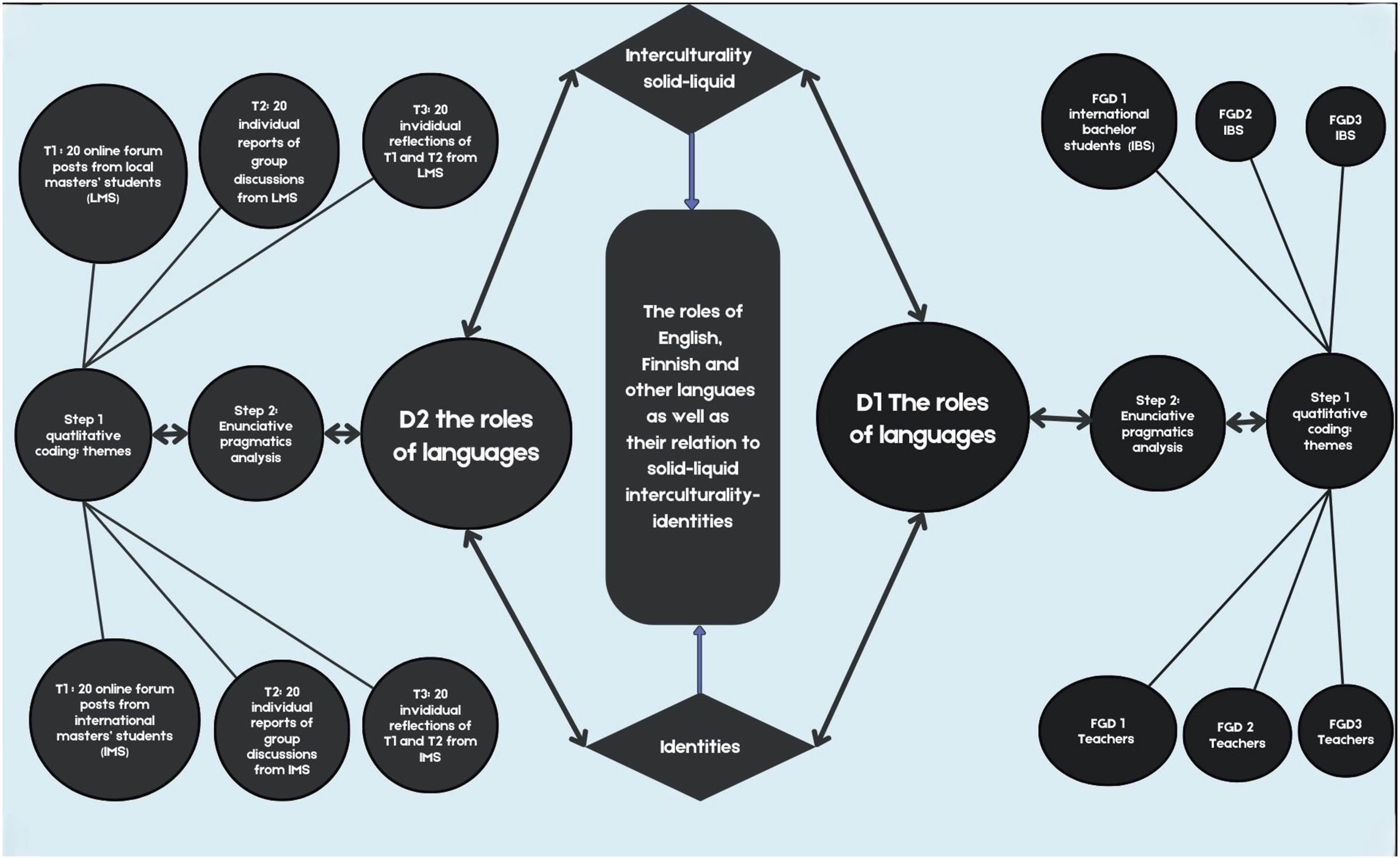
Results: The interplay between interculturality, languages and identity in relation to the roles of languages for ‘doing’ interculturality
This section presents the main findings organised under the aforementioned main thematic headings (i.e. the roles of English, Finnish and other languages and their relation to solid-liquid interculturality and identities). The themes encompass the roles of the different languages (RQ1) as well as the interplay between interculturality, language and identity (RQ2).
English as a full or partial enabler: Identities as ‘proficient L2 speakers’ and ‘non-native speakers’
The role of English for doing interculturality within internationalisation in the Finnish HE context is intrinsically linked to Finnish and other languages. In this section, some excerpts address the roles of different languages, but we will focus now solely on the role of English, and its relation with interculturality and identity, bearing in mind that we need to compare it with other languages. Although some participants assigned English the role of ‘full enabler’ and others as ‘partial enablers’, some students contradicted this role even within their own discourses: Excerpt 1, D2, T1, IMS20: Finnish language and culture (!) courses are key if one wants to start to integrate, even within the university. Though only knowing English is no problem inside and outside the university, knowing Finnish at a conversational level will open many doors here and beyond-especially in the workplace.
This international student (IMS20) contradicts himself by presenting first the discourse that learning Finnish language and culture is of crucial importance to integrate in HE to later positioning English as a language that ‘fully enables’ speakers to achieve their integration in the university and in Finnish society (see in the excerpt: no problem inside and outside the university). In this utterance, the student (enunciator) is borrowing a discourse from the institution (locutor) by using the indefinite pronoun ‘one’ that refers to international students who need to learn Finnish to integrate (Angermüller, 2011). IMS20 also removes himself from the second statement by not using any personal pronoun (e.g. I or we), which indicates that he might be using discourses from other speakers who give English its role as a full enabler for doing interculturality in relation to integration and internationalisation. These two contradictory discourses seem to battle with each other although this participant seems to prefer the voice that repositions English as a ‘partial enabler’, by stating at the beginning and at the end of excerpt 1 the importance of knowing Finnish in HE and in the workplace in Finland as it is stated by the institution in their internationalisation goals (see: open many doors).
Let us now examine in the next quote the connections between identity and interculturality behind the fluid role of English as a ‘full’ or ‘partial’ enabler for doing interculturality: Excerpt 2, D2, T1, LMS17: Learn some Finnish [talking to an international student]. You may have noticed that most Finns do speak and understand English (when they speak), but they are more likely to welcome you with open arms, if you greet them or thank them in Finnish (specially elderly people)…
LMS17 maintains that although many Finns speak Finnish and English, the latter language has a less positive affective value for them (see in the excerpt: open arms, thank them in Finnish). Furthermore, this participant identifies and categorises elderly Finns, who are said to have a more affectively distant relation when using English with ‘others’ than the implicit and opposite ‘younger Finns’ (Angermüller, 2011). The identification of plural identities of Finns in relation to the attitudes and behaviours using English could align with a liquid approach to interculturality (Dervin, 2011). This approach consists in Finns having both similarities and differences, which results in diverse identities (elderly vs young) with different levels of affective use of English and Finnish, beyond uniformism and potential essentialism in relation to their use of language. We note however that, by subcategorising the Finnish population, essentialising is still taking place (the youth, the elderly). The role of English for interculturality in this student’s excerpt is also a ‘partial enabler’ because although most Finns speak English, they are said not to welcome international students equally well in English than in Finnish.
Moreover, some teachers question the role of English as a ‘partial’ or ‘full’ enabler based on the foreign accents that teachers and students have: Excerpt 3, D1, LT6: … in the first lecture I have to lay down some ground rules… “yeah we come from different cultures but there are certain things that you just have to understand”… because some of the [international] students have just so heavy accent. So, it is important to understand when they ask something … “don’t get embarrassed or panic if I asked the fifth time”… LT5: Does it work the other way around as well that the student will have difficulties understanding the Finnish accent? LT6: Ahhhh...I don’t know. I understood for other context such as Finnish accent is easy to understand for ... The way that Finnish people talk rallienglanti [referring to the type of English that rally drivers use when they are interviewed by the media] it is easy to understand. It doesn’t sound nice, but it is easy to understand…
LT6 maintains that he makes sure (see I have to lay ground rules in the excerpt) that his students are aware that English is a ‘partial enabler’ to do interculturality when some of them ask him something. This participant might be implying that the international students’ foreign background (see we come from different cultures) and languages impact the way they speak English (see students have…heavy accent), which influences communication. This enunciator displays ownership and necessity in this utterance through the personal pronouns of ‘I’ and ‘we’ and the verb ‘have to’ (Angermüller, 2011). LT6 asks the students to avoid feeling overpowered by the teacher’s request to repeat (see embarrassed-panic), which can be connected to liquid interculturality (Dervin, 2011) because the teacher acknowledges that students’ other languages and cultures can have some bearing on the role of English as a ‘partial enabler’ when the students talk to him. Interestingly, when LT5 questions the possibility that international students face difficulties understanding the Finnish accent when LT6 speaks English, teacher 6’s response is that he has never questioned the students about this possibility (see I don’t know). This indicates that problematizing English as a ‘partial enabler’ is only unidirectional, from the students to the teacher and not contrariwise. LT6 continues answering by stating that he understood for other contexts that the Finnish accent is easy to understand for international students, which is a discourse from locutors from outside HE (Angermüller, 2011). LT6′ discourse implies that English is a ‘full enabler’ when it is spoken by teachers with a Finnish accent (solid interculturality). In this excerpt, LT6 indicates the unidirectional and fluid role of English as a ‘partial’ or ‘full’ enabler depending on the heavy accent of some students or the understandable Finnish accent of the local teachers.
In the previous excerpt we also note that LT6 mentions and agrees with the notion of ‘rally English’ (see rallienglanti), which was inspired by the ‘shameful’ way of speaking English by Finnish competitive rally drivers with a distinctive Finnish accent (see doesn’t sound nice in the excerpt), but that seems to be gaining acceptance (see is easy to understand) in Finnish contexts (Peterson, 2022). The notion of rally English might help LT6 to claim a solid identity (Dervin, 2009) as ‘proficient L2 English speaker’ in international HE programs where the Finnish accent can be understood by all international students without problems or need for adaptation (solid interculturality). In sum, in this excerpt, LT6 might imply that the difference between ‘proficient L2 speakers’ and native speakers of English is only the Finnish accent, which in this case it is seen as a facilitator for doing interculturality between teachers and students.
In the quote below, an international bachelor student illustrates the interplay between language, identity and liquid interculturality, which is connected to the fluid role of English as a ‘full’ or as a ‘partial enabler’ for doing interculturality between students and teachers as follows: Excerpt 5, D1, FGD, IBS8: about educational synergy between the student and the teacher that they talked about requires reactive communication between the student and the teacher which… may or may not be possible to a full extent in the real world especially in the international context. It is like sometimes hard for people to, you know, communicate with each other… even like communicating in a language that is clear but that is not the mother tongue of either of the speakers.
For IBS8, successful collaboration between actors (labelled as synergy in the excerpt) requires negotiation of interculturality (see: reactive communication), which aligns with the notion of liquid interculturality (Dervin, 2011). For IBS8, this negotiation is a more difficult process in an international program where students have diverse backgrounds, languages and nationalities (international context) than in a Finnish bachelor’s program. For this participant, the success of such negotiations might be fully possible at times, while other times is possible only partially (see: may or may not) because although students and teachers use English with clear accent or grammar as L2, this language might be at times influenced by other factors when speakers have it as L1 (see: is clear but that is not their mother tongue). The role of English as a ‘partial enabler’ might arise from the students’ and teachers’ identity as ‘non-native speakers’ who are not owners of this language and might not be able to communicate ‘fully’ in this language. Similar results were found in Akkakoson (2019), where Thai students identified English as a language for communication but did not have a sense of ownership over it as it is often considered to belong to ‘native speakers’.
In a similar vein, some teachers also make a call to question the perception that English is always a ‘full enabler’ for doing interculturality: Excerpt 6, D1, LT5: Well, it might be a good idea to check in the very early stage of the course if you understood, if the students can follow your... language and the... LT6: Yeah
In this excerpt, LT5 recommends negotiating with students if English is a ‘full enabler’ when the teachers speak to them (see good idea to check). If students could not follow the English of LT6, it might imply that the teacher would need to adapt the way he speaks this language. In this excerpt, LT5 and LT6 open the door (see check-yeah) for the possibility that English is a ‘partial enabler’ when the teacher talks to the students and not only when the students talk to the teacher (see excerpt 3). This negotiation might balance the power difference between the students and the teachers when negotiating how to adapt when communicating in English, which relates to liquid interculturality (Dervin, 2011). The discourse of the teachers in excerpt 6 as well as the student in excerpt 5 connect with the liquid approach to interculturality that consists in conceptualising interculturality as unstable, changing and economically politically influenced negotiations and co-constructions between individuals with different identities (students and teachers) in their encounters (Dervin, 2023b).
Therefore, we argue that the interplay between the actors’ use of English, approaches to interculturality (solid and liquid), and their identities as ‘proficient L2 speakers’ who are able to communicate fully with a Finnish accent and ‘non-native speakers’ with more limitations to communicate beyond accent and grammar, relates to the contradictive, but more importantly, fluid roles of English as a full or partial enabler for doing interculturality in HE.
Finnish as an (in-) dispensable language (for doing interculturality): Identities as ‘owners’ and ‘partial speakers’
The role that the university under review assigned to Finnish was as the language that allows the integration of international students in HE – an element that was also identified in previous studies (see Darling, 2022; Shirahata and Lahti, 2023). Although many of the participants are in line with this institutional ideology, the language identities related to Finnish might play against the international students’ inclusion in HE: Excerpt 7, D2, T1, IMS5: Finnish language courses can be arranged to boost the integration process in education. Learning language is essential to integrate in a society and to understand their culture and values. It's a key to make a new friend in a new place because people are more comfortable with you when you speak to them in their language.
Finnish is perceived by IMS5 as an indispensable language (see: essential) for integration because it has a connection to the local culture and values, which are used to interpret accurately (understand) the locals’ behaviours and manifestations of ‘culture’. IMS5 constructs and links Finnish language, culture, values in a singular and essentialist manner (solid interculturality), which results in the intersubjectivity of Finnish identity. Moreover, for IMS5, locals are ascribed (Collier and Thomas, 1988) an identity as the owners of Finnish language through the possessive pronoun their (Angermüller, 2011), which relates to Hutton’s (2010) conception of the mother tongue-native speaker tradition. This tradition views language as the collective property of the native speakers who own their language and culture and also view the ownership of language as a close and systematic space (Hutton, 2010). To put it briefly, the role of Finnish for some international students aligns with the institutional discourse of Finnish as the language for integration. However, the identity they ascribed to locals as ‘owners’ of Finnish through a solid approach to interculturality might play against international students’ sense of power to use Finnish freely in diverse spaces and without boundaries. Some local students also imply their identity as ‘owners’ over the Finnish language and the identity of non-Finnish speakers as ‘outsiders’: Excerpt 8, D1, T1, LMS3: …take language courses (foreign students) to integrate more into Finnish society, culture and student culture. It is way easier to understand Finns and Finnish nuances by understanding the language.
In LMS3’s excerpt, we encountered the adjective foreign that comes from Old French ‘forain’, referring to ‘strange’ and the Latin foraneus ‘on the outside’. In French the word forain today refers to funfair travellers and showmen (who are often considered as ‘outsiders’ because of their mobile position, see Dervin, 2023b). In a subtle way, foreign students could be seen as a potential oddity for local students as they stand outside of Finnish society and student culture. Nevertheless, according to this participant, international students can boost their integration by speaking Finnish to perform a local identity (Dervin and Jackson, 2018). LMS3 also assigns Finnish an ‘indispensable role’ for integration and internationalisation of international students (foreigners) in Finnish society. This approach to interculturality could relate to the solid approach to interculturality (Dervin, 2011) whereby individuals can switch back and forth between and adopt separate essentialist depictions of cultures and identities (see Finnish culture… understand Finns…) and, in this case, Finnish is used as a vehicle to understand and ‘possess’ Finnish culture. Moreover, in this discourse we identify a solid approach to interculturality, which positions international students as foreigners (travellers) and ‘outsiders’, which are part of a large group with predetermined characteristics such as not speaking Finnish or not being ‘owners’ of the Finnish language that can create exclusions and inequalities in HE. To sum up briefly, although Finnish is considered by some participants as ‘indispensable’ for doing interculturality between local and international students, the latter might be identified as ‘outsiders’ with the potential to become Finnish speakers but not as ‘owners’ of this language (see Hutton, 2010; Saarinen, 2014).
Although it might be assumed that new international students are potential Finnish speakers as shown in the previous excerpt, some participants described their current use of the local language, and they report their struggles to be considered Finnish speakers: Excerpt 9, D2, T1, IMS7: The first thing that I would like to accomplish in this new endeavour [to integrate in HE] is to be welcoming to the new students…I have lived here for a few years now and have a little bit of an understanding of the city… will help with my integration to higher education is learning the language. I am looking forward to learning more words and phrases for everyday interactions…but I still struggle with everyday conversations…it will be beneficial to open up and immerse myself more in the Finnish language.
IMS7 avows an identity as a ‘partial speaker of Finnish’ (see learning more words and phrases…) although she has lived in Finland for a few years, which at the very least describes her contact with this language. It is noteworthy that this participant’s Finnish is not seen as a factor in welcoming other international students, and it seems to be reserved to be spoken only with locals, the ‘owners’ of Finnish. In fact, none of the international students planned or used Finnish as an L2 with similar others outside of the language classroom, which might relate to the perception of language as a possession and closed space for ‘native speakers’ (Hutton, 2010). Moreover, this enunciator (IMS7) owns this discourse (utterance) by using the pronoun ‘I’ (Angermüller, 2011) to point out the restrain and forceful nature (see I still struggle in the excerpt) of her encounters with locals using Finnish. This participant also highlights her lack of confidence (beneficial to open up), which leads to her struggles to avow (Kim and Ebesu Hubbard, 2007) a Finnish speaking identity. Nevertheless, it is necessary to consider several factors that might influence other challenges that international students experience when they communicate in Finnish: Excerpt 10, D2, T1, LMS18: The challenge is that at least in Finland the tendency is to change to English pretty easily, if the Finnish isn't near perfect. [talking to an international student] If that happens, let the other person know if you'd prefer to use the local language.
In LMS18’s discourse we note that the ‘partly Finnish speaker’ identity of international students is contested (Dervin and Jackson, 2018) by locals when it is not spoken with all the desirable elements such as having an L1 accent or fluency (see isn’t near perfect in the excerpt). LMS18 constructs through a solid approach to interculturality an identity of an imagined ‘near perfect Finnish L2 speaker’ whose attributes such as accent and fluency are almost the same among those who have it as an L1. In contrast, Parmegiani (2010) argues that language ownership could be more inclusive by accepting linguistic features that are diverse and in competition. In LMS18’s view, the avowed identity (Kim and Ebesu Hubbard, 2007) of international students as ‘partly Finnish speakers’ is denied by the locals, who through ascription (Collier and Thomas, 1988), assign a ‘foreign-outsider’ identity to them by switching to English. For this participant, the ‘role of Finnish is dispensable’ for international students as it is easily replaced by English when doing interculturality. LMS18 assigned the responsibility to the L2 Finnish speakers to negotiate their positionality explicitly with L1 speakers (see in the excerpt: let the other person know) if they want to be identified as (‘partly’) Finnish speakers, which indicates a mutual but not equal adaptation between the ‘owners’ and the ‘partial speakers’ of Finnish (see Mendoza et al., 2023).
Let’s take one step back to consider the opportunities that local and international students have to use Finnish in HE. In a previous excerpt (9) the participant IMS7 assumes that local and international students interact often in the university and that she plans to use her Finnish words and phrases for everyday interactions. On the contrary, some teachers point out that encounters between international and local students are not always frequent in the classroom because language(s) function(s) as a barrier: Excerpt 11, D1, LT1: … these courses are also open for Finns and they can use them as an alternative for the Finnish course, but I am afraid that most of the Finns don’t select that…that is on bachelor level, but in Master levels…then they have to mix them somewhat.
LT1 points out that even though bachelor local students have the possibility to take courses in the international English program (see open for Finns), most of them decide not to do so (see Mendoza et al., 2022). We note that their proficiency in English is not questioned here. Interestingly, LT1 and other teachers did not discuss if the international bachelor students can take courses in Finnish as an alternative. As Angermüller points out (2011), it is important to consider the omission of topics discussed by the participants. The absence of this discussion might be in part caused by these teachers’ implicit identification of international bachelor students as not proficient enough speakers of Finnish to take courses in this language. Nevertheless, some of the international bachelor students in this program had lived in Finland and studied Finnish for several years before they got into their university program (see Mendoza et al., 2022). For these students, being denied an identity as ‘owners’ or ‘partial speakers’ of Finnish functions as a barrier to enter the courses in Finnish and increase their opportunities to speak Finnish with local students and teachers. Furthermore, the courses in the Finnish bachelor program might be perceived for some teachers as spaces where no other language is allowed, despite the (‘partial’) proficiency of some of the students in Finnish. On the other hand, for LT1 the encounters in the Masters’ programs between international and local students are more frequent but not guaranteed (see they have to mix them somewhat) because there is not the option for the students to study in different languages (see Mendoza et al., 2022).
Other foreign languages as hindrances for English and Finnish? Identities as ‘anonymous L2 speaker’ and ‘speakers of other native languages’
This last analytical section relates to the roles of another aspect of multilingualism (beyond English and Finnish): other foreign languages. Teachers and students gave different roles to other foreign languages. Some local students emphasised their willingness to use other foreign languages for their studies: Excerpt 12, D2, T2, LMS1: One thinks the best way of achieving these objectives will be… more courses should be held with a foreign language. However, it is not necessary to study lesson in English as only a language option, but as with besides the teaching can be in other languages, for examples, the class can be held in French, Spanish or other languages which are not English.
This participant borrows the discourse of the institution (locutor) that promotes foreign languages for the internationalisation of HE through the pronoun and verb ‘One thinks…’ (Angermüller, 2011). Moreover, LMS1 implies that teachers and students should use other languages from their linguistic repertoires beyond English (see: teaching can be in other languages…) to promote multilingualism and the competition between the ‘other languages’ and English. This discourse aligns with the findings of Darling (2020) where international students in Finland did not often use their ‘other’ languages in HE. Interestingly, this discourse disregards the influence of languages on individuals’ intercultural interactions, which correlates with the solid approach to interculturality (Dervin, 2009) as languages are not connected to identities beyond the ‘anonymous L2 speaker’. To sum up, LMS1 suggests that other foreign languages should be used beside English to promote internationalisation although his solid approach to interculturality does not consider if or how those languages might influence the identities of the speakers such as ‘owners’, ‘only proficient speakers’ or ‘partial speakers’ as in the case of Finnish and English in HE. Other teachers also perceive other L1 languages as competition for English: Excerpt 13, D1, FGD, LT1: I have the feeling… master people of the same origin tend to collect together. So if you have people from Bangladesh, they go about and form the group…So, they find each other and...it is probably that they can use their native language within discussion, and they just try to report in English but when they mix they have to use English all the time. So, the question is should we…force mixing of nationalities?
In this excerpt, the enunciator LT1 owns and assumes an uncertain discourse through the pronoun ’I’ and the epistemic marker ‘feeling’ (Angermüller, 2011), the possibility that the only reason for international students, (‘speakers of other native languages’), to form groups is because they can use their L1 to collaborate (see: native language within discussion). In LT1’s view, other aspects of interculturality such as identity as co-nationals or educational background might not be considered to play a role in forming those groups. LT1 constructs an implicit identity based on the assumption that native language equals nationality (Bangladesh) and seems to correspond to a solid approach to interculturality, which does not consider other dimensions of interculturality (Dervin, 2009, see the use of the very Eurocentric idea of ‘native language’). Moreover, LT1 proposes that students’ L1 might be hindering the use of English as he uses the word just, which might imply that it is ‘less’ than what other students using English do (English all the time). The exclusive use of English might be more desirable for LT1 since the idea of mixing students makes English the only possible language for communication (they have to) in their context. LT1’s question about teachers forcing the mixing of nationalities to enforce speaking English is answered by another teacher in this negotiation: Excerpt 14, D1, FGD, LT4: yes, because at least in the Finnish [language] courses they often complain that is so hard to get to learn Finnish people, they would like to have more contact and they say “because it is hard to practice Finnish when they are not Finnish people with whom we can discuss”…The international students they are in international groups and then they are.
Although the original question in excerpt 10 focused on the enforcement of English, LT4 answers it by focussing on the benefits of mixing local and international students to promote the use of Finnish. LT4 also perceives through a solid approach to interculturality that Finnish people and international students would speak Finnish if they were in mixed groups because they would not share English or other languages as L1. This solid approach aims to describe homogenous groups that behave in predictable ways (Dervin, 2011), but it does not consider that the English context of the international programs and the students’ language repertoires and negotiated identities will impact the use of languages in the students’ interactions as mentioned by a student in excerpt 10. For LT4, international students’ ‘other L1 languages’ are competing with Finnish, and they are hindering the role the institution and some participants assigned to Finnish and English too.
Discussion and conclusion
The aim of the present study was to provide a comprehensive and multifaceted understanding of the roles of multilingualism for ‘doing’ interculturality as well as the interplay between (liquid-solid) interculturality with language and identity, as reflected through the discourses of students and teachers. It is hoped that these findings help to identify and understand the exclusions and inclusions as well as equality or inequality that multilingualism can bring forth in HE (Dervin and Jackson, 2018). This study identified that some participants had diverse, fluid and at times contradictory and ambivalent discourses about the roles of different languages for ‘doing’ interculturality and that this was clearly seen in the participants navigating between liquid and solid approaches to interculturality (Dervin, 2011). The multilingual context of Finnish HE was explored from the position of different actors (teachers, local and international students) to understand better how they co-construct identities that are connected to the role they give to languages. Figure 2 summarises the main findings of the study. Illustrates on the right side the connections between solid interculturality and discourses about absolute identities and language roles; the middle section highlights fluid discourses; the left side presents the relations between liquid interculturality and partial identities and language roles.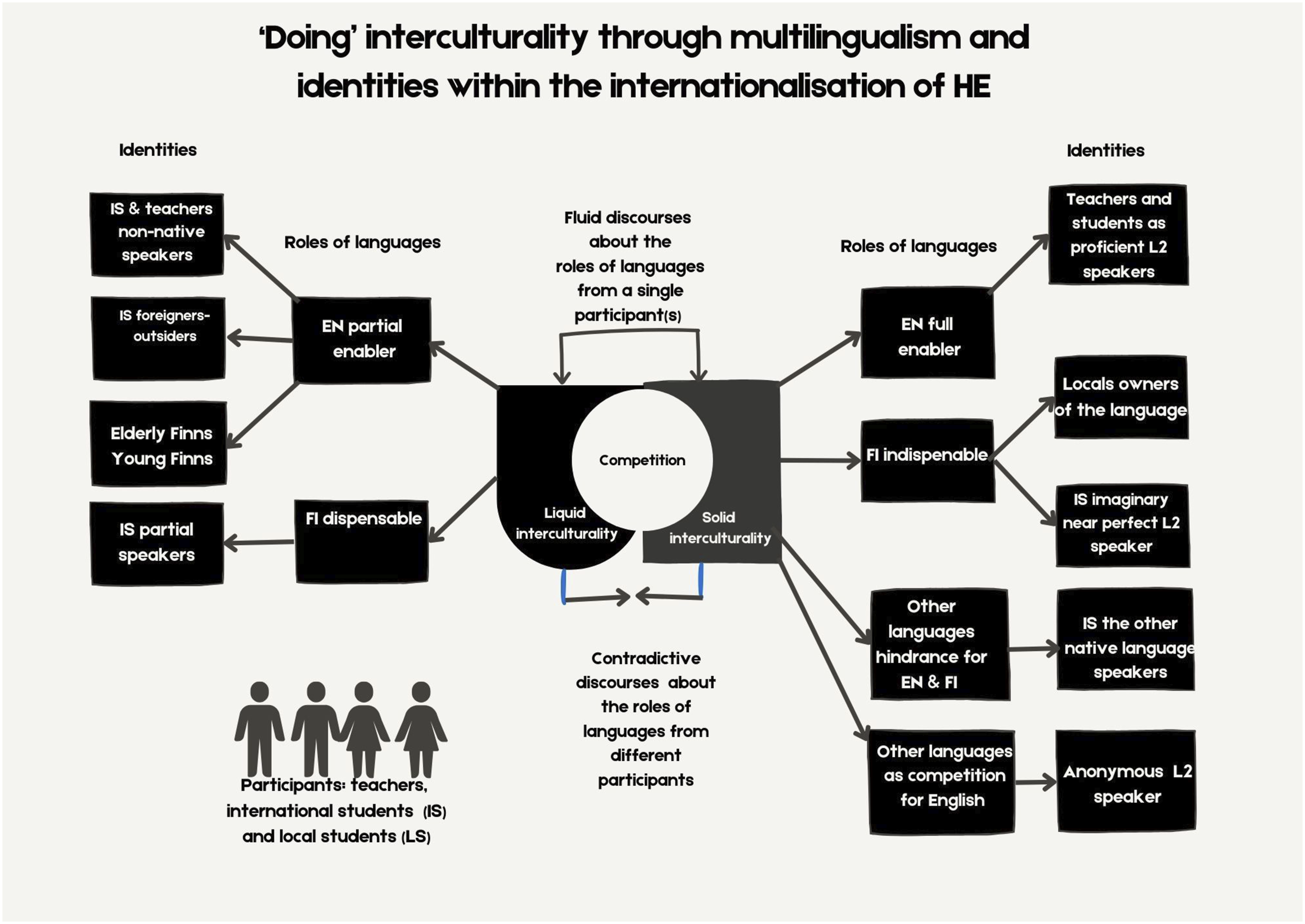
In the case of English, some actors assigned it the role of either a ‘full enabler’ (solid interculturality) or only as a ‘partial enabler’ (liquid) for doing interculturality within the scope of internationalisation in Finnish HE. Other actors described English as a ‘partial enabler’ that excluded them from the group by giving them identity as ‘outsiders’ of the society (Dervin, 2023b), which might motivate them to use other languages in HE. In contrast, participants who saw English as a ‘full enabler’, providing an identity as ‘proficient L2 speakers’, might not be aware that speaking only English could exclude them from having an identity as an integral part of the Finnish community and/or that this language might be influenced by other factors beyond accents (solid). Moreover, these actors might not distinguish how English shapes teaching and learning interactions differently (Dervin and Jackson, 2018) in an English taught program context in Finland than in an anglophone country, which might result in inequalities among actors in HE. Finally, some participants described the roles of English as ‘fluid’ connecting them to contexts and speakers’ identities in intercultural encounters (liquid).
Similarly, Finnish was assigned a ‘fluid’ and at times contradictory role of an indispensable or a superflous language for doing interculturality. Learning this local language was seen by several actors as crucial for the inclusion of international students. Nevertheless, the positioning of locals as ‘owners’ (Hutton, 2010) of Finnish, through a solid approach to interculturality, might be detrimental for international students because they are implicitly (self) perceived as having less rights to use Finnish in their interactions with local students. The identity of international students as ‘partial Finnish speakers’ might also be unfavourable because it is contested when compared with the imaginary identity of the ‘near perfect L2 Finnish speaker’, which at times results in speakers switching to English. As part of the theoretical contributions of this paper, we propose that HE institutions could promote positioning L1 and L2 speakers of Finnish as ‘common [but diverse] owners’ of Finnish. This positioning is inspired by Posner’s (1983) ‘common ownership’, which considers that every member of a group would be entitled to use a given language freely, within their capacities and in open spaces. We propose that this ‘common but diverse ownership’ of Finnish considers similarities and differences between L1 and L2 speakers in regard to language capacities, identities related to languages and interculturality, which correlates to Dervin’s (2011) liquid approach.
Finally, teachers’ perceptions of the role of the ‘other’ languages as competition and hindrance for English and Finnish contradict and contribute to previous findings where these languages were seen as a ‘hobby’ and as supported by teachers in the classroom (see Darling, 2021; Darling, 2022). Our study found that some local students consider that other foreign (L2) languages should be used as a medium of instruction and implicitly compete with English. We also identified that some teachers perceived the role of other foreign L1 languages to be against the use of English and Finnish between local and international students. The discourses about ‘other’ foreign languages only displayed and interplayed with the solid approach to interculturality because languages were perceived only as a tool to communicate without a connection with the identities avowed, granted or contested by the speakers. We argue that this role of the ‘other’ languages as competition and hindrance for English and Finnish might in part lead teachers to gate-keep students’ encounters (see Mendoza et al., 2022) in those “other” languages in the classroom, which is an obstacle for multilingualism in HE.
These findings extend the previous understanding of liquid and solid approaches of interculturality in connection to the sphere of language roles and identities (see Figure 2). Such understanding provides a link between the participants’ solid approach to absolute identities (e.g. ‘owners of Finnish’, ‘proficient L2 speakers’, and ‘foreign-outsiders’) and the absolute roles of the languages (e.g. ‘Finnish as indispensable’ and ‘English as a full enabler’) for doing interculturality. On the other hand, the liquid approach is connected to partial identities (e.g. ‘partial speaker of Finnish’ and ‘international and local students as ‘non-native speakers’) and partial roles of languages (e.g. ‘English as a partial enabler’ and ‘Finnish as dispensable’). These findings align with Dervin and Jackson’s (2018) view of interculturality which state that identity is an unstable process influenced by context, language and nationality (among others). In addition, we identified that the liquid approach to interculturality might affect those actors who perceive a ‘fluid’ role of languages and the implicit or explicit way in which languages shape the negotiation of identities in HE. The ‘fluid’ roles of languages represent a strong contribution to the previous literature that had identified fixed roles of English and local language(s) in the internationalisation of HE.
Furthermore, the study identified that the participants’ discourses displayed a continuum of liquid-solid interculturality that relates to the languages, (lack of) identities and contexts of the encounters between students and teachers in Finnish HE. The interaction between all these factors is used by the participants to (re-)negotiate and (re-)position the roles of languages for ‘doing’ interculturality. Moreover, through the enunciative pragmatic analysis, we have noted that participants can evoke diverse discourses from other speakers (e.g. students or the institution) that can be unwittingly inconsistent, multifaceted and varied. On this basis, we conclude that, instead of trying to put forward a form of for example, interculturality that is straightforward and systematically being promoted as, for example, ‘effective’ (see Deardorff, 2020), learning to approach interculturality in multi-layered, consistent/contradictory, in-/authentic ways, while problematizing it alongside identity and language, should be a priority in the context of HE internationalisation (Dervin 2023a).
Some recommendations for practice for HE institutions across different contexts could thus include: university pedagogical studies should encourage and support teachers and staff to negotiate diverse approaches to interculturality (solid, liquid) and its relation to language and identity, which might help identify language inequalities and exclusions linked to multilingualism in HE. This negotiation could result in promoting multilingualism rather than monolingualism or bilingualism (e.g. English-Finnish) and avoiding exclusionary identities such as ‘foreigners-outsiders’ and ‘owners of the language’. Furthermore, language teachers might benefit all actors by promoting a sense of ‘communal but diverse ownership’ over, for example, Finnish, which could empower L2 speakers to use this language inside and outside of the classroom in different levels of capacity and among all kind of actors to promote internationalisation in HE.
Footnotes
Declaration of conflicting interests
The author(s) declared no potential conflicts of interest with respect to the research, authorship, and/or publication of this article.
Funding
The author(s) received no financial support for the research, authorship, and/or publication of this article.
