




Abstract
The aim of this article is to provide an analysis of continuity and change dynamics in knowledge production in the field of Comparative and International Education (CIE). In addition to a general review of the field, the objective is to assess the extent and effects of dominance of the field by scholars in the Global North. The article investigates the dominance of northern hegemony in the scholarly field of Comparative and International Education, both from a literature survey of the field and from the content of analysis of articles published in the Comparative Education Review (CER). Strong criticism of northern hegemony was found, taking the following forms: criticism of the imposition of one model of development; criticism of foreign aid and of international agencies; anti-globalization; criticism of neoliberal economics and its impact on education; calls for the decolonization of education and of Comparative and International Education; criticism of racism in education and in CIE; lack of appreciation of indigenous knowledge systems; and allegations that scholars of the Global South find themselves on an unequal playing field. The 246 articles that were published in the CER during the decade 2010-2019 were analyzed under the following rubrics: geographical focus; authorship and themes/topics. The results indicate that while acknowledgment and criticism of northern hegemony has grown, the predominance of a Global North perspective persists. A majority of articles marked by a unique authorship pattern and geographic and thematic foci of research continue to be authored by scholars located in the North. In conclusion, the authors recommend a renewed effort to present the Global South in its true importance in the field of Comparative and International Education.
Introduction
The Chilean biologist and philosopher Maturana used the term autopoiesis to identify the capacity of living systems to create structures and processes capable of both sustaining and changing themselves (Maturana and Varela, 1980). The interaction of these subsystems is dynamic, capable of changing at speeds that render forecasts meaningless, but also responsive to efforts to move the system toward a new homeostasis or condition of sustainability. As evidence of the dynamism of interactions between systems, the first 20 years of the new century have accelerated the pace of climate change, set off a Great Recession (Ford et al., 2021), and brought on the COVID-19 pandemic (Welch, 2022). We in the scholarly field of CIE have been challenged to respond with a sympoeisis (Silova, 2021), a collaborative effort of humans and their organizations that can resolve these issues without creating others.
Education is one of those subsystems that can contribute to generating a new system consistent with changes in its environment. The scholarly field of Comparative and International Education, conceived with a strong philanthropic mission (see Wolhuter, 2017), has a vital role to fulfill. However, such a role can only be fulfilled as a global endeavor that benefits all of humanity. For example, the world’s problems (such as global warming) cannot be resolved by favoring the interest of the Global North to the disadvantage of the Global South (Frankopan, 2023).
The field of CIE is a product of interactions, as recognized in two well-known sources of information about its origins. The first is the classical publication of Noah and Eckstein (1969). They distinguished five phases: a phase of travelers’ tales; a phase of the systematic study of foreign education systems for borrowing; a phase of international cooperation; a phase of “factors and forces”; and a social sciences phase. Paulston (1997) distinguished three stages in the development of Comparative Education since the 1960s. These were a phase of orthodoxy (which corresponds to Noah and Eckstein’s social sciences phase of the 1960s), a phase of heterodoxy in the 1970s and the 1980s, and a phase of heterogeneity beginning around 1990. The quintessential feature of the phase of heterogeneity has been a proliferation of the number of paradigms extant in the field.
Noah’s, Eckstein and Paulston’s depiction of the field and its stage of evolution as universal and unidirectional have been widely criticized (Crossley and Watson, 2003; Manzon, 2015; Phillips and Schweisfurth 2014). After more than 30 years, another stocktaking of the field is opportune, especially given the tectonic changes in the global context and the implications of these changes for education and for the field of CIE. An up-to-date typification of the field is required. The aim of this article is to provide an analysis of continuity and change dynamics in knowledge production in the field of Comparative and International Education (CIE).
Manzon (2015) argues that education has always been the product of “historical contingencies and power struggles” (2015: 33). Various academic disciplines provided methodological and conceptual frameworks shaped by political and economic factors which varied across geographic, linguistic, religious cultural boundaries. Contextual factors generated a variety of methodologies and conceptual frameworks that have contributed to confusion and contention about the field’s aims and contents. In turn, events in the economies and political systems of various countries are the source (and to some extent the consequence) of changes in existing educational institutions and processes. For example, international development assistance, intended to shape education in developing countries, grew out of the economic concerns of richer countries (Espinoza and McGinn, 2022). Stated in other terms, the pressures for change in education have (always) been the result of an interaction of (political and economic) instrumental as well as scholarly objectives.
In this article we investigate the criticism that, at present, most academic studies of education use systems in the “Global North” as the standard. Northern hegemony within the field of CIE means dominance or disproportional authority or influence of scholars, institutions (including universities, publishing houses, journals and funding organizations) and professional societies in the Global North. These actors set the research agenda and lay down the parameters of what qualifies as valid epistemologies and knowledge in the field. The presence of such hegemony affects the capacity of the field to fulfill its philanthropic mission, to respond appropriately or optimally to the societally contextual changes and the education changes induced by these changes.
The rise of the Global South on the world stage stands in contrast to the current (alleged) configuration of northern hegemony in the field. Defined by Oglesby in 1969, its exact borders are difficult to draw; the term refers broadly to Latin America, Africa, the Middle-East and Asia (excluding the high-income Asian countries or jurisdictions, such as Singapore, South Korea, Japan, Hong Kong and Taiwan). The term “Global South” is, incidentally, more frequently used in social science scholarship than in comparative education publications.
It is important to note that the spatial coordinates of Global South are not to be understood as suggested by Oglesby as simple physical geographic space, exclusive territory, or contiguous territory. As Lewis et al., 2015: 550-60), and more recently Brown and Schweisfurth (2024) too, have explained, in the field of CIE the notion of space should be reconceptualized as being determined by relations or connections rather than only physical space. Brock (2016) notes the importance of physical connections that are important. The exigencies of the contemporary era require that comparativists adapt their notion of space of geography as a shaping force to include the notion of cyberspace and as an additional attribute of education systems. In addition, attention must be given to genealogical connections (in the self-definition of people and communities and/or the way their identities are constructed by others) (Wilson, 1994).
The article begins with a brief review of the field of comparative education by other scholars, and then analyzes in more depth publications in the Comparative Education Review. The goal of the analysis of articles published in the CER was to get an idea of continuity and change dynamics in knowledge production in the field CIE. CER was selected because it draws authors from a wide range of countries and perspectives. It is the oldest running journal in the scholarly field of CIE, and the flagship journal of the Comparative and International Education Society (CIES), the oldest and (in terms of membership) the largest professional CIE society in the world. This is the first extensive review since 2008 (Wolhuter 2008).
We begin with literature related to Southern Theory and northern hegemony, in order to provide a broader theoretical anchoring or framing of its main thrust, namely, northern hegemony in CIE. Then the literature review moves towards trends in CIE. In our analysis, current features are contrasted with those in previous decades. Persisting themes, changes and lacunae are noted. Developing and using a construct of northern hegemony as a framework, the article uses CER publications to assess the current state of the field and to suggest a forward trajectory.
Review of literature
Gramsci’s theory of subordination and hegemony argues that cultural institutions (including the state) are used by the ruling class as instruments to maintain power and to subordinate the people, depriving them of self-reliance and autonomy (see Uribinati, 1998). The relationship between geopolitical position and northern hegemony has been advanced by a few social scientists, including Coleman (1990), Bourdieu (1980) and Giddens (1984). General social theory has a distinct “northern” orientation (Connell 2006) in which hegemony hinges on historically developed global power relations. These power relations include exclusion and erasure of non-northern populations. As explained above, while the Global North has a geographic heartland, its exact demarcation is difficult. Besides location, connections and genealogy also should be taken into account when demarcating the Global North and the Global South. Rather than a stark dichotomy, a continuum exists where locations, institutions and people can be placed.
Economic, technological and military power are major forces, but education too has become an instrument for the globally powerful to maintain their positions of dominance. CIE can be typified as a field of scholarship gaining new relevance in a changing world (Powell, 2020). From the first publication in the field to today (Epstein, 2017), scholars have noted how education contributes to changes in the relative power of different countries (Abbas et al., 2019; Altbach and De Wit, 2018; Bleiklie, 2005; Manzon, 2015). Much of the analysis of these changes can be subsumed under the construct of Criticism against northern hegemony. The constituting stands of this construct will now be discussed.
Criticism of linking education with one model of development
The social sciences phase of the 1960s was characterized by a large degree of unity amongst Northern comparativists regarding the theoretical and paradigmatic framework to be used. Most influence was exerted by scholars residing in the United States of America, which at that time rose as the center of gravity of the field in terms of publications and institutional presence. Structural-Functionalism and its derivative Modernization Theory stood central, with these comparativists’ view of the world as to how to see regions denoted by the term Global South (cf. Kelly et al., 1982: 516). This model and theory of development and modernization (Inkeles and Smith, 1974) was undilutedly and solely based on the Western (Northern) experience since the Enlightenment. Formed by Western experience it has come under severe criticism from scholars in the field (e.g., Macintyre et al., 2023; Silova, 2019).
Sobe and Kowalczyk (2014) has criticized the assumption of universality noting that in most studies, “context” is often treated as having a fixed effect on education systems rather than as an issue that can generate internal actions that can lead to system change. In their words “Too often Context has been treated as a matter of fact and invoked as a unity that is always already-there, waiting to be observed and described via stable categories” (2014, p. 8). Therefore, context is an imposed perception of reality, an interpretation.
Criticism of the involvement of foreign aid and international agencies in Southern education
In a recently published extensive study on financial aid to Africa, Mills (2021) asserted that in the thirty-year period since the conclusion of the Cold War in 1990, there is little sign of any positive effects of US$1.2 trillion of foreign aid. There is a strong stream of criticism of aid as patronizing, an “undercutting” agency (of the people of the Global South) that distracts from organic development and reinforces dependency (Riddell and Niño-Zarazúa, 2016). In recent years voluminous literature in this vein has flowed from comparativists such as Ginsburg (2017), Robertson (2017) and others.
Anti-globalization
When globalization became a buzz word along the entire line of social sciences around 1990, it was not ignored by CIE. Members of the CIE scholarly community have negative sentiments about globalization principally around issues of social justice. Globalization was seen as a force against social justice. Examples of this reaction are the CIES Presidential Address of 1996 (McGinn, 1996) and the 2000 British Association of International and Comparative Education (BAICE) Presidential Address by Jarvis (1990), arguing that Education for All should be understood as a global regime of education governance.
Criticism of the neoliberal economic revolution and its impact on education
The twin sibling of globalization—the neoliberal economic revolution—that had been sweeping over the world since 1990 also drew criticism from the CIE scholarly community. This criticism revolves around the commodification of education, the deprofessionalization of the teaching profession, the dehumanization of students, and lack of considerations of human rights, especially social justice (cf. Torres, 2010). As in the case of criticism against globalization, these objections against neoliberal economics and its impact on education entail far more than its differential, detrimental effect on the Global South. This latter, however, constitutes a very important component of the criticism.
The impact of external shaping forces on education is clearly portrayed in an article that describes how education has been instrumentalized to support economic development objectives (Cino Pagliarello, 2020). Those responsible for the design and creation of the European Union, informed by research on returns to investment and other comparative research, assigned education a critical role in pursuit of economic growth objectives. Political processes such as those leading to the Bologna Accord enlisted new industrialists in the construction of a narrative that would inspire commitment to education’s key role in fostering economic competitiveness in world markets. “European countries, including the United Kingdom, France and the Netherlands, began to focus less on the social needs of education and became more oriented towards pursuing concepts such as the efficiency and modernisation of their education systems” (Cino Pagliarello, 2020: 451).
Over time the narrative began to be reshaped, to ask for a curriculum that would result in high levels of “employability” of university graduates (Sin and Neave, 2014). The volume of studies on employability has grown significantly, focusing on its inclusion in the formational process (Espinoza et al., 2020; Suleman, 2018) and on its effects in the labor market (Chadha and Toner, 2017; Tomlinson, 2017). Much of this research has used comparative methods from a disciplinary perspective (e.g., sociology, economics). The topic, employability, is less prominent in journals of comparative and international education (Jing et al., 2021).
A call for the decolonization of education and of comparative and international education
Ever since the heterodoxy phase in the 1970s there has been criticism of neo-colonialism in education, at least among CIE scholars based in the United States (e.g., Altbach, 1977). In recent years however, the call for the decolonization of education in general and by CIE scholars in particular has reached new levels (see Anuar et al., 2021). One indication of this is the CER’s 2017 Special Issue on “Contesting Coloniality: Rethinking knowledge production and circulation in Comparative and International Education.” The authors offer many challenges to the premises of universal education and to claims of immutable laws or principles emanating from disciplines such as history, psychology, sociology, and anthropology (e.g., see Macintyre et al., 2023).
More recently, attention has been focused on the knowledge production system of CIE (Takayama et al., 2017). In a recent CIES Presidential Address, Silova (2021: 589) linked incidents of racism, such as the recent George Floyd incident and the global crisis such as the ecological crisis, with persistent colonialism in the global scholarship industry.
An appreciation of indigenous knowledge systems
For some time, many CIE scholars have accepted the (Western derived) canon taught in educational institutions. Only recently has interest in Indigenous Knowledge Systems been visibly on the rise in the field (e.g., in the publication of Hayhoe and Pan, 2001). Now, comparativists such as Brock-Utne (2010) have taken part in investigating the potential of indigenous languages, knowledge and epistemologies for education and for Education research. An indication of the re-appreciation of Indigenous Knowledge Systems and its potential for the field is the recent (2016) CIES Presidential Address of Assié-Lumumba (2017) on Ubuntu (indigenous African philosophy). The new resource of Indigenous Knowledge Systems lies largely (though not exclusively) within Global South cultures.
An unequal playing field for scholars located in the Global South
Scholars in the Global South are finding themselves in a very disadvantaged situation (particularly compared to their colleagues in the Global North). In addition to enduring historically developed dispositions, Southern scholars are limited by differential access to financial, university infrastructure, and status research sources; production means such as publishing houses; and by journal editors who act as gate keepers of knowledge production systems (e.g., see De Gayardon, 2022; Lee and Maldonado-Maldonado, 2018; Mweru, 2010; McMahon and Milligan, 2021). The difficulties of an unequal playing field apply not only to scholars attached to institutions located in the Global South, but even to Global North affiliated scholars doing research in the Global South (e.g., see Akpan et al., 2024). These constraints are detrimental not only to scholars, but also to education and eventually to the field of CIE as well (e.g., see Novelli, 2023).
Racism in education and in comparative and international education; the black lives matter movement
The study of racism in education has become more visible on the CIE research agenda. One example of this trend is a recent article by Walters and Jansen (2022) about racial science in Human Anatomy research in South Africa. A Global North scholar has written about incidents of racist biases by key figures and publications in the historical development of CIE (Epstein, 2018).
Recognition of the importance of the Global South
One of the problems experienced in working with the Global South as a category is the difficulty in finding aggregate data (in order to contrast the Global South with the Global North) (cf. De Baston and Mukku, 2020). Economically, the Global South is a factor of growing importance in total global economic output (even excluding China). In terms of social dynamics and many global societal trends, authors such as Comaroff and Comaroff (2012) have argued that in many respects the Global South constitutes the vanguard in that it has already experienced some of the changes yet to affect the Global North.
In the past, articles in the Comparative Education Review (CER) compared studies of national systems in the United States, the United Kingdom or Europe (Wolhuter, 2008). More recently, however, researchers have begun to study education systems in China and in South Africa. Much more attention has been given to the political and economic factors that shape education policy and more attention to higher rather than primary or secondary education.
Synthesis: Core features of criticism against northern hegemony in the field
The asymmetry in power relations between scholars of the Global North and scholars from the Global South created an unbalanced field for scholars. This lopsidedness of the field not only works to the disadvantage of scholars of the Global South, but also to the construction of a distorted corpus of knowledge that affects education and society at large, in the final instance to global society (Global North included). The rise of both anti-capitalist critiques of privatization, neoliberalism, high fee schooling, etc., and calling for anti-imperialism/decolonization, the latter more focused on racism and colonial injustices and former on capitalist exploitation, together constitute the driving force of a new direction in comparative education. These new criticisms echo a more general trend in Social Science, which can be subsumed under the collective concept of criticism against Northern Hegemony.
Methodology
This study followed an approach like that used by Wolhuter (2008) and Nordtveit (2016) in their earlier reviews of articles in or submitted to the Comparative Education Review (CER). A thematic analysis was done. Using the approach employed by Wolhuter (2008), it is possible to compare recent articles with those of the first 50 years of CER publications. All articles published in the Review between 2010 and 2019 were included in this study.
The 246 articles that were published in the CER during the decade 2010-2019 were tallied according to: 1. Original geographic location and level of the system covered. 2. Number of units covered (i.e., how many units of comparison are covered, e.g., one national jurisdiction/district/continent, two national jurisdictions/districts/continents), Authorship (geographical location of authors) and 3. Themes on which articles focus.
The geographic categories were the following: world; super-continent, continent, supra-country, country, and sub-country (i.e., state/province, city or category of population of country); institution; class; and individual. Super-continent refers to groupings or taxons spanning more than one continent, for example, “developed countries,” “developing countries,” “Global North” and “Global South.” Supra-country taxon refers to more than one country, for example, South-East Asia, East-Africa, Middle-East, Sub-Saharan Africa, or the European Union.
Regarding themes, articles dealing with (issues in) CIE as a field for scholarship were separated from those pertaining to other topics. The articles dealing with education were then divided into three categories: those dealing with societal forces shaping education; those dealing with aspects of education systems (e.g., finance, institutional fabric and structure, curriculum, social dynamics/school culture), and themes on the effect of education on society and on the lives of students.
Articles were read by the authors of this article, and then classified into one category of each of the above aspects.
Results
Geographical areas
Number of units covered by articles at various geographic levels.
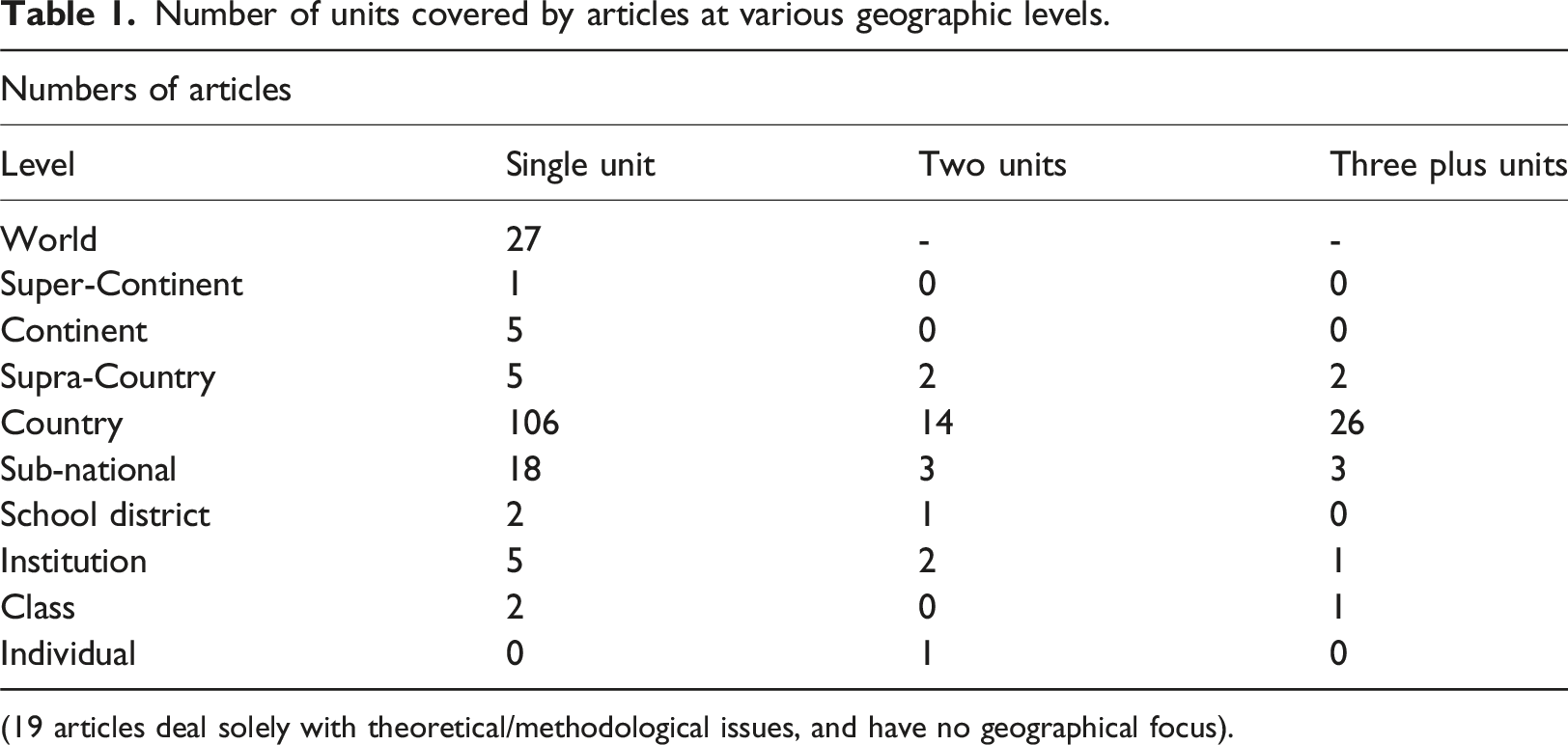
(19 articles deal solely with theoretical/methodological issues, and have no geographical focus).
What is evident from Table 1 is the imbalance between articles falling into higher geographical levels (especially at the global or world level) and those falling to levels smaller than the nation-state. Comparing the geographical frame of the West versus the rest the dominance of the West remains but is less than previously reported. Bromley (2010: 589) found in her analysis that immediately after the Second World War 91% of international nongovernmental organizations active in education were based in the West. This declined to 58% at the time of her analysis (2010).
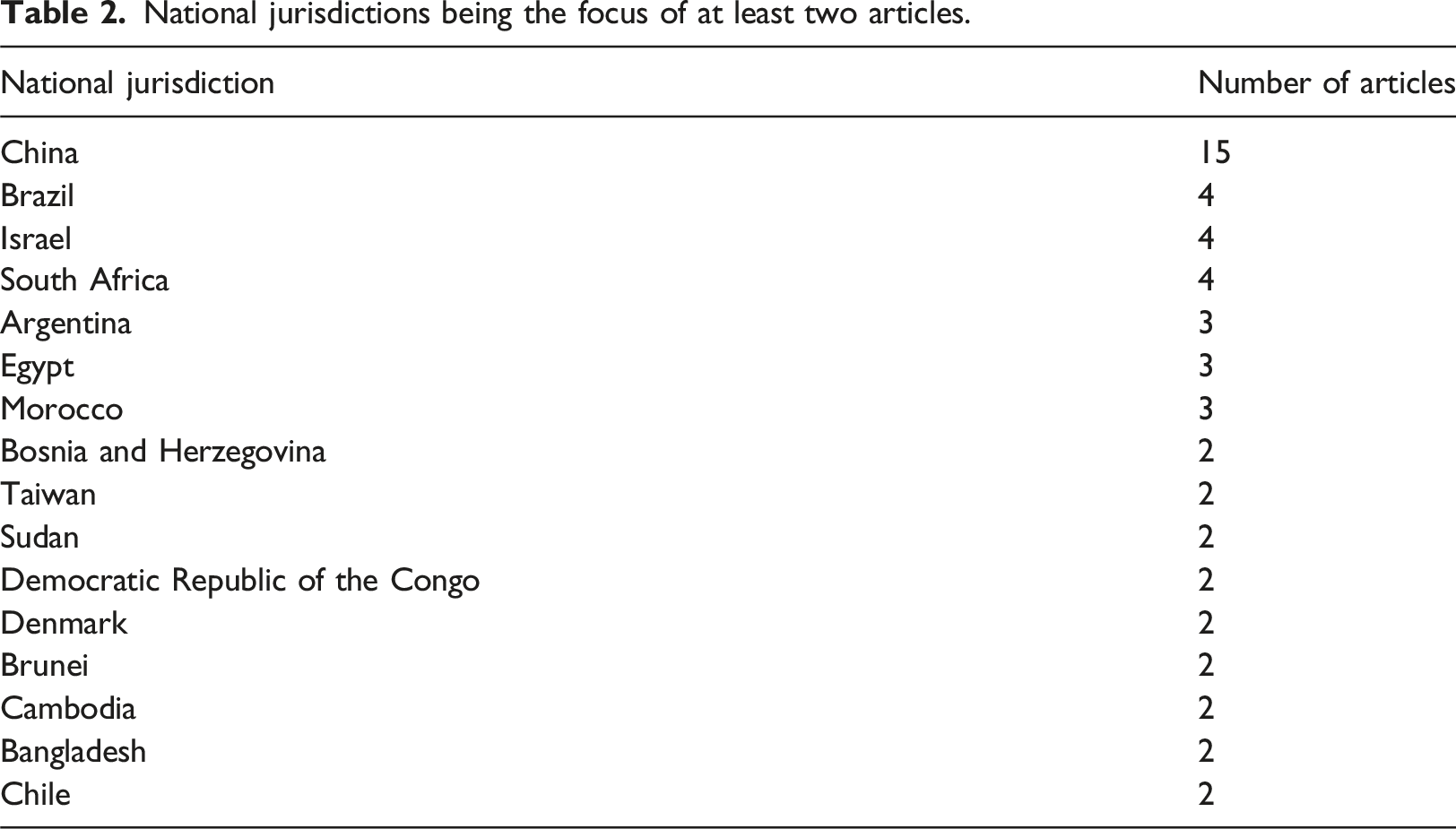
National jurisdictions being the focus of at least two articles.
Frequency of articles offering single-nation level studies focusing on the various UNESCO world regions.
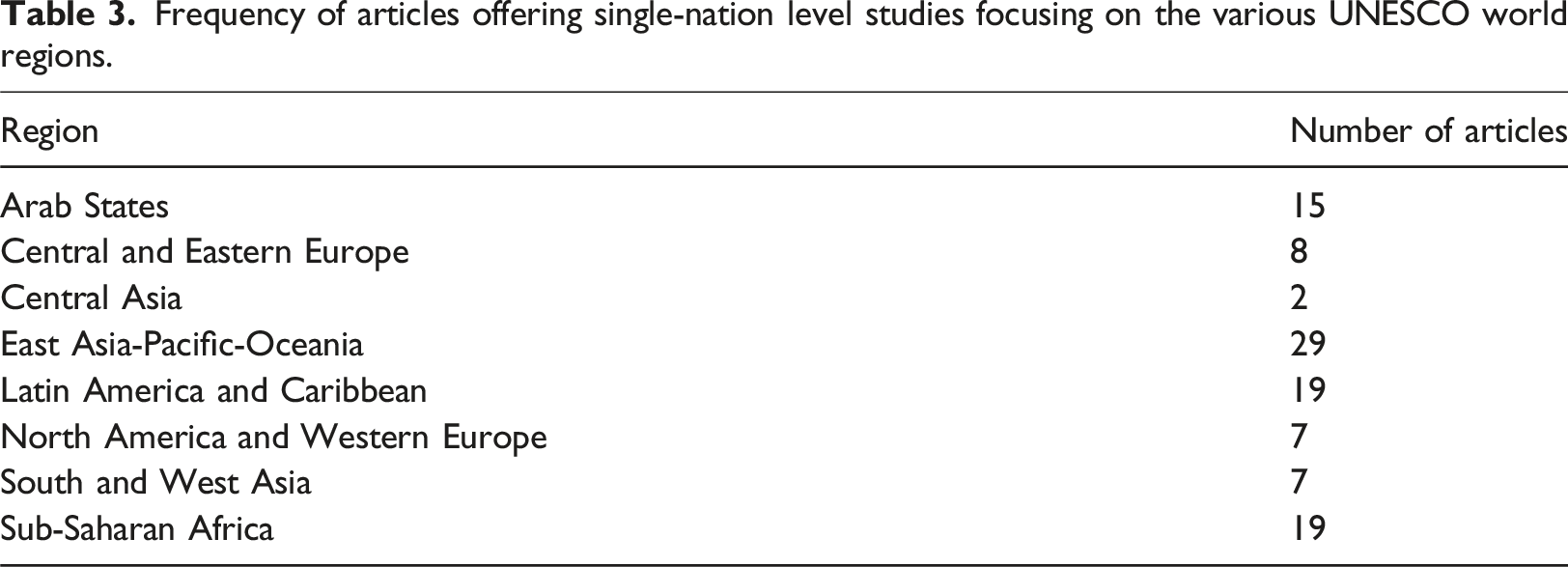
Topping the list is the East Asia-Pacific-Oceania region, followed by Latin America and the Caribbean, Sub-Saharan Africa, and the Arab states. By contrast, the countries of Western-Europe and North America, South and West Asia, and Eastern Europe and Central Asia have attracted less attention. Turning to the comparison of national jurisdictions, the most common occurrence is the United States of America, appearing in four articles (the other jurisdictions were Russia, Japan, Israel and Australia, one article each).
On geographical levels lower than the national, no area stands out as attracting a noteworthy amount of scholarship. Only studies by authors in the United States of America attracted three articles. Where two or more units were compared, it was in most cases of units within the same national jurisdiction, rather than comparisons of units across national jurisdictions. Comparisons tended to be either between units in the Global North (e.g., Yamada’s (2015) comparison involving Japan and North America, or Erichsen and Salajan (2014) comparing the European Union and the United States), or between units in the Global North and units in the Global South (such as Gosh’s (2012), CIES Presidential Address comparing academic excellence vs accommodating diversity at universities in the United States, Canada and India). South-South comparisons have not made a conspicuous rise, despite the growing economic and political importance in recent years of the Global South. The Global South now includes the largest education systems in the world.
Authorship
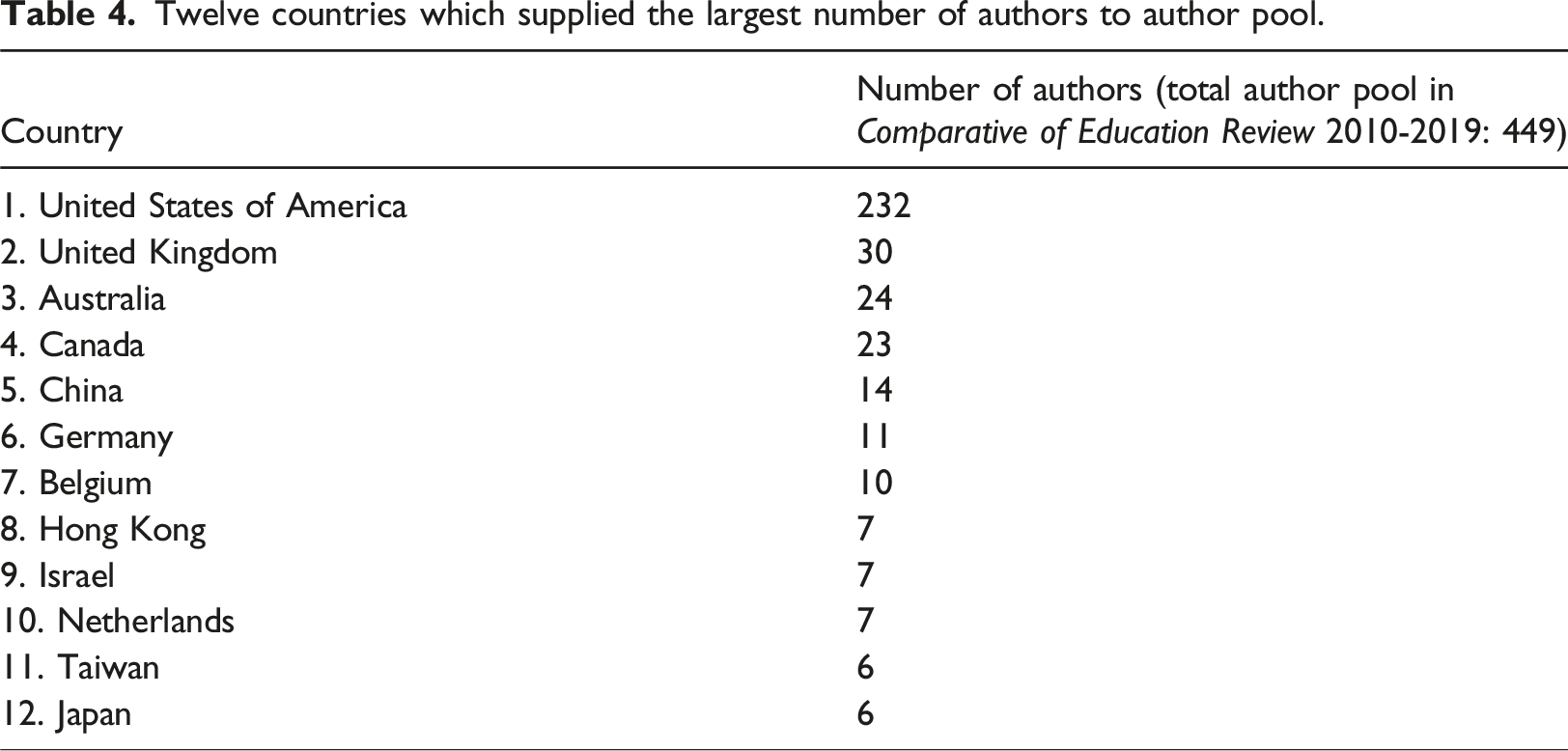
Twelve countries which supplied the largest number of authors to author pool.
The predominance of Global North authorship has attracted attention in the past. In an editorial published more than 30 years ago, Epstein (1997) expressed concern about the overly concentration of authorship from the United States of America. In their first editorial since taking over the post of editors, current editors Jules and Salajan (2024) expressed their vision to enrich the journal by taking in the voices of scholars living worldwide.
Over time, the predominance of authors resident in the United States of America has decreased: from 76% of the authorship during the first 5 years of the journal to 59% during the last 5 years up to 2006 (Wolhuter, 2008: 331). During the period of review reported in this article, this percentage has dropped further, although 57% authors from the United States of America still form a majority of the total author pool.
As can be gleaned from Table 4, a second node (though much weaker than the prime North American-Western Europe node) is forming in the Far East, including China, Hong Kong, Japan, and Taiwan. This shift in the location of authors is in line with developments in other fields of Education and other fields of scholarship in the social sciences and beyond (see Wolhuter, 2017).
Themes
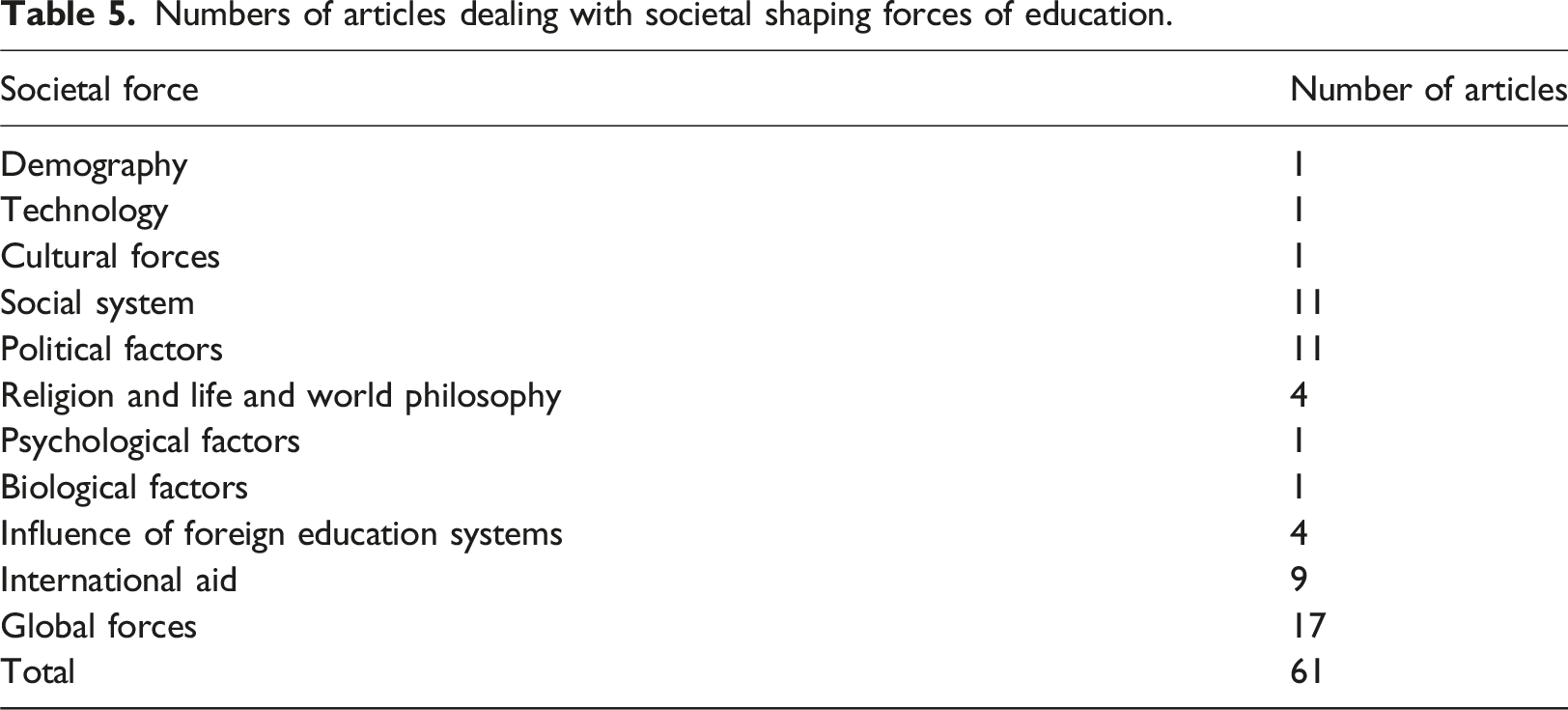
Numbers of articles dealing with societal shaping forces of education.
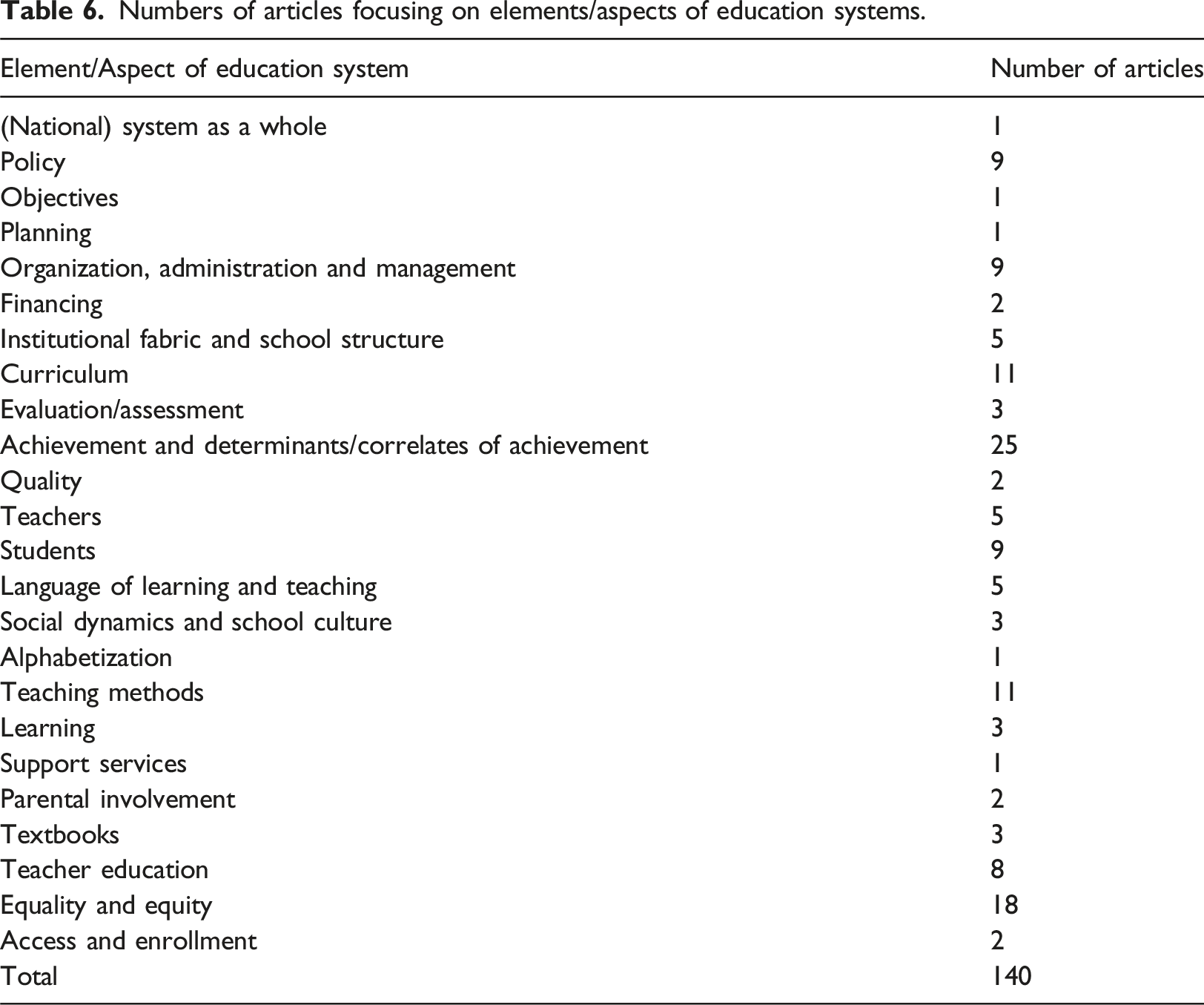
Numbers of articles focusing on elements/aspects of education systems.
Number of articles dealing with outcomes of education.
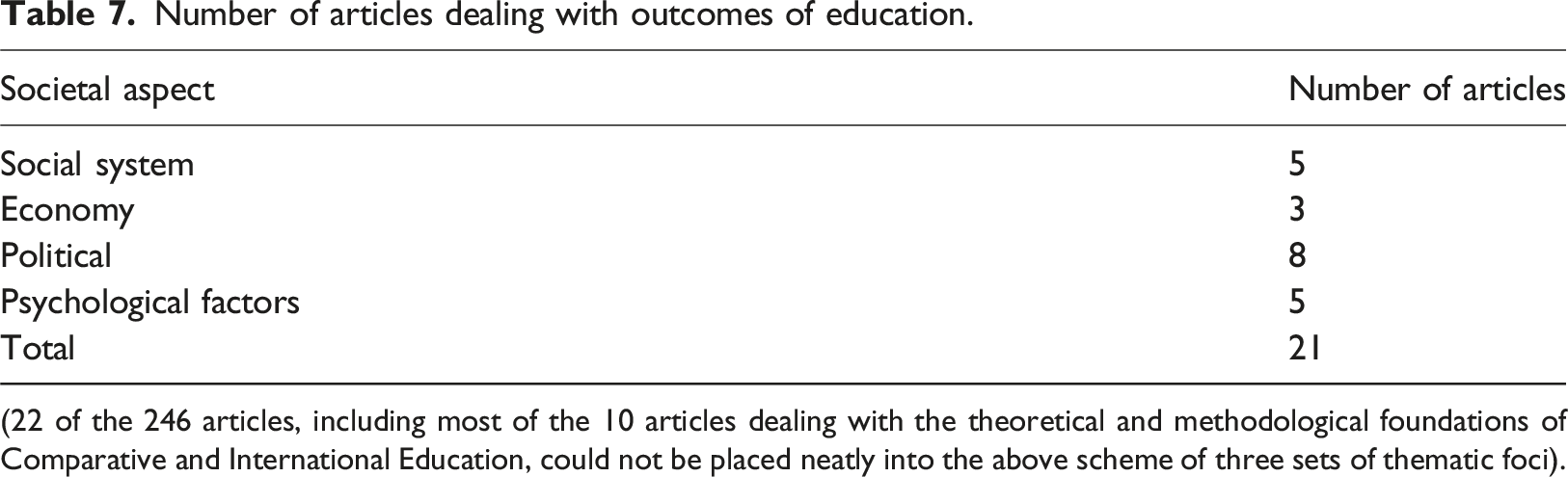
(22 of the 246 articles, including most of the 10 articles dealing with the theoretical and methodological foundations of Comparative and International Education, could not be placed neatly into the above scheme of three sets of thematic foci).
The division of the 222 articles that fall in one of the three areas of thematic focus is: 28% deal with societal forces shaping education; 63% deal with aspects of education systems; and 9% deal with the effect of education on society. Compared to the pattern during the first 50 years of the review (cf. Wolhuter, 2008: 339), the percentage of articles dealing with aspects of education systems has risen sharply. This includes the rise in studies focusing on student achievement and causes thereof. An example is a study led by Carnoy et al. (2017) involving a comparison between all 27 sub-national jurisdictions of Brazil, on how state education administrative regimes impact student achievement.
The rise in intra-education system themes may be linked to the availability of large databases, and the impact of neoliberal economics, and the systems’ emphasis on performance (evident in the large numbers of articles on factors affecting achievement levels of students). This rise in intra-education systems themes seems at the cost of articles dealing with shaping forces of education systems, which have declined in frequency. Articles dealing with the societal outcomes of education remain at approximately the same proportion in the pool and are the smallest of the three categories.
Turning to the set of articles on the societal shaping forces of education systems, most attention went to global forces. This occurs in the age of Globalization which gathered full force during the period of analysis, 2010–2019. The series under review commenced with Kamens and McNeely’s (2010) article on globalization and the rise of national testing regimes. They argued that regimes are an ideological instrument in global hegemonic forces. Foreign aid, and social and political forces, also attracted attention.
Most research, however, was on the effect of education on national social systems and on the economy and the political subsystems. This continued the emphasis during the first 50 years of CER. A spate of 1917 articles published in the CER on the societal outcomes of education included Van de Werfhorst (2017) piece on political engagement, Becker’s (2017) on the effect of education on ethnic socialization and identity formation in Bosnia and Herzegovina, and Deyden-Peterson and Mulimbi’s (2017) article on peace and national unity in Botswana.
Discussion
The taxon Global South has not succeeded in gaining much traction in CIE (or at least not in the CER), although it has been increasingly mentioned in the social sciences. In the period under review the term “Global South” does not appear in a single article title, nor does it constitute the level of analysis of a single article. In terms of geographical level of analyses, the nation-state still dominates.
Consistent with the verdict of Schweisfurth (2015) on Northern dominance, it can be argued that parts of the field such as theories of learning, pedagogies, and education planning, are modeled on knowledge derived at higher geographic levels (global and supra-national). This is where the organs of Northern dominance, such as the World Bank, PISA (Sjoberg, 2017) and other international nongovernmental organizations (see Bromley, 2010), operate. These institutions are less familiar with knowledge derived from smaller geographic, finer textured analyses of education embedded in sub-national contexts. Shah (2015) points out the value of micro-studies and participatory research in giving voice to the downtrodden and the marginalized. The neglect of sub-national level studies in comparative education research maintains Northern dominance.
Many of the countries that are not important in the global geopolitical calculus of the decade 2010–2019 attracted little or no attention. These include India, Russia, and in general the countries of South and West Asia, South Asia, and West and East Africa. Greater attention to education in China may be explained by the fact that (at least in terms of primary and secondary school enrollments and teacher numbers) this country has had for quite some time now the largest education system in the world. It is not difficult to detect a dimension of northern hegemony in at least some of the articles on education in China (Liu and Tobin (2017).
The proportion of comparisons involving three or more national jurisdictions has, compared to the past, increased slightly (Wolhuter, 2008: 326). What is new is the number of articles covering a larger number of national jurisdictions and drawing their data from international test series (Program for International Student Assessment, PISA and International Association for the Evaluation of Educational Achievement, IEA). Articles analyzing such large databases such as that for international testing are based on research done in the positivistic tradition of the field (cf. Epstein, 1983; Epstein and Carroll, 2005). Examples are the articles by Goos et al. (2013) and by Lauglo (2016), the latter comparing 35 countries using an IEA study database, and articles such as that by Bray and Nutsa Kobakhidze (2014) criticizing the large data bases’ way of measuring certain variables or indicators. For a critique of the use of such results in international policy transfer see Takayama (2010).
The large database studies such as those by IEA or PISA are carried out principally in Global North jurisdictions. They do not provide an unbiased sample of different systems, nor do they provide South-South comparisons (e.g., see Lauglo, 2016). This pattern corresponds to the findings of Flessa et al. (2021) in their analysis of articles on Educational Administration and Leadership published in 11 Comparative Education journals, 1995 through 2018. This pattern also underscores the statements made earlier about Northern Hegemony. Using tertium comparisons of Global South contexts places the Global South in a disadvantaged position compared to the Global North.
The author pool is still much dominated by authors from the Global North, and from a very small number of countries in the Global North at that. Authors from four countries, the United States of America, the United Kingdom, Canada and Australia, make up more than two thirds (68.8%) of the CER authors. This narrow spread of author provenance is out of step with the geographical distribution of the focus of articles noted above, lending concern for the extent of Northern Hegemony reported in the 2008 review (Wolhuter, 2008) and repeated by Takayama et al. (2017). The dominance of Global North authors is traced to not only founding father Isaac Kandel but also to intellectuals (regarded as progressive or radical in the North), such as Marx, Foucault and Bourdieu.
On a more positive note, there has been a rising percentage of articles focusing on aspects or themes within the education system, institutions, and classrooms. This shift signifies a break from the “black box” approach of the comparative field. The difference in concerns of Global Northern and Southern authors shows, however, in three themes. First, large databases are used more frequently in Northern countries. Second, the Northern studies are more frequently focused on identifying practices to raise test scores, with less attention to inclusion issues. Third, the nations of the Global South are much more dependent on education as a sole means or hope to attain a range of desired societal outcomes (e.g., economic growth, eradicating unemployment, stabilizing democracy, or attaining peace in a post-conflict society) than are the more affluent nations of the Global North. The lopsided thematic focus of research disproportionally disadvantages the Global South, which urgently needs guidance from the CIE scholarly community as how to plan, structure, and improve education.
Conclusion. Aurora Australis, per aspera ad astra
The analysis of CER articles during the decade 2010-2019 showed in some respects a continuation of historical patterns as well as, in other respects, a broadening of the field and tilling of new soil. In recent years, scholars have raised a series of related criticisms which could be understood as directed toward northern hegemony in the field of Comparative and International Education. The defining features of this criticism are that the differential resource base of scholars of the Global North has placed such scholars in a situation of hegemony vis-a-vis scholars of the Global South, and that this has resulted in an unbalanced field and body of scholarship working against the interest of not only the Global South, but also of humanity as a whole (see Bromley, 2010). Not yet clear is whether the increasing intellectual production of China will reinforce dominance by the Global North, support the concerns of the South, or become a new source of dominance.
Changes have occurred in comparative education. The “black box” character of the field, salient a few decades ago, has now dwindled, as more attention is paid to what is taking place within education systems. However, the societal outcomes of education are still very much neglected, especially in the South. Experience has shown that theoretical frameworks predicated on the experience and contexts of the Global North or the Global South, and sold as universal truths, are erroneous. Three examples will be mentioned here.
Finer textured analyses of Global South contexts are required. Allier-Gagneur and Gruijters (2021) have shown in a recent publication based on extensive empirical evidence that the Heyneman-Loxley rule does not always hold true. There are many instances in the Global South in which high education quality alone has not resulted in high levels of student achievement. More than 2 billion people of the global labor pool work in the informal economic sector (International Labor Organization, 2018). This informal economic sector is found principally in the Global South. Ever since the reference point study of Harbison and Myers (1964), statements pertaining to the relation between education and work/economy are predicated largely on the formal economic sector. Tertiary education and even vocational education and training are almost exclusively geared towards supporting the skills needs of the formal labor market. In the Global South, however, there is an urgent need to build the capacity and knowledge to engage with the informal sector.
Secondly, a large proportion of the population of the Global South lives in informal housing in urban areas. According to Valery Purry (2016) more than 940 million people across the globe reside in shanty towns or squalor conditions, and it is estimated that in 30 years’ time one in three people in the world will live in such informal housing. These living conditions are markedly different from the urban environment of the Global North. The contrast sends up a red flag to any attempt to extrapolate a statement on, for example, education-family background interrelationships from the Global North to the Global South, and places a question mark on the universality of any statements on this topic. A third example is a theme such as the brain drain, which has a very adverse effect on the Global South. The last and sole article in the CER focused on the Brain Drain question was the article by Broaded (1993). Research is needed on the factors that motivate comparative studies, especially North-South comparisons. Who are the beneficiaries?
Does criticism of northern hegemony become the defining feature of the current phase in the historical development of the field of Comparative and International Education? The evidence presented in this paper, both from a literature survey and a content analysis of articles published in the CER suggest so. Indeed, criticism of northern hegemony may well be regarded as an eighth phase in the evolution of the field of CIE, following the seven outlined by Noah and Eckstein (1969) and Paulston (1997). Content analysis of other journals in the field would be a valuable complement to this study. If this is accomplished, will the yearned-for desire for a next phase, that is, a ninth phase, in which the Global South assumes its entitled full and equal right in the field of Comparative and International Education, be achieved?
What is pleaded here for is not an uncritical acceptance of everything sold by the Criticism of Northern Hegemony lobby. Indeed, in a recent publication Edward Vickers (2020) has argued that those in the field calling for decolonization have a lot of questions to answer. On the other hand, the broader embeddedness of Comparative Education in a global western project is spectacularly failing to deliver, economically, politically, morally and educationally. This is suggested by the worldwide rise in authoritarianism and the implications thereof for CIE scholarship. The most recent editorial column in the CER, August 2024, calls for a considered, informed, balanced and justifiable affirmation of the Global South in the field, which would be a wholesome development (Salajan and Jules, 2024). And, at the same time, can such a development also provide the other desiderata of the field in terms of research foci, similar to those mentioned in the analysis reported in this manuscript? Then the sympoiesis role called for in Iveta Silova’s (2021) vision for the field, fulfilling a mission of taking humanity into the future, can come to fruition.
“Our task is not to find or to study Comparative Education, but to create it”
(Turner, 2020: 82)
And to re-create it
(CCW, OE, NMcG)
Footnotes
Declaration of conflicting interests
The author(s) declared no potential conflicts of interest with respect to the research, authorship, and/or publication of this article.
Funding
The author(s) received no financial support for the research, authorship, and/or publication of this article.
