



Abstract
Student academic success plays an important role in higher education institutions, as it is often used as a core measure of university performance. Internationally, there is an extensive literature on the predictors of academic success. In addition to intellectual variables, the effects of psychological factors have received increased attention. However, there is little literature on cross-cultural differences in the predictors of academic success. This study examines three psychological predictors (hope, self-efficacy, and motivation) and investigates differences between the scores of business students at a university in Germany and a university in Finland. The results indicate differences in students’ scores on the predictor hope. In addition, some differences were found in relation to the students’ demographics. Regarding the predictive power of the factors examined, for hope and self-efficacy this was higher in Finland than in Germany.
Introduction
Competition between universities for top students can be fierce. This is not surprising, as students’ academic success is an important indicator in higher education, often used as a core measure of university performance (Alyahyan and Düştegör, 2020; Sothan, 2019). Academic success of graduates, mostly measured in students’ final study grade point average (GPA) and retention rates (York et al., 2015), enhances the reputation of a university and attracts new intelligent and talented students (Sothan, 2019).
There is an extensive international literature on the predictors of academic success, with studies conducted in many different countries and fields of study (e.g., business, humanities, mathematics, medicine). A wide range of intellectual factors have been found to be good predictors of academic success, including high school GPA and university entrance scores such as American College Text (ACT) / Scholastic Assessment Test (SAT) results (e.g., Alyahyan and Düştegör, 2020; Nagy and Molontay, 2021; Silva et al., 2020). In addition, there is a growing body of literature suggesting that a significant proportion of the variability in students’ academic success could also be explained by psychological factors such as student hope, self-efficacy, motivation, emotional intelligence, and mental health (e.g., Feldman and Kubota, 2015; Han et al., 2022; Nonis et al., 2005; Viviers et al., 2023). Further predictors of academic success include demographic factors such as age and gender (e.g., Fong et al., 2017; Lotkowski et al., 2004; Richardson et al., 2012).
In terms of terminology, the most commonly used terms to refer to the different basic categories of predictors are “cognitive” versus “non-cognitive” (e.g., Farruggia et al., 2018; Han et al., 2022). According to the authors mentioned, “cognitive” predictors measure graded school skills (e.g., high school GPA, university entrance test scores), while “non-cognitive” factors include a wide range of factors such as self-efficacy or motivation, but also gender, age, or family support. Following Farrington et al. (2012) and others, we consider “cognitive” and “non-cognitive” to be “unfortunate words” for the distinction of predictors. Psychological constructs such as self-efficacy, motivation, hope, or optimism are highly cognitive in nature. Therefore, following Nonis et al. (2005) and Elias (2008), we use the term “intellectual” for variables measuring graded school skills. For the other predictors we use the term “non-intellectual,” or rather, following the categorizations of Alyahyan and Düstegör (2020) and Sothan (2019), the more specific terms “psychological,” “demographic,” “school,” and “family factors.” While intellectual indicators are most often considered relevant for student selection (e.g., Cliffordson, 2008; Silva et al., 2020), the predictive power of psychological variables provides useful guidance for both student selection (e.g., Nonis et al., 2005) and, even more so, student support (e.g., Feldman and Kubota, 2015; Han et al., 2022; Nonis et al., 2005).
As student populations become more diverse and student mobility increases, the question of how students’ scores on different predictors of academic success, and their predictive power, vary across national and university cultures becomes more important. In particular, the psychological factors are of interest for cross-cultural comparison because many of them describe personal characteristics and behaviors that are at the core of individuals’ cultural profiles. Although there are some studies on cross-cultural differences between the scores of students from different cultures within the same university (Farruggia et al., 2018; Li et al., 2010), there are hardly any studies that collect data from students at different universities in different countries and compare their results on predictors of academic success.
The present study aims to address this research gap: It focuses on three psychological factors, namely, hope (e.g., Feldman and Kubota, 2015; Gallagher et al., 2017; Marques et al., 2017; Penzar et al., 2021), self-efficacy (e.g., Beatson et al., 2020; Feldman and Kubota, 2015; Han et al., 2022; Preuß et al., 2023; Viviers et al., 2023), and motivation (e.g., Amida et al., 2021; Fong et al., 2017; Mahdavi et al., 2023; Nonis et al., 2005; Robbins et al., 2004). These three predictors were chosen because, when comparing students’ scores across cultures, we wanted to select predictors that have been shown to be good predictors of academic success. As we will show in the literature review section, this is the case for these three predictors.
The study looks at cross-cultural differences between the scores of business students on these variables at two universities of applied sciences, one in Germany and one in Finland. The term “score” here refers to the student’s point on a Likert scale for hope, self-efficacy, or motivation. In addition, the study examines how the predictors differ between students belonging to different demographics (internationality, gender, and semester) and how the predictive power of these factors differs. A short note on terminology: The data for this study were collected at two universities of applied sciences. For ease of reading, the shorter term “university” is often used instead of the full term.
The study thus makes the following contribution to research on predictors of academic success: First, it provides current results on the predictive power of the three psychological factors hope, self-efficacy, and motivation, namely, in the two cultures of Germany and Finland, which have so far received little attention in the discussion on predictors of academic success. Second, it presents findings from a comparison of students’ hope, self-efficacy, and motivation in two different cultures and two different learning and teaching environments. A comparison between a German and a Finnish university seems academically interesting for the following reason: On the one hand, the practical orientation of the two universities as well as the structure, the curriculum, the teaching mode (face-to-face) and the teaching language (English) of the respective study programs are comparable. On the other hand, research has found relevant cross-cultural differences between the German and Finnish cultures in general (e.g., Brodbeck and Frese, 2008; Härkönen, 2000; Lindell and Sigfrids, 2008; Linderoos, 2002) and between the German and Finnish university cultures and teaching styles (e.g., Heo et al., 2018; Möller and Holmlund, 2000; Niemi, 2011; Sahlberg, 2007, 2015; Takei, 2023), which could influence students’ hope, self-efficacy, and motivation, as well as the predictive power of these psychological factors. In terms of international higher education research, the study contributes to the investigation of students’ hope, self-efficacy, and motivation in different university and learning cultures. From the findings, recommendations could be derived on which teaching and learning cultures, both influenced by national culture (Heo et al., 2018), and which specific interventions could promote the development of hope, self-efficacy, and motivation in students (Feldman and Kubota, 2015; Han et al., 2022; Viviers et al., 2023).
The aim of this study is therefore to answer the following research question (RQ):
The following sub-questions (SQ) can be derived for a comparison between business students in Germany and in Finland:
Literature review
Research on predictors of students’ academic success
There is a large number of studies that focus on the factors that predict academic success in higher education. Based on previous research, the predictors of academic success can be classified as intellectual, psychological, demographic, family, school, and study behavior factors.
Among the intellectual predictors of academic success, studies have found the following factors to be relevant. High school GPA is considered one of the best indicators (e.g., Silva et al., 2020; Westrick et al., 2015). Another well-researched predictor is students’ performance on university entrance tests. Although many studies focus on the SAT and ACT and their use in the US (e.g., Hoffman and Lowitzki, 2005; Westrick et al., 2015), there are also studies that look at university entrance tests in other countries (e.g., Sweden: Cliffordson, 2008; China: Bai et al., 2014; Portugal: Silva et al., 2020). Other intellectual predictors of academic success considered in research include students’ English language skills (e.g., Gagen and Faez, 2023; Sadeghi et al., 2013) and quantitative skills, such as mathematics skills (e.g., Arnold and Straten, 2012; Müller et al., 2018).
Several studies have shown that other factors such as psychological, demographic, family, school, and study behavior factors could add value to the prediction of students’ academic success. Researchers have summarized these other factors under the terms “non-intellectual” (e.g., Nonis et al., 2005) or “non-cognitive” (e.g., Han et al., 2022). Han et al. (2022) examined the effects of adding what they called “non-cognitive” factors to academic preparation to predicting high school students’ academic success. “Non-cognitive” factors added 10% or more of explained variance to each success-related variable in the enhanced model compared to the model containing only academic preparation variables. In another study Sothan (2019) examined the effect of a number of factors on the academic performance of undergraduate students. He found that, in addition to high school grade and English proficiency (as intellectual predictors), class attendance, study effort, academic self-efficacy, and family socioeconomic status were associated with academic performance.
Looking at the research on non-intellectual predictors of academic success, these can be categorized into several areas: First, a wide range of psychological factors have been examined. While research initially focused mainly on established psychological constructs such as hope, self-efficacy, optimism, and motivation (e.g., Feldman and Kubota, 2015; Fong et al., 2017; Han et al., 2022; Lotkowski et al., 2004; Nonis et al., 2005; Viviers et al., 2023), more recent research has additionally examined a broader range of concepts such as emotional intelligence (Alabbasi et al., 2023), mental health (Mahdavi et al., 2023), grit (Boerma and Neill, 2020) and engagement (De Castro et al., 2021). In addition to these psychological factors, factors related to demographics, family, school, and study behavior have been the subject of research.
The psychological predictors hope, self-efficacy, and motivation
Among the best researched psychological predictors of academic success are the factors of hope, self-efficacy, and motivation. Therefore, our comparative study focuses on these three variables.
Hope
The most widely used and researched conceptualization of hope in the last three decades is probably Snyder’s (1994) hope theory. According to Snyder (1994), hope is a cognitive process that allows individuals to plan for and execute the pursuit of goals. Essentially, he postulated that individuals have goals and they assume that these goals can be achieved. Within this general goal-setting framework, Snyder (1994, 2002) defines hope as a combination of two main components: agency thinking and pathway thinking. Agency thinking means that individuals believe they can successfully achieve their goals. Pathway thinking means that individuals are generally able to develop pathways for achieving their goals and they are confident that the chosen pathways will lead to success.
A large body of research shows that the cognitive conceptualization of hope developed by Snyder (1994) predicts a variety of student outcomes, including GPA. Feldman and Kubota (2015) examined hope, self-efficacy, and optimism and their ability to predict student academic success. They found that the variables that most strongly correlated with GPA were academic hope and academic self-efficacy. Using path analysis, they showed that academic-specific hope predicted GPA more than twice as strongly as academic self-efficacy. The correlation between optimism and GPA was rather small and not significant in predicting GPA. The combination of academic-specific hope and self-efficacy accounted for 51% of the variance in GPA. Gallagher et al. (2017) reported similar findings based on their study of over 200 undergraduate students. They found that only academic hope positively impacts GPA over and above the effect of academic self-efficacy. In contrast to these studies, Penzar et al. (2021) found that the agency subscale of hope is moderately correlated with the GPA, but once self-efficacy is used as a mediator between those two variables, the effect of agency hope was no longer significant. A possible reason for the conflicting results may be that the studies were conducted in different countries with students from different national cultural backgrounds.
Self-efficacy
Self-efficacy is a key component of social cognitive theory. It was introduced by Bandura (1977, 1997), who defined perceived self-efficacy as “beliefs in one’s capabilities to organize and execute the courses of action required to produce given attainments” (p. 3). Thus, self-efficacy is the belief in one’s competence to succeed in a particular task, the competence to perform certain behaviors. It typically develops over time based on an individual’s experiences and reflections on those experiences. Snyder (2002) contrasted the two expectancy constructs of self-efficacy and hope: Whereas self-efficacy is primarily concerned with the expectation that one can perform certain behaviors, hope is concerned with the general expectation that one can achieve goals and initiate the right goal-directed actions. Rand (2018) adds that “in contrast to hope’s trait-like nature, the original conceptualization of self-efficacy is more situation-specific.”
Several meta-analyses have shown that self-efficacy is a good predictor of academic success. In their early meta-analysis Robbins et al. (2004) found that academic self-efficacy and achievement motivation were the best psychosocial predictors of students’ cumulative GPA. In another meta-analysis by Richardson et al. (2012) academic self-efficacy showed medium-sized correlations with GPA, with performance self-efficacy being the strongest to correlate (whereas they found at best small correlations of demographic factors with GPA, and also only medium-sized correlations for high school GPA, SAT, and ACT).
In addition to these meta-analyses, several studies have confirmed the predictive power of self-efficacy for academic success, even when compared to other psychological factors such as optimism (Chemers et al., 2001), motivation (Han et al., 2022), and hope (Feldman and Kubota, 2015). A number of other studies have confirmed the predictive power of self-efficacy for academic success for students from different fields of study and different countries (e.g., Beatson et al., 2020; Meng and Zhang, 2023; Sothan, 2019; Viviers et al., 2023).
Motivation
Another psychological construct that has been shown to be a good predictor of academic success is motivation. Motivation is conceptualized as the energy that drives individuals to act and strive to achieve a goal (Ryan and Deci, 2000), with research distinguishing between intrinsic and extrinsic motivation. Intrinsic motivation is defined as the motivation to engage in an activity or a task because the activity itself is interesting and satisfying (Ryan and Deci, 2000). Extrinsic motivation refers to the motivation to engage as a means to an end (Pintrich and Schunk, 2002). In an academic context, students may be extrinsically motivated because they believe that studying will help them get a good job when they graduate. Being intrinsically motivated can mean that individuals study for the pleasure of learning new things and developing themselves.
Several meta-analyses have found that motivation is a good predictor of students’ academic success (Fong et al., 2017; Lotkowski et al., 2004; Robbins et al., 2004). Lotkowski et al. (2004) found in their meta-analysis that the factors of academic self-confidence and achievement motivation had the strongest relationship with college GPA. The overall relationship to college performance was strongest when ACT assessment scores, high school GPA, and socioeconomic status were combined with academic self-confidence and achievement motivation. In another meta-analysis Fong et al. (2017) examined the relationship between five psychological categories (motivation, self-perceptions, attributions, self-regulation, and anxiety) and students’ academic success (measured by persistence and academic achievement). They found the largest correlations for motivation and self-perceptions. They define self-perception as a set of predictors that includes self-efficacy. Motivation and self-perception were also found to be the most important predictors for both achievement and persistence outcomes. In their study Nonis et al. (2005) found student motivation to be the most significant non-intellectual factor influencing academic success (along with various demographic, psychological and behavioral factors).
Contrary to these findings, Han et al. (2022) showed that for their sample, motivation, when considered together with self-efficacy, sense of belonging, and academic goal engagement, had no predictive power for students’ academic success. One possible reason for the contradicting results is that motivation may not have a direct effect on student performance, but may be superseded by other factors. Another reason may be that some studies focus on motivation in general, while others distinguish clearly between intrinsic and extrinsic motivation. Research suggests that it is mainly intrinsic motivation that is related to students’ academic performance (e.g., Amida et al., 2021; Arnold and Rowaan, 2014; Arnold and Straten, 2012). Furthermore, cross-cultural differences may influence the predictive power of motivation on students’ academic success, as the mentioned studies were conducted in different countries or with students from different national cultural backgrounds.
Examining predictors of students’ academic success across cultures and demographics
In the last few sections, we have looked at a wide variety of studies that examine predictors of students’ academic success. The studies work with samples of students from many different countries around the world, including countries in Europe, Asia, Latin America, Africa and the Middle East. However, there is very little literature that focuses on differences in students’ scores on the predictors of academic success and on the predictive power of these factors in different countries or cultures.
Differences across national cultures
Farruggia et al. (2018) conducted a study of non-cognitive predictors of academic success with a large number of students (N = 1603) at an ethnically diverse university. They found significant differences between ethnic groups in students’ scores on the predictors of academic self-efficacy and grit. Li et al. (2010) examined the differences between Chinese and non-Chinese students on several predictors at a multicultural university. They found several cultural differences in the students’ learning behaviors (e.g., adoption of an active learning strategy, social interaction with students from other countries) and slight differences in the predictive power of some factors.
A cross-cultural comparison of predictors of academic success seems particularly relevant for psychological predictors, as some of these factors describe typical phenomena that are subject to cultural differences. This can be seen, for example, in the definitions of the cultural dimensions of the GLOBE study (House et al., 2004). The GLOBE study is one of the world’s well-known, scientifically most elaborate, and most comprehensive studies of cross-cultural differences between cultures worldwide. The authors describe nine so-called cultural dimensions and use them to measure cultural differences in behaviors and values of individuals. Several of the defining criteria of these cultural dimensions are the same as, or very close to, the factors discussed as predictors of academic success: For example, in the GLOBE descriptions, “belongingness” is a defining characteristic of the cultural dimension “performance orientation” (House et al., 2004: 245). “Sense of belonging” is one of the predictors discussed in our research area (e.g., Han et al., 2022). “Psychological health” and “intrinsic motivation” are both mentioned as defining factors of the cultural dimension “future orientation” (House et al., 2004: 302). Both are also discussed as psychological predictors of academic success (e.g., Mahdavi et al., 2023; Arnold and Straten, 2012, respectively). “Having a ‘can-do’ attitude,” which is a paraphrase of self-efficacy, is mentioned as a defining criterion of “future orientation” (House et al., 2004: 245) and “assertiveness” (House et al., 2004: 405).
These similarities suggest that it is worthwhile to conduct more detailed research on cross-cultural differences in how people from different cultures score on psychological predictors of academic success and how great their predictive power is. Differences in the scores are also suggested by studies that examine cultural differences in the constructs discussed without considering them as predictors of academic success. There are studies of cultural differences in individuals’ motivation (Artelt, 2005), optimism (Fischer and Chalmers, 2008), and hope (Edwards and McConnell, 2023).
The influence of national culture on university culture
While some studies have looked at cross-cultural differences in the predictors of academic success for students from different cultures within the same university (Farruggia et al., 2018; Li et al., 2010), few studies have collected data from students at different universities in different countries and compared the results for predictors of academic success. This study aims to fill this gap by examining differences between business students at a university in Germany and a university in Finland in terms of their scores on hope, self-efficacy, and motivation. However, we do not focus primarily on a comparison between students of German and Finnish nationality. Instead, we focus on the university level: Do the scores of students studying at the German university differ from the scores of students studying at the Finnish university, regardless of their nationality? And does the predictive power of the selected factors differ between the universities in Germany and Finland?
Thus, this approach is based on the assumption that national culture influences university culture including teaching and learning styles (e.g., Heo et al., 2018; Kortsch et al., 2023), and the latter influence students’ levels of hope, self-efficacy, and motivation. We define university culture as the values, beliefs and attitudes of university stakeholders (e.g., faculty, students, support staff) that influence all kinds of individual and organizational behaviors at this university, including teaching and learning behaviors (Fralinger and Olson, 2007)). Learning culture is defined as a set of shared values, beliefs, and attitudes that defines how individuals in a certain organization learn and acquire knowledge and skills (Kortsch et al., 2022). The learning culture of institutions of higher education is an important component in the understanding of a country’s education system, and it can be influenced by the social and cultural context of that country (Heo et al., 2018).
German and Finnish national and university cultures
Although, according to the GLOBE study (House et al., 2004), the German and the Finnish culture are similar in some aspects (e.g., high degree of individualism, high uncertainty avoidance, high future orientation), previous research indicates some cross-cultural differences that may also be relevant to how students deal with the issues of hope, self-efficacy, and motivation.
First, the results of the GLOBE study (House et al., 2004) show a notable difference between the German and the Finnish cultures in terms of assertiveness. While Germany is found to be a more assertive, dominant, task-oriented culture, the Finnish culture seems to be less assertive, more non-dominant and non-aggressive in social relationships (Lindell and Sigfrids, 2008). The lower level of assertiveness in Finland comes with a different communication style. Various studies have shown that the Finnish communication style is less formal, less aggressive, more consensus-oriented and respectful, and more reserved than the German style (Linderoos, 2002; Salo-Lee, 1996). Tiittula (1993, 1994) and Härkönen (2000) add that German business communication and behavior is much more formalized and hierarchical than Finnish.
Another difference that could have an influence on students’ hope, self-efficacy, and motivation is that Finland is less performance-oriented than Germany: While Germany is traditionally a country with a high degree of performance and quality orientation (Brodbeck and Frese, 2008), this is much lower in Finland (Lindell and Sigfrids, 2008). Lindell and Sigfrids (2008) argue that one reason for the comparatively low performance orientation in Finland may be the desire to even out differences between different members of society, for exmaple, through a redistributive tax system and a good social security system. The GLOBE study calls this a lower level of institutional collectivism, and in the GLOBE study Finland actually scores much higher than Germany on this dimension (Brodbeck and Frese, 2008; Lindell and Sigfrids, 2008). This means that the goal of Finnish society is to bring prosperity and an acceptable standard of living to most Finns. Institutional collectivism affects not only society as a whole but also smaller institutions such as companies or universities. Mutual respect and support, flat organizations, consensus and a fair distribution of resources are features of many Finnish organizations (Lindell and Sigfrids, 2008).
German and Finnish national cultural values also influence the respective university cultures. Although the German and the Finnish systems of universities of applied sciences are comparable in many respects, such as a high degree of practical application, a combination of knowledge transfer and skill development, and an active learning style (e.g., Takei, 2023), there are also some differences. Studies have highlighted the high level of engagement and commitment of Finnish teachers and university lecturers, their interest in students’ well-being, their ethical responsibility, and the low hierarchies and respectful and close relationships between teachers and students (e.g., Heo et al., 2018; Niemi, 2011; Sahlberg, 2007, 2015). This fits with the general Finnish values of low assertiveness, high institutional collectivism, and a respectful and consensus-oriented communication style. Although these aspects are also becoming more important in German universities of applied sciences, the German teaching and learning culture is still influenced by the German values of performance orientation and assertiveness (Brodbeck and Frese, 2008) and by the more hierarchical structures compared to Finland (Möller and Holmlund, 2000: 58 and 84).
Differences by demographic groups (internationality, gender, and semester)
In addition to the studies of cross-cultural differences mentioned above, some studies provide evidence that there are also differences in students’ scores on the predictors when compared across demographic groups, for example, in terms of internationality (national vs international students), gender, and semester.
As noted above, only few studies have examined the differences between national and international students at a university in terms of predictors of academic success and the associated challenges of programs with a diverse student body (Ferencz and Hormuth, 2021). Those studies that have done so have mainly focused on culture-related predictors such as different learning strategies and behaviors (Li et al., 2010), levels of social communication and social integration (Li et al., 2010; Rienties et al., 2012), or students’ language skills (Li et al., 2010; Woodrow, 2006).
In terms of gender, Fokkens-Bruinsma et al. (2021) and Penzar et al. (2021) found that female students scored higher on academic self-efficacy than male students. In contrast, Viviers et al. (2023) found higher levels of self-efficacy beliefs in male students than in female students for several tasks. Arnold and Rowaan (2014) found weak evidence of a gender gap in motivation for first-year study success in economics and econometrics. In particular, their study found a significant gender difference in intrinsic motivation. On average, female students scored positive on this factor, while male students scored negative.
Finally, some studies have found that the predictive power of certain factors varies between students in different semesters. For example, in their study, Nonis et al. (2005) found differences in the predictive power of factors such as achievement striving and time spent on academics between freshmen, junior, and senior students.
Methodology
Data collection and study sample
Demographics.
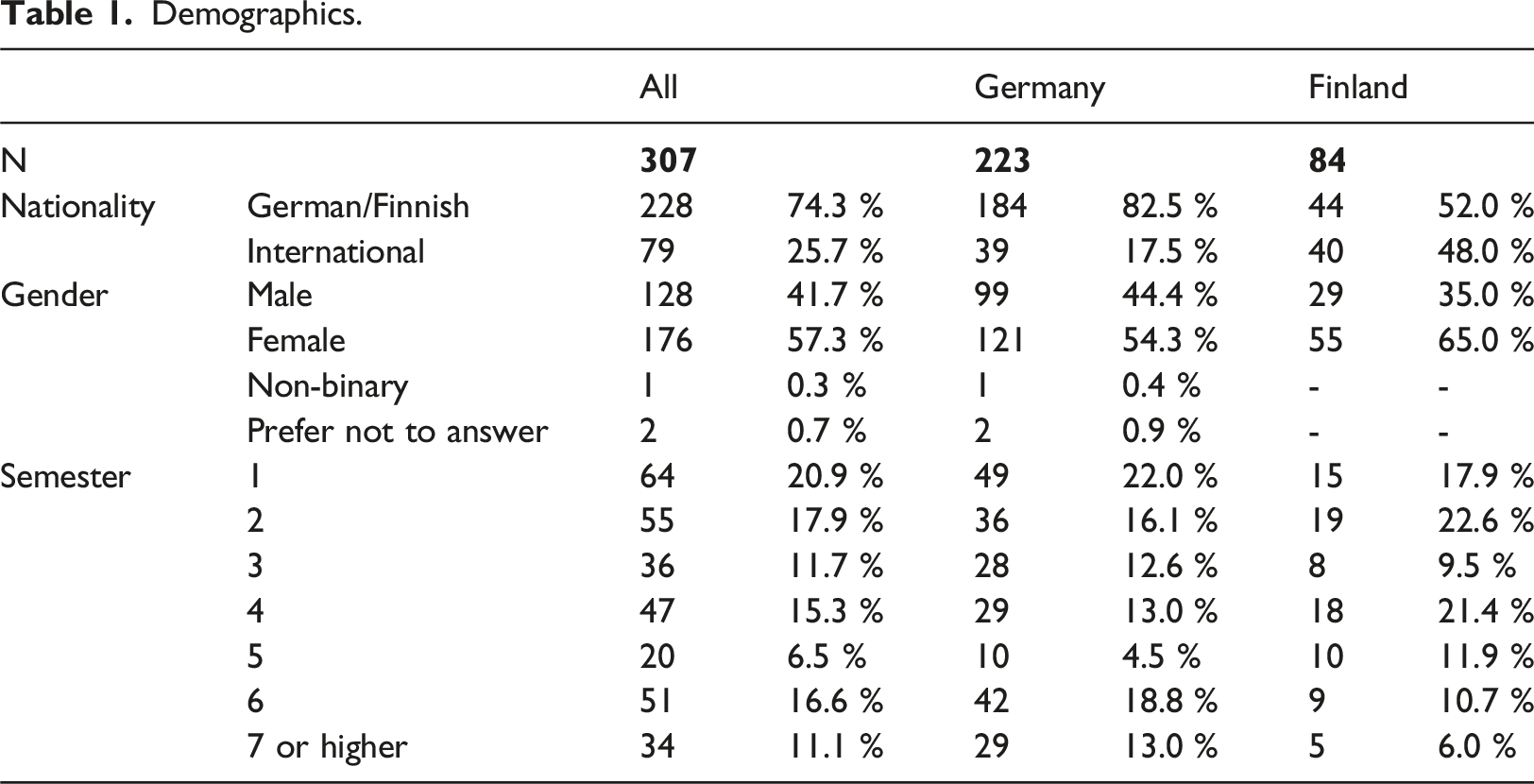
A total of N = 307 valid responses (N = 223 for Germany and N = 84 for Finland) were used. Among the respondents, there are slightly more female than male students at both universities. In Germany, 54,3% of the respondents are female, compared to 65,5% in Finland. The respondents in Germany are generally slightly younger than those in Finland. The distribution of national and international students differs somewhat between the two universities. In Germany, 82,5% of the participating students are national students, while in Finland the corresponding percentage is 52,4%.
Measures
The three predictors measured in this study are hope, self-efficacy, and motivation. These were measured using the scales presented below. Each scale contains items that respondents rated on a six-point symmetrical Likert scale where 1 = strongly disagree and 6 = strongly agree. A six-point scale removes the option of choosing a neutral midpoint and forces respondents to either agree or disagree. We chose not to use a midpoint because it minimizes social desirability bias (Garland, 1991), which can be an issue with our topics and is especially relevant with younger participants (Chyung et al., 2017). It also improves the reliability of responses (Chomeya, 2010). In addition, all of the established scales that we used as the basis for our study (see below) use an even number of items. To ensure the internal consistency of these predictor scales, Cronbach’s alpha was calculated separately for each predictor. The scales were assessed for measurement invariance to ensure they consistently measure the same construct in Germany and Finland.
Hope
The Domain Specific Hope Scale (DSHS) developed and validated by Snyder et al. (1996) was used to measure students’ hope. This is a measure of hope in different life domains with eight items each. Four of the items measure participants’ agency thinking, four their pathway thinking. We used the scale for the academic domain which includes items such as “There are lots of ways to meet the challenges of any class” or “My past academic experiences have prepared me well for the future.” In the data collected from both universities, the hope scale showed fairly high internal consistency, as indicated by a Cronbach’s alpha coefficient of 0.803.
Self-efficacy
The New General Self-Efficacy Scale (NGSE) developed by Chen et al. (2001) was used to measure self-efficacy. It is a unidimensional scale consisting of eight items such as “I believe I can succeed at most any endeavor to which I set my mind” or “I am confident that I can perform effectively on many different tasks.” The purpose of the NGSE scale is to assess individuals’ confidence in their ability to achieve their goals, even when faced with challenges. A general self-efficacy scale was selected over an academic self-efficacy scale because it seemed more appropriate for a cross-cultural comparison. Academic self-efficacy scales focus quite a lot on specific study tasks (e.g., writing papers, taking exams), the relevance of which may vary between different teaching and learning contexts. In addition, an advantage of the NGSE scale for our study is that it has been validated in different settings and in different national cultures. In this research data, the scale showed reliable internal consistency, as indicated by a Cronbach’s alpha coefficient of 0.892.
Motivation
An eight-item scale by Vallerand et al. (1993) was used to measure respondents’ academic motivation. This scale consists of four intrinsic motivation items (specifically the desire for knowledge) and four extrinsic motivation items (specifically identified reasons). Respondents were asked to indicate their reasons for studying international business, such as “Because my studies allow me to continue to learn about many things that interest me” for the intrinsic part, and “Because this will help me make a better choice regarding my career orientation” for the extrinsic part. In the context of this dataset, the scale showed robust internal consistency, as indicated by a Cronbach’s alpha coefficient of 0.820. When the scale was split into its intrinsic and extrinsic components, both segments showed strong reliability: a Cronbach’s alpha of 0.811 for intrinsic motivation and a high 0.774 for extrinsic motivation. In the analyses, the results for the motivation variable were studied both in general and separately for intrinsic and extrinsic motivation. As the results were all very similar and no significant differences between general motivation, intrinsic motivation, and extrinsic motivation were found, the results for motivation are reported as one overall variable.
Grade point average
Students’ GPA were obtained from the study register at the end of the spring semester, in July 2023, for those students who responded to the survey. The GPA used in this research is the students’ overall GPA from the entirety of their previous studies in the international business degree program. The grading scales for the GPA used in Germany and in Finland are different. The grading scale used in Germany is from 1 to 4, with 1 being the highest grade. In Finland, the scale is from 1 to 5, with 5 being the highest grade. For the data analysis, the German GPAs were converted to the Finnish grading scale using the following formula
Great point averages (GPAs) in Germany and in Finland.
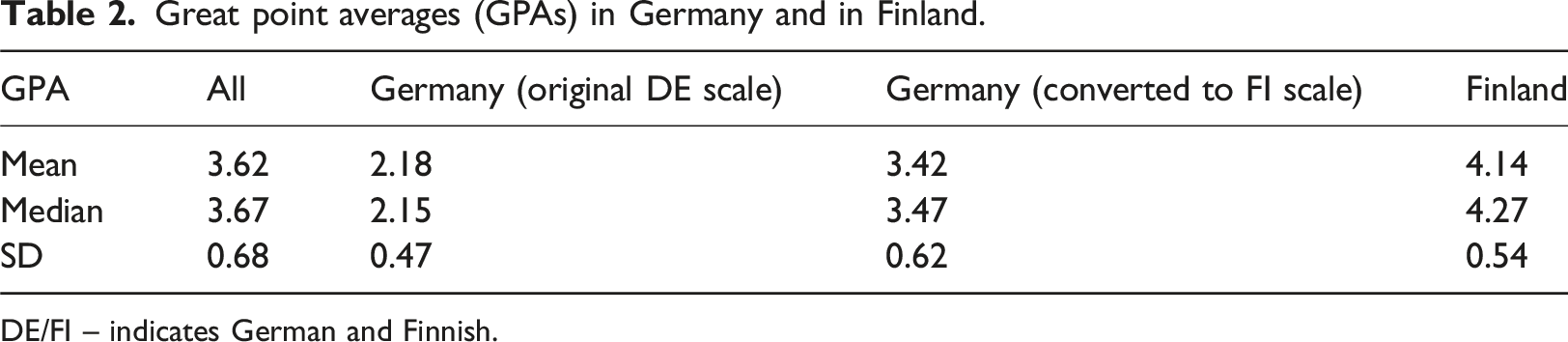
DE/FI – indicates German and Finnish.
Measurement invariance
Test of measurement invariance.
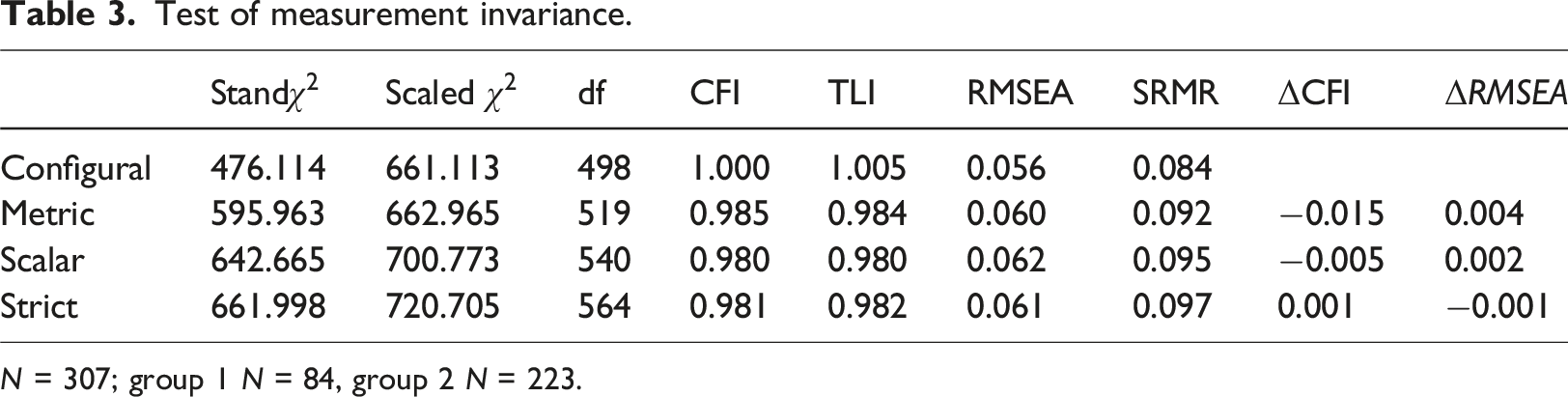
N = 307; group 1 N = 84, group 2 N = 223.
The fit indices indicate a strong model fit for CFI and TLI (≥0.95) and an acceptable fit for RMSEA (≤0.08) and SRMR (≤0.10). Configural invariance showed an excellent model fit (CFI = 1.000, TLI = 1.005, RMSEA = 0.056, SRMR = 0.084), confirming the same factor structure across groups. While metric invariance was not fully supported by ΔCFI (the decrease of 0.015 > 0.01), other fit indices were within acceptable ranges. To further evaluate metric invariance, we conducted a robust difference test to compare the configural and metric models (Satorra and Bentler, 2001) based on the standard chi-square test statistics. The results were not statistically significant (Δχ2 = 30.840, Δdf = 21, p = 0.076), suggesting that the factor loadings are equivalent across groups, despite the slightly elevated ΔCFI value. Scalar invariance was fully supported (ΔCFI = 0.005), allowing meaningful latent mean comparisons. Strict invariance was also achieved (ΔCFI = 0.001), allowing for comparison of observed item scores across groups.
Data analysis methods
Likert questionnaires are widely used in survey research, but the choice between using parametric or nonparametric methods to analyze them remains unresolved. De Winter and Dodou (2010) showed that these two types of tests had comparable power for the majority of the pairs studied. However, nonparametric methods had a power advantage when one of the samples was derived from a distribution that was either skewed or peaked.
The variables measured by the Likert scale in this research exhibit a non-normal distribution. Therefore, nonparametric tests were selected for making comparisons. For comparisons between two distinct groups, such as the two countries under consideration, the Mann-Whitney U test was employed, while for comparisons involving more than two groups, such as different semesters, the Kruskal–Wallis H test was used (Mann and Whitney, 1947; Kruskal and Wallis, 1952; see Pallant, 2020 for their appropriateness). When the Kruskal-Wallis H test yielded statistically significant results, Dunn’s test (Dunn, 1964; see Hollander et al., 2013 for its appropriateness) was applied to identify the differing groups.
In the above tests, the eta squared (η2) was used to measure the effect size to assess the practical significance of the observed effects. The effect size is calculated based on the test statistic, as described in detail by Fritz et al. (2012). Following Cohen (1988), a value of 0.01 indicates a minor effect, a value of 0.06 a moderate effect, and a value of 0.14 a considerable effect.
Since all of the predictor variables in this study are measured using a Likert scale, Spearman’s correlation coefficient was used to examine the monotonic relationships between the predictors themselves, as well as their associations with the GPA. Given the correlations between the three predictors, separate regression analyses were performed to evaluate the effect of each predictor on GPA separately. In each analysis, GPA was used as the dependent variable, with one predictor at a time designated as the independent variable. This approach allows us to isolate the effect of each predictor on academic performance without the confounding influence of other correlated variables. The statistical analyses were conducted using IBM SPSS Statistics version 28.
Results
Overall results for the three predictors and GPA
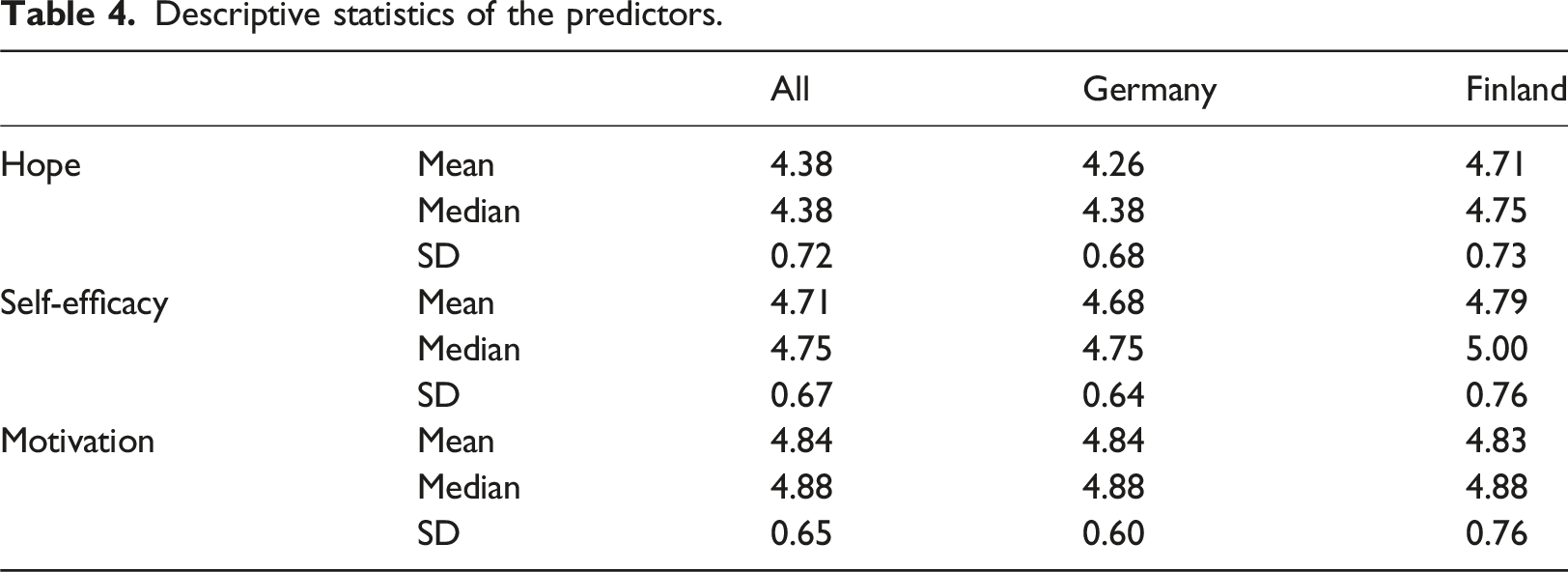
Descriptive statistics of the predictors.
Hope, self-efficacy, and motivation of students in Germany and Finland
The purpose of this section is to test whether the distributions of the predictors of hope, self-efficacy, and motivation differ between Germany and Finland. Statistical tests indicate that only the distribution of the predictor of hope differs between the two universities. A Mann-Whitney U test shows (U = 6139.50, p < 0.001) that students studying in Finland (mean rank = 192.41, N = 84) agreed more with the concept of hope than students studying in Germany (mean rank = 139.53, N = 223). This test result indicates a medium effect (η2 = 0.07).
As an example of a result at the indicator level, the students at the Finnish university show higher agreement with the question “I get the grades I want in my classes” (U = 5124.5, p < 0.001). The mean score of 204.49 for the N = 84 students at the Finnish university is significantly higher than the mean score of 134.98 for the N = 223 students at the German university.
For the other predictors, that is, self-efficacy and motivation, there were no differences between the scores of the students at the German and the Finnish university.
Hope, self-efficacy, and motivation across student demographics
The focus of this section is to examine the differences in students’ scores on the predictors of hope, self-efficacy, and motivation between students of different demographic groups (namely, internationality, gender, and semester). Country-specific findings are highlighted where applicable.
Internationality
In this study, international students represent all students who are not citizens of the country in which the university is located. Students with the nationality of the local university are called national students. In this dataset, there are N = 228 national students and N = 79 international students. The Mann–Whitey U test showed that none of the predictors examined, hope, self-efficacy, and motivation, indicated a significant difference between national and international students.
Gender
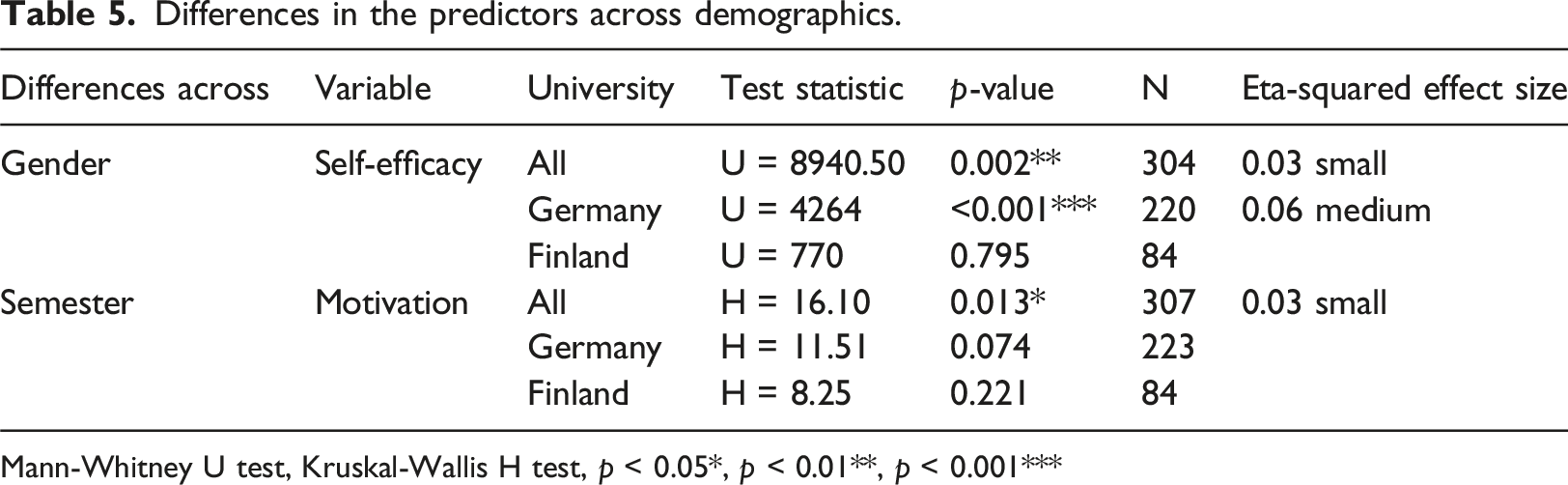
Analysis of gender differences was conducted only between students who identified as either female or male (N = 304). Differences between the two genders were analyzed using the Mann-Whitney U test.
Differences in the predictors across demographics.
Mann-Whitney U test, Kruskal-Wallis H test, p < 0.05*, p < 0.01**, p < 0.001***
Semester
The length of the degree programs at both universities is seven semesters. A Kruskal-Wallis H test indicated that the distribution of motivation differs between semesters. Dunn’s pairwise tests show significant changes from lower to higher semesters. The difference found between semester 2 (rank 176.18) and semester 6 (rank 130.52) is highly significant (p = 0.008). This leads to the conclusion that students’ motivation decreases during the course of their studies. The result is only valid for the joint data of both universities, no difference was found for either university separately. However, the calculated eta-squared effect size shows a small effect (Table 5).
The predictive power of hope, self-efficacy, and motivation for students in Germany and Finland
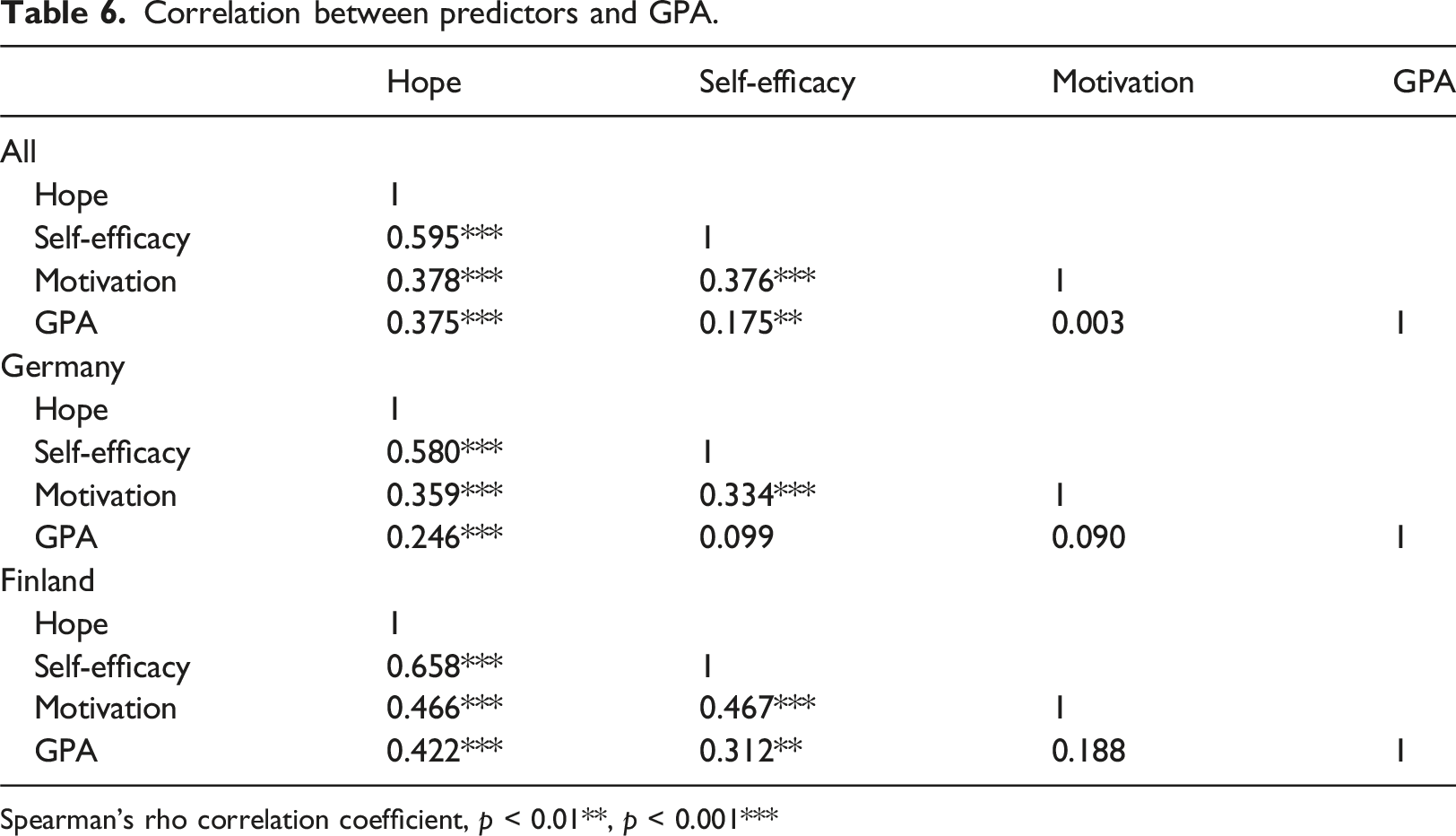
Correlation between predictors and GPA.
Spearman’s rho correlation coefficient, p < 0.01**, p < 0.001***
In the common dataset, the variable hope showed the largest correlation with GPA (r = 0.375, p < 0.001), followed by a comparatively weaker correlation between self-efficacy and GPA (r = 0.175, p = 0.002). There was no significant relationship between motivation and GPA, even when intrinsic and extrinsic motivation were considered separately. At the university level, hope remained the variable with the strongest correlation with GPA. The correlation between self-efficacy and GPA was found only for students studying in Finland, not for those studying in Germany (Table 6).
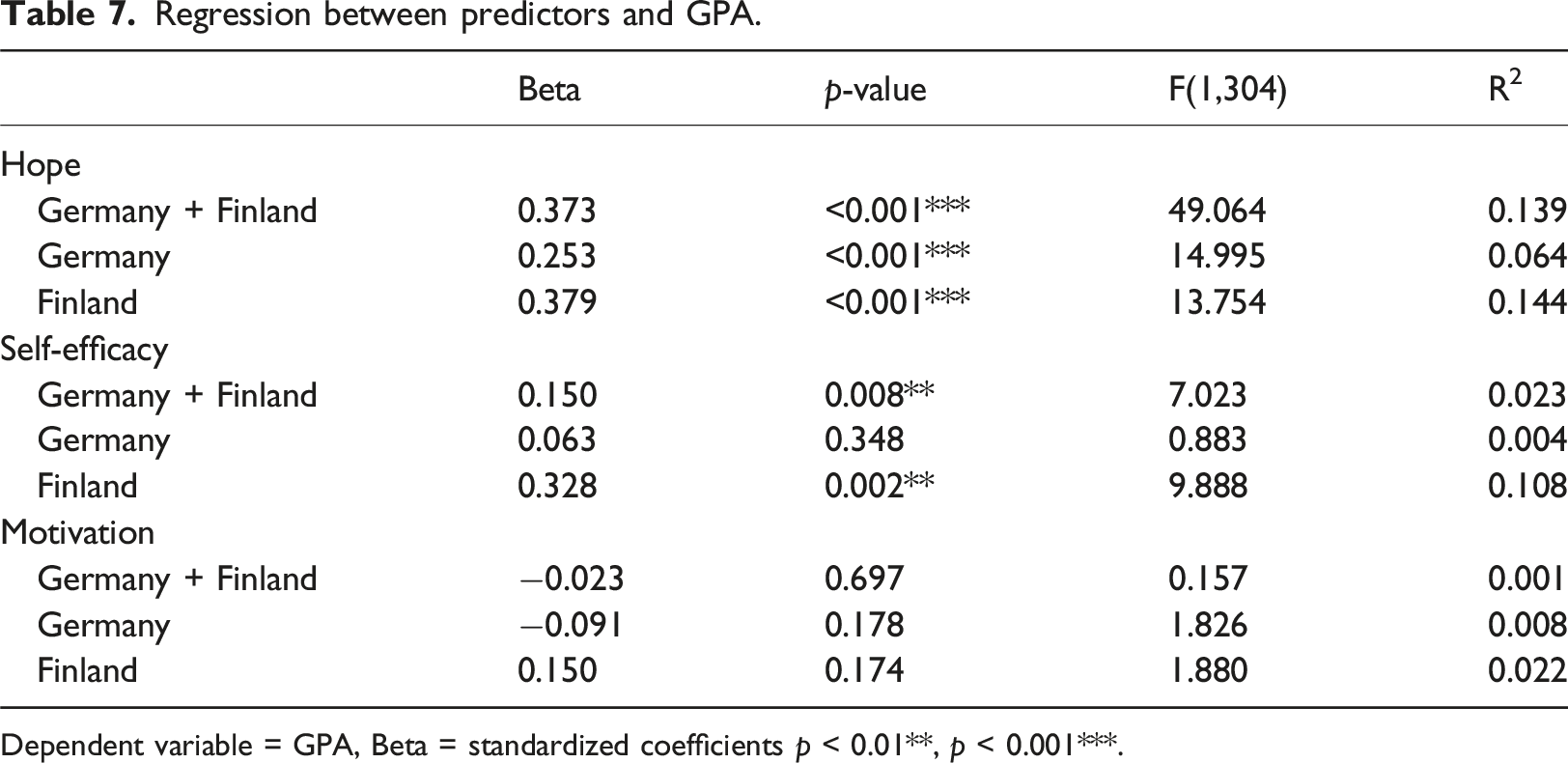
Given the correlations between the predictors, the unique influence of each psychological predictor on GPA was assessed separately to avoid mutual influence. The focus was on the unique impact of each psychological predictor on GPA, rather than their interactions. In total, nine simple linear regressions were performed, analyzing each of the three predictors individually, both for the full dataset and by country. To ensure result validity, the assumptions regarding the regression residuals were tested. The Breusch-Pagan test yielded non-significant results (p > 0.05) across all nine regressions, confirming homoscedasticity, or equal variance of residuals (Breusch and Pagan, 1979; Greene, 2018). Although the normality assumption for the residuals was not met, this assumption is typically the least critical of the standard linear model requirements (Lumley et al., 2002). Estimates of the regression coefficients remain unbiased even when residuals are not normally distributed, while prediction intervals may be inaccurate because they rely on the assumption of normality (Gelman and Hill, 2007; Greene, 2018).
The results of the regression indicate that the predictor hope explains 13.9% of the variation in the GPA (F = 49.064, β = 0.373, p < 0.001). The influence of self-efficacy on actual GPA is much smaller (Table 6), explaining only 2.3% of the variance in the grades for the dataset from both universities (F = 7.023, β = 0.150, p < 0.01). Motivation has no significant influence on the GPA in this dataset, not even when intrinsic and extrinsic motivation are analyzed separately.
Regression between predictors and GPA.
Dependent variable = GPA, Beta = standardized coefficients p < 0.01**, p < 0.001***.
Discussion and implications
The purpose of this study was to examine differences between business students in Germany and Finland in terms of their scores on three psychological predictors of academic success: hope, self-efficacy, and motivation. Next, the main findings are summarized, and references and comparisons to previous research are discussed along with possible explanations for the cross-national differences found.
Discussion of results
The main findings from the data analysis were as follows. The findings are presented according to the research questions:
SQ-1: What are the differences in students’ overall scores on the predictors of hope, self-efficacy, and motivation?
First of all, it was observed that respondents generally scored high on all predictors. Consistent with previous research (Brooman and Darwent, 2014; Fokkens-Bruinsma et al., 2021), all means were above the midpoint of the scale (motivation M = 4.84, self-efficacy M = 4.71, hope M = 4.38). Interestingly, our results contradict those of Feldman and Kubota (2015) and Gallagher et al. (2017), who found higher scores for hope than for self-efficacy, but are consistent with the findings of Dogan (2015), where motivation had the highest scores.
A notable observation was the significant difference in scores on the predictor hope between students from the German and the Finnish universities. The significantly higher scores of students from the Finnish university may be due to differences in university cultures and support for students’ well-being. It is consistent with the previously described higher level of engagement and commitment of Finnish university lecturers and the close relationships between teachers and students (e.g., Heo et al., 2018; Niemi, 2011; Sahlberg, 2007, 2015), as well as with the higher degree of assertiveness (Lindell and Sigfrids, 2008) and respectful communication in the Finnish university culture compared to the German one (Härkönen, 2000; Linderoos, 2002). In terms of self-efficacy and motivation, no significant differences were found between students at the German and Finnish universities.
SQ-2: What are the differences in students’ scores on these factors across demographic groups (internationality, gender, and semester)?
Internationality
No significant differences were found between the scores of national and international students on the three selected predictors of academic success, either within the overall sample or within the subsets of students in Germany and Finland. This finding differs from some other studies that have found differences in the scores and in the predictive power of certain factors for academic success (e.g., Ferencz and Hormuth, 2021; Li et al., 2010). However, the studies that do find differences focus on intellectual factors, particularly language skills and study behavior, rather than psychological factors. For example, Li et al. (2010) found significant differences in learning preferences and English language skills between Chinese students and students of other nationalities.
The fact that the present study did not find any differences between national and international students at the same university, but differences between students at a university in Germany and a university in Finland, suggests that the university cultures and the teaching and learning cultures of the respective institutions have an influence on students’ attitudes towards learning.
Gender
When comparing female and male students, a significant difference was observed in the predictor of self-efficacy. In this study, male students had higher self-efficacy scores than female students. This finding is similar to and consistent with the results of a recent study by Viviers et al. (2023) in which male students were found to be more confident in four self-efficacy beliefs. However, it contrasts with some other studies (e.g., Fokkens-Bruinsma et al., 2021; Papageorgiou et al., 2023; Penzar et al., 2021) where female students tended to have a higher score in self-efficacy than male students.
The observed gender differences in self-efficacy were particularly evident among students at the German university, but not at the Finnish university. This may be due to higher levels of assertiveness in Germany, combined with the fact that the GLOBE study suggests that there is some gender difference in assertiveness. Although researchers debate the extent to which there are real gender differences or whether they are the result of societal beliefs and stereotypes about behavioral differences (House et al., 2004: 400), assertiveness tends to be seen as a masculine trait, which means that higher levels of assertiveness are mainly found in men. Therefore, the higher levels of assertiveness in Germany may be seen mainly in the scores of male students.
Semester
Another finding was the notable shift in the predictor of motivation from students in lower semesters to students in higher semesters. It was observed that students’ motivation tended to decrease as they progressed through the semesters. This is consistent with the findings of Nonis et al. (2005) who, in a study of freshman, junior, and senior cohorts, demonstrated a decreasing effect of psychological variables on GPA as students progressed in their academic journey.
SQ-3: What are the differences in the predictive power of these factors?
In our overall sample, the most influential predictor of student GPA was the psychological factor hope
The correlation between self-efficacy and GPA found in our study appears to be relatively weak (r = 0.175). This is consistent with Viviers et al. (2023), who found comparable correlations between various self-efficacy beliefs and academic performance (ranging from r = 0.102 to r = 0.281). The influence of self-efficacy on GPA in our study, using the data from both universities, explains only 2.3% of the variance in grades. However, for students in Finland, self-efficacy yields for 10.8% of the variance in GPA, which is consistent with the results of Viviers et al. (2023). The results of the Finnish university students show a moderate correlation (r = 0.312) with GPA, a result that is consistent with the meta-analysis results of Robbins et al. (2004) with r = 0.378 and Richardson et al. (2012) with r = 0.31. The result is also consistent with Penzar et al. (2021) who, based on a study in the US, proposed that the model with self-efficacy as the mediator fully explained the relationship between the agency component of hope and academic achievement (R2 = 0.13). These results contrast with studies that claimed hope to be a unique predictor of academic achievement, such as those by Feldman and Kubota (2015) and Gallagher et al. (2017). Conversely, self-efficacy had no effect on GPA for students at the German university, a finding consistent with Fokkens-Bruinsma et al. (2021) from the Netherlands.
In our research, we found no correlation between motivation and GPA, which is consistent with the findings of Han et al. (2022), who also found that academic motivation was not associated with academic performance in their study. However, this contradicts other studies that have reported correlations between students’ motivation and their academic performance, claiming that motivation serves as a significant predictor of academic success (e.g., Fong et al., 2017; Mahdavi et al., 2023; Nonis et al., 2005).
Practical implications and recommendations
The results of our study suggest that universities would be well advised to consider students’ cultural experiences and backgrounds when designing their student selection and, even more so, their student support systems. This is particularly important for programs that have culturally diverse student bodies or extensive student exchange programs. In particular, our findings have the following implications for student selection and student support.
Supporting students’ hope, especially in Germany
Given that students in Germany score much lower on hope than students in Finland, and yet hope is a good predictor of academic success, it seems beneficial to explore interventions to support students’ hope, especially at German universities. Feldman and Kubota (2015) also suggest that, regardless of the national culture of a university, new tools and interventions should be developed that promote the development of academic hope and thus help to improve students’ academic performance. For 8th graders in Finland, Alanko (2021) shows that encouragement, progress, and the experience of success could increase hope in young people. Bryce et al. (2022) also found that for middle school students teacher commitment and a positive school culture, as well as good student-teacher relationships, are critical in fostering student hope. They recommend interventions aimed at improving student-teacher relationships, such as ongoing student-teacher interactions and teaching practices that help students feel connected to and respected by their teachers.
Developing students’ self-efficacy, especially in Finland
In Finland, self-efficacy has been found to be an important predictor of academic success in addition to hope. Therefore, it seems advisable to promote students’ self-efficacy, especially in Finland. This could be achieved through targeted training and individual support measures. Offering appropriate self-efficacy interventions such as workshops that could enhance self-efficacy beliefs is also suggested by Viviers et al. (2023). Wirawan and Bandu (2016) propose self-efficacy training based on Bandura’s (1986) four primary sources of self-efficacy: success experiences, vicarious experiences (experience that others with similar competence can perform successfully), social persuasion including verbal persuasion (when persuasion is within realistic bounds) and physiological states (eliminating emotional arousal to subjective threats increases perceived self-efficacy). Examples of self-efficacy training tasks suggested by Wirawan and Bandu (2016) include writing down current and desired skills in specific courses (to later increase awareness of past successes), or providing success stories of students who initially struggled with academic performance but then successfully completed their studies.
Keeping students motivated throughout their studies
In Germany and Finland, it also seems recommendable to provide ongoing support for students’ motivation, as our results suggest that students’ motivation declines over the semesters. Amida et al. (2021) emphasize that universities should develop interventions that identify ways to increase, in particular, students’ intrinsic motivation. They stress the importance of enabling students to internalize and enjoy their learning, which could significantly improve their academic success. Nonis et al. (2005) state that it is the responsibility of universities, schools and disciplines to communicate to all prospective business students the importance of motivation in increasing the likelihood of successful study (e.g., through brochures, promotional material, in basic courses). They further argue that all students, especially those who lack the necessary motivation, should have access to training sessions focusing on motivation. Finally, they add that a specific teaching style (experiential learning instead of lectures) and specific assessment approaches (interesting and stimulating individual projects instead of knowledge tests) could increase students’ motivation.
Considering hope, self-efficacy, and motivation in student selection
A large body of research has shown that hope, self-efficacy, and motivation could have an impact on students’ academic success. Universities may therefore consider taking these factors into account when selecting students, as Nonis et al. (2005) suggest for non-intellectual factors in general. One possibility would be to measure applicants’ hope, self-efficacy, or motivation as part of the selection process, for example, with quantitative tools like those used in this study. Another possibility would be to consider these factors in selection interviews. Motivation is often an issue in such interviews, and hope and self-efficacy could also be considered. However, many universities do not have the opportunity to conduct selection interviews or to use tests as part of the selection process. In this case, the focus must rather be on support and training interventions.
Limitations and future research
Although this study adds new insights to the discussion of predictors of academic success in different cultural settings, it also has some limitations. First, our sample consisted of only a limited number of participants (N = 307) and the sample sizes in Germany (N = 223) and Finland (N = 84) are somewhat different. Furthermore, there are some structural differences between the participating students in Germany and in Finland (e.g., slightly different proportions of international students, slightly different GPAs) that may have influenced the results. Third, as the study programs at both universities are very international and have a high proportion of international students, a true cross-cultural comparison in the sense of a comparison of students from two different national cultures could not be realized. The study is based on the assumption that national culture influences university culture and that the latter has an influence on students’ scores on predictors of academic success. In this context, it is also a limitation that the study does not assess the differences between the teaching and learning contexts at German and Finnish universities in terms of concrete variables. This was beyond the scope and possibilities of the present study, but could be a direction for future research. The present study relies on existing research on German and Finnish teaching and learning cultures. Finally, the predictive power of the factors may vary across semesters. However, this limitation is of limited relevance to the present study, as we did not focus primarily on the predictive power of the selected factors, but rather on a cross-cultural comparison of students’ scores on these predictors.
The findings of this study suggest several directions for future research. First, it would be beneficial to conduct research studies with larger samples of students and, if possible, even more comparable student bodies. Second, it would be interesting to look at students from national cultures other than German and Finnish and from cultures with completely different university systems and university cultures. Further research could also assess the teaching and learning context of the cultures studied more concretely in terms of specific variables. Furthermore, different conceptualizations of the assessed predictors could be used, for example, hope as an achievement emotion according to Pekrun (2006) instead of a cognitive construct according to Snyder (1994) and the predictors could be measured with different instruments. Other psychological and study behavior predictors, such as engagement, could be considered, as well as cultural differences in terms of student scores and the predictive power in different cultures. In addition, future research could consider other aspects of measuring student performance besides GPA, such as retention or performance in specific courses. These factors are considered in some other studies in the field. Finally, future research could use other methods for predictive power analysis, particularly methods enabled by machine learning capabilities.
In its present form, however, the study makes a significant contribution to the cross-cultural higher education literature by examining cultural differences in students’ scores on three predictors of academic success and in the predictive power of these factors across different university and learning cultures.
Footnotes
Declaration of conflicting interests
The author(s) declared no potential conflicts of interest with respect to the research, authorship, and/or publication of this article.
Funding
The author(s) received no financial support for the research, authorship, and/or publication of this article.
