



Abstract
This paper examines dynamic, intersecting pathways – marked by gender inequalities, poverty dynamics and conflict trajectories – affecting education access and learning outcomes in conflict-affected contexts. A set of key challenges in intersectional research in conflict-affected contexts are outlined, embedded in the complexity of these contexts, heterogeneity of conflict processes and non-trivial data gaps. To better engage with this complexity, this paper argues that the capability approach extended through a multidisciplinary, intersectional lens drawing on mixed methods data has the potential to offer a strong conceptual basis to understand pathways of impact. The operationalisation of the capability approach in the context of research on conflict can help move the empirical literature towards a sounder focus on intersecting factors that may dynamically constrain the exercise of people’s freedoms. In turn, suggestions for promoting gender-sensitive, inclusive education amidst conflict are discussed.
Introduction
Access to schooling has considerably improved globally over the last two decades, and efforts are being made to concurrently improve the quality of learning. However, this overall trend hides inequalities faced by certain children on the basis of gender, household poverty pathways and contextual disadvantages such as armed conflict over time. These intersecting, often dynamic factors of people and place can operate on their own to limit school accumulation and learning quality. Their intersections moreover can amplify constraints and shape opportunities and access to resources to varying degrees in ways that can push girls and boys affected by poverty further behind.
There is an increasing body of empirical literature that details the impact of armed conflict on education, reflecting improvements in data collection in conflict-affected contexts especially over the last two decades (Justino, 2016). However, beyond basic gender disaggregation, there is limited understanding of how factors at different levels can intersect, sometimes dynamically, to mediate this relationship. This is an important limitation, because the ability to look across heterogeneities, such as gender which is fairly exogenous, and poverty status and conflict exposure which are likely more endogenous, could provide important insights to disentangling demand- and supply-side impacts. Yet there is inadequate treatment of these intersectional issues, alongside limited consideration of how dynamics of poverty and of conflict may shape and be reshaped over time.
This paper examines the literature on conflict and education, and in particular conceptual gaps that centre around an inadequate understanding of the dynamic, intersecting pathways characterising education access and learning outcomes for girls and boys in conflict-affected contexts. It argues that part of the challenge in addressing these research gaps stems from the complexity of conflict-affected contexts, high degrees of context-specificity in the ways gender inequalities, poverty dynamics, and conflict intersect, and non-trivial data gaps. To better engage with this complexity, this paper proposes that a capabilities foundation extended through an intersectional lens is one approach that may be well-suited to the research agenda understanding conflict and its pathways of impact in ways that offer a meaningful contribution to the field of gender-sensitive, inclusive education amidst violent conflict.
The next section summarises the quantitative literature on the association between conflict and education, both in terms of inter- and intra-country analysis. It then relies on quantitative and qualitative literature to examine the various pathways through which conflict may affect education outcomes. This is followed by consideration of a set of key challenges in undertaking intersectional analysis to interrogate the relationship between conflict and education. This discussion provides impetus to next examine potential ways to address these challenges, and why the capability approach may be one relevant lens through which to view the intersectional relationship between conflict and education. In doing so, it discusses applications of the approach to the context of conflict and education, and for children facing intersecting inequalities within these contexts. Finally, the article concludes and discusses policy implications from this analysis.
The relationship between armed conflict and education
A summary of quantitative literature on the conflict-education nexus is provided below, relying on a suite of working papers published in the Households in Conflict Network, and academic journal repositories and other report publications focused on understanding this relationship. The focus on quantitative sources was with a view to develop a general understanding of the relationship in question. A brief overview of multi-country quantitative studies linking conflict with education presents a backdrop to introduce qualitative and quantitative country-level and subnational studies that investigate pathways of impact. The review of pathways of impacts in turn builds on existing literature exploring transmission mechanisms (e.g. Justino, 2016). However, it significantly builds on this by drawing attention to gender-differences and poverty differentials.
The review is not meant to exhaustively cover sources, but rather draw attention to the different relationships that may be observed and the types of mediating pathways through which conflict might affect education. As such, it adopted a purposeful search of grey and published literature. Regarding the inclusion and exclusion criteria, it focused on literature from approximately 2005 onwards, which refer to armed conflict and education. It started with examining multi-country papers that provide a macro-level overview of this relationship. It then honed in on the literature focused on pathways through which conflict affects education, especially where gender and/or poverty was a focus in the analysis. Even so, it is worth reiterating that this was purposeful and non-systematic, meant to offer insights on the relationships pathways to motivate the subsequent discussion of shortcomings and theoretical frameworks to mitigate these shortcomings.
Inter-and intra-country quantitative investigations into conflict and education
The quantitative literature on the effect of conflict on education in low- and middle-income countries has grown with improvements in data collection in conflict areas (see Justino, 2012, for a review). Cross-country studies generally find that conflict is associated with lower school enrolment and years of schooling. For example, Lai and Thyne (2007) in a global study observe that countries undergoing civil wars between 1980 and 1997 experience a decline in school enrolment by around 1.6 to 3.2 percentage points, while Shields and Paulson (2014) find that conflict was significantly correlated with reduced growth in enrolment rates amongst 149 countries more recently between 2000 and 2011. Another investigation of 25 conflict-affected countries between 2000 and 2008 added that conflict is associated with less years of schooling, lower literacy rates and a decrease in the share of individuals with formal schooling (UNESCO, 2015). However, there are also exceptions to this negative relationship. For example, Stewart et al. (2001) discovers that five in 18 African countries affected by civil wars saw primary school enrolment rates increase between the beginning and end of the conflict. Even so, the authors note that during the most severe years of the war, case study evidence suggests that the situation in these countries deteriorated and enrolment fell. Chen et al. (2008) observe that, when the end of war signals the beginning of lasting peace, education enrolment rates tend to follow pre-war trends.
Such approaches are useful in understanding the general direction of the relationship between conflict and education, but often fail to capture the causal pathways through which armed conflict affects education, or how these effects vary depending on the severity or distributional consequences of conflict (Blattman and Miguel, 2010). To help fill this gap, micro-level analysis of low- and middle-income countries have emerged over the last two decades in particular, spurred by the increasing presence of data from conflict-affected countries (Verwimp et al., 2019). In this literature, conflict is typically associated with reductions in education outcomes of children of school-going age during and immediately after the conflict (e.g. Akresh and De Walque, 2008; Arcand and Wouabe, 2009; Dabalen and Paul, 2014; Diwakar, 2015; Merrouche, 2011; Rodriguez and Sanchez, 2012; Serneels and Verporten, 2012; Islam et al., 2016; Bertoni et al., 2018; Bruck et al., 2019). Education outcomes in such studies tend to cover years of schooling, enrolment rates and school completion (Parlow, 2011).
In establishing causality, micro-level studies generally merge household survey data with GIS intra-country data sources on conflict intensity, and often rely on difference-in-differences, propensity matching methods or instrumental variable techniques to account for endogeneity. Instruments for conflict are most commonly defined in terms of the distance to a border. Where instrumental variables are not adopted, there is some compensation for omitted variable bias through, for example, restricting the sample to high conflict communities or creating a synthetic control region (Wharton and Oyelere, 2011; Groot and Goksel, 2011).
These studies have increasingly adopted gender disaggregation, recognising gender inequalities that may sometimes be aggravated in conflict contexts, with heterogenous impacts on education (Blattman and Annan, 2010; Akresh and De Walque, 2008; Kecmanovic, 2013; Diwakar, 2015; Chamarbagwala and Morán, 2011; Shemyakina, 2011; Buvinic et al., 2014; Singh and Shemyakina, 2016; Diwakar, 2023). However, a focus on gender disaggregation alone hides important inequalities related to poverty. Indeed, not only do wealth and gender inequalities interact, but poverty is a major cause of the education gap (Ilie and Rose, 2016). The bidirectional, mutually reinforcing relationship between armed conflict and poverty places a focus on this disaggregation not only by gender but also by poverty and its dynamics particularly relevant in conflict-affected contexts.
Armed conflict and education: Pathways of impact by gender and poverty
An attempt to summarise the pathways through which conflict affects education is provided in Figure 1 and the text that follows, drawing on both quantitative and qualitative literature. This summary goes significantly beyond existing syntheses of conflict and education by explicitly focusing on multi-level pathways, and how gender and poverty affect this relationship. This accordingly draw a focus to a broader framing of intersecting inequalities (Kabeer, 2010). It is worth reiterating that the list below is by no means exhaustive but rather guided by pathways derived from the literature. Summarising pathways of impact of armed conflict on education. Source: Author’s compilation based on surveyed literature.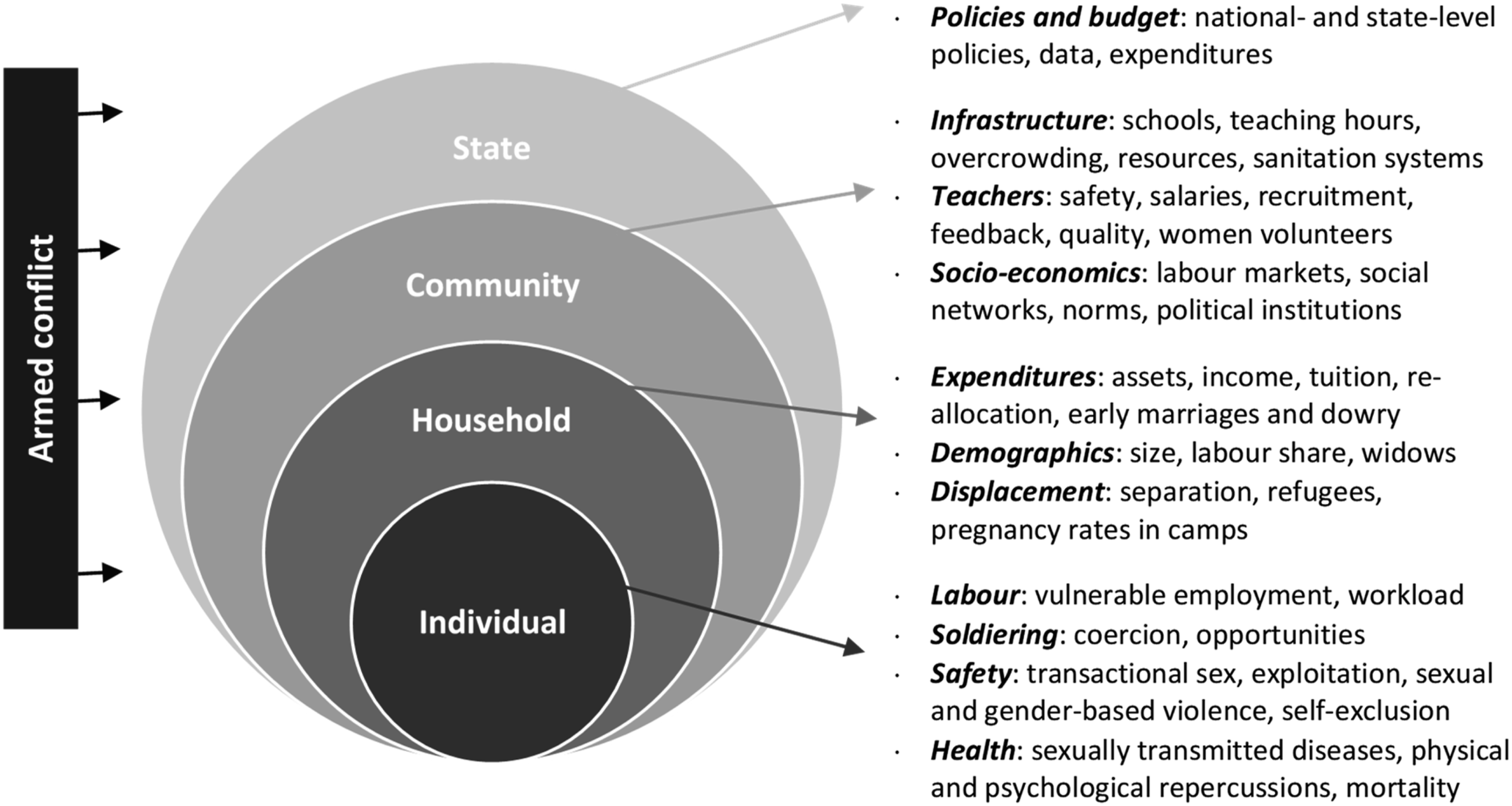
State-level pathways
Public policies and expenditures
At the national- and state-level, conflict can reduce the government’s capacity to provide socio-economic services and implement pro-poor policies. This could be a result of direct costs of war, such as from the destruction of infrastructure including school facilities, or indirect costs stemming from the loss of revenue or human productivity and data collection capacities which may push governments to reducing non-military spending (Lai and Thyne, 2007). It could also be accompanied by alternative forms of governance and service provision (Arjona and Kalyvas, 2012; Sahoo, 2015). In some cases, where warring parties’ ideology may be in favour of gender equality, such as during the Maoist conflicts in Nepal (Valente, 2014) and India (Diwakar, 2023), education access and learning may still be nurtured. However, more generally, girls’ education in conflict settings have not been a priority and thus received little international funding support (UNESCO, 2015). Lower budgets overall could in turn result in a reorientation of household resources towards boys’ education (Singh and Shemyakina, 2016). Or, following Poirier’s (2012) argument, the decline in social spending could disadvantage young boys first, and next prevent older girls from completing secondary schooling. The loss or decline in social support could push poor children out of the school system entirely.
Community-level pathways
Schools
Conflict also affects school infrastructure, both indirectly through a shift of resources away from social sectors, and directly through its destructive impact on school buildings. During violent conflict, schools can be destroyed through targeted attacks or collateral damage (Jones and Naylor, 2014), closed for safety concerns, or even co-opted by a warring party (Machel, 1996). Recent analysis also points to an increase in attacks on girls’ schools, in particular where a warring party may be opposed to girls’ education (GCPEA, 2018; UNICEF, 2017). This suggests that the micro-dynamics of conflict are important, and require sounder attention in the literature as they differentially affect supply-side factors for the education of girls and boys. As a result, the length of the school day may reduce to accommodate a higher number of shifts in remaining schools, and the supply of learning materials would reduce (Buckland, 2005). Children in poorer households might have less opportunities to transfer to other schools to maintain education continuity. In addition, children, especially girls, who have to then travel further distances to a functioning facility, may stay home due to the long and possibly dangerous commute (Diwakar, 2023). Or, the absence of sanitary facilities at the affected schools could disproportionally affect adolescent girls, who may be forced to miss school during menstruation (UNESCO, 2006).
Teaching
In addition to the physical destruction of schools, teachers could be killed or flee the area of conflict due to threats of violence, lack of salaries or inadequate supplies (Plan, 2008). Teacher recruitment may be more difficult given the prevailing uncertainty. The reduced supply of teachers contributes to overcrowding of students and reduced opportunities for feedback. For the teachers who do remain, the lack of salary or inadequate incentives could further reduce the quality of teaching (Bruck et al., 2019). Girls may be further affected due to fewer women volunteers as teachers in male-dominated schools (UNESCO, 2006; Roy and Singh, 2016), which in turn could have a host of implications for their safety and wellbeing if they remain in school. In addition, children in poor households may have less resources for private schooling or tuition, and would accordingly suffer more from a lack of quality education. However, policing of school quality particularly by left-wing armed groups could result in improved school attendance or learning outcomes (Valente, 2014; Diwakar, 2023).
Socio-Economic conditions
Armed conflict has a negative effect on wider community-level infrastructure beyond schools and the provision of teaching services. For example, local labour markets can get depressed when socio-economic conditions deteriorate due to armed conflict (Justino, 2009), while job losses can also emerge affecting household poverty (di Maio and Nistico, 2019), and so lower the returns to education and drive school dropouts. These returns could be even lower amongst girls in chronically poor households due to structural constraints and limited social relations and socio-political networks through which to access labour market opportunities (Bird, 2017). In situations of armed conflict, there could also be a reversion to traditional values which further disadvantages girls’ education in particular (Justino, 2012), and the education of girls’ in chronically poor households even more through exclusion. In addition to these economic and social impacts, there are also political changes that occur in conflict situations. Armed conflict offers opportunities for alternative governance structures that may challenge existing leaders, which have ambiguous effects on household welfare (Arjona and Kalyvas, 2012), and in turn, the education of children.
The pathways described so far are only some of the more prominent supply-side channels through which armed conflict can affect the education of girls and boys, with the intersection of poverty and gender inequalities contributing to particularly negative outcomes. Various demand-side pathways also exist, such as through the effect of armed conflict on household economic status, which I turn to next.
Household-level pathways
Expenditures
The destructive nature of armed conflict on education goes beyond public expenditures and local services to directly affect the households in which children live. To this end, armed conflict ‘damages education from above [through national budgets] and below [through household budgets]’ (EFA, 2011). An important demand-side mechanism through which armed conflict affects schooling is through its destructive impact on productive household assets and income. Impoverished families in these situations may be unable to meet the rising costs of private tuition and so may pull children out of school (Buckland, 2005). Particularly where the destruction of infrastructure is extensive and job opportunities for skilled labour are scarce, there could be a reallocation of education expenditures towards boys who may be more likely to find jobs in the workforce (Justino, 2012; Singh and Shemyakina, 2016). Indeed, the opportunity cost of education girls may be perceived to increase in these contexts (Pereznieto et al. 2017; Alam et al. 2016). Additionally, it may prove difficult or unsafe for girls to engage in income-generating activities, who consequently may not have the means to pay for their schooling (UNSECO, 2006; Diwakar, 2023), especially if they are poor. Early marriages to reduce the dependency burden in chronically poor households and procure dowry to complement household welfare could curtail schooling opportunities for girls in poor households, and furthermore lead to health problems if they get pregnant at a young age (Plan, 2008).
Demographics
Even where household expenditures are not directly affected, changes in household demographics may affect schooling decisions. However, it is not always the case that the effect on education is negative. The literature points to an interdependence between women’s choices and the wellbeing of children, which is even more prominent amongst poor households (Buvinic et al., 2012). Following Thomas’ (1990) model of intra-household allocation of resources, armed conflict could alter the share of these resources in favour of women through an increase in conflict-related male deaths or an increase in labour income. In turn, this could lead to a higher share of investments in human capital of children, particularly for girls (Dasgupta, 2001). However, conflict could also create households headed by widows especially vulnerable to the intergenerational transmission of poverty (Buvinic et al., 2012), and so offset any gendered gains. There could also be different outcomes for primary- compared to secondary-school age girls and boys (Poirier, 2012).
Displacement
Displacement of families and separation of children could also affect household demographics and through this the education of children. Women and children constitute the majority of refugees and displaced (Buvinic et al., 2012), an intersecting group which may experience severe impoverishment. The evidence on girls’ access to education in IDP or refugee camps is mixed (Pereznieto et al., 2017; Verwimp and Bavel, 2012). Some studies also suggest that displaced households may spend less on the education of children (Eder, 2013). Children living in temporary conditions or with relatives may also lack the support to continue schooling, including where household size increases as a result of deaths resulting in the merging of families. Impoverished girls in these situations especially may be forced to take up additional tasks around the house, and have less time to study (UNESCO, 2006). Teenage pregnancy rates are also high in refugee camps. Without support systems in place, and in the face of stigma and discrimination, young mothers may be unlikely to receive an education (UNESCO, 2006).
Though the household-level impacts of armed conflict affect boys and girls to different degrees, there are also other pathways by which conflict directly affects the individual, discussed next.
Individual-level pathways
Labour
As stated earlier, though it may be unsafe for girls to engage in economic activities, girls and boys in chronically poor households may have no recourse but to undertake vulnerable employment including unsafe paid work or commercial sex to help supplement household welfare (Bird et al., 2010). In cases where income-generating adults die, intra-household reallocations of labour may result in children in impoverished households being removed from schools to act as substitute wage earners (Justino, 2009). Moreover, conflict-affected areas suffer from various infrastructure failures which may increase girls’ workload in particular. For example, when sanitation systems fail, girls in poor households may have to walk far distances to fetch water (Plan, 2008). This could reduce study time and lead to worse educational outcomes, or altogether prevent girls in poor households from going to school. However, it is also likely that boys may be taken out of schools to engage in income-generating activities during times of armed conflict (Justino, 2012), and so experience lower education outcomes relative to girls.
Soldiering
Another issue particular to conflict situations is child soldiering. Children in conflict-affected areas may be abducted or recruited to join armed forces, while others may join in the absence of alternatives, particularly if they are from impoverished or marginalised backgrounds (Machel, 1996; HRW, 2008). A study of armed conflict across a range of African countries indicated that girls often joined fighting forces to escape domestic violence, abuse and poverty (Coulter, 2008). In other instances, girls may choose to participate in armed forces as a child soldier, as these settings can help expand the set of opportunities available to them, for example, through new positions of power and skills (McKay and Mazurana, 2004), which in turn could contribute to future poverty escapes. This potentially positive impact reinforces the wide spectrum of outcomes in conflict situations, though needs to be balanced with the trauma and other negative consequences which child soldiers may live with long after the conflict.
Safety
For children in conflict-affected areas, the symbolic power of education as a ‘portable asset’ and means of resilience (Bird et al., 2010) may persuade them to obtain education at any cost, whether through informal or formal channels. Groot and Goksel (2011) suggest that individuals in conflict-affected areas have an incentive to increase their level of education. To do so, girls may engage in transactional sex including with education authorities, particularly if they have limited financial resources to continue schooling (Hutchinson et al., 2016; Sommer et al., 2018; UNESCO, 2006). Their personal safety may further be compromised through other forms of exploitation at schools or on the way (Buckland, 2005; Salem, 2018). Indeed, girls are more vulnerable to sexual and gender-based violence – often a feature of conflict-prone and post-conflict areas – and so may be an especially vulnerable subgroup (Jennings and Nikolic-Ristanovic, 2009). There is also the risk of girls being taken as forced wives or sexual slaves in conflict-affected contexts (Save the Children, 2018; Omoeva et al., 2016). As such, girls may self-exclude from further education due to these safety concerns, or may be married earlier as a protective measure and in this process might be more likely to withdraw from school (Hutchinson et al., 2016).
Physical health
Commercial and transactional sex may become more pronounced in situations of armed conflict, and has clear health impacts such as the risk it brings of sexually transmitted diseases (UNESCO, 2006). Increases in GBV and IPV may also be prevalent in conflict-affected contexts especially marked by the normalisation of violence (Read-Hamilton and Marsh, 2016; Østby, 2016; OECD, 2022). Girls in chronically poor households in this situation may not have the resources to substitute towards home-based schooling. More generally, conflict-induced ill health could also worsen education outcomes of young children (Bundervoet, 2012) through, for example, increased absence rates or dropouts (Jones and Naylor, 2014). The violent nature of armed conflict could also directly result in the loss of child lives. Mortality amongst adults in conflict situations, often men (Michaelsen and Salardi, 2020), could have further implications for children’s education.
Mental health
There are also long-lasting psychological repercussions which may increase school dropouts or contribute to lower school achievement amidst conflict. In other cases, this trauma from violence is also observed to contribute to lower test scores, where some studies find no differences by gender, while others find strong declines variably for boys or girls (Bruck et al., 2019; Poutvaara and Ropponen, 2018; Monteiro and Rocha, 2017; Diwakar, 2018). There are also effects on trauma of parents and teachers in these contexts, in some cases amplified for women (Gershenson and Tekin, 2018). Children, in particular girls, who may develop a disability or experience mental ill health due to conflict, may be kept hidden and out of school (UNESCO, 2006). In spite of this, health system responses in situations of violent conflict remain largely gender-blind (Percival et al., 2018), pointing to challenges thus in both supply- and demand-side constraints.
The above review highlights expected and unexpected pathways of impact that operate on multiple levels, from state budgets down to individual push and pull factors. Even so, there are certain gaps in this literature. Though there are also some studies that rely on panel data to enable consideration of changing dynamics over time (e.g. Pivovarova and Swee, 2015; Justino and Salardi, 2014; Valente, 2014; Roy and Singh, 2016; Michaelsen and Salardi, 2020; Diwakar, 2023), in general there is limited engagement with conflict trajectories and the varied processes through which these affect education outcomes. Second, the wider literature generally remains evasive on the impact of conflict on education for children in households on different poverty pathways. The limited evidence that does exist suggests that certain intersecting groups like girls in chronically poor households experience especially negative consequences. The intersections of poverty dynamics with gender and other markers thus deserve more consideration than currently accorded in the literature.
Challenges in studying conflict and education
Though there are a range of studies investigating the relationship between conflict and education, there is relatively less investigations into the intersections of conflict, poverty and gender, and how these combine to affect education outcomes. This section outlines some of the complexities that may limit this type of analysis.
Challenge 1: Multi-level impacts
Firstly, there are multiple levels of impact that affect each other. Indeed, though the pathways discussed above are categorised by the primary level of impact, they also affect and are affected by other levels, as well as pathways within the same level. In other words, there are transmission mechanisms that operate between and within levels. For example, reduced public spending on education could affect teacher incentives which in turn could reduce the number of women volunteers and influence children’s safety perceptions and decisions to go to school (Diwakar, 2023). Or, ill health of children linked to violence could increase household expenditures and push some poor parents to pull children out of school. Related to this, some of these pathways of impact can be self-reinforcing, creating feedback loops that may sometimes amplify the effects of the constituent parts.
Challenge 2: Complexity and bidirectionality
The relationship between the gendered impacts of conflict and poverty on education is also complex and bidirectional. For example, there are various reverse pathways by which lack of education of girls and boys could act as instigators for conflict (Justino, 2009; Justino et al., 2013; Couttenier and Soubeyran, 2015). Limited education is often linked to poverty as a cause and consequence itself, and can contribute to grievances that can compel individuals to take up arms. There is relatedly a complex, mutually reinforcing relationship between poverty and conflict (Blomberg et al., 2006; Collier et al., 2003; Collier and Hoeffler, 2002; Diwakar et al., 2017; Fearon and Laitin, 2003; Hess and Orphanides, 1995; Sambanis, 2004). Poverty could itself be a cause of conflict, and the experience of it – even as captured through local event counts (e.g. Besley and Mueller, 2012), and could likely be an outcome of conflict as well. The precise causal relationships within an episode of conflict, too, are complex, and may have further heterogeneity by gender, as noted in the last section. Indeed, as noted above, the micro-dynamics of conflict are likely to play an important role in both supply- and demand-side effects on the education of girls and boys. This requires mediation analysis to understand how conflict is working through poverty to impact education differentially for girls and boys.
Challenge 3: Heterogeneity of conflict processes
The mechanisms perpetuating violent conflict can be complicated and incredibly context-specific. Indeed, armed groups both shape and are shaped by conflict dynamics. In turn, they can have varied roles and impacts across these levels. For example, education may be provided by armed groups, sometimes to win hearts and minds but fundamentally to indoctrinate or shape collaboration of populations in areas under their control (Kalyvas, 2008). Relatedly, there may be alternative governance structures (Arjona and Kalyvas, 2012) or a form of parallel service provision including of schools (Sahoo, 2015; Das, 2017), which can sometimes partly offset the destruction of infrastructure that might otherwise be anticipated through conflict (Jones and Naylor, 2014). Dependent on ideologies of armed groups, the effect of conflict on education may be mitigated or even reversed, whether through increased enrolment (Valente, 2014), or improvements in learning outcomes of certain groups (Diwakar, 2023).
Challenge 4: Data limitations
The data needs for such approaches are not trivial, especially considering that untangling these causal relationships are inherently complicated. Unfortunately, conflict zones are notoriously data-light environments (Bruck et al., 2019). Moreover, data on poverty in many conflict-affected countries are limited. Even in cases where this does exist, sometimes regions of high conflict intensity may be excluded from the data collection. This is, for example, the case in Nigeria, where Borno state with high conflict events and fatalities had smaller coverage in both the General Household Survey panel (2012–2019) and the larger Nigeria Living Standards Survey 2018/19. This means that any analysis that merges these two datasets are likely to underestimate the true impact of conflict amongst the most marginalised populations.
From the discussion above, it is clear that the problem is not merely that intersectional analysis does not exist, but that its complexity and data requirements make it a challenging enterprise. The theoretical frameworks used to analyse conflict may also be inadequate for the task at hand. For example, neoclassical and endogenous growth models still largely mainstream in the economics literature can acknowledge that conflict destroys the total human capital stock, but says little of the multi-level impacts outlined above or the feedback loops and bidirectionality often operating in conflict-affected contexts. Thus, even where there is relevant data, there may be a need to expand our conceptual lens through which to interrogate the relationship between conflict and education.
Expanding the capability approach to interrogate conflict and education
So how can we overcome the knowledge gaps outlined in the previous section? This section considers what is needed to overcome the challenges outlined above, and ultimately draws attention to how the capability approach might be one valid means of helping address these challenges.
Tackling challenge 1: Acknowledging multi-level ‘conversion factors’
Embedding research on inequalities in education within a framework that captures multiple scales of analysis can help draw attention to multi-level factors that affect the ability of children to exercise real freedoms, thus helping mitigate the first challenge noted above. One such framework which takes this into account is the capability approach. The capability approach advocates that wellbeing be evaluated based on capabilities and functioning. ‘The focus here is on the freedom that a person actually has to do this or be that – things that he or she may value doing or being’ (Sen, 2009, p. 232). According to the capability approach, ‘conversion factors’ enable or constrain the ability of resources and assets to ‘convert’ into capabilities and functioning (Robeyns, 2005, 2016). These factors may be personal, social or environmental. Personal factors may include intelligence or physical impairments, social factors often include gender norms and social policy, and environmental factors span infrastructure, climate (Robeyns, 2005; Nambiar, 2013), and can be extended to include armed conflict not only in terms of its presence and intensity but also in its dynamic shifts across time and space. Conversion factors are central to our understanding of the capability approach, as it suggests that income and assets are necessary but not sufficient in generating education capabilities. Instead, these depend on the presence and strength of enabling ‘conversion factors’, which determine the degree of education-related capabilities held by individuals and societies.
Tackling challenge 2: Centring intersectionality
Intersectionality theory examines the relationship between social inequalities, and begins with the premise that people live multiple and layered identities (Crenshaw, 1991; McCall, 2005; Hancock, 2007). The review towards the start of the article presented a case for focusing on certain intersecting inequalities, namely, gender inequalities at the individual level, poverty dynamics at the household level and subnational conflict trajectories which can exert differential impacts on education outcomes. It suggested that outcomes of girls in poor households would differ considerably depending on inequalities based on gender and poverty dynamics, as well as conflict processes. As the review highlighted, moreover, there are stark differences by gender that mediate the relationship between conflict and education.
Adopting intersectionality as a lens through which to strengthen the capability approach (Balsera, 2015) emphasises the underlying processes that may affect education outcomes within and across groups. It can thus be a useful means of which to respond to the second challenge outlined above. Moreover, gender inequalities are often described in the capability approach as an issue of ‘disparate freedoms’ (Sen, 1992: 125) insofar as inequality of opportunity and agency for women is by definition also an inequality of freedom which can contribute to lower education outcomes.
Extending the capabilities approach through an intersectional lens can aid in drawing attention to power dynamics that may affect people’s lived experiences. By treating one identity category as dominant, whether poor children or girls, groups at the intersection may be marginalised. The education of poor girls in conflict-affected areas moreover depends extensively on the domain of violence, including the extent of armed conflict in various localities, political agendas and local government responses, and structural inequalities. The capability approach extended through an intersectional lens would focus on the role of these complex social and power relations both within and between. These relations permeate across levels, are complex and can also impact education outcomes (Rose and Dyer, 2008).
An intersectional lens investigating gender alongside poverty dynamics can further help mitigate concerns about limited engagement with power and conflict within the capability approach. Poverty dynamics can influence education access and learning outcomes, and is itself created or reinforced through local contexts, social structures and power asymmetries. There is another added level of dynamism where violent conflict can affect chronic poverty, as well as vice versa (Justino, 2006). Examining pathways within this mutually reinforcing relationship between poverty and conflict, and the drivers underlying their dynamics, places emphasis on the multi-level causes that go beyond static conceptions of income to span social and political processes that can maintain or perpetuate conflict and the chronicity of poverty. A strong contextualisation of poverty dynamics in conflict settings in turn helps acknowledge a more social conception of ‘living well together’ that considers social structures enabling or constraining people to pursue freedoms in relation to others (Deneulin and McGregor, 2010).
Tackling challenge 3: Promoting multidisciplinary studies of crises
Armed conflict can be framed as a dynamic inequality that can limit the ability of production and assets to ‘convert’ into education capability. While existing quantitative analysis continues to largely examine static impacts primarily through cross-sectional data, the review points to the importance of investigating trajectories of conflict over time. Extending the capabilities discourse to more centrally engage with group-based inequalities and how their trajectories intersect with other processual factors draws attention to the ways in which these processes can converge in different ways over time to amplify dynamic conflict effects in ways that are often larger than the sum of the independent characteristics and processes. Linking this to a sound analysis of power relations is again critical in understanding the ways in which conflict trajectories may affect service provision, including of education of marginalised children. This necessarily involves a sound understanding of the ideologies underpinning parties to conflict, through multidisciplinary economic, political, historical and anthropological approaches.
At the same time, focusing on conflict dynamics on its own is insufficient. There are a spectrum of armed conflict dynamics alongside a range of sequenced shocks and stressors in conflict-affected contexts, such as crime, alcoholism and other health shocks, depressed labour markets, exploitative lending practices, and natural hazards. These may impoverish or maintain poverty in conflict-affected areas (Diwakar, 2023). Such findings build on poverty dynamics literature which finds that it is often a series of shocks which have the potential to impoverish (Baulch, 2011; Diwakar and Shepherd, 2022). The intersection of shocks such as crime and disasters with conflict can amplify the gender-differentiated human capital consequences of conflict. All of this points to the need to recognise a plethora of shocks and crises operating in conflict-affected areas that need to be adequately contextualised in research on conflict.
Tackling challenge 4: Collecting and analysing mixed methods data
Operationalising research on conflict and poverty trajectories may be complicated, as noted in Section 3. On the one hand, they require panel data to derive trajectories over time, which may not be readily available in conflict-affected contexts. To be sure, there are various countries with panel datasets available, both in terms of conflict data and household panel data, which have been successfully merged to investigate these relationships (e.g. Pivovarova and Swee, 2015; Justino and Salardi, 2014; Diwakar, 2023). In addition, there has been over the last decade a surge in subnational data on armed conflict and political violence, including through international datasets like UCDP-GED and ACLED, both of which offer geo-referenced data on conflict fatalities though with differences in the types, fatality counts and coverage of events.
At the same time, data challenges remain a real problem, especially when attempting to find sufficient panel data that contains sufficient topics to overcome intersectional analysis. In Bruck et al. (2019), for example, household socio-economic information is not available, even if other indicators related to conflict and educational achievement are. It may also be difficult to link individual children from surveys to specific schools that have been damaged, which is a constraint related to Challenge 1 above. The level of precision in different datasets can also vary, with implications for the unit at which conflict is measured. For example, whether conflict is measured with a latitude/longitude offset or at the district level or beyond can have implications for the degree of precision. For example, analysing poverty at the household level, education at the individual level and conflict at the district level as done in Diwakar (2023) becomes particularly challenging given the large population sizes of many districts in India. On the other hand, this might also enable such assessment to better capture conflict spillovers, and so again understanding the micro-dynamics of conflict is critical in these efforts.
Data needs can nevertheless be aided through multi-level mixed research methodologies, whereby qualitative data could also be collected. Where insecurity limits access, drawing data from areas that were conflict-affected in the recent past may be a safer alternative (Diwakar, 2023). Qualitative data collection could comprise contextualising focus groups and key informants alongside life history interviews. This is a hallmark approach in other research on poverty dynamics, for example, by the Chronic Poverty Advisory Network (see da Corta et al., 2021, for an overview). This could be built on through relational interviews with schoolteachers and other meso-level actors to strengthen the multi-scalar focus outlined above (Diwakar, 2023), and improve our understanding of the governance arrangements and political economy considerations influencing access to education and learning. It would place the individual in relation to others in society, contextualised within a structural understanding of patriarchy, gendered intra-household decision-making, and intersecting dynamic factors around conflict and poverty. There are emerging examples of how mixed methods approaches and tools to analyse poverty dynamics can be embedded within the capability approach to guide its framing (Diwakar and Shepherd, 2022), which could be built on in the analysis of conflict and education more systematically.
From the analysis above, the capability approach (Sen, 1992, 1999), extended through an intersectional framing that is contextually embedded and draws on multiple methodologies, may thus provide a sound conceptual basis for investigating the relationship between conflict and education. The examples above have highlighted ways in which this approach can be operationalised to help move investigations towards the real freedoms that people have to achieve their potential and intersecting factors (gender, poverty trajectories and conflict) that may dynamically constrain the exercise of these real freedoms. In this way, it can help broaden our understanding of this relationship to draws attention to how dynamic intersecting inequalities might affect education.
Conclusion and policy implications
This paper highlighted dynamic relationships between conflict and education, attributable largely to context specificities as well as the multi-faceted pathways of impact. The literature on these pathways generally adopted limited consideration of changing conflict dynamics over time, and of the impact of conflict on education for girls and boys in households on different poverty trajectories. Interrogating these gaps pointed to a set of key challenges in undertaking intersectional analysis of the relationship between conflict and education: (1) the challenge of multiple levels of impact that affect each other, (2) presence of a bidirectional relationship between conflict, poverty and education, (3) the complexity and context-specify underlying conflict processes and (4) data gaps.
In turn, the theoretical and conceptual space through which the capability approach is introduced emerges from these gaps. A capabilities framing offers a conceptual springboard from which to assess the extent to which certain constraints may result in capability deprivation. The constraints explored emanate from conditions of armed conflict, material deprivations that are also socially constructed or reinforced as observed through poverty dynamics, and gender inequalities. Though the capability approach has been argued to focus predominantly on the individual at the expense of social groups and group-based inequalities, intersectional mixed methods research on poverty dynamics that is contextually embedded offers potential to more explicitly situate the individual in relation to others in society at the centre of analysis, and to examine how individual, household and group-based inequalities affect schooling outcomes. A focus on group-based inequalities reflected in dimensions of armed conflict, as well as its intersections with gender and poverty dynamics, presents an extension of the approach.
A research focus on these dynamic, intersecting inequalities has important implications for the design of conflict-sensitive, equitable policy formulation. Specifically, the examination of conflict dynamics is relevant in developing more effective policies that recognise armed conflict as a dynamic spectrum, with other shocks and stressors moreover having the potential to reinforce its effects. This requires a more holistic approach to addressing risks that include but go beyond conflict and violence. A risk-informed policy development approach would be particularly relevant to consider. Such an approach pushes decision-makers to understand and acknowledge that all development choices involve the creation of uncertain risks, as well as opportunities (Opitz-Stapleton et al., 2019). Policies or programs that are not adequately informed by both risk and equity in conflict-affected areas could worsen the impacts of conflict on vulnerable girls and boys.
An emphasis on gender and household poverty dynamics when researching and responding to these complex conflict impacts is important in ensuring conflict-sensitive design of policies and programs in ways that address the multiple and often intersecting sources of deprivation in violent situations. In drawing attention to the multiplicity of education impacts, the arguments presented this paper offer impetus for education specialists to be interested in issues well beyond but linked to the education sector, to span gender inequalities, poverty and conflict dynamics that operate outside the level of the learner. A wider audience base can collectively advocate for improved wellbeing through education amidst armed conflict.
Footnotes
Acknowledgements
I would like to express sincere thanks to Pauline Rose for her guidance during the earlier development of this research. I would also like to thank two anonymous reviewers who provided very helpful feedback on the draft article.
Declaration of conflicting interests
The author(s) declared no potential conflicts of interest with respect to the research, authorship, and/or publication of this article.
Funding
The author(s) received no financial support for the research, authorship, and/or publication of this article.
Replication statement
The data and code used in this paper will be provided to researchers on request. If interested, please send an email to