



Abstract
Despite a range of internationalisation efforts at the government and institutional levels, Vietnam remains on the periphery of the existing scholarship on international education, especially inbound mobility. Drawing on interviews with 38 participants, this article provides insights into how Australian students arrive at a comparative, international perspective in their field of study and develop Vietnamese cultural literacy during their short-term mobility to Vietnam. The study also brings to the fore the hindrances, in particular language barrier, facing Australian students in mobility programs. The article points out how the New Colombo Plan can play an important role in raising the awareness of the value of learning an Asian language like Vietnamese and enriching Vietnamese cultural literacy among young Australians. It concludes with practical recommendations for incorporating the development of regional languages and cultural literacy in learning abroad programs.
Keywords
Introduction
The dominant discourse on international student mobilities tends to concentrate on East–West, South–North binaries. Within this discourse, countries in the global North have been positioned as major and transformative study destinations for both full-degree and short-term mobilities. The emerging attention given to student mobilities within the Asian region, ‘periphery’ to ‘semi-periphery’ and South–South student mobilities (e.g. Collins and Ho, 2018; Gunter and Raghuram, 2017; Lipura and Collins, 2020; Mulvey, 2021; Phan et al., 2022) points to a critical need to diversify and transform our thinking about higher education and international education in the Indo-Pacific. Within the region, studies of student mobilities in countries in East Asia and Southeast Asia-particularly China, Japan, South Korea, Singapore and Malaysia have dominated the existing literature. It is therefore critical to understand marginal or overlooked spaces such as Vietnam that, in diverse ways and to varied extent, are rising as increasingly important players in the realm of inbound mobility and international education (Ha and Fry, 2021; Tran and Marginson, 2014). In addition, Pham (2022) points out an imbalance of the literature about Vietnam’s student mobilities which appears to be mainly concerned about outbound flow from Vietnam while overlooking inbound flow to Vietnam. This article responds to a critical need for more evidence-based research on Vietnam as a destination for student mobility.
Emerging research on international student mobility to Vietnam has addressed issues such as government policy, trends and programs related to student mobilities (Bui and Tran, 2023; Hoang et al., 2018; Tran et al., 2022; Tran and Marginson, 2018), factors shaping the success of international student recruitment in Vietnam’s tertiary institutions (Pham et al., 2022) and social engagement and student mobility for non-academic purposes (Kumpoh et al., 2021). Yet, little is known about whether and how short-term mobility to Vietnam has transformed discipline-specific knowledge and professional experiences for students from a developed Western country like Australia. Scholars have called for empirical research on the impacts of learning-abroad on students’ academic learning and discipline-specific outcomes (Doyle et al., 2010; Dall'Alba and Sidhu, 2015; Nerlich, 2021).
This article examines how Australian engineering students engaged in learning during a short-term mobility program to Vietnam. It looks at whether and how they developed discipline-specific knowledge, skills and cultural literacy and identifies the challenges, including language barriers, they encountered through this learning-abroad program. The study draws on interviews with 38 Australian students and members of the local communities hosting them in Vietnam. It uses Kolb’s (1984) experiential learning theory as a conceptual framework to interpret the nature of Australian students’ learning through this outbound mobility program. In this article, short-term learning abroad refers to a mobility program, summer school, mentorship or/and an internship abroad for less than a semester.
Outbound student mobility and the New Colombo Plan
Student mobility programs tend to reflect government’s economic and political goals. UK’s mobility programs such as ‘Generation UK-China’ and ‘Generation UK-India’, and USA’s ‘100,000 Strong China’ embrace these countries’ commitment to strengthening ties with their targeted destinations, China and India, through student mobility programs. It has also been argued that the discourse around international student mobility from countries in Africa to China mirrors the relative positions of the two nations within the global political economy (Mulvey, 2021). Another development in existing scholarship about international students mobilities is the emergence of research on intra-Asian mobility (Hanada and Horie, 2021; Lipura, 2020; Kumpoh et al., 2021) and ‘periphery’ to ‘semi-periphery’ student mobility like from Africa to China (Mulvey, 2021). This body of the literature has provided significant evidence about how government positioning and agendas on international and regional relations impact on student mobility trends and programs. In Australia, the New Colombo Plan (NCP) introduced in 2014 embraced the government’s goal to draw on outbound student mobility to the Indo-Pacific to strengthen Australia’s regional engagement and enhance people-to-people linkages. This regional mobility program views Australian students as key actors in implementing public (soft) diplomacy goals (Tran et al., 2022; Tran and Bui, 2021; Tran and Marginson, 2018) while undertaking study and internships in the region. The NCP has shifted Australia's outbound mobility trend from a concentration on traditional Anglophone destinations to Indo-Pacific countries. Within the NCP, the term ‘Indo-Pacific’ refers to Asia, the Pacific and the subcontinent.
The New Colombo Plan is a reverse form of the Colombo Plan. The original Colombo Plan was launched in 1951 by the Australian government with the goal to support scholars from Asia to study in the commonwealth countries to enrich their professional and cultural knowledge (Oakman, 2010; Rizvi, 2011), enable technological transfer and strengthen Australia’s position in the region. The Colombo plan sponsored over 20,000 students and scholars in total (Australian government, 2021a). The Colombo Plan is thus the symbol of international education as aid and public diplomacy. Building on the legacy of the Colombo Plan, the New Colombo Plan provides Australian undergraduate students with opportunities to engage with the Indo-Pacific region through study and internship programs in 40 locations (Australian Government, 2021b). The government’s initial funding for the NCP was around $100 million, followed by $51 million p. a. for 2017–24 (Australian Government, 2016, 2020). Since 2014, there have been about 70,000 NCP scholarships and mobility grants awarded to Australian undergraduate students.
There has been a substantial growth in research and scholarship on students’ learning broad over the past two decades (Sin et al., 2017; Humphreys and Baker, 2021; Maharaja, 2018; Dall’Alba and Sidhu, 2015; Li, 2020). This emerging body of the literature focuses on key aspects of outbound mobility such as career benefits (Potts, 2015; Tran et al., 2021a), personal growth, and development of intercultural and global competence (Humphreys and Baker, 2021; Maharaja, 2018) and challenges and adaptation (Coleman, 2013; Dasli and Sangster, 2021; Pogorelova and Trenchs, 2018). In particular, Li’s (2020) study revealed a link between outbound mobility and an increase in grade point average (GPA) regardless of students’ gender, ethnicity and field of study. Nevertheless, students’ academic learning in specific disciplines has not received adequate attention in literature. Furthermore, as learning abroad is often depicted as being transformative, its benefits are often seen as being generic (Nerlich, 2021). The need to research discipline-specific learning and transformation is highly relevant and critical to our holistic understandings of learning-abroad programs and the creation of opportunities for nurturing academic learning in such programs. With this aim, our study investigates whether and how short-term mobility program could potentially transform students’ curriculum learning, knowledge and skills in a specific discipline, alongside language awareness and cultural literacy development.
Engineering students’ learning abroad
Engineering has increasingly become a global profession. Engineers in today’s world are expected to solve multiple global challenges such as energy security, pollution, access to clean water, poverty, resource depletion and climate change (Baker and Ağar, 2011). In addition, contemporary challenges in different technical fields including biomedical devices, complex manufacturing design and large systems of networked devices require a system perspective, resulting in the need for collaborations among multidisciplinary teams of technical experts (National Research Council, 2005). To remain competitive and to cope with the increasing demand of collaborations, STEM workforce needs to develop knowledge and skills beyond their traditional technical subjects including teamwork and entrepreneurial mindset (Miller and Way, 2007), ability to communicate with diverse people, an understanding of a global market and social context and its complexities, and capacity to be flexible, receptive to change and respectful (National Research Council, 2005). A scoping study on Engineering Future 2035 in Australia also highlights a growing need of collaborations and interactions across an ever growing range of constituencies and global perspectives including an understanding of the world outside Australia in engineering practice (Burnett et al., 2019). Future engineers should be well prepared to adapt to changes in global labour force and trends.
However, there is a growing concern that undergraduate engineering students in the Global North including the US and Europe are unable to gain the much needed international experience and are not adequately prepared for a future professional in the technology industry that has become highly internationalised (Klahr and Ratti, 2000). The emphasis on internationalisation has resulted in growing students participating in study abroad to acquire the necessary global competencies to prepare for their future profession as the central goal of learning-abroad programs is often to develop students’ global competency including problem definition, engineering cultures, local regulation and engineering ethics (Knight et al., 2019).
Although learning-abroad is reported to assist students to develop needed global competencies to participate in the increasingly internationalised workforce (e.g. Netz, 2021; Tran et al., 2021b), the participation of engineering students in study abroad is low, compared to those from other fields of study (Klahr and Ratti, 2000; Seccia, 2017). Challenges associated with engineering students’ learning-abroad include the rigid structure of required, sequential courses that makes it difficult for students to be away from campus (Niehaus and Inkelas, 2016; Seccia, 2017; Parkinson, 2007), the difficulty in credit transfer, and lack of applicable courses/engineering courses (Seccia, 2017). In addition, students in STEM majors may not prioritise foreign language study and faculty may not encourage study abroad due to the perceived less educational value of such experiences (McLeod and Wainwright, 2009). Moreover, due to the pressure to reduce students' time to complete a degree, solutions that add courses or semesters to the required curriculum are not viable (Knight et al., 2019).
Theoretical framework
Experiential learning theory was used to analyse the student learning experience from participating in the NCP program. The learning theory defines experiential learning as ‘the process whereby knowledge is created through the transformation of experience’ (Kolb 1984: p. 41). This is a continuous process that involves the creation and recreation of knowledge through reflection and transformation of experience gained from real-life activities (Kolb, 1984). The theory is built on the proposition that learning is not an outcome; rather, it is a process involved relearning where leaners’ beliefs are challenged and tested with new ideas, insights and feedback. It is also a process of adapting to the environment driven by conflicts, disagreement and/or differences whereby learning outcomes are achieved through resolving these conflicts and incorporating new experience to existing concepts for new knowledge creation (Kolb, 1984).
Participating in real situation provides students with a chance to transform knowledge learnt from textbooks and classrooms into their understanding and create their own meaningful learning outcomes (Chan, 2012). In higher education, there are a range of experiential learning activities including work placement, internships, practicum experiences, field studies, classroom experiential learning exercise and community service learning to add a practical component to their traditional academic training (Kolb, 2014; Chan, 2012). In Kolb’s experiential theory, learning is viewed as a four-stage cycle: concrete experience, reflective observation, abstract conceptualisation and active experimentation (Figure 1). This learning cycle is a recursive process where the learner experiences real situation, reflect, think and act. This process is sensitive to what is being learnt and the situation where the learning takes place (Kolb, 2014). The Experiential learning cycle. Source: Kolb (2014, p. 51).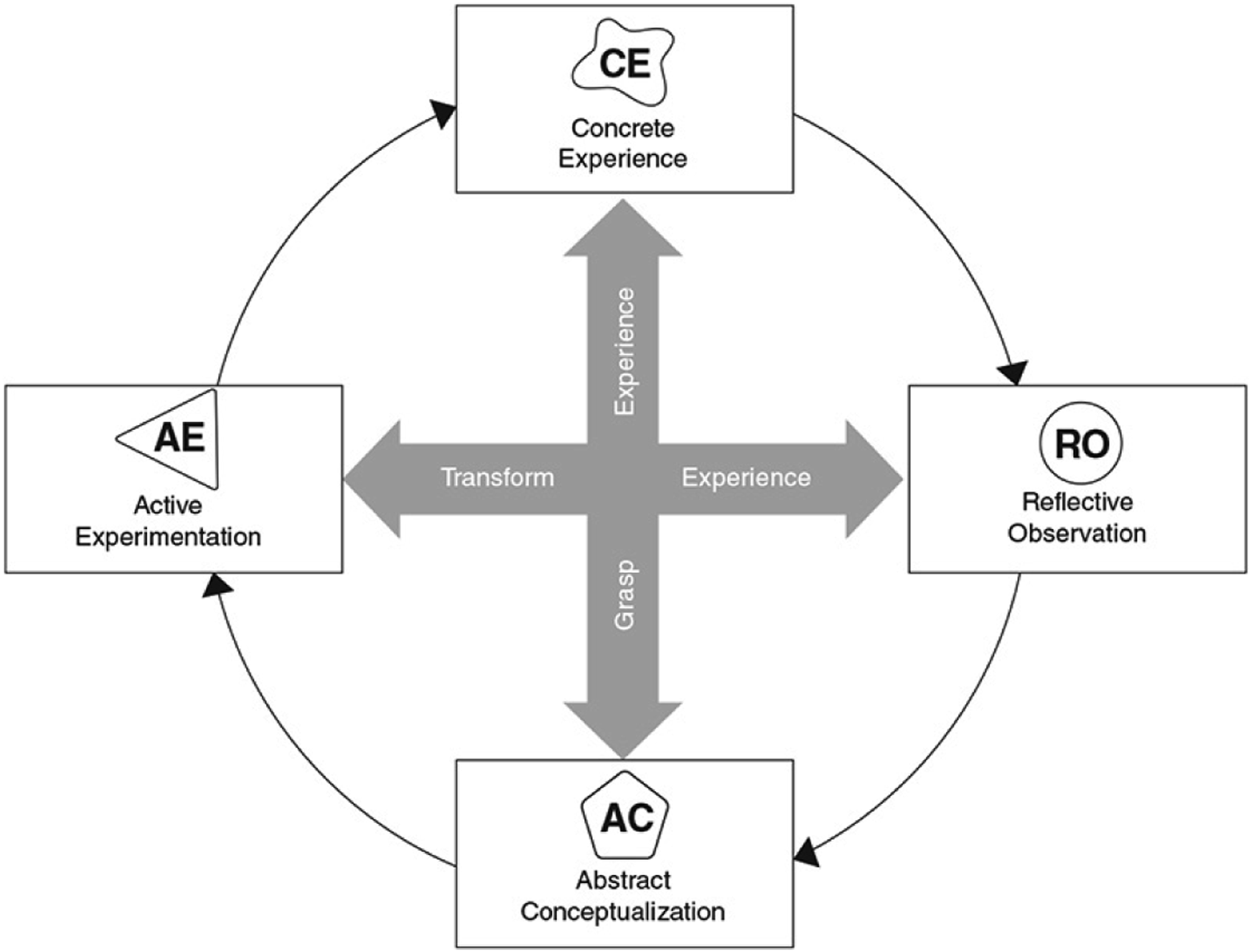
As a start, concrete experience is acquired when the learner actively takes part in a real-life activity, experiences and performs which forms the basis for observation and reflection in stage 2. The conclusion draws on their experience as a reflective observation is then assimilated and distilled into abstract concepts (stage 3), subsequently resulting in new implications for further action and experiment with different scenarios as the final stage of the learning cycle. This learning cycle can begin at any stage of the four stages and is an ongoing learning process which involves multiple cognitive and affective behaviours of the learners in acquiring experience, reflecting, transforming and conceptualising new knowledge (Kolb, 2014).
This learning cycle is a continuing and recurring process of interaction and exchange between the learner’s internal world and the external environment (Kolb and Kolb, 2018). An experience in the context of learning can be fresh and new but can also be saturated with the interpretations of past generations (Kolb and Kolb, 2018). To initiate reflection and learning, this normal flow of experience must be interrupted by deep experiencing caused by the learner’s being stuck with a problem or struck by the strangeness of something outside of their usual experience (Kolb and Kolb, 2018). For greater changes in the learner’s beliefs and behaviour, a ‘shock’ that disrupts life may be required (ibid).
The very nature of study abroad involves international travel and navigation in a new environment. The centrality of learning abroad is learning from contextual-specific experiences in a foreign environment of different culture and climate, and unfamiliar ways of life. Learning abroad is therefore bound to the reflection on these experiences whereby knowledge is created through the transformation of experiences. As study abroad occurs in an environment that may be alien to students, the process of learning and development may involve both positive and negative experiences that will potentially have powerful impacts on student learning, depending on how they navigate through opportunities and challenges in the host environment. The experiential learning cycle by Kolb; thus, provides a relevant theoretical frame to not only explain the students learning and transformation process but also help the analysis of data in different experiential learning contexts.
Research design and methodology
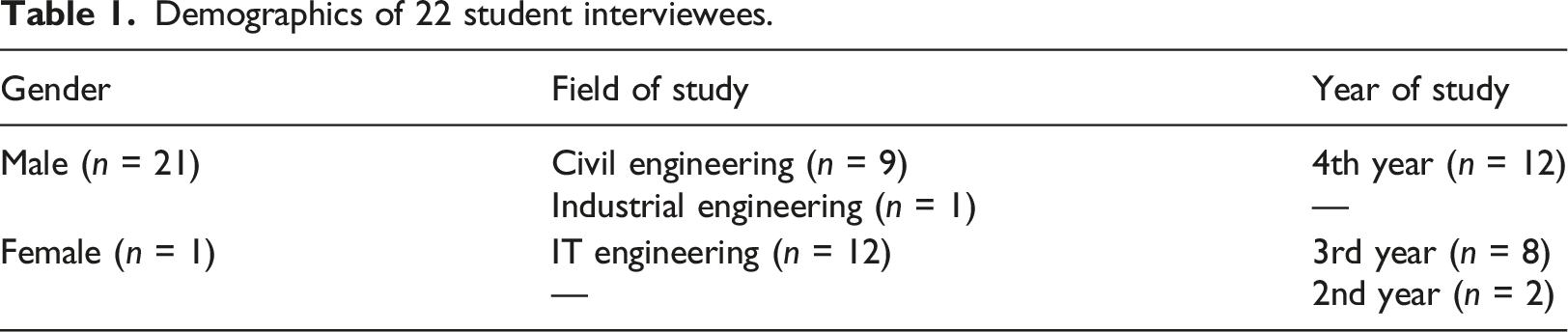
This article is derived from a larger study on Australian students’ learning and engagement in the Indo-Pacific, funded by the Australian Research Council. It focuses on the qualitative data from 44 individual interviews and three group interviews with 38 participants, including 22 undergraduate engineering students who majored in Information Technology (IT) Engineering, and Civil and Industrial Engineering (Table 1) and 16 hosts from universities and industry in Vietnam.
The IT Engineering short-term mobility program combines a study tour and an internship in 5 weeks, including four main components: orientation, IT training course, internships with IT companies and Vietnamese culture and economic development exploration. The IT short-term program was the collaboration between a medium-ranking university in Australia and a private IT-focused university in Vietnam with strong industry partnerships. The Civil and Industrial Engineering short-term mobility program promoted the applications of technology for solid waste management in Vietnam through involving Australian students in a research project under mentorship collaborations between an Australian university and three Vietnamese universities, including a leading technology university. The Civil and Industrial Engineering program comprised two phases: Phase 1 is 3 months of research in Australia, and Phase 2 is 2 weeks of travelling to Vietnam to collect data and work with Vietnamese partners. The teachers were an Australian academic in the first phase and several Vietnamese academics and industry experts in the second phase. Students who complete the project would earn 15 credit points. The student participants heading to Vietnam were recruited through an invitation sent to the Faculty’s international offices and academic leaders of mobility programs. They were interviewed during the pre-departure and in-country stages. Each interview lasted up to 30 minutes. The interviews were digitally recorded and transcribed. Participants’ names and home and host institutions are anonymised to protect their identity. NVivo was used for open ended thematic categorisation of the interviews. As explained in the section ‘Theoretical framework’, the interview data were analysed drawing on Kolb’s experiential learning theory that guides the interpretation of students’ learning and transformation process and barriers facing them across different experiential learning contexts.
Findings and discussions
Responses from participating students and hosts show that students’ experiential learning occurs when the students interact with the host environment both in their daily life and in a work or study setting. The students’ learning process of grasping the experience, reflection, transformation and conceptualisation to reach new knowledge is an interactive process that greatly varies in different contexts where the learning takes place. Accordingly, the capital gained from participating in the short-term mobility program is also wide-ranging, including discipline-specific knowledge and skills, soft skills, cultural literacy and personal development.
Transforming discipline-specific knowledge and skills
Discipline-specific knowledge and skills acquisition from experiential learning was highlighted as an important form of human capital gained from participating in the NCP short-term mobility program to Vietnam. For students whose field of study is in IT such as software development and cybersecurity, they had an opportunity to learn different and new technical aspects of their disciplines such as ‘Arduino and Raspberry Pi’ which was like a little CP kind of unit (Susan) or ‘SDN technology that is relatively new that they [Australian university] wouldn’t have taught otherwise’ (John). Others reflected on their curriculum-specific learning and intention to transfer these knowledge and skills when they return to Australia. I’m learning things [in Vietnam] that I wouldn’t learn at university in Australia like the frameworks with programming so this framework that we’re using reacts native apparently is widely used in mobile application development…So this is a learning experience that can be… like I can transfer it to even in Australia (Justin)
Despite being a developing country, Vietnam is one of the most dynamic IT markets in the world. The country has become a production centre for both IT hardware and software development outsourcing (Austrade, 2022). In particular, Vietnam ranked 6th as a global software outsourcing destination in 2021 (Kearney, 2021). Therefore, studying with an IT-focused university and interning with the university’s cooperation, a leading IT company in Vietnam, provided Australian students with the opportunity to be exposed to and learn from some of the latest developments in their field of study, that would otherwise not be taught at their Australian university. Australian students’ reflection on their short-term mobility learning experiences in Vietnam challenges the existing assumption that global South destinations like Vietnam is regarded as a ‘backward’ world or a less developed or less resourceful place, compared to a global North country like Australia, so it was not considered a worthwhile learning-abroad destination. The students’ insights bring to the fore the curriculum-specific learning to question the long-held Euro-centric, neo-colonial perspective against the Indo-Pacific as a space to learn and engage for Australian or Anglophone students.
Australian civil engineering students who worked on a waste management project reflected multiple aspects of their experiential learning including the academic and non-academic aspects So obviously we were there taking notes [on waste management] the whole time and documenting and adding that stuff to our report. And I'd say without going there, the report is just another, you know, theoretical piece of paper (Jim). Yes, I found out pretty hard issues, solid waste management …It's not something you can kind of just, solve pretty quickly…Like there are workers who are fine with separating all the waste that's come from the, to get some of the recycling happening because they make some money off it. Whereas no one in Australia wants to do that…If you then change the system where it's separating a waste at the source, then those people there don't actually have a job anymore… (Harry)
Some students reflected a change in their pre-departure expectations as a result of the real-life experience gained during the study It wasn’t my area of work…we are software engineering students and we got to work with a lot of electronics. So it was kind of disappointing at first …But I think once we got to know about it, it was a really good experience… so in that way it ended up being a good experience for us and we ended up learning way more than what we thought we would. (Susan)
The interviews with participating students report that for engineering students, the discipline-specific knowledge and skills transformed from their learning experience are often those that were not taught at their Australian university. The students were working on different projects with new technology, framework and programmes which were novel to them. They reflect on their experiential experience in different ways including comparing and contrasting between what they learn at university, and their real-life experience, between practices in Australia and Vietnam, and between their pre-departure expectations and their real experience. All these experiences and reflections transformed into new curriculum-specific knowledge and skills as well as their new abstract and concepts that have been tested during their learning-abroad and/or reflected upon on their return as new knowledge ‘can be tested and serve as guides in creating new experiences’ (Kolb, 2014: p. 51).
The process of knowledge transformation involves different forms of agency. For civil engineering students who worked on a waste management project such as Harry, his learning experience is a tension between (1) thinking with logic and ideas that forms a judgement that ‘it is necessary to change the system where it’s separating a waste at the source’ and (2) feeling which is intuitive understanding as he wondered about the consequences that ‘people there don’t actually have a job anymore’ if such change occurs. Students’ experiential learning process involves a range of cognitive and affective behaviours of the leaners (Kolb, 1984) that may influence the learners’ manner of carrying out tasks (Moon, 2004). Experiential learning also varies in different contexts and is sensitive to the learning situation (Kolb, 2014). In this study, it is the situational factors related to the different waste management systems in Vietnam and Australia and the broader social contexts where the waste management systems are managed that affect the students’ learning and reflection. Harry juxtaposed two situations of Vietnam and Australia to reflect on a challenging issue facing the existing waste management in Vietnam. His interpretation of learning from experience is that ‘separating a waste at the source’ that is a not a problem in Australia because ‘no one in Australia wants to do that [manual waste separation]’ will, however, become a critical problem in Vietnam as it can eliminate some people’s means of earning their living. In this regard, learning abroad in Vietnam provides the student with the springboard to relate their newly acquired professional knowledge in the Vietnamese context to that in Australia, enabling them to develop an international comparative perspective that is critical to not only their immediate curriculum learning but also their long-term professional development.
The responses by the interviewed students on the experiential learning were echoed by host organisations who shared their experience of supporting the students’ learning and their observations of the benefits that Australian students enjoyed. They [the Australian students] have chance to interact with some customers to understand more about the market need especially the recruitment market. On the Vietnam Information Security day, they get to know about the dynamic Information Security Industry in Vietnam and Asia Pacific. (Dung) Robert is investigating new techniques to discover the attack and Audrey is establishing the firewall to protect web applications. Audrey and Iris both finished their assignment on one week. We agreed that they would present their working progress on Friday. When we give them feedback for their work. (Dung)
From the host perspectives, apart from working on different discipline-specific projects such as investigating new techniques to discover the attack or establishing the firewall to protect web application, students were also offered opportunities to interact with customers and deliver presentations on their projects to enhance their experiential learning. During the learning process, students had opportunities to learn something new to them, ask questions and receive feedback from the host supervisors and members of the team as part of ongoing professional learning as shared by Dung ‘They are not getting used to the technique, but they are working hard, willing to ask questions and make quick progress’. In the context of discipline-specific knowledge learning, an experienced facilitator is important to improve the students’ learning process (Rodrigues, 2004) as they ask the right questions, guides reflective conversation before, during, and after an experience that ‘can help open a gateway to powerful new thinking and learning’ (Jacobson and Ruddy, 2004: p. 2).
The finding of this research discussed above shows that Australian students’ experiential learning in Vietnam is a process of learning involved the connection of relevant prior knowledge, comparing and contrasting with different professional practices and real-life experiences in an unfamiliar context to arrive new knowledge. Although experiential learning process is an individualised process, the commonality lies in the fact that the students all interact with the new learning context, grasp the unfamiliar experiences, interpret the meaning of new ideas, reflect on what they have learnt and transformed into immediate actions (Jim) or future actions (Justin and Harry). In addition, Vietnam as a developing country with its own dynamic and fast developments, contexts, traditions, norms and practices provide students with a unique learning context that is different from Australia. These structural conditions enacted students’ learning agency to compare and contrast, interpret, reflect and transform their experiences. Farrugia and Sanger (2017) argue that students who choose to study in a less popular or culturally dissimilar location are more likely to articulate a clear impact on skills development and career pathways.
Enhancing soft skills
Apart from acquiring discipline-specific knowledge and skills, Australian students reported they were able to develop a range of soft skills from their learning and engagement in Vietnam. These include being more confident in delivering a professional presentation (Tony), and being more willing to take responsibility, leadership responsibility for a team (Nathan, Julian). Other students articulated how the interactions with the work environment helped them become more professional: My internship gives me very like real life experience working, you know, working in a company, working in a totally different platform… It got me how to work with barriers and stuff. And I got to experience the, I would say experience in what work life would be in a totally different country (Susan)
Host organisations also shared similar observations about the students’ experiential learning as an opportunity to fully immerse in the host industry to acquire the disciplinary-specific skills and soft skills as human capital accumulation I really do think that the experience that the students get here in Vietnam ticks all the boxes for the New Colombo Plan. You know, they do have a fully immersive experience. I think, in particular we host a lot of students that come for some semester long internship programs. And I think that’s just a very sensible use of the NCP program to actually have those fully immersive experiences in industry as well as with the programs here. (Jacob) Students gain their professional experience in the companies not just only the technically knowledge but also the soft skills how to deal with problems and how to communicate. Have effective communication with the company…They understand themselves better so a kind of inner communication to understand what they really want because they share that with internship programs is an opportunity for them review their interest with their career. (Chau)
This finding supports previous studies that report students’ development of professional knowledge and skills from their international placement (e.g. Green et al., 2008). Within the NCP context, while Vietnam as a country in the Indo-Pacific that was traditionally not a popular destination for Australian students’ outbound mobility (Dall'Alba and Sidhu, 2015), those who opt to this culturally dissimilar region are likely to have transformative opportunities to develop a wide range of context-specific skills, knowledge and attributes in addition to traditional skills outbound mobility students often acquired. This is because the transformation of experience into knowledge may acquire deep experience including unfamiliarity, challenges and difficulties that the learners may get stuck or be struck from. New knowledge is often created and skills are often developed from the process of navigating through these challenges and unfamiliar contexts (Kolb and Kolb, 2018).
Developing cultural literacy and intercultural capability
Intercultural outcomes have emerged as an important cultural capital accumulated resulting from the students’ learning abroad. The students in this study have not only participated in both academic and cultural activities but also reflected on these experiences, resulting in enhanced cultural literacy and intercultural competence. In particular, students have developed cultural sensitivity and empathy from different contexts and reflected on these experiences by comparing, contrasting and changing their frame of reference, which might not be done by normal tourists, as elaborated below.
Under the general setting, participating students increased intercultural awareness referred to as the recognition and understanding of disparities between cultures (Roy et al., 2019) by taking part in different cultural activities. These include attending a Vietnamese wedding (Joseph) going out and talking to locals (Mark), learning how to cross the road (Liam), exploring the city just to understand what their rules and what they can and can’t do (John), visiting Mekong Delta where they ‘got to like wear Vietnamese hats and dress up as a Vietnamese girl or a guy and that culture and eat Vietnamese food’ (Nathan), visiting war museums and the old palace (Nathan, Jim) and attending cooking class and fundraising activities (Anthony). Some students were brought to different restaurants and taste different types of food everyday by their colleagues (Justin) or supervisors as shared by Nicolas ‘my bosses take me out for lunch pretty much every day and just try some of the different food and seeing some of the different restaurants’.
All the above intercultural activities whether being organised or self-exploring contribute to increasing cultural literacy of the participating NCP students and have different meanings to them in the reflection and transformation stages. Some students enjoyed the experience as the first time ever they travelled abroad thanks to the NCP as articulated by Susan ‘It was the best thing that ever happened’ while others appreciated the experience as something that could not have gained in Australia shared by Tyson ‘something I can’t experience at home’. Like when you’re walking in the street, you can see so many different cultures. I saw a Hindu temple there and right next to it I saw a Church, and right next to it I saw a Buddhist temple. So it was so diverse and they were so beautiful, like I could go anywhere on my own, I didn't have to have people with me. Like everyone was just so friendly and welcoming and the culture was just so beautiful. (Susan)
Among the key themes emerged, the beauty of Vietnam as the host country, the greatly diverse culture, history and the friendliness of local people were very marked, highlighting a distinctive feature of study abroad in a country in the Indo-Pacific region. Unlike professional skills that are often developed within a work or an academic environment with experienced facilitators, the cultural literacy learning process is more flexible, and the interpretation and transformation of these grasped experiences are therefore various. For Justin, the visit to the war museum has improved his understanding about aspects of the Vietnam war that are ‘not taught in Australia’, including how the Vietnamese have successfully fought against colonisation and defended themselves against so many outside invaders. This experience formed his judgement as a learning reflection and developed his cultural understandings and empathy as he justified ‘we should know more about it and what was committed there should never be committed again-the war crimes and stuff’. Others developed their cultural sensitivity and empathy by observing people out the streets working hard to make money ‘Whether that’s selling heaps of sunglasses or mums walking around with their baby, asking people for money’ because ‘they don’t have Centrelink
1
over there’ (Harry). The comparison between the two situations in Vietnam and Australia helped Harry draw a conclusion that a difficult circumstance makes people to become more resilient. Such development of cultural sensitivity and empathy and intercultural competence helped participating students understand international students better and therefore adjust themselves when working with international students back home as articulated below And I clearly know that as soon as I came back, when now I’m working with international students who are from other countries, I can clearly understand their mindset and I'm actually like adjusting to work with them. (Susan)
The learning experience also changed the pre-existing low expectations about Vietnam as reflected in the following excerpt. I think it’s hugely beneficial, hugely beneficial means that what we hear again and again, people are always, people have very low expectations of Vietnam and I think in big parts of Asia and they always walk away surprised at the quality of work and programming and, but also of, of colleagues here.
Unlike the above students where the reflections and transformations of experiential learning are immediate, some students need a bit more time to transform their experience into new knowledge and skills as shown in the following quote. But it's not until you get back and you sort of look, look back in retrospect and like sort of like do an inventory of everything that happened and then sort of compare it and like work through it a little bit emotionally. You sort of begin to realise how it, how it affected you and like what the cultural differences actually mean. And like yeah, upon some reflection you begin to see some stuff in different colours. (Anthony)
In a work environment, the cultural learning from interacting with professionals of different culture helps students develop intercultural competence that enables them to be confident to work with people of different culture in their future job ‘I will be able to communicate with anyone from a different culture’ (Susan). The following quotes denoted similar learning reflections. I think this is a really good opportunity for anyone and I really think every student should take this up because it really gives them a new perspective of what culture and what internships work, and it gives them like a real-life situation. So I know that for a fact that a few years later when I'm actually working in a real job, I would be able to go to a country and be able to survive there all alone. (Jim)
The observations were reinforced by the hosts interviewed …in the friendliness of people I think that they are going to the company they expected that they go to the company to work but they are treated like guests. And also they’re impressed with the beauty of the country. Many students in the feedback they share and even later on they still keep connection with us and they share their photos. (Chau)
The students also exercised their agency to transform their experience working in community project into their intercultural understanding and skills as shared by a company host. Actually, during the time that students came to the project locations, since AOP has the project of “community tourism” in those locations, we shared with students in advance that they can experience the local culture and tourism during the time they work there. For example, students can perform dance and sing with local people. They can also try the local people’s costume. Herb bathing or rowing are also recommended activities for students to try. Our interns also support Australian students in contacting with local people to arrange for the above experiences (Nam)
This study echoes existing literature about how outbound mobility might result in enhanced cultural literacy and intercultural capability. (e.g. Byker and Putman, 2018; Holtbrügge and Engelhard, 2016; Kumpoh et al., 2021). However, the discussion of the data extends the current literature and provides explicit insights into how Arts appears in the STEM with the cultural discoveries pointed out by the participants. In most culture-related quotes shared by the participants, the learning and engagement move beyond engineering education to the development of cultural knowledge and attributes. This finding challenges the widely held assumption that the STEM disciplines are rigid in academic structure and transferrable in its technical contents, thereby not benefiting substantially from international learning experience. The cultural literacy and intercultural attributes that the students in this study have developed through their learning abroad are the human part of the technical profession as they are associated with people skills, personal creativity, attitudes and experiences (National Research Council, 2005), which are often referred to as ‘Arts’ in scholarly discussion on incorporating non-STEM skills into the curriculum for engineering students, acronymised as STEAM (Science, technology, engineering, arts and maths). The discussion of the data shows that the cultural literacy accumulated by NCP students takes different forms and has different meanings to the individual students that result in diverse reflection and transformation. The cultural capital aggregated include cultural awareness, cultural sensitivity and empathy and intercultural competence that contributes to enhancing the students’ overall capital. Learning abroad for engineering students in an unfamiliar environment like Vietnam increases their symbolic capital to navigate in an intercultural setting environment which is vital to their future career. The study underscores the importance of recognising the presence and value of arts embedded in STEM in our understanding and practice of internationalisation. The internationalisation as a transformative experience both for engineering students culturally and personally and for the STEM-specific curricula needs to be accorded more attention.
Challenges and language barriers
There are barriers and challenges involved in the students’ learning abroad in Vietnam including a lack of local language to facilitate communication, culture shock and reverse cultural shock, and humid weather and food safety.
The participants found that language represents a significant barrier during their learning in Vietnam. It was definitely hard to communicate, especially when you’re talking about technical terms and you’re trying to put your point across to someone. (Aaron) I think most challenging thing was a bit of a language barrier…the local engineering students are limited with English, so it's hard to discuss things…Yeah, it was very challenging to communicate technical things, engineering terms and that sort of thing, rather than just basic everyday communication. (Julian) I sort of assumed that, especially the Engineering Majors, I thought they’d have a better grasp on English. But there was a little bit of a language barrier when you got over there…I was surprised to see that not many of them had really good English skills (Anthony) There were some students who struggled with the English a lot. And I think that those students probably didn’t get the most out of the time that we were there. Because obviously we all spoke English with them (Jim)
Language barrier has been reported as a challenge for study abroad students especially those who study in countries where English is not a native language (e.g. Dall’alba and Sidhu, 2015; Root and Ngampornchai, 2013; Tran et al., 2021a). To overcome these challenges, engineering students in this study used different strategies including avoiding using Aussie slang and keeping it basic (Mark), using Google translator (Justin, Susan), breaking down technical terms (Aaron) and writing down (Nathan). For Julian, pre-departure training with learning the host language could help to reduce the challenge.
However, despite efforts in mediating language obstacles, the study shows little evidence about Australian students seeing their responsibility related to learning or knowing the local language of the host communities to facilitate intercultural communication. This mindset might be due to several factors. The nature of short-term mobility might underpin the assumption that learning or knowing the host language is not required for Australian students in these programs. It might be because the widespread perception that Australian students speak English which is considered an international language, and thus they do not have to learn the regional language to communicate with the local communities. These both perpetuate the neo-colonial perspective about the superiority of English language, precluding the support and investment for Australian students to learn an Indo-Pacific language and enhance regional literacy, which is critical to Australia’s aspiration to engage with the region. More deeply rooted problems are the long-term decline and crisis in the teaching and learning of Indo-Pacific languages or foreign languages in general at Australian schools (O'Regan, 2014) and universities (The Guardian, 2021) and problems around policy on Asian language education (Slaughter, 2011), leading to a detrimental impact on Australian students’ understandings of and attitude toward the value of Asian and Pacific language learning and on national capacity building for regional engagement. In particular, this research found that when communication barriers arise during short-term mobility programs, host students and communities are often blamed to not possess a proficient level of English but Australian students’ ability to speak the host language is not called into question, as this comment from an Australian student showed: ‘the [local] engineering students are limited with English, so it’s hard to discuss things’. This reflects the ethnocentric view about the onus of adaptation related to the language of communication being placed mainly on the Indo-Pacific hosts, rather than Australian students.
Some of the participating students experienced culture shock relative to dealing with different cultural expectations, communication misunderstanding as well as norms and traditions during their first couple of days in Vietnam as reflected in the following excerpts. I guess the way they [local students] act, we misunderstood it… At first, we were culturally shocked. We obviously had to adapt that and think about, oh okay, no, they’re not trying to be rude, they’re trying to be friendly and smiley. (Aaron) I guess, just to begin with the first few days, the culture shock, definitely… And simple things like the way the streets work and not being able to just cross the road. Then not having to wait for traffic lights, cars and motorbikes, you just go off on the footpath. (Liam) And also just being able to challenge their own sort of cultural view on waste management because it's a big thing to try and change. (Harry)
Reverse culture shock is another concern shared by the participating students. And then the return culture shock coming back into Australia after having done that for two weeks. And just how strict all of the things are here. That were not strict over there. That kind of, like I didn’t notice that until I'd been there and seen how it’s done there. To now coming back, everything’s a big confusing again sometimes.
Literature on international student culture shock has been well documented especially on those from Asian countries studying in the West due to language barrier, cultural distance, financial pressure, academic and social stress, discrimination and problems of belonginess that in some cases cause serious mental health problems (e.g. Forbes-Mewett and Sawyer, 2016; Tran and Hoang, 2020; Tran and Marginson, 2018). On the topic of short-term mobility, cultural shock has also been reported but the consequence is not that serious due to the nature of the learning abroad that often lasts for a short period, and the focus of this form of study is experiential learning. Short-term mobility students often see cultural difference and culture shock as a learning opportunity and the cultural distance acts as a bridge for learning (e.g. Kheir, 2021). In the case of this study, the students exercised their agency of adjusting and adapting in the new environment as well as managing their expectations with some trying to accept the difference while others turning it into learning opportunities. In addition, while reverse culture shock was observed in some students, the majority of them readjust well on their return to Australia.
Demographics of 22 student interviewees.
Conclusions
This article provides fresh insights into the experiential learning in a specific context of Vietnam by Australian engineering students. The finding enriches the current literature on student mobility by identifying three main forms of knowledge and skills transformed from Australian students’ study abroad experience in Vietnam as a periphery destination: curriculum-specific knowledge and skills, soft skills and cultural literacy. Australian students acquired these knowledges and skills from different learning contexts in the host universities, the workplace and the wider community in Vietnam. The findings of the article disrupt the existing assumption about the superiority of North-to-North and South-to-North mobilities by bringing to our attention the real, deep, meaningful and transformative learning that North-to-South mobility or dominant-to-periphery mobility like Australia-to-Vietnam learning-abroad can offer. Australian students’ accumulation of curriculum-specific knowledge, soft attributes and cultural literacy through mobility programs in a periphery destination like Vietnam delegitimises the Western supremacy related to the dominance of global North countries as inbound destinations and as sites of learning transformation.
The empirical data show that during their in-country experiences, engineering students acquired different soft skills and intercultural competence that are reported critical for engineering graduates’ future professional in an increasingly internationalised global economy (Klahr and Ratti, 2000). The transformation of the discipline-specific knowledge and skills is also prominent. This technical part of the human capital accumulated is not only the result of the transition from education into work but also to the work in an intercultural environment nested by the structural conditions of the host country including traditions, norms and institutional practices as well as the political, economic cultural environment specific to that country that is different from Australia. The article also reports the barriers and challenges students encountered during their study abroad including culture shock, food safety, uncomfortable weather and language barrier specifically relative to engineering disciplines.
Recommendations for practice
The findings of the research call for a critical need to move beyond the ethnocentric view that it is mainly the responsibility of host students and communities to possess a certain level of English to communicate with Australian students during learning-abroad programs and the position of English represents superiority in intercultural communication. This perspective undermines Australian students’ commitment and opportunities to learn an Indo-Pacific language and enrich their regional cultural literacy. Learning the Indo-Pacific host language as part of their Indo-Pacific capability will be critical to not only Australian students’ learning and engagement within the mobility programs but also their ongoing professional development, intercultural growth and career advancement. This aligns with the government commitment to increasing regional literacy and language capability among young Australians. There is thus a need for the crucial role of the NCP in particular and also Australian universities, leaders of learning abroad programs and related stakeholders to nurture an interest in Asia and Pacific language learning and raise the awareness of the importance to enhance regional language capacity and cultural literacy among NCP students. Coordination with host organisations and mechanisms are needed to encourage and incentivise language development in NCP short-term, semester-length and scholarship programs throughout its full cycle of pre-departure, in-country and re-entry stages. Below are guiding principles that program leaders, practitioners and stakeholders can consider in incorporating the development of regional languages and cultural literacy in learning abroad programs: • Carefully consider and clearly articulate learning outcomes, highlighting language awareness and cultural literacy development as one of the key outcomes. • Raise the awareness of NCP students and scholars about the critical need for enhancing language and cultural literacy development early in their NCP journey and especially through carefully planned pre-departure sessions. • Develop an online language and cultural support program for students, tackling identified barriers related to language and cultural literacy in a range of Indo-Pacific destinations. • Leverage digital technologies and transnational language tuition and cultural literacy programs to support NCP students’ flexible engagement with language and cultural development earlier on in their NCP cycle. • Co-design with hosts to place language and cultural literacy development at the centre of mobility, semester and scholarship programs and to ensure contextually and culturally appropriate contents and approaches. • Explore possibilities for in-country programs to explicitly raise the awareness of or/and embed language development and cultural exploration into curriculum-specific activities. • Design and support in-country experiences that ensure pastoral care and encourage interaction and establishment relationships with peers, academics, industry practitioners and communities in the host country not only for curriculum-specific learning but also for explicit language and cultural literacy development and broader educational experiences. • Support NCP students to further develop their interest in language and cultural literacy development in subsequent components of the curriculum and extra-curricular programs and activities. • Provide guidance for students to articulate their language awareness and cultural literacy development through NCP programs into employability capital during in-country and upon re-entry. • Provide incentives to encourage NCP students and scholars, upon re-entry, to sustain and extend their language and cultural literacy development through both formal and informal program of study, individually and collectively (through opportunities to continue the connections and development of language and cultural literacy with their NCP cohort, NCP communities, international alumni from Australia in their host country and international students and diaspora from their host country in Australia). • Additional funding is awarded for the study of Asian and Pacific languages. • Funding is prioritised for short-term and semester mobility programs with a language study component. • Consider models of short-term and semester-length outbound language program and learn from good practices around the world.
Footnotes
Acknowledgement
We would like to deeply thank the two Reviewers for their very helpful feedback and suggestions that help us improve this article and the participants for sharing valuable insights.
Declaration of conflicting interests
The author(s) declared no potential conflicts of interest with respect to the research, authorship, and/or publication of this article.
Funding
The author(s) disclosed receipt of the following financial support for the research, authorship, and/or publication of this article: This work was supported by the Australian Research Council through the Future Fellowship (FT170100101) project.