



Abstract
This article draws on a qualitative comparative research study of global citizenship education (GCE) in two primary schools, an international school in Singapore and an independent school in Australia. This paper focuses on the implementation of GCE within the two specific school contexts, Singapore and Australia, examining the tensions which existed between neo-liberal market rationales and the critical democratic ideologies at each site. The paper explored in-depth how the neo-liberal market agenda influenced and shaped the societal imaginaries specifically in relation to their GCE commitments. Despite each schools’ commitments to critical democratic GCE ideals, they were very mindful about being distinctive and remaining competitive within their respective educational markets. To that extent, the schools were neo-liberal market actors. Empirical data shows the complexity of a more hybridised or a continuum existence between these two ideologies, thus providing a more nuanced insight of the binary within the school sites.
Keywords
Introduction: Global citizenship education and its impact on international curricula
In recent years, the concept of global citizenship education (GCE) has been used by national and international educational institutions, as well as researchers, to explain the increase in the internationalisation of education. The complexity and ambiguity in defining GCE has resulted in scholars and policy developers within the field developing several conceptual models that attempt to unveil, communicate, and evaluate the objectives behind GCE (see Pashby et al., 2020; Pais and Costa, 2020). The literature on GCE distinguishes neo-liberal, critical and liberal framings and mixes of these (Andreotti et al., 2016; Pais and Costa, 2020; Pashby et al., 2020). Pashby et al. (2020) present a ‘typology of typologies’ highlighting that GCE may represent a range of approaches through conflation of orientations and ambiguity in the interface between orientations. Mindful of this complexity, this paper examines seemingly conflicting motivations for GCE associated with neo-liberal and critical orientations. The ‘neo-liberal discourse’ privileges a market driven philosophy, which is focused on competition between institutions and individuals for institutional and individual preferment (Camicia and Franklin (2011; Pais and Costa, 2020), whereas the ‘critical democracy’ rationale emphasises social accountability, active community engagement, the betterment of all, social justice and ethics. Some have suggested a conflictual binary divide between a progressive global citizenship purpose and the production of self-investing neo-liberal global subjects with the latter disaffecting the former (Camica and Franklin, 2011), while recently Pais and Costa (2020) have argued that there is a closer compatibility between them. They argue that concerns about the production of neo-liberal subjects, is ‘exculpated’ by the progressive approach, which is more focused on liberal progressive outcomes (Pais and Costa 2020).
All binaries of this kind simplify and bowdlerise reality in a way similar to Weber’s concept of ideal type. The empirical reality is usually more hybridised or sitting on a continuum between these two types. This paper, drawing on an empirical study, actually argues this binary works in a number of ways in the two research schools; namely as competing and/or complementary rationales for adopting GCE programmes, as a descriptor of the programmes themselves, and as a way of thinking about the intended and achieved outcomes of such GCE programmes and related curricula. Specifically, this paper is concerned with how these two frameworks and tensions associated with them have played out in the global citizenship work of two independent primary schools, one in Singapore, the other in Australia.
The rise of GCE can be seen to be set against globalisation and the condition of ‘super-diversity’ (Vertovec, 2007, 2009), whereby many countries are now characterised by a heightened level of demographic and ethnic diversity. Complexities arising from the state of super-diversity challenge the ability of countries to meet the needs of their contemporary diversified population in relation to economic, educational, health and social matters, while ensuring social cohesion (Vertovec, 2007). Multiculturalism is no longer seen as an adequate response with its historical emphasis on cultural maintenance and limited contemporary emphasis on socioeconomic concerns (Torres and Tarozzi, 2020; Baker-Beall et al., 2014; Nowicka and Vertovec, 2014). For multiculturalism to remain relevant in this globalised world, it needs to be immersed in the wider global context and situation of super diversity. Arising from this need for global connectivity, ‘global citizenship’ and ‘cosmopolitanism’ have emerged as the new state ideologies to manage cultural diversity within and beyond national boundaries (Rizvi and Choo, 2020; Rizvi, 2008).
Public and policy discourses pertaining to GCE argue for ‘global competence’, requiring schools to prepare students to survive the ever-evolving, interdependent and globalised world of the twenty-first century with the OECD actually introducing such a measure into PISA (Yemini, 2014; Ying, 2021). To this end, many schools globally have responded through the adoption of internationally minded curricula, aimed at promoting intercultural understanding and encouraging an international outlook (Salter and Halbert, 2017; Wu and Tao, 2022). It is believed that through this approach, students gain a better understanding of the diverse, multifaceted nature of the globalised environment and interdependence and are better prepared to participate in it as global citizens. Aligned with these curricula, numerous schools in the United Kingdom, United States (US), Australia, Singapore and elsewhere have crafted school mission statements that promote ‘cosmopolitanism’ or ‘global citizenship’ (Yemini, 2014).
Global citizenship education is enacted through a range of programmes, activities and events, but these manifest differently according to varied interpretations, contexts, resourcing capacity and underpinning ideologies (Harris, 2014). In their quest towards implementing an internationally minded curriculum, some international and independent non-government schools have adopted international programmes such as the International Baccalaureate (IB) and International Primary Curriculum (IPC). These programmes have also been taken up in some non-international school settings as well and also in some government schools where the global citizenship agenda is at the forefront of schools’ curricula and practices. The effectiveness of global citizenship education is dependent on clear articulation of initiatives and desired outcomes, fulsome commitment to implementation and its enactment and practices in schools (Hameed, 2020, 2022). However, that enactment will inevitably be influenced by the tensions which exist between neo-liberal market rationales and critical democratic principles and extant policies and practices of schools.
This paper focuses on the implementation of GCE within the two specific school contexts, one in Singapore and the other in Australia, examining the tensions which existed between neo-liberal market rationales and critical democratic ideals at each site. We will explore in-depth how the neo-liberal market agenda influenced and shaped the societal imaginaries specifically in relation to both schools’ GCE commitments. Our analysis will show that despite each schools’ commitments to critical democratic GCE ideals, they were very mindful about being distinctive and remaining competitive within their respective educational markets and attracting enrolments.
This paper will first describe the contextual background within which GCE has developed in Australia and Singapore, giving a brief overview of the national and policy contexts of the two research schools, followed by a review of each school’s profile. The research methodology is outlined, then key findings from the case study schools, with a concluding discussion about the significance of the research outcomes in terms of the rationales for, nature of programmes, and outcomes of GCE in the two schools.
The conclusion will also consider Pais and Costa (2020) argument that there is not so much a tension between the critical democratic goals and the neo-liberal market agenda for GCE, but that the production of neo-liberal subjects overwhelms the other more putatively progressive goals. Our analysis adds another binary to this one: namely a binary between competing rationales for the introduction of international curricula and a focus on GCE. This is the binary, and the tension, between an educational rationale for the introduction of GCE and the international curricula, and a market one in which the two schools act as institutional neo-liberal subjects seeking to strengthen their school’s distinctiveness and position within their local school markets. Here we see the two schools as market players in their respective schooling markets. In this sense, this analysis provides a comparative illustration of ‘cosmopolitan nationalism’ enacted at school levels, as each school seeks to ‘promote internationalisation and a global gaze’, while responding to their locally defined markets and national education policy agendas (Maxwell et al., 2020).
Global citizenship education in Singapore and Australia
Each schools’ profile and their respective contexts are significant factors framing their GCE practices. The first school, Stamford International 1 is an International school situated in Singapore. It is one of a group of Catholic schools in Singapore whose history dates back over 150 years and as such is affiliated with one of Singapore’s oldest and most respected educational institutions. This elementary school, established in 2008, was an extension to the International High School, which was established in 2007 and offers places to Singaporean and expatriate children. With an enrolment of about 687 (37 Singaporeans, 253 Singapore Permanent Residents (PR) and 397 Others), the background profile of the students is highly diversified, originating from 38 different countries as evident from Stamford International School Annual Report, 2016. The school’s community includes families from various cultures, religions and traditions.
Congruent with the key goals of GCE, Stamford’s vision and mission statements emphasise development of global citizens, where the focus falls on developing students’ global perspectives, intercultural sensitivity, and capacity to be responsible global citizens. The school has developed an outstanding reputation for quality education in Singapore and is one of the most recognised international institutions in Singapore. It is also situated in a competitive international school market and is a high-range fee school.
Singapore is a small nation state with a unitary form of government and a small population of approximately 5.61 million with 3.97 million Singapore citizens, 0.53 million permanent residents (PR) and 1.65 million non-residents 2 (Department of Statistics Singapore, 2020). One party has been in power since independence in 1965. Singapore articulates distinct national and ‘racial’ identities, but also attempts a ‘global + citizenship education approach’, resulting in citizenship education being less parochial and more globally relevant (Davies, 2006: p. 14). This is evident for example in the national social studies curriculum, which stresses principles of ‘being rooted’ and ‘living globally’. The objectives are, ‘promoting national identity, multicultural understanding, and global perspectives’ (Ho, 2009: p. 289). This is what Maxwell and her colleagues (2020) have called ‘cosmopolitan nationalism’. Moreover, Singapore’s commitment towards bilingualism (English and mother tongues, including Malay, Tamil and Chinese) has contributed to the balanced management of educating for nationalism, accounting for diversity and educating for prosperity. Singapore’s aim to retain its ‘Asian core’ by means of bilingualism is an intentional move toward establishing a cohesive identity and society. When bilingualism was introduced in Singapore, the intended purpose was to provide students with the language competencies to access both eastern and western cultures, and to develop a global outlook. The mother tongue language policy was introduced so that ‘children will know their mother tongues and maintain their sense of identity, their values and their culture’ (Lee, 2015), while English is used as the language of instruction in all state schools.
The second case study school, Coastal College 3 is an independent school in Australia. This school opened in 1987 and is a Christian, Lutheran co-educational college and an International Baccalaureate World School. As a Lutheran College, the school uses the ‘Lutheran Education Australia’s Christian Studies Curriculum Framework’ to administer the Christian Studies program across Prep to Year 12. The school’s vision and mission value global mindedness and inclusion in a Christ-centred community, encouraging their students to serve the world.
The school’s total enrolment according to the federal government’s 2017 MySchool Census is 1050 students, and of these, 399 are in the primary school. The primary school has students from about 25 countries including New Zealand, Papua New Guinea, South Africa, Singapore, Malaysia, Indonesia, Philippines, Germany, USA, Korea, Japan, China, Taiwan, India, Sri Lanka and Russia. Eighteen percent of the students come from a language background other than English. Within the Junior Years, Prep to Year 5, the school has adopted the International Baccalaureate Primary Years Programme (PYP). The school would be considered to reflect a population of reasonable socioeconomic advantage, based on the federal government’s Index of Community Socio-Educational Advantage (ICSEA). The MySchool census shows that 93% of students came from the middle and top quarter range of socioeconomic status (https://www.myschool.edu.au/). The school is situated in in a very competitive education market, in a geographic area with many independent schools, some more elite, and high-performing government schools, including some with an international outlook. It is a mid-range fee school, thus, its fee structure and student population are different from that of Stamford, much more lower-middle class than that of Stamford. 4
Australia, in sharp contrast to Singapore, has a much larger land mass and has a population of approximately 25 million (Australian Bureau of Statistics, 2018). Australia, in contrast with Singapore, has a federal political structure with schooling the Constitutional responsibility of the States and Territories. However, since the 1970s and particularly since the Rudd/Gillard Labor governments (2007–2013), the Federal government has participated actively in education and in conjunction with the States and Territories developed a national curriculum in 2008 (ACARA, 2020). In the same year, the Federal government also introduced national testing in literacy and numeracy for all students in all schools at Years 3, 5, 7 and 9, and created national standards for teachers and school leaders. In Australia, all schools must be registered and this requires the adoption of an approved curriculum, most often the national curriculum (Savage and O’Connor, 2015).
The educational policy contexts in both Australia and Singapore have ‘nationalistic and locally-inclined’ idiosyncrasies, as with all national schooling systems (Maxwell et al., 2020). Additionally, there is the impact of converging global pressures (e.g., participation in international large-scale assessments) and neo-liberal market influences which have played out in different ways in the two nations. In recent years, policy makers in Australia have looked to Singapore as a reference system because of its outstanding performance on international testing. Both Australia and Singapore have also had to respond to increasing population diversity and have done so in part through policies implemented through broad public policy and through schools. Singapore and Australia have different political structures (unitary as opposed to federal structure) and different approaches to policy development. This has directly and indirectly affected both schools’ curricula initiatives. The policy and national landscapes in which these two schools exist, and their own differences and similarities, illustrate the potential multifariousness which underpins comparative global citizenship education studies for multi-ethnic nations such as Singapore and Australia.
Research methodology
Central to this research is the examination of the enactment of global citizenship education in the two schools. The research analyses how GCE practices have taken shape in these two schools within differing political, policy, economic and social contexts, and how they have been institutionalised or otherwise in the two schools.
This study is situated within the tensions between localised variances and global commonalities within educational policies and practices. As indicated above, Australia offers an interesting comparison with Singapore, and within these differing contexts, both schools have adopted international education models, aspiring to developing cosmopolitan ideals which promote intercultural understanding, global sensitivity, and expand international knowledge (Brunold-Conesa, 2010). A case-oriented approach allowed for an interpretive analysis of the two schools. The study explored the case study schools’ international-mindedness focus and examined their respective school cultures that frame the general practices aligned to GCE. More specifically, the methodology allowed the examination and analysis of the concept of GCE as enacted in the two schools and to capture aspects of local contexts, while seeking where possible to generalise from and to theory (Yin, 2014).
For this study of GCE in the two schools in two different national contexts, a collective case study approach was used, which involves the study of multiple cases, while attempting to generate a broadened insight of a particular issue (Crowe et al., 2011). For this study, the design type was adapted from Yin’s (2014) models of single case design and multiple case design as illustrated in Figure 1. This design is thus a hybrid one. Adapted from Yin, 2014, p. 50).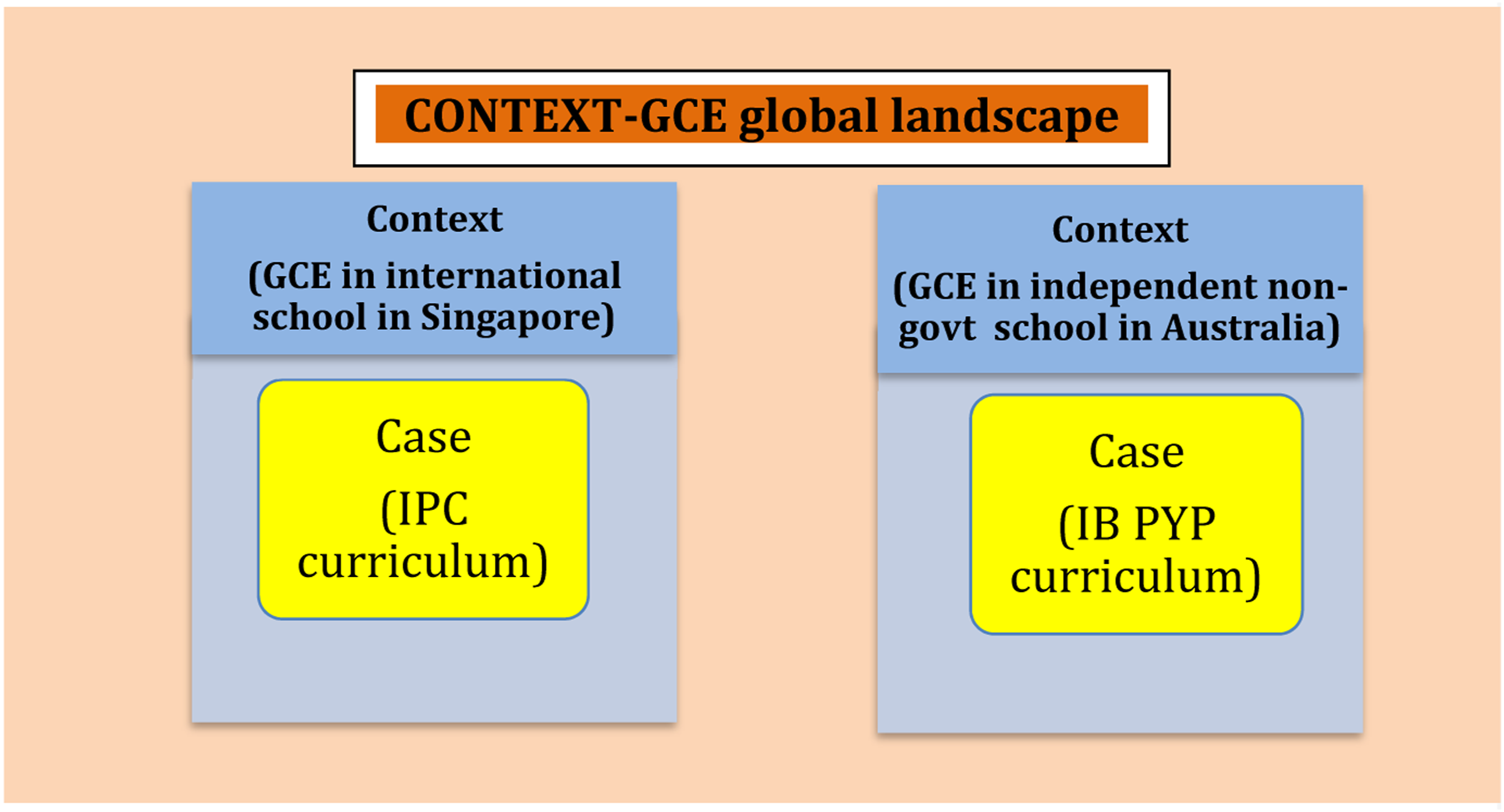
With a multiple case design, we have two separate cases, situated within two different contexts – the global citizenship practices in an elementary international school in Singapore and in an elementary independent (non-government) school in Australia, which are both located within their specific national and local educational contexts, the global citizenship educational landscape and within the broader global education policy field. Set against these different contexts, the IPC in the Singapore international school and the IB (PYP) in the Australian independent school are the focus of my study.
Five strategies were used to ensure that comprehensive and robust data formed the basis of the analysis. These included an extensive literature review, data from the semi-structured interviews from the school leaders (Principal and Deputy Heads), and from 8 to 10 teachers involved in planning programmes related to the inclusion of global citizenship education in the school, observation notes from the fieldwork, analysis of school policy and strategic planning documents, curricula materials and syllabuses, and school websites. Qualitative data from these various sources were analysed both inductively and deductively.
There were four phases considered during the whole process of data analysis as reflected in the diagram below.
As seen from Figure 2,, the analyses include the following processes: (a) preparation of the data to be analysed (transcription of interviews, typing and organising the field notes during observation, classifying all the different types of data collected – interviews, observation field notes, documents); (b) reviewing all the data collected to have a general sense of all the data collected; (c) coding data using a systematic process and drawing out key themes, as well as situating the data within the literature and analysing deductively at the same time; and (d) interpretation of data and generation of conclusions. Phases within data analysis.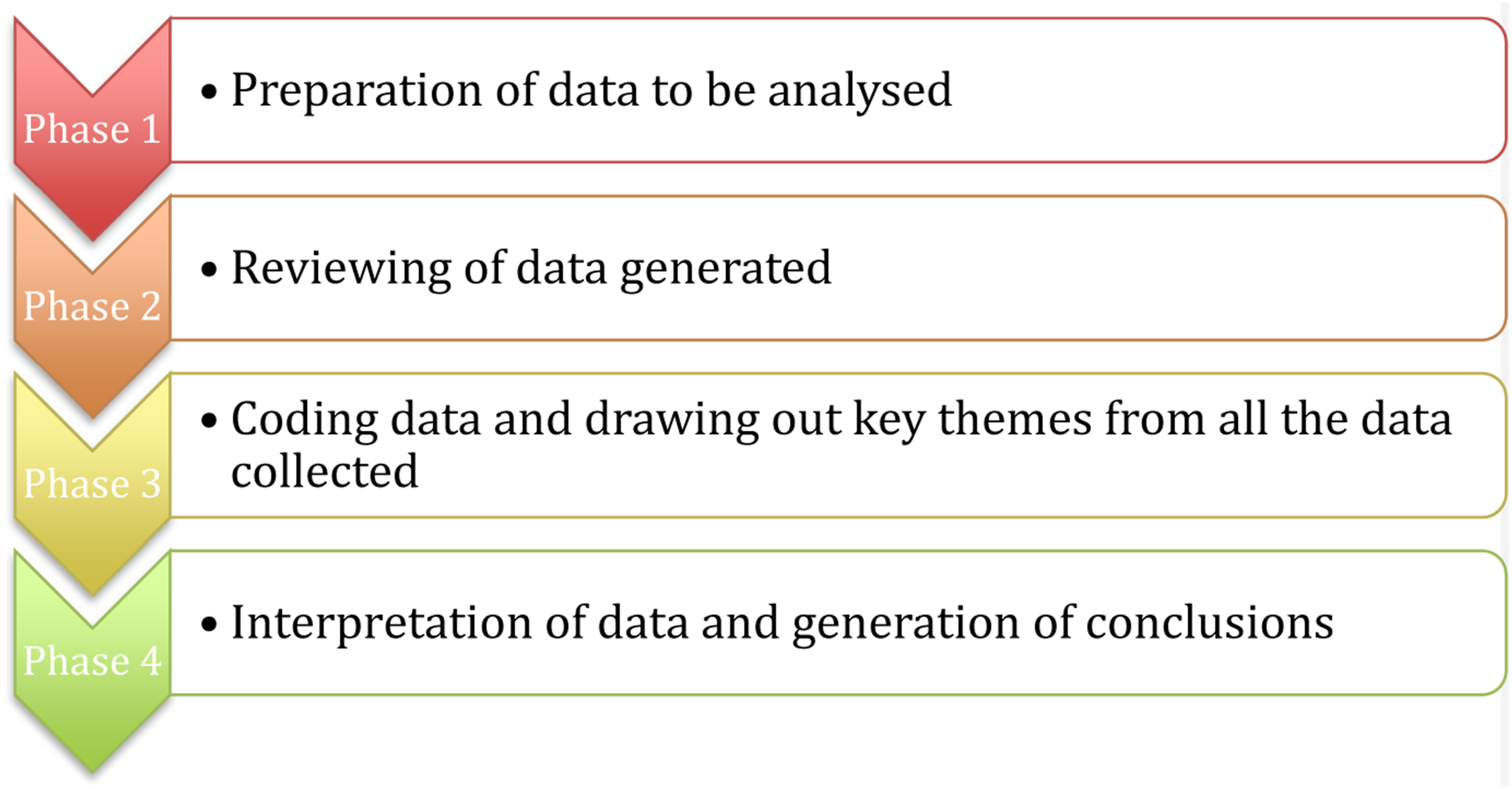
Findings and discussion
The research identified two broad conflicting discourses in GCE in the two research schools, confirming Camica and Franklin’s (2011) binary divide. The first of these centred around the neo-liberal market agenda of GCE, which focuses on the competitiveness of schools in their local education market contexts. The other discourse focuses on the critical democracy approach to GCE, which emphasises the significance of social and moral values, shared social responsibility and action (Camica and Franklin, 2011; Pais and Costa, 2020).
The following section will explore the tensions between these two approaches in both schools in their international curricula and their commitments to GCE. Analysis of relevant data has shown that despite the schools’ commitment to GCE ideals, they were mindful about being distinctive and remaining competitive within their specific educational markets. The exploration of this tension will be conducted through the analysis of the insights from research interviews with the school leaders and teachers, as well as through analysis of the two schools’ reports, policies, curriculum documents and websites.
The findings will be organised into two sections. The first section will discuss the neo-liberal influence, focusing on the market agenda that had an impact on GCE as manifested in the two research schools. The second section explores the tensions between the market rationale and the critical democracy agendas in GCE. This is a tension between branding in market contexts and the educative focus of GCE.
The influence of neo-liberalism: focusing on a market rationale
Neo-liberal market ideology has played a key role in influencing and shifting contemporary global educational policies and practices, exercising its dominance within different national and school contexts (Ball, 2021). According to Hameed (2022), the neo-liberal agenda has emerged as an influential ‘social imaginary of globalisation’. This concept of a social imaginary (Taylor, 2007) curates the ways in which people ‘imagine their social existence—how they fit together with others and how things go on between them and their fellows, the expectations that are normally met and the deeper normative notions and images that underlie these expectations’ (p. 119). The dominant neo-liberal social imaginary of globalisation has resulted in the narrowing of the ‘common good’ focus of education and encouraged instead an emphasis on the values associated with distinct self-interest and responsibility, market efficiency, leading to market priority as opposed to a common good priority. This focus on the neo-liberal market priority, however, plays out empirically in different path-dependent ways in different nations and in respect of different schools and different school markets. What is distinctive in this analysis is the neo-liberal actions of the two schools, acting as market players, while simultaneously articulating more progressive constructions of GCE. We might see this as the latter exculpating the former (Pais and Costa, 2020).
Singapore has always been more state centric than many other societies and has had a human capital framing of education since independence and has placed great emphasis on schooling, with a specific focus on Math and Science, as it has sought to capitalise on its human resources, given its lack of natural resources. This focus was in place well before the current emphasis given to STEM in many societies and well before explicit human capital theories began to frame the approaches to education policy in most nations at the end of the Cold War and with the globalisation of the economy (Author et al., 2022)
Australia’s human capital framing of schooling has become more evident in recent years with the dominance of neo-liberal discourses. Sahlberg’s (2006, 2011) account of systematic school reform, what he calls the Global Education Reform Movement (GERM), set against the broader neo-liberal framing, also purports a critical new positioning to learning, in education and school administration. The component parts of GERM, according to Sahlberg (2011, p. 103) are: a stress on standardised teaching and learning, a reductive curricular focus on literacy and numeracy, a prescribed curriculum, test-based modes of accountability, and the adoption of market-oriented management and reform ideas. Also important in this approach to educational reform is an attempt by the state to create a market in schooling so as to enable parental school choice based on publicly available and comparable school test results. These very policies have played out in Australia across the last decade, since 2008 with the development of the Australian national curriculum, national tests of literacy and numeracy and the creation of the MySchool website, providing comparative details about the performance of every school in Australia. This has resulted in marketisation in the government sector and has strengthened the market in the non-government sector as well, both within that sector and with government schools. This is broad policy context of Coastal College, which is also situated in a very competitive local school market.
The constitution of school markets and the need for schools to brand themselves and position themselves in their specific market contexts must be seen in the broader neo-liberal policy context. Yet, these neo-liberal pressures play out differently in varying national contexts (here Singapore and Australia), and build on what has gone before (path dependence) and as noted already Singapore has taken a human capital construction of the purposes of education from independence, given they have no natural resources. Interestingly, Australia has taken on board the human capital framing of education, but still is economically dependent on the export of natural resources (see Reid, 2019: pp.19ff.).
Although the official discourse in UNESCO’s 5 agenda towards global citizenship education focuses on the social justice ideals, unity, diversity and community engagement, the enactment of this particular discourse within schools is thwarted to some extent by national neo-liberal political and policy agendas, which are focused on ‘market rationality’, as well as the ideology of producing an ‘entrepreneurial citizen’ (Pais and Costa, 2020; Camicia and Franklin, 2011).
The tensions between a market rationale and the critical democratic rationale in the two case study schools’ GCE focus were very evident from the data collected and analysed. Both schools were committed to the development of the ethical, moral and social aspects of GCE, while remaining mindful about the market necessity of being distinctive and competitive in terms of enrolments in their specific educational market contexts (Fielding and Vidovich, 2016). Their global focus was thus linked at one level to their overt positioning in their respective school markets, their differing student clienteles and the related demand for effective, market-aware branding.
Stamford International was situated in the competitive Singapore school market, which consists of international schools, other independent schools and some academically elite and selective government schools. Stamford was also situated within a broader global market of international schools. These different market contexts were also reflected in the complexity of the student mix of the school, including both locals and the children of globally mobile workers. Coastal College was located in a very competitive private and government school market and had to seek a particular market niche for itself. Unlike Stamford however, it was not situated in a global international school market. Thus, we would hypothesise that GCE and cosmopolitanism in the two schools functioned in relation to different class-making strategies or choreographies: Stamford’s seeking to produce a more globally mobile elite, Coastal College, more a local/national middle class (Howard and Maxwell, 2021; Kenway et al., 2017).
The ‘non-government’/independent (and international for Stamford) status of both schools facilitated some autonomy in relation to curriculum development and this offered them an opportunity to both drive global citizenship education as well as their specific market strategies. This was much more the case for Stamford than for Coastal College. This flexibility in curriculum development provided an avenue to enhance their market competitiveness. In Australia, for a school to receive any government funding, it must employ registered teachers and comply with national and state level curricula. Some international curricula (e.g., IB, IPC) are approved for these purposes. However, all Australian schools must participate in the national testing of literacy and numeracy at Years 3, 5, 7 and 9 and comparative performance on these tests made public on the My School website, as already noted, is also central to a school’s market position.
Both schools have adopted international curricula, the International Primary Curricula (IPC) for Stamford International and the International Baccalaureate Primary Years Programme, IB (PYP), for Coastal College. Both curricula focus on the development of international-mindedness. International-mindedness entails the promotion of ‘intercultural understanding’ and encouragement of an ‘international outlook’, integrating GCE principles.
In the discussion of internationalisation of curriculum, it is important to acknowledge the impact of global and the local nexus on the implementation of the international curriculum, specifically the hybridised curriculum that comes about as a result of this global-local influence (Stobie, 2016), as well as regulatory requirements. What we see is a kind of cosmopolitan nationalism manifested in both schools’ curriculum approaches (Maxwell et al., 2020).
The rising influence of market ideology and specifically school markets thus formed one significant contextual backdrop for the development of the hybridised curricula in both case study schools. An internationally minded curriculum was deemed important to enhance the market advantage for both the schools and also for student graduates and enabled them to consolidate a distinctive position in their local education marketplaces, as well as in the international education marketplace for Stamford International. This can be seen from the interview data shown below from the school leaders in the respective schools. Mr Gray, Stamford’s principal, commented on the adoption of IPC as a strategic decision by the school’s Founding Principal. The adoption was intended to provide a structured and rigorous curriculum to meet the academic expectations of the actual and potential parent clientele. We chose the IPC because it wasn’t just teachers getting together and changing curriculum every year, there was a bit more structure which the founding Principal felt was more important for international schools because of the changeover of teachers and because of the expectations of parents. Founding Principal wanted a bit more structure, she wanted rigour, I think she’s been in Singapore for a long time and realised that our clientele, whether they are local or international has high expectations in terms of academic achievement. (Mr Gray, Principal, Stamford International, Singapore)
In this extract, the Principal of Stamford International highlighted the idea of parents’ expectations as one of the key drivers in the school’s decision to embark on the IPC. Like the neo-liberal tenets of staying competitive within the market, educating students to become individuals who are part of a competitive global community (Hursh, 2011; Rizvi et al., 2022), the Founding Principal’s long-term experience in Singapore translated into an awareness of the school’s market positioning. In turn, the Founding Principal’s selection of curricula was aligned to the perceived needs, demands and expectations of potential clientele.
In the following interview excerpt from Coastal College Deputy Head, Mrs Shine, the implementation of an international curriculum was explicitly described as a deliberate strategy for achieving distinction within the competitive local educational market. The IB program is one thing that sets us apart because it does have to focus on the international mindedness on being part of a global community, the approach to teaching language, inquiry-based engaging, and relevant significant things that they are learning and challenging…it’s not just the curriculum. It is how we teach and how we deliver the curriculum, that is probably quite innovative and sets us apart, I think, in terms of what we do. The independent schools in the Coastal area, I see them as being more traditional and more curriculum driven. (Mrs Shine, Deputy Head, Coastal College, Australia)
Mrs Shine’s measurement of distinctiveness – ‘sets us apart’ – against other schools in the Coastal region, was the school’s international curricula, IB (PYP). Although the emphasis on the importance of being part of a global community can be seen as an alignment with the intentions of enacting GCE, the underlying rationale still denotes and connotes a competitive education market element. One of the rationales for the adoption of IB (PYP) was to remain distinctive in their school market context. She also perceived other schools as having a more traditional curriculum, usually more academically driven compared with Coastal’s international curriculum approach. This reflects the necessity for schools to compete with others to stay viable in their market contexts.
Another example that is indicative of a market focus is the school leaders’ decisions to embark on some key programmes, strategically targeting potential families through community perceptions of the school. The schools’ programmes were carefully planned and both schools reviewed their processes regularly. This ensured that both schools stayed ahead of their competitive counterparts by enhancing their images and building ethos and market appeal. The interview response below by Mr Gray, Principal of Stamford International, captured this thinking. Singapore Math, Daily Mandarin, a Catholic Lasallian school, they were our big marketing thing which now have been caught up by a lots of other international schools who want to be doing that now as well. So are we staying ahead of the crowd now? Possibly not, which is why we are looking at programme we are offering, to give it a bit of a flavour, really sort of enhance it a bit more, but also to make it easier for our children transitioning into the high school.
Singapore Math but I think that was chosen as a marketing tool just because it had a good reputation as well. It was considered a strong structured programme and when the school was started, Louise, the Principal then wanted it to be, I knew she felt that inquiry approaches were a bit airy fairy and she wanted to give children a strong mathematical and literacy base. (Mr Gray, Principal, Stamford International, Singapore, emphasis added)
This interview excerpt indicates that the adoption of key programmes such as the Singapore Math and Daily Mandarin for Stamford International was a strategic move to ensure that the school stayed distinctive in its market context and stayed ‘ahead of the crowd’, as it were. Although there were other reasons for the adoption of the Singapore Math and Daily Mandarin, the market emphasis remains a key motivation behind the school’s adoption of the stated curricula. The fact that other international schools have also adopted such an approach had resulted in an urgent need, as iterated by Mr Gray in the research interview, to enhance the current programme so that they could continue to provide that element of distinctiveness. We might also see cosmopolitan nationalism at work in these research observations.
In the following excerpt from Mr Gray, the objective of staying distinctive with the introduction of Daily Mandarin is discussed. Now as I have said, we have a lot of Singaporean PR, a few Singaporean children and when they go into high school, they must take Mandarin. Now that’s not why we do it. When we set the school up, daily Mandarin, we were the only school doing that of all the international schools. I have never been in a school with daily language lessons but again coming back to our uniqueness of school is apparently one of our big selling points and it’s one of the reasons why a lot of parents bring their children here. So in a way, that can’t be diminished. For example, they get 40 min of Chinese lessons daily, which is about 200 min a week, which in some cases is more than the IPC is taught. So they get more in Chinese than they get in History, Geography, Science, Technology, so that’s one aspect. So it has created a little bit of an imbalance. (Mr Gray, Principal, Stamford International, Singapore, emphasis added)
Again the emphasis is on marketing the school, as Daily Mandarin was considered to be one of the ‘school’s biggest selling points’ and would not be diminished. Daily Mandarin had been introduced because of a marketing strategy based on economic positioning. We note here that the Singapore Government has emphasised both the cultural and economic value of studying Mandarin in its policy statements as part of its compulsory bilingual policy. 6 Several researchers have attributed this emphasis to the rise and growth of China, which has resulted in the importance of Mandarin as a global language (Tan, 2006). So, while there was a marketing element here in the take-up of Mandarin, there were also the significance of the Singaporean context and government policy stance, as well as a global perception of the rise of China and thus of Mandarin. This might also be thought about as part of the internationalisation of the school’s offerings.
Like Stamford International, Coastal College also emphasised the design of curricula programmes; however, they positioned these in alignment with national testing pressures evident in the Australian context. The following response by Mrs Maru, the Head of Elementary at Coastal College, highlights this pressure: Well our problem on the Coastal region is that we are just so highly competitive and it is massively competitive. Parents will come in and tell me that the results from whatever is not as good so what are we doing about it. But they don’t understand statistics. So we will lose children annually. We get children getting the top NAPLAN results and off they go, they shop around with those charts and they get pretty good scholarships and they will leave for somewhere else. But we have had them come back because it is such a dry curriculum in some of these other schools. They will come back because they realise that it is much richer here. (Mrs Maru, Head of Elementary, Coastal College, Australia)
Here, we can see the pressure that Coastal College experienced in meeting parents’ expectations, especially in terms of test results on NAPLAN, the school’s comparative performance, and catering to their child’s needs. The response from Mrs Maru from Coastal College sums up the emphasis on results in exams and tests and delivery of particular curricula to meet parents’ expectations. We see both market and parental pressures here that the school had to respond to. Mrs Maru commented on the school’s curriculum being much richer, and parents coming back because of the school’s distinctive curriculum. She further commented on the unique character of the hybridisation of the IB (PYP) curriculum with the Australian curriculum approach that contributed to the enhancement of the school’s curriculum (cosmopolitan nationalism in a local market context). It can be seen here that the school placed a lot of consideration on parents’ expectations and the need to assuage them. These actions were carried out in the context of a very competitive local school market, parents as consumer citizens and national education policy pressures.
The following interview excerpt clearly indicates the emphasis that Coastal College placed on good NAPLAN results to address parents’ expectations. Although the school’s focus was on curriculum development with the IB (PYP) model, this did not compromise the focus on NAPLAN as the school’s parent community still expected good test results. Yes we have to emphasise on NAPLAN because we are an independent school so people are choosing to come here and if we say we don’t have to worry about NAPLAN, then we won’t have that clientele in that sense. So we have to worry about it. All we want to do is to prepare children as best that we can to do their best… So it is a bit like a balancing act. I guess it is not the only thing we look at, but we do have to prepare them. The parents are looking at it, the community expects us to do well. If we are providing a quality education then they expect us to do well. (Mrs Shine, Deputy Head, Coastal College, Australia)
Mrs Shine spoke about both the emphasis on NAPLAN results in relation to attracting potential clientele and balancing the type of curriculum taught to ensure good NAPLAN results. Inherent tensions usually arose when the school tried to provide a rich curriculum, while simultaneously attending to the accountability agenda of NAPLAN. In a way, the curriculum has been compromised by the ‘necessity’ of a test focus. We see though market pressures flowing from national policies and their effects.
Other examples of key initiatives undertaken by the two case study schools to remain distinctive and attract potential students include the schools’ decisions to include subjects such as the Singapore Math (Stamford International). Market concerns in undertaking the Singapore Math were clearly seen in the following interview excerpt. Of course the founding team looked at Singapore Math getting a lot of attention internationally. It is an excellent curriculum. Does very well on the international assessments and we are in Singapore, so let’s do Singapore Math. I think it was a leap of faith because no international school in Singapore does Singapore Math and I also think it was also a unique selling point but also a good decision because it is a very good curriculum with great outcomes. (Mrs Wilson, Deputy Principal, Stamford International, Singapore)
The school had thus leveraged the success of the Singapore Math curriculum as a unique selling point because it is a curriculum that has yielded positive outcomes. Singapore Math curriculum is highly regarded internationally and seen as a factor in Singapore’s outstanding performance on International Large-Scale Assessments. Moreover, the school was the first international school in Singapore to adopt Singapore Math. This was a significant move on the school’s part to stay distinctive within the schooling market and stay ahead of competitor schools; a different kind of market pressure.
The competitive pressures for excellence, efficiency and productivity have had an impact on both schools and their teachers. This has seen schools like Coastal College focusing on their scores in national testing with such test results also functioning as a mode of performance-based accountability. A key element of this focus has also been a reconstitution of the leadership of schools, so that the Principals become very much more focused on how their schools are doing in publicly available league tables of test performance, linked to their market positioning. The competition has also shifted schools’ modus operandi from a critical democratic ideology focus, towards a more efficient and productive model, for example, ensuring better test results, improved positioning within league tables, quantifiable outcomes and thus greater distinctiveness when compared with comparable schools in their respective markets. There is here a symbiotic relationship between test performance and schools’ market positioning.
The next section of this paper will focus on the ‘critical democratic approach’ to GCE that both schools were trying to emphasise so as to prepare students for the imagined future (and contemporary reality) of global interconnectedness. The prominent feature of this approach is the critical engagement of individuals with global and local issues incorporating social, cultural and political elements. This is set against the tensions between the market rationale agenda and the critical democracy agenda for GCE.
Balancing the tensions between neo-liberal market ideology and critical democracy in global citizenship education
Amidst the tensions between the market rationale agenda and the critical democracy agenda for GCE, certain questions are raised: ‘whether global citizenship education should promote global community outcomes or outcomes for individual learners’; ‘how to promote, simultaneously, global solidarity and individual national competitiveness?’; and ‘how to bring together local and global identities and interests?’ (UNESCO, 2013: p. 5). Pais and Costa (2020) would suggest that the citizenship element can contribute to the production of global neo-liberal subjects, future cosmopolitan workers and also appease those educators disconcerted with the neo-liberal. Although neo-liberalism is a significant ideology influencing national and global social imaginaries and education policy frames, as pointed out in the preceding section, it is important to further analyse how other ideologies, such as critical democracy, interrelate with neo-liberalism to define social imaginaries in specific contexts, in the case of this research, specifically in relation to GCE.
In brief, the critical democracy component of GCE emphasises ‘active, responsible citizenry’. According to Camicia and Franklin (2011), critical democracy ‘is based upon a deep commitment to multiculturalism, critical awareness of global power asymmetries, emancipation and social justice’ (p. 314). We see here a collaborative, community focus on social and moral values, shared social responsibility and active citizenship.
The critical democratic discourse plays a pivotal role in mitigating the heightened commodification and marketisation of education. It will also be shown that GCE attempts at unification of the above two opposing discourses, the critical and the market focused, but that the former can be overwhelmed by the latter (Camica and Franklin, 2011; Pais and Costa, 2020). The examples drawn from the interviews and document analysis in our research will provide insights into some of the tensions between the two rationales.
Both schools focused on critical democratic GCE, where the emphasis was on moral and social agendas and the broader purposes of schooling. For example, at Stamford International, there had been a deep commitment towards character and values education through the Virtues Project, since the school began, and this had been the fundamental commitment within the school since inception.
Mr Gray, the Principal of Stamford International, and Joyce, the Virtues co-ordinator, articulated the importance placed on the school’s Virtues Project. The founding Principal of the school believed in aligning Christian principles with the ideals of the critical democratic agenda of GCE. The focus was on Virtues education so that students could learn to appreciate diversity and give back to community and beyond. The importance of this aspect was articulated by all thirteen educators interviewed for this research from Stamford International. The Principal commented on this: I think that, that is one of the most positive things about our character education program, about the children, about the things that are in place for them, is that we are giving them that language…It is ingrained within them, they are nurtured and when they grow as adults, they are able to exemplify those values. (Mr Gray, Principal, Stamford International, Singapore)
In the school, emphasis was placed on the use of the Virtues Language and how to ingrain these values in students throughout their lives. This emphasis on values was very much aligned with a critical democratic approach in GCE, where the focus is on social and moral values, shared social responsibility and action. We might see the goals of GCE rearticulated through the Virtues Program, an indication of extant school realities mediating the implementation or enactment of new policies (Ball, 2021).
Stamford’s aim was also to promote civic engagement by embedding it in their curriculum and through their service learning programmes. As reported in the Stamford International Report Document (2015), ‘all students participate in a specific Service project each year’ and the mission of the school is to ‘help the children to become people of integrity and people who care for others and the world in which we live’ (p. 12).
The efforts by Stamford International showed that the school was conscious of achieving the balance between educational/academic excellence and a values-driven education. The values-driven education in the case of Stamford International was part of the school’s focus on an advocacy type of GCE where the focus is on social, environmental, spiritual and critical aspects (Oxley and Morris, 2013). This was the basis of the critical democratic agenda. Mr Gray, Principal of Stamford International, further stated that having the right balance between educational excellence and character development was an essential element of the school’s desired plan. We can’t deny that our core business is the educational outcomes, as well as the character ones but we also have to stay distinctive. And really if you get the educational outcomes right, the word of mouth gets out there and people start coming in as well. So actually the educational rationale is very important because if you’ve only got the market rationale and it is not what you said it was, parents would lose that confidence in you. I think for us the important thing is that we are making big steps all the time, enhancing the curriculum, look at our infrastructure and resources…It is about having that right balance. (Mr Gray, Principal, Stamford International, Singapore)
It is evident from this interview data that the Principal is very aware of the tensions between the desired educative purposes of their programmes and market demands. At the same time, he sees particular values oriented curricula as being both educationally valuable and defensible, but also important for creating the school’s distinctiveness in its context. Here the two rationales come together, rather than sit in tension.
As for Coastal College, one of the key outcomes from the school’s Strategic Plan 2015–2019 was establishing meaningful and engaged networking ties with local and global communities (Coastal College Strategic Plan, 2015–2019). The School’s teaching and learning framework also had a major component in respect of this. However, there were other factors that impeded the school from attaining this desired outcome. One of the obstacles identified by Mrs Shine, Deputy Head of Coastal College, was the balancing of GCE principles and the pursuit of academic excellence. She spoke about the importance of preparing students to be useful global citizens who could contribute to the global community being balanced against the expectations of getting good results for NAPLAN. I’m trying to prepare the students for their future. So I see their future as being part of a global community, so I need to show them and educate them to be mindful of that now, so that they can take away that with them when they leave…Unfortunately they have to get good scores for NAPLAN but for me I prefer to see happy and engaged students thinking about the world, thinking about the difference they can make in the community locally globally is what I rather see. (Mrs Shine, Deputy Head, Coastal College, Australia, emphasis added)
The school understood the importance of the development of the critical democratic agendas, the principles of ‘active, responsible citizenry’, but had been impeded in its commitment as a result of pressure for good NAPLAN results, academic pursuits and excellence.
In Coastal College, programmes that had been planned for students in terms of global connections seemed to be lacking depth in terms of attaining the intended GCE principles, as proposed in the school’s vision. The interview excerpt below highlighted some of the struggles faced by the school in defining the goal of their approach in staying globally connected. Our goal is that every year, we add a few countries, foreign countries into our map so that we can give them the opportunities to have the connection. It really does not bother me what kind of connection, whether it is a reciprocal exchange, whether it is a short-term visit, or just a virtual connection. (Mrs Wee, Principal, Coastal College, Australia, emphasis added)
The objective of building global connections described here was rather superficial at this stage. As can be seen from the excerpt, the Principal’s focus is mainly on getting connected so that they can start developing ties with other institutions in other countries. The emphasis was on exchange programmes and establishing ties through virtual connections. The lack of depth and integration may have been influenced by changes in the leadership of the college in 2016. Mrs Wee, Principal of Coastal College, mentioned the struggles to get to the desired stage of intended ideals towards GCE. No I think it would take us 10 years to get there…I think that there is a lot of work to be done and it would not be an end date per se. I think the only end date is when I leave this institution and whether my successor embraces the same commitment and ideology. (Mrs Wee, Principal, Coastal College, Australia)
The Principal was aware of the challenge of establishing and institutionalising these new practices within the school. Nonetheless she was clearly committed to attaining the intended vision of the school.
The neo-liberal market agenda often overrides the critical democratic agenda, evident in some of the examples provided in this paper (Camicia and Franklin 2011; Pais and Costa, 2020). The democratic discourse needs to counter the neo-liberal, in the current neo-liberal hegemonic policy setting where schools have to position themselves in their markets. Schools have to find a balance between market pressures and providing an internationally minded curricula supportive of GCE principles and perhaps these discourses could be considered to exist along a continuum rather than as binary opposites. In the case of both schools, there is evidence in the analysis of a desire to prepare students to be global citizens, but there is evidently a tension between the neo-liberal pressures and critical democratic agendas in both sites. The neo-liberal was manifested in the two research schools in their having to work on multiple fronts in order to successfully position themselves in their local school markets and for Stamford also in an international market. In the Coastal College case, market pressures also resulted from national policies such as the test-based accountability associated with national testing.
Conclusion
The tension evident in the research data generated in both schools indicated that there were strategic initiatives that had been introduced to form part of marketing strategies for the schools so they remained distinctive and continued to attract potential students. The introduction of Daily Mandarin and Singapore Math by Stamford International and the IB (PYP) approach by Coastal College were aimed at ensuring the schools remained distinctive and appealing to their respective and potential clienteles and competitive in their markets. The two Principals in their interviews acknowledged the tensions and were trying to find the balance between academic pursuits and critical democratic principles of GCE on the one hand, and marketing pressures and imperatives on the other.
Despite the varying contexts (the different geo-political positioning of the schools, differences between the two national contexts, the demographics, social class of clientele, the political structure, the educational policy, the varied markets that the schools are situated in), tensions between the educational and market rationales were clearly evident in both Stamford and Coastal. Both schools understood these tensions and attempted to use the distinctiveness of their curriculum approaches to brand themselves in particular ways to ensure their competitiveness in their local/global school markets. At the same time, they attempted to emphasise their broader educative purposes and commitments to GCE and internationalisation of their curricula.
What is distinctive about this analysis is that the neo-liberal manifested most clearly in respect of the schools’ market positionings and the use of GCE and international curricula to support this marketing. Furthermore, the specificities of GCE in the two schools also linked to their histories, their locations and other aspects of school culture; for example, at Stamford, this was evident in the Virtues Program and a commitment to a Christian social justice ideal. In the GCE literature, the point most often emphasised in respect of the tensions between the educative/progressive and neo-liberal aspects of GCE is between the production of critical citizens working collaboratively to change the world in more socially just ways and the production of self-capitalising, neo-liberal subjects, future cosmopolitan workers, who accept the neo-liberal world as given and who compete successfully in future global labour markets for their own advancement and benefit. In contrast, our empirical analyses suggest that at both Stamford and Coastal this tension was most clearly manifest between the schools’ desires to produce progressive global citizens (very evident at Stamford) and the reality of the two schools’ using GCE and international curricula as part of their branding to ensure a competitive positioning in their school markets. Here the schools were neo-liberal market actors.
Pashby and colleagues (2020) in their meta-review of typologies of global citizenship education have complexified our understanding of the phenomenon and called for a decolonising approach. At Stamford, the neo-liberal market and liberal-critical approaches to GCE work together and have been mediated by the critical Catholic social justice values the school aspires to, as well as by the cosmopolitan nationalism almost endemic in national schooling policies in Singapore. Coastal College adopts a less institutionalised approach to GCE at the interface of the neo-liberal market and liberal approaches, but heavily mediated by other market pressures flowing from national policy and local market pressures. Again, what we see is a manifestation of Maxwell and colleagues’ (2020) concept of cosmopolitan nationalism, which they see as resulting from the interweaving of internationalisation desires and national policy and local, here market, pressures.
Our analysis also suggests that the binary we have been dealing with, and have sought to go beyond, works in respect of the rationales proffered by both schools for introducing international curricula and GCE, also in respect of the nature of the curricula and programmes offered by the schools, and probably we would speculate in relation to the effects of these programmes in relation to the ‘class-making’ of these programmes. We would speculate that the internationalisation of the curricula at Stamford functioned to produce future globally mobile professionals (Howard and Maxwell, 2021), while the strategies of Coastal College were more likely to produce a more locally and nationally based middle class. However, more research is required to confirm these speculations.
Footnotes
Declaration of conflicting interests
The author(s) declared no potential conflicts of interest with respect to the research, authorship, and/or publication of this article.
Funding
The author(s) received no financial support for the research, authorship, and/or publication of this article.
