



Abstract
This paper explores the employability of young Higher Education (HE) graduates in Belarus, from the point of view of employers. Graduate employability can be defined by six items: starting a job; learning at work; performing work tasks; improving professional prospects; improving personal development; and developing entrepreneurial capacity. The FOSTERC database contains representative information on 261 employers in 2018 derived from an employer questionnaire. The questionnaire includes a specific section, which asked about 24 competencies associated with obtaining a job after graduation, and the competency levels required by employers. The responses to these questions allow analysis of employability based on HE achievements and subsequent workplace learning. The 24 competencies are grouped into five categories: entrepreneurial, leadership, interdisciplinary, cognitive and adaptability. The findings provide strong support for the assumption that the match between individual human capital competencies and the characteristics of the firms and organisations matters.
Keywords
Introduction
In the transition to a knowledge society, Higher Education Institutions (HEIs) have had to recognise that graduate employability is a major driver and measure of university outcomes (Clarke, 2017). HEIs are employing several strategies designed to build and enhance graduate employability, including incorporation of ‘employability skills’ in programme curricula (Harvey, 2005), providing opportunities for work and life experience through internships (Tomlinson, 2012), offering work-integrated learning (Holmes, 2013), overseas exchanges (Crossman and Clarke, 2010), etc. In this context, the employability literature tends to focus on human capital development as the foundation for graduate success.
There is a stream of literature that argues that employability is the responsibility of both employer and employee, and requires organisations to develop pools of suitably skilled employees and individuals to acquire experience to enable job mobility whenever necessary (Clarke, 2017). Research on employability focuses on these aspects and how the acquisition of skills and experience can be developed and maintained at the individual level, to ensure good long-term career prospects (Van der Heijde and Van der Heijden, 2006). This literature highlights the need for more investigation of graduate employability and points out its complex nature. That is, current conceptualisations do not adequately articulate the complexities of role of HEIs versus the role of the individual, in the development of the skills and attributes which underpin successful employment outcomes (Clarke, 2017).
Moreover, the Higher Education (HE) literature tends to emphasise the role of employers as important decision-makers in relation to labour market outcomes, while the few empirical studies in this area focus largely on employee or student perceptions of employability rather than how employers understand employability in relation to HE graduates (McMurray et al., 2016). This suggests the need for a deeper examination of how employers perceive young graduates’ employability and what factors influence their perceptions. The present paper integrates these two approaches to employability research by incorporating insights from employability research in HE and in the workplace based on the competency-based approach. To be specific, competency-based approach defines employability as a multidimensional process that help graduates manage both obtaining and retaining a job in a highly competitive labour market. In this paper, based on a national longitudinal survey of employers, three research questions are addressed: (1) How employability is generally perceived by employers? (2) Do employers believe that HEIs are doing enough to address graduates’ employability? (3) According to the competency-based approach, which competencies are more relevant for improving graduates’ employability? To answer these questions, it is used the FOSTERC database, which contains representative information on employers from Belarus.
We focus our analysis on Belarus as a post-Soviet country, which transition from a centrally planned to a market economy requires ambitious studies in the area of labour market and HE reforms, particularly in the portion of the labour force who are equipped with competencies that do not match the needs of a market economy, and in a country where the main function of the HE system is the training of professionals for the needs of the Soviet command economy in the Republic of Belarus (Gille-Belova and Titarenko, 2018).
The paper is organised as follows. In the following section, we present an overview about how employability is defined according to the competency-based approach in both streams of literature. Then, we describe the data used and present the results. Finally, we discuss implications of considering a more integrated approach in defining employability and make suggestions for future research.
Literature review
Employability based on graduates’ higher education achievements
Graduate employability is often defined as graduates’ possession of a certain level of competencies (types of knowledge, skills and attitudes) and ability to utilise them to obtain and retain a job (Lowden et al., 2011). The direct beneficiaries of these competencies are potential employers, whose job recruitment and candidate selection decisions affect the probability of graduates securing employment. Graduates with high levels of competencies are highly valued by employers and generally succeed in the labour market. However, those with lower levels of competencies are driving up unemployment rates (Anderson and Tomlinson, 2021). Employers assume that HE graduates are equipped with a range of competencies which they are able to demonstrate. This assumption arises from the fact that such competencies are seen as a specific aim of tertiary education (Williams et al., 2016). This would require a focus on employability in the curricula in all disciplines, with the aim of equipping students with appropriate competencies by graduation. Such an emphasis would make HE graduates more employable, but requires identification of the competencies required by the business sector (García-Aracil and Van der Velden, 2008; Kamaliah et al., 2018). It has been argued that inclusion of an employer dimension in analyses of employability competencies and their importance would be beneficial for graduate employability, since potential employers are the closest and most direct evaluators of graduates’ performance (Caballero et al., 2021). Therefore, in this context, HE research defines employability from the perspective of competency-development.
Employability in terms of graduates’ workplace learning
There is another literature strand that focuses on defining employability from the complex and multifaceted perspective of workplace learning (Cole and Tibby, 2013). Increasingly, workers are required to maintain their employability across longer working lives, to keep abreast with the changes that occur in product and service markets, organisational restructuring, technology, knowledge work, and the roles of government and the community sector, among others (Hall, 2006). Consequently, workers need to be adaptive, innovative and entrepreneurial and participate in changes in order to maintain their employability (Peeters et al., 2019). Here the term employability refers to what Billet (2002) describes as maintaining the currency of individual competencies throughout the working life, as workplace practices transform over time and work performance goals change. This understanding is consistent with the idea that employability embodies proactive adaptability in the work domain (Fugate et al., 2004). For workers already in employment, proactive adaptability involves negotiating opportunities for and access to the resources and support necessary to update their competencies to allow them to maintain and sustain employment and advance in their careers (Smith et al., 2013). Much research on adaptability in the workplace relates to individual performance and the cognitive and personality constructs underlying individual ability to adapt to change. Peeters et al. (2019) use the term ‘employability capital’ to emphasise that the competencies associated to employability not only help individuals to change their jobs but also to retain jobs. Research on lifelong learning during employment provides evidences of the benefits of employee employability (Eppler-Hattab, 2021). Some scholars highlight the relevance of employability for career mobility opportunities, referring to dynamic careers which require the individual to take responsibility for self-managing transitions between different positions in affiliates, other organisations and other industries (Small et al., 2018). This dynamic career environment requires workers to manage change continuously (Van der Heijde and Van der Heijden, 2006).
The present study
The above views of employability, in both the literature on HE and workplace learning, are well-established in the context of a competency-based approach. However, these streams of literature are isolated; the academic and business sectors have different perspectives on what constitutes employability competencies. Debate focuses on whether it is the responsibility of the academic sector to equip students with the competencies required by the business sector (Kamaliah et al., 2018), or whether the business sector should develop systems allowing acquisition of those competencies based on the knowledge and skills provided by the academic sector (Tran, 2015). The aim in this paper is to explore how these views might be reconciled and become self-reinforcing in relation to employers’ perceptions of graduate employability. We use the responses to an employer survey and focus on the context of Belarus, which its HE system is undergoing a transformation and it is influencing the employability of its graduates as we describe below.
Contextualising the higher education system in Belarus
Since the late 1990s, Belarus has been involved in progressive economic reform and stabilisation. Its economy grew considerable up to 2008, with GDP increasing by 8.3% annually up to that time (World Bank, 2018). However, Belarusian authorities are concerned about how to achieve further development and a robust and growing economy (Vankevich, 2020). One of the main national priorities of the Belarusian government is to increase the labour productivity, which, in turn, requires a workforce adequately prepared (EC, 2020). In this context, the role of the HE system is highlighted to address that challenge (Hrechyshkina and Samakhavests, 2019; FOSTERC, 2020).
The Belarusian HE system include education, research and governing institutions that apply unified official standards and rules in relation to teaching, management, assessment and research. It is overseen by the Ministry of Education, which is responsible for the accreditation and licensing of HEIs and the development and application of the State Educational Standards (García-Aracil and Isusi-Fagoaga, 2019). HE is provided by public (state) and private (non-state) accredited HEIs. Education in public HEIs is free for students who pass the university entrance exams, while those who have not reach the cut-off score associated to each specific degree can attend private HEIs, which requires the payment of a tuition fee (World Bank, 2018).
The HE system in Belarus is undergoing continuing transformation (FOSTERC, 2020). The first reforms, in 1994, introduced a two-cycle system: the structure of HE included a traditional one-cycle 5–6-year programme, leading to a specialist diploma, a 4-year bachelor’s degree programme and a 1–2-year master’s degree programme. During the period 1994 to 2007, different models of the two-level system were operating simultaneously. However, the legal regulations imposed in 2007, 2008 and 2011, removed the term ‘bachelor’ from the description of the structure of HE degrees in Belarus (García-Aracil and Isusi-Fagoaga, 2019). Since the implementation of the Bologna process in 2015, the Bologna model system of HE has been adopted and consists of 4–4.5-year bachelor’s degree programmes, constituting the first cycle, a second cycle of 1–2-year master’s programmes and 5–6-year (depending on the discipline) specialist programmes.
However, the organisation of HE remains fairly traditional and is not completely aligned with the Bologna objectives (EC, 2020). For example, the outcome of master’s degrees is uncertain. Although a master’s degree does offer specific opportunities and better employability in academia and research, it is not recognised by most of the rest of the Belarusian labour market and there are no positions that are aimed specifically at master degree holders (García-Aracil et al., 2021). Most students finish first cycle programmes and then try to enter the labour market (FOSTERC, 2020). The most recent Bologna implementation survey 2020 shows that Belarus has the lowest master’s level enrolment rates among European Higher Education Area (EHEA) countries: slightly above 5% compared to the average rate in EHEA of around 22%, and in some countries over 30% (EC, 2020).
In addition, graduates in Belarus are very young: since 2009 compulsory school education in Belarus lasts for only 11 years, therefore, 70.4% of HE graduates are under 21 years old, 24.7% are aged between 22 and 24 years and only 4.7% are 25 years old or above. Such a young student age profile combined with undeveloped second cycle degree programmes, reduces the ability of students to pursue independent/active learning strategies and has a negative effect on their employability in the early career stages (García-Aracil et al., 2021).
Another feature specific to HE in Belarus, which requires a brief discussion to provide a better understanding of the context, is the fact that HE is understood as professional training of specialists for a specific sector of the economy (FOSTERC, 2020). As a result, the country’s authorities and HEIs adopt traditional study practices, for example, quality assurance is understood as quality control, and central regulation of HE and curricula development dominates. There are also strict rules regarding the organisation of the education process, such as mandatory class attendance, and teaching dominates the learning component, resulting in huge numbers of contact hours (sometimes up to 50 hours per week) (Bylaite-Salavejiene and García-Aracil, 2019). At the same time, the 2017 Business Environment and Enterprise Performance Survey reports a lack of soft skills among Belarusian graduates in the labour market (BEEPS, 2017). The major human resources agencies, which are in contact with employers and former student-job-seekers, report the same deficiencies (Kalesnik et al., 2020).
Therefore, although Belarus is considered a country with advanced education (the adult literacy rate is 99.7% and the gross enrolment in primary, secondary and tertiary education is around 98.7%), the content of the education and training provided needs to be adapted to the contemporary job market (United Nations, 2016; World Bank, 2018). This paper provides insights into how to improve graduates career success considering employers’ perceptions of graduate’s employability. In the following section, we present the data used in our analysis.
Methodology
The data used in this paper are from a major representative survey – the FOSTERC - Fostering Competencies Development in Belarusian Higher Education survey – of 261 Belarusian employers. The survey was administered online during 2018. Employers were selected using random stratified sampling, based on sector (public and private), size (number of employees), the location of the firm or organisations in the six regions of Belarus (Brest, Gomel, Grodno, Minsk, Mogilev and Vitebsk), and having hired young graduates from public Belarusian universities into the last three years (2015, 2016 and 2017) (see Table A1 for the distribution of the sample). The questionnaire was answered from those responsible for recruitment, training and support of graduates.
The survey followed the design of ‘The Flexible Professional in the Knowledge Society: New Demands on Higher Education in Europe’ (REFLEX) survey. The REFLEX project included a survey to examine the experience of HE graduates during their studies, competencies acquired during their HE studies and their transition to the labour market (Allen and Van der Velden, 2011). The FOSTERC employer questionnaire covered the following aspects: (i) the firm’s characteristics (e.g. location, size – number of employees, public vs private sector); (ii) employers’ views about the contribution of Belarusian HE to the development of the competencies needed to perform a job; and (iii) employers’ views about HE graduates’ employability.
This last item was explored to analyse the employers’ perception of HE graduates in obtaining and maintaining employment throughout their career. Employers were asked to what extent they consider that the graduate education provided by Belarusian HE system was a good basis for: (i) starting work; (ii) learning at work, (iii) performing work tasks; (iv) improving professional development; (v) improving personal development; and (vi) developing entrepreneurial capacity. We used this variable to best capture the complexity of employability definition considering both the literature on HE and workplace learning (Fugate et al., 2004; Harvey, 2005; Van der Hejide and Van der Heigden, 2006; Cole and Tibby, 2013; Jackson and Wilton, 2017). Employers were asked to score their answers on a scale from 1 (not at all) to 5 (to a very high extent). Table A1 presents the descriptive statistics for this variable (see Appendix Table A1). We observe that employers were optimistic about the advantages provided by HE – all the items received scores higher than 3 on average. Employers’ highest scores were given to the item related to the contribution of Belarusian HE to improving personal development (4.09 on average), followed by capacity of graduates to learn at work (4.07) and capacity to improve professional prospects (4.01). The only aspect that was poorly rated was capacity of Belarusian HEIs to encourage entrepreneurship.
While we were aware of the difficulty for measuring the concept of employability based on subjective perceptions of employers, we opted to complement their views with additional dimensions measured according to how Belarusian HE provides those competencies that contribute to graduate employability (García-Aracil and Van de Velden, 2008; Cole and Tibby, 2013).
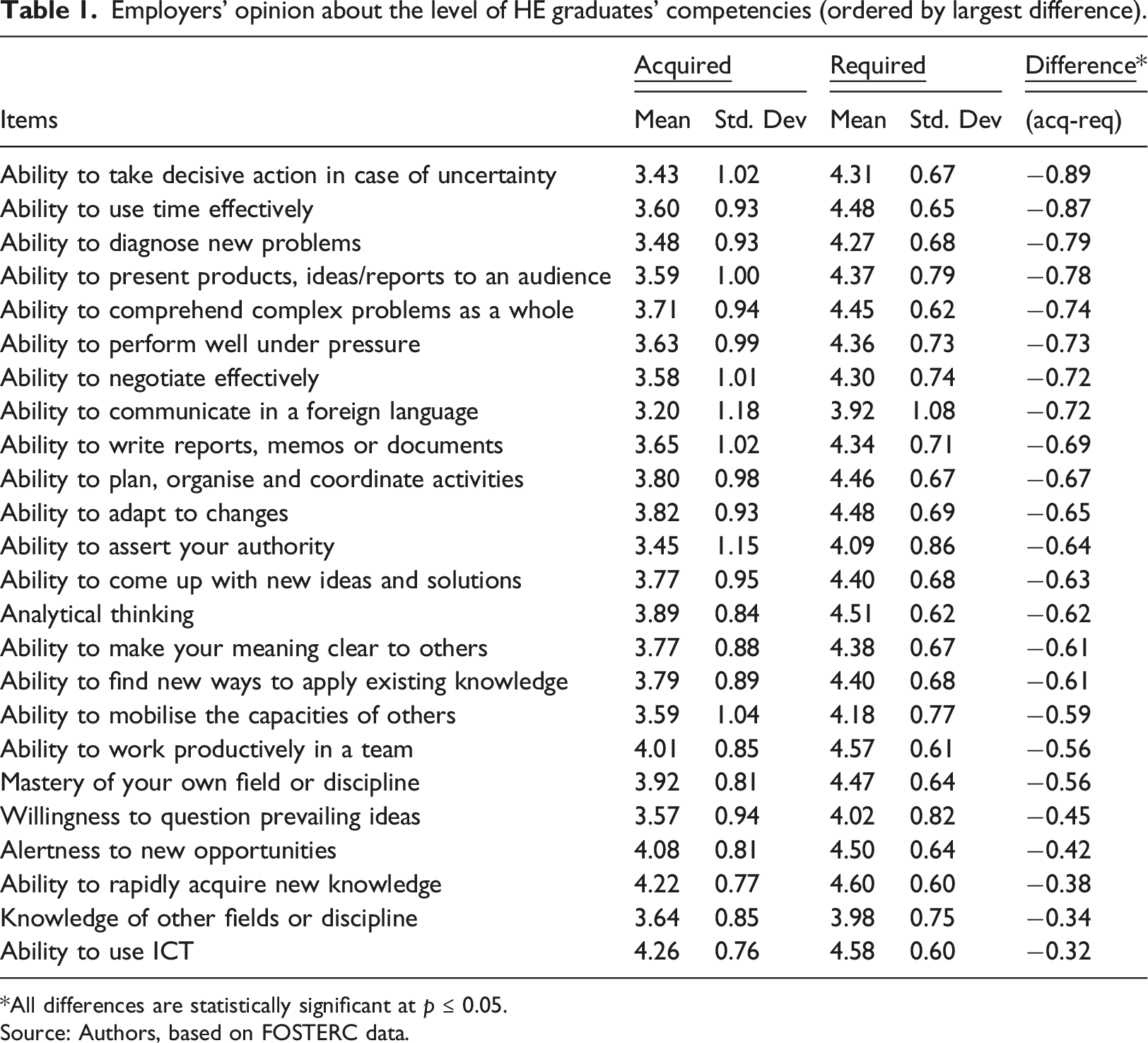
Employers’ opinion about the level of HE graduates’ competencies (ordered by largest difference).
*All differences are statistically significant at p ≤ 0.05.
Source: Authors, based on FOSTERC data.
The acquired level of competency shows how employers assess the graduate’s HE degree up to three years after their graduation, for young (aged between 21–25 years) HE graduates (i.e. retrospective judgments in 2018 of HE graduates who were awarded their degrees in 2015, 2016 or 2017). The level of competencies required is an employer self-reported measure regarding the graduate’s current job. Our criteria allow us to obtain information from the source closest to the actual job situation. However, compared to job analyst gradings, it lacks uniform instructions and measurements, and could produce biased results. Table 1 shows that on average, employers reported that graduates had a lower level of competency than was required for the job. However, they did not, to a great extent, identify lack of ability to use ICTs, knowledge in other fields or disciplines or ability to rapidly acquire new knowledge.
In addition to the competencies, in our analysis, we include some control variables to explain firm characteristics, such as size and private or public sector. In our sample, size is measured as the number of employees in the firm or organisation: the sample includes 4.98% micro firms (1 to 9 employees), 18.39% small firms (10 to 49 employees), 43.67% medium-sized firms (50 to 249 employees) and 32.86% large firms (250 employees or more). Due to the size distribution of the organisations, we defined three dummies – micro and small-sized firms, medium-sized firms and large firms, with medium-sized firms as the reference group. We defined a dummy variable for public (68.58% of our sample) or private (31.42% of our sample) sector organisation. Finally, we include a control for firm location by defining dummies for each of the six regions of Belarus – Brest (11.68%), Gomel (7.85%), Grodno (25.29%), Minsk (39.09%), Mogilev (8.34%), Vitebsk (7.66%) – with Minsk the reference (see Appendix Table A1).
Classification of Competencies
Discussions about the relevance of some human capital competencies compared to other competencies, often emphasise particular knowledge, skills and attitudes required for a particular occupation (García-Aracil and Van de Velden, 2008; ESCO, 2020). The literature highlights a range of graduate skills and personal attributes required to make the individual employable, for example, analytical, technical, communication, entrepreneurial, decision-making, problem-solving, interpersonal, teamwork skills, self-motivation, flexibility, adaptability, etc. (Jerman et al., 2020). Some propose a classification of competencies related to ‘hard’ and ‘soft’ skills (Hurrell, 2016; Pang et al., 2019). The multidimensionality of the concept of competencies is underlined by the fact that some scholars consider different competency-groups, such as behavioural (i.e. intrapersonal, interpersonal and intercultural ones), cognitive, functional (i.e. technology and administrative routines, day-to-day tasks), social (including communication) and affective (including emotional intelligence) (Jackson and Wilton, 2016; Chen, 2020; Macchi Silva and Ribeiro, 2021). Others offer an overall competency classification that distinguishes only between generic and specific skills (Agnihotri et al., 2018; Ferreras-Garcia et al., 2021). Thus, there is no consensus about how competencies should be classified and economic theory provides no clear categorisations (Ménard and Shirley, 2014; Lafuente and Vaillant, 2021).
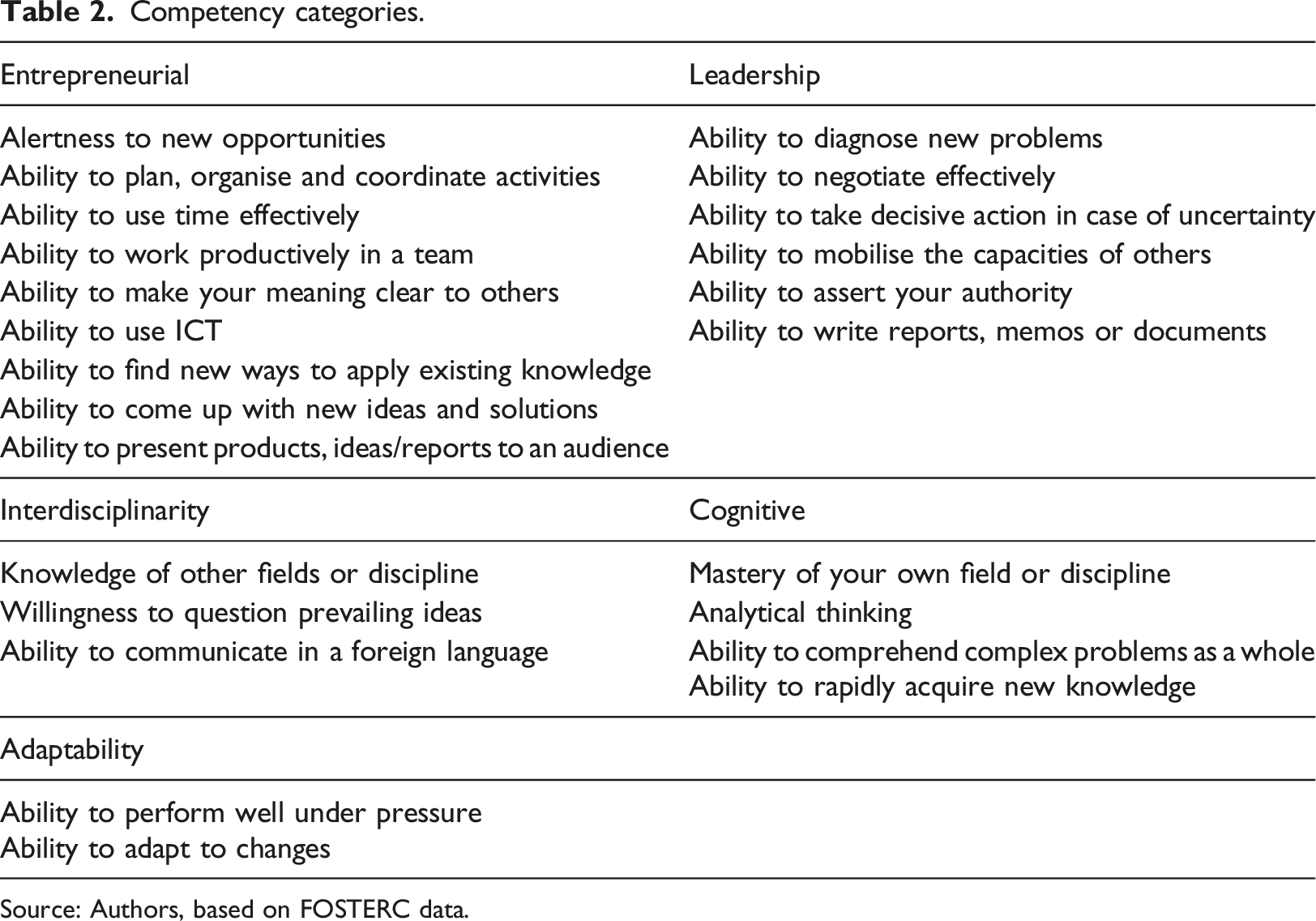
Since competencies have a meaningful association, we tried to make the data more transparent and to overcome multicollinearity problems in relation to the 24 competencies considered in our sample. We employed factor analysis to the list of required competencies while employers referred to graduates’ actual job content. Factor analysis provides orthogonal factor scores which are completely uncorrelated. This does not allow us to attribute cause and effect, but it does enable classification into some main categories. Principal component analysis yielded five factors (entrepreneurial (F1), leadership (F2), interdisciplinarity (F3), cognitive (F4) and adaptability (F5)) with eigenvalues greater than 1 (10.53, 1.27, 1.24, 1.17, 1.10). These five factors account for 63.78% of the overall variance (i.e. 16.15%, 13.86%, 12.03%, 11.41% and 10.33%). These percentages represent the proportion of the total unit variance of each item, explained by each factor, after allowing for the contribution of the other factors. For each item, the loadings on each factor were used to create an individual factor score for each respondent, that is, the 24 item scores for each respondent were reduced to 5 factor scores (see Appendix Table A2). The Cronbach’s alpha coefficient represents the internal consistency of the items in the scales; the closer it is to 1.0, the greater the internal consistency of the items. The alpha levels were: F1 0.91, F2 0.83, F3 0.71, F4 0.79 and F5 0.74. Although there is no generally agreed cut-off, a value of alpha of 0.70 is generally considered acceptable (Raykov and Marcoulides, 2011). Since all five factors have an alpha above 0.70, the consistency of the factors is rated good.
Competency categories.
Source: Authors, based on FOSTERC data.
While there are variations in the definition of employability, we analyze if there is a broad understanding of what knowledge, skills and values are more relevant, and then expected, by Belarusian employers for their young HE graduates and how it influences employers’ perceptions of graduates’ employability (Anderson and Tomlinson, 2021).
Findings
Employers’ perceptions of young graduates’ employability in terms of the level of competencies required in the workplace
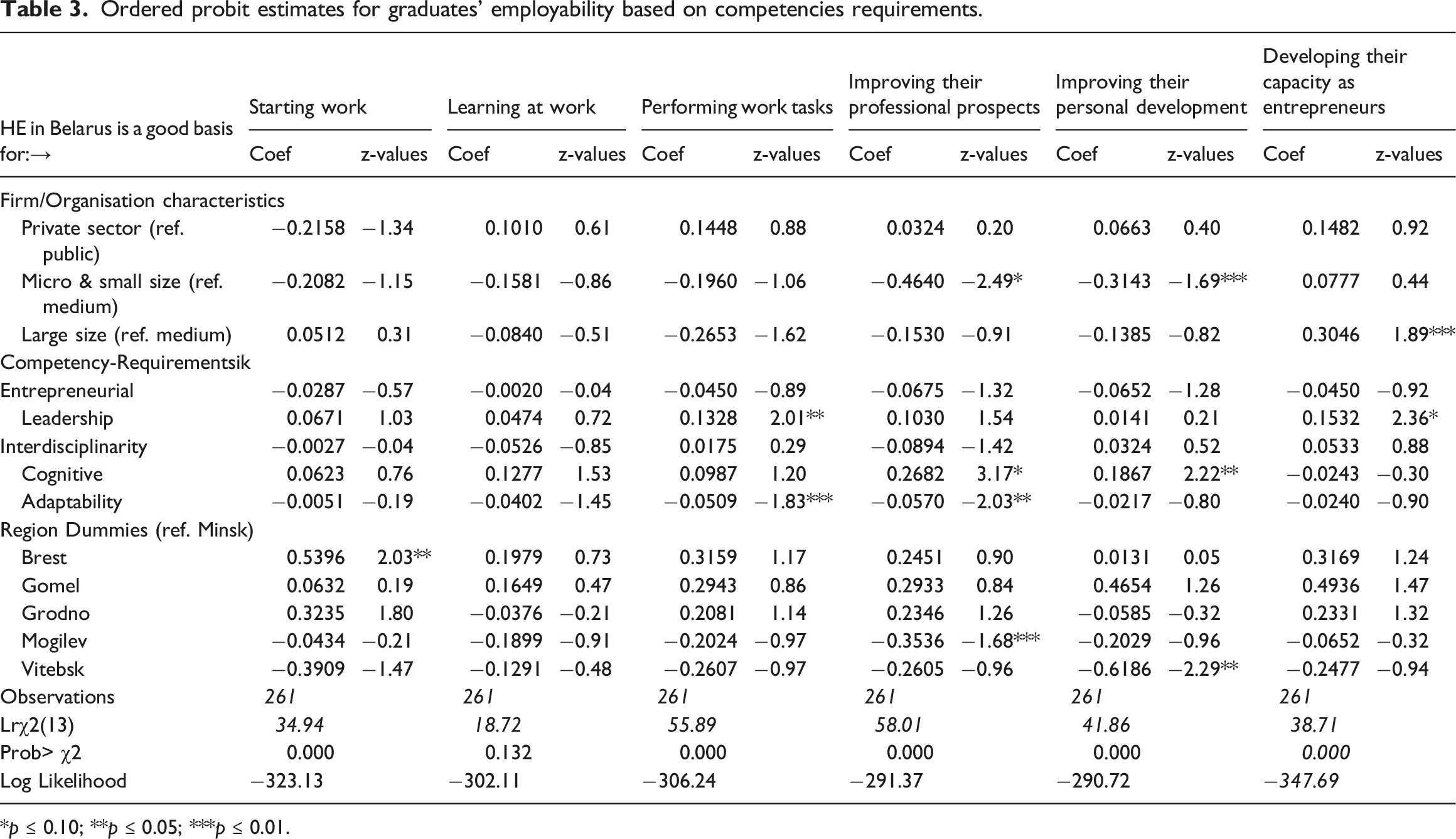
Ordered probit estimates for graduates’ employability based on competencies requirements.
*p ≤ 0.10; **p ≤ 0.05; ***p ≤ 0.01.
In contrast to expectations, we found no statistically significant differences among the requirements for accessing the labour market for young HE graduates in the private or public sectors. Empirical studies discuss the relevant differences between public and private firms related to recruitment and promotion, and the rules governing employment conditions (Wright and Brown, 2013; Lorincova, 2015; Behle, 2021). In some developed EU economies (e.g. UK, Germany, Sweden, etc.), where wage costs are broadly equivalent to or lower in the public compared to the private sector, but where public sector employment is better protected, central and local municipalities have adopted stricter recruitment conditions (Behle, 2021). However, in developing countries (e.g. Morocco, Tanzania, Cote D’Ivore, Haiti, etc.), where average pay gaps generally favour the public sector, there is a tendency for better educated individuals to remain unemployed until there is an opportunity to secure a better paid and more stable public sector job, which causes selection bias in the private sector recruitment process (Mizala et al., 2011; Lorincova, 2015; Campos et al., 2017). In Belarus, the labour market is characterised by state intervention which affects labour issues. Although employers manage daily labour at the point of production, they have little autonomy since industry is, essentially, state-owned and all enterprises are subject to huge state involvement (Danilovich and Croucher, 2011; Vankevich, 2020). This state power, over the system of labour management in Belarus, might could explain the absence of differences in recruitment for the public and private sectors.
We found some differences related to organisation size. Compare to medium-sized firms, large organisations assessed the item associated to the development of entrepreneurial capacity more positively. Micro and small employers assessed the items associated to improving graduates’ professional and personal development lower than the assessment made by medium-sized organisations. These results are linked to the sectoral structure of Belarusian enterprises, where, according to the statistical handbook of the Republic of Belarus (NS, 2019), between 2012 to 2018 there were non-significant changes. The main economic sectors include large private entities, which are interested in fast turnover of capital and high levels of income (trade and services) and, thus, are interested in the development of an integrated HE system in the field of entrepreneurship. However, micro and small organisations are subordinate to the interests of state enterprises. Based on the Papko’s (2017) study, it seems that the Belarusian public authorities have developed a broad set of informal rules, which allow them to extract resources from micro, small and medium private enterprises through inspections and fines, and avoid sector expansion by the imposition of what Papko (2017: 109) calls ‘informal barriers to the development of small and medium enterprises in Belarus’. It is likely that these barriers influence employers’ opinions and reduce their interest in development of their personnel.
With respect of the competency-requirements, Table 3 shows that high requirement in leadership is positively related to employability, in particular, in relation to performing the tasks needed for the current job and developing entrepreneurial capacity. Cognitive competencies are also positively associated with employability and to the improving professional prospects and improving personal development items. However, adaptability (working under pressure and ability to adapt to changes) has a negative influence on employability in terms of task performance and improving professional prospects. These findings are similar to those proposed by job performance theory, which holds that performance can be measured as the aggregate of all behaviours relevant to organisational objectives (Campbell, 1990). This theory of job performance focuses on behaviour rather than results although there are other factors that might affect organisational results which are unrelated to individual performance. Motowidlo et al. (1997) examined the relationship between individual differences (such as personality and cognitive ability) and performance, and found no direct relationship. Other theorists distinguish between two dimensions of job performance – task performance and contextual performance (Fugate et al., 2004). Task performance includes behaviours related to tackling the technical content of the work, such as sales or administration, while contextual performance includes behaviours responding to the interpersonal, cultural and structural dynamics of the organisation. Others propose individual adaptability as a third dimension of job performance (Tucker et al., 2010). However, despite the importance of adaptability in contemporary jobs, there is limited integrated research on individual adaptability, although the field of psychology acknowledges the relevance of its multidimensional context in the workplace in relation to reducing work-stress and uncertainty, adapting to crises, ability for creative problem-solving and learning, etc. (for a detailed review, see Johnstone and Wilson Prangley, 2021). Therefore, the reported effects of adaptability, cognitive ability and leadership ability highlight their potential use as tools to improve performance, professional prospects, personal development and entrepreneurial abilities.
In terms of the differences among the regions of Belarus, compared to the Minsk region, it seems that Brest and Grodno offer better opportunities for starting work, while improving professional prospects and personal development are poor in Mogilev and Vitebsk. These results are consistent with the labour market situation for young people in Belarus. The household survey of employment issues in Belarusian regions, which follows the International Labour Occupation (ILO) methodology, finds that levels of employment for youth (age 15–29 years old) are lowest (36.8% in 2018) and youth unemployment levels are highest (10.3% in 2018) in Vitebsk region compared to the other Belarusian regions (Belstat, 2018). Vitebsk and Mogilev are characterised by low levels of urbanisation, ageing populations in rural areas, and low density of paved roads which last affects transport and communication and reduces labour resources potential in these regions (Fakeyeva and Shadrakov, 2016).
Employers’ perceptions of young graduates’ employability regarding level of competencies of graduates entering the firm.
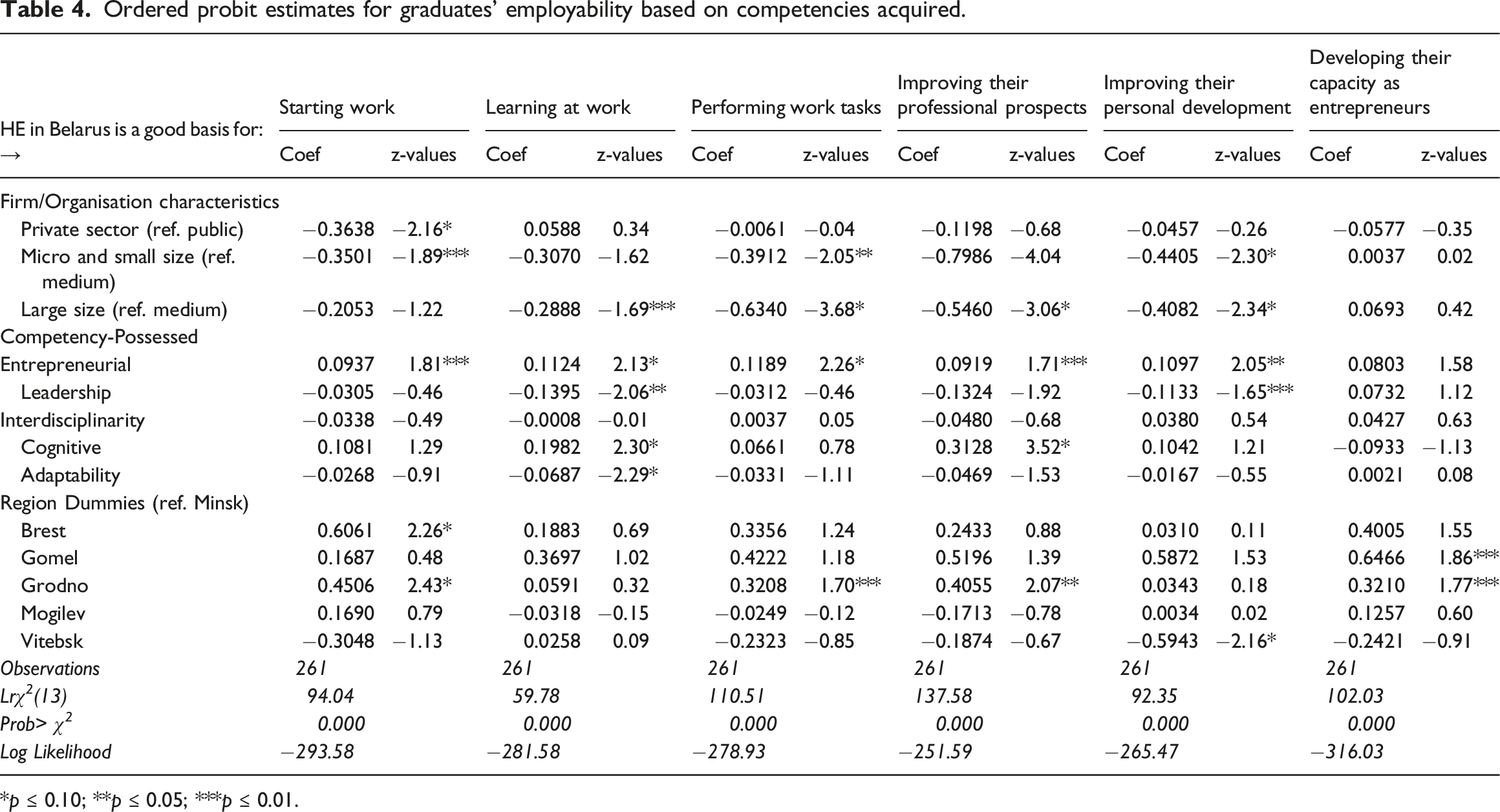
Ordered probit estimates for graduates’ employability based on competencies acquired.
*p ≤ 0.10; **p ≤ 0.05; ***p ≤ 0.01.
For young HE graduates, starting work in the Belarusian private sector and in micro and small-sized firms or organisations is worse than starting in the public sector and in medium-sized firms. This result is due to the concentration and centralisation of capital investment in the public sector, which, in 2018, had more fixed assets and was able to attract more foreign capital and to create new job opportunities (Hrechyshkina and Samakhavets, 2019). In addition, for young HE graduates keen to learn on the job and improve their career prospects, working in a medium-sized rather than a small or large company is more advantageous. However, employability in terms of entrepreneurial capacity, seems not to be statistically significant for any firm or organisation. This might be because most Belarusian firms’ activities are aimed firm survival rather than expansion of production and attraction of new investment and innovation (Danilovich and Croucher, 2011). This leads Belarusian employers to be less concerned about personal and professional development of their staff.
The level of competencies of HE graduates first entering the workplace shows that entrepreneurial competencies have a positive influence on employability according to Jackson and Wilton (2017). Cognitive competencies are positive for learning at work and improving professional prospects. However, leadership has a negative effect on learning at work (as does adaptability), professional prospects and personal development. This might indicate that these kinds of competencies – leadership and adaptability – are not taken into account in the graduate’s early professional career (García-Aracil and Van der Velden, 2008). These results might also indicate that job performance is mediated by type of job and job requirements (Jackson and Wilton, 2016). However, FOSTERC data do not provide information on occupational titles.
Compared to the Minsk region, in Grodno graduates might be more motivated by employers emphasising professional prospects, development of entrepreneurial skills and good task performance. In Brest, employers were more optimistic about the advantages that HE graduates had after getting their degrees in starting a job; and in Grodno, employers underlined development of entrepreneurial capacity among young employees. Improving personal development was negatively assessed by employers in Vitebsk perhaps because the majority of employers in that region believe that young HE employees lack professional training and have insufficient work experience, so they are offered low-skilled jobs (Hrechyshkina and Samakhavets, 2019).
Conclusion
This paper explores young HE graduates’ employability from the point of view of employers in Belarus. Graduates’ employability was defined as a set of six items referred to starting work, learning at work, performing work tasks, improving professional prospects, improving personal development and developing entrepreneurial capacity. The analysis uses FOSTERC data, which provides information gathered from 261 employers in the six regions of Belarus. The inclusion of a specific section in the employer questionnaire of a total of 24 competencies associated to the level of competencies possessed by graduates when they access a job, and the level of competencies required by employers, allowed inclusion of both employability dimensions in the analysis: associated to graduates’ HE achievements and graduates’ workplace learning. The 24 competencies were grouped into five categories – entrepreneurial, leadership, interdisciplinary, cognitive and adaptability. Other variables, such as job characteristics and regional characteristics, were included as control variables. Overall, the results provide strong support for the assumption that the match between individual human capital competencies and the location (i.e. Belarusian regions) and characteristics of the firms and organisations matters.
Analysis of the competency-requirements provides information on demand and performance requirements in firms and organisations in Belarus. The findings provide an overview of the relevance of cognitive and leadership competencies for work performance and the improvement of professional and personal development. However, other competencies, such as entrepreneurial ability and interdisciplinarity, seem to be irrelevant, and individual adaptability has a negative influence. Data limitation do not allow us to confirm whether these personal qualities are related to jobs that do not require special training and education at HEIs, for example, agricultural, construction and services jobs (job titles, according to ILO methodology, are not included in the FOSTERC database that could allow us to explore further this result). The data also do not allow us to check whether, for employers, graduate attributes are more important than the degree discipline (i.e. knowledge area). We need more empirical evidence to obtain a better understanding of employers’ requirements in the context of the complex and changing work environments in Belarus, which, currently, is undergoing a transition from industrial to post-industrial development. Factors, such as state-regulations, lack of employer autonomy and workplace characteristics, which could restrict employers’ managerial power should be considered in further research. Moreover, employer associations, trade unions, the employment contract system, working conditions (including monetary and non-monetary rewards), employees’ work promotion and longer-term employability, which could constraint employers’ management should be also considered in further research.
In this paper, we identified the set of employability competencies required for young HE graduates in Belarus in 2018. Future work could explore the types of employability competencies required for different types of jobs and compare the before-, during- and after-the-pandemic situation. For instance, ICT competencies might be more important for young graduates involved in sales and marketing related jobs or to cope with the rapid changes in work styles induced by the Covid-19 pandemic, when almost all organisations are shifting to online working and using of a range of different digital tools. This might add to the importance of entry level ICT competencies.
In addition, our analysis of the level of competencies possessed by graduates on entry to the workplace highlights the magnitude of the mismatch between the level of competencies provided by HE studies programmes and the level of competencies required in the workplace. These results open the way to several discussions about the design and renewal of the HE curriculum in Belarus. For instance, which competencies should be promoted to allow HEIs to reduce this mismatch in the transition from HE to the labour market? How could employers contribute to a renewed HE curriculum? What should be the role of state interventions?
To sum up, our results suggest that there is a lack of a common understanding of employers’ perceptions of the graduates’ employability according to our six items referred to starting work, learning at work, performing work tasks, improving professional prospects, improving personal development and developing entrepreneurial capacity, depending on the location and size of the firm or the organisation. Moreover, employers expected young HE graduates to demonstrate a range of competencies that include, overall, cognitive competencies such as being mastery in your own field or discipline, analytical thinking, ability to comprehend complex problems as a whole and ability to rapidly acquire new knowledge. However, employers are not demanding competencies associated with leadership and entrepreneurship. This result could provide insights of the high state-interference in business management in Belarus, where employees’ autonomy is not considered relevant for the day-to-day work tasks. The added value of our research is that the problem of graduate employability maps strongly onto the Belarusian authorities that should support micro and small-sized business, and making them attractive to young university graduates in addition to working in state enterprises. Our results also suggest that additional measures should be addressed to improve students’ recruitment after graduation from the university, especially in some regions of Belarus such as Mogilev and Vitebsk, in order to reduce regional disparities in employment and enhance graduates’ mobility.
Finally, our analysis has also implications for the interactive processes involved in graduates’ career development, talent management and internal organisational employability trajectories in workplace contexts, where graduate recruiters or human resource development practitioners should be involved at the labour market conditions and government regulations to promote employees’ capabilities in order to develop private and entrepreneurial initiatives, which in turn affects productivity and growth.
Footnotes
Author’s note
The funders did not influence the design of the study or the collection, analysis and interpretation of the data, the writing of the manuscript and the decision to publish the results. Informed consent was obtained from all subjects involved in the study.
Declaration of conflicting interests
The author(s) declared no potential conflicts of interest with respect to the research, authorship, and/or publication of this article.
Funding
The author(s) disclosed receipt of the following financial support for the research, authorship, and/or publication of this article: This research was funded in part by the National R&D Programme of the Spanish Ministry of Science, Innovation and Universities, grant number RTI2018-101722-B-I00 Spanish Universities Involvement in Social Innovation Activities (SUISIA). The views expressed in this paper are not necessarily the views of that organisation. This work also received support from the FOSTERC project, ref. 574087-EPP-1–2016-1-ES-EPPKA2-CBHE-SP (2016–3219).

Appendix
Descriptive statistics.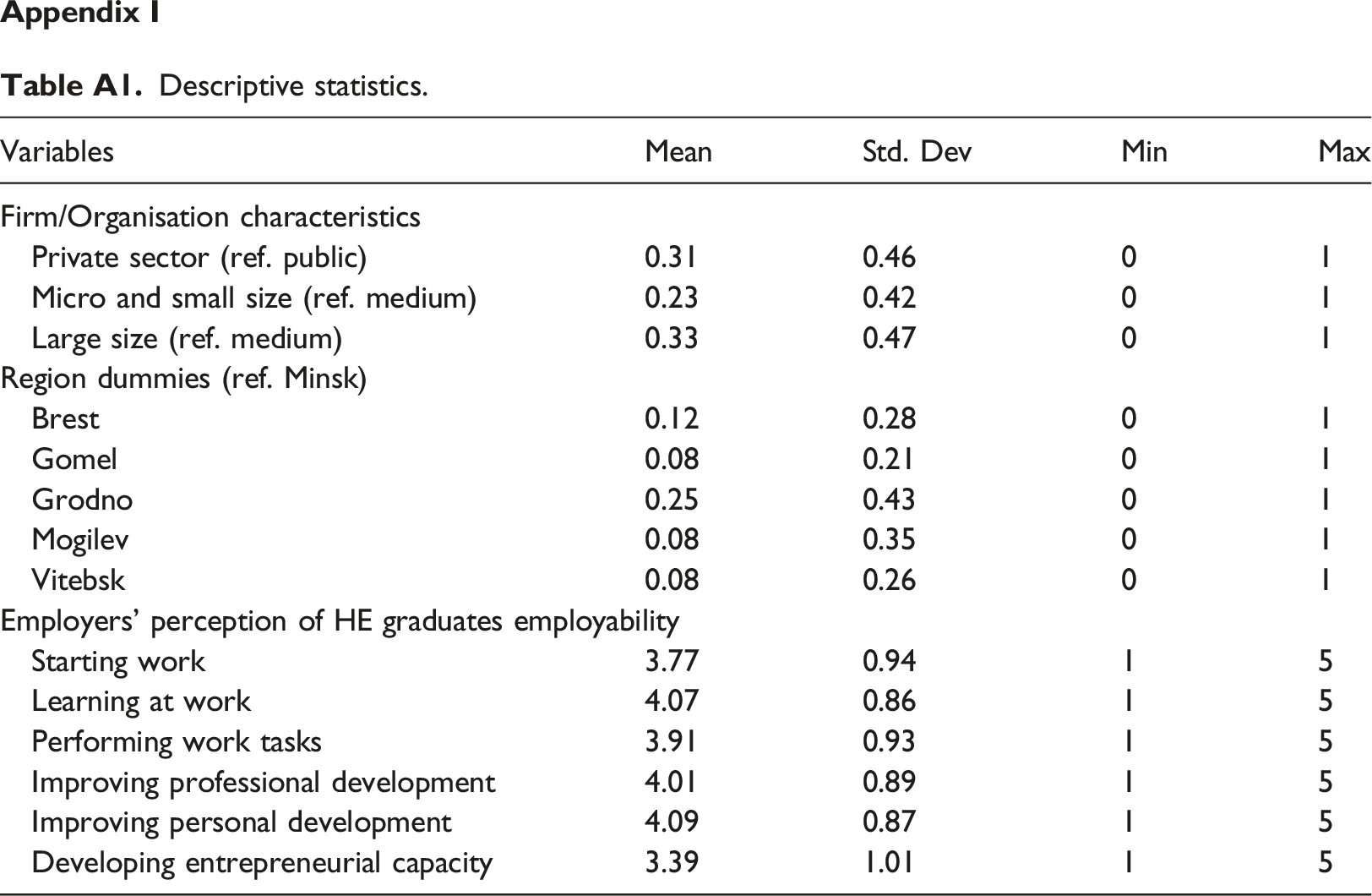
Variables
Mean
Std. Dev
Min
Max
Firm/Organisation characteristics
Private sector (ref. public)
0.31
0.46
0
1
Micro and small size (ref. medium)
0.23
0.42
0
1
Large size (ref. medium)
0.33
0.47
0
1
Region dummies (ref. Minsk)
Brest
0.12
0.28
0
1
Gomel
0.08
0.21
0
1
Grodno
0.25
0.43
0
1
Mogilev
0.08
0.35
0
1
Vitebsk
0.08
0.26
0
1
Employers’ perception of HE graduates employability
Starting work
3.77
0.94
1
5
Learning at work
4.07
0.86
1
5
Performing work tasks
3.91
0.93
1
5
Improving professional development
4.01
0.89
1
5
Improving personal development
4.09
0.87
1
5
Developing entrepreneurial capacity
3.39
1.01
1
5
Rotated Factor Matrix for Required Competencies. Source: Authors, based on FOSTERC data.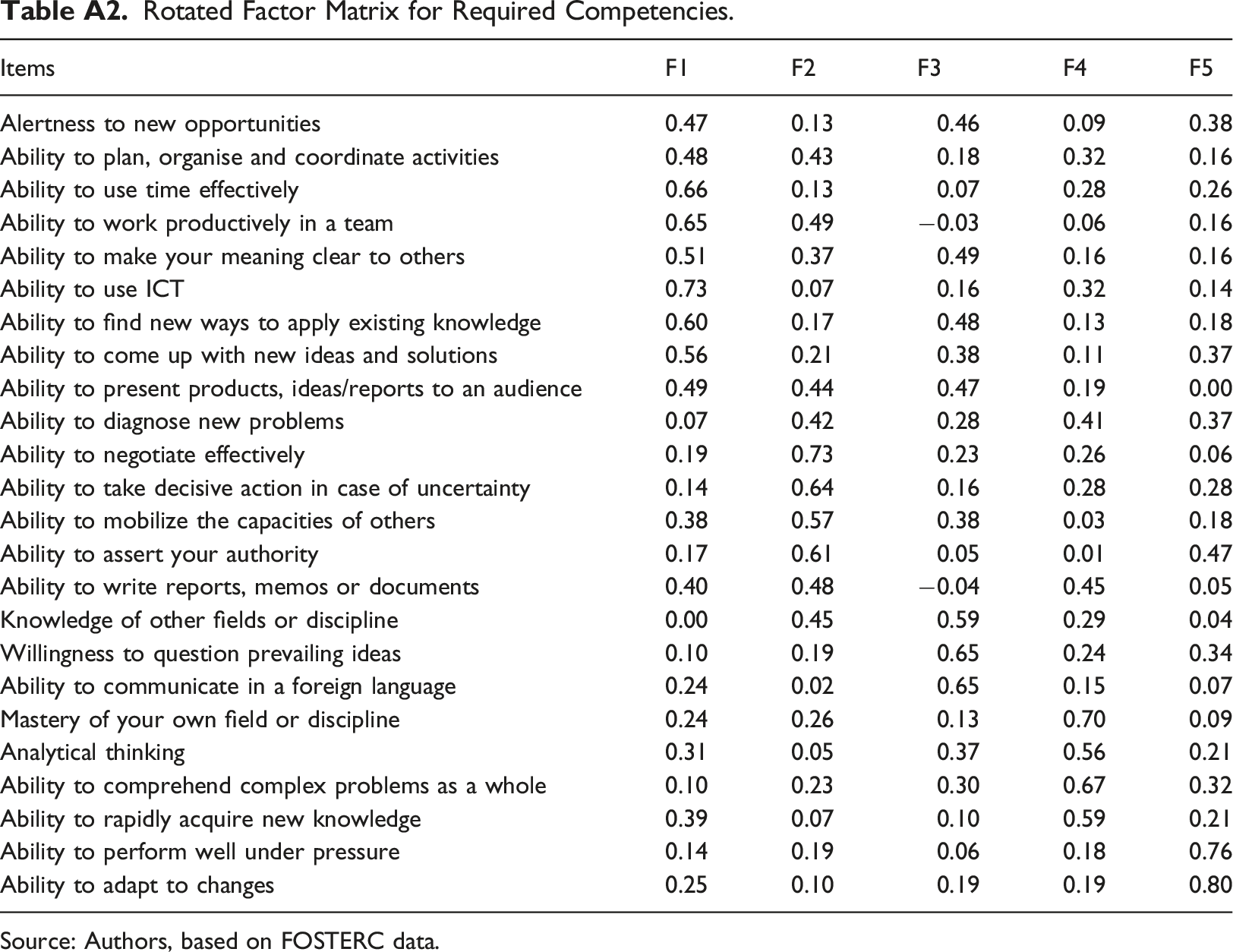
Items
F1
F2
F3
F4
F5
Alertness to new opportunities
0.47
0.13
0.46
0.09
0.38
Ability to plan, organise and coordinate activities
0.48
0.43
0.18
0.32
0.16
Ability to use time effectively
0.66
0.13
0.07
0.28
0.26
Ability to work productively in a team
0.65
0.49
−0.03
0.06
0.16
Ability to make your meaning clear to others
0.51
0.37
0.49
0.16
0.16
Ability to use ICT
0.73
0.07
0.16
0.32
0.14
Ability to find new ways to apply existing knowledge
0.60
0.17
0.48
0.13
0.18
Ability to come up with new ideas and solutions
0.56
0.21
0.38
0.11
0.37
Ability to present products, ideas/reports to an audience
0.49
0.44
0.47
0.19
0.00
Ability to diagnose new problems
0.07
0.42
0.28
0.41
0.37
Ability to negotiate effectively
0.19
0.73
0.23
0.26
0.06
Ability to take decisive action in case of uncertainty
0.14
0.64
0.16
0.28
0.28
Ability to mobilize the capacities of others
0.38
0.57
0.38
0.03
0.18
Ability to assert your authority
0.17
0.61
0.05
0.01
0.47
Ability to write reports, memos or documents
0.40
0.48
−0.04
0.45
0.05
Knowledge of other fields or discipline
0.00
0.45
0.59
0.29
0.04
Willingness to question prevailing ideas
0.10
0.19
0.65
0.24
0.34
Ability to communicate in a foreign language
0.24
0.02
0.65
0.15
0.07
Mastery of your own field or discipline
0.24
0.26
0.13
0.70
0.09
Analytical thinking
0.31
0.05
0.37
0.56
0.21
Ability to comprehend complex problems as a whole
0.10
0.23
0.30
0.67
0.32
Ability to rapidly acquire new knowledge
0.39
0.07
0.10
0.59
0.21
Ability to perform well under pressure
0.14
0.19
0.06
0.18
0.76
Ability to adapt to changes
0.25
0.10
0.19
0.19
0.80