



Abstract
Comparative and international education (CIE) claims to be an interdisciplinary field embracing a diversity in methodologies and theoretical perspectives. Over the years, there has been an expansion in the range of theoretical perspectives employed in scholarship, as new scholars bring with them interests, expertise and positionalities. Our analysis maps the development of theoretical perspectives in doctoral theses in CIE at North American universities since 1990. We find that theory has changed considerably in this time, with a greater emphasis on critical perspectives and standpoint theories and a declining interest in economically focused perspectives. We also note that the role of doctoral advisors is primarily in terms of theoretical perspective, rather than context or methodology. These findings improve our understanding of the field in North America and potentially hold relevance to scholarship in other parts of the world.
Comparative and international education (CIE) 1 identifies as an interdisciplinary field that borrows methods and theoretical perspectives from a variety of disciplines to inform and contribute to research, policy and practice (Jules et al., 2021; Klees, 2008; Paulston, 1994). As such, both the corpus of theory with which research engages and the way that these theories are used has changed over time. New scholars generate discussion on emerging substantive issues in education, bring new positionalities and intersectionalities, and consequentially import new theoretical perspectives and methodological approaches (Psacharopoulos, 1990). It is therefore important to acknowledge that interdisciplinarity and theoretical identity are not only static characteristics of the field, but also dynamic processes through which both substantive issues and theoretical perspectives are imported into the field.
While the interdisciplinarity of the field and its diversity of theoretical perspectives has been well-established, less attention has been given to the processes through which the substantive scope of the field (i.e., the issues it examines) and the theoretical perspective it employs grow and change over time. In this process, the role of doctoral education is central, as it is mainly through doctoral research that new scholars first embark on a sustained research agenda, including both substantive areas and theoretical perspectives. In this paper, we examine whether generations of scholars in the field of CIE align with the theoretical perspectives of their doctoral mentors. The question we explore in this research is whether diversity in theoretical perspectives is transmitted from supervisor to students, and thereby to identify how such perspectives enter and persist in the field. Similarly, we seek to establish to what extent doctoral advising is either induction into a particular theoretical perspective or, conversely, application of expertise to a given substantive area.
Our analysis seeks to map the development of theoretical perspectives in CIE in North America since 1990, based on the Proquest Dissertation Database unique dataset capturing three decades of doctoral education in the field. The knowledge mapping and changing theoretical perspectives for the period up to 1990 has been well documented in the works of Paulston (1994, 1999). More recently, detailed works situating the history of the different perspectives and relevance to CIE has also been examined in the edited volume by Jules et al. (2021). We examine generations of scholars in the field of CIE to discern whether perspectives represented in their thesis research align with the theoretical perspectives of their doctoral mentors.
Using methods of text mining, we examine how the theoretical and substantive research focus of students are connected to those of their doctoral advisors and look at how the overall theoretical focus of the field has changed over the past three decades to encompass new critical and other theories of difference. We begin with a brief discussion of how theory has been considered in CIE literature, then turn to introduce our data, which are taken from the Proquest Dissertation Database. After presenting an analysis of how the influence of supervisors is reflected in students’ work, we conclude by discussing implications for the field.
Historical context: Theory in comparative and international education
The discussion of the historical roots of the field of CIE and expansion of theoretical perspectives represented in the field is not new (Brickman, 1960; Woock, 1981). Paulston (1994, 1999) and Epstein (1994) have mapped the diversity of perspectives in the field of CE in historical context, and our research extends this work in exploring the development in the period after to include more recent theorizing of education development issues.
Discussions on the disciplinary identity of CIE have often centered around the question of what ought to be the standard for methodology and theory informing scholarship and practice in the area study. Earlier attempts drew on both Enlightenment era traditions rooted in the scientific method and historical understandings of national school systems. However, after the end of the Second World War (WWII), the field increasingly engaged with the international development project and with it, an introduction of modernization theory and positivist perspectives that has characterized much of the development education work to date (Epstein, 1994). This debate includes some resistance to expanding the theoretical perspectives informing the intellectual discourse in the dominant outlets for scholars in the field. For example, Cook et al. (2004) argue that those seeking to introduce new perspectives must convince other CIE scholars of the need for change.
The emergence of newer and critical perspectives has been predicated on changing understanding of context over time, often presenting an implicit critique of the economic rationales and emphasis on evaluation of outcomes related to international development efforts. As late as 1990, there was expression of resistance to the newer conflict theories even within the positivist tradition (Psacharopoulos, 1990). The 1988 critique of the relevance of dependency theory in the examination of educational issues in the context of works by emerging critical theorists (Noah and Eckstein, 1988) is illustrative of earlier resistance to the expansion of perspectives to be employed in the field.
The influence of gate-keeper scholars can be demonstrated in both avenues of dissemination of the scholarship and in the training of new scholars. Analysis of the major objectives and trends reflected in the field since the 1970s revealed a significant influence of a small group of then contemporary scholars within the Comparative and International Education Society (CIES), even as wider membership acknowledged the increased awareness of the interconnectedness of the educational issues and the need for a broader scope for research in the field (Ross et al., 1992). Subsequent examinations of the dissemination of scholarship in the field reveal that the editorship of journals has often controlled both the theoretical orientations and perspectives that are showcased as legitimate scholarship in the field (Cossa & Epstein, 2016; Nordtveit and Epstein, 2016). In contrast, doctoral theses can offer a broader perspective and capture more intellectual diversity in the field due to the varying interests and experiences of doctoral students. This also continues and draws upon a significant history of disciplinary introspection through the examination of doctoral work (Friedrich and Ku Bradt, 2021; Parker, 1964). The work of Parker and Parker (1971a, 1971b, 1978), is particularly notable for reviewing a large number of doctoral theses related to different geographic areas (e.g., Latin America, Japan, and India).
Ideological leanings tend to be evident in the theoretical perspectives adopted by authors and scholars. Earlier work by Kazamias and Schwartz (1977) explored the ideological perspectives underpinning the scholarship of the pioneers in the field of CIE in the USA, which they identified as including functionalism, structural-functionalism, and modernization theory. A mapping of the evolution of paradigms and theories reflected in the scholarship of CIE scholars into the 1990s was undertaken by Paulston (1994), who identified an expansion and movement towards heterogeneity in perspectives employed in the field. An examination of knowledge communities in the postmodernist era of the 1990s led Paulston (1999) to conclude that CIE scholars were concerned with variations in social and educational change, processes and outcome and they employed a diverse set of theories as appropriate. In addition to equilibrium theories (primarily functionalist and structural-functionalist) and conflict theories (including Marxist and Neo-Marxist paradigms), Paulston also identified culturally centered critical theories that he termed as cultural revitalization and anarchistic utopian (Paulston, 1999: 442).
The post-WWII geopolitical context gave rise to a focus on education for international development in CIE scholarship (Epstein, 1994; Steiner-Khamsi, 2006), with scholars also acting as consultants for the foreign policy arm of their respective government (Spreen, 2005). It is in this context that human capital theory and rate-of-return economic development theory came to inform modernization interventionism (Burnett, 2014; Noah and Eckstein, 1969), dominating the theoretical orientation of the scholarship in the field. Both functionalism and structural-functionalism also found space in the context of education for development (Kazamias and Schwartz, 1977; Welch, 1985), mostly as explanatory theories informing education sector interventionism and attendant outcomes in lived experiences of the population towards the decade of the 1990. The 1970s also saw diversification in theoretical perspectives to include Marxism, dependency theory, world-systems analysis, and structural-functionalism (Arnove, 1980; Kelly and Altbach, 1986; Woock, 1981), all employed to contest macro-level difference and inequality in CIE scholarship and similarly explanatory theories as well. The expansion of theoretical perspectives to include postmodernism, feminism, globalization, and neoliberalism in the 1990s (Clayton, 2004; Mehta and Ninnes, 2003; Omwami and Rust, 2020; Rust, 1991; Stromquist, 1990, 1995; Torres and Puiggrós, 1995; Welch, 2001) signaled an acknowledgment of engagement with micro-level issues of difference and marginality by scholars in the field of CIE.
In tandem with the development in area studies, diversification in perspectives informing the understanding of educational and social context of lived experiences of populations globally has evolved to be responsive to narratives of differences that include voices from previously excluded groups. As an example, critical race theory has come to dominate much of the scholarship theorizing inequality in education in the US from the 1990s (Arnove, 2001; Horsford, 2009; Solorzano, 1997). The field of CIE has seen a growth in the representation of minority ethnic, international scholars from non-western regions of the world and women scholars who bring perspectives from their positionality in examining educational issues. For example, feminist theories (Ahlquist, 2000; Altbach, 1991; King, 1987; Kirk, 2004; Ross, 2002; Stromquist, 1995; Torres, 1998) have been explored in CIE from the 1980s with postcolonial theories as the field enters the post-2000 period (Aikman et al., 2011; Hickling-Hudson, 2006; Kamat, 2004; Limond, 2010; Mason, 2011; Niens and Reilly, 2012; Rassool, 2004; Takayama et al., 2015; Tikly, 1999).
The post-2000 shift in development towards a human rights and basic freedoms focus with the adoption of the United Nations (2000) Millennium Development Goals and the UNESCO sponsored 2000 World Education Forum (Dakar Conference) focused on the equal access to a quality basic education for all (United Nations, 2000; UNESCO, 2000; Sperling, 2001). This was accompanied by an increase in research applying Sen’s capabilities theory in the study of education for development (Unterhalter 2005; Walker and Unterhalter, 2007). Among the perspectives that have been adopted in CIE that align with the human rights agenda is Ubuntu that highlight indigenous knowledge and theorizing that centers human dignity (Enslin and Horsthemke, 2004; Ross, 2002; Smith and Ngoma-Maema, 2003; Walker, 2003).
Lastly, the entry of postmodernism in CIE discourse was viewed as an acknowledgment of multiperspective lenses that allow for the adoption of elements of different theoretical perspectives most suitable to illuminating the issue under examination (Epstein and Carroll, 2005). Besides diversity in perspectives, starting in the 1990s, critical theories also ushered in the acknowledgment of multidimensional experiences of marginalization and oppression. This concept of intersectionality drew upon experiential perspectives on race, gender, and social class in the lived experience of Black women (Crenshaw, 1991) and in the social sciences has been contemplated in scholarship that distinguishes the various feminist perspectives in what constitutes intra-gender difference. The membership in the field has continued to grow and today we have an even more inclusive and diverse representation of theoretical perspectives employed in CIE scholarship.
This analysis seeks to contribute to the understanding of the field’s development from the perspective educators and the graduates of their programs at the doctoral level recent decades. Our intent is to revisit the multidisciplinary identity of the field of CIE and to advance the argument for intersectionality by exploring the possibility of the convergence of multiple perspectives in the examination of a given educational issue that centers individual scholars and individual experiences in the more recent scholarship in the field. We examine the works of scholars and their intellectual “offspring” as the tapestry through which we explore continuity, diversity, and change in theoretical and intellectual engagement in CIE. We make the assumption that engagement in particular works of scholar would reflect an alignment in ideological perspective in their mentorship and mentoring relationships.
Doctoral education in comparative and international education
While the recent history of CIE points to its increasingly pluralistic nature, the processes through which this pluralism is created and preserved are less clear. In investigating this question, recent scholarship shows how the process of doctoral education holds important insights, as it is through doctoral education that the induction of new researchers into the field presents a window of opportunity for the institutionalization of new theories (Friedrich and Bradt, 2021). Comparative and international education has largely been a field of “outsiders,” those whose personal and academic trajectories did not fit neatly with established categories of academic disciplines, nationalities, or other social categories (Cowen, 2018). The focus on doctoral supervision also draws our attention to the realization that theoretical positioning is connected to personal experience and interpersonal relationships (Silova and Auld, 2020).
Research on doctoral education more broadly indicates it is a heterogeneous process, with considerable variation between advisors, institutions, and national higher education systems. With massification of the doctorate credential in the 1990s, doctoral research is increasingly tied to practical concerns and reflects a broader shift towards “Mode 2” knowledge production with closer links between the academy and practice or industry (Gibbons et al., 1994; Kearney and Lincoln, 2018). In the field of CIE, this shifting emphasis is somewhat less noticeable as research has often been motivated primarily by a particular problematique (Schriewer, 2014). This implies that research will reflect context and the concepts and ideas informing CIE research evolve with changes in context.
The doctorate in CIE represents a unique intersection of theory and context, not only insofar as both theory and context manifested within the doctoral research project but also in how a new researcher intersects with the existing field, albeit one that is syncretic and fluid (Schriewer, 2014; Schweisfurth, 2014). This intersection is not a process of socialization or induction into a well-established field, but rather one evincing a dialectical process and “a fusion of horizons” (Gadamer, 1960/2013). Cowen (2020: 130) highlights this symbiotic nature of doctoral education in the field of CIE as a whole, as international doctoral students often research their country of origin, and they thus “gain ‘comparative’ doctorates while at the same time contributing confidence to the department as a whole that it is au fait with developments in education in whichever foreign place.” In this sense, the advisor is certainly not an expert in the context of study; in fact, she or he actually stands to learn a considerable amount from the doctoral student.
The contribution of the advisor to doctoral research is less clear as the question remains as to whether the advisor nevertheless influences the doctoral scholars with respect to ideology and politics of the issues they seek to examine in their education. Research on doctorates more generally points to the versatile skills required of supervisors, ranging from functional support of the research project to critical intellectual engagement to pastoral support and advice (Lee, 2018; Taylor et al., 2018). Cowen (2020) argues that an emphasis on methodology has come to characterize CIE doctoral research, originating in Bereday’s (1964) technocratic vision of doctoral education in the field. While not disputing this claim, introspective studies of the “tribe” of CIE point to its distinctive academic culture (Schweisfurth, 2014), with inherent tensions between the universalizing approach of Western social science and the culturally situated experiences of “travellers” who are often located outside of this narrative (Cowen, 2018; Silova and Auld, 2020).
Within this complex scenario, we wish to draw further attention to the doctoral encounter and the unique interplay of theoretical outlook, topical knowledge, and methodological expertise it involves. We seek to investigate the transmission of theory from one generation to the next through textual artifacts of the process, that is, the doctoral thesis, asking whether students of a common advisor might form a “tribe” and, if so, what bonds might unite it.
Methods and data
The current analysis is limited to examining the patterns in the theoretical orientation of doctoral students and their advisors in North American universities in order to uncover whether there are similarities in the nature of the works they engage with and the lens through which they examine educational issues they seek to interrogate in their research. The patterns should reveal if the doctoral advisors share theoretical perspectives and focus on issues with their advisees, and thus a reproduction in the perspectives employed. In order to study how theories are imported to and used within the field of CIE, we performed an analysis of 214 CIE doctoral theses in the Proquest Dissertations Database. We use presidents of the CIES as the entry point for our sample, querying theses in which all CIES presidents between 1990 and 2020 were listed as a doctoral committee member (often called a supervisor or advisor in other higher education systems). In total, 27 CIES presidents within this period were listed as committee members in the Proquest Database, with presidents serving on between 4 and 63 different committees, with a median of 16 committees and average of 20.5 committees per president. Our dataset of 214 theses is comparable to other studies of doctoral theses, for example, Parker (1964) examined 269, and Parker and Parker (1978), examined 284. However, our study adds significant depth in that we are able to analyze the entire thesis text while other focused upon abstracts only.
Comparative and International Education Society presidents are used as our entry point for sampling because they are recognized as major academic figures within the North American field of CIE and the majority are drawn from the university system. However, the data source entails both benefits and limitations. On the one hand, the Proquest Dissertations Database offers a unique and comprehensive record of all doctoral theses completed, including the full thesis text and the names and institutions of committee members. Such comprehensive information on a national level is not available in other higher education systems, where it is often stored in individual institutional repositories or library websites. On the other hand, this data source necessarily focuses our study on the CIE in North America, which is somewhat (but not completely) distinct from other regions in which CIE scholarship is active (e.g., the Asia, Europe and the United Kingdom). Recognizing geographic variation in the field (Takayama, 2018), we nevertheless propose that the patterns of how intellectual schools form within the field is of general relevance, even if the theories and topics differ across regions within the global field.
This time period and geographical focus of our work are also necessitated by more practical considerations. It is only after 1990 that most theses are available on Proquest in electronic format, and those that are available are in machine-readable formats (i.e., digital text rather than scanned images) required for our text-mining methods detailed below. Thus, extending back to earlier presidents of CIES was not practically feasible. In addition, the North American focus is somewhat necessitated by the availability of a consolidated source of doctoral theses (i.e., the Proquest Dissertations Database). While some other national repositories are available (i.e., the British Library’s E-theses Online Service, EThOS), the coverage is not as complete as Proquest, as submission is optional. Furthermore, information on supervisors is generally missing, which makes identifying theses relevant to CIE nearly impossible.
We are concerned with two key aspects of the theses in our dataset: the literature with which they engage and the topics they discuss. To investigate these aspects of the theses, we use methods of bibliometric analysis and text-mining, respectively. For our bibliometric analysis, we extract citations from each thesis (using the open-source software “anystyle”) in order to obtain a list of works cited in each thesis. Second, we use text mining methods to create a term document matrix, which maps all terms that occur in the theses to the respective theses in which they occur (Feinerer et al., 2008). These terms are processed to remove common “stop words” (common words that are not relevant to the document, e.g., “it,” “this,” “is”) and account for “stemmed” terms to isolate the grammatical root of the word; for example, “possibilities,” “possibly,” and “possible” are all stemmed to “possible” (Bramer, 2016).
The resulting dataset can be analyzed in two formats (Figure 1). One is as a pair of 214 × 214 triangular matrices, in which the columns and rows correspond to each thesis (numbered 1–535) included in the sample, and the value of each cell corresponds to either the number common references or terms. The matrix is symmetrical (i.e., the number of common citations between T1 and T3 is the same as T3 and T1), and so only the lower triangle of the matrix is needed (Figure 1, top). Alternatively, the data can be represented as a series of rows in a dataset as shown before, with columns indicating a thesis pair (ID1 and ID2), a dichotomous measure of whether the theses were supervised by the same advisor (SameAdvisor), the number of years that separated the completion of the thesis (YearDifference) and the number of common references and terms. Pairwise comparisons of each thesis in the dataset yield 23,005 unique pairs of theses. Overview and matrix and list data formats derived from the corpus of 214 comparative and international education doctoral theses.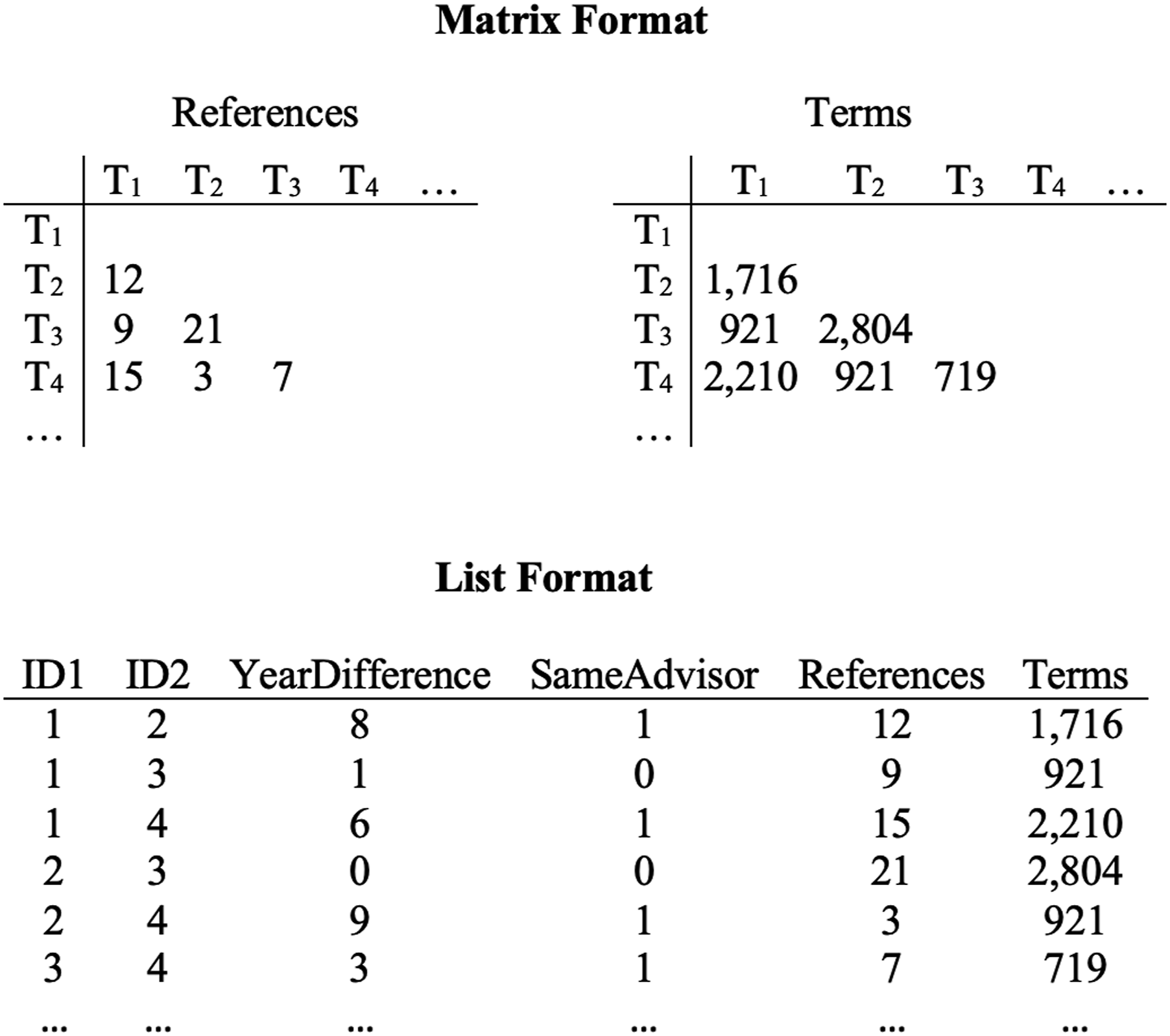
Our analysis is comparative in that it looks at similarities and difference in theses, specifically focusing on those that share the same advisor. The motivation for this comparison is to determine whether scholars that share an advisor reflect commonalities in their intellectual resources or topics of research (or both). Our research focus is on developments in the field as a whole, rather than the approaches and strategies of particular individual advisors, and for that reason individual advisors are not named in our analysis.
Results and analysis
Comparisons by advisor
Our first key question concerns the extent to which doctoral advisors within the field tend to produce a school of scholars who follow and draw upon a common body of literature and discuss a common set of concepts and ideas. Conversely, advisors may provide more general expertise, for example, guidance on the process of formulating a researchable question, planning data collection, etc. To investigate these possibilities, we look at common citations and common terms among students of the same advisor and compare them to students from different advisors. In doing so, we seek to establish whether the theses of students with a common advisor reflect a common intellectual or theoretical heritage in the works they cite and the terms they discuss. Students from different advisors are somewhat akin to a “null hypothesis” illustrating commonalities in references or terms that might be found among theses in the field of comparative and international generally. To the extent that an advisor has an “effect” in creating a school of students with a common focus, similarity among students’ work will differ from that found among a comparison of theses from different advisors.
Results (Figure 2) show that students with a common doctoral advisor do show similarity in the works they cite and the terms they discuss. On both plots (left and right), the number of common citations between theses with different advisors (N = 21,549) are shown with a white bar, while similarity in the theses from each individual advisor is shown with a gray bar (ordered from lowest to highest common citations). Comparison of theses supervised by the same and different doctoral advisors.
2
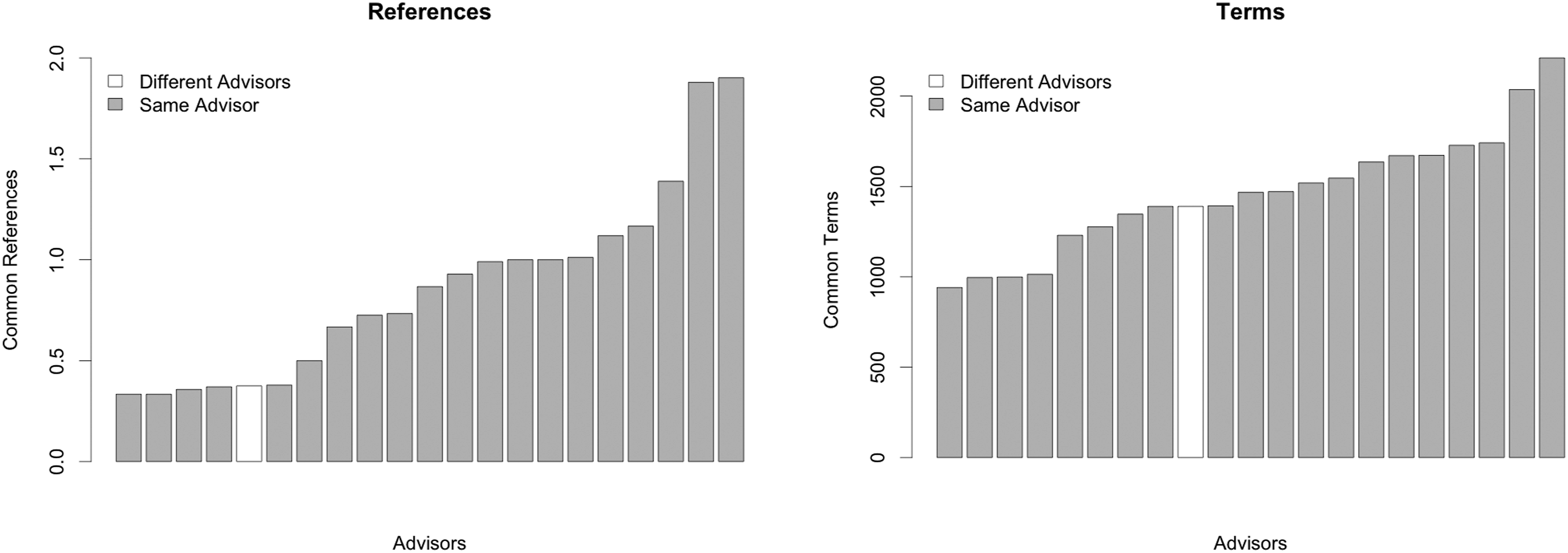
In terms of references, students with the same advisor (the gray bar) tend to have far more common citations than those with different advisors, suggesting that a significant role of the advisor is in placing the student’s work within a particular body of literature. With respect to common terms, the pattern is less pronounced. For most advisors, students tend to use more common terms than students with different advisors, but for a considerable share of advisors this is not true, meaning that the advisor’s input into the content (which might be largely shaped by the context and topic or substantive area) is essentially absent. Thus, a preliminary analysis shows that the primary contribution of the doctoral advisor is in shaping both the literature with which students engage. It might also suggest that context changes yield new terms that are then adopted in scholarship in subsequent years.
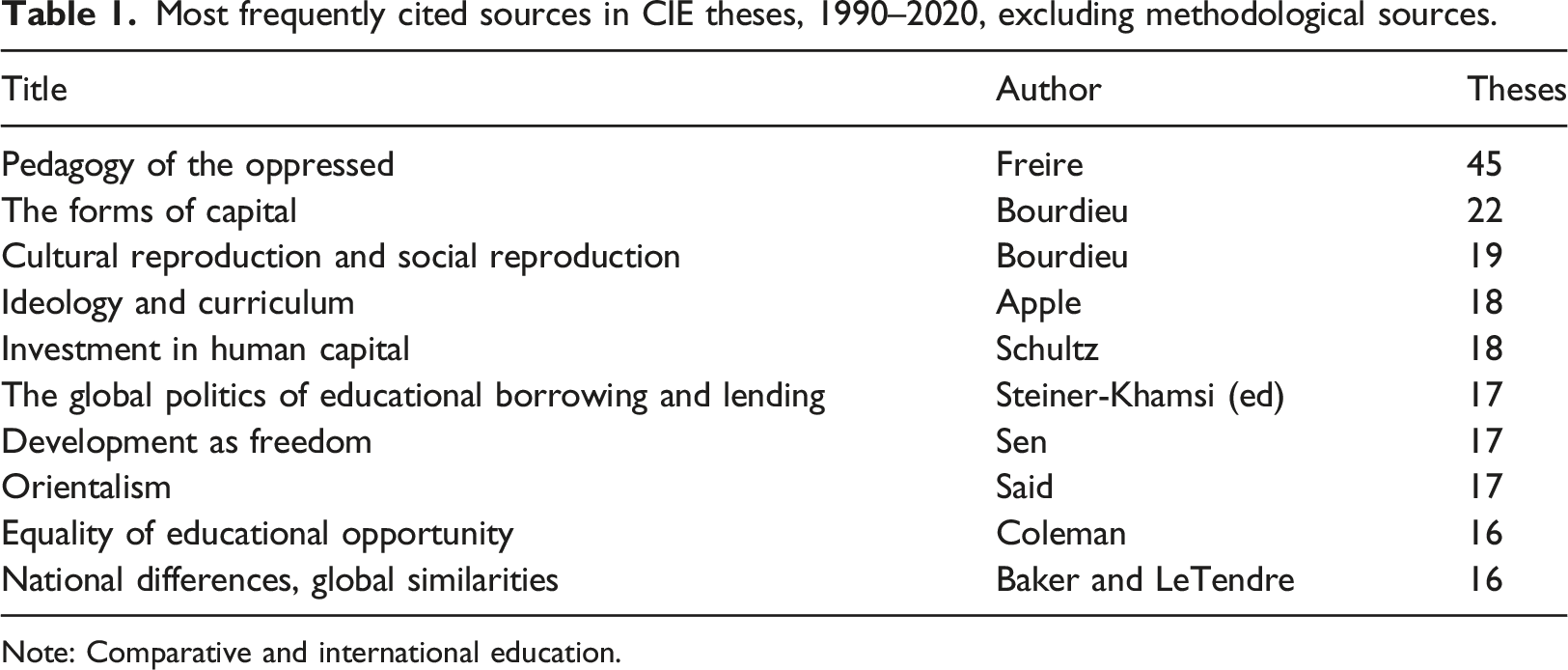
Most frequently cited sources in CIE theses, 1990–2020, excluding methodological sources.
Note: Comparative and international education.
Comparisons across time
Another key question is the extent to which common the development of research in CIE has been shaped by trends over time. As ideas and concepts are both developed in CIE and imported from other fields, it is possible that the content of students’ theses (both the literature cited, and topics discussed) would reflect current thinking in the field. We examine this possibility by looking at how the number of common citations and common terms vary by the years between the acceptance of theses.
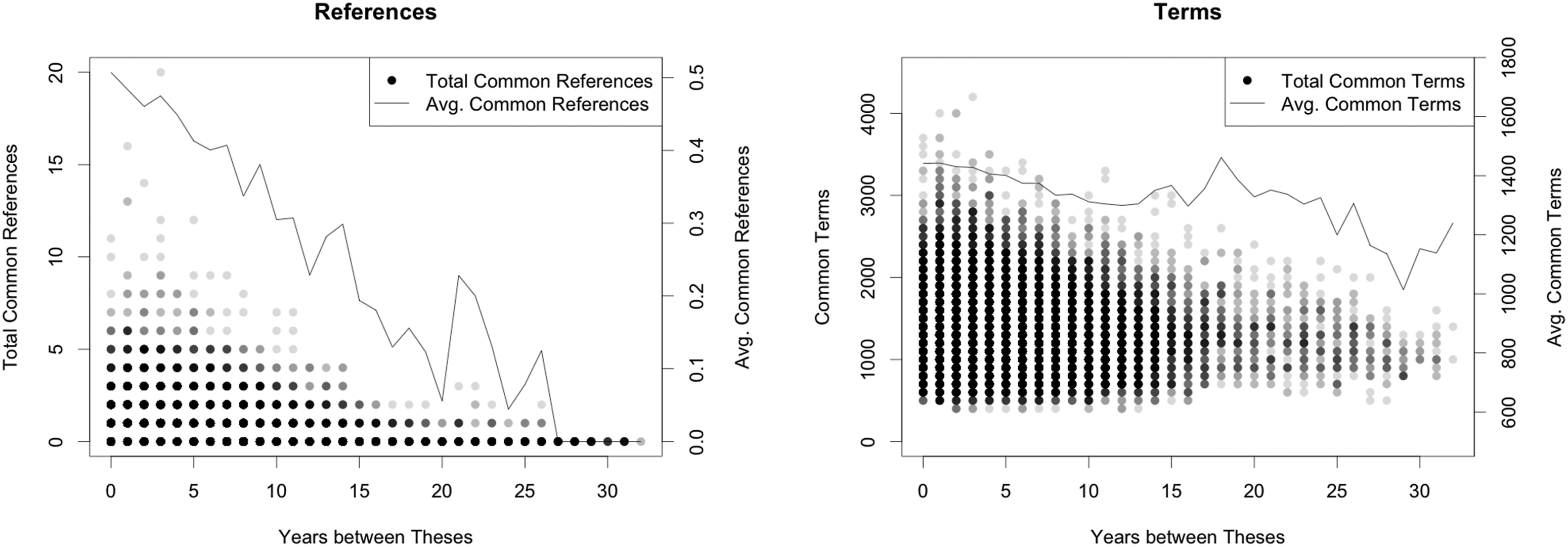
Our results (Figure 3) show that the number of common citations tends to be much higher for theses that are published near the same time, dropping by 50% in 10 years to almost no common citations for theses published more than 25 years apart. Thus, the time at which a student is writing is likely to shape the theories upon which they draw, perhaps more than the individual supervisor. In contrast, the terms used in theses are more constant across time, although similarities do diminish steadily as the number of years between the theses increases. It is probably not surprising that both literature cited and topics discussed both change across time. However, what is important is that this trend is much more pronounced in terms of the literature cited than for the terminology, which points to likelihood that theorizations in the field that change more quickly than the topics of analysis themselves. Differences in theses based upon the number of years between their completion/acceptance.
3
To further illustrate theoretical changes across time, we examined the prevalence of theoretical keywords. We purposively identified key terms and phrases particular to certain theoretical perspectives, for example, “rates of return” is highly associated with studies using human capital theory, while “actor” and “rationalization” are terms commonly found in neo-institutional analysis.
Trends in the frequencies of 13 keywords are plotted in Figure 4, which reveals several interesting trends in the field. For example, language relating to neoclassical economics (e.g., “human capital”) have tended to decline, as has language relating to more orthodox “grand narrative” theories such as Marxism and Structuralism. The terms that have increased the most are those related to critical theories, for example, terms associated with Bourdieu’s theory of capital (i.e., social and cultural capital, 1986), as has discourse, a key term in much research undertaken from a post-structuralist perspective (Olssen, 2003). It is important to note that the figure shows trends rather than absolute magnitudes, showing what terms are growing or declining rather than their absolute usage (in other words, the vertical axis is scaled independently for each term rather than held constant across terms). Thus, critical race theory is actually the fastest growing theoretical keyword in the thesis corpus, but it still occurs with approximately one-third the frequency of “cultural capital.” Trends in theoretical keywords in comparative and international education doctoral theses over time (1990–2020).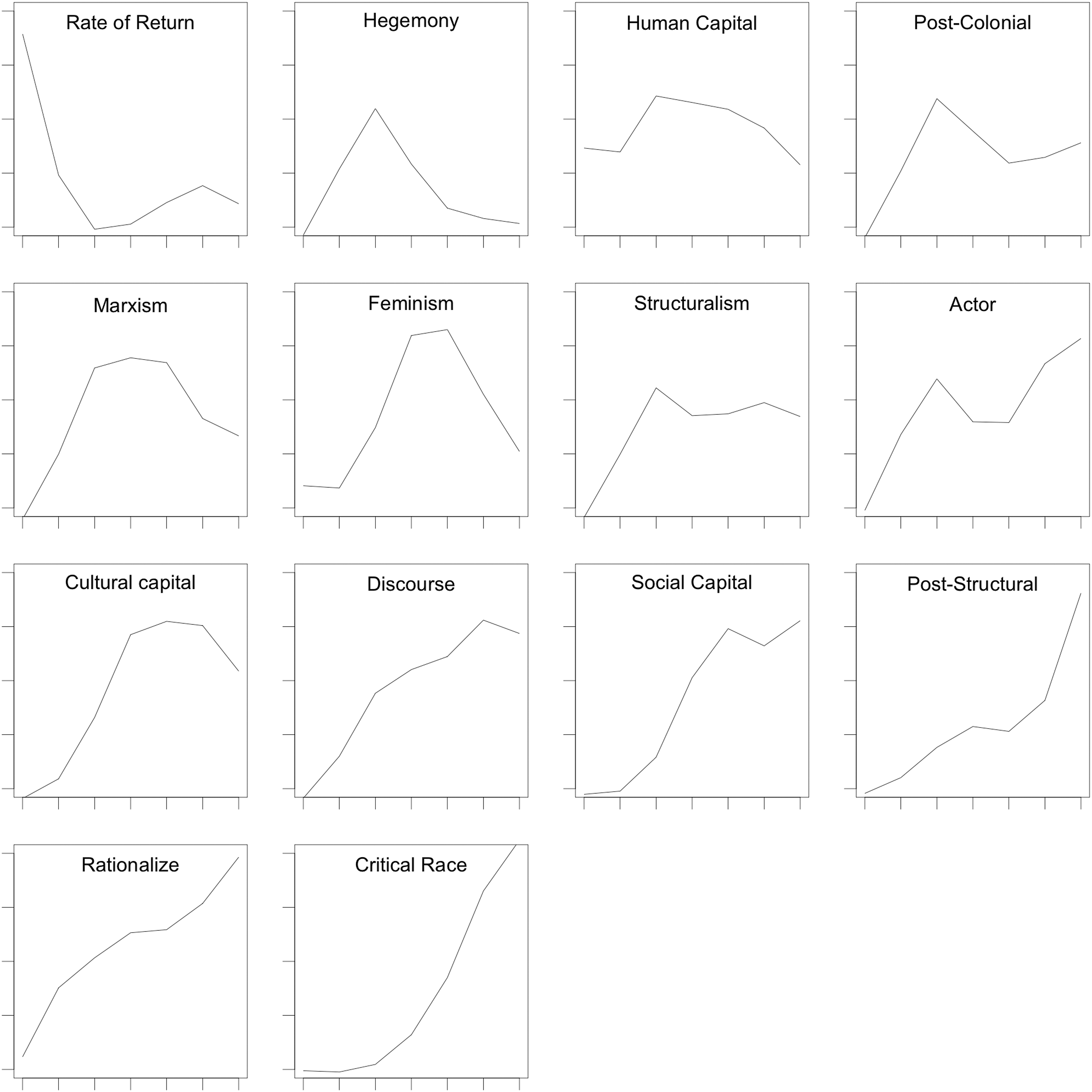
Disaggregating supervisor influence and temporal trends
The preceding analysis shows that the content of doctoral theses (both citations and terms) varies across supervisors and across time. However, these two trends are confounded: as supervisors are active at different times, differences that appear to be across time could actually be differences across supervisors, and vice versa. We disaggregate these sources of covariation in the data using multiple regression analyses of the number of common citations and terms in the data.
Results of regression analyses.
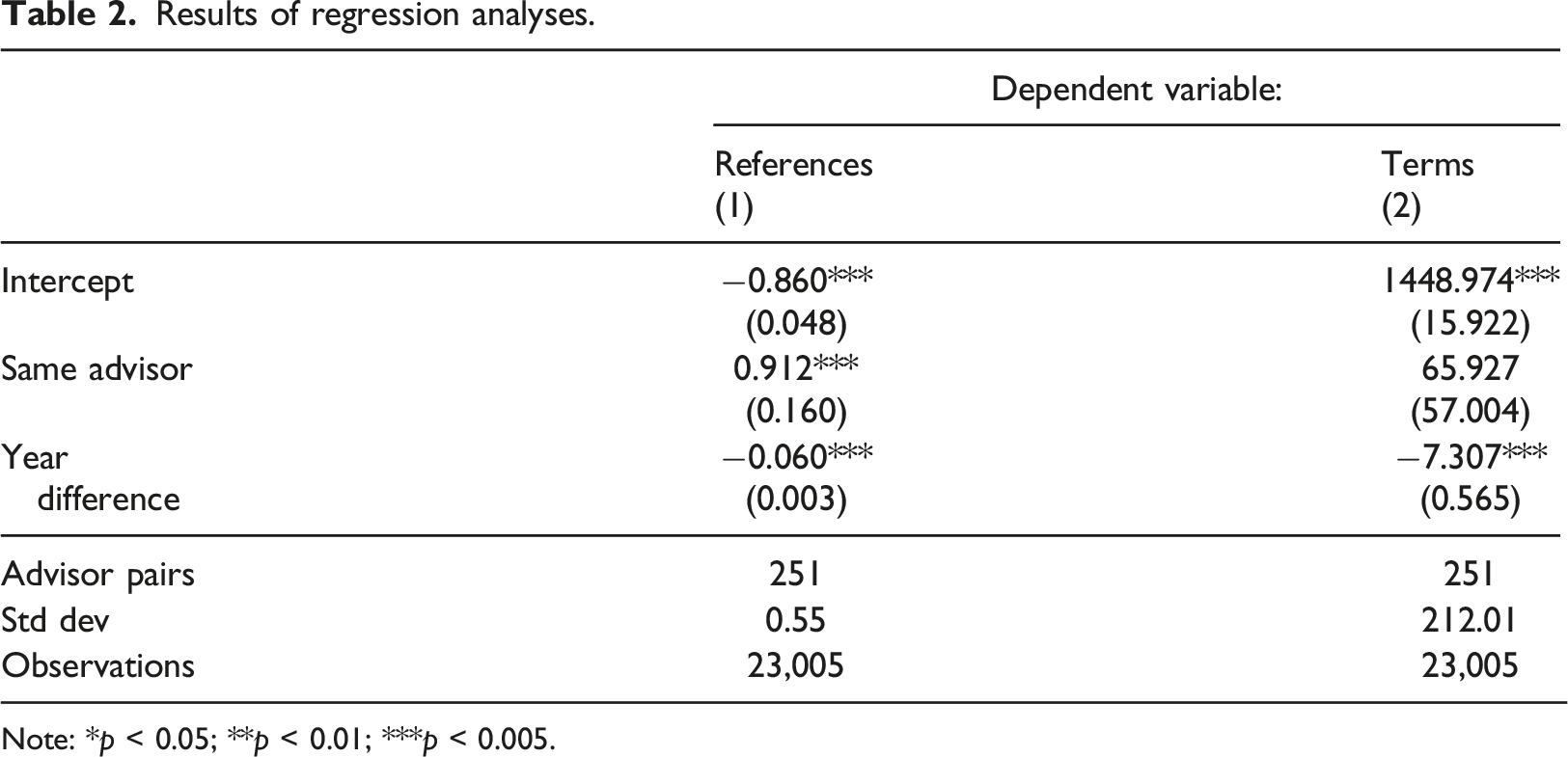
Note: *p < 0.05; **p < 0.01; ***p < 0.005.
Discussion
While previous literature has mapped theories within the North American field of CIE and the process through which theories are imported into the field (Paulston, 1994), our study contributes to the literature by showing how theory is transmitted and reproduced within the field. In particular, our analysis of doctoral theses shows that theses from the same advisor tend to resemble one another in theory more than in terms of topic of study, as indicated in a higher similarity in references than in terminology. This may be indicative of the degree to which the scholarship of generations of scholars working with a specific mentor in the field reproduces the ideas embedded in the similar sources of intellectual influence. While analysis of highly cited sources supports an emphasis on methods in the doctorate (Cowen, 2020), our study also shows that a doctoral advisor is important in developing a community of scholars engaging with certain ideas, models and concepts, much more so than they are in providing authoritative expertise on a topic. This finding aligns to Cowen’s remarks (quoted above) on the value that doctoral students may bring to the supervisor in terms of knowledge and expertise within a given educational context.
Furthermore, we show that theory is subject to a more rapid change and development than the topics with which the North American field engages, as studies separated by more than a decade are likely to engage with substantially different bodies of literature. This facilitates the entry of new theoretical perspectives into the literature, which we chart through the prevalence of theoretical key words over time. The results show a shift towards a growing influence of the new critical sociological theories, mainly associated with a rights-based orientation in scholarship and qualitative methods.
Limitations
Our study inevitably suffers from several limitations that should be considered when evaluating our argument. As mentioned above, the entry point for our study—presidents of the CIES—and the focus on the North American variant of the field, limit the extent to which one may generalize from our findings. On the one hand, the emphasis of theory over topic in the doctoral relationship accords with our experience elsewhere, but on the other hand, this personal experience would be more convincing if substantiated with a similar corpus developed in another context. In either case, our findings may offer general starting points to consider how theory has developed in the field of CIE in other contexts.
Similarly, our analysis has a relatively narrow focus: we examine the balance between theoretical perspectives and topical expertise that doctoral advisors offer by looking at the similarity in the fruits of their students’ work, but there are many other dimensions and trends that could be examined in this corpus. Our motivation to better understand the use of theory in CIE informed our approach, but consideration of other aspects of the theses or relationships between them might yield different insights.
Conclusion
Continual disciplinary introspection and reflexivity are a hallmark of the field of CIE, even across its many geographic variants and communities. Such work is valuable and pertinent, not least because research must consider the field itself as constituent of the phenomena it is studying. In many respects, our analysis only scratches the surface of what the corpus of doctoral theses might tell us about the field of CIE. We hope this work serves as motivation to others in the field to engage with the large corpus of doctoral theses and text-mining methods to enable greater levels of introspection and self-understanding in the field. For example, it would be of interest for scholars in the field to consider examination of the similar works in other regions of the world given that this research relied on the thesis works generated at US institutions. Together, they hold a clear mirror to the field that will contribute to ongoing discussions in this area.
Footnotes
Declaration of conflicting interests
The author(s) declared no potential conflicts of interest with respect to the research, authorship, and/or publication of this article.
Funding
The author(s) received no financial support for the research, authorship, and/or publication of this article.