



Abstract
If we admit that students must be prepared for life and work in increasingly culturally-diverse and ever changing contexts through core curricula which are the competences that must be prioritized? What competences are ‘strong candidates’ to be considered as trans-regional and can lead to inclusive excellence in higher education? Does, this, perhaps depend on the region where students are educated? The present article reports on a meta-study that sought to respond to these questions through looking at 40 generic competences valued by over 71,000 graduates, employers, students and academics from different disciplines in Europe, Latin America, Africa and Asia. The notion of trans-regional generic competences is introduced and four levels of trans-regionalisation are distinguished. Differences across regions and countries in relation to competence formulation and conceptualization, as well as the very presence/absence of a particular competence, are discussed with views of re-introducing further nuances in the global debates about internationalization of curriculum.
Keywords
Introduction
As a recent special issue of ‘Research in Comparative & International Education’ (Vol 15: 1) illustrates, there seems to be little doubt left that higher education institutions (HEIs) must design curricula in such a way that graduates can be prepared for life and work in ‘an increasingly globally interdependent world’ (Smith-Isabell and Rubaii, 2020: 3), ‘a globally interconnected world’ (Garrett-Rucks and Jansa, 2020: 12) or a ‘culturally complex, globalized world’ (Krebs, 2020: 37).
The same issue brings to the fore at least three conceptual challenges associated with this task. First, even those who agree to use the term ‘global, international and intercultural competencies’ (GII) to capture this particular component of desired graduate profile are not necessarily in agreement about the exact competences to be developed. Is it about intercultural communicative competence, intercultural competence/skills, or different types of understandings (cf. Arasarathnam-Smith, 2020)? Is it enough to refer to ‘multiple excellent examples of well-thought-out taxonomies of GII’ (Killick, 2020: 28), with every HEI having the ultimate responsibility for identifying the competences to be developed by their students? Or is it important to insist on inclusion of particular competences - i.e. competence in a second language (e.g. Fantini, 2020)?
Second, how can different disciplinary perspectives be brought into this debate? Islam and Stamp (2020) point out the limitations of trying to find an answer without engaging academics of diverse disciplinary backgrounds in a joint conversation about what makes graduates ready for life and work in increasingly culturally-diverse and ever changing contexts.
Third, it might be worth questioning if current discussions about the competences that make higher education (HE) curriculum internationalized remain culturally-biased. To return to the emphasis on a second-language competence: on the one hand, this can perhaps be more characteristic of a multinational perspective (cf. Fantini, 2020). On the other hand, however, from the point of view of HEIs situated in bi-/multilingual environments, this would be rather indicative of a culturally limited response.
These conceptual challenges are at the core of the Internationalisation of Curriculum (IoC) debate (Clifford and Montgomery, 2014, 2017; Knight, 2013), particularly since the beginning of the pandemic (Hsieh and Yeung, 2021). Commonly defined as entailing the ‘incorporation of an international and intercultural dimension into the content of the curriculum’ (Leask, 2009: 209), IoC debate has prioritised students’ development of competences in cross/intercultural understanding (Fragouli, 2021), paying less attention to connect this discussion to a no-less-topical debate on the competences that make a graduate employable in different contexts. Such competences have also been referred to as ‘generic competences’ (GCs) (González and Wagenaar, 2003; Wagenaar, 2019), ‘soft or transferable skills’ (Succi and Canovi, 2019), ‘more subtle and flexile skills’ or ‘broad generic skills and capacities’ (Pennington and Stanford, 2019). They highlight the human dimension – something that cannot be automated, at least in the foreseeable future – (Calanca et al., 2019) and help graduates be prepared for a world full of uncertainty and requiring constant adaptation (VUCA world): higher education cannot simply prepare students for today’s jobs, nor can [HEIs] accurately and precisely predict what jobs will exist in the future. Instead, universities need to facilitate students’ knowledge and skill acquisition with explicit acknowledgement of the uncertainty of the current economic and social context – and prepare graduates to respond to change and actively shape their futures (Pennington and Stanford, 2019: 90)
Researchers from Europe, Americas, Asia, Africa and Australia unanimously highlight an ever increasing importance of such competences for graduates to succeed in their work after finishing their HE degrees.
From an employers’ perspective, several global and national reports highlight the competences graduates must develop in order to succeed in their work after finishing HE. At global level, WEF (2020) provides in-depth information for 15 industry sectors and 26 advanced and emerging countries in relation to future skills. Some research studies show that one of the main issues associated with competence development and graduate employability is related to the (mis)match between university graduates’ competences and employers’ needs (e.g. Abelha et al., 2020).
The question in this second, major, employability-focused, debate is no longer whether soft/transferable skills and transversal/GCs are to be focused on, but rather which ones must be prioritized and what type of academic research permits to identify or even predict the GCs relevant beyond the national contexts.
Since the beginning of the 21st century, academics from over a hundred countries have been involved in a discussion that brings together both above-mentioned debates: what competences, apart from those which make students specialists in their chosen domains, should be aimed at in core curricula to prepare students to work and live in the increasingly culturally-complex world? Occasionally developed at national levels (in Russia, China and India), most often, these discussions had a clear inter-national scope (the EU, Latin America, Africa, Central and South-East Asia). The present article reports on a meta-study that analysed eight of such initiatives in order to identify and compare some cross-regional and cross-continental answers. This meta-study sought to contribute to the discussion of which competences are key for curriculum internationalization, which competences can – regardless of the area of study – prepare graduates to perform globally both as citizens and professionals.
Methodology of the meta-study
The present article builds on the data of eight studies implemented world-wide between 2001 and 2018. All these studies used the same methodology and the same structure of data collection instruments. Each had a different geographical scope and aimed, among other goals, to identify those generic competences (GCs) that were in need of greater attention in HE programmes offered in the region or country in question.
Overview of the eight studies in terms of their geographical scope, the number of generic competences agreed on in the region/country and the samples.
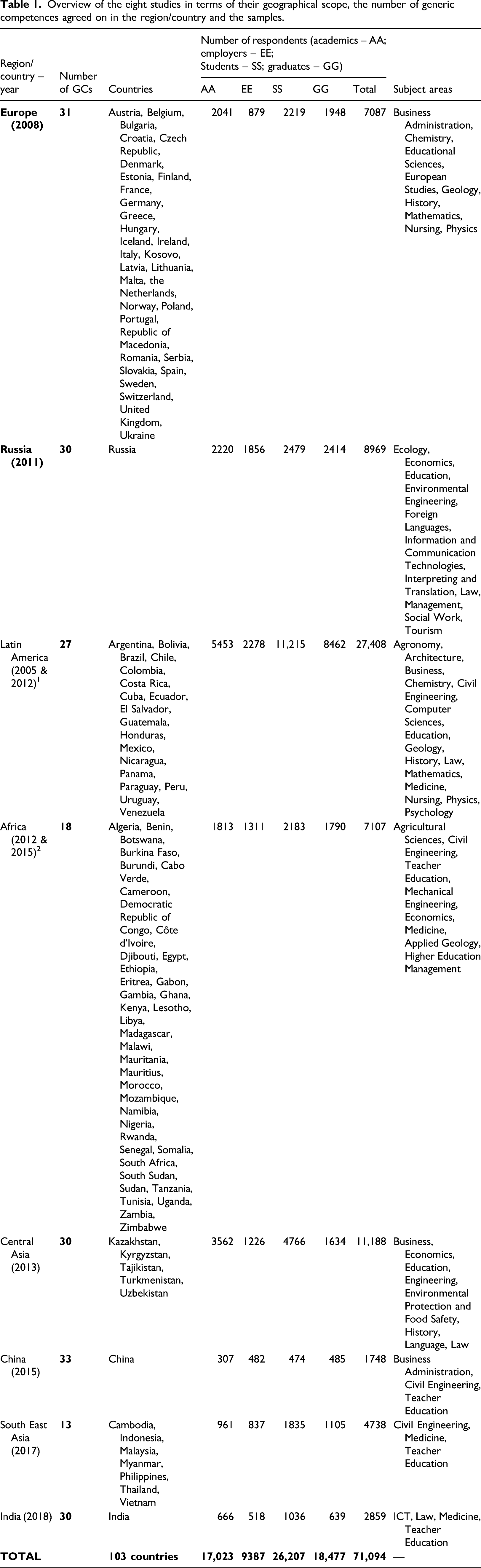
To understand the results better, it is worth explaining that for each of the eight individual studies, the first step was for academics – those teaching at HEIs in the region of the study – to agree among peers from the same discipline/subject area on the list of GCs they believed students in their country/region needed to develop. The final list of GCs for each country/region reflected an agreement of academics from all the subject areas included in the study. This is why Table 1 also provides information about the subject areas from which academics (and later students, graduates and employers) took part in each individual study and, thus, agreed on the lists of GCs to be consulted in the given country/region. Table 1 also indicates the number of GCs agreed on in each study, along the source where the exact contents of each list can be consulted. The second step was to consult stakeholders – graduates, students, academics and employers – in the region about importance and perceived achievement of GCs from the list.
Comparison of Generic Competences in four regions (eight studies).
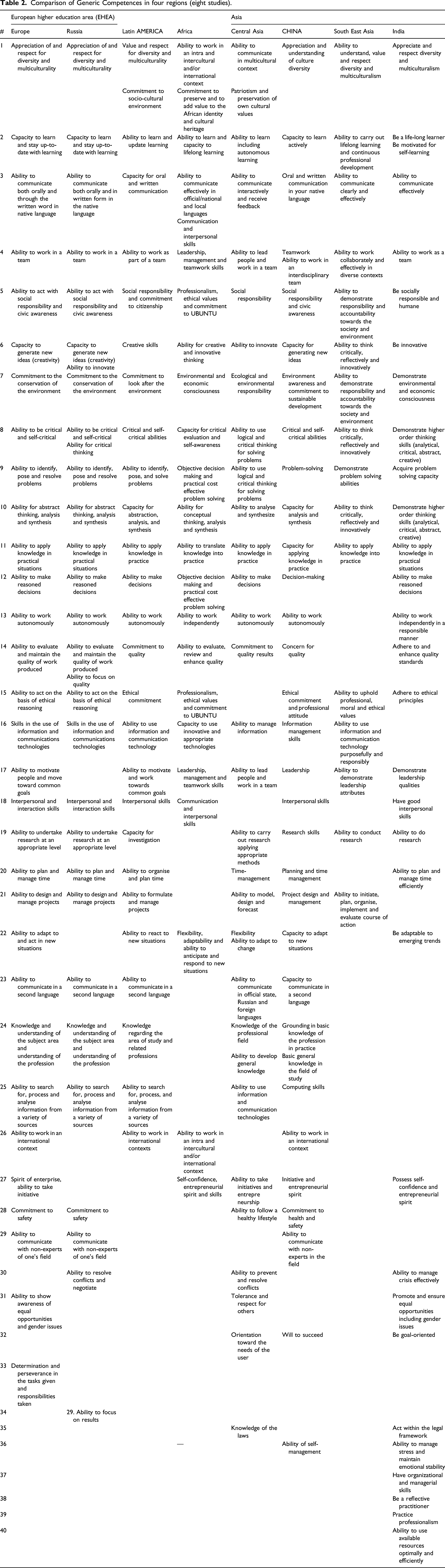
There are no overlaps among the individual studies in terms of the countries and academics involved, and, even if academics in every study were free to consult the lists agreed in other regions/studies and could opt to use the same formulation of a given competence as in other studies to make graduate profiles in their country/region more comparable and compatible internationally, each study drew its own list and made its own decisions about which competences to include and which not and how to phrase them. Thus, the choices made might provide insights into priorities and concerns of different countries/regions, on the one hand, and allow to discover the overarching themes – GCs all the countries and regions involved considered key for all HE graduates, on the other hand.
The left-most column indicates the region/country of the study and the year of consultation. The second column shows the number of GCs agreed on and validated by the respondents. The exact list of the countries that participated in the study appears in the third column from the left. The next five columns indicate the numbers of respondents – by category and in total who validated the original list in each study. The right-most column mentions the subject areas involved in the study
To explore both these aspects, the meta-study reported in the present article did the following. First, the eight studies were grouped region-wise to allow cross-regional analysis. For this purpose, the following four regions were distinguished: 1. European Higher Education Area (EHEA), with Europe 2008 (Beneitone and Bartolomé, 2014) and Russia 2011 (Demchuk et al., 2013) studies; 2. Latin America, with 2005/2012 studies (Beneitone et al., 2007; & Beneitone and Bartolomé, 2014); 3. Africa, with 2012/2015 studies (Awono Onana et al., 2014); and 4. Asia, with Central Asia 2013 (Isaacs et al., 2016), China 2015 (Wagenaar et al., 2015), South-East Asia 2017 (Jugar and Teda Ena, 2019) and India 2018 (Tuning India Project, 2018) studies.
Latin America conducted two consultations about GCs, first in 2005 and then in 2012. Both consultations are treated here as part of the same study, because the difference between them consisted in the subject areas from which respondents were consulted in each occasion, not the list of GCs. Africa, like Latin America, conducted two consultations, one in 2010 and the other in 2015. Once again, the list of the 18 GCs that describe the African graduate was the same in both cases, with the main difference being that of the subject areas whose stakeholders were consulted each time. In Asia, four studies were carried out, two of which were sub-regional: Central Asia, with five countries, and South-East Asia, with seven. Besides this, two national studies were carried out: one in China and the other in India. It is important to highlight that three of the studies identified between 28 and 33 GCs, while South-East Asia only agreed on 13 GCs relevant for all HE graduates. Similarly to African agreement, a single competence in the South-East Asian list often appears expressed in two or more competences in the other studies. Table 2 Asia column, with its four sub-columns, gives an opportunity to observe the main coincidences and divergences between the four Asian studies.
Second, after grouping the studies region-wise, the meta-study reported on in the present article analysed the lists of GCs of the eight studies according to the meaning and scope of each competence rather than the exact wording. This allowed to identify 40 distinct Generic Competences (Table 2).
Third, it looked at the patters of presence/absence of a particular GC across the four regions. This permitted to distinguish four groups of GCs or four levels of ‘trans-regional relevance’ of GCs (from high to very low). The high level of relevance was defined as pertaining to GCs featured in all the eight individual studies (validated as one of the most relevant GCs in all the countries of the four regions for which the data are available). Moderately trans-regionally relevant GCs are those which were validated as one of the most relevant in the four regions distinguished, but only in seven or fewer individual studies (i.e. GCs that did not make it to the top level of relevance in some of the studies within the Asian region or within the EHEA). The third group of GCs distinguished brings together GCs valued by the four stakeholder groups across the different disciplinary and professional sectors (subject areas) in three of the four regions; while the fourth group features those of the 40 GCs that were among the most valued in two regions only (even it this might still mean that they were considered among the most relevant by hundreds of actors). Introducing such a categorization allowed for the highlighting of similarities and differences among the different countries and regions – something that must be kept in mind when designing curricula in a culturally-sensitive manner.
Fourth, for the first two groups of GCs – those with high and moderate level of trans-regional relevance – differences in conceptualization and delineations of the competences (according to their formulations/denominations) were considered.
Finally, for the other two groups, possible explanations of relative un-importance of a GC in some of the countries/regions were proposed, in the hope of re-introducing further nuances in this global debate about curricula internationalization.
Table 2, featuring the full lists of GCs from the eight individual studies, can be used to compare all of the studies among themselves and observe the presence/absence and variations in relation to every GC included in any of the eight studies. The present meta-study, however, focused on inter-regional agreements with the aim of identifying those GCs that are valued across the four continents/regions.
Generic competences: Trans-regional agreements and major differences in eight studies
Description of level of trans-regionalisation of generic competences.
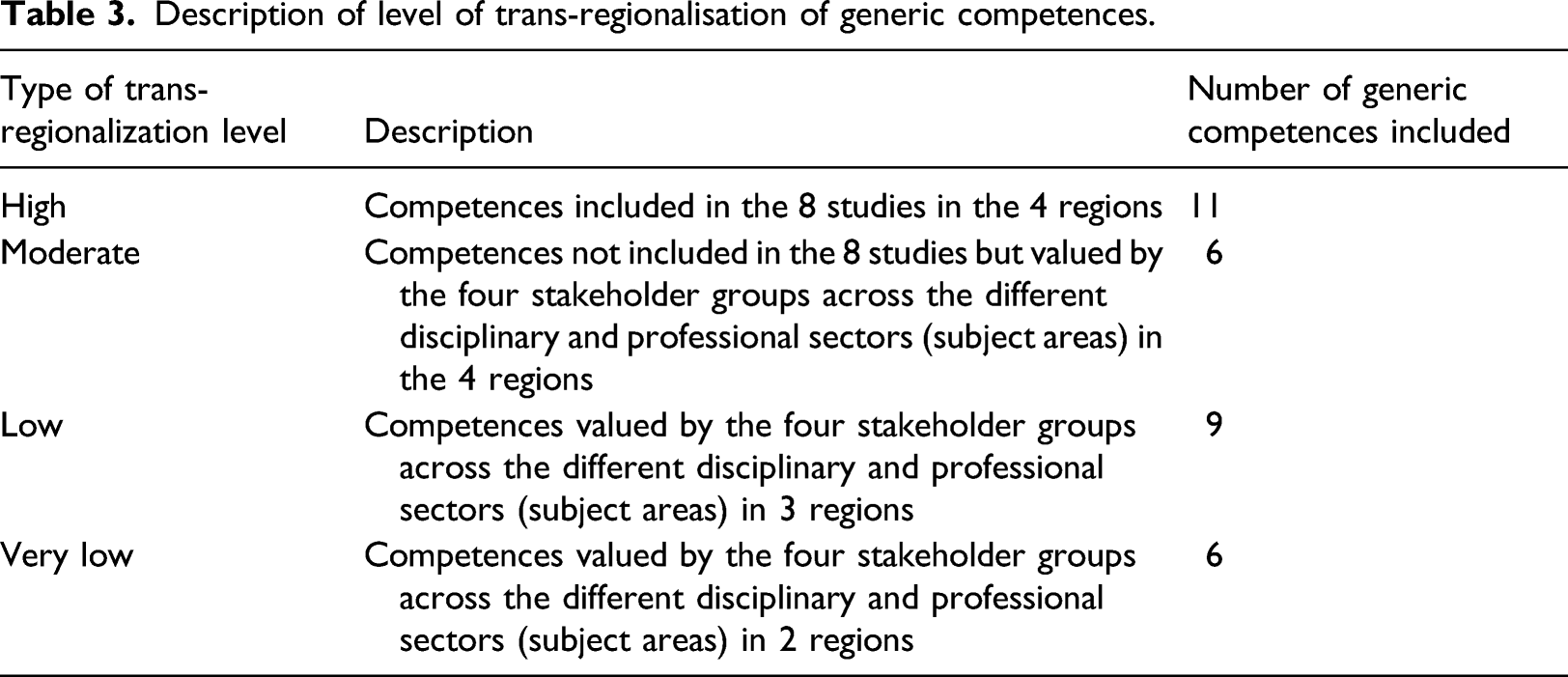
The analysis proposed below goes deeper into the characteristics of each level of trans-regionalisation of Generic Competences.
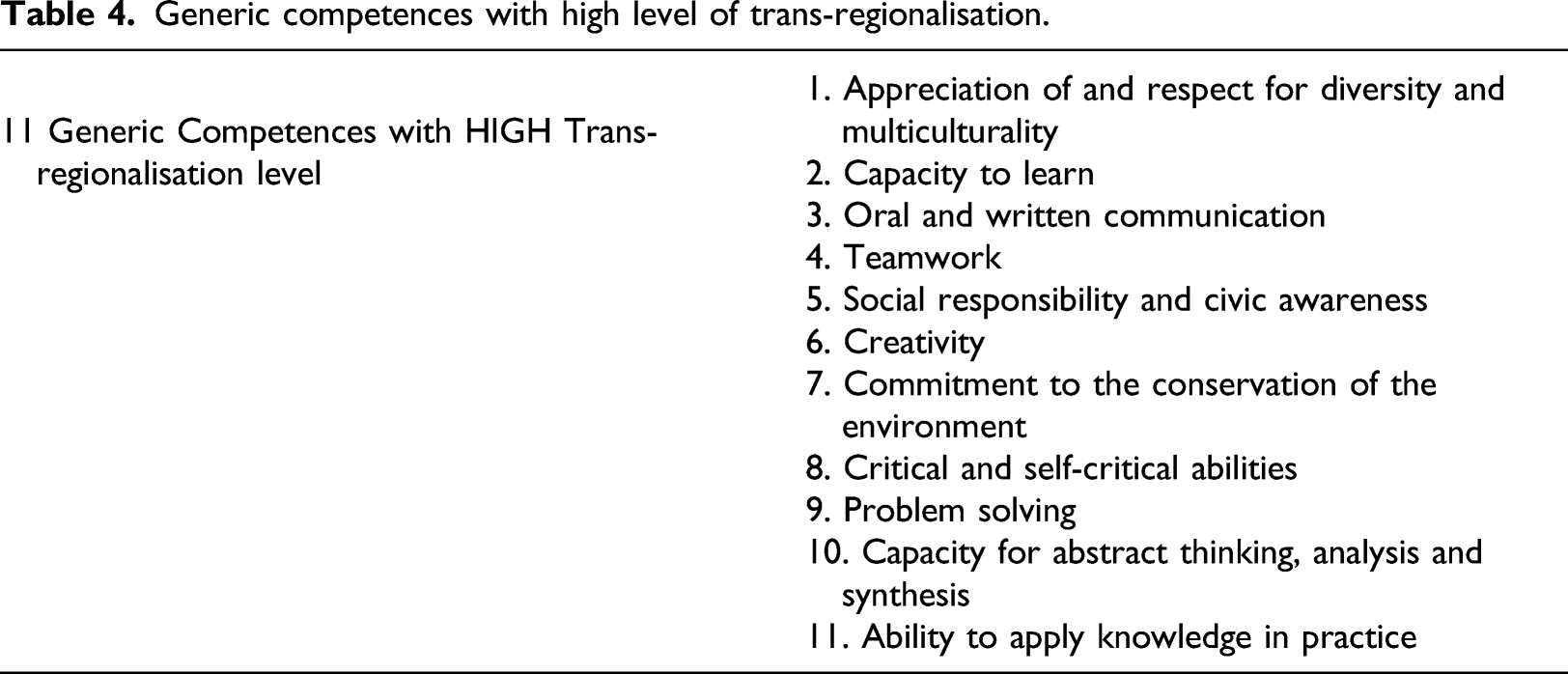
Generic competences with high trans-regionalisation level
Eleven competences can be considered as the most trans-regional, as they clearly appear in the four regions analysed and in all the studies. The agreements on their importance for the profile of a university graduate are validated. Beyond these agreements, some differences can be perceived with regard to their denomination by region and/or study, which marks nuances in the way they are conceived. Below are some considerations on each of these 11 competences with the highest level of trans-regionalisation (Table 4).
Appreciation of and respect for diversity and multiculturality (Competence 1) has many different wordings across the eight studies. First, in three of the studies there are two competences related to diversity and multiculturalism. In Latin America, there is respect for diversity and multiculturalism and a commitment to the socio-cultural environment. In particular, this last competence seems to emphasize the importance of protecting the socio-cultural aspects of the countries/region, which could be explained by the colonial past that Latin America had. In Africa, one of the aspects is associated with a competence that raises the ability to work in an intra- and intercultural context, and the other focuses on the importance of preserving one’s own culture, identity and heritage. The concern for the preservation of African culture and identity could also be associated with the colonial past and the need to emphasize the importance cultural identity has for the profile of a graduate from the region. Likewise, the ability to work in an international context is linked to cultural diversity and its respect, assuming that both aspects must be considered together. In Central Asia, the second competence associated with multiculturalism also highlights the idea of one’s own values and patriotism. The concept of patriotism is very specific and accounts for the concrete context in which it was proposed. In these three studies, the emphasis on self-preservation may be associated with a history of submission and domination by other powers over the territories. In six of the studies there appears the concept of multiculturalism – with the only exceptions of China, where it is mentioned as cultural diversity, and Africa, where the idea of intra and intercultural contexts are brought to the fore. In five of the studies, the competence refers to appreciating and respecting diversity, while in Africa the competence emphasizes the ability to work in a diverse context, in Central Asia – to communicate in a multicultural context, and in China – to understand cultural diversity.
In relation to Capacity to learn actively (Competence 2), and with the exception of EHEA region, where both studies used the exact same wording for this competence, each study chose to formulate this competence slightly differently, although the focus is always clearly on being able to learn continuously, throughout one’s life and beyond formal educational context. In Central Asia an emphasis is put on autonomous learning (rather than on other types of learning), in China on being a protagonist of one’s learning (active learning), and in South-East Asia capacity to learn on the workplace – of continuous professional development – is highlighted. In India, the two key aspects of this competence – the lifelong learning and the self-directed learning – being ‘motivated for self-learning’ – were even presented as two separate, although clearly complementary, generic competences. This tend to happen when a region wants to bring a certain competence to the fore and/or sees a competence as in need of more attention.
In all the four regions, graduates are expected to be effective communicators (Competence 3), although each study preferred a slightly different wording for this competence. Four of the studies focus on oral and written communication (Europe, Russia, Latin America and China), with three of them further linking these communicative skills to students native language (Europe, Russia and China). Africa has two competences related to communication, with one focussing on effective communication in the languages graduates need in order to function in the society – both official or national and local, and the other on communication as means of interacting with others – thus placing communication together with interpersonal skills. The need to highlight communication as more than a one-way process can also be seen in the wording of Central Asia – graduates are expected to ‘communicate interactively’ and learn how to ‘receive feedback’. In South-East Asia and India communication is seen as broader than only written and oral (e.g. including non-verbal and visual modes) and the emphasis was put rather on effectiveness of communication (in both zones) and clarity (in South-East Asia in particular).
Four of the studies refer to Teamwork (Competence 4) as ‘Ability to work in or as or as part of a team’. Central Asia groups teamwork together with leadership, and Africa joins together teamwork, leadership and management skills. China expressed this desired capacity in two competences: ‘Teamwork’ and ‘Ability to work in an interdisciplinary team’, highlighting the need to also work with persons from different educational backgrounds. This emphasis reflects the importance given in China to these specific aspects. South East Asia, in turn, formulated this competence in such a way as to highlight the need for graduates to be able to demonstrate this competence in a diversity of contexts.
The concept of social responsibility Competence 5) appears explicitly in seven of the eight studies. Only Africa does not mention the social aspect directly, but it does so through its own concept such as UBUNTU. It is often translated as ‘I am because we are’, or ‘humanity towards others’. For this competence, UBUNTU asserts that each human being needs to live as part of a society or community, not only as an individual. Being humane also appears in the wording of this competence in India. In South-East Asia, responsibility towards society is mentioned in parallel with environment. Only Latin America includes the notion of citizenship, while in Europe, Russia and China the idea of civic awareness is used.
Creativity (Competence 6) has different denominations in the different regions. In three studies (Europe, Russia and China) it is presented as ‘ability to generate new ideas’. Russia and India use two different competences to describe creativity. Russia, in addition to the ‘ability to generate new ideas’, adds the ‘ability to innovate’. India divides them into ‘being innovative’ and ‘being motivated for self-study’. In Central Asia is also called ‘ability to innovate’ and South-East Asia includes the ability to think innovatively along with reflection and criticism. Africa names it as the ‘ability to be creative and to have innovative thinking’, while Latin America is the only one that mentions only ‘creative skills’.
Commitment to the conservation of the environment (Competence 7) presents quite a few similarities in its wording across the eight studies. Some of the variations that can be mentioned are given by the association of the concept of environment with the economic aspect, as it happens in Africa and India. In the case of China, the peculiarity of linking the importance of the environment with the commitment to sustainable development appears. Finally, in the case of South-East Asia, and as mentioned in the description of Competence 5, the commitment to the environment is linked to social responsibility.
In relation to Critical and self-critical abilities (Competence 8), four of the studies use this wording (Europe, Russia, Latin America and China). In Africa, it is formulated slightly differently – with the emphasis on evaluation and self-awareness. In Central Asia, South-East Asia and India, critical thinking is conceptualized together with other types of thinking – reflective and innovative thinking in South-East Asia, various higher order thinking skills in India, and logical thinking in Central Asia. Additionally, in Central Asia the main aim of practicing critical thinking is seen as that of solving problems. Finally, in Russia, there is a second closely-related competence, but still treated as a separate generic competence – ‘ability for critical thinking’.
Problem solving (Competence 9) is linked and put together with logical and critical thinking in Central Asia and with decision making in Africa. In the African case, the need to solve problems in a practical and cost-effective way is also highlighted. In Latin America and EHEA, it was considered preferable to clearly indicate that graduates should not only solve problems formulated by others, but also to be capable to identifying and defining problems themselves. Finally, the wording used in India might also be indicative of the strongly felt need for the graduates to keep working on this competence after their graduation.
Capacity for abstract thinking, analysis and synthesis (Competence 10) presents variation in its wording, particularly due to the different aspects that are mentioned for its enunciation. In general terms, three concepts appear in most of the eight studies: abstract thinking, analysis and synthesis. The notion of analytical thought is directly raised in seven studies; only in South-East Asia this idea appears as ‘reflection’. The notion of abstraction appears in six studies, not including China or South-East Asia. The synthesis component appears in six studies, having no mention in India or South-East Asia. These two studies, in the formulation of the competence, include the creative and critical aspects that have already been discussed when presenting competences 6 and 8, respectively.
Finally, Ability to apply knowledge in practice (Competence 11) is worded nearly identically across the eight studies, with the only three minor differences being as follows: (a) the use of the word ‘capacity’ and a gerund-phrase after it in China (at least in the English-language version of the competence); (b) a variation between ‘practice’ (Latin America, Africa, Central Asia, China and South-East Asia) and ‘practical situations’ (Europe, Russia and India); and (c) the choice of the verb ‘translate’ (‘translate knowledge into practice’) instead of ‘apply’ in the case of Africa. Apart from this, this competence is seen in all the individual studies as a distinct one (not grouped with another competence in the same item) and is also not ‘backed up’ by a second closely-related competence to highlight one of its aspects further (as is the case with some other competences).
Generic competences with moderate trans-regionalisation level
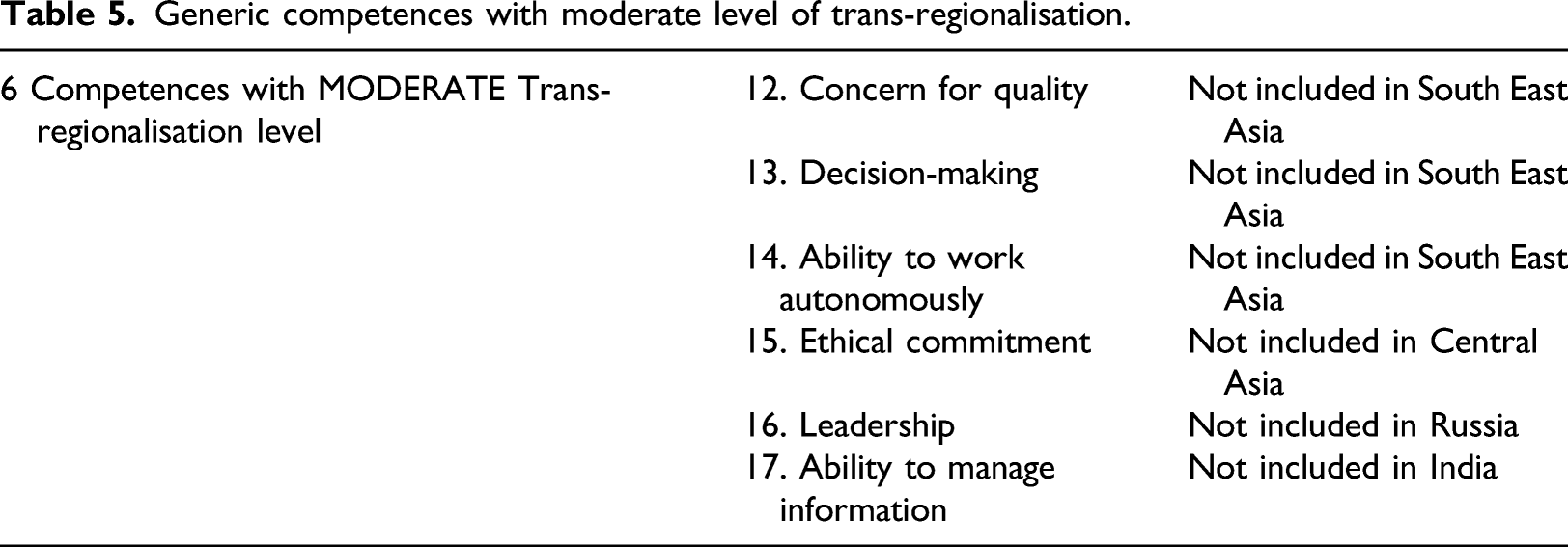
Apart from the competences common for all the four regions, there are also five competences that appear in the three regions (EHEA, Latin America and Africa) and are present in three of the four studies in Asia. Nevertheless, due to their absence in one of the Asian studies, they are not included as Asian competences and, thus, could not be included into the group of Generic Competences with High Level of Trans-regionalisation. Finally, there is one competence - ‘Leadership’ - that appears in three regions (Latin America, Africa and Asia) and is present in Europe but not considered as the most relevant one in Russia. As in the previous case, seven studies mentioned this competence but as it is not among the highest valued ones in all of them it cannot be considered at the top of trans-regionalization (Table 5).
All these seven Generic Competences should be considered in any trans-regional debate of internationalization of curriculum, as they have been identified in the majority of the studies and have a strong presence in all the regions. Similar to the high level trans-regional generic competences, the generic competences with the moderate level of trans-regionalisation have different denominations and some particularities that can be stressed in this analysis.
Concern for quality (Competence 12) shows variations in all regions, but the most relevant is that in the Russian study which comprised two competences very closely related to each other and reflected by only one item in the other six studies ‘Ability to evaluate and maintain the quality of work produced’ & ‘Ability to focus on quality’. When two so closely related items are included in a study list, this means that there is a will or a perceived need to draw greater attention to the overarching competence.
In relation to Decision-making (Competence 13), the denominations in all the studies are very similar, except in the case of Africa (‘Objective decision-making and practical cost-effective problem solving’) where decision making is linked to problem solving. The importance of considering both aspects in the same competence marks a very distinctive feature of Africa’s position in this respect.
Ability to work autonomously (Competence 14) is worded in exactly the same way in five of the studies (Europe, Russia, Latin America, Central Asia and China), while the other two studies (Africa & India) where this competence is included in the list of the most relevant ones uses the word ‘independently’ instead of ‘autonomously’.
Ethical commitment (Competence 15) includes different aspects in some studies. In South East Asia, China and Africa, professional values associated with performing with ethical conduct are emphasized. Likewise, in the African study, this competence is associated with Social Responsibility, as it is included together with UBUNTU.
Leadership (Competence 16) is used in Africa, China, South East Asia and India without opting for a euphemisms – or narrowing the competence down to a particular type of leadership (‘Ability to motivate and work towards common goals‘) – as is the case in other regions like Europe and Latin America.
Ability to manage information (Competence 17) has been identified as the core of the GC 17 (see ways of referring to this competence in Central Asia and China), while capacity to use technologies – ICT or innovating and appropriate technologies more broadly – is an accompanying element. This is very clear in Europe, Russia, Latin America and South-East Asia. In the South-East Asian study in fact, the capacity to use ICT itself was seen as not sufficient for a graduate – the graduates must learn to use ICT purposefully and responsibly. The African wording is the broadest, and, out the context, could even appear as very different from information management. However, the study publications make it clear that the focus is on using information-related technologies.
Generic competences with low trans-regionalisation level
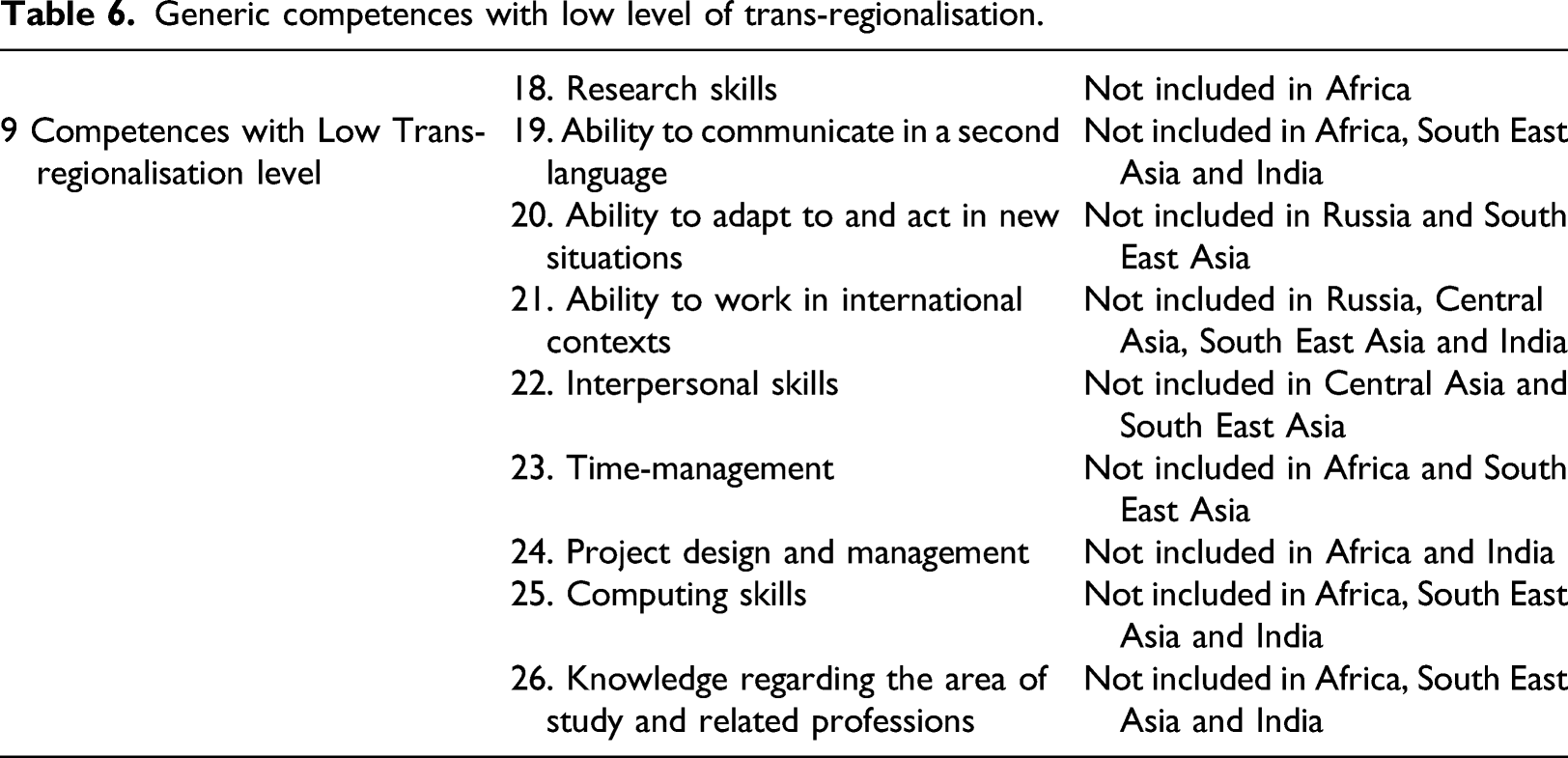
This low level of trans-regionalisation shows agreement in at least three regions. The nine competences of this group are, however, not present in the agreements of a regional study, or in more than one study in two or more different regions (Table 6).
Four of these competences deserve a special comment.
First, Research Skills (Competence 18) is mentioned in seven studies and is absent only in Africa. One possible explanation for this may be related to the fact that African students are expected to develop research skills in second- and third-cycle programmes only.
Second, especially in the present context – in the framework of curriculum internationalisation discussion – it might come as a surprise that GCs 19, 20 and 21 form part of this low level of trans-regionalisation group.
Ability to communicate in a second language (Competence 19) does not appear as a strong generic competence in the comparative meta-study. In the case of Africa, it can be equally hypothesized that the need to learn another language was not included into the continental agreement because in many African countries even those who never join HE programmes are already bilingual or multi-lingual. Alternatively, due to the same reason – the culturally diverse multi-lingual environments that are prevalent in many African countries – perhaps the strongest need perceived is for graduates to be highly competent in communicating at local/national level. This could explain why – with the clear importance given to effective communication in the profile of an African graduate – the aspects chosen for emphasis were interpersonal interaction and communication in national and local languages: ‘Ability to communicate effectively in official/ national and local languages’ and ‘Communication and interpersonal skills’. In Asia, this competence appears clearly in China. In the case of Central Asia, which has its recent history associated with the former Soviet Union, the competence is phrased as ‘Ability to communicate in official state, Russian and foreign languages'.
Another relevant issue for internationalization of curriculum is related to Ability to adapt to and act in new situations (Competence 20), which has different denominations in the regions, but in most of them appears as ‘adaption to emerging trends and situations'. In Central Asia this aspect seems to be critical, because they use two different competences to describe it: ‘Flexibility’ and ‘Ability to adapt to change’. In this particular case, the historical situation of the countries involved in the study might explain the importance of including such competence in graduate profiles.
Finally, it is very significant that Ability to work in international contexts (Competence 21) appears in this category of low trans-regionalisation level. The denominations in the regions in which it is considered are very similar, it is only interesting to note how China formulates it, including not only the international component, but also the intercultural and intra-cultural, which shows the importance it has for Chinese context.
Generic competences with very low trans-regionalisation level
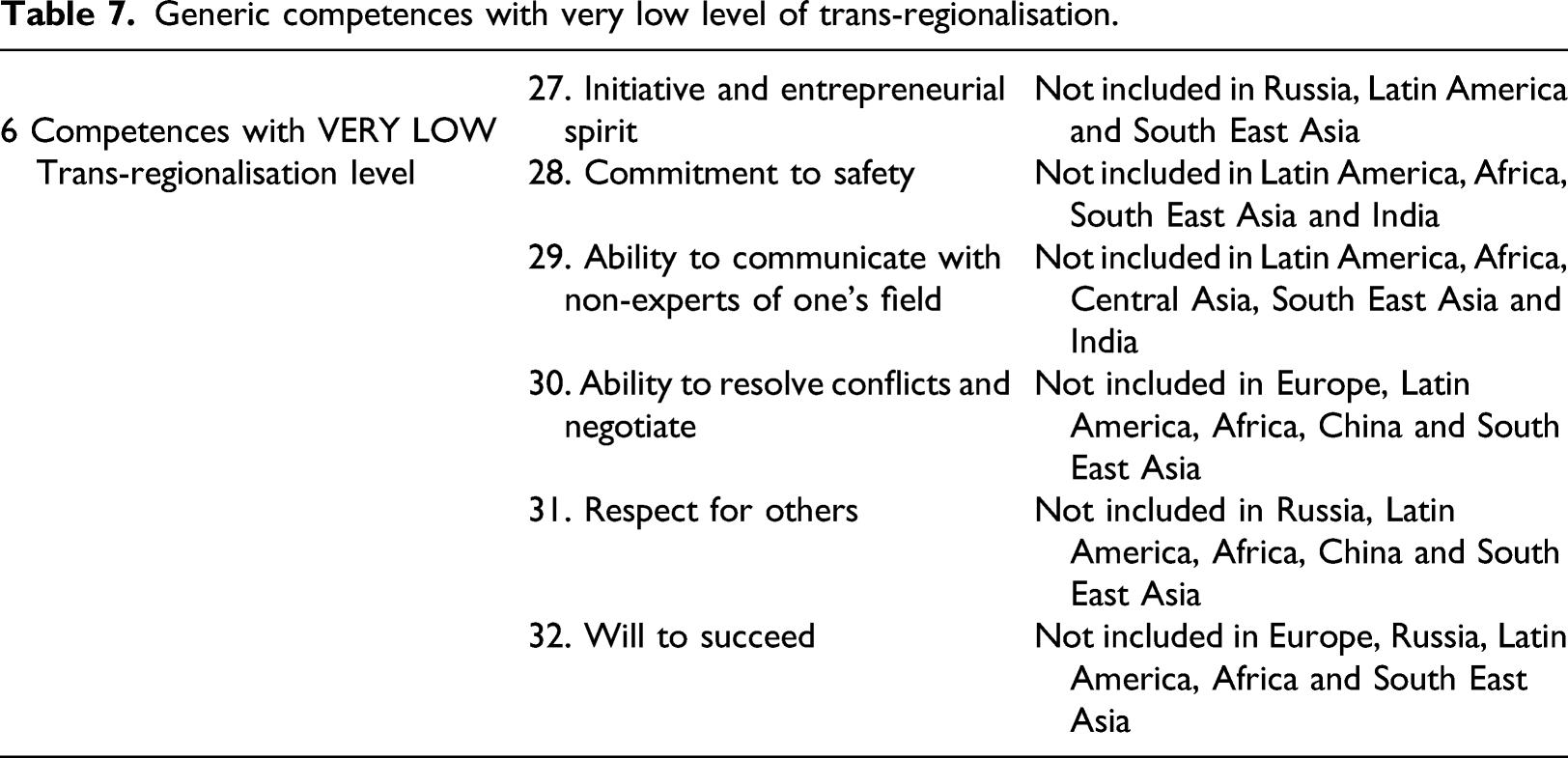
The six generic competences presented below can be considered as having an excessively low level of trans-regionalisation, given that they only appear in studies belonging to two regions, and in many cases (4 of 6 competences) only in three of the eight studies, which makes them too weak to be considered relevant on a broad scale (Table 7).
In relation to this list, two competences appear worth an additional comment.
Ability to resolve conflicts and negotiate (Competence 30) does not form part of any regional agreement and is absent in the agreements of most of the studies analysed. It is mentioned in Russia, and appears in two other studies: with the Central Asian ‘Ability to prevent and resolve conflicts’ as a clear correspondence and the Indian ‘Ability to manage crisis effectively’ at least partly overlapping/pointing in the same direction. Conflict resolution seems to be relevant in the three studies.
In relation to Respect for others (Competence 31), it is mentioned in three studies, with different denominations, in two of them (Europe and India) including the importance of ‘gender issues’ and in the third the concept of ‘tolerance’.
Generic competences with high level of trans-regionalisation.
Generic competences with moderate level of trans-regionalisation.
Generic competences with low level of trans-regionalisation.
Generic competences with very low level of trans-regionalisation.
Conclusions
The starting point of the conclusions of this comparative meta-study is the identification of the 11 generic competences with a high level of trans-regionalisation: generic competences that are considered key elements of the desired graduate profile regardless of the area of studies in 103 countries by academics and other key stakeholders from more than 20 disciplines/subject areas, and that describe what a graduate is expected to know, be able to do and be on a trans-regional scale. This finding clearly contributes to the current discussion on the internationalization of the curriculum and about which competences can be considered ‘strong candidates’ to be seen as trans-regional and possibly even global. This means that by ensuring that students develop these 11 generic competences to a higher level, any HE programme could – at least partly – be meeting the goal of preparing globally-competent graduates.
Secondly, the meta-study has allowed to identify generic competences that are trans-national and even trans-regional, although within a more limited geographical scope (see generic competences with moderate and low levels of trans-regionalisation). They are no less relevant for HEIs who aim to service regional communities or even international communities limited to a particular part of the globe. Such competences can foster internationalization of the curriculum through its regionalization – through ensuring that graduates are ready to live and work well beyond local and national contexts, even if, probably, not really anywhere in the world. In this respect, it might be worth highlighting that, depending on the area of specialization and the characteristics of a HEI and its environment, internationalization through regionalization might well be preferable and a better strategic choice than internationalization through globalization.
A third aspect to note is that, beyond the coincidence in the presence of certain competences in the desired/reference graduate profiles, there is a divergence in the way of competences are formulated or conceptualized – through the inclusion of other aspects associated with the core element in their denomination/conceptualization. These differences can be linked to, among other issues, cultural and historical roots and traditions of a region. In other words, beyond or along the trans-regional commonalities there are significant culture-specific nuances related to the way of expressing a competence. As a result, different regions divide the desired graduate profile into more complex or more focused elements. Furthermore, when a particular element of a graduate profile is given a greater weightage in a certain region, this leads to such competences appearing as referenced more than once in the graduate profile so as to emphasize their relevance.
Regarding future prospects, one of the first aspects to consider are the limitations of the meta-study presented. Not all world regions could be included since no comparable date have so far been collected in North America or Oceania. A new consultation is, therefore, needed to be able to confirm that what is displayed here is indeed global. Another limitation is the asynchrony of the findings analysed. The data showed reflect the perceptions of different stakeholders, consulted over a period of 14 years. This is why a new consultation, not only conducted on a global scale but also carried out at the same time, will be necessary to be able to compare results and perceptions world-wide and without the possible interference of the time factor. For this purpose, it might be convenient to include not only the 11 highest trans-regional generic competences, but also to those which are repeated in the majority of studies with moderate and even low level of trans-regionalization.
Furthermore, it would be convenient to analyse and compare the trans-regional generic competences with different initiatives, like Regional/National Qualification Frameworks, and identify the existing coincidences between these agreements and the standards defined in different contexts to describe a graduate.
Finally, it should be highlighted that – as could be seen in Table 1 – the data collected, in addition to representing the views of different stakeholder groups from different countries/regions, also comes from stakeholders representing different disciplinary/subject areas. It has not been the object of this work to analyse the perception of the 40 trans-regional generic competences in terms of disciplinary differences, but it may be relevant to observe the coincidences and divergences that may appear in a much more detailed study and whose objective could be to identify particularities from the point of view of disciplinary/subject areas.
Footnotes
Declaration of conflicting interests
The author(s) declared no potential conflicts of interest with respect to the research, authorship, and/or publication of this article.
Funding
The author(s) received no financial support for the research, authorship, and/or publication of this article.