



Abstract
In order to address the paucity of research on Chinese teachers and to foreground their ‘Other (ed)’ ways of knowing and experiencing, this paper draws on interviews with 15 host country Chinese teachers from three internationalised schools in China. Specifically, this paper explores the participants’ pathways into internationalised schooling. These pathways include an attachment to the local, a way to escape the vicissitudes and precarity of private language school teaching, a (re)entry point for teachers returning to China after studying/working overseas, and a vehicle for social mobility. The findings suggest that host country teachers as a group are far more diverse than has been assumed, with many of teachers migrating into internationalised school teaching from other educational sectors (such as language tutoring) or non-educational sectors (such as I.T.). The findings have implications for educational policy making for internationalised schooling in China, particularly in terms of notions of professionalism and what this might mean within the context of internationalised schooling.
Introduction
The international school landscape has changed significantly in the last 20 years. Whilst the realm of international schooling has traditionally been restricted to a globally mobile expatriate elite, the rise of an aspirant middle-class in developing countries, such as China, has led to the emergence of a new type of international school (Hayden, 2011). These schools, which continue to defy classification (Wu and Koh, 2021), might best be described as ‘internationalised’, as they provide an English-medium or bilingual education using an international curriculum for a majority population of local students (Hayden and Thompson, 2013). Internationalised schools can be thought of as ‘glocalised’ versions of the traditional international (expatriate) school (Bettney and Nordmeyer, 2021). They represent ‘a hybrid identity along a continuum of national and international schools’ (Bettney and Nordmeyer, 2021: 121), providing ‘programmes that are carefully developed to fit with the local linguistic and sociopolitical landscape, and to promote positive models of bilingualism (Spiro and Crisfield, 2018: 26).
According to ISC research, the balance between children of expatriate and local families attending international schools is estimated to have shifted in the last two decades in favour of the latter, from 80:20% in 1989 to 20:80% by 2019 (ISC Research, 2019). These schools are perceived by middle class parents as giving their child an advantage by experiencing an English-medium education which is intimately connected to their ‘aspirations concerned with potential for their children to access international opportunities’ (McIntosh and Hayden, 2021, 2). Whereas international schools were once clustered in the global North (Europe and the US), the global South has now emerged as the main arena of activity (Gaskell, 2019). Nowhere is this concentration more evident than in China (the focus of this study), where internationalised schools continue to grow at 14% per annum since 2012 (Poole and Bunnell, 2021). ISC (International School Consultancy) data from 2019–2020 show that the international private schools market in China has grown substantially due to an increasing demand from Chinese parents for an international, bilingual approach to learning for their children. Today, there are 857 international schools in China, with 563 of them being international Chinese–owned private schools (Gaskell, 2019) or, as they are referred to in this paper, Chinese Internationalised Schools. Another change can be seen in the number of teachers entering the arena of international schooling. ISC estimated there were 566,000 educators teaching 5.98 million children in 11,627 schools (quoted in Bunnell and Poole, 2020). Significantly, many of these teachers are now heading to the global South, particularly China, where employment opportunities are plentiful (Machin, 2017).
Reflecting the changing nature of international schooling, the literature has started to explore the international school teacher experience. Researchers have focused on understanding teachers’ perceptions of the effects of high student turnover (Hacochen, 2012), experiences of precarity (Bunnell et al., 2017; Poole, 2021), unfair dismissal (Blyth, 2017), micropolitics (Caffyn, 2018) and intercultural adaptation (Savva, 2017). Researchers have also developed a number of international school teacher typologies (Bailey and Cooker, 2019; Cambridge, 2002; Rey et al., 2020). These typologies identify different types of international educator and, in some cases (e.g. Bailey and Cooker, 2019), shed light on teachers’ motivations for choosing to work in international schools. These reasons include wanting to see the world, wanting to make the world a better place, and, for some teachers, an attachment to their locality, perhaps due to marriage or their place of work.
This literature is a welcome development in a field that has traditionally eschewed the experiences of educators in favour of historical and macro-level analyses (Poole, 2021). Whilst it was being lamented that the literature on international schooling ‘ignored’ the lives of international school teachers (Bailey, 2015), the last few years has seen something of a ‘turn’ to the international school teacher. Sadly, the voices of host country teachers have not been included in this turn. This silence may strike the reader as surprising. Given that the international school arena is dominated by the internationalised school, and over 70% of teachers in such schools are host country teachers (Gaskell, 2019), one would expect to see greater interest host country teachers from researchers. Curiously, this is not the case. To date, host country teachers have been viewed in overly homogeneous terms as ‘locals’ (Rey et al. 2020) or a faceless ‘pool’ (Cambridge, 2002). Save for a handful of papers (e.g. Bunnell and Poole, 2021; Lai et al., 2016; Poole, 2019), the literature remains firmly focused on Anglo-Western teachers, although there is a burgeoning literature on internationalised schooling in China and parental aspiration (e.g. Wright et al., 2021).
The absence of host country teachers from the literature might be the result of the nascent nature of the internationalised school industry. Some commentators have described the appearance of internationalised schools in China in terms of a ‘stealth’ emergence (Kim and Mobrand, 2019). This sudden emergence suggests that there is a lag between what is happening in the field and how the field is being researched and represented in the academic literature. In order to address the paucity of research on Chinese teachers and to foreground their ‘Other (ed)’ ways of knowing and experiencing, this paper draws on interviews with 15 host country Chinese teachers from three internationalised schools in China. Specifically, the paper sets out to answer the following research question: Why do host country teachers enter the internationalised school arena? The question is designed to identify the motivations and backgrounds of Chinese host country teachers. In contrast, the motivations and experiences of expatriate teachers have received a fair amount of attention from researchers (e.g. Bailey and Cooker, 2019; Savva, 2015). As this paper is designed as a starting point for an emerging research agenda, its scope is limited to understanding why host country teachers enter the arena of internationalised schooling. Subsequent papers will explore other dimensions of lived experience and how they compare to those of expatriate teachers.
Methodology
Biographical information about the participants.
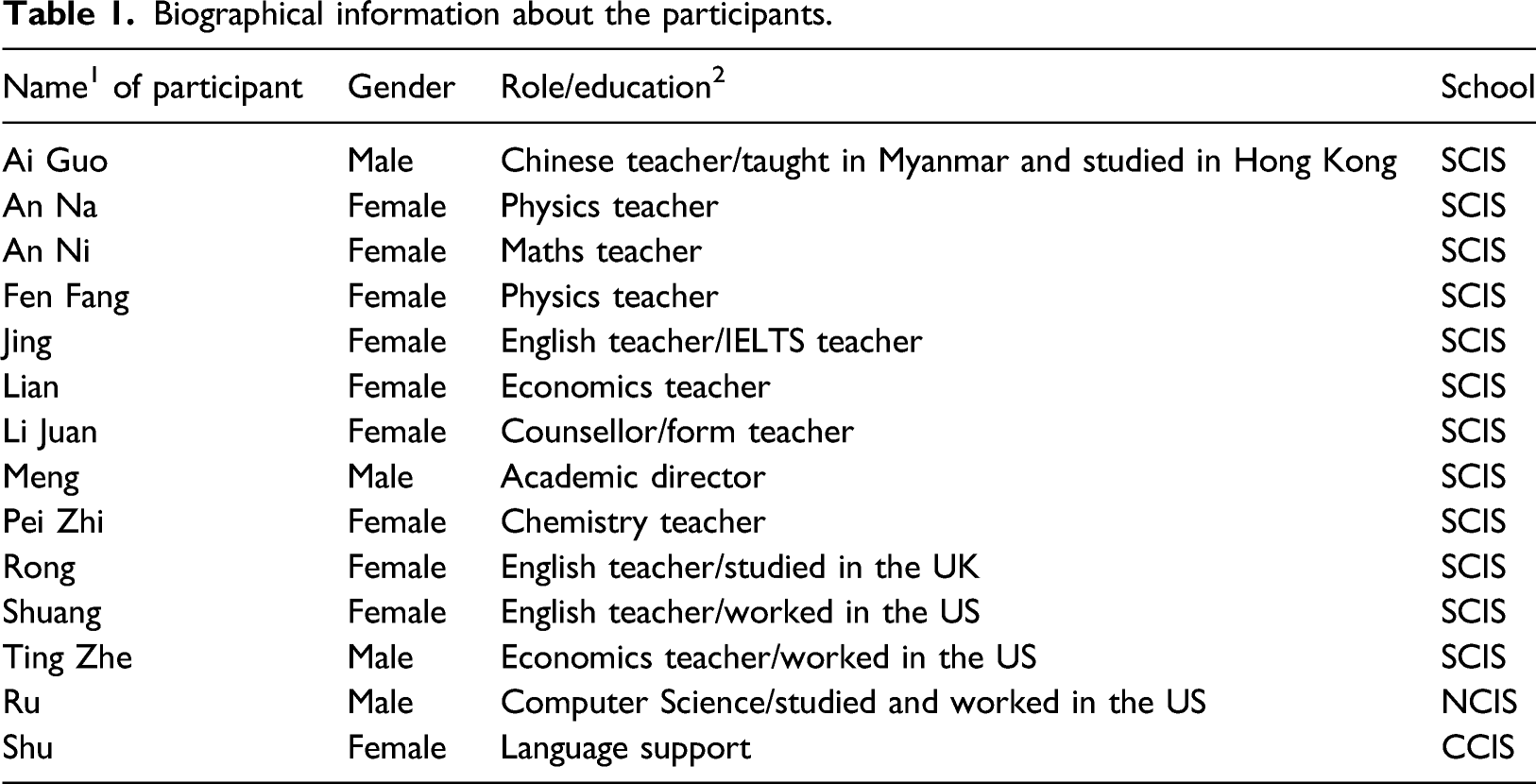
There were two criteria for participant selection. The first was that the participants had to be Chinese nationals – that is, they had to hold Chinese citizenship. The second criteria was that the participants had to be employed in a Chinese Internationalised School (i.e. private K-12 schools offering a fusion of the Chinese national curriculum and an international curriculum). As the focus of the paper was on why the participants chose to enter the arena of internationalised schooling, there was no criteria for how long the participants had been working in their school. The essential criteria was that the participants were working in an internationalised school at the time of interview. Accessibility to the participants was facilitated by the author’s institution, with which the three participating schools were affiliated. The author was part of a department that provided professional development and research support to the teachers.
The participants taught in three internationalised schools that offered an international curriculum, such as the International General Certificate of Secondary Education and the International Baccalaureate Diploma Programme, to Chinese host country nationals: SCIS (South China Internationalised School), NCIS (North China Internationalised School) and CCIS (Cosmopolitan China Internationalised School). NCIS was a small high school located in a large city in the north of China. It did not own its premises but rented a floor in a university to which it was affiliated. As it was accredited by Cambridge Examinations, it might be more accurate to describe NCIS as a branded ‘Cambridge Centre’. SCIS was a newly opened school (it opened in 2018) located about 3 hours’ drive from Shanghai. The location was very remote, which made recruiting expatriate international school teachers difficult. The majority of teachers were Chinese. Finally, CCIS was a non-profit Chinese Internationalised School that modelled itself on a private boarding school model. Overall, the three schools are representative of the diversity of internationalised school found across China (see Wu and Koh, 2021 for more information about the different types of schools catering to Chinese host country students in China).
Ethical approval was sought and granted from the participants, who all gave informed consent. The study from which the interviews were selected also received ethical clearance from the researcher’s institution. Interviews were conducted from November 2019 to November 2020 and focused on eliciting ‘thick descriptions’ (Geertz, 1973). The participants were asked to talk about their reasons for entering international schooling, their experiences in their current school, and their experiences of professional development. Each participant was interviewed once, with interviews lasting between 40–50 min. The participants were encouraged to use English during the interview, but were given the chance to use Chinese if they wished. In all but two cases, the interviews were conducted in English. The two interviews conducted in Chinese were translated into English before data analysis began. Once transcribed, the interviews were returned to the participants to review. The member-checking process not only strengthened validity by ensuring the accuracy of the transcriptions but also enhanced ethics by inviting the participants to take some ownership of the research process.
Data were analysed using a three-step thematic analysis approach, suggested by Braun and Clarke (2006). Once transcribed, two interview transcripts were lightly coded in order to generate emerging themes. These emerging codes were added to an ‘organic code book’ to which new themes were added as data analysis proceeded. Following this initial inductive phase, the transcripts were reviewed again to identify new emerging codes. All code labels were then carefully examined and reduced by merging similar or overlapping codes. The author also remained open to new and unexpected themes. Three main themes that emerged were status and benefits; school location; a (re)entry point for overseas returnees; and dissatisfaction with the private tutoring sector. In order to achieve trustworthiness of the findings, the transcripts were also shared with the participants, who were encouraged to modify what they had said by adding or removing anything with which they disagreed.
Findings
Status and benefits
The most significant reason given by the participants for working in an internationalised school related to status and economic benefits. As most of the participants were not qualified teachers, working in an internationalised school provided them with a way to access the benefits and status of a teacher, both of which would have been out of reach in the state-run public school sector, as teachers in such schools need to hold a teaching licence.
An Ni, for example, was unsure about what she wanted to do with her life after graduation, but found herself attracted to the teaching profession as she considered it to be prestigious: I felt very confused about my future so I chose to become a teacher, and after two years I found that being a teacher is good because we have the holiday. In our country, being a teacher is very prestigious, so then I decided to be a teacher. And I found it is a lot of fun teaching the students.
Significantly, An Ni did not plan on becoming a teacher, but instead ‘chose’ teaching as way to deal with the uncertainty she felt after graduating from university. The word ‘chose’ suggests a certain amount of agency, whilst the verb ‘found’ suggests that An Ni has come to appreciate the benefits of being a teacher (such as status). Whereas teaching in other countries, such as the UK or the US, is often presented as a thankless task, teaching in Confucian countries, like China, is accorded greater status due to the prevalence of Confucian thinking, which emphasises respect for one’s elders (Tan, 2015).
The benefits of working in an internationalised school were also seen by some participants as superior to university teaching and private language school teaching: To be frank, the wage is a little bit higher. Also, when I started teaching in a university, I was very young, like 28. Being a lecturer in that university was boring. The whole job was just about getting to know college students. It was a vocational school, so English was not a main course and the things I taught were just basic stuff. I think it’s limited my ability to develop my career, and I guess if you specialize in something, maybe you can get a chance to reach a higher level. So I came to SCIS (Ting Zhe).
Ascertaining local Chinese teachers’ salaries is a difficult task, as schools are generally reluctant to publicly disclose such potentially sensitive information. It is possible, however, to find out more information about foreign teachers’ salaries, which can be used to make some generalisation about host country Chinese teachers’ salaries. According to Deady (2018), foreign teachers in tier-1 cities like Beijing and Shanghai can earn about 1500 - 2500 dollars (1107 - 1839 pounds) in public schools and 2500 - 4700 dollars (1839 - 3458) in international schools. Based on these numbers, it can be assumed that host country teachers are likely to receive higher salaries in private schools than in public schools. Writing about the context of private schooling, Meik (2021) observed that foreign teachers may make between 15,000 and 30,000 RMB 3 (1708 and 3416 pounds) whereas host country teachers may only make about 8000 RMB (910 pounds) (Meik, 2021). Once again, this number may be higher or lower depending on location, although Meik appears to be basing her numbers on tier one cities, like Beijing and Shanghai. Whilst 8000 RMB does not appear to be very much, especially when compared with foreign teachers’ salaries, it does compare quite favourably with salaries from public schools. Depending on location, the average salary for Chinese teachers in public schools is likely to be about 3000 – 4000 RMB a month, although once again, this number is likely to be higher in cities like Beijing and Shanghai.
Whilst Ting Zhe considered the salary to be the biggest inceptive for moving into internationalised schooling, he also considered such a move to be beneficial for his career. His position as a lecturer in a vocational university offered limited opportunities for him to develop professionally. As an economics teacher in an internationalised school, he is able to specialise in an specific area of knowledge. This finding suggests that internationalised schools are also an attractive option for non-qualified teachers, as they offer ample opportunities for professional development, which in turn can lead to promotion and increased career mobility (‘get a chance to reach a higher level’).
A number of the participants also reported that they were motivated to join SCIS due to its reputation and status: I graduated from Beijing University, so naturally I became a teacher in a technical school in my hometown after my undergraduate studies. I got many offers from different schools, and I had interviews with them. I think SCIS is a better platform as it carries the name of NIRU (North International Research University) and also the pay is fine. Yeah. I guess it’s roughly the same in Ningbo, but SCIS is closer to my hometown (An Na). I think the position of NIRU in the field of foreign language learning is authoritative. I’m also very honored to be the colleague of excellent teachers (Fen Fang).
NIRU is a pseudonym for a research university in Beijing with which SCIS was affiliated. NIRU provided the school with educational support, such as professional development and recruiting teachers and students. An Na’s choice of the word ‘platform’ suggests that the name and reputation of NIRU offers more opportunities for career development than other schools (i.e. public schools or other private internationalised schools) which are not affiliated to a well-regarded university or educational network.
Despite the advantages, the participants were aware that the private education industry, of which internationalised schools are a part, was considerably more precarious than the public school sector. For example, Jing observed that ‘In China, private schools are not as stable as public schools’. Meanwhile, Shu explained that: ‘teachers can work there [in private internationalised schools] with a higher salary, with the same social benefit [as public schools], but you don’t have this long-term stability’. Social benefits include pension contributions and medical coverage. Another teacher, Meng highlighted how changes in government policy forced him to change jobs: I came here last year. The city’s municipal government had called all international divisions of public schools to a stop - they banned all international divisions - and asked them to transfer into private international schools. So teachers originally from there had to go into private schools.
Despite the uncertainty, the participants considered the potential status and benefits provided by private internationalised schools to be worth the risk.
School location
The participants cited school location and proximity to family as another significant factor in wanting to work in an internationalised school: This kind of job is similar to what I did before, and SCIS is very close to my family in Town X. So I wanted to come back close to my family and do my old job. I never worked in a school before - I was in a counselor company, so I just wanted to give it a go (Lu Wen).
Working in an internationalised school enabled Lu Wen her to be close to her family, whilst also allowing her to develop her career as a school counsellor (she had previously worked as a counsellor in a university). For other teachers, like Meng and Rong, family was instrumental in their decision to work at SCIS: I didn’t want to get far from my hometown, so SCIS became an appropriate destination. So it was because of family and policy (Meng). My home is in Town X, so SCIS is quite a short distance and I can drive from home. So I chose SCIS (Rong).
There were also some teachers who had moved a great distance to work in the school, as illustrated by Ai Guo: I was from the north of China, and the weather and stuff were was different back there, so I wanted to work in the south. And when I arrived at SCIS, I found this place was very quiet and beautiful, so I think it’s a good place to live or to work in.
Whilst school location might seem relatively insignificant compared to the other themes that emerged from data analysis, the participants nevertheless considered it to be one of the most, if not the most, important factor in why they chose to work at SCIS. The significance of wanting to be close family needs to be understood from a cultural perspective. The effects of the one child policy have led to the formation of ‘only-child centered’ families (Xu and Xi, 2014). The three-person families consisting of a father, a mother, and an only-child have become one of the major patterns of Chinese families, especially in urban areas (Sheng, 2005). Despite changes to the one child policy (families are now encouraged to have up to three children), the majority of working-age individuals in China are from single-child families. Due to the abolition of workplace pensions, urban parents have found themselves dependent on their children in retirement (Xu and Xi, 2014). The children, meanwhile, are often dependent on their parents in order to provide child-care, as they are either too busy to do this themselves (a work ethic of ‘996’ – working form 9am to 9pm 6 days a week – is currently prevalent) or cannot afford, or do not trust, private child-care.
When all of these factors are considered, it is not too surprising to find that many of the participants chose to live and work close to their parents. What emerged from the participants’ interviews was the instrumental appeal of internationalised schools. The participants were not attracted to internationalised school teaching due to some intrinsic interest in international education; rather, these schools satisfied pragmatic needs related to child-rearing and family care.
A (re)entry point for overseas returnees
The interviews also revealed that internationalised schools provided some of the participants (Ting Zhe, Rong, Ru, and Ai Guo) with a (re)entry point into the Chinese employment market after studying and/or working in overseas: I majored in business administration as an undergraduate, and tourism and hospitality management on the master’s degree. I went back to China in 2010, and my first job was in an investment company, but after that I started to teach English in a university in my hometown. I taught English in the US for about three years (Ting Zhe). Actually, I didn’t study teaching when I was a college student. But after graduation, I worked in a Confucius Institute in Myanmar for three years as a Chinese teacher. During that time, I found that I was really interested in teaching Chinese, so after that I went to Hong Kong and got a master degree in Chinese, after which I chose to teach Chinese in Mainland China. I talked to a person here, then I chose to work here as a Chinese teacher (Ai Guo).
The most vivid description of the returnee experience was offered by Ru. He had hoped to settle down in the US, after starting an I.T. company, but was forced to return to China when his company failed. I quote Ru’s narrative at some length in order to convey the depth of his experience and to leave room to tease out the factors that led him into internationalised school teaching: I started a company with two Chinese people who were my classmates. I was very focused on that. But there was no investment, so I didn’t have the chance to stay in America. Then I found I could start a business in Shanghai. But I knew nobody and I just lost a little bit of my confidence. I just came back to Beijing, because I’m a local, and I went to an international school. And after that there was a very good job from Huawei. It gave me a lot of money. It was a very very high position. So I worked at Huawei last year, 2019. But the Corona virus came here, and also we had US competition. Then I started to think: ‘What is my goal? What is my dream?’ After all, I chose to go to education. So I went to apply, and NCIS was actually the only school. I found other schools, but they didn’t give me an interview. So this was the only school that gave me an interview, and everything was very smooth. And I really like this school. You know, it’s close to my home. And I found the students are really good. Everything has worked out.
Unlike their placebound peers who have had a chance to build up an extensive network of connections (guanxi), returnees like Ru typically do not possess such a strong network due to being out of the country, and therefore struggle to ‘get their foot in the door’ (Hao et al., 2015; Nachatar Singh, 2020). Entry into the business sector is not just based on what a person knows (i.e. their ‘international’ capital, gained from overseas study), but perhaps more importantly, who they know (i.e. their social capital or guanxi). Thus, returnees are likely to find themselves in a precarious situation, a situation that has been exacerbated by the global pandemic. This is illustrated by Ran, whose seemingly secure place at Huawei is short-lived due to the pandemic and competition from the US.
In contrast, gaining entry into the internationalised school industry is relatively easy for non-qualified returnees like Ru. Their intercultural experiences, linguistic capital and international qualifications are highly valued and sought after by leaders in internationalised schools. Moreover, given that the majority of faculty in internationalised schools are Chinese (Gaskell, 2019), hiring Chinese teachers who possess ‘international’ capital can endow the school with greater legitimacy (Bunnell et al., 2016). As noted by researchers, internationalised schools often struggle to legitimise themselves as authentic ‘international’ schools, as they are perceived negatively as being international in all but name (Bunnell et al., 2016). However, as argued by Poole (2021), internationalised schools should be understood on their own terms as ‘complete’ internationalised schools (i.e. glocalised schools) and not, as is frequently the case, as ‘incomplete’ international schools.
Dissatisfaction with the private tutoring sector
Some of the participants (Rong, Ru, Shu and Fen Fang) chose to work in an internationalised school in order to ‘escape’ from the private tuition sector. According to Gupta (2021: 3) private tutoring is primarily an exercise of mimicking the formal schooling system and uses three parameters to identify the ‘shadow’ nature of private tutoring services: supplementation (of the school curriculum), privateness (tutoring in exchange for a fee) and academic subjects (the subjects that are assessed in the formal education system).
Whilst the four participants each had different experiences in private language schools, they utilised their experiences in a similar manner as a kind of stepping stone to something better. They also portrayed the private language school industry as precious in nature. For Rong, working in a private language school was both tedious and strenuous: In New Oriental, we taught a lot of students at the same time, and you always taught the same subject. I normally taught IELTS writing and reading, which means I taught more than 44,000 hours in the same subject in these three years. It’s exhausting in the summer and winter, so I thought it’s time to leave that place and get a new start.
For Rong, teaching in a language school was overly restrictive in nature, as she had to teach the same content over and over again. Moreover, because the majority of teaching in private language schools occurred during the holidays, when students were not in school, Rong was unable to enjoy extended holidays, something which she could do in an internationalised school.
In contrast to Rong who was over-worked, Ru found himself frustratingly under-worked: The first is to go to New Oriental. But there were not a lot of students going to the US at that moment, especially because of the Corona virus. So I didn’t have a lot of students. And I didn’t feel that I was a teacher. I just worked there for 2 hours a week. Then I started to find a real school.
Ru had little actual teaching to do, as he was part of a VIP service for students who intended to study overseas. Due to the impact of the pandemic, many students had decided not to study overseas. In response, he chose to seek out a ‘real’ school. Given that Ru had little formal teaching experience, as he had previously been employed in I.T., the training school enabled him to get his ‘foot in the door’ of the education industry, gaining much needed teaching experience, which he could then combine with his ‘international’ capital in order to make the jump to the internationalised school context.
Shu, a teacher from CCIS, also found herself caught up in a culture of over-work, which she described in terms of ‘duo lao duo: ‘If you work more, you earn more’: I worked in some training centres for children because the market was good. For adults, it was risky. It depends on the money invested in the business. But for the kid’s market, teenager market, even though you don’t need a lot of money, you can still run a very successful school because of its reputation.
4
Because of the high volume of work, we worked from 8 until 10 pm. But we could have a break from 10 am to 3 pm. But after 4, when the kids finished school, after 4 until 10 was the teaching time. Our rush hour. I made some money at that time because every month the salary was okay to support me and I had a little bit of savings. That’s one reason why the training schools attract people.
Although Shu had always wanted to work in an ‘international school’, her lack of experience and qualifications (her family did not have the means to send her overseas for further study) meant that private language school teaching was the only option available to her. Public schools were also ‘out of bounds for non-local people’ like Shu. Originally from Wuhan, she was unable to work in a public school in Shanghai where she was based because she was a ‘wai di’ teacher (literally, an ‘outsider’ teacher). Shu explained that there was a big difference between the Shanghai Gaokao and National Gaokao (the Gaokao is a high-stakes university entrance test): It was discrimination but it was understandable. If I were in that position, if I was a teacher in Wuhan, I would trust people of my own kind. Because it’s easier to communicate. And it’s easy because they share the same beliefs about education.
Therefore, Shu bided her time working in language schools until an opportunity arose for her to work in an internationalised school as an English teaching assistant. Although she had hoped to become a full-fledged teacher, she was unable to do so due to parental preference for native English teachers: When I signed the first contract as a TA [teaching assistant], HR [human resources] told me ‘you will probably not become an English teacher because you are Chinese.’ Most of the teaching positions for English teachers are for expats.
Significantly, the other Chinese English teachers in this study (Jing, Rong and Shuang) who worked in SCIS did not experience such discrimination. This suggests that location and school type may play a significant role in mediating status and role in internationalised schools. For example, CCIS was located in Shanghai and could be described as a ‘premium’ Chinese Internationalised School. Whilst gaining entry into a premium internationalised school might indeed be a step up the social ladder for teachers like Shu, such schools are also characterised by discrimination. However, the interviews once again suggest that the benefits of working in an internationalised school far outweigh the disadvantages.
Discussion
This paper explored Chinese host country teachers’ reasons for joining internationalised schools and found that location (being close to one’s home town and family), status (being a teacher in China carries greater prestige than other countries) and benefits (holidays and salary) were important factors.
Some of the findings (e.g. Ru’s experiences) resonate with studies from the field of migration studies. For example, Hao et al. (2015) and Nachatar Singh (2020) have shown that Chinese returnees struggle to find employment on their return to China, as they do not possess the necessary guanxi in order to ‘get their foot in the door.’ This is seen in Ru’s attempts to set up a business in Shanghai, which ultimately fail because he did not have the necessary connections (guanxi). Ru’s narrative offers an insight into why Chinese returnees might choose to enter the arena of internationalised schooling. Unlike local schools, which require teachers to hold a teaching licence, Chinese Internationalised Schools do not have the same formal requirements, valuing teachers’ ‘international’ qualifications and experiences over their professional teaching qualifications. Internationalised schools, therefore, offer returnee teachers a (re)entry point into the Chinese employment industry. The interviews also highlighted how private language schools function as a metaphorical springboard to launch unqualified (yet highly academic) teachers into the internationalised school arena. These schools also offer some teachers, such as Shu, a vehicle for upward social mobility. Shu’s findings complement research on unqualified expatriate language teachers’ experiences in China (Leonard, 2019; Stanley, 2013).
There were also a number of unexpected findings. Interestingly, the teachers were not drawn to internationalised school teaching by the allure of ‘the international’ as might be anticipated. Moreover, the participants did not define themselves as ‘international school’ teachers but rather viewed themselves as regular high school teachers. Whereas expatriate teachers have tended to embrace the ‘international school teacher’ label as a central aspect of their identities (e.g. Bailey and Cooker, 2019; Rey et al., 2020), the teachers in this study did not directly refer to themselves in such terms. The participants also tended to conceptualise their schools as ‘private schools’, even though they were internationalised schools, due to their provision of an international curriculum to host country Chinese students. As noted earlier, a reason for this difference may be due to the participants’ priorities – their primary concern was pragmatic and strategic in nature (location, status and security), rather than idealistic (the ‘international’ as a vehicle for intercultural understanding). Whereas foreign teachers will need to be oriented to the ‘national’ aspects of the internationalised school (such as rituals like the flag raising ceremony), the findings suggest that host country teachers will need assistance in understanding and implementing an internationalised curriculum. Compounding matters, the adjective ‘internationalised’ is a highly ambiguous, ‘fuzzy’ concept, and is rarely ever defined by schools. Whilst the notion of an ‘integrated’ curriculum (i.e. a fusion of the Chinese national curriculum and some form of international curriculum, such as the IBDP) is a good starting point for interrogating the meaning of the ‘internationalised’, school leaders may need to develop their own glocalised interpretations of this elusive adjective in order to reflect the idiosyncrasies of their contexts. This might lead to a working definition of the nature of such schools which can then be used to help orient teachers to the school (the process would be ongoing, and the definition would need to be revisited and revised). Such an endeavour would require the inclusion of all stakeholders’ voices, perhaps in the form of a forum or in small group meetings.
Another unexpected finding was how diverse the participants’ experiences were. Whilst there have been a number of typologies developed that differentiate expatriate teachers (Bailey and Cooker, 2019; Rey et al., 2020), host country teachers have tended to be overly homogenised. The findings from this paper suggest that host country teachers are more diverse than has been assumed. In fact, the findings identified at least three types of internationalised host country teacher. The first group of teacher are ‘returnees’ and include those individuals who studied/worked abroad and who utilise internationalised schooling as a (re)entry point into the Chinese employment industry. The second group of teacher are characterised by a strong attachment to the local due to reliance on family networks to provide child-rearing support. The final type of teacher, represented by Shu, utilise internationalised school teaching as a vehicle for social mobility.
Implications
School leaders need to be sensitive to host country teachers’ different trajectories into internationalised schooling. This sensitivity is typically reserved for foreign teachers, who will often receive some form of cultural orientation to help them settle into the international school (Hayden, 2006). However, it should not be assumed that just because a teacher is Chinese that they will not require support in adjusting to an internationalised school environment. The internationalised school is a complex, and often contested, intercultural and social space. Even for experienced host country teachers who are familiar with the education system in China, trying to make sense of an ‘internationalised’ curriculum, as opposed to a national or an international one, is likely to be difficult. Meanwhile, host country returnee teachers may struggle to reorient themselves to the social milieu of the internationalised school, which tends to emphasise ‘national’ orientations (Poole, 2021). Consequently, these teachers may feel marginalised due to a lack of social capital/guanxi (Hao et al., 2017). At the same time, teachers with overseas experience are likely to bring with them a wealth of international capital that their placebound peers are less likely to possess.
The findings also have implications for educational policy making for internationalised schools in China. Until recently, private internationalised schools have largely been ignored at the policy level by the Chinese government (Wright et al., 2021). Whilst these schools have always had to follow certain requirements, they have been largely left to themselves. Their emergence has essentially been a bottom-up phenomenon, a response to market demand from an affluent middle-class. These schools also provide students who have been bullied and discriminated in the competitive local system with an alternative pathway to educational success, usually in an overseas university (Young, 2018).
However, in mid-2021, it was announced that the Chinese government planned to take greater control of the private education landscape. Private internationalised schools would be prohibited from teaching foreign curricula (i.e. the IGCSE) until after grade 9, the point at which compulsory education in China terminates in the Zhong Kao examination (Reuters, 2021). It was also announced that all privately owned internationalised schools cannot receive investment from outside of China (Reuters, 2021). This will be a potential issue for many internationalised schools in China, which have been set up as joint ventures between Chinese and overseas investors (Wu and Koh, 2021). It was further stipulated that private schools should set up supervisory agencies consisting of grassroots party representatives and staff representatives, with members in charge of the supervisory agency also being involved in the school’s decision-making body as a non-voting member (Koty, 2021).
Given these regulations, it is likely that teachers (both local and expatriate) entering private internationalised schooling will need to hold a valid teaching qualification, thereby reflecting changing notions of professionalism. What ‘qualified’ means within the context of internationalised schooling is not clear, not least of all because the adjective ‘internationalised’ is highly ambiguous. Would teachers need to be similarly qualified as their peers in state-run schools? Would being qualified in an internationalised school require an additional component that included aspects that related to the international dimension – such as global competence or intercultural awareness? The ‘PGCE-China’ offered by Buckingham International School of Education, which appears to have been created specifically with these recent regulations in mind, might provide some pointers. According to the course description, the course is aimed at China based teachers who are looking to complete a ‘demanding’ British teaching course and to develop the understanding, pedagogy skills and competencies needed to be successful in any classroom around the world (BISE, 2021). Whilst this qualification looks promising, its focus on universal applicability (‘any classroom around the world’) suggests that it would not address the integration of national and international orientations, a defining feature of internationalised schools. A teaching qualification tailored for internationalised schools would not only need to include pedagogic skills and competencies, but would also need to explicitly address the precise meaning and nature of an ‘internationalised’ education. One solution would be for school principals and leadership to provide the missing link by offering bespoke in-house programmes that address the ‘internationalised’ aspect more explicitly.
The findings also have implications for teacher recruitment and retention, and how school leaders can best support and sustain host country teachers in internationalised schools. As the findings indicate, whilst host country teachers possess content knowledge, they are less likely to possess an explicit understanding of the principles of teaching and learning. Prior to the move towards regulation, it was unnecessary for internationalised schools to require incoming teachers to hold formal teaching qualifications. First, the demand for private internationalised schooling was (and perhaps still is) such that demand from middle-class consumers outstripped supply (Gaskell, 2019). Significantly, it had been argued that the majority of foreign teachers in China are unqualified (Quinn, 2019). The findings from this paper suggest that host country teachers are also likely to be similarly unqualified. Second, for schools like SCIS, which are located in remote areas, recruiting qualified teachers is, and will continue to be, problematic, due to school location. Whilst the majority of internationalised schools are to be found in China’s Tier one cities, typically located on the eastern-sea board (Gaskell, 2019), these schools are starting to appear outside of ‘tier-cities’ (Keeling, 2019). Highly qualified teachers are likely to gravitate to the metropolitan cities of Shanghai and Beijing, where salaries are higher, leaving a smaller pool of teachers from which schools like SCIS can recruit. Given this reality, the most practical strategy for leaders to best support host country teachers is by providing access to high quality ongoing professional development and/or support for undertaking a formal teaching qualification. Whilst a teaching qualification, as suggested above, could also be a long-term strategy, such a qualification is not yet widely available; therefore, professional development may offer an alternative route to increased professional knowledge.
Ongoing professional development is of key importance, not only in terms of providing teachers with a firm pedagogical foundation, but also in terms of retaining teachers in order to ensure the long-term development of the school. Whilst there are many types of professional development available to school leaders, such provision needs to be sustained and cumulative in nature. Bespoke professional development can address issues that are unique to the school context; however, it can also be somewhat fragmented, inconsistent and tokenistic in nature. For experienced teachers and teachers who have undergone formal accreditation to be teachers, such professional development is likely to be frustrating but arguably not overly detrimental to their careers. They have reserves of professional experience on which to draw in order to make do. However, for early-career teachers or teachers who do not hold formal teaching qualifications, a piece-meal approach to professional development could impact on their future retention in the school. These teachers need support in, and opportunities for, establishing a firm subject knowledge/pedagogical foundation. Whilst the participants in this study had all undertaken an introductory course offered by Cambridge (covering content and assessment) their greatest need was pedagogical in nature: I would like to have some training on the teaching process. Maybe instead of being so teacher-centered, I will be able to learn some in-class activities that makes teaching more efficient. I also need training on student management (Ting Zhe). I just came here for two months, I haven’t experienced any training yet. (Before I started the job) I haven’t received any training about the teaching, but I did receive trainings about being an employee in this school (Lian). I am a novice teacher, I would like to attend some systematic training courses (Pei Zhi).
Regardless of the logistics of implementation, it is essential that school leaders invest in teachers’ professional development. This requires a shift of focus from recruitment (surviving) to retention (thriving), with retention being situated in a developmental framework where quality professional development is going to be the main strategy for retaining teachers and ensuring that they develop the necessary teaching skills in order to thrive as educators.
Conclusion
This paper drew upon the lived experiences of 15 host country Chinese teachers from three internationalised schools in China. Specifically, this paper explored the participants’ pathways into internationalised schooling. These pathways included an attachment to the local, a way to escape the vicissitudes and precarity of private language school teaching, a (re)entry point for teachers returning to China after studying/working overseas, and a vehicle for social mobility. The findings suggested that host country teachers as a group are far more diverse than has been assumed, with many of teachers migrating into internationalised school teaching from other educational sectors (such as language tutoring) or non-educational sectors (such as I.T.). More generally, this paper sought to create a space for the performance of ‘Chinese’ internationalised school teacher voices, which more broadly is an attempt to de-colonise the international school literature and shift the focus from the global North to the global South, the latter of which is now the centre of international school activity.
Whilst this paper attempted to make and give space to the participants, other aspects of their lived experiences still need to be explored. What are the teachers’ future career plans in the school? Do they intend to settle down or move on? Studies on expatriate teachers’ experiences in international schools suggest a number of future directions. The literature has explored has explored teachers’ identities (Bailey and Cooker, 2019), experiences of precarity (Blyth, 2017), intercultural adaptation (Savva, 2017). Taking a cue from this literature, future research could explore these themes in relation to Chinese teachers, which would also deepen the development of a ‘Chinese voice’. It would also be useful to compare the experiences of host country and expatriate teachers in international schools more generally in order to identify similarities and differences between these two groups’ experiences and professional training, which could also inform policy on the national and school-wide level.
Footnotes
Acknowledgements
I would like to thank the reviewers for their helpful feedback on an earlier draft. I would also like to express my gratitude to the participants for sharing their time and experiences with me. Soundtrack to this paper: ‘In Crooked Flight On The Slopes Of The Sky' by Oiseaux-Tempête.
Declaration of conflicting interests
The author(s) declared no potential conflicts of interest with respect to the research, authorship, and/or publication of this article.
Funding
The author(s) received no financial support for the research, authorship, and/or publication of this article.
