




Abstract
Addressing the learning crisis in low-income contexts remains a major concern. This paper analyses how active teaching and learning pedagogy (ATL) was implemented in secondary schools in Malawi to improve learning outcomes. Based on interviews with teachers and headteachers from five schools, the paper seeks to explore how ATL was understood and implemented, and what challenges were experienced from the perspectives of trained and untrained teachers. The findings reveal that ATL was positively viewed by all participants, as it was considered beneficial in improving students’ academic performance and skills development. All participants identified some key implementation challenges, including large classes, lack of materials, the use of English, long distance to school and poverty. The paper underscores the need to move away from a polarised view of pedagogy (direct instruction against ATL) and conceptualise active learning on a continuum.
Keywords
Introduction
The majority of low-income countries have witnessed remarkable strides towards universal access to primary education. Nonetheless, there are increasing concerns that children are learning very little, with millions lacking basic literacy and numeracy skills even after spending several years in school (UNESCO, 2019). Such a slow start to learning implies that many students do not master basic competencies. For instance, in sub-Saharan Africa, fewer than 7% of students in late primary school are proficient in reading, and 14% in mathematics (World Bank, 2018). Consequently, the current debate on education and international development reveals a preoccupation with addressing the ‘global learning crisis’ (Robinson and Winthrop, 2016; UNESCO, 2014; World Bank, 2018).
The implications of the global learning crisis are usually discussed along two major lines; although education is seen as a major catalyst for social and economic development, it will have very limited impact if students are not learning. In other words, learning is indispensable to realising education’s promise for employment, higher earnings, health, poverty reduction, and social cohesion. Moreover, children and youth who are already disadvantaged in society due to poverty, ethnicity, gender, disability or location, learn the least. Such inequitable access to knowledge in school contexts is likely to result in further social and economic exclusion (UNESCO, 2014).
Classroom pedagogy remains a key intervention area, as good teachers and effective learning and teaching strategies can make a substantial difference to learning outcomes (Hattie, 2009; Westbrook et al., 2013). In fact, the most recent systematic review studies on the effectiveness of educational interventions to improve learning have consistently identified pedagogical interventions as the most effective (see Conn, 2014; Kremer et al., 2013; Krishnaratne et al., 2013; McEwan, 2015). It is important to note that in these studies, learning outcomes were mostly measured as test scores in reading and mathematics, reflecting a narrow yet easily measurable definition of educational quality.
This study seeks to analyse a pedagogical intervention, active teaching and learning (ATL), implemented by a Dutch and a local non-governmental organisation (NGO) in secondary schools in Malawi in order to improve student learning outcomes. Malawi is a highly relevant context regarding the contemporary debates on the global learning crisis as well as those on pedagogical change in sub-Saharan Africa (SSA). The country has been applauded for enrolling almost all six-year-old children and achieving near gender parity in primary education (Hall, 2015). However, learning outcomes of Malawian children are among the lowest in SSA (Ravishankar et al., 2016). In the past decade, the country introduced a pedagogical reform, learner-centred pedagogy, in primary and secondary education in an effort to improve educational quality (Chirwa et al., 2014).
The study is based on qualitative research methods, and involved semi-structured interviews with headteachers, teachers and local NGO staff. Its main objective is to improve our understanding of how ATL is defined and practiced by headteachers and teachers, and to reveal what challenges are identified in the implementation process. The key research questions addressed in this study are as follows:
How do headteachers and teachers define ATL and its perceived benefits?
What kind of support did teachers receive from the local NGO, school management and peers in the implementation process?
How did teachers implement ATL in their classrooms?
What challenges did headteachers and teachers encounter as they implemented ATL?
This study contributes to our existing knowledge and addresses some gaps. It focuses on Malawi, a rarely studied context within the field of pedagogical change. The study involves both trained (those who took part in in-service training organised by the Dutch and the local NGO) and untrained teachers (those who were trained on ATL only through their peers), and compares their views and experiences with ATL. As such, it aims to broaden our understanding of the effectiveness of the cascade method of in-service training, and highlights its benefits and shortcomings. The emphasis on teacher preparation is also informed by the fact that poor teacher training has been identified in various research studies as one of the key bottlenecks to successful pedagogical reform. In various contexts, insufficient training has left teachers feeling ill-equipped to implement the new pedagogical approaches and resulted in high levels of uncertainty and confusion (Altinyelken, 2010a; Schweisfurth, 2013). Moreover, the study focuses on secondary schools catering to poor communities, thereby exploring the adoption of ATL in some of the most disadvantaged contexts, and it involves rural schools with large classes and relatively high absenteeism and drop-out rates. A rigorous review of existing evidence about pedagogical interventions in low-income contexts (Westbrook et al., 2013) proposed that research on pedagogy is particularly needed in such schools.
Theoretical and empirical underpinnings
Improving educational quality through pedagogical change
Traditional teaching or teacher-centred pedagogy has been the most pervasive pedagogical approach around the world for many centuries. This model is characterised by its expository form and narrative character (Schweisfurth, 2013). In diverse geographical contexts and at different historical moments, this pedagogical model has been critiqued for its emphasis on memorisation and rote learning, for inhibiting creativity and critical thinking (Freire, 1996), for being ineffective (Gauthier and Dembele, 2004), and for undermining spontaneity and initiative among students (O’Sullivan, 2004). Alternative pedagogical approaches have been proposed by diverse educationalists since the second half of the 1800s, and a wide range of pedagogical models have been tried out across the world. However, the current discourse points to two competing approaches: structured teaching and discovery-based approaches that are based on constructivism. Both of these approaches agree that knowledge acquisition is a constructive process. Nevertheless, they differ in terms of the level of structure and directivity that should be provided by teachers (Windschitl, 2002).
Since the 1990s, several countries around the world, particularly in the global south, have introduced pedagogical reforms, mainly based on the discovery-based approaches and rooted in the rhetoric of constructivism (Altinyelken, 2010a), such as student-centred pedagogy, child-centred pedagogy, learner-centred pedagogy, or active learning. Despite some differences among them (Westbrook et al., 2013), they are often used interchangeably (Mizrachi et al., 2010). In many countries, these pedagogical reforms have been introduced alongside curriculum reforms introducing outcomes-based or competency-based curricula and continuous assessment (Altinyelken, 2010b; Chisholm and Leyendecker, 2008).
Active learning and its rationale
Active learning is based on the pedagogical principle of learning through activities and aims to provide a flexible learning space and engaging teaching and learning materials. As a pedagogical model, it highlights:
conceptual learning that goes beyond memorisation, the use of cooperative learning through which students construct knowledge together, the ability to communicate independently, students’ original work used to demonstrate learning (often displayed in classrooms), minimal teacher lecturing or direct transmission of factual knowledge, multiple small group activities that engage students in discovery learning or problem-solving, and frequent student questions and discussions (Leu and Price-Rom, 2006: 15).
Active learning signifies major shifts in the roles of teachers and students through reconceptualising the role of the teacher as that of a facilitator who supports students in taking responsibility for their own and one another’s learning. Teachers are expected to provide children more space and freedom to express themselves, ask questions and learn through working in groups. They engage with students in a friendly manner, stimulate joyful learning, and support children’s self-learning according to their own pace. As such, teaching is perceived as less burdensome for teachers since students are expected to be more self-directed and assume more roles and responsibilities in their learning (Singal et al., 2018). Students are also expected to co-create knowledge by working collaboratively or with their teacher. Due to these principles and qualities, active learning is often perceived as diametrically opposed to ‘traditional’, ‘teacher centred’, ‘didactic’, ‘frontal’, ‘chalk and talk’ (Schweisfurth, 2011) and authoritarian teaching.
In the past two decades, we have witnessed an explosion of policy document rhetoric and reform efforts promoting active learning due to myriad national and global forces (Ginsburg and Megahed, 2008). Yet, the call for active learning pedagogies arose mainly from a range of international organisations, bilateral donors, or international NGOs that provided technical advice, training and financial resources (Ginsburg, 2010). However, in a few other contexts, active learning was locally conceived and promoted as a contextualised pedagogy, such as in Tamil Nadu in India (Singal et al., 2018).
The rationale for promoting active learning is rooted in three major objectives. First, active learning is assumed to lead to deep and meaningful learning through engaging students in their learning. This is coupled with strong assumptions that the use of active learning pedagogies will improve student learning outcomes, test scores, retention, attainment, and overall education quality (e.g. National Council of Educational Research and Training (NCERT), 2011). Second, active learning is thought to be positively related with the development of a set of skills and competencies that are highly praised and considered crucial for our contemporary globalised knowledge economies. In this context, the most frequently cited skills included critical thinking, problem solving, research skills, creative thinking and adaptability (Schweisfurth and Elliott, 2019). Third, active learning is also thought to be related to empowering students, reinforcing their individual and collective agency, making classrooms and learning more democratic and fostering principles, skills and practices that would sustain democratic attitudes and active citizenship (De Baessa et al., 2002). Gains in these three areas are linked with positive implications for economic development (resulting from a capable labour force and consumers), improved competitiveness internationally (both in terms of competitiveness of the education system and the national economy), political democratisation in the broader society, and overall national development.
Insights from implementation experiences
The outcomes of these reform initiatives point to mixed results across diverse contexts. Nudzor et al. (2015) reported that in Ghana there have been large gaps between how active learning was conceptualised at the policy level and how it was understood and practiced by teachers. For instance, active learning required the display of students’ work in classrooms, organisation of seating arrangements to allow students to work in groups, use of teaching and learning materials, and activity-oriented lessons. Nevertheless, classroom observations revealed that none of these key aspects were practiced. In Cambodia, teachers reported that they had improved knowledge and use of active learning, and that their students had become friendlier and more confident in expressing themselves and participating in discussions. Teachers appeared to use more games and group work, and students could cooperate and work in groups. However, from these accounts, it was not clear to what extent teachers were promoting critical thinking and problem solving in their classrooms (Ginsburg, 2010).
In the case of Guatemala, De Baessa et al. (2002) reported that in experimental programmes children engaged significantly more in democratic behaviour as they engaged in student-directed small group activities (such as turn-taking and directing others). In successful classrooms, students made use of self-instructional guides and other learning materials in order to solve problems through inquiry and collaboration. In Kyrgyzstan, teachers observed that ‘their students developed skills in asking questions, felt freer to express their opinions, and interacted with the teacher on a more equal basis’ (Price-Rom and Sainazarov, 2010: 16). An evaluation of activity-based learning (ABL) in India (Mohapatra et al., 2008) suggested that there had been dramatic improvements in student achievement scores, attendance rate and gender parity in the Tamil Nadu schools that implemented this pedagogical approach. However, rather contrasting results were obtained in a more recent study undertaken by Aslam et al. (2016). Their analysis was based on the Annual Survey of Education report data for students’ periodical test scores for reading and mathematics. According to this study, the scores of children attending ABL schools in Tamil Nadu were not better than those of students attending non-ABL schools in the neighbouring state of Karnataka. Furthermore, a programme evaluation report by NCERT (2011) was inconclusive about cognitive outcomes of active learning; students who were taught according to this pedagogical approach for a longer time did not show higher achievement levels compared to those who were exposed for a shorter period. However, the report pointed out some non-academic outcomes such as greater self-confidence, increased motivation, less fear of teachers and exams, improved teacher–student relationships, and better cooperation among students.
Furthermore, a wide range of challenges related to material and human resources were identified in earlier studies. Material resource constraints included limited classroom space, lack of furniture and teaching and learning materials (teacher guidebooks and textbooks), limiting organisation of lessons in more interactive and participatory ways (Singal et al., 2018). Moreover, in many contexts, classrooms were too crowded to allow students to move around and work in groups (Nudzor et al., 2015). Human resource constraints particularly pointed to inadequate teacher preparation for implementing active learning, resulting in simplistic and inconsistent conceptualisations of active learning among teachers and other educators, and less than desirable formalistic implementation practices. There were also calls for creating stronger incentives for teachers (e.g. increased salary, promotion prospects or recognition) to reform their instructional methods and practices (as in the case of Egypt and Kyrgyzstan), since training and regular implementation of active learning required major time commitment and energy (Ginsburg, 2010).
Contextual Background of Malawi
Malawi is a small, land-locked country, located in southeast Africa, with a rapidly increasing population, currently at 17.5 million (World Bank, 2019). Children and young people make up 39.5% of the overall population. Malawi is one of the poorest countries in the world, with 70% of the population living below the poverty line. The economy is mainly agriculture-based; about 80% of the population depends on agriculture for their livelihood. There are various languages spoken in the country, but English is the official language and Chichewa is the national language (Kamwendo, 2016).
The majority of primary schools are public, including schools run by both governmental and religious agencies (Robertson et al., 2017). In 2007, a new primary school curriculum with an outcomes-based focus was implemented nationwide in a phased approach for different grades, advocating learner-centred pedagogy and continuous assessment (Chirwa et al., 2014), echoing similar reform developments in other African countries (Altinyelken, 2010b). Secondary education officially starts at the age of 14 and lasts for 4 years. In 2009, the Secondary School Curriculum and Assessment Reform began, with the objective of incorporating outcomes-based education and student-centred teaching and learning. Due to budget limitations, the curriculum implementation only commenced in 2015 (Robertson et al., 2017).
Overall, 80% of students attend public schools. Primary education is free, but at the secondary education level students need to pay a tuition fee even if they attend public schools. Public secondary schools are categorised as national, district and community day schools, and they differ from one another with respect to their origins, funding, catchment areas and students’ performance in national examinations. The national schools are called Conventional Secondary Schools. They are few and have a countrywide catchment area, enjoying much better facilities and enrolling mostly the children of the elite. They enrol the top achievers on the Primary School Leaving Certificate of Education examinations, and the majority of students making a successful transition to higher education come from these schools. District schools – Open Day Secondary Schools – mostly offer boarding facilities, due to the poorly-developed infrastructure in the country and dispersed population distribution. The third category, Community Day Secondary Schools (CDSSs), enrol the third tier of students from the primary leaving exam, and students progressing into public universities are few. CDSSs make up half of all secondary schools in Malawi. They are relatively cheap, located in or near rural communities and offer no boarding facilities. Students, almost all from low-income families, walk or cycle to school, covering distances averaging 7 km. CDSSs have poor financial resources and employ many underqualified teachers. Basic salaries are covered by government grants, but schools rely on fees and community contributions to cover operational costs (Akyeampong et al., 2018).
Despite its high poverty levels and increasing population pressures on the education system, access to primary schools is significantly better than the SSA averages. Nearly all six-year-old children are in school, due to the adoption of free primary education in 1994. However, only 38.4% of children are able to make the transition from primary to secondary education. The net enrolment rate for secondary education remains very low, estimated at around 16% in 2017 (UNICEF 2019). The classrooms are overcrowded, with an average of 111 students per classroom at the primary level (Ravishankar et al., 2016). Consequently, learning outcomes are low, as Malawian children demonstrate weaker reading and math scores on average, in comparison to other countries in the region (Hall, 2015). Among all 4-8 grade primary school students, only 22 % were proficient in reading and writing in 2012 (Ministry of Education, Science and Technology, 2017).
The contrasting picture of Malawi’s performance on access and quality can be understood against the background of a dramatic increase in the number of primary school children since 1994. All attention was steered towards accommodating the huge influx by building hundreds of schools. The government was not able to provide adequate infrastructure, learning resources and sufficient numbers of qualified teachers. As a consequence, severe quality concerns emerged, which especially affected schools serving students from lower socio-economic backgrounds (Mizrachi et al., 2010). According to official documents, the Government of Malawi is committed to introducing and promoting active learning pedagogies because of their alignment with democratic principles and because they foster critical thinking and decision-making skills. The 2007 primary school and primary teacher education curricula make an explicit reference to active-learning pedagogies (Ginsburg, 2010).
Star school programme and ATL
This study analyses the pedagogical component of the project ‘Star school for CDSS in Malawi’ developed by a Dutch NGO (Edukans Foundation) in cooperation with an international donor (Mastercard Foundation), and implemented by a partner NGO in Malawi, the Education Expertise Development Foundation (EEDF). The programme is based on the Star school model for improving quality education, which includes effective teaching and active learning among its five pillars of basic educational quality.
The implementation phase in 16 CDSSs across 4 districts in different regions of Malawi commenced in April 2018, and will run until April 2021. Due to the disadvantages of CDSS students in terms of socio-economic background and preparedness for learning, as well as school-related disadvantages related to funding, staffing, and resources, CDSSs report low levels of achievement and graduation when compared to conventional secondary schools in Malawi (Chimombo et al., 2014), confirming that poor students learn the least and suffer disproportionally as a result of the learning crisis.
The ATL component of the Star school programme is aimed at improving the teaching and learning process in the classroom in order to increase student retention, learning outcomes, graduation rates and transition to vocational and higher education. The programme is concerned with making students active during lessons, by using a range of activities (e.g. writing, discussing, reading, drawing and group work), and optimising students’ learning experiences through providing a rich, safe and challenging learning environment. It presupposes that active teaching and learning stimulates students’ understanding, knowledge retention, application of knowledge in different contexts, and the development of key skills for employment and for making meaningful contributions to society. At the same time, the training approach incorporates elements of effective instruction. Teachers learn how to develop well-structured lesson plans based on learning objectives, link new lessons with previous lessons, explore students’ prior knowledge and identify gaps, give clear explanations on subject matter, and develop skills in formative and summative assessment (Hoeksma et al., 2015). The programme also underscores the importance of respectful language and behaviour that makes students feel at ease and promotes a positive communication style.
Teacher Preparation
The development and implementation of the ATL training trajectory included strategic partnerships with diverse institutions, and a cascading or train-the-trainer model was used to prepare teachers (See Figure 1). Several elements were built into the training structure to compensate for problems associated with cascading in teacher training, such as dilution of effect through cascading levels, lack of involvement of teachers in directing and managing their own professional growth and a lack of support in implementation at classroom level (Dichaba and Mokhele, 2012; Hayes, 2000). Firstly, the teacher training sessions were designed jointly by the teacher trainers and the trainers from the Dutch NGO as part of the trainers’ training sessions. Secondly, the trained teachers were required to organise knowledge sharing sessions in their schools according to the specific context of their own school. Finally, regular follow-up coaching and support through classroom observation and feedback was offered to all teachers involved in the training.
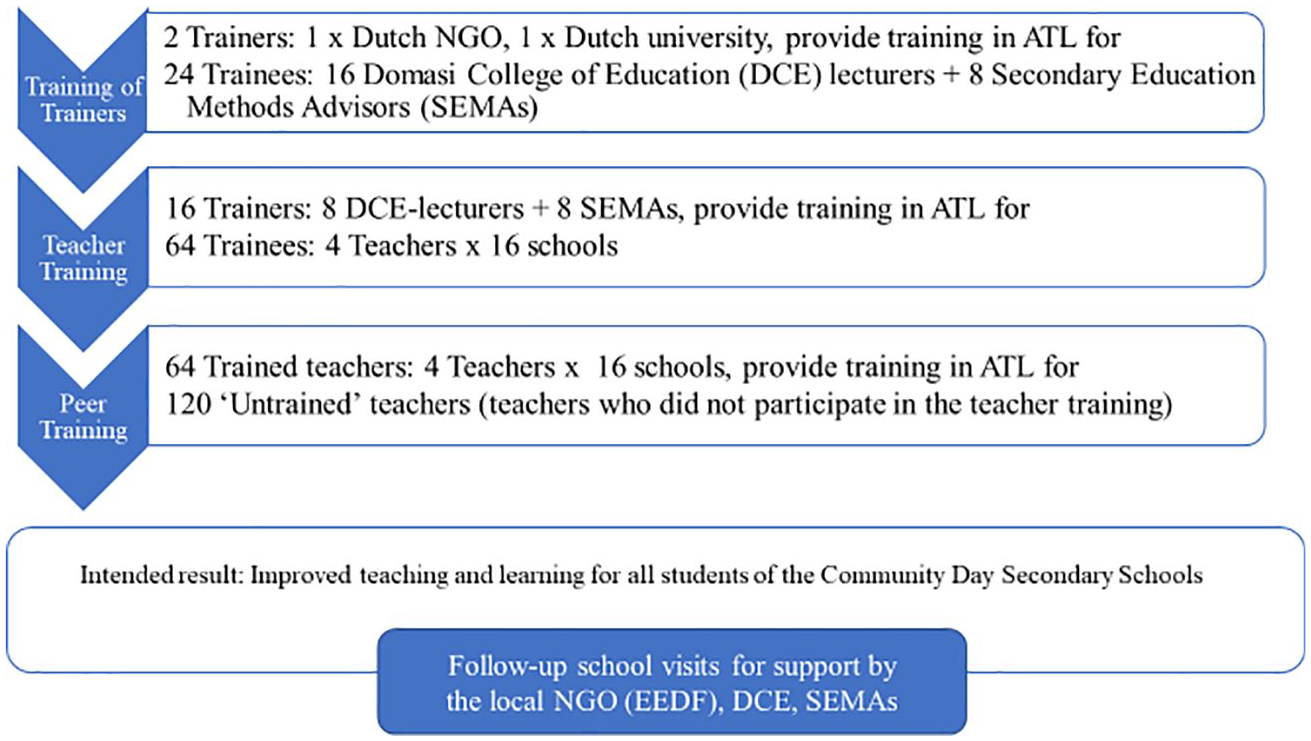
ATL Training Model.
A Dutch university and Edukans Foundation played key roles in developing the training sessions, as they prepared lectures and trained 16 lecturers at Domasi College of Education (DCE), a prestigious teacher training college in Malawi, and 8 Secondary Education Method Advisors (SEMAs). SEMAs function as school inspectors for the Ministry of Education. The four-day trainer’s training was organised biannually. In these sessions, pedagogical concepts such as ‘concept building’, ‘formative assessment’, ‘cooperative learning arrangements’, and ‘stimulating critical thinking’ were discussed. Watching and discussing video clips of real classroom situations in project schools was a central training method. Each trainers’ training would result in detailed scripts to be used by the DCE lecturers and SEMAs in the teacher training planned in the week after completion of the trainers’ training. The teacher training within the Star school programme does not focus on a specific subject area but seeks to enhance teachers’ general pedagogical skills across all subjects.
Before actually delivering the teacher training sessions, the trainers spent two days visiting classes and providing feedback to a number of teachers who were selected for training. The actual teacher training sessions lasted four days. The headteachers and three or four teachers from each CDSS took part in these training sessions. In each teacher training session, a representative of the Edukans Foundation was present to supervise the process and provide coaching to the trainers. To prepare them for their role in supervising and leading the implementation of ATL at their schools, the headteachers were grouped together separately for one day in each training session. The trained teachers, led by their headteachers, were expected to train and coach the remaining teachers at their schools upon their return. The teacher training was repeated every six months within the three-year project timeline. Hence, six biannual training sessions were planned in total. At the time of data collection, headteachers and teachers had been trained twice.
Approximately two months after each biannual training session, teams with trained lecturers from DCE, SEMAs and staff from EEDF, carried out school visits to monitor and support the application of ATL techniques in practice. The classrooms of both trained and untrained teachers were visited and feedback was provided on what teachers were doing well and where and how they could improve their practices. The support from Edukans Foundation also included material support, such as provision of desks, textbooks, sanitary buckets, and financial aid for minor renovation of classrooms. Furthermore, EEDF staff provided leadership and effective financial management training for headteachers, and the schools received donations and infrastructure investments to improve the school and learning environment.
Methods
This paper is based on data collected in secondary schools in Malawi between February and March 2019. Semi-structured interviews were conducted with headteachers, teachers and EEDF staff, who were in charge of teacher training and monitoring of the implementation process. Before the start of the fieldwork, Ethical Committee approval was sought from the appropriate authorities at the university where the authors are employed. The data collection was carried out by two masters students with the support of the Edukans Foundation and EEDF under the supervision of the first author Hülya Altinyelken. Five schools were selected for this study based on the following eligibility criteria: i) school should be a CDSS school and must be taking part in the Star school programme; ii) school should be located in a rural area and each school should be located in a different region in Malawi; and iii) the school must be representative in terms of size, resources and infrastructure. The selected schools enrolled between 177 and 500 students, and each employed 10 to 16 teachers. The students mainly came from low socioeconomic backgrounds.
Headteachers at all five schools were interviewed, as well as teachers who did and did not participate in in-service training on implementing ATL organised by EEDF and delivered by DCE lecturers and SEMAs under the supervision of Edukans Foundation. The former group is called here ‘trained teachers’ and the latter ‘untrained teachers’. Both trained and untrained teachers from four schools were interviewed for comparative purposes. However, at School D, trained teachers were not available for an interview; hence, only one untrained teacher was interviewed. The total number of interviewed teachers was 19 (9 trained and 10 untrained). All 5 headteachers and 13 of the teachers were male, and only 6 teachers were female, which reflects the gender distribution in secondary schools. Although teachers in secondary schools are required to have a bachelor’s degree or a diploma from the Domasi College of Education, three were certificate holders instead, which only qualified them to teach in primary schools. After working in primary education for some years, they started teaching in secondary schools. Teachers’ ages ranged between 31- to 52-years-old, and their average teaching experience was 16.7 years for trained teachers and 20.8 years for untrained teachers. They taught a variety of subjects including agriculture, English, science, mathematics and social studies. In addition to teachers, two staff members from EEDF were interviewed to explore their role in the implementation of ATL, and their observations based on their regular school visits. Participation in this study was entirely voluntary; all participants were informed about the objectives of the study, and signed consent forms prior to the interviews. Anonymity and confidentiality were ensured by masking teachers’ identities and the names of their schools (the former are identified by a number and the latter by a letter).
The interview questions were developed by the first author and the two masters students, and feedback was sought from the Edukans Foundation and EEDF. The interview questions were piloted at School A, and some revisions were made before visiting the other four schools. The interviews focused on in-service training and on-going support provided to teachers for project implementation, definitions of ATL, its perceived benefits and potential for improving education quality, classroom implementation practices, and challenges. The individual interviews were conducted on the school premises, lasted between 20 and 50 minutes, and were all tape-recorded with the permission of the participants. English was used during the interviews, and it was also the language of instruction at the schools. Although teachers’ and researchers’ language comprehension in English was adequate, there were still some limitations to the richness of discussion on this topic.
All interviews were transcribed for analysis. A code list was developed based on the existing literature and a reading of selected interview transcripts. The main codes included the following: in-service training, on-going support, definition of ATL, perceived benefits of ATL, implementation practices, teacher competence, challenges, and sustainability. The data were coded using a software programme, ATLAS.ti. A report was then produced for each code, and carefully read. A summative table including supporting quotations was generated to organize the information for each code, enabling the identification of similarities and differences among teachers, and between teachers and headteachers. When necessary, original transcripts were consulted again for a broader understanding of specific issues. Comparative analysis particularly focused on the narratives of trained and untrained teachers.
Findings
Defining active learning
Teachers’ definition of active learning indicated three key aspects: the role of students, the role of teachers, and the way in which learning was facilitated. Active learning was described as a pedagogical approach in which students assumed full responsibility for their learning, and took an active role in the learning process. Through participation in diverse learning activities, spending most of their time on-task, and interacting with their peers and teachers, they were expected to be fully involved in their learning. There was also frequent reference to how students were supposed to do ‘much of the work’. On the other hand, when teachers were asked to define their own role, they often referred to facilitation, guidance, assistance and supervision of students and learning processes. For instance, teachers would ask questions, assign work to students, group them, check what they were doing, respond to student questions, and make sure all students participated. In contrast to students, who assumed major responsibilities in classrooms, the teachers’ job was perceived to be ‘easier’ and ‘lighter’.
Active learning and teaching is the method which we use to involve the students to do much of the work than the teacher. . . The teacher is just the facilitator. There to assist when is needed. (Trained T13. School B. Female) Even the teacher finds teaching easier because most of the work is done by the learners themselves. (Non-trained T2. School A. Female)
Teachers accounts also underscored the importance of using a variety of teaching and learning methods, such as group work, question and answer, whole-class presentations, debates, research activities, reading and field trips. Such activities were believed to facilitate self-directed and exploratory learning, and self-discovery.
What I understand, the most important aspect is that learners alone have to discover what is intended to be learned on their own, other than just teaching them and they get that information passively. That is easy to be forgotten by them, but the more they discover themselves they will never forget. (Non-trained T1. School A. Male) Now people are getting used to where learning is much left in the hands of the learners to learn for themselves and teachers facilitating the learning. (Trained T12. School A. Male)
Teachers contrasted the key aspects of active learning with what they called teacher-centred teaching, in which teachers were dominant, spent most of their time talking and lecturing, and students were passive listeners.
In the past we were just talking whole 40 minutes, students were just looking at the teacher, listening. Others sleeping, others dozing. Whereas now, this active teaching makes the students know what is taking place and also able to do any other activity. (Trained T13. School B. Female)
There were no differences between the accounts of trained and non-trained teachers in terms of the key concepts they used to define active learning. However, trained teachers appeared to give somewhat more elaborate answers. Headteachers’ definition of ATL emphasised students’ active involvement, participation, interaction and group work, echoing the definitions of teachers. The roles of students and teachers were also defined along very similar lines to the accounts of teachers. The importance of teachers not dominating the learning process and leaving much of the work to students was highlighted. The teachers’ role was seen as one of consolidation and accommodation of what students do.
ATL is a type of teaching whereby a teacher does not actually involve much in the lesson, but just giving instructions [about the activities] to the learners. So much of the work is done by the learners. (Headteacher 2. School B. Male)
Implications for education quality
All participants appeared to be convinced that ATL had multiple benefits on learning outcomes, skills development, and teacher workload. Teachers associated ATL with improved learning outcomes and higher academic performance among students. They believed that through hands-on-learning, increased participation, classroom interactions, peer-to-peer learning, and increased sharing of experiences and knowledge, students were able to acquire more knowledge, understand concepts better, construct new knowledge based on their prior understanding, and retain more of what they learnt over time. Consequently, teachers made strong associations between ATL and improved educational quality, and they expected that their students would perform better on national exams.
I feel like this system whereby, when you are in class and teaching, students don’t understand and they get nothing. And then you have a lot of work to do as a teacher but students get nothing. (Trained T20. School E. Female) In most cases when you do lecture methods you find students that are sleeping. . . . when you are teaching. . . . they’re not getting information. But, as they are doing themselves, they are always active. So, which means they are benefitting a lot. (Untrained T4. School B. Male)
Similar remarks were made by the NGO staff, suggesting that students learn more and retain that knowledge longer.
Because they [students] are in the driver’s seat, they see that they are important, they are valued. They learn more, they can have what they’ve learned for a longer period because, to begin with, they were taking an active role in their own learning process. (EEDF staff 2. Male)
Moreover, teachers and headteachers believed that ATL improved students’ confidence, self-expression, autonomy and independence. It contributed positively to skills development, such as problem-solving, decision-making, debating, and leadership. Even shy students who would not normally ask questions in the classroom would be encouraged to participate through small group activities. As such, ATL supported more holistic development of students, which was important for becoming good citizens. The participants also maintained that both teachers and students enjoyed lessons more, students were more interested, and there was a positive classroom atmosphere conducive to learning.
Training and support
Teachers who participated in ATL training were overall very positive about their experience. However, they would have liked more time to practice and attention on how to involve girls and distracted students in classroom activities. Similar remarks were made by headteachers as well, arguing that because of limited time, too much content was squeezed into four days and that practising what was learnt remained limited.
All untrained teachers commented that they would have liked to join the biannual training sessions as well. Their in-service training was limited to in-service training sessions (INSETs) organized at school by trained teachers and headteachers, lesson observation and supervision by school management (in some cases by trained teachers), and responses to occasional requests for support in lesson planning or making classrooms participatory. The INSET at schools was not formalized by the local NGO, since they did not have the budget to oversee this. More importantly, it was a deliberate choice to give teachers more responsibility to adopt these practices to their own school and classroom contexts, thereby improving their professional autonomy. Hence, each school approached it differently. In some schools, day long seminars were organised while in others training lasted one hour or more, or was conducted through a few lesson observations.
By the time we went for the trainings we were told that we need to impart knowledge to our friends, so we sat down together and shared information. Though they cannot do the very best, but they know the idea of Active Teaching and Learning. (Trained T13. School B. Female) Yes, we do cooperate. Here, we do discuss different topics, so let’s say if a teacher would want to teach a certain topic, and would ask ‘how can we make this topic into an active lesson?’ So we give suggestions. (Trained T12. School A. Male)
There is a general understanding that trained teachers knew more about ATL, and that they developed more skills. All teachers maintained that school management had been very supportive of ATL, and they provided materials to teachers (such as pens, chalks, paper, new chairs). The headteachers were expected to observe classes and see how teachers and students were interacting, and what different methods were used. This took place once or twice in a semester. However, they also recognized the limitations of such a cascade system.
So, they [trained teachers] come and impart information from what they have learned, giving that to the teachers. . . those trained teachers. . . impart the knowledge for only one hour, two hours. . . that is not enough. It might be leaving some information out. (Headteacher 1. School A. Male) We teach those teachers who remained behind, so that we move together, we move on the same page. (Headteacher 4. School D. Male)
Implementation experiences
When teachers were asked whether they felt competent to implement ATL, both trained and untrained teachers provided affirmative responses, except for one untrained teacher who said he could not really assess his level of competence. Two other untrained teachers commented that teachers who did not receive training might lack a good understanding of ATL as well as the skills to practice it.
These trained teachers whenever they are teaching they try to stick to what they have been taught. . . but we untrained teachers we try because we have the passion of having these learners to be actively involved but sometimes we lack skills since we are not trained. (Untrained T3. School B. Male)
Headteachers also believed that teachers are overall competent to implement ATL. Yet, they also pointed to differences in levels of competence between trained and untrained teachers, and suggested that untrained teachers might be lacking some key elements.
Those people who went for training have a lot of knowledge, aspects that are involved in active learning. . . where the other group which did not go there, they just hear the word active learning, not knowing what is inside the active learning. (Headteacher 2. School B. Male)
Teachers also argued that both trained and untrained teachers were very happy with ATL, and they all had very positive attitudes towards this new pedagogical approach. Only one (trained) teacher commented that there was some resistance to ATL in the beginning, simply because ATL implied change, and it was inevitable in his opinion that people resist change, at least initially. Yet, he also confirmed that eventually it had been accepted by all teachers, and there was passion and motivation for implementing ATL. A few teachers explicitly commented that one reason for this widespread acceptance of ATL had to do with the perception that it made teaching simple and reduced teacher workload.
Establishing whether or not teachers had adopted the approaches featured in the training was an important aim of the research. Hence, teachers were asked about how they implemented ATL, and what exactly they were doing differently in their classrooms. Teacher responses to these questions highlighted three key practices: organising a range of classroom activities to involve students; using a diverse range of teaching and learning methods (including peer work, group work, student presentations, question and answers, brainstorming, excursions, writing simple reports, demonstrations and role-play), and using diverse teaching and learning materials to facilitate hands-on learning. For most teachers, these were all new and they needed to adapt their teaching styles as they learnt to implement ATL. Another common element in teachers’ answers was how they applied new routines in lesson preparation and delivery, e.g. planning learning activities that were suitable for lesson objectives or stepwise introduction of new subject matter built on prior knowledge. These structuring routines were perceived as helpful and were not commonly practiced before the project.
The pedagogical approach prior to ATL was described as teacher-centred, and ‘preaching-style’; teachers were mostly standing at the front, and they sounded like ‘they knew it all’.
If anything you could maybe ask a few questions. But this time around, it’s the student-centred lessons. Which are better for the students. So there is a great difference, and unlike before, where. . . we’re taking the centre stage the whole lesson (Trained T18. School E. Male) Previously teacher was talking like a bank of knowledge and students had to simply listen and praise that whatever the teacher is saying that is the truth. So, with this one, learners are discovering themselves so teachers are no more talking as banks of knowledge. (Untrained T7. School D. Male)
Another teacher commented that previously she just went to the classroom and gave a lecture, but now she first explored what students already knew on the subject to build up from that, since ‘no student is empty-headed’ (Trained T20. School E. Female). Others, however, commented that they already learnt about learner-centred pedagogy at teacher colleges, and in this programme they only needed to polish their knowledge and skills to make learning more participatory and engaging.
Teachers were also asked if they observed differences in the implementation of ATL between trained and untrained teachers. Trained teachers were convinced that ATL was implemented well by trained teachers. Five of these teachers believed that the implementation of ATL by non-trained teachers was also successful, since they were prepared through training within the school, and their lessons were observed, supervised and corrected when needed by school management and trained teachers. However, some of the trained teachers argued that even if untrained teachers were also doing their best, some were nonetheless ‘struggling’, or their implementation practices were not very good. When the same question was asked of untrained teachers, they commented that unlike trained teachers, they were not involved in lesson observation or supervision of their peers. Consequently, they assumed that trained teachers were implementing ATL well, while there might be some differences in untrained teachers’ implementation, due to the limited training they received, or due to contextual and material challenges, rather than lack of competence or lack of faith in ATL. In their opinion, the main difference between trained and untrained teachers in their implementation of ATL was probably the number of teaching and learning methods they used.
All headteachers, however, acknowledged that trained and untrained teachers might differ in terms of their implementation practices. The headteacher from School A was concerned that since only one-third of the teachers were trained, the impact of ATL might be limited. The headteacher of School B commented that after observing various classrooms, he saw that trained teachers involved students more while untrained teachers still did much of the work in the classroom. Three other headteachers also acknowledged differences in terms of the variety of teaching and learning methods used or in teachers’ concept-building, however, they believed that through collaboration among teachers, regular supervision and feedback, these differences were increasingly diminishing. The EEDF staff also acknowledged differences between the trained and untrained teachers: for instance, group work was not done effectively by untrained teachers, because 10 or 15 students were grouped together, which did not facilitate participation or discussion. Students were ‘just sitting in groups’. Or, untrained teachers were not preparing worksheets, resorting more to lecturing in their classes, and their application of subjects to their students’ real-life situations was more limited. They also noted that there were observable differences among teachers who were trained to be primary school teachers but teaching at secondary level. These teachers were not able to use a variety of methods in their lessons.
Furthermore, teachers were also asked about observed changes in their classrooms. Classrooms had changed because there were charts on all the walls, and some other teaching and learning materials. Teachers believed most students enjoyed ATL, and they were happy because they were occupied with diverse activities during lesson time, instead of ‘feeling bored’ and ‘sleeping’. Several teachers, both trained and untrained, also suggested that student motivation, interest in learning, attention span, and participation levels had all improved after the introduction of ATL. The school library was also used more often, since some teachers gave research assignments.
I think now they’re taking school as something which arouses their curiosity, in the way that I understand most of the learners they dislike each and every time to be taught by a teacher to say this is this, this is that, but when they’re doing alone, they feel like they’ve been given a sense of responsibility, they’re always happy to be in class and learn. (Trained T20. School E. Female)
Some teachers particularly underscored that girls’ participation had also increased, that they were more engaged, outspoken and confident. This was contrasted with previous observations and experiences, which pointed to a pattern of boys speaking up or being in charge.
Because we encourage them and we challenge them with what we learned, saying that, if you girls, if you can. . . I mean you can do it, you can manage. So when you are in class, don’t just listen from the boys, cause in the past it was only boys who were active. . . to see the hands of girls, it was a challenge. But, this time around, there is a change that even a girl can stand and speak among her group. (Trained T15. School C. Female)
Some untrained teachers were more cautious, however, about commenting on observed changes. They believed that few teachers were trained in this new pedagogy, and there were in fact only small changes and improvements among their students. Most of the changes took place in the classrooms of trained teachers. EEDF regularly visited schools and conducted classroom observations to oversee implementation practices. They believed that classrooms were more active, most of the students were ‘on task’, there was more grouping of students, and teachers were applying diverse methods in their lessons. They also observed that the role of teachers in the classrooms had been changing:
Past practice of teaching was like, the teacher. . . knows it all, so you’re not supposed to put your input or to say no that is not what happened. The teacher knows everything, so I think that has been challenged, but slowly. (EEDF staff 1, Female)
On a more general level, several participants maintained that ATL lessened teacher workload as they were not ‘burdened’ nor ‘tired’ anymore. While in the past they had been ‘sweating’ and ‘using a lot of energy’, they have realised that they could achieve more by not being so energetic themselves.
It is like the whole work you try to give to the students. . . then you just supervise their work and off you go. (Untrained T9. School E. Male) They [teachers] were the main deliverer of the teaching but now with this methodology they are simply facilitating. They are allowing students themselves to discover, to get involved. Therefore they are not as exhausted as they used to be. (EEDF staff 2. Male)
These impressions reflect a narrow understanding of ATL because adapting this pedagogical approach as intended by the Star school programme would actually entail that teachers spent more time in preparing lessons (e.g. lesson plans and relevant learning materials). Hence, their overall workload would not decrease. On the contrary, it might even increase.
The challenges
The majority of teachers were enthusiastic about ATL, but they were also concerned about a range of challenges limiting successful implementation. These included large class sizes, inadequate materials and textbooks, the use of English as the medium of instruction, insufficient lesson time, certain aspects of Malawian culture contradicting key tenets of ATL, and problems related to students’ preparedness for learning.
Several teachers commented that their classrooms were too large; there were sometimes more than 100 students in a single classroom. This imposed serious setbacks on classroom management, grouping, and student participation. All teachers also pointed to inadequate infrastructure or materials as a key concern, such as insufficient desks, lack of textbooks (often five students shared a single textbook), pens, chalk, or a photocopy machine. ATL required more use of teaching and learning materials to organise diverse activities, yet these materials were often lacking. English was used as the medium of instruction in all secondary schools included in this study. Although some teachers commented that English posed no challenges in learning and teaching, several others suggested that it was a key impediment, especially in lower grades. Students started learning English in grade five at the primary level, yet often, when they reached secondary school they were still not fully proficient and preferred to speak in their mother tongue, such as Chichewa. Several teachers responded to the language challenge by code switching. All headteachers, however, identified the use of English as a key challenge.
They may know the answer, but then it’s very difficult for them to stand up and express themselves in English. (Untrained T9. School E. Male) We have to teach in English and we find that the learners don’t really understand the language. So if you ask a question you just see them looking at you as if they have not understood anything. (Headteacher 5. School E. Male)
Various teachers also believed that the 40-minute lesson time was not sufficient. This was because the classes were large, and sometimes just distributing materials or grouping students took up a lot of lesson time. Moreover, ATL required the use of diverse teaching and learning methods, and organisation of activities to involve students. These were also time-consuming, and teachers had difficulty covering topics within specified time periods. The compatibility of ATL with Malawian culture was also brought up, particularly in relation to the implications of gender roles and gender separation in the broader society. When classroom activities were perceived as requiring ‘masculine tasks’, then the boys took charge. Malawian culture entails gender separation, especially among Muslim communities in the south. Yet, at school, boys and girls were together, and teachers tried to group them together in ATL activities. It was challenging for some teachers to facilitate interactions, to seat them together, to require them to manage certain tasks jointly, or to encourage girls to participate in the presence of boys.
Society tells them not to mix. At school we do the opposite. It is difficult for them to adapt. (Untrained T6. School C. Male) Girls and boys are not comfortable sitting in one group, but when we are using ATL you ask them. . . you need to be in groups, so some might not be comfortable sitting in a group. So maybe they’ll be limited in what they’ll be sharing and what they’ll be discussing with others. (EEDF staff 1. Female)
Another cultural aspect brought up by teachers was related to adult–child relationships and how children were expected to behave when they interacted with persons who were older and had more authority. Certain aspects of Malawian culture were not perceived as conducive for debating, critically reflecting, or challenging persons in authority positions.
The students are brought up in village environment. . . When they’re talking to their parents, they don’t know to answer back, so that syndrome is carried to school. When you start asking them, when you talk to them, they are not all that critical, they don’t say their opinion openly. (Untrained T9. School E. Male)
Furthermore, several teachers underscored the fact that the families of most of their students were poor. Some of these students walked 10 kilometres to school. Hence, by the time they reached school, they were tired and exhausted. What is more, some had had no breakfast, and had to sit with an empty stomach for hours. Teachers believed that tiredness, hunger and other serious problems in their families appeared to burden their students, and impaired their full engagement, attention span, and concentration during lessons.
When the teacher is teaching. . . they [students] may seem to be in the classroom, yet they are thinking of another problem. Possibly they are beaten by their parents at home, or they have missed their breakfast. (Headteacher 2, School B. Male)
A few teachers also commented that the level of knowledge and skills was also low among some students, some of whom were not able to read and understand or lacked so much knowledge that when teachers introduced new topics, they simply could not participate. Another major obstacle was high rates of absenteeism and drop-out, which was raised in all schools as a factor that undermined the continuation of learning. Children were asked by their families to work on certain days at the village markets. During those days, they missed school. High drop-out rates had to do mainly with high incidences of early marriages, pregnancies, and poverty.
Conclusion
This study adopted a qualitative approach, examining the implementation of ATL in disadvantaged schools using descriptive and interpretive approaches. The findings revealed that all teachers were highly receptive to ATL and believed that it would improve learning outcomes and address some other educational concerns, such as drop-out, absenteeism and low transition rates to higher education. Their widespread acceptance of ATL might be due to the similarities between ATL and learner centred pedagogy which was promoted by the Ministry of Education, and observing some positive changes among their students, such as increased motivation, self-expression, confidence, and greater interaction between girls and boys. Moreover, the high level of teacher enthusiasm could be informed by a common understanding that ATL reduces teacher workload, and that teachers were no longer so ‘burdened’ nor ‘tired’. Heightened support and a strong belief in active learning and in other comparable pedagogical approaches (such as student or child centred pedagogy) has been observed in several other studies as well (Altinyelken, 2015; Singal et al., 2018; You, 2019), and only in few cases the Western origins, contextual and cultural relevance or the underlying assumptions were questioned (Altinyelken and Sozeri, 2018; Guthrie, 2011; Tabulawa, 2013) .
Teachers’ understanding of active learning has emphasized students’ ownership of their learning process, active participation in a variety of activities, working together and being on task most of the time, rendering their own role to guidance, supervision and facilitation of learning processes. There was a strong belief that activities would stimulate learning, and that students could co-create knowledge through interacting with others. Consequently, many expected that such self-directed and exploratory learning would lead to higher student performance at national exams. There were also negative comments about the traditional practice of direct teaching, referred to as a form of ‘preaching’ and an activity that tended to induce boredom or sleep among students. Studying similar reform initiatives in other contexts, Pathmarajah (2014) notes a common misconception about teachers in terms of how they equate active learning with self-learning, or a form of primarily supervising students, and ‘naivety’ in their trust that activity would lead to learning. In fact, not only in active learning, but also more generally in other participatory pedagogies such as child or learner centred pedagogy, a major move away from teacher talk and direct transmission or factual knowledge is emphasized (Schweisfurth, 2013), reflecting a polarised view of direct teacher instruction versus learner centred pedagogies (Di Biase, 2018).
This raises a few key questions. If teachers are not supposed to convey knowledge, what is the source of knowledge for students living in resource poor areas where textbooks or other educational materials are scarce both at school and home? Would conversing in groups with their peers lead to knowledge creation and broaden their horizons and awareness beyond their socialisation and conditioning in their communities? There is a risk that stigmatisation of direct teaching as traditional, conventional and ineffectual might undermine students’ access to knowledge even if they are at school. Involving students in activities, stimulating interactions and reflections, and using a variety of teaching methods are undoubtedly important to improve education quality. However, these should not be at the expense of undermining the teacher’s key role as the source of knowledge particularly in resource poor contexts, as well as the merits of direct teaching in conveying essential knowledge to students (see Di Biase, 2018; Gordon, 2009). The question is not shifting the pendulum from teacher talk to student activities. It is about finding a balance between diverse sets of learning and teaching activities while moving away from a polarised view of pedagogy and conceptualising it on a continuum (Hattie, 2009; Vavrus et al., 2013). The findings of a rigorous review study (Westbrook et al., 2013: 2) on pedagogical reforms in low-income contexts also concluded that ‘flexible use of whole-class, group and pair work’ is one of the most effective teaching practices.
The study also revealed that participation in biannual training was viewed as a positive and valuable learning experience, yet teachers also expressed the need for more training and practical sessions. There was a sense that untrained colleagues were left behind as they had to rely on in-service training and coaching by their trained peers, which was perceived as less intense and effective. The majority of teachers stated that they felt competent to implement ATL, though there was a general conviction that trained teachers were more knowledgeable and skilled. Indeed, trained and untrained teachers differed in the way they articulated the rationales and strategies of ATL, trained teachers reflecting on these in greater depth. Some differences were also noted in how trained and untrained teachers were implementing ATL. While there was a conviction that ATL was well implemented by trained teachers, there were concerns that non-trained teachers were ‘struggling’ or used less variety in teaching methods or adopted some superficial techniques. However, over time the gap between trained and untrained teachers was expected to decrease.
These differences question the effectiveness of the cascade structure of this training, however it is too early to reach a conclusion on this since the implementation is ongoing. At the time of data collection only two training sessions had been organised and four additional training sessions were scheduled for the coming period, with anticipated delays due to the corona pandemic and school closures. However, the accounts of the participants point out that more attention to in-service training at school level and incorporation of this phase in the overall programme design would strength the internalisation of ATL at schools. Not formalising in-service training in schools and leaving it solely to their discretion appeared to have led to wide differences in how schools approached training at school level, some organising day-long training and some others limiting it to a two-hour presentation. Insufficient training at school level is likely to result in superficial and simplistic understanding and formalistic implementation, undermining the effectiveness of a cascade training approach. This study suggests that in countries, such as Malawi, where teachers’ overall level of professional training is rather low, it is imperative to train all teachers, rather than opting for a model that assumes that a few trained teachers can successfully train their peers. Moreover, a mentorship system, recognised by the Ministries of Education in relevant countries, could be instrumental in supporting teachers’ continuous professional development. In such a model, a few experienced and knowledgeable teachers could be assigned specific mentorship roles and responsibilities, and assigned additional hours to carry out this new pedagogical function.
It is also important to note that a range of other factors appeared to constrain successful adaption of ATL, including large classroom sizes, inadequate materials and textbooks, the use of English as the medium of instruction, insufficient lesson time, problems related to students’ preparedness for learning, and certain aspects of Malawian culture refuting some key tenets of ATL. These challenges echo similar narratives from other SSA countries (Altinyelken, 2010a; Ginsburg, 2010; Thompson, 2013), although in this study, concerns about student preparedness for learning were more prominently articulated as a key impediment. The discussions on myriad implementation challenges relating to teacher and student agency and contextual factors raise the following question: How do teachers who claim that they are making progress with implementing ATL actually manage to overcome these setbacks, and what are the implications of their experiences for pedagogical change in severely resource-constrained school contexts?
This study identified four key aspects that supported teachers’ implementation of ATL: i) unlike several other pedagogical reforms that involved only a single training session for teachers before the implementation phase, trained teachers involved in this study received longer training and these training sessions were planned regularly twice a year, moreover, teachers received ongoing pedagogical support from the local NGO; ii) schools received material resources, such as stationery, learning materials and chairs in order to improve school capacity to implement ATL; iii) headteachers appeared to be highly motivated and enthusiastic about ATL – their leadership and commitment were instrumental in motivating teachers and facilitating peer learning among them; and iv) schools which coordinated higher levels of interactions and exchanges among teachers (e.g. in the form of classroom visits, feedback and workshops) stimulated increased knowledge and skills on ATL, supporting teachers’ implementation efforts. These factors imply that reforms aimed at pedagogical change in severely constrained classroom environments could emphasize regular teacher professional development on pedagogy; creation of a community of learners among teachers to exchange views, experiences and to facilitate collective reflections; provision of material resources in addition to professional training; and investment in training and motivation of school leadership about the importance of pedagogical change. The last point confirms another study which highlighted that implementing active learning was challenging when the school management did not favour such pedagogical understandings (Price-Rom and Sainazarov, 2010).
For the current study, it is too early to conclude that the implementation of ATL has led to improvements in learning outcomes. A fair assessment on this can only be made once ATL has been implemented in these schools for a few years, and the training programme is completed. Having said that, it is also important to underscore that one of the strong narratives emerging from teachers’ accounts was ATL’s perceived positive impact on skills development, such as improved self-confidence, self-expression and autonomy. Moreover, teachers reported increased motivation, attention, interest, and participation levels, that learning has become more stimulating and joyful. Similar outcomes were conveyed in some other studies as well, such as classrooms becoming learner and learning friendly and positive impact on learner identity (Singal et al., 2018).
However, these positive results on students’ socio-emotional development and cognitive achievement should be viewed with caution. The study was based on teachers’ self-report and their perception of student outcomes which are rather subjective. This partly relates to some methodological limitations of the study. For instance, the study did not include learning assessment tools such as specific tests that can assess student knowledge and competencies before and after the implementation of this project, nor did it compare report cards. Hence, it is difficult to verify to what extent teachers’ and headteachers’ conviction about ATL’s positive impact is warranted against real improvements in learning outcomes. Moreover, the study did not include systematic classroom observations which were used in some other studies on pedagogy (see Guo and Pilz, 2020; Liu and Neuhaus, 2017). Although classroom observations might have their own limitations (e.g. the mere act of looking influences the phenomenon being observed), when they are done systematically, they can help to triangulate teacher narratives collected during the interviews. For instance, a study on classroom pedagogy in Uganda (Altinyelken, 2010a) demonstrated that lesson observations only partly substantiated teacher accounts about their implementation of reformed pedagogical practices; hence pedagogical reform permeated classrooms to a lesser extent than alleged by teachers. Having said that, it is important to also note that systematic classroom observations are an integral part of the Star school programme’s monitoring, evaluation and learning strategy. However, since they are ongoing and not yet analysed, they are not referenced in this study. Furthermore, some members of the local NGO were present at the schools at the time of data collection. The researchers underscored the independence of this academic study; however, this might not have been clear or convincing to some participants, which could have led to some socially desirable answers.
The findings of this study can be used for future research designs in Malawi, and other SSA countries where there are ongoing programmes to implement learner-centred pedagogy, such as Kenya and Uganda. Studies combining qualitative (e.g. interviews as well as systematic classroom observations) and quantitative research methods with both baseline and post-intervention tests would be expedient to measure the impact of the pedagogical interventions on student learning outcomes and psycho-social development. While this study focused on the most disadvantaged secondary schools, future studies could also compare the implementation and perceived outcomes of ATL in three different categories of secondary schools in Malawi, and explore how ATL was perceived and practiced by students from different socio-economic backgrounds.
Footnotes
Acknowledgements
We would like to thank Limbani Eliya Nsapato and Randall Blair for the policy and research documents they shared; Robert Mponela, Moffat Njati, Takondwa Mbewe and the EEDF team for their support in the field; Jonna Coornaert and Shiwa Nizak for their valuable work on data collection; the lecturers of Domasi College of Education and the Secondary Education Method Advisors for their commitment to the training and research activities, and all the teachers and headteachers of the Community Day Secondary Schools for taking part in this research and for their continued effort to offer students their very best.
Declaration of conflicting interests
The author(s) declared the following potential conflicts of interest with respect to the research, authorship, and/or publication of this article: This study was funded by the Mastercard Foundation, which also provided financial support to the design and implementation of the active teaching and learning programme in Malawi. However, the funder had no role in the study design; in the collection, analysis and interpretation of data; in the writing of the report; and in the decision to submit the article for publication.
Funding
The author(s) disclosed receipt of the following financial support for the research, authorship, and/or publication of this article: This work was funded by the Mastercard Foundation.