



Abstract
This article uses thematisation theory (Luhmann, 1996; Pissarra Esteves, 2016) and frame analysis (Entman, 1993) to analyse externalisations to world situations (Schriewer, 1990) in the Portuguese print media’s discussion of education. Our data constitutes news and opinion articles collected after each PISA cycle’s results was published. The analysis demonstrates that the education themes discussed in the media between 2001 and 2017 are consistent, despite occasionally being discussed more intensively, frequently following the themes highlighted by PISA reports and OECD media communications. The frames used for these themes are more diverse, changing according to the speaker’s agenda and viewpoints. Externalisations (frequently PISA, OECD, and other participants in the survey) serve as sources of authority that help in thematising and framing education. This process works as a mechanism of double reduction for the complexity of the social world, narrowing the possibilities of how education is seen and interpreted by the public.
Introduction
In 1993, Murray Edelman (1993) stated that ‘the social world is (…) a kaleidoscope of potential realities, which can be readily evoked by altering the ways in which observations are framed and categorized’ (231). In this sense, the social world is shaped by communications within complex networks of individuals providing and consuming information. Media actors, the providers, and the readers, the consumers, actively construct views of reality shaped by factors such as cultural values and contextual events. In modern societies, these reality constructions are also increasingly influenced by situations in the global world that accentuate their complexity.
Media actors are active participants in these processes. Indeed, media actors such as journalists, bloggers and commentators from all kinds of social, political and academic backgrounds design reality from their perspective not only by focusing on a selective number of themes considered newsworthy, but also by presenting these themes through specific frames that highlight some aspects to the detriment of all others (Entman, 1993). Interchangeably, the public’s interest in some themes more than in others defines what the media offers, and how it frames it.
As the complexity of modern society expands due to the faster rhythm of globalisation in recent decades, the rationalities, and instruments of international organisations (IOs) are considered relevant at the national and local levels by an increasing number of ‘reality makers’ within diverse social systems. During the last 20 years PISA (the Programme of International Student Assessment) more than any other International Large-Scale Assessment (ILSA) has been the focus of politicians, journalists and academics, among other actors who not only present and discuss the results of the survey departing from specific viewpoints, but also utilise it in discussing other themes related to the perceived state of the education system (see, e.g. Afonso and Costa, 2009; Berenyi and Newmann, 2009; Bonal and Tarabini, 2013; Carvalho, 2012; Carvalho et al., 2017; Costa, 2011; Fladmoe, 2011; Grey and Morris, 2018; Hopfenbeck and Görgen, 2017; Hu, 2020; Rawolle and Lingard, 2014; Stack, 2006; Takayama, 2008; Yemini and Gordon, 2017).
PISA, along with other external elements such as international organisations (IOs) and practices in other countries and regions, has been one of the main elements in processes to which Schriewer (1990) refers as externalisation to world situations. Stemming from the Luhmannian theory of self-referential social systems, the externalisation to world situations thesis refers to the shift of the discourse in modern societies from self-referencing to external referencing as a tool for advocating internal policy reforms. Research suggests that the use of external references tends to occur when themes are problematic, and policies are contested, earning insufficient public support with reference to internal experiences (Steiner-Khamsi, 2002). Among the frequently used external references, reference societies, a concept originally defined by Bendix (1978) to describe developed countries used as models by countries looking to improve, has been expanded in recent years to include sub-national regions (e.g. Shanghai) and supra-national areas (e.g. the Nordic countries), as well as negative cases, that is, nations or regions used as examples not to follow (Waldow, 2017, 2019:1). In this paper, we adopt Waldow’s (2012: 418–419) description of externalisation to world situations as a discursive tool that is helpful in legitimising one’s own arguments or de-legitimising those of one’s opponents.
Our study also draws on Luhmann (1996) analysis of the role of the media in selecting certain themes as a focus of their productions and its effects on public opinion. More specifically, we utilise content and frame analysis to study how externalisations to world situations contribute to the thematisation of education and its repercussions in public opinion. We attempt to answer the question: how does the media in Portugal utilise external references in the thematisation and framing of education after each PISA cycle’s results are published?
Our aim is to understand (a) if and how the discussion of education themes varies during the 2001–2017 timeframe as the Portuguese PISA results oscillate, and (b) how the media uses references to the survey and other external elements to frame education themes in specific ways. We analyse news 1 and opinion 2 articles collected from two daily newspapers (Diário de Notícias and Público), one weekly newspaper (Expresso) and one weekly magazine (Visão), all of which strongly focus on the discussion of public policy in Portugal.
The role of the media in the process of public opinion formation
Media productions are the main vehicle for citizens to inform themselves about all sorts of themes and events because citizens are otherwise unable to access vast areas of social reality. As Luhmann (1996: 1) states, ‘whatever we know about our society, or indeed about the world in which we live, we know through the mass media’. The media therefore plays a significant role in shaping public opinion (Jasperson et al., 1998) by selecting which themes are publicly discussed, and how they are framed. Nevertheless, if the media affects public opinion – through the selection of the themes presented, how they are framed and whose opinions have a voice – it also mirrors the public’s interest, and media actors select what is worthy of publication based on it (Pissarra Esteves, 2016). Media productions’ success always depends on the public’s acceptance of the selected theme (Luhmann, 1996: 12).
By selecting specific themes and silencing others, the media proposes certain meanings and attempts to manage the relevance of certain aspects of education, with the aim of limiting the social world accessed by the public (Luhmann, 1996; Pissarra Esteves, 2016). Media productions are therefore more than simple and neutral presenters of events and themes. Indeed, they ‘decide what is and is not of the public sphere’ (Nery, 2004: 16), and for that matter the themes reported in the media ‘reveal public problems’ (Nery, 2004: 2) and a sense that these problems need to be addressed (Luhmann, 1996).
The media functions as a mechanism that acts on the agenda of public opinion (Pissarra Esteves, 2016) and in doing so intertwines the public agenda with the agenda of other systems. For example, the media system establishes the communication between public opinion and the political system (Agostini, 1984; in Saperas, 1987: 89). In this sense, the media has increased power as a ‘political public space, when discussions focus on themes related to the state practices’ (Nery, 2004: 15), and it functions as a mechanism that enables processes of political control and decision making, not only mediating the political themes discussed by the public (the subjects of political action), but also helping the political system to understand public expectations and the acceptability of policy decisions (Pissarra Esteves, 2016: 414–420). Studying the media and its effects on these terms brings to the fore the thematisation theory originally developed by Niklas Luhmann in the 1970s, which within his social systems theory highlights how the media, like other social systems, is operationally closed, self-organised and autopoietic – and thus autonomous (within the limits of public acceptability) – in what it selects as a communication theme (Luhmann, 1996: 23–24). Given that the borders of the social systems are blurry, despite its functional closeness, the media’s selection of themes works as an externalisation of the media system beyond its own borders (in the binary self-reference/external reference), which allows its coupling with its environment or other systems (Artieri and Gemini, 2019: 568; Luhmann 1996). Thematisation can be described as ‘the process of defining, establishing and publicly recognising the major themes and the major political problems that constitute public opinion’ (Saperas, 1987: 88). According to Luhmann (1996) events outside the media system irritate this system which in turn attempts to process these events while preparing society for constant novelties and surprises.
Additionally, framing is a major complement to the process of thematisation. In framing the selected themes in specific ways, the media leads the public to understand these themes from specific interpretative angles. In a highly complex modern society, the mass media affects public opinion not only by injecting specific themes into the public discussion, but also by how it frames them. For example, while paying attention to education events such as PISA results and highlighting certain aspects of education through them, media actors analyse the survey and simultaneously highlight other education themes such as the impact of students’ learning backgrounds, teachers’ work and qualifications, or a government education reforms. Furthermore, these themes are not analysed neutrally: a stance is always adopted through the aspects of education the writer accentuates (Entman, 2010: 392). References to world situations such as PISA and other ILSAs, IOs and other countries or regions, introduce elements of authority to the legitimation of the presented arguments, potentially increasing the public acceptability of a theme under discussion, and how it is framed.
Data and methods
Our data consists of 133 print media articles collected between October 2018 and January 2019 from the archives of the Portuguese National Library, where all the print media publications in Portugal are kept. The timeframe considered for the search was 2 months after each PISA cycle results’ publication, when more attention is given to the survey (Rawolle and Lingard, 2014). The selection criterion was to collect articles discussing education using at least one reference (named or described) to PISA.
The media outlets were selected based on their coverage of and relevance to the Portuguese public policy debate. We selected two daily newspapers (Público and Diário de Notícias), one weekly newspaper (Expresso) and one weekly magazine (Visão). These are representative of the three main Portuguese print media types. In 2016, Visão was the most circulated weekly magazine. In 2019, Expresso was considered the most trustworthy newspaper in Portugal, while Diário de Notícias and Público were in third and fourth place, respectively (OberCom, 2020). The second most circulated daily newspaper is classified as a tabloid and we therefore consider that it does not explore aspects of the national public policy arena sufficiently deeply. Although the European Media Systems Survey 2010 (Popescu et al., 2011) demonstrates that in Portugal, the media puts strong pressure on political actors and the themes raised by the media are discussed by politicians, the Portuguese media do not openly admit partisan slant, as ideological diversity is seen to have a positive impact in sales (Álvares and Damásio, 2013: 139). Thus, we selected media outlets for their representation of the reference print media in Portugal, independent from the ideological positions of their leadership.
Of the total of 133 articles, 115 were published in the daily newspapers Diário de Notícias (30) and Público (85), 14 in the weekly newspaper Expresso and four in the weekly magazine Visão. Of these, Público is the newspaper with the greatest focus on the discussion of education. It has a dedicated education section, which explains the greater number of articles found (64%). Although the data includes articles like major news reports, smaller news articles, interviews, diary pieces, letters to the editor, and so on, in this study we organised them in two major analytical groups: news articles and opinion articles.
Because of the low coverage of PISA results during the survey’s initial three cycles we will analyse the combined data of these cycles. The study therefore focuses on a comparison between news and opinion articles during four time periods: 1) between the publication of the first and third PISA cycles (2000, 2003 and 2006); 2) after PISA 2009; 3) after PISA 2012; and 4) after PISA 2015.
The analysis started with a combination of deductive and inductive qualitative content analysis with the support of the ATLAS. ti software. The aims were familiarisation with the data and to synthesise it in accordance with the relevant categories of meaning required to answer the research question (Schreier, 2014). Thirteen categories 3 were created beforehand for this analysis. These were complemented by the content of the articles during the reading process, allowing the identification of diverse items useful to the analysis presented here, such as the authors, the kinds of publication, the themes discussed and the externalisations made. We also performed a frame analysis (Entman, 1993, 2003, 2010).
Frame analysis
Framing is an extremely common practice. All human beings interpret and simplify world events’ complexity by framing them through structured schemata constructed from their interpretative background (culture, values, previous experiences and understanding of the issue or situation at hand, and so on) by focusing on some aspects more than others (Entman, 1993, 2003, 2010).
‘Frame analysis offers a theoretical, methodological and critical tool for exploring processes of meaning making and influence among governmental and social elites, news media and the public’ (Winslow, 2018: 2). It focuses on how public policy issues are discussed in the media, and how the media encourages the public to discuss issues in one way instead of another (Pan and Kosicki, 1993). Framing is often used as a tool to problematise issues on diverse themes and in consequence promote certain agendas. Examples of prominent professionals using frames with this aim are politicians and journalists (Entman, 2003). They do this by ‘select [ing] some aspects of a perceived reality and mak [ing] them more salient (…) promot [ing] a particular problem definition, causal interpretation, moral evaluation and/or treatment recommendation’ (Entman, 1993: 52).
In practice, this means that some aspects of a story are emphasised, while others are left unsaid. This process of framing complements the process of thematisation. After a certain theme is selected some aspects of it are emphasised, and others are ignored. Like in the thematisation process, salience is constructed in the interaction between the provider of information and the public that receives it, which means that the aspect of the information highlighted must be recognised by the audience as valid and relevant (Entman, 1993).
In this article we use frame analysis to further explore the results of the content analysis by identifying frames used to discuss selected education themes (e.g. comparisons with other countries or regions highlighting Portugal’s poor results, good results, or results similar to others’ in PISA). The aim is to further explore how the media as a mechanism that acts on public opinion works to promote certain education themes in the public agenda, and how external references work as a legitimation tool that helps to frame these themes in certain ways.
One of the common problems of studies using frame analysis is its tendency to ignore the factor of time in the analysis, thereby leaving unidentified possible variations in framing that may be relevant (Entman et al., 2009). In an attempt to cover this gap, we perform a longitudinal exploration of the media articles. This exploration leads to an understanding of how the themes or events are discussed, and how the frames used change or are maintained after the publication of the results of each PISA cycle.
Understanding the data and the use of externalisations in Portuguese media discussions of education
An inconsistency in the media’s interest in PISA results can be observed in Portugal (Figure 1). After initial ‘enthusiasm’ in 2001 PISA was barely discussed during the following two cycles. More attention was paid to the results of PISA 2009 and – though less prominently – subsequent cycles. Number of publications per year, per newspaper/magazine.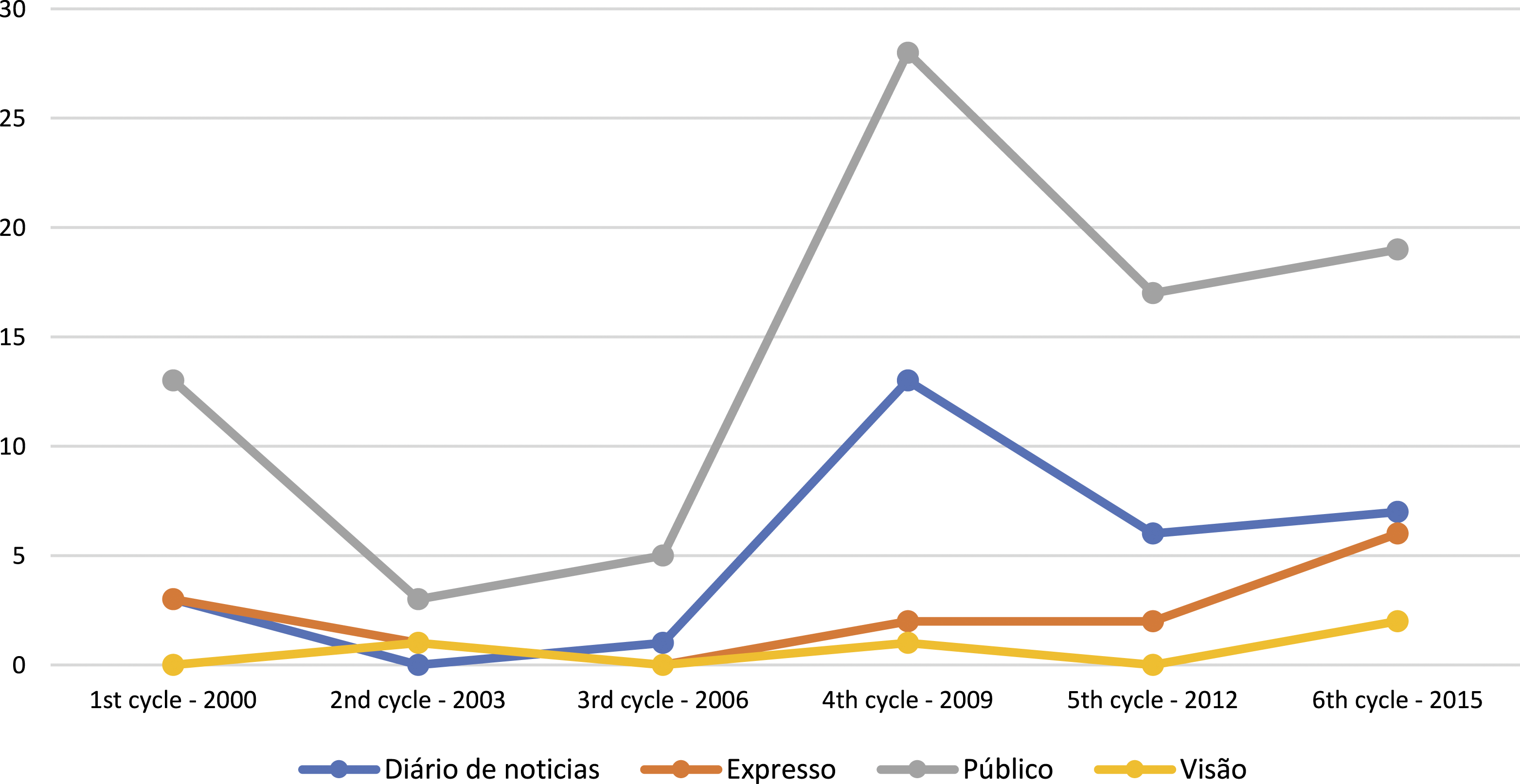
Among other possible reasons, two important factors help to explain the increased attention given to PISA 2009. First, the PISA 2009 results were a surprise – in the face of the longstanding negative perceptions regarding the quality and efficiency of the Portuguese school system (Antunes, 2004; Gomes, 1999; Nóvoa, 2005) education became a hot topic, because Portuguese students’ performance was finally approaching the OECD average. Second, since the end of the 1990s a modality of regulation of the school system, more anchored in the observation of results than in the consideration of the norms, has gained expression, with the expansion of the use of assessments especially significant – of students, teachers and schools (Carvalho et al., 2019).
Journalistic genre. In the publications, 46% of the articles were news articles, including small individual news reports and extensive highlighted sections composed by several smaller articles focusing on various education issues. The other 54% were opinion articles (e.g. editorials, diary pieces and letters to the editor).
The news articles were written by journalists and most frequently, their main focus was on the PISA results. They usually described the survey and its results, comparing the performance of the various participants and their positions in the ranking often with reference to Portugal’s ranking position. Consequently, in comparison with the opinion articles, the news articles displayed more externalisations to world situations (especially externalisation to other participant countries). Of the 815 quotations identified with one or more external references, 62% were in news articles.
News articles also discussed education in relation to PISA and other external references to legitimise arguments on education themes other than the students’ performance in PISA. These themes frequently related to the issues emphasised by the PISA report itself and OECD media communications. Adherence to an uncritical comparative logic and the use of a league table logic forces us to examine these articles’ neutrality more cautiously, because PISA reports and OECD communications are not neutral, calling attention to certain issues (thematisation) and driving the conversations in specific directions (framing). Some good examples of the possible slant identified in the news articles are identified in the headlines that emphasise perspectives also highlighted in PISA reports, such as ‘Portuguese students fail’ (Expresso, 08.12.2001), or ‘Excess of grade repetitions separates Portugal from the top of the PISA ranking’ (Diário de Notícias, 07.12.2016). It is common for the articles with such headlines to present the chosen themes through one single frame instead of a thorough and multiple perspective discussion.
A longitudinal analysis of the articles reveals not only a general increase in the number of publications focusing on education themes when the PISA 2009 results were released, but also a large growth in the number of opinion articles (Figure 2), with this journalistic genre surpassing the number of news articles for the first time. The escalation in the number of opinion articles discussing education themes shows that education has, at that moment, gained importance in the public space. Number of articles per PISA cycle, per journalistic genre.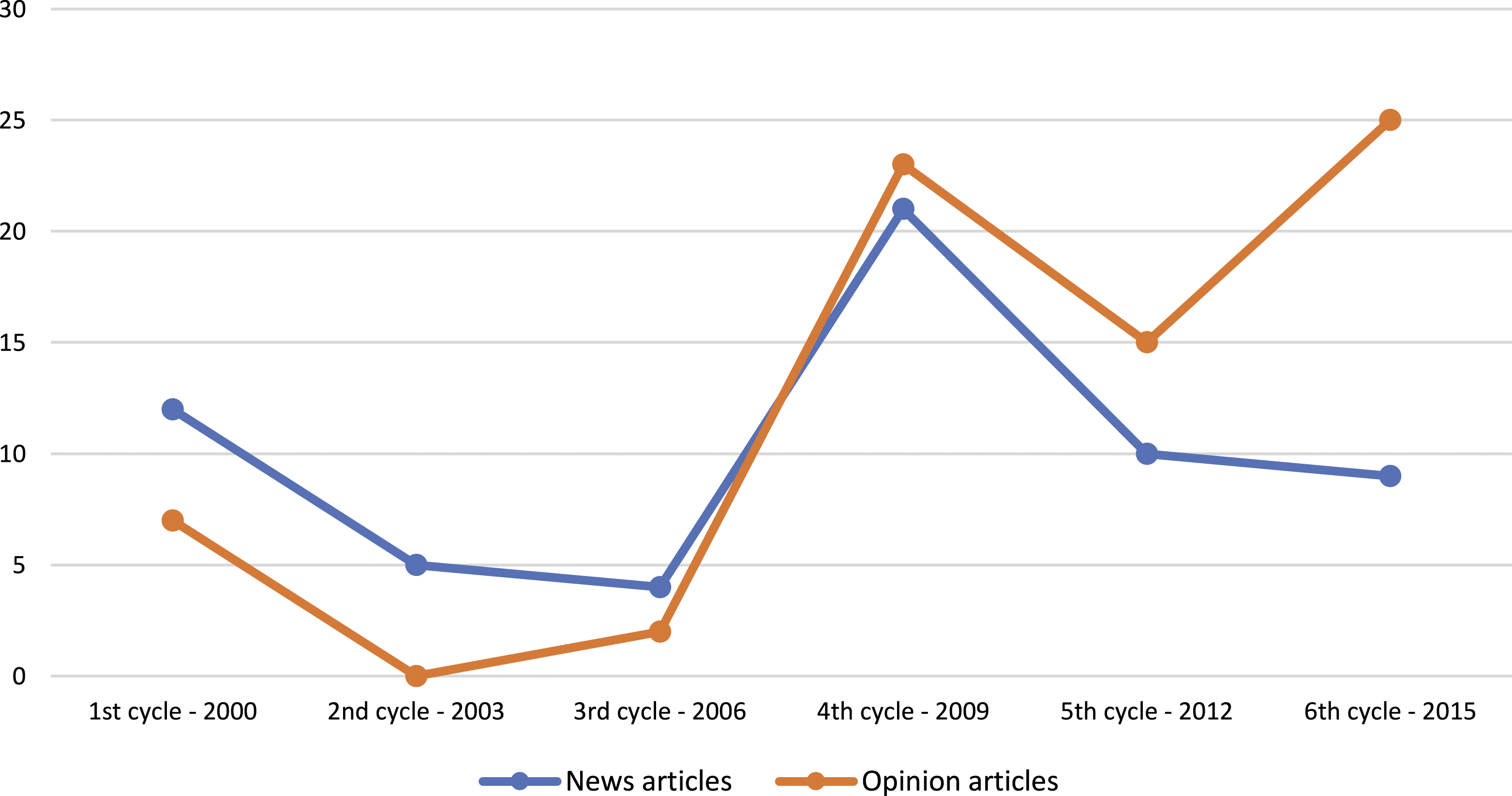
Within the opinion articles the letters to the editor (10% of the opinion articles collected) are usually smaller and in less prominent areas of the newspaper, and their authors are not usually social actors viewed as relevant in the public sphere (Melo, 2005: 609). However, while these articles cannot be considered equally influential in the process of opinion making, they offer the opportunity for a broader diversity of social actors to get involved in public discussions, ask questions and express their concerns based on their own ideologies and experiences of the social world.
Authors. While the news articles were written by journalists, the opinion articles, in allowing more room for the expression of opinion, invited the participation of a variety of social actors (journalists and non-journalists – academics and politicians). These articles were largely written by regular opinion makers – collaborators with frequent publications in the media – and often regular columnists (e.g. academics).
PISA centrality. In the opinion articles, a significant interpretation of the facts can be observed (Figueiras, 2005), and clear attempts to influence public opinion by doing both: thematising education and accentuating certain aspects of the themes discussed. PISA and other external references were used in nuanced ways as a source of authority to legitimise arguments that framed a larger variety of education themes. PISA results and other external references were therefore used more frequently as support information than as the article’s main topic. For example, in the quotation below the writer promoted the importance of public schools in improving equality by referring to the good performance of their students in PISA 2009: It is proved that the public schools (to which the majority of students participating in the PISA test belong) can live up to their educational responsibilities, and that only these schools are in a position to realise the republican ideal of education equality, overcoming inequalities, and the realisation of citizenship (Público, 14.12.2010).
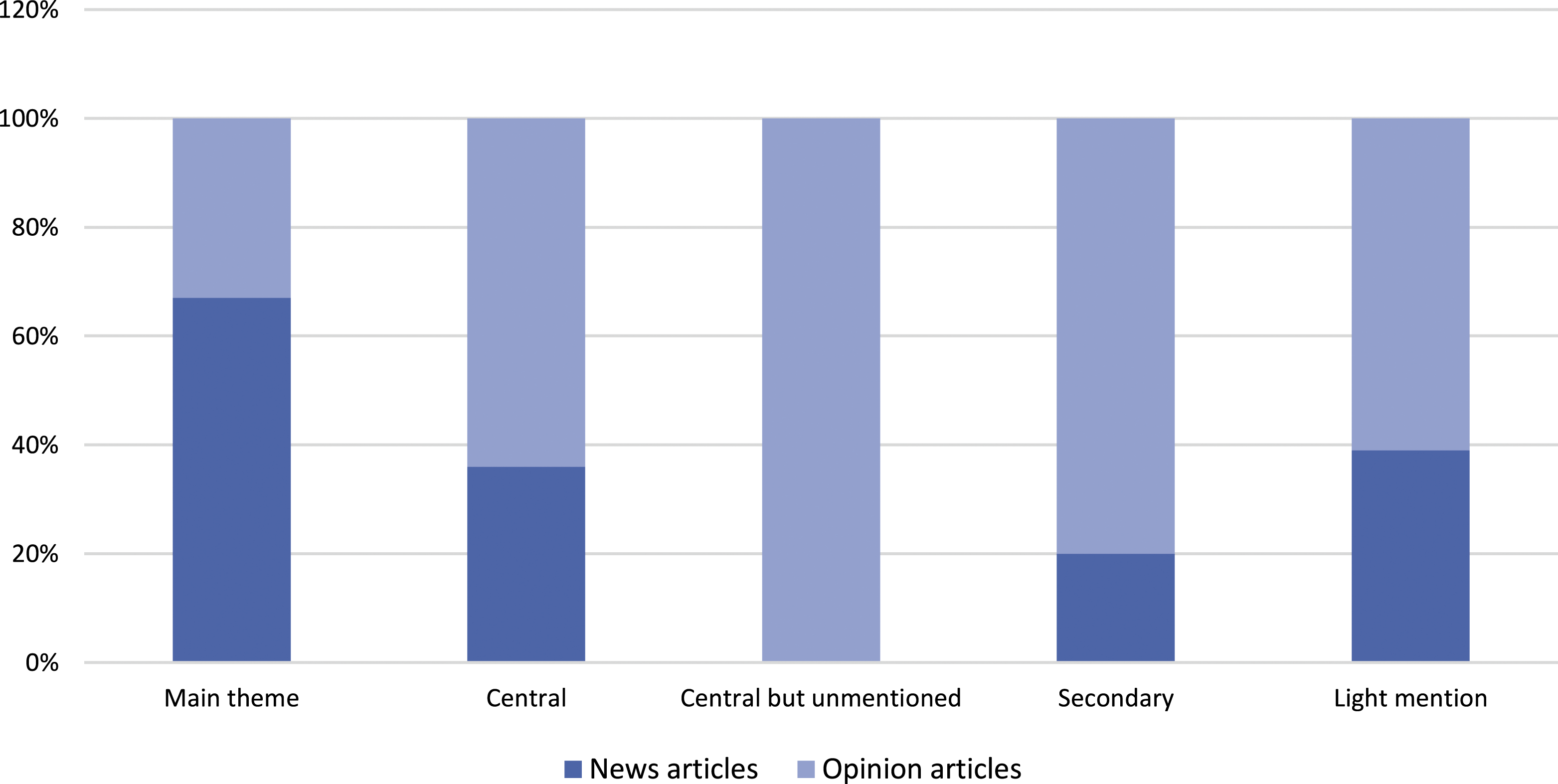
Nevertheless, PISA was the major external reference used in both journalistic genres. Of the total of 815 quotations identified with external references during the 2001–2017 timeframe, 449 (55%) referred to the survey. Figure 3 shows the different levels of PISA centrality in news and opinion articles. PISA centrality per kind of article.
4
Externalisation to world situations as a legitimation tool
The growth of the use of externalisations to world situations demonstrates that external references, especially PISA, have earned an authoritative status in the discussion of education themes. Here we identify a paradox related to the use of external references: if governance and policymaking processes become more complex with the international space being integrated in these systems, externalisations also provide elements that work as sources of (de-)legitimation for the presented arguments, narrowing the possible ways of thinking about education.
PISA and other external references were tools used by the media in attempts to guide public opinion on issues that emerged in its environment, for example, in the political system. It is noteworthy that the articles rarely comprehensively discussed education using external references and considering various and/or complementary perspectives. Education themes were usually only partly discussed, framed in accordance with agendas that were biased by some sort of ideology – for example, articles highlighting the better results of private schools in PISA to advocate the benefits of these schools and to argue for the need of state financial support for them, or the reference to the high levels of grade retention from disadvantaged socioeconomic and cultural backgrounds to support arguments advocating the stronger intervention of the state in reducing such inequalities.
Externalisations in the Portuguese media: thematisation of education and the multiplicity of frames
Although it is possible to identify other broad themes, we consider that most of the quotations in our analysis can be categorised in at least one of 13 recurrent themes: comparisons (international and national); student performance; political praise and blame; teachers (work, qualifications, relations, assessment, and so on); students’ socioeconomic and cultural background; families; critique/questioning of PISA/ILSAs and their use; reactions to results; education policies; education funding; grade retentions and dropouts; subject knowledge and learning; private schools and school choice. Admittedly, some quotations may be related to other themes. For example, some spoke directly of the quality of education in discussing student performance, while others mentioned the OECD’s widely accepted – but also contested – idea that education was an important element in improving the quality of human capital and economic development.
Frequently, one quotation discussed more than one theme. For example, in the discussion of the impacts of grade retention on the students’ performance, the themes of retentions and dropouts, and performance can be identified. Given the impossibility of presenting here an analysis of all the identified themes, in this paper we focus on the most prominent ones, because of their constant presence in the media agenda and the diversity of frames used to discuss them: student performance; comparisons; political praise and blame games; and teachers (work, qualifications, relations, assessment, and so on). The study of these specific themes also enables the analysis to focus on a) the three main actors of the education system: policymakers; teachers; and students and b) the intersections between the global, national and local levels of the education system (Figure 4).
The themes discussed during the 2001–2017 timeframe in the analysed media articles are therefore consistent. However, their centrality, and how they are framed, change. Our longitudinal analysis shows that most themes became more central after the results of some PISA cycles were published, but not after others. It can therefore be suggested that the PISA reports and the Portuguese results in the survey may have been elements that inflamed the discussion of specific themes and provided the momentum that led to an intensification of their discussion.
Student performance. As expected, the theme of student performance was present in the great majority of articles (93%), and 39% of the total of 1253 quotations. In both journalistic genres (news and opinion), this theme was discussed most after the first, second and third PISA cycles (2000–2006). It was less discussed after PISA 2009, and even less after PISA 2012, reversing the curve after the PISA 2015 results were published. Although the intensity of the theme’s discussion followed the same tendency in both journalistic genres throughout the timeframe, student performance was consistently more discussed in the news articles than in the opinion articles. Identification of the main themes in PISA and in the analysed media.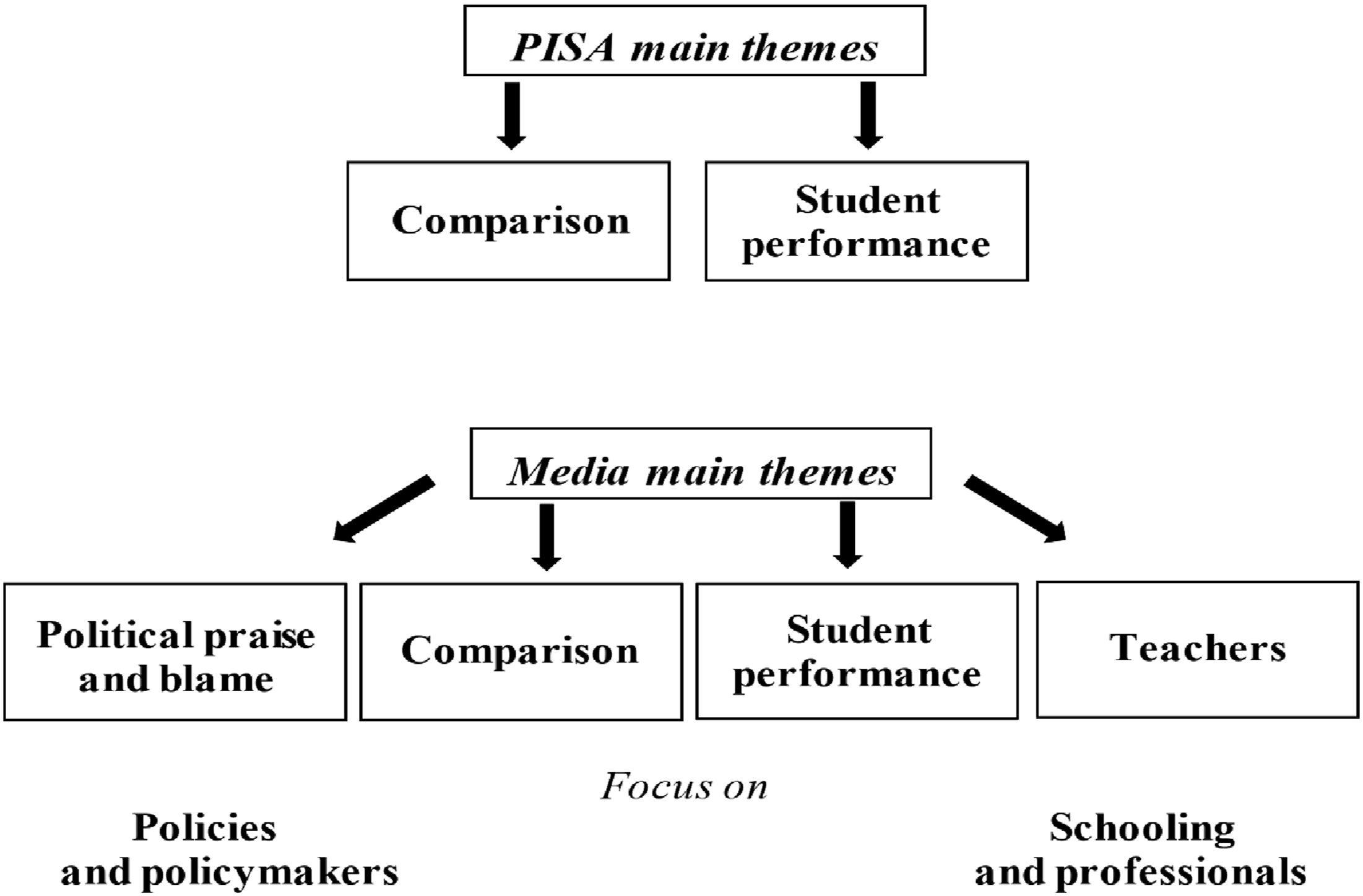
In comparison, student performance was discussed in the news articles by focusing on describing how the students performed in PISA and in maths, sciences and reading literacy, with student performance framed as ‘poor/bad’ (2001–2006 PISA cycles), and as ‘improved/good’ (2009, 2012, 2015 PISA cycles) (Figure 5). Percentage of quotations with the theme of student performance per journalistic genre per PISA cycle.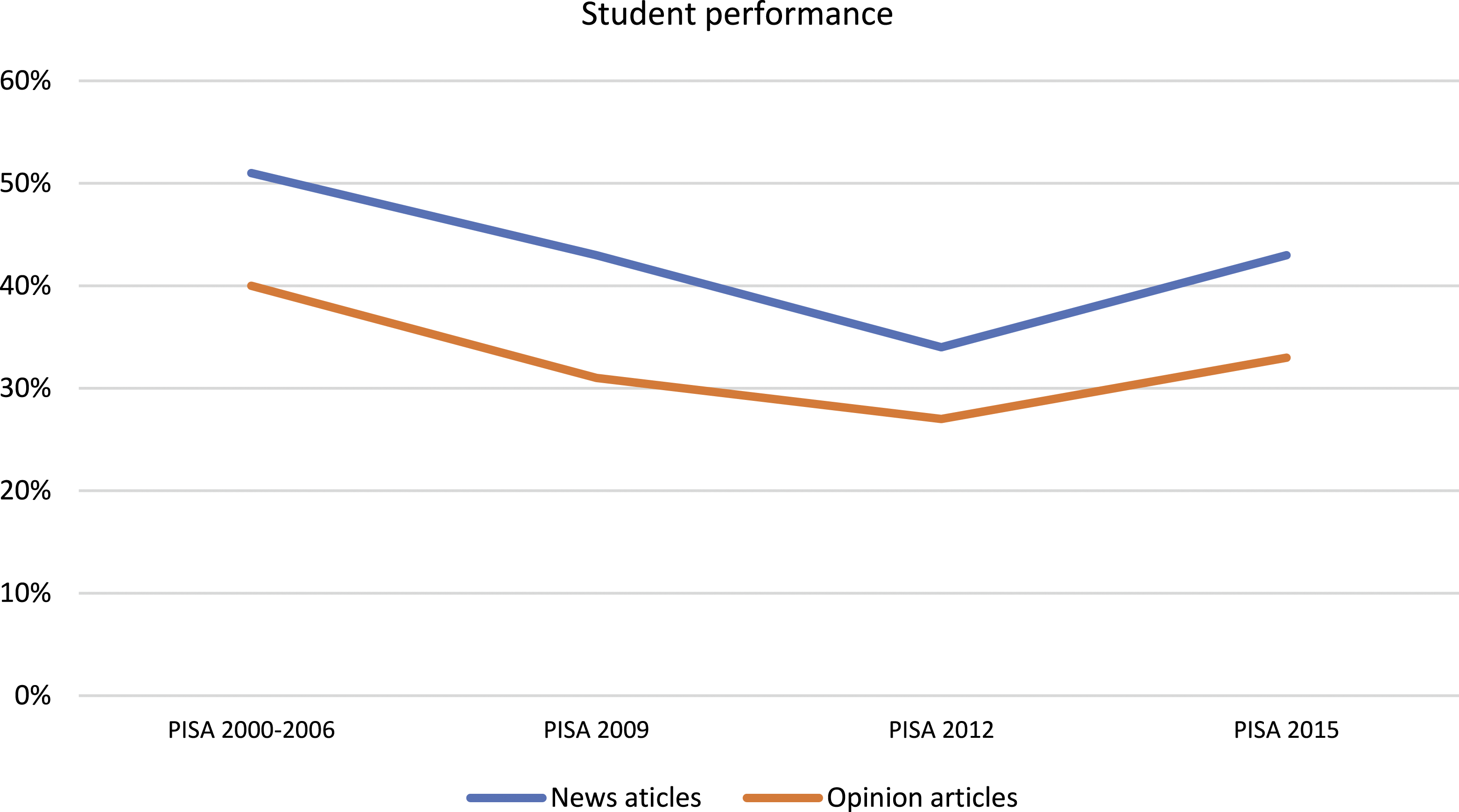
In the opinion articles, after the survey’s three initial cycles, the students’ poor/bad PISA performance was highlighted, but the main focus was on criticising the passivity with which the poor Portuguese performance in PISA 2000 was received by the XIV 5 government (1999–2002) as simply unsurprising: ‘As the minister of education said, these results are not surprising. But that was not what he should have highlighted. What should be stated is how disturbing they are’ (Público, 05.12.2001). After PISA 2009 and 2012 these articles framed the results as improved but remaining below the OECD countries’ average. In addition, after the survey’s 2012 cycle opinion articles strongly criticised the education reforms and cuts in funding made by the minister of education of the XIX government. Finally, after PISA 2015 was published there was a consensus that the performance in PISA (and TIMSS 2015) had improved significantly, surpassing the OECD countries’ average, and even surpassing the Finnish results in TIMSS 2015. The discussion on PISA also emphasised that in Portugal both the number of low achievers decreased, and the number of high performers increased, following the theme and frame as presented in the survey’s report.
Comparisons. In both article genres (news and opinion), student performance was compared with other countries, and the theme was therefore simultaneously discussed with the theme of comparisons in most articles, but with a greater incidence in the news articles, where the focus was on describing the PISA results (Figure 6). About 70% of all identified comparisons were in news articles published after the first three PISA cycles (2000–2006). Percentage of quotations with the theme of comparisons per journalistic genre per PSIA cycle.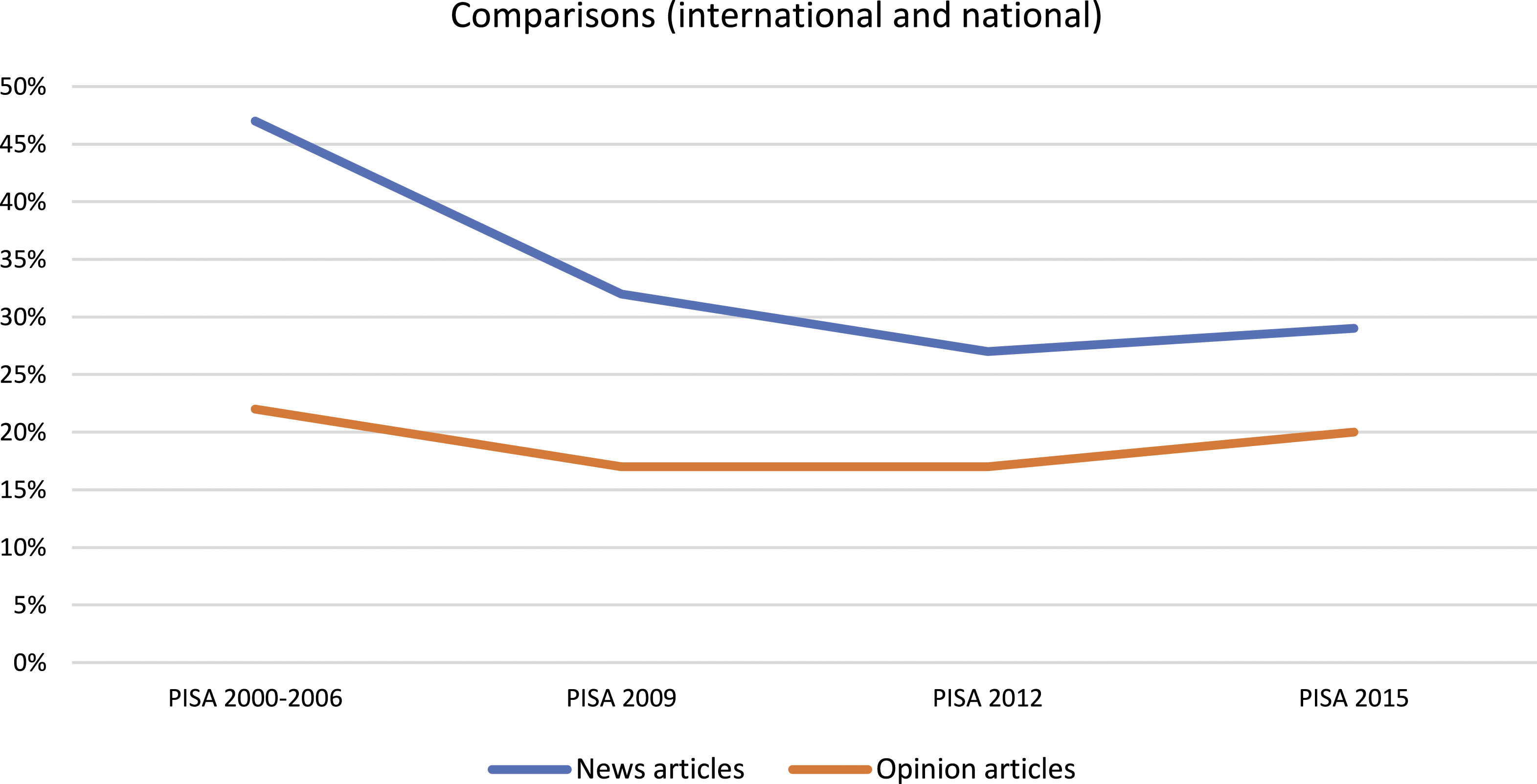
Top-5 most referenced externalisation targets per PISA cycle.
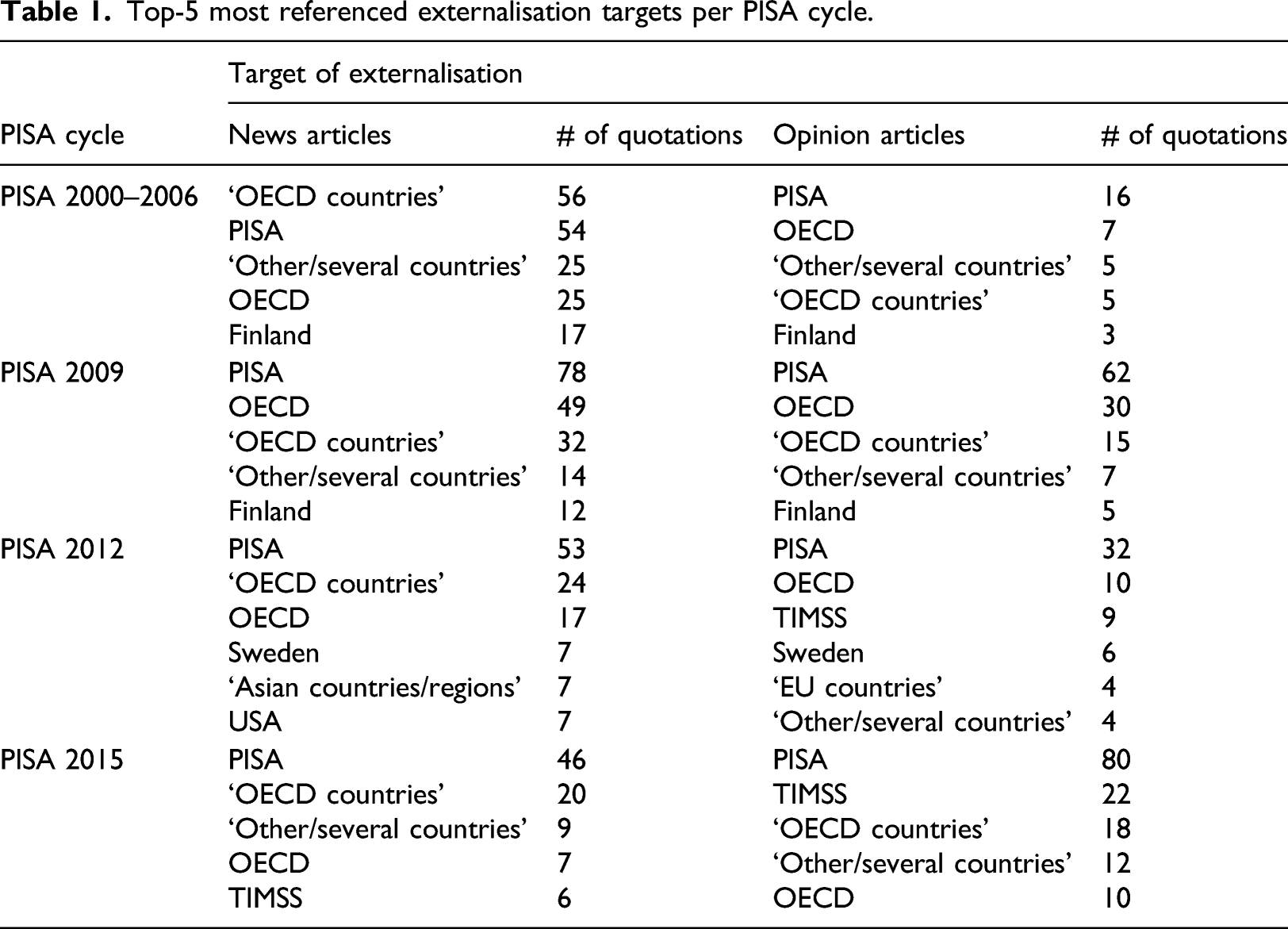
During the first three PISA cycles (2000–2006) the frames used in the discourses with comparisons were mainly negative, highlighting that the Portuguese education system was worse than in other countries or regions (‘OECD countries’, ‘other/several countries,’ Finland, Ireland), not only in performance but in Portugal’s allocation of more funding than other countries while achieving poorer results, reflecting poor funding management. In addition, while in the opinion articles some authors critically framed the PISA results as needing further and deeper analysis, in the news articles the role of grade retention in students’ performance was emphasised, as was the case in other countries with fewer retentions that performed better.
After the PISA 2009 results were published this discourse of failure changed, and both kinds of article framed the results positively as on a par with other countries or regions (‘OECD countries’, ‘other/several countries’, or specific countries, especially France, the UK and Germany) or on a par with others (e.g. Spain), and emphasising that Portugal was the country that most improved in PISA 2009. However, the opinion articles also stressed that despite the improvements, Portugal remained below the ‘OECD countries’ and far from other countries like the so-called ‘top performers’, Finland, and South Korea. Yet some positive tones framed the Portuguese performance as better than other countries (Spain, Turkey, Greece and sporadically the ‘OECD countries’.
After PISA 2012 results were made public, the comparisons continued to highlight that Portugal was on a par with other countries or regions (e.g. ‘OECD countries’, Luxemburg and France), and better than others (Sweden, Spain, the USA, Spain and the ‘OECD countries’), especially in the news articles. The opinion articles were more moderate and mostly compared the performance of Portuguese students with those in countries considered to have similar results (‘OECD countries’, France, Italy and the UK). At this time, Sweden emerged as a major reference society because of another theme that was much discussed: the minister of education’s policy proposal for increasing support for private schools and families’ choice of school. Interestingly, Sweden was used as a reference society on both sides of the discussion. Those who opposed school choice highlighted Sweden’s poor PISA results as a sign that the structure of the Swedish schooling system did not work. Meanwhile, the actors who supported the idea of expanding private education and school choice argued that the Swedish municipalities with more school choice had the best PISA performance.
In 2016, after the results of the fifth PISA cycle were launched, the comparisons usually emphasised that Portuguese students performed better than in other countries (in both journalistic genres), especially the ‘OECD countries’ and Finland (in both journalistic genres), and in Sweden, France, Cyprus and Denmark in the news articles. Both kinds of article also highlighted the OECD’s declaration that Portugal was the only OECD country that had consistently improved its results since the 2000 PISA cycle.
However, the frames focusing on grade retention were also common: Portugal was one of the OECD countries with higher retention levels despite recent improvements. The impact of grade retention on students’ learning was also described: students without grade retention performed better in PISA; Portugal would be at the top of the rankings if grade retention were not so high; grade retention was useless and had significant social effects; countries without retention performed better in PISA.
Political praise and blame games. This theme’s constant presence is unsurprising, because the political dynamics were inherently controversial, and the media was a central means of communication between the political system and the public. PISA and other external references were politicised by diverse political and social actors, becoming useful authoritative tools in the legitimation of arguments that often opposed each other, especially after PISA 2009 and the publication of the survey’s subsequent cycles (Figure 7). Percentage of quotations with the theme of political praise and blame per journalistic genre per PISA cycle.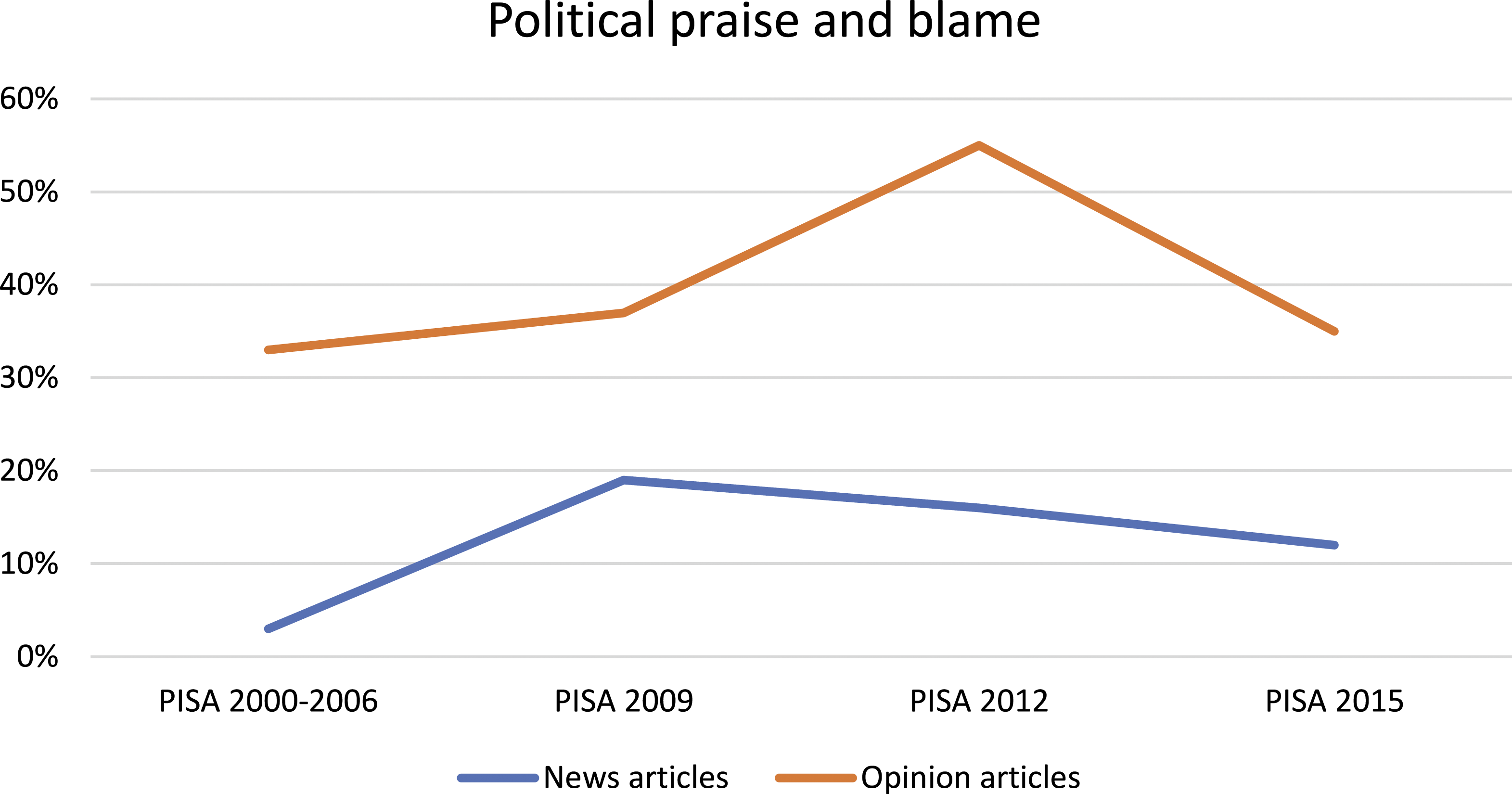
This theme was identified in 289 quotations of the total 1253. The great majority was in the opinion articles (73%), revealing the strong tendency of the authors of this journalistic genre to refer to PISA results, IOs, and reference societies in political games of blame and praise. Until 2010 the reactions of the governments to the survey results were infrequent, and the comments on government reactions, arguments and decisions also remained minimal. Nevertheless, this theme was identified in 24 quotations in the opinion articles, focusing mainly on criticising the XIV government’s apathetic reactions to the poor Portuguese results in PISA 2000.
After PISA 2009 and subsequent PISA cycles, the political blame and praise game increased and remained strong, only declining after the PISA 2015 results were published (Figure 7). The PISA results were discussed in 55% of the opinion articles published after the survey’s 2012’. The survey, the organisation that developed it – the OECD – and some of its participant countries or regions, fed political discourses which reduced present and past governments’ actions to three simple arguments: positive/good; negative/bad; or insufficient. Arguments framing the past and present governments positively emerged from these governments’ members and their supporters, and each attributed the reasons for the improvements in the PISA results and the education system in general to their own policies. When PISA 2012 results were published, Portugal was being financially supported by the Troika – the International Monetary Fund, European Central Bank and European Commission. Education was hit by financial cuts and policy adjustments, which were the main themes related to education discussed in the media. The opinion articles, especially, criticised the minister of education specifically and the government in general and their policies (e.g. reforms in the maths programme, school choice, teacher assessment, vocational education and the track system) were framed as unsuitable, problematic, and even harmful for the continuity of students’ improvement, and the quality and efficiency of the education system in general.
For the first time Portuguese students’ performance in PISA 2015 surpassed the OECD average, leading to a consensus concerning pride in the students’ improvements, and most actors agreed in framing the success in the survey as a result of teachers’ good work and the continuity of the policies of the various governments in the last two decades. However, some voices in the opinion articles preferred to focus on criticising the ex-ministers of education and their claims that their reforms alone were those that had led to the improvements in student performance.
Teachers. Themes related to teachers, their work, qualifications and relations, among others, were also constantly present in the media discussions. In the analysed opinion articles, the theme remained equally prominent throughout the timeframe, with a slight intensification after PISA 2015. In contrast, these themes remained relatively separate from the main agenda in the news articles, apart from after the publication of the PISA 2009 results (see Figure 8). Percentage of quotations with themes related to teachers per journalistic genre per PISA cycle.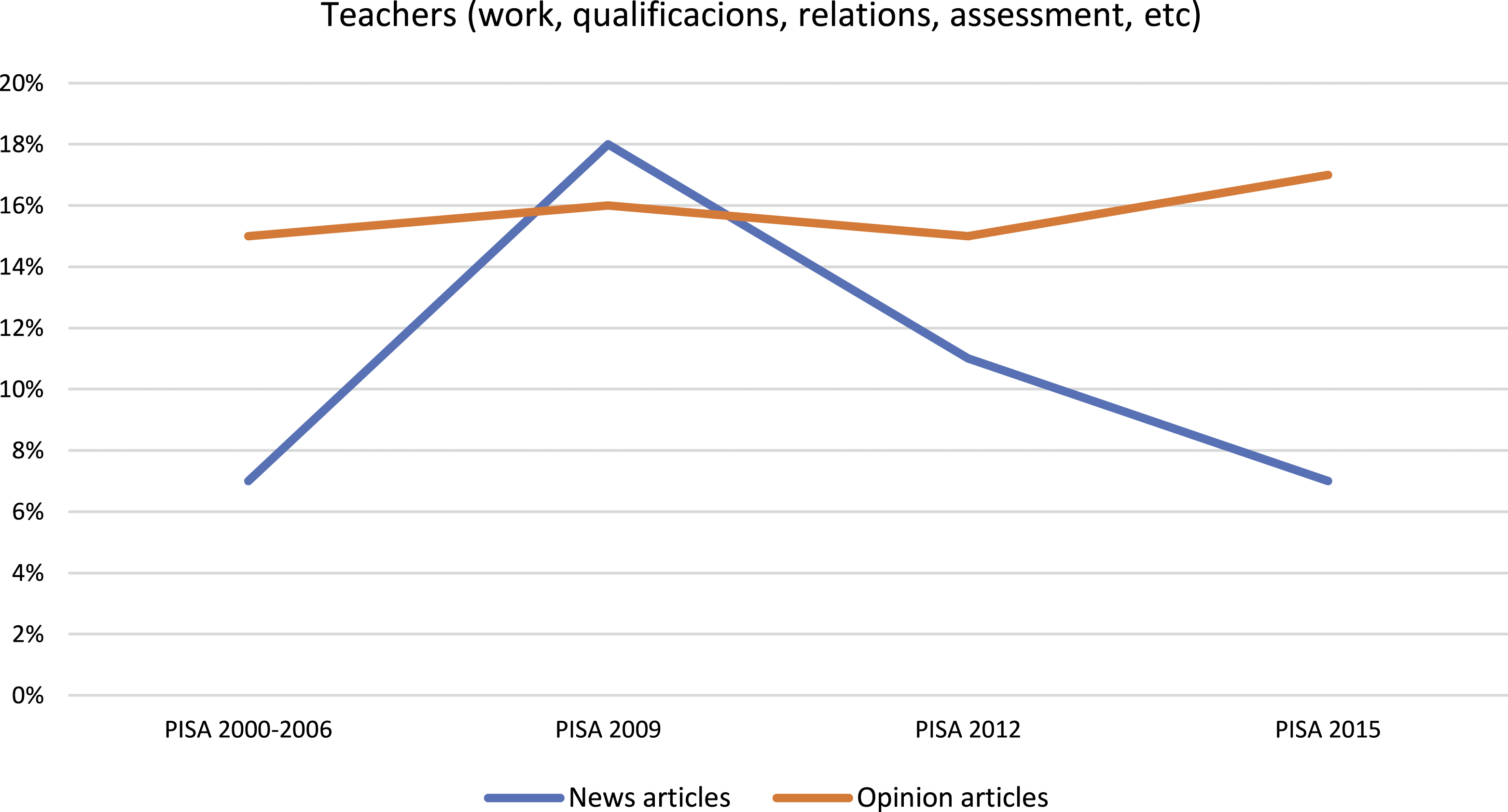
Between the 2000 and 2006 PISA cycles the news articles only sporadically focused on the theme of teachers. When they did, they reproduced policymakers’ and OECD justifications that teachers influenced student performance not only through their practices and their qualifications, but also through the relations they developed with students and parents. Teacher’s degrees should therefore be improved, while student teachers should already have a good number of practice hours in schools, and co-teaching practices should be put in place. In contrast, the opinion articles, where the theme was more frequent, engaged in a critique of the government’s justification of poor student performance with teachers’ poor qualifications and work practices.
In 2010 the discussion of this theme saw a spike in the news articles. It was present in 18% of the quotations identified during the period, slightly surpassing the opinion articles, which remained at 16%. This reflected the fact that after years of conflict with teachers, mainly with regard to their recruitment and assessment processes, the XVIII government (2009–2011), whose composition was in part the same as the XVII government (but with several different ministers, including the minister of education), intensively acknowledged that teachers were the main reason for the good improvements in PISA 2009. Instead of being appreciated, this attitude was often criticised as a political move, especially in the opinion articles, which also emphasised the need to respect teaching as a career.
After the PISA 2012 results were published the focus on teacher issues decreased and changed slightly. The minister of education of the XIX government (2011–2015) was accused of disrespecting teachers and worsening the relations between the government and teachers, particularly through the new strategy of teaching assessment that would include an exam to gain access to a career in teaching. The reforms in the maths curriculum that had led to the good results in PISA 2009 were highly criticised by teachers, who framed it as not being child-focused, on the contrary, it was too demanding and uninteresting for the children.
In 2016 the good performance of the Portuguese students in both PISA and TIMSS 2015 significantly reduced the conflicts between teachers and the government. It was now agreed that such improvements were to a great extent the result of teachers’ good work and improvements in their qualifications. The news articles highlighted the need to increase school democracy by involving teachers and other school actors in its management, especially with the new system in which a director, instead of a board, was responsible for school management. No significant differences between the journalistic genres can be seen here.
Interestingly, most of the discussed themes focused on identifying problems, or to some extent on referring to education policies and practices to justify the existence of these problems, or the presented student performance. Only rarely were concrete solutions offered to improve the education system in general or the students’ performance specifically. It is also noteworthy that in many instances the themes pushed by the media strongly followed what was highlighted by the OECD reports – for example, teachers’ work and qualifications in 2000–2006, or the impacts of grade retention and early dropouts on students’ learning after the publication of the PISA 2015 results. We believe this reveals the OECD’s influence on the Portuguese print media, which appears to confirm the organisation’s role as an agenda setter which other researchers (e.g. Mahon and McBride, 2009; Martens, 2007; Sellar and Lingard, 2013) have identified in previous research.
Nevertheless, although these themes may have been spread by the OECD’s own agenda, the frames through which they were discussed were not a simple reproduction of the IO’s position. Various media actors discussed these themes using frames to legitimise their policy choices and ideological positions (often promoting specific party agenda). A good example of this strategic framing is that after PISA 2009 was published the OECD underlined that the Portuguese improvements were related to a string of policies of recent decades, while the XVIII government’s (2009–2011) prime minister still focused only on the government’s own policies (going back only 5 years if the XVII government is included) and argued that the OECD confirmed the benefits of these policies in improving the education system and student performance. The following statement of this prime minister illustrates this well: ‘An international organisation now confirms the fairness of all the reforms we have undertaken’ (Expresso, 11.12.2010).
Conclusions
In this article we used thematisation (Luhmann, 1996) and frame analysis (Entman, 1993) to analyse how externalisations to world situations (Schriewer, 1990) made in the Portuguese print media contributed to the selection and framing of certain themes in education between 2001 and 2017. This analysis demonstrated that externalisation to world situations can help highlight specific themes in education and support a multiplicity of discourses constructing these education themes through different perspectives, depending on the observer’s stance. In the analysed Portuguese print media education was mostly discussed through a small number of themes that gained more importance at specific moments, closely following the themes in the OECD agenda, thus constructing a very reduced reality of the education system. These constructions were further simplified through a broad range of perspectives, depending on who the observer was, and what her/his views and agenda were.
The main themes on the media agenda were student performance, comparisons, political praise and blame games, and teachers were analysed, and a diversity of frames was identified. Our analysis revealed that although the themes discussed by the media were relatively constant during the 2001–2017 timeframe, Portuguese students’ performance in PISA seemed to affect the prominence of the themes in the media agenda, and the frames that were applied to them. It is possible to identify three overall tones in the discourse that dominate the majority of arguments presented in the analysed articles: a) the poor student performance in PISA 2000, 2003 and 2006 led to an unanimity in discourses of failure; b) the improvements in performance in PISA 2009 and 2015 resulted in the prominence of discourses of achievement; c) the stagnation of the Portuguese PISA results in 2012 that coincided with the social and political upheaval resulting from the financial crisis, and its related policy adjustments and cuts to public spending on education by the XIX government (2011–2015), gave rise to an intensification of discourses of crisis. While one can argue that these discourses were already dominant before the survey’s results were published, our analysis suggests that the publication of each PISA cycle results offers an opportunity to print media collaborators to expound on their favourite themes.
The media, therefore, earns the opportunity to perform its two main duties: to manage contingency with the aim of reducing the complexity of the social world and to couple with its environment and with other social systems – for example, political and public opinion systems. Indeed, we suggest that the combined process of thematising and framing functions as a mechanism for the double reduction of complexity, through which the public is influenced to focus on some education themes instead of others, and to interpret these themes through specific perspectives. External references (mostly to PISA and other references related to the survey such as the OECD and PISA participating countries or regions – most often the broad reference to ‘OECD countries’) become convenient tools that are used in arguments that attempt to achieve this double reduction of complexity and insert particular issues into the public agenda as urgently in need of action.
Moreover, a substantial amount of political criticism gained a louder voice after the publication of each round of PISA results, especially in the opinion articles after 2009. External references were politicised and used in the discussions to focus on assessing the performance of present and past governments and their education reforms, in which political actors most frequently attributed the improvements verified in the students’ performance to their own policies – and even at times appropriated policies that were already implemented when they entered government, or that were not yet implemented when the PISA survey took place.
Externalisations to world situations are mechanisms that offer the resources of ‘knowledge’ and ‘evidence’ that previous research demonstrates have become volatile and mouldable to the needs of the speaker (e.g. Santos and Kauko, 2020; Santos, 2021). The growing number of opinion articles being published gave voice to an increasing number of social and political actors to express their opinions and bring to the public debate a variety of education themes. In the analysed articles, these voices defined problems, made judgements, and sporadically presented solutions, expressing their own perspectives (mainly regarding comparisons among students’ performance at the national and international level, teachers’ work and qualifications, and political praise and blame games). In doing so, they injected constructions of the education system into the public space that attempted to earn the support of public opinion. Furthermore, these social and political actors did so by implicitly adopting the OECD/PISA categories, as in the case of news articles, within the field of the possibilities and expectations that the results (including their assumptions and analytical tables) set (Carvalho, 2012; Dale and Robertson, 2014). It seems PISA has a chain of moments of de-politicisation-re-politicisation, the former relying on the universalism of expert knowledge with the aim of legitimising governance by numbers and comparison, and the latter on the use of externalisation to world situations with the aim of legitimising distinct understandings of education.
In its focus on the Portuguese print media this paper’s analysis is strongly contextualised and therefore cannot be generalised. Yet the analysis dialogues with and combines two growing bodies of research: education research concerned with the reception and effects of global elements such as ILSAs, IOs and practices and policies of reference societies in local/national policy discussions (e.g. Carvalho et al., 2017; Elstad 2012; Santos and Kauko, 2020; Saraisky, 2015; Takayama et al., 2013); and communication studies, concerned with opinion formation and using thematisation and frame analysis (e.g. Artieri and Gemini, 2019; Baroutsis and Lingard, 2017; Camphuijsen and Levatino, 2021; Chong and Druckman, 2010; Crow and Lawlor, 2016). Indeed, our analysis demonstrates that the media provides fertile ground for externalisation to world situations. As the social world is becoming increasingly complex, media actors need more authoritative elements to legitimise their arguments, and externalisations provide such elements. This article therefore makes a twofold contribution in offering greater understanding of the entanglements between the global and the local in policymaking and illustrating the usefulness of combining thematisation theory and frame analysis in analysing the media’s role in shaping public opinion.
Footnotes
Acknowledgments
We would like to thank the members of the research group Knowledge, Power, and Politics in Education (EduKnow) at the Faculty of Education and Culture, Tampere University for their comments on earlier drafts of this article.
Declaration of conflicting interests
The author(s) declared no potential conflicts of interest with respect to the research, authorship, and/or publication of this article.
Funding
The author(s) received no financial support for the research, authorship, and/or publication of this article.
Notes
Author Biographies
Portuguese scores in PISA 2000–2015.
Retrieved from www.OECD.org
Maths
Science
Reading
PISA 2000
454
459
470
PISA 2003
466
468
478
PISA 2006
466
474
472
PISA 2009
487
493
489
PISA 2012
487
489
488
PISA 2015
492
501
498