



Abstract
The United States and Canada, two countries known to have large immigrant populations, have long since reflected a dichotomy, where Canada is generally perceived to be a country with language policies that demonstrate its receptiveness to embrace multiculturalism in schools and classrooms. In contrast, the United States has consistently espoused the notion that one is “American first” and one’s cultural identity follows behind. It is within this context that the following study examines the difference in reading literacy performance between youth in the U.S. who self-identify as native English speakers and those who self-identify as non-native English speakers on the PISA assessment. The study also explores the difference in reading literacy performance among Canadian youth who self-identify as native English speakers, those who self-identify as native French speakers, and those who self-identify as neither native English nor native French speakers on PISA. Implications for policy, practice and society are discussed.
The world is currently witnessing an unprecedented movement of people, things, and ideas. Geopolitical, cultural, linguistic, and literate borders are being crossed in new, varied, changing, and rapidly moving ways. People from around the globe are encountering one another in spaces that Vertovec (2007) refers to as “super diverse.” Furthermore, the increased incidence of multilingualism and fluidity in language and identity has resulted in implications for teaching and learning in super diverse global classrooms, and educators and community leaders are being tasked with developing multilingual and multicultural policies and pedagogies that meet the needs and aspirations of (multilingual) youth within a globalized landscape. These practices embed themselves within two different contexts: (a) those contexts with existing policies that have traditionally and historically framed a positive discourse that supports multiculturalism (in particular, multilingualism), and (b) those contexts in which policies have inadvertently or purposefully failed to provide the supports for diverse students that schools serve. As two examples of this dichotomy, the United States and Canada both represent countries known to have large immigrant populations with widely divergent immigration and education policies as regards multicultural/multilingualism. Canada is generally perceived to be a country with (education) policies that embrace multiculturalism, entrenching it both in the classroom and its society. In contrast, the United States has tended not to demonstrate this same receptiveness to diversity (Ungerleider, 2007).
If indeed the United States’ policies towards language and multiculturalism are more restrictive than those of Canada, one would expect that comparing immigrant youth literacy performance in these two countries could provide a valid indicator of the potential influence of these policies on diverse student populations, particularly in terms of their reading literacy.
Our investigation was premised on the basic assumption that a policy that embraces diversity is more likely to realize better literacy performance among immigrant youth than one that is restrictive. We ascertained that one valid way to test this linkage between multicultural (and more specifically language) policy and literacy performance of these two countries was to first establish, through a review of literature, if and how they are addressed in both settings. We then employed an international measure, the Programme for International Student Assessment (PISA), to compare the literacy performance of two groups of students, one from the United States, and one from Canada. Our research was framed around the following questions: What is the difference in reading literacy performance between youth in the U.S. who self-identify as native
1
English speakers and those who self-identify as non-native English speakers on the PISA assessment (both before and after controlling for students’ demographic characteristics)? What is the difference in reading literacy performance among Canadian youth who self-identify as native English speakers, those who self-identify as native French speakers, and those who self-identify as neither native English nor native French speakers on the PISA, both before and after controlling for students’ demographic characteristics? What is the difference in reading literacy performance between Canadian youth who took the PISA assessment in their native language and those who did not, both before and after controlling for students’ demographic characteristics? What is the difference in reading literacy performance between youth in the U.S. and Canada who were assessed on the PISA in their self-identified native language and those who were assessed in a non-native language?
We believe that a study of this nature extends conversations about how language policy functions across multilingual countries and contexts (see for example, Palacios-Hidalgo et al., 2021) and brings to the fore lingering discussions regarding how policy shapes practice. This study also challenges the rhetoric of policies and practices that have the tendency to view multiculturalism/multilingualism as deficits rather than assets. Before delving into an examination of policies and practices in these two countries, we briefly lay out comparatively, a discussion of the literature, to demonstrate that both Canada and the U.S. are multicultural in nature. Through a theoretical analysis, we then seek to illustrate how, even with similar cultural features, a country’s language and literacy policies and practices can lead to different results in reading literacy performance. Our methodological approach to the study is then presented, followed by our findings and a discussion that includes implications for the field.
A comparative overview of Canadian and American cultural and linguistic history
Both Canada and the United States possess a history marked by a French/English colonial presence, plundering (as was the custom of the day) but also settling peoples in new colonies (Encyclopedia Britannica, 2020; The Library of Congress, 2020). The first colonists encountered First Peoples who had their own languages and cultures. Over time, these cultures were eventually subjugated by the mother country such that Indigenous people (i.e., first peoples) were obliged to adopt the official language(s) of the colonizers. Today, only a handful of First Peoples have retained some aspects of their culture and language. Out of this historical colonization, the United States emerged with one de facto official language, English. Canada’s historical trajectory saw both England and France holding dominant power and, as a result, the country began its linguistic story with two official languages: English and French. The official entrenchment of these colonial languages became a deliberate policy and strategy of European colonizers, not just in Canada and the U.S., but also, across the New World (Thompson et al., 2011). Despite their colonial histories forging official languages that were defined by their colonial powers, both the United States and Canada are today described as multicultural societies. The two countries have depended on the flows of immigration to build their nations (Ibrahim, 2019) and as a result, they now comprise populations of diverse races, ethnicities, languages, religion, and heritage.
Until the mid-1900s, most immigrants to the United States hailed from Europe, but by 2017, some 57% came from Asia and Latin America, with the remaining 43% originating from across the globe. In fact, using 2016 statistics, Alperin and Batalova (2018) calculated the number of European immigrants to the United States at just 11% of the overall 44 million immigrants. In 2017, more than 44.5 million immigrants (people born outside of the country) resided in the United States. This represented 13.7% of the overall population of 325.7 million. Currently, immigrants and their U.S.-born children account for 28% (89.4 million) of the United States’ population (Zong et al., 2019).
In the Canada 1871 census, as reported in The Daily (Statistics Canada, 2017b), most immigrants to Canada were from Europe (over 80%), with the majority coming from the British Isles. Like the United States, The Daily (Statistics Canada, 2017b) reports that the intervening years between the census years 1916 and 1971 showed significant and steady shifts in migration flows. The 2016 census in Canada, which is the second largest country by land mass in the world, cited a population of 35,151,728 people (Statistics Canada, 2017a). Of this population, 7,540,830 million (21.9%) were immigrants (Statistics Canada, 2017). By 1971, though continuing to be the largest represented group (remaining around the 80% mark), other European countries combined (excluding the British Isles) made up a larger demographic. By 2016, a demographic change started occurring, with over 60% of migrants coming from countries outside of Europe. Asia alone accounted for 48.1% of immigrants while European immigration showed significant decline, representing 27.7%. The remaining 24.2% of immigrants were from other parts of the world, with significant numbers from Africa, and from Latin America and the Caribbean.
The 2016 Census in Canada reports that although most immigrants reported being able to conduct a conversation in the official languages of French or English, there was a significant decrease from 1921 to 2016 for those reporting either of these two languages as their mother tongue (Statistics Canada, 2017b). This revelation of mother tongue representation among more recent immigrants seems- illustrative of the clear shift from Eurocentric to more global demographics, resulting in the multicultural mix that now exists in Canada. Along with the current linguistic diversity, the 2016 census reported that the population of Canada comprised over 250 ethnic origins, including its First Peoples and those of European descent (Statistics Canada, 2017b).
In the case of the U.S., Rumbaut and Massey (2013) posit that the country has traditionally been one in which several languages were spoken. At the time of independence, along with English and the many languages of the First Peoples, there were, for example, many speakers of German, African languages, and, later, Spanish. Rumbaut and Massey (2013) estimate that in the early period, about a third of all Americans spoke a language other than English. The authors report that this linguistic diversity continued to increase as the country developed, with occasional lapses. One major lapse, for example, was just before 1970 (1944–1970). During this time frame, monolingualism was more the norm than the exception, to the extent that the Census Bureau stopped asking about mother tongue. After 1970, there was a major upsurge in linguistic diversity. During this period, 48 percent of immigrants reported speaking English less than “very well” (Zong and Batalova, 2019). As with Canada, this large percentage of languages other than English represented within the U.S. borders, demonstrated the dynamic nature of this demographic shift in both countries. In fact, in terms of race and ethnicity, the United States determined there are six official demographic categories: White, Black or African American, American Indian or Alaska Native, Asian, and Native Hawaiian or Other Pacific Islander (United States Census Bureau, 2020). However, it appears that Americans identify more specifically with other ethnic groups from all regions of the world.
We recognize that the multicultural nature of Canada and the U.S. goes beyond immigration and language, but for this paper the major focus is on language while acknowledging other key features of diversity. We chose language as the central feature of multiculturalism since the measure used in this study, PISA (a literacy test), reflects the major variable, “language identified by the students as their home language”, as well as another variable, “language in which the test is taken.” In considering language as such a major variable, we acknowledge the U.S. and Canada as being societies whose populations are largely multilingual, often operating based on heteroglossic norms (García, 2009) in their daily lives, even while the schools (and other organizations) within these societies often operate based on legislation undergirded by monoglossic language ideology (García, 2009), which is constantly at odds with the linguistic realities of children and youth.
Aligned to some degree with language as being socially influenced, “literacy” as defined by PISA, represents students’ readiness for everyday reading-related tasks that they may face after leaving school and is measured based on their capability to put their knowledge into practical use (OECD, 2006). This definition is partially consistent with conceptions of multiple literacies that are socially situated, functional, and culturally informed and thus reflect how students make meaning in an increasingly multicultural and multilingual world (New London Group, 1996; Street, 1995). It presents a stark contrast to typical assessments of literacy achievement that focus on measuring reading-related skills that students have mastered at school. Instead, the definition highlights how meaning-making occurs beyond the linguistic mode and across multiple other modes (e.g., gestural, audio, video; Karkar Esperat, 2019; New London Group, 1996), allowing for an emphasis on the social elements that influence students’ literacy performance based on multicultural and multilingual realities. We believe that the multicultural policies (including their language aspects) of Canada and the United States may in part be responsible for the differences in reading literacy performance within and across these countries on the international PISA reading literacy test which, to some degree, considers the social and linguistic realities of youth.
Cultural alloys and heterogeneous mixes
Earlier, we acknowledged the multicultural nature of both Canada and the U.S. Nevertheless, multiculturalism goes beyond the surface or visible features such as race, ethnicity, heritage, and language (see Aspinall and Hashem, 2011; Cocchiara et al., 2006; Harrison et al., 1998). We acknowledge the importance of these features, recognizing also, that multiculturalism includes such characteristics as attitudes, identity, and how individuals and groups are positioned in society. For example, a deeper discussion of multiculturalism should consider attitudes of the dominant group towards visible differences in non-dominant groups. This can lead to further discussion as to whether or not non-dominant groups should be allowed to retain their (cultural) identities as they strive to position themselves in the society.
In many societies, whether they espouse multiculturalism or not, non-dominant groups often struggle to negotiate or establish their own identities (Warrican, 2020). In many cases, there are overt policies that seek to maintain societal norms and values with clarion calls for citizens and residents to have a particular way of being. Such ways of being are generally those of the dominant groups and, as such, non-dominant groups are often forced to position themselves in ways that conform to the ascribed norms. In these societies, the constructs of attitude, identity and positioning are exercised overtly and covertly in the struggle for the maintenance or disruption of cultural norms. They are all interrelated constructs that often work together. For example, the attitude of the dominant group to a newly arrived immigrant in a country who decides to speak his/her home language publicly can determine whether that language is then relegated to private spaces only, or spoken openly in light of acceptance, or as a show of resistance This is of course linked to identity, as the dominant group either embraces the identity of the immigrant, or through negative demonstrations of attitude, seeks to force its ways of being on new residents (Warrican, 2020).
The power relationship demonstrated through the attitude of the dominant group and the stance taken by the non-dominant group (in this case, the immigrant) is a show of positioning (Harré and Van Langenhove, 1999). For Harré and Van Langenhove (1999), positioning is linked to local moral orders, as well as associated rights and obligations of speaking and acting in society. It is about how these moral orders, rights and obligations are shared or contested in environments that demonstrate high levels of fluidity. The fluidity allows for a lack of fixed form as individuals are [re]positioned by others, or they [re]position themselves as a show of asserting their identity, possibly as a response to the attitude of the dominant group (Smith, 2019).
Through a discussion on attitudes, identity, and positioning, we are able to do more than a surface examination of multiculturalism in Canada and the U.S. These concepts in fact help us to understand what multiculturalism means in both contexts. While both countries can be seen as “melting pots” where diverse people meet and where people go to seek opportunities, there is a perception by some that the experiences in both countries are linked to attitudes and identity and ultimately how people position themselves vary significantly. For example, Ungerleider (2007), in highlighting the contrast in the two countries, had this to say: In the United States, democracy was considered the crucible in which differences among immigrants would be melted and forged into a new American alloy…Canada has tried to become a society in which its citizens can retain the characteristics and values of the groups with which they identify. The belief…is that Canadians should be able to retain the characteristics and values of their ancestors, so long as that retention does not create inequality. (p. x)
Using Ungerleider’s chemistry analogy, it seems that both countries strive for a mixture, but of different types. The American way seems to be that of a homogeneous alloy where all the elements are melted to become a substance where the original components are not readily discernable. As early as 1919, for example, the majority of the states in the U.S. had adopted English-only instruction laws. The U.S. Bureau of Education played an active role in propaganda efforts encouraging Americanization by publishing an Americanization Bulletin and other forms of literature to promote, for example, the replacement of immigrant languages and cultures with Standard English and what was perceived as the American way (Irwin, 1923). This may no longer be overtly written in language policies, but Ungerleider (2007) suggests that it was at least the prevailing perception.
The Canadian way, on the other hand, seems more of a heterogeneous mixture where the constituent elements remain distinct. Thus, while in both contexts, diversity is espoused, it is seemingly manifested differently. In the U.S., there appears to be acceptance of diverse people but with the apparent belief that there is a single way of being, while for Canada, there is also seemingly the acceptance of diverse people, but with a view that they retain their original way of being. Blanding (2013) points out that the Multicultural Act of 1971, for example, explicitly expresses the desire for residents to remain rooted in their cultures. While the act nationally acknowledged the country as officially bilingual, it also framed bilingualism within the context of multiculturalism. Essentially, what this means is that non-dominant groups are encouraged, and to some extent, supported, in attempts to preserve their heritage languages and cultures.
Ungerleider (2007) went on to posit that the difference between the Canadian way and the American way could be linked to population size. Canada’s outlook on diversity could be linked to the possibility that though it is the second largest country in the world, it is one of the least populous, and as such, depends heavily on immigration. Canada, Ungerleider pointed out, depends on immigration to keep its population viable to ensure its survival. It is a society that seems forced to ensure it is welcoming to immigrants, as without them there may be limited human resources to meet labor demands. The U.S., on the other hand, is densely populated and until recently, seemed more likely to maintain a viable workforce through live births (Kearney and Levine, 2021).
Such attitudes towards diversity, coupled with policies, surely can affect self-identification. The expectation is that attitudes or policies that encourage non-dominant groups such as new immigrants to aim for the values of a country without shedding their home culture, or forcing them to do so, will affect their identity and how they position themselves. It seems reasonable to expect that in Canada, where cultural heterogeneity is perceived to exist, and where it is permissible or desirable for immigrants to retain their home languages while striving for competence in French and/or English, immigrants would not be shy about speaking their home languages in public (see Cummins, 2014b for a discussion). Using the same line of argument, in a context where a cultural alloy is the expectation, new immigrants to the U.S. may restrict themselves from speaking their home languages in public (see Warrican, 2020 for a discussion). Ungerleider (2007), however, highlighted that identity and positioning is not as simple as an obvious anticipated response. They point to what they consider to be an irony. The U.S., they claim, is the country that is populated by people “who cling tenaciously to their heritage cultures and languages [where] neither sustained messages encouraging assimilation nor episodic attacks such as English-only laws seem capable of completely eradicating difference” (p. xiii). Ungerleider, in portraying what he considers the irony of Canada, states that in a country “with its officially declared vision of a society in which it is permissible – even desirable – to retain one’s cultural self-identification and home language, heritage language retention beyond the second generation is infrequent and beyond the third a rarity” (p. xiii).
Ungerleider’s (2007) depiction of the irony of Canada and the U.S. is illustrative of the complexity of cultural identity and positioning. Several writers (Moje et al., 2009; Smith et al., 2020; Warrican, 2020; Yoon, 2012) have in fact written on both the interplay between identity and positioning and the complexity of how individuals position themselves or are positioned by others. According to Yoon (2012), the ways in which an individual’s identity stands out is dependent on context. Sometimes, an individual may assert or minimize his or her identity and position himself or herself. On other occasions, the individual may be positioned by the group. Yoon also suggests that there is a level of fluidity in how individuals position themselves, in that it is possible to see the same individual shifting his or her stance, again depending on the context. Davies and Harré (1990) characterized how individuals position themselves or are positioned by others as being intentional (deliberate act by the individual) or interactive (placed by the group).
It is worth noting here that the characterization by Ungerleider (2007) of the U.S. and Canada depicting forms of multiculturalism that can be likened to alloys and heterogeneous mixtures, respectively, seems more of an opinion, and to some extent, can be challenged. Ungerleider’s notion of holding on to heritage languages regardless of language policy seems not to always hold in the U.S. context. For example, in 1919, most of the states adopted English-only instruction laws. The U.S. Bureau of education played an active role in propaganda efforts encouraging Americanization by publishing an Americanization Bulletin and other forms of literature to promote the replacement of immigrant languages and cultures with Standard English. Some immigrants complied in the Americanization ethic and refused to pass their heritage languages to their children hoping that English monolingualism would ‘save them’ from being discriminated against (Waters and Jiménez, 2005). In the United States today, at times, there also seems to be little evidence to demonstrate any significant change from 1919, such that in a comparative study involving students from the United States and Sweden, immigrants appeared to reflect lower civic knowledge than their native-born peers in both countries, with language spoken in the home partially explaining some of this difference (Barber et al., 2015). Essentially, it seems that on the surface, a policy that hopes for an alloy or for a heterogeneous mixture is not sufficient to guarantee any desired results in either country.
Admittedly, multicultural or language policies are not just ‘played out’ in the wider society; they are also enacted in schools. Thus, though a language policy can possibly affect decisions that immigrant children make when they become adults, a more immediate influence may be observed in the effect of these policies on the willingness of young immigrants to participate in classroom activities. For example, as Yoon (2012) suggests, the enactment of such policies in classrooms may cause students of non-dominant groups to demonstrate acts that range from resistance to active participation, or to position themselves in ways that their true identities are minimized, believing that they would more likely be accepted by their peers. For instance, in comparisons between U.S. and Cosa Rican students, U.S. students were more likely to reflect “ethnic nationality” in how they reported their identities in addition to being civic-minded. They also tended to show a more cosmopolitan perspective than their Costa Rican peers (Solano-Campos, 2015). Using Yoon’s logic, the anticipated response to policies that value and embrace heterogeneous mixtures seems more likely to encourage active participation in classrooms rather than resistance and superficial acceptance. On the other hand, policies that call for a single way of being (cultural alloy) may be more likely to result in resistance or passivity in classrooms. As we have shown in the earlier discussion, such reasoning, though it appears logical, is not always manifested in such a manner. It seems prudent to consider the indication by Yoon (2012) that the interplay between identity and positioning is quite complex and as such, responses by students of non-dominant groups to peers or teachers in classrooms can be quite unexpected.
From the discussion thus far, it seems that no firm conclusion can be “drawn regarding how” non-dominant groups respond to multicultural or language policies in Canada and the U.S., respectively. Scholars have opined on the value of both the Canadian and American way and even situate them philosophically. In some instances, both approaches seem to point to similar outcomes, while in others, to contrasting ones. With mixed opinions and no clear answers emerging, it seems prudent to look elsewhere to judge the effects of multicultural and language policies. For us, the school is one such place where answers can be sought, since in both countries, there are large numbers of children in schools whose first language may be considered by some as subordinate to the official language(s) of instruction in the two countries. In both countries, these children share the characteristic of being educated in settings in which they must navigate classrooms and learning activities in the language(s) of the dominant group. These children seem to bear an extra burden of worrying about whether the cultures and languages that they bring to the classroom would be accepted or ridiculed by their teachers and peers. This burden is reflective of the wider society where many adults who have first languages different from the official ones must make decisions on how to act in the public, whether to fit in or to defy the ways of being of the dominant group. Perhaps the most heartening difference between the wider society and the classroom is that effective teachers can create an environment in the classroom, of tolerance and acceptance, one in which affected students can be free to express themselves.
One should always bear in mind that in relation to schooling, the key is to have well-trained teachers (see Cummins et al., 2012). It is possible that multicultural and language policies and their references to non-dominant groups can be deliberately ill-intentioned, or even when well-intentioned, can be misinterpreted. Consequently, teachers need to be well prepared to provide effective instruction in classrooms that are culturally and linguistically diverse (Cummins et al., 2012; Ladson-Billings, 2014; Li, 2017; Paris, 2012). The expectation is that in the classroom, teachers must have an awareness of how non-dominant groups are affected by their practice as well as their attitudes to their students. They should be aware that their attitudes to issues of identity will impact how their students of the dominant culture position the students of the non-dominant groups and how the students of non-dominant groups would position themselves. For example, Alidou (2000) warns against linguicism in classrooms where teachers and students of dominant groups legitimize and ensure an unequal division of power to devalue the non-dominant groups’ linguistic heritage. Is it possible that linguicism may exist to similar degrees in both the U.S. and Canadian contexts? With a multicultural policy that calls for the embracing of heritage languages, it seems that in Canadian classrooms the expectation should be that linguicism is not likely to be pervasive. However, the absence or reduction of linguicism may really only be achieved with training that brings these issues to the fore.
Acar-Ciftci (2013), though highlighting some challenges with the Canadian multicultural policy in practice, speaks to the fact that to counter linguicism, the federal government of Canada offers support to programs of multiculturalism with some level of acceptance to heritage languages. Acar-Ciftci also points out that among several other initiatives, and though more can be done, there are instances (in some provinces more than others) where heritage languages are used in classrooms up to third grade as students learn the world in their language before experiencing the official and new language of French or English. In other cases, there are heritage language classes that support students of non-dominant groups. These initiatives, to some extent, demonstrate a level of respect for languages other than the official ones, something that, according to Alidou (2000), seems to be absent in the U.S. In the U.S., Alidou argues that linguicism is a prominent feature of many schools, to the point where the acceptance of languages other than English is nil.
We should, however, not simply juxtapose Alidou’s observation with the initiatives highlighted by Acar-Ciftci (2013) to make a judgement on how multilingualism and multiculturalism play out in the education system of Canada and the U.S. The easiest conclusion seems to be that Canada has got it right and the U.S. has not. However, Burnaby (2008), in a historical overview of Canadian policy vis-à-vis language education, suggests that “one would scarcely believe that Canadians speak languages other than English and French” (p. 334), since federal documents emphasize the rights of Francophone and Anglophone communities and “refer to speakers of non-official languages as other cultural groups” (p. 334). Canada continues to face the challenge of locating the ever-rising multilingualism within a national policy that articulates this reality.
Clearly, the translation of multicultural and language policies into practice in these two countries is complex. For instance, in comparative studies on cultural diversity and its relationship to reading based on comparisons between the U.S. and other nations (i.e., Netherlands), indications have illustrated that the U.S. as well as the Netherlands observed tensions between the prescriptiveness of programs and flexibility needed to support students who struggle with literacy as well as cultural and contextual nuances which created variations in supports provided to students who struggle with reading (Hingstman et al., 2021). Other studies on the U.S.’ participation in international large-scale assessments have reinforced the need for more detailed ways of representing student backgrounds when they have a first language that is not the language of assessment (e.g., Plisko, 2013; Smith et al., 2018b). In Canada, studies focused on inclusion across multiple provinces reflected a tendency to focus more on social inclusion in curriculum objectives than on academic inclusion, highlighting that reasoning which “appears inclusive of all can also carry many ideas, identities, and patterns of conduct that are exclusionary” (Bélanger and Gougeon, 2009; Bloch et al., 2006: 22). Cummins, Mirza and Stille (2012) confirmed this assertion, noting significant gaps in Canada in “the extent to which coherent policies have been formulated at all levels of the educational system to address the implications of linguistic diversity for instruction” (p. 27). The authors observed that: …many educators who work with bilingual students and English language learners (henceforth bilingual/ELL students) have had little preparation either in teacher education or through professional development to equip them to teach effectively in contexts where linguistic and cultural diversity is the norm. (p. 27)
Specifically, examining PISA reading literacy in the Canadian context with a focus on immigrants, Cummins (2014a) has observed that linguistic diversity, socioeconomic background and students’ marginalized status function as sources of disadvantage in performance on the assessment, observing that students tend to “perform better in countries such as Canada and that have encouraged immigration during the past 40 years”, “that have a coherent infrastructure designed to integrate immigrants into the society” and that have “explicitly endorsed multicultural philosophies at the national level aimed at promoting respect across communities and expediting the integration of newcomers into the broader society” (para. 3).
The complexity of how multicultural and language policies thus translate into practice is subject to multiple understandings and the associated outcomes of these policies are to a large degree, left up to subjective interpretations. From our review of the literature, we do not believe we are in a position to draw any firm conclusions about exactly how policies of language or culture affect non-dominant groups in Canada (i.e., “non-native speakers” of French and/or English) or the U.S. (“non-native speakers” of English). We have no doubt that they affect such groups, but we cannot say with any certainty that any one context is better than the other, or exactly what the effects of the policies are. We thought that we could take this discussion beyond just a conversation on the effects of multicultural and language policies to a more empirical investigation drawing on existing data from PISA results.
We have decided to apply what we think we know about the effects of multicultural and language policy to the school context as it is a contained environment that, for example, facilitates observation and measurements of the impact of the policies of interest. While the current investigation has no observational evidence, it relies on measurements obtained from the PISA 2018 results. We are aware that it is already established that Canada performs better on PISA than the U.S., and while we will look at that performance in our analysis, our major interest is linked to how non-dominant groups who are affected by language and culture fare on these assessments across and within countries. Though we would not be able to make definitive statements about causation, we believe that we can still infer linkages between the multicultural or language policies and practices of the two countries in the study and their literacy performances. The aim is to provide sufficient linkages to merit further investigations in classrooms in these two countries. Such investigations would provide a more in-depth understanding of how teachers and students interpret these policies and the reaction evoked from different interpretations. This paper presents the initial investigation that we hope would advance the study of this phenomenon.
Methods
We conducted a secondary analysis on the data retrieved from the Programme for International Student Assessment (PISA) in 2018. PISA is a cross-nation survey that aims to measure students’ academic competencies in reading, mathematics and science as well as creative problem solving. The administration of PISA usually occurs every 3 years. The 2018 PISA assessment is the seventh cycle of the survey that had approximately 600,000 15-year-olds from 79 countries and economies participating. In contrast to previous research that has examined PISA reading literacy in Canada in relation to a country with similarly structured multilingual and multicultural legislation at the national level (i.e., Australia) (Cummins, 2014a), we chose to compare PISA reading literacy across Canada and the U.S. given the interaction of federal policy favoring multiculturalism present in Canada but absent in the U.S., where implementation of education in the U.S. is leveraged at the state or provincial and not the federal level. Moreover, we acknowledged that the PISA assessment and its use has been increasingly linked to accountability across much of the Organisation for Economic Co-operation and Development (OECD) over the past 15 years (Teltemann and Jude, 2019) even while critiques persist relating to the underlying view of literacy education and assessment reflected in PISA, its implementation, and its interpretation and impact on education globally (see Smith et al., 2018a, 2018b, 2020; Zhao, 2020).
Participants
Data were drawn from the publicly accessible student and school questionnaires of the 2018 PISA assessment. U.S. and Canada data were selected for the analyses in the current study since these two countries are neighbors, share a similar history and both are multilingual and multicultural in nature. A total of 4838 and 22,653 students formed American and Canadian samples, respectively. In Canada, the assessment was administered in either English or French according to the school system, while English is the only assessment language in the U.S. (OECD, 2018). Of students in the U.S. and Canada, 49.92% (n = 2361) and 50.16% (n = 9775) were females, respectively. Students’ ages in PISA 2018 ranged from 15 years and 3 months to 16 years and 2 months, and all students were enrolled in an educational institution at grades 7 to 12 at the time of assessment (OECD, 2018).
Variables
The variables used in this study were reading literacy, language at home, language congruence, and socio-demographic variables including gender, grade, socioeconomic status (SES) and school type. All these variables were retrieved from student and school questionnaires in PISA 2018.
Reading Literacy: The PISA reading literacy assessment involves understanding and participating in written texts and applying the reflection and interpretation to achieve personal goals and real-life challenges (OECD, 2018). As mentioned earlier, OECD definitions of reading literacy increasingly align with conceptions of literacy as socially situated, functional, and to a certain degree, culturally informed (for discussion, see OECD, 2006; Smith et al., 2020; Street, 1995). Yet, questions continue to be raised regarding the degree to which this definition provides opportunities for youth to draw from their wide range of literacies, regarding students’ designation as “native speakers,” and the degree to which such a designation may differ for students who speak multiple Englishes (Smith et al., 2019, 2022). Our decision to use PISA reading literacy in the current study thus represents a direct response to such concerns, which, as Zhao (2020) has recently observed, continue to be largely overlooked. We focus comparatively on PISA reading literacy in the U.S. and Canada, which are both multicultural and multilingual countries, but which reflect differences with regards to policy making and implementation surrounding linguistic and cultural differences in education.
Because each student completed only a subset of the assessment items, PISA 2018 provided 10 plausible values to represent a student’s reading literacy ability. All 10 plausible values were used as dependent variables simultaneously for multilevel analyses with the MPLUS command of “imputation” (Muthén and Muthén, 1998–2017).
Language at Home: The variable of Language at Home is the variable for students to identify which language they spoke at home. Two language categories were used for the U.S., including native versus non-native English speakers, whereas three categories were used for Canada, including native English and French speakers versus non-native English/French speakers. Non-native speakers were used as the reference group in statistical analyses.
Language Congruence: The variable of language congruence indicated whether students’ language at home was consistent with language of assessment. There were two categories for language congruence: One was “language of test” and the other, “other language”. The language of testing category indicated language congruence and the other language category represented language incongruence. Students in the language incongruence category were used as the reference group.
Socio-demographic Variables: This study included students’ gender (male vs. female), grade, school type (public vs. private), and socioeconomic status (SES) as socio-demographic variables. Males were used as the reference group for gender. Grade was categorized into three categories: below 10th grade as the reference category, 10th grade, and above 10th grade. Public schools were the reference group for school type. As for socioeconomic status (SES), PISA 2018 formulated a single index for SES involving five different domains: parental education, parental occupation, cultural possessions owned by the student’s family, family wealth, and availability of educational resources at home. In our analysis, SES was standardized across countries with a mean of 0 and a standard deviation of 1.
Statistical analyses
Descriptive statistics were computed for studied variables and multilevel regression analyses were conducted to investigate research questions. Two-level regression analyses were applied: level-1 was the student level and level-2 the school level. The numbers of clusters (schools) and average cluster size were 164 schools and 30 students for the U.S. as well as 821 schools and 28 students for Canada. The intraclass correlations (ICCs) for U.S. and Canadian samples were 0.20 and 0.16, respectively. Moderate ICCs, large numbers of clusters and large cluster sizes showed that multilevel analyses were more appropriate statistical analyses for this study than single-level ordinal least square (OLS) multiple regression analyses.
The dependent variables were reading literacy scores. The level-1 (student-level) predictors were language at home, language congruence, gender, grade, and SES and the level-2 predictor (school-level) was school type. The student-level and school-level weights were extracted from PISA 2018 and applied in the multilevel analyses. Based on research questions, multilevel analyses were conducted for U.S. and Canada samples separately, and for the combined sample as well. All the analyses were performed using MPLUS 8.3 (Muthén and Muthén, 1998–2017) with maximum likelihood with robust standard error estimation (MLR) that is robust to non-normality.
Results
Descriptive statistics
Descriptive statistics for studied variables in U.S. and Canada.
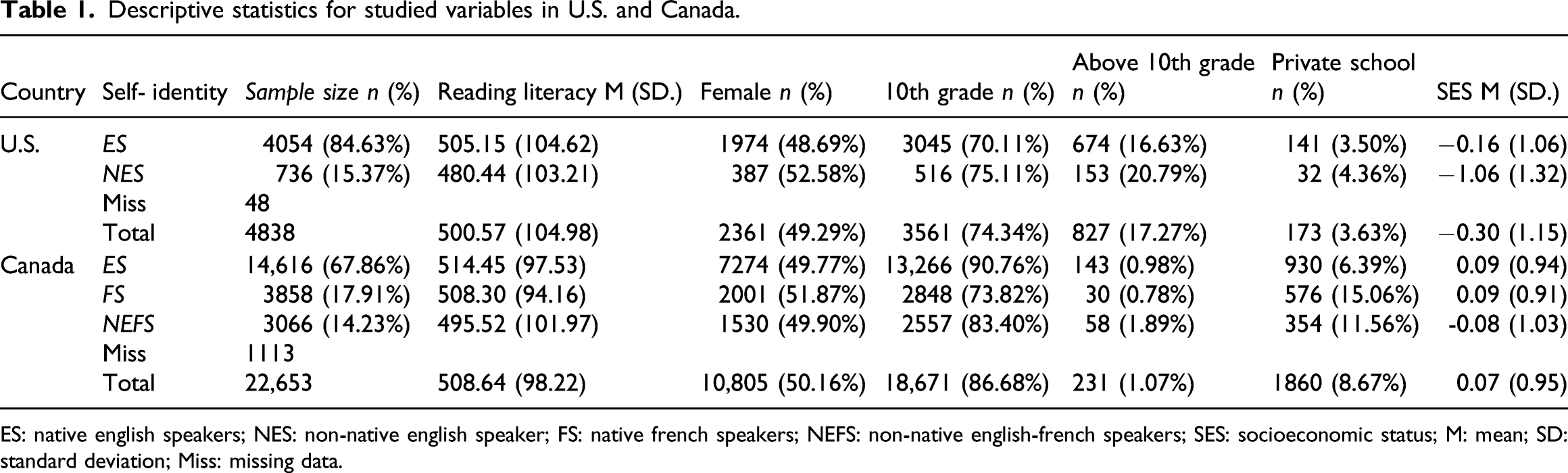
ES: native english speakers; NES: non-native english speaker; FS: native french speakers; NEFS: non-native english-french speakers; SES: socioeconomic status; M: mean; SD: standard deviation; Miss: missing data.
Effects of students’ self-identified language on reading literacy
Comparisons of reading literacy scores between native and non-native English speakers in the U.S. and Canada with and without covariates.
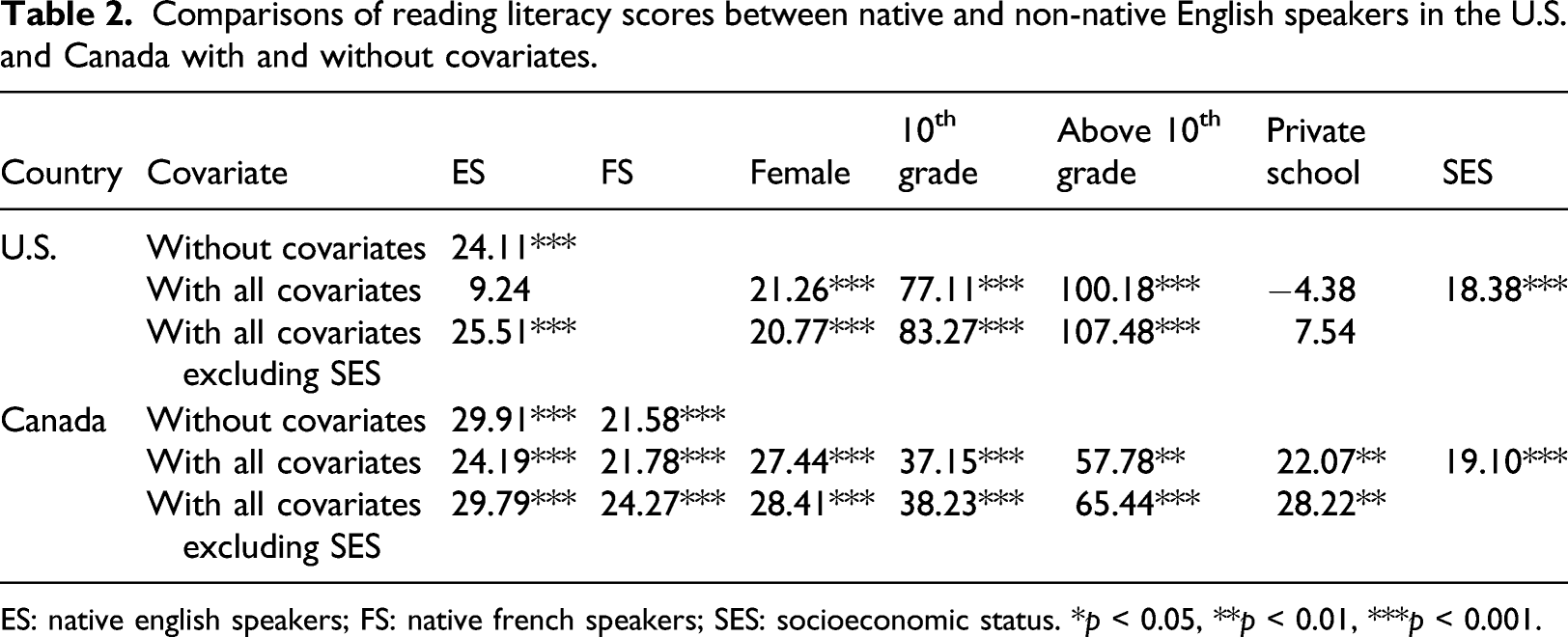
ES: native english speakers; FS: native french speakers; SES: socioeconomic status. *p < 0.05, **p < 0.01, ***p < 0.001.
In the U.S., ES students (M = 505.15, SD = 104.62) had significantly higher scores of reading literacy than NES students (M = 480.44, SD = 103.21) without controlling for other variables (b = 24.11, p < 0.001) or with all covariates except for SES (i.e., controlling for all other variables excluding SES) (b = 25.51, p < 0.001). However, when all students’ and schools’ demographic characteristics (i.e., gender, grade, school type, and SES) were taken into consideration, the advantage of native speaking students became non-significant in the U.S. (b = 9.24, p = 0.26). These findings indicated that students’ self-identified language (i.e., native versus non-native English speaking) might not have had a major or practical impact on American students’ performance on reading literacy. Instead, SES was a significant predictor of American reading literacy scores. American students from higher SES families tended to have higher reading literacy scores (b = 18.38, p < 0.001).
In Canada, ES (M = 514.45, SD = 97.53) and FS (M = 508.30, SD = 94.16) students showed higher scores of reading literacy than NEFS (M = 495.52, SD = 101.97) without covariates added (b = 29.91, p < 0.001) and (b = 21.58, p < 0.001), and with all covariates (b = 24.19, p < 0.001) and (b = 21.78, p < 0.001), and with all covariates excluding SES (b = 29.79, p < 0.001) and (b = 24.27, p < 0.001). Unlike the U.S., these findings indicated that students’ self-identified language significantly impacted Canadian students’ performance of reading literacy. In other words, native-speaking students, including English and French, performed better than non-native speaking students. In addition, after controlling for other variables, Canadian students from higher SES families tended to have higher performance on reading literacy (b = 19.10, p < 0.001).
Of note also is that after controlling for other variables, gender and grade were significant predictors (all ps < 0.001) and had similar patterns (all bs > 20) across both countries. In other words, female students had significantly higher scores than male students, and students in higher grades (i.e., 10th grade or above 10th grade) showed significantly higher scores than students in below 10th grade in each country. In Canada, students enrolled in private schools had significantly higher scores than those in public schools (ps < 0.01) after controlling for other variables, but in the U.S., students in public and private schools did not show a significant difference in reading literacy scores after controlling for other variables.
Effects of language congruence on reading literacy in Canada
Distributions of congruence and incongruence of language at home and language of assessment in Canada.
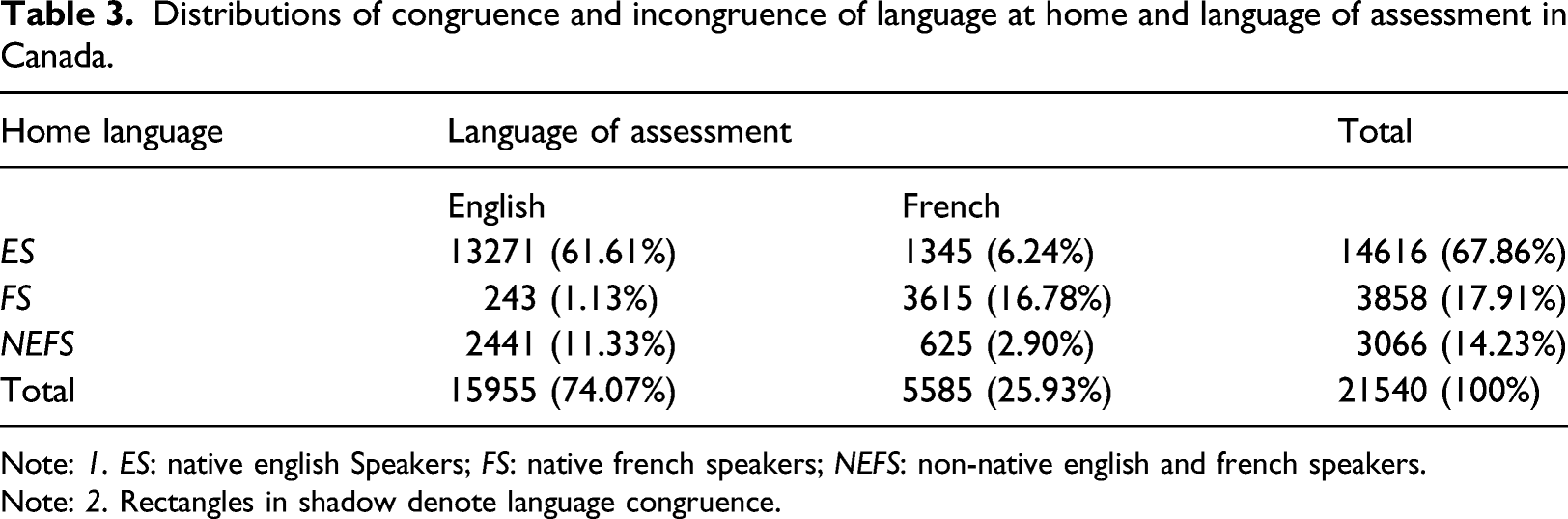
Note: 1. ES: native english Speakers; FS: native french speakers; NEFS: non-native english and french speakers.
Note: 2. Rectangles in shadow denote language congruence.
Comparisons of canadian reading literacy scores between language congruence and incongruence groups with and without covariates.
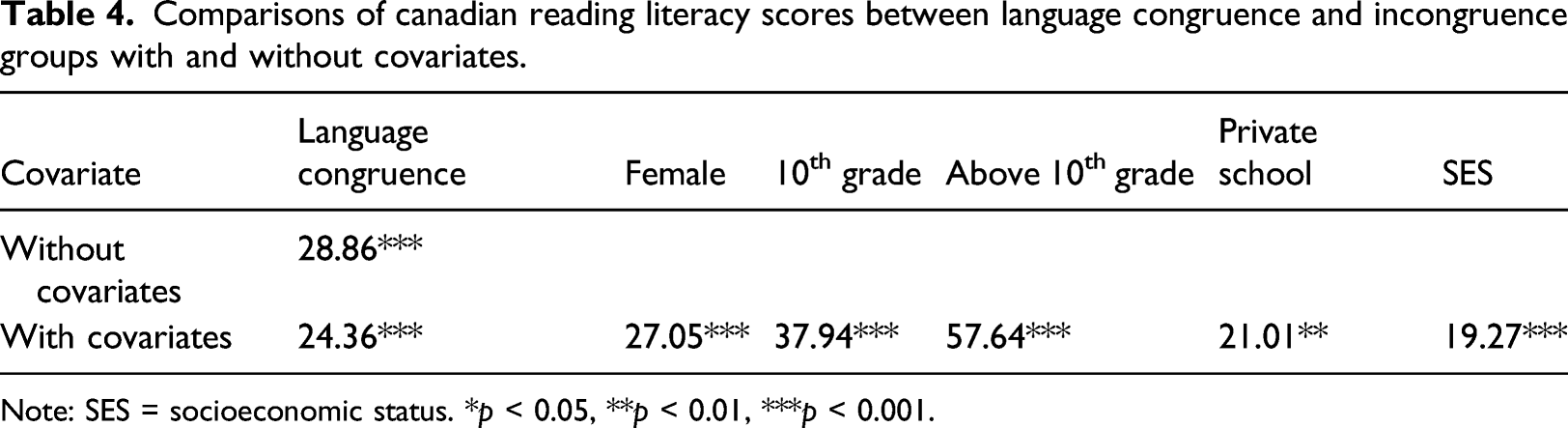
Note: SES = socioeconomic status. *p < 0.05, **p < 0.01, ***p < 0.001.
Students with language congruence had higher performance than those with language incongruence. Furthermore, after controlling for other variables, all covariate variables also showed significant impacts on students’ reading literacy performance. Compared with male students, female students tended to have higher scores (b = 27.05, p < 0.001). Students in 10th grade or above 10th grade had better performance than students in below 10th grade (b = 37.94, p < 0.001 and b = 57.64, p < 0.001, respectively). Students in private schools had significantly higher scores than students in public schools (b = 21.01, p < 0.01). Students from high SES families showed higher performance on reading literacy than students from low SES families (b = 19.27, p < 0.001).
Comparisons of Effects of Language Congruence on Reading Literacy across Canada and the United States
Comparisons between U.S. and Canada reading literacy scores between language congruent and incongruent speakers with and without covariates.
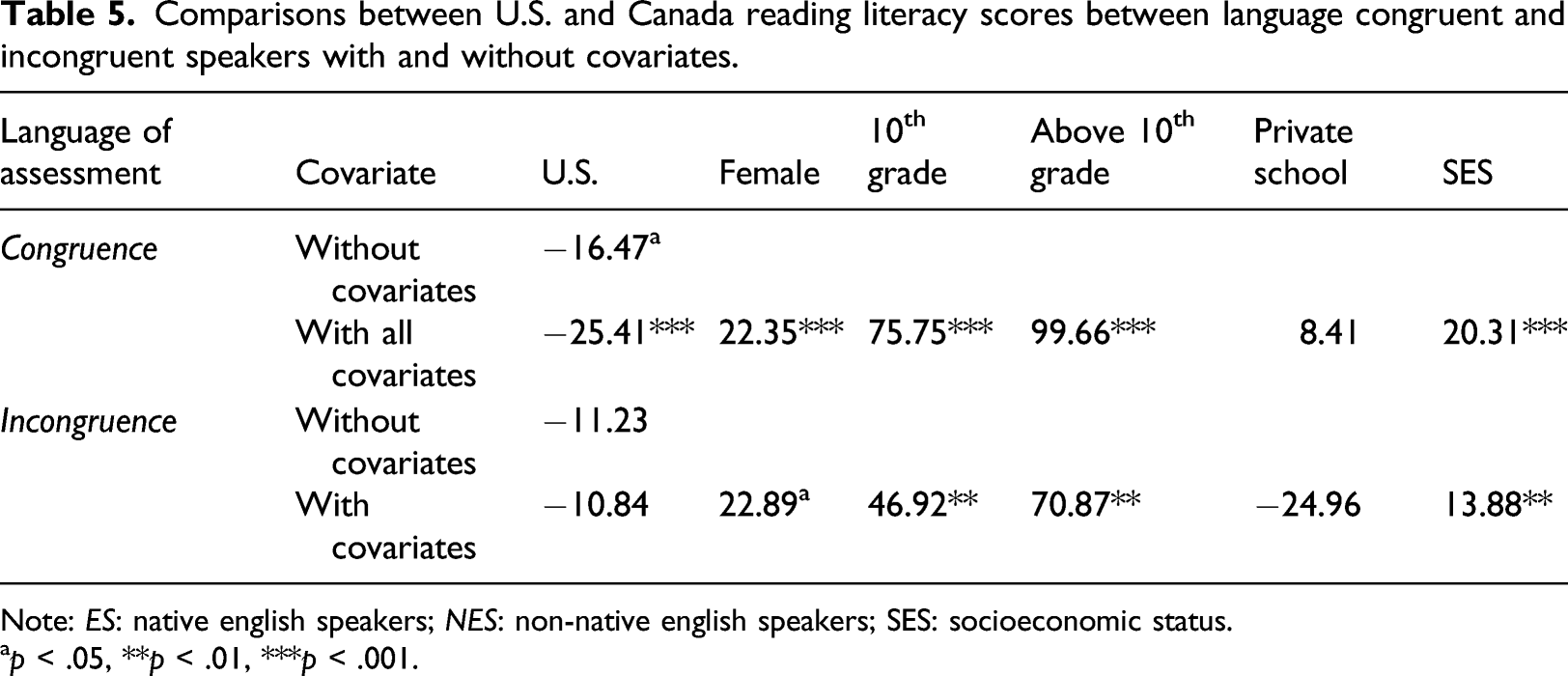
Note: ES: native english speakers; NES: non-native english speakers; SES: socioeconomic status.
ap < .05, **p < .01, ***p < .001.
As for the covariate variables based on the combined students in both countries, similar results were found for students with language congruence and with language incongruence. All these covariates except for school type were significantly associated with reading literacy (all ps < 0.001 for congruence and ps < 0.01 or 0.05 for incongruence). For both language congruence and incongruence groups, female students, students in 10th grade or above, and high SES students tended to have higher reading literacy scores than male students, students in below 10th grade, and students from lower SES families, respectively.
Discussion
As mentioned previously, our investigation was premised on the basic assumption that a policy which embraces diversity is more likely to realize better literacy performance among youth than one that is restrictive. For this study, we chose Canada and the U.S. to explore this premise. We thought that a comparison of the literacy performance of youth in Canada and the U.S. would provide some insights into this phenomenon as both countries are perceived to have contrastive education policies and practices (Ungerleider, 2007). According to Ungerleider, the general perception is that the education policies of Canada are more receptive to embracing multiculturalism in schools and classrooms than are those in the U.S. Thus, as mentioned earlier, we have in fact used Ungerleider’s characterization to liken Canada to a heterogeneous cultural mixture (immigrants encouraged to retain the characteristics of their home culture as they integrate into Canadian society) and the U.S. to a cultural alloy (immigrants are encouraged to shed their home culture and adopt the “American Way”) to illustrate the perceived dichotomy. To conduct this exploration, we thought it best to use an international measure, PISA, to compare the reading literacy performance of a group of their youth using variables outlined earlier. We are aware that one iteration of PISA does not tell the full story, but we see this study as the start of further investigations to better understand the data. During the current exploration, several findings stood out.
Regardless of the country, NNS students had significantly lower scores than native speakers of the testing language before controlling for variables. This finding suggests that the students from a language background that is different from the one in which they were tested seemed to be at a disadvantage. We should not lose sight of the reality that NNS students are likely to be immigrants or children of immigrants (see Cummins, 2014a). The significance is that, as previously highlighted (e.g., Suárez-Orozco and Suárez-Orozco, 2009), immigrants are likely to be at a disadvantage in many classrooms as sufficient care is often not taken to ensure that their ways of being and using language are embraced and viewed as legitimate. Cummins et al. (2015) stress that in the classroom setting, teachers should embrace and affirm the identity of students such as those from immigrant communities. Cummins et al. (2015) reported on experiences where such students felt a sense of acceptance and belonging when their identities were valued and affirmed, resulting in heightened classroom engagement (especially in language and literacy) and raised academic achievement. Notwithstanding, it is critical to acknowledge recent findings which show that Black immigrant NNSs outperformed Black immigrant NSs on PISA reading literacy in the U.S., suggesting that it is possible for linguistic differences and immigrant to interact in ways that provide an advantage (Smith et al., 2022).
Of note is that when we controlled for variables such as gender, grade, SES and school type, we found that for the U.S., there was no significant difference between scores obtained by ES students and NNS students. On the other hand, in Canada, ES and FS students continue to show significantly higher scores than NNS students. This finding would be somewhat unexpected to many, as several writers (e.g., Haque and Patrick, 2015; Ungerleider, 2007) have argued that the Canadian system is more accommodating and caring when it comes to students who are outside of the dominant group. This finding surely raises some questions about whether the dichotomies of cultural alloys and heterogeneous mixtures are misplaced. For this cohort of students, it seems that on one level, it is in Canada moreso than in the U.S., that greater attention should be paid to embracing multiculturalism in their classrooms. We believe that in a classroom that respects diverse cultures, there is likely to be students who are confident, socially adjusted and who experience academic success (Ladson-Billings, 1995). Even with this unexpected finding, we believe we should highlight that there is a well-documented body of work indicating that a number of policies and classroom practices in the Canadian setting (Cummins, 2014b) work not only to improve learning, but also, especially, to facilitate diversity. In fact, as a response to the emerging imperative of valuing home languages and intercultural literacy, provincial educational institutions are moving away from traditional curricula that are solely based on monolingual objectives and outcomes that use one of Canada’s two official languages as the language of instruction (Egbo, 2019; Swain and Lapkin, 2005).
Unlike Canada, what was found for U.S. students is that SES, rather than self-identified language, was the significant predictor of performance on the reading literacy test, a finding consistent with Cummins (2014a). Overall, the Canadian sample also revealed that students with low SES were at a disadvantage as they scored significantly lower on the PISA reading literacy than those with high SES backgrounds. It seems then, as advocated in other studies, that for both the U.S. and Canada, a major focus has to be on how to help the youth from lower SES background to improve their literacy performance (see also Cummins, 2014a). Particular attention should be paid to the NNS students with low SES, since these two factors when combined may exacerbate adverse academic performance (Smith et al., 2019).
On further exploration, we found that with or without covariates, in both countries, students with language congruence (students being tested in their native language) had higher performance than those with language incongruence (not being tested in the students’ native language). This disparity between NS and NNS students could simply be linked to the fact that the NNS students were not tested in their own language. In a previous paper (Smith et al., 2018b), we explored the possible negative effects of the OECD privileging of dominant languages by designating them as the languages of assessment, as well as countries restricting the testing language to the same as that of instruction. We argued then, and still hold the view, that it is an importantly overlooked advantage that favors NS over NNS students. Along with the factor of testing language, classroom practices are key factors that affect student performance. From these findings, we extrapolated that classrooms in both countries may need to pay greater attention to cultural diversity to ensure, for example, the embracing of linguistic differences among their students, and in particular, those who are immigrants. Even so, we point out in a more recent study that variations in what it means to be designated as the “native speaker” of a language on the PISA reading literacy assessment must be further examined (Smith et al., 2022).
We cannot help wondering if perhaps both countries have not fallen short of embracing a way of being where heterogeneous mixtures are encouraged. We strongly believe that it is not sufficient to be classified, as Canada for example, is, as one of the strongest performers internationally on PISA reading literacy, while a sub-group (i.e., immigrant) is “underperforming” (see Smith et al., 2019 for a problematization of the term “underperformance” on PISA). We believe that in both countries, but amplified more in the Canadian cohort, the immigrant student population stands out as being disadvantaged (Cummins, 2014a). It seems that there is a greater need for a demonstration of equity where all groups are treated fairly, and, in particular, the immigrant populations in schools are treated in ways that value them and their cultures. Paris (2012) has called for a culturally sustaining pedagogy where differences are celebrated and youth’s culture and identity are embraced. This seems necessary in classrooms in both countries. Such classrooms, according to Paris, would not only help students to feel like they belong, but they are also likely to translate into better academic performance. Smith (2019, in press) has also called for a transraciolinguistic approach to be used in literacy classrooms so that attention is paid to the simultaneous effects of race, language and culture. As mentioned before, one iteration of PISA results may not be sufficient to tell the full Canada/U.S. story. In fact, we are also recommending studies that offer the opportunity for qualitative analysis where consideration is given, for example, to classroom observations and in-depth interviews of students, teachers and other stakeholders in both systems. Along the same vein, we believe future comparative research can conduct analyses by state and by province levels as such analysis may very well reveal nuances or a difference portrait when contrasted against our current comparisons of the US and Canada as monoliths. Until such research is conducted, even where statistical significance exists, we advise restraint in imputing practical significance.
Beyond the above, we found that for all analyses, Grade and Gender were significant predictors of performance. For the most part, School Type was also a significant predictor of performance. We believe that School Type could be explained through the finding that SES is a significant predictor of performance. In this study, generally, private school students had higher scores than those in public schools. It is reasonable to believe that private school students would generally be from higher SES backgrounds than are those in public schools. In the case of the variable Grade, it was found that the higher the students’ grade, the better their performance. This finding is expected, as it suggests that such students would have greater literacy exposure through more years of schooling than their younger peers.
We believe, however, that we should single out the findings related to Gender. The fact that in both countries, female students had significantly higher scores than males on the reading literacy test is worth special mention, as this seems to be the pattern now established (e.g. Smith et al., 2020). We believe, as we posited in one of our previous works (Warrican et al., 2019) and as is supported by other research such as Hoxby (2000), that this finding should not simply be seen through the lenses of gender disparity. Instead, we should recognize the other implications for the classroom context to which this finding may be pointing. For example, in our previous work (Warrican et al., 2019), through the theoretical frame of peer effects, we found that peers can have positive or negative effects on each other’s performance in class. The key, we postulated in that study, may be to manipulate the composition of classrooms so that we can ensure positive effects. That is, it may be prudent to ensure that a class has sufficient high performers to positively influence their other peers. Like Hoxby, recognizing that girls generally perform better than boys on literacy and other assessments, we believe that to raise boys’ performance in reading literacy, it may be worth considering classroom compositions that have more girls than boys. Hoxby (2000) found that, generally, having more females in a class raises scores of both male and female students.
Conclusion
This paper set out to explore differences in reading literacy performance between youth in the U.S. and Canada who self-identified as native English speakers and those who self-identified as non-native English speakers on the PISA assessment, before and after controlling for demographic characteristics such as gender, grade, and SES. It also examined the differences in performance between youth who took the assessment in their native language and those who did not, again controlling for demographic characteristics. Using theoretical analysis, we sought to illustrate how even with similar cultural features, policies and practices can lead to different results. Extending the analogy by Ungerleider (2007) of cultural alloys to include heterogeneous mixtures, we drew on the 2018 PISA results for the reading literacy component for the U.S. and Canada to theorize about possible effects of language policies on the literacy achievement of immigrant youth in those countries.
Although we acknowledge the best practices of embracing diversity that are highlighted in the literature about Canadian classrooms and the wider society, our findings are not fully reflective of such. We are led to challenge the theory of Canada as a country of cultural heterogeneous mixtures that fully embraces the languages and cultures of its immigrant population. We also question the extent to which the U.S. fits the bill of the cultural alloy mold, especially as it relates to classrooms and what immigrant youth experience there. We are also left to wonder whether the concepts of cultural heterogeneous mixtures and cultural alloys may be more applicable to the wider societies, especially to the social fabric of these societies, but are not yet manifested in classrooms (see for instance the case of India, Tsimpli et al., 2019). It may be true that schools and classrooms are microcosms of the wider society, but it is possible that school/classroom cultures are so deeply ingrained that the views (whether liberal or conservative) on immigrant cultures may not have yet been fully embraced.
It seems that some level of introspection is needed in both education systems. Canadians, for example, cannot be satisfied with their overall ‘good’ performance on PISA when there exists such a disparity between subgroups: NS and NNS. Though, surprisingly, the American data shows less disparity between the two groups of youth, particularly after controlling for variables, Americans should see no reason to celebrate either, as NNS students in their context performed less well than their NS counterparts. Until all students are performing at their optimum level, inequities in both educational systems should be recognized (see Dowd and Pisani, 2013). Efforts should be made to ensure that all students, no matter their backgrounds or current circumstances, are in an environment where they can experience maximum success.
The findings of this study extend previous research by Cummins et al. (2012) and have implications for teaching and learning transactions in classrooms where there are ‘non-native speakers' of the language of instruction. Teachers in these contexts must practice their craft in such a way as to reflect genuine acceptance of the diverse languages and cultures that students bring to the classroom. This acceptance should be further reflected in assessment policies, especially for national and international assessments (Dowd and Pisani, 2013; Smith et al., 2018b). Speakers who are not as familiar with the language of instruction and assessment should be reconceptualized in their designations as “non-native” speakers (Smith et al., 2022) and should perhaps be given the option of writing the assessment in a language with which they are comfortable. Another option would be to ensure that such speakers have additional support as they prepare to write the assessment in a language with which they may be unfamiliar. The analysis of the results of the 2018 PISA assessment provides sufficient evidence of some inequities that exist between so-called NS and NNS students in two major countries of the world. These inequities can have a negative impact on students’ academic achievement, as we found in our study, even as such results are used to inform major policy decisions nationally in Canada and across states in the U.S. It is unlikely that the influence of “poor academic performance” will be restricted to the classroom. It is well documented that such suggested deficiencies in student academic performance (Smith et al., 2019) spill over into decisions about college and career readiness, impacting adult life, and affecting, for example, the choices of employment and opportunities for further education and training. We believe that this type of research sheds light on inequities that exist and helps to highlight the need to create the best learning environment for disadvantaged youth, all of which have implications for goals of internationalization beyond secondary education (Garrett-Rucks and Jansa, 2020). In doing so, this study echoes previous calls for attention to equity in PISA reading literacy (Smith et al., 2019, 2022) and in PISA at large (Zhao, 2020).
Footnotes
Declaration of conflicting interests
The author(s) declared no potential conflicts of interest with respect to the research, authorship, and/or publication of this article.
Funding
The author(s) received no financial support for the research, authorship, and/or publication of this article.

Notes
Author biographies
S. Joel Warrican has been in the field of education for over 30 years, with teaching experience at all levels, from kindergarten to tertiary. He holds a B. Ed. in Language and Literacy education from The University of the West Indies, an MPhil in Research Methods and a PhD in Language and Literacy Education, both from the University of Cambridge. He is currently the Director of the School of Education at The University of the West Indies Cave Hill Campus. His recent publications include “Peer effects in the individual and group literacy achievement of bidialectal high-school students” in Reading Psychology and “Towards caring language and literacy classrooms for Black immigrant youth: Combating raciolinguistic ideologies and moral licensing” in Teachers College Record.
Melissa L. Alleyne is a Planning Officer in the Office of Planning and Institutional Research for The University of the West Indies, Open Campus and a PhD student in Applied Linguistics at The University of the West Indies, Cave Hill Campus. She holds a BA in Linguistics and Literatures and English and an MPhil in Applied Linguistics, both from The University of the West Indies, Cave Hill Campus. Her research interests are in applied linguistics, literacy, online and distance education and institutional planning and development. A recent publication is “Predictors of student success in an online learning environment in the English-speaking Caribbean: Evidence from The University of the West Indies Open Campus”, published by Open Praxis.
Patriann Smith is Associate Professor of Literacy Studies in the Department of Teaching and Learning at the University of South Florida. Her research interests include Black immigrant literacies, Black immigrant Englishes, standardized and non-standardized English ideologies, multicultural teacher education, literacy assessment, and cross-cultural and cross-linguistic literacy practices. Her recent publications include “Characterizing competing tensions in Black immigrant literacies: Beyond partial representations of success” in the Reading Research Quarterly and “How does a Black person speak English? Beyond American language norms” in the American Educational Research Journal.
Rahat Zaidi is Associate Professor and Chair of Language and Literacy at the Werklund School of Education, University of Calgary. Dr Zaidi conducts research in Language Education, Intercultural Coomunication, Teacher Education and Curriculum Theory. Her latest research funded by the Social Sciences and Humanities Research Council of Canada focuses on transcultural approaches to literacy; exploring refugee families’ stories of migration and resettlement-the implications of these stories for language education and educational policy initiatives to support new Canadians across the country. Her latest books include Anti-Islamophobic Curriculums with Peter Lang and Literacy Lives in Transcultural Times with Routledge. She is Associate Editor of Language and Literacy: A Canadian ejournal.
Tala Karkar Esperat serves as Assistant Professor in the Department of Curriculum and Instruction at Eastern New Mexico University. Her areas of research include pedagogical content knowledge of new literacies, coaching of teachers, multicultural education, teacher preparation, and effective online teaching practices. Her research has been published in Literacy Practice and Research and International Journal of Mentoring and Coaching in Education.
Yi-Hsin Chen is Associate Professor of Educational Measurement and Research in the Department of Educational and Psychological Studies at the University of South Florida. His research interests include applications of cognitive diagnostic modeling, item response theory, and multilevel modeling to educational and psychological data. His recent publications include “Examining psychometric properties and level classification of the van Hiele geometry test using CTT and CDM framework” published by the Journal of Educational Measurement, “The relationships of learning strategies with self-efficacy and mathematics performance: A cross-cultural comparison” published by the International Journal of School and Educational Psychology, and a chapter in the “International perspectives on the teaching and learning of Geometry in secondary schools” published by Springer.
Yue Yin is a PhD candidate of Educational Measurement and Research in the Department of Educational and Psychological Studies at the University of South Florida. His research interests include differential item functioning, item response theory, and multilevel modeling to educational and psychological data. He holds a Master’s Degree in Teaching English to Speakers of Other Languages (TESOL) at the University of South Florida.