



Abstract
This article discusses the impacts of the East Asian Leaders Program (EALP) organized as a trilateral collaborative educational program participated by students from Japanese, Chinese, and Korean universities. The East Asian Leaders Program has been operated under the CAMPUS Asia initiative led by the governments of the three countries, aiming at cultivating talents who contribute to promoting mutual understanding between the three countries. The empirical analysis of this study was designed by a mixed method approach collected from 16 Japanese students. The results showed that the East Asian Leaders Program has cultivated students’ attitudes and skills for mutual understanding, including acceptance/willingness to understand, ability to consider different perspectives, self-expression and assertion, and initiative and resilience. As this study indicates that the East Asian Leaders Program is effective for fostering students’ attitudes toward mutual understanding, further policy development should consider encouraging universities to develop such practices to increase intra-Asian student mobility as an alternative strategy for the internationalization of higher education.
Introduction
The number of international students in the world reached about 5.3 million in 2016 (UNESCO Institute for Statistics, 2020a). The number has been increasing since the 1960s, for example from 290,615 in 1963 to almost double to 595,320 in 1973 (Cummings, 1993). This pace has continued ever since, with the number rising to 1.95 million in 1997 and to 3.1 million a decade later in 2007 during the midst of the internationalization of higher education (UNESCO Institute for Statistics, 2020a). Although the COVID-19 pandemic will influence this trend, the number is predicted to increase to 8 million by 2025 (Altbach and Bassett, 2004).
Looking at the contexts of student mobility trends, however, the trends do not appear to be uniform. For example, the trend in the 1960s was East to West mobility, with students from former colonies going to study in former colonial powers, and students from the Global South countries going to study in the Global North countries (Altbach and Lulat, 1985). As a recent trend, on the other hand, major economic engines in the Asia Pacific region, such as India (Lipura, 2021), Hong Kong, Singapore, Korea, and Taiwan (Oleksiyenko et al., 2021) that used to be on the sending end of the equation are gaining reputations as host countries. Furthermore, there are steady intra-Asian study abroad programs provided by individual universities, such as the Universiti Brunei Darussalam’s Community Outreach Program (COP) in Vietnam (Kumpoh et al., 2021). As a result, in addition to the traditional East to West transcontinental mobility between the Asia Pacific and Europe and North America, a new East to East regional mobility, whereby students from Asia Pacific countries are going to study in other Asia Pacific countries, is emerging. This new phenomenon cannot be ignored when examining student mobility trends in the world today.
A primary explanatory source for examining this new trend is the pull factors of study abroad. Looking at pull factors affecting students going to the United States as the most popular study abroad destination, Altbach (2004) identified the following pull factors: academic system reputation, the prestige of the degree granted, easier admission policies, the lure of life in the United States, and career and work prospects after study. By contrast, the following four more recent studies identified pull factors pertaining to intra-Asian student mobility. Firstly, Lee (2017) analyzed the pull factors attracting 633 Chinese students to Korean universities and identified the top five factors as selectivity of institution, parents’ and friends’ recommendations, job market vision, lower costs of study abroad, and geographical location. Secondly, Aleles (2015) examined the pull factors for 96 students studying in Japan (89 were from the Asia Pacific region). The five top factors were availability of English medium programs while living in Japan, the opportunity to pursue a career in one’s field of interest, the availability of financial aid, general interest in Japan and Japanese culture, and overall affordability. Thirdly, Padlee SF et al., (2010) analyzed the pull factors that attracted 656 international students (students from Southeast Asia make up 32%, the largest population) to universities in Malaysia and concluded that the top five factors were the entry qualification, English usage in the host country, English-medium instruction, specialized fields, and the quality of academic staff. Among Southeast Asian students, customer focus, cost of education, and socialization were the top three factors. This study also founded that religion in the host country had a factor. Fourthly, Kheir (2021) mentions that Taiwan is an emerging study abroad destination mainly from the Global South countries, including Asia Pacific countries. The pull factors are English-medium programs and the creation of a Western-style diverse environment. It can be seen from these studies that the pull factors for US study abroad identified by Altbach (2004) have recently been complemented by universities in the Asia Pacific countries. Due to the advantages of study abroad costs and geographical proximity, an increasing number of students from the Asia Pacific region, which account for 53% of the world’s international students (OECD, 2015), are choosing to study at universities in Asia Pacific countries.
This trend can be seen in UNESCO statistics. The data shows that students from the Asia Pacific region increased 210% from 464,693 to 1,442,182 between 1997 and 2017 (UNESCO Institute for Statistics, 2020b). Of these, students from East Asia and the Pacific going to study in East Asia and the Pacific increased 218% from 157,359 to 501,156, while the number going to study in North America and Western Europe increased 196% from 284,153 to 842,485. The trend demonstrates that although the absolute number of international students going to North America and Western Europe continues to grow, the intra-Asian mobility is remarkable.
Intra-Asian student mobility among Japan, China, and Korea
Focusing on the mobility data for Japan, China, and Korea in 2019, before the COVID-19 pandemic in 2020–21, Japan relies heavily on China and Korea for international student intake, with 124,436 from China (the biggest country of origin) and 18,338 from Korea (the fourth biggest country of origin) of all 312,214 incoming students in all types of higher education institutions (JASSO, 2020). Likewise, China accepted 50,600 students from Korea (the biggest country of origin) and 14,230 students from Japan (the ninth country of origin) in 2018 (Ministry of Education of the People’s Republic of China, 2018). Korea accepted 71,067 students from China (the biggest country of origin) and 4,392 students from Japan (the fourth biggest country of origin) of 160,165 international students in 2019 (Korean Education Statistics Service, 2020).
Japan has aimed to increase the number of international students studying at Japanese higher education institutions, starting with the 100,000 International Students Plan launched in 1983 and then again with the 300,000 International Students Plan in 2008. Both quantitative and qualitative aspects have been emphasized in the 21st century to attract international students. For example, the Japanese government has initiated several key projects to establish leading international universities, launch English-taught degree programs, promote outbound and bilateral study abroad mobility in targeted regions, and more. In this way, the government’s rationale for internationalization has been improving its own higher education system (Horie, 2015a). With such a government-driven approach to the process of internationalization, several practical issues have been reported, such as a lack of faculty members/local students who are proficient/capable of teaching/learning in English-medium instruction courses (Horie, 2018; Yukawa and Horie, 2018), students’ inward-looking attitudes and lack of willingness to study abroad (Horie, 2015a), the gap between the policy intentions and employers’ expectations (Horie, 2015b), etc. Meanwhile, throughout this series of internationalization policy initiatives, internationalization practitioners at higher education institutions have generally come to share an understanding of its pedagogical significance on students’ personal growth (Hanada, 2012; Horie, 2017).
In traditional study abroad programs, the content and quality of the experience gained in the host country, such as academic fields study and cross-cultural experiences, are often left up to the individual student. In recent years, however, efforts have been made to create higher quality education abroad programs by establishing consortiums of universities in Japan and other Asian countries to co-arrange the research and educational contents and student support systems, such as the University Mobility in Asia and the Pacific (UMAP), the ASEAN International Mobility for Students (AIMS) program, and Universitas 21.
Among various policy initiatives for promoting higher education cooperation, CAMPUS Asia is a program that aims to promote intra-Asian student mobility in undergraduate education, and more specifically, triangular student exchange among Japan, China, and Korea. For many Japanese universities, China and Korea have long been major home countries of their international students but have never been major study abroad destinations for local students. For the region to foster young people who can contribute to further peaceful development and constructive diplomacy in Japan, China, and Korea, these countries recognize the necessity of pedagogical development for regional student mobility as a significant practice (Horie, 2014).
Rationales of CAMPUS Asia
The goal of the CAMPUS Asia initiative is to build relationships of mutual understanding among young people in the region to collaborate further to tackle various issues shared by these countries. The assumption is that, due to various issues caused by historic and political situations, the relationship among Japan, China, and Korea has been experiencing various barriers to deepen mutual understanding. For example, Asian Barometer, an international comparative survey to examine respondents’ awareness of the degree of influence by other countries, showed mutual understanding among the three countries. According to the survey, only 30% and 26%, respectively, of Japanese respondents said that China and Korea have a positive impact on Japan. In response to the same query, only 24% and 35%, respectively, of Chinese respondents replied that Japan and Korea made a positive impact on China, while in Korea, the percentages for Japan and China were 29% and 45%, respectively (Inoguchi et al., 2005). Although these survey results were released in 2005, it remains one of the largest and most comprehensive international comparative surveys in East Asia.
The national governments and higher education sectors in the three countries expect education exchange to be a means to develop mutual understanding and launched the Japan–China–Korea Committee in 2010, going on to produce the CAMPUS Asia scheme for the trilateral collaborative educational program in 2012. Under this policy initiative, universities in the region developed 10 provisional projects. Unlike traditional bilateral study abroad programs between Japan and China, Japan and Korea, or China and Korea, CAMPUS Asia is a collaborative exchange program managed by one university from each country under governmental supervision to provide students from the three countries with a platform to learn together. During the exchange, they share their values, cultures, histories, etc.; understand the perspectives of people in the partner countries towards history and political issues; and eventually seek ways to deepen mutual understanding.
Research design
This section addresses the research questions and the significance of this study, the structure of the East Asian Leader Program (EALP) as a case of the CAMPUS Asia initiative, and the research method.
Since CAMPUS Asia was implemented in 2012, there are some previous studies that have examined different elements, such as students’ language proficiency (Kiyota et al., 2016), program structure (Anzako, 2018), program evaluation (Kim, 2017), policy analysis (Hanada, 2012), and student mobility (Hou et al., 2017). However, there has been no empirical study to look at the impact and significance of CAMPUS Asia on the participants’ personal development of mutual understanding. This study focuses on the skills and attitudes for mutual understanding, which covers cognitive, affective, and behavioral elements in making efficient relationships with people from different cultural backgrounds. The research question of this study is what the impact of CAMPUS Asia is on the development of students’ attitudes and skills toward mutual understanding among Japan, China, and Korea.
In essence, this study investigates EALP as a program developed under this policy initiative. It focuses on how participating students see partners’ culture, and how they adjust to the cultural differences psychologically and behaviorally by comparing the students before and after participation in the program. As the research method, this study explores the answer from both qualitative and qualitative approaches, since judging one’s inner elements is required to be observed from both objective data perspectives and subjective contextual perspectives. For the quantitative perspective, Intercultural Development Inventory (IDI) is used to assess students’ views and behaviors as responses to the EALP experiences. For the qualitative perspectives, students’ reflection papers are analyzed to understand their subjective understanding of learning experiences in the intercultural environments provided by the EALP.
The reason for using the research design lies in CAMPUS Asia’s philosophy of cultivating people who can bring about mutual understanding among the three countries. The point of the philosophy is not for individuals to build mutual understanding without being aware of doing so. Instead, it is for them to make a conscious effort to develop mutual understanding, become aware of what to consider and how to respond to situations, and to cultivate a proactive attitude toward expanding their efforts in this area. For example, the focus is not on unconscious efforts by Japanese returnees who have experience of life in China and already accept Chinese culture to build mutual understanding with Chinese people. Instead, the aim is for ordinary Japanese students, who grew up in Japan, to study and live together with Chinese students in a cross-cultural environment, thus cultivating their abilities to consciously think, make judgments, and respond to situations, as well as developing a proactive attitude toward expanding these abilities.
Among the 17 CAMPUS Asia operating programs (CAMPUS Asia, 2021), this article examines the EALP, which was designed and managed by Ritsumeikan University (RU) in Japan, Guangdong University of Foreign Studies (GUFS) in China, and Dongseo University (DU) in Korea. The reason why this program was selected as a case study is that it is the only long-term trilateral exchange program for undergraduate students, while other programs mostly focus on short-term exchanges or the development of research collaborations between universities in the three countries. Additionally, one of the authors belongs to RU and had the advantage of having easy access to the EALP. Among the students participating in the EALP, this article focuses explicitly on Japanese participating students. By examining the growth of mutual understanding of participating Japanese students, this article intends to set out the implications for further policy development to promote intra-Asian student mobility as an effective strategy for the internationalization of Japanese higher education institutions.
The competence for mutual understanding
The competencies to adapt to intercultural environments have generally been recognized as a capability that supports effective and appropriate interaction among people in different cultural contexts. However, the specific components comprising such competencies have been explored based on the perspectives of various disciplines such as business management, communications, and higher education. Different researchers see different components of intercultural competence developed through study abroad programs. Such components identified in recent works include a sense of self (Harper, 2018), cultural resistance (Lemmons, 2015), independence and self-confidence (Walsh and Walsh, 2018), awareness of cultural diversity (Wooldridge et al., 2018), intercultural competence (Deardorff, 2015a; Hanada, 2019), self-efficacy and cultural intelligence (Nguyen et al., 2018), contact with the host society (Matera et al., 2018), and the acculturation process (Lee and Negrelli, 2018). Although there is no authoritative academic definition of the competence for mutual understanding universally accepted in the relevant literature, it can be understood that it includes at least three essential elements: cognitive, affective, and behavioral (Bennett, 2011: 3). The cognitive element deals with cultural knowledge and cultural self-awareness. In the EALP, the cognitive element covers knowledge of culture, history, and language of partner countries and considers how to deepen mutual understanding throughout the EALP. The affective element relates to how students see different cultural qualities such as open-mindedness, inquisitiveness, and willingness to adjust to varying circumstances. In the EALP, the affective element involves an ability to see matters not from their cultural perspective but the perspectives of people from partners’ cultural perspectives. The behavioral element relates to students’ behaviors and the skills adopted in intercultural environments. In the EALP, the behavioral element identifies skills that influence students’ behaviors to build mutual understanding with students from partner countries.
Referring to the three elements, Spitzberg and Changnon (2009: 7) defined intercultural competence as “the appropriate and effective management of interaction between people who, to some degree or another, represent different or divergent affective, cognitive and behavioral orientations to the world.” Deardorff (2015b: 141–143) also showed that intercultural competence is categorized under “knowledge, skills, and attitudes, internal outcomes as adaptability, flexibility, ethnorelative view and empathy, and external outcomes as effective and appropriate communication and behavior in an intercultural situation.” In addition, Hammer (2012) suggests that building intercultural competence involves increasing self-awareness; deepening understanding of the experiences, values, perceptions, and behaviors of people from diverse cultural communities; and expanding the ability to shift cultural perspective and adapt behavior to bridge cultural differences.
This study labels the three elements as the essential elements in adopting intercultural environments and examines the impacts of the EALP on the personal development in cognitive, affective, and behavioral elements for building skills and attitudes for mutual understanding.
EALP structure, curriculum, and pedagogy
The EALP aims to foster students with the following four competencies: (1) an understanding of traditional East Asian cultures and the current state of ever-changing contemporary East Asian cultures; (2) an understanding of the societies, lifestyles, histories, and media situations of Japan, China, and Korea; (3) the ability to actively interact with the people of East Asia in Japanese, Chinese, and Korean; and (4) the ability to seek out peaceful and symbiotic solutions to the various problems facing East Asia (Ritsumeikan University, 2012). To realize this vision, the EALP has created a three-stage curriculum.
The first stage comprises first-year learning at the student’s home university. In preparation for study abroad at partner universities in the second or third year, students learn the language of the host countries (for Japanese students, this means Chinese and Korean) while developing communication skills including intercultural understanding and presentation skills and gaining a basic knowledge of the host countries’ cultures, societies, and histories. In the second stage, students spend two years studying at partner universities. In the EALP, this is called the “mobile campus” (Anzako, 2018). The curriculum covers a range of subjects in the humanities and social sciences related to East Asian studies, and students take these courses in the language of the host institution (i.e. Chinese, Japanese, or Korean). Since the students’ levels of proficiency in their non-native languages are not necessarily high enough at an early stage, the students spend significant time on intensive language courses in each country (i.e. Japanese students take a Chinese language course in China and a Korean language course in Korea). Students are expected to become proficient in the three languages by the time they finish their undergraduate programs, in addition to obtaining knowledge of East Asia from a humanities perspective. The capstone course, “CAMPUS Asia Seminar,” allows students to learn about various contemporary issues in the region through discussion and activities. For example, the students intensively examine the various perspectives in the history textbooks used in each of the three countries. In addition, students are given the opportunity to undergo practical education and participate in internships. In the third and final stage, students return to their home university where they continue studying to meet their graduation requirements while preparing to enter the workforce or advance to graduate school.
Thus, the EALP is a two-year program as part of a four-year Bachelor of Arts degree program accredited by the home institution of each participating student. The two-year EALP includes six trimesters (three trimesters per year), wherein the 30 participants, 10 from each institution, form a cohort group that lives and studies together in the three countries (Figure 1).
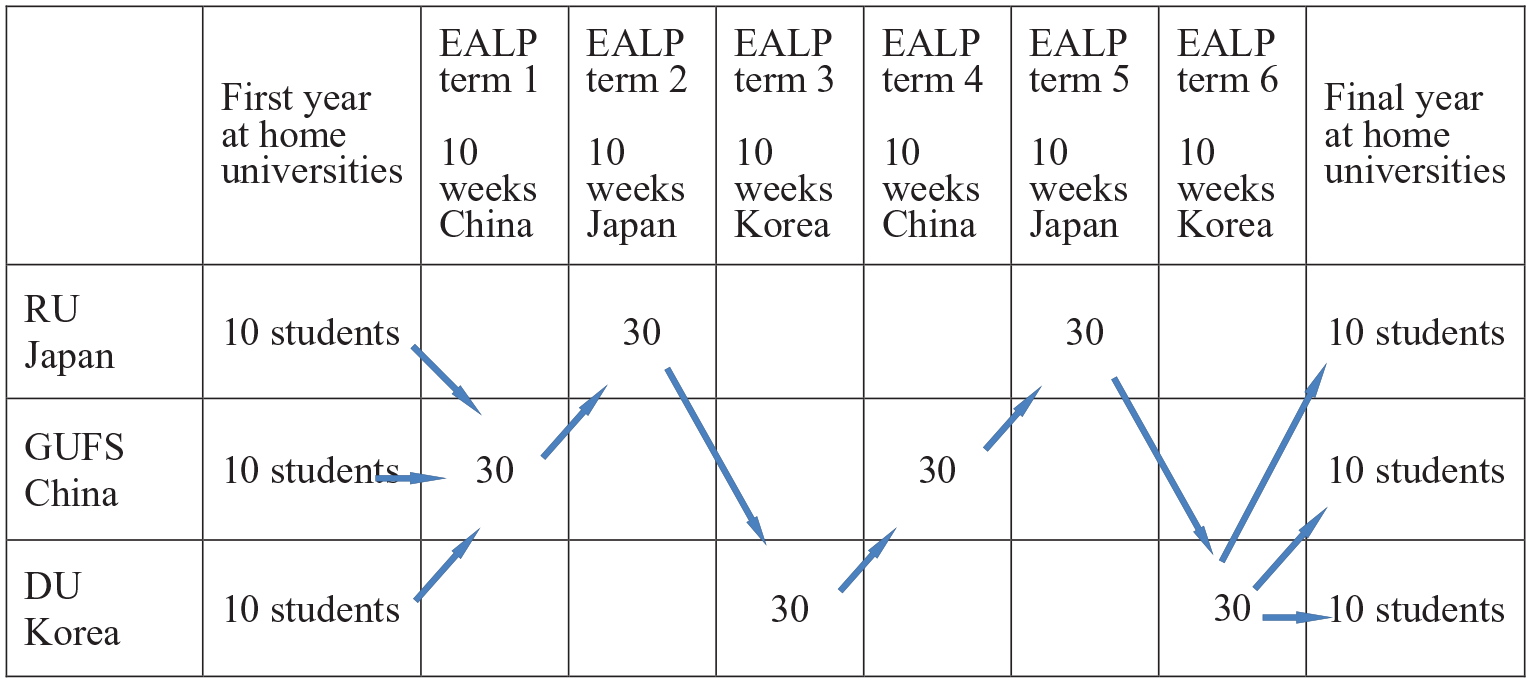
Structure of the East Asian Leaders Program (EALP).
One of the significant characteristics of the EALP is its intensive cross-cultural living–learning component. The students from three countries live together in student housing accommodation at each university, where they have to overcome various conflicts due to cultural differences and create ground rules for themselves. All the students are assigned to live in one of two traditional Japanese houses according to their genders while attending classes in Japan. They share a kitchen, living room, bathrooms, and bedrooms. No prescribed house rules are given to them, so they need to develop their own rules and revise them as they experience unexpected circumstances. Cultural differences in expectations, assumptions, and beliefs about daily living are not visible and verbalized, often revealing conflicts. Such conflicts initially tend to be personalized and are not necessarily recognized as cultural differences.
The program intends to give such experiential learning opportunities to students, who learn by reflection and active experiments in their behaviors (Kolb, 1984), and by providing educational intervention from the program coordinators at each university. These program coordinators communicated regularly to share insights about the students’ learning processes. They also invite intercultural communication trainers to intervene with students to teach them how to solve cultural conflicts in their community. They are consistent in their basic philosophy that daily issues are great sources for participants to learn to overcome and develop intercultural competence. As researchers (e.g. Deardorff, 2015b: 49) have pointed out, pedagogical intervention is extremely important for improving the quality of intercultural experiential learning.
Another characteristic of the program is that the common language is not English, but the three local languages. Although the number of English medium instruction programs continues to increase along with globalization (Horie, 2018) and internationalization of Japanese higher education (Phan, 2013), the EALP focuses on providing students with deep insight into the cultures and histories of the host countries along with the ability to communicate in the local languages as a means to foster mutual understanding with the people in the host countries (Anzako, 2018). This emphasis stems from the fact that it is preferable to gain a direct understanding of issues in the local language rather than an indirect understanding via English when students are engaged in area studies in each country. Furthermore, it is not possible to use English for routine communication in Japan, China, and Korea. The program emphasizes the importance of developing proficiency in local languages, not only for the academic purpose of gaining a deeper understanding of the region but also as a tool for daily communication. That being said, the level of proficiency in the three languages varies from student to student. Given this, the EALP focuses on cultivating translanguaging abilities whereby students choose which of the three languages to use based on the person to whom they are talking.
In the EALP, the goal is to build mutual understanding through thinking about political and historical factors influencing the relationships between Japan, China, and Korea from the perspectives and standpoints of the citizens of each other’s countries. For this reason, students from each country first carry out in-depth research into the views in their home country, deepening their understanding of their own country. They next deepen their understanding of the views in their counterparts’ countries, clarifying the points of overlap and divergence. The educational content consists of seeking the approaches required for mutual understanding, taking the above into account. On the other hand, on bilateral study abroad programs, students usually take classes offered by the host university. Depending on their field of study, students may be able to take classes in the economics, politics, or culture of the host country, or classes relating to international society. However, the educational content of such classes does not necessarily aim to build the kind of mutual understanding described above.
Research method
This study employs a mixed method approach. The purpose of conducting a mixed method analysis is to enhance research credibility. Quantitative analysis provides statistical data results, but the data would not show what factors in the EALP shaped the result. On the other hand, qualitative analysis facilitates a deeper understanding of the factors responsible for the data by observing the EALP students. However, this analysis is sometimes influenced by the researchers’ bias in observation. The advantage of conducting a mixed method is to bring deeper research exploration to findings, as one method complements the other.
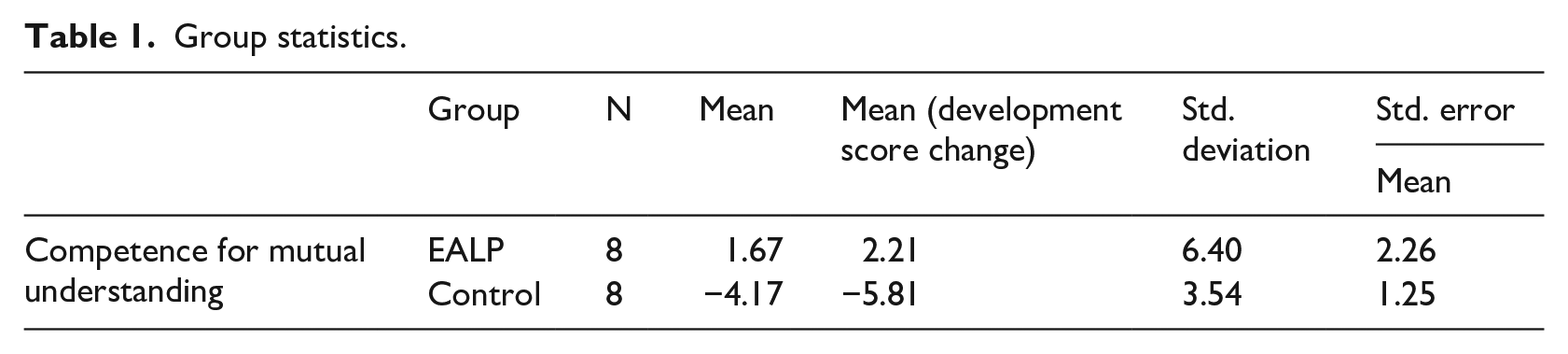
The first phase of this study was a quantitative analysis to statistically understand students’ development of the competence for mutual understanding between their pre-and post-EALP periods. This study used the IDI, which has validity as a measurement instrument to assess intercultural competence for diverse cultural groups, including Japanese people (Hammer, 2011: 478). Also, there are some previous studies that look at the impact of study abroad programs on participants’ development (e.g. Jackson, 2008; Pedersen, 2010; Vande Berg et al., 2009); thus, the validity of IDI in intercultural research is secured. The IDI provides students’ perceived scores, which means the degree of self-understanding, and students’ developmental score, which means actual personal competence of cognitive, affective, and behavioral elements in intercultural adaptation. By comparing the gap between the two scores in both pre- and post-EALP periods, this study aims to clarify the degree to which students understand their own cognitive, affective, and behavioral elements in intercultural environments. The smaller the gap between self-evaluation (perceived score) and evaluation by scale (developmental score), the more accurate the students’ self-awareness. Each mean value in Table 1 was calculated using the formula of (perceived score minus developmental score in pre-study abroad period) − (perceived score minus developmental score in post-study abroad period). For example, if the mean score in the pre-and post-study abroad periods are 10 and 5, respectively, the change between the post- and pre-study abroad periods is 5; this means a positive change in self-awareness. A Welch’s t-test was conducted using SPSS version 25 to reveal the results of the EALP students compared to the control group of students who did not participate in the EALP but remained at their home universities during the same periods of the EALP. Since IDI is available to take online, this data was collected by sending the invitation to EALP students and given the URL to take IDI.
Group statistics.
The quantitative part of this study looked at 16 Japanese students. Among these, the first group were eight students who participated in the EALP. The second group was the other eight students who did not join the study abroad program; they were the control group. Since this study aims to examine the impact of the EALP, the first group covered all students who joined the EALP from Japan. By contrast, the second group was recruited randomly from students who did not study abroad. Regarding the data collection procedure, the investigators first obtained data from eight EALP students at RU, where one of the investigators worked. Second, the investigators obtained data from eight students who stayed on their home campuses. Students were requested to access the URL online. This method was arranged by the investigators due to ethical considerations, so that participants could decide whether to take the IDI without any pressure from the investigators.
The second phase was qualitative analysis. The objective of the phase was to explore the students’ subjective understanding of learning experience throughout the EALP and the possible impact factors contributing to the gap revealed by quantitative analysis. Through examining reflection papers submitted by the students who participated in the EALP, the qualitative analysis examined students’ reflections on their learning experiences and illustrated the process of intercultural development. In essence, a questionnaire about self-reflection on their learning experiences and outcomes was conducted immediately after the program finished. Participants were asked to answer the following two questions freely: (1) Please describe the 3 most significant things (knowledge, skills, and/or attitudes) that you obtained throughout the EALP experience and explain how you obtained these, and (2) Please indicate three things (knowledge, skills, and/or attitudes) that you want to develop further and explain why you think this is important for you. The collected text data was analyzed using the thematic analysis method to find emerging themes regarding specific knowledge, skills, and/or attitudes that comprise the participants’ self-awareness in their intercultural development.
Results
Quantitative analysis and discussion
Checking the normality using the Shapiro-Wilk test and the equality of variance using Levene’s test, a Welch’s t-test was conducted to compare the degree of changes of competence for mutual understanding before and after joining the EALP. As a control group (comparative group), this study used students who did not study abroad during the EALP periods. As a result, EALP students significantly developed the competence more than control group students. Table 1 shows the group descriptive data, and Table 2 shows the test result. It was confirmed by the mean (average) scores for EALP students (Mean=1.67, SD=6.40) and the control group students (M=−4.17, SD=3.54) condition in Table 1, and t (10.92) =2.26, p=0.045 in Table 2. These results suggest that the EALP does affect developing the competence for mutual understanding.
Welch’s t-test.
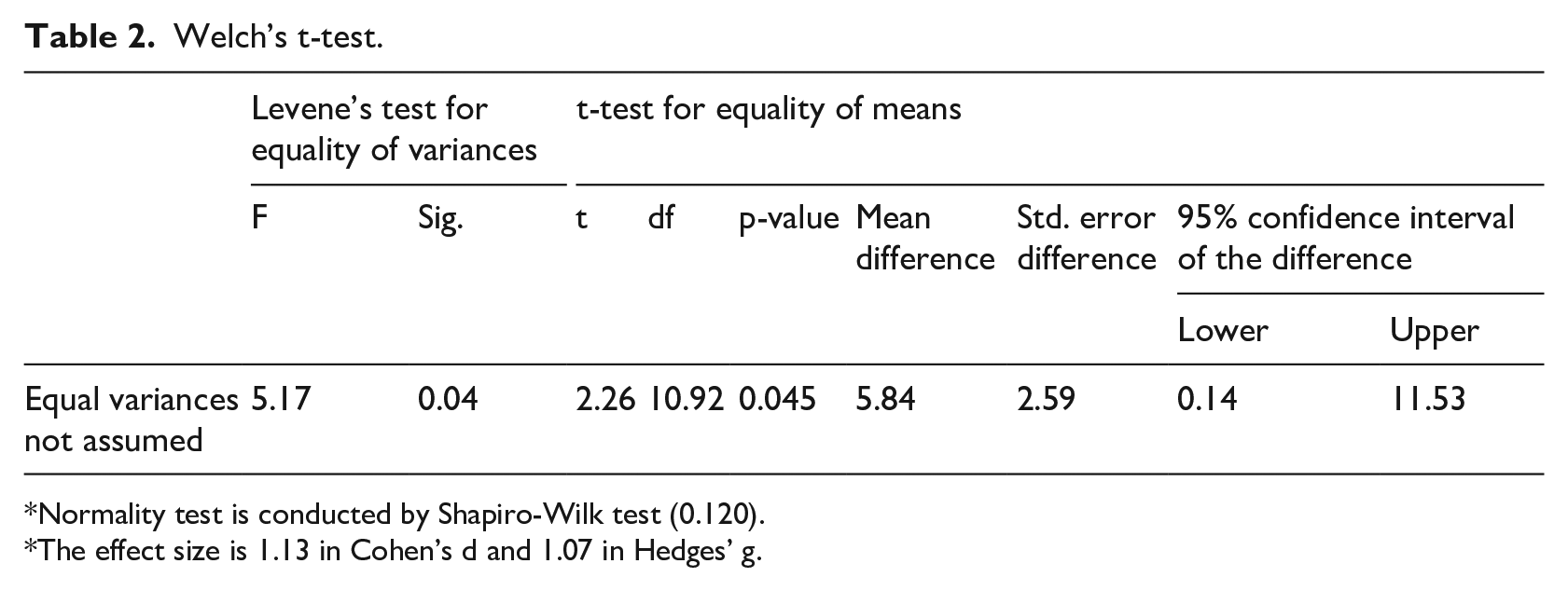
Normality test is conducted by Shapiro-Wilk test (0.120).
The effect size is 1.13 in Cohen’s d and 1.07 in Hedges’ g.
The following two concrete points can be understood from the statistical results. Firstly, students developed their intercultural competence for mutual understanding through the EALP. Furthermore, students were able to enhance their self-awareness of their intercultural competence. Intercultural competence can be considered to be cultivated in other education abroad programs such as exchange programs. Still, the improvement of self-awareness of one’s intercultural competence is a characteristic of the learning outcomes of EALP that might be difficult to obtain in other education abroad programs where learning and living in the host country are mainly left to the individual student. According to the W-Curve model, which examines the psychological changes that occur when a student enters an intercultural environment, a student first spends a period of psychological elation due to the freshness of foreign cultural immersion before entering a period of conflict due to the difficulty of adapting to the foreign culture (Gullahorn and Gullahorn, 1963). Although it is possible to overcome the conflict period by oneself, it is more effective to have support from others, such as the intervention of intercultural specialists, cooperation with other students who share the same conflict, and teacher intervention. In this regard, it is assumed that Japanese students in EALP have opportunities to objectify themselves through joint study and living with Chinese and Korean students, and analyzing their status and issues compared to those students. This point will be examined in more detail in the qualitative analysis.
The second finding is that the mean score of the control group between pre- and post-study abroad programs was negatively changed. It proves the effectiveness of the EALP paradoxically. The score grew by −4.17 points. For the interpretation, Hanada (2019) mentioned that there are two growth curves of students’ perceptions of different cultures: linear curve or up-and-down curve through the analysis of Japanese students of intercultural learning. In intercultural immersion, the latter curve is likely to happen as it is mainly related to a student’s psychological changes. Therefore, the descending situation is not an exceptional case. Rather, when students are in that position, a crucial point for international professionals is to intervene to help them understand that experiencing the difficulty in intercultural environments is a process to move forward. The intervention will also help to pull them up toward the ascending curve. That is because intercultural intervention leads students to the existence of invisible deep cultural elements, which is essential to understanding different cultures. It is the implicit culture represented by values, customs, ways of thinking, all of which cannot be seen visually. By contrast, the visible cultural element is the explicit culture such as food and clothing, where short-term international sojourners are likely to experience intercultural immersion. Deardorff (2015b) addressed the need for intercultural intervention to lead students to have profound cultural experiences. Also, Hanada (2019), which focused on the intercultural learning of Japanese study abroad students, indicated that cultural intervention is one of the essential factors to enhance intercultural understanding. However, only 177 of the 303 students from 13 different Japanese universities collected in this study were provided with some form of intercultural intervention. On the other hand, many of these students were offered English language training programs, such as daily English conversation classes for prospective students joining study abroad programs. In this point, the EALP was effective as the qualitative analysis of this study showed that students became more aware of the ways of thinking and behaviors of partner country students. Also, it was another opportunity to learn the invisible cultural part through communal learning and living with partner students for two years. During that period, students not only had interventions from international education professionals in each country, but they were also supported in their daily lives by local students during their stay in partner countries.
Qualitative analysis and discussion
The purpose of this qualitative approach is to explore how EALP students recognize actual intercultural competence (knowledge, attitudes, and skills), as significant learning results from the program as a means to understanding the possible impact factors contributing to improvement of EALP students’ self-awareness. As the quantitative analysis indicates, EALP students have a higher level of self-awareness about improving intercultural competence than those who did not participate in any study abroad program. What competence do they recognize as significant through their EALP experiences? How do they come to this recognition?
As a result of thematic analysis of the data, we found four emerging themes: (1) acceptance and willingness to understand, (2) ability to consider different perspectives, (3) self-expression and assertion, and (4) initiative and resilience. These four categories cover elements indicated by the participants as self-aware intercultural competence, including both elements that they had already obtained through the program and elements that the program experience motivated them to develop further.
Acceptance/willingness to understand
The EALP participants were aware of the importance of obtaining skills and attitudes for accepting and understanding others due to their experience of living and studying together in such a cross-cultural and cross-linguistic environment.
In order to accept and understand others, they found that careful and active listening to others was particularly critical for better communication: I learned that I need to listen to others with my ears and also use my eyes in order to understand the person’s perspective. (Respondent #6) When living and studying together with students of different cultures, I experienced frustration because we were unable to understand each other well every day. To overcome this, I found that it was very important to try to let others express themselves freely. I tried to be attentive and show my willingness to understand. By doing so, they tended to speak more and I was able to learn more from them. (Respondent #7)
The participants also developed a willingness to communicate with others from different cultural and linguistic backgrounds. The program encouraged, or even forced, all the participants to confront peer members through learning and living together, and they were immersed in a situation where they had to “live with” different opinions. For example, participants observe the changes in themselves as follows: Before the EALP, I easily got upset with others about their different ideas, but now I can get along with anyone. Even though we cannot share the same opinion, I feel it is totally OK to be different. I am more accepting. (Respondent #6) Now I am much more comfortable living with others. I had never lived with anyone other than my family members before. Through living with EALP members, I learned skills to live together with anyone, whatever their various backgrounds. (Respondent #3)
Ability to consider different perspectives
As mentioned earlier, the learning and living environment of the EALP exposed the participants constantly to different viewpoints and opinions. Besides developing accepting attitudes and a willingness to understand, they also obtained the ability to see multiple perspectives when looking at an issue. Students pointed out that they were accustomed to thinking about other possible perspectives in order to understand a situation: Before the EALP, whenever I was told something uncomfortable, I easily got angry and said something bad. But as a result of experiencing various interactions with foreigners, I now try to think what intention or thinking is behind their behavior. Now I know that when I feel bad about something, it tends to be due to my misunderstanding of their true intention. (Respondent #2) Through experiencing challenging moments because of language barriers, I learned that it is important to take some time to think about what others are trying to say beyond their words. (Respondent #4)
Such ability to consider different perspectives also encouraged them to look at themselves more critically. Students became more conscious of their biases and stereotypes and tended to regard their opinion as just one of the various possible explanations.
I became more accepting of various ways of thinking, and I believe that my idea is just one of the various possibilities. My idea is not definitive. (Respondent #7)
Moreover, they recognized the importance of gaining knowledge from wider sources. They believed that they needed broader knowledge of various cultural and social contexts in order to come up with more possible perspectives: I found a way to develop my knowledge into imagination, which motivated me to obtain more knowledge. (Respondent #2) I am more curious about global news, especially related to the East Asia region. When I am curious about something, I have learned to search for news articles written by various news sources in the Chinese and Korean languages so that I can obtain various perspectives. (Respondent #4)
Self-expression and assertion
Students also obtained, and are still trying to obtain, skills of self-expression and assertion. Interestingly, this one reflects the impact of Chinese and Korean participants’ behaviors on Japanese students. Japanese students regarded Chinese and Korean students as more expressive and assertive than themselves. In other words, they discovered that Japanese students’ indirect and non-confrontational communication styles, which are often pointed out as characteristics of communication in the Japanese language, were not the norm in the EALP environment. Such recognition pushed them to realize that self-expression and assertion are necessary communication skills in a cross-cultural setting. Students express such findings in various ways: When I was a freshman student, I felt awkward to speak up in class. But the EALP requires us to speak up on a daily basis and I have learned to be comfortable expressing myself. I now feel ashamed not to have my own opinion. I speak more in the classroom now. (Respondent #1) The EALP environment always required me to have my own opinion. I learned to push myself to have my own thinking in every situation. Now I have my opinion at all times. (Respondent #4) I don’t want to worry too much about searching for the “right” answers. I just want to express myself freely and confidently. (Respondent #7)
The following statements represent the participants’ desire for further growth in self-expression and assertion. The EALP experience made them realize that even after finishing the program, they are not yet competent enough in such communication skills. They still feel frustrated about this and recognize such skills as highly important to be more effective in a cross-cultural setting: I am creative and have a lot of ideas, but I am not good at expressing myself in a way that others understand. I want to become better at organizing and presenting my ideas. (Respondent #2) I think an issue for me is that, because I am too sensitive about the possible responses of others, it still takes me a while to get used to others and express myself honestly. (Respondent #3) My way of expressing myself is not easy for others to understand. I want to be able to organize my ideas in a way that others can easily understand. (Respondent #6)
Initiative and resilience
This category includes various elements related to initiative and resilience, such as confidence, psychological toughness, a readiness to take on challenges, stress management, and personal leadership. Students were aware of the significance of having, or obtaining, such a psychological foundation in order to tackle further challenges and difficulties. They were appreciative of all the tough moments that they had managed to overcome. They were more confident and open to exposing themselves to further unknown situations in the future. They explained it thus: Before the EALP, I tended to avoid facing challenges, but seeing other EALP members always trying to overcome tough situations, I thought that I had to change and become like them. I forced myself to go through various tough situations in the EALP. When I was about to give up, other members pushed me back and I was able to continue. This whole experience gave me a lot of confidence. I am confident that I can overcome any challenges in life. (Respondent #1) Before joining the EALP, I thought that I was open enough to cultural differences, but now I think it was too superficial. I had a preconception that even though we have different cultures, a bit of effort will solve problems and we will be fine because we are all human. But actually living in foreign countries was not easy and I felt stressed at many moments without realizing it. Using foreign languages, and even different climate patterns, bothered me a lot. (Respondent #2) I am very confident that my college life was more meaningful than that of others. Though I am not sure if I can verbalize everything I did, I am sure that what I experienced through the EALP was tremendously significant. (Respondent #3) By living and studying together and taking part in many group activities, I learned to obtain the skills to initiate things and get them done through cooperation. I became very motivated because I saw many of the EALP participants making great efforts. (Respondent #6) I am much more motivated and now I can initiate things by myself. Before the EALP, I tended to choose things by looking around and trying to be similar to others. Now I am sure about what I want; I choose what I want and take action accordingly. (Respondent #3) I became much more confident about expressing myself and taking leadership roles in the EALP community, but I still feel awkward about doing so in a new environment. I want to behave the same on any occasion. (Respondent #3)
This category also reflects the Japanese students’ reactions to, or inferiority complex towards, Chinese and Korean students’ attitudes. They recognized that their peer members from China and Korea had more confidence and a stronger sense of themselves. This is another aspect of the learning experience of the EALP which indicates mirror effects in a triangle comparison. One student stated: Compared to other members (Chinese and Korean), I need to gain a stronger will to develop myself. I should not limit myself. I want to have psychological strength to push myself to a higher stage. (Respondent #1)
Students were quite self-critical and expressed frustration with their limitations. This recognition motivated them to grow further: My comfort zone expanded a lot by joining the EALP, but I also noticed that I did not try to leave my comfort zone once I had created it in different places. I want to go beyond it all the time. (Respondent #2) I tend to escape from difficult situations. I am afraid of making mistakes. I don’t want to be blamed by others. I am aware of all of these characteristics, and I really want to change. I realized that I have some ability to develop myself further, but I am not brave enough to take action. (Respondent #1)
I need to confront myself more seriously. I am now trying to understand myself better in order to discover the right career. I feel I am not doing it enough yet. (Respondent #6)
In summary, the qualitative analysis of the participants’ subjective reflection found four sets of emerging themes, namely (1) acceptance/willingness to understand, (2) ability to consider different perspectives, (3) self-expression and assertion, and (4) initiative and resilience, as the actual skills and attitudes obtained through the EALP experience. The EALP participants were aware of, and appreciative of, these skills and attitudes as one of the results of joining the EALP. They also recognized the positive impact of having two different counterparts (Korean and Chinese members) for intercultural learning. The participants also indicated that they were able to learn cultural triangulation as a method of understanding themselves and others. Furthermore, the EALP students were highly aware of the importance of developing intercultural competence and were keen to reflect on and verbalize the changes in themselves. The result suggests that the triangular exchange may foster students to form a meta-level analysis of cultural differences and their personal changes, which made them able to verbalize their learning experiences in such clear ways.
Conclusion
This research generated the following knowledge. Firstly, the efficacy of the EALP in fostering self-awareness of intercultural competence was demonstrated statistically using a Welch’s t-test. Compared to the control group, the EALP specifically demonstrated the pedagogical effect of triangular student mobility in fostering students’ self-awareness in intercultural learning and development, which possibly assisted the CAMPUS Asia policy in achieving its goal.
Secondly, the qualitative analysis of students’ reflections illustrated the actual skills and attitudes included in their intercultural competence that they had obtained through the program: (1) acceptance/willingness to understand, (2) ability to consider different perspectives, (3) self-expression and assertion, and (4) initiative and resilience. These Japanese participants also interpreted that the trilateral cultural exchange, or community-based cross-cultural learning with Chinese and Korean counterparts, had a positive impact on their development in intercultural competence for mutual understanding. They were also highly motivated for further intercultural learning.
Trilateral exchange is not yet a common scheme in study abroad programs at Japanese universities. This research suggests that, with the close collaboration of the program coordinators at each university and some educational intervention such as intercultural training, developing and offering such intensive trilateral exchange programs may further contribute to students’ intercultural development at higher levels. In this sense, the CAMPUS Asia program has ample potential as a new study abroad program option from the bilateral study abroad programs which have hitherto been the norm at Japanese universities.
Implication for further policy development
The findings of this study revealed that the EALP demonstrated some pedagogical effect in deepening mutual understanding between the university students who will take on responsibility for their countries’ futures, in line with the philosophy of the program. This indicates the effectiveness of study abroad programs with educational structures set up to focus on fostering mutual understanding, rather than just conventional bilateral study abroad programs, in which fields of study and learning outcomes differ according to the motivation and experiences of the individual student.
In Japan’s international education policies thus far, a series of recent Japanese policies for the internationalization of higher education policies such as Global 30, Go Global Japan, and the Top Global University Project involved the setting of key performance indicators, which are a condition of application for candidate universities. Such policies have tended to prioritize the attainment of numerical targets as key performance indicators, such as the number of Japanese students sent abroad, the number of foreign students hosted, the number of courses taught in English at Japanese universities, the proportion of faculty with degrees obtained overseas, the number of foreign faculty employed, or the scores of faculty on English language tests (Horie, 2015a). A major problem is that achieving the key performance indicators has often become a purpose or goal in itself at the selected universities. In the end, achieving numerical targets becomes the first priority for the selected universities, so that it becomes a kind of numbers game (Ota, 2018). In addition, the selected universities need to cope with periodic checkups by the Ministry of Education, Culture, Sports, Science and Technology (MEXT) to continue to secure funding support throughout the designated period (Shimmi and Yonezawa, 2015). This tendency not only makes selected universities lose opportunities to focus on improving the quality of education by utilizing the funding support but also forces their students to lose out on substantive learning. For instance, TOEFL or IELTS scores do not necessarily show the actual students’ abilities (Ota, 2018). Such indicators are not necessarily directly related to student growth and the dilemma in Japanese higher education.
In the EALP and the CAMPUS Asia initiative, increasing the number of Japanese students studying overseas does not ensure the learning effectiveness of study abroad nor the learning outcomes of students. Delivering the “community-based trilateral exchange,” “pedagogical approach,” and “intercultural intervention,” which are the distinctive features of the EALP, has required collaboration on education between the faculty of the three universities, the securing of faculty specializing in intercultural competence, and the construction of a highly detailed guidance framework for the supervision of students during their study abroad. Regarding this point, while initiatives aiming to internationalize higher education as a whole through holistic indicators are necessary, the introduction of indicators that evaluate substantive, concrete education programs set up to achieve such holistic goals also appears desirable.
This study has illustrated a certain level of validity in triangular intra-Asian student mobility that is conducted in the Japanese, Chinese, and Korean languages. Moreover, this case is a rare experiment of an intercultural program that is in neither English nor the local language. Such an approach focusing on intra-Asian mobility should be given more attention and be expanded even more in the whole structure of long-term internationalization policy initiatives.
Footnotes
Funding
The author(s) disclosed receipt of the following financial support for the research, authorship, and/or publication of this article: This work was supported by JSPS KAKENHI Grant Numbers JP26381157, JP16K02827 and JP 19115118.
