



Abstract
According to dominant perspectives on educational mobilities, India is not an obvious study destination choice and more so not a favoured one for students from South Korea. The aim of this paper is to question this prevalent discourse by drawing attention to the small-sized but rather steady flow of Korean students who have gone to Indian universities for both short-term and long-term educational programmes. Obviously, this unique but underexplored phenomenon is at odds with the prevailing episteme surrounding international student mobilities (ISM) focused on the ‘world-class’ imaginary and East–West, South–North binaries. By presenting empirical data on and from Korean degree-seeking students in India, this study offers fertile understanding of student experiences and imaginings of transformations – those that take place in what have been typecast as ‘peripheral’ study destinations such as India. Drawing on critical scholarship on ISM, this paper seeks to find out what changes and shifts are generated in and through the periphery as a place of study. In particular, it asks: what discourses on transformation do students construct as they experience, imagine and desire changes in their lives through their everyday encounters with and negotiation of India? How are these transformations articulated and how do these articulations, in turn, manifest (de)constructed views of place, of self and of others? And, lastly, how do these narratives shape the broader discourse on educational mobilities and study abroad? In approaching these questions, this paper introduces diverse discourses on ‘everyday transformations’ articulated by students through comparison, contradiction and conjecture.
Keywords
Exploring the unexplored: Korean student mobility in India
To be honest, in South Korea. . .do you know su-neung (College Scholastic Ability Test)? Because of su-neung, all curricula are focused on it. . .It was so hard. There was no freedom. It was hard. . .In Korea, I didn’t know what to do. And that time, there wasn’t much break. That’s why I really didn’t know what existed, what I should do. Coming to India, now, this is the goal, there’s a target. This is me running. Here is a booster. It is India. The booster is India. And, because of India, I am growing up a lot. I think it’s good and later on, if I become successful, the places I’m stepping on will be India, Korea and other countries. (Mina, Korean degree-seeking student in India).
India has been regarded as a key player in educational mobilities globally but mainly as a sending and not as a host country for international students (Agarwal, 2011; Pawar et al., 2020). It is thus ‘not’ an obvious study destination choice and more so not a favoured one for students from South Korea 2 . What has been largely under-explored, however, is the small-sized but rather steady flow of Korean students who have gone to Indian universities to undertake both short-term and long-term programmes. Mina 3 , whom I interviewed in New Delhi in 2019, was among these students. Figure 1 is Mina’s drawing, illustrating in both words and symbols, the multiple and complex ways mobilities facilitate subjective interaction with places that in turn catalyse multi-layered, multi-faceted understandings and experiences of ‘transformations’ (Chowdhury and Phan, 2014; Kang, 2018; Prazeres, 2017). For Mina, her sketch is a portrayal of her broader everyday life and the role that India plays in ‘boosting’ her ‘growing up’ and ‘everyday transformations.’

Drawing by Mina (research participant) of her imagined past, present and future selves 1 .
The aim of this paper is to draw attention to these transformations – those that occur in places described by scholars as ‘peripheral’ (Rizvi, 2007), ‘marginal’ (Xu, 2020) and ‘unconventional’ (Johnson, 2020). There is dearth of research on this subject especially as knowledge mobilities let alone transformative experiences, in these geographies, are only superficially, if at all, acknowledged (cf. Kumpoh et al., 2021 in this issue; Sidhu et al., 2020).Within the broader scholarship of international student mobilities (ISM), these place descriptors signify the ‘uneven’ (Marginson, 2008), ‘hierarchical’ (Findlay et al., 2012) and ‘jagged’ (Waters, 2012) landscape of international higher education – a problem widely recognised in the literature (Altbach, 2007; Lee, 2013). Nevertheless, theoretical and empirical focus on global education ‘centres’ (Madge et al., 2015), notably the ‘West,’ represented by the Anglo-American duo (Andriansen, 2019), prevails in ISM research such that knowledge production and ‘learning’ occurring outside of this sphere not only receive scant attention but also to an extent become ‘irrationalised’ (Lipura and Collins, 2020; Sidhu et al., 2020). Yang notes, for instance, that ISM is predominantly theorised from the lens of privilege – ‘elite class moving towards elite spaces’ to acquire and reproduce privilege (Yang, 2018: 696). The aim of this paper is to trouble this prevalent discourse by introducing some of the key findings of arguably a pioneer research on Korean students pursuing non-Western degrees in an urban-located university in India. Obviously, this unique but underexplored phenomenon is at odds with prevailing ISM narratives focused on the ‘world-class’ imaginary and East–West, South–North binaries. By presenting empirical data on and from Korean students in India, this paper highlights the roles of both Korea and India not only in expanding conceptualisation of ‘Asia’ in intra-Asia educational mobilities to include other areas beyond the more documented countries of the People’s Republic of China (PRC) (Wei et al., 2020) or Singapore (Collins et al., 2017) but also in illuminating actual experiences of diverse ‘Asian spatialities’ as revealed by emerging discourses on transformation.
With the above aims, this empirical study on Korean degree-seeking students in India offers fertile understanding of experiences and imaginings of transformation, a key theme of this issue. Transformation in this paper is understood from critical lenses that emphasise shifts, changes and disruptions in thinking and practice in the context of knowledge and power hierarchies. Drawing on critical scholarship on ISM (Chowdhury and Phan, 2014; Sidhu, 2015), this paper thus seeks to find out what changes and shifts are generated in and through the periphery as a place of study. In particular, it asks: What discourses on transformation do students construct as they experience, imagine and desire changes in their lives through their everyday encounters with and negotiation of India? How are these transformations articulated and how do these articulations, in turn, manifest (de)constructed views of place, of self and of others? And, lastly, how do these narratives shape the broader discourse on educational mobilities and study abroad?
These questions will be approached by first providing a brief discussion of the paper’s theoretical framework and methodology, highlighting its conceptual and empirical foundations. This will be followed by situating India within the grand narrative of ISM that establishes it as a ‘misfit’ if not an ‘impossible’ study abroad destination. The next section examines the dominant Korean worldview that ‘irrationalises’ India-bound Korean student mobility. It is important to show these established discourses in order to demonstrate the need for deconstruction (Derrida, 2008). These are then unsettled by presenting ‘uncommon’ (Collins and Ho, 2018) or ‘subjugated’ knowledges (Chowdhury and Phan, 2014) represented by ‘unnoticed histories’ (Kim, 2020) shared by India and Korea that in turn foreground the students’ narratives on their imagined, experienced and desired transformations in and through India. To unpack these, I conceptualise ‘everyday transformations’ as being constituted of ongoing, fluid shifts that are imagined, experienced and desired – articulated through comparison, contradiction and conjecture. In the conclusion, I examine how these key findings resonate with and build on recent critical scholarship on discrepant knowledge spaces and mobilities especially within Asia and the unexpected possibilities generated in and through them (Collins and Ho, 2018; Phan, 2018; Sidhu, 2015).
Theoretical/conceptual framework: Ontological and epistemological moorings
This paper adopts an interpretivist–constructivist ontology that draws epistemological guidance from critical approaches. In particular, it takes deconstruction (Derrida, 1972; Royle, 2000) as a guiding principle to show how international students are constructing new images of their place of study through the experience of transformation. In particular, this paper is interested in the agenda of deconstruction to unsettle normative discourses, allowing for the (re)construction of multiple knowledges and thus the rethinking of the broader international education discourse (Chowdhury and Phan, 2014). According to Derrida (2008), ‘one of the gestures of deconstruction is to not naturalise what isn’t natural – to not assume that what is conditioned by history, institutions or society is natural’. With the (re)construction of multiple knowledges (Phan, 2018) comes the breaking of binary oppositions and hegemonic discourse. Western thinking is said to rest upon binary oppositions (Pinkus, 1996) which deconstruction exposes and subverts (Whitehead, 2011) through comparisons and comparative perspectives, among others (Schweisfurth, 2012). This highlights the importance of relational framing (Botterill, 2017) especially in viewing transformation as a subjective and socially situated experience of change.
The discussion of transformation in this paper is aimed at illustrating study outcomes in the periphery and how the periphery is then experienced and deconstructed as a site of study. In education, transformative learning theory highlights the human capability to understand and act upon the meanings of educational experiences (Mezirow, 1997). Within the ISM literature, transformation is largely associated with experiences of becoming and personal growth during international study (Kang, 2018; Marginson 2014). Marginson (2014), for instance, conceptualised international education as ‘self-formation’. Contrasting this with simply adjusting or adapting to the host society, self-formation was described to involve the exercise of agency as international students encounter change, navigate difference and craft new identities (Marginson, 2014). However, transformation in the ISM literature has been predominantly examined as a West-situated or West-generated experience. For instance, the study of Liao and Asis (2020) focused on the self-discovery journey of Filipino international students who returned from Europe. Beech (2014), on the other hand, reported on how the United Kingdom is marketed not only as a destination for world class education but also as an opportune place for personal growth. Likewise, Marginson’s (2014) research itself was based on students’ self-formation experiences in Australia and New Zealand. This paper contends that favouring the Anglosphere as focus of empirical research skews our conceptualisation not only of transformation but also of ISM as an enabler of transformative learning more broadly. While highlighting the need to expand the empirical scope of the current literature, this paper, nevertheless, acknowledges some prior work as critical in broadening the vista from which to interpret the different meanings that students in this study ascribe to transformation (i.e. Kang, 2018; Prazeres, 2017) and how these meanings also shape their perspectives of India. Acknowledging the dearth of literature on international student flows from the Global North to the Global South, the study of Prazeres (2017) revealed that students from Canada imagined the Global South (i.e. Africa, Asia and Latin America) as a place of escape from one’s ‘comfort zone,’ and a potential field for self-discovery. Self-discovery as a dimension of transformation was said to be incited by discomfort, unfamiliarity and a ‘different lifestyle’. This paper identifies these conditions as resonating with the experiences of some of the students in this study albeit being embraced and understood differently. On the other hand, in her research on Korean educational migrants in Singapore, Kang (2018) introduced the concept of ‘constant becoming’ to illustrate students’ persistent self-transformation aimed at an aspired global future. This notion is useful in framing students’ perceived self-transformation both as a process and a product of everyday encounters. However, this paper is mindful of the limitations of these two studies. First, Prazeres’ (2017) analyses were based on short-term students’ imaginative geographies prior to study abroad that only probed potential rather than actual experiences of transformation. Second, Kang’s (2018) accounts of constant becoming mainly came from accompanying mothers and not from students themselves. In contrast, this paper directly draws on the experiences of long-term degree-seeking students whose longer stay in India makes them more susceptible to encountering multiple forms of everyday transformations. This way, the study expands the empirical scope and adds a necessary nuance to the ISM literature by connecting instead of delinking transformation with study abroad in the periphery.
Specifically, this paper situates transformation within empirical scholarship on ‘discrepancy’ that seeks to examine logics behind non-traditional knowledge mobilities and the unexpected possibilities, or transformations, generated by and within these movements (Collins and Ho, 2018; Kortegast and Kupo, 2017; Phan, 2017). Examples of these movements are from India to the PRC (Yang, 2018), or from the Philippines to Vietnam (Phan, 2018). Central to this literature is the investigation of discrepancy in relation to, not outside dominant knowledge forms (Collins and Ho, 2018: 680). Aligned with this relational framing, this paper reviews prevalent discourses (see next two subsections below) alongside what Chowdhury and Phan (2014) call ‘subjugated knowledges,’ represented here by less known, if not unnoticed, facets of India–Korea relations as well as by students’ subjective experiences on which this paper is empirically grounded. In this research, Korean students’ subjective experiences were articulated both verbally through narration of stories and symbolically through drawings. According to Chowdhury and Phan, ‘conscious appropriation of available discourses’ is critical in countering hegemony (Chowdhury and Phan, 2014: 30), such as through the voices of the students from the periphery. This way, this research moves beyond plain recognition of the lingering ‘geographical bias’ in ISM scholarship but takes de-centring (Mulvey, 2020) to a deeper level by unearthing empirical knowledge in underexplored spaces.
Methodology/method
Data reported in this paper were drawn from a wider research on Korean student mobility in Asia and the South Pacific with India as a case-country. The study’s primary participants were degree-seeking students enrolled in Jawaharlal Nehru University (JNU), a top university and a ‘central’ higher education institution in India (Altbach and Matthews, 2020). In 2015, the Government of India launched the National Institutional Ranking Framework which serves as a standard methodology for evaluating performance of different institutions across the country, including education institutions such as universities (Ministry of Education of India, 2021). Based on this framework, JNU ranks as the 2nd top Indian university from 2017–2020. All of JNU’s undergraduate degree programmes are for three years and are focused on the study of foreign languages that are handled by Area Studies centres such as the Centre for French and Francophone Studies, Centre for Russian Studies, Centre for German Studies and Centre for Chinese and Southeast Asian Studies. On the other hand, JNU’s master’s and doctoral programmes cover a wide range of disciplines.
Participants for this study were recruited through personal networks. My main contacts were academics working in JNU who have assisted me first, in validating the presence of Korean degree-seeking students in the university, and second, in connecting me to potential interviewees. Lasting between 60 and 75 minutes, in-depth interviews were conducted face-to-face at the JNU campus in a mix of English and Korean. Interview themes covered, among others, factors driving Koreans’ study abroad in India, students’ perceptions of education in India and Korea, and students’ learnings and aspirations (cf. Zheir, 2021 in this issue) expressed through their imagined past, present and future selves. At the beginning of each interview, students were also asked to provide background information on their family and education in Korea. My conversational skills in Korean, albeit modest, helped in establishing rapport with students and gaining their trust. Annabel, one of the participants, expressed during the interview that she felt moved by the questions, enabling her to reflect on her journey and the lessons she learned through her experiences in India.
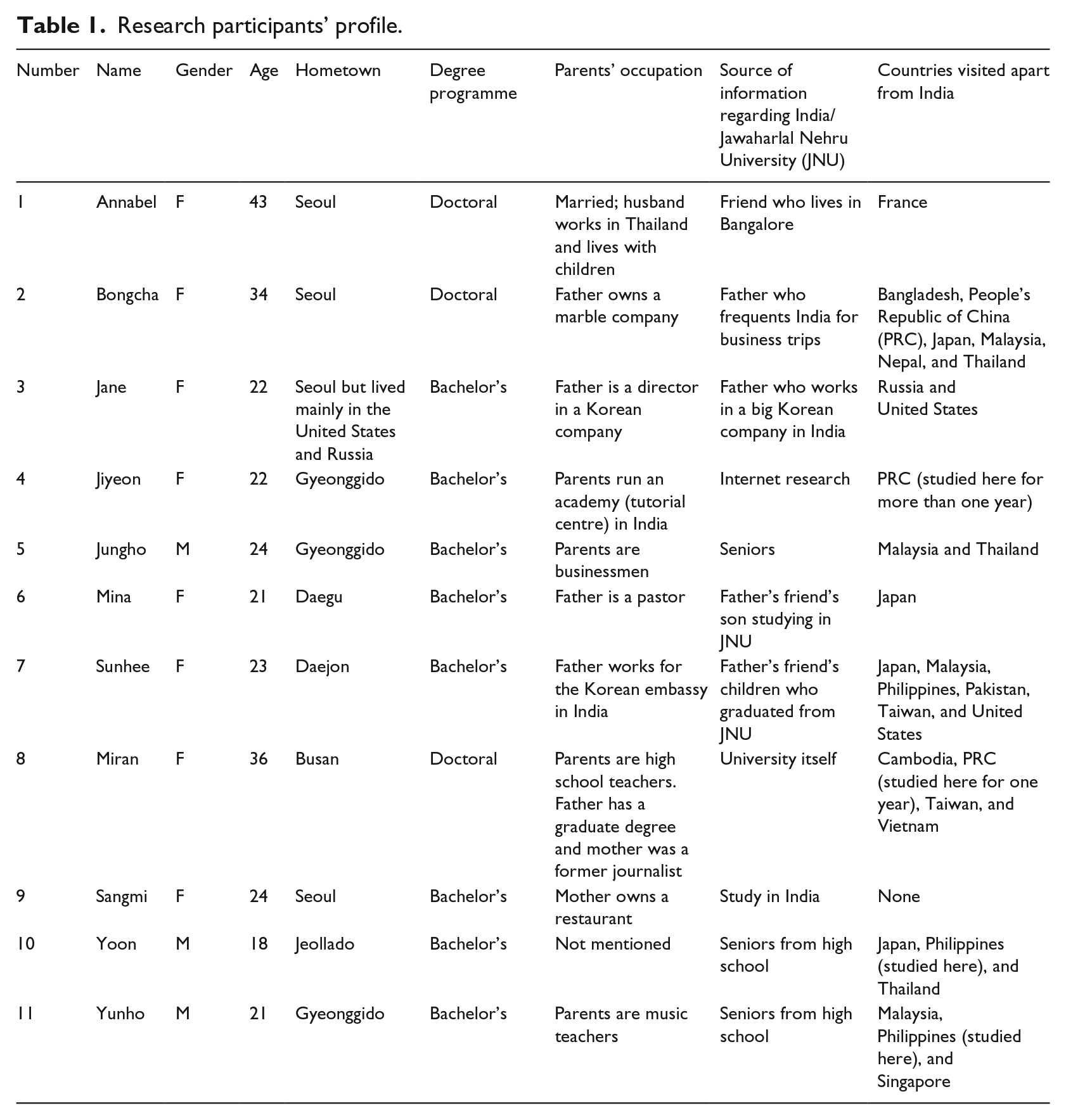
A total of 11 Korean degree-seeking students (eight female and three male) participated in the study. Three students were enrolled in doctoral programmes in Sociology, History and Linguistics, two of whom were continuing post-graduate students at JNU. On the other hand, eight were undergraduate students, most of whom were in their 20s and majoring in different languages such as Chinese, French, German, Russian and Spanish. While limited, background information given by students on their hometown, parents’ occupation and previous travel and/or study abroad experiences or ‘mobility capital’ (Brooks and Waters, 2011) were insightful in gauging privilege but also heterogeneity of students’ middle-class status. This aligns with Koo’s assessment of the middle class as a ‘notoriously heterogenous category’ especially in today’s global age (Koo, 2016: 442) but contrasts, on the other hand, with many studies on Koreans’ study abroad that largely homogenise Korean students in Asia as coming from less affluent and less resourced backgrounds compared to their counterparts in the Anglo-American West (Kang, 2012; Kim and Ozakazi, 2017). Middle class heterogeneity is reflected in participants’ hometowns – some came from big cities such as Seoul, Busan and Daegu, while others from the suburban area of Gyeonggi-do and farther South such as Jeollado. Except for one student who has been studying in India since high school, all participants have had previous overseas travel experience prior to studying in India. In fact, five students also had previously studied abroad for a minimum of one month to more than a year in the United States, Russia, the PRC and the Philippines. Students’ parents were reported to be involved in a range of occupations, the majority of whom were based in Korea while others have direct engagement with India as businessman, company manager, academy owner and embassy official. Information on JNU and India were mainly sourced from personal networks and parents’ business affiliation. Five students mentioned about being encouraged either by their seon-bae 4 or older schoolmate or family friend with children who graduated or were about to graduate from JNU. While not a focus of this paper, social networks, mainly educational and family links (Lee, 2013), have played an instrumental role in facilitating Korean student mobility to JNU. All students were fee-paying students, except for one who was a recipient of a Korean government scholarship. A summary of participants’ profile is shown in Table 1.
Research participants’ profile.
Interview data and projective techniques
Two types of data were elicited during the interviews, namely, narratives and drawings. Narratives were drawn from verbatim transcriptions of interviews done by the author and validated by the participants. While there were a number of interviews conducted in Korean, data presented here are English translations by the author. All interviews were supplemented by the use of projective techniques (Porr et al. 2011) as powerful strategies to elicit meaning within qualitative inquiry. There are different types of projective techniques, including expressive techniques such as sketching and drawing that allow creative self-expression by participants. This has been useful in gauging deeper meanings of transformations through students’ creative articulation of their imagined past, present and future selves that could have been restricted or filtered by language or text (Collins, 2008; Porr et al., 2011). This technique aligns with the deconstruction approach that allowed for ‘visual’ articulation of subjective constructs (Spencer, 2011) of places in relation to self and vice versa.
Prevailing ISM discourse and the ‘misfit’ that is India?
Based on prevailing discourses on ISM, India, positioned at the ‘periphery’ of global knowledge production, is not an obvious study destination choice. The following expounds on how India as a host for international students and therefore a provider of international education encompasses a paradox. First, the world systems perspective (Wallerstein, 2004) applied to the global higher education field suggests the maintenance of the core–periphery divide between developed and developing nations as suppliers and consumers of knowledge, respectively (Altbach, 2012; Sidhu and Ishikawa, 2020). This dichotomy is reified in the ‘world of academic knowledge’ (Xu, 2020) with the West at the centre stage (Gunter and Raghuram, 2018; Guzman-Valenzuela and Brunner, 2019). This imagined ascendancy of the Western episteme (Chatterjee and Barber, 2021) results in an uneven international education landscape charting what are politically, economically and symbolically regarded as centres and peripheries (Lo, 2011; Raghuram, 2013). In reality, this perceived concentration of ‘knowledge stock’ is reflected by the concentration of ‘global stock of internationals students’ in a few countries in North America and Europe (Yang, 2020), but mainly in the United States and the United Kingdom.
Critical perspectives that draw on notions of power and hegemony also accentuate how core–periphery imaginations translate to imaginations of favourable and unfavourable study destinations within the global field of education (Ishikawa, 2009; Marginson, 2008). This aligns with Said’s (1977) explication of geographical imaginations as being relative and reflective of unequal notions of power (Chowdhury and Phan, 2014; Madge et al., 2009) that romanticise or exoticise places based on privileged hierarchies (Van Mol et al., 2020), triggering preference for some over others. Beech highlights this postcolonial construct as shaping many Asian students’ perception of the United Kingdom as an ‘obvious’ study destination choice by virtue of its historic relations with the students’ home countries (Beech, 2014: 171).
Within the more general push-and-pull framework widely used to describe ISM, Western dominance within the global hierarchy of education is codified and strengthened by the practice of ranking ‘academic attraction’ (Ahmad and Buchanan, 2016; Cullen et al., 2020; Findlay et al., 2012; Marginson, 2008). As place identities are constructed through this practice, institutions within places are equally hierarchised into degrees of reputations and (un)desirability (Prazeres, 2017). This converges with theorisations of overseas studies as being engaged in and employed by privileged and utility-calculating, ‘rational’ individuals driven by the pursuit of global capital embodied by having an Anglo-American diploma (Collins et al., 2017; Sidhu et al., 2011). Moreover, social network analyses of ISM continue to recognise the hegemonic relationship between host and source countries and the fractal networks (Macrander, 2017) that govern this relationship which, though evolving, remain constrained by historical, political and economic inequalities affecting education (Perkins and Newmayer, 2014). Hou and Du’s (2020) study, for instance, confirms the existence of a core–periphery structure in the ISM network based on economic development and educational resources across countries.
Within these paradigms, India tends to occupy the periphery where peripherality, traditionally assessed from the gaze of the centre (Carrin and Guzy, 2012; Klimczuk and Klimczuk-Kochanska, 2019), implies marginality and inferiority relative to what is ‘world-class’ (Altbach and Choudaha, 2018; Marginson, 2008). From the lens of marginality (Xu, 2020), India lies outside the major leagues of knowledge producers. From the lens of inferiority, India’s higher education system, despite being the second largest next to the PRC, is said to be crippled by internal challenges, producing low-ranked and unpopular universities both regionally and globally (Agarwal, 2011; Altbach and Matthews, 2020; Bajpai, 2018). These dominant perspectives on knowledge mobilities then put India in a ‘fitting’ template of a ‘giant periphery’ (Altbach, 1993) that does not fit the mould of a desirable study destination, let alone a site of transformation.
India as ‘hu-jin-gug’ (periphery) in Korea’s alleged worldview
I never imagined the map of India. I always cover India in the map – that country we have to remove. . .I’ll never go (Annabel).
As presented in the previous section, dominant discourses produce an essentialised knowledge about India as a misfit for Korean students mirrored in Korean sensibility. In fact, India has not been a ‘longstanding destination’ (Abelmann et al., 2015) for South Korean students, clearly illustrated by Annabel’s narrative above regarding her perception, if not avoidance, of India prior to her studies in the country. This section establishes India’s peripherality not only based on its position within the broader geography of international education but also within South Korea’s history and ‘self-world’ imagination as recounted by dominant discourses.
Historically, Korean student mobilities were politically and spatially confined to the borders of its neighbours, the PRC and Japan. As early as the 7th century, for instance, close ties between the Silla and Tang dynasties facilitated mobility of Korean scholars to the PRC (Cartwright, 2016). In the modern period, a number of Korean students – 187 in 1897 and rising to 739 in 1909 – were also recorded to have left the country for studies in Japan (Schmid, 2002: 109). This trend accelerated further after Japan’s annexation of Korea with numbers growing to nearly 30,000 from 1910 to 1942 (Abelmann et al., 2015). During this time, study abroad was driven by the lack of educational opportunities at home but also by aspirations for modernity and independence (Seth, 2002). After Japan’s surrender and following the division of the Korean peninsula into North and South, the United States occupied South Korea and maintained a strong military presence in the country until now. According to Danilovic, as American capitalist ideals penetrated every aspect of South Korean life in this period, ‘Koreans also began referring to the US as Mi-gug (미국) meaning, “beautiful country”’ (Danilovic, 2014: 16). The United States has since then become the new source of modernity, maintaining a strong political and economic clout in South Korea (Park, 2017). Subsequently, the ideology of “white superiority” started to dominate the country (An, 2015: 209) with the United States replacing the PRC and Japan as the dream destination (Abelmann et al., 2015).
The historical and structural entrenchment of the contemporary world system where White/Western hegemony is reproduced even implicitly and unconsciously (Lee, 2014: 82 cited in Koh, 2015: 440) continues to be strongly reflected in Korea’s self-views and world-views.
In expounding this, Kim’s (2014) seon-jin-gug (advanced country) discourse is particularly useful as it illustrates South Korea’s ideological complex of its imagined position in the world. Said to be largely Westcentric, but particularly US-centric (Cho, 2007), South Korea sets seon-jin-gug as its national goal and accordingly ‘constructs a world dichotomized by idealized seon-jin-gug (West) and marginalized [hu-jin-gug (backward country)] (non-West). . .’ (Kim, 2014: 383). The self-subalternisation by South Korea based on its perception of the United States was discursively reproduced throughout its modern history (Kim, 2012). With its ‘middling view’ of itself as superior over the periphery but inferior to the centre, it is then assumed that Koreans will naturally be attracted to the West – its model for the kind of advancement that it aspires to for itself – while bipolarising its spatial perceptions of the ideal and the marginal (Kim, 2014).
In terms of education, India occupies an inferior position in relation to South Korea in two main respects. First, while South Korea is a major supplier of international students like India, it is also home to prestigious universities, a number of which are at the upper tier of global rankings (Collins and Park, 2015; cf. Oleksiyenko et al., 2021 in this issue). According to Brooks and Waters, Korea has, in fact, emerged as a significant player on the world stage of higher education by placing premium on education (Brooks and Waters, 2011: 121) with all of its top three universities, alluded to as ‘SKY’ (i.e. Seoul National University, Korea University and Yonsei University), making it to the top 200 world university rankings (Times Higher Education, 2020). Second, South Korea is considered one of the most educated countries in the world, having the highest share of young adults with tertiary qualification in the Organisation for Economic Co-operation and Development (2019: 1) and a Gross Enrolment Ratio of 95.9% for 2018 compared to only 26.3% for India (India Department of Higher Education, 2019).
In sum, the following prevails in Korean worldview: that the United States is ‘the centre of knowledge,’ ‘the mainstream’ and ‘the centre of academic activity’ (Cho, 2007; Kim, 2012: 457); that American English is the ideal English (Park, 2017); and accordingly, that India, among many other destinations, for acquiring knowledge or learning English, is a hu-jin-gug.
Expanding the discourse: ‘Uncommon knowledge’ on India–Korea relations
I have friends in Bangalore. They’re doing their job there. They suggested that we come to Banglore. (Annabel). The reason why I was interested in India was totally because of my father. He used to come to India for his business trips in early 1990s when I was only 9 or 10. Since then, I got interested in Indian culture, people, society. (Bongcha) …my father’s senior, his son also graduated from [here]. . .I had a chance to chat with him and he told me about the university. . .his younger brother also graduated from [here]. I think approximately 10–12 [Korean] students graduate from [here] a year. (Sunhee) When I was in high school, few of my colleagues were already in Indian universities like Delhi University and JNU. I just knew that there are some universities in India, which are
Obviously, the paradigms discussed in the earlier sections are unable to explain the potential logics surrounding Koreans’ study abroad in India. Rather, they offer a prism that fixates India, but also Korea, within specific categories that obscure many multiple experiences such as those recounted above by Annabel, Bongcha, Sunhee and Yunho. Their narratives clearly suggest a recurring flow of Korean students to India, a type of mobility which goes against ‘common sense’ or ‘common knowledge’ (Chowdhury & Phan, 2014; Collins & Ho, 2018). In foregrounding these narratives, this section draws attention to ‘unnoticed histories’ (Kim, 2020) 5 shared by India and South Korea that have transpired in the same junctures – post-war Korea and se-gye-hwa periods – when the ideology of Western supremacy was said to take root in Korean sensibility, but which remain ‘uncommon knowledge’. Turning our gaze towards specific aspects of India–Korea relations may be considered an attempt to encourage discursive practice of juxtaposing ‘taken-for-granted truths’ (Chowdhury and Phan, 2014) with untroubled, accepted but partial truths in order to oppose hegemonic discourses and develop broader spectrums of multiple knowledges. This will be done by referring to Indian scholarship and available reports on Korean migrants in India.
The work of Tayal (2014) is arguably the first detailed study of India–South Korea bilateral relations published in English that includes, albeit incomprehensively, a historical account of the two countries’ academic exchanges (Iyer, 2014; Mishra, 2014). In Tayal’s documentation, the post-Korean war context is critical not only because it was when the foundations of the Korean migrant community in India were laid but also because of India’s global position at that time in relation to South Korea. For one, India played a major role in the Korean peninsula – a role that was widely recognised by the international community. Serving as chair of the Neutral Nations’ Repatriation Commission, it mediated between the United States and the PRC in the handling of prisoners of war (POWs) (Barnes, 2013). Tayal (2014) notes that a number of POWs who decided to seek refuge in India as a neutral country instead of being repatriated back to either side of Korea became the first Korean residents in India. Settling in India, these POW-turned-residents eventually formed the Korean Association in India, who played host to the next waves of Korean arrivals and who became bridges between India and Korean firms at a later stage (Bell, 2008). For another, while Korea was still recovering from the war, India’s socio-economic conditions were considered better with its education institutions even viewed as superior by Korea (Tayal, 2014). This could have underpinned Korea’s interest in India such that as early as in the 1970s, Hindi studies made its way to Korean academia, with the setup of the Hindi department in Hankuk University of Foreign Studies in Seoul and the Hindi programme in Pusan National University (Tayal, 2014: 199). In 1974, the two countries entered into a cultural agreement that facilitated, albeit few, Korean student arrivals in India and their enrolment in the then popular tertiary courses such as Buddhism, philosophy and history (Tayal, 2014).
In the 1990s, South Korea entered a new era as an economically advanced country, with the government aspiring for global competitiveness through its globalisation campaign known as se-gye-hwa. This was when Korea became more proactive in exploring markets overseas, including India, consequently resulting in the inflow of more students as Korean investments poured into the country (Jenkins, 2012). In particular, the population of Korean migrants in Indian cities grew with the establishment of global branch offices of Korean companies run or financed by jae-beol or conglomerates. For instance, Hyundai, Samsung, LG and POSCO established facilities mostly in the urban regions of Chennai, Bangalore and Delhi (Bell, 2008). Many of the deployed Korean employees in India-based Korean firms, who brought with them their families, have likewise opted for their children to attend schools in India. Jeong (2008), for instance, stated in her autoethnography that her studies in India were connected to her father’s management role with Samsung, such that their whole family had to relocate to the country following the establishment of Samsung’s global facility in Bangalore. Eventually, Korean communities sprouted in the regions where Korean companies were established, making Korean churches, restaurants, groceries, salons, even guest houses a common sight (Pothukuchi, 2015). This growth of Korean migrant communities in India reflecting the expansion of the two countries’ economic and commercial relations was also said to have generated interest in India-focused and India-based studies among Korean students. For instance, Jenkins quotes a doctoral student studying international law at an Indian university: ‘I have been here for seven years now,” he says. ‘I specialize in sustainable development. . .the Korean government is so interested in the Indian market, and when I go back to Korea, I will have very specialized knowledge about India (Jenkins, 2012: n.p.). Today, not only is India South Korea’s 7th biggest export market but it also hosts the 26th largest Korean overseas community in the world, recording more than 11,000 Korean residents in the country in 2019 (Ministry of Foreign Affairs, 2019).
It is important to note that it is also in these same two periods, post-Korean war and se-gye-hwa, when American superiority took root and became solidified in Korean society as discussed in the earlier sections of this paper. This explains why English is also considered a major driver for studies in India among Korean students. According to Altbach and Matthews, as a colonial legacy, English continues to be widely used in Indian higher education institutions such that ‘50% of Indian undergraduate students study in an English-medium environment, and a large majority of the graduate and professional studies, especially in engineering and medicine, are offered exclusively in English’ (Altbach and Matthews, 2020: 54). De Wit (2018) also notes that English remains a crucial factor influencing international student flows even for English-teaching countries in the developing world such as India. Phan (2017) describes India as among the top destinations for international students in the Asian region together with other former colonies who use English as an official language such as Singapore, Malaysia and the Philippines. In so far as Korean students in India are concerned, many are reported to be lured by cheap English lessons and immersion in an English environment (Pothukuchi, 2015). For instance, Kim Do Young, a Korean student who went to India in the 1980s and who eventually became a renowned Korean academic in Indian universities, pursued both graduate and doctoral degrees in English literature. Subsequent years saw a further increase in the number of Korean students who pursued English education in India – some are younger students who also stay in Korean boarding schools while others are much older, participating in study tours and practising English while on a business trip visiting companies (Tayal, 2014).
While these episodes may have facilitated contemporary mobilities, including educational mobilities, from South Korea to India, there remains a huge gap as to the understanding of the lives of Koreans who moved to India. More specifically, there is lack of information as to how Korean students envisage their studies in India or whether education in India has brought about any transformation for them. This aspect will be explored through the presentation and examination of student narratives in the next section.
Constructing discourses on ‘everyday transformations’ through comparison, contradiction and conjecture
In this section, I will unpack what I call ‘everyday transformations’ to describe the shifts and changes that Korean students experience, imagine and desire as they undertake their studies in India. The use of the term ‘everyday’ is important in suggesting that transformation is not a grand, one-off episode but is constituted by everyday physical, social, psychological and emotional encounters with and negotiations of India. ‘Everyday’ is thus construed in this paper as relational, denoting subjectivity, materiality and uncertainty. In analysing the narratives, I found out, for instance, that as students deconstruct and make sense of their subjective experiences of India, they also construct varying subjective discourses of transformation. These discourses are embedded within their narratives assembled and connected together through comparisons, contradictions and conjectures.
Comparison occurs at different levels. As students share their stories, they simultaneously compare and contrast places and their own selves in relation to others, as well as their past, present and future. Contradiction, on the other hand, embodies disruption in long held views, disposition or tradition while conjecture manifests through students’ hopes and aspirations but also uncertain futures. By comparing, contradicting and conjuring, students narrate what has changed, what continues to change and how they embrace and desire for changes as they encounter and experience India in the everyday. These changes constitute their everyday transformations understood as subjective but interrelated discourses of freedom, diversity, distinction, resistance, discomfort and moving selves (cf. Hanada and Horie, 2021).
Transformation through freedom
For some students, India is a space where they can be free. For others, India itself is a state of ‘being free’. While comparing their situation in Korea, students talked about the diverse factors that inhibit freedom in Korean society: Actually, my friends are attending university in Korea. They are in 1st year but if you look at them, it’s so hard. Everyone’s having a hard time while here in India, I’m so free. More than Korea. . .Korea is that kind of society that puts pressure on Koreans. Coming here, I’m so free. Yes. In Korea, that kind of education, that kind of culture, it’s so hard. When I first came here as a tourist, I saw JNU once and it was nice. My first impression was that it’s so free. When Koreans think of India, they think of it as dangerous, dirty, so hot, this is how they think. . .but me, I didn’t feel it. It’s so fresh. . .In Korea, groupism is intense but here, it’s rather individualistic so I have plenty of time for / with myself. I have plenty of time that I can be alone. (Mina)
Mina expressed transformation through multi-layered comparisons. First, she compared herself with her friends and with her past self in Korea. She claimed that in India, she is free because she is liberated from the pressures of Korean society. Second, she compared her impression of India and how she thought Koreans in general would perceive India. For Mina, India is refreshing and a crucible of freedom in that she can have time for herself and time to be alone. The same is expressed by Jungho and Yoon in the following narratives: First, if I were in Korea, I would probably be busy with playing around. In Korea, people drink a lot, right? Drinking, gaming, karaoke, there’s so much to amuse oneself with. I wouldn’t have been able to focus on studying but here in India, there’s nothing to play around with, I can study. Shall I call it freedom? I meet my friends, have conversation with them, play football, basketball and do things that are good for my health, studying. I have a lot of time. (Jungho) The positive aspect is that I’m free. Here, I don’t have parents. . .(Yoon)
Jungho spoke about freedom as ‘having time’ for oneself. Jungho’s expression of ‘I have a lot of time’ translates to ‘I am free to choose how I use my time’ thereby expanding the notion of freedom as having the ability to create options for one’s use of time. In the same manner, Jungho implied being liberated from societal pressure – the same pressure brought about by ‘groupism’ mentioned by Mina. Yoon, on the other hand, gave a more personal assessment of freedom – freedom from his parents. Korean parents are often portrayed as managers of their children and their children’s future (Abelmann et al., 2015; Kang, 2012).
For the three students, being free in India is a transformative experience, a liberation from both societal pressures and temporal routines.
Transformation through diversity
The ‘grandeur’ of India is imagined as interaction with diversity – with a culturally and linguistically diverse environment. Annabel and Miran, in particular, highlighted how this converts into a powerful tool for shaping one’s worldview. Quantifying diversity as ‘30 times more than Korea’, Annabel spoke of more than exposure but of closer interaction with diversity that changes the way she looks at and understands others and herself. Unlike Korea which is claimed to not have much diversity, India is said to offer a rich space from which to gain knowledge and wisdom from experience: India is a very big country in terms of population, environment, culture, language, religion. . .It is 30 times more than Korea. . .Compared to Korea, it’s a big country. Its population is also big. You can’t see this much in Korea. Here in India, you can see [encounter] a lot of people and this broadens your understanding of people. For me, loving is. . . I think I’ll be able to love based on the knowledge and wisdom I’ve gained from how much I’ve experienced, and how much people I’ve met. . .(Annabel)
Miran similarly described India as a nation of multiple nations. This diversity is construed as offering legitimation for India as a supplier of knowledge despite being outside of the purported ‘world class’: Especially India, India is a country where we should never put a fixed frame because it is so diverse. The culture of South and the culture of North are totally different; West, East, totally different. It’s just like different countries. And people’s mindset are that much various as well so you can’t completely say that India is this, India is that. . . There are too many things to study. You can talk about International Relations, caste, gender, Regional Studies, Indian Studies. . .(Miran)
Yunho, on the other hand, spoke of diversity as an opportunity to accept and embrace differences, transforming his life in India into something that is unexpectedly favourable: I would say, it’s better than I expected. I only expected that I would be learning German language. That was my own expectation. I never expected that I would enjoy the life here. I expected it to be harsh 3 years. It was actually really nice. My friends come from different environment and different circumstances so we can share differences with each other. Even though we are different, we can get closer by sharing our common things, by hanging out together. (Yunho)
In Yunho’s narrative above, the experience of ‘shared’ differences is what was found as transformative such that learning occurred beyond the course but within diversity between peers.
Transformation through distinction
The narratives of Jiyeon and Jungho are centred around distinction and their lack of it in Korea. Jiyeon related this to acquiring skills and abilities such as multiple foreign languages other than English. Similarly, Jungho associated it with ‘being special’. Hence, in contrast to prior studies that privilege Western capital and assume its automatic conversion across all types of societies (Collins et al., 2017; King et al., 2010), Jiyeon and Jungho confirmed that not only can similar skills and capital be acquired outside of the West but also that they are satisfied with what they gained from India, making them special and distinct: I didn’t have any ability. But present, I kinda have ability because I can speak English and Chinese. (Jiyeon) I’m not special in Korea. If I go to another country, I think I will be special. And I am Korean, I can teach taekwondo. . .and speak Korean, English, Hindi and Russian. (Jungho)
Drawing attention to Jungho’s mention of ‘another country’ is also important as this implies ‘circulation of distinction’, where becoming distinct is now seen to be applicable in different contexts after its acquisition in India.
Transformation through resistance
For many of the students, transformation represents a discourse of resistance. Resistance is articulated in different ways and is evident in the students’ deconstruction of India as an English destination. According to Kim (2012), the elevated position that Koreans place upon English has created for itself a subaltern self-perception in relation to the United States. American English has therefore been constructed and viewed as the prototype. The narratives of Korean students in India and on Hinglish (Hindu–English), however, are challenging and unsettling this prevalent view. India emerges as a space not only for learning but also for expressing English without ‘shame’, as stated by Jiyeon below. Similarly, Yunho’s admission of the status of his India-acquired English shifts the discourse from the symbolic to the practical use of English: Ability can be proven. There’s a specific certificate like TOEFL[Test of English as a Foreign Language]. The score will appear. . .In India, we use language generally. If they come to India, even if their grammar knowledge is less, they can use English without any shame. (Jiyeon) I acknowledge that my English could have been more fluent if I were to study English speaking countries like the US. But I don’t find any serious problem either here as there was no communicative problem whenever talking with American friends. (Yunho)
The discourse of resistance likewise emerges from contradiction to the point where students are ‘othering’ fellow Koreans and distancing themselves from ‘Korea’. For both Yunho and Sangmi, being with fellow Koreans was a barrier to actualising one’s goals – whether it is for plain adventure or for learning English. Yunho and Sangmi’s narratives thus suggest daily resistance against ‘co-ethnic interaction’ but also ‘co-ethnic othering’ expressed in ‘they’ versus ‘I’: I just wanted to go somewhere where no Koreans are. Koreans have some kind of collectivism. Especially in foreign countries, they tend to gather together and just try to be collective always. I just want to avoid that and hang out with native people. I didn’t expect that there will be so many Koreans like this but still I am still enjoying life with Indian friends. My teacher recommended me to go to the USA. In the USA, there are still many Korean students. I just want to go somewhere where few Koreans are there and continue my adventure. (Yunho) … I think I can speak better English than them. . .Many Koreans were staying for 5 to 8 years and Korean people will say, oh, you were abroad for 5–10 years, you’re speaking English very fluently. But actually, they’re not coz they’re only hanging out around with Koreans and they didn’t try to make mistakes and speak out. Most of Koreans were doing Commerce when their class level begin. But then I chose Science and there was no Korean in the Science stream so I could only hang out with Indian friends. Even my roommates were Indians. I think that really helped a lot. (Sangmi)
For Miran, however, resistance is not against Korea but against the ‘core’, legitimising studies in the periphery. According to Miran, even if she did not choose to study in the United Kingdom while she could, she could still benefit from British knowledge while in India because British scholars go to India. On the other hand, it would not be the same if she studied in the United Kingdom as Miran related this to uneven academic mobilities such that there are fewer opportunities for Indian scholars to visit the United Kingdom: While I’m studying in India, I could face various perspectives – perspectives of Indians but also perspectives of British scholars at the same time. They also come to JNU for conferences very often so you get to learn both things. But the other case is not happening that much. I could have studied in the UK but then I don’t think I would have learned this much if I had gone to the UK. (Miran)
Resistance is summed up by Sangmi below as she contradicted Korea’s education as not being the right or ‘only’ way: Curriculum system in Korea means fastest way. It’s not right way. If some people can stay in another road, it doesn’t mean. . .if someone has one opinion and another has another opinion, it doesn’t mean wrong. Different opinion, another way. It will be so dreadful if somebody says my life is right and you’re living your life very wrong. No one can decide that. (Sangmi)
Sangmi’s narrative above demonstrates resistance to dominant discourses represented by the ‘curriculum system’ and ‘people’s opinion’. This implies her legitimation of pursuing studies in India as being the ‘other’ but the ‘right’ road for her – a transformed view not just of education but of life more broadly outside of the Korean context.
Transformation through discomfort
Students also shared about what they did not like about India such as the discomforts and inconveniences they experienced. Bongcha, for instance, who has known India as a child through her father’s business and has thus visited the country several times prior to her studies thought that living in India would be easy for her. It turned out, however, that the discomforts of weather and poor infrastructure generated in her feelings of ambivalence and disappointment to the point of wanting to give up. As emotions are negotiated every day, disposition towards one’s studies and place of study are transformed. For Bongcha, she made a choice not to give up, aspiring to be a bridge between Korea and India: I would say I have an ambivalent or love-and-hate relationship with India. Before I joined JNU, I thought that I knew India – its people and culture. . . I thought I could easily adjust in its society because I have already had lots of experiences traveling here. I thought I could adapt myself well better than any other people. . .during the summer it’s really, really hot in India, especially in Delhi. The temperature goes up to 48 degrees Celsius. Just imagine when there is no air-conditioner under this weather. It is not allowed to have one in the hostel room. Surviving in the hostel during summer is really tough. After I spent one year in JNU, I came back home in Korea for summer vacation, and I told my mom that I don’t want to go back to India again. I didn’t regret to study in India but it was a disappointment. I couldn’t even believe that I told this to my mom because I thought that I really love India and that I understand its people. . .[Now] I will never give up. I will continue my studies and I would definitely study India in the future and become a bridge between Korea and India. (Bongcha)
Similarly, Mina narrated her frustration with India’s way of doing things, characterising it as slow compared to the fast-paced life in Korea: [At first, it was so slow, people are slow, slow slow. In Korea it’s so fast, right? Here, it’s too slow. At first, I was really frustrated. . .[But] every vacation, when I go back [to Korea], it became difficult for me. People are fast, fast, fast. I’m slow, slow, slow, so it’s difficult. It was because I was so used to here already. (Mina)
As Mina encountered and embraced India on a daily basis, her initial discomfort with India was reversed when she went home to Korea where she had to ‘readjust’ herself to her now secondary environment. The discomfort was then transformed into comfort and vice versa.
Transformation through ‘moving selves’
Students similarly construct a discourse on transformation through a conjecture of a ‘moving’ rather than a ‘stuck’ immobile self (See Figures 2 and 3). Both the narratives of Sangmi and Yunho imply how physical mobility to India allowed them to escape the state of ‘stuckness’ by gaining new knowledge and opportunities: Because my mom gave me the opportunity, I can go this much and I think I can go further more. I don’t think going to Germany, if I go there, I don’t think I’ll be afraid anymore. Increasing your confidence and your knowledge. Not locked in the. . .I don’t know how to say in English. ‘U-mul an-ui gae-gu-li’ [frog in the well]. It’s the frogs. If they don’t try to get out, they’ll be stuck there. (Sangmi) Life is going well. Especially in the last year, I got a chance to go to Germany because I was selected for a scholarship program. It was really awesome – meeting people from all over the world, getting to know them, was really a wonderful experience for me. Should I talk about my future? I am going to apply for an MA program in India. Linguistics Studies. If I get selected, maybe I can study more about languages and people. It’s nice for me and I’m really enjoying this. (Yunho)

Drawing of Sunhee’s imagined past, present and future selves.
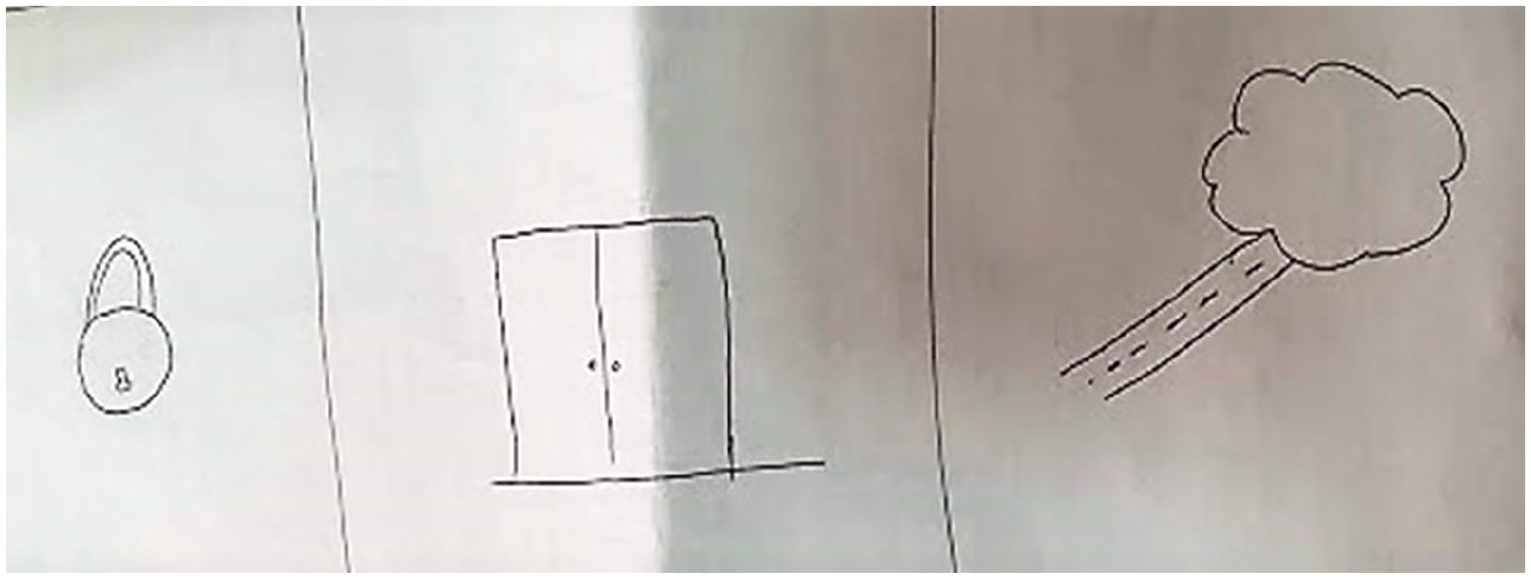
Drawing of Yunho’s imagined past, present and future selves.
In the same way, the discourse of ‘moving selves’ in the following narratives demonstrates India as an enabling space for hoping and aspiring where the self is seen as being different from the past and constantly moving at present for the future: I actually didn’t have a clear plan about my future life when I was in Korea since I was so focused on competitive things in Korea. After I came here, I started to learn Russian and Hindi and started to gain my confidence back and I work as a volunteer as much as possible so that I can help people in India with my knowledge and capacity. . .(Jane) After coming to India, I was a flower at the first time but very dry because it was hard to adjust while studying. I have to find my way and these days, I am searching the way through which I can flourish here. I don’t know about my future yet but if I bloom out and flourish with my efforts, this will be a door of other chances. (Sunhee) I just draw a lock. In the past I was blind and didn’t know what to do in my future. I wasn’t able to think about my future. I was blind. I just wasted my time. I was in the darkness. The present is about door. I can open it now because I got the key. I don’t know what will be there beyond that door but still I can say that it’s at least open. This is way and this is kind of a mist. I don’t know what will happen in the future but I still have the way. I can go through this way even if I cannot see the future. (Yunho)
The narratives of Jane, Sunhee and Yunho thus articulate the lack of ‘aspiring’ or the ability to conjure future possibilities. In this sense, India was also seen to serve as an ‘eye opener’ replacing past ‘blindness’, as in the words of Yunho, when life did not have any direction. Through India, the students imagine themselves more confident in opening and confronting the ‘door’ of uncertainty or of possibilities where their selves may be moving towards.
Conclusion
…Not only India, but also in many things, you should not simply generalise things. (Miran)
Miran, alongside the students in this research, offered rich insights on ‘transformation’ as an important feature of the variegated and multifaceted educational mobilities transpiring outside the purported global education centre of the West. In line with this special issue, the theme of transformation was taken up by this paper to illustrate how international education in the periphery can be a transformative experience and how diverse experiences of transformation can in turn deconstruct and transform the view of the periphery. The paper demonstrates this first by applying deconstruction as a guiding principle to unsettle centre–periphery, East–West binary oppositions and contest simplistic and problematic assumptions about fixed trajectories of knowledge and student flows (Sidhu, 2015). This was illustrated by presenting historical but less attended knowledge about India as host for Korean migrants, including Korean students, lying at the margins of Anglo-American ‘truth regimes’ (Chowdhury and Phan, 2014: 27). By doing so, this paper transforms the discourse of India as a misfit and of Korean students as unprivileged, irrational individuals pursuing education in a putatively impossible study destination. More broadly, this paper likewise contributes to new ideations surrounding study abroad by broadening avenues from where to compare and assess relationalities beyond binary thinking (Sidhu, 2015).
The deconstructed periphery has then foregrounded student narratives on their subjective experiences of India and the ways by which these narratives – expressed through words and drawings – also construct and articulate plural discourses of ‘everyday transformations’. In conceptualising everyday transformations, the paper drew attention to the meanings suggested by ‘everyday’. First, it discussed transformation as a fluid, daily dynamic and a constant tension between encounter and negotiation (Kang, 2018; Prazeres, 2017). Transformation is seen as not signalling a single episodic change but rather emerging from recurring and subjective confrontations with people, ideas and place. Everyday transformations, with emphasis on its plural form, are thus replete with multiple meanings reflecting multiple subjectivities of international students that are irreducible (Chowdhury and Phan, 2014). The paper argues in addition that these subjectivities are also relational to that which makes them plural. In this sense, uncertainty is an inherent aspect of the everyday in that even while it is experienced as part of a life course that allows conjectures of the future, it is foregrounded on the abundance and multiplicity of possibilities. This, as the paper suggests, is the landscape on which lies transformations – the landscape of everyday, within which diverse discourses of transformations are constructed and reconstructed. For degree-seeking Korean students in India, this everyday is constitutive of multiple discourses of freedom, diversity, distinction, resistance, discomfort and moving selves, (re)constructed through iterative comparisons, contradictions and conjectures.
Through its empirical focus on Koreans’ study abroad in India, this paper constitutes a landmark contribution to the fields of comparative international education and ISM. It is a pioneering work on Korean degree-seeking students’ place-grounded experiences in India that not only expands the empirical scope of the extant ISM literature but also opens space for conceptual rethinking of transformation and its multiple meanings within the context of international education (Chowdhury and Phan, 2014). By acknowledging the importance of inclusivity in knowledge production (Dat et al., 2019), the study likewise advances theorisation of transformative learning by pivoting to the broader social and educational ecology of Asia, specifically India, as constituting of transformative environments. In doing so, this paper deconstructs intra-Asia student mobilities as a discrepant form of knowledge flow that is on the one hand an ‘experience of the impossible’ (Royle, 2000: 11) but on the other, also of multiple possibilities (Phan, 2018). By focusing on these possibilities and also on the tensions that generate them, this research directs attention to the need for examining more closely the role of emerging hosts and study destinations within the broader landscape of the Global South in enabling transformative international student outcomes and experiences. As a pioneering study, this work urges scholarly interest in the current and post-study lives of students in diverse but vast regions of the periphery to gauge how experiences of transformation are converted into new logics of mobilities but also into navigational capacities needed in the ongoing post-COVID-19 pandemic world.
Footnotes
Appendix
Romanised Korean terminologies listed according to their sequence of appearance in the paper:
Acknowledgements
The author thanks the 11 Korean students who participated in this research and all key contacts in India who assisted in her fieldwork, especially Professor Vjayanti Raghavan, Dr Sandip Mishra and Mr Shadhi Imran. The author would also like to acknowledge Dr Margaret Kitchen, Dr Changzoo Song and Professor Francis Collins for their important inputs to the earlier version of this article. Equally, the author is grateful to the issue editors, Professor Phan Le Ha and Professor Gerald Fry as well as the anonymous reviewers for their thorough reading of the paper and extremely valuable feedback.
Funding
The author(s) disclosed receipt of the following financial support for the research, authorship, and/or publication of this article: Field research in India was supported by the University of Auckland 2018 Faculty of Arts Doctoral Research Fund.
