



Abstract
Despite the importance of advanced language proficiency when teaching a foreign language, little research has investigated the oral proficiency of aspiring foreign language teachers across multiple countries and what their teacher training programs do to enhance it. In response, the researchers collected and analyzed both quantitative and qualitative data from foreign language teacher candidates in Germany, China, and the United States. Results suggested that oral proficiency varies significantly both within individual teacher training programs and across nations. The teacher candidates from Germany demonstrated significantly greater oral proficiency in the target language than their Chinese counterparts, who in turn, demonstrated significantly greater oral proficiency than the US teacher candidates. Helping to explain these findings, the data suggested that foreign language teacher training programs have differing areas of focus. While the programs in Germany and China focused more attention on language development, the US program emphasized pedagogical skills. Implications for practice are discussed.
Keywords
Introduction
The importance of advanced language skills and communicative language pedagogy among foreign language teachers is undeniable. Multiple studies have shown that teacher oral proficiency in the target language is an important factor influencing student learning (Butler, 2004; Chan, 2017; Faez, 2011; Richards, 2015). Oral proficiency refers to one’s ability to communicate orally in real-life settings and encompasses both speaking and listening. Weakness in target language oral proficiency can negatively impact a foreign language teacher’s ability to plan and deliver lessons (Veilleux and Bournot-Trites, 2005), select and adapt instructional resources (Le and Renandya, 2017), model use of the language (Richards, 2010), and provide corrective feedback (Le and Renandya, 2017). Limited fluency also impedes teachers’ ability to use the target language fluently and confidently in the classroom (Turnbull and Arnett, 2002). Teachers who lack confidence in their oral proficiency may not speak consistently in the target language and thus deprive their students of the input necessary for language acquisition (Ellis, 2005). To underscore the importance of advanced target language proficiency, Tedick stated, “Proficiency in the [foreign language] is an essential prerequisite for effective foreign language teaching because it is not feasible to implement communicative pedagogy or other approaches, such as content-based instruction (CBI), without advanced level proficiency” (Tedick, 2013: 536).
In light of the importance of strong oral communication skills in the target language, it is troubling that many foreign language teachers lack advanced proficiency in their intended language of instruction. Studies conducted in multiple countries and involving a variety of different languages have raised concern over the often inadequate command of the language possessed by many foreign language teachers (Glisan et al., 2013; Richards et al., 2012; Thompson, 2019; Veilleux and Bournot-Trites, 2005; Yeung, 2017).
Compounding this concern, inadequate target language proficiency is preventing aspiring foreign language teachers from pursuing the profession at a time of critical shortage (Kissau et al., 2019). In the United States, for example, where recent reports indicate the shortage of qualified foreign language teachers is the worst on record (ACTFL, 2017), aspiring foreign language teachers are often denied entry to the profession due to their inability to meet benchmark proficiency standards established by the American Council on the Teaching of Foreign Languages (ACTFL, 2012). Others steer away from the profession due to fear of failing high-stakes and costly proficiency assessments required for licensure (Kissau et al., 2018).
At a time when many countries around the world, including Australia (Weldon, 2015), Canada (Alphonso, 2018), China (Gamlam, 2016), Germany (Spiegel, 2016), New Zealand (Richards et al., 2012), Slovenia (Kyriacou and Kobori, 1998), the United Kingdom (Nuffield Foundation, 2000), and the United States (Skorton and Altschuler, 2012), are reporting critical shortages of qualified foreign language teachers, the profession cannot afford to lose aspiring teachers. Research needs to be done to investigate means of supporting foreign language teacher candidates in the development of the degree of target language proficiency needed to both gain access to the profession and be successful teachers. With this in mind, the researchers investigated the oral proficiency of selected foreign language teacher candidates in selected programs in three countries (Germany, China, and the United States) and the extent to which their teacher training programs work to enhance it, in the hope of using the findings to guide programmatic improvement.
Review of literature
To guide and inform the study, a review of literature was conducted focusing on (a) national standards for foreign language teacher training programs in each of the participating countries; (b) the proficiency of foreign language teacher candidates around the world; and (c) strategies aimed at enhancing teacher candidate oral proficiency.
Teacher candidate proficiency requirements
Germany
The German education system depends on a federal system that leads to diverse regulations. To achieve some consensus and coordination across the states, the Standing Conference of the Ministers of Education and Cultural Affairs (Kultusministerkonferenz, 2019) was established in 1948. To be eligible to commence a teacher training program in Germany, all candidates must first pass the Abitur, a final comprehensive exam that a student must complete and pass to be eligible for post-secondary education (Kultusministerkonferenz, 2019). In Germany, high school graduates have typically completed at least seven years of instruction in one foreign language (most often English), and at least four years in a second. The degree of proficiency in these languages is indicated on the Abitur certificate and based on the Common European Framework of Reference for Languages (CEFR: Council of Europe, 2001). In Germany, teacher training programs in all licensure areas (including foreign language) consist of two phases that build on each other. In Baden-Württemberg, the state from which the German participants were drawn, teacher candidates first complete a 3-year bachelor’s program, followed by a 2-year master’s program. This qualifies pre-service teachers to commence the second phase, the preparatory service, which lasts for 18 months. During this time, aspiring teachers gain further pedagogical and subject-specific didactic knowledge and skills. After successful completion of the final state examination, which consists of a teaching project, teaching observations, and an assessment of candidates’ understanding of the principles of pedagogy and school law, the candidates are deemed fully qualified teachers.
China
In China, undergraduate students wishing to pursue a career as a primary or secondary school English teacher are prepared in what are commonly referred to as normal universities located in different provinces across the country. Upon completion of what is typically a 4-year program, majoring in English, graduates of normal universities are able to register as qualified teachers at the Ministry of Education (Mak, 2016). Students who already possess an undergraduate degree may also seek certification in teaching English language to become an English teacher via completion of a master’s degree or a postgraduate certificate from an accredited institution. In addition to completing a teacher training program, aspiring English teachers in China are required to pass the Test for English Majors – Band 8 (TEM8). The TEM8 is an achievement test intended to measure overall English proficiency, including oral proficiency, and to determine whether or not test-takers meet the requirements of English language abilities necessary to be a qualified English teacher (Yang, 2017). The TEM8 is administered by the National Advisory Committee for Foreign Language Teaching (NACFLT) on behalf of the Higher Education Department of the Ministry of Education in the People’s Republic of China (Yang, 2017). To be eligible for teacher certification, completers of the TEM8 must reach a benchmark score. A score of 80 or above is classified as “excellent”, between 70 and 79 is considered “good”, and a score between 60 and 69 is considered a “pass” (Yang, 2017).
USA
The vast majority of all teacher candidates in the United States complete their teacher training in a 4-year undergraduate program leading to a bachelor’s degree or in a 1–2-year post-baccalaureate program that leads to a graduate certificate or master’s degree (American Association of State Colleges and Universities, 2017). Establishing licensure requirements falls under state jurisdiction. As a result, states have different requirements. Many states, including the state where this study was conducted (North Carolina), require completion of a teacher preparation program at an accredited institution to receive a teaching license. Specific to the preparation of foreign language teachers, approximately half of the country’s 50 states require aspiring teachers to provide evidence of oral proficiency in their intended language of instruction via completion of the Oral Proficiency Interview (OPI; Kissau et al., 2019). The OPI is a standardized test that assesses an individual’s oral communication skills in a foreign language. Among these many states, 16 have adopted the national standard set by the American Council on the Teaching of Foreign Languages (ACTFL) of Advanced Low or higher (oral proficiency) for teacher licensure in the following languages: French, German, Hebrew, Italian, Portuguese, Russian, and Spanish. Many other states, however, have set a lower minimum oral proficiency standard (Intermediate High) for teachers of the above-mentioned languages, despite national (ACTFL) standards permitting Intermediate High oral proficiency among teachers of only a select group of challenging languages (i.e. Arabic, Chinese, Japanese, and Korean) 1 . These proficiency ratings equate with ratings of B2.1 (Advanced Low) and B1.2 (Intermediate High) on the CEFR. Further pressuring foreign language teacher training programs to adopt the more rigorous ACTFL (national) proficiency expectations, as opposed to occasionally lower state expectations, colleges of education that choose to adopt national accreditation standards for their teacher licensure programs established by the Council for the Accreditation of Educator Preparation (CAEP, 2013) are expected to demonstrate how their specific programs (e.g. foreign language teacher training) meet the standards of an accreditation body, such as the standards of professional associations like ACTFL.
Oral proficiency of foreign language teacher candidates
The struggles of aspiring foreign language teachers in the United States to meet benchmark proficiency expectations are well documented (Glisan et al., 2013; Kissau, 2014; Kissau and Algozzine, 2017; Kissau et al., 2019; Swender, 2003). In one of the largest studies of its kind in the United States, Glisan et al. (2013) found that only approximately half (54.8%) of 2881 aspiring teachers of 11 different foreign languages were able to meet the proficiency expectation of Advanced Low established by ACTFL for their respective language. More recent, but smaller studies conducted in the United States involving foreign language teacher candidates have continued to show troubling results. In his study involving 41 aspiring teachers of Spanish, French, and German, Kissau (2014) found that only 56% were successful in reaching Advanced Low.
While research investigating the proficiency of foreign language teacher candidates in countries outside of the United States is scant, multiple studies conducted around the world have documented concerns about the proficiency of practicing foreign language teachers (Butler, 2004; Nadasdi at al., 2005; Richards et al., 2012; Salvatori, 2009; Thompson, 2019; Veilleux and Bournot-Trites, 2005; Yeung, 2017). In Canada, for example, Veilleux and Bournot-Trites (2005) found that school districts neglect to assess the competency of French immersion teachers and suggested that many do not possess adequate oral proficiency to teach in the target language. Ministries of Education in several Asian countries (i.e. Malaysia, Japan, Vietnam, and Thailand) have raised similar concerns about the proficiency of many of their English as a foreign language (EFL) teachers. In a study by Le and Renandya (2017) involving Vietnamese EFL teachers, the researchers reported that while high school EFL teachers in Vietnam were required to achieve level C1 on the CEFR (i.e. Advanced High on the ACTFL proficiency scale), only about one-third were able to meet that requirement. Multiple case studies of elementary school EFL teachers in Korea, Taiwan, and Japan conducted by Butler (2004) revealed gaps in their English language proficiency, most notably in regard to their speaking and writing skills. A thorough review of related literature found no research investigating the oral proficiency of aspiring English teachers in Germany or China.
Strategies
The few studies that have investigated specific strategies to enhance the oral proficiency of current and aspiring foreign language teachers have focused on adding or enhancing coursework in teacher preparation programs (Bale, 2016; Kamhi-Stein, 2009; Kissau et al., 2019; Le and Renandya, 2017). Bale (2016), Kamhi-Stein (2009), and Le and Renandya (2017), for example, all advocated the integration of language skill development into methodology coursework to give teacher candidates the opportunity to practice and enhance language skills in the context of learning instructional strategies. To specifically enhance the oral communication skills of Spanish majors, many of whom were aspiring Spanish teachers, Kissau et al. (2019) developed and implemented an online, proficiency-based course for students whose first language was not Spanish (non-native speakers). In addition to exposing the students to authentic resources in Spanish and providing them with multiple opportunities to interact in the language, the course required students to complete the OPI at both the beginning and end of the semester, analyze their performance, and develop a performance improvement plan. Results suggested that the course succeeded in enhancing the students’ confidence to communicate in Spanish and their oral proficiency. In a study aimed at improving OPI performance of US foreign language teacher candidates, Hammadou Sullivan (2011) compared the OPI preparation strategies of aspiring teachers of multiple languages that attained a score of Advanced Low or higher with those of their peers who did not. Results suggested that the successful candidates used more culturally authentic and discourse-laden resources (e.g. reading newspapers and watching television) and more consistently used the target language outside of the classroom, than their peers who were unable to attain a score of Advanced Low or higher.
Given the paucity of research investigating the oral proficiency of foreign language teacher candidates outside of the United States and strategies to enhance their oral proficiency, the researchers sought answers to the following three research questions:
To what extent is the target language oral proficiency of aspiring foreign language teachers similar in three teacher preparation programs in Germany, China, and the United States?
To what extent do teacher candidates in three teacher preparation programs in Germany, China, and the United States perceive their teacher training programs to be effective at enhancing their oral proficiency in the target language?
To what extent are the strategies to enhance teacher candidate oral proficiency similar in three teacher preparation programs in Germany, China, and the United States?
Method
The researchers used a mixed methodology to investigate these questions. Quantitative data allowed for the analysis of scores reported by a large number of participants in multiple countries. Qualitative data, on the other hand, afforded deeper insights and perspectives on the topics that emerged from the quantitative analysis.
Participants
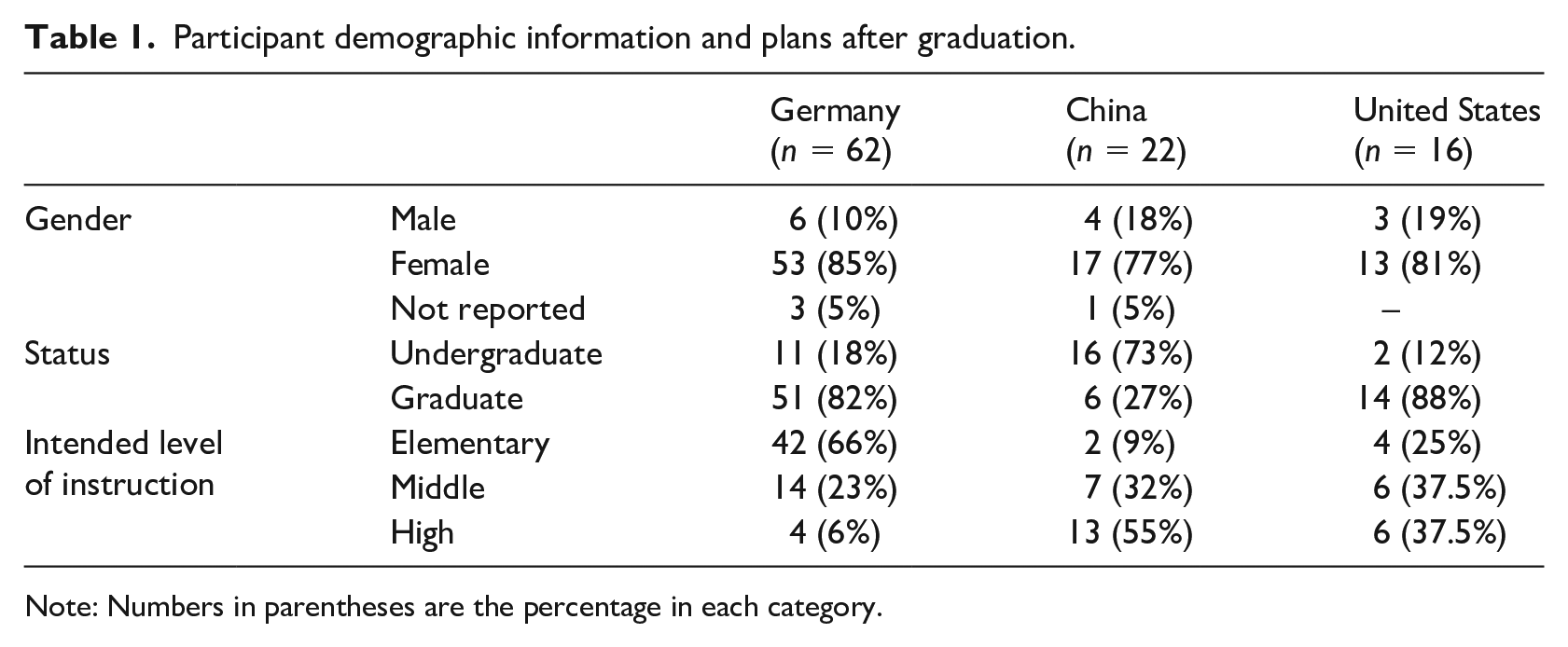
The study utilized a convenience sample of pre-service foreign language teachers completing the final semester of a teacher training program in three countries (Germany, China, and the United States). In spring 2020, aspiring English teachers at universities in southern Germany and in Macau, China were invited to participate, as were their counterparts at a large university in the United States who were studying to become French, German, or Spanish teachers. Participation involved completion of the OPI, an online survey, and possible participation in a follow-up interview. Demographic information about the participants and their intended level of instruction is provided in Table 1.
Participant demographic information and plans after graduation.
Note: Numbers in parentheses are the percentage in each category.
German sample
Sixty-two German students studying to become English teachers at a university of education in southern Germany completed the survey. Six (10%) were males, 53 females (85%), and three (5%) did not indicate their gender. Eleven (18%) were enrolled in an undergraduate program for aspiring teachers and 51 (82%) were in a graduate program. Most (n = 42: 66%) planned to teach at the elementary/primary school level, with only 14 (23%) hoping to teach middle school students, and four (6%) high school students. All reported to be non-native speakers of English. In other words, none of the Germans reported English to be their first language. Thirty-seven (60%) indicated that they had spent more than three months living, working, or traveling in an English-speaking country. From these 62 teacher candidates, 15 were randomly selected to complete an assessment of their oral proficiency (the OPI) in English (1 male and 14 females) and 5 of the 15 (one male and four females) also agreed to be interviewed by one of the researchers.
Chinese sample
Twenty-two Chinese students studying to become English teachers at a university in Macau, China completed the survey. Four (18%) were males, 17 females (77%), and one (5%) did not respond to the question. Sixteen (73%) were enrolled in an undergraduate program for aspiring English teachers and six (27%) were in a graduate program. More than half (55%) planned to teach English at the high school level, whereas seven (32%) were aspiring middle school teachers, and two (9%) hoped to teach elementary/primary school students. One Chinese participant did not respond to the question. All reported to be non-native speakers of English, and only 5 of the 22 (23%) indicated that they had spent more than three months living, working, or traveling in an English-speaking country. From these 22 teacher candidates, 15 (3 males and 12 females) were randomly selected to complete the OPI in English, and 5 of the 15 (one male and four females) also agreed to be interviewed by one of the researchers.
US sample
Sixteen US students studying to become Spanish (13), French (2), or German (1) teachers at a CAEP-accredited university in the southeastern United States completed the survey. Although the university is CAEP-accredited and sets the minimum required proficiency level at Advanced Low, candidates are permitted to complete the program and apply for teacher licensure with a score of Intermediate High, as long as they submit an approved remediation plan to further enhance their oral proficiency. Three of the 16 US students (19%) were males and 13 were females (81%). Most (88%) were enrolled in a graduate program for aspiring foreign language teachers, with only two (12%) enrolled in an undergraduate program. The intended level of instruction was more evenly distributed among the US participants than their peers from Germany and China. Six (37.5%) planned to teach high school, six (37.5%) middle school, and four (25%) elementary/primary school. All reported to be non-native speakers of their intended language of instruction (Spanish, French, or German), and 10 (63%) indicated that they had spent more than three months living, working, or traveling in a country where the language they planned to teach was the principal language of communication. Unique among their colleagues in Germany and China, 11 of the 16 US teacher candidates (69%) indicated that they were employed as a foreign language teacher at the time of the study. Due to the critical shortage of foreign language teachers in the United States (Commission on Language Learning, 2017), it is quite common for school districts to hire someone with proficiency in the target language but without teacher training credentials, and give that person up to three years to complete a teacher preparation program.
Due to the limited number of foreign language teacher candidates enrolled at the participating US university in a given semester, data speaking to the oral proficiency of US foreign language teacher candidates were supplemented via inclusion of archival data dating back to 2010 when completion of the OPI became a program requirement. While over 100 aspiring teachers of French, Spanish, and German had completed the OPI at the US university since 2010, only those completed by non-native speakers of the intended language of instruction were considered in this study, resulting in a total of 64 oral proficiency assessments completed by US teacher candidates (12 males and 52 females). Of these 64, 50 (78%) were Spanish teacher candidates, 12 (19%) were French teacher candidates, and only two (3%) were aspiring teachers of German. To augment the number of US survey respondents, the researchers at the US university reached out to candidates who had completed the program within the last two years (since 2018). From the US participants who completed both the OPI (64) and the survey (16), five (one male and four females) were randomly selected to participate in individual, semi-structured interviews.
Procedures
Quantitative and qualitative data were gathered and analyzed from a variety of sources to answer the research questions.
Oral proficiency interview
To investigate the extent to which target language oral proficiency of aspiring foreign language teachers is similar in three teacher preparation programs in Germany, China, and the United States (research question #1), teacher candidates from all three participating countries completed the ACTFL Oral Proficiency Interview (OPI). There are two major frameworks for assessing foreign language proficiency: the proficiency guidelines established by the American Council on the Teaching of Foreign Languages (ACTFL), and the Common European Framework of Reference for Language (CEFR). The alignment between these two frameworks, as determined by extensive research and validation studies (ACTFL, n.d.), is outlined in Table 2. In this study, proficiency was defined using the ACTFL proficiency guidelines. In other words, teacher candidate proficiency was measured against descriptors in the ACTFL Proficiency Guidelines (ACTFL, 2012), and rated on a scale ranging from Novice Low to Distinguished. Administered by Language Testing International, the most economical (US$105) and convenient means of completing the OPI is via computer (OPIc), and involves candidates participating in a 20-minute conversation with an avatar. Often described as more like an interview than a conversation (see Kissau, 2014), completion of the OPIc involves candidates completing an online survey to collect information about their interests and hobbies, followed by the avatar asking questions of the candidate, in the target language, related to those interests and hobbies. A recording of the interview is analyzed by two certified ACTFL raters who independently assess the candidate’s speaking and assign a rating (Novice Low–Distinguished).
Alignment of the ACTFL OPIc and CEFR ratings.
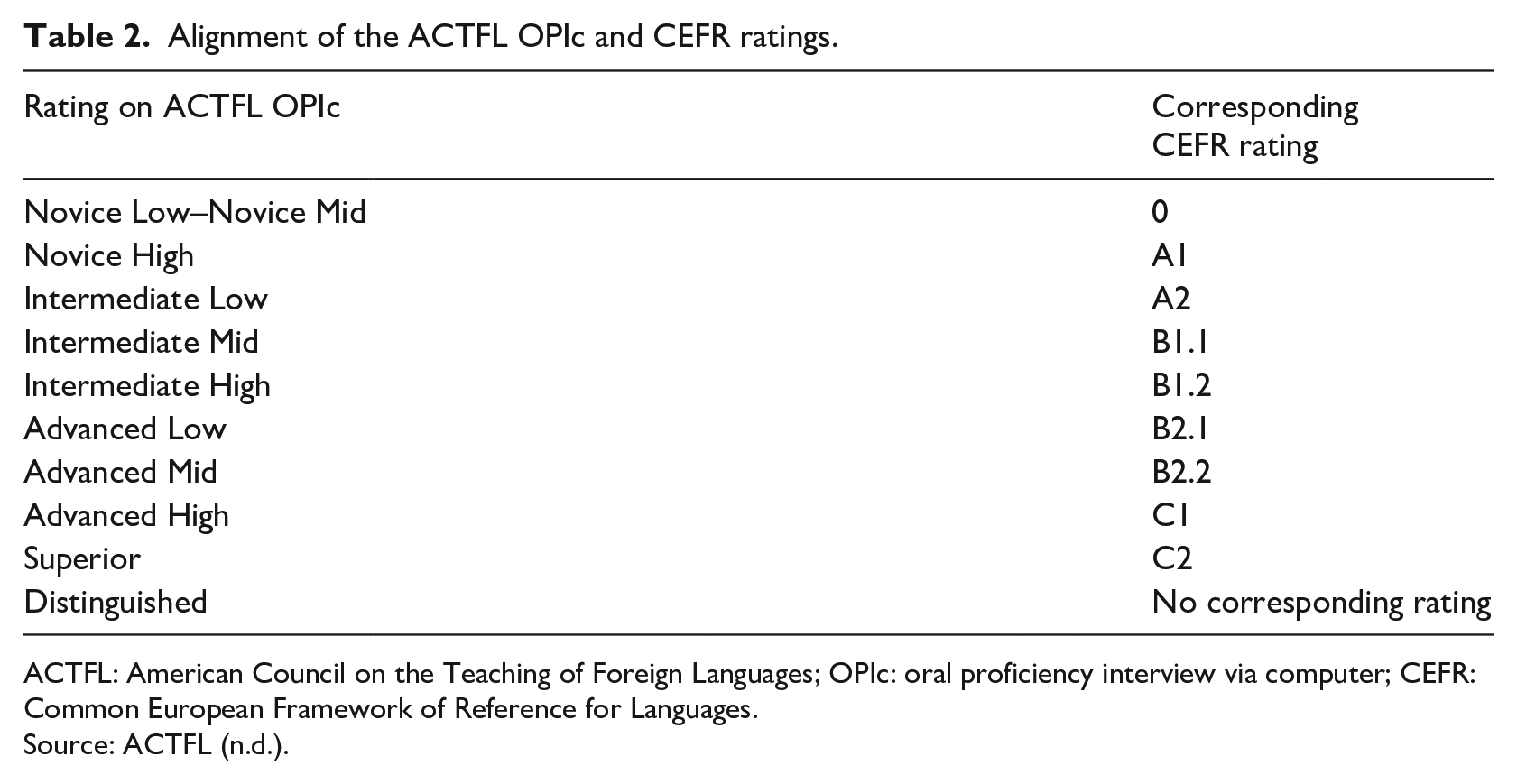
ACTFL: American Council on the Teaching of Foreign Languages; OPIc: oral proficiency interview via computer; CEFR: Common European Framework of Reference for Languages.
Source: ACTFL (n.d.).
Survey
To investigate the extent to which teacher candidates in three teacher preparation programs in the three countries perceive their teacher training programs to be effective at enhancing their oral proficiency in the target language (research question #2), participants were invited to complete an online survey using Surveyshare.com. The researchers created the survey using the ACTFL proficiency guidelines for Advanced Low proficiency (ACTFL, 2012), creating a survey item for each major component of oral proficiency as described in the profile for Advanced Low proficiency. Thus, the survey asked participants to rate the extent to which they perceived that their teacher training program prepared them to enact the components of oral proficiency expected of an Advanced Low speaker of the target language. Given that all participants were native speakers of English living in the United States, or aspiring English teachers in Germany or China, an English version of the survey was used for all participants. To detect and modify any challenging language that might be confusing to, or misinterpreted by, non-native speakers of English, the survey was first piloted on a small group of teacher candidates in China and Germany before wide-scale implementation. The reliability of responses to the survey was satisfactory with a Cronbach’s alpha of .87.
Interview
To investigate the extent to which the strategies to enhance teacher candidate oral language proficiency are similar in three teacher preparation programs in Germany, China, and the United States (research question #3), five teacher candidates from each country who completed the OPIc and survey were randomly selected to participate in individual, semi-structured interviews in English. Due to the COVID-19 pandemic, most of the interviews were conducted online. During the audio-recorded interviews, candidates were asked to describe their oral proficiency in the intended language of instruction, how effective their teacher training program was at enhancing their target language oral communication skills, specific strategies used to enhance those skills, and recommendations for teacher training programs to enhance the development of candidate oral communication skills.
Data analysis
A quasi-experimental comparison design was used to document the extent to which OPI performances (research question #1) and perceptions of preparation (research question #2) were similar for groups of foreign language teacher candidates in the three countries. The researchers compiled and reported descriptive (i.e. means and standard deviations) and inferential (i.e. analysis of variance) statistics. Family-wise alpha value was set at .05 for statistical significance, and effect size was also reported as small, medium, and large (Cohen, 1988). Open-ended, qualitative data collected from one survey question and the interviews were also collected and analyzed to investigate the extent to which strategies to enhance teacher candidate oral language proficiency are similar in three teacher preparation programs in Germany, China, and the United States (research question #3). For the survey question, responses were compiled in an Excel spreadsheet and color-coded by strategy. For example, themes related to study abroad were highlighted with yellow and themes related to viewing authentic resources were coded with green. Researchers counted and compared the number of times each strategy appeared within each context. For the interview data, researchers transcribed and uploaded interview transcripts into N-Vivo. Using the constant comparative method (Corbin and Strauss, 2015), they began with a first round of attribute coding in which each transcript was coded for the country of the speaker. Next, thematic coding was used to identify themes within each group, which were counted for frequency within each group, and subsequently compared across groups.
Results
The study compared the oral proficiency of aspiring foreign language teachers in Germany, China, and the United States, the extent these teacher candidates perceived their teacher training programs to be effective at enhancing their oral proficiency, and the degree to which the strategies used to enhance teacher candidate oral proficiency are similar. Both quantitative and qualitative findings are reported below.
Oral proficiency (research question #1)
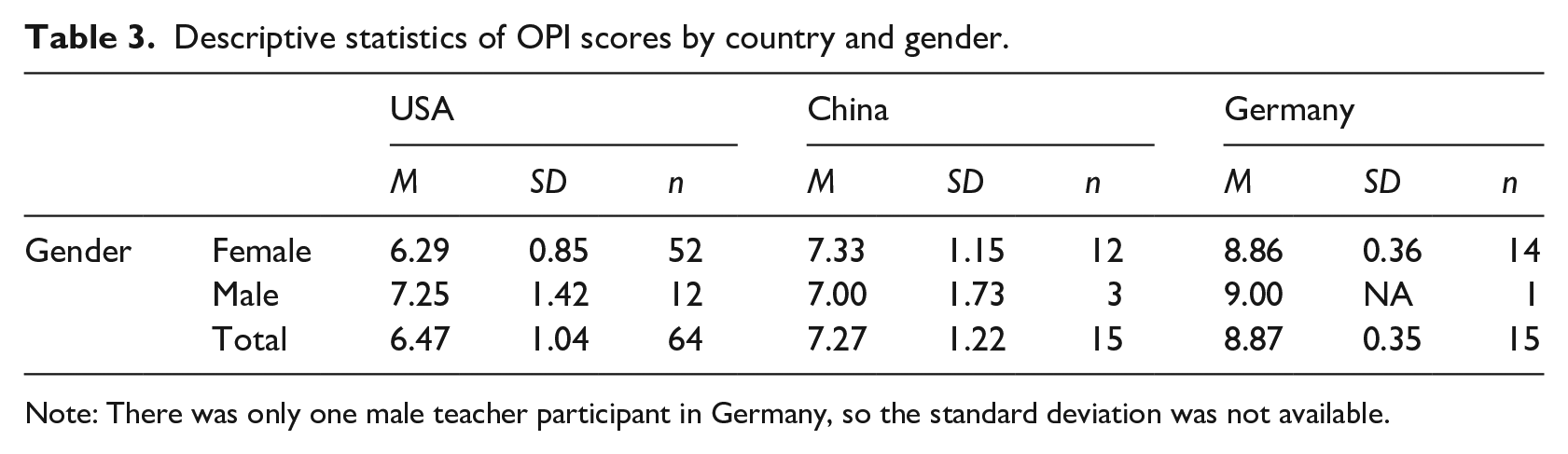
Descriptive statistics of participants’ OPI scores by country and gender are presented in Table 3. Three-way analysis of variance (ANOVA) with country, gender, and study-abroad experience as independent variables and OPI numeric scores as the dependent variable suggested no statistically significant three-way interaction effects F(2, 31) = 1.71, p = .20, partial η2 = .10 (medium effect size). However, the two-way interaction between country and study-abroad experience was statistically significant, F(2, 31) = 3.31, p = .04, partial η2 = .18 (large effect size). In other words, the impact of a significant study-abroad experience on the participants’ oral proficiency varied by country. Having spent at least three months living in a country where the target language is spoken was not found to have an impact on the proficiency of Chinese, F(1, 13) = 0.97, p = .34, partial η2 = .07 (medium effect size), or US teacher candidates, F(1, 13) = 1.56, p = .23, partial η2 = .11 (medium effect size). However, it did have a significant impact on the proficiency of the German teacher candidates, F(1, 11) = 7.62, p = .02, partial η2 = .41 (large effect size). German teacher candidates who had at least three months studying/living/working in English-speaking countries (M = 9.00, SD = 0.00) performed better than their counterparts who did not have such a study-abroad experience (M = 8.50, SD = 0.58).
Descriptive statistics of OPI scores by country and gender.
Note: There was only one male teacher participant in Germany, so the standard deviation was not available.
As illustrated in Table 3, the difference in OPI scores was statistically significant among the three teacher preparation programs in these countries, F(2, 31) = 11.27, p < .001, partial η2 = .42 (large effect size). Post-hoc multiple comparisons with Tukey’s Honest Significant Difference test showed that the oral proficiency of the German participants, as measured by the OPIc, was significantly higher than that of the Chinese participants, and the oral proficiency of the Chinese participants was significantly higher than that of the US participants (p < .05). Of the 64 US teacher candidates, only 24 (37.5%) met the benchmark proficiency standard of Advanced Low (numeric score of 7) or higher for aspiring foreign language teachers. Slightly more than half of the US teacher candidates (51.5%) received a score of Intermediate High (numeric score of 6), and seven (11%) were rated at the Intermediate Mid (numeric score of 5) level of proficiency. 2 In sharp contrast, 11 of the 15 Chinese participants (73%) and all 15 of the teacher candidates from Germany were found to have Advanced Low proficiency (or higher) in English. All but two of the 15 Germans (87%) received a score of Advanced High on the OPIc (numeric score of 9). The other two Germans both received scores of Advanced Mid (numeric score of 8).
Perceptions of teacher training effectiveness (research question #2)
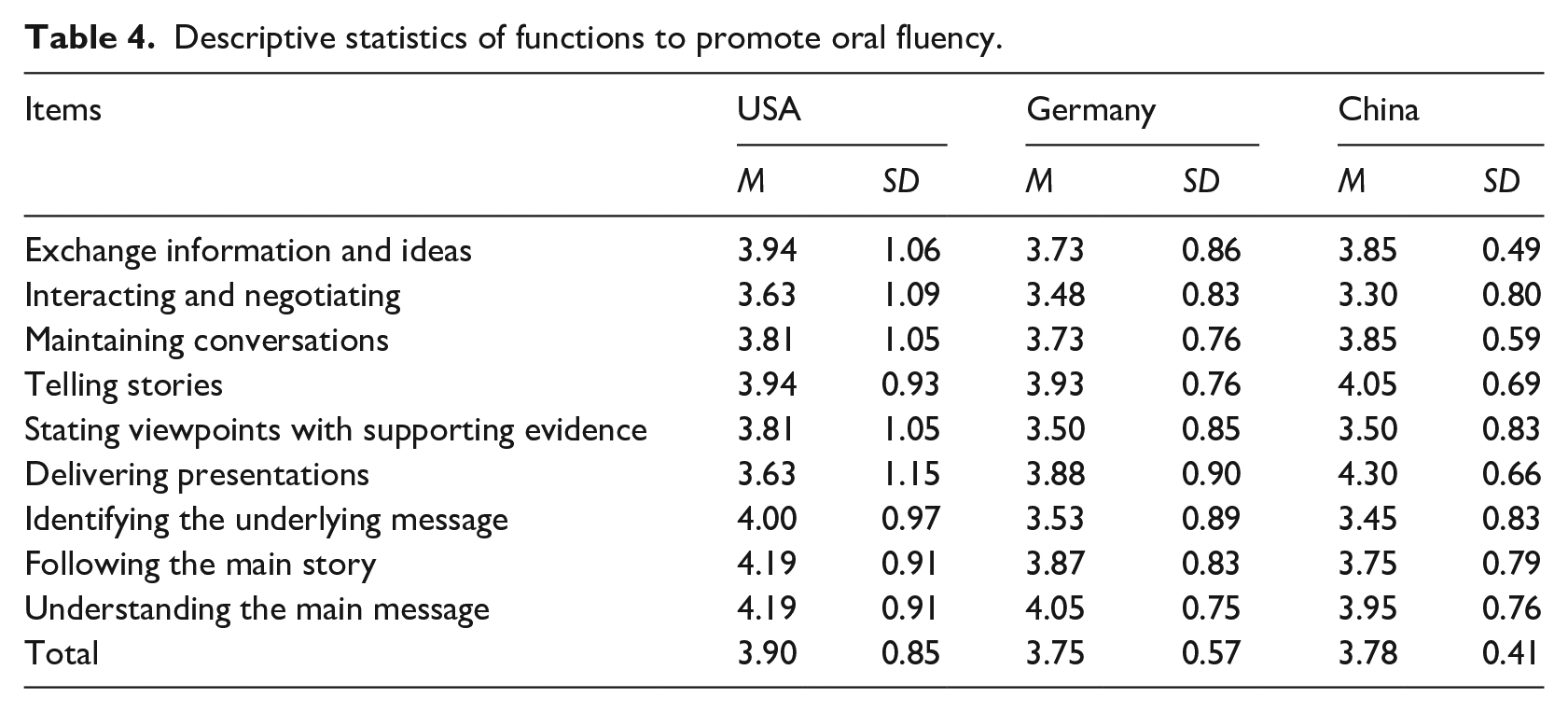
The extent to which the participating teacher candidates perceived that their teacher training program promoted their oral proficiency is reported in Table 4. Three-way ANOVA suggested no statistically significant differences in the three-way interaction, F(2, 84) = 0.79, p = .46, partial η2 = .02 (small effect size). Likewise, none of the two-way interaction effects, that is, between gender and country, between gender and study-abroad experience, and between study-abroad experience and country, was statistically significant (p > .05). The main effects of gender, F(1, 84) = 0.22, p = .64, partial η2 = .003 (small effect size), country, F(2, 84) = 0.20, p = .82, partial η2 = .005 (small effect size), and study-abroad experience, F(1, 84) = 1.71, p = .20, partial η2 = .02 (small effect size), were not statistically significant either. Follow-up analysis at the item level also failed to detect any statistically significant differences between the participants from the three countries (p > .05). Despite demonstrating the weakest proficiency, the US teacher candidates perceived their teacher preparation to be just as effective at preparing them to perform the language skills of an Advanced Low speaker as did their counterparts from Germany and China. In fact, the US teacher candidates reported the highest mean score for six of the nine language functions highlighted in the survey, but none of these differences was found to be significant.
Descriptive statistics of functions to promote oral fluency.
Strategies to promote oral proficiency (research question #3)
Analyses of interview data and the response to the open-ended survey question regarding most impactful experiences on oral proficiency revealed that the two most common themes were study abroad and coursework taught in the target language. A third theme, clinical experiences in schools, was present but less common.
Study abroad
Data from all three contexts converged around the theme of study abroad. On the survey, 19 of the 62 German students, 3 of the 22 Chinese students, and 7 of the 16 US students commented on the value of studying abroad. Interview data revealed that four of the five German participants had studied or worked abroad as au pairs in English-speaking countries where they spoke English to the families with whom they lived, three of the Chinese participants had studied abroad, and four of the American participants had studied abroad. All participants indicated that these experiences were impactful on their oral proficiency. As one of the US students eloquently explained, Living in Madrid with a host family required me to use the language to the point of mental exhaustion. There was no “out” for words I didn’t know. I had to figure out how to communicate with my host mom in the target language or not communicate at all.
Explanations such as this one suggested that immersion in the target culture, which required individuals to use the language on a daily basis for survival, promoted their oral proficiency. Evidence suggested that the time spent abroad, on average, was longest for the German participants, some of whom spent a year or more working as au pairs.
Use of target language in coursework
Another prominent theme was the use of English as the medium of instruction in coursework, although candidates spoke more about the teacher’s use of English rather than their own. This theme was just as prominent as study abroad on the survey for the Chinese students (3 of 22 students), who reported that all of their courses were taught in the target language (English). As one student explained in the interviews, “The instructions and presentations are all conducted in English, which helps us to practice the language”. She explained that, “we are required to discuss in English, present in English, and finish our assignments in English. Languages besides English are not allowed to appear. It helps us to practice the language and enhance the oral communication skills in English.”
This theme was similarly prominent for the German students, emerging as the second most prominent on the survey (9 of 62 students). Like the Chinese, the German interviewees were primarily enrolled in an undergraduate teacher preparation program composed of students all studying to teach the same language—English. Three interviewees described a program where courses focused on English grammar and pronunciation. One student explained, “we’ve had Language Skills 1, 2, 3, and 4. . .which was about phonetics and pronunciation. They helped us a lot to enhance our overall proficiency.” She stated that these courses taught them “what typical German mistakes are and how to improve our English pronunciation.” Interestingly, the other courses described by the German interviewees focused on history, film, debate, and argumentation, but two of the students described a desire for more opportunities to use the language themselves in these courses. For example, one student explained, because we have very big courses and the students, they don’t get the possibility to speak it. Sometimes we do group work where we get to speak in English to other students. But the teacher never really corrects what you’re saying in English.
The theme of use of the target language in coursework was conspicuously absent from the American survey respondents, whose interviews suggested that use of the target language in coursework would have been beneficial. Unlike the Chinese and Germans who described programs taught exclusively in their intended language of instruction (English), the US interviewees described a program taught exclusively in their first language (English) and, also distinct from the other two contexts, one that focused solely on pedagogy. All five US interviewees agreed that their teacher preparation courses had not enhanced their oral proficiency because they were taught in English. Two of the five students explained that because students in the courses were studying to teach a wide variety of languages, it was difficult to improve oral proficiency. One stated that it would be “difficult to accommodate the five different target languages that are involved in the class” and expressed that “it’d be helpful if there were classes of only Spanish candidates studying foreign languages.” As part of their program, four of the five had been required to take an advanced language course. Two reported that this course supported their oral proficiency, while two reported that it did not. The latter two explained that the language courses at the university involved mostly reading. As a French-speaking student explained, “we read French literature and the professor lectured on it. We gave one presentation at the end of class and that was it.” The other two had taken language courses geared more toward oral proficiency, one of which was designed by foreign language education faculty. The student who had taken that course explained that it helped her to pinpoint her areas of weakness as related to oral proficiency and that it improved her confidence in her ability to communicate.
Clinical experiences in schools
The least common theme from the data set related to clinical experiences in K-12 schools (i.e. observations and internships in K-12 classrooms). In response to the open-ended question on the survey, one US student and three German students wrote that their internship in a school had promoted their oral proficiency. However, this theme was largely absent during the interviews. None of the German participants and only one Chinese participant mentioned clinical experiences during the interviews. One Chinese participant explained that she learned, “how to conduct classroom English by observing more experienced teachers. . .I could take down lots of useful notes like the way they speak to give a specific instruction.” In addition to communicating with these teachers in English throughout the day, she was also “required to have an interview with a student every lunch time, each lasting about 10 to 15 minutes.” She explained that this activity aimed “to improve students’ oral English” but that she as a teacher “also got benefit from it.”
Surprisingly, four of the five American participants stated specifically that clinical experiences in target language classrooms had not improved their oral proficiency. As one student explained, I mean I really only spoke French when I was teaching the lesson that was being filmed or helping in the class. But like I said, when I was planning lessons or talking to the clinical educators, it was really just in English.
Discussion
Given the dearth of research comparing the oral proficiency of aspiring foreign language teachers internationally (research question #1), the study’s results represent a significant contribution to the field. Despite the benefits of having a foreign language teacher with advanced oral proficiency in the target language (Chan, 2017; Faez, 2011; Richards, 2015), the findings suggest that many do not, and that teacher candidates in some countries may be better prepared to exhibit the type of language command required of a foreign language teacher than are others. Confirming research coming out of the United States that raises concerns about the proficiency of aspiring foreign language teachers in that country (Glisan et al., 2013; Kissau, 2014; Kissau and Algozzine, 2017; Kissau et al., 2019), average scores of the 64 US teacher candidates who completed the OPI were lower than those of their counterparts in Germany and China. Building upon US research including both native and non-native speakers of the target language, and indicating that only approximately half of candidates meet Advanced Low proficiency (Kissau, 2014; Swender, 2003), this study involved only non-native speakers and found that only 37.5% of the US teacher candidates demonstrated Advanced Low or higher proficiency in the target language (French, German, or Spanish). Although to a lesser extent, the study’s findings also confirm reports from several Asian countries that aspiring English teachers do not consistently possess adequate proficiency in the target language (Butler, 2014; Le and Renandya, 2017). More than one-quarter (27%) of the Chinese participants failed to demonstrate Advanced Low proficiency in English. On the other hand, all of the 15 teacher candidates from Germany exceeded the Advanced Low threshold by at least one proficiency level, and in fact, the large majority (87%) exceeded it by two levels (Advanced High).
In response to the second research question, despite the varying degrees of proficiency exhibited by the teacher candidates from the three countries, the survey data suggested they were all similarly satisfied with the extent to which their teacher preparation program prepared them to exhibit the language skills required of a foreign language teacher. In fact, although the US teacher candidates demonstrated the weakest proficiency among the three groups, they often reported the highest degree of satisfaction with their language skill preparation. A possible explanation for this unexpected finding is that the teacher candidates from all three countries feel equally prepared to do what is expected of them, but those expectations are not the same. The interview data provided compelling evidence that much less, with respect to language use and development, is expected of US teacher candidates in their teacher preparation program than is required in China and Germany.
Perhaps the study’s greatest contribution to the extant body of related research is that it helps to explain the varying degrees of proficiency exhibited in the different countries. Directly related to the third research question (strategies to enhance language proficiency), three important differences emerged. First, the US teacher candidates spoke of foreign language methodology courses conducted entirely in English, advanced foreign language courses that focused on receptive rather than productive skills, and clinical experiences in K-12 foreign language classrooms where the target language was used when teaching, but not outside of instructional time. On the other hand, the Chinese and German teacher candidates mentioned that their language skills were developed via teacher training coursework conducted entirely in the target language (English), the strict use of English in all coursework, and clinical experiences that required frequent use of English with K-12 students, not only during instructional time, but also outside of class (e.g. interviews during lunch break). The reported consistent use of English in teacher training coursework in China is noteworthy and suggests progress in the ongoing paradigm shift in China from a traditional grammar-based approach to EFL instruction to a more student-centered, communicative approach (Zheng, 2012). Earlier research has suggested that many EFL teachers in China do not communicate consistently in English (Lam, 2005) and are resistant to a communicative approach to language teaching (Yang and Hao, 2007).
A second difference related to strategies to enhance language proficiency pertained to programmatic focus. While the US foreign language teacher training program focused on the development of pedagogical skills (e.g. lesson planning, assessment, meeting the needs of diverse learners), the programs in Germany and China placed much greater attention on the development of language skills (e.g. grammar, pronunciation, analysis of typical errors). This difference was not surprising in light of the US teacher shortage and low enrollment in foreign language teacher preparation programs, which prohibits language-specific methodology courses. Thus, while the German and Chinese candidates’ courses were all taught in English, the US candidates had few, if any, courses taught in their respective target languages. As one advances up the ACTFL proficiency scale, expectations for accuracy increase. Thus, the focus on form provided in the German and Chinese contexts may have fostered greater awareness on language use (i.e. noticing) leading to improved proficiency for these candidates.
Third, data supported existing research that time spent abroad impacted candidates’ oral proficiency, but also suggested that an immersion experience does not guarantee enhanced proficiency. Spending a period of three months or more abroad did have a significant impact on the German participants, but it did not on the participants from the US or China. In support of Swender (2003), studies abroad may need to be of a longer duration than three months to make a significant impact on one’s oral proficiency. Of the five German candidates selected for an interview, four had worked as au pairs in English-speaking homes for at least a year, an experience more common for Europeans than students in China or the United States. Unlike some study abroad programs in which candidates may live in an apartment with peers from their home country, working as an au pair requires total immersion in the target language and culture. Similarly, au pairs typically commit to at least one or two years abroad, unlike study abroad programs that may be one semester or less. Such an immersion experience may account for higher levels of language proficiency among the German participants.
Implications and applications
Foreign language teacher training programs around the world should consider the results of this study in their efforts to enhance candidate target language proficiency. Had the focus of the present study been not solely oral proficiency but instead efficacy in teaching language, the distinct approaches of these three training programs would raise additional questions. Is stronger language proficiency more important than stronger pedagogical skills? To be sure, a hybrid approach seems to offer the most promise. When feasible, programs should incorporate both language- and pedagogy-focused coursework and instruction should be delivered in the target language. The German and Chinese participants in the interviews made it clear that the pervasive presence of the English language in their teacher preparation program not only increased their exposure to the target language, but also gave them multiple opportunities to practice using it. On a related note, language-focused coursework should provide students with multiple opportunities to practice the oral language skills that will be required of them as foreign language teachers. While some of the US teacher candidates made references to an advanced language course that they were required to complete, half indicated that it did not provide opportunities to communicate orally in the language, did not include any instruction on metalinguistic awareness through a focus on form, and thus did not enhance their oral proficiency. The half that did perceive their language course to be beneficial mentioned completing a proficiency-based course that required them to frequently interact in the target language and assessed their oral proficiency at multiple points throughout the course to shed light on areas for improvement. In streamlined, graduate programs, such as the one completed by many of the US participants that have little space for multiple language courses, it is critical that these select courses be proficiency-based and focus on language development.
In cases similar to that experienced by the US teacher candidates where aspiring teachers of multiple languages are grouped together in the same courses, efforts should be made to introduce teaching-related materials in the target language, so that teacher candidates can see and use the vocabulary, expressions, and language structures commonly seen in foreign language classrooms. When numbers permit, teacher candidates could also be clustered by the intended language of instruction and given opportunities to discuss concepts, practice teaching strategies, and deliver mock lessons in the target language.
It is also critical in all teacher preparation programs, but particularly those that lack much time or attention to the development of language skills, that all clinical experiences in K-12 foreign language classrooms are meaningful and provide multiple opportunities for target language use. In streamlined teacher preparation programs that focus on pedagogy, as opposed to language development, as was the case with the participating US program, there is no time to be wasted simply observing instruction or talking to the teacher in a language other than the target language. The fact that only 1 of the 16 US teacher candidates who completed the survey mentioned that experiences in K-12 classrooms contributed to her target language development is unfortunate and a lost opportunity. Foreign language teacher educators should consider development of a graduated checklist of experiences that their teacher candidates must complete in their clinical experiences that logically build upon each other, that involve increasing independence, and that require them to use the language of instruction.
Limitations and directions for future research
While the study’s results are unique and worthy of consideration, there are limitations to consider when interpreting them. The study involved only teacher candidates from one institution in each country. In large and diverse countries like China and the United States it is not possible to generalize the study’s findings to all foreign language teacher candidates in the respective countries. Additional research is needed that involves multiple teacher training programs from a wider geographic area. Future research might also involve foreign language teacher educators and perhaps also mentoring teachers who work with foreign language teacher candidates to gather their insights into what promotes oral proficiency among aspiring foreign language teachers.
The focus of this study was on the oral proficiency of foreign language teacher candidates. Despite the obvious benefits of strong oral proficiency in the target language, Pasternak and Bailey (2004: 161) emphasized that “proficiency is only one element” of what is needed to be an effective foreign language teacher. The qualitative data made it clear that the teacher training programs in China and Germany devote significant time and attention to developing the English proficiency of their aspiring teachers. In contrast, the US program appeared to focus more on the development of pedagogical skills. Future research might compare both content and pedagogical skills to investigate if attention to one must come at the expense of the other.
One must also be cautious about solely attributing teacher candidate oral proficiency to teacher preparation programs. While the data suggest that the training programs in China and Germany devote more time and attention to the development of language skills than in the United States, the development of advanced language skills can take many years and may be influenced by K-12 language instruction. Findings suggested that study or work abroad may have impacted candidates’ proficiency, yet the survey used in this study did not allow the researchers to distinguish between the two and did not seek additional details such as length of time abroad or depth of immersion (i.e. living with a host family, renting an apartment, etc.). Moreover, the differences between the K-12 language learning experiences of the participants from the three countries, while beyond the scope of this study, may have contributed to its results.
Finally, research abounds, particularly in the United States, that reports inadequate language proficiency among aspiring and practicing foreign language teachers (Glisan et al., 2013; Kissau, 2014; Kissau and Algozzine, 2017; Swender, 2003). While this is important work in drawing our attention to the issue, the next logical step is to implement specific strategies to enhance foreign language teacher proficiency in the intended language of instruction and to investigate their impact.
Conclusion
The study provided compelling evidence that despite the importance of advanced language proficiency when teaching a foreign language to K-12 learners, the degree of oral proficiency among aspiring foreign language teachers varies greatly both within individual programs and across nations. While the proficiency of the US teacher candidates ranged from Intermediate Mid to Superior, almost two-thirds did not possess advanced proficiency in the language they intended to teach. Proficiency of the Chinese teachers ranged from Intermediate Mid to Advanced High and more than a quarter did not possess advanced oral proficiency in English. In sharp contrast, all of the aspiring English teachers in Germany had either Advanced Mid or Advanced High proficiency. Despite these differences, the participants from all three countries were equally satisfied with the extent their teacher preparation program supported and enhanced their oral proficiency. Helping to explain the significantly lower degree of target language proficiency among the US teacher candidates, the qualitative data suggested that much more is expected of aspiring foreign language teachers in China and Germany, with respect to language use within their teacher preparation coursework and in their K-12 foreign language classroom experiences. To better prepare aspiring foreign language teachers, teacher preparation programs need to focus on the development of both language and pedagogical skills.
Lastly, the study’s findings underscore the importance of attention to context and sociocultural variables in an international comparison such as this one. It could be argued, for example, that multilingualism is more strongly promoted, and perhaps more necessary, in Europe than in Asia or the United States. Further, on the world stage, English is considered lingua franca (Reagan and Osborn, 2002). While the mastery of English may lead to upward social mobility in Germany and China, and thus may serve as a motivating factor, none of the languages studied by the US candidates confers the same degree of social mobility. Additionally, the resources required to study or work abroad in a country like Germany in which the United Kingdom is only a train-ride away are much less than those required of individuals in China or the United States. Such factors must be considered, confronted, and grappled with in designing effective foreign language teacher preparation programs.
Footnotes
Funding
The authors disclosed receipt of the following financial support for the research, authorship, and/or publication of this article: Support for this research was provided in part by the University of Macau Start-Up Research Grant (SRG2019-00175-FED) and by the Office of Research Development and Funding at the University of Education, Ludwigsburg, Germany. The opinions expressed do not necessarily reflect the position or policy of the two universities, and no official endorsement should be inferred.
