




Abstract
Effective school leadership is crucial to a school’s success. Yet throughout the world, attracting and retaining qualified school leaders is often a formidable challenge. To discern ways in which we may recruit and retain competent school leaders, this study compares the extent to which principals in three industrialized countries, China, Germany and the USA, value the characteristics of their positions as principals. Survey responses of principals in these three countries reveal many factors that gratify and some factors that disappoint principals about their work environments. Comparing the similarities and differences of the principals’ responses in these countries provides insights into ways in which we may learn from each other about the factors that influence the recruitment and retention of qualified principals.
Keywords
Introduction
A growing body of evidence indicates that effective school leadership significantly influences the quality of the learning environment in a school (Chu, 2003; Davis et al., 2005; Dhuey and Smith, 2018; Huber et al., 2017; Leithwood and Jantzi, 2008). Examining an array of published articles in the field of education, Robinson et al. (2008) discovered that student learning is most directly impacted by leaders who: (a) establish goals and expectations; (b) strategically deploy resources; (c) plan, coordinate and evaluate teaching and the curriculum; (d) promote and participate in teacher learning and development; and (e) ensure an orderly and supportive environment in the school. Similarly, the Wallace Foundation’s (2018) review of principal leadership concluded that effective schools have principals who can: (a) create a vision of success for all students; (b) establish a climate hospitable to learning; (c) cultivate leadership in others; (d) improve instruction; and (e) manage people, data and processes that support school improvement.
Despite the importance of the principal’s contribution to a school’s effectiveness, attracting and retaining competent school leaders is becoming increasingly difficult (Chu and Cravens, 2019; Clifford, 2012; Lemoine et al., 2014; Lyons, 2019; Snodgrass Rangel, 2018). In many countries of the world, attrition rates of principals leaving their positions are high (Huber, 2010; Landtag von Baden-Württemberg, 2012). One recent study of 114,330 principals in the USA found that 12% left the principalship before the start of the following school year (Goldring and Taie, 2014). Although principal attrition rates are less well documented in Germany and China, researchers note significant levels of dissatisfaction leading to principal turnover in both countries (Chu and Cravens, 2019; Hancock et al., 2019; Pietsch et al., 2020). The effects of high principal attrition and turnover are catastrophic, often resulting in lower gains in student achievement, higher teacher turnover, and redirection of resources to train new principals that could otherwise be allocated for classrooms (Levin and Bradley, 2019).
Although reasons for principals leaving their positions vary by country, the primary causes of principal turnover in these three countries involve perceptions of inadequate preparation and professional development, poor working conditions, insufficient salaries, lack of decision-making authority, and high-stakes accountability policies (Chu and Yang, 2009; Hancock and Müller, 2014; Levin and Bradley, 2019; Tulowitzki, 2015). Further complicating the situation is that while many principals are reaching retirement age, fewer young teachers are choosing career paths that lead to school leadership positions (Simon and Newman, 2004; US Bureau of Labor, 2018). In recent years, there has been a significant increase in the number of tasks required of a principal (Chu and Cravens, 2019; Hancock and Müller, 2014). For example, principals must now monitor teachers’ performance in the classroom while also ensuring the quality of instructional practices (Tyre, 2015). Some educators are reporting that the tasks associated with being an effective principal are simply no longer accomplishable (Beteille et al., 2011; Chu and Cravens, 2019).
China, Germany and the USA are three industrialized countries struggling to attract and retain an adequate supply of qualified candidates for school leadership roles (Chu and Cravens, 2019; Hancock et al., 2019; Huber, 2004; Landtag von Baden-Württemberg, 2012). What characteristics of the principalship are most satisfying to current principals? This study examines factors that motivate current principals in these three countries to pursue the principalship and to remain in their positions in order that the countries may learn from each other about factors that influence the recruitment and retention of qualified principals.
School principals in Germany, the USA and China were selected for this study because principals’ responsibilities in these three countries are similar in many ways. In all three countries, principals oversee basic school functions, influence curricular decisions, supervise teachers, staff and other administrators, ensure compliance with requirements imposed by local and federal governments, prepare a myriad of reports and records, and interact with constituencies such as parents and community leaders (Guo, 2020; Huber et al., 2016; Murphy and Orr, 2009). Regardless of cultural differences, these activities require great competence on the part of school principals (Hancock et al., 2016; Huber, 2010, Levin and Bradley, 2019).
Theoretical framework
Although several theories of human motivation could be used to examine why teachers pursue the role of principal (i.e. Adam’s (1965) Equity Theory; Alderfer’s (1969) ERG Theory; Herzberg’s Two-Factor Theory (Herzberg et al., 1959); McClelland’s (1965) Acquired Needs Theory; McGregor’s (1960) Participation Theory; Maslow’s (1943, 1954) Need Hierarchy Theory; Skinner’s (1953) Reinforcement Theory), Vroom’s (1964) Expectancy Theory of Motivation offers the most robust explanation for teachers seeking the principalship in that it combines important elements of many of the pre-existing theories. Vroom’s (1964) theory views people as purposeful beings who act in accordance with their expectations that their efforts will result in outcomes that they value (Lunenburg, 2011; Penk and Schipolowski, 2015). A person’s desire to work in a particular environment depends on three perceptual relationships: (a) expectancy – the person’s subjective estimation of the probability of successfully performing a specific behavior; (b) instrumentality – the person’s subjective estimation of the probability that a specific behavior will result in certain outcomes; and (c) valence – the positive or negative value that the person places on each of those outcomes.
Expectancy theory asserts that people identify and evaluate the outcomes associated with their own performance by asking the question ‘What value do I place on each outcome that I receive if I put forth adequate effort to perform a certain behavior to standard?’ Unpleasant outcomes have a negative valence whereas desirable outcomes have a positive valence. If expectancy and instrumentality are both positive, valence becomes the most critical component of the theory and can help explain why a person is satisfied or dissatisfied with the components of their position within an organization (Gaffney, 2018; Shrestha, 2017).
When a person values specific characteristics of a job (e.g. salary, autonomy), that person’s satisfaction with that job is impacted positively when expectations are met and negatively when expectations are not met compared to a person who does not value those job characteristics. Various researchers (Miner, 2005; Shweiki, et al., 2015; Wood et al., 2015) have affirmed the usefulness of expectancy theory toward explaining one’s overall job satisfaction as an aggregate across all characteristics of a job weighted by each characteristic’s importance to the individual. Its comprehensiveness allows expectancy theory to explain why people pursue and remain in the role of principal better than can most other theories of human motivation. People who identify positive outcomes associated with the role of principal will be inclined to pursue a principalship, and principals who value outcomes experienced in their work environments will choose to remain in their positions (Wang et al., 2019). Therefore, to attract and retain qualified principals, educational environments must ensure the existence of work outcomes and conditions that are valued by those considering the role of principal and by principals serving in the role.
School principalship in Germany, China and the USA
The responsibilities of school principals in China, Germany and the USA are similar in many ways. In all three countries, principals oversee basic operations, influence instructional and logistical activities, ensure compliance with governmentally imposed mandates, assign work requirements, supervise teachers and staff, prepare and monitor reports and records, and interact with multiple constituencies such as parents and community leaders (Chu, 2003; Guo, 2020; Hallinger, 2003; Huber and Hiltmann, 2010; Murphy and Orr, 2009). These activities require extraordinary vision and competence on the part of school leaders (Chu and Yang, 2009; Nieder-Engelmeier, 2017; Tulowitzki, 2015).
Although many similarities exist, differences in school principalship also exist. One difference is the manner in which school leaders prepare for their positions. Whereas school leaders in China and the USA generally attain their training prior to assuming their leadership positions in the schools, school leaders in Germany normally complete their training after being assigned a principalship.
In China, principal candidates are selected from among experienced teachers and must participate in 120 hours of professional development workshops to receive an administrator certificate. Certificate completers initially serve in lower-level administrative roles, such as assistant principals or grade level directors, before becoming principals. Only a few teachers who complete the professional development training ultimately become principals (Chu and Cravens, 2019). In 1999, the Chinese Ministry of Education established the Basic Education Principal Training Guidelines defining professional standards, performance criteria and leadership competencies for all Chinese principals (Chu and Yang, 2009).
In Germany, principals usually accept their leadership positions in the schools and then participate in a professional development program developed by one of the 16 German states. Earning a master’s degree to be a school leader is not obligatory in Germany (Huber, 2010; Huber and Pashiardis, 2008). Therefore, very few principals return to a university to earn an additional occupational master’s degree. Professional development standards for German principals are often regulated by local governments (Tulowitzki, 2015).
In the USA, most aspiring principals attain their knowledge and skills by completing a master’s degree in school administration and a licensure program at an accredited university or by completing a licensure program after earning a master’s degree in a related academic discipline (Bastian and Henry, 2015; Murphy and Orr, 2009). In the USA, professional organizations establish professional competence standards for principals, and the government generally abstains from control of professional development qualifications (Marzano et al., 2005).
Organizational differences in the educational systems in these three countries significantly impact the roles and responsibilities of principals in the countries, also. In China, school-age children attend either public schools controlled by the federal government or private schools largely controlled by private corporations (Organisation for Economic Co-operation and Development, 2016). Chinese principals exercise significant authority over all aspects of school operations, especially in the area of school funding. Schools in China, both public and private, are allowed to charge admission fees from the families whose children are applying to the schools and the fees vary dramatically between schools. The scale of the admission fee depends on the location of the family’s residence as well as the performance of the students in the entrance examinations to middle and high schools. Principals of well-resourced schools have significantly higher levels of autonomy and influence than do principals of poorly resourced schools, and the educational opportunities for children in these schools vary widely (Chu, 2003; Guo, 2020).
Within the federal system of Germany, education is largely centralized within the separate school systems of the 16 federal states (Huber et al., 2016). These individual state systems have control over many educational issues, including policy goals, school structures and curricula (Huber et al., 2017). The responsibility of appointing school leaders lies with the Ministry of Education of each state (Huber and Pashiardis, 2008). Due to the centralized nature of the German system, school leaders in Germany lack considerable authority and autonomy over important school decisions, such as staff employment and financial resources (Braukmann and Schwarz, 2015; Huber et al., 2017).
In the USA, educational jurisdiction is delegated to the states by the 10th Amendment of the United States Constitution (US Constitution – Tenth Amendment, n.d.). Each state provides direct oversight of educational issues within its geographical boundaries and is responsible for providing the majority of school funding, licensing schools and educational professionals, and enforcing state education laws and regulations. Within each state, educational decision-making and jurisdiction is further decentralized through the establishment of approximately 13,000 local school districts in the country. These districts exercise broad oversight of daily operations, budgets, staff and local school curricula (US Department of Education, 2008a, 2008b). As a result, school principals in the USA have a higher degree of authority and autonomy than in many developed countries.
Although the roles and responsibilities of principals in China, Germany and the USA are both similar and different in many ways, all three countries are experiencing the formidable challenge of recruiting talented people to become principals (Chu and Cravens, 2019; Goldring and Taie, 2014; Hancock et al., 2019; Nieder-Engelmeier, 2017). Given the importance and influence of school leaders and the increasing difficulty of recruiting them, an understanding of why people join and remain in the profession is a pressing issue for educators in all three countries. Comparing the similarities and differences of the principals’ perspectives in these countries provides insights into ways in which we may learn from each other about factors that influence the recruitment and retention of qualified principals.
Methods
Sample and procedures
Two hundred and eighty-nine Chinese, 890 German and 149 US principals chosen at random in the regions near Beijing, Stuttgart and Charlotte, North Carolina, respectively, were asked to complete a survey (see Appendix) designed to measure school principals’ satisfaction with their position as a principal. To achieve broad representation of principals in these regions, inclusion criteria for potential survey respondents included both genders and a wide range of education and experience as principals. Principals were excluded from taking the survey only if they had less than six months of service as a principal. Reflecting the importance of the research topic to the survey-takers and the strong personal relationship between the survey administrators and the survey respondents, response rates in all three countries were well above 50%.
Items included on the survey were derived in accordance with Vroom’s (1964) Expectancy Theory of Motivation and from research (Hancock et al., 2019; Winter et al., 2007) identifying factors that often exist in a school principal’s work environment. The survey consisted of 14 items modified from a previous version of the survey (Wang et al., 2017). Participants were asked to respond to each survey item by indicating their level of satisfaction on a Likert scale from 1 (very dissatisfied) to 5 (very satisfied).
As suggested by Vroom’s (1964) Expectancy Theory of Motivation, one’s satisfaction with a job is in part related to the extent to which one values specific job components. Based upon the theory, the rationale for examining a principal’s satisfaction with specific job characteristics (e.g. salary, career opportunities, sense of achievement) in her or his current job is the assumption that highly valued components will serve as an incentive to remain a principal. Conversely, if the principal is less satisfied with the characteristics in her or his current position, then the lower satisfaction may be a disincentive to remain in the position.
Survey construction followed Loewenthal’s (2001) assertion that an alpha coefficient of .60 is acceptable when the number of items and construct validity are taken into consideration. Cronbach’s alpha was used to examine the internal consistencies of the responses to the survey items. Confirmatory factor analysis (CFA) was used to examine if the structure of the participants’ responses followed that of the design of the questionnaire, thus providing the structural aspect of the construct validity. Descriptive statistics and analysis of variance (ANOVA) were used to describe and compare the mean responses from the school principals in the three countries. Tukey’s honestly significant difference (HSD) test was used for multiple comparisons between China, Germany and the US school principals after a statistically significant difference was identified.
Previous research (Wang et al., 2017) evaluated the psychometric properties of the survey by examining the factorial and item-level invariance of principals’ job satisfaction and perspectives about reasons and barriers to becoming a principal with a sample of US and German principals. CFA and differential item functioning (DIF) analysis were employed at the test and item level, respectively. A single group CFA was conducted first, and the model was found to fit the data collected. The factorial invariance between the German and the US principals was tested through three steps: (a) configural invariance; (b) measurement invariance; and (c) structural invariance. The results suggested that the survey was a viable measure of principals’ job satisfaction and perspectives on reasons and barriers to becoming a principal because principals from different cultures shared a similar pattern on all three constructs.
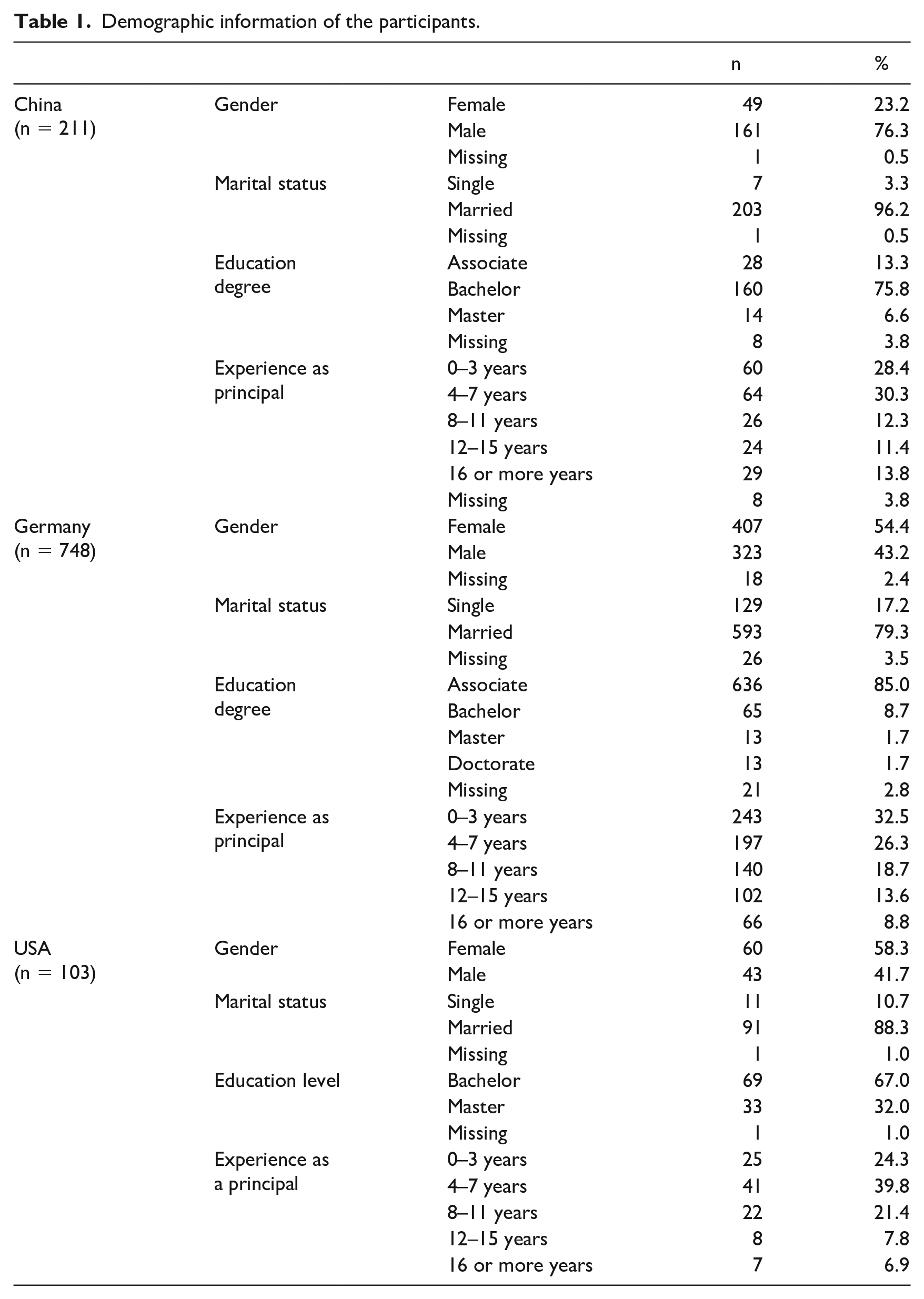
In this study, survey respondents with more than two missing values on the survey were removed. Little’s (1988) Test of Missing Completely at Random was conducted to determine if the remaining missing values were at random at first and then the missing values were replaced with the mean of the scale. After data cleaning, the sample included responses from 748 German principals in the region of Stuttgart, Germany; 211 Chinese principals in Beijing, China; and 103 US principals in the south-central region of the state of North Carolina. Although the schools in all three countries represented a sample of convenience, participants were similar in gender, educational level, years of service as a principal and levels of schools to the populations that they represented in their respective countries. No significant response differences were discovered based on the characteristics of the participants. Table 1 reveals the participants’ demographic information by country.
Demographic information of the participants.
Based on the Rasch reliability indexes, responses to the survey appeared to be reliable with a person reliability of .83 and item reliability of .99 (Wang et al., 2017). CFA was employed to examine the structural aspect of construct validity of responses to the survey. The goodness of the fit of the CFA models was evaluated with fit indices such as the statistic, standardized root mean square residual (SRMR), root mean square error of approximation (RMSEA), comparative fit index (CFI) and goodness-of-fit index (GFI).
When conducting comparative education studies, researchers must obtain accurate translations of instruments (Bracken and Barona, 1991, Lamnek, 2005). In this study, the English-language version of the survey had to be translated into Chinese and German language versions (Friebertshäuser, 1997). To do so, the original English-language survey was initially translated by two independent translators (one native English speaker and one native Chinese speaker) who were fluent in both languages. The resulting translated document was reviewed by principals who were fluent in both English and Chinese. Adjustments to the translated document were made based on the feedback from these principals resulting in important clarifications in the Chinese-language version of the survey.
The original English-language survey was also translated by two independent translators (one native English speaker and one native German speaker) who both were fluent in these two languages. The resulting translated document was reviewed by principals who spoke both English and German and clarifications to the translated document were made based on the feedback from these German principals.
Results
The internal consistency, measured by Cronbach’s alpha, was .89 for the whole sample. Cronbach’s alpha was .92, .86 and .89 for the Chinese, German and US principals, respectively. Descriptive statistics of the job satisfaction with being a school principal are presented in Table 2.
Means and standard deviations of job satisfaction.
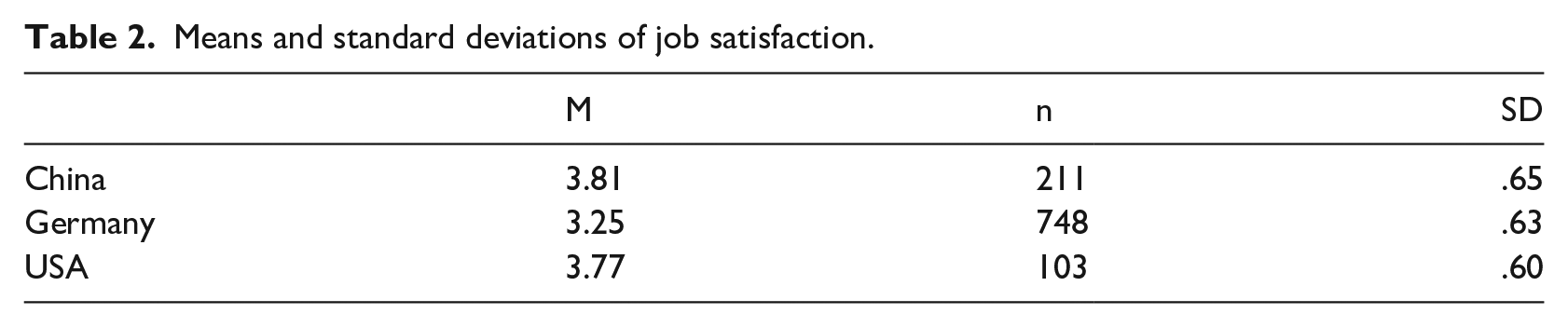
Mean comparisons suggested a statistically significant difference between the job satisfaction of principals from the three countries with F (2, 1059) = 81.80, p < 0.001, partial η2 = .13 (large effect). Post-hoc multiple comparisons indicated that Chinese and US school principals reported significantly higher overall job satisfaction than German principals (p < 0.001) but that the difference between Chinese and US principals was not statistically significant (p = 0.87).
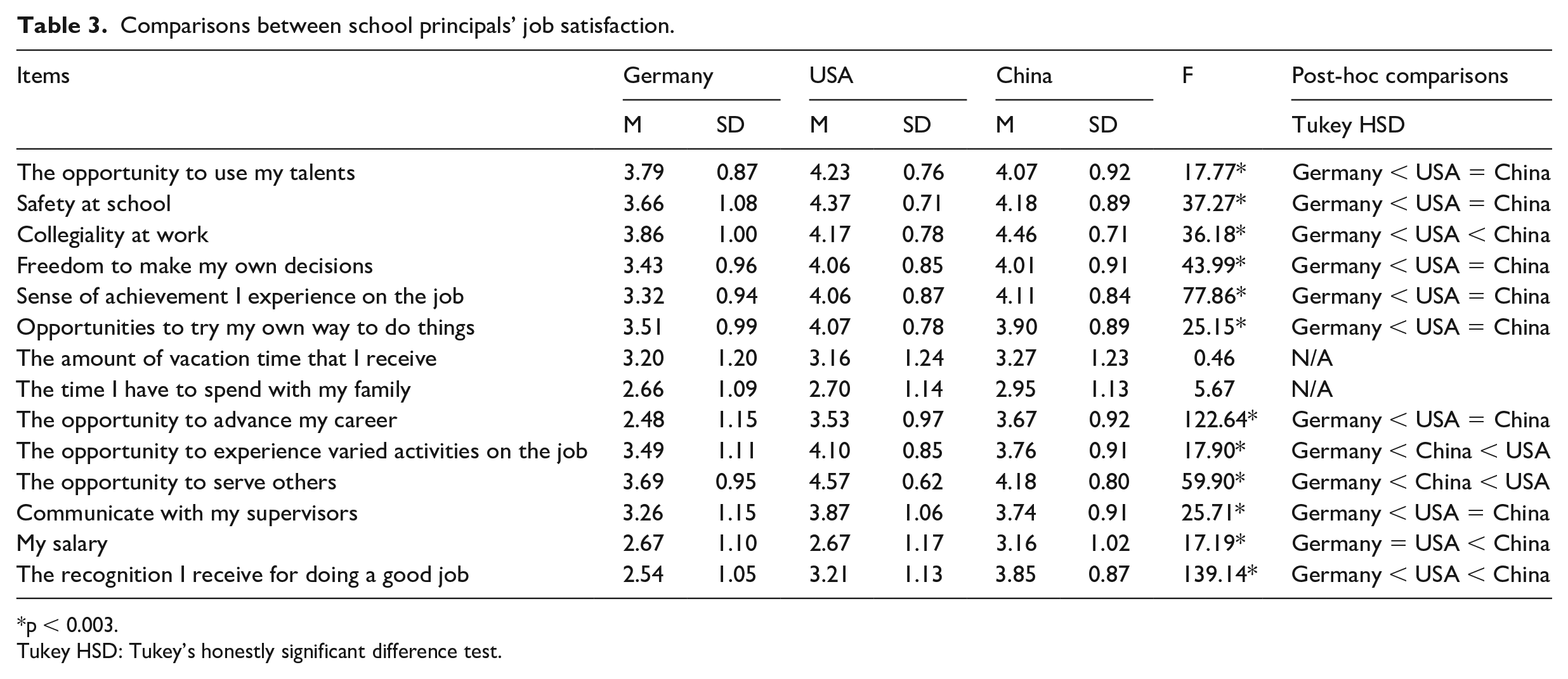
In order to further understand the specific differences between school principals in these three countries, mean comparisons at the item level were also performed. With 14 survey items and the familywise alpha of .05, Bonferroni correction was used to adjust the significance level to .003 (.05/14) to avoid Type I errors because 14 independent statistical tests were performed simultaneously on a single data set. Results are presented in Table 3.
Comparisons between school principals’ job satisfaction.
*p < 0.003.
Tukey HSD: Tukey’s honestly significant difference test.
Item-level mean comparisons suggested that the principals’ job satisfaction may be grouped in five categories. In one category, the principals’ response means were not significantly different from each other across the three countries on the items ‘the vacation time I have’ and ‘the time I have to spend with my family’. These results suggest that school principals in all three countries have similar levels of satisfaction with the amount of extracurricular time associated with their jobs.
In a second category, the response means of German principals were significantly less than the response means of principals from China and the USA. The seven items in this category were ‘the opportunity to use my talents’, ‘the freedom to make decisions’, ‘the sense of achievement that I experience on the job’, ‘the opportunity to try my own way of doing things’, ‘the opportunity to advance my career’, ‘communication with my superiors’ and ‘safety at school’. These results suggest that German principals are less satisfied than Chinese and US principals with their levels of autonomy over school operations and activities whereas Chinese and US principals are similarly satisfied with their levels of autonomy over school operations and activities.
In a third category, the response means of German principals were significantly less than the response means of principals in the USA which were significantly less than the response means of principals in China. The two items in this category were ‘collegiality at work’ and ‘the recognition that I receive for doing a good job’. This finding suggests that German principals are less satisfied than US principals with the support that they receive from colleagues and superiors and that US principals are less satisfied than Chinese principals with the support that they receive from these individuals.
In a fourth category, the response means of German and US principals were significantly less than the response means of Chinese principals. The one item in this category was ‘my salary’. This finding indicates that German and US principals are less satisfied than Chinese principals with their compensation levels whereas the satisfaction levels with compensation of German and US principals are similar.
In a fifth category, the response means of German principals were significantly less than the response means of Chinese principals which were significantly less than the response means of US principals. The two items in this category were ‘the opportunity to experience varied activities on the job’ and ‘the opportunity to serve others’. This result suggests that German principals are less satisfied than Chinese principals with the variety of the tasks in their positions and with their opportunities to serve others. Furthermore, Chinese principals are less satisfied than US principals with the task variety of their positions and with their opportunities to serve others.
Discussion
Vroom’s (1964) Expectancy Theory of Motivation asserts that people who identify positive outcomes associated with the role of principal will be inclined to pursue a principalship and principals who value outcomes experienced in their work environments will choose to remain in their positions. Therefore, to attract and retain qualified principals, China, Germany and the USA should consider each other’s principal recruitment and retention practices as they strive to create work outcomes and conditions that are the most satisfying to people considering the role of principal and to principals serving in the role. The findings of this study reveal several workplace characteristics that expectancy theory would suggest will motivate teachers to pursue the role of principal and principals to remain in their positions.
This study reveals that US and Chinese school principals are not significantly different in their overall levels of job satisfaction and that principals in both the USA and China are slightly more satisfied with their jobs in comparison to German school principals. However, significant differences exist between the countries’ principals in many important categories. Comparing these differences may help these countries identify and adopt principal recruitment and retention practices as they consider the most satisfying components of the position.
The highest levels of satisfaction appear in the second category dealing with principals’ autonomy over school operations and activities. With respect to activities such as ‘the opportunity to use my talents’ and ‘the freedom to make decisions’, German principals are less satisfied than Chinese and US principals with their levels of autonomy over school operations and activities whereas the Chinese and US principals are similarly satisfied with their levels of autonomy. This result may stem from the fact that German education is largely centralized within each of the 16 federal states. Despite years of debate about school autonomy in Germany, in practice each state still exercises significant control over issues such as policy goals, school structures and curricula (Huber et al., 2017). As a result, German principals often lack authority and autonomy over important school decisions such as staff employment and financial resource allocation (Braukmann and Schwarz, 2015; Huber et al., 2017). Conversely, the relative satisfaction of Chinese and US principals with their levels of autonomy may be a function of their autonomy and control over school functions. In China, principals exercise significant authority over all aspects of school operations, especially in the area of school funding and student admissions (Chu and Yang, 2009). In the USA, educational decision-making is largely decentralized in 13,000 local school districts in which principals are heavily involved in oversight of daily operations, budgets, staff, and school curricula and instruction (US Department of Education, 2008a, 2008b). These findings suggest that exercising autonomy over the day-to-day activities of a school is a highly valued characteristic that may serve as a significant incentive to attract and retain principals in all three countries.
Another area of high satisfaction is category five which indicates that US principals are highly satisfied with the ‘variety of the tasks in their positions’ and with their ‘opportunities to serve others’. Chinese principals are slightly less satisfied with these job characteristics than US principals but more satisfied than German principals. This finding may stem from the fact that US principals are responsible for a wide variety of tasks including oversight of school functions; supervising teachers, staff and other administrators; influencing curricular and instructional decisions; ensuring compliance with rules imposed by local and federal governments; preparing reports and records; and interacting with constituencies such as parents and community leaders (Tyre, 2015). In addition, previous studies have discovered that the highest professional desire of US principals is to have a positive impact on people (Hancock et al., 2012). As in the USA, Chinese principals have a significant variety of tasks including substantial influence over admissions decisions. In Germany, principals are often allowed to hire teachers and manage school budgets, but many other activities are controlled by the 16 federal states. These results indicate that opportunities to engage in multiple tasks that serve the needs of students and teachers are motivating factors for principals in all three countries and may serve as catalysts for principal recruitment and retention.
One area of relatively poor satisfaction of principals in all three countries is the salary that they receive. In China and the USA, principals have higher salaries than most teachers and even some university professors. In Germany, principals are viewed as primus inter pares (first among equals). As a result, German principals earn only slightly higher salaries than teachers depending on the level and size of school (Hancock et al., 2016). Despite these variations in compensation, the results of this study reveal that principals in all three countries are relatively dissatisfied with their salaries. Although barriers to higher salaries exist in all three countries, officials interested in attracting and retaining principals may want to consider the motivating potential of higher remuneration.
Finally, in all three countries, principals indicate general satisfaction with their ‘amount of vacation time’ and the ‘amount of time spent with family’. No significant differences exist in the extent to which Chinese, German and US principals perceive these job characteristics. This finding suggests that principals in all three countries are generally satisfied with the discretionary time that they have to engage in activities other than those associated with their positions. Because discretionary time is valued by principals in all three countries, officials interested in recruiting and retaining principals may want to continue to emphasize this important job characteristic.
Significance
Research indicates that effective school leadership is crucial to a school’s success. Recruiting and retaining high-quality school principals is essential. Unfortunately, attracting and retaining school leaders is becoming increasingly difficult in many developed countries of the world. Therefore, it is important to understand the job characteristics that principals find most satisfying which contribute to their motivation to become a principal and to continue to serve as a principal. The results of this study reveal many lessons that these countries may learn from each other regarding ways to recruit and retain high-quality principals. Issues related to participation in extracurricular activities, autonomy over school operations, recognition and respect from superiors, compensation levels and opportunities to serve others are critically important areas worthy of international comparison in order to identify best practices.
As evidenced in the results of this study, Vroom’s (1964) Expectancy Theory of Motivation helps researchers and educators understand and identify positive workplace characteristics that influence people’s motivation to become and remain principals. Despite the significant contributions of this study to our understanding of workplace characteristics that impact people’s motivation to become and remain principals, limitations to these findings exist. For example, differences in the levels of influence of the federal governments on educational activities in these three countries may limit the generalizability of findings to the respective countries. In addition, variations in compensation levels of principals in the three countries may serve to neutralize sound efforts to motivate educators in these environments. Nevertheless, this study’s investigation of the opinions of principals in China, Germany and the USA regarding the most satisfying characteristics of their positions should help officials identify ways in which they can address principal shortages and issues of school principal turnover. This study contributes to the literature on this topic and helps inform the next generation of research by identifying the most satisfying characteristics of a principal’s role in developed countries.
Footnotes
Appendix
Declaration of conflicting interests
The author(s) declared no potential conflicts of interest with respect to the research, authorship, and/or publication of this article.
Funding
The author(s) received no financial support for the research, authorship and/or publication of this article.
