



Abstract
We tested whether a semester-long classroom experiential activity designed to foster international and domestic student social interaction increases international students’ sense of belonging and perceived social support. Two studies were conducted testing the effectiveness of this experiential activity which was based on the theoretical underpinnings of how social attachment is formed. The first study was a controlled experiment with freshmen university students. When compared to the control group, the students participating in the experiential activity had an increased sense of belonging and perceived social support by the end of the semester, especially when they had lower levels of openness at the onset of starting college. The second study was a longitudinal study conducted with graduate students. The results found that students had an increase in their sense of belonging and perceived social support. These studies suggest that semester-long classroom experiential activities designed to foster international and domestic student social interaction can foster international students’ sense of belonging and social support.
Introduction
International students with a low level of social integration can experience heightened anxiety and depression (Becker et al., 2018; Sümer et al., 2008). The social interaction between international students and their domestic student peers can have positive benefit (Trice, 2004). Unfortunately, while beneficial, the social interaction between international and domestic students is limited; many international students only spend time with co-nationals (i.e. people from their home country) or spend free time communicating with family and friends in their home countries via social media (Sandel, 2014; Van Mol and Michielsen, 2015). In the United States, where over 1 million international students are currently studying, nearly 40 percent of international students report having no close American friends (Gareis, 2012). This is a missed opportunity for social integration. Social integration between international and domestic students can both enhance international students’ well-being while concurrently benefitting domestic students’ cultural awareness and respect for diversity. As the potential “wins” are high for both international and domestic students, it is important for universities to address ways to foster integration through targeted interventions.
College students’ social integration is important because it increases students sense of belonging (Glass and Westmont, 2014; Hurtado and Carter, 1997; Museus et al., 2017; Strayhorn, 2008) and increases their perceived social support (Lamonthe et al., 1995; Wilcox et al., 2005). Integration creates a virtuous cycle; students who feel as though they belong to a social unit (e.g. with other students in a team, club, university) will affiliate within that unit and develop significant meaningful relationships. In turn, their reliance on the social unit for instrumental, informational, and emotional support deepens social relationships and social integration, fostering deeper integration (Ng et al. 2017). Thus, students who experience greater social integration in their campus community are more likely to have a heightened sense of belonging and perceived social support.
While some of the factors affecting students’ integration are unique to an individual, such as a person’s personality traits, other factors are institutional, such as living–learning communities, encouraging participating in campus clubs, academic advisement, and student counseling. Most of these institutional factors are at the university level and not within the academic units, as part of required coursework. We believe there are more the academic units could do to facilitate the integration between international and domestic students especially through course-related work. Specifically, in the remainder of this article, in two longitudinal studies, we test whether a semester-long classroom experiential activity designed to foster students’ social integration can facilitate a sense of belonging and perceived social support.
Features of an experiential activity to foster international and domestic student social interaction
Merely sharing a campus and classes is not enough to foster the level of meaningful social integration necessary to build cultural agility. The critical ingredient is a deeper level of social integration, which might not occur naturally on most college campuses. Although anxiety, such as the fear students experience when starting at a university, fosters a desire for affiliation and attraction (Schachter, 1959; Sarnoff and Zimbardo, 1961), anxiety also produces a preference for spending time with those who are going through the same anxiety-inducing experience (Gump and Kulik, 1997; Schachter, 1959). International students can often relate best to other international students, irrespective of nationality, because they experience the stress of being a new student in the same manner, which may differ from the experience of a new domestic student. This results in many demographically-similar students connecting with one another at the onset of their potentially-stressful university experience.
Based on our theoretical understanding of how social integration builds cultural agility, we contend that university interventions could increase domestic and international student integration if interventions have the four critical features: start early, focus on similarities, create social ease and meet frequently. The theoretical underpinnings for each are described below.
Start early
The first feature of this experiential activity is start as early as possible when the students arrive on campus. For everyone, a heightened anxiety at the onset of a new experience fosters affiliation between people (Gump and Kulik, 1997). This is certainly true for students at the start of a new academic experience. During that period of heightened anxiety, friendship bonds form quickly as a palliative way to ease the anxiety students feel when starting an academic program. Ideally, experiential activities designed to foster international and domestic student integration should be embedded within a first-year required course.
Focus on similarities
The second feature of this experiential activity is to encourage international and domestic students to have conversations about their similarities and explore what they have in common. This approach of conversational partners sharing information about themselves in a structured format has been found to produce some degree of felt closeness among college students (Aron et al., 1997; Wright et al., 1997). Many university-based programs exist to help students appreciate cross-cultural differences; however, for this program, designed to foster student integration, we encourage conversations around similarities, especially at first. A focus on similarities will enable students to experience the palliative effects of sensing common ground while not focusing on making mistakes related to cultural differences. As students find similarities, the controlled and comfortable self-disclosure will help increase liking and, for some, social integration (Aron et al., 1997; Collins and Miller, 1994).
Create social ease
Another feature of this experiential activity is for domestic and international students to be provided with a semi-structured situation that enables social conversations but does not produce social anxiety. For some students, open social activities (e.g. networking events, mixers, unscripted social gatherings) produce social anxiety which further draws them into seeking similarity and comfort (Gruman and Saks, 2011). In other cases, when domestic and international students are matched as roommates, there are too many issues to navigate for a relationship to form (Yao, 2016). Less intrusive and more structured interactions presented in a way that do not require students to independently initiate the conversation provide strategies for reducing that anxiety.
Meet regularly
Social bonds are created from familiarity which requires proximity, frequency of interactions, longer duration of those interactions, and intensity of those interactions (Schafer, 2015). Thus, the last feature of this experiential activity is to embed regularly scheduled meetings for conversations between international and domestic students to occur across multiple occasions and time. This feature of regular meetings occurs most naturally within the duration of an academic semester and ideal to be embedded within a course. The typical 14 weeks and assignments within that time would provide the regular meetings to promote social ties. If students interact on multiple occasions with deeper conversations, they will have a greater likelihood of forming stronger bonds and, in turn, integrating.
Personality as a moderator
We recognize that student integration will not work equally well for all students. There are certain affiliating personality traits, extraversion and openness, that will accelerate social interactions. Consistent with personality theory (see McCrae and Costa, 1987), extraversion is an innate ability to engage and establish interpersonal relationships with others and openness is one’s receptivity to learn and change in the new situation. For students who are more naturally open and extroverted, new social experiences cause less socio-emotional stress and they are more likely to feel comfortable in new social situations than individuals who are less open and extroverted.
For both international professionals and international students, research has found that those with the affiliating personality traits of extraversion and openness will more naturally gravitate toward host national interactions and more easily adjust to living in the host country (Caligiuri, 2000; Zimmermann and Neyer, 2013). Thus, we posit that two personality characteristics, extraversion and openness, affect international and domestic students’ social integration and moderate the effectiveness of the proposed social integration experiential activity.
Hypothesis 1: International and domestic students with higher levels of affiliating personality traits will report greater social integration from participation in the semester-long classroom experiential activity designed to foster international and domestic student social interaction.
Sense of belonging
The formation of strong and stable interpersonal relationships creates a sense of belonging. The “need to belong is a powerful, fundamental, and extremely pervasive motivation” for all humans (Baumeister and Leary, 1995: 497). International students, who are away from their friends and family (i.e. their sources for belonging), are especially motivated to seek a sense of belonging in the possibly unfamiliar host country. While motivation is high, it can be challenging for international students to achieve a sense of belonging among domestic students because of unfamiliar social norms, possible language barriers, and cultural differences in how relationships are formed (Rivas et al., 2019).
International students’ sense of belonging is important to address because it is related to academic success, social interactions (Glass and Westmont, 2014) and ability to manage stress (Pittman and Richmond, 2008). We contend that the semester-long classroom experiential activity designed to increase international and domestic student social interaction will help facilitate, in part, a greater sense of belonging on campus.
Hypothesis 2. Participating in a semester-long classroom experiential activity designed to increase social integration between domestic and international students will result in a higher sense of belonging.
Perceived social support
Instrumental, informational, and emotional support are important for everyone’s well-being, but especially important for those who are living in a new and unfamiliar country, trying to navigate language and cultural differences (Caligiuri and Lazarova, 2002) In the case of international students, those students who have more successfully developed social ties with domestic students are better adjusted to their host country (Poyrazli et al., 2004). This follows given that domestic students can provide informational support (e.g. where to buy a winter coat, how to order at the deli), instrumental support (e.g. drive to the store, bring to a party) and, if friendship develops, emotional support (i.e. provide comfort and advice).
While important for adjustment, many international students are not close with domestic students, often because it is easier to befriend compatriot students who speak the same language and share the same cultural challenges (Gareis, 2012; Bertram et al., 2014). While compatriot friends provide language and cultural ease, domestic friends might be able to provide useful support for a more satisfying experience in the host country. Domestic students can possibly augment the support received from compatriot students to help facilitate overall adjustment (Bertram et al., 2014). To give the domestic-international student bonds a chance to form, we advocate the semester-long classroom experiential activity designed to increase international and domestic student social interaction. We believe this type of intervention will help facilitate, in part, a better perception of social support.
Hypothesis 3. Participating in a semester-long classroom experiential activity designed to increase social integration between domestic and international students will result in a higher level of perceived social support.
The following two studies test whether this theoretically based structured classroom experiential activity increases social integration between international and domestic students, facilitating their sense of belonging and perceived social support. Study 1 tests Hypotheses 1 2, and 3. Study 2 tests Hypotheses 2 and 3.
Study 1
The experiential activity was implemented in a First Year Experience (FYE) course designed for students who just started at the university. The experiential activity included lecture, partner assignments, and individual reflection. First, the experiential activity began with one 50-minute lecture-discussion style class on “Conversational Skills for Relationship-Building.” This class was designed to cover topics such as conversation starters, interpersonal styles, and conversational empathy. Second, the students practiced having conversations with someone from another culture. To achieve this, each student was matched with one conversation partner, and maintained that partnership throughout the semester. To the extent possible, one international student was matched with one domestic student. Using this approach produced some degree of felt closeness among dyads (Aron et al., 1997); the students met five times in total (once for each assignment) for the remainder of the semester. During each meeting, the students were given a series of four or more casual interview style questions from a conversation protocol. During their meeting time, the partners had a conversation, and were encouraged to cover each of the questions in the protocol for the given assignment. Sample questions from the first meeting included: Which course do you think will be your favorite this semester and why? What is your major and why did you select that major? At the end of each meeting, the students wrote, independently, a few sentences on what they had in common with their conversational partner. This mini- assignment was repeated for each of the five interactions.
Participants
This study took place at a large, public suburban American university in the Midwest where the business school freshmen must enroll in an FYE course. In this group of freshmen (N = 279), 61.3% of are female; 7.9% are international students; the average age is 18.2 years. The business school had a larger number of international students compared with the student body at the university as a whole, which has only 2.2% international students in the incoming freshman class. With respect to racial composition of this business school freshman class, they were 10.7% African-American, 3.4% Hispanic, 1.8% Multiracial, and 0.2% Native American.
Two offerings were available to all freshmen international students at the time of the study. One was a mandatory international student orientation for all freshmen just prior to the start of classes. The other was the university’s peer-mentoring program for international students, coordinated by the student advising group. This peer-mentoring program matched current students with international students to assist with their transition.
Twenty course sections were involved in this study; experimental sections received the experiential activity (n = 44) and the remainder comprised the control group (n = 235). A group of six faculty members who teach the FYE course in the College of Business Administration agreed to add the “Conversational Skills for Relationship-Building” module and assignments to their regularly scheduled courses. Their students comprise the experimental group. Among the 44 students in the experimental group, 28 were in an American–International student pair with the remaining 16 in an American–American student pair. The students in other classes who did not have this class comprised the control group.
Procedure
All students, both experimental and control, were given a pre-test at the start and the post-test at the end of the semester. In Week 3, the students in the experimental sections had their 50-minute class session on conversational skills and were matched in dyads with a conversational partner. The students in the experimental group were given their five conversation and reflection assignments throughout the semester until Week 14.
Measures
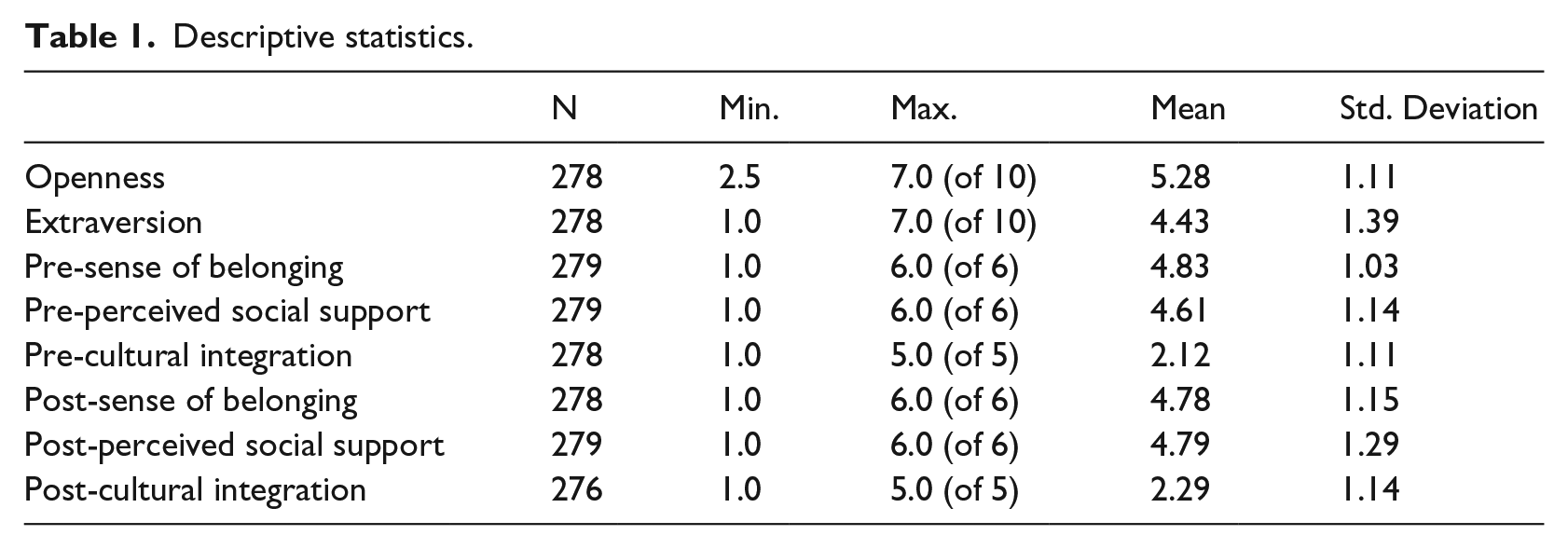
Both the pre-test and post-test included assessments of sense of belonging, perceived social support, and affiliating personality characteristics. Descriptive statistics are found in Table 1 and the correlation table is found in Table 2.
Descriptive statistics.
Correlation matrix.
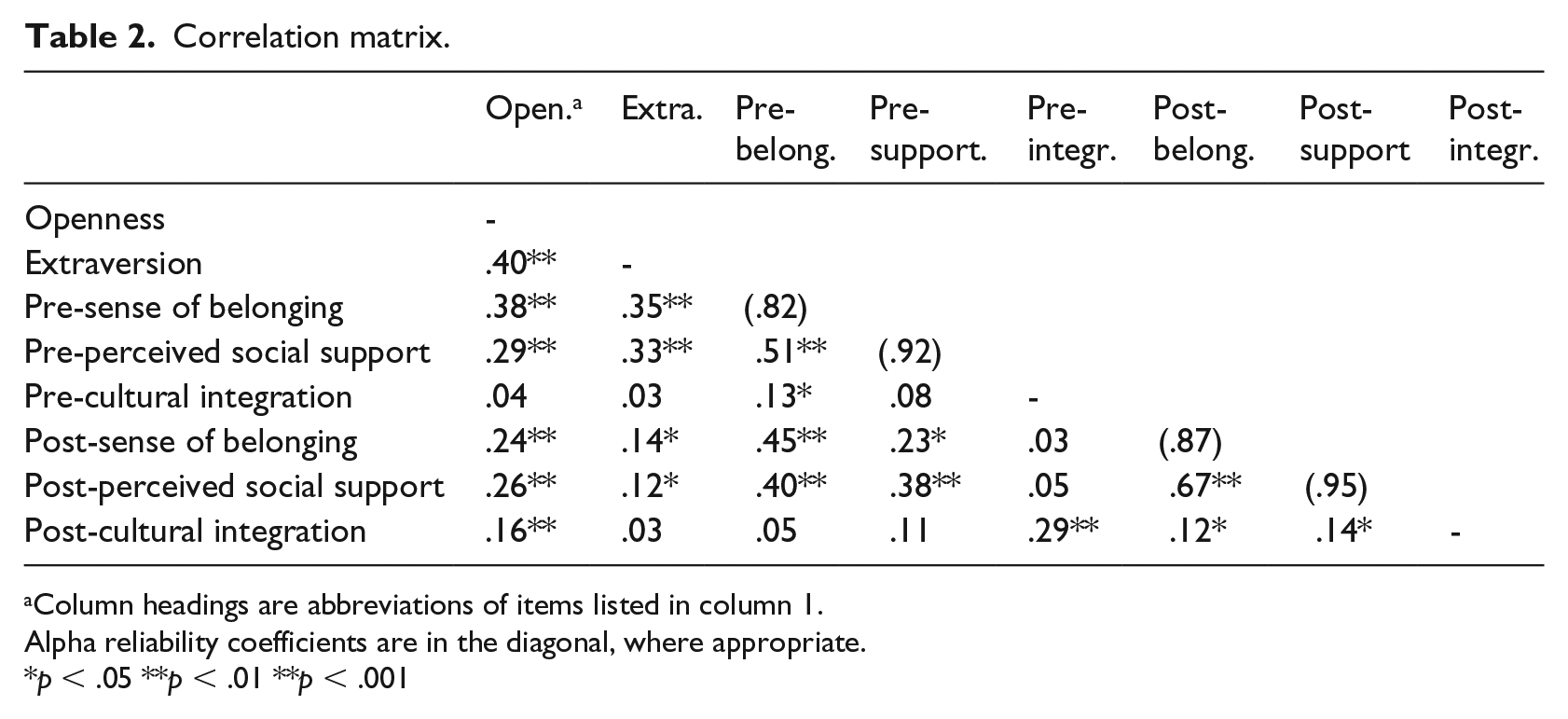
Column headings are abbreviations of items listed in column 1.
Alpha reliability coefficients are in the diagonal, where appropriate.
p < .05 **p < .01 **p < .001
Experimental and control groups
Originally, students who participated in the experiential activity were the experimental group and those who did not participate were in the control group. However, since there were more American students than international students, 16 students in the experimental group did not have an international partner. This created a naturally occurring experiment; a control group was formed of students without an international conversational partner. This naturally occurring control group was deemed to be an even better test of the effectiveness of this experiential activity because the dyads shared nationality (comparing whether being in a same versus different nationality dyad has an effect).
Affiliating personality characteristics
We administered the Ten-Item Personality Inventory (TIPI, Gosling et al., 2003), a measure of the “Big 5” personality traits (openness, conscientiousness, extraversion, agreeableness, emotional stability). Among these five personality traits measured in this 10-item scale we extracted the two affiliating personality traits related to sojourner success—extraversion and openness. The test–retest reliability is .70 for extraversion and .56 for openness. For extraversion and openness, the mean of the pre-test was 4.43 (SD = 1.39) and 4.53 (SD = 1.38), respectively and the mean of the post-test was 5.28 (SD = 1.11) and 5.17 (SD = 1.16), respectively.
Sense of belonging
The students provided responses to a 3-item scale to assess their sense of belonging. 1 Each item was measured on a 6-point scale where 1 = strongly disagree and 6 = strongly agree. Higher scores on the items indicated a greater sense of belonging. The Cronbach’s alpha reliability coefficient was .82 for the pre-test and .87 for the post-test. The mean of the pre-test was 4.73 (SD = 1.03). The mean of the post-test was 4.78 (SD = 1.15).
Perceived social support
This variable was measured by the friend dimension of the Multidimensional Scale of Perceived Social Support scale (Zimet et al., 1988). Each of the 4 items was measured on a 6-point scale where 1 = strongly disagree and 6 = strongly agree. 2 Higher scores on the items indicated a greater sense of social support among friends. The alpha reliability coefficient was .92 for the pre-test and .95 for the post-test. The mean of the pre-test was 4.61 (SD = 1.14). The mean of the post-test was 4.79 (SD = 1.29).
Cross-cultural integration
Cultural integration was assessed with a single item: I spend time with students from countries other than my own. The item was measured on a 5-point scale where 1 = never and 5 = almost all of the time. The mean of the pre-test was 2.12 (SD = 1.11). The mean of the post-test was 2.29 (SD = 1.14).
Results
To test Hypothesis 1, we used multiple regression to assess the effect of students’ natural affiliating personality traits, openness and extraversion, as predictors of their cultural integration (i.e. whether they spend time with students from countries other than their own). After controlling for their pre-test time spent with students from other countries (β = .29, p < .01), both extraversion and openness were entered. Openness (β = .17, p < .01) was a significant predictor of time spent with students from countries (R2 = .11, F = 11.20, p < .001). Extraversion was not significant. This provides partial support for hypothesis 1. See Table 3 for the results. Given the significant role of openness we used this variable as a moderator for all subsequent analyses.
Affiliating personality regression analysis.
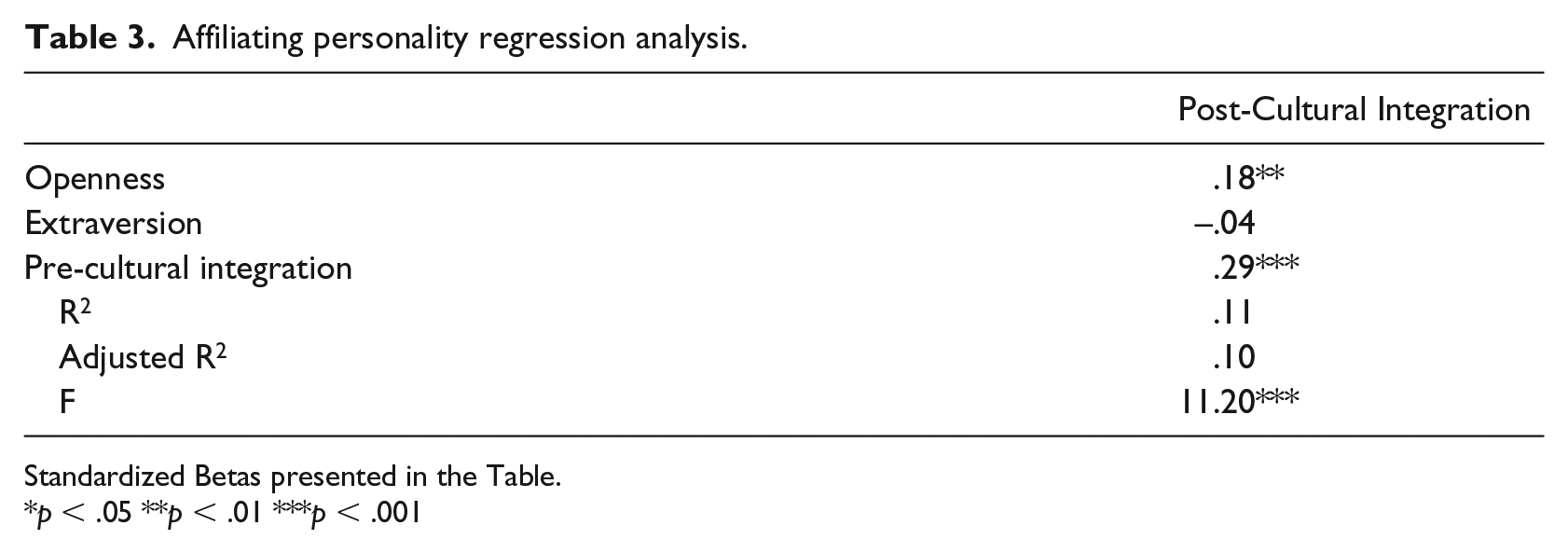
Standardized Betas presented in the Table.
p < .05 **p < .01 ***p < .001
To test Hypotheses 2 and 3, we examined whether our experiential activity would accelerate international and domestic students’ sense of belonging and perceived social support using moderated regression. We first entered students’ pre-test scores on perceived social support and sense of belonging. After controlling for the pretest scores, we included the main effect of openness and (control or experimental) group. We then added the interaction between openness and group. As shown in Table 4, the inclusion of the two-way interactions significantly improved the model fit in predicting both sense of belonging (R2 = .33, F = 4.71, p < .01) and social support (R2 = .34, F = 4.90, p < .01).
Moderated regression analyses.
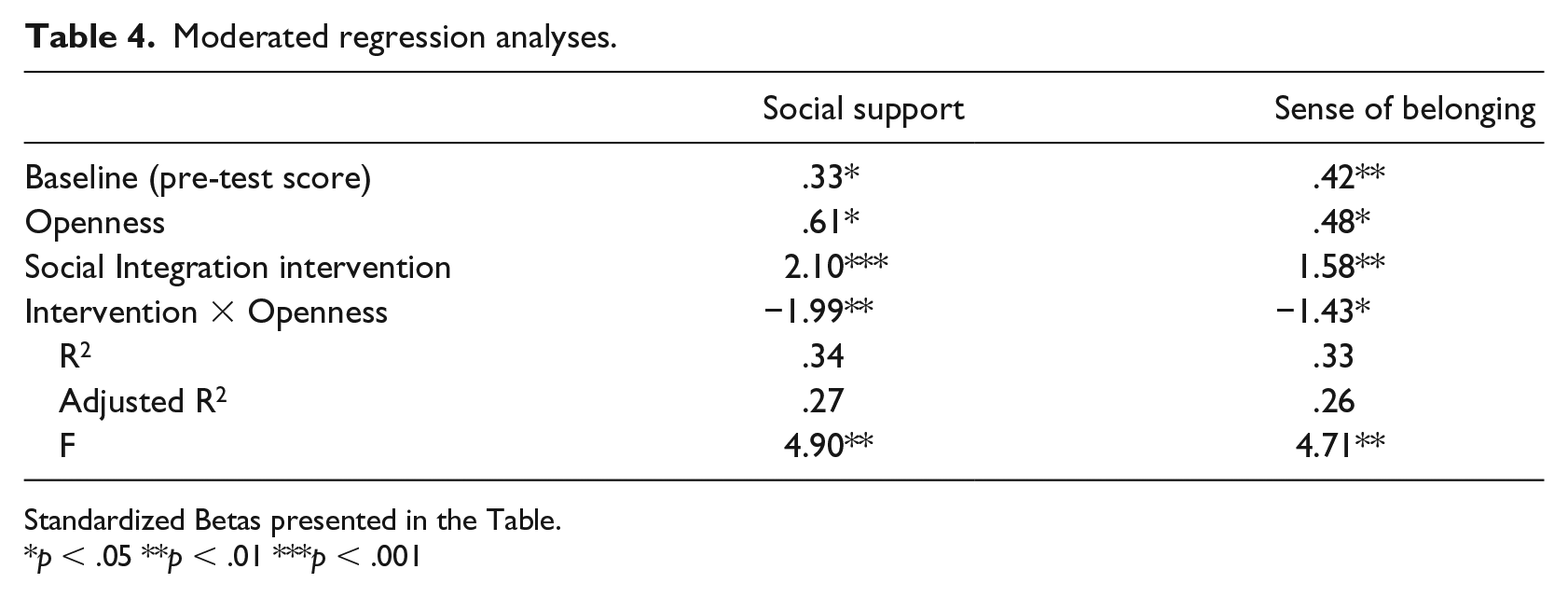
Standardized Betas presented in the Table.
p < .05 **p < .01 ***p < .001
To further clarify the pattern of the significant interaction, we followed the approach of Aiken and West (1991) to plot the relationship between openness and both dependent variables (both sense of belonging and social support) at the high (one standard deviation above the mean) and low values (one standard deviation below the mean) of openness. As presented in Figure 1, students with the lowest level of openness at the beginning of the semester gained most from participating in the experimental condition.
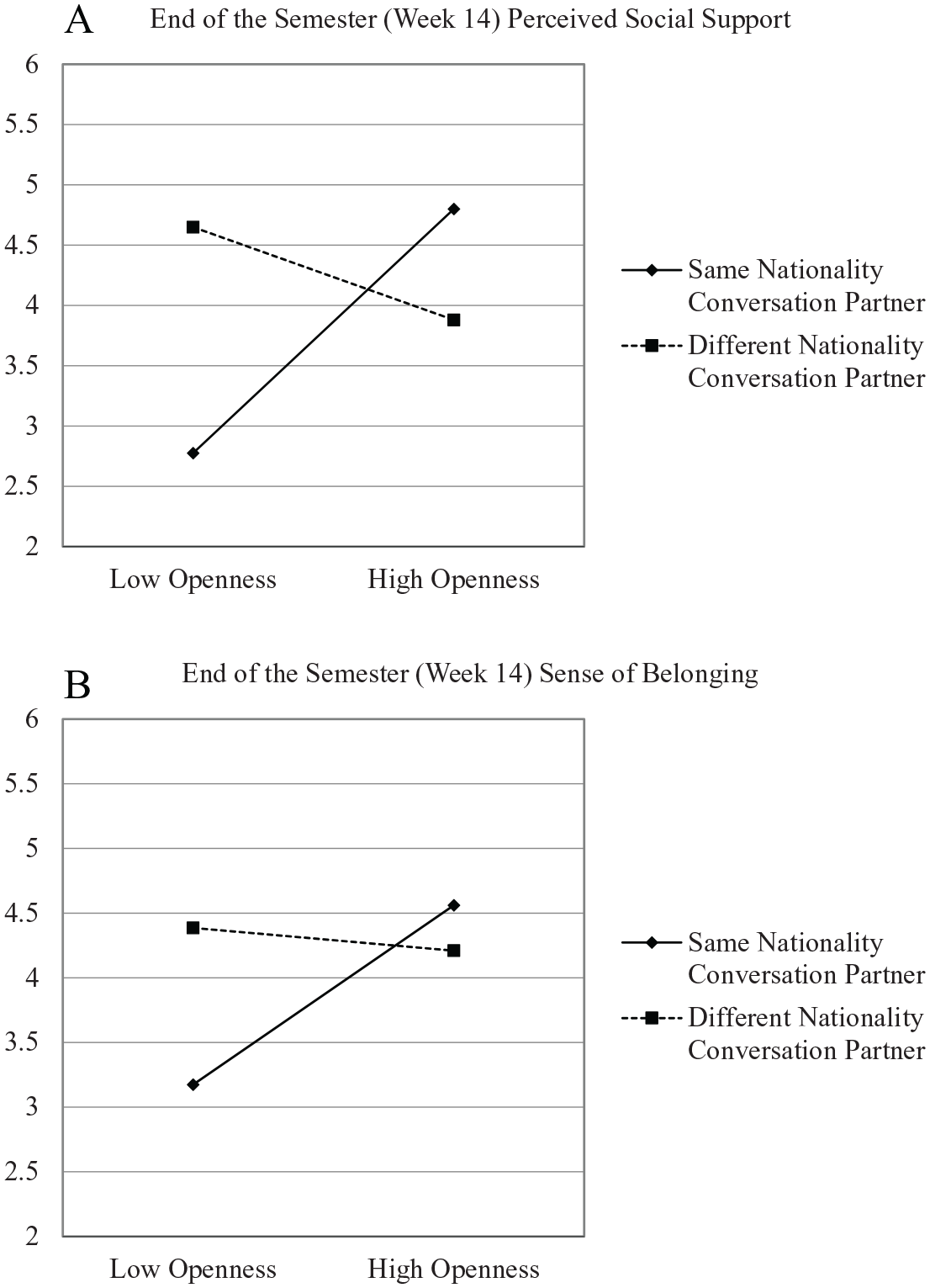
Graph of moderators.
Study 2
Based on the same theoretical foundation, the semester-long experiential activity was implemented as part of a graduate course for international students.
Participants
Study 2 took place at a large, private, urban university on the East Coast of the United States. The international graduate students had newly arrived in the United States (N = 39) and participated in this program as part of a required course. All students (100%) in the group were from China and were male.
This university has many international students in its student body (32.8% of total students). In addition to international student orientation, there were other offerings available to the international graduate students at the time of the study, including international student services, country-based associations, and cultural clubs.
Procedure
For this experiential activity, the newly arrived international students were partnered with graduate students from a leadership course who had been instructed that that they were to be cultural “guides” for international students. The experiential activity began with the business students (i.e. those who were serving as the cultural guides) receiving an hour-long lecture-discussion style class on “Relationship-Building across Cultures.” As with the lecture portion in Study 1, this initial class was designed to cover topics such as conversation starters, interpersonal styles, and conversational empathy. During the following week, during the business students’ regularly scheduled class time, the international students met with the business students (i.e. cultural guides). As a combined group they networked and created smaller groups of two or three students (1 cultural guide with 1 or 2 international students). Freer flowing than Study 1, the cultural guides were told they should arrange meetings with their international student partners about three more times over the remainder of the semester. The cultural guides were encouraged to provide instrumental support, answer questions, and help the students to practice speaking English. The international students were given a pre-test at the start of the semester (before their first meeting with the cultural guides) and the post-test at the end of the semester.
Measures
Both the pre-test and post-test included assessments of sense of belonging and perceived social support.
Sense of belonging
As in Study 1, the students provided responses to a 3-item scale to assess their sense of belonging. Each item was measured on a 6-point scale where 1 = strongly disagree and 6 = strongly agree. The Cronbach’s alpha reliability coefficient was .90 for the pre-test and .92 for the post-test. The correlation between the pre-test sense of belonging and post-test sense of belonging is r = .89 (p < .001). The mean of the pre-test was 4.59 (SD = 1.13). The mean of the post-test was 5.04 (SD = 0.99).
Perceived social support
As in Study 1, this variable was measured by the friend dimension of the Multidimensional Scale of Perceived Social Support scale (Zimet et al., 1988). Each of the 4 items was measured on a 6-point scale where 1=strongly disagree and 6=strongly agree. Higher scores on the items indicated a greater sense of social support among friends. The alpha reliability coefficient was .65 for the pre-test and .74 for the post-test. The correlation between the pre-test perceived social support and post-test perceived social support is r = .72 (p <.001). The mean of the pre-test was 5.18 (SD = .66). The mean of the post-test was 5.52 (SD = .52).
Results
We tested Hypothesis 2 using a repeated measures ANOVA. The results suggest the international students reported a significantly higher sense of belonging at the end of the semester (F = 30.09, p < .001). We tested Hypothesis 3 using a repeated measures ANOVA. The results suggest the international students reported perceived social support that was significantly higher at the end of the semester (F = 21.55, p < .001).
Discussion and Conclusion
Although a significant number of students study abroad each year, research and practical experience shows that far too few international students establish meaningful connections with other individuals in their host countries. In this study, we examined an experiential activity designed to foster international and domestic student interactions. It is important to note that the results from Study 1 suggest that the experiential activity only proved helpful for students who started the study with a lower level of openness. Students who enter the university with a higher level of openness are already open to engaging students from different cultures. As such, they came into the study with a more natural comfort to establish meaningful connections with students from different cultures. It is possible that for students with lower levels of openness, the experiential activity might have provided a psychologically safe and comfortable way to experience social integration. Since the student interactions were part of an assignment and somewhat scripted, the low socio-emotional demands might have mitigated the stress that is often present in free-form conversations (e.g. networking events or welcome parties or mixers). For individuals who score low on openness, having some structure to their conversations may have reduced the anxiety associated with interacting with someone from another culture. We suspect that while the low-openness individuals may have felt stress initiating the assignment, we believe that the tools and training of this experiential activity, coupled with multiple homework assignments/meetings (with the same partner), created a sense of security and comfort.
Anecdotally, the first author’s former students have reported that their conversational partners have become friends, relationships that have endured long past the end of the course. Other students credit the experiential activity for making novel social situations more comfortable. Testing in a more systematic way, future studies should follow students past their first semester to see whether there is a long-term change in students’ interactions. As both studies suggest, students who participated in this semester-long experiential activity experienced an increase in their subjective sense of belonging and perceived social support. Since students’ belonging has been also associated to academic motivation in college-level students (Freeman et al., 2007), future studies could examine whether this experiential activity can also affect long term outcomes such as student retention and graduation rates.
This intervention to foster international-domestic student integration was tested in two different institutional contexts, a public suburban Midwestern American university with a low proportion of international students and a private, urban Northeastern American university with a high percentage of international students. These university contexts are important. It might be the case that at both extreme, the desire to connect with host national students are important but for different reasons. For example, with few international students on campus, international students might feel the need to connect with host nationals to not feel isolated and to feel socially connected. On the other hand, with many international students on campus, international students may wish to step out of their ethnic enclave to have a more authentic experience of studying in the host country by interacting more with domestic students. Whichever the case, greater exploration of the university context is needed in future research.
We also tested this intervention with both undergraduate freshman in study 1 and graduate students in study 2. Within these groups, the students already shared a similar age and major which might have been enough of a connection for this intervention to be effective in increasing international-domestic student integration. Future research should examine whether the intervention would be as effective if the students did have the same major or where of different ages. To preserve anonymity, we could not gather any demographic variables such as race and gender; however, future research examine the effect of other forms of diversity beyond classification as an international or domestic student, including race, age, and gender. For example, racially diverse dyads might have a similar effect as culturally diverse dyads on predicting feelings of social integration.
While living, studying and working abroad can be one of the most developmental experiences for building cultural agility (Black, Gregersen, Mendenhall & Stroh, 1999; Caligiuri & Tarique, 2012), international education is not necessarily increasing students’ global citizenship (Pike & Sillem, 2018) or their ability to connect with people from different cultures. Given the millions of students studying abroad each year and the potential for education abroad to build students’ cultural agility, that is, the ability to comfortably and effectively work in different countries and with people from different cultures, there should be a plethora of culturally agile professionals in today’s global workforce. Unfortunately, this is not the case; there is an unmet need for graduates with cultural agility (McKinsey Quarterly, 2014; PWC, 2012). Thus, beyond social integration, increased sense of belonging, and perceived social support (which should be laudable goals in their own right), universities can think about domestic and international student integration as an important goal for career and professional development.
Higher education institutions that host international students are uniquely positioned to actively foster international and domestic student integration. However, to do so requires structured interventions, such as the one described in this study. We have found that implementing these interventions requires support from both senior administrators (e.g. Deans, Provost, Director of Global Programs, Director of International Student Services) and the faculty who teach entry-level, required courses (such as the First Year Experience (FYE) course), or from faculty who are willing to develop elective courses (such as a Developing Cultural Agility course). Faculty can opt to add the content to existing courses, such as the example in this study.
Adding content to courses and creating new courses requires effort. Reframing the benefits associated with that effort, deans and faculty within the academic units should focus on the multiple “wins” in embedding this type of structured experiential activity into courses. In additional to the socio-emotional benefits, this structured interaction gives all students, especially those who will never study abroad, an opportunity to have a developmental international experience. We believe that this type of experiential activity is a powerful learning tool for students who eventually hope to work in a global role, those who plan to study abroad and international students who have just arrived.
In whatever way it is implemented, the results of this study suggest that embedding social integration experiential activities would help increase integration between international and domestic students and increase their social ease with people from different cultures. Studying on a multicultural campus, students can learn to demystify demographic differences and become more open to students who originate from different countries and cultures. We hope more universities feel compelled to nudge the social integration needed for this cultural agility to develop. In doing so, they would provide their students with a heighted sense of belonging and support, who when graduating, could have a higher level of cultural agility, a competency that has become essential for professional success.
Footnotes
Funding
The author(s) received no financial support for the research, authorship, and/or publication of this article.
