



Abstract
University administrators, academic staff and students are key agents of internationalisation of higher education, particularly at the institutional level. The growing volume of literature on internationalisation has looked at the role that these stakeholders play. However, few studies in Kenya have examined these stakeholders’ conception of the internationalisation process. The current study explored Kenyan universities’ understanding of the process of internationalisation and how their perceptions influenced the provision of quality academic programmes. The focus was on the conception of the process and the rationales pushing universities in Kenya to internationalise. The targets were the university administrators, academics and students in two public and two private universities in Kenya. The study used institutional theory as a theoretical framework in examining the implications of stakeholders’ understanding of the internationalisation process on the provision of quality academic programmes. The study noted a failure on the part of universities in Kenya to utilise internationalisation as a tool for improving the quality of their education. There was a lack of shared understanding of the process among the stakeholders. In both public and private universities, academic rationales were identified as the main reason for supporting the internationalisation process. The lack of a comprehensive and shared understanding of the internationalisation process among the institutional stakeholders in Kenyan universities had compromised their capacity to utilise the process to advance the quality of their academic programmes. The study recommends investment in training on internationalisation to ensure that there is clarity on what constitutes the process, its rationale and its underlying values within the unique context of Kenyan universities.
Introduction
Higher education is known for its generation of knowledge for socio-economic development. Knowledge production is not only credited with enhancing economic efficiency but is also seen as a reliable measure of competitiveness of nations and regions (Cloete et al., 2011; Pausits, 2015). There is a belief that the competitiveness of nations and hence their future depends largely on the quality of knowledge generated within the higher education sector. The relationship between the quality of knowledge from higher education and improvement in the economy has been supported by recent studies conducted in Africa where a positive correlation has been established between increased investment in the higher education sector and an improved gross domestic product (World Bank, 2009). In Asia, the tremendous growth in the global knowledge-based economies has been linked to the rise of their institutions of higher learning and their intentional investment in scientific research (Ramakrishna and Krishna, 2011).
The critical role played by the higher education sector in knowledge production cannot be gainsaid (Cloete et al., 2011). The expectation remains that the sector produces graduates with the capacity to engage in socio-economic development (World Bank, 2009) and also generates appropriate knowledge recognised beyond its borders (Hyland et al., 2008). Throughout the world, there has been a shift of focus from access to the quality of knowledge from higher education. The emphasis is on an education that equips graduates with the necessary knowledge, attitudes and skills for the increasingly multicultural labour market (Schuerholtz-Lehr, 2007; Zeleza, 2017). The Association of Indian Universities (2014) terms such graduates as globally ‘employable’. Consequently, higher education and particularly universities have experienced rapid transformation as a result of these changes. One common trend globally, for universities, has been policy convergence as they seek almost a single-model policy that enhances their visibility as ‘world-class universities’. This has necessitated a lot of policy borrowing across the world, albeit with national and local considerations (Marginson and Van Der Wende, 2009).
The rapid transformation witnessed in universities over the years has manifested itself in the form of unprecedented new international collaborations and consortia, the ever increasing number of students and academics engaged in academic mobility, the increased number of academic programmes emphasising comparative and international themes, heightened aspirations to prepare graduates in a cosmopolitan learning environment for global competences, the increasing need to recruit international students and staff, and the growth in the number of joint and double degrees (De Wit, 2010; Hyland et al., 2008; Munene, 2014; Oanda, 2009; Teferra, 2008).
The one policy narrative that has been linked to the modern forms of internationalisation of higher education has been the vital role that multicultural education plays in the generation of competitive global graduates. The multicultural diversity of contemporary universities demands that experiences of academics and students should not be limited to the domestic and national boundaries (Hyland et al., 2008). As modern societies become increasingly multicultural, universities become better prepared to inculcate the much needed intercultural competences. The success of these internationalisation aspects, however, depends largely on the attitudes of the university stakeholders, specifically the academic staff. As key resource persons for internationalisation, academics are expected to intentionally ensure that classroom interactions encourage intercultural dialogue, design curricula that address the needs of their diverse students, form strong networks with other universities for knowledge sharing, participate in collaborative research, publish their work in recognised international journals and design curricula that can instil intercultural skills in all their students (Lee et al., 2014; Slee, 2010). The heavy responsibility on the part of academics makes it vital that they are aware of the concept of internationalisation, particularly as a process capable of promoting the quality of education.
The question of why higher education should internationalise has attracted scholarly attention. Some scholars have argued that internationalisation enhances curricula sharing as academic curricula and products are no longer restricted by national borders (Jowi, Knight & Sehoole, 2013; Oanda, 2009). This diffusion of curricula products is crucial in the development of international knowledge, skills and values that guarantee multicultural education. Further, the process allows utilisation of available capacity around the world to design appropriate content that enables flexible use across different cultures and social backgrounds. It is in the use of such curricula that universities are able to produce globally employable graduates with the potential to work in cross-cultural labour markets. Overall, internationalisation is credited with the preparation of a workforce for the globalised economy, enhancing international understanding, improving interculturalism for multicultural societies and improving the quality of academic experience for students (Knight, 2008; Zeleza, 2017).
Even with the dominant views in support of internationalisation of higher education, recent happenings have cast aspersions on the process. The world has seen and continues to witness sophisticated mobilisation against globalisation together with the related activities of international organisations (Hall, 2004). New forms of national identities and their related challenges have led to a resurgence of xenophobic nationalism (Zeleza, 2017) and in some cases stricter regulations on world travel. Some of these cases have been witnessed in South Africa, the UK and the USA. There is a sense in which one can be tempted to dismiss these political and sociocultural influences, particularly with regard to how they affect the internationalisation of higher education. However, the impact on internationalisation going forward might be significant and therefore necessitates academic attention.
Claims have been made that globalisation and its consequences seem to make it near impossible for higher education not to internationalise (International Association of Universities (IAU), 2014; Zeleza, 2017). However, serious questions remain as to how universities will still accomplish their sole responsibility to serve the national culture and their regional needs. On one hand, they are expected to remain nationally relevant and on the other hand be visible internationally. The notion that universities are international entities is not in contention but they must strike a balance, given their vital role to serve the regional, social, political and economic system of the particular societies of which they are part and parcel. It is this multi-dimensional and dynamic nature of the university that should characterise its activities and dictate to a large extent the nature of its mission, vision and strategies. The challenge in most African universities is how to strike a balance between the global and the local dimension in the university practice, provision, strategies, processes and outcomes. Relevant to this internationalisation discourse is the question: how can higher education, particularly in marginalised economies already operating on the periphery of knowledge production, position itself to benefit fully from internationalisation? These concerns bring into focus the conception of the process of internationalisation as a starting point in helping universities integrate internationalisation activities into their regular structures to benefit university education.
Internationalisation activities appear not to favour African higher education. For instance, the global scientific systems such as innovative technologies facilitating internationalisation of higher education emanate from the developed economies, with establishment of international campuses and student and staff mobility all favouring the developed regions of the world (Oanda, 2009; Zeleza, 2019). Student mobility is still characterised by uneven flows between and within regions. In 2017, Africa accounted for 10.4% of the outbound student mobility while receiving a paltry 4.3% of mobile students (Zeleza, 2019). Zeleza further observed that Northern America and Europe accounted for 62.2% of the inbound international students. The high flow of inbound international students into an economy is linked to income generation from the fees and related expenses incurred by the international students. The USA, with over 1.1 million international students, was reported to have generated US$42.4 billion in the academic year 2018/2019, and in 2016 £20 billion was brought into the British economy from fees and related expenses of international students (Zeleza, 2019). Again, it would seem that the case for internationalisation of African higher education would be made, rather than assumed, as is the case.
Whilst it is fair to argue for internationalisation of African higher education, in particular Kenya, it is not obvious that the process is always beneficial. After massive expansion of higher education in the early 2000s, Kenya faced a myriad of challenges, especially on how to handle quality issues. This culminated in the creation of the Commission for University Education by an Act of Parliament, Universities Act, No. 42 of 2012 (Republic of Kenya, 2012). However, over a decade since the regulator was created, Kenya still faces challenges in its university education. There are indications of inefficiencies in the sector, with low participation and completion rates. The skill level and qualification of the academic staff is still a challenge, with only 34.5% observed to have the requisite qualification of a doctorate degree needed to teach at the university (Mukhwana et al., 2016). The unemployment rate of graduates has been on the rise. Unfortunately, those who are lucky to get jobs are accused by their employers of having low or lack of appropriate skills. According to Ihucha (2014), reporting for the The EastAfrican newspaper, more than 50% of graduates in Kenya lacked job market skills, specifically the appropriate skills and right attitudes necessary to be successful. This could only suggest that the type of higher education on offer may not be tailored to the needs of the emerging economy or the dynamic labour market.
As Hall argued in 2004, there are many ways in which the case for internationalisation can be made. In this study, we look at the conception of the ‘process of internationalisation’ as was understood within university education in Kenya. In addition, the study examines ‘why’ universities in Kenya were internationalising. This was necessary given the many empirical studies showing that the concept not only varies from one region to another but also guides the policies and the overall impact on the growth of university education (De Wit et al., 2015; IAU, 2003, 2014).
The promotion of quality university education has emerged as one of the crucial policy discussions in Kenya. The higher education sector has undergone tremendous expansion in terms of numbers and student enrolment. According to the Kenya National Bureau of Statistics (KNBS) (2017), student enrolment in universities in Kenya in the academic year 2009/2010 to 2016/2017 grew from 142,789 to 564,507, translating to a 295% increase. The number of universities have been on the rise and now stands at 74 universities (Commission for University Education, 2017). This unprecedented growth has had its challenges. For instance, the expansion was not matched with an increase in the infrastructure and services, leading to pressure on the already overstretched facilities. Furthermore, the university sector lacks an adequate number of qualified personnel for the ever growing enrolments, and low outputs in terms of research, publication and innovation have been reported (Kagondu and Marwa, 2017; Mukhwana et al., 2016).
As a response to the observed challenges, calls for universities in Kenya to restructure to promote quality has been rising. One such suggestion has been a paradigm shift to adopt internationalisation of higher education as a strategy of promoting quality university education in Kenya (Republic of Kenya, 2006). This seems to be taking place, with most universities reframing their organisational structures to reflect the urgent mission of internationalisation. However, even with the acceptance of internationalisation as a strategy for improving higher education in Kenya, there is a lack of studies on what the process means.
Therefore, this study examined the students, academic staff and university administrators’ understanding of the process of internationalisation of higher education. The focus was to assess the implications of their understanding of the internationalisation process for the provision of quality academic programmes.
Institutional theory as a theoretical framework for understanding the process of the internationalisation of higher education
Institutional theory was used to explore the key stakeholders’ understanding of the process of internationalisation of higher education in universities in Kenya. The proponents of institutional theory are the institutional sociologists DiMaggio and Powell (1983), Meyer and Rowan (1977) and Scott (1987). The theory explores how structures, rules, norms and routines become established as authoritative guidelines for acceptable behaviours within organisations (Bealing et al., 2011). In this study, the focus was on university stakeholders as they are actively engaged in the construction of university norms and routines. Accordingly, academics, administrators and students’ perceptions of the process of internationalisation determine the forms of internationalisation activities adapted within universities and they are the adapted activities that work collaboratively to influence the quality of academic programmes.
The key stakeholders within the university conform to institutionally designated behaviours since they confer legitimacy (Meyer and Rowan, 1977). Therefore, stakeholders in the universities might exhibit similarity of behaviours with regard to conception of the process of internationalisation, since that accords them legitimacy (Oliver, 1991). In some cases, the university stakeholders might also be the actual change bearers who embrace the legitimised changes and in the process bring about institutional change (Hoffman, 1999).
The current study used these basic attributes of institutional theory as a framework for understanding how stakeholders in Kenyan universities understood the process of internationalisation. The investigation was whether there was appropriate understanding of the process to promote academic programming. The study examined whether the selected universities had institutionalised the internationalisation process into their university structures. The focus was to examine the extent to which internationalisation activities are implemented as any other university activities. The converse of this meant the selected universities’ support for internationalisation was only for legitimacy and with a lack of necessary institutional support. In addition, the study looked at convergence in the understanding of the process of internationalisation among the institutional stakeholders and shared convictions in the rationales of the process as avenues for use of internationalisation in promoting quality academic programming.
Summary of literature review
Rationales for internationalisation of higher education
The rationales for internationalisation of higher education vary from country to country, region to region and university to university (Knight, 2008; Zeleza, 2017). Teferra (2008: 17) defined rationales of internationalisation as ‘the driving force to explain why a country, a sector, or institution wants to address and/or invest in internationalisation’. Therefore, they give an indication of the expected benefits and outcomes of the process of internationalisation. As already observed, the rationales are not one-dimensional but rather differ from country to country and region to region with the differences associated with economic, political, social, cultural and academic factors (Knight, 2004).
Proponents of economic rationales argue that the process of internationalisation prepares a workforce for the globalised economy. This is with the understanding that the labour market is multicultural and internationalisation ensures that the future workforce has the multicultural skills needed for the labour market (Hyland et al., 2008). Therefore, the economic rationales relate to the financial gains that universities and nations draw from tuition, fees and related expenses from international students. The other justifications have been the preparation of graduates capable of fitting into the globalised economy, national development and enhancing the competitiveness of universities (Teferra, 2008; Zeleza, 2017).
Politically, internationalisation of higher education is part of the solution to the ever increasing conflicts in the world. The process promotes international understanding, which is critical for peace and security and development of a global person. The sociocultural rationale supports the need to enhance interculturalism, so critical for the social wellbeing of multicultural societies. The academic rationale calls for efforts to internationalise the teaching, research and service activities of universities. The overall concern is the quality of the academic experience where the involved institutions ensure that students are exposed to different cultures. Through internationalisation, institutions review their university systems, improving the skill levels of their human, technical or management infrastructure system (Qiang, 2003).
Traditionally, cultural and exchange agreements were the force behind the internationalisation of higher education. However, globalisation and related effects like innovation and the use of information and communication technology means the rationales are not distinct or mutually exclusive. Practically, support for internationalisation at a national and institutional level has become complex and multifaceted, with the reasons not only evolving but also changing to respond to the dynamic world.
The growth of internationalisation in East African higher education
Development of higher education in East Africa since the colonial period has always embraced internationalisation. The first established college in East Africa was Makerere University in Uganda in around 1926, with student catchment from Eastern and Central African states and degrees awarded by the University of London (Kinyanjui, 2006). The academic staff were international, particularly from Britain. The establishment of the University of East Africa, which had constituent colleges in Dar es Salaam, Kampala and Nairobi, maintained this international approach.
The drivers of internationalisation of higher education in Kenya can be traced back to the time of independence. Emerging from the effects of colonialism, the main discussion then was the type of university education that would be appropriate for decolonising and mitigating against the legacies of foreign domination. According to Kinyanjui (2006), the ‘development’ university was adopted with the understanding that it would produce human resources for Africanisation and development of the young Kenyan nation. The rapid changes sweeping higher education and university education in particular meant that Kenya had to go for an appropriate model and strategies for the development of higher education adequate to meet the challenges of the time. The public then and even now called for a university that is responsive to quality issues and prepares individuals and the country to be competitive in the knowledge economy (Kinyanjui, 2006: 9).
The establishment of the first institution of higher education in Kenya, University College Nairobi, started with a more diversified staff in terms of nationalities. This was in tandem with the tradition that had been set by the mother university, the University of East Africa. However, over the years, universities in Kenya seem to have lost their strong international presence, particularly in terms of the proportion of international students, international staff and their overall international prestige (Republic of Kenya, 2006). Unfortunately, lack of international presence compromises the ability of the sector to enrich scholarship and diversity, and to foster meaningful partnerships needed for quality higher education. Questions of what has caused Kenya’s reduced international presence and whether the differences present similar trends for both public and private universities remain unanswered.
Studies on the process of internationalisation and its rationales are common in Western universities (Friesen, 2012), with very few in developing and marginalised areas like Africa. For instance, there exists internationalisation literature, especially in Western universities, on the students, academic staff and university administrators’ understanding of internationalisation (Friesen, 2012; Khorsandi, 2014; Warwick and Moogan, 2013). However, there is insufficient research attention on these key stakeholders’ understanding and perceptions of the internationalisation process in Kenya, yet their inclusion as strategic partners in the provision of higher education remains central to sustaining and consolidating Kenyan universities’ efforts to internationalise.
Research methodology
Research design
This study utilised the case study method in examining the understanding of the concept of the internationalisation process in the selected public and private universities in Kenya. In qualitative research, a ‘case’ might refer to an individual, a programme, a policy, an agency, a group, an institution, an event, a concept, or a project (Merrian, 1998; Stake, 2005; Yin, 2006). According to Stake (2005), case studies provide answers to the question ‘what’, while Yin (2006) argues that the method is ideal when the main aim of the research is to explore and generate first-hand understanding of a case. Theoretically, the principle behind case studies is the belief that social phenomena, human interactions and the nature of cases are not permanent but situational. When used in education research, Yin (2006) observed that ‘case studies’ are meant to provide a broader understanding of a complex social phenomenon studied in a real-life context. The major strength associated with the case study method is the focus on the ‘process’ rather than the ‘outcomes’ and ‘discovery’ rather than ‘confirmation’ (Merrian, 1998; Yin, 2006).
The multiple-case study method was appropriate for this study for two reasons. First, the method allowed the researcher to analyse the understanding of the process of internationalisation and how the stakeholders’ perceptions influenced what they set as policies and practices needed to improve their programmes. The stakeholders were the students, academic staff and university administrators. Second, the method allowed for a holistic comparison of the collected data in the selected four universities to allow conclusions to be drawn on the understanding of the process of internationalisation.
Study sites
The study was carried out at the University of Nairobi (UoN) and the United States International University-Africa (USIU-Africa), located in the capital, Nairobi; Mount Kenya University (MKU), located in the Central Kenya region; and Moi University, found in the North Rift region.
Sample and sampling techniques
The study’s target population was selected by purposive and random sampling. For university administrators, the study employed maximum variation sampling with the aim of getting the views of all the diverse categories of university administrators on their understanding of the process of internationalisation. Equally, maximum variation sampling was used in identification of academic staff and students to participate in the study. The aim was to ensure a variety of academic fields from the different universities were included to give their understanding of the concept of the internationalisation process. For academic staff, considerations were based on where the highest level of qualification (grouped either by in country or overseas) was obtained, the academic rank and the area of specialisation/discipline. There were interviews with academic staff that were randomly selected from the above identified clusters and Focused Group Discussions (FGDs) with a random sample of first-year doctoral students.
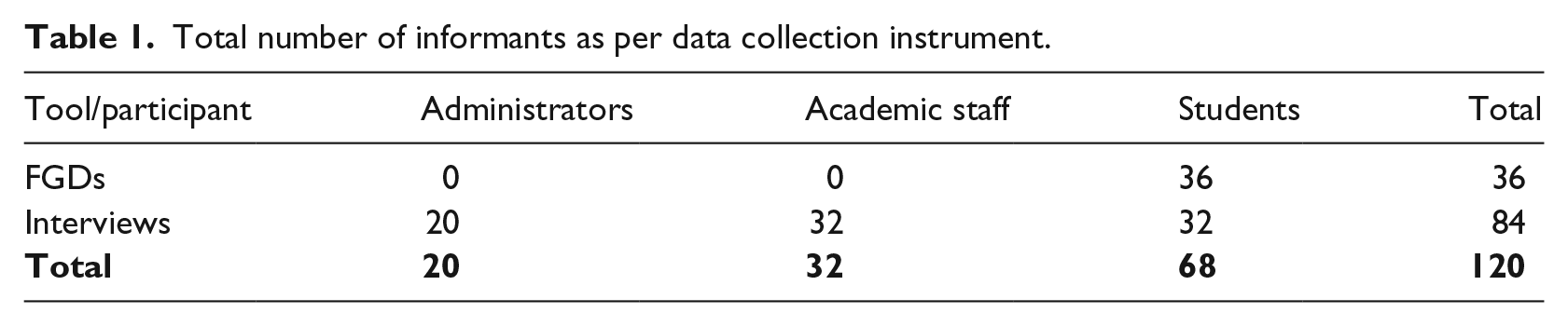
The distribution of participants as per the tool is shown in Table 1.
Total number of informants as per data collection instrument.
The characteristics of the sample used in the study were as follows:
University administrators
There were 20 university administrators: predominantly male (78.9%) as compared with female (21.1%). There was a deputy vice chancellor, two registrars, two deputy registrars, five directors of respective international offices, two deans of schools and three heads of departments, also known in some universities as chairpersons of departments. The average years of experience of administrators was three years, which was adequate for responding to questions on the established process of internationalisation in their respective universities.
The academic staff
There were 32 academic staff, more male (57%) than female (43%). Over half of the academic staff (51.2%) had a master’s as the highest qualification, compared with the 48.8% with a doctoral qualification. The sample showed that 70.4% of the academic staff had obtained their highest level of qualification within the country, while 29.6% had an overseas education background. The data on the ranks/position of academic staff showed that the majority of the participants (39.5%) were lecturers, followed by tutorial fellows (20.4%), assistant lecturers (14.2%), professors (13.6%) and senior lecturers (12.3%).
Over half of the academic staff (54.9%) were from the College of Humanities and Social Sciences. The College of Education provided 19.1% of the sample, the College of Pure and Applied Sciences 9.9%, the College of Health Sciences 7.4% and the College of Engineering was least represented, with 6.2% of academics taking part. A small percentage (2.5%) of the academics did not indicate their host college. These colleges did not exist in all four selected universities, as presented above. However, the existing faculties were collapsed to fall under any of the five parent colleges.
Demographics of the students
The study involved 68 doctoral students; there were more male (52.9%) than female students (47.1%). The majority of the students (40%) were from the College of Humanities and Social Sciences, followed by the College of Education (30.9%), the College of Health Sciences (13.2%) and the College of Pure and Applied Sciences (10.3%). The College of Agriculture and Veterinary Science had the least representation (5.9%).
Data collection instruments
The study employed three research instruments in data collection, which allowed for triangulation. The instruments employed were as follows:
Interview schedule
There were 20 semi-structured interviews for university administrators and 32 semi-structured interviews for both students and academic staff. Interview schedules for university administrators sought information on their understanding of the concept of internationalisation of higher education and their rationale for internationalisation, including the reason for identifying the process as a priority area. Further, there were questions on the impact of the internationalisation process on academic programmes. The focus was on how the established perception of the process permitted the use of internationalisation to promote university academic programmes.
Document analysis
The study analysed documents related to internationalisation of higher education. These were internationalisation plans, mission and vision statements, university strategic plans, strategic plans for directorates and/or centres of internationalisation of higher education, university newspapers, websites and budgets, which together provided a holistic perception of how the key stakeholders in universities in Kenya perceived the process of internationalisation of higher education.
Focused group discussions (FGDs)
The study used FGDs to collect data from the students. According to Nyumba et al. (2018), FGD is a qualitative data collection approach that is used to gain an indepth understanding of social issues. There was a total of five mixed-gender FGDs. In total, 36 students participated in the FGDs. The discussions were on the understanding of the process of internationalisation and how the process had been used to influence their academic programmes.
Data analysis
The study utilised the comparative method as the primary analytical technique to systematically and continuously categorise, compare, synthesise and interpret the collected data (Merrian, 2002). Using a technique specific to multiple-case studies, the researcher adopted two stages of data analysis: within-case and cross-case analysis (Merrian, 1998).
Within-case analysis involved analysing the data of each individual university with respect to the stakeholders’ understanding of the process of internationalisation of higher education. At this stage, the explanation for emerging data was linked to the unique and prevailing contextual factors specific to the university. The focus, including any comparison, was restricted to the individual university.
The cross-case analysis phase involved abstractions across the different universities to generate explanations that fit the four selected universities. To generate the similarities and differences, as is always the case in comparative studies, the researcher utilised ‘pattern clarification’ by use of cluster matrices to clarify patterns and draw conclusions across cases (Merrian, 1998). The cluster matrices were vital in organising and analysing convergent and divergent findings in the four selected universities.
Study findings
Understanding of the process of internationalisation of higher education
The first task was to examine the understanding of the process of internationalisation of higher education among institutional stakeholders, namely academic staff, university administrators and the students at the selected public and private universities in Kenya. The main sources of data were the universities’ official documents, interviews and FGDs that were carried out at the selected universities.
Administrators’ understanding of the process of internationalisation of higher education
According to the administrators at the four selected universities, the process of internationalisation of higher education is about ‘opportunities’, ‘capacity building’ and ‘university visibility’. There was a consensus that the process enhances access to learning opportunities, partnerships, multicultural education, collaborations and capacity for the staff, students and the university in general. Interviews with some of the directors of the international offices, for instance, observed thus: this process encompasses exchange programmes involving both staff and students, linkages that we have given a lot of priorities here, and raising our standards to international level to remain visible in the region. (University administrator: international office, 10 October 2017). those internationalisation activities and programmes supported by our international office. The university has launched recent projects like Confucius Institute and the activities that we participate in through African Network of Internationalisation of Education like international conferences. (University administrator: university management, 16 November 2017).
The university administrators’ perception of the process of internationalisation of higher education had a lot of influence from the existing internationalisation activities and discussions within their universities. The findings from both the public and private universities indicated an activities approach to internationalisation. The process was defined in terms of activities such as exchange programmes, partnerships, university visibility and available institutional infrastructure that universities had put in place to support the process of internationalisation of their campuses, for example international offices. These views were succinctly summarised by one of the university administrators attached to the international offices: This process encompasses exchange programmes involving both staff and students, linkages that we have given a lot of priorities here, and raising our standards to international level to remain visible in the region. (University administrator: international office, 10 October 2017)
The activities approach highlights the university administrators’ inadequate knowledge on the ‘structural’ and ‘conceptual’ constructions of the process of internationalisation as a quality measure within university education. It was not the intention of this study to solicit a working definition of the process of internationalisation from the university administrators as outlined by Knight (2004). However, analysis of the available internationalisation quality frameworks, for instance the Internationalisation of Universities Audit by the German Rectors Conference and the Indicators for Mapping and Profiling Internationalisation project led by the Centre for Higher Education Development demands that university administrators exhibit adequate knowledge on ‘ostensive’, ‘structural’ and ‘conceptual’ meanings of the process of internationalisation of higher education. Therefore, the findings that university administrators had little knowledge on the ‘structural’ and ‘conceptual’ meaning of the internationalisation process means that it was unlikely that the process was used to align and integrate internationalisation activities into existing university structures to promote the quality of academic programmes.
In terms of motivation to internationalise university activities, the university administrators in the selected public and private universities picked academic rationales as the main incentive for their universities to internationalise. There were no substantive differences based on the category of the universities as the overall emphasis in both the public and the private universities was on capacity building and the various linkages and opportunities that were available for both academics and students. In all 20 interviews that were conducted with the different categories of university administrators, none identified the process of internationalisation as a source of income for their institutions, particularly the school fees of international students. It is worthwhile to note that there was a mention of the use of internationalisation for ‘visibility’ of their university and university activities.
The use of internationalisation as an avenue to access opportunities and also enhance university visibility was evident in the university official documents and their respective websites. In the University of Nairobi’s Centre for International and Links (CIPL) Strategic Plan 2014–2019, the first three quality objectives were about visibility of the university and fostering partnerships for students and staff. The universities perceived internationalisation as an avenue for enhancing international visibility and offering opportunities to their staff and students.
The study also explored the university administrators’ perceptions of internationalisation activities as institutional strategies to improve the quality of their academic programmes. Notable was the admission by university administrators that internationalisation activities were viable tools for improving academic programming. However, in most of the interviews, the university administrators did not draw any clear relationship between the many internationalisation activities that were mentioned and how their implementation would enhance their academic programmes. In both the public and private universities, internationalisation activities were implemented and/or tended to be seen as an end in themselves. For instance, besides the written intention of using internationalisation activities to enhance visibility of universities, none had drawn out a strategy or a monitoring framework to track the implementation of all the university targets. Critical was the lack of mention of university activities such as creation of campus diversity, internationalisation of the curriculum and capacity building of the academics through training workshops, elements that are crucial in improving academic programmes. This is consistent with institutional theory where stakeholders in a university profess positive attributes of internationalisation as this accords them legitimacy and therefore borrow acceptable internationalisation practices without proper institutional structures to support their implementation, leading to inefficiencies in the outcomes (Oliver, 1991; DiMaggio and Powell, 1983).
The inadequate link between internationalisation activities and academic programmes emanated from the perceptions that the administrators in both the public and private universities identified as constituting quality academic programmes. When asked their opinions on quality academic programmes, most of the administrators identified the established quality measures by the higher education regulator, the Commission for University Education (CUE). In one of the interviews, an administrator observed: On quality I will say the regulator has clearly defined what is acceptable within our programmes which cuts across even for private universities, and ours is to implement the regulations as administrators. We face our own challenges but quality programmes are clearly defined and you can look at it in terms of the lecturer–student ratios which of course varies from one programme to the other sometimes as determined by their professional bodies and universities. In terms of curriculum, you shouldn’t forget that CUE is very clear on reviews that should be done after every five years and the process is equally known. We can also not forget Vision 2030, our trainings have to supply the personnel for achieving the ambitious vision and this calls for programmes that are responsive to Kenya’s job market. . .. (Key informant interview, female university administrator, 17 November 2017)
Universities that are globally competitive have invested heavily in the learning environment to guarantee implementation of their academic programmes. This has been through the creation of multicultural campus environments, exchange programmes, research fellowships and internationalised focused programmes (Oanda, 2009; Salmi, 2009). Unfortunately, these aspects did not form part of what most university administrators in Kenya identified as key components of a quality academic programme. The university administrators also defined internationalisation from the effects of globalisation and its implications on higher education policy. There was a strong conviction that it was no longer tenable to produce a workforce restricted to national boundaries.
Other university administrators looked at internationalisation as a process of raising university standards to international standards for production of competent global graduates. The emphasis was to have a competitive edge in a global market where education is treated like any other purchasable good. However, as already established, very little was identified and discussed in terms of the contribution of the internationalisation process to the production of quality graduates with a global orientation.
The university administrators’ understanding of the process of internationalisation also revealed differences in the level of clarity among administrators working directly in the established internationalisation offices and the mainstream administrators such as principals of colleges, deans of schools and heads of departments. The university administrators at the international offices were more informed on the process of internationalisation as compared with the mainstream administrators. This was the case for both the public and private universities. This is worrying given that the mainstream university administrators, especially deans of schools and heads of departments, were responsible for championing integration of internationalisation activities at school and departmental levels respectively.
The established trend whereby university administrators working in international offices demonstrated more clarity in what constitutes internationalisation of higher education than mainstream administrators points to an inefficient strategy in communicating the process and rationale of internationalisation in Kenyan universities. The university community was expected to have a clear understanding of the policies and strategies guiding the university operations, which was not meant to be left to the top university management team alone, as was in fact the case.
Academic staff’s understanding of the process of internationalisation of higher education
The need to establish the convergence and/or divergence of university administrators’ perceptions with those of academic staff who naturally implement university policies necessitated exploring academic staff’s perspectives of the internationalisation process. Interviews conducted with academics in both the public and private universities indicated that they had minimal knowledge on the process of internationalisation of higher education. In most cases they did not have a clear understanding of the process but linked it to capacity building of academic staff by accessing opportunities available within their established networks. There are a few excerpts to illustrate these views, thus: internationalisation to me is what we do to be part of the world especially with more calls for collaborations at all levels of university education. (Academic staff, 15 November 2017) internationalisation is ways in which institutions align their programmes on offer to meet international standards. (Academic staff, 10 September 2017) Internationalisation means global approach in higher education. I will imagine that the process involves borrowing international programmes. People go out there to learn something different maybe in a different environment. (Academic staff, 11 November 2017)
Most of the university academic staff had limited knowledge on the process of internationalisation. As was the case with the university administrators, the few who had knowledge of the process gave an activities approach to internationalisation and as argued above lacked both conceptual and structural knowledge of the process.
The activity-based definition of the process of internationalisation by academics was the case for both public and private universities. This established that inadequate knowledge exhibited by academic staff could partially be explained by the profound absence of any well thought out structures within the sampled universities in Kenya to support the academic staff to internationalise. When administrators were asked about the support they provide to academic staff to internationalise for quality academic programmes, their responses ranged from participation in international conferences to grants made available for research, with no mention of structured training and workshops on internationalisation. Utilisation of internationalisation activities as tools to enhance quality programmes in universities would accrue more benefits to programmes when structures are in place, and personnel supported to acquire adequate knowledge, skills and attitudes.
A few of the academic staff interviewed exhibited clarity particularly on how to translate internationalisation activities to enhance the quality of their academic programmes. This can be seen in one of the interviews with one of the academic staff, who observed: I will give you an example of one of our unit which I teach called ‘internationalising conflicts’. In essence, it is taking a unit or field of study to international realm, that is, encouraging international discourse, putting a global context, how do we involve others even through student exchange programmes, which expose our students to other international discourse. In the institute (IDIS) we have committees responsible for exposing our students to UN engagements, African mission, East African Commission in Arusha and so on. I am responsible for UN trips. (Academic staff, 18 November 2017)
The findings of academic staff on their understanding of the process of internationalisation also revealed that academic rationales remained the main motivation for internationalisation of Kenyan higher education. When the academic staff were asked why they support the process of internationalisation, most of them chose academic rationales, as shown in Table 2.
Rationales for internationalisation.
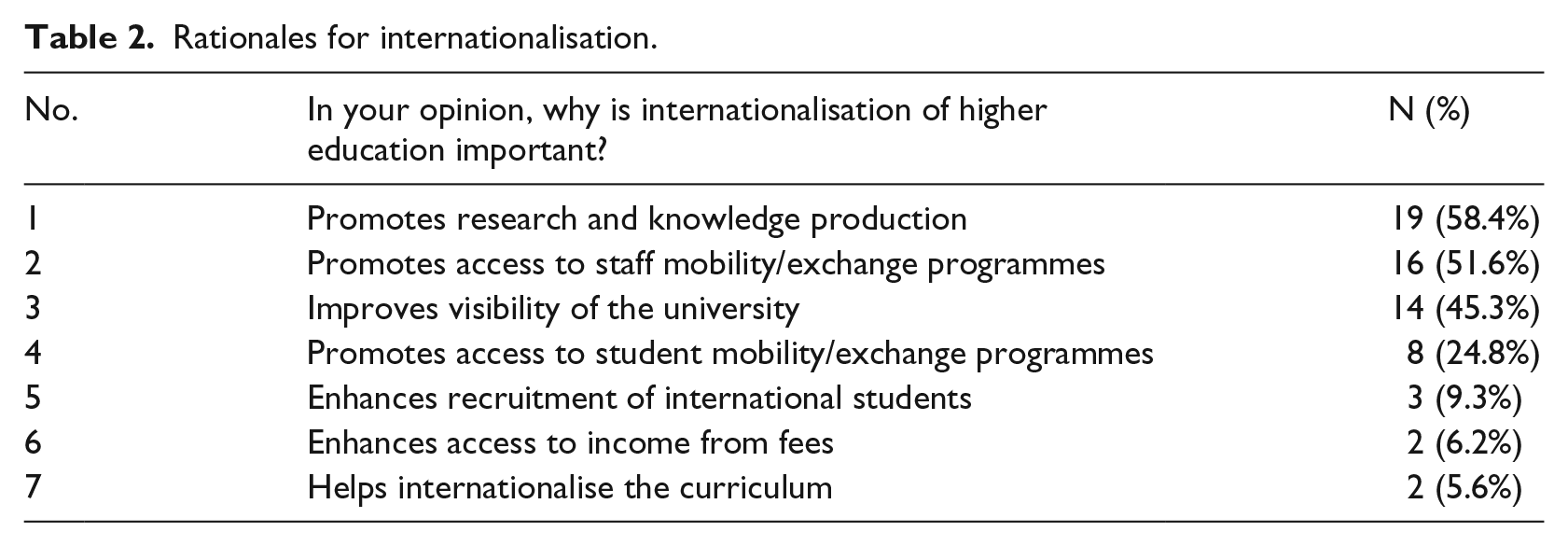
Table 2 shows that access to opportunities and visibility associated with the internationalisation process is what attracts the academics to support the process. As was the case with the university administrators’ views, the learning environment received little consideration in how the academic staff perceived the process of internationalisation. For instance, the low ratings of campus diversity, that is, recruitment of international students (9.3%) and internationalisation of the curriculum (5.6%) highlights how the process would struggle to have a meaningful impact on the quality of academic programmes.
University students’ understanding of internationalisation of higher education
The study explored university students’ understanding of the process of internationalisation of higher education. Overall, the findings from the interviews conducted in the four sampled universities with first-year postgraduate students found that students were not aware of the process of internationalisation. Most students, when asked about their understanding of the concept of the internationalisation process, mentioned what could be considered the ‘benefits’ of the process rather than what the process entails. For instance, the students knew that the process of internationalisation ought to raise the standards of their universities and ensure global competitiveness. However, there was lack of clarity on how the mentioned activities would guarantee this objective.
The overall finding was that the students lacked awareness of internationalisation activities. There was no mention of internationalisation activities such as campus diversity, curriculum review to infuse international aspects and investment in both the academic staff and students, which have a direct and strong influence on the creation of quality university education. It is not the intention of this study to argue that students’ lack of knowledge on internationalisation activities in their local university campuses necessarily indicates the absence of internationalisation activities. However, their inadequate knowledge corroborates findings from the academic staff. This ultimately justifies the claim that indeed their lack of knowledge of the process of internationalisation points to the existence of very few visible internationalisation activities in the sampled public and private universities in Kenya. Further, this limited knowledge could equally be attributed to the inadequate communication of internationalisation activities on the part of the university management.
The study established differences in the understanding of the process of internationalisation of higher education among university administrators, academic staff and students. The university administrators demonstrated a moderate understanding of the concept of the process of internationalisation, focusing on the opportunities related to funding, capacity building and international competitiveness. The academic staff had minimal understanding of the process, limited to opportunities related to scholarships and conferences. This was the case for both the private and public universities. The university administrators, especially those charged with spearheading internationalisation, were somewhat clearer about the components of the internationalisation process.
In addition, the universities had fewer structures to orient academics and students as key stakeholders to participate in the process of internationalisation. This was contrary to the anticipated appropriate environment to enhance quality academic programmes. Both the university administrators and the academic staff ought to have similar understanding of the process in order to ensure effectiveness in the implementation of the designed programmes meant to support university education. Therefore, the minimal involvement of the academic staff and students was an inhibitor in utilisation of internationalisation for quality academic programmes.
Discussion of the findings
The heart and soul of internationalisation as a proxy process for quality university education lies in the understanding of the process, and the most critical resources at the institutional level are the university administrators, academic staff and students. Where there is a lack of shared understanding of the process, as was established in this study, then it is unlikely that internationalisation will be successful in enhancing the quality of university programmes. The unclear meaning of internationalisation reported in the current study mirrors the general experiences of other scholars, who have indicated the conceptions of the process of internationalisation as contestable and varying (Friesen, 2012; Schuerholtz-Lehr, 2007; Welch et al., 2004). For instance, Welch et al. (2004), in a case study conducted at the University of Zululand, reported a state of confusion over what the process meant and even called for the development of institutional policies to support greater understanding of the process.
In a study that explored faculty engagement in one of the Canadian universities, Friesen (2012) reported adoption of an internationalisation agenda into institutional strategic documents but with lack of clarity on what internationalisation means. The varying conceptions of internationalisation should be studied within the wider discussions on what the term means. In scholarly circles, many researchers have associated internationalisation with different aspects. For instance, Paige and Mestenhauser (1999) identified an ‘international mindset’ to respond appropriately to changes orchestrated by globalisation as the main guiding principles in defining internationalisation. This was not the case for Stromquist (2007), who preferred looking at internationalisation as a process of creating ‘international presence’ within learning environments to guarantee dominance in the international marketplace (Stromquist, 2007). There are some scholars, such as Schoorman (2000), who focus on the value of a multicultural learning environment as a key component of internationalisation. This is to ensure educational institutions promote awareness and inclusivity of different cultures.
The question of varying understanding of internationalisation of higher education is because the concept itself is neither simple nor static. The term not only encompasses integration of an international approach to education (Knight, 2008) but is also seen as an instrument to enhance the quality of the same education (de Wit et al., 2015). Broadly speaking, there are two components of internationalisation: internationalisation abroad and internationalisation at home (OECD/European Union, 2019). The struggle, at an institutional level, is how to integrate an international dimension into provision of education. Thus, the varying conceptions of internationalisation among institutions do not necessarily reflect a fragmented understanding of the concept. Institutions and individuals can be persuaded by specific definitions located within internationalisation abroad or internationalisation at home when examining the process as a response to quality issues in university education. What is important is ensuring that institutions cultivate a shared commitment and meaning as to what constitutes the process. This is what this study has established as lacking in the targeted universities.
The discourse on the meaning of the internationalisation process as argued above indicates that the question of ‘what’ remains inadequate in defining internationalisation and therefore there is a need to examine ‘why’ and ‘how’ the process works as a quality measure in local institutions. Why should universities internationalise? In Kenya, the motivation to internationalise was related to the perceived benefits of enhancing academic staff and students’ international knowledge capacity, strengthening the institutional research capacity and production, enhancing the qualifications of academic staff and improving the general standard and quality of education. This was the case among university administrators, academics and students. The identification of an academic rationale as the main incentive for internationalisation in Kenyan universities is not a new trend in African higher education. This is consistent with findings from Ethiopian higher education (Tamrat and Teferra, 2018) and earlier studies by IAU (2003, 2014) that identified the above-mentioned benefits as the main reasons for internationalisation by African higher education.
Studies on internationalisation rationales conducted in Western universities have shown contrary trends as to what motivates Western universities to internationalise. Whilst it is true that not all European universities or the developed universities in North and South America share similar motivations to internationalise their university education, economic rationales feature heavily as the decisive motives in internationalising. This has been reported in the USA, Canada, the UK, Australia and New Zealand, all of which see the process is seen as an income-generating activity (Chankseliani, 2018; Clarke et al., 2018; Friesen, 2012; Hyland et al., 2008; Warwick and Moogan, 2013). In the UK, for example, Chankseliani (2018) observed a tendency of the institutions to prioritise attracting students from Eastern Europe, Russia, the Caucasus and Central Asia. In Irish higher education, Clarke et al. (2018) alluded to economic rationales as the main strategies pushing for internationalisation. They argued ‘a recurring theme in the data was an emphasis on increasing numbers and revenue rather than using resources to meet the needs of international students’ (Clarke et al., 2018: 6). Consequently, economic rationales emerge as among the decisive motives for the internationalisation of most of European higher education.
Scholars including Turner and Robson (2007) have further cited differences in the rationales for internationalisation among academics and university administrators in British higher education. The university administrators emphasised competitive-market based rationales, where internationalisation was seen as a tool to enhance their competitiveness, contrary to their academics, whose support of internationalisation was linked to more cooperative-related rationales. It is important to note that, although overall there are concerted efforts in universities in the West, supported by financial budgets, to recruit international students as a source of income, there exist unique cases in some parts of Europe where the support is linked to a cooperative approach to internationalisation. For instance, in Finland, Tossavainen (2009) linked the support of internationalisation to mobility, multiculturalism and networking. In Germany, Wahlers (2018) reported cooperative approaches as motivating the internationalisation of German higher education more than any other rationales.
The noted differences in the rationales for internationalisation in Kenya and Western universities relate to the variations in level of investment in internationalisation in favour of the latter institutions. The universities in the West, supported by financial budgets have recruited international students mainly as a source of income (Warwick and Moogan, 2013; Zeleza, 2017). Even where cooperative-related approaches are the main motivation for internationalisation, attraction of international students for economic reasons still features heavily (Clarke et al., 2018; Tossavainen, 2009; Wahlers, 2018).
This is contrary to Kenyan higher education, where the motivation to internationalise relates to the practical needs that have emerged. The rapid expansion of the university sector with unmatched investment has given rise to challenges, particularly the inadequate number of qualified academic staff and the quality of education. In the academic year 2015/2016, the percentage of academic staff with PhD qualifications in Kenyan universities stood at 34.3%. Research output is still low, with poor research traditions, heavy teaching workloads, insufficient funding and sometimes lack of requisite skills in the sector blamed for the low research output (Mukhwana et al., 2016). This low investment in Kenyan higher education and by extension Africa is what forces the sector to depend on developed universities for capacity building and partnerships in research and curriculum innovations. This explains the reason for the identification of academic rationales as the major motive for internationalisation in Kenyan universities.
From the study, it is apparent that internationalisation activities were not integrated into institutional structures as the basis of their implementation. This is consistent with institutional theory where universities profess internationalisation in their university activities but these activities lack institutional structures to facilitate their adoption (DiMaggio and Powell, 1983). The process of review of academic programmes takes place within established institutional structures. Where the institutional structures are overlooked, it is unlikely that internationalisation activities were implemented successfully to enhance academic programming.
One of the approaches to ensure integration of internationalisation activities into university operations lies in the communication of the vision for internationalisation. However, universities in Kenya encountered a challenge in outlining this vision to all the university stakeholders. The vision for internationalisation remained with the top university management and had not percolated to mainstream administrators at school and department levels, staff and students. The target universities did not have a communication strategy that would ensure internationalisation is rooted within their operations.
Conclusion
The study suggests that the sampled universities in Kenya had adopted an internationalisation agenda with lack of a shared understanding, attitudes and beliefs among the institutional stakeholders, namely the university administrators, academics and students. Furthermore, the sampled universities experienced a challenge in communicating their vision for internationalisation. This was evident in the inability of the universities to develop a common understanding of what constitutes the internationalisation process. This inhibited the progress of internationalisation and even compromised the capacity of Kenyan universities to utilise the process to advance the quality of their academic programmes. This could partly explain the outcry from employers who have raised concerns over the quality of graduates in the market. The study suggests a need for Kenyan universities to invest in ensuring that the administrators, academics and students are actively engaged in internationalisation of their university activities. Some of the recommended avenues include organising workshops and training for the stakeholders on the process of internationalisation.
Footnotes
Acknowledgements
The authors would like to thank the involved universities for providing the relevant documents as well as the staff and students who agreed to be interviewed. Furthermore, the authors highlight and appreciate the academic support that Prof. Ibrahim Oanda from the Council for the Development of Social Science Research in Africa (CODESRIA) gave throughout the various stages of this work.
Funding
The author(s) received no financial support for the research, authorship, and/or publication of this article.