




Abstract
This is a comparative study that examined the relationship between the Big Five personality factors and English language speaking anxiety among Moroccans (N=270) and Koreans (N=257), who completed the International Personality Item Pool Big Five Inventory and the English Language Speaking Anxiety Scale. The results indicate that Openness and Neuroticism were the only significant predictors of English language speaking anxiety in the two countries, noting that Openness was the strongest significant predictor in Morocco, whereas Neuroticism was the strongest significant predictor in Korea. Implications indicated that assessing the personality of students may predict those who will experience these anxieties.
Introduction
Foreign language anxiety (FLA) has been studied since the mid-1990s, and hence a wealth of research has profoundly contributed to the understanding of this language phenomenon. As a case in point, researchers have come up with an overall agreement that FLA is a situation-specific anxiety (Horwitz et al., 1986). This study tends to further the understanding of FLA in relation to personality factors. While much evidence has proved personality factors to be related to many life outcomes and disorders, no such relationship has been examined between personality factors and English language speaking anxiety (ELSA). Similarly to those studies which found that personality factors were associated with and predictors of various life outcomes and personality disorders, this study also follows the same trend by investigating which personality factors are more or less prone to experience ELSA among both Moroccans and Koreans. Thus, this study is the first of its kind.
Literature review
The context of teaching English as a foreign language (EFL) in Morocco and South Korea
According to the Ministry of National Education (2007) in Morocco, English-language teaching is a standards-based approach. This means that English-language teaching focuses on the improvement of five goals, namely communication, cultures, connections, comparisons, and communities. These 5C’s involve the main elements of English-language teaching and learning in Morocco. Broadly, the major aim of these 5C’s is to enable learners to properly function in a multicultural global community of English-language speakers without losing their local identity as foreign-language speakers (Ait Bouzid, 2017).
In South Korea, the Ministry of Education has been trying hard to improve and boost native-speaker proficiency among learners of English. Eun (2001) mentions that the curriculum presented in 1992 clearly indicated that communicative language teaching (CLT) has to replace the audiolingual method and the grammar translation method used in middle schools and high schools respectively. CLT is based on the perspective that learning a language does not stop at the level of linguistic competence, but goes beyond it to reach communicative competence. CLT tends to teach learners how to use language not only accurately but appropriately and functionally.
The Big Five personality factors
The Big Five personality factors (BFPF) are composed of five trait dimensions and are alternatively referred to as the Five Factor Model (FFM). The trait dimensions are Openness (or Intellect), Conscientiousness, Extraversion, Agreeableness, and Neuroticism (or Emotional Stability). The BFPF were developed as an attempt to better understand human personalities through a limited number of trait dimensions. It was also mentioned by many personality psychologists that the BFPF cover the most essential basic individual differences in personality (McCrae and John, 1992).
The BFPF have proved to be either negative or positive predictors of various life outcomes including well-being, social acceptance, relationship conflict, criminality, mortality, and life satisfaction (John et al., 2008; Lahey, 2009; Ozer and Benet-Martinez, 2006). In clinical psychology, the BFPF were found to predict a great number of personality disorders such as Paranoid, Schizoid, Borderline, Narcissistic, and Depressive (Reynolds and Clark, 2001). In relation to anxiety, several studies found that Neuroticism was a strong positive predictor of this disorder (Ireland et al., 2014; Trull et al., 2001). Therefore, the BFPF are useful predictors that may be employed in anticipating various life outcomes and disorders.
Foreign-language anxiety (FLA)
FLA has been regarded as a significant affective factor in the process of foreign-language learning. Given that anxiety is a part of the learner’s affective filter, it may interfere with the process of learning and acquiring a language (Krashen, 1982). The first scholars who dealt with FLA as a separate phenomenon particular to language learning were Horwitz et al. (1986). They defined this phenomenon as “a distinct complex of self-perceptions, feelings and behaviors related to the classroom language learning process.” Another definition refers to FLA as “the feeling of tension and apprehension specifically associated with second language [L2] contexts, including speaking, listening, and learning” (MacIntyre and Gardner, 1994). Nevertheless, despite well-documented research on FLA, there is still much to be clarified regarding the personality traits of students who experience FLA.
Horwitz et al. (1986) classified FLA into test anxiety, communication apprehension, and fear of negative evaluation. This implies that a learner may experience anxiety in one or all of these situations. Many studies have been done to detect the sources of language anxiety; these found sources associated with the learner, the instructor, and the institutional practices (Young, 1994), the learning context (Phillips, 1999), the mother-tongue skills (Sparks and Ganschow, 1995), learning styles (Reid, 1995), cultural practices (Ohata, 2005b), stage fright, the learner’s personality, the teacher’s methodology (Oxford, 1999; Price, 1991; Tse, 2000), and the expectation of negative evaluation from others (Aydin, 2008; Kitano, 2001; Liu, 2006).
Foreign language speaking anxiety
In addition to the extensive number of studies that have been conducted on FLA, many other studies have investigated foreign language speaking anxiety (FLSA) (Balemir, 2009; Basic, 2011; Chaokongjakra, 2012; Gregersen and Horwitz, 2002; Huang, 2004; Kitano, 2001; Liu, 2007; Luo, 2014; Mahmoodzadeh, 2012; Melouah, 2013; Öztürk & Gürbüz, 2014; Sellers, 2000; Suleimenova, 2013; Tanveer, 2007; Tsiplakides and Keramida, 2009; Tüm and Kunt, 2013; Woodrow, 2006) as it has been found to be the most anxiety-provoking language skill among both native speakers and foreign/second-language learners (Keramida, 2009; Melouah, 2013; Palacios, 1998; Young, 1992). Chaokongjakra (2012) mentioned that “FL speaking anxiety had an influence on the process of language learning. That is, speaking anxiety played a crucial role in acquiring the productive or active skills in language learning that is speaking and writing skills.” This indicates that as both speaking and writing are productive language skills, being anxious in foreign-language speaking may also result in being anxious in foreign language writing.
Within the literature of FLSA, much research has focused on the sources and factors that lead to this aspect of anxiety. A highly valuable study that tackled this issue was conducted by Aydin (1999) where she divided those sources into four categories, namely personal reasons, the teacher’s manner in the classroom, learners’ beliefs, and testing and teaching procedures.
Personal reasons refer to a situation where students assess and compare themselves to others in terms of speaking performance. The teacher’s manner in the classroom is also a substantial contributor to speaking anxiety, which refers to his/her teaching methodology followed in the classroom, which may be either student-centered or teacher-centered. The relationship between the teachers and their students along with the teachers’ personality are two main anxiety-provoking factors (Bekleyen, 2004). Teachers with a sense of humor were found to reduce the level of anxiety in the classroom (Yan and Horwitz, 2008). Learners’ beliefs refer to those false ideas that sometimes lead to anxiety. For instance, some learners may think that excellent speaking is obtained when one properly pronounces the language (Wilson, 2006). Thus, their pursuit to achieve this objective may turn them into frustrated and anxious students (Aydin, 1999; Ohata, 2005a). As for testing and teaching procedures, it was indicated that oral exams were the most anxiety-provoking factor for students (Aydin, 1999; Huang, 2004), in addition to public speaking (Cheng, 2005; Wörde, 2003).
Mastering the speaking skill of a foreign language requires communicative competence (Shumin, 1997). This competence allows the speaker to “convey and interpret messages and to negotiate meanings interpersonally within specific contexts” (Brown, 1994). Other competences that speaking requires are linguistic competence, sociolinguistic competence, discourse competence, and strategic competence. These competences are not easily learned or mastered, which results in anxiety for foreign/second-language learners. Besides, an investigation of anxiety and its effect on FLSA has to take into consideration the psychological phenomena associated with the fear of speaking in general. That is to say, how much of anxiety is related to speaking in general and how much is related to FLSA in particular. This explains that some individuals experience speaking anxiety even in their mother tongue whereas others experience it only in a foreign language.
The Big Five and FLA
Despite the fact that personality is considered stable over time and cannot describe intrapersonal differences in FLA over time (MacIntyre, 2007), many personality dimensions have been found to be predictors of interpersonal difference in FLA. More precisely, the studies that were conducted on the relationship between the BFPF and FLA focused mainly on Extraversion, Neuroticism, and Conscientiousness.
Starting with Neuroticism, it was found to be related to a high level of FLA (Dewaele, 2013). An important association was also found between this factor and foreign-language classroom anxiety (FLCA) in the second, third, and fourth languages of two groups of language learners (Dewaele, 2013). This implies that “more emotionally stable participants suffer less from FLCA, whereas high-Neuroticism participants report significantly higher levels of FLCA” (Dewaele, 2013). Notwithstanding, the relationship between Neuroticism and FLA is not wholly clear, and this was mentioned by MacIntyre and Charos (1996), who found no relationship between Neuroticism and FLA.
The second personality factor that showed association with FLA was Extraversion. A high level of this factor was found to be related to lower FLA (MacIntyre and Charos, 1996). This backs up those findings which imply that individuals high on Extraversion tend to experience less anxiety because they have a feeling of comfort while communicating (Brown et al., 2001). However, a moderate relationship was found between Extraversion and FLCA (Dewaele, 2013).
As for Conscientiousness, Gregersen and Horwitz (2002) stated that conscientious students had higher FLA than other students. Precisely, conscientious students who considered their performance insufficient in an interview had higher FLA and experienced more stress concerning errors they made in the foreign language. Learners with higher anxiety usually want to achieve outstanding personal performance, which leads to fear of evaluation and procrastination.
The purpose of this study
The purpose of this study is to investigate the relative and predictive power of the BFPF in relation to ELSA in two totally different contexts: Morocco and South Korea. It is an attempt to investigate which personality traits are more related to ELSA, and whether there are any similarities and differences between the two countries. This study will broaden the understanding of how personality and ELSA are related. Moreover, the results will help teachers of English language predict, to a certain extent, which personality factors may have a strong relation with ELSA. Thus, based on students’ personality traits, teacher can predict the students who will have ELSA and then try to give those students more support and help in advance, which will reduce or stop ELSA before it becomes an obstacle for students’ academic and work career. Accordingly, three research questions (RQs) were developed for this study and are as follows:
Is there a significant difference between Moroccans and South Koreans in ELSA?
What kind of significant correlations exist between the BFPF and ELSA in the two countries?
Among the BFPF, what are the strongest and weakest significant predictors of ELSA in the two countries?
Methodology
Subjects
To ensure that the sample is big enough for this study, an a priori power analysis was conducted. Accordingly, the desired sample for this study was 216 for both Morocco and South Korea. With an expected medium effect size of .05 and p<.05 (Cohen, 1992), this led to acceptable power of .99. The sample size recruited in this study exceeded the required number, which gave more statistical power to the findings.
Morocco
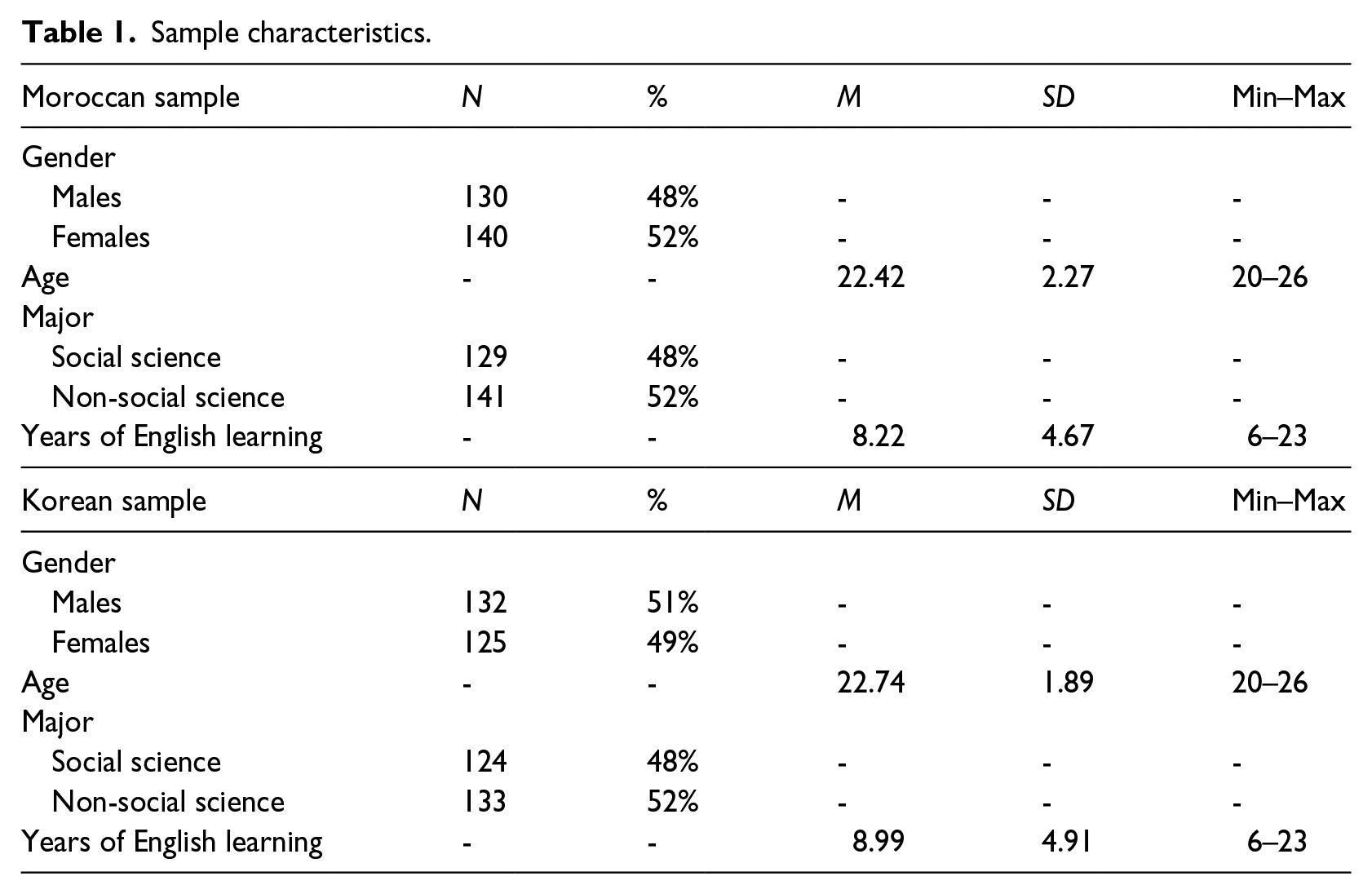
The Moroccan participants were 270 non-English major university students (130 males and 140 females) ranging in age from 20 to 26 years (M= 22.42, SD= 2.27). All the participants were recruited from Moulay Ismail University. A total of 129 (48%) of the participants belonged to social science majors, and 141 (52%) belonged to non-social science majors. The sample revealed a range from 6 to 23 (M= 8.22, SD = 4.67) in years of English learning (Table 1).
Sample characteristics.
South Korea
The Korean participants were 257 non-English major university students (132 males and 125 females) ranging in age from 20 to 26 years (M=22.74; SD=1.89). All the participants were recruited from Inje University. A total of 124 (48%) of the participants belonged to social science majors, and 133 (52%) belonged to non-social science majors. The sample revealed a range from 6 to 23 (M=8.99, SD=4.91) in years of English learning (Table 1).
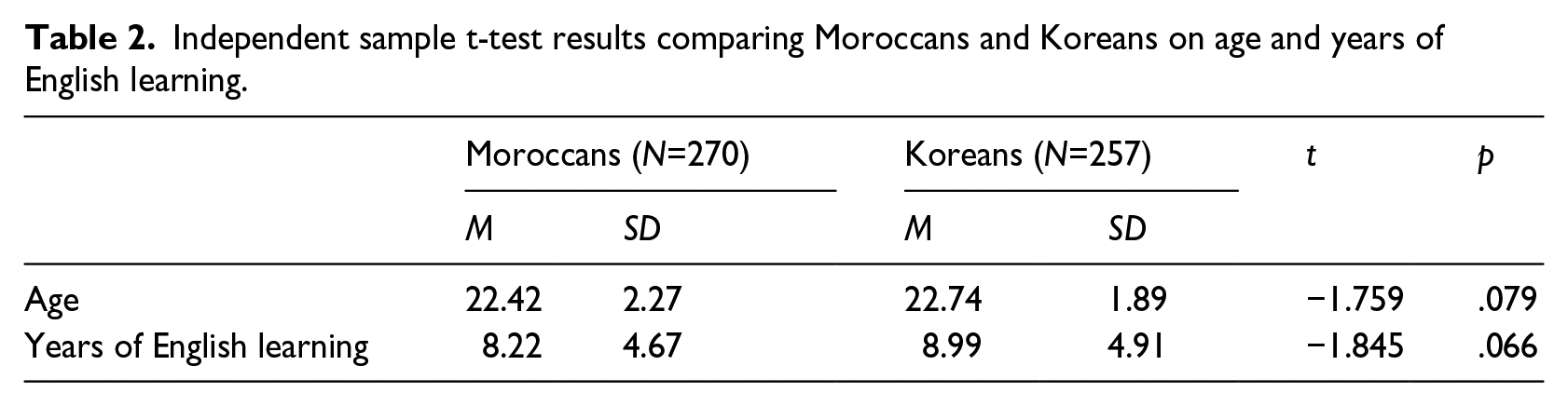
Given that this is a comparative study between two countries, it was necessary to make the two samples as similar as possible by controlling the highly expected confounding variables. Accordingly, gender, age, major, and years of English learning were controlled by holding them constant as much as possible by restricting them to similar criteria. They were controlled as they were considered to have strong impact on the study’s variables. For example, age and years of English learning were not significantly different between the two countries (Table 2). However, it is almost impossible, statistically speaking, to control all the variables that might affect the findings.
Independent sample t-test results comparing Moroccans and Koreans on age and years of English learning.
Instruments
International Personality Item Pool Big Five Inventory (IPIP)
This study adopted the 50-item version of the IPIP, which was developed by Goldberg (1999). This scale was used to assess the Big Five factors of personality: Openness, Conscientiousness, Extraversion, Agreeableness, and Neuroticism. This scale allots 10 items to each of the personality traits. The items are answered on a 5-point Likert scale ranging from very inaccurate (1) to very accurate (5). Each of the personality traits has a score with a range between 10 and 50, which is calculated by summing all the items’ scores. This means that higher scores indicate higher level of the personality traits. Items 2, 6, 8, 9, 10, 12, 16, 18, 19, 20, 22, 26, 28, 30, 32, 36, 38, and 46 are inversely coded. Examples of items are: am quick to understand things (Openness), am always prepared (Conscientiousness), am the life of the party (Extraversion), am interested in people (Agreeableness), and worry about things (Neuroticism).
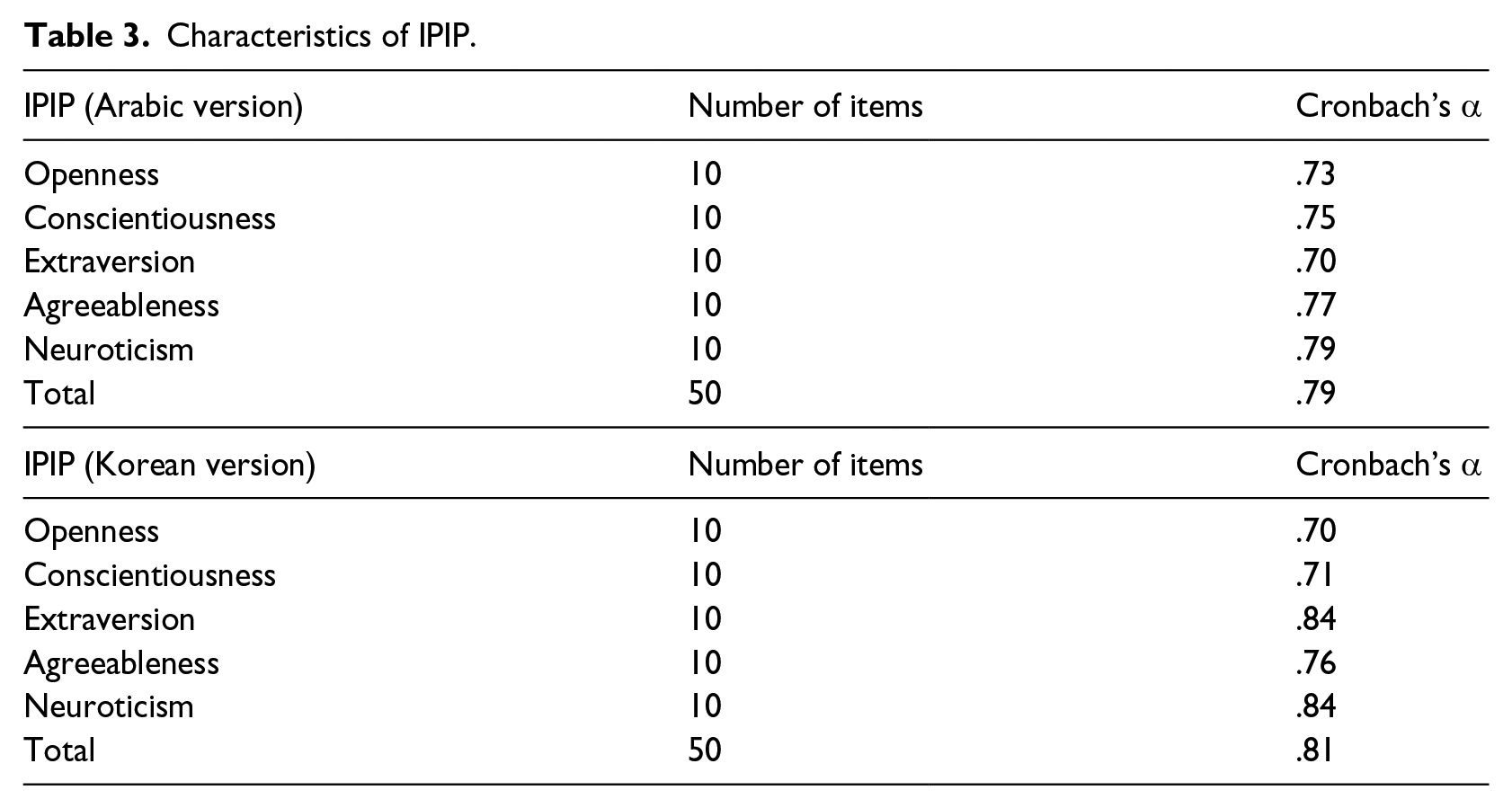
Given that the participants in this study were not native speakers of English and came from non-English majors, IPIP was delivered to them in their mother languages (Arabic and Korean). For the Moroccan version, the IPIP was first translated into Arabic by the researcher and then back-translated into English by a university teacher of English. The translations were then compared to determine whether they were accurate. Accordingly, the final version was adopted. The Arabic version showed a good internal consistency (Cronbach’s α=.79) in this study (Table 3). As for the Korean IPIP, the researcher adopted a translated version by Yoo Tae-yong, Lee Ki-bum, and Ashton (2004), and it also showed a good internal consistency (Cronbach’s α=.81) in this study (Table 3).
Characteristics of IPIP.
Foreign Language Speaking Anxiety Scale (FLSAS)
The FLSAS, which is the most frequently used scale, is derived from the Foreign Language Classroom Anxiety Scale (FLCAS) that was developed by Horwitz et al. (1986) to measure the degree to which students feel anxious while learning a foreign language in the classroom (Fiadzawoo, 2015; Öztürk and Gürbüz, 2014; Saltan, 2003). Among the 33 items of the FLCAS, 18 items were found to be reliable and valid for measuring foreign language speaking anxiety. The FLSAS follows a 5-point Likert scale ranging from strongly disagree (1) to strongly agree (5). The total score ranges from 18 to 90 points, and it is calculated by summing all the items’ scores. A higher score indicates higher FLSA and vice versa. Items 2, 6, 8, and 17 are inversely coded. Examples of items are: I get nervous and confused when I am speaking English and I feel overwhelmed by the number of rules I have to learn to speak English.
For the Moroccan version, this scale was also translated by the researcher into Arabic and then back-translated into English to make sure that the translation was accurate. The translated version showed a high internal consistency (Cronbach’s α=.92). As for the Korean FLSAS, a translated version by Manley (2015) (with some modifications by Prof. Lee Hankyu) was adopted and also showed a high internal consistency (Cronbach’s α=.91). Moreover, a slight modification to FLSAS was made by the researcher by replacing the words “language” and “foreign language” with “English language.” This is because English language speaking anxiety in particular was assessed, rather than foreign language speaking anxiety in general. Thus, FLSAS will be referred to as ELSAS (English Language Speaking Anxiety Scale).
Procedures
Before the administration of the instruments, certain instructions on the objective of the study and on how to fill out the scales were given to the participants. They were also told that there was no right or wrong answer, that their confidentiality would be kept secure, and that their answers would be used for the study only. Moreover, any questions that may have seemed vague to any participant were explained.
Data analyses
The statistical methods used to examine the three RQs were computed through the Statistical Package for Social Sciences (SPSS), version 21. The statistical methods employed were independent sample t-tests, correlations, Fisher z-transformations, and stepwise multiple regression analyses (MRA).
As for RQ1, an independent sample t-test was conducted. This method explored if there was a significant difference in the ELSAS means between the Moroccan and Korean samples.
RQ2 was analyzed through correlational analyses which were conducted between the IPIP and the ELSAS. Moreover, Fisher z-transformation was applied to compare correlation scores between Moroccans and South Koreans. This was through the calculation of z, which can be used to measure the significance of the difference between two correlation scores, ra and rb, found in two independent samples.
Stepwise MRA were conducted to examine RQ3. This statistical method was chosen to find the most useful independent variables in a regression model. That is to say, it may be possible to come up with a good prediction equation with fewer than five personality factors. This statistical method follows an automatic procedure for choosing predictive variables. In each step, adding or deleting a variable from the group of predictor variables is based on some pre-defined criteria, mainly F-tests or t-tests. The personality factors (IPIP) were entered as independent variables, whereas ELSAS was entered as a dependent variable.
Results
Comparison between Moroccans and Koreans on ELSA
Descriptive statistics of the two scales used in this study are presented in Table 4 for both Moroccans and Koreans. The data show that the two samples were close in terms of the means and standard deviations. As for RQ1, the results indicate that there was no significant difference between Moroccans and Koreans in ELSA (Table 5). It means that no sample experienced ELSA significantly higher than the other.
Descriptive statistics and correlations between IPIP and ELSAS.
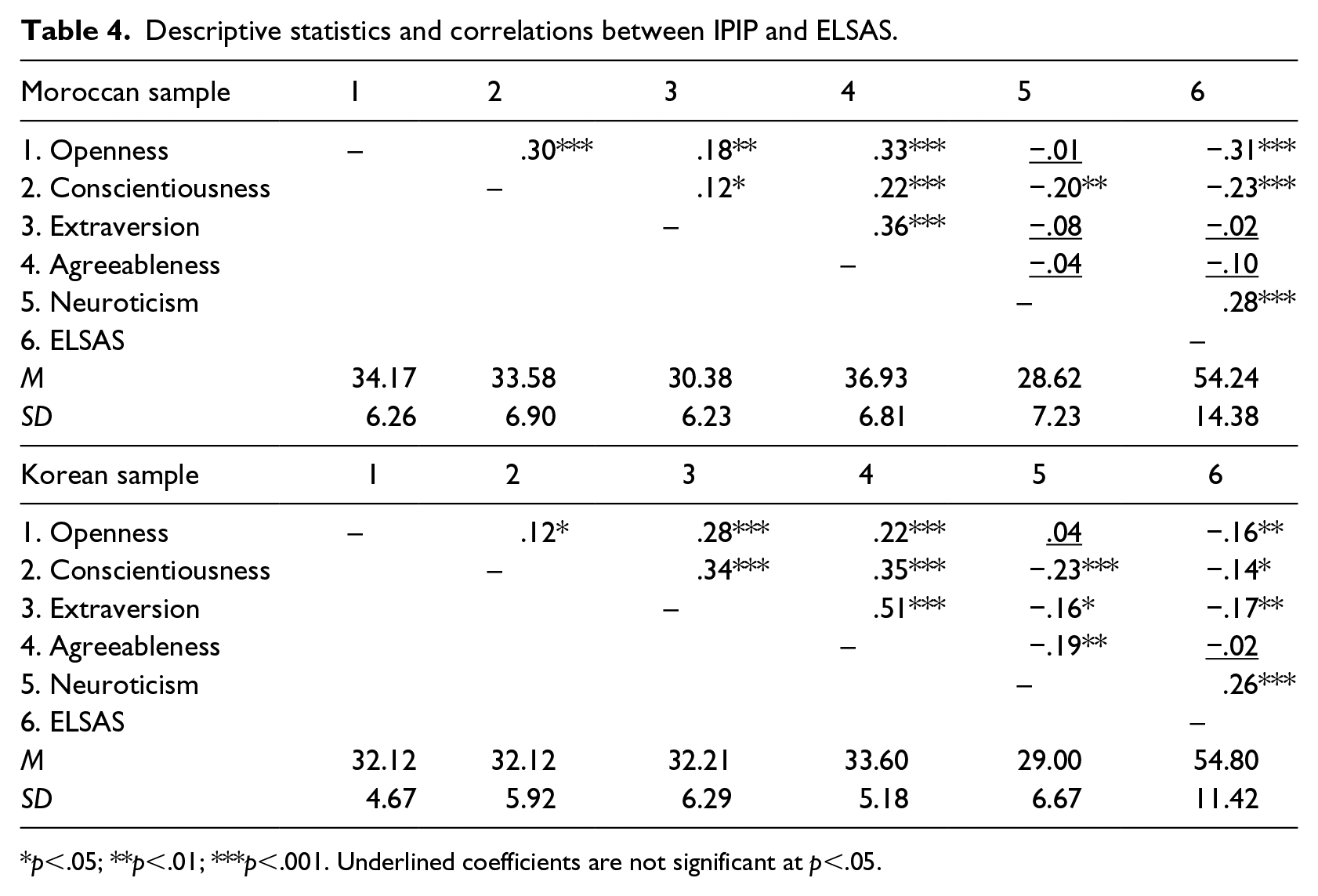
p<.05; **p<.01; ***p<.001. Underlined coefficients are not significant at p<.05.
Independent sample t-test results comparing Moroccans and Koreans on ELSA.

The correlations between the BFPF and ELSA
RQ2 was conducted to examine the kind of significant correlations that may exist between the BFPF and ELSA (Table 4). Starting with Neuroticism, the results of the Moroccan and Korean samples reveal that this factor did have a significant positive correlation with ELSA (r=.28, p=.000) and (r=.26, p=.000) respectively. Furthermore, the results found in the Moroccan sample show that Openness (r=−.31, p=.000) and Conscientiousness (r=−.23, p=.000) were significantly negatively correlated with ELSA, while both Extraversion and Agreeableness were not significantly associated with ELSA. In the Korean sample, Extraversion (r=−.17, p=.007), Openness (r=−.16, p=.009), and Conscientiousness (r=−.14, p=.026) were significantly negatively associated with ELSA, whereas Agreeableness showed no significant relationship. Hence, it appears that Openness and Neuroticism revealed the strongest correlation with ELSA among Moroccans and Koreans respectively.
It is also worth mentioning that there was no difference in terms of the direction of the significant correlational results between Moroccans and Koreans. In other words, no significant correlation between the same variables was negative in one sample but positive in the other (Table 6). For instance, Openness had a significant negative correlation with ELSA both in the
Significant correlations of BFPF with ELSA.
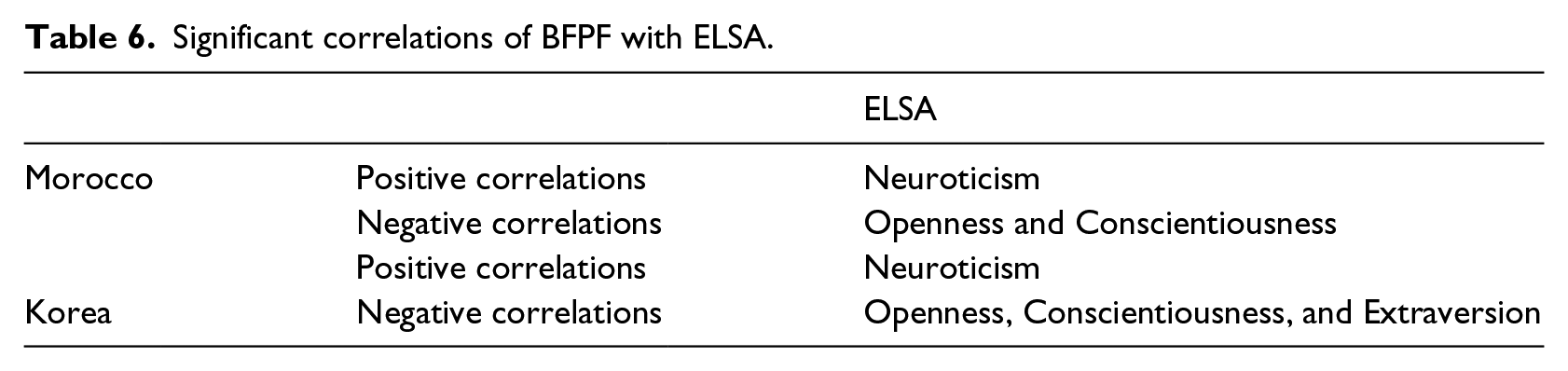
Moroccan and Korean samples. However, a somewhat different pattern of results appeared between the two samples regarding the number of significant correlations. Briefly, three personality factors (Openness, Conscientiousness, and Neuroticism) were significantly correlated with ELSA in the Moroccan sample, whereas four personality factors (Openness, Conscientiousness, Extraversion, and Neuroticism) were significantly correlated with ELSA in the Korean sample (Table 6).
Moreover, the correlational scores between the same variables appear to be numerically different between the two samples. As an example, the significant correlation between Neuroticism and ELSA was r=.28, p=.000 in the Moroccan sample, and was r=.26, p=.000 in the Korean sample. To investigate whether those correlational scores were significantly different between Moroccans and Koreans, Fisher z-transformation was applied. The three significant correlational scores that could be compared between the two samples were Openness and ELSA, Conscientiousness and ELSA, and Neuroticism and ELSA. Consequently, no significant differences were found between Moroccans and Koreans regarding those correlational scores (Table 7). This suggests that the associations between those three personality factors and ELSA in the Moroccan sample were not significantly higher or lower than they were in the Korean sample. Therefore, with the exception of Agreeableness, the results revealed so far report several significant correlations between BFPF and ELSA in the two samples.
Fisher z-transformations.
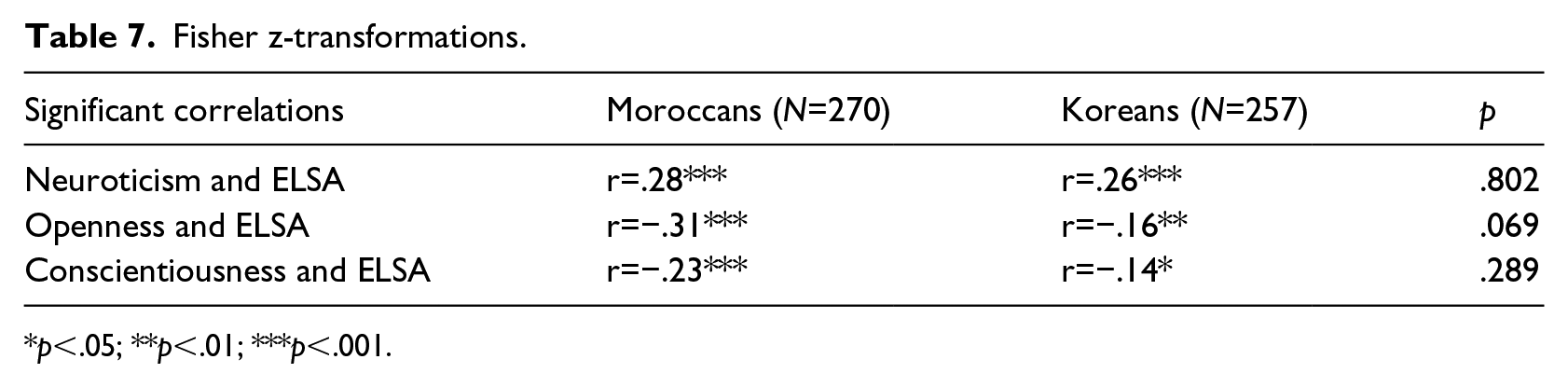
p<.05; **p<.01; ***p<.001.
The BFPF as predictors of ELSA
Turning to RQ3, which examined which ones among the BFPF were the strongest and weakest significant predictors of ELSA in the Moroccan and Korean samples, stepwise MRA were applied. Clearly, stepwise MRA were conducted to evaluate how many BFPF could significantly predict ELSA and, thus, identify the strongest and weakest significant predictors (Table 8).
Stepwise MRAs for predicting ELSA from the BFPF.
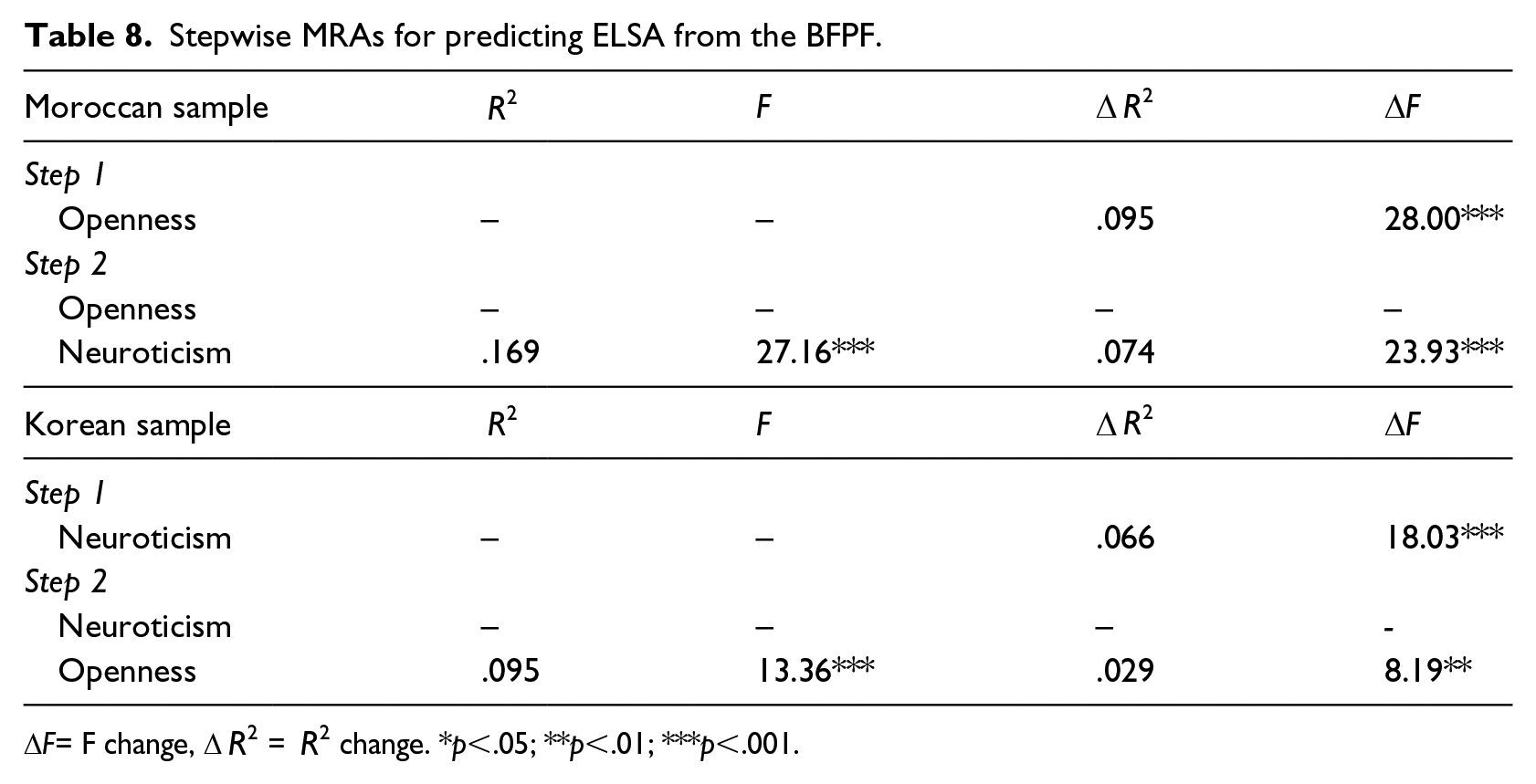
ΔF= F change, ΔR2 = R2 change. *p<.05; **p<.01; ***p<.001.
In the Moroccan sample and at Step 2 of the analysis, Openness and Neuroticism entered into the regression equation and were found to be the only personality factors that were significantly associated with ELSA by explaining 16.9% of the variance (R2 =.169, F(2,267)=27.16, p=.001). Openness significantly predicted ELSA (ΔR2 =.095, ΔF(1,268)=28.00, p=.000), and Neuroticism significantly predicted ELSA over and above Openness (ΔR2 =.074, ΔF(1,267)=23.93, p=.000). These results show also that the two steps reported significant F change statistics. That is to say, when Openness was entered in Step 1, it significantly explained 9.5% of the variance in ELSA, and when Neuroticism was entered in Step 2, it significantly added 7.4% to the explained variance. To be noted, three personality factors did not enter into the equation at Step 3 of the analysis, namely Conscientiousness, Extraversion, and Agreeableness. It means that no one of these three personality factors significantly explains any variance in ELSA.
It was also reported that Openness (β=−.30, t=−5.45, p=.000) and Neuroticism (β=.27, t=4.89, p=.000) had significant betas in Step 2 (Table 9). The model shows that with every increase of one standard deviation in Openness and Neuroticism, ELSA decreases by .30 and increases by .27 standard deviations respectively. Based on these results, Openness had more impact in the model and, therefore, was the strongest significant predictor of ELSA among Moroccans. This result was consistent with the correlational analyses where the same personality trait was found to have the strongest correlation with ELSA. As there were only two significant predictors, it was deduced that Neuroticism was the weakest significant predictor of ELSA.
Unstandardized and standardized betas for ELSA regressions.
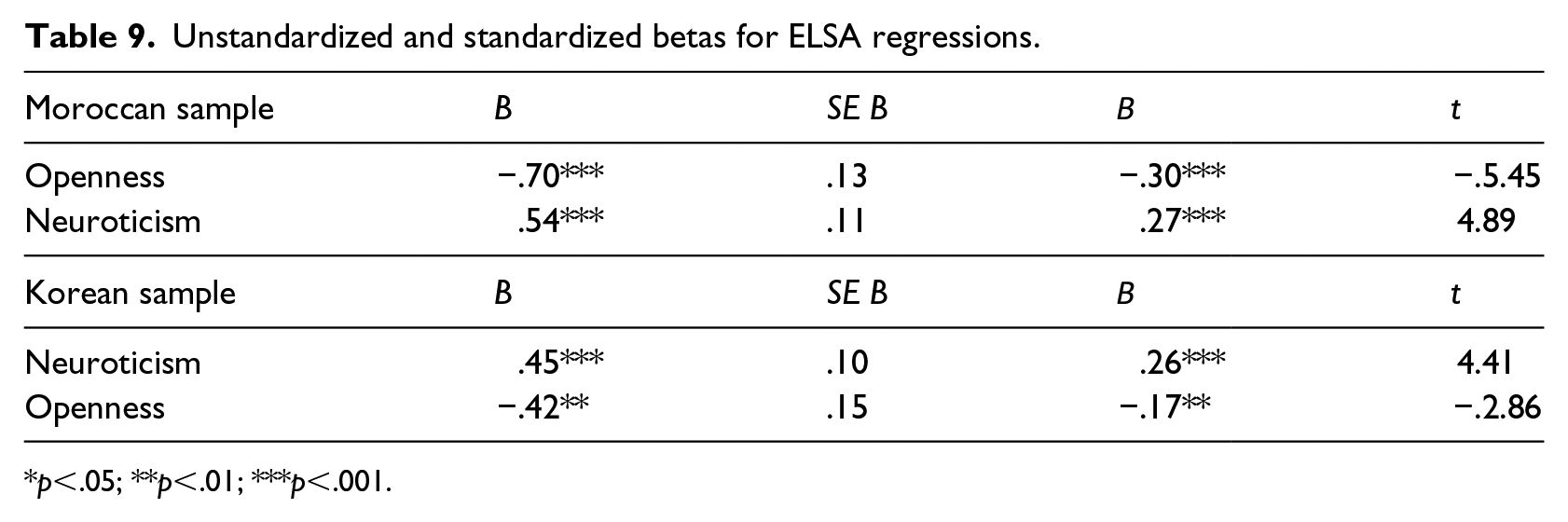
p<.05; **p<.01; ***p<.001.
As for the Korean sample and at Step 2 of the analysis, Neuroticism and Openness again entered into the regression equation and were revealed to be the only personality factors that were significantly related to ELSA by accounting for 9.5% of the variance (R2 =.095, F(2254)=13.36, p=.000). Separately, Neuroticism significantly positively predicted ELSA (ΔR2=.066, ΔF(1255)=18.03, p=.000), and Openness significantly negatively predicted ELSA (ΔR2 =.029, ΔF(1254)=8.19, p=.005). Both Step 1 and Step 2 indicated significant F change statistics. In other words, Neuroticism significantly explained 6.6% of the variance in ELSA when it was entered in Step 1, and Openness significantly added an extra 2.9% to the explained variance in ELSA when it was entered in Step 2. As in the Moroccan sample, Conscientiousness, Extraversion, and Agreeableness did not enter into the equation at Step 3 of the analysis.
Both Neuroticism (β=.26, t=4.41, p=.000) and Openness (β=−.17, t= −2.86, p=.005) revealed significant standardized betas. With every increase of one standard deviation in Neuroticism and Openness, ELSA rises by .26 and decreases by .17 standard deviations respectively. Accordingly, Neuroticism had more impact in the model and, hence, was the strongest significant predictor of ELSA in the Korean sample. This was also appropriate with correlational analyses where Neuroticism showed the strongest association with ELSA among Koreans. As stepwise MRA revealed only two significant predictors, it was concluded that Openness was the weakest significant predictor of ELSA.
Some interesting findings emerged in these stepwise MRA and suggest that Conscientiousness, Extraversion, and Agreeableness did not significantly predict ELSA either in the Moroccan sample or in the Korean sample. A decrease or increase in ELSA cannot be significantly explained by any decrease or increase in those three personality factors. Furthermore, Openness and Neuroticism were depicted as the only two significant predictors of ELSA among both Moroccans and Koreans, with the exception that the former was the strongest significant predictor among Moroccans, whereas the latter was the strongest significant predictor among Koreans. The predictions’ directions of these two significant predictors were also similar between the two samples, revealing a negative direction on Openness and a positive one on Neuroticism.
Overall, the findings suggest that Moroccans and Koreans did not significantly differ in ELSA in terms of their mean scores as it was reported by the independent sample t-test (Table 5). Moreover, most of those significant correlations were similar between the two samples apart from a few exceptions (Table 6). However, it is worth mentioning that correlational analyses revealed an important difference between the two samples. Precisely, Extraversion displayed significant negative association with ELSA in the Korean sample, whereas no such association was found in the Moroccan sample (Table 4). Comparing significant correlational scores between Moroccans and Koreans, Fisher z-transformations showed no single significant difference in terms of the strength of correlations between the two countries (Table 7). Furthermore, despite the fact that this study shows an inverse result in terms of the strongest and weakest significant predictors of ELSA between Moroccans and Koreans, it also shows that no sample had different or more significant predictors of ELSA than the other (Table 8). Broadly, Moroccans and Koreans share more similarities than differences in this study.
Discussion
This study examined the BFPF and their relationships with ELSA, controlling for gender, age, major, and years of English learning. In other words, the purpose of this study was to investigate the predictive power of the BFPF in relation to ELSA in two different contexts: Morocco and South Korea. The reason for choosing these two countries is that both of them are similar in various dimensions including low level of individualism, average level of power distance, low level of masculinity, higher level of uncertainty avoidance, and low level of indulgence (Hofstede, 2001). Thus, this study was an attempt to identify the personality traits that were more related to ELSA, and whether there were any similarities and differences between the two countries. Accordingly, three RQs were tested among Moroccan and Korean university students.
Comparisons between Moroccans and Koreans on ELSA
In regard to RQ1, which examined whether there was any significant difference in ELSA between Moroccans and Koreans, no significant difference was found between the two samples. The findings suggest that no sample scored higher than the other in ELSA. One plausible explanation may be that both Moroccans and Koreans have similar attitude and motivation for speaking the English language, although these two variables were not investigated in this study. Furthermore, the non-significant result for this RQ may be due to similarities between the two samples in various factors including study habits, self-confidence, and self-efficacy. However, this finding is inconsistent with that reported by Woodrow (2006), who stated that English language learners coming from Confucian heritage cultures (Korea, China, and Japan) experienced more speaking anxiety compared with other ethnic groups. That is to say, culture may have an impact on the level of ELSA.
It should also be noted that there is an important difference between this study and Woodrow’s (2006) one. The participants in this study were EFL learners, which means that they learned English in a non-native English-speaking country (Morocco and South Korea in this case). This indicates that they usually practice speaking skills only with their classmates and teachers in the classroom. On the contrary, the participants in Woodrow’s (2006) study were English as a second language learners, meaning that they learned English in a native English-speaking country (Australia in this case). This context entails more English language speaking not only in the classroom but outside it as well. Thus, English as a second language appeared to provoke speaking anxiety more than English as a foreign language as the former provides more contexts where an individual is required to speak English.
The correlations between the BFPF and ELSA
Regarding RQ2, Neuroticism showed a significant positive relationship with ELSA in the two samples. This result was highly expected as one of the six facets of Neuroticism is anxiety. Moreover, several studies found that Neuroticism was a strong positive predictor of anxiety (Ireland et al., 2014; Trull et al., 2001). Consequently, as both Neuroticism and ELSA include a similar element, anxiety, it was logical to find a positive association between them among both Moroccans and Koreans. Nevertheless, it is worth noting that, despite the fact that both ELSA and Neuroticism include a measure of anxiety, it does not automatically mean that they are correlated. If so, there will not be many studies which examined the relation between Neuroticism and anxiety disorders (Ireland et al., 2014; Trull et al., 2001) and foreign language anxiety (Dewaele, 2013). This study’s finding is congruent with Dewaele (2013), who found Neuroticism to be positively associated with a high level of FLA. Additionally, when the significant correlation between Neuroticism and ELSA was compared between the two countries, no significant difference was found. This suggests that no significant association between those variables was significantly stronger in one country than the other.
Both Openness and Conscientiousness were significantly negatively related to ELSA in the Moroccan sample, whereas Openness, Conscientiousness, and Extraversion were significantly negatively correlated with ELSA in the Korean sample. Agreeableness showed no significant relationship in the two samples. These results may be explained through previous studies where Openness positively correlated with approach learning (Vermetten et al., 2001) and learning motivation (Tempelaar et al., 2007). Besides, Conscientiousness refers to strong will (McCrae and John, 1992) and was found to be positively correlated with intrinsic and extrinsic motivation (Komarraju et al., 2009). Nevertheless, the results revealed for Conscientiousness in this study were incongruent with Gregersen and Horwitz (2002), who reported that conscientious students had higher FLA compared with other students. They mentioned that the pursuit of outstanding personal performance led these individuals to experience higher FLA.
With respect to Extraversion, the findings revealed by the Korean sample are in line with MacIntyre and Charos (1996), who reported that a high level on Extraversion was negatively related to FLA. These individuals tend to experience less anxiety because they feel comfortable when they communicate (Brown et al., 2001). Unexpectedly, Extraversion showed no single significant association with ELSA in the Moroccan sample. This implies that the way this personality trait is associated with ELSA differs from one culture to another.
To be noted, the Moroccan and Korean samples showed several similar results for RQ2. One plausible explanation may be due to the universality and generalizability of the Big Five (Allik and McCrae, 2004; Cheung et al., 2011; McCrae and Terracciano, 2005; Nel et al., 2012). In other words, these personality factors were similarly perceived and considered by both Moroccans and Koreans, which resulted in approximately similar correlations with ELSA, both in terms of significance and the directions of relationships. Furthermore, comparisons of those significant correlations of the same variables (Openness and ELSA in the Moroccan and Korean samples as an example) showed no significant differences.
Interestingly, one of the most surprising findings was that Agreeableness showed no significant relationship with ELSA in the two samples. This was consistent with previous situation-specific anxiety studies where Agreeableness had no significant relationship with English language test anxiety (Asmali, 2017), statistics anxiety (Chew and Dillon, 2013), and individual instrument performance anxiety (Özdemir and Dalkiran, 2017). This absence of significant correlation may derive from the way Agreeableness is gauged in IPIP. Specifically, this personality factor is measured by asking participants to identify the extent to which they agree with statements such as “feel little concern for others;” “am interested in people;” “insult people;” “sympathize with others’ feelings;” “am not interested in other people’s problems;” “take time out for others.” These statements do not explicitly or implicitly relate to anxiety. The main focus of these items is on the interpersonal relationship.
The BFPF as predictors of ELSA
RQ3 examined which ones among the BFPF were the strongest and weakest significant predictors of ELSA in the Moroccan and Korean samples. Using stepwise MRA, the findings indicate that only Openness and Neuroticism were significant predictors of ELSA in the two countries, with Openness as the strongest significant predictor (negative) in the Moroccan sample and Neuroticism as the strongest significant predictor (positive) in the Korean sample. Importantly, what was reported as the strongest significant predictor in the Moroccan sample was reported as the weakest significant predictor in the Korean sample and vice versa. This difference may be due to the fact that, in the Moroccan sample, Openness was significantly higher than Neuroticism, whereas Neuroticism was significantly higher than Openness in the Korean sample. A further explanation for this result may be related to correlation analyses where Openness and Neuroticism were found to have the highest correlation with ELSA in Morocco and Korea respectively. That is to say, this result was also reflected in the stepwise MRA and reported these two personality factors to be the strongest significant predictors of ELSA in the two contexts. Conscientiousness, Extraversion, and Agreeableness did not significantly contribute to the prediction of ELSA in the two countries.
The fact that Neuroticism and Openness were the only significant predictors of ELSA may be given various explanations. Neuroticism is defined as the tendency to experience negative emotions (Costa and McCrae, 1992), which makes its relationship with ELSA more logical and highly expected. Moreover, students with a higher level of this personality factor do not have enough control over their behaviors. This lack of control inhibits individuals from being able to perform properly while learning English, which may provoke ELSA. A further explanation may be that this kind of student usually experiences extreme worrying, which prevents them from asking questions. As an example, these students may worry about being regarded as naive or stupid in front of their teachers and classmates if they ask a question about something they do not understand. Consequently, Neuroticism was found to be a significant positive predictor of ELSA. These results provide support for the previous study where Neuroticism was found to be positively correlated with a high level of FLA (Dewaele, 2013).
Contrary to Neuroticism, Openness was found to be a significant negative predictor of ELSA in the two countries. This may be due to the curiosity that is typically related to those who score higher on this personality trait (Costa and McCrae, 1992) along with their broad inner workings (John et al., 2008), which may increase their motivation and, hence, decrease ELSA. Furthermore, Openness implies a wide range of experiences, and students with a high level on this personality trait may consider English language to be of pivotal importance. These individuals may undergo lower anxiety while asking questions and seeking help from their teacher and classmates.
As in correlational analyses, stepwise MRA also came up with similar results as both Openness and Neuroticism were found to be the strongest significant predictors of ELSA in the Moroccan and Korean samples respectively. One possible explanation may be due to the similarities between Moroccan and Korean society (Hofstede, 2001). Comparing Moroccan and Korean society resulted in similarities in various dimensions including low level of individualism, average level of power distance, low level of masculinity, higher level of uncertainty avoidance, and low level of indulgence (Hofstede, 2001). Consequently, the similarities in those dimensions may be the reason behind those similarities between Moroccans and Koreans in the findings of this study.
To sum up, the main question this study sought to clarify the extent to which personality factors could predict ELSA. The stepwise MRA displayed Openness and Neuroticism as the only significant predictors in the Moroccan and Korean samples. These two personality factors were the only ones that could be useful in predicting ELSA in these two contexts. It is also worth noting that the BFPF did not provide an ideal prediction in the two samples, and that this study generally highlighted more similarities than differences between Moroccans and Koreans.
Conclusions
Summary
As it was mentioned above, the objective behind conducting this research was to examine the relationship of the BFPF with ELSA in the Moroccan and South Korean contexts. To achieve this objective, the IPIP and ELSAS were used to collect data, which were analyzed by independent sample t-tests, correlational analyses, Fisher z-transformations, and stepwise MRA. The findings show that Moroccans and Koreans did not significantly differ in ELSA. In the Moroccan sample, Neuroticism was significantly positively correlated with ELSA, whereas Openness and Conscientiousness were significantly negatively correlated with ELSA. As for the Korean sample, Neuroticism was significantly positively correlated with ELSA, whereas Openness, Conscientiousness, and Extraversion were significantly negatively correlated with ELSA.
Comparing significant correlations of the same variables between the two samples, Fisher z- transformations reported no significant difference. With regard to the predictability of the BFPF, stepwise MRA revealed that only Openness and Neuroticism were significant predictors of ELSA: the former was the strongest significant predictor of ELSA among Moroccans, whereas the latter was the strongest significant predictor of ELSA among Koreans. Overall, the current findings display more similarities than differences between the two countries.
Implications
Based on the results and interpretations of this study, several implications are provided: first, English as a foreign language (EFL) teachers must be aware of the existence of ELSA. They have to understand that English speaking may be intimidating for some students. Moreover, EFL teachers should make the process of language learning less stressful for the students. This may be through providing positive feedback and making good relationships with their students. Given that mistakes are a major source of language anxiety, it may be very useful for teachers to tell the students, at the first meeting, that mistakes are normal in developing their speaking skills.
Second, teachers should discuss with their students the importance of speaking in learning the English language, along with the feeling of anxiety that students go through when they learn any foreign language. If aware of these things, students may encourage themselves and become more motivated, active, and confident in improving this language skill in particular, and the English language in general.
Third, throughout the course, EFL teachers can follow different ways and methods of increasing their students’ motivation and interest in learning and using the English language. This may help students use the language more and, therefore, become more proficient. To promote speaking skill and lessen anxiety, it would be highly beneficial for teachers to encourage students to practice this skill both inside and outside the classroom in several situations and with different persons. Consequently, this can allow them to increase their confidence and feel comfortable when speaking the English language in different contexts.
Fourth, given that ELSA was not similarly experienced by all personality factors, this study suggests that EFL teachers should be aware of the BFPF. Personality assessment may be highly beneficial in guiding students throughout English language learning. That is to say, having information on the personality of every learner in the classroom can be employed to identify those who are high on Neuroticism because they are more prone to experience ELSA according to this study.
Limitations and directions for future research
This current research addressed the BFPF and their relationships with ELSA in Morocco and South Korea. While the findings of this research were significant and noteworthy, there are several limitations that need to be acknowledged, as follows:
First, the generalization of the results in this research is limited by the specific sample used, which included students from solely one university in each country and with specific demographic backgrounds. Participants from other universities and with different demographic backgrounds may provide different results. Future research needs to investigate if the current results translate to other students from other universities and with different demographic backgrounds in the two countries. This research should also be replicated with students from other language groups such as Chinese, French, and German. Furthermore, it would be highly beneficial to do a similar study but with elementary or middle school students, as it might be that students start to experience ELSA at this level.
Second, despite the fact that the focus was on the BFPF, using the 30 facets of personality factors would have given more information in this study. Paunonen et al. (2003) mentioned that there were at least two advantages when using Big Five facets, instead of factors, in psychological research. The first advantage is that the facets increase the predictive accuracy when associating the Big Five to several external variables. The second advantage is that the facets allow for more understanding of the nomological network behind the association between personality and other behaviors or constructs. Costa (1996) also emphasized the use of the facets to better understand the impact of personality in the workplace. Hence, using the 30 facets of the Big Five gives more and specific results than using only five personality factors. As a case in point, Openness is composed of six facets: Fantasy, Aesthetics, Feelings, Actions, Ideas, and Values (Costa and McCrae, 1992). It might be that Fantasy, Actions, and Ideas were significantly related to ELSA, whereas Aesthetics, Feelings, and Values were not. Thus, future research should employ those facets so as to have more and clearer understanding concerning the relationship between personality and ELSA.
Third, the quantitative findings of this research come from self-reported measures. Accordingly, the findings rely on the participants’ accuracy and honesty when answering the items on the scales (IPIP and ELSA in this study). This means that it is hard to assess personality or situation-specific anxiety in a clear-cut way as the participants may not give absolutely true answers, or they might give answers that they think the researcher wants. Nevertheless, as personality and situation-specific anxiety cannot be directly measured, self-reports are significant for this kind of research.
Strengths of the study
Although there are some limitations in this study, there are also strengths that are specific to this study and give more reliability and credibility to the findings. First, this study is the first of its kind to examine the relationship of the Big Five with ELSA in general, and to compare the results between two different countries in particular, in this case Morocco and South Korea. Thus, the study gives a unique and broader understanding of how personality factors are related to ELSA in two different countries. Another strength comes from the large sample, precisely 527 participants, divided into 270 Moroccans and 257 Koreans. The use of variables such as age, gender, and years of English learning as controls in data analyses is an additional strength. The recruitment of university students is another strength as they can give more accurate answers compared with students from lower degrees.
Footnotes
Funding
The author(s) received no financial support for the research, authorship, and/or publication of this article.