



Abstract
This study examines whether preexisting close friendships facilitate students’ cultural agility development during short-term international study abroad experiences. Using a longitudinal design, we found that study abroad students who had a close friend accompanying them on the experience (i.e., an “international study buddy”) had lower cultural agility at the onset of the experience but had a higher level of cultural agility development upon return, compared with those without a friend on the trip. Those who did not travel with friends demonstrated no significant cross-cultural competency development. Our findings suggest that contextual novelty is independently determined, and the presence of a trusted friend may help reduce the novelty enough such that students with lower predeparture cultural agility can comfortably gain from the experience. At the same time, for development to occur, students with higher cultural agility may need more contextual novelty than the short-term study abroad experience provides.
Introduction
According to the Organization for Economic Cooperation and Development, nearly five million students are enrolled in universities outside of their home countries. There are more than 1 million non-American students studying in the USA, with over 300,000 American students in various host countries around the world (Institute of International Education, 2015). These international programs range from full degrees to short courses, with the greatest increase in these programs being in short-term programs. Over 60% of all study abroad programs are 8 weeks or shorter in duration (Institute of International Education, 2015). This increase in study abroad participation is positive; studying abroad has the potential to be among the strongest developmental opportunities that university students can experience (Czerwionka et al., 2015; Lumkes et al., 2012; Niendorf and Alberts, 2017).
With the increased use of short-term study abroad programs, researchers and university administrators have accelerated their interest in understanding the features of these programs to enhance student development. When designed well, study abroad programs can help students build cultural agility—the cross-cultural competencies needed to comfortably and effectively work in different countries and with people from different cultures (Caligiuri, 2012). In addition to the cultural immersion and pedagogical features of well-designed study abroad programs (Pedersen, 2010), we contend that the appropriate level of social support also affects cultural agility development.
Our study examines whether (and when) the presence of a close friend will facilitate the development of cultural agility in short-term study abroad experiences for some students. Using the theoretical premise that contextual novelty, while developmental, is individually determined, we propose that traveling with a close friend can either facilitate or impede cultural agility development, depending on a given student’s predeparture or baseline cultural agility. To test this, we conducted a longitudinal study of short-term study abroad students who varied on their baseline cultural agility.
Developing cultural agility during study abroad programs
Caligiuri (2012) suggests that culturally agile individuals have self-management competencies (e.g., tolerance of ambiguity and resilience), relationship-management competencies (e.g., perspective-taking and humility), and task-management competencies (e.g., adapting approaches, integrating perspectives). These culturally competent individuals can adjust in novel contexts, accelerate interpersonal relationships with diverse people, and enable the effective completion of tasks in a new cultural environment (e.g., Bird, 2013; Bird et al., 2010; Caligiuri and Tarique, 2012; Leiba-O’Sullivan, 1999; Shaffer et al., 2006).
Cultural agility is an important competency for universities to foster in their students because it enables future professional success working in different countries and with people from diverse cultures. Across industries, organizations have identified the need for a better pipeline of professionals who can “thrive in a world that reflected this new reality of real-time, multiple spanning of technological, financial, cultural, organizational, stakeholder, and political boundaries” (Bird and Mendenhall, 2016: 4). Unfortunately, universities might not be doing enough to address this need. Only 20.7% of employers rate new graduates as proficient in “global and multicultural fluency,” while they rate 77% of new graduates as proficient in “teamwork and collaboration,” another critical competency (National Association of Colleges and Employers, 2018). In light of this, it is valuable for universities to ensure their students are deriving the greatest possible developmental gain from the study abroad programs offered.
Both long- and short-term study abroad programs have the potential to build cultural agility, as they have been shown to build students’ global awareness (DeLoach et al., 2015; Gullekson et al., 2011), intercultural competence (Lo-Philip et al., 2015), intercultural knowledge (Czerwionka et al., 2015), global citizenship (Gambino and Hashim, 2016), and intercultural mindedness (Terzuolo, 2018). Study abroad programs also develop the personal characteristics that underpin cultural agility (Caligiuri, 2012), such as autonomy (Niendorf and Alberts, 2017), internal locus of control (McLeod et al., 2015), emotional strength (Niehoff et al., 2017), and self-efficacy (Niehoff et al., 2017).
While the potential for study abroad programs to foster the development of students’ cultural agility is high, not all programs successfully achieve this goal (Lokkesmoe et al., 2016). Developing from study abroad experiences requires more than breathing the air of another country or having classes with students from different cultures. A program’s features are important (DeLoach et al., 2015; Lo-Philip et al., 2015; Niendorf and Alberts, 2017; Pike and Sillem, 2018), such that developmental study abroad experiences should include high-quality cross-cultural interactions (Caligiuri and Tarique, 2012; Lo-Philip et al., 2015; Niendorf and Alberts, 2017) and intercultural training, coaching, and guided reflection (Pedersen, 2010). As Pedersen (2010) noted, “it is not enough to send students to study abroad without intentional pedagogy focused on outcomes of intercultural effectiveness” (70). In addition to the cultural immersion and pedagogical features of a study abroad program, we contend that social support also affects students’ development of cultural agility during the study abroad experience.
Social support and developing cultural agility
Researchers have long noted the importance of social support experiences abroad for both expatriates (e.g., Kraimer et al., 2001) and international university students (e.g., Lee et al., 2004). Social support describes “communication between recipients and providers that reduces uncertainty about the situation, the self, the other, or the relationship, and functions to enhance a perception of personal control in one’s life experience” (Albrecht and Adelman, 1987: 19). As such, social support helps an individual mobilize psychological resources that bolster feelings of reinforcement, recognition, and affirmation (Fontaine, 1986; Rook, 1984) that greatly enhance cross-cultural adjustment. Social support also helps buffer against the stress international students and expatriates experience while adjusting to their new environment and re-establishing their lives (Aycan, 1997; Black, 1990; Lee et al., 2004).
Moreover, social support can serve as a mediator, explaining cross-cultural competency development during experiences abroad. Research has demonstrated that social support is a particularly important component for navigating learning from an international assignment or experience (Adelman, 1988; Aycan, 1997; Black, 1990; Black et al., 1991; Church, 1982; Feldman and Bolino, 1999). In a socially supportive learning environment, social interaction increases learning, such that social support received from others provides resources for the individual to continue learning (Bandura, 1962). One reason this supportive environment fosters learning is because individuals feel an increased sense of psychological safety, as a result of which they feel more comfortable receiving feedback and making mistakes without fear of rejection from group members (Edmondson, 1999). In fact, researchers have found that social support in a psychologically safe environment is a requirement for development abroad (Birdi et al., 1997), and a supportive context is more likely to foster knowledge transfer from peers and the environment to the individual (Andrews and Delahaye, 2000; Caligiuri et al., 2016).
Close friends to buffer contextual novelty
Contextual novelty facilitates development of cultural agility during study abroad programs because it requires students to manage a greater number of contrasts that, in turn, create new, more complex cognitive structures, more nuanced behavioral responses, and more advanced professional competencies (Black and Gregersen, 1991; Gupta and Govindarajan, 2002; Lord and Hall, 2005). In international experiences, contextual novelty is provided by an unfamiliar cultural environment and may be experienced through a culturally different context, new physical environment, or interaction with host nationals (Hollenbeck and McCall, 2001). In the context of developing cultural agility, it might be the case that some study abroad situations are too overwhelming for students to experience any developmental gain. In an international educational context, too much novelty may be overwhelming for some students (Hechanova-Alampay et al., 2002), limiting their ability to develop (Wang et al., 2015).
Students will utilize their cognitive resources when experiencing novel or challenging situations (Fiedler and Garcia, 1987; Sweller, 1988, 1994) such as studying abroad. Thus, when students become overly depleted, they will have fewer cognitive resources to engage in developmental activities, such as asking professors for feedback, practicing the host national language, and engaging in personal reflection. Thus, for students with lower levels of baseline cultural agility, studying in another country might be too much of a cultural stretch for development to occur. The situation, in other words, is too mentally demanding. For them, having a friend to facilitate the experience may provide enough of a buffer, freeing some developmental bandwidth.
At the other end of the continuum, students who have higher levels of cultural agility might find the presence of compatriot friends as limiting the contextual novelty of the study abroad program. In their case, studying abroad without the presence of compatriot friends would provide a greater (and needed) stretch for the study abroad experience to be developmental. Collectively, we believe development from study abroad is likely moderated by an individual’s baseline cultural agility. Thus, we hypothesized: The relationship between the presence of a close friend and a student’s post-program cultural agility is moderated by baseline cultural agility, such that students with low baseline cultural agility will develop more when they have a close friend, and individuals with high baseline cultural agility will develop more when they do not have a close friend joining them on the trip.
Methods
Sample
College students from a large, private US-based university located in the northeast of the USA comprise the sample for this study. Each student participated in a 5- to 6-week short-term study abroad program through the university. The programs are available from every academic college at the university, ranging from civil engineering to fine arts. Each student received credit for two courses for participating in this summer program. Students enrolled in this summer program were recruited to participate in this study via email through the university’s study abroad office. In Time 1, 128 students of the 413 possible participants completed surveys, giving a response rate of 31.0%. In Time 2, 67 students completed surveys, giving a 52% response rate from the original Time 1 participants and a 16.2% overall response rate. Thus, the final sample size was 67 students with both Time 1 and Time 2 data. Participants were not offered direct compensation for their participation but were entered in a raffle to win a US$100 gift card for their participation.
The sample in this study was 70% female. A total of 8.9% of students listed a country of origin outside of the USA; however, no students studied abroad in their country of origin. Most of the sample (50.7%) was entering their second year as undergraduates, with 17.9% entering their third year, 19.4% entering their fourth year, and 10.4% entering their fifth year. The participants studied abroad in a number of countries, including Argentina (1.5%), Australia (3%), Brazil (1.5%), France (4%), Germany (7.5%), Hungary (3%), Iceland (1.5%), India (7.5%), Israel (1.5%), Italy (15%), Japan (3%), the Netherlands (3%), Peru (9%), Poland (3%), Ireland (1.5%), Russia (1.5%), Serbia (4.5%), South Africa (4.5%), South Korea (1.5%), Spain (10%), Switzerland (1.5%), Turkey (3%), and the UK (7.5%).
Procedure
Students completed an electronic survey before departure and upon return from the study abroad program. The Time 1 surveys were distributed via the university’s study abroad office 1–2 weeks prior to the students’ departure, and Time 2 surveys were distributed 1–2 weeks after students’ return.
Measures
Cultural agility
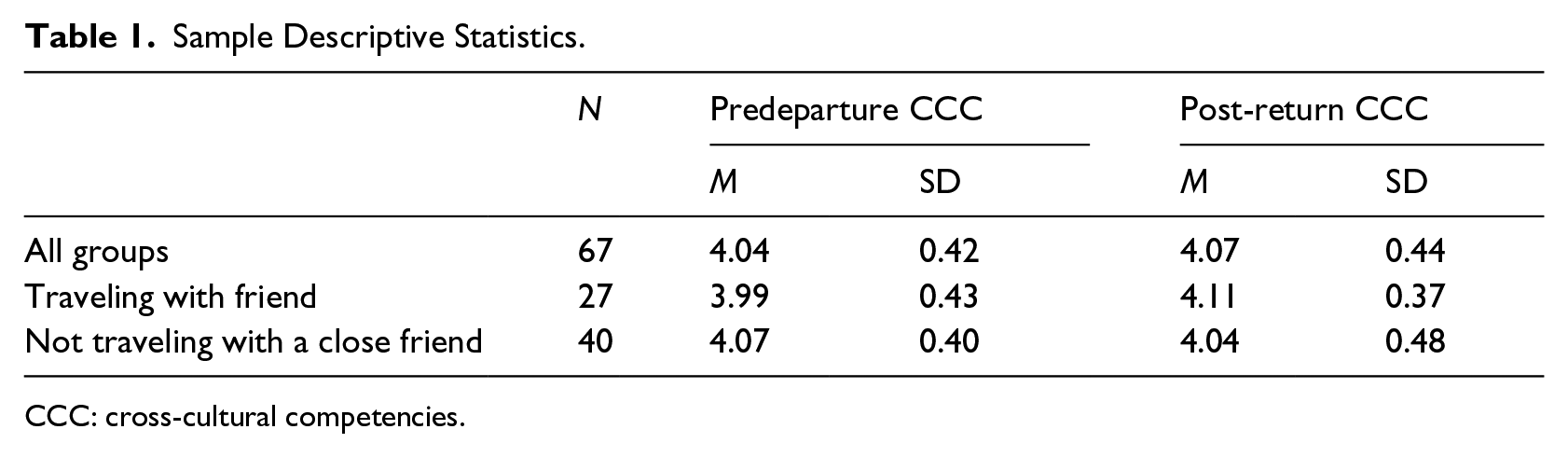
As a measure of cross-cultural competencies, students responded to 50 (α = .89) items in the Cultural Agility Self-Assessment (TASCA Global, 2017). The Cultural Agility Self-Assessment has demonstrated validity as a predictor of those who can comfortably and effectively interact in different countries and with people from diverse cultures. The measure includes items regarding tolerance of ambiguity, perspective-taking, cultural humility, resilience, relationship building, and cultural curiosity. Each item was measured on a 6-point scale where 1 = strongly disagree and 6 = strongly agree. The calculated range in this sample was from 2.94 through 5.50. The means and standard deviations (SDs) are presented in Table 1.
Sample Descriptive Statistics.
CCC: cross-cultural competencies.
Traveling with a close friend
Students were also asked how many students from the trip they would consider to be close friends. Two groups of students were identified. Predeparture, the close friend group reported having at least one close friend participating in the same study abroad program (N = 27). The second group reported no close friends that would be attending the program (N = 40).
Results
We conducted a two-way, mixed effects analysis of variance to test the hypothesis of this study and interpret statistical significance using the standard p = .05 cutoff. As hypothesized, the interaction was significant, F(1, 65) = 4.68, mean squared error = 0.04, p = .034, η2p = .067, d = .536. To interpret the interaction, we conducted simple main effects analyses and found that the effect of time was significant for students who traveled with a friend, F(1, 26) = 4.33, p = .047, η2p = .143, d = .817. However, the effect was not significant for students who traveled without a friend, F(1, 39) = 0.51, p = .48, η2p = .013, d = .230. Descriptive statistics are included in Table 1.
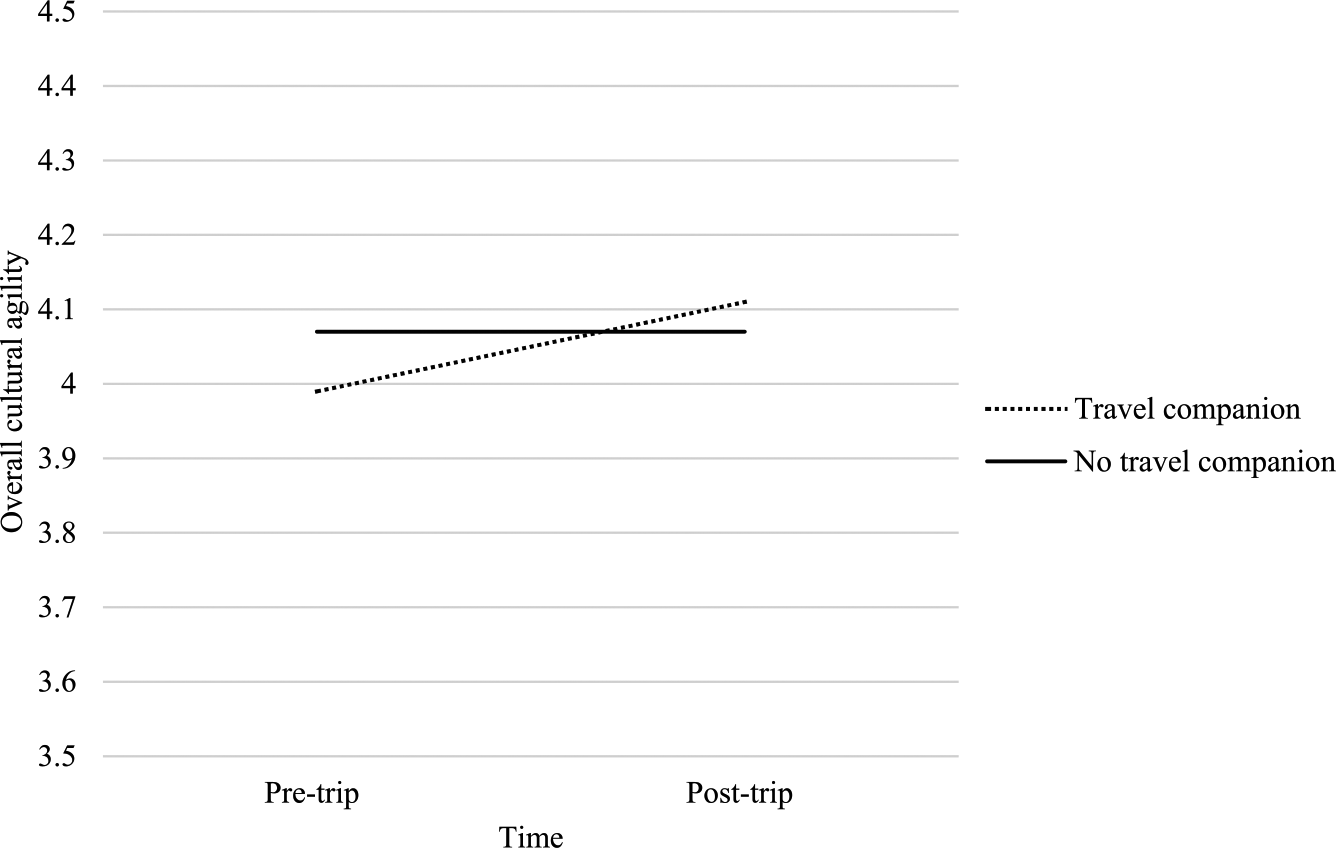
Self-rated cross-cultural competencies.
Discussion
Our results suggest that students who had at least one close friend with them during the study abroad experience tended to have lower predeparture cross-cultural competencies and experienced the greatest increase in cross-cultural competencies during their time abroad. Those without a close friend did not experience development in cross-cultural competencies; however, the trend suggested that many had higher predeparture cross-cultural competencies. We found a medium-sized effect of the interaction between time and the presence of a close friend and a large main effect for the presence of a close friend (Cohen, 1988). These findings speak to the overall role that traveling with a close friend has on development—despite initially lower cross-cultural competencies, the main effect difference between those with and without a close friend was large. Our findings suggest that the presence of a close friend may provide social support that helps students buffer stress stemming from the contextual novelty of studying abroad.
In addition, considered in light of other recent work, we believe the present study begins to highlight the possibility of an “individual × program” effect to explain students’ cultural agility development, wherein individuals experience greater development when the novelty of their experience is matched with their preparedness. Recent research found a similar effect in a study of corporate employees’ cultural agility development from short-term volunteer assignments. Employees developed cultural agility in two conditions: when employees with higher baseline cultural agility worked in high contextual novelty (i.e., international non-governmental organization location) and when employees with lower baseline cross-cultural competencies worked in low contextual novelty (i.e., domestic nonprofit location; Caligiuri et al., 2019). However, our study did not specifically examine contextual novelty, and thus additional work is necessary to explicitly investigate how traveling with a close friend interacts with both baseline cultural agility and novelty to predict development.
In an examination of individual differences of study abroad students, Terzuolo (2018) found that American students with a multicultural identity (i.e., identified with more than one national culture or had a non-American grandparent) increased their intercultural mindedness during semester-long study abroad experiences. Students with a multicultural identity may have had a higher level of readiness to develop from the contextual novelty present in a semester-long experience because dispositional characteristics can affect how challenging a student perceives their experience to be (Petersdotter et al., 2017). Thus, those students who are ready for a greater stretch challenge may need greater contextual novelty for development to occur.
Taken together, these findings provide additional evidence that students in our study with higher predeparture cultural agility may not have increased cross-cultural competencies because their study abroad experience was not enough of a contextual stretch. Instead, these students might have benefited from a longer (e.g., one-semester, 1-year) or more independent international experience. More research is needed to investigate this possible “individual × program” effect and identify which of the students’ predeparture characteristics are the best predictors of student development and under what study abroad situations.
With respect to program differences, our results highlight the potential role for social learning, which describes how individuals learn from observing and interacting with others (Bandura, 1962). As Pedersen (2010) found, study abroad experiences with guided reflection and coaching produce the greatest gain in students’ intercultural development. In our study, close friends might have played an informal role to foster reflection during the trip. This may suggest that social learning is critical in helping sojourners better make sense of and develop from their experiences in their host countries.
Although not statistically significant, a trend in our data is worth future investigation: students with lower levels of predeparture cultural agility also tended to select opportunities to study abroad with a friend. It might be that, for them, the experience seemed less challenging when a friend was also having the same experience. Future studies should examine this decision-making process and the accuracy of self-sorting into the right level of contextual novelty for development to occur.
Limitations and conclusions
There are strengths in the design of this study, particularly its longitudinal design; however, it is important to acknowledge a few of the limitations of the study. First, data was gathered exclusively from university students traveling on short-term study abroad experiences. While short-term experiences can be highly developmental (Lumkes et al., 2012), we believe that more research is needed across a wider range of sojourner experiences of varying lengths. The short-term study abroad experiences in the present study were approximately 6 weeks in duration. Compatriot social support may change over longer periods of time and hinder (rather than help facilitate) development (Geeraert and Demoulin, 2013).
We believe more research is needed to investigate how individually determined contextual novelty makes sojourner experiences developmental. Sojourners, whether corporate employees or students, are likely to experience various forms of novelty as they adjust to a culturally different work and school environment, manage paradoxes, and interact with host nationals in different organizational and educational situations (Bird and Oddou, 2013; McCall and Hollenbeck, 2002; Osland, 2000). Whether these forms of novelty are experienced and how they are experienced is likely individually determined. While we were not able to directly investigate the role of subjective or objective contextual novelty in relation to our findings, variability in actual or perceived novelty may also interact with individuals’ baseline cultural agility and socially supportive ties to predict development. Future studies should examine how this perception of contextual novelty is understood and whether there is an objective level of novelty that translates into the appropriate stretch for individuals at various starting points in their developmental journey.
The present study did not investigate the specific mechanisms through which friendships affected development, another important area to examine in the future. Since sojourner experiences lead self-aware individuals to seek advice and receive feedback within the new environment (McCauley and Van Velsor, 2004; Oddou and Mendenhall, 2013; Zaccaro and Banks, 2004), the source of that advice and feedback may affect the developmental outcome. For example, in the present study, a co-national friend might be enough to help navigate a relatively structured educational experience. However, more challenging long-term experiences (such as international assignees) might require host national coaches and mentors. Relatedly, we were not able to assess whether students explored friendships with other host national students while abroad. While having a travel companion may lead to increased cultural agility, it is unclear how close friendships with travel companions would impact an individual’s propensity to interact with host national students. Future work may consider the distinct role that forming social ties with host national peers has on development of cross-cultural competencies.
Future studies may also consider the impact of traveling with close friends on other outcome measures. Given that cultural agility is measured through individual self-reporting, more objective measures from an instructor or peer ratings may be worth pursuing in future work. In addition, given the study abroad context in our study, examining learning effectiveness as an outcome may be interesting. Perhaps traveling with a close friend would eliminate some of the challenges associated with traveling abroad, thus reducing learning from the experience.
Our study raised the question of whether all students benefit equally from comparable short-term study abroad opportunities. Leadership development research in the corporate context has found that too much novelty may be overwhelming for some individuals (Day and Dragoni, 2015; DeRue and Wellman, 2009). At an extreme, too much novelty might produce stress, which can limit one’s ability to develop (Salehi et al., 2010). While our study suggests that “study buddies” can be a buffer to perceived novelty and foster development, more research is needed to better understand which students grow from their contextually novel experiences―and under what circumstances. Across all types of sojourners, it will be important to better understand whether the relationship between contextual novelty and individuals’ ability to handle that novelty will interact and the extent to which co-national, host national, or international friends can foster that development.
Footnotes
Funding
The author(s) disclosed receipt of the following financial support for the research, authorship, and/or publication of this article: This work was supported by a grant from the Northeastern University Scholars Independent Research Fellowship program.