



Abstract
This paper compares the findings of two studies on the publication patterns in leading Australian, English and German education journals. The first study was funded by the German Research Association and the second one was unfunded, and they were conducted by a team of international researchers. The first study compared three English and three German leading education journals. The second study analysed the publication patterns in three leading Australian education journals. All papers published between 2001 and 2010 in the nine selected education journals were analysed according to their author profile, thematic focus and methodology used. The analyses (covering three geographical regions) showed the publication patterns in the selected journals, indicating similarities and also some key differences. This paper focuses on the Australian education journals and how their publication patterns relate to the English and German journals.
Introduction
This section will discuss nationally-run research assessment exercises in general and then more closely look at such a research assessment exercise run in Australia with a particular focus on the discipline of education. This will provide a backdrop to this paper which compares the publication patterns between the Australian, English and German education journals over a 10-year period. The comparison of the German and English publication patterns draws on a German Research Association funded project and the Australian publication patterns were analysed in an unfunded project. The rationale for comparing education journals from these three higher education (HE) contexts lies in the distinctiveness of the German system which has historically developed quite differently from the two Anglophone systems. The rationale for the initial comparison of German and English education journals was provided by the increase of assessment and evaluation processes in the German discipline of Erziehungswissenschaft. The role of publications in leading journals in these processes has been particularly important and therefore the project aimed at providing a better understanding of publication patterns in German journals when compared with journals initially in one other country. 1 English journals were chosen because of their importance in the European and wider international discourse, expressed inter alia in their high positions in the Social Science Citation Index (SSCI) table of top-cited educational journals. Similarly, journal publications have played an important role in the assessment of Australian research, including the discipline of education, and thus the second research project which this paper draws on aimed to assess Australian educational journals using the method developed in the two German funded projects to examine how the leading Australian education journals compare to the English and German contexts.
The Australian context was brought into the comparison because of its historical links to the English tertiary system (Davies, 2013; Forsyth, 2014; Gannaway, 2015; Marginson and Considine, 2000; Markwell, 2007; Pascoe, 2003). In fact, the Australian system was originally modelled on the English system (Forsyth, 2014; Gannaway, 2015; Marginson, 2014), but it equally developed its own unique features (Gannaway, 2015; Marginson, 2002). This was also the case for the discipline of education, as indicated for instance by Seddon et al. (2013). Another reason for a comparison of the Australian and English HE contexts is the relatively frequent policy borrowing between the two contexts, as for instance in the area of quality assurance (e.g. student surveys), student fees and general financing of HE (Hackett, 2014; Marginson, 2014), which draws on the similarities between the two contexts.
Nationally-run research assessments are increasingly becoming a vehicle for judging and comparing the quality of research output across tertiary disciplines, frequently tied to funding implications for tertiary institutions and individual departments in a growing number of countries around the world. The British Research Assessment Exercise (RAE), or as it was first called ‘Research Selectivity Exercise’, was one of the first research evaluation exercises among the Anglophone countries aimed at a redistribution of funding from the less research active to the more research-intensive institutions in Britain, and was first conducted in 1986 (Shattock, 2006).
Research assessments in Australia
The Australian Commonwealth government considered and rejected introducing a similar research quality assessment in the 1990s (Goodyear, 2013). The government revisited the idea in the 2000s, and between 2005 and 2007 involved the Australian Association for Research in Education (AARE) and Australian Council of Deans of Education (ACDE) in consultations when developing the Research Quality and Accessibility Framework (RQF). RQF was subsequently scrapped by an incoming Labor Government in 2007. The Government then developed a cut-down version entitled Excellence in Research for Australia (ERA) which was first conducted in 2010, with a follow-up in 2012 (Goodyear, 2013). The third run of ERA was completed in December 2015. It was conducted by the Australian Research Council (ARC) between June and October 2015 (Australian Research Council, 2015). When comparing performance of the Australian HE across the three exercises, the ARC reported a general improvement as a result of the exercises. The ARC further reported a gradual growth in research activity as a result of the ERA in terms of assessed units of evaluation, research outputs and number of research staff assessed. 29% of institutions improved their rating (on a 5-point scale from well above world standard to well below world standard) and 56% of institutions maintained their rating between ERA 2012 and 2015. Although the field of education was not rated by ERA 2015 as one of Australia’s fields of strength, most institutions have improved their rating for education and two institutions performed ‘above world standard’. Similarly, to the English Research Excellence Framework (REF) and German research evaluations, publications in leading journals played a key role in the Australian ERA research assessments. Thus comparing the publishing patterns in leading Australian education journals will enable comparing research practices of the Australian education community with those of England and Germany.
ERA and Australian education discipline
The results of the first ERA run in 2010 provoked a substantial debate about the state of educational research in Australia. Education received a low ranking of 2.2, well below 3 (the ‘world standard’). The ERA 2010 ranking was rated on a 5-point scale (1–5; with 1- ‘well below world standard’ and 5 – ‘well above world standard’). Yet, in 2009 the ACDE found that Australia was producing 5.4% of educational research published around the world. Subsequently, to investigate this mismatch and the ‘sub-ecologies’ of Australian educational research (Seddon et al., 2013), in 2011 the ARC funded an AARE/ACDE Strategic Capacity Building initiative which was aimed at strengthening national research capacity in the field of education (Harrison and Seddon, 2013). The project was undertaken by senior researchers from around Australia who volunteered to get involved and was aimed at mapping educational research in Australia to inform a strategic response to ERA 2010 and 2012. A special issue of the Australian Educational Researcher (AER) (40.4, 2013) was dedicated to debating the outcomes of this initiative and also to relating these to international experience (in countries such as England, New Zealand, Hong Kong and Sweden). Comparing the Australian and UK research assessment exercises, Furlong (2013) argued that the UK RAE and the latest REF have significantly shaped the current educational research as a ‘smaller’ and ‘more differentiated’ system of ‘higher quality’. At the same time, he highlighted the fact that a growing proportion of educational research in UK universities is perceived as a ‘research free zone’ by the RAE/REF standards. Furlong indicated that the UK RAE/REF (representing only 31% of education academics in the 2008 RAE) is highly selective compared to the Australian ERA. He pointed out that this selectivity has significant implications for individual researchers in terms of their research careers, but also has significant reputational implications for individual departments and whole universities. Furlong further pointed out that UK educational research is rarely submitted to and assessed by other research disciplinary areas, unless the researchers work in other disciplinary units. In Australia, on the other hand, educational research conducted in other disciplinary units may be classified as educational for ERA purposes and researchers from educational units can submit their research to other disciplinary panels, such as sociology or psychology. Further, all the RAE/REF data are publicly available, whilst the ERA results are not in the public domain (Furlong, 2013). Although Furlong has not explicated this, it may be argued that RAE/REF has influenced the ERA and other similar research assessment exercises around the world, although they have often developed distinctively different features.
Bobis et al. (2013) argued that the current set-up of the Australian educational research community has been shaped by the history of education as an academic discipline in Australia where its historical links with teacher training colleges played an important part. Bobis et al. further argued that the division of universities and teacher training colleges initiated by the former prime minister Menzies in 1958, the unification of the national system instigated by the Dawkins reforms in the late 1980s/early 1990s, and the more recent division of the system into HE and the vocational education and training sector in the late 2000s have all impacted on the educational research community in Australia. This historical development of Australian educational research has created divisions between distinctive educational communities of practice or as Seddon et al. (2013) called them ‘sub-ecologies’. Seddon et al. highlighted that recognising the historical complexities in the divisions between individual ‘sub-ecologies’ of Australian educational research which formed to support a range of ‘adult and school-based learning and development programs’ (Seddon et al., 2013: 447) could open up space for discussion about how these ‘sub-ecologies’ can inform and learn from one another. The AARE/ACDE project revealed that the educational research community in Australia was spread among researchers in Education ‘academic organisational units’ (AOUs) classifying their research outputs as belonging to the Education ‘field of research’ (FoR), researchers in education AOUs perceiving their research as belonging to other FoRs, and researchers in other AOUs perceiving their research as belonging to the education FoR. Bobis et al. (2013) reported that the proportion of education FoR submissions to ERA 2010 for education AOUs was 54.6% and in ERA 2012 this increased to 59.3%. ERA 2010 covered 20% of research published between 2003 and 2008, and ERA 2012 covered 30% of research published between 2005 and 2010. Educational research for ERA was coded into four categories: Education Systems; Curriculum and Pedagogy; Specialist Studies in Education; and Other Education. The group of leading Australian research-intensive universities, the so-called Group of Eight produced 54% of the education FoR submissions in ERA 2010 and 60% in ERA 2012 (Bobis et al., 2013). Bobis et al. (2013) pointed out that the Education FoR should not be considered as synonymous with educational research. Adding to Seddon et al.’s (2013) argument about building capacity in educational research by sharing across ‘sub-ecologies’, Bobis et al. suggested the need to acknowledge the input of academic disciplines associated with Education and also the input beyond the Academy by ‘schools, workplaces and community learning agencies’ (Bobis et al., 2013: 469). Although seemingly more inclusive than the RAE/REF, as indicated by Furlong (2013), Bobis et al., on the other hand, perceived the ERA as an exercise similarly controlled by the ‘professional elites’ (Bobis et al., 2013: 469) which subscribes to the notion of ‘international excellence’ and that the ERA is driven by and drives internal promotion, tenure and review processes, as Yates (2016) reflected.
Although this paper is unable and not intended to compare the above divisions, inclusions and exclusions in Australian educational research with other cultural contexts, by selecting the leading educational journals from a range of country and regional contexts (Australian, German and English), it may be perceived to follow the elitist line but it is certainly not intended that way. The research projects selected the leading (i.e. highest ranking and established) educational journals in the individual country contexts for the validity of comparing similar types of journals.
The discussion of the logistics and strategies around the recent ERA exercises and the position of education within them aimed to shed some light on how this discipline has developed and how its ‘sub-ecologies’ were shaped in the Australian context. Examining the publishing patterns across the three leading Australian education journals will enable a more nuanced analysis of the research practices and trends within the discipline, and how these compare to the practices and trends in the English and German education communities.
Research extent and timelines
This paper reports on two research projects, one funded by the German Research Association (Deutsche Forschungsgemeinschaft) 2 and the second one unfunded. There was a third study funded by the German Research Association which compared four leading US and four pan-European education journals. Data from this study will not be brought into the comparison in this paper, as it aims to compare national contexts and the findings have been reported on in several other papers, such as Ertl et al. (2012, 2015). This paper focuses on some of the data and findings from the first German-funded project and compares those with the Australian context. The first project analysed three English and three German leading education journals initially between 2001 and 2009, and 2010 was later incorporated to bring the timeline in line with the second German-funded project. The third, unfunded project analysed three leading Australian educational journals between 2001 and 2010. This paper compares findings from a complete set of articles in nine journals over a 10-year period.
The Australian educational journals included: AER, Australian Journal of Education (AJE) and Higher Education Research and Development (HERD) journal. The English journals included: British Educational Research Journal (BERJ), Oxford Review of Education and British Journal of Sociology of Education. The German educational journals included: Zeitschrift für Pädagogik, Zeitschrift für Erziehungswissenschaft and Zeitschrift für Soziologie der Erziehung und Sozialisation.
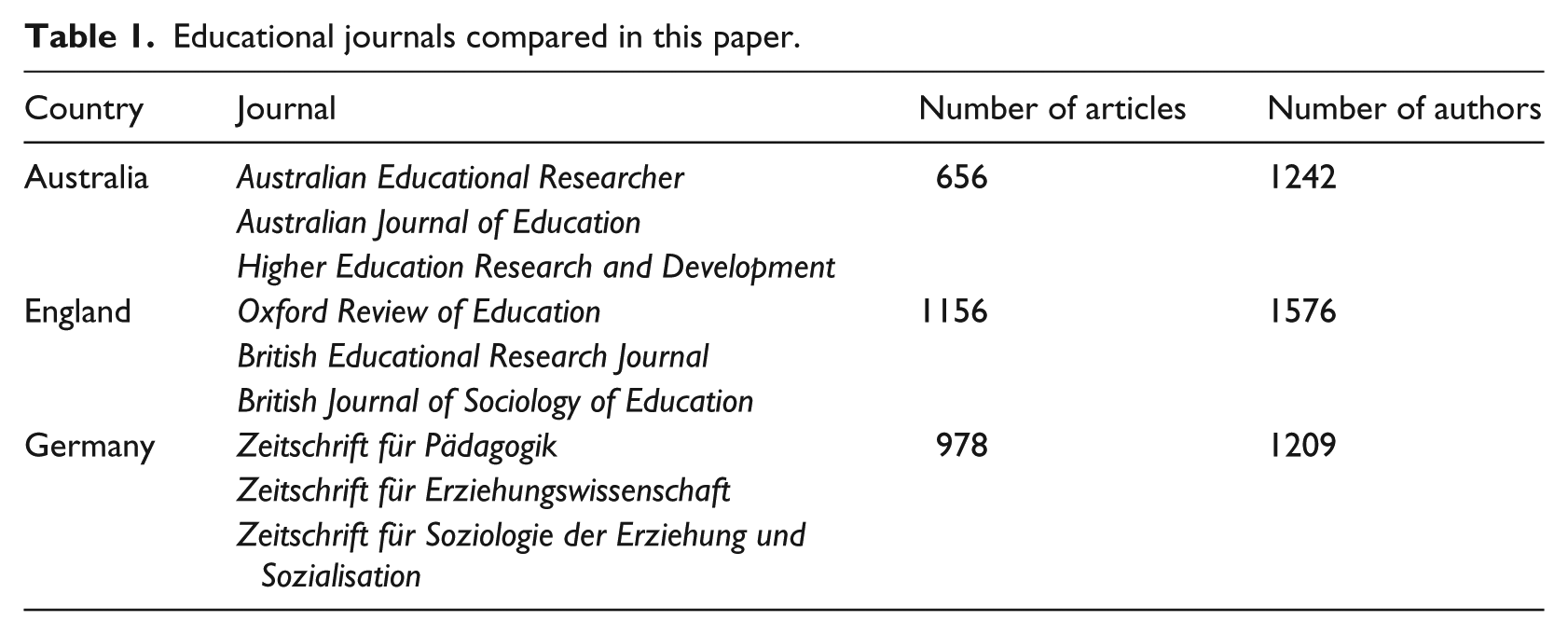
The SSCI was used to select leading educational journals in the three countries based on ranking and impact of the journals. The authors acknowledge the limitations of using the SSCI for selecting the leading journals which applies a relatively basic quantitative measurement of the impact of journals and has a relative bias towards journals in the English language and rather limited coverage of journals from non-English speaking jurisdictions. Table 1 shows the number of articles reviewed from each jurisdiction and the number of authors. Table 2 outlines the compared journals’ impact factors (IFs) for 2014, ranking, a 5-year IF trends, self-citations and IF 2014 without self-citations, according to the SSCI.
Educational journals compared in this paper.
Impact factors (IFs), ranking and self-citation of compared journals.
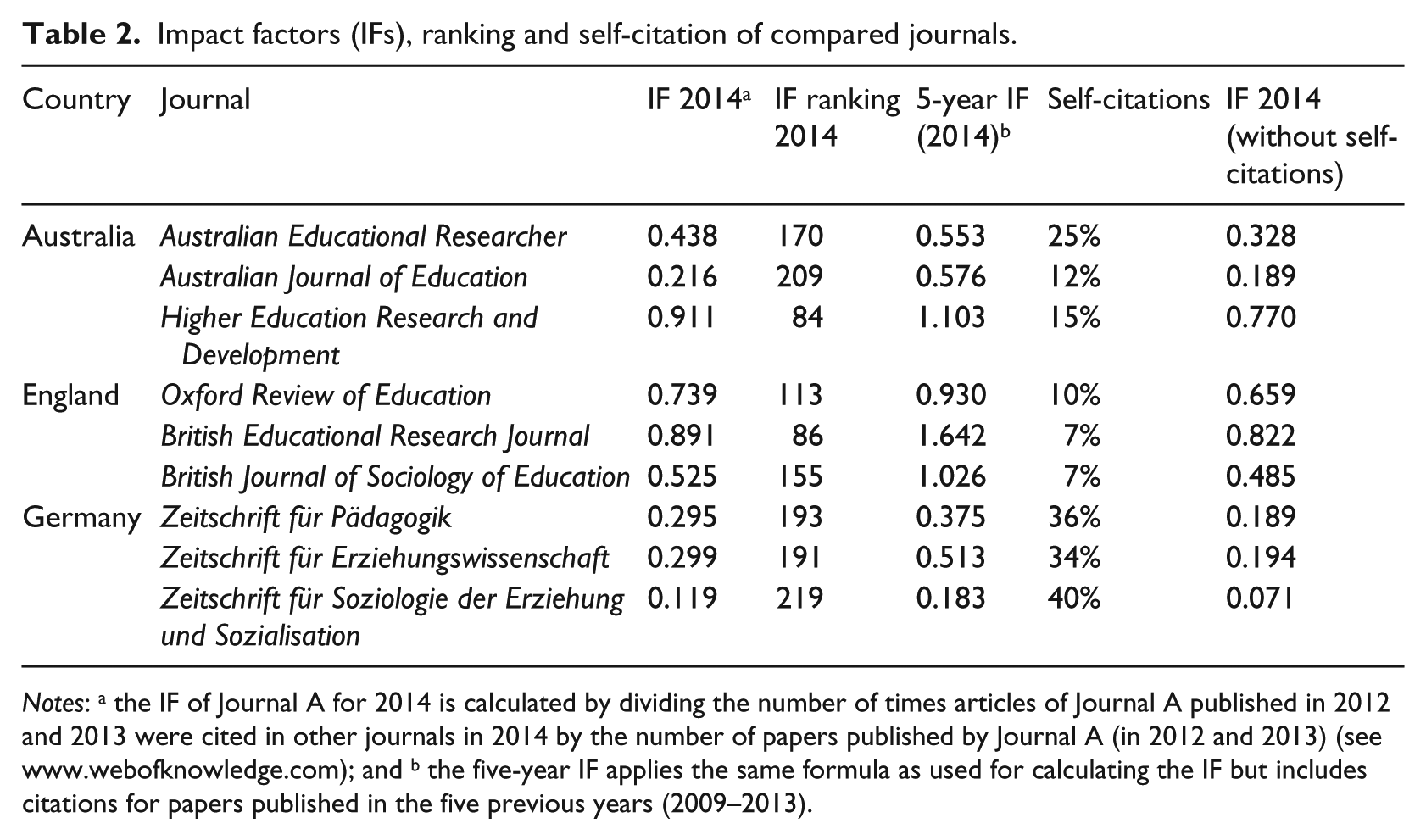
Notes: a the IF of Journal A for 2014 is calculated by dividing the number of times articles of Journal A published in 2012 and 2013 were cited in other journals in 2014 by the number of papers published by Journal A (in 2012 and 2013) (see www.webofknowledge.com); and b the five-year IF applies the same formula as used for calculating the IF but includes citations for papers published in the five previous years (2009–2013).
On average, the Australian education journals had the lowest proportion of single authorship across the three reviewed journals, the German journals had the highest proportion and the English journals were in between. This indicates that Australian education research is more likely to be conducted by groups of researchers than is the case in English education research. German education research is, on the other hand, most frequently conducted by individual researchers, as was highlighted by Zierer and Ertl (2014). They established that over the 10-year period investigated, two-thirds of the German journal articles were single-authored, although they indicated a downward trend in single authorship over that period.
Comparing the IF across the national contexts, on average, the English educational journals had the highest impact (0.72), followed by the Australian (0.52) and the German journals had the lowest impact (0.24). When comparing individual journals, the Australian HERD journal had the highest impact (0.911), closely followed by the BERJ (0.891) and the German Zeitschrift für Soziologie der Erziehung und Sozialisation had the lowest impact (0.119). The English journals had the lowest percentage of self-citations (average of 8%), followed by Australian journals (average of 17%) and the German journals had the highest (average of 37%).
The high proportion of self-citations in the German journals might indicate a degree of inward-looking in educational discourses and closely-knit academic communities whose members primarily refer to the research of other, like-minded researchers who prefer to publish in the same journal. Interestingly, if self-citations are not considered for calculating the IF of journals, the rank order of the nine journals analysed changes, with the BERJ taking the top position.
It was not within the scope of the two projects to cover a wider range of education journals published in the three countries. By selecting the leading (i.e. high-profile and well-established) education journals, the projects did not aim to take an elitist approach. These journals were selected for a relative comparability of similar types of journals. Thus, this paper does not aim to give an extensive representation and comparisons of education journals across the three countries but rather intends to give a broad overview of the publication trends and patterns in the education journals selected for analysis.
Approach to analysis
The analysis in this paper is based on 2790 journal articles by 4027 authors. The analytical approach was developed in a number of previous studies mainly in the German context. 3 Therefore, the authors acknowledge the grounding of the methodological framework in understanding research dissemination and publishing in journals within the German tradition (Ertl et al., 2015). The current approach evolved from an analytical framework developed by Macke (1989, 1990). The ambiguity of Macke’s coding categories was pointed out by Leschinsky and Schoepflin (1991). The analytical framework used in the research reported here was significantly refined to accommodate different national and cultural traditions. Clearer categories for coding the themes and methods used in the papers were developed. These categories are broad and cover: authors; themes; and methods (Ertl et al., 2015). Reliability of the coding was ensured by running inter-coder reliability tests for which a sample of papers were coded by two independent coders. Cohen’s kappa was calculated based on the number of matches between the two codings which resulted in a value of 0.87. This indicated a good level of reliability and clarity of coding categories (Hedderich and Sachs, 2012). For further discussion of this, see Zierer et al. (2013).
This paper further discusses the suitability of some of these categories for the Australian and generally Anglophone contexts in conceptual and partly also linguistic senses. The aim of the research undertaken within the three projects (two of which are drawn on here) was to develop a database for an international comparison of education journals and thus contribute to the existing body of comparative research on journal publication and research dissemination in education (for a discussion of this, see Zierer et al., 2013).
Analytical framework
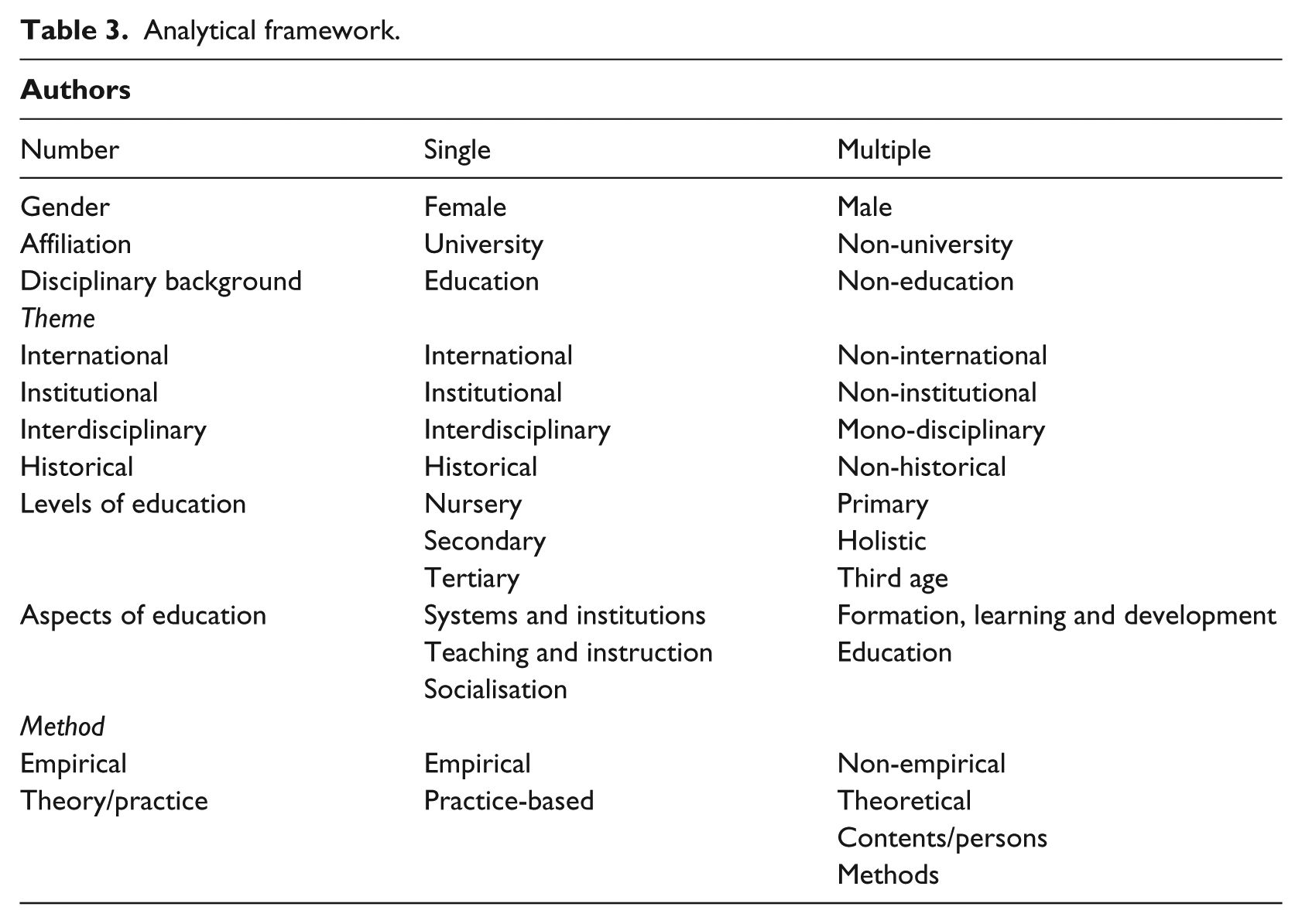
The analytical framework and the coding categories covered three broad areas: authors; themes; and methods. The author analysis looked at the number of authors, gender, institutional affiliation (university or non-university) and disciplinary backgrounds (education or non-education backgrounds). In order to conduct the thematic and methodological analyses, typically, the article’s abstract and conclusions were read and also references were reviewed. Often, other parts of articles were read in detail, such as methodology and other sections, to confirm correctness of coding.
The thematic analysis covered categories, such as: international focus (international vs non-international); interdisciplinary focus (interdisciplinary vs mono-disciplinary); and historical focus (historical vs non-historical). The last two categories may also be considered as methodological, if articles use methods from disciplines other than education, including history. However, this distinction was not a major focus of the coding system. For all these three categories, references used in articles were reviewed first. To be classified as ‘international’, an article needed to have at least three internationally published key references or the references needed to have an international focus. To be coded as ‘interdisciplinary’, the article had to have at least three key references from a field other than education. To be classified as ‘historical’, an article needed to have at least three key historical references. The framework set 1945 as the landmark for historicity, that is, references published prior to 1945 were classified as ‘historical’ and also references with historical focus prior to 1945 were understood as such. The thematic analysis further included institutional focus, the levels of education and aspects of education. The institutional focus included the categories: institutional (i.e. focus on schools, universities, education systems or family); and non-institutional (i.e. the main focus is on other aspects, such as politics, media, etc.). The levels of education included focus on: nursery (i.e. early childhood, up to the age of 6 years); primary (children between the ages of 6 and 10/12 years); secondary (children and young adults between the ages of 10/12 and 19 years); tertiary (over 19 and up to 65 years); third age (over 65 years); and holistic (focus on more than one level of education). The aspects of education included focus on: systems and institutions (i.e. main focus is on systemic and/or institutional issues); formation, learning and development (i.e. the main focus of the article is on the learner); teaching and instruction (i.e. the focus of the article is on interaction, with an emphasis on intended interactions; and a professional teacher or instructor is part of the interaction); education (i.e. the focus of the article is on interaction, with an emphasis on intended interactions); and socialisation (i.e. the focus of the article is on interaction, with an emphasis on unintended interactions).
The methodological analysis covered the categories of empirical and theory/practice. The category of empirical (i.e. empirical vs non-empirical) looked at whether the article drew on new empirical data or analysed existing data through a different, new analysis. The category theory/practice looked at whether an article was based on practice (i.e. related to teaching and learning practices or had mainly practical implications); or was based on theory (i.e. had a theoretical focus) on contents/persons (focused on concepts or people) or methods (focused on teaching and learning methods and also educational research methods).Table 3 outlines the analytical framework.
Analytical framework.
Australian education journals
Focus of Australian journals
The first Australian journal discussed is the AER, an ‘international, peer reviewed’ journal published by the AARE. It was started in 1974 and describes itself as providing education researchers with a forum where to debate ‘internationally relevant issues across all levels of education, including:
early childhood,
primary and secondary school education,
alternative education,
adult education,
vocational education and training, and
university education.’
It aims to promote educational issues through international and national perspectives, using a range of qualitative and quantitative methodologies ‘addressing issues of theory and practice’ and welcomes different disciplinary perspectives.
The second Australian journal discussed is the AJE, established in 1957 by the Australian Council for Educational Research. The AJE highlights drawing on original research on issues of contemporary concern in education conducted in Australia and internationally. It aims to contribute to knowledge on education and schools with a particular but not exclusive focus on Australia and neighbouring countries. Its target audiences are educational researchers, educators, professionals in the community, administrators, policy-makers, government agencies and citizens with interest in education.
The third selected Australian journal is HERD, an official journal of the Higher Education Research and Development Society of Australasia (HERDSA) established in 1982. The HERD highlights promoting HERDSA’s ‘purpose of continuously improving HE by informing and challenging researchers, teachers, administrators and others concerned with the past, present and future of higher education.’ Furthermore, the HERD indicates that it publishes original scholarly articles and essays contributing to the ‘theory, practice or research of higher education’ which have empirical, theoretical, philosophical or historical focus and are aimed at international audiences.
For the profiles of the three British and three German education journals, see Zierer et al. (2014).
Comparison of trends in Australian, British and German education journals
Authorship
When examining the 10-year period across the three Australian journals, multiple authorship slightly dominated (51%). Looking at trends across the Australian educational journals over the investigated 10-year period, it appears that single-authored papers dominated in the first half of the 2000s and the multi-authored papers have become dominant in the second half of the 2000s. In the German education journals, on the other hand, two-thirds of the articles were single-authored underlining the single researcher trend in German education research. Although this tradition is slowly changing which is supported by a downward trend (over the studied 10-year period), as indicated by Zierer and Ertl (2014). The trends in single authorship across the British journals were around 50%.
When comparing the Australian journals over the 10-year period, female authorship dominated (averaging over 60%), and there was a general upward trend in female authorship in the English journals, with around 40% in the early 2000s and rising to around 50% in the late 2000s. The German journals, on the other hand, had the lowest proportion of female authors which averaged slightly over 30%, although there was a general upward trend.
There was an interesting trend across the three Australian journals: in early 2000s, the AER had the highest proportion of female authors (around 70%). However, towards the end of the decade all the three journals had similar levels of female authorship (close to 70%). Overall, the dominance of female authors in the Australian education journals is striking compared to the British and particularly German journals. One explanation for this may be that Australian research assessment and promotion processes are geared to publishing in international (non-Australian) journals and there is a larger proportion of ambitious male authors publishing overseas (particularly in British and US journals), and so the larger proportion of authors publishing in the Australian educational journals remain women who tend to ‘stay close to practice conducting more action and qualitative research’ (Yates, 2016).
In terms of authors’ institutional affiliations, the HERD had the highest percentage of university-affiliated contributors (95%). The percentage of non-university affiliated contributors was relatively low across the Australian journals, with the AJE having the highest percentage of those (9%). This may be partly attributed to the fact that the AJE is an official journal of a non-university research institute with potentially a slightly higher percentage of non-university-based authors inclined to contribute but this is fairly marginal, given that the AER had 7% of non-university affiliated and HERD 5%. When taking the three journals together, 93% of authors came from universities and 7% from outside of universities. The trends in all German and English educational journals over the investigated 10-year period have also indicated the dominance of university-affiliated authors: 86% for the German journals and 95% for the English ones. This dominance of university-affiliated authors is perhaps not surprising, given the increasing pressures on academics to publish in all the three countries. The German journals had the highest proportion of non-university affiliated authors (14%), and the English journals the lowest with 5%. This finding possibly points to a small number of non-university affiliated education research institutes in both Australia and England or that it is not as valuable for these researchers to publish in education journals, whilst the trend in Germany is not as limiting.
Looking at the countries of authors’ workplaces, the AER had the highest percentage of Australian-based authors (83%), HERD on the other hand had the highest percentage of international contributors (30%) and the AER had the lowest international contributions at 17%. When comparing the Australian journals together, 75% authors were Australian-based, followed by New Zealand (6%), England (5%), USA (4%), and Hong Kong (2%); the proportion of international authors was slightly lower in the English journals (23%) and the German journals had the lowest proportion of international authors with 15%. The highest proportion of the international authors in the English journals was based in English-speaking countries (such as the USA, Australia, Canada and New Zealand). Similarly, linguistic affinity was identified in the German journals, where authors based at Swiss and, to a lesser extent, Austrian institutions were the dominant groups of international authors, despite the fact that all three German journals included in this study publish articles in English.
The analysis further examined authors’ background distinguishing whether they had a pedagogical or non-pedagogical background. In the Australian context, this relates to the 2011 AARE/ACDE project investigating the Australian education community which found that ERA 2010 had 46% of contributions from fields and organisational units outside of education; for ERA 2012 this was slightly lower (40%). There was also a proportion of researchers from education units who did not consider their research as educational. As was discussed by Bobis et al. (2013) and Seddon et al. (2013), what is defined or understood as education research and community is far from clear-cut and this also depends on the researchers’ positioning of themselves.
Comparing the three selected Australian journals, the HERD had the highest proportion of non-pedagogical contributors (50%), followed by AJE (36%) and AER (30%). When taking the Australian journals together, 41% of authors had non-pedagogical backgrounds. The Australian educational journals had the highest proportion of non-pedagogical backgrounds (compared to the other two countries) which supports the understanding of education in Australia as a discipline incorporating academics from a broad range of other disciplines, as discussed by Bobis et al. (2013) and Seddon et al. (2013). The English and German educational journals had higher percentages of authors with pedagogical backgrounds – 63% and 68%. Furlong (2013) discussed what is regarded as an education community in relation to the RAE/REF exercises in the UK and also pointed out that researchers contributing to education journals in the UK largely come from Education departments and units. This appears to be the case even to a greater extent for the German education journals and authorship.
Thematic focus
Moving onto the thematic categories investigated in this research, these included examining whether articles had:
(1) international versus non-international focus;
(2) interdisciplinary versus monodisciplinary focus;
(3) historical versus non-historical focus;
(4) level of education: (a) nursery (b) primary (c) secondary (d) tertiary (e) third age (f) holistic
(5) aspects of education: (a) systems and institutions (b) formation, learning and development (c) teaching and instruction (d) education (e) socialisation; and
(6) institutional versus non-institutional focus.
The analysis of the Australian education journals found that all the three selected journals had a high percentage of articles that could be defined as international (averaging 94% across the three journals), with the HERD having the highest percentage (97%), followed by AER (93%) and AJE (92%). There was also a significant level of international focus in both English and German educational journals, with above 90% across the English and 82% across the German journals. There were general upward trends in both contexts over the decade.
The highest percentage of interdisciplinary papers was found in the HERD (98%), followed by AJE (94%) and AER (86%). The interdisciplinary focus averaged at 93% across the Australian journals over the analysed decade; this compared with 98% in English and 89% in German journals. The Australian journals were comparatively the most interdisciplinary, which is not surprising, given what Bobis et al. (2013) and Seddon et al. (2013) argued about the discipline in Australia. The German journals were relatively the least interdisciplinary, compared to the other two contexts. This relates to what Ertl et al. (2015) explained about the development of the discipline of education within the German context.
The percentage of historical papers across the three educational contexts was generally very low. In the Australian journals, the highest level was in the AER (4%), followed by AJE (3%) and HERD (1%). The average historical focus across the Australian journals over the decade was 2% and it was 15% for the English journals. The percentage of German papers with historical focus was the highest with 26%. The strong historical focus of the German education journals is explained by the hermeneutical grounding of German education research focused on in-depth analyses (Ertl et al., 2015).
Examining the level of education represented in Australian education journals, the AER and AJE covered all levels, apart from third age. The highest percentage of papers in the AER focused on the tertiary level (36%), followed by holistic (33%) and secondary (20%). The highest percentage of papers in the AJE were holistic (41%), followed by tertiary (30%) and secondary (22%). The HERD had 100% papers with tertiary focus which is not surprising given that it is dedicated to HE and has HE in its title. When taking the Australian journals together, the highest represented category was tertiary level (55%), followed by holistic (49%) and secondary level (14%). The highest percentage of both German (53%) and English (45%) journal articles was ‘holistic’ in focus, followed by tertiary level (English, 26% and German, 15%) and secondary level (English, 7% and German, 12%). The nursery and primary levels received a minimal coverage across the three compared contexts, and the third age level was virtually not covered across the three contexts.
Regarding the aspects of education covered in Australian journals, the highest proportion of AER papers focused on systems and institutions (42%), followed by formation, learning and development (30%), and teaching and instruction (19%). The AJE’s dominant focus was also on systems and institutions (56%), followed by formation, learning and development (24%), and teaching and instruction (19%). The HERD’s most dominant focus was on formation, learning and development (47%), followed by teaching and instruction (34%), and systems and institutions (19%). There was a rather marginal focus on education among the Australian journals – AER (9%), AJE (1%) and HERD (0%). Australian journals did not focus on socialisation. When taking these Australian journals together, the highest proportion of papers focused on systems and institutions (39%), followed by formation, learning and development (33%), and teaching and instruction (24%). The most represented category among the German (51%) and English (57%) journals was also systems and institutions, followed by teaching and instruction (German, 11% and English, 13%), and formation, learning and development (German, 9% and English, 8%).
There was a high level of institutional focus in the three Australian journals: the HERD (100%), AER (90%) and AJE (87%), averaging 92% across the Australian journals. The institutional focus was comparatively lower for both English educational journals at 78% and German at 67%.
Methodological focus
Looking at the methods used in the Australian journals, the AER (59%) and AJE (58%) had similar percentages of empirical papers. The HERD had a slightly higher percentage (77%). Empirical focus averaged at 65% across the Australian journals over the decade. The level of empirical focus in the English context was slightly lower (with 61%) and it was the lowest in German journals (43%). The greater empirical focus in the Australian and English journals can be explained by the more ‘pragmatic’ approaches to social sciences typically taken by the Anglophone countries, as was indicated by Wagner and Wittrock (1991). The lesser empirical focus in German journals can be explained by the hermeneutic grounding and theoretical structuring of knowledge as Ertl et al. (2015) pointed to referring to Wagner and Wittrock (1991).
There was a variation in the focus on theory versus practice. The AER had the highest level of focus on theory (41%), followed by AJE (27%) and HERD (9%). The Australian average of focus on theory was 26% which compared to 16% in English and 16% in German journals; this slightly higher focus on theory across Australian educational journals is interesting to note, given what Bobis et al. (2013) and Seddon et al. (2013) indicated about Australian education as a discipline of very practical roots. Although this might just simply indicate that the three most highly ranked journals focus less on practice compared to other Australian educational journals. Within the theoretical focus, all Australian journals predominantly focused on contents/persons: AER (97%); AJE (90%); and HERD (88%). Out of the theoretically-focused articles, the Australian average of contents/persons theoretical focus was 92% over the 10-year period which was similar to 93% for both English and German journals; thus, the focus on methods was very limited for all the three jurisdictions – 7% for England and Germany and 8% for Australia.
Table 4 summarises the key trends, differences and similarities among the compared Australian, German and English journals over the investigated 10-year period.
Summary of key trends across the three jurisdictions between 2001 and 2010.
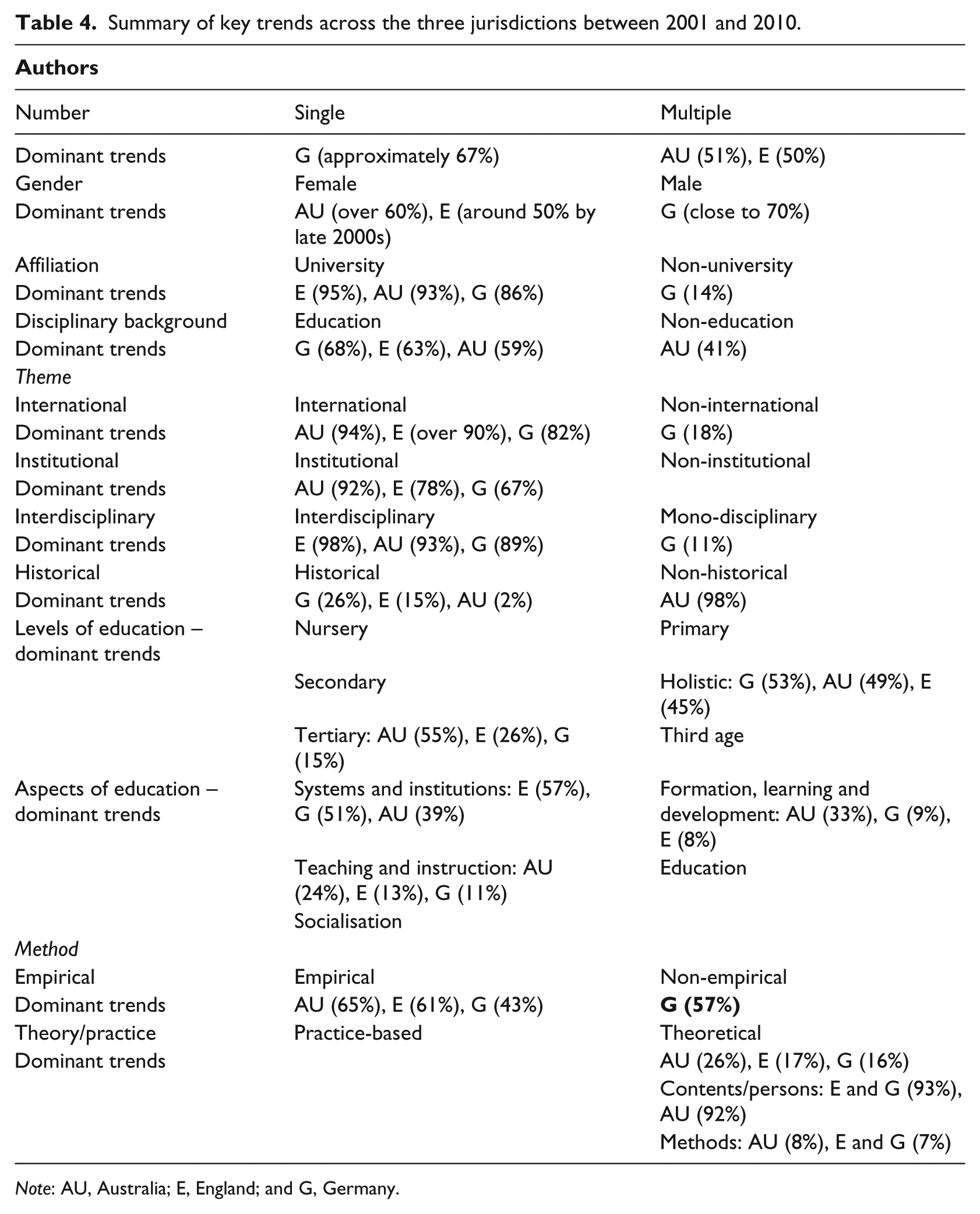
Note: AU, Australia; E, England; and G, Germany.
Proposed improvements to coding
When examining the coding categories used in the Australian journal context, the main coder of the Australian data found that some of the categories did not fit particularly well the educational topics and areas discussed in the Australian journals. For example, issues of leadership, recruitment, organisational development/change, research on teacher burn-out and other more research-focused articles could not be easily ascribed to the categories initially developed and used for analysing publication patterns in German journals. The coder found that there were not enough categories, or not sufficiently nuanced categories, within the ‘practice’ focus. The coder felt in a number of instances found fitting of the foci of articles within not quite appropriate categories within practice or theory and this might have had something to do with a broader range of topics within the Australian education context, compared to the German arguably more ‘clear-cut’ and somewhat more traditional education focus and topics. Furthermore, this perhaps goes back to the historical development of the Australian education ‘ecologies’ (Seddon et al., 2013), compared to the more structured and possibly more systematic development of the German education academic culture along the lines of the hermeneutic tradition.
Although there was generally not enough space within the second project described here to delve deeper into these issues, and some, such as the ‘thematic’ coding categories or the theoretical category of ‘methods’ would warrant further attention, there is one proposed refinement for aspects of education drawing on Tight’s (2004) classification situated in the English education context. Tight outlined a broader range of categories in his HERD 2004 (23.4) article on the use of theory in the field of education. These categories included: teaching/learning; course design; student experience; quality; system policy; institutional management; academic work; and knowledge. While some of these categories overlap with the range used in this paper’s analyses, such as ‘formation, learning and development’ and ‘teaching and instruction’ with Tight’s ‘teaching/learning’, a number of categories in Tight’s outline might broaden and refine the current range. This would benefit the suitability and accuracy of analyses applied in the Australian but also perhaps other Anglophone contexts. The category of ‘education’ is suggested to be changed for ‘knowledge’ as a more positive and inclusive term; thus, the refined ‘aspects of education’ range is as follows with the added categories and sub-categories highlighted in bold:
aspects of education: (a) systems and institutions (i. (b) formation, learning and development; (c) teaching and instruction (i. (d) (e) (f) (g) socialisation.
This new refined range of categories would perhaps not change the results extensively, nevertheless it is hoped would that it would contribute to a more nuanced approach and greater refinement with respect to cultural differences.
Discussion
Along most investigated categories, the Australian and English journals followed similar trends and the German journals exhibited the most divergent trends, which is hardly surprising, given the historic ties between Australia and England and similar developments in many education policy and practice areas in the two countries. The most distinctive features of Australian education journals lay in their authorship. They had the highest proportion of female authors, the largest proportion of authors with non-pedagogical backgrounds and also the largest proportion of authors not affiliated to universities. They also had the highest proportion of multiple-authored papers. This seems to indicate a distinct development in the way education research in Australia is conducted, with Australian education researchers perhaps collaborating in research more than English and German researchers. The higher proportion of female authors contributing to the three analysed Australian educational journals may simply underline Yates’ (2016) argument on the politics of promotions and research assessment in Australian HE, and the fact that male authors might target higher ranking non-Australian journals for their publishing.
All these aspects and issues would deserve further attention, as was indicated earlier – for instance, looking closely into the Australian context from the perspective of suitability of particular coding categories. The coding category that might particularly warrant further investigation and refinement for the Anglophone context/s apart from aspects of education is also the theoretical category of methods. This may also be relevant to the other two Anglophone contexts investigated in the two German-funded projects: English; and US. While there was not enough space in this paper to provide an in-depth reflection on the suitability of the coding for the Australian context, the refinement of the aspects of education based on Tight’s (2004) classification was perhaps an initial attempt.
Overall, it is hoped that this paper has provided a useful comparison of the key differences and similarities in the publishing patterns among the leading Australian, English and German educational journals, indicating the ways in which educational research is conducted and how the methodology of the analysis may be refined to better suit different cultural contexts.
Footnotes
Author’s Note
Hubert Ertl is now also affiliated with University of Padeborn, Germany.
Declaration of conflicting interests
The author(s) declared no potential conflicts of interest with respect to the research, authorship, and/or publication of this article.
Funding
The author(s) disclosed receipt of the following financial support for the research, authorship, and/or publication of this article: The first study was funded by the German Research Association and the second one was unfunded.