



Abstract
Internationalization of higher education is considered to be among the most widely researched as well as one of the most misunderstood topics. In this study, we take a phenomenological approach to better understand what internationalization means to faculty members at a leading business school in India, as the country has emerged as one of the largest providers of management education in the world today. This is important because faculty members are considered to be the key drivers of internationalization at their institutions. We find that internationalization means different things to different faculty members, and that these views are strongly shaped by each faculty member’s unique set of past international experiences. We are able to link these views to De Meyer’s three strategic drivers of globalization/internationalization, and find that for Indian management faculty, the desire to enrich the home base emerges as the dominant driver of internationalization, followed by the desire for global learning. Although not a prominent driver, the desire to leverage India’s unique knowledge base was also evident. We expect that these views will drive the future internationalization endeavors of this and other similar leading Indian business schools.
Introduction and literature review
Business schools and India
India is said to be the largest provider of management education in the world today (The Economist, 2016). However, the quality of this education varies considerably. The All India Management Association has a stated goal of rivaling American business schools in the next decade (The Economist, 2016). Although this is not considered to be very realistic, it is evident to the stakeholders that India can and should position itself as a global hub for management education (The Economist, 2016). It has been stated that “India is in a unique position among developing countries to be a significant participant in international higher education” (Altbach, 2002: 7). Internationalization is important because the “globalization of management education seems to have become a necessary condition for any business school or provider of management education” (De Meyer, 2012: 337). Providing an international perspective is vital when training future managers in a globalized world (Ricart, 2011). Businesses depend on management schools to provide them with managers possessing skills related to global business (Shetty and Rudell, 2002). As such, business schools have been embracing an international outlook to cater to the needs of students who are looking forward to international careers (Jepsen et al., 2014). International linkages between business schools, whether via joint program delivery, research initiatives, or even the opening of international campuses, are becoming ever more common (De Meyer, 2012). In India, the top-ranked business schools are mostly public institutions rather than private, and they are usually autonomous and generally faculty led and administered. Participation of faculty members of leading Indian business schools in institutional development activities such as internationalization is largely voluntary. This means that the views and attitudes of Indian business school faculty toward internationalization are of particular significance.
Internationalization of higher education
Internationalization of higher education is defined as: “the process of integrating an international, intercultural, or global dimension into the purpose, functions or delivery of postsecondary education” (Knight, 2003: 2). Although research on the internationalization of higher education has grown significantly (Kehm and Teichler, 2007), and is a common topic of academic discussion (Dima and Vasilache, 2016), internationalization is said to be widely misunderstood (Altbach, 2002). It is said that internationalization “is a term that means different things to different people” and that “there is a great deal of confusion about what it means” (Knight, 2004: 5). For some academics, internationalization involves engagement in international activities such as academic mobility, international partnerships, and joint international research and academic programs (Knight, 2004). For others, internationalization is about exporting education abroad through collaborations such as branch campuses or other means (Knight, 2004). Still others see it as the inclusion of a global component into the curriculum and teaching process (Knight, 2004). Many faculty members are not even sure what the internationalization of higher education means to them (Ilieva et al., 2014). One reason for this ambiguity is that internationalization is a very broad area covering many different activities (Criswell and Zhu, 2015). This can be partly attributed to advances in information and communication technologies that have facilitated the growth of internationalization within academia (Li and Yu, 2015; De Meyer, 2012).
Although there has been quite a lot of research on internationalization at the institutional level (Bartell, 2003; Britez and Peters, 2010; Childress, 2009; Croom, 2012; Knight, 2015; Stromquist, 2007) there is a more limited understanding of how internationalization is appreciated and engaged in by individual faculty members, with some notable exceptions (Bedenlier and Zawacki-Richter, 2015; Dewey and Duff, 2009; Friesen, 2013; Sanderson, 2008). The perceived impacts of internationalization on faculty members are significant at the individual, institutional, and global levels (Bedenlier and Zawacki-Richter, 2015). At an individual level these impacts could include personal and professional development, international reputation, promotion, and tenure; at an institutional level they could encompass the internationalization of the curriculum, sensitivity toward international students, and addressing the Anglo-American hegemony with regard to perspectives and structures; and at a global level they could involve global knowledge networks, academic competition, declining heterogenization, and increasing pluralization, to name a few (Bedenlier and Zawacki-Richter, 2015). Internationalization initiatives may be placed on a continuum that is anchored at the individual faculty member’s research and teaching, proceeds to curriculum-related issues, and thereon to institutional initiatives (Dewey and Duff, 2009). It is evident that faculty members’ views and attitudes on internationalization are important because these could either serve to motivate faculty members to participate in institutional internationalization initiatives or, alternatively, have the opposite effect (Childress, 2010). Enhancing our knowledge in this area is of vital importance because faculty interest in internationalization is considered to be the most important factor in its future success (Friesen, 2013).
Given that internationalization means different things to different academics, and also given that faculty members are the key factor in the success of internationalization initiatives, it is important to gain a deep understanding of how and why faculty members come to hold their views on internationalization. However, studies considering faculty views on internationalization are limited (Friesen, 2013). The research most relevant to the current study was undertaken by Rhonda Friesen (2013) involving Canadian faculty. Friesen (2013) studied faculty members’ motives and rationales for engaging in international activities and concluded that Canadian faculty members primarily see internationalization as being based on personal relationships between faculty in Canada and abroad. Canadian faculty members also saw internationalization as a complex and mutable concept (Friesen, 2013). In addition, Canadian faculty perceived internationalization as improving the quality of research, teaching, and administration/service (Friesen, 2013). Although Friesen’s study looked at how internationalization is understood by faculty members, and their rationales for engaging in internationalization, it did not look at why or how faculty came to hold these views. In this study, we take a within-case approach to gain insights into how faculty members come to hold their views on internationalization. We limit our focus to Indian business school faculty members’ views on internationalization. By faculty members’ views, we refer to the meaning given to internationalization by each faculty member.
RQ1: What does internationalization mean to faculty members at a business school in India?
RQ2: How do Indian business school faculty members come to hold their views on internationalization?
Attitude toward internationalization
In addition to learning about how faculty members view internationalization, it is important to find out if these views are favorable, unfavorable, mixed, or neutral. This is particularly important because internationalization “has become a synonym of ‘doing good’ and people are less into questioning its effectiveness and essential nature: an instrument to improve the quality of education or research” (Brandenburg and De Wit, 2011: 15). Although it has been accepted that internationalization has transformed higher education, it is unclear if this transformation is a net positive or negative development (Knight, 2014). It has been recommended that we move away from idealistic and dogmatic views of internationalization, and view it as a means to an end and not as an end in itself (Brandenburg and De Wit, 2011). The need to leave old ideas behind and develop a new paradigm that allows researchers to redefine and rethink internationalization has been stressed (Brandenburg and De Wit, 2011). Because strong interest among faculty members is said to be by far the most important factor supporting internationalization at higher education institutions (Friesen, 2013), it is important to gain insights into faculty members’ attitudes toward internationalization.
RQ3: What is the attitude of Indian business school faculty members toward internationalization?
Drivers of internationalization
It has been noted that internationalization and globalization “act like two connected universes” (Brandenburg and De Wit, 2011: 15). The two terms are closely related to one another and it is essentially impossible to distinguish between them (Brandenburg and De Wit, 2011; Friesen, 2013). It is claimed that many aspects of the internationalization of higher education are driven by the globalization of ideas and educational services (Brandenburg and De Wit, 2011; Friesen, 2013) and it has been noted that a large part of what is often attributed to internationalization is, in fact, the result of globalization (Brandenburg and De Wit, 2011). As some academics put it, “Internationalization is seen as something higher education institutions do while globalization is something that is happening to them” (Mitchell and Nielsen, 2012: 3). The number of students studying abroad has risen dramatically owing to globalization and internationalization (Jackson, 2008). These expanding ties between higher education institutions and the global economy have led to the commoditization and marketization of higher education, most commonly through the provision of educational services for a fee (De Meyer, 2012; Rhoads and Hu, 2012).
Usually, the pressure to internationalize is external, arising from sources such as institutional policy-makers, accreditation agencies, alumni, recruiters, or other faculty (De Meyer, 2012). Based on his extensive international experience at multiple universities, De Meyer (2012) identifies three main categories of what he calls “strategic drivers” of globalization (or internationalization, given their interconnectedness). One driver is the desire of institutions to leverage their home base advantage. This often involves recruiting international students primarily to generate income, or even to just export ideas (De Meyer, 2012). It can also involve setting up international campuses to cater for a larger number of international students (De Meyer, 2012). International or branch campuses are sometimes referred to as transnational activities (Gopal, 2011), and such initiatives are often aided by the receiving nation through the development of “education hubs” that provide support for branch campuses (Knight, 2011). These activities are primarily driven by monetary considerations, and have been referred to as the milking of cash cows (Haigh, 2014). For example, it has been observed that many higher education institutions in Canada are increasingly enrolling international students in order to bolster dwindling institutional finances (Garson, 2016). This drive to enlist international students for primarily fiscal gains is certainly not new, and was observed two decades ago at universities in Australia, the UK, and the United States (Howe and Martin, 1998).
The second category identified by De Meyer (2012) is based on the desire to enrich the home base. In this category, institutions aim to attract international students and/or participate in student exchange programs primarily “in order to improve their selling proposition” (De Meyer, 2012: 339). Such an approach is driven by globalization and the realization by institutions that their key stakeholders need international exposure (De Meyer, 2012). The implementation has several pitfalls, as noted by De Meyer, such as the lack of intermingling between exchange and home students, and particularly a lack of internationalized faculty, leading to limited benefits to the host institution. This requires faculty to be highly involved in internationalization-related activities and practices through exposure to and adoption of global-standard pedagogies, content, and research practices (De Meyer, 2012). The third category of strategic driver is based on learning from the world. Here, De Meyer (2012: 339) notes that “a few institutions have come to the conclusion that research is actually the main driver for their internationalization.” Institutions driven by learning realize that in order to tap into the tacit and fuzzy knowledge available in various locations across the globe, they need to collaborate by means of a physical presence in these areas (De Meyer, 2012). Institutions take this dispersed knowledge and integrate it into their systems to generate new, globally relevant insights through a process described by De Meyer as “melding.” For brevity, in this article, we refer to the third driver (learning from the world) as global learning. It is important to note the distinction between “enriching the home base” and “learning from the world (global learning).” Enriching the home base involves activities such as exposure to foreign institutions, adopting global best practices, and learning how to conduct high-quality academic research, among others. Global learning, on the other hand, involves more innovative activities, such as holistic learning, developing cross-cultural activities, and collaborative research and learning.
De Meyer claims that the choice of strategic driver will strongly influence the internationalization process, and that the leadership at education institutions need to have a very clear understanding of which driver or drivers are most important. This will also require institutional leadership “to invest in faculty exchanges, attendance at the appropriate conferences, support for international research and perhaps industry internships” in order to be successful (De Meyer, 2012: 342). In this article, we drill down to the individual faculty level to better understand the process of internationalization. This focus on faculty members is apt because they are “at the center of academic processes such as internationalization – as catalyst and initiators of international programs and collaborations and as the day-to-day implementers of new developments” (Finkelstein et al., 2013: 326). In this study, in addition to understanding how faculty members come to hold their views on internationalization, we link these views to the strategic drivers identified by De Meyer (2012), in order to understand the direction(s) in which faculty members are likely to drive their institutions’ internationalization activities.
RQ4: In which direction are Indian business school faculty views likely to drive internationalization efforts?
Study details
Method
We took a phenomenological research approach (Moustakas, 1994), as it is very relevant in research studies involving faculty members in the sphere of internationalization (Friesen, 2013). The use of phenomenology has been well established in the area of qualitative research (Creswell, 2007; Moustakas, 1994). The aim of a phenomenological research approach, which involves a small sample size of respondents, is to gain insights into the phenomenon of interest through accurate description of the personal experiences of the respondents (Friesen, 2013; Groenewald, 2004). This approach is interested in “the lived experiences of the people” (Groenewald, 2004: 44), and requires that “study participants be able to articulate opinions of the phenomenon from personal experience” (Friesen, 2013: 214). Study respondents were full-time faculty members at one of the most prestigious Indian business schools. The chosen business school has approximately 70 full-time faculty members and is widely considered to be among the top ten business schools in India.
A total of fourteen faculty members consented to be interviewed for this study. The first four interviews were loosely structured, with the focus being on gaining initial insights and developing the interview protocol to be employed. In the next phase, semi-structured interviews using the protocol developed were carried out with ten faculty members, of which six are included for discussion in this article. The number of respondents was restricted to six to keep the analysis and overall article to a reasonable length. Other studies on faculty views have a similar number of participants in the final study (Friesen, 2013). In addition, because we use within-case analyses extensively, a larger number of participants could not be accommodated in this study. The six faculty members were selected on the basis of their experience level, with a higher level of international experience being preferred. All six faculty members had some mix of significant academic and industry-related international experience. Three of the participants were full professors, two were associate professors, and one was an assistant professor. Two of the six interviewees had received their doctoral degrees abroad, whereas another three had received their terminal degrees (doctoral or equivalent) in India. One faculty member had received a terminal degree from an Indian institution and had also spent a significant length of time abroad on a student fellowship during his doctoral studies. All six interviewees were male and at least forty years of age.
The interviews lasted between 20 and 40 minutes. The participants were each interviewed face-to-face by two interviewers. One interviewer asked the questions while the other took detailed notes of the salient aspects of the interviewee’s responses. With the interviewee’s consent, the interviews were also audio recorded. Based on the notes taken during the interview, a preliminary analysis was performed, and the audio files were transcribed accordingly in order to obtain the participants’ own words and other nuances that were not captured in the notes. The respondents were anonymized with pseudonyms, and their responses were anonymized through the removal of institutional names and other identifying information. The detailed analysis involved linking the faculty member’s responses to the four research questions. Analyzing the responses to the first research question was straightforward because we directly asked participants about their personal views on what internationalization meant to each of them (views on internationalization). Similarly, for the third research question, we directly asked the faculty members about their attitudes toward internationalization. For the fourth research question, we linked the faculty views to one of the strategic drivers of internationalization (and often also to a secondary driver) identified by De Meyer (2012). Therefore, the analysis undertaken in order to answer these three research questions was straightforward and direct. For the second research question, which inquired as to how faculty members came to hold their views on internationalization, we analyzed each participant’s set of salient international experiences and linked them to his views on internationalization. We used each participant’s lived experiences to determine how they came to view internationalization. To ensure these linkages were appropriate, the resulting analyses and accompanying direct quotations were shared with each faculty member for their input and approval. This process was conducted in person, via email, and over the phone. Four of the six respondents either requested changes or made their own changes to the quotations attributed to them. These changes included grammatical corrections, clarifications of what was meant by a phrase, removal of a phrase or statement in one section of the transcript and the addition of another in a different section, and a request for further anonymization. All requests and changes were acceded to, and the overall analysis was unaffected. All six participants in this study expressed their satisfaction with the final analysis and quotations attributed to them, and expressed their consent to the publication of the results.
Findings
We primarily performed within-case analysis as opposed to more traditional across-case analysis (Ayres et al., 2003). By using within-case analysis, we were able to gain a deeper and richer understanding as to how faculty members came to hold their individual views on internationalization. This is in some ways a departure from the qualitative analysis used in other studies on internationalization that overwhelmingly apply an across-case analysis. However, within-case analysis is required here in order to understand the relationship between the research questions, particularly the link between a faculty member’s views on internationalization (RQ1), how his views came about (RQ2), and whether they are favorable or not (RQ3). In the discussion stage, we return to an across-case analysis, particularly with regard to the strategic drivers of internationalization (RQ4).
The six faculty members were anonymized as Professors Karan, Vishal, Jagan, Pavan, Ajay, and Ravi. Each faculty member’s views and analysis of these views are presented in a “caselet” (mini case) format, which includes rich quotes from each participant. In each caselet, we attempt to understand what internationalization means to the faculty member (to answer RQ1) and, based on his description of past international experiences, we attempt to understand how these views on internationalization may have developed (RQ2). It is important to note here that we did not ask the interviewees directly about how they came to hold their views in order to avoid biasing the responses. Rather, we make inferences from their responses. To further avoid biasing their responses, we first asked each interviewee about their views on what internationalization meant to them, followed by questions about their previous international experiences. This ensured that the participants did not alter their views on internationalization “on the fly” to match their previous responses. We then attempted to determine if the faculty’s views on internationalization are favorable, unfavorable, mixed, or neutral (RQ3), and finally proceeded to link each faculty member’s views on internationalization to one or more of De Meyer’s drivers of institutional internationalization (RQ4). Depending on the length of the interview and the insights gained, some caselets are longer than others.
Professor Karan: Indian PhD, assistant professor
Karan sees internationalization in terms of exposure to other parts of the world, with regard to both people and processes. Ideally, to Karan, internationalization involves students and faculty members being exposed to best practices at higher education institutions around the world. As a faculty member, he sees the benefits of internationalization arriving through exposure to advanced tools, pedagogies, and the latest knowledge in the field. He sees it as a way for Indian faculty to catch up with those from more advanced nations in terms of the quality of education imparted.
[Internationalization to me is about] providing an exposure to students or educators … of education in all parts of the world … or, at least, the more advanced parts of the world, in the concerned domain, say business – in a manner that is meaningful. For faculty, [it means] to address the need to know good practices. From my perspective as well, [it’s about] teaching students what the best practices are in different parts of the world. From an India perspective, we are still playing catch up. If we look at how educators in other parts of the world are getting better results … or being able to connect to audiences better … from a faculty perspective it is more about getting to know the relevant tools – how it’s being done [differently]. That’s one thing. Secondly, faculty themselves may look to move beyond tools and examine how they are equipping themselves in terms of knowledge or pedagogy. Examining successes in other parts of the world, successes that one may not have seen locally … that is what comes to my mind [about what internationalization means].
Karan’s idea of internationalization has been strongly shaped by his nine-month international stint at a highly prestigious American university as a doctoral student on a Fulbright scholarship. The exposure to faculty and students across various departments at a top-tier university gave Karan a strong appreciation for diversity of people as well as of thought. He was deeply struck by the broad academic grounding of his peers and concluded that although faculty members and course content at Indian institutions were of a comparable quality, the overall delivery of education was far superior at the American university. Karan feels that this may be due to fundamental differences in thinking processes emanating from different education systems. This helps explain his statement earlier that, “from an India perspective, we are still playing catch up.”
I went on a Fulbright student program during my doctoral studies at (removed). The cultural dimension was of great importance – brought in a new dimension altogether. [The] management processes in a fairly old and well-heeled university … gave me opportunities to meet faculty and PhD students across departments, irrespective of what they are learning or teaching. Interacting with PhD students from diverse backgrounds – in terms of their geography, culture as well as in terms of the subjects they were studying was one standout experience. [For example] I’d taken one OB [organizational behavior] course for which participating students came from humanities, from business school, agriculture business students. This was a diversity of the order that would be difficult to get in a typical [Indian] business school setting – not sure one would find that [diversity] even in the university system here [in India] because we tend to be pretty domain specific even at the doctoral level. That was an experience that stood out for me. In terms of quality of faculty members, it was perhaps comparable to (Karan’s doctoral home institution). But what was a humbling experience for me personally was the grounding of the students … my cohort … seemed to have in terms of wider range of subjects – [the] ability to talk about fundamental philosophical issues … [I] felt I didn’t know anything. Of course, Indian schools do also have courses like Philosophy of Management and so on [but] perhaps they don’t push students enough to be inquiry driven. Perhaps this thinking at a more fundamental level … a fair depth, ability to link to something at a more fundamental level … to trigger thinking processes – may not be possible to fix in a two-year coursework [PhD coursework period, [excluding dissertation] … [it may come from] something more deep rooted. Overall, my experience at (the American university) was a sure positive.
Karan also attended a fairly large number of domestic and international conferences as a doctoral student, and these have also influenced his views on internationalization. Although he did not seem to have gained much in terms of the academic aspect of a conference, he was impressed by the equal treatment received by students from faculty at these conferences, which is in stark contrast to India, where there is a significant power distance. Karan sees this exposure as benefiting both faculty and students.
In terms of the exposure that international conferences may provide … to international scholars, it is … you know … more of a flash in the pan … [I] don’t think it leaves a lasting imprint. Of course, it provides you [with] a forum for your work and the work of other researchers; it is a chance to meet people, present your work, discuss with people who are used to a different set of standards – that is useful, no doubt. In India, there is still a faculty–student distance, which is not what is expected in international conferences. In India, students are in a “pure learner” mode. Internationally, you are treated on par [with faculty members] and you ought to behave accordingly. This Western cultural aspect is certainly good. This [egalitarian] treatment of students [of a certain level … doctoral] is useful for students but also for faculty. It helps a faculty member by enabling continued learning … looking at learning as a two-way process.
Thus, Karan’s Fulbright fellowship and conference interactions have caused him to see internationalization from a student–learning as well as a faculty–student interaction viewpoint. He describes the Fulbright experience as “a sure positive,” and this is reflected in his attitude toward internationalization.
I think that it [my view on internationalization] would be favorable. [My view on internationalization] is not based on something being better or worse [in different geographies]. It’s positive from a diversity perspective. Second thing … increasingly there are exchange students and programs, across countries – either formally or informally … getting students from different parts of the world. So, I guess it also behooves us to maintain a comparable quality and character [with the top universities in the world]. Cultural experiences are one thing. But the mode of teaching or the value added to the students is important. For that we cannot have it that the pedagogy – the process of imparting knowledge – is of a poorer character.
However, despite noting that a certain “Western cultural aspect is certainly good” (with regard to egalitarianism, pedagogies, and systems), Karan completed the interview emphasizing the need for some semblance of a two-way exchange, at least in niche areas related to the field of ethics, which he opined could gain significantly by reexamining ancient Indian philosophical and academic thought.
For example, something like ethics … internationalization works both ways … we ought to have a niche … learn and teach … for example, Eastern and Indian philosophies, ethics. We shouldn’t forget that institutions like Nalanda and Taxila [ancient Indian universities] took ages to develop into centers of global reckoning, maybe we ought to look to build up all over again. We need to explore deeply buried knowledge such as Vedic knowledge.
Karan’s view on internationalization primarily links to the strategic driver described by De Meyer (2012) as enriching the home base, through exposure to people, processes, and pedagogies from across the world. Despite his view that Indian faculty (and the students they teach) have a lot to learn and gain from exposure to the rest of the world, he also sees the possibility of leveraging the home base. Karan advocates achieving this by exporting Indian knowledge in niche areas such as ethics, and ancient Indian philosophical thought, which is described as “deeply buried knowledge,” although this is a secondary driver.
Professor Vishal: UK PhD, associate professor
Vishal sees internationalization in terms of exposure to foreign business schools and all aspects of their functioning, which include the teaching, research, and administrative aspects of an academic career.
[Internationalization is about] the exposure to foreign business schools. Familiarization of the way in which things are done – teaching, research, and administration. If we look at these three things – teaching, research, and administration – then you can see the differences. To me what it means is [that] faculty gets the exposure and opportunities to interact and understand how things work – differences in undergraduate, postgraduate, [and] doctoral supervision.
This view has been shaped by Vishal’s extensive international experience, both at the doctoral level and afterwards, as a visiting faculty member for two years in the UK. During his studies and teaching stint in the West he was able to observe as well as experience firsthand the differences between India and the UK with regard to academic norms and cultures. Vishal was able to appreciate the possibilities and opportunities available in the West for those who want to pursue higher education.
I earned my PhD from (UK) University. It was a good experience. I had undertaken my PhD after I had worked in industry for quite some time. In the Indian context if you want to do a PhD in your middle age, people do not take that idea very positively. In the West, it is common for folks to undertake higher studies in their 40s and 50s. In (another UK university) [where Vishal did a two-year teaching and research stint in the recent past], I saw a mom and daughter graduate UG [undergraduate] together … those things are possible in the West. In Indian context [we] generally do not encourage … such initiatives. I am still in touch with my supervisors and PhD batch mates. You work with people coming from different countries and cultures … [I] found that environment [in the UK] to be quite supportive.
Noting personal gains in teaching and research, Vishal’s views on research, teaching, and administration were broadened during his two-year teaching stint in the UK, with this exposure affecting the views he held on internationalization.
I had UG, PG, [and] PhD teaching and guidance experience already when I went back after 4–5 years to (the UK). It is a big university with approximately 20,000 students. It is very different from here [leading Indian business school], where we are very selective in the students we take in. We have a focus on placing our students. There they have UG career support and subsequently career guidance for PG. Many international students from different countries are enrolled in various programs of study both at the UG and PG levels. Many of them are quite serious about their studies and they work very hard to complete the assessment activities. Generally, a typical three-hour class consists of lectures, activities, case discussions, and simulation sessions. Very often, managers from the industry are invited to give talks to the master’s-level students during their classes. I like that type of teaching. Apart from teaching, [there are] lots of benefits in terms of research as well. I was able to establish contacts and networks in my areas of research interest. There were opportunities to interact with academics and journal editors during workshops conducted in my university and in other universities. These workshops bring together like-minded academics. Many such opportunities are available. It is very good professionally.
Vishal views internationalization favorably, linking it to the ability to incorporate best practices from abroad, be they in teaching, research, or training, Favorable. Maybe we can adopt some of these best practices from abroad. Now with NIRF [National Institutional Ranking Framework] and other ranking/accreditations … the thrust [is] on research – everyone is trying to get published. You need to co-author, establish relationships with those who are well-published [conferences are useful here] in order to publish papers in good journals. So, those kinds of things are helpful in enhancing the professional skills of faculty members.
Clearly, Vishal’s doctoral studies and two-year teaching stint in the UK have strongly influenced his views on internationalization. He views it as exposure to foreign business schools and gaining an understanding of how they do things differently in all aspects including teaching, research, and administration. This view of internationalization has caused him to have a favorable opinion of this, as he sees it as an opportunity to bring in best practices that he has learned and been exposed to while abroad. Thus, Vishal’s view on internationalization is firmly linked to the drive to enrich the home base through exposure to foreign business schools.
Professor Jagan: North American PhD, associate professor
Jagan sees internationalization in terms of standards, as well as in terms of a need for the emergence of cross-cultural perspectives. He cautions that internationalization as it is currently occurring is actually the homogenization of academic cultures through the adoption of Western culture, and that true internationalization would involve the incorporation of cross-cultural perspectives.
[What does internationalization mean to you?] Well, two things. First, standards – they should be globally calibrated as opposed to regional or national level calibration. Individually, one can’t do much. It is institutional systems and processes you should be internationalizing – be it international education, jobs, cross-cultural experiences, etc. Second, and probably more importantly, there should be a cross-cultural perspective that should emerge. Right now when we talk of internationalization, what happens is that we have a dominance hierarchy of cultures – maybe North America at the top and things following … And we try to mimic the higher order culture as the way forward. That may not be internationalization. That is actually what we could call homogenization. That should not be the case. All the different cultures that come through with their different perspectives and views, about life and other things, should be recognized [for true internationalization] and accordingly accepted in the educational curriculum and system. That would, in a true sense, be internationalization.
This view has been shaped by Jagan’s own experiences during his doctoral studies abroad, where the emphasis placed on systems and standardized processes has had a major impact on the views he held. Jagan notes that the West has had a longer gestation period for the development of rigorous academic systems. Thus, he developed an appreciation for Western academic norms during his doctoral studies abroad and, although he states that, “there I found another way of thinking,” it is evident he sees this alternative way of thinking as a compliment to his “old” way of thinking, and not a replacement. In other words, it led to him developing a cross-cultural perspective.
[I] did my PhD in North America, [and] got close to their culture which is very, very helpful I think. Those five years [abroad] are the best of my life. It was quite exciting [intellectually]. I had a way of thinking and there I found another way of thinking … the American [Western] way – perhaps [an] understanding of systems. I find in India that understanding to be a little different. In North America, systems have checks and balances, where there is an anticipation of what would happen [an anticipation from theory]. They [West] have run more institutions, and so are used to more mature processes. That [PhD experience] actually helped me understand their perspective … processes like academic peer review for instance. At the same time, it [academic peer review process] has problems and challenges as well. But, if we were to think of a better alternative, there doesn’t appear to be one at this moment. Multiple international perspectives ought to be examined and explored.
As previously discussed, Jagan’s views on the desirability of internationalization are mixed. Although he advocates the internationalization of institutional systems and processes, he also expresses concern regarding the domination of a single culture (North American) in academia.
You should be exposed to different kinds of academic backgrounds. You must have worked in different parts of the world. Number three is obviously the cross-cultural aspect that I have spoken about … exposed to other cultures … If we look back thousands of years there were thousands of human groups and over time their histories have intersected with one another … since about the time Vasco da Gama landed in India … last 500 or 600 years we are really part of a global community. No history of an individual person is independent of the history of another person … definitely a case for global humanity coming together. But global humanity coming together does not mean that one cultural experience will dominate, for historical or economic purposes. That should not happen. Obviously, internationalization is a welcome thing but its definition should be appropriately adjusted. Right now, internationalization means how well we mimic North America. Internationalization is [currently] a euphemism for Westernization.
Jagan sees internationalization as ideally being driven by learning from the world. However, he laments that in its current form, internationalization is just “a euphemism for Westernization.” He does see some advantages at the level of institutional processes and standards, whereby Indian institutions can gain by adopting international best practices (enriching the home base), although he cautions that these best practices ought to emerge from a thorough examination of various cross-cultural perspectives. Overall, Jagan is views are primarily linked to the drive for global learning. Enriching the home base through the adoption of international standards is a secondary driver for Jagan.
Professor Pavan: Indian PhD, full professor
Pavan views internationalization in terms of learning beyond boundaries involving a diverse group of people, cultures, professions, and concepts. He sees internationalization as a means to learn holistically. To him, this means making learning more complete, through diversity.
[Internationalization is about] learning beyond boundaries, beyond limited concepts, say for example, within the country, learning within a professional group. Going beyond these [national/cultural/professional] boundaries I would say is internationalization. Definitely this would involve collaboration or participation across countries, cultures, across professions, and so on. It is for faculty members as well as for students for that matter. It is learning beyond boundaries and constraints. Many of these – like conferences, exchange programs, collaborations – all are mechanisms to make learning more complete, people can learn from each other, from different cultures and professions. Today, if you see, what is required is a holistic learning – learning in diversity. I see internationalization as a mechanism to learn holistically beyond boundaries – physical or cultural.
Pavan’s views on internationalization seem to have been shaped by his international experiences as well as a long academic career. His six-year stint in Singapore instilled in him an appreciation for diversity. He also learned a lot about the technology trends of the time while working in a university lab mixing with a diverse set of people and being exposed to disparate ideas.
I worked abroad [Singapore], which helped me to understand and appreciate diversity, and appreciating places where we lag behind. In Singapore, [I] was employed in a lab which was part of (removed) [for a six-year period] … focusing purely on technology. [I] learned a lot about the trends of that time. Today most of those technologies are being practically implemented in India. I got more opportunities to travel overseas and open to those experiences.
Pavan’s views of internationalization as learning beyond boundaries toward the goal of holistic learning have led him to have a nuanced, perhaps even slightly negative view of internationalization. He notes that although the West is more advanced than India in science and technology, it may not be so in other arenas of what he describes as holistic learning.
Today what is practiced as internationalization [collaboration across countries] has its own limitations. Another way of looking at it is through our ancient culture – learning was holistic. Many people from different parts of the world coming to India to learn … from what was highly regarded as the best system of education in the world. Back then there were many people coming here to learn [at] Nalanda, Taxila, and so on. Now everyone looks to the West and learn … Yes, [the] West has a better understanding in science and technology and I believe that is the appropriate way to proceed … but let us not get carried away … let us not assume that we can learn everything from the West. We have to be selective about what to learn from different regions and different cultures. We don’t have to learn everything from them [the West] … in some domains, we may be better. What is required is a selective approach. We should learn best practices from everyone – but we should have self-respect also.
Pavan also cautions against being overwhelmed by the dominant majority, regardless of the source of the ideas.
Too many opinions may even be confusing. If one is strong enough in terms of what ideas to accept, in terms of adequately introspected decisions and not blindly accepting everything – then and then only could [connecting with others] be useful. Management theory is context specific, hence there is a need to be specific about absorption of ideas.
These views and opinions on internationalization seem to have affected his views on the future benefits of continued internationalization. He notes that if internationalization was leading to what he calls “true learning,” then there should be diminishing returns, as more knowledge is exchanged. However, he hints that this may not be the case, because the challenges and complexities being faced are increasing.
Well, that would depend on individual motivation such as career, learning, money, and so on. [From a learning perspective],with true learning, we would not have been facing so many challenges and increasing complexity, as has been faced quite often now. This shows that there is a lack of true learning. True learning reduces friction, and takes into cognizance the cultural roots as well.
Pavan’s concept of internationalization is one that builds a cohesive, frictionless world, one which involves holistic learning through diverse groups, interactions and experiences. It is clearly linked to a desire for global learning, which is De Meyer’s third strategic driver. However, Pavan does not believe that internationalization as it is practiced today (Western dominated) will help achieve global learning, and that a more inclusive and holistic approach is needed.
Professor Ajay: Indian PhD, full professor
Ajay sees internationalization as interactions with people from different geographical regions that lead to learning as well as making an impact beyond domestic borders.
[Internationalization to me personally] would mean connecting with the rest of the world in the context of the business school and all its stakeholders … to interact with people from different regions … and making an impact beyond the immediate geographic context (of the home school) … (and) also connecting and learning from people and problems from various geographies.
Ajay’s views on internationalization can be seen to have been shaped by his international experiences, which involved teaching-oriented assignments. These interactions with faculty and students from different geographical regions have influenced his views on internationalization. In addition, Ajay’s teaching stints in Ghana, Thailand, and Sweden have likely caused him to view internationalization as having an actual impact beyond boundaries, as was true for himself.
I have spent three and a half months in Thailand at (removed) and one and a half months in Sweden at (removed). These engagements involved teaching and interacting with students and faculty. It was on a fellowship offered to faculty members working in Asian institutes, and was meant to facilitate exchange. It [experiences in Thailand and Sweden] was an opportunity to learn and gain a lot of exposure. It [Sweden] provided networking opportunities as well. Further opportunities in Ghana … three week-long assignments … opened up [from the Sweden stint]. For the Ghana [at] (removed) stints, academic content and resources were provided for by Sweden and I got an invitation subsequently to teach [a course in Ghana]. Three times I went to Ghana … teaching three batches.
Ajay’s interaction with students from various geographical backgrounds and cultures seems to also have affected his idea of internationalization. These interactions have caused him to see internationalization as involving learning from people and problems in different parts of the world. He learned how students from different cultures interact differently with faculty, and these experiences have made him a more culturally aware and sensitive teacher.
I interacted with Asian [Thailand], African [Ghana], European [Sweden] students … other students from Europe and even from India. It was an experience where I learned how students of different nationalities and cultures react to what the instructor is saying in the class. Student feedback content and styles tend to be very different, and it becomes important for a faculty member as an instructor in a class to appreciate how students of different communities react differently to essentially the same content and method/style. The manner of the feedback they provide also changes and is very different. [Ghanaians] are very visible, explicit, clear in body language and immediate in the feedback they provide [whereas] Europeans … especially Swedes … are expressionless, and don’t give you much feedback until you ask a specific individual directly, thereby as an instructor you wouldn’t be sure where things stood unless you asked formally. Now, I am aware – by and large – how certain people would react in my class. In that sense it has made me a more sensitive teacher in a class with a diverse student group.
Ajay also noted that exposure to different administrative structures was a source of great learning. He believes that Indian institutions can gain much from international institutions in the arena of institutional management. His viewpoint links to the drive to enrich the home base (De Meyer, 2012).
It [my exposure to the administration of an academic institution] was the biggest learning in terms of academic institutions … how they are run … how to make one better. The way in which programs [and] activities are managed … you get to observe a lot of things. For Indian institutions, there is a lot we can learn from others in terms of institutional management. There is a lot India can learn from other contexts. For example, in Thailand, the funding model was different and the funding model had evolved over time which, in turn, was creating challenges. Of course, the overarching philosophy would be similar, across the world, but there are certainly interesting differences and nuances as well.
Ajay notes that Indian researchers can gain significantly by learning how to conduct academic research. In particular, he opines that international training or incubation is required for Indian faculty so that they may learn skills related to research idea formulation and academic writing. 1 This links to the desire to enrich the home base.
An intense international incubation in the area of research interest is much required. In terms of teaching, we already do a good job [national/institutional priorities]. But in terms of research, it is very poor in India. But formulation is important … we just don’t appear to do it that well or that much. There is no concern for formulation. For instance, Upanishads [Hindu scriptures/teaching consisting of 19 texts] is written by wise sages. Somebody asked me who the authors of these Upanishads were! Traditionally, nobody took credit for formulation [such as the Upanishads]. Maybe people didn’t take credit … you don’t take credit for your work, that is fine. However formulation [knowledge formulation] ought to be given importance. Publications can be boosted significantly if Indians knew the methods to write scientifically. There are lots of problems and they are aware of lots of solutions but Indian researchers are not able to formulate, write, [and] approach it systematically.
In addition to Indian academics and research in general, Ajay notes that in the area of business, Indian faculty can learn much from their American counterparts. However, he does note that American institutions have indirectly gained from this imbalance, with many of the leading American business schools being led by faculty members of Indian origin – those who emigrated from India to the United States to pursue more fruitful academic careers.
In my opinion, in business, US is the leader from where India can learn … in terms of formulating knowledge. Internationalization can unlock this potential. [C.K.] Prahalad comes to mind – went from (leading Indian business school) to a US university and stayed back pretty much. In fact six out of the top ten US schools are led by (Indian origin)/Indians.
Ajay sees internationalization favorably, as a means of gaining experience and learning from “out there,” particularly the West. On a personal level he sees internationalization as a great learning opportunity through exposure.
Favorable, yeah! One has to get the maximum out of the experience. There is enough out there to absorb, learn, etc. In areas such as formal knowledge [formalization, formulating], there is a lot to learn from the West, for me. There is a lot of learning [from internationalization] in terms of how to formalize/formulate knowledge. Internationalization offers richer exposure that I may not have otherwise. Like I said, my primary motivation is learning and that is very important.
Therefore, Ajay’s views are primarily linked to the drive to enrich the home base. 2 This applies to his personal desire to continue learning, as well as his views on how Indian academics in general can learn from the rest of the world, particularly with regard to best practice related to academic research.
Professor Ravi: Indian PhD, full professor
Ravi sees internationalization as the movement of people and ideas around the world. He notes that the direction of the movement can be bidirectional – a point that he emphasizes strongly later in the interview.
Internationalization means ideas traveling [and] people traveling. An example is Yoga; the word “Guru” is used [widely] these days – even in Harvard. Even mannerisms could travel across the world. The direction of travel need not only be in one direction, it could be the other way also.
Ravi’s views seem to be influenced by his international experiences, in which he often found the students to be less academically focused than the elite students he interacted with in India. Ravi was able to adapt to the Western European system and raise the pass percentage of a course he taught (which, he clarified, had a low pass rate in the past), while simultaneously gaining from the formalized knowledge available in Western Europe. This “win-win” two-way exchange of knowledge and expertise has influenced Ravi to view internationalization as a bidirectional movement of people and ideas.
I have been to Southeast Asia and Western Europe, both on teaching assignments. Short international teaching assignments have helped me in terms of learning how to teach an internationally diverse student group – a group of students who may not have the “academic inclination” of (leading Indian business school) students. This has involved constantly updating examples as well as [finding] new text sources. Compared to [our] students, the [students in the] classes abroad did not want to work that hard. [In Western Europe,] I needed to push the class due to which the pass rate went from less than 20% to above 80%. However, this involved walking the extra mile and being open-minded to adjusting my teaching methods. It has also benefited me as a teacher. For instance, the text used in Western Europe was of a much higher quality – [it] challenged me in terms of the concepts and their treatment, which was the subject of my PhD. This gave me the insight that there is always room for improvement, even in our core area of expertise.
Ravi sees this two-way exchange in economic terms. He advocates leveraging the significant cost advantage of Indian higher education institutions to provide education to Latin America, Africa, economically weaker parts of the West, and even Japan.
Several years ago, I wrote about why we should follow the Harvard model. Harvard has built a deep influence on the world, and it attracts the best people from all over the world. If we start providing intellectual alternatives [theory, etc.] to Harvard, along with our cost advantage and cultural richness, we could emulate China [that rapidly progressed in the economic sphere] in the intellectual sphere. We may not be able to export our educational services immediately to the West, but we could target Latin America, Africa, [and others] to start with. However, top policy-makers of the land [India] may not agree to this idea. We need to establish our brand in the West. In the economically weaker sections of society in the West, there could be opportunities. We need to have a strategy – seek well-identified customer segments, [and establish a] brand identity. India has the potential to deliver higher education at a fraction of the cost to large sections of the world. Even [former US President] Obama has indirectly acknowledged India’s potential in technical education. Even the Japanese may prefer the more rigorous India system of education to the Western alternatives.
Ravi has a favorable view of internationalization, and believes that India has a lot to contribute to the world, which is a viewpoint held by some of the other interviewees. However, his viewpoint is different from that of the other faculty members interviewed in that he sees internationalization of higher education primarily as an excellent opportunity to export Indian thinking abroad.
I am always an advocate of India conquering the world. Two thousand years ago India conquered the world through knowledge. Many came to India to acquire knowledge. Nalanda and Taxila universities attracted students from several parts of the known world. Some of them traveled hundreds of kilometers on foot to reach these universities to get an education. Even the Shaolin temple was set up by an Indian Buddhist monk – now so many countries in Asia are Buddhist. So, if two thousand years ago India could give knowledge to the world, why shouldn’t we be able to do the same today?
Ravi’s view of internationalization is one that seeks to leverage the home base by exporting Indian educational products and services abroad. He is a vocal proponent of this viewpoint. While the desire to leverage the home base is dominant, he also sees opportunities to enrich the home base by imitating to some extent the “Harvard model,” although the purpose of this is to aid the primary desire of leveraging the home base.
Discussion
Our first research question inquired as to what internationalization meant to faculty members. In the context of a leading Indian business school, we found that, as expected, it varied from person to person. Still, some broad themes emerged: gaining of international exposure (Vishal and Karan); developing cross-cultural perspectives and adopting global standards (Jagan); knowledge generation and learning across boundaries (Ajay and Pavan); and the movement of people and ideas (Ravi). These views differ from those of Canadian faculty, who primarily viewed internationalization as consisting of personal relationships between faculty in Canada and abroad (Friesen, 2013). This difference in viewpoints was perhaps best emphasized by Jagan who stated that: “Individually, one can’t do much.” This doesn’t mean that Indian faculty did not benefit from establishing personal connections. For example, Vishal was able to gain from networking opportunities while abroad. Rather, personal connections did not dominate their views on internationalization. Perhaps these broad differences can be attributed to a developed/developing, receiving/sending, or a Western/non-Western national paradigm. This would require further investigation in future studies. However, like their Canadian counterparts, Indian faculty (at least leading business school faculty), saw benefits from internationalization in the realms of teaching, administration, and research (Friesen, 2013). Thus, although we find some important differences between the views of faculty in India and a Western country (Canada), the views of Indian faculty are not homogenous and, indeed, are quite varied. We are particularly interested in why these views are varied, which we discuss next.
The second research question inquired as to how faculty members came to hold their respective views on internationalization. The results indicate a strong relationship between faculty members’ international experiences and their views on internationalization. For example, Professor Karan’s views on internationalization were strongly shaped by his Fulbright experience in the United States that caused him to see internationalization as a means by which to become exposed to global best practices in the arena of teaching and learning. This view of internationalization as a way of adopting international standards has been noted in previous research (Umakoshi, 1997). On the other hand, Professor Ajay’s views were shaped by the teaching opportunities and experiences in Asia, Europe, and Africa that made him a more culturally sensitive teacher. These experiences have influenced Ajay to see internationalization as involving interactions with people from different geographical regions that lead to learning, and also make an impact beyond domestic borders. This ability of faculty to learn to communicate with people from different cultures through international experiences has been previously documented (Hamza, 2010). This is important because interactions in the classrooms are said to be deeply rooted in a society’s culture, and issues can arise when the faculty and students are from different cultures (Thorstensson, 2001). Indeed, other researchers have noted that internationalization primarily consists of reciprocal cultural exchanges (Jiang, 2008; Lumby and Foskett, 2016).
Similarly, all the other faculty members’ views seem to have been shaped to a considerable extent by their respective international experiences. Therefore, although we did find some broad themes as previously discussed, each faculty member’s view on internationalization is essentially unique because each one has had a unique set of international experiences. Previous studies only stated or confirmed that faculty views on internationalization were diverse and mutable (Friesen, 2013), whereas, in this study, we are able to explain why these views are diverse by examining how they came to be held. However, although individual faculty members’ views have been strongly shaped by their distinct international experiences, it does not exclude the possibility that previously held views and values also played a role in how they assessed internationalization. In our study, four of the six faculty members interviewed brought up the topic of ancient Indian philosophical knowledge and the historical role India played in the arena of education. It is likely that these views were not formed by their international experiences, but are perhaps due to the participants reflecting on India’s place in the world of higher education during the interview process of this research. This notion could even go deeper, and reflect views developed and held over a longer period of time. Nevertheless, the discovery of strong linkages between faculty views on internationalization and their international experiences is an important finding. We now have a better understanding of why faculty views on internationalization tend to be heterogeneous.
The third research question inquired as to whether faculty views on internationalization were positive, negative, neutral, or mixed. The interviews indicated that faculty members’ views of internationalization are largely positive, but almost all had caveats. There was near universal concern that internationalization in the Indian context was mostly a one-way affair, with the Indian faculty member “receiving” internationalization and the usually Western academic entity on the opposite side “sending” it. These concerns have been raised by other faculty members in non-Western developing nations, including China (Rhoads and Hu, 2012). This caution is justified, because internationalization, in addition to providing benefits, can carry risks and have unintended and undesirable consequences (Knight, 2012, 2014). It has been noted that due to American global hegemony, “American universities do not have to adjust their programs or cultural ambience to attract international support,” and that, instead, “they offer themselves as the global standard” without offering an internationalized curriculum (Marginson, 2006: 34–35). Academics have been cautioned that ignoring the local context and pushing homogenization could cause a backlash against internationalization (Knight, 2012). A favorable attitude toward internationalization is beneficial as we live in a “global era (that) requires globally competent citizens” (Dewey and Duff, 2009: 491). Global competency, in turn, arises from an internationalized higher education system (Dewey and Duff, 2009). Regardless of the ups and downs of the global economy, there will always be a need for managers who can work effectively in an international environment (Banister, 2009). Faculty members play a critical role in the process of internationalization (Li and Tu, 2016). As one scholar notes, “if we want to internationalize the university, we have to internationalize the faculty” (Stohl, 2007: 367). Thus, maintaining a favorable attitude toward internationalization is important, and Indian business school faculty concerns regarding the downsides of internationalization should be addressed in order to receive their full support, which is vital to the success of internationalization efforts.
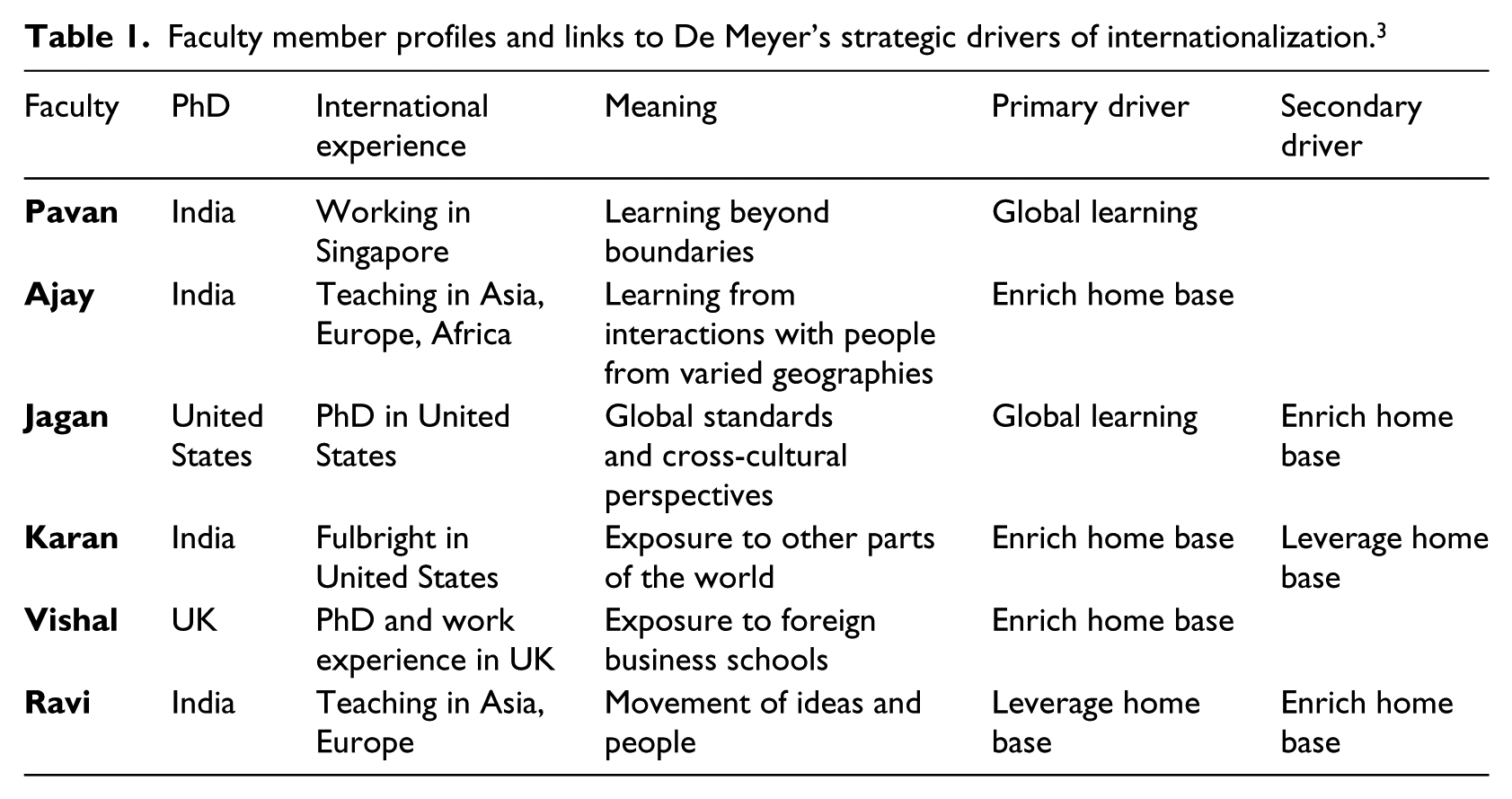
The final research question inquired as to the direction in which faculty members’ views on internationalization would drive institutional or other meta-level internationalization efforts. To this end, we linked each faculty member’s views on internationalization to one or more of the strategic drivers identified by De Meyer (2012). Three of the faculty members in this study held views that linked to the drive to enrich the home base. Ajay, who advocates learning through interactions with others, and also learning how to conduct good academic research, Vishal, who advocates adopting best practices through exposure to foreign business schools, and Karan, who notes the need for India to catch up with the West, held views that clearly link to the drive to enrich the home base. This need for Indian institutions to catch up with international standards is considered important in order to generate a workforce skilled enough to allow the Indian economy to reach its potential (Mitra, 2010).
Two faculty members held views that linked to the drive for achieving global learning. Pavan, who advocates holistic learning, and Jagan, who advocates the development of cross-cultural perspectives, held views on internationalization linked to the desire for global learning. Only one faculty member’s views strongly linked with the drive to leverage the home base by exporting education from India through a low-cost model. The links between faculty members and the strategic drivers posited by De Meyer (2012) are shown in Table 1. Thus, for this set of faculty members, the drive to enrich the home base is dominant, followed by the drive for global learning, with the drive to leverage the home base not being given much priority in the context of internationalization motivations. If this set of faculty members is representative of their institution, it is likely that the institution, being faculty driven, would exert efforts that represent this “portfolio of drivers” (De Meyer, 2012: 340). This is important to know, because although all institutions are affected by the same processes of globalization, they contribute in different ways to it (Beerkens, 2003). As other researchers have noted, “there is no ‘cookie-cutter’ approach” toward internationalization of management education (Kedia and Englis, 2011: 331).
Faculty member profiles and links to De Meyer’s strategic drivers of internationalization. 3
Conclusion and limitations
This study set out to gain an understanding of how Indian business school faculty develop their views on internationalization. We put forward four research questions to determine: what faculty views on internationalization were; how faculty came to hold these views; whether they were favorable or not; and how these views might drive the internationalization efforts of their institutions. The results provided significant insights that helped answer these questions. We found that faculty views on internationalization vary significantly, and are essentially unique for each faculty member. We also found that these views are heavily influenced by their individual experiences with internationalization. By linking these views to the strategic drivers posited by De Meyer (2012), we concluded that the motivation to enrich the home base was the primary driver collectively, followed by a desire for global learning. We expect that these dominant drivers will have a significant impact in the future on the internationalization process of this particular business school and of similar management institutions.
The study has several limitations. First, we looked at only one aspect of the Indian higher education system, namely management education. It is quite possible that the views of faculty members in other fields will differ from those of business school faculty and, as such, caution must be exercised in attempting to generalize the findings of this study. Second, the faculty members who participated in this study are affiliated to a leading and prestigious business school in India. Thus, the views expressed in this study represent the views of the elite in Indian management education, which may not be representative of Indian business schools in general. Third, we did not include faculty members with more limited international experience. Their views on internationalization are likely to differ considerably from faculty with significant international experience. Some other limitations have been discussed in the previous section as well. These can be addressed in future research.
Footnotes
Declaration of Conflicting Interests
The author(s) declared no potential conflicts of interest with respect to the research, authorship, and/or publication of this article.
Funding
The author(s) received no financial support for the research, authorship, and/or publication of this article.