



Abstract
Globally, international student recruitment has become one of the prominent topics of higher education. In addition to the leading native-speaking English world, several non-native-English-speaking countries have reshaped their higher education system to attract more international students. Finland is one of the non-native-English-speaking countries having instituted a change in international student recruitment policy. This study seeks to improve the understanding of the experiences of international students in non-native-English-speaking countries by focusing on postgraduate-level students at a selected university in Finland. Following a phenomenological viewpoint, 11 students were interviewed on their motivations and expectations for studying abroad, and what challenges they have encountered. The findings indicate that education quality and free higher education are important motivations for choosing to study abroad in Finland. Moreover, international students encounter academic, social, financial and psychological challenges and have concerns about their future career in a non-native-English-speaking country.
Keywords
Introduction
International student experiences have been widely examined in the literature. A considerable number of studies have focused on understanding the patterns of motivations behind one’s choice of destination. Starting with McMahon (1992), student motivations have been mainly reviewed through a push–pull model that explains the decision-making process by taking into account the social, economic and academic circumstances in sending and receiving countries as well as selected institutions (Chen, 2008; Maringe and Carter, 2007; Mazzarol and Soutar, 2002; Oliveira and Soares, 2016). Some scholars, on the other hand, explored the practical problems encountered by international students during their experiences in their new academic and social environments. A broad range of obstacles, including: (a) academic challenges, such as dealing with language requirements and lack of sufficient research support; (b) socio-cultural and psychological problems, such as culture shock, adaption, isolation, loneliness and discrimination; and (c) financial difficulties related to tuition fees, funding and daily life expectations, have been covered in these studies (Andrade, 2006; Grayson, 2008; Gu et al., 2010; Harman, 2003; Lee and Rice, 2007; Rienties et al., 2012; Russell et al., 2010; Sawir et al., 2008; Sherry et al., 2010; Yusoff, 2012).
Most of this scholarly work, however, has concentrated mainly on native-English-speaking countries, as the USA, the UK and Australia have dominated the international student market for a considerable length of time (Chen and Barnett, 2000; OECD, 2013). On the other hand, as several scholars, including Ahmad and Buchanan (2017), Knight (2011), Jon et al. (2014) and Marginson (2011), have emphasised, a considerable number of non-native-English-speaking countries have in recent years invested heavily in educational reforms in a bid to become regional hubs for higher education. Hence, the number of international students in Asian countries, such as China, Malaysia, the Republic of Korea, Qatar, Singapore, Turkey and the United Arab Emirates, has witnessed a significant increase (UNESCO, 2016). Similarly, countries in the Nordic region are considered strong options for studying abroad due to their level of welfare, education quality and programmes taught in English (Airey et al., 2017; Lundahl, 2016; Nordic Council of Ministers, 2013; Saarinen and Taalas, 2017). Thus, changes in the policies of international student recruitment have also gained attention in Nordic countries.
Finland finds herself as one of several Nordic countries that has begun to implement a more market-oriented approach, discarding the traditional no-tuition-fee policy for non-European Union (EU) international students starting in 2017 (Cai and Kivistö, 2013; Kauko and Medvedeva, 2016). However, similar changes in other Nordic countries, such as Denmark and Sweden, have resulted in fluctuations in their numbers of international students (IIE, 2016). Considering other regional examples, concerns have been raised about the future of international student recruitment for Finland in the native-English-dominated market during the planning and implementation of the policy change (Aarrevaara et al., 2009; Cai, 2012; Cai and Kivistö, 2013; Kauko and Medvedeva, 2016; Schatz, 2015; Weimer, 2013). In addition, since the majority of related studies have focused on the native-English-speaking world, the current literature lacks sufficient research providing a comprehensive understanding of individual motivations, experiences and expectations in non-native-English-speaking countries. Also, most of the published research on international students has not considered students’ level of study as a point of focus, tending instead to examine postgraduate experiences together with undergraduate ones (Abdullah et al., 2014). Therefore, greater attention needs to be given to the experiences of postgraduate international students in Finland as a non-native-English-speaking Nordic case in line with the changing higher education policies.
The main purpose of this study is to provide insight into international students’ experiences in Finland. In order to examine students’ views in detail, 11 international postgraduate students studying at a selected university were interviewed and their experiences studying abroad were solicited. Following a phenomenological viewpoint, the students were specifically asked about: (a) their motivations leading them to study in Finland and at the selected university; (b) the challenges they have encountered while abroad; and (c) their future plans and expectations upon finishing their education in Finland. After conducting a thematic analysis of the interview data, the findings were discussed in light of the related literature. The following section summarises the recent developments related to international student recruitment in Finland.
International student recruitment in Finland
Finland is one of the Nordic countries in which international student recruitment policies have gained an important place on the higher education agenda. According to the Finland Ministry of Education, one of the strategic aims of the country’s higher education society is to increase the number of international students in order to: (a) promote a genuinely international higher education community; (b) increase quality and attractiveness; (c) export education as expertise; (d) support a multicultural society; and (e) instil a sense of global responsibility (Ministry of Education, 2009). Finnish authorities also consider higher education to be an exportable industrial tool, encouraging higher education institutions (HEIs) to generate income through a more market-oriented approach for international students and programs (Cai, 2012; Cai and Kivistö, 2013; Kauko and Medvedeva, 2016; Schatz, 2015). Hence, in 2010, the government started a five-year tuition trial program for HEIs that gives them autonomy in charging fees from non-EU students seeking master’s degrees in English-taught programmes (Nordic Council of Ministers, 2013). After the trial evaluations, the Finnish parliament passed new regulations for the university act, rendering tuition fees mandatory for non-EU/EEA (European Union/European Economic Area) origin bachelor’s and master’s students starting from Autumn 2017 (Finnish National Agency for Education, 2017).
The new tuition fee regulation has brought a number of contradictory reactions regarding the future of international student recruitment in Finland. First, the trial period and evaluations were expected to be more integrative since the number of institutions and programmes included in the process were considered limited (Nordic Council of Ministers, 2013). Furthermore, developing market-oriented higher education strategies in a country that had traditionally highlighted its free education would need careful and multifaceted considerations and comprehensive policy evaluations. However, the implementations conceived by authorities have been questioned in terms of these needs, and concerns have been raised related to the future of international student recruitment in Finland, especially taking into account the adverse experiences encountered in Denmark and Sweden (Aarrevaara et al., 2009; Cai, 2012; Cai and Kivistö, 2013; Kauko and Medvedeva, 2016; Schatz, 2015; Weimer, 2013).
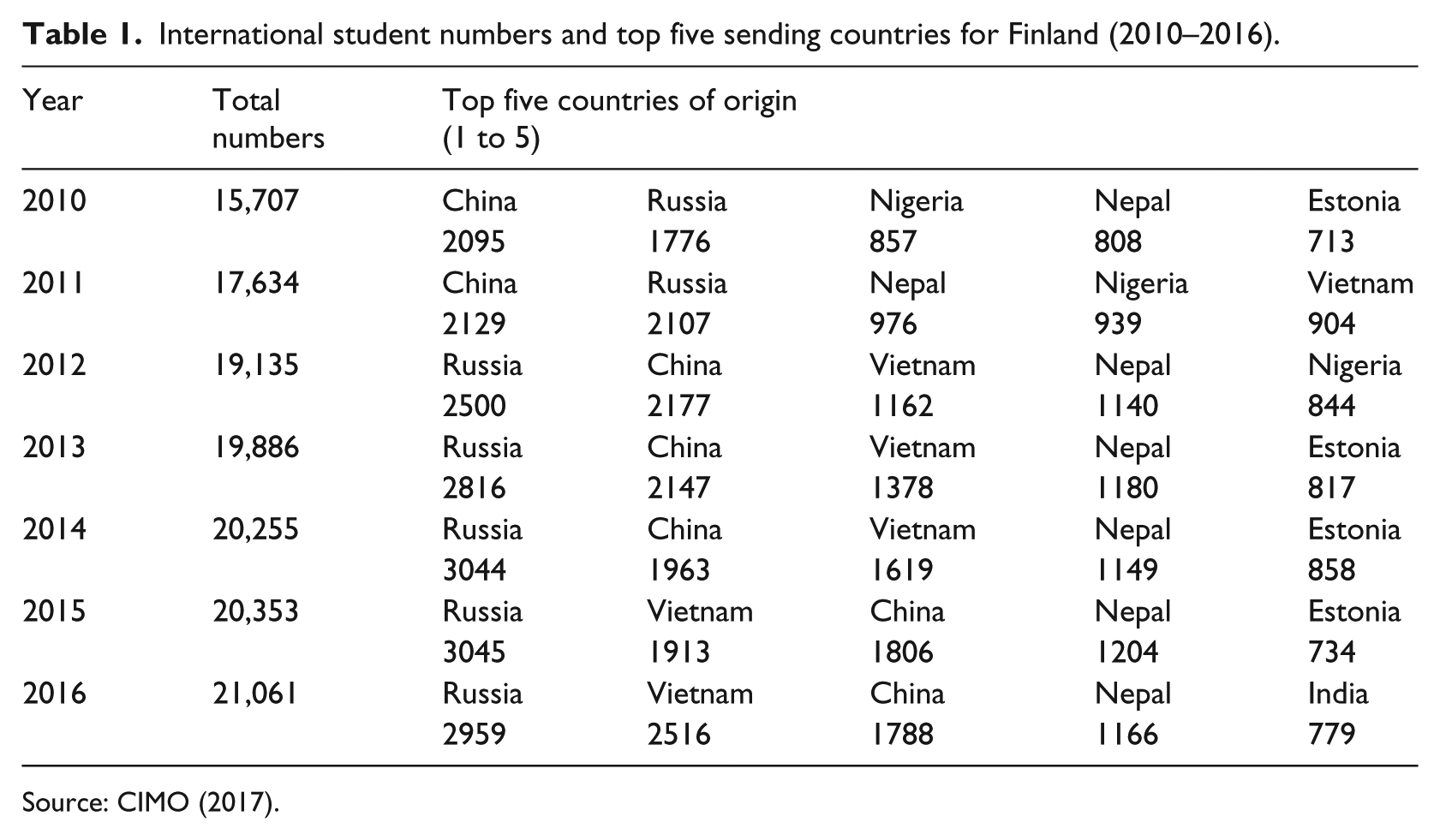
While the number of international students has continued to grow, a drop may be expected over the upcoming years since a great majority of international students in Finland originate from developing African and Asian countries and free education is considered an important motivating factor by these incoming students (Cai and Kivistö, 2013; Kärki, 2005). Table 1 shows recent changes in the total numbers of international students studying in Finland and the top sending countries of these students between 2010 and 2016.
International student numbers and top five sending countries for Finland (2010–2016).
Source: CIMO (2017).
Considering the previous no-tuition-for-all policy, it may be concluded that the geographical and economic conditions of the top sending countries shown in Table 1 were consistent with one of Finland’s previously espoused internationalisation goals, which was explained as the global responsibility of enhancing education opportunities for students from developing and lower economies (Ministry of Education, 2009). However, the new policy on charging non-EU students tuition fees should be carefully considered in terms of its effect on international student recruitment since the great majority of international students in Finland originate from outside of the EEA (CIMO, 2017), and free education is accepted as one of the most important rationales in non-EU/EEA students’ choice of Finland as their study-abroad destination (Cai and Kivistö, 2013; Kärki, 2005). Within the changing national and global context, the following questions should be considered: ‘Which objectives concerning international student recruitment will be prioritised in the future?’ and ‘Which strategies will be followed and which actions will be implemented to achieve these objectives?’ Hence, if the higher education society of Finland has decided to compete with global opponents by adopting a more market-oriented approach in its international student recruitment practices (Cai and Kivistö, 2013), then it is expected that international students’ motivations and concerns should be given greater consideration; as Kärki (2005) noted, students would demand more value for their money once they were required to pay for their education.
Conceptual framework
One of the well-known conceptualising efforts toward international student experiences is the push–pull model, which examines the destination choice of international students while taking into consideration the characteristics of sending and host countries and institutions. Considering student movements to the USA in the 1960s and 1970s, McMahon (1992) examined the international student flow from developing to developed countries. According to her model, pushing factors are related to the sending country’s conditions and include the country’s economic engagement with the world system, her level of prosperity and the educational opportunities created by the government. The pulling factors, on the other hand, are more linked to the hosting country’s conditions and are related to economic growth, financial support provided for international students and cultural/political links with the sending country (McMahon, 1992).
Drawing on McMahon’s (1992) framework, Mazzarol and Soutar (2002) examined those factors influencing the decision process of Asian international higher education students in Australia, and Chen (2008) studied the motivations of international students seeking education in Canada. Their studies indicated that students, in deciding their destination for studying abroad, take into account such factors as living costs, future employment opportunities, multicultural environment, safety and social life conditions in the host country, on the one hand, and the reputation of the selected institution and program, on the other (Chen, 2008; Mazzarol and Soutar, 2002). According to the aforementioned studies, the destination choice of international students can be explained in three fundamental steps: (a) deciding to study abroad instead of staying in one’s home country due to push factors; (b) choosing one’s destination country after taking into account pull factors; and (c) selecting the institution in the host country after considering distinctive pull factors, such as the quality of the program and the financial circumstances of the institution (Chen, 2008).
Although the push–pull model emerged from native-English-speaking countries, it has been employed for several non-native-English contexts in the recent literature (Li and Bray, 2007; Oliveira and Soares, 2016; Wilkins et al., 2012). The model has provided a useful framework for understanding international students’ motivations and the flow from developing to developed countries. Considering the high numbers of international students from less-developed countries (see Table 1), it is considered appropriate to examine the Finland context in terms of student motivations.
On the other hand, the push–pull model may, in some circumstances, be limited in its explanatory capacity. First, the model is considered less useful when the purpose is to broadly understand individual students’ personal experiences and motivations (Lee, 2008; Li and Bray, 2007). Moreover, there is also a considerable amount of student flow from developed countries to Finland in addition to students from the less-developed world (CIMO, 2017). The push–pull model often focuses on patterns that flow from developing to developed countries and lacks explanation for different patterns of movements. The model is also limited in its power to link the political economy with students’ expectations (Cantwell et al., 2009). Therefore, further studies were found to be needed to broaden the conceptualisation of this research.
At this point, the study carried out by Cantwell et al. (2009) provided additional insight into the conceptual understanding. In their study, the authors examined the orientations of international students in Mexico, preferring to use the term orientation as they aimed to explore the personal dispositions, experiences and expectations of international students in a broader aspect. Cantwell et al. (2009) briefly defined these three dimensions as follows: (a) dispositions refer to students’ general opinions on their studies and the rationales on their choice of country, institution and program; (b) experiences refer to challenges that the students confront during their studies, especially difficulties regarding how they are treated; and (c) expectations refer to students’ hopes and future aims in terms of their educational and occupational achievements and acquisitions. Their findings indicated that scholars should consider what effects political economies and different patterns of global student flow entail in order to understand the diverse experiences of international students seeking education in different country contexts (Cantwell et al., 2009).
Methodology
In order to understand the diverse individual realities and experiences of international students, a phenomenological qualitative design was employed for the current study (Patton, 2002). The participant group consisted of 11 postgraduate students (four master’s, seven doctoral) who were studying at the same university in Finland during the study’s execution. Some of the doctoral-level participants had also completed their master’s program at the same university. Data were collected using a semi-structured interview form composed of 14 questions soliciting responses on participants’ background, motivations and future expectations as well as the problems they have experienced during their time in Finland. Potential participants were invited to take part in the research via an email message explaining the aims and basic procedures of the research. Each interview lasted between 30 and 60 minutes, and the conversations were recorded after obtaining participants’ permission. Recorded interviews were transcribed by coding the participants with numbers (e.g. P1, P2, P3), and the transcription documents were checked for language and grammar by an English language expert before starting the analysis.
The collected data were analysed according to the thematic analysis approach. Thematic analysis is a qualitative data analysis technique that allows the researcher to interpret the collected data by developing themes and principal categories in order to condense content into key ideas (Boyatzis, 1998; Marshall and Rossman, 1999). The analysis process was implemented in accordance with the phases explained by Marshall and Rossman (1999). First, the data were organised and iteratively read in an interpretive manner in order to gain familiarity with and to understand the content better. During the readings, patterns in the collected data were noted by focusing on shared experiences of the interviewees, and these patterns were used together with previous conceptual studies to guide the initial theme and category generation process. By using the emergent themes and categories, the interview data were coded using data analysis software. The coded data were tested through re-readings along with previous conceptual and empirical studies. In addition, two higher education researchers were asked to check the analysed codes. Some of the codes, themes and categories were changed, modified or combined during these phases in order to maximise trustworthiness (Marshall and Rossman, 1999).
The limitations of the study should be taken into account while interpreting the results. As Lee and Rice (2007) emphasised, due to potential cultural misconceptions in a new country context, lived experiences might be shared subjectively in cross-cultural interviews. Considering the different backgrounds and stories of the interviewees, subject sensitivity toward lived experiences should be taken into account while interpreting the findings. Also, the findings of this study are based on interviews with 11 international postgraduate students selected from a single HEI in Finland. As such, it should be understood that the study’s aim is not to evaluate Finland’s higher education system or Finnish society in regard to international students’ experiences. It is quite possible that there exist other students holding additional, different or even opposing views either at the same university or at other universities in Finland. Moreover, since the participants interviewed in this study had registered to their respective institution and program before September 2017, they were not directly affected by the changing tuition fee policy. As a result, the student motivations and experiences in this study were delimited with the data collected from interviewed subjects.
Findings
Taking Cantwell et al. (2009) into account, the findings were introduced under three main themes: (a) motivations – rationales for selecting Finland as a study-abroad destination; (b) challenges – problems faced during one’s time as a student in Finland; and (c) future plans – educational and occupational expectations after completing education. Emerging sub-themes were identified according to participants’ experiences. Figure 1 presents a summary of the findings.
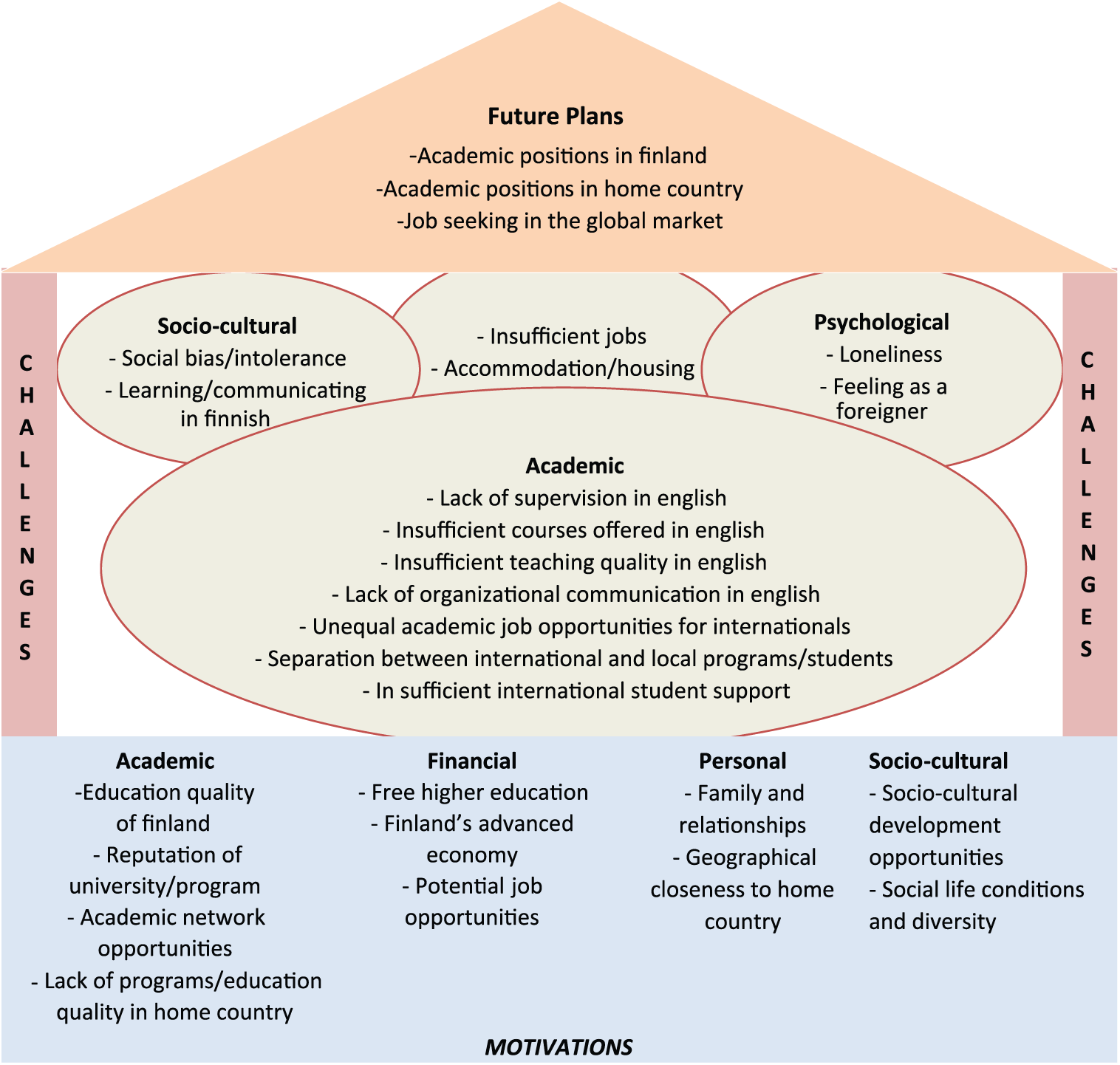
Findings related to international students’ experiences in the selected Finland case.
Motivations
Academic motivations
As can be seen in Figure 1, several participants underlined the importance of academic motivations in explaining their rationale behind choosing to study abroad in Finland. One of the academic motivations observed to be held by the participants was the quality of Finnish education (P1, P5, P7, P11). Students emphasised the role of information channels advertising Finland’s education and school system in their attraction. One student, for example, stated that s/he had been curious about Finnish education and decided to explore before making his/her decision to study in Finland, stating, I watched many documentaries about Finnish education, the energy in the class. I wanted to feel this, to be in the class and say myself “I am in a Finnish class”. I was curious and I have the chance to explore. (Master’s, North America)
University reputation and program quality were also indicated as academic motivations (P4, P6, P9, P11). Students used such words as “international standing”, “the best” and “famous” to describe how they viewed the reputation of their university and program. Some students also referred to the lack of study opportunities in their home country for their field to explain their motivation to study abroad (P9, P10). These students indicated that both Finland and the program at the university in question met their educational needs in their field of study. This view is exemplified by one student as follows.
I chose Finland and this particular program because I’m studying [field of study]. And it is not so huge in [home country]. I can’t do this at home. So, I had to look elsewhere. And the particular program here, the description on their website was what I was looking for. (Master’s, Eastern Asia)
Moreover, some interviewees underlined their need for building academic networks while explaining their motivation to study abroad (P2, P9). These students noted that while developing academic networks was difficult in their home country, they believed Finland to be an appropriate option. A doctoral student, for example, commented, I hoped that it would give me contacts. Because it is very important in academic environments not to be isolated, especially [if you] come from a small country. It’s really important to have a good network that you can connect and research with. (Northern Europe)
Financial motivations
Free higher education/no-tuition policy was one of the most important financial motivations for those participants seeking inexpensive study options (P1, P4, P5, P7, P10). These participants indicated that they needed to consider low-cost options to study abroad since they were funded by their families or by personal income. Moreover, some interviewees who had previously studied as international students in native-English-speaking countries, such as the US, the UK and Australia, underlined the importance of Finland’s free higher education policy in their decision, comparing tuition costs in Finland to tuition costs in those countries (P4, P7, P10). For instance, a student who had received his/her bachelor’s degree from an Australian university made the following comment.
Tuition was a huge factor. For instance, I could have chosen Australia. But the tuition was increasing. It was getting very expensive to study in Australia. International students have to pay like three times more than locals. And, that was a huge amount of money [for me]. (Master’s, Eastern Asia)
An advanced economy and potential job opportunities were the other financial rationales stated by two participants (P5, P10). These participants emphasised the economic conditions and job opportunities in expressing their desire either to work in Finland after graduation or to receive a better education in their specific field of study. Citing the needs in his/her field, one student studying technology-related subjects cited Finland’s advanced economy as an important point influencing her/his decision, stating: ‘[Finland] is already an advanced country using technology in all levels and sectors: education, business, university, organisational levels. I felt that okay, it’s good’ (Doctoral, Southern Asia).
Socio-cultural and personal motivations
Socio-cultural development opportunities were also emphasised by some of the participants as a factor pushing them to study abroad (P5, P6). Participants expressed their desire to ‘know about the world rather than just their home country’ and to ‘get to know different cultures, people and education systems’. Some of these socio-cultural rationales can also be considered personal, as the participants underlined their personal background, characteristics and mindset while expressing the source of their desire to study abroad. For example, social life opportunities and diversity present in the selected city were cited as a personal/socio-cultural motivation to study in a particular destination in Finland (P1, P4). Referring to her/his personal prior experiences as a migrant student in another country, a doctoral student from Eastern Europe stated that s/he had chosen Finland and, more particularly, the university in question because of the immigrant population, commenting: ‘There are more immigrants in this area. It is easier for immigrants to adjust here. So, I picked [name of the city]’.
Having noted that socio-cultural and personal motivations can be related in some cases, several students also emphasised particular personal reasons that affected their decision in choosing a place to study abroad. For instance, some participants stated that their personal relationships and significant others affected their decision-making process (P1, P6). Moreover, a doctoral student from a Northern European country referred to the geographical closeness of Finland to her/his home country and her/his family situation, stating: ‘Because my life didn’t allow me to move away for 4 to 6 years, so it is really convenient to come here’. Another student commented on her/her personal and psychological situation, expressing, ‘I decided to study abroad since I thought I needed to recharge myself’ (Master’s, Eastern Asia).
Challenges
Academic challenges
Lack of supervision and courses in English was emphasised as an important challenge by many interviewees (all except P7, P10, P11). A doctoral student stated that s/he felt annoyed because ‘in the whole faculty, there is only one supervisor who offers PhD seminars and supervising in English’, adding What still really makes me angry is that I got accepted here as a PhD student a year ago, and since then, there has been only one course offered in English at the department. All the other courses, credits and studies I got through conferences or writing articles, but basically there is no [English] teaching at all. (Western Europe)
Another doctoral student made a similar comment.
It is not really good to be an international student [here]. Because there are not so many English courses that you can take. That is the problem. Okay, you can take [courses] from other universities or you can complete your coursework by going to international conferences. But in the faculty, there are not so many courses taught in English. In recent years, it has improved, but when I entered, there were just few courses I could have taken. And then, for that reason, I took some courses outside the faculty. But I’m afraid it’s not well structured. (Southern Asia)
Insufficient teaching quality in English was another academic challenge experienced by some participants (P1, P4, P10, P11). Participants expressed that those teachers with less experience lecturing in English sometimes preferred speaking Finnish in class or asking for help from Finnish students to explain the subject in English (P4, P10). In addition, a student made a comparison between working with international professors and Finnish professors in class, expressing the following.
With the international teachers, I think it’s easier. Because I guess they came from the same educational background, and I could follow that. Whereas with the Finnish lecturers, it’s a bit difficult, I guess. Because in terms of the language and their not being very fluent, it can be a barrier sometimes, you know, in delivering a lecture. So, I guess that is the difficulty. You have to be understandable. It has to be easy for people to understand you. (Master’s, South-Eastern Asia)
Some participants stated the lack of organisational support and staff in guiding international students as being a challenge during their adaptation (P4, P8, P11). A doctoral student stated that s/he could not find sufficient support from the institution regarding her/his visa problems since most of the staff were native Finlanders and did not have sufficient knowledge regarding immigrant issues (P4). Another doctoral student from Western Europe referred to similar adjustment problems, articulating that since it was her/his first experience abroad, s/he faced difficulties accessing the necessary information on how to do specific tasks correctly (P8). Moreover, a master’s student who had previously studied in Australia underlined the same problem by comparing her/his time in Australia to her/his current experience, making the following comment.
For example, in terms of university life, it was a bit more structured in Australia. There was someone acting as an academic officer who was there to guide you. Because you are a new student and you need support about that kind of stuff. And I think there was a very important role for that. Here, there is an academic office, but what I found was a lot miscommunication and no communication going on. A lot of the information was still in Finnish. So that is a huge barrier, because we can’t access the information on our own. (South-Eastern Asia)
Similarly, the lack of using English in organisational communication was indicated by nearly all of the students (except P1, P11). Several students emphasised that they had experienced difficulties accessing necessary information on academic and social events in English. Commenting on the language barrier, a doctoral student made the following observation.
I think the people who are working here don’t know English well enough. So, there’s always the opportunity to ask in Finnish and you get the answers. And not knowing Finnish is sometimes a problem. For instance, they send information to the PhD mailing list and it’s sometimes only in Finnish and Swedish, and it may be confusing for the people who don’t understand these languages. (Northern Europe)
Another challenge underlined by the participants was the barrier between international and native Finnish students (P2, P3, P8, P10, P11). Participants underlined the language barrier and the isolated nature of international and local programmes. For example, a master’s student commented on the language barrier, stating the following: ‘A lot of the staff speaks in Finnish. So a lot of international students are excluded from such things as mailing lists. All of the student mailing lists and the information about society and other things are all in Finnish’ (South-Eastern Asia).
Regarding the barrier between international and local programmes, a doctoral student said, ‘International programs are very segregated from Finnish programmes. So, there is no really mixture between English international activities for international students, which means basically foreigners versus Finnish students’ (Western Europe). As a solution to this problem, several participants recommended units and activities aiming to create opportunities to meet with and learn from other people (P2, P3, P6, P7, P8, P11) so as to facilitate and accelerate integration between international and local students.
Several doctoral students emphasised that they believed there to be inequalities between local and international students in academic job opportunities (P3, P4, P5, P7, P10, P11). A doctoral student, for example, stated that equality and equal opportunities were a problem and were ‘still more facilitated for the local people than for internationals for different reasons’ (Southern Asia). When s/he was asked to explain the reason behind her/his idea, s/he made the following comment.
It is not easy to explain, I don’t know. Probably, I can’t comment on this issue because it is very personal, and everybody can see different things. If everything is equal in terms of quality, for instance, if you were to apply for funding from somewhere and you had the same qualifications as a local [Finlander], it’s more likely to be given to a [Finlander] than [an international student] with equal qualifications. I’m not sure, but I guess that it’s like this, but I can’t expand on it more. (Southern Asia)
According to another doctoral participant, the university is not made accessible enough for international students and that international students could be treated unequally in certain circumstances. S/he provided an example of her/his friend in the same faculty.
In her [participant’s friend] group, half of her colleagues are Finnish, and the others are European. She told me that she’s the only person that supervisors don’t like talking with because the supervisors like to talk with Finnish [people] first, and [then] with people from Europe. And, they [participant’s friend] cannot get quality information from the supervisors. Because they want to apply for some position in the group, this kind of information was given to people from Finland first, and then to people from Europe. And, this is a problem. I don’t understand why the supervisor doesn’t like to share information for this position. (Eastern Asia)
Another doctoral participant stated that although s/he wishes to remain at the university after graduation, s/he does not think that it will be possible to do so because local applicants are often preferred for post-doctoral positions over international candidates. Regarding this subject, s/he made the following comment.
Here, I think internationalisation is just in the beginning stage. It’s like they don’t expect you to stay for a long time. They think of [Finlanders] as the in-group, and these [international students] are our guests. And they don’t like to treat us as guests. They ask how long we’re going to stay here, and then, [they react], saying ‘Ohh, that’s so long’. But what if I am going to stay? You don’t allow me to be accepted for a post-doc or a teaching position. But, what if I want to stay? There are still these kinds of boundaries. (Eastern Europe)
Socio-cultural and financial challenges
Some participants cited social bias and intolerance in their social life as one of the challenges that they had encountered abroad (P1, P3, P4, P7). A doctoral student from Western Europe said that during her/his studies in Finland, s/he witnessed social discrimination several times, especially when s/he lived with a partner from South Asia. Noticing that in some cases, students can be treated according to their background, s/he made the following comment.
When you live in [city in Finland], you have these good students who don’t cause problems, who come from a rich background, who can be supported by their parents if they have to be, who learn Finnish so fast that they find a job here, who may have time to learn Finnish and then they can find a job and then sustain themselves or get grants.
The same participant stated that s/he always appeared as a ‘good foreigner’ since s/he was white and came from a country toward which Finlanders held very positive stereotypes. She continued by sharing the experiences of so-called bad foreigners.
If you are, for example of Asian or of African origin and you don’t come from a rich background, and you come here as a student, you first start working very cheap jobs, which don’t require any Finnish, and which enable you to survive. For most of the students, that is in cleaning companies. The problem is that the students often do night shifts, they don’t even have time to learn Finnish, and it’s kind of a vicious circle. Because you have to work at night, you can’t really spend much time studying. And that means your study takes longer, and that means you get even lower jobs. And, at the same time while they are sustaining themselves here, they also have to sustain their families abroad, and very often they can’t get out of doing that. I’ve seen a lot of cases where foreign students either got really depressed or went back home or ended up turning to crime because they just weren’t able to manage, and they never felt accepted as a good foreigner here, or as bringing something to society. (Western Europe)
Discrimination in political speeches and in formal documents was also emphasised in this section as a challenge faced by some participants (P1, P4). A master’s student from North America stated that s/he felt sad when s/he heard hate speech from political figures on TV. Similarly, a doctoral student emphasised the importance of the terminology used in official documents, making the following statement.
For instance, it disturbs me sometimes when I read something in internationalisation documents [that says something] like ‘3rd generation migrant’. There is no such thing. This is pure discrimination. Because there can only be first-generation migrants. A child who was born here can’t be a migrant in this country. If I get citizenship here, there should be no boundary. You’re not allowed to take my background [into consideration] if I have citizenship. I put my best effort in, and then we are all equal. For me this is disturbing. (Eastern Europe)
Another challenge that participants cited regarding social and financial issues was accommodation and housing for international students (P2, P3, P5). Participants emphasised that housing opportunities were limited and, in some cases, could be rather expensive. In addition, the lack of sufficient university facilities was underlined. For example, a doctoral participant expressed the following.
[Name of the university housing organisation] provides apartments for students. Usually, every international student has a right to apply for a room and usually the international students get rooms in shared apartments. So, you have a room, for example 13 m², and you share the kitchen and the bathroom. Now, the truth is that because the money situation is so bad for international students, there are a lot of people who rent out those apartments illegally and move to live with others. I’ve seen apartments where 5–6 people live in 10 m² rooms. (Western Europe)
Personal and psychological challenges
Participants stated several personal and psychological challenges of being an international student. One of these problems was feeling like a foreigner (P1, P2, P3, P4). One master’s student stated, ‘I can hardly consider [the city] as home so far. I think it’s more like a cottage; it’s a place I live’ (North America). Similarly, a doctoral student who had come with her/his family from a Northern European country said, ‘Everyone is so far away, only the three of us [her/his family] are together’, adding, ‘here, I’m a bit like an outsider’.
Some participants indicated that they had dealt with loneliness during their experience in Finland and that they had experienced difficulties meeting new people (P6, P8, P11). Students underlined the need for tools, units and organisations to meet other people. For instance, a master’s student who had previously studied in Australia commented on the challenges in meeting new people, emphasising the importance of a student union in her/his comparison between Finland to Australia. Her/his comment in this vein is noteworthy.
A lot of students party here, and I don’t prefer that. So, it’s a bit difficult for me. In Australia, the international student organisations that I experienced helped me integrate and also make life more enjoyable. But, I didn’t really find those here. There is an international student organisation here, but they don’t seem to be very active. (South-Eastern Asia)
Future plans
The participants were asked about their career plans and expectations regarding the future benefits of their studies in Finland. Some participants originally from Asian countries who were beneficiaries of governmental scholarships stated that they planned to return to their home country for academic positions upon completing their education in Finland (P5, P6, P7). Some of these participants stated that their scholarship was designed as a part of an educational reform program aiming to improve higher education in their home country and that although they would prefer to stay, returning to their country of origin was a pre-agreed upon condition of their scholarship (P5, P7).
Several doctoral students from European countries, on the other hand, stated that they planned to seek academic/researcher/other positions in their home countries, in Finland or elsewhere. (P2, P3, P4, P8). Taking into account some of the cultural and academic advantages present in EU countries, these students often noted that they felt flexible in choosing a place to work following graduation. Some of them, however, were inclined to prioritise Finland over other countries. For example, a doctoral student of Western European origin who had visited several places in Europe prior to studying in Finland commented that s/he had planned either to return to her/his home country or to travel to other European destinations, seeking employment upon arrival. However, s/he experienced a change of heart after having studied in Finland and was contemplating continuing his/her career in Finnish academia as s/he considers her/his new environment as less competitive both academically and culturally and as more manageable overall (P8).
Several participants of Asian and Eastern European origin who did not want to return to their home countries stated that deciding what to do after graduating from a university in a non-native-English-speaking country came with the dilemma of staying or leaving (P4, P5, P11). These participants suggested that if an international student wanted to consider her/his options after graduating from a university in Finland, s/he must either adjust to the society by learning Finnish and understanding the local culture or seek other opportunities in native-English-speaking destinations. At this point, it was commonly underlined that both studying and continuing to stay in a destination abroad after graduation require not only academic and research expertise but also a variety of social, cultural and personal skills. A doctoral student from Southern Asia, for example, stated the following: ‘[In order to decide] you have to consider your resources, your personal and professional skills, your language, cultural understanding, capability of coping with different situations and other available resources in your destination country’. S/he then continued: ‘It’s not only about doing research and studies. It’s also about how we can enjoy our lives, the resources that can make us more happy and productive’.
Similarly, another doctoral participant noted that due to the difficulties related to learning Finnish, s/he wanted to try her/his lot in an English-speaking country after graduation. Her/his comment in regard to this is as follows.
I think in Finland, it [i.e., being an international student] is a major [experience] of survival. Because in other places, it’s okay, people manage with English, that’s okay. But [here], you will still need more than English. There aren’t many events in English. I’ve understood that it’s a priority for international staff and students to learn Finnish [here] in a non-English speaking country, too, if they want to stay. (Doctoral, Eastern Europe)
Finally, some master’s-level participants revealed their desire to seek different job opportunities internationally. One master’s student said, ‘Currently, I was thinking that I’d probably work in an English speaking country after Finland, such as the UK or USA. I don’t want to do a PhD because my plan is to work another 5 or 10 years’ (Eastern Asia). In a similar vein, another master’s student referred to the importance of partaking in an international experience, stating that s/he expected not to ‘be stuck in a few jobs’ after graduation and to seek different opportunities with the flexibility gained through her/his international experiences (P11).
Discussion and conclusion
The aim of this research was to explore the motivations, experiences and future plans of international students in Finland, an emerging non-native-English-speaking destination for studying abroad. The results demonstrated that the push–pull model can be useful in understanding several motivations inciting international students to leave their own country and study in Finland. According to the findings, most of the participants from developing countries started seeking study abroad opportunities because of the push factors related to the academic or economic conditions in their home countries (e.g. lack of academic programmes, education quality or job options). These students tended to choose Finland and the specific university upon consideration of the quality and reputation of the programme and university in question, the cost of education and possible financial and social opportunities in the city in which the university is located. Most of these fundamental considerations appear consistent with the motivations in previous push–pull model studies examining the flow from developing countries to certain more-developed native-English-speaking destinations (Chen, 2008; Mazzarol and Soutar, 2002; McMahon, 1992). On the other hand, different motivations were also witnessed among participants coming to Finland, especially among those originating from developed European countries. These students apparently prioritised more personal motivations in choosing Finland as a destination to study abroad. Some such students also sought to benefit from the academic, geographical and cultural closeness that Finland and her education system shared with their countries of origin.
Having noted varied student motivations based on geographical background, a similar variety can also be shown in statistics revealing the country of origin of international students studying in Finland (see Table 1; CIMO, 2017). These sending-country statistics may imply different patterns concerning international student flow to Finland, namely (a) world economy (e.g. traditional sending developing countries, such as China, Russia and other developed countries from North America), (b) regional interest (e.g. Northern and Western Europe, such as Estonia, Sweden and Germany) and (c) unique country cases (e.g. Nepal, Nigeria, Pakistan and Vietnam). Taking into account the findings in this study together with statistics, it appears that regional, economic and geographical conditions as well as different personal dispositions play a significant role in understanding international students’ motivations. Thus, push–pull factors influencing the destination choice of international students can be expanded by taking into account different language, geographical/regional, governmental and economic patterns of mobility in addition to personal motivations.
This study has revealed that in order to gain a more comprehensive understanding of international students’ orientations (Cantwell et al., 2009), the difficulties that such students face and the future expectations that they hold need to be considered in addition to their motivations. As can be expected in a non-native-English-speaking case, academic and language-related challenges were widely shared by international students in the study, regardless of their personal and geographical background. Similar concerns were also noted in previous studies examining non-native-English-speaking cases, such as in China (Li and Bray, 2007), Malaysia (Ahmad and Buchanan, 2017), the Netherlands (Rienties et al., 2012), South Korea (Jon et al., 2014; Lee et al., 2017) and Turkey (Kondakci, 2011) as well as in research focusing on different aspects of international student experiences in Finland (Cai, 2012; Cai and Kivistö, 2013; Kärki, 2005; Kauko and Medvedeva, 2016; Schatz, 2015). The results of this study, however, have emphasised the importance of perceived inequalities and intolerance in social, financial and educational environments in shaping international students’ experiences and future plans. As argued in several previous studies (Cantwell et al., 2009; Lee and Rice, 2007), the experiences and expectations of international students may vary according to their geographical origin and personal cultural background. Acknowledging the role of these characteristics, this study has also demonstrated that, in terms of non-native-English-speaking destinations, international students may also evaluate their destination choice and subsequent future plans by comparing the challenges they have faced while studying in their current country with their previous experiences in native-English-speaking countries. It is, therefore, recommended that the adjustment conditions in students’ destination countries and their previous international experiences be included among those factors influencing international students’ orientations in different countries.
According to the findings of this study, together with the concerns revealed in previous research (Aarrevaara et al., 2009; Cai, 2012; Cai and Kivistö, 2013; Kärki, 2005; Kauko and Medvedeva, 2016; Schatz, 2015; Weimer, 2013), Finnish policy-makers and practitioners should ask and seek answers to a number of pertinent questions regarding international student recruitment. The new international student tuition policy might promote the international export of education and thereby cause a shift from the traditional equity and access-based higher education understanding to a more market-oriented approach in Finland (Cai and Kivistö, 2013; Ministry of Education and Culture, 2010; Schatz, 2015). If so, further answers to the following question should be sought: ‘How prepared are Finnish higher education institutions for this new reputation-based global competitive market?’ Moreover, with the new market-oriented higher tuition fee policy, the following should be asked: ‘What specific priorities and characteristics of Finnish higher education will help Finland become an alternative destination to native English speaking countries for international students?’ Considering the global opponents and student needs, the following question is of pertinence: ‘What strategies have been promoted in terms of the student diversity in programs, the curriculum, organisation and both equal access and employability for international students?’ It could be beneficial for Finnish HEIs to reconsider their position and think about how they can better prepare themselves to adjust to the new more market-oriented approach and meet students’ diverse needs and expectations.
The results also provide policy and application-related points to consider regarding the future trajectory of international student recruitment for other non-native-English-speaking countries. Due to the recent social, political and economic changes in many leading native-English-speaking destinations, it is expected that non-native-English-speaking countries will become more attractive for international students in the near future (Choudaha, 2017; De Wit and Hunter, 2015). On the other hand, this study has demonstrated that while an enhanced use of English in academic settings in addition to education quality and costs are, in many cases, of significant importance in attracting international students, factors influencing international students’ satisfaction and future plans go beyond these academic requirements. It appears that creating equal and genuinely tolerant, multi-cultural social and educational environments is also crucial to enrich the experiences of international students. Moreover, as prior research has emphasised, those countries in which legislative structures enable international graduates to be integrated into the job market constitute attractive options for international students (Shachar, 2006). Although both the USA and the UK are traditionally accepted as archetypes of successful integration (Shumilova and Cai, 2016), new players have begun to emerge in the global talent and student competition market due to the changing economic, political and social environment in these two traditional destinations (Choudaha, 2017; De Wit and Hunter, 2015). That countries such as Australia, Canada, New Zealand and Germany have recently instituted legislative changes facilitating highly skilled international workers to migrate into each respective country and enter her workforce has enabled them to become stronger post-graduation work and study alternatives for international students (Shachar, 2006). In several of these destinations, governments have also tended to deepen their financial ties and collaboration with regional and global student markets (Chen, 2008). For instance, Australia has continued to extend her economic, social and educational relations with several Asian countries to recruit a greater number of students from the region (Welch, 2016). Thus, stronger legislative structures facilitating the integration of international graduates into a specific country’s job market and economic collaboration with regional and global student markets may aid in not only attracting more international students from different source countries but also strengthening the national economy of the host country with a talented, multicultural workforce. As a result, non-native-English-speaking countries should approach international student recruitment from a multifaceted perspective considering all academic, economic, legislative, political, social, personal and psychological dimensions in order to reach anticipated growth in quantity and quality.
The purpose of this paper is to provide insight into the motivations, challenges and expectations of international students in Finland. The scope of this study is limited to a specific number of participants in terms of the qualitative research method it follows. In spite of its limitations, the study certainly adds to our understanding of international students’ experiences in non-native-English contexts and brings to the fore several noteworthy questions about evolving policies in several higher education destinations around the world. Further attempts to explore international students’ motivations, experiences and expectations while focusing on different country cases and levels of study in addition to using wider samples might reveal broader explanations concerning this specific area of study.
Footnotes
Acknowledgements
The author would like to thank Dr Hasan Arslan and Dr Fred Dervin for their recommendations on how to design this research.
Declaration of Conflicting Interests
The author(s) declared no potential conflicts of interest with respect to the research, authorship, and/or publication of this article.
Funding
The author(s) received no financial support for the research, authorship, and/or publication of this article.