



Abstract
Internationalization of higher education affects academic faculty in various ways. However, the internationalization experience of faculty in Latin America, a region concerned with internationalization only quite recently, has not yet been sufficiently researched. This research gap is addressed with this qualitative interview study. Five Colombian academics relate their experiences of internationalization, with a key focus on their own international mobility and the effects this has had on their professional lives and their institutional environment. Qualitative content analysis resulted in the identification of the four wider themes of mobility as personal professional enrichment, the ability to make an impact within Colombian higher education and, on the institutional level, to engage with the concept of internationalization at home and revisiting the role of academics in advancing internationalization. These themes are discussed against the background of literature on faculty mobility and the specific situation of emerging countries.
Introduction
In recent decades, internationalization (e.g. Knight, 2003a) has evolved into a comprehensive field for both practice and research within higher education. International mobility, including that of faculty, has been identified as one area that takes different shapes and follows different intentions (Kehm and Teichler, 2007). It constitutes a central feature of internationalization for individuals and higher education institutions alike (Probst and Goastellec, 2013), referring to a ‘non-permanent border-crossing: for temporary study, for study of a whole programme, for mid-career international experience or employment in another country for a while’ (Teichler, 2015: 11). Prior research has focused on, for example, (temporary) faculty teaching abroad (e.g. Bodycott and Walker, 2000; Hamza, 2010), early career researchers in their doctoral or post-doctoral studies (e.g. Kim et al., 2011; Zhou, 2015), and foreign-born faculty (e.g. Jepsen et al., 2014; Pherali, 2012); and it has also considered the effects arising out of international faculty mobility (e.g. Andújar et al., 2015; Jonkers and Cruz-Castro, 2013).
However, analysis of the specific experience of long-term mobility and its effects on faculty from the so-called academic periphery — that is, the divide between higher education systems in the global North and South and dependency of the latter (Altbach, 2011), and including Latin America — is limited. Thus this study seeks to answer the following questions:
How do faculty members from a peripheral country, Colombia, experience prolonged international mobility as an element of internationalization of higher education?
Which implications from internationalization do they perceive in their professional life in higher education upon their return?
Interviews were conducted with five Colombian professors who spent extensive time abroad — that is, more than a year (Hoffman, 2009: 352) — and then returned to Colombia. Colombia is, next to Argentina and Chile, the third Latin American country considered among the TACTICS countries — Thailand, Argentina, Chile, Turkey, Iran, Colombia and Serbia — referring to potentially expanding and rising higher education systems (Bothwell, 2016). Having entered an economically and politically more stable situation in recent years, the traditionally inward-focused Colombian higher education system (Jaramillo, 2005: 175) has opened up to the world, and hence constitutes an interesting example of a quite recently internationalizing higher education system. Findings from this study provide for complementing and extending the analysis by Berry and Taylor (2014) who carried out the first qualitative in-depth inquiry into the internationalization of Colombian universities from the administrators’ perspective.
In this article, previous research on international mobility of faculty is reviewed and information on the present state of internationalization in Latin America and Colombia is provided. Following the outline of the approach used for the interviews and their analysis, findings are reported, and tentative themes discussed. Concluding remarks locate these against the background of the results of the 2014 International Association of Universities (IAU) survey (Egron-Polak and Hudson, 2014) and identify the acknowledged limitations of the study.
Literature review
International mobility of faculty
When referring to faculty, the term is understood to include ‘professors, associate professors, lecturers or assistant professors who are mainly involved with teaching and research activities in higher education institutions’ (Huang, 2014: 8). Because participants in this present study spent extensive time abroad as early career researchers, literature on research on the experience of doctoral students and post-doctoral researchers is included in this literature review as well.
Probst and Goastellec identify approaches to the analysis of international faculty mobility on the level of the individual with regard to the three topics of mobility patterns; effects on their career and perception of mobility benefits; and, finally, the strategies and motives underlying mobility (Probst and Goastellec, 2013: 124). Supporting this, Teichler and Cavalli state that, [a] look at the role migration and mobility play for the individual clearly suggests that border-crossing in the course of the formation of competences and the course of academic or other research tends to be beneficial for career success, research work and inter-cultural understanding. (Teichler and Cavalli, 2015: 125)
Previous exemplary research has focused on faculty going abroad temporarily for teaching purposes or to develop further their teaching practice, as was the case with the North American female lecturers and administrators in the interview study by Hamza (2010). Participants in her study report this mobility experience to be closely related to initiating self-reflexive processes with regard to their positioning within the classroom, and their own learning and development processes as professionals. This topic is similarly present in the account by Bodycott and Walker (2000), discussing their experience as Western higher education teachers in Hong Kong and recognizing the need for teachers also to adapt to the students in the classroom, and not only vice versa.
When researching doctoral students’ or postdocs’ experience abroad, often in the context of the USA, different foci can be identified. Zhou (2015), for example, identifies different motivations of international students for beginning and continuing their PhD studies. Whilst participants were dissatisfied as a result of unmet expectations or conditions in academia, they reported as having persisted because of intrinsic motivations or the perceived benefits of obtaining the degree. Using human capital theory as an approach, Kim et al. (2011) discuss US doctorate holders’ intention to stay in the USA or to return to their home country. Their samples from three different decades show that stay or return patterns have shifted over time, which the authors explain by push and pull factors, such as employment opportunities in the USA or abroad, or changing immigration laws.
Beyond temporary work assignments or obtaining a postgraduate degree abroad, research has also addressed the specific situation of foreign-born faculty. For example, Jepsen et al. (2014) document the experience of six international academics working in business schools in different countries. Their analysis shows the perceived personal value for these academics — for example, an enlarged ‘social-skill-toolkit’ (Jepsen et al., 2014: 1321) — whilst also indicating that international experience does not per se increase career opportunities in the home country. Pherali (2012) analyzed the professional experiences of seven foreign-born academics in the UK, including himself, and identified the challenges of seeking support, as well as the lack of adequate support structures. Pherali thus showed that the actual experience for international academics can also be accompanied by challenging situations.
Finally, international mobility has been found to influence faculty beyond the sole experience of being abroad, encompassing both positive and negative aspects. Positive aspects included those found by Anderson (2013) where, in Europe, internationally mobile early career researchers make strategic use of their multilingualism in publications in order to foster their individual careers. For Turkish participants in the Fulbright programme in the USA, Engin-Demir et al. (2000) reported that academics improved their English language ability, broadened their perspective and also changed their approach to teaching — all of which also led to developing further their respective institutions in Turkey. Jonkers and Cruz-Castro (2013) showed that Argentinian returning academics demonstrated higher levels of international research collaboration and publication in international high-impact journals. For Spanish returning academics, Andújar et al. (2015) reported that the majority in the sampled group had started to collaborate internationally whilst abroad and continued to do so — whilst also indicating that the likelihood of returning to Spain decreases as the length of the stay abroad increases. Academics who stayed abroad for teaching purposes reported increased sensitivity to cultural diversity and reflections on their teaching practices (Hamza, 2010).
Whilst positive aspects of international mobility are clear, other studies also draw attention to the potentially negative aspects inherent in long-term mobility. For example, Richardson and Zikic (2007) point to the fact that some of the 30 British academics in their study reported challenges related to their personal life situation abroad, as well as the risk that international experience might not translate into career benefits. In their personal accounts as academics returning to Spain, Bielsa et al. (2014) relate challenging periods of adjustment after having been abroad for several years; for example, feeling like ‘strangers at home’ (Bielsa et al., 2014: 76). For Chilean academics who studied their doctorate abroad, Muñoz García and Chiappa (2017) found that mobility is not only understood as physical movement but also entails critically questioning construction of knowledge upon return. Finally, for some cases in his sample of Swedish postdocs returning from abroad, Melin concluded that ‘negative sides relate most often to the process of homecoming and the culture at the department’ (Melin, 2005: 235), but not to the stay abroad as such.
The research reported here serves to inform discussion on various forms of the mobility of international faculty and sheds light on both the opportunities and the challenges that arise for academics. However, comprehensive investigation of the mobility experience of academics hailing from countries that have not yet been in the focus of internationalization research — such as Colombia — is still lacking. As Berry and Taylor (2014) indicate in their study on the perception of internationalization by higher education administrators in Colombia and Mexico, spaces for internationalization policies and activities have been opened, which also affect faculty. However, for both countries, Berry and Taylor state ‘a lack of qualitative data regarding institutional experiences of internationalisation, and especially individuals’ perceptions about the process’ (Berry and Taylor, 2014: 589). Insights on the internationalization experience of faculty from this region complement existing studies and, based on previous research discussed here, provide a new perspective on this topic.
Internationalization in Latin American and Colombian higher education
As little as a decade ago, the editors of an extensive report found it to be ‘the first attempt to analyze the internationalization of higher education both for Latin America and for most of the countries studied. Very little has been written on the topic, and data are scarce’ (Gacel-Ávila et al., 2005: xvii). Further analysis of the region by Gacel-Ávila (2007) emphasized the lack of concerted involvement at the institutional and policy levels with internationalization, leaving it an activity largely detached from the core of higher education. Despite recognizing the overall progress of internationalization, Gacel-Ávila (2012, 2014) maintains her conclusion that it is not yet being strategically and comprehensively picked up in theory and practice in Latin America. Although Latin America is being referred to here as seemingly homogenous, the actual diversity of the respective countries’ higher education systems should not be ignored (Brunner, 2009). Brunner (2009) argues that despite the impulses given by the Bologna process in Europe, for example contributing to a more intense discussion on quality assurance or curriculum design, the region’s varying systems would be unlikely to integrate within such a harmonization process.
Following Gacel-Ávila’s (2012, 2014) and Gacel-Ávila and Marmolejo’s (2016) examples of comparing results from the IAU global survey over time, the IAU global surveys from 2003 and 2014 illustrate Latin America’s shifting foci within internationalization across roughly a decade. According to the 2003 IAU global survey (Knight, 2003b), responding higher education institutions from that region named ‘cultural awareness’ as the highest benefit from internationalization, followed by ‘student, staff and teacher development and standards and quality’ (Knight, 2003b: 9). Interestingly, ‘erosion of cultural identity’ equally constitutes the greatest perceived risk of internationalization, followed by ‘brain drain’ (Knight, 2003b: 10). By contrast, the latest IAU global survey (Egron-Polak and Hudson, 2014) shows that ‘faculty and researchers’ networks are now perceived as the greatest benefit for Latin America and the Caribbean’, followed by ‘improved quality of teaching and learning and increased international awareness of students’ (Egron-Polak and Hudson, 2014: 53). The authors note that, only for this region, faculty and researchers’ networks are cited in the top three expected benefits. The greatest risk is constituted by the fear that only financially secure students will be able to participate in internationalization, followed by difficulty to regulate locally the quality of foreign programmes offered and the ‘pursuit of internationalization partnerships/policies only for reasons of prestige’ (Egron-Polak and Hudson, 2014: 62). Marquina and Ferreiro (2015) emphasize internationalization as being related to inequality between academics within an emerging country. They conclude in their comparative quantitative analysis, which includes Brazil and Mexico, that within emerging countries the involvement in international activities is indeed an element of distinction between institutions and individuals. This is similarly stated by Egron-Polak and Hudson (2014), who show that ‘growing gaps among higher education institutions within the country’ is the second highest perceived societal risk (Egron-Polak and Hudson, 2014: 65) in Latin America and the Caribbean.
The Colombian case
According to Jaramillo (2005), internationalization of Colombian higher education can be depicted as having occurred in three phases: the establishment of universities in the 16th century by the colonial powers; the outgoing mobility of individuals from the 1950s on; and then, beginning in the 1990s, that outgoing mobility as an increasing and ongoing trend within higher education. Recovering from decades of internal conflict and political and societal instability, Colombia actively works towards promoting itself as an attractive study destination, for example through campaigns such as ‘Colombia challenge your knowledge’. 1 For faculty mobility, incoming faculty mainly comes from the USA, Spain, Argentina and Mexico, whilst outgoing mobility is directed at the top three destinations — the USA, Spain and Argentina (Henao and Velez, 2015: 225).
Next to student mobility, a considerable increase in international scientific publications with Colombian authors in the Web of Science™ between 2000 and 2011 is noted (OECD et al., 2012a). These, however, originate from only six universities, three of which are located in Bogotá (Thomson Reuters, 2011, cited in OECD et al., 2012a: 238). Articles included joint publications with researchers from other countries, thus showing that researchers — at least in some universities — are connected to ‘much broader international scientific networks’ (OECD et al., 2012a: 241). Overall, Losada argues that in order to advance research within Colombian higher education universities need to actively engage in ‘international research projects’ (Losada, 2016: 84) and ‘collaborations with top institutions’ (Losada, 2016: 84): thus internationalization is also seen here as a means to an end. Losada (2016) also points to the qualification level of Colombian academics: in 2013, only 6803 of all 116,819 Colombian faculty had a PhD; and 45,241 entered the profession with the equivalent of a bachelor degree (Ministerio de Educación Nacional, 2014). The OECD et al. identify seven central areas, including a global dimension in the curriculum, second language competence, international mobility and cooperation, and intensified exchange between international units within in different Colombian institutions (OECD et al., 2012b: 212–213), which need to be addressed in order to internationalize Colombian higher education comprehensively. Whilst partial progress has been achieved, these areas still demand considerable attention. Henao and Velez (2015) state that internationalization in Colombia is still primarily fostered in the individual institutional context rather than through comprehensive national policies. They also argue that Colombian tertiary education comprises a variety of institutional types, there being only 81 universities compared to 207 other tertiary education institutions in 2014 (National Information System of Higher Education, n.d., cited in Henao and Velez, 2015: 218), and that internationalization needs to take different shapes accordingly.
Given the scattered evidence and limited number of studies on the internationalization within Colombian higher education, and reiterating the importance of Berry and Taylor’s (2014) study, analyses of the stakeholders directly involved in internationalization are needed to complement general observations.
Method
A qualitative approach was chosen for this research: this provided for in-depth analysis of the study participants’ experiences and perceptions (Merriam, 2002). Problem-centered interviews (Witzel, 2000) were conducted in English with two female and three male professors, who gave their written consent to participate in the study. Having used an interview guideline for all interviews, the researcher also asked additional questions or provided examples to illustrate questions when needed; participants tended to respond to those directly, a fact which needs to be taken into consideration regarding the analysis. Prior to this study, the researcher had used the interview guideline for another interview study with international faculty (Bedenlier, 2017), and so similar dimensions of the international experience are in focus. Three interviewees worked at the same public university in Medellín, and two interviewees worked in different private universities in Bogotá. All interviewees had the rank of professor and had been or were still research-active. At the time of the interviews, one interviewee worked in the top-level management of a university; the others were both professors and had coordinating posts at the departmental and programme level. Having conducted their doctoral and/or post-doctoral studies abroad, knowledge of English and involvement with a managerial task was applied as an indicator of extensive exposure to internationalization and international involvement. In some cases, the interviewees stayed abroad after the degree to work in faculty positions. The length of their stay abroad amounted to several years and in some cases included multiple countries: host countries were the USA, France, Germany and Switzerland. At the time of the interviews, interviewees had returned to Colombia at least three years previously, and thus they were each considering their stay abroad retrospectively. Following the interviews, transcriptions were provided to the interviewees, giving them the opportunity to review them, thereby providing further validation of the data collected (Kvale, 2009). One study participant was contacted without success. A qualitative content analysis was conducted on the transcripts (Schreier, 2012), reducing the text material to the passages relevant for answering the proposed research questions. The coding frame was developed deductively in relation to the interview questions and accompanied by inductive approaches based on the interview documents, piloted, and then modified slightly (Schreier, 2012).
Findings
In the presentation of findings, the style of Berry and Taylor (2014) is followed. Findings are presented both in tabular and written form to illustrate whether participants, identified here as IP1, IP2, IP3, IP4 and IP5, touched upon a certain topic, and examples of how the participants relate their perspectives and experiences are provided. Emerging themes are then identified and discussed. Regarding the first research question — ‘How do faculty members from a peripheral country, Colombia, experience prolonged international mobility as an element of internationalization of higher education?’ — the experience of international mobility can be divided into three larger topics: the initial motivation to go abroad; the actual stay abroad; and the conscious decision to return to Colombia. As can be seen in Table 1, motivation to conduct studies in a country other than Colombia relates to academic reasons and the choice of a specific country — if participants touched upon their individual motivations.
Motivations for studying abroad.
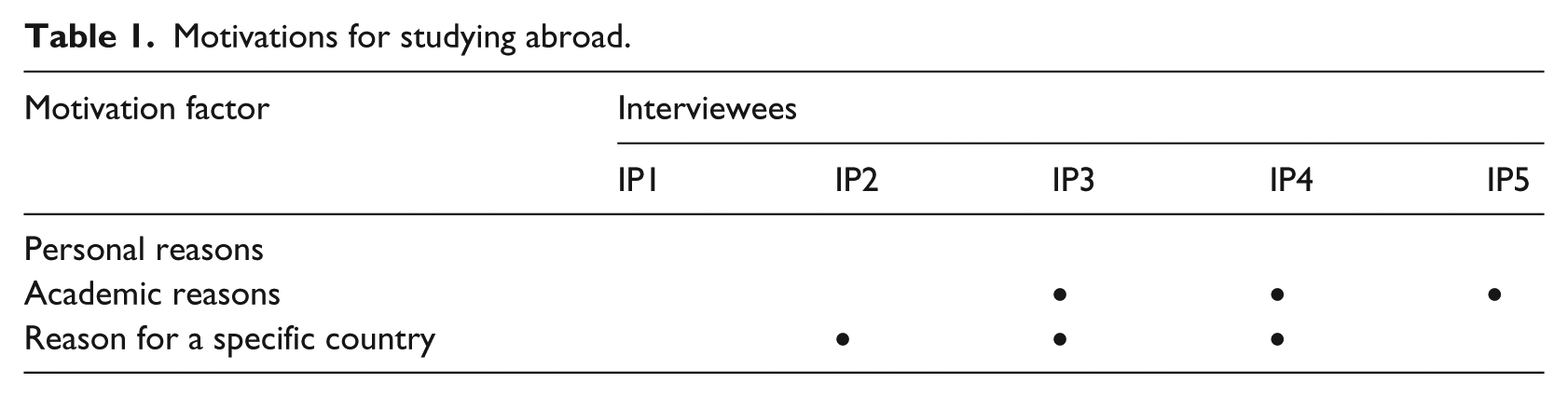
For IP4, leaving Colombia was necessary to be able to advance academically, first for her PhD and then for her postdoctoral studies: First of all there wasn’t a PhD programme in my subject at that time. There just wasn’t. … I mean it’s a long time ago but it’s not like centuries ago … So this is how behind we were. And then that was a stepping-stone, I was fortunate to have a good thesis and that allowed me to get this post doc at [this institution]. And I mean, [this institution] is the Mecca for doing my subject. I mean I couldn’t go to a better place, no way. (IP4)
While push and pull factors have an influence here, IP5 in contrast relates his motivation based on interest in and contact with a specific person: I had been working here with a teacher in [my subject] and he was communicating with a scientist in [country name] that needed [a specific material]. And I communicated with the person and I was interested in what he was doing and he said ‘Come over here’; and I said ‘OK, I’ll go’. (IP5)
The choice for a specific country is grounded in more practical reasons in the case of IP3, who was a member of a university-organized academic development programme that included the obligation to conduct doctoral studies abroad before returning to work with his university in Colombia. He obtained his PhD in [country name]: I had some friends who did the PhD in [that country] before. At that time I had another opportunity to go to US but then I decided to go for [that country] because I wanted also to learn [the local language]. (IP3)
Thus, deciding to pursue graduate studies abroad stems both from a lack of study options in Colombia as well as seizing opportunities being offered.
As depicted in Table 2, staying abroad involved an academic learning process for all interviewees, unfolding on different levels, as the following quotations show:
Experience of studying and working abroad.
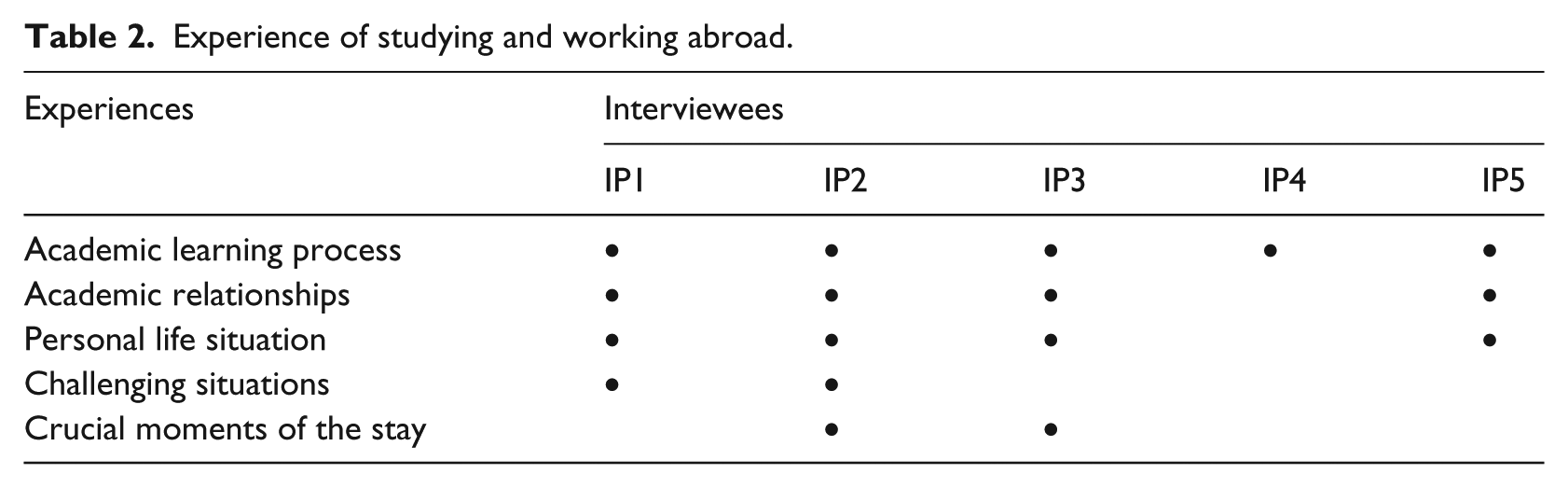
I learnt a lot of things from the academic life, from my own discipline, from my own area of research in [country name]. (IP1) So when I went abroad, I mean it was a completely different world from what I had had before. (IP4) I learnt the value of science. (IP5)
This learning process occurs with regard to experiencing how academic practices differ between countries (IP3, 4 and 5), or concrete examples of improving language skills (IP1) or presenting at conferences (IP2). Interviewees IP1 and IP2 realized that as an international graduate student and faculty member one can contribute valuable insights from one’s own academic and cultural background, meaning that, for IP2, …it was a nice opportunity discover that also professionals [from that country] are looking for international, international opportunities and experiences. So they are pulling their eyes in developing countries and, you know, to understand different phenomenon, different dynamics, for example from the public health perspective. (IP2).
Related to this learning process is the positive relationship that interviewees mentioned, either with their supervisor and colleagues: [Colleagues, the author] acknowledging the positive dimension that I was bringing, other perspectives into my research, into my teaching, into my outreach that they couldn’t have. (IP1) The most important of this friendships, or relationships, is with my PhD supervisor, [name] Because even today we have a good, a strong friendship and he helped me with everything in [country name]. (IP3)
Whilst the reason to study abroad was centered on academic motives, participants also made friends during their stay (IP2 and IP3) and in one instance started a family (IP1), thus making the stay inclusive beyond the academic setting. With regard to critical moments during their stay abroad, IP2, for example, points to the fact that [to] find people who would recognize me as a potential professional that, could contribute to the field was one of the most important things. (IP2)
These experiences helped her to endure the difficulties she faced before being able to enter the study programme of her choice. Despite the fact that interviewees related their experience abroad as predominantly educative and positive, IP2 recalled that, despite the career she had already established in Colombia prior to going to [country name], …when I went to [country name], I was nobody. … You know, nobody. Because when I went there, my language skills were, you know, really limited. (IP2)
She states further that an major effort was required to acquire English language fluency, admission to the study programme of her choice ‘because I wanted to be again me’ (IP2). In the same vein, both IP1 and IP2 remarked on stereotypes they encountered: They [people in that country, the author] see always Colombia as ‘down there’. It is under the, the —. The word ‘down there’, they have a lot of ideas of what it is like to live in Colombia… (IP1) But anyway, it was very challenging, not only the language but also the discrimination that you can feel because you are Latina […]. (IP2)
All participants report that their return to Colombia followed a conscious decision — as shown in Table 3 and in the following quotations: If you have the right attitude, then you can just think‚ ‘OK, what if I go back, I can be a factor to change this and for it not to remain the same way’. (IP4) I probably sacrificed, if you would say it in those terms, the development of a much more productive career outside just for the sake of that country commitment and the family commitment. (IP5)
Repatriating to Colombia.
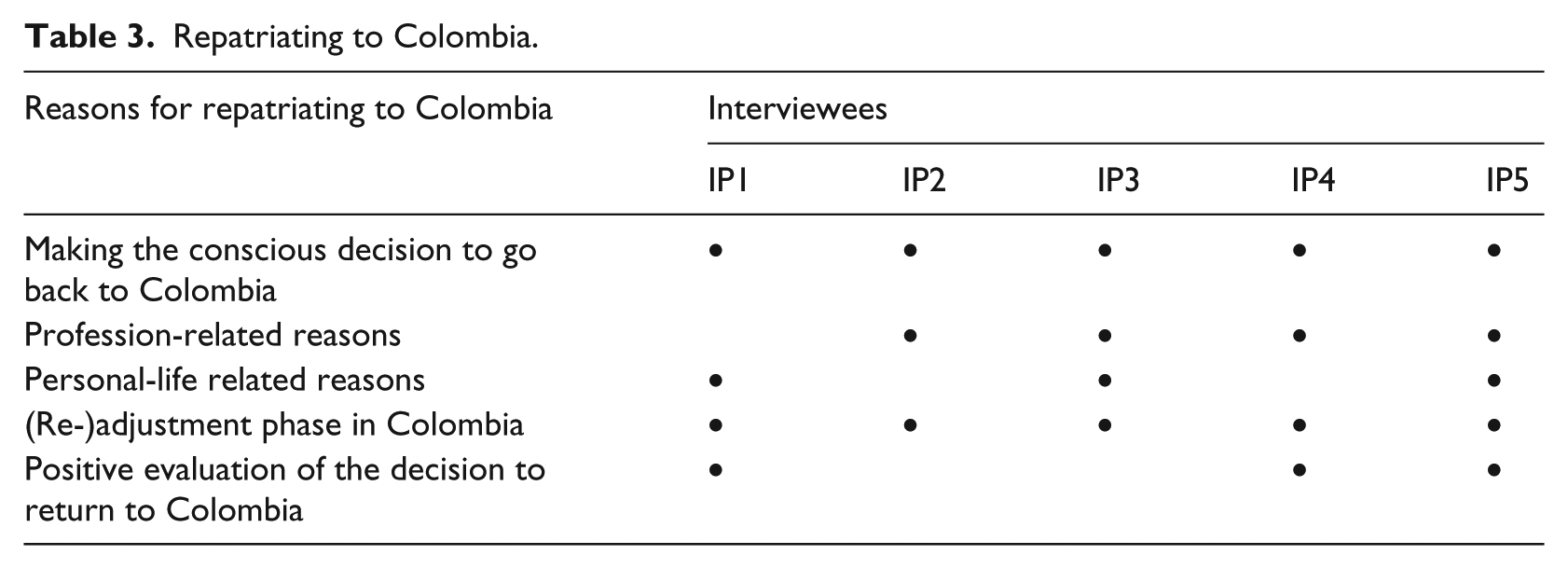
With one exception, in which the participant was abroad on a contractual basis with his university, the decision to return to Colombia was based on both personal and professional reasons: My dream was to come back to my country and really, […], I don’t know how to say that, to give back whatever I learnt over all these years. (IP2). It was a real decision to come back, as I said because I think the fundamental point was that the impact of my work would be greater here than there. (IP4) I came back because I had a child and I wanted her to have grandmothers and grandfathers and family and a community. (IP5)
IP1 explained that, I decided to come back to Colombia and of course, that wasn’t understood by a lot of people in [country name]. They would say ‘Hey, but, you know, you have all the opportunities here, that all that people would love to have, and you decide to just go to Colombia. Where your future is uncertain, where you don’t have any faculty appointment’. (IP1)
Upon their return, all participants reported a phase of re-adjustment to being in Colombian higher education, unfolding on different levels. Whilst IP5 adapted back to the Colombian system and IP2 entered her university via an ‘open excellence’ contest, it was found that, The experience at the beginning was hard because of the reverse cultural shock that the cultural psychologists call ‘reverse cultural shock’, when you get back and get used again to these like daily life style things. That was really difficult. (IP1)
IP1 also felt he needed to prove to his former colleagues in [country name] that his decision to return was correct, and asked himself, ‘Will I be able to show them that I am doing OK’; or, […], ‘were they right?’. (IP1)
The decision of returning to Colombia as such was perceived positively by the three interviewees touching on this topic, typified by this response from IP5: I don’t regret anything. (IP 5)
With the first research question primarily addressing the individual experience of being abroad, the second question — ‘Which implications from internationalization do they perceive in their professional life in higher education upon their return?’ — encompasses both the implications of international mobility and internationalization on the individual academic, as well as their awareness of institutional practices of internationalization in their respective universities in Colombia. Despite its highlighted importance, it needs to be noted that internationalization is most likely not the only influencing factor for the participants in their professional life in Colombia, and thus findings should be evaluated with this in mind.
As depicted in Table 4, all participants report international networks, effects on their career and promotion and their publishing behavior as gains from their extensive sojourn abroad.
Effects from internationalization on the individual participants.
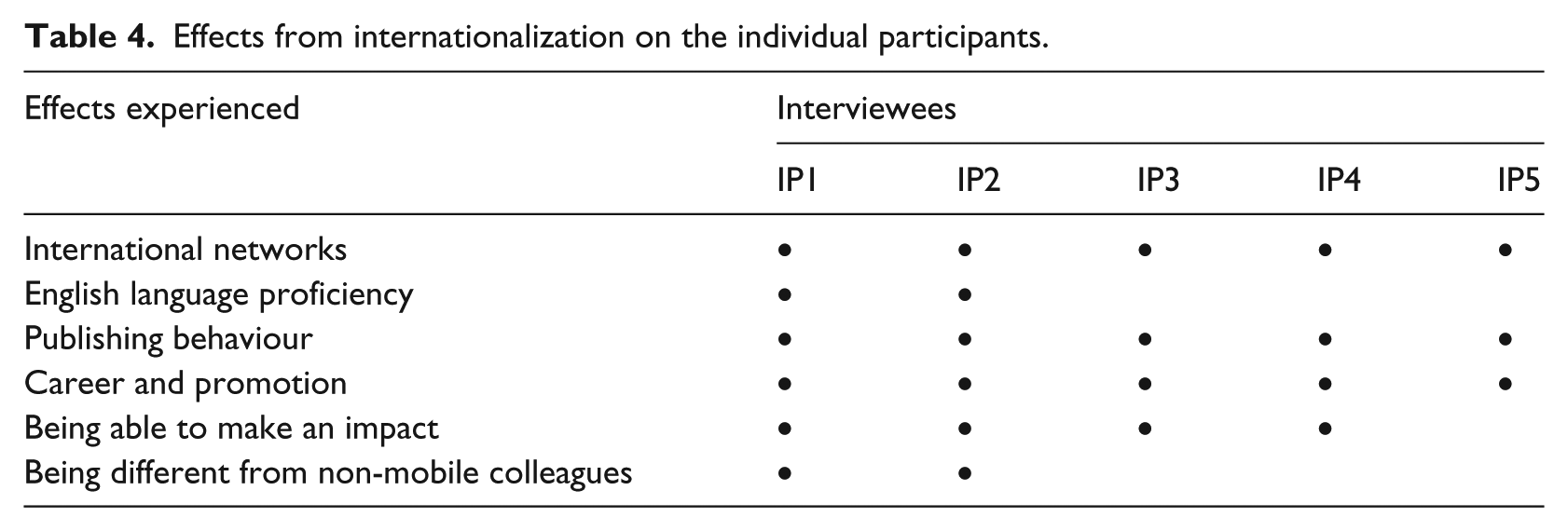
With regard to networks, participants touched upon the importance of interpersonal relations (IP2) and the ‘permanent exchange of ideas’ (IP1) between [country name] and the Colombian context. The other interviewees highlighted the active collaborations they had by saying that, Even today, my research problems, projects here in Colombia are together with [country name]. So this is changing the way we can work in a collaborative way (IP3). We have joint research publications, we have all kinds of academic activities, we have research, joint research grants and just a very strong network in that specific field where I am a researcher. (IP4) I work with people from Europe and from the United States and I have active collaborations with them. (IP5)
The influence that their stay abroad had on their individual careers, and promotion to managerial responsibilities within their institutions, was clearly stated by all participants. For example, internationalization ‘…had a huge impact in my CV’ (IP5), and IP2 and IP3 stated that they were given the responsibility for the international relations of their respective schools because of their ‘international experience’ (IP3). Beyond the actual responsibility and position obtained, IP1, now the research director of his school, added that, Certainly the fact of having received higher education internationally contributes to that respect that I feel nowadays from my colleagues and from the institution here. (IP1)
International experience is thus also perceived here as an element of one’s overall credibility.
IP1, IP2 and IP3 commented very explicitly on the fact that publishing research in international journals was of great importance, with IP3 saying that his is an international science and therefore communication occurs in English. Thus, If the results are good enough, they have to go to the higher impact factor journal we have available for that. (IP3).
IP1 and IP2 indicate the visibility of their research that increases with international publications: I am able to make publications in international journals, I think, that is also a good thing because that makes my research more visible in other contexts, in other countries. (IP 1) I realize that we really need to publish in English and in the best journals, so that you can, you can move forward by our science and as far as research visibility. (IP2)
However, IP3 also added the following: …and this is maybe easy for me because I have this friendship with Professor [XXX: professor’s name] because if you are working alone here in Colombia and you send a paper as [IP3’s name] in, let’s sayNature, they will tell you ‘are you crazy, no’. BUT if you are well connected with other researchers all around the world, like Professor [XXX], maybe they will tell you ‘yes’. So even in this field, friendship is very important. (IP3)
Participants also noted the positive impact that they had on their Colombian colleagues and students and their institutional units, which stems from their decisions to return to Colombia. Whilst IP2 stated that she organized the international relations unit for her school and had initiated all the necessities to foster outgoing student mobility, IP4 stated that both colleagues and students working in her research groups ‘had opportunities of international collaboration’ and ‘that impact, I think, I appreciate a lot’ (IP4). In this regard, IP1 touched upon the fact that he is able to bring international perspectives to his Colombian students, and furthermore stated that, I am also asked to review several papers for international journals and (..) I think I am very sensitive to international faculty members who are submitting their papers to those journals because, of course, sometimes there are a few language issues but — and I know that a typical editorial board member would immediately, just, you know, deny the possibility for that paper to be published just because of the language issues but then I try to go beyond that side and try to understand the importance of the research that is being conducted. (IP1)
Overall, the positive impacts that interviewees perceived to have experienced are summarized by IP1 and IP4 thus: I have been able to contribute to my country a lot more than I could have done, if I had stayed in [country name]. (IP1) There, I would be another one in, you know, a larger number of people that had the same kind of attributes or quality. And here, definitely not. (IP4)
Finally, two participants mentioned their English language ability resulting from their stay abroad — perceived as an important asset for communicating internationally (IP1) and an enabling factor for doing the present job (IP2). These two interviewees also mentioned a perceived difference between internationally mobile and non-mobile faculty, most overtly expressed through the lack of English language competency of non-mobile colleagues and, subsequently, problems in publishing research internationally. IP1 also mentioned the fact that academic stays abroad extend one’s perspective on the ‘ethics of academic life’(IP1).
As Table 5 summarizes, participants’ awareness or involvement with internationalization at their universities evolves around inter-institutional agreements, the practice of international mobility and internationalization at home.
Participants’ awareness of institutional internationalization.
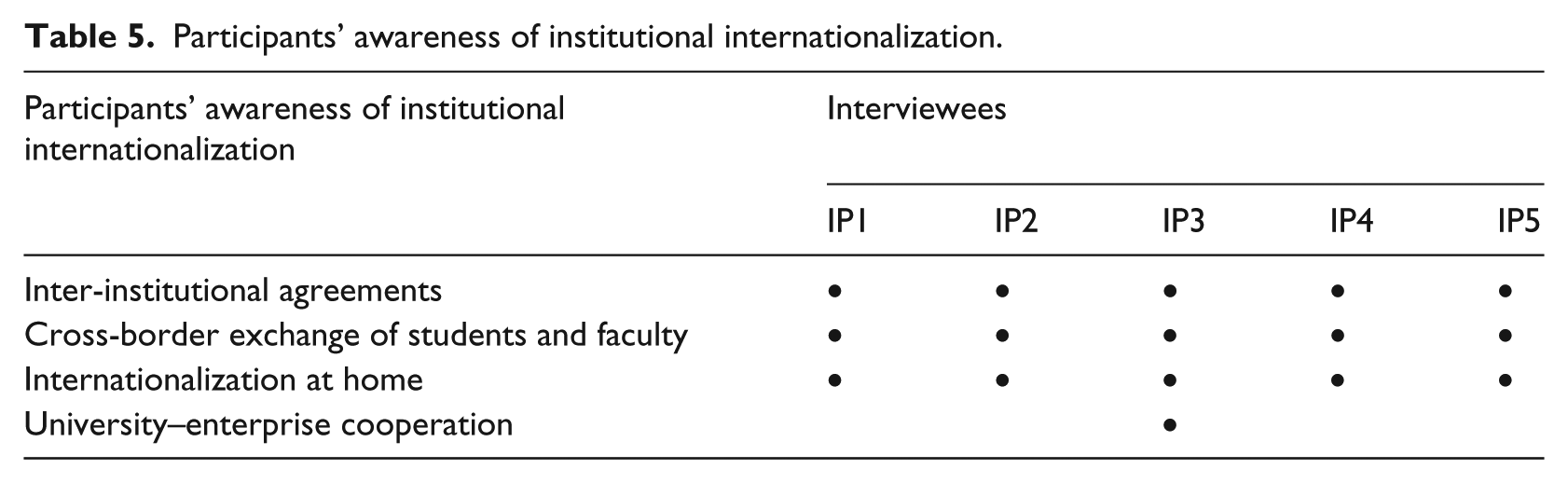
All participants acknowledged the importance of international inter-institutional cooperation, whether for student mobility (IP2), or to ‘attract funding and apply to grants’ (IP2) and hence ‘develop agreements with some institutions for some things and with others for other areas’ (IP1). IP4 perceived these international agreements as providing a form of quality and also enabling access funds that would otherwise be unavailable.
It is apparent that existing cooperative activities stem from individual (IP2, IP4) and programme-level (IP5) initiatives and are also perceived as strategic instruments: They have like five or six institutions that they had a historical sort of collaboration with and that facilitates mobility between those institutions and the university, any academic unit in the university. (IP1)
Closely related to this aspect is international mobility, which largely occurs within these agreements (IP1). Increased interest in students travelling abroad was noted (IP3); and, because IP2 was strongly involved in her position of leading the international relations unit, she wanted to learn everything she could in order to ‘facilitate all this mobility’ and says, ‘we are promoting international mobility’ for students. She stressed the positive experience for students who go abroad: So the students, they go to different parts of the world. And it’s so nice and their experience is just amazing. So whenever they go I feel like I am going. So you know, I am feeling like this is me going there … and discovering the world. (IP2)
Although IP4 argued that incoming mobility also affects ‘large numbers of people here at the university’, IP5 stressed the fact that outgoing mobility should be enabled, because [to] permit students from our programme to go abroad would be a very important asset, if not an essential asset for them. (IP5)
However, IP5 also stated that international mobility for the sake of mobility should not be the objective, but rather that it should be based on an academic rationale.
Finally, all participants mentioned activities that they knew about or were involved with, that promoted internationalization at home — a concept that IP3 found to be ‘really attractive’. Introducing English into instruction, or providing English language courses, was one central activity that IP1, IP2, IP3 and IP5 touched upon. IP3 actively engaged students in English-language presentations, lecturers introduced their classes in English before continuing in Spanish, and students were involved in, for example, translating the school webpage into other languages. For IP3, working with the professors to provide small grants to invite colleagues from abroad for presentations meant …putting the international relationships not only in your coordinator but in all your staff. (IP3)
Inviting or employing researchers from abroad was also a means mentioned by IP4 and IP5, with IP4 also adding that, on the level of the curriculum, …we can identify a course and find one of our partners in whichever country, and we will do the whole semester jointly with students of that same course, you know, virtually. (IP4)
On the basis of comments made by IP3, providing internationalization to students, without them leaving Colombia (IP5), involved engaging students and professors in these activities — which are of relatively low cost, but nevertheless fruitful. Beyond internal measures, IP3 also mentioned cooperation between industry and his university.
Discussion
The findings from the interviews in this study reveal insights on two levels: the individual academics; and their integration into the respective institutions. As a result, wider themes emerging from these findings include long-term academic mobility as professional enrichment for Colombian academics, as well as a conscious decision to return to Colombian academia for the individuals involved. For the institutions, internationalization at home, and the role of internationally experienced academics as drivers for internationalization, are notable themes.
Figure 1 illustrates how the findings and themes from the study relate to each other. However, attention needs to be paid to the fact that a general linearity and causal explanation beyond the study is not suggested here — for example, non-mobile faculty members could equally well foster internationalization at home.
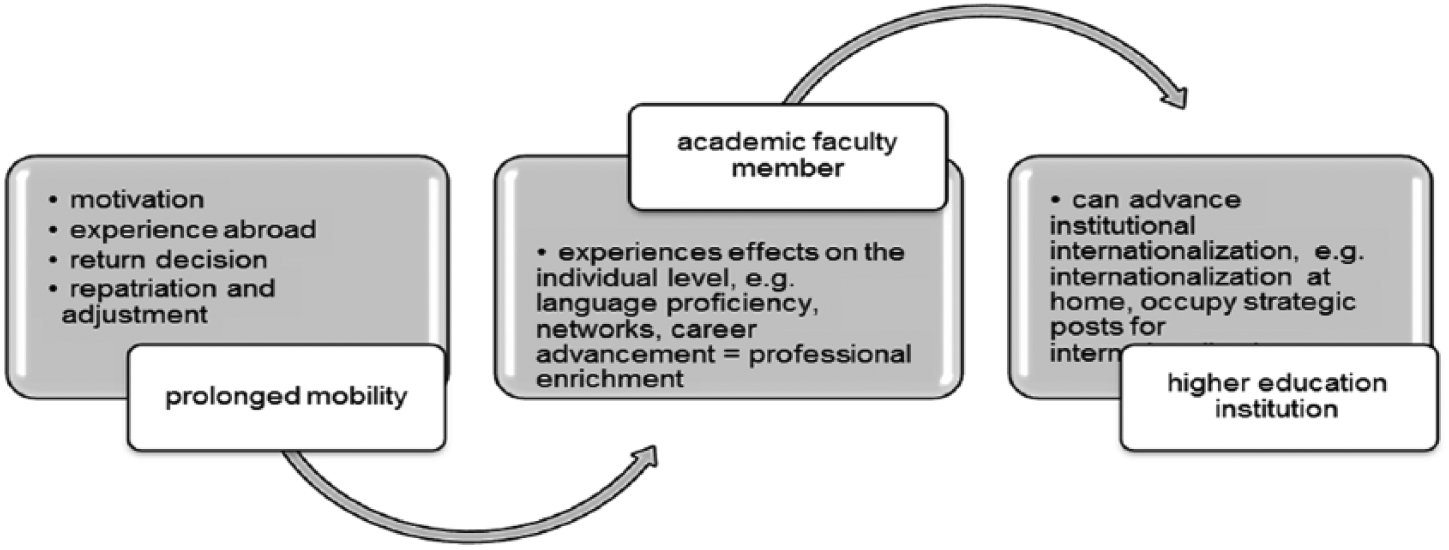
Findings and themes identified from the interviews.
Professional enrichment
A central finding from the interviews is the view on mobility as having contributed to professional development and having opened opportunities to access and join the international communities in their respective fields. Because interviewees were abroad in the early years of their academic career, this experience proved to be enabling on different levels: accessing programmes not available at that time in Colombia, connecting to international researchers in the field, and developing an understanding of academic work in non-Colombian contexts. Consequences such as sensitivity towards cultural differences (Hamza, 2010), increased international publications (Jonkers and Cruz-Castro, 2013), and the importance of language skills (Engin-Demir et al., 2000), were identified by the interviewees, confirming Teichler and Cavalli’s (2015) perception of the positive influence of international experience on academic careers. As also noted by Andújar et al. (2015), the interviewees reported having established international networks, perceived as a common central benefit of internationalization (Egron-Polak and Hudson, 2014). However, whilst participants evaluated their stay abroad as enriching and beneficial for them, two participants also detected differences between mobile and non-mobile faculty; for example, the lack of language competency resulting in non-English speaking colleagues not having the opportunity to publish in international outlets. This exemplifies the problematic distinctions that can be enforced through internationalization between faculty within one country (Marquina and Ferreiro, 2015) and which is emphasized by Gacel-Ávila and Marmolejo, who stated that, ‘mobility schemes have a limited impact as they mainly benefit the minority of scholars: an elite hired on a full time basis in traditional large research universities’ (Gacel-Ávila and Marmolejo, 2016: 144).
Professional impact upon return to Colombia
The interviewees constitute a group of individuals who decided to return to their home country. Although they provided different reasons for their return (personal, contractual and professional), a commitment towards either the country and academia, or the people in their personal lives, was evident. Thus the fear of ‘brain drain’, as reported in the IAU survey by Knight (2003b), was a concern for only one respondent in Berry and Taylor’s (2014) study and does not apply for the faculty in this study. Despite partial challenges in re-adapting to the academic profession in Colombia, similarly found by Bielsa et al. (2014), the interviewees noted — and positively appraised — the impact they had in their institutions, and are aware that their return has also had an impact on colleagues and students around them.
Faculty’s role for internationalization of Colombian higher education
Findings from this study confirm earlier statements by Knight (1994), and their emphasis by Stohl (2007) and Childress (2010), that it is faculty who foster and disseminate internationalization within their institutions. Certainly, having international experience was presumably not the sole criterion for being given responsibility for administrative and managerial positions in the case of the interviewees. However, the case of, for example, IP2, shows that being both internationally experienced and now in charge of internationalizing her school is a step towards developing institutionalized structures for internationalization, instead of leaving it as an individualized endeavour. Because all interviewees reported on international networks as an outcome from their stay abroad, their role for potentially facilitating further personal and institutional collaborations with international partners is undeniable.
Despite the involvement of faculty as a necessary condition (Hudzik, 2011) to internationalize their institutions, it also becomes clear in the interviews that an institutional effort is needed for institutional coherence and long-term planning of internationalization. As noted by Henao and Velez (2015), the diversity of the Colombian higher education system makes this especially important and calls for institution-specific measures. As Berry and Taylor (2014) indicate, the difference between, for example, public and private institutions regarding their position and advances towards internationalization, is one issue to consider in detail. With regard to the seven dimensions identified by the OECD et al. (2012b) to foster internationalization in Colombian higher education, these are to be analyzed to determine where faculty can contribute and at which point structures need to be implemented to institutionalize change. Thus whilst on the institutional level the example of the interviewees shows that faculty can initiate and steer internationalization to a considerable extent, the previously stated limited national efforts (Henao and Velez, 2015) need to be expanded.
Supporting internationalization at home and/or student mobility
The fact that IP3 considered internationalization at home (see Beelen and Jones, 2015 for an extensive definition) an ‘attractive concept’ suggests the potential that it can hold for higher education in Colombia; and findings from the interviews suggest that returning faculty are central contributors to fostering this through their experiences, international contacts and professional networks. Given that study abroad is a costly undertaking — not only for Colombian students but also in general — one administrator in Berry and Taylor’s study points to the fact that ‘not all students can go abroad so you have to bring internationalization to them [the students]’ (Berry and Taylor, 2014: 590). In addition, the central risk that only wealthy students will be able to engage with internationalization — as expressed for the region in the 2014 IAU survey (Egron-Polak and Hudson, 2014) — would, in this way, generate a response. Although only one private Colombian university has mentioned internationalization at home as an important activity (Berry and Taylor, 2014: 591), the participants in this study suggested a number of activities already in place or planned — an iteration of the growth of this idea and tentative proof of its suitability for the Colombian context. Next to fostering (mostly English) foreign language capabilities and inviting researchers for presentations, the potential to internationalize the curriculum via the use of digital technology, which is fostering ‘virtual forms of internationalization’ (Bruhn, 2017: 2), should be taken into consideration in the future. Whilst incoming and outgoing student mobility is of importance, as stated by participants in Berry and Taylor’s (2014) study as well as in this one, de Wit (2014) emphasizes that cross-border mobility is possible only for a very limited number of students, whereas the impact of an internationalized domestic curriculum and internationalization at home would be felt more widely. Participants in this study touched upon the availability of financial resources to support students wanting to study abroad; however, internationalization at home presents itself as a potentially wider but less costly approach. This is not to say, though, that study mobility should be discouraged or would not yield individually invaluable gains and experiences. Faculty involvement is therefore a crucial factor for bringing internationalization to the students and the formal curriculum (Beelen and Jones, 2015).
In the light of the discussion on centres and peripheries in higher education (Altbach, 2011), findings from this study can be read as both affirming, for example the aspect of dependency, as well as contradictory. Speaking about his work as a reviewer, IP1 pointed to his role as an advocate for sensitive behaviour towards authors whose native language is not English, thus addressing one central bias in international academe — English as the lingua franca in publications (Altbach, 2011). Construction and circulation of knowledge is also problematized by Muñoz García and Chiappa (2017), who address the problematic implications of publishing in English at the expense of losing touch with the local community. At the same time, IP1 and IP2 have both noted how their experiences, and specifically their Latin American background, have enabled them to establish certain areas of academic work in their host country that fellow researchers could not have had without them. Hence, while the majority of findings and themes identified in this study are also potentially applicable to other countries, reading them with the concept of centre and periphery in mind adds to their contextualization.
Conclusions
This study has extended the results of Berry and Taylor’s study (2014) on how Mexican and Colombian university administrators perceive the internationalization of higher education in these two countries. Interviews with five Colombian professors have elucidated how they experienced international long-term mobility in the early years of their academic careers and how this experience has translated into their academic life in Colombian higher education and their respective institutions. In the context of Colombian higher education, this can be understood as an advantageous distinction from non-mobile colleagues (Marquina and Ferreiro, 2015; Gacel-Ávila and Marmolejo, 2016) and has had certain positive influences on their respective careers.
With some experiences being similar and comparable to those of internationally mobile academics in other countries (e.g. Engin-Demir et al., 2000; Hamza, 2010; Jonkers and Cruz-Castro, 2013; Melin, 2005), internationality and international involvement of the interviewees manifests very clearly in their professional lives and academic activities when contrasted with mature countries (Marquina and Ferreiro, 2015), where differences in international involvement do not indicate a strong gap between faculty within a country. Participants in this study also identified being able to have an effect on processes in their institution, either regarding research, administration or teaching: the effects thus also go beyond their individual careers. Aside from international networks of the individual academic and institutional collaborations, the concept of internationalization at home has emerged as a viable way to internationalize the campus in the participants’ universities. Beelen and Jones noticed this approach to be in focus not only in European countries but also in ‘South Africa and Latin America’ (Beelen and Jones, 2015: 67). Here, research shows that internationalization at home has indeed gained momentum, in contrast to only one university finding this important in Berry and Taylor’s (2014) study.
Contextualizing the findings from this study in light of the 2014 IAU survey results, faculty’s international networks, as a benefit arising from internationalization, were noted by the participants; whilst in the long term, and if appropriately supported, activities in the frame of internationalization at home can lead to improved teaching and learning for students as well as enhancing their global outlook. However, despite these promising perspectives, the perceived risk of increasing gaps between higher education institutions within the country, as voiced for the region in the 2014 survey, needs to be addressed, if internationalization is intended to benefit Colombian higher education more widely. Whilst participants mentioned differences between internationally mobile and non-mobile, English speaking and non-English speaking, fellow academics, these differences can presumably be extrapolated to institutions within Colombia; for example, as noted by OECD et al. (2012a), international collaboration and publication has increased but mostly for urban-located universities. Although this finding is concerned primarily with academics, effects on students can reasonably be assumed.
Limitations
Given the interviewees’ formal academic qualifications and international experience within the Colombian higher education context, it is imperative to note that this group of interviewees is part of an educational elite. This needs to be kept in mind in the analysis of the findings: it also constitutes a limitation of this study. A further limitation lies in the fact that not all topics raised in some of the interviews could be taken into consideration in this analysis — for example, controversies raised about internationalization regarding the importance of English language, the perspective on relationships between the global North and South, or perceived discrimination whilst abroad. Whilst they need and merit further and distinct attention this should occur in a separate study in order to comprehensively address these as topics in their own right. Finally, given the explorative character of this study, the small number of participants provides only a first glimpse into the experience of internationalization of Colombian faculty. Future research can expand and deepen the results obtained here.
Footnotes
Acknowledgements
I sincerely thank my interview partners for sharing their thoughts and experiences with me.
Declaration of Conflicting Interests
The author(s) declared no potential conflicts of interest with respect to the research, authorship, and/or publication of this article.
Funding
The author(s) received no financial support for the research, authorship, and/or publication of this article.