




Abstract
This paper aims to map the landscape of higher education transformation in the BRICS (Brazil, Russia, India, China and South Africa) nations while exploring the status of BRICS nations in some of the global university rankings and analysing their potential to give new meaning to notions such as excellent and world-class universities. The study provides different theoretical perspectives about global university ranking and about the notion of ‘world-class/excellence’. Based on the literature exploration, the gathered data from some of the global university ranking agencies and the critical reflections from purposefully selected respondents, it is considered that the quest for world-class universities is articulated in several public policy documents of BRICS nations. While some attempts to achieve this quest vary (e.g. from China’s strong effort to India’s least effort), BRICS nations, like many other nations, seem to evolve towards this ambition, as universities have become the centre point of the development agenda. The ability of BRICS nations to provide new meaning to ‘world-class/excellence’ notions, although not clear, cannot be disputed given the indications that the BRICS bloc is emerging as an alternative economic force and the role higher education is playing in this emergence.
Keywords
Introduction
Every university is striving hard to move up the ranking table and every nation takes pride in getting some of their top universities to the top of this table. The cost of building the ivory tower of excellence is higher and the competition is tougher, yet every nation and university dreams to achieve it. The development and transformation of BRICS (Brazil, Russia, India, China and South Africa) nations are being observed curiously from all corners. Educational development, particularly of higher education, is crucial for the transformation of these growing economies. BRICS nations, like other nations, continue to strive to build world-class universities. Several higher education institutions within BRICS nations are identified as centres of excellence, and several universities from BRICS nations have made their way into some of the top-ranking lists.
The study is based on the literature review, document analysis and the use of secondary data from various sources that have helped to deepen the understanding and exploration of BRICS in university ranking and the attempt of BRICS to build world-class universities. Exploratory and focused literature-review techniques were used for the literature review. Some of the criteria for the selection and review of the literature and document analysis were exploring, identifying, screening, summarizing, analysing and interpreting. The study used secondary data sources from some of the ranking institutions, such as The Times Higher Education World University Ranking (THEWUR), Academic Ranking of World Universities (ARWU), Quacquarelli Symonds (QS) and University Ranking by Academic Performance (URAP), and the critical reflections shared by purposefully selected academics who have contributed considerably to the field of ‘comparative higher education’.
The study identifies that BRICS nations have indicated in their public policies their interest to establish world-class universities and create centres of excellence. They have also taken some actions to achieve this. China seems to have made a relatively better attempt than other BRICS partners and South Africa continues to be recognized within the African context. Brazil and India are slowly emerging, while the Russian context is not very clear with its undisputed capacity. The emerging pressures in these countries as they go through economic transition continue to stimulate the quest to develop a strong knowledge base. The growing youth population and the ever-increasing competition in the knowledge space in Brazil and India, the strong scientific basis in Russia, the established academia in South Africa and the massive industrialization that demands innovation in China continue to provide some positive hope without clear indications if BRICS will be able to give a new meaning to the notion of ‘world-class universities’ and build ivory towers of excellence.
Understanding university ranking
There are different views on university ranking; some consider university ranking helps students to identify good universities. One realistic question is this: when the name is the game in the modern academic world, why should ranking not be recognized, regulated and established? Moreover, it is important to understand that ‘rankings reflect university research performance far more accurately than teaching’ (Rauhvargers, 2011: 14). Some consider university ranking as a potential danger to academic harmony as ranking appraises universities and brands them good or bad (Rauhvargers, 2013). A study commissioned by Norway’s Ministry of Education concluded that, ranking is to a large degree based on the subjective weighting of factors, which often have a weak relationship to the quality of education and research. The rankings are based on data that to a varying degree are made available and made transparent. Furthermore, the rankings say almost nothing about education. Rankings are therefore not useful as the basis for information and feedback both on research and education if the goal is further improvement of higher education institutions. (Myklebust, 2014: 1)
Chi Hou et al. (2012) consider the ARWU, the World University Rankings, the Webometrics Ranking of World Universities and the Performance Ranking of Scientific Papers for World Universities as the four major global university ranking agencies.
In addition, some see university ranking as a modern development, which cannot be stopped but could be enhanced to work better. Some consider that ranking leads to unwanted practices of universities. Universities are tempted, for example, to improve their performance specifically in the areas that are measured by ranking agencies, resulting in tension between improving quality or ranking position (Rauhvargers, 2013). Yet, others such as Marginson (2013) believe that university ranking is likely to keep growing and become more specialized, and, therefore, it is preferable to take ranking into account. It is, however, imperative that higher education institutions with other missions than that of being top research universities may have to re-justify their missions and visions (Rauhvargers, 2013). The expert group on the assessment of university-based research for the European Union (EU) (2010: 9) pointed out that ‘rankings enjoy a high level of acceptance among stakeholders and the wider public because of their simplicity and consumer-type information’. Therefore, ranking systems should be reviewed to value universities more broadly, rather than for their performance in the few areas the agencies identify.
Table 1 indicates what criteria some of the ranking agencies use to measure and rank universities. It seems clear from the above table that most of the ranking agencies give importance to research output. Whether we like it or not, ranking has become a reality. Institutional and national policies on higher education seem to adopt ranking as an inevitable external factor influencing higher education transformation. Ranking seems to be translated into policy responses and actions (Hazelkorn, 2009). Scholars such as Cairns (2013) question: is there is an ideal methodology to rank universities? And, how seriously should ranking be taken by students, academics and others? Salmi (2009) asks, could ranking provide a diagnostic of the whole higher education system? He realistically points out that only 500 universities will be positioned in the top 500 universities in the world, indicating that over 16,000 universities across the world will not be among the top 500.
Comparing what ranking measures.
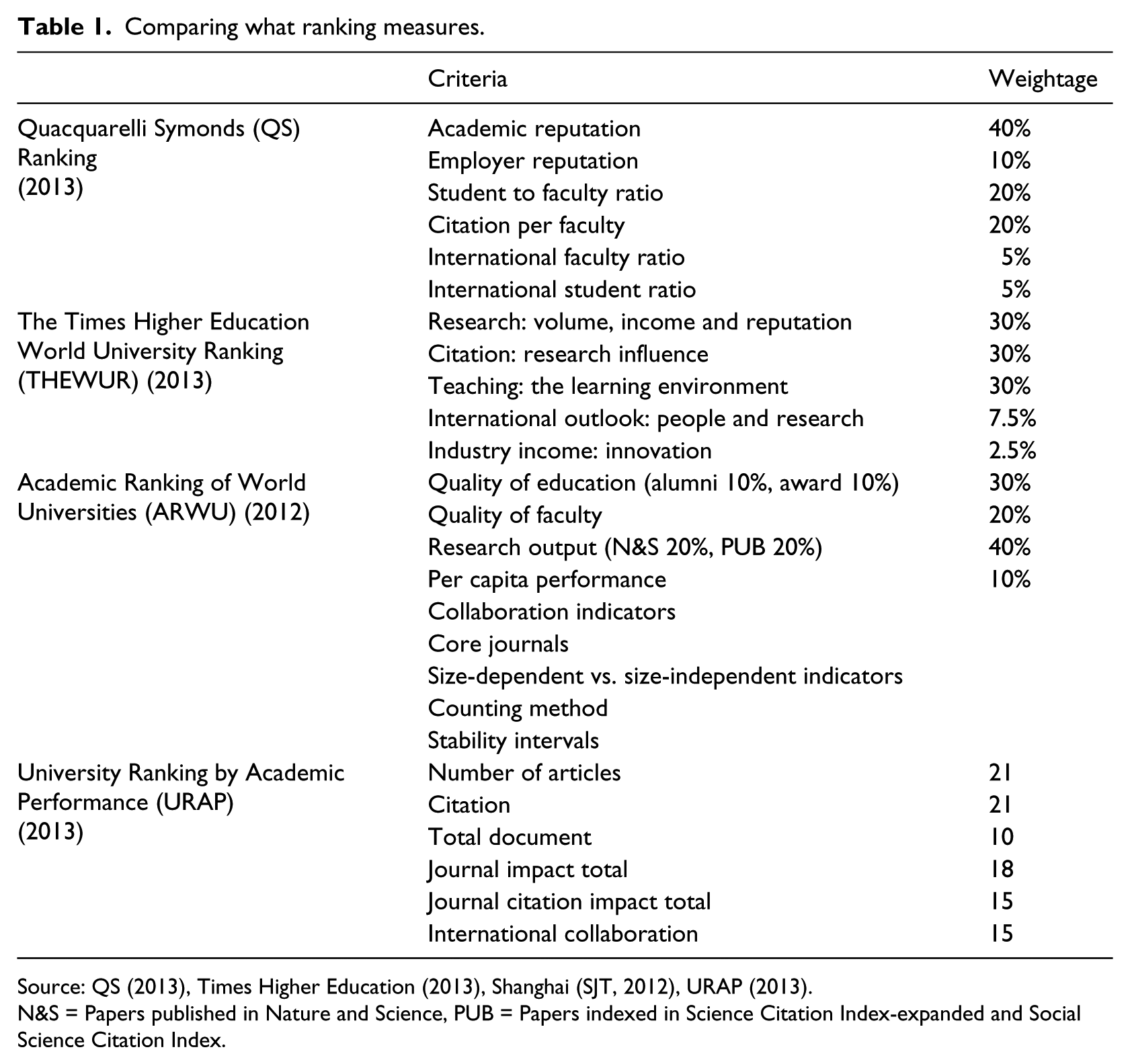
Source: QS (2013), Times Higher Education (2013), Shanghai (SJT, 2012), URAP (2013).
N&S = Papers published in Nature and Science, PUB = Papers indexed in Science Citation Index-expanded and Social Science Citation Index.
Strengthening the research basis and increasing research funding are very important for any nation to reach the top in global university ranking. According to the United Nations Educational, Scientific and Cultural Organization (UNESCO, 2009), Asia leads with 41.40%, Europe 28.40%, North America 22.20%, Latin America 3.60%, Africa 2.30% and Oceania 2.10% in the distribution of researchers by regions. However, in terms of women researchers, Asia accounts for only 18% compared to 46% in Latin America. In terms of world research and development (R&D) expenditure, the Americas account for 37.6% compared to Asia which accounts for 32.7%, while the triad (EU, USA and Japan) represented almost 70% of global R&D expenditure during 2007.
It is important to observe that global university ranking has increased the competition in higher education. Marginson and Wende (2007) observe that ranking has increased international competitive pressures in the higher education sector. Soudien (2014) points out that ranking has influenced the incentive systems on academic publishing. Bowman and Bastedo (2011) suggest that ranking may influence assessments of institutional reputation based on the anchoring theory or focalism, which states that the common human tendency is to rely on the first piece of information. Times Higher Education (2016b) indicates that the average age of the top 200 universities is 213, which indicates that it takes years to build a reputation. However, Salmi (2013a) informs that several young universities achieve a high-ranking reputation within their short history, rejecting the weight of tradition concept, as some old universities are not ranked high. Eaton (2013) argues that rankings have emerged as new accountability tools for quality assurance. Tadaki (2013) calls ranking the new currency of quality and with English as the official language of science converging to a singular vision.
Downing (2013) argues that there is nothing wrong with ranking when it helps institutional quality. Rauhvargers (2013) indicates that rankings are here to stay with both positive (for some) and negative (for others) implications. Marginson (2013) suggests that the ranking in the future will evolve with a broader framework that might benefit all. However, it is important to understand the ‘ranking game’ broadly in the light of the tension between ‘mechanical solidarity and true social solidarity’ as posed by Emile Durkheim (Marske, 1987). In the growing competition among universities in the race to the top of the ranking table there is less social solidarity and cooperation among universities. The future of higher education relies on how the tension between academic utilitarianism and academic solidarity is resolved.
Imperatives of ranking
Ranking has institutional and individual imperatives. The institutional imperatives include the quest for establishing a name, as name is the rule of the game. In doing so, universities go beyond their value boundaries, particularly using extreme market rationales to establish their names and build their brands. Some consider university ranking as a tool for university transparency (Rauhvargers, 2011) so that the stakeholders are able to understand the trends. In a study conducted by Times Higher Education Ranking (2017), nearly 77% of students indicated that university and subject ranking are important. Rauhvargers (2013) identifies the following as the main trends in global university ranking: a continued focus on elite universities; relative neglect of the arts, humanities and the social sciences; superficial descriptions of methodology and poor indicators; addressing the near exclusiveness of English-language publications; and a more self-critical attitude to rankings from the providers and consolidation of the overall phenomenon of rankings. Salmi (2009) indicates that universities play a critical role in the economic growth and competitiveness of every nation as driven by knowledge. University ranking is important for employability and placement as there is greater employability opportunities for graduates from recognized universities. Moreover, students increasingly understand this market dynamic when choosing their university and programme (David, 2014). Rauhvargers (2013) indicates that global university ranking continues to focus mainly on research functions and has limited measuring of teaching performance. He points out that ranking began to impact on public policymaking, and several stakeholders began to use and misuse ranking data to benchmark, profile and classify.
Critics of ranking claim that ranking universities in endless league tables is distorting research and becoming meaningless (Scott, 2015). Bekhradnia (2016) questions the credibility of some of the top-ranked universities (ranked by some of the global ranking agencies), who refuse to provide data to U-Multirank. Competition fuels inter/intra departmental, institutional rivalry. Disciplinary hierarchies are increasingly being stratified based on the values departments add for helping university for ranking. Moreover, departments that produce more research outputs receive increased recognition and funding. It is important to note that unethical strategies of institutions may accelerate in the ranking race. Grove (2016) refers to the Leadership Foundation Report that states that the tension between academic tribes of differing prestige and status anxiety harms university cooperation. Some of the individual imperatives are that ranking has increased individuals’ desire to produce more research output, created interest in joint and collaborative research and interest to publish in peer-reviewed journals. Such an approach provides clear and transparent indications for recognition and promotion. In the quest for ranking, some universities began to value and develop academics with certain skills, rather than value and develop them all-round. It has become part of faculty-hiring practice that universities have begun to increasingly hire top-rated academics for institutional prestige and for the sake of ranking (Clauset et al., 2015). The obsession with becoming an academic ‘rock star’ fuels academic anxiety (Grollman, 2014) and professional burnout. Colleagues in the field are viewed as competition (Grollman, 2014) as everyone strives to prove their self-worth by their publications. Academics have begun to give more attention to research and less to teaching, and some academics even keep themselves away from students to meet their research desires.
Understanding world-class/excellence
It is important to explore the question, what is a world-class/excellent university? Sadlak and Cai (2009) observe that the notion ‘world-class university’ has become part of the higher education discourse and there is a shift from institutional quality to systemic excellence. Salmi (2013a) accounts the following as indications of world-class universities: highly sought graduates; cutting-edge research; dynamic technology transfer; a high concentration of talents (faculty and student); abundant resources to offer a rich learning environment and facilitate advanced research; and favourable governance features that encourage strategic vision, innovation and flexibility. Some scholars such as Dill and Sou (2005) indicate the growing international consensus for academic excellence and quality as reflected in ranking systems.
Salami (2013a) point out that the quest for excellence allows universities to develop the capacity to compete in the global higher education market through the acquisition, adaptation and creation of advanced knowledge, but these indicators demand a long tradition to develop the culture of excellence. Yet, being an established university is no guarantee of academic excellence. Altbach and Salmi (2011) inform that there are exceptional fast movers who achieve excellence in a relatively short time – they clearly define themselves as centres of excellence. In addition, they indicate that the spirit of research, the language of science, applied research, research professors, industrial cooperation and leadership are key indicators of excellence. Laurillard (2005) asserts that a university is defined by the quality of its academic conversations and not by the technologies that service them. As Salmi (2009: 4) points out, ‘becoming a member of the exclusive group of world-class universities is not achieved by self-declaration; rather, elite status is conferred by the outside world on the basis of international recognition’. Pomeda and Casani (2016) identify that little research has been undertaken on the concept ‘world-class university’ and they suggest that leading universities are working to adopt the world-class university label based on their salient characteristics.
Can BRICS build ivory towers?
Higher education in the BRICS nations is growing considerably in terms of both quantity and quality. The study explored some of the top global university rankings and listed the number of top universities from BRICS nations, which are presented in Table 2.
Number of BRICS universities in some world rankings.
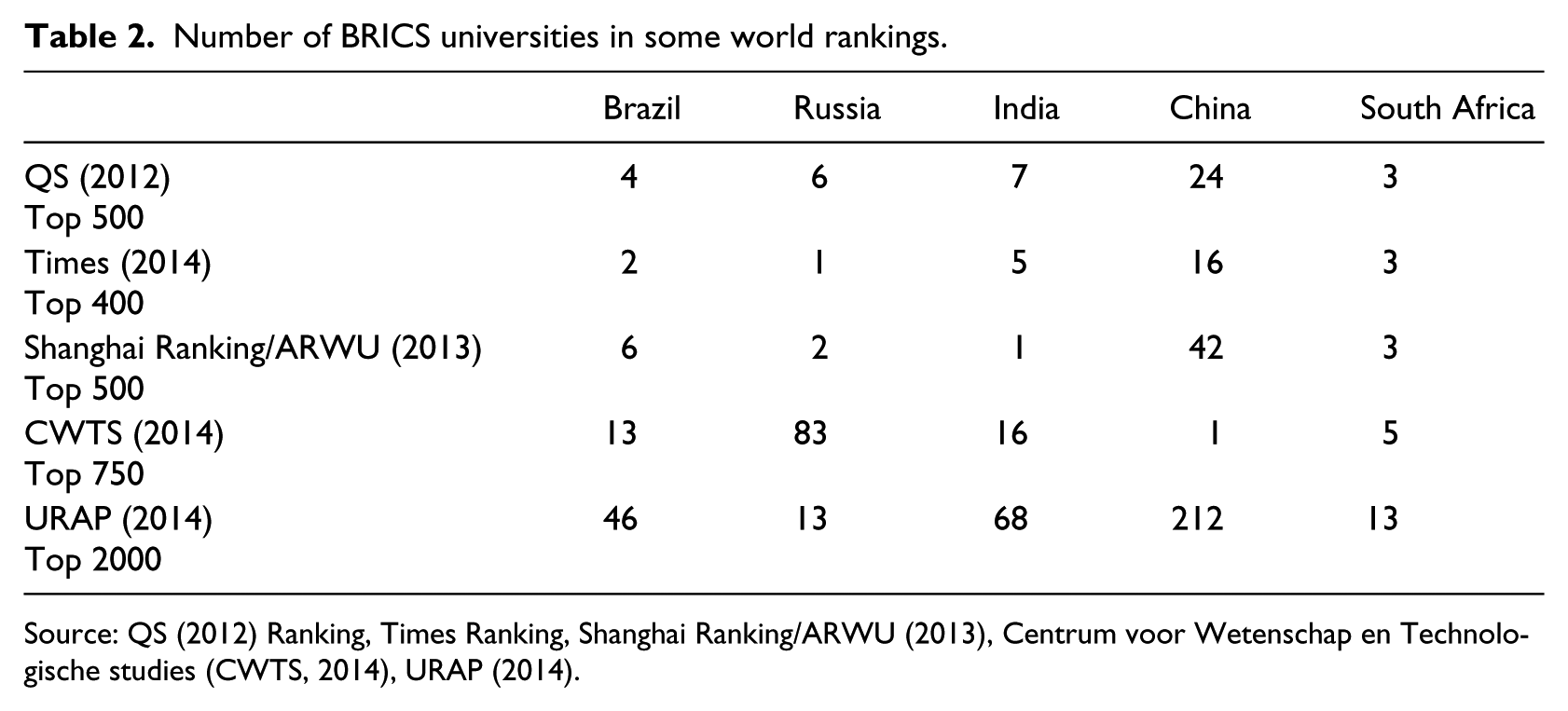
Source: QS (2012) Ranking, Times Ranking, Shanghai Ranking/ARWU (2013), Centrum voor Wetenschap en Technologische studies (CWTS, 2014), URAP ( 2014).
Table 2 shows the number of universities from BRICS that are listed among the world’s top universities by different ranking agencies. According to the ranking by QS, among the top 10 universities in BRICS, seven are in China, two are in Brazil and one is in Russia. Out of the 100 top universities in BRICS, 36 are in China, 18 are in Russia, 16 are in Brazil, 14 are in India and eight are in South Africa (QS, 2013). According to Times Higher Education (2014a), of the top 100 universities in BRICS and emerging economies, China has 13, India has eight, South Africa has five, Brazil has three and Russia has two. The U21 (2014) ranking places Hong Kong at 15th, Taiwan at 22nd, Russia at 35th, Brazil at 38th, South Africa at 45th and India at 50th (it only evaluated 50 countries). U21 used four key criteria: resources, environment, connectivity and output. In this overall adjusted ranking, China is ranked 9th, South Africa is ranked 17th, Brazil is ranked 18th, India is ranked 23rd and Russia is ranked 36th.
Among the top 500 universities in the 2012 QS ranking, China has the most and South Africa has the least. China has the most and Russia has the least in the Times Higher Education (2014a) top 400 universities. In the Shanghai Ranking/ARWU (2013) top 500 universities, China has the most and India has the least. Russia has the most and China has the least in the CWTS (2014) top 750. In the URAP (2013, 2014) top 2000 universities, China has the most and Russia and South Africa have the least. China performs best in all five rankings, while South Africa, given its limited number of universities, performs well. Almost all the ranking agencies give importance to research output, joint research and international research collaboration. Table 3 provides the list of top-ranked BRICS institutions.
Top-ranked BRICS institutions.
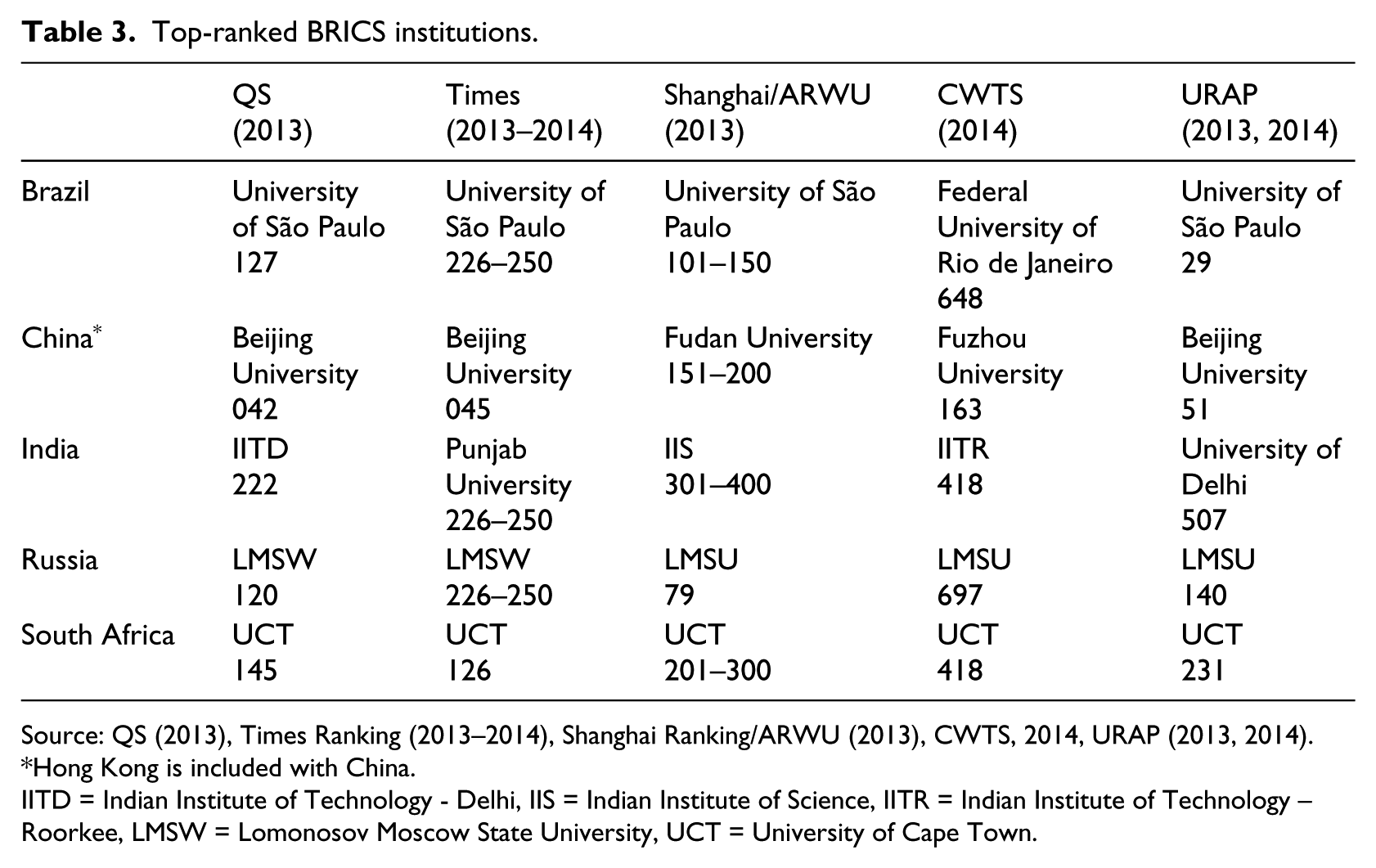
Source: QS (2013), Times Ranking (2013–2014), Shanghai Ranking/ARWU (2013), CWTS, 2014, URAP (2013, 2014).
Hong Kong is included with China.
IITD = Indian Institute of Technology - Delhi, IIS = Indian Institute of Science, IITR = Indian Institute of Technology – Roorkee, LMSW = Lomonosov Moscow State University, UCT = University of Cape Town.
Bothwell and Staufenberg (2016) identified the top 20 universities attracting industry funding; among these, seven are from BRICS nations, four are from China and nine are from Asia. This indicates an interesting shift within academic powerhouses. Institutional and national policies on higher education seem to accept it as an inevitable external factor influencing higher education transformation, translating it into policy responses and actions (Hazelkorn, 2009). Notwithstanding critics of ranking, this table and these numbers give some indication where BRICS stands in university ranking.
The University of Cape Town is ranked as the leading university in South Africa by all five ranking agencies, and the Lomonosov Moscow State University as the leading university in Russia by all five. The University of São Paulo is considered the leading university in Brazil by four ranking agencies. Beijing University is ranked as the leader in China by three agencies. The five agencies rank different institutions as the leader in India. Three agencies rank Beijing University among the top 51 and the other two also give it good positions. China seems to dominate in university ranking among BRICS, while India is at the bottom of the list.
China is far ahead in the rankings game (Altbach, 2005) compared to India. South Africa is a regional academic powerhouse, receiving global recognition. Russia focuses on scientific advancement and less on higher education. Brazil witnessed tremendous quantitative growth in higher education, yet questions remain about quality. English is the language of tertiary-level teaching, research and publication, but this is not the general case in Brazil, China and Russia, unlike South Africa and India; however, China still publishes the highest number of documents in English compared to its BRICS counterparts, while the highest number of citable documents in English is produced in South Africa (Rensburg et al., 2015). While some of the global ranking agencies have published regional rankings, some of the BRICS countries have their own national ranking, particularly the Human Resource Development ministry in India which has produced its own national ranking (The Indian Express, 2016). The term ‘ivory tower’ describes ‘a state of privileged separation from the practicalities of the real world’, or ‘an environment of intellectual pursuit disconnected from the practical concerns of everyday life’, particularly ‘a place where higher order scientific knowledge is generated and disseminated’ (Wikipedia, 2016). The desire of BRICS to build such ‘ivory towers’ is intentional to a large extent, but in reality the opportunities and challenges to realize this desire seem unclear.
Giving new meaning to world-class universities
Altbach and Balan (2007) observe that there is a growing vocationalization of higher education in developing countries which may not create a competitive advantage for these universities to develop world-class universities. Pillay et al. (2015: 6) pose several questions regarding higher education in BRICS nations, including ‘Are there any efforts to build “world-class” in the country and what are the links between such efforts and the broader issues of science, technology, and innovation polices?’ Philip Altbach (2005) calls India a world-class country without a world-class university. He considers India and China as two giants who have awakened in response to the demand to expand their higher education. China has invested heavily to establish 100 Chinese universities with world-class standards. National Knowledge Commission (2007) of India has made several recommendations to enhance the higher education in India. Similar attempts are found in Brazil, Russia and South Africa. Does BRICS give new meaning to the world-class universities and should they prioritize ranking, re-creating Oxford and Stanford? We are in an age of academic ‘hype’ in which universities of different kinds in diverse countries claim this exalted status (world-class) often with little justification (Altbach, 2004).
Altbach (2003) says that most of today’s higher education institutions are the replica of 16th-century European universities. He observes that right from the beginning universities are global institutions and operate mostly with an international (global) language, content, people and environment, and have thus been affected by circumstances beyond the campus and across national borders. He further states that the convergence trend is setting global standards for degrees being comparable globally, as there is a growing migration among the workforce around the world. The use of English as an academic language has become global.
Disciplines and fields vary in terms of how globally homogenous they have become. Such fields as business studies, information technology, and biotechnology are almost entirely dominated by the major academic centres. Other fields – such as history, language studies, and many areas in the humanities – are largely nationally based, although foreign influences are felt in methodology and approach to research and interpretation. (Altbach, 2003: 12)
The criteria for world-class universities or centres of excellence are determined by the dominant knowledge culture from the knowledge centres that are mostly found in Western Europe and North America. Under such conditions, it is becoming problematic for any other nation or any other bloc of nations to provide meaning for the world-class notion; nevertheless, a new meaning is possible. BRICS nations are dealing with several pressing demands such as expanding higher education, creating fair and large access and facilities, strengthening quality, research and several other priorities before achieving excellence and world-class status. Pillay et al. (2015) indicate that it is challenging for BRICS nations to fulfil all the contradictory expectations, particularly the challenge to make and renew the social pact between higher education and society. However, they raise the hope that these countries are evolving, where higher education is emerging as a central standpoint. Should the BRICS nations strengthen their higher education sector to meet the raising global standards, it might give an opportunity to the BRICS to give new meaning to the world-class/excellence notion.
The emerging alternative views and voices have begun to set the pace for developing new meaning for world-class and excellence. A report of Times Ranking from 1997 indicated domestic diversity as key for world-class. ‘World class means domestic diversity’, which posed a question: ‘To what extent can multinational interests be national interests?’ (Times Higher Education, 2016a), suggesting the importance of national priorities to be considered by ranking. The Russell Group (2010) paper insists on sustaining world-class higher education. It indicated that world-class universities bring important and unique benefits to the national economy, educate the next generation of innovators, attract international students in a globally competitive market, lead research and support innovation and entrepreneurship, and attract international investment. These benefits derive from both teaching and research, which require adequate investment from a wide range of sources. Another paper from the Russell Group (2012) emphasizes the economic and social impacts higher education has to make, which requires building a civic sense, collaboration, partnership, noble values, engaging community and valuing the broader impact of research and teaching. In addition, the Russell Group is convinced that world-class universities deliver outputs that are crucial to a nation’s knowledge base and innovative capacity. Sadlak and Cai (2009) insist on cooperation rather than competition. They insist that the reason behind world-class aspiration must be excellence rather than differentiation that may bring a special privilege and status. How can BRICS nations give a different meaning to world-class? Must BRICS nations focus on national preferences and focus on common interests and problems of the group rather than global ranking? BRICS nations have indicated in their public policies their interest to establish world-class universities and create centres of excellence, and they have taken some actions to achieve these outcomes. China seems to have made a relatively better attempt than other BRICS partners have. South Africa continues to be recognized within the African context, Brazil and India are slowly emerging and the Russian context is not very clear. The emerging pressures continue to stimulate the quest to develop a strong knowledge base. The growing youth population and the ever-increasing competition in the knowledge space in Brazil and India, the strong scientific base in Russia, the established academia in South Africa and the massive industrialization that demands innovation in China continue to provide some positive hope without clear indications if BRICS would be able to give a new meaning to the world-class universities. Although the ability of BRICS nations to provide a new meaning to world-class/excellence notions does not seem to be clear, the emergence of the BRICS bloc as an alternative economic force indicates some possibility.
Critical reflections and discussion
In order to substantiate the arguments and perspectives in the ongoing debate on global university ranking from current literature, the study considered the critical reflections of established scholars who have made a considerable contribution to the field of ‘comparative higher education’. Ten established scholars shared their critical reflections on some of the key questions on university ranking, particularly among BRICS nations, which emerged in the theoretical exploration. Critical reflection as a methodological approach is increasingly used in qualitative research, particularly when contemplating a specific phenomenon. Reynolds (1999) traces the roots of critical reflection as a methodology from Habermas’ ideas on critical perspectives and the emergence of critical theory and critical management theory as developed by scholars of the Frankfurt School, with influences from liberationist pedagogy, feminism, Marxism and postmodernism. He accounts the principles of critical reflection as ‘a commitment to questioning assumptions and taken-for-granteds embodied in both theory and professional practice, and to raising questions that are moral as well as technical in nature and that are concerned with ends at least as much as with means’ (Reynolds 1999: 538). He refers to Gibson for whom critical reflection ‘puts traditional notions of objectivity into question and is constantly alert to attempts to pass off sectional viewpoints as universal, natural, classless, timeless ones’.
Among the 10 scholars, five are from BRICS (one per each of the BRICS countries) and five are from non-BRICS nations (each of them represents one of five different countries from five different continents), who were purposefully selected, based on their considerable contribution to the field of comparative higher education. The sample of 10 scholars is not sufficient to generalize the findings, yet it adds relevant perspectives to the ongoing debate on university ranking. The analysis of the critical reflections was made using thematic analysis. For Braun and Clarke (2006: 79) thematic analysis is ‘identifying, analysing and reporting patterns (themes) within data. It minimally organizes and describes your data set in (rich) details. However, frequently it goes further than this, and interprets various aspects of the research topic’. The transcribed reflections for the 10 questions from the 10 scholars are presented in Table 4.
Thematic analysis along with diverse views.
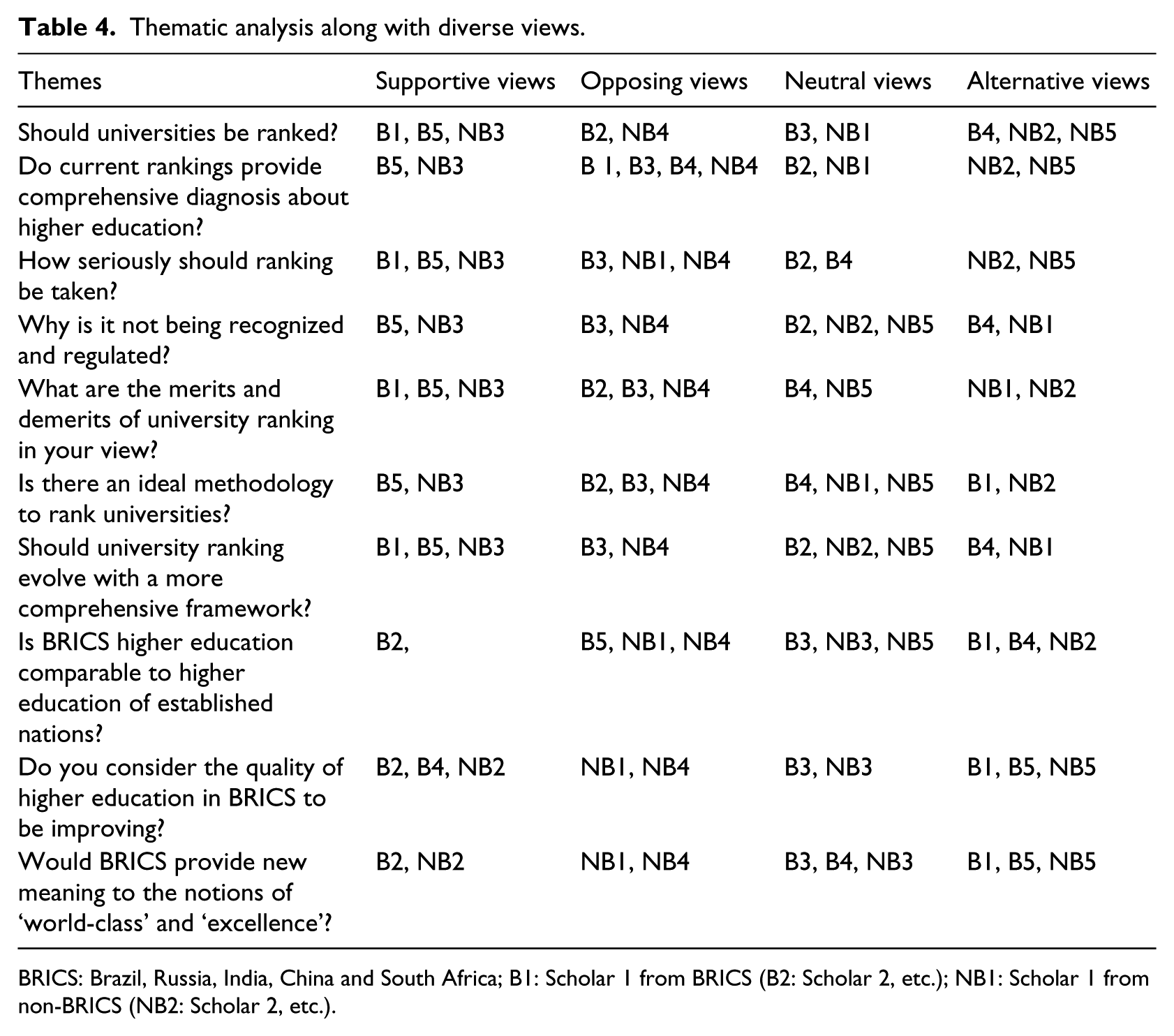
BRICS: Brazil, Russia, India, China and South Africa; B1: Scholar 1 from BRICS (B2: Scholar 2, etc.); NB1: Scholar 1 from non-BRICS (NB2: Scholar 2, etc.).
Some of the respondents who shared their critical reflections were sceptical (B2, NB4) about global university ranking when reflecting on the question, ‘Should universities be ranked?’ Some (B4, NB2, NB5) insisted that universities must not be valued based on the outcome of the ranking, while some indicated the relevance of ranking (B1, B5, NB3) and a few others were not confident about their importance or irrelevance (B3, NB1). It is, therefore, indicative that there is no clear consensus in the scholarly world for the question, ‘Should universities be ranked?’ Most scholars, however, are sceptical about global university ranking and demand a comprehensive approach.
Most of the respondents suggested that ranking criteria should evolve with clearly defined criteria and guidelines while addressing the questions, ‘Do current rankings provide comprehensive diagnosis about higher education?’ and ‘Should university ranking evolve with a more comprehensive framework?’ Some of the respondents were sceptical about ranking relying heavily on research-related criteria. One of the respondents asked, ‘If research can be ranked, why not teaching and learning?’ (B1). Another respondent said that not all universities have the same number of faculties, staff and resources, so how could they be compared and ranked using the same measure? (B2). B3 demanded that ranking include broad criteria, and was particularly critical about ranking heavily relying on research. B5 strongly favoured ranking as a good strategy. He/she considered that ranking should improve and evolve with more comprehensive measures and insisted that ranking be taken seriously. NB1 pointed out that the current ranking system is not comprehensive and thus it needs to be improved constantly for increasing reliability. NB2 expressed serious doubts about the principles and procedures of international university ranking and recommends developing fair, serious comprehensive alternatives. NB3 said that ‘If the ranking is genuine, it will be very helpful for students to identify good university and good programme, but if the ranking is not reliable, it will mislead’. NB4 strongly objected to universities being ranked as rankings are market-oriented and do not respond to cultural and social realities and needs. NB5 pointed out that ‘ranking reputation mostly is linked to the ability of universities to acquire power and resources; the richer the universities the better their ranking is as they would be able to hire top academics, create better facilities’. These reflections suggest that the current rankings don’t provide comprehensive diagnosis about higher education, while they do provide some indication to different stakeholders.
To another question ‘How seriously should ranking be taken?’, some of the respondents insisted that the ranking must be taken seriously (B1, B5, NB3), as it helps students to make their choices. Some opposed taking the ranking seriously, as some of the rankings are operating with business motives that favour some universities (B3, NB1, NB4). However, some other respondents suggested not being overwhelmed with ranking, while considering their indications for positive impacts (B2, NB1, NB2, NB5). It would be good that universities learn from rankings while not being directed and dictated by them.
Some of the respondents supported the argument that ranking be recognized and regulated (B5, NB3), while some felt it would not be possible to regulate ranking as it operated with free market logic (B3, NB4). B2 preferred ‘subject ranking instead of overall university ranking’, while B3 recommended autonomous regulatory agencies to monitor and regulate ranking agencies. Some of the respondents considered ranking to be more a national affair than a global affair (B4, NB5), while others suggested that global ranking is relevant for international students (NB2, NB3). It is relatively clear that ranking will continue to stay and, therefore, it is important to regulate it rather than leave it to take advantage of the absence of regulation.
To the question ‘What are the merits and demerits of university ranking?’, one of the respondents suggested that ranking should evolve with suitable technologies for data collection, analysis and publishing the results with possibilities to access the data (B1). B4 indicated that the current ranking criteria are driven by western standards and suggests that a national- and regional-level ranking would be more relevant as countries must focus on their higher education in line with their national and regional challenges and needs. B5 believes ranking is useful for students and insists ranking be regulated by independent institutions. NB2 raised concerns that ‘ranking has increased competition among universities and academics who consider each other as enemies rather than collaborators; knowledge is patterned, protected and sold just as enterprises do’. NB4 suggests that universities must provide answers for their own societies rooted in their own cultural, historical and political contexts rather than driven by global factors. NB5 indicated that ‘universities in less advanced countries don’t have the same market, network advantage compared to the advanced nations’. These arguments suggest that there are both merits and demerits in the current ranking system and it is expected that the ranking will continue to exist and grow.
For the question ‘Is there is an ideal methodology to rank universities?’, most of the respondents agreed that there is no ideal methodology to rank universities. Some argued that some of the current rankings include broader criteria (B5, NB3), and some suggested that it is impossible to have the same method to evaluate all universities given different contexts and complexities (B2, B3, NB4). Some of the respondents indicated that the methodology of ranking continues to improve (B4, NB1, NB5), while some suggested that ‘reaching global consensus on a comprehensive framework is essential’ (B1, NB2). These arguments indicate the need for ranking methodology to grow with more comprehensive criteria.
Some of the respondents agreed that some of the BRICS universities are comparable to universities of established nations, while many of them are not. B2 indicated the dramatic transformation BRICS higher education is going through, which might allow us in the near future to see more globally comparable standards within BRICS higher education space. B5 strongly believes that ‘ranking will continue to evolve which will help universities to operate more in a transparent manner, which will give equal opportunities for all universities to compete and benefit’. NB4 states that ‘rankings tend to preserve and uphold notions such as quality, which often is linked to the power relations demanding universities to compete in the liberal paths for the capitalist interest’. NB5 indicates that ‘rankings are the replication of colonial agenda as the standards established on ranking is drawn from the colonial power centres’. Most of the respondents share the same views in terms of incompatibility to compare the entire higher education system of BRICS with that of the western world (Western Europe and North America), although a handful of institutions from BRICS are evolving to reach such status. Most of the respondents indicated that it is difficult to compare higher education within BRICS as well as BRICS with other nations.
Most of the respondents indicated that the quality of higher education in BRICS is improving, while some were cautioning about double standards. B1 stated that although BRICS nations are transforming, the higher education system has not reached the standards similar to Western Europe and North America. B4 raises a question, ‘Why must BRICS quality be compared with the standards established by the west?’. B5 said that international reputation is one reason BRICS universities have to compete with advanced nations where academic freedom, availability of research funds, knowledge advancement, technology mediation and attraction to international faculty and students are better. NB2 highlighted that higher education in BRICS is improving since the economy of these nations is prospering. NB2 suggests that ‘BRICS must not fall into the trap to reproduce the same frameworks and standards that are now used by the dominant countries’. NB3 indicated the brain drain from BRICS to western countries is slowing down the progress, and pointed out that most of the BRICS students who study in western countries stay back and do menial jobs such as driving. NB4 suggests that ‘ranking be organized within the local society or at least at regional level or among countries that share similar cultural, social values’. NB5 indicated that ‘the current ranking strongly is based on the use of English language in teaching and publishing, which only present the one-sided picture of global knowledge and research landscape’.
One of the respondents pointed out that ‘the current attachment of the notion world-class is strongly linked to American and European universities, which is radically changing and BRICS nations seem to provide some indication on this’ (B1). B2 expressed confidence that some of BRICS nations are already providing new meaning to the notions ‘world-class’ and ‘excellence’. B4 raised concerns about these notions as they are linked to western and business notions of quality, and questions, ‘Who and what should define quality and global standards?’ B5 said that some of the BRICS nations have already indicated their ability to get several universities in the ranking league table. NB1 informed that there has been a quantitative improvement, but quality concerns are central for BRICS nations now. NB3 indicated that the quality of higher education is improving in BRICS nations, while academic integrity has not improved much yet. NB4 considered that BRICS can’t be compared given the difference among their social, political and cultural contexts. NB5 claimed that ‘students in BRICS are at times more resourceful and creative than students at some of the top universities’. The different views of the respondents suggest that the quality of higher education in BRICS nations is considerably improving. Some of the BRICS members such as South Africa and Russia have long traditions of quality higher education. China has also made a remarkable improvement in quality in recent years, while Brazil and India seem to show some progress.
Some of the respondents believe that BRICS may provide new meaning to the notions of ‘world-class’ and ‘excellence’, and others are not sure about it. Respondents from Brazil and India indicated privatization of higher education posing competition, leading to quality as well as sub-standards. A respondent from China indicated the operation of foreign universities and the engagement of international academic staff has stimulated quality concerns for domestic universities. B4 indicated the globally shrinking public funding for higher education and the rise of for-profit higher education institutions, growing competition, increasing rights of students, changing resource distribution for different fields and technological advancement tend to present higher education as an industry. NB1 felt that BRICS may or may not provide the new meaning; it relies on necessary reforms and radical transformation, which does not seem to be happening dynamically for now. NB2 believes that ‘BRICS will try to develop alternatives which may develop new opportunities as well as challenges to global higher education space’. NB3 expressed strong hope that the Chinese and Russian institutions will have the ability to provide alternative academic and research abilities. NB4 raised an interesting question, ‘Why must the western science be the only universally accepted science?’ He/she suggests that ‘if BRICS take a more decisive role in the global political, economic contexts they could mark some new meanings in such notions; however, in the current conditions they simply follow the popular trend’. NB5 believes that ‘the notion “world-class” will continue to be judged by employability and the size of graduates’ salary and some of the top universities with their brand value will continue to take advantage of this’. NB5 thinks that ‘the notion “excellence” will depend on the field of research of which every country may take advantage although it depends on the resources, leadership, vision, marketing talents and output of the faculty and students of each university’ and BRICS nations seem to emerge to provide new meaning to ‘excellence’.
The critical reflections from the 10 established scholars clearly indicate that it is important to be sceptical about global university ranking while taking advantage of the positive impacts ranking makes. As most of these scholars pointed out, the BRICS nations may take the opportunity to provide new meaning to the notion of ‘world-class university’ that would be relevant to the emerging context in BRICS nations.
Conclusion
Altbach (2004) describes the paradox of the world-class university: everyone wants one, but no one knows what it is, and no one knows how to get one. He observes that we are in an age of academic hype, and the world-class status often emulates the wealthiest and, in many ways, most elitist universities. Salmi (2011) indicates that becoming a member of the exclusive group of world-class universities is not something that can be achieved by self-declaration. Sadlak and Cai (2009) emphasize that the quest for excellence must not be dictated by economic and business interest, and they invite centres of excellence to extend support to others to emerge. Kehm (2014) considers ranking as a symbolic value that influences major decisions in higher education, and she calls this ‘a postmodern shift’. The academic reputation survey conducted in 117 countries with 4296 respondents (Thomson Reuters, 2015) indicated that North America and Europe are the most familiar regions for higher education and academic research, and English is the most widely used academic language.
These are some of the questions that have to be constantly discussed and debated: should academic integrity/cooperation be preferred to academic completion? Should focus include good teaching/learning experience rather than increased emphasis on research? Coetzee (2016) emphasizes that we need free inquiry because freedom of thought is good in itself, and considers universities as good for individuals and good for the society. Does that mean that universities have a broader social purpose and value (the generation and dissemination of universal knowledge) than being limited to serving the quest for excellence and world-class status? However, universities are left to deal with the ongoing dilemma to serve/focus on different interests and priorities. Therefore, the future of ranking/excellence remains in the way we resolve the tension between academic utilitarianism and academic solidarity. Some of the alternatives for ranking are suggested by Salmi (2013b), who prefers benchmarking as a cure, if the ranking is the disease. Vught and Ziegele (2013) propose U-Multirank, which is a user-driven and multi-dimensional ranking tool for higher education and research. Yelland and Valle (2013) recommend the Organisation for Economic Cooperation and Development (OECD)-led Assessment of Higher Education Learning Outcome initiative, which aims to develop an international assessment of higher education learning outcomes. Marginson and Wende (2007) indicate the need ‘to secure “clean” rankings – transparent, free of self-interest, and methodologically coherent’ (p.326). Scott (2016) suggests that targets and rankings are the way forward for universities.
The theoretical and empirical exploration indicate that there are supportive, opposing, neutral and alternative views on global university ranking. There is a strong feeling among various stakeholders that ranking has both opportunities and challenges. The realistic view is that, whether we like it or not, global university ranking will be with us and it will continue to evolve and will make big impacts on shaping higher education. There is, however, a strong expectation from all to develop alternative ranking models, particularly to rank comparable countries and regions that share similar cultural, social and political contexts. For many, BRICS is not a comparable unit given the cultural, social and political differences among the countries, although there is some economic and political aspiration for BRICS to work together on common issues. Although the higher education in BRICS nations is growing in terms of both quantity and quality, it will take a long time to improve further. The current status of higher education in BRICS nations has been strongly driven by popular global trends, and they may or may not provide alternative meanings to the notions of ‘world-class’ and ‘excellence’ based on the radical transformation of the higher education landscape within BRICS. For some respondents, these nations seem to be evolving rapidly, which provides some indication that BRICS does have the ability to provide alternative meanings.
Footnotes
Declaration of Conflicting Interests
The author(s) declared no potential conflicts of interest with respect to the research, authorship, and/or publication of this article.
Funding
The author(s) received no financial support for the research, authorship, and/or publication of this article.