



Abstract
The purpose of this study was to examine similarities and differences of American, Japanese, and Taiwanese kindergarten teachers’ perspectives about clean-up time. The participants consisted of two female American kindergarten teachers in the southeastern US, two female Japanese kindergarten teachers on the main island, and two female Taiwanese kindergarten teachers from central Taiwan, all of whom teach four-year-olds. Qualitative analysis of the data yielded four themes regarding teachers’ views of clean-up time: teaching cleaning-up methods, the developmental stages, the extension of play, and reflection of one’s own practical knowledge and skills. These teachers perceived clean-up time was more than just a transitional time. The implications for early childhood education are presented.
Clean-up time, or tidy-up time, in early childhood educational settings is usually considered a transitional time from one activity to another (Corsaro, 2003; Lash, 2008; Minowa et al., 2009; Nakatsubo et al., 2009; Nagase and Kuramochi, 2013a). Clean-up time refers to “cleaning up of materials, toys, and work space so that the class can transition to another activity” (Lash, 2008: 35). Transitions in early childhood educational settings mean “changes from one activity to another or from one place to another” (Thelen and Klifman, 2011: 92). In classrooms, many teachers use simple verbal cues before clean-up time: ”We will be cleaning up in ten minutes.” Giving children two signals before a transition might encourage children who have difficulty in changing from one activity to another (Thelen and Klifman, 2011; Weldemariam, 2014).
Clean-up time is also viewed as children’s “secondary adjustments to adult rules” (Corsaro, 2003: 138). Secondary adjustments are defined as children constructing adjustments to avoid or postpone their required tasks (Corsaro, 2003). When observing children’s behavior during clean-up time, there are three “categories of clean-up evasion: the relocation strategy, the personal problem delay, and the pretending to not hear strategy” (Corsaro, 2003: 150). Regarding the first category, children left play areas and moved to different areas to avoid cleaning. In the second category children told teachers that they were had personal problems, including being sick or hurt, so they could not participate. In the last category children pretended not to hear the clean-up signal and continued playing. Therefore, teachers ended up finishing most of the work (Corsaro, 2003). Likewise, clean-up time becomes “a source of conflicts” for children and teachers (Nakatsubo et al., 2009: 81).
Romero (1991) examined children’s perceptions of play and work and found some children helped clean up a few items, not finishing, and joining in group time. Others cleaned up only toys with which they played. As soon as they heard it was clean-up time, some went to the bathroom or began to paint on the easel or engaged in other activities. Still some wandered in the classroom, telling others it was clean-up time.
The purpose of the study
The purpose of this study was to examine similarities and differences of American, Japanese, and Taiwanese kindergarten teachers’ perspectives about clean-up time. Cultural beliefs, values, and traditions influence the goals of education (Hsieh, 2004), and such influences might provide the best practices of early childhood education when reviewing the values and contexts of teachers’ varying perceptions of clean-up time. Sharing educators’ knowledge and skills of how to guide children through this activity would be beneficial in a universal understanding of early childhood education.
Regardless of the current emphasis on the importance of early childhood education (Van Hoorn et al., 2011), there exist limited studies examining teachers’ perceptions of clean-up time in different cultures. This study was conducted to address such limitations and was guided by the following two research questions: (1) What views of clean-up time were revealed among American, Japanese, and Taiwanese teachers? (2) Are there any similarities and differences regarding their teaching methods during clean-up time? This paper first outlines the contexts concerning previous studies of clean-up time, and is followed by a report on the study, analysis of findings, and discussions of implications and limitations for early childhood education.
Previous studies of clean-up time
Studies on clean-up time in the US were examined in relation to children’s self-regulation (Elias and Berk, 2002; Kochanska et al., 1995; Kochanska et al., 1997; Rubin et al., 2002) or parent–child relations in terms of behavioral issues (Combs-Ronto et al., 2009; Gilliom et al., 2002; Hastings et al., 2008; Kuersten-Hogan and McHale, 2000; Sessa et al., 2001). One study examined preschool teachers’ practices and found that clean-up time was a 100% teacher-initiated task (McMullen et al., 2006), but teachers were not specifically asked about their perceptions of clean-up time since a self-reported questionnaire was used. None of these studies explored teachers’ perceptions of clean-up time.
Although no standards are prescribed by governmental early childhood educational guidelines, the National Association for the Education of Young Children’s book on developmentally appropriate practice (DAP) (Copple and Bredekamp, 2009) states “teachers engage children in developing their own community rules and behavior” (p. 17). DAP recommends everyone in the classroom be responsible for its members and its environment, although it does not use the term “clean up.”
In Japan, current research about clean-up time was examined in relation to teachers’ professionalism (Nakatsubo, 2013; Nagase and Kuramochi, 2011). Other studies observed children’s behavior during clean-up time and found that children learn to clean up as part of their everyday habits in group settings (Nagase and Kuramochi, 2011, 2011a). When supporting children’s clean-up abilities, Japanese teachers took into consideration children’s ages and the time of day (Nagase and Kuramochi, 2013b; Sunagami et al., 2015; Tomita and Takahashi, 2012). Teachers’ interactions with children regarding clean-up time changed according to the time of year, indicating that teachers guided children based on their developmental stages (Sunagami et al., 2015). It is critical for children to learn to clean up by the age of four (Nagase and Kuramochi, 2013a, 2011a; Sunagami et al., 2015).
Other studies (Sunagami et al., 2009; Sunagami et al., 2012; Tomita and Takahashi, 2012) found that many educators recognize clean-up time as the process of transition from one activity to another and nurture children’s initiative in cleaning up their environment through such processes. Japanese teachers do not rely on the use of any signal for clean-up time, but encourage children’s initiative to clean up their play areas in order to transition to another activity (Nagase and Kuramochi, 2011). Teachers generally view clean-up time as the group’s responsibility, and consider it as a group-oriented activity. Through this activity, teachers hope to enhance children’s initiative and group spirit. Many teacher educators in Japan emphasize the importance of early childhood educators’ professionalism when guiding children during clean-up time as it can promote teachers’ practical knowledge and skills (Sunagami et al., 2015).
In Japan, as regards the development of children’s abilities to clean up, the Ministry of Education, Culture, Sports, Science, and Technology (MEXT, 2008) provides early childhood education guidelines, stating that children need to understand “the way of life in kindergarten” (p.5) and to organize their environments by themselves. Such abilities should be developed by maintaining healthy physical environments (Sunagami et al., 2015). Teachers must recognize each stage of children’s development when guiding them during clean-up time (MEXT, 2008), and teachers should support the development of children’s abilities through their own self-reflection (Muto, 2004).
In Taiwan, the Preschool Activities and Curriculum Guidelines Working Edition set forth by the Ministry of Education (2013) state that children need to use appropriate tools to clean up their environments, and that they should observe and adjust their behavior in order to care for and clean their environments. Clean-up time in Taiwanese early childhood settings is allocated for transitional time from one activity to another (Lin, 2015). However, there exists no research regarding Taiwanese kindergarten teachers’ concepts of the subject.
Almost all preschools in Taiwan emphasize the importance of cultivating children’s habit of cleaning which is considered as a good habit. However, it is hard to find any research on this topic in Taiwan. I believe that there are at least two reasons because clean-up is integrated into children’s daily routine, few researchers will consider it an isolated issue for study; thus, most researchers may underestimate its significance. The curriculum and teaching in ECE or content of learning for young children are much more attractive to researchers (Shu-Chin Chen, personal communication, 16 March 2015).
Method
Participants
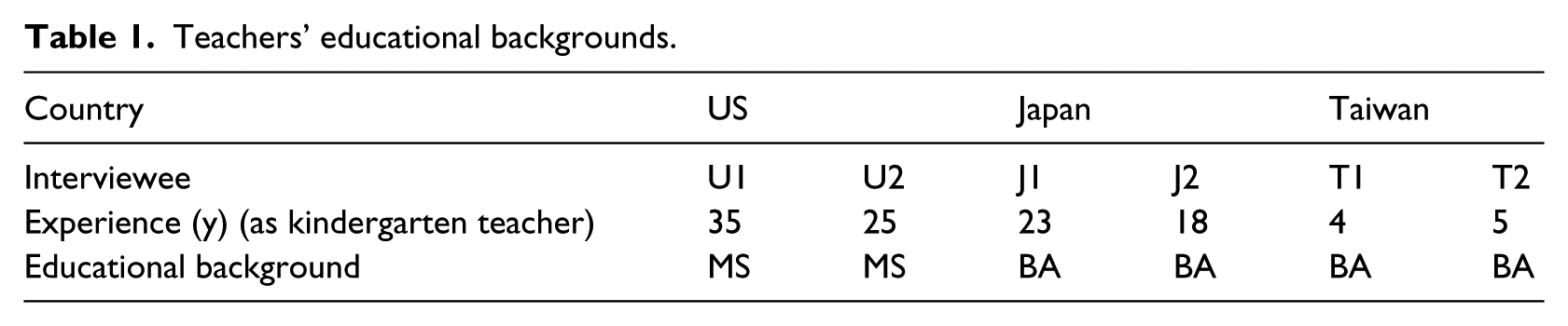
The participants consisted of two female American kindergarten teachers in the southeastern US, two female Japanese kindergarten teachers on the main island, and two female Taiwanese kindergarten teachers from central Taiwan, all of whom teach four-year-olds. The respondent pool was selected through convenience of access (Hactch, 2007), and was identified as teachers who might have “the best information to which we can address our research questions” (Hancock and Algozzine, 2006: 40). As shown in Table 1, both American teachers had Master’s degrees in early childhood education, and the Japanese and Taiwanese teachers had BAs in early childhood education. The two American teachers had 35 and 25 years of teaching experience, respectively, two Japanese teachers had 23 and 18 years of teaching experience, respectively, and the two Taiwanese teachers had four and five years of teaching experience, respectively.
Teachers’ educational backgrounds.
Data collection
We followed some procedures of the “ethnographic interview” (Tobin et al., 2009: 15) by videotaping each teacher’s classroom during clean-up times for 10–15 minutes. Each teacher watched the videotape of her clean-up time and was interviewed “to provide context, reflections, and explanations” (Tobin et al., 2009: 15). The second author interviewed Japanese teachers, the third author interviewed Taiwanese teachers, and an American research assistant interviewed American teachers.
The interview questions were categorized in the following three ways:
Teachers’ interactions with children during clean-up time (What does clean-up time mean to you? When beginning and ending clean-up time, what do you say to your students? When you see some students who are not participating in clean-up time, what do you say to them? Do you have any rules that your students have to participate in when cleaning up together even though they did not use the toys or equipment?)
Teachers’ ideas about how children’s clean-up activities are related to their development (As a teacher of four-year-olds, what do you think of the relationships between clean-up time and children’s development? How do you want three, four, and five-year-olds’ clean-up behavior to be changed?)
Teachers’ concepts of clean-up time (While viewing this videotape, what was interesting or what did you think? Which parts of this videotape made a big impression on you?).
Data analysis
The first author translated Japanese teachers’ responses into English, and two Japanese bilingual educators reviewed the responses, reaching consensus on translation (Izumi-Taylor et al., 2010). The third author followed the same procedures with the Taiwanese data.
Our data analysis consisted of content and thematic analyses. The data were coded and categorized using qualitative analysis methods (Lichtman, 2010). The first author trained two assistants to code and categorize responses. We coded each response “according to its relevance to the study, and multiple category codings were counted as separate responses” (Izumi-Taylor et al., 2010: 412). We discarded responses that were irrelevant to the themes, and coded other responses more than once.
Results
Qualitative analysis of the data yielded four themes regarding teachers’ views of clean-up time: teaching cleaning-up methods, the developmental stages, the extension of play, and reflection of one’s own practical knowledge and skills. We defined teaching cleaning-up methods as how teachers guide children during clean-up time. The developmental stages referred to how children grow and change as they interact with their environments. The extension of play meant incorporating clean-up time into play. Reflection of one’s own practical knowledge and skills was defined as introspection of one’s own knowledge of teaching and decision-making skills (Sunagami et al., 2015).
Teaching clean-up methods
When asked to discuss clean-up time in their classes, the teachers in these three nations appeared to be discussing their methods of guiding students during such time. In the United States, when it is clean-up time, the teachers used songs or bells to signal their students it was time. One teacher gave her students a 5-minute warning, dimmed the lights or used a clean-up song. She said, “We tell them in five minutes we are going to start cleaning. Sometimes we dim the lights, and we sing the clean-up song.” Another teacher also gave her students a 5-minute warning before the time to clean up at the block center since it takes lots of time to put blocks away, and her assistants made sure the students engaged in cleaning. “The place where we start is the block area because that takes longer, so I give them a head start. I tell them I am about to ring the bell,” said another teacher. While the students and her assistants cleaned the block area, this teacher sat on the carpet for “circle time” and began singing with accompanying finger-play movements (“Itsy-bitsy spider” for example). When these teachers saw some students not participating in clean-up, they instructed them to go back to the block area before they joined in the “circle time.” One teacher said, “You did not clean up, did you?”
In Japan, the teachers simply told their students that it was time for cleaning. They first guided the students to the outdoors to tidy up first because it takes longer. They observed their students’ play behavior, waiting for the appropriate time to suggest cleaning, saying, for example, “You worked hard at cooking, so let’s start tidying up here, alright?” When observing students who did not clean up, a teacher said, “You used this toy, didn’t you?” To these teachers, it was important to make sure that their students realize when it was clean-up time, and then, both the students and teachers commenced cleaning.
In Taiwan, the teachers used bells to signal cleaning. Teachers and students together engaged in cleaning, with teachers praising their behavior. “You are an expert in cleaning” said one teacher. Another teacher commented, “Five minutes till clean-up. Keep it up; you are doing well.” Only Taiwanese teachers praised their students’ efforts at clean-up time. One example of a Taiwanese teacher’s comment was “Free play time is finished. You are doing very well, now let’s start cleaning up our room.”
Instead of praise, the Japanese teachers described how their students tidy up the environment. One Japanese teacher mentioned that she tries not to praise them but instead described her students’ efforts as a group by saying, “I do not praise their efforts at cleaning up their own classroom, but I tell them how they all work hard at it.”
Both Japanese and Taiwanese teachers used encouragement when guiding students during clean-up time, but this was not so for the American teachers who just informed their charges that it was clean-up time. One Japanese teacher said, “I observe the process of their play and estimate how long it would take to clean up. So, I help them by reminding that such time is coming soon.” Another Japanese teacher noted, “I avoid shorting their play time. If they are pretending to cook at the sand and water area, I might say to them, ‘I see you have been cooking something delicious. Mmmm … that looks so good, so let’s eat and then clean up.’ I do not want to stop my students’ activity suddenly.” Similarly, Taiwanese teachers encouraged their students by saying: “My dear, we are ready to do something different now. If you did not finish your work, we can do it this afternoon or tomorrow,” and “If you don’t finish your play activity, you can do it later.” Both Japanese and Taiwanese teachers appeared to empathize with their students’ feelings/emotions during play.
All of these teachers reminded their students to engage in cleaning. One Japanese teacher said, “Because some children know how to tidy up and some don’t, I try to encourage those who don’t know by talking about how to clean it together.” Another Japanese teacher mentioned that she leads children in clean-up time, saying, “I encourage and remind them to clean up together” Likewise, two Taiwanese teachers reminded their students to work with them in cleaning, saying, “Can you put back these materials where they belong?” and “Would you please help me make our room beautiful?” Also, American teachers commented: “I see you still have your work out, so you need to put that away before you join us,” and “Did you hear the clean-up song?”
Developmental stages
Both Japanese and Taiwanese teachers voiced their opinions about children’s understanding of clean-up time being associated with their developmental stages; thus, they work with their students accordingly. One Japanese teacher observed, “When I work with three-year-olds at clean-up time, I encourage them by saying, ‘Can you put them away here? I will help you.’ As for four-year-olds, their play is more complex and dynamic. So, they seem to know how to clean up but I still support them.” Another Japanese teacher mentioned, “My students’ understanding of clean-up time is developmental. When they are younger, I suggest where they can put their toys. When they are older, they are able to clean up by themselves.”
Two Taiwanese teachers also described how their students’ understanding of clean-up time is related to their developmental stages. One teacher claimed: Three-year-olds should be able to follow teachers’ directions and put toys back in their places. Four-year-olds should be able to put toys back in the right baskets or shelves. Five-year-olds should neatly place toys back on shelves.
Another Taiwanese teacher’s comments were similar to her colleague’s but were associated with cooperation: Three-year-olds should be able to follow teachers’ directions and put toys back where they found them. For four-year-olds need to help each other to restore their classroom. By five, they need to place toys neatly back on the shelves and keep their classroom environment clean by helping each other.
One American, one Japanese, and two Taiwanese teachers’ responses were associated with cooperation in relation to the developmental stages. An American teacher noted, “They (students) have to make sure the center looks nice before students are cleared. In general I think it (clean-up time) teaches respect, cooperation, and determination to stick with something that they may want to do.” A Japanese teacher observed, “It is my responsibility to lead and promote my students’ cooperation to clean up together.” Two Taiwanese teachers commented: “It helps children to restore classroom environments,” and “Children can cooperate in cleaning the whole classroom and enjoy the neat and comfortable environment together.”
Two Japanese teachers focused on how they would enhance their students’ cooperation in understanding the concepts of clean-up time. For example, they affirmed, “I talk to my students about clean-up time in a concrete way so they can understand about clean-up time, and I clean with them. In this way I can promote their understanding of how to clean up cooperatively,” and “I work with them to create a classroom atmosphere of cleaning.”
Two Taiwanese teachers also related cleaning to cooperation. One opined, “It is the time for mutual cooperation and social development,” and another responded simply, “Cooperation.” Also, this American teacher’s remark was related to peaceful environments, “I know that if the room gets way too crazy and messy, we all start to get a little stressed out. It is calming when the room is in order. And of course, respect and cooperation.”
Only one Taiwanese teacher mentioned cooperation when viewing the videotapes, while no American and Japanese teachers did. This Taiwanese teacher discussed how her students cooperated while cleaning by communicating with each other, saying “By looking at the video, my students had different opinions about clean-up. However, because they discussed the issue, they were able to finish cleaning tasks together.”
One Japanese teacher mentioned the power of the group when viewing her classroom video: I enjoyed the video and felt the power of the group when my students begin clean-up time. One child begins cleaning up, then another one participates. They are influenced by each other. Children are keen observers of others.
Only American teachers not only viewed clean-up time as related to children‘s developmental stages but also perceived it as associated with children’s independence skills. When asked about their students’ developmental stages in terms of clean-up time, the American teachers discussed independence. One American teacher claimed: They are very excited about their own independence. So in a way, the clean-up process is a little easier with kids at this age. They want to take ownership of things because they are independent enough to do it now.
Another teacher said, “What we focus on is building independence and self-reliance in children of that age group. They should be able to clean up after their own messes, acquiring that sense of independence, taking care of your own.”
These teachers appeared to be associating clean-up time and students’ developmental stages in terms of responsibility. Two American teachers commented that clean-up time is a time for children to learn to be responsible. One American teacher observed, “Clean-up time is a time where children acquire a sense of responsibility for their environment,” and another shared, “It encourages a lot of team work. Everyone is responsible for cleaning up a center.” A Taiwanese teacher stated, “I feel clean-up time is important for children to develop responsibility and the ability to take care of themselves in daily life.” Although one Japanese teacher acknowledged clean-up time develops students’ responsibility, her responses were somewhat different from her American and Taiwanese counterparts, “I do not see clean-up time as just developing my students’ abilities to be responsible, I see it as their opportunity to internalize that it is time to clean up, but not do this just because I said so.”
Only one American teacher discussed clean-up time in relation to a transitional time. She said, “I think that clean-up time is a transitional time for the kids. I think it is important for the children to take ownership of their environment and their materials, and it really teaches them respect for their classroom.”
When discussing how clean-up time was related to students’ developmental stages, one American, one Japanese, and one Taiwanese teachers mentioned the development of sorting skills. An American teacher noted, “It is to restore the room to order, to make sure everything is in the right place so we can find it again.” A Japanese teacher observed, “I want them to develop their sorting skills.” A Taiwanese teacher’s response was simple, “Sorting ability!”
Extension of play
This theme separated Japanese teachers from the others because only Japanese teachers related clean-up to the extension of play. One teacher explained: Clean-up time is part of play. Since I consider it as an extension of children’s play, so we need to create an environment where children can save their play activities for the next day. I need to prepare such an environment where children can extend their play.
This theme was again evident when this Japanese teacher discussed how children’s understanding of cleaning up is developmental. “Because I view clean-up time as connected to tomorrow’s play time, I set the environment where they can not only clean up but can also save their play creations.” Likewise, another Japanese teacher asserted, “To me, even the end of clean-up time is part of play. I try to instill in my students habits that develop their abilities to maintain clean environments with feelings of joy while cleaning.”
To promote their students’ understanding of having clean environments which can expand their play, only Japanese appeared to describe students’ efforts to keep order in classrooms. One teacher said, “When my students finish cleaning their classroom, I describe how clean the classroom looks and how we all feel better,” and another explained, “I name those who helped clean up, saying, ‘Mika, it looks very nice and clean, doesn’t it?’ I am hoping others will hear this, encouraging them to participate in clean-up.”
Reflection of one’s own practical knowledge and skills
The theme of reflection about their own practical knowledge and skills emerged when teachers were asked to discuss their reactions to their videotapes of clean-up time. One American and two Japanese teachers related their views of the videotapes to their own teaching while none of their Taiwanese counterparts did so. An American teacher responded: I noticed a lot of things that I never thought about before…I guess we have not made a big focus on the order of doing things in clean-up…That to me, I felt like something I would like to work on as a teacher.
Two Japanese teachers’ responses were also reflective: “I found out that I missed noticing how some children were highly engaged in clean-up activities. I learned that through this video, and I should show more appreciation to those who clean up,” and “Children observe others’ actions and influence each other. Through the video, I learned that some children can start an opportunity for everyone to participate in clean-up by modeling it.”
Discussion
The thematic analysis of results indicated how samples of American, Japanese, and Taiwanese early childhood teachers perceived clean-up time and related it to teaching young children. Certain themes appeared to be more commonly identified by one or another of the three samples in their responses. Both research questions will be addressed simultaneously.
American, Japanese, and Taiwanese teachers’ perceptions of clean-up time
All participants utilized different teaching methods to engage their charges in cleaning. Both American and Taiwanese teachers used bells, songs, and lights as signals, while Japanese teachers did not use any signals to engage students, instead they talked to them about it (Sunagami et al., 2015). These observations about using signals were supported by Thelen and Klifman (2011) and Weldemariam (2014), noting many early childhood teachers implemented various kinds of signals before classroom cleaning.
American, Japanese, and Taiwanese teachers perceived clean-up time to be more than a transitional time since they considered it as a time for students to learn to cooperate, learn sorting skills and responsibility. The development of cooperation was mentioned by many participants when discussing children’s developmental stages and clean-up time. These teachers recognized that cleaning time should be done by everyone cooperatively (Sunagami et al., 2009). However, Japanese teachers were more adamant about the importance of working together to tidy up their environments because the Japanese school in this study subscribed to a group-oriented curriculum.
Regarding the development of children’s sorting skills, Minowa and others (2009) also found some teachers recognized that clean-up time can promote such skills. However, to these teachers, developing such skills is not only a goal of clean-up time but should also be nurtured by teachers’ careful guidance.
Only one American teacher described clean-up time as transitional time. In the US, it is well known that clean-up time is considered as a transitional time (Lash, 2008; Thelen and Klifman, 2011). Although none of the Taiwanese and Japanese teachers mentioned the issue of transition, both Japanese and Taiwanese studies found clean-up time to be related to transition (Lin, 2015; Minowa et al., 2009; Nakatsubo et al., 2009).
In contrast to the findings of other studies (Corsaro, 2003; Nakatsubo et al., 2009; Romero, 1991) indicating that clean-up time becomes “a source of conflicts” among students and teachers (Nakatsubo et al., 2009: 81), the teachers in this study did not mention any difficulties in engaging their students in cleaning activities. Instead, they had their own ways of guiding students in cleaning up their environments, including helping, reminding, praising, and encouraging them to work as a group (Copple and Bredekamp, 2009; Nakatsubo, 2013; Sunagami et al., 2015). Taiwanese teachers praised their students more than their American and Japanese counterparts.
As American, Japanese, and Taiwanese teachers perceived clean-up time as associated with students’ developmental stages, they discussed how they guided students according to children’s developmentally appropriate abilities. Both Japanese and Taiwanese teachers assisted the young children more than the older ones (Minowa et al., 2009; Nagase and Kuramochi, 2011, 2013a), expecting older students to clean up by themselves. Although one American teacher related children’s cleaning abilities to their developmental stages; she connected such abilities with students’ independence, while none of her Japanese and Taiwanese counterparts did so.
The theme of the extension of play differentiated Japanese teachers from their American and Taiwanese counterparts. Japanese participants observed that clean-up time is part of children’s play and did not stop it abruptly. Because they recognized children’s play for the day should be extended to the next day, they wanted to clean as well as to save such play environments (Minowa et al., 2009; Sunagami et al., 2009). This observation was verified by the early childhood education guidelines set forth by the government (MEXT, 2008), asserting that teachers need to respect and value children’s play as well as to teach children to care for their play materials and equipment.
When all participants reviewed their videotapes, only American and Japanese teachers appeared to agree with the notion that when examining their own teaching methods during clean-up time, it provided them with the opportunity to reflect on their own practical knowledge and teaching skills. Assessing one’s own practical knowledge and skills is the primary component of being a professional practitioner (Copple and Bredekamp, 2009; Minowa et al., 2009; Muto, 2004; Sunagami et al., 2009). For teachers to improve their teaching skills, they must engage in self-reflection (Copple and Bredekamp, 2009; Muto, 2004).
Although each country’s teachers used various kinds of methods to encourage their charges’ engagement in tidy-up time, it seemed cleaning strategies were effective when teachers consider such time as part of play, saving their children’s play activities till the next day (Weldemariam, 2014). These observations were aligned with Corsaro’s findings (2003) that some children voiced their opinions that it would be helpful if they were able to save their activities till the next day and that they did not understand why they had to tidy up just for one day. It might also be helpful if teachers talk about the importance of tidy-up time when children are working as a group, rather than just announcing it is tidy-up time.
Implications for early childhood education
The findings of this study indicate that teachers from Japan, the US, and Taiwan have their own perceptions of clean-up activities and their own ways of engaging children in them; each country’s teachers could work together to expand their knowledge on how to engage children in cleaning.
As part of this collaboration, teachers might also observe the effective methods to create training materials and sessions that enable teachers to translate theory and research into practice. By doing so, educators of different nations can understand how they can share their teaching methods with other teachers to better understand how to nurture children’s abilities and initiatives during cleaning because clean-up time is more than just a transition.
Because teachers in different cultural settings appeared to make their own connections between clean-up time and teaching, it is important for educators to understand how their views of clean-up time are influenced by their own cultures. It would be beneficial for teachers to review videos of clean-up time from different countries to rethink and reflect on their own understanding of the subject.
Limitations of the study
This indication must be considered limited, given the small number of participants from the three nations. Further research would require a wider sample of teachers from different schools.
Given the diversity of teaching experiences and educational backgrounds of the participants, as well as having only female participants, their perceptions might have influenced their responses. Matching participants’ teaching experiences, educational backgrounds, and including male teachers in the study would be helpful in understanding clean-up time.
Although the questionnaire was created by the Japanese and the American researchers, it is not free of cultural bias. The questionnaire was derived from hours of discussions by researchers from the two nations, but teachers in different cultures may interpret each item differently. It would be appropriate to have more input from researchers and educators of different nations.
It would be interesting and helpful to understand the notion of clean-up time if we ask students about their views, since teachers’ views of school activities do not necessarily align with those of students. When given opportunities, students are capable of voicing their opinions and ideas. Future studies could include their participation.
Footnotes
Declaration of Conflicting Interests
The author(s) declared no potential conflicts of interest with respect to the research, authorship, and/or publication of this article.
Funding
The author(s) received no financial support for the research, authorship, and/or publication of this article.