




Abstract
This paper critically engages observations from a school that was aligned with a resistance movement in Lebanon during a post-war period of sustained political violence (2006–2007). Focusing on the pedagogical practices at one community-centered and community-led Shi’a Islamic urban school, the paper draws on extensive ethnographic data to illustrate how teachers and students, together, negotiated resistance and peace learning through a critical and participatory process at a school whose curricular content, structure, and pedagogy explicitly addressed both direct and structural forms of violence. Drawing on rich, illustrative classroom data, I examine the production and enactment of peace knowledge as resistance to the status quo. This knowledge production does not exclude the performance of militarism and heroic resistance as forms of praxis, creating dissonance for understanding peace education as a field of scholarship and practice. This dissonance, I posit, is critical in forging possibilities for transformative change. The paper brings postcolonial theory into conversation with critical peace education to consider how larger structural, material, and political realities serve to mediate learning processes and value biases in peace research.
Keywords
Introduction
This paper critically engages observations from a school that was aligned with a resistance movement in Lebanon during a post-war period of sustained political violence (2006–2007). Focusing on the pedagogical practices at one community-centered and community-led Shi’a Islamic urban school, the paper draws on extensive ethnographic data to illustrate how teachers and students, together, negotiated resistance and peace learning through a critical and participatory process at a school whose curricular content, structure, and pedagogy explicitly addressed both direct and structural forms of violence (Zakharia, 2013). Drawing on rich, illustrative classroom data, I examine the production and enactment of peace knowledge as resistance to the status quo. This knowledge production does not exclude the performance of militarism and heroic resistance as forms of praxis, creating dissonance for understanding peace education as a field of scholarship and practice that is concerned with the elimination of all forms of violence, as well as the creation of “structures that build and sustain a just and equitable peace” (Bajaj and Hantzopoulos, 2016: 1; Galtung, 1969; Reardon, 1999).
This qualitative case study responds to the call by Bajaj (2008: 138) to reclaim a critical peace education in order to “acknowledge the complex and diverse forms that peace education can … take.” Emphasizing “local understandings of how participants can cultivate a sense of transformative agency” (Bajaj, 2008: 135), critical peace education as a field of scholarship and practice “interrogates invisible and taken-for-granted notions and assumptions through a juxtaposition of disciplinary insights, critical analysis, and/or empirical research” (Bajaj and Brantmeier, 2011: 223). Critical peace education also draws on Freirean notions of critical pedagogy, which play a central role in processes of knowledge production towards transformative agency (Diaz-Soto, 2005; Hantzopoulos, 2011).
Bringing postcolonial theory into conversation with critical peace education, I grapple with the roles that schools can play as sites of indoctrination and liberation (Freire, 1970) and the value bias that shapes peace education research during particular historical moments, often excluding the schooling of communities aligned with resistance or government opposition movements from discussions about localized peace efforts or community-based peace education. Rather, such populations are essentialized, divorced from their cause, and assumed to be wedded to violence. This posture is increasingly evident in prescriptive research and development programming that seeks to inscribe a peace discourse into educational projects in fragile and post-conflict settings, particularly among youth who are seen to be “at risk” of “radicalization” or mobilization into armed groups. Such programming often ignores local forms of peace knowledge. For example, in Lebanon, youth living in underserved geographies, such as Shi’a and Sunni Lebanese youth and their Palestinian refugee counterparts, have been subject to educational programming under the banner of peacebuilding in recent years without attention to local tensions in meanings, articulated needs, or structural issues. 1
Further, discussions of community-based peace education tend to privilege non-formal education over schooling and some have questioned whether the hierarchical organization and socialization processes at schools can generate spaces for the development of transformative agency (Haavelsrud, 2008; Harber, 2004). The notion that peace education may be incompatible with school structures and processes serves to dismiss the role these can play as conduits for critical peace education (Hantzopoulos, 2011). This case study offers an opportunity to consider the complexities of critical peace education by examining the practices of a community-centered school, by and for a historically marginalized population, within a formal system that is both tied to a government-mandated national curriculum and its opposition movement.
Through a critical, participatory, and anti-oppression pedagogy, teachers and students at this school engaged in a dynamic form of critical peace education, ultimately arriving at non-consensus with the status quo. It is the community-centered aspect of this school’s process that makes the transformative nature of schooling palpable, and also vulnerable to external critique. The case study suggests that schools are neither emancipatory spaces nor sites of hegemonic reproduction of norms alone. Rather, schools are sites of contestation, in which the interrogation of peace occurs in multiple spaces, including the classroom, forging possibilities for the enactment of transformative agency towards social and political change.
Postcolonial theory and critical peace education
This study brings postcolonial theory into conversation with critical peace education (Bajaj, 2008; Bajaj and Brantmeier, 2011; Brantmeier, 2010; Diaz-Soto, 2005) as a site of research and practice. Andreotti (2011: 17) suggests a distinction between two strands of postcolonialism, one in a Marxist vein, concerned with “changing the material circumstances of exploitation structured by assumptions of cultural supremacy and on the struggles for liberation of subjugated peoples” (e.g. Freire, Fanon, Gandhi), and the other leaning towards poststucturalism, in which the discursive orientation focuses on “contestation and complicity in the relationship between colonizers and colonized and on the possibility of imagining relationships beyond coercion, subjugation, and epistemic violences” (e.g. Spivak, Bhabha). This second approach, she argues, proposes a constant problematization of knowledge production and “recognizes the instability of signification, the location of the subject in language or discourse, and the dynamic operations of power associated with knowledge production” (2011: 18). Both of these strands are evident in the varied scholarship and practices of critical peace education (e.g. Shirazi, 2011; Williams, 2013; 2016).
However, peace education, as a formalized field of research and practice since World War II, has traditionally been premised on the notion of universality and embedded in the normative, often ahistoric, teleological project of Western Enlightenment humanism. As such, its proponents have traditionally sought consensus around universal conceptions of peace, humanity, social justice, and progress towards the elimination of all forms of violence. To this end, scholarship and practice in peace education have historically attempted to unify conceptualizations of peace and peace practices through a number of prescriptive measures, while also recognizing the multiplicity of peace education, whose various forms “seem to defy clear and precise definition that can be universally applied” (Reardon, 1999: 4). As other scholars have noted, the thrust to universalize or homogenize concepts or approaches may be counter-productive by masking power relations embedded in complex historical relations and undermining local understandings of how participants might cultivate their sense of transformative agency (e.g. Bajaj, 2008; Hantzopoulos, 2010; Zembylas and Bekerman, 2013).
The thrust towards universal conceptions of peace and peace education has not been lost on populations who dissent, and in doing so, are viewed alternately as incompatible with peace education projects, or else as critical targets for peace education interventions. For example, in my work in Lebanon as a peace researcher, educator, and consultant, I have noted the disdain of self-identifying peace educators towards other self-identifying peace educators affiliated with marginalized populations, who have been viewed as “nonconforming,” or who have been assumed to be affiliated with radicalized political parties. Furthermore, various educators and practitioners whose work might be construed as “peacebuilding” have refused this label in Lebanon, identifying “peace” to be a “politically loaded” term that has been “parachuted in” and that reflects international agendas (Zakharia, 2016). As such, “peace” has been viewed as an imposition that implies giving something up to those who hold greater power. Commonly, “peace” in Lebanon has been framed as either “civil peace” and “national dialog,” or an enforced peace with Israel (Zakharia, 2011)
Postcolonial critique offers an alternative avenue for peace education, namely, for recognizing the political interests at play in the promotion of: (a) a unified vision of peace and peace education; and (b) the individuals and groups who conform to this vision as agents of peace. In seeking “ethical solidarities,” and acknowledging the limitations of a singular approach, postcolonial theory enables “the emergence of a kind of contestatory dialogue where knowledge is perceived as situated, partial, and provisional” (Andreotti, 2011: 3) and where “contextual and ongoing co-construction of meaning” is possible (Andreotti, 2011: 4).
In this sense, postcolonial theory speaks powerfully to critical peace education as elaborated by Bajaj and Brantmeier (2011) and others, who argue for a multiplicity of approaches to, and understandings of, peace education that resist the call for regulation, universalization, and standards for what peace education ought to be. Rather, critical peace education scholars and practitioners note the need for contextualized approaches to peace education that stem from diverse political, theoretical, and methodological positions and engage in “constant and meaningful conversation with other fields and traditions of critical inquiry” (Bajaj, 2015: 157).
While the school at the focus of this study did not explicitly frame its work in terms of peace education, it focused on individual and community empowerment within a framework of collective development, social action, and resistance to the status quo. Thus, the community-centered structure and form of education at this school (Zakharia, 2013) draw attention to localized forms of peace education as ways of cultivating transformative agency, working towards greater justice, and understanding community struggle in ethical solidarity with others around the world, recognizing that these struggles are inextricably linked to a global system of oppression. In countering status quo reproduction and critically analyzing race, class, gender, disability, religion, and citizenship status, teachers and students also engage in critical peace education (Brantmeier, 2010), getting to “no”, or non-consensus with the status quo.
In getting to “no”, I make reference to the famous work by Fisher et al. (1991) that has become a key text on negotiation, that is, how parties in conflict might reach a mutually acceptable agreement: “Getting to Yes.” According to the authors, everyone negotiates something every day, and they define negotiation as a process of back and forth communication to reach some sort of agreement or consensus. In the context of this study, I refer to negotiation as a process of reaching deeper understanding, but not necessarily agreement. This may involve both a rational and an intuitive or emotional process. In the context of critical peace education, negotiation may lead to non-consensus with a status quo that perpetuates oppressive structures and, in the case of this study, directly impacts the focal Shi’a community. I refer to this non-consensus as resistance learning, a term that more closely reflects the focal school’s explicit alignment with a resistance movement, along with its sociopolitical, economic, and cultural dimensions. The case study troubles singular notions of peace education in describing the “pedagogies of resistance” (Bajaj, 2015) employed at the school. It also creates dissonance by situating peace education within a school aligned with an armed resistance movement.
Critical peace education, at the intersection of postcolonial theory and peace education, implies a political project through a pedagogy of non-indoctrination. It also implies non-violence. However, teaching and learning is a social and political practice that cannot be divorced from its historical moment, its social and political context, and larger state, regional, and global affairs. As Hantzopoulos and Bajaj (2016: 236) state, “the enactment of peace education must continually take into account [the] intricate negotiation between participants’ experiences and the larger structural realities that frame them.” Thus, postcolonial theory opens up an unsettled space for making sense of the enactment of peace and resistance learning within a context of sustained direct and structural violence and among a school community largely affiliated with an armed movement.
Sociopolitical context
Lebanon has a long history of political conflict, including both direct and structural forms of violence. Education within this dynamic and multifaceted political landscape is situated within interconnected global, regional, national, and localized conflicts. Much of the political violence has been linked to sectarianism, or the deployment of religious heritage as a marker of political identity, which emerged as both a discourse and administrative practice under 19th-century Ottoman rule (Makdisi, 2000). The culture of sectarianism was furthered through missionary practices and consolidated under the French Mandate (1920–1943) and, ultimately, the formation of the state and its confessional–consociational governance structures (Hanf, 1993). 2 The influence of international and regional actors in armed conflict and in various peace formulas have further served to “re-inscribe unresolved political, social and economic grievances, including inequalities in power and resources, among confessional communities and among geographic regions” (Zakharia, 2011: 8). Sectarianism has underpinned the mobilization for various episodes of violent conflict. It has also pervaded public life and institutionalized forms of disparity and discrimination (Khalaf, 2002; Salti and Chaaban, 2010; Zakharia, 2011). Since the Lebanese civil war (1975–1990), these disparities have largely been maintained (Tfaily et al., 2013) or grown (UNDP, 2007). In addition, Lebanon’s precarious positioning within the ongoing Arab–Israeli conflict, and the legacy of this conflict for generations of Palestinians and more recent refugees and migrants in Lebanon, serves to normalize discriminatory regulations and exclusionary practices (Zakharia, 2016).
Armed conflict, occupation, and localized forms of political violence have differentially impacted populations across different geographies in Lebanon. The Shi’a, in particular, have been persecuted and marginalized historically—politically, socially, and economically—for much of Lebanon’s history (Deeb, 2006; Winter, 2010). Under late Ottoman rule, colonial and missionary educational projects largely ignored them, contributing to inequities in their material and educational development relative to other religious groups in the modern period. They were underrepresented in government at independence in 1943 and further marginalized through the institutionalization of sectarianism as a means for accessing resources. Various forms of injustice eventually contributed to their mobilization into various political parties in the 1960s and 1970s—notably communist and socialist—and later into sectarian political movements, such as Hizbullah (Deeb, 2006; Norton, 2007). The 22-year Israeli occupation of southern Lebanon (1978–2000), from where a majority of Shi’a hail, further marginalized the Shi’a population and contributed to their urban migration.
The contemporary Shi’a of Lebanon are politically, socially, and economically diverse; however, they are often referred to as a “community,” masking that diversity and giving them a homogenous face based on presumptions regarding their sectarian affiliation or religiosity. 3 The designation of “community” also implies inaccurate generalizations regarding their presumed political affiliation to Hizbullah, a political party that, at the time of the study, represented the opposition movement in the US- and French-backed government and a terrorist organization in the US (Norton, 2007).
The period of research was marked by upheaval and political violence. Between 2005 and 2007 Lebanon saw: the withdrawal of a 29-year Syrian occupation (1976–2005); a war between Hizbullah and Israel (2006); internal sectarian violence, civilian terror targeting, and political assassinations; protests, sit-ins, and riots; a war between the Lebanese army and an al-Qaeda-inspired insurgent militia; and a power vacuum in government amidst conflict between pro-government and opposition parties backed by international and regional actors. By 2008, Lebanon ranked 151 out of 162 on the Global Peace Index, with a national cost of violence estimated at over 6.7 billion USD (Vision of Humanity, 2008). This sociopolitical context provides the backdrop for the research.
Data collection and school context
This paper draws mainly on ethnographic data from one of three focal schools, privately funded organizations that were at the focus of a larger study comprising ten religious and secular schools in ten different neighborhoods of Greater Beirut. Fieldwork took place between 2005 and 2007, during one of the most violent periods in recent years. In particular, this paper draws on qualitative data collected during the 2006–2007 academic year, following the July War between Hizbullah and Israel.
Data collection included: participant observation; interviews with school administrators, teachers, parents, and students; focus groups with students and parents; document analysis; and a survey of 1000 secondary students drawn from across the ten schools. The focal school investigation also involved observing extracurricular undertakings, such as performances, lectures, and exhibits at the school, and conversations with school network administrators and Ministry of Education and Higher Education (MEHE) officials. Interviews and focus groups were conducted in Arabic, English, and French, or a combination of these, depending on the preference of the interlocutor, and audiotaped. Digital recordings were then transcribed and translated into English in order to simplify the data coding and analysis process. Where needed, emic terms were left in their original language to ensure consistency with original meaning.
At the time of the study, private schools enrolled approximately 73% of students in Greater Beirut, where the study took place (CRDP, 2007). These figures reflect a widespread and long-held view that private schools—whether they charge high or low tuition fees or whether they are fee subsidized—provide a higher quality education (see e.g. Wheeler, 1966). Furthermore, Lebanon’s 15-year civil war (1975–1990) severely hampered the development of public education and promoted the proliferation and diversification of private schools. While largely parochial and autonomous, with latitude to determine curricula and practices, private schools in Lebanon are ultimately recentralized by a government-mandated examination system that requires students to sit for “official examinations” at two points in the 12-year schooling cycle in order to receive secondary certification, access to higher education and, ultimately, to enter the professions. The Brevet is administered at the end of Grade 9, or the end of the intermediate cycle, and the Lebanese Baccalaureate at the end of Grade 12, or the end of the secondary cycle. Thus, private schools generally incorporate or stay close to the government curriculum, often using government-issued books supplemented by other texts and materials, to promote student success in the national examinations. The schools take the greatest latitude in introducing their own versions of history (Van Ommering, 2014), civics, and religious studies (where the subject is taught), in line with sub-directives from their umbrella organizations.
The post-civil war Lebanese curriculum, which was published in 1997 and in use at the time of the study, advanced ideas of human rights and peace education through its aims and objectives and through the content of the civics textbooks (Shuayb, 2015). However, the approach to civics is primarily descriptive, rather than constructivist (Shuayb, 2015). Civics is often taught by rote, and presents a limited vision and pathway for active citizenship (Akar, 2012). As such, peace and human rights education, where actively taught as part of the formal curriculum, generally represent school-based or teacher-driven initiatives.
At its founding, the Shi’a focal school was intended for girls. However, it quickly amassed a strong reputation in the larger Shi’a community for its academic standards and community-centered approach. Soon, families were also requesting places for their boys. By the time of the study, the school was just ten years old and had over 2500 students on its roll in gender-segregated classrooms. Students included girls in grades Kindergarten through Grade 12, or the terminal year of the secondary cycle, which culminates in the final government examination (Baccalaureate) and precedes entry to tertiary education. Students also included boys in grades Kindergarten through Grade 9, the final year of the intermediate cycle which culminates in the first government examination (Brevet) and precedes entry into secondary school. Although the school was open to all, its students and teachers were almost exclusively Shi’a Muslims, a reflection of neighborhood segregation by sect that had become increasingly entrenched since the Lebanese civil war (Khalaf, 2002).
Among the academic features of the school were: its two bilingual streams of the Lebanese national curriculum (Arabic–English and Arabic–French); its university preparatory orientation; and its rigorous test preparation focus in the final secondary years to support student performance in the Lebanese Baccalaureate, the terminal national examination, as well as the Scholastic Achievement Test (SAT) for students seeking entry into American universities in Lebanon or abroad. It was not unusual for secondary students and their teachers to come in on weekends and holidays for extra preparations, particularly because of the numerous school day closures resulting from political violence during that academic year. The school curriculum also included biweekly religion classes and daily morning prayers, not unlike many Christian missionary schools that are prevalent in Lebanon.
The study was designed to investigate postcolonial and post-civil war language-in-education policy and processes at the secondary school level to gain insights into educational inequities. However, during the period of field research, the July War in 2006 between Hizbullah and Israel devastated the country, killing 1187 civilians, injuring 4398, and displacing nearly 1 million people, or one-quarter of the country’s population, of which 600,000 were sheltered by host families or in public buildings, such as schools (Kelly and White, 2006). In addition, 350 schools were damaged or demolished within 34 days (Shehab, 2006). These schools were disproportionately Shi’a educational institutions. Furthermore, 1.2 million UXOs were dropped on areas largely populated by Shi’a Muslims in southern Lebanon, the Bekaa Valley, and Beirut’s southern suburbs, where the Shi’a focal school was located.
Several of the schools participating in the study sheltered orphans and displaced youth, including refugees from the US-led war in Iraq. This violence and the political instability that ensued permeated the research context, impacting school demographics. It also created new security concerns for schools, and a heightened awareness of social injustice among students and teachers. During the course of the study, a series of political assassinations, roadside bombs, and other forms of direct violence resulted in daily disruptions to schooling.
It was a particularly difficult period for students and teachers at the Shi’a focal school, as many students or members of their families had lost their homes during the July War and were living in temporary or communal housing. Some students had been orphaned and were receiving additional social and academic services from the school. In interviews and informal conversations in hallways and classrooms, teachers and students expressed fears about the possibility of another war. The principal explained, “Our people—the people who come to this school—were hardest hit this summer. They’ve had a hard time … We’re just trying to finish the year in the most effective and productive way possible” (interview in English, 17 April 2007).
The situation had the effect of broadening the scope of my investigation at the three focal schools. I began to consider the roles of direct and structural violence on school policies, their day-to-day practices, and teachings. I sat in hallways, playgrounds, teacher lounges, and libraries. I observed community events and social action projects. And I read the walls, which consistently bore new student work. It was in the classrooms that my attention was first drawn to the content and form of education at this particular school, from which a world of schooling immersed in transformative learning, activism, and resistance emerged. Because of the richness of this data, I was able to code interviews and observations iteratively, using deductive and inductive terms that signaled issues of significance to peace and resistance learning, including specific content, form, pedagogy, and policy aspects that addressed both direct and structural forms of violence. This paper brings together some of this analysis, centering the role of secondary school teachers and students in the production and enactment of peace knowledge and the cultivation of transformative agency in ethical solidarity with others.
Addressing direct and structural forms of violence: A whole-school approach to peace education
While the school did not use the term “peace education” to describe its pedagogy and practices, it engaged in a number of deliberate strategies to address both direct and structural forms of violence. As described in Zakharia (2013), these strategies were integrated into the teaching and learning process, rather than developed as stand-alone programs. They encompassed: (1) instructional content, both academic and extracurricular; (2) instructional form, or pedagogical strategies; (3) student skill development, or skill areas taught; and (4) educational support structures. Table 1 provides some examples of how teachers engaged students across the curriculum.
Some examples of observed activities addressing direct and structural violence through various strategies.
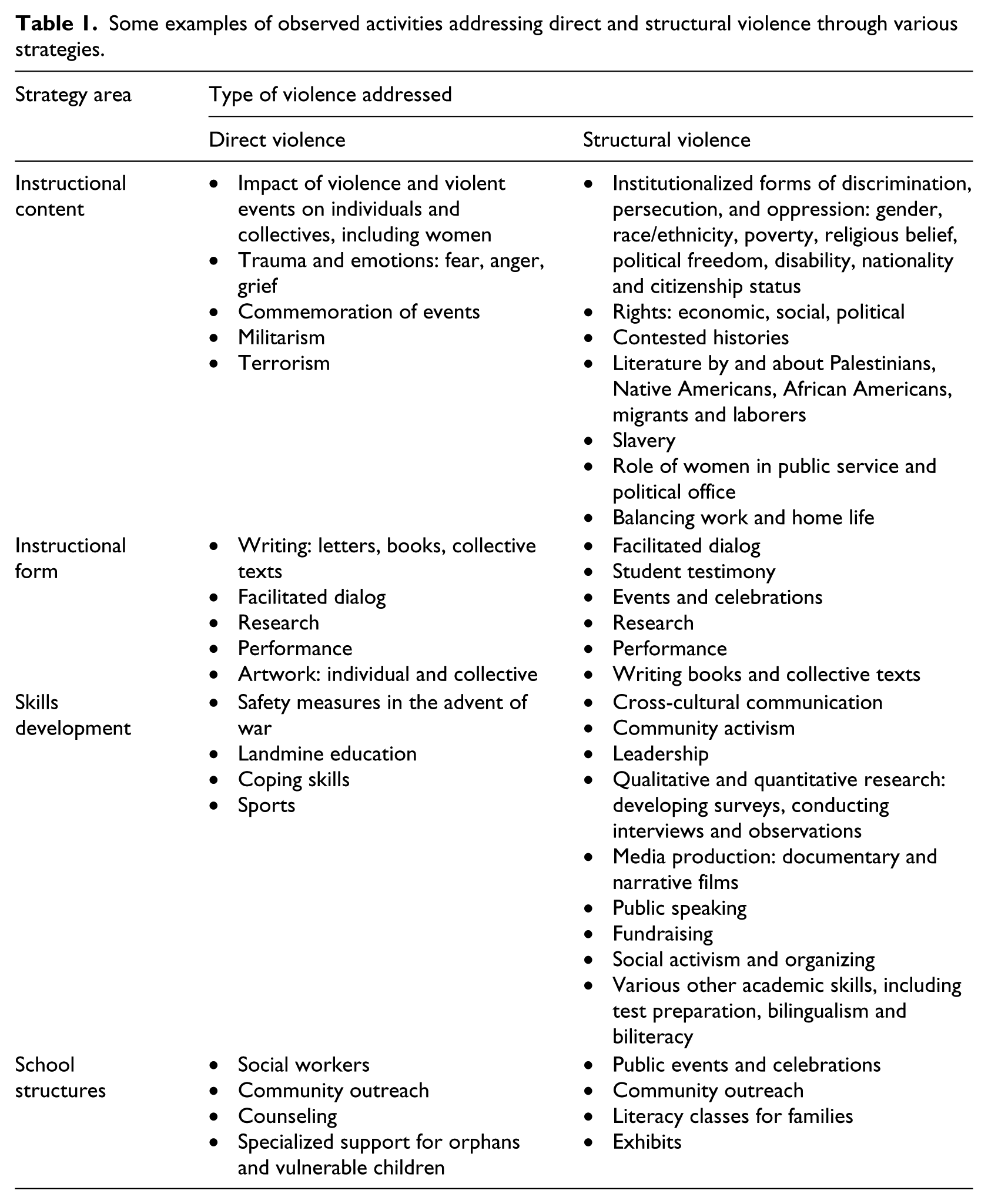
I observed a number of activities that explored ideas about political and other forms of direct violence affecting the school community and populations elsewhere in the world. Rather than ignoring the day-to-day reality of political violence, or halting educational activities to attend to psychosocial needs, teachers integrated concerns about direct violence into their everyday work with students and also through a variety of research, writing, and performance projects that attended to social and emotional needs, and brought these concerns into conversation with the academic process. Furthermore, they addressed survival skills, landmine education and coping mechanisms, for example. A number of school support structures were also in place to advance this work inside and outside the classroom, such as the full-time social workers and community outreach programs established to support children and their families (Zakharia, 2013).
For example, in French class, teachers engaged elementary students in letter-writing to their Israeli counterparts in response to photographs taken by Associated Press photographer Sebastian Scheiner. The photographs, which were widely circulated in the press and over the Internet, pictured Israeli girls at a heavy artillery position in northern Israel, writing messages on shells similar to those launched into southern Lebanon during the July War. As described elsewhere (Zakharia, 2013), teachers began the exercise with a free-write, then engaged students in dialog about their responses, which reflected negative emotions and expressions of retaliation. Through the discussion and reflection process, teachers and students talked about their feelings and drew on religious understanding to process their responses. The teacher guided the discussion, noting that Islam and Judaism are “above this” and call for greater understanding. Students were then given the opportunity to rewrite their letters. According to the French language coordinator, the new letters reflected a change in attitude. They were “more thoughtful” and suggested a “deeper processing of emotions, such as sadness and fear” (interview in Arabic, 10 May 2007). I use this example to demonstrate how teachers engaged both deliberate instructional content and instructional form to address the psychosocial impact of direct violence, while meeting the writing goals of the French language curriculum. In this way, teachers provided an opportunity for students to reflect critically on their attitudes towards violence and peace through academic engagement on an issue of direct relevance to their school community.
Similarly, the school attended to structural violence through an infused social justice curriculum that explicitly addressed various forms of oppression through strategies that included instructional content, form, skill development, and support structures (Zakharia, 2013). I observed secondary girls’ classes that focused on various forms of institutionalized discrimination, persecution, and oppression, including those based on gender, race, ethnicity, poverty, religious belief, political freedom, disability, and nationality and citizenship status. This was done through a number of subject areas, such as: English, Arabic, and French language classes; history, geography, and economics; and the visual and performing arts. It was also done both in the classroom and through extracurricular activities that included social activism and community outreach. While my focus was on the secondary girls’ level, I also observed girls and boys in other years taking up some of these themes and participating in social activism and school-wide community outreach events. According to the school librarian, library activities, such as reading programs, book fairs, book talks and signings, and poetry readings, were also designed to be “socially oriented.” She explained: “For example, we featured a book talk by an author who is legally blind during the week that focused on disabilities” (interview in Arabic, 3 May 2007). In addition, students were active in fundraising for their community service work.
Numerous learning activities encompassed economic, social, and political rights through research, discussion, performance, and individual and collective action. For example, as a component of Human Rights Week, students examined the right to education and the extent to which this right had been fulfilled among Arab states and across different generations. This work was done across the grade span and culminated in a public, community-centered event that showcased student artwork, books, and research on the right to education. The well-attended event both celebrated the UNESCO-sponsored “Education for All” commitment with speeches and presentations by officials and secondary students on the right to education, and simultaneously promoted learning for other members of the school community by encouraging adults to return to school. In one student skit performed by elementary students in Arabic and French, for example, students implored parents to continue their education, stating that “it is never too late for learning.” These performances were followed by information regarding adult literacy classes and other opportunities for continuing education. A child exclaimed: “It’s not too late; you can register now … and anyone can apply!” (field notes, 26 April 2007). A chorus of girls then sang about learning: “Let’s go learn! The schools have opened!” (in Arabic). After this performance, primary students talked about not being able to read, write, or draw well, but noted that they were “not worried because the teacher says every person has a talent, and I will discover mine in time.” This was followed by a young boy soloist singing: “Draw your own page in your book.” In my field notes, I remarked, “It is a celebration of learning and community development” (field notes, 26 April 2007).
According to teachers, the school was predicated on a vision of collective struggle for community development, articulated as both material and spiritual progress. This vision of progress mirrored discourse within the Shi’a neighborhood in which the school was situated (Deeb, 2006). It also included elements of individual and collective agency emerging from intellectual progress through education and lifelong learning.
Like other whole-school approaches to peace education, the school sought multiple entry points for addressing direct and structural forms of violence. This included developing knowledge, skills, and capacities for exploring and interrogating ideas about critical issues in society. Teachers intentionally integrated discussions on direct and structural violence, as well as peace, security, and human rights, into their everyday curriculum. In this case, such peace knowledge was articulated in terms of resistance and anti-oppression education. According to the school principal, this intentionality included considering issues of importance to the school community in developmentally appropriate ways (interview in English, 17 April 2007). For example, the school had an objective to teach about Palestinian issues, including people’s dispossession, migration, status, and violation of rights in Lebanon. In order to integrate this across the grade span, ideas about “family” were introduced in the primary grades, extending the notion of family beyond blood relations. Students also explored notions of citizenship and eventually developed increasingly complex ideas about rights and duties. By the secondary level, students were able to research, discuss, and write about human rights violations, persecution, and dispossession in increasingly nuanced ways. In addition to developing knowledge, skills, and capacities for exploring and developing ideas on such critical issues, the school’s structural features and programs supported students and their families in facing related challenges. Importantly, by integrating these issues and supports into the academic curriculum and focusing on academic skills in tandem, the school operated as a space of resistance to structural violence and became a form of community-centered resilience to historical and contemporary forms of oppression.
Getting to “no”: Locating peace education within resistance learning and anti-oppression education
The 2006–2007 academic year saw a delayed start, following the July War between Hizbullah and Israel. At the time of the study, most within the focal school community viewed Hizbullah as “victor,” and many teachers and students were sympathetic to Hizbullah’s political party or its social institutions and charities. However, others had no stated relationship, even though they supported the resistance movement, were actively engaged in government opposition politics, and admired its leader, Hassan Nasrallah.
During this time, the general viewpoint in mainstream society was that Shi’a schools, whether Hizbullah-affiliated or not, taught in a “particular way,” indoctrinating students for the purposes of an armed resistance movement. For example, during an informal conversation about education in Lebanon, a teacher at a Sunni Islamic school commented to me about the school system to which the focal school belonged: They were nothing but small religious schools. Now they are developed. One school has three floors below ground level with labs and specialized rooms. They have surpassed us. But they don’t teach students for life in any society. They have a specific aim and don’t prepare students to live in a diverse society. This is the difference [between them and us] (personal communication in Arabic, 19 February 2007).
This commentary came unprompted from a teacher who did not know that I was conducting research in the school system to which she was referring.
In another example, a Shi’a father who had been schooled by French nuns in the Bekaa region, but chose to place his seven-year-old son in a secular English–Arabic-medium school, told me: I would not send my son to [the focal school system or another Shi’a school system] for the same reason why I would not send him to be schooled with the nuns. Although [the Shi’a schools] are very strong—perhaps among the best in Lebanon—[with] strong programs and only the most qualified teachers, and total control [over discipline]. But they also have total control over the mind. They suckle students on a certain way of being—religious and narrow. I want my son to be able to choose [his affiliations] later. If he decides to follow them, then so be it. But it should not be pre-determined, such that you send your son to that school and know that there will only be one outcome (interview in Arabic, 19 February 2007).
The notion that the school and others within the system have a “specific aim,” that they offer “total control over the mind,” and do not prepare students for a diverse society, was echoed by other teachers and parents during the research period. However, the survey I conducted with 1000 secondary school students across ten different Christian, Islamic, and secular schools, with both high and low tuition fees, in various Beirut neighborhoods, revealed that students at this focal school were most likely to agree or strongly agree with the statement that “it is possible to belong to a community whose religion you do not share.” In fact, 78% of secondary students surveyed at the Shi’a focal school agreed or strongly agreed with this statement, as compared with an average of 61% across the student population sample of 1000 (survey, 2007). This finding contrasts with commonly expressed perceptions about the school and its population as not being oriented for life in a diverse society.
Furthermore, while international actors and peacebuilding activists in Lebanon generally did not recognize the school as engaging in peace education, and Western governments viewed the school’s spiritual leader as a terrorist (field notes, 2010), my own observations at the school suggested complex teaching and learning processes. A number of teachers employed critical and participatory methods that involved reflection, and facilitated dialog, and also facilitated individual and collective action on difficult issues, including violent extremism and terrorism, utilizing pedagogies in line with UNESCO’s (2016) guidance for teachers to prevent violent extremism. Published almost ten years after the fieldwork, the teacher guidebook notes the significance of connecting content to global issues and emphasizes the need to adapt any approach to particular contexts, based on a deep knowledge of these (UNESCO, 2016).
At the focal school, observed lessons in the humanities, arts, and social sciences emphasized social, political, and economic rights, citizenship, and ethical solidarity with oppressed populations in the Middle East and North Africa region, and around the world, historically, and in the present day. In aligning with anti-oppression, they also reflected the spirit of resistance to the status quo through a teaching and learning process that emphasized: (1) individual and collective critical reflection; (2) individual and collective action; and (3) symbolic meaning.
For example, in art class, students reproduced Guernica, Pablo Picasso’s critically acclaimed anti-war, mural-sized oil painting, which hung on the wall above the school’s main staircase. The school mural was a collective project—a collage made up of many smaller A4-sized paintings, each produced by one or more students and then brought together in a stunning wall-sized mural. Regarded by art critics as one of the most powerful anti-war paintings in history, Picasso’s Guernica was commissioned by the Spanish government in 1937. It depicts the suffering of people and animals, and the destruction of buildings in a palette of blacks, grays, and whites. Drawing on inspiration from Hitler’s aerial bombardment of the town of Guernica during the Spanish Civil War, the painting symbolizes the destructive impact of war on innocent lives. Critics consider it a powerful anti-war symbol and embodiment of peace. 4 At the school, the reproduction was a product of individual and collective critical reflection and action. It also garnered meaning as a symbol of resistance in the post-war climate.
The school’s active engagement in resistance and anti-oppression education was evident in the ways in which the two permeated the curriculum. They were visible and palpable in a number of different ways: the school was decorated with student work; people and events were commemorated; and attention was paid to social service and activism. I observed lessons related to resistance and anti-oppression in Arabic, English, and French, focusing on topics such as civil rights movements in the US, indigenous people’s issues, and human rights concerns.
In one example, during the monthly book talks run by secondary girls in the school library, students explored issues around political imprisonment and torture in the Arab world through the works of famed Saudi-born novelist, Abdul Rahman Munif. Students facilitated a discussion of Sharq al-Mutawassit (‘East of the Mediterranean’) in which the protagonist is imprisoned for challenging a tyrannical Arab regime and then tortured and forced to recant his beliefs by signing a document. At first he resists but, after five years, a number of events come together to challenge his resolve, and he agrees to sign the document to end his suffering. This act paradoxically destroys his sense of freedom.
During the student-led discussion, the protagonist’s rescindment of beliefs emerged as a point of contention among students, with some questioning as to how the protagonist could possibly agree to such an act of betrayal. An animated discussion ensued among students about resistance to coercion and they reflected on the constraints that have been placed on their own beliefs, causing Shi’a religious communities and communist intellectuals to go underground to avoid persecution. One student referred to the practice of taqiyya, in which Shi’a Muslims denied their religious beliefs and practices during particular historical periods when they were threatened by persecution, noting that it was a survival strategy in the face of extreme violence.
The class teacher and librarian intervened to guide the conversation around issues of non-violence and prisoner rights, noting the common practice of violence against prisoners in the Arab world. They also raised the importance of intellectual and political freedom to the wellbeing of civil society: You cannot jail people just for their ideas. […] We have to understand that just as we have our beliefs and ideas and opinions, others have theirs and we must accept their right to have them and voice them. And from an Islamic point of view too—to accept the Other and the Other’s point of view. We cannot dream of a real civil society otherwise (field notes, 2 June 2007).
In response, one student commented that she could not fully accept others who do not share her beliefs. The teacher directly intervened at this point, probing and questioning her: “What do you mean, you cannot accept others? What makes you say that?” As the library hour came to a close, she invited this student to speak with her after class. The teacher and the librarian then used their break time to talk to the student, challenging her to explain her view. The student just repeated, “I don’t know, I just can’t accept [those who do not share my beliefs].” They pressed her to rethink her stance and to consider “what type of society we would have if no one accepted the Other for having different views.” In my field notes I remarked that the conversation was “loving but firm” in challenging the student to articulate her views. Finally, the teacher demonstrated care by gently pulling on the girl’s ear over her hijab and saying, “What am I going to do with you?” and sending her on her way.
In another lesson, Grade 10 girls explored gendered relationships, such as friendship and love during French class. In my field notes, I describe: A student, Maryam, is sitting behind a desk at the front of the class, facing her classmates and teacher, who are seated in a semicircle. The students pose questions (in French) to Maryam about friendship. Are her friendships with girls the same as her friendships with boys? How are they the same or different? Are there limits to friendship with boys? The class is interviewing Maryam, who is providing “expert testimony.” She is dressed in the school uniform for her class—a floor-length muted green Islamic dress and matching green hijab. Maryam takes several interview questions together and then responds. She tells the class that she has male friends, and that these friends are the same to her as her girlfriends—they meet, hang out together, joke (field notes, 2007).
The teacher then called on Heba, who was dressed in a black abaya, signaling a more conservative dress code than her peers. Heba sat in the “hot seat” and a student asked her: “Do you have a boyfriend?” Heba explained that she had a boyfriend, Bassem, who was 20 and worked in Saudi Arabia. The teacher intervened here, asking questions such as: “What makes him special? Tell us, why did you choose him?” Heba responded: “His feelings towards me.” The teacher then challenged Heba: “Is that enough? What if another person tells you that he loves you, will you change your mind? What are the qualities you look for in friends? What makes you say, I might marry this guy?” Next, the students and teacher developed a concept map on the board to describe qualities associated with love and friendship. They brainstormed: trust, mutual respect, agreement, reciprocity, etc. A student interjected, saying, “A man cannot have all of these qualities. We need to put up with their weaknesses …” A discussion ensued regarding to what extent women should “put up with their partners’ weaknesses.” One student asked: “What if we are not able to tolerate their weaknesses?” And the teacher offered: “Then we should not enter into the relationship in the first place.”
During this critical participatory activity, students critically examined gendered relations and the teacher prodded them to consider whether they needed relationships with men and, if so, what for? She also intervened in their responses, saying “Don’t say for family and children!” After hearing a number of viewpoints from students, she concluded: “You are free to think about this as you wish, but first you must think of yourself.” Through the session, students were challenged to negotiate between differing views of gendered relationships within the class community. The teacher encouraged alternate perspectives. Using “expert testimony” from two girls with different views, the class interrogated different ways of establishing relationships with men while still maintaining autonomy and companionship. The teacher monitored the discursive space, indicating that students were free to express different opinions. At the same time, she regulated the space, establishing a norm for the empowered partner—one who engages in a relationship out of choice, not dependency. In this way, she challenged Heba to reframe her relationship with Bassem as one of choice, based on positive qualities and equal partnership.
Both the book talk in the library on political imprisonment and the classroom discussion on gendered relations illustrate how teachers at the school facilitated individual and collective critical reflection, providing space for contestation, and then intervening to direct the negotiation process towards non-consensus with the status quo, or getting to “no”: in the first case, “no” to political oppression; in the second case, “no” to gender-based oppression. These issues were of direct significance to the school community, and teachers not only knew this well, but they also told me that knowing the individual families at the school and their religious and political orientations allowed them to facilitate the space more adeptly. As one teacher explained, she facilitated discussion with a view to challenging individual students to examine their beliefs and existing evidence on important social issues. She also wanted them to determine their own positions on the issues while understanding the diverse views held in the class and wider society, as well as what personal and collective actions they might take towards greater justice and democracy for all. The teacher’s comment reflects the notion of transformative agency, a central tenet of critical peace education. However, the process of critical reflection followed by action can potentially lead to a number of outcomes; to mitigate these, the teachers intervened in the discursive space to lend their authority to particular ideas that oppose various forms of oppression and bend towards resistance to the status quo. It is in this space of contestation and negotiation that I locate critical peace education.
Concluding thoughts: Indoctrination or liberation?
This exploration of critical peace education considers how one school affiliated with a resistance movement engaged in resistance and anti-oppression education during a period of marked political violence. Although the school did not use the term “peace education” to articulate its work, school administrators, teachers, and students engaged in a whole-school approach to addressing direct and structural forms of violence through a critical, participatory, and community-centered approach to schooling. A central feature of the pedagogical process was the cultivation of transformative agency through processes of contestation and negotiation, facilitated by teachers with deep personal and contextual knowledge of the school community. In referring to the processes of contestation and negotiation, I point to the iterative reflective and dialogic process of reaching deeper understanding, but not necessarily agreement. The process involves both rational and intuitive or emotional aspects.
The data illustrate the ways in which the production and enactment of peace knowledge may emerge from this contestation and negotiation process as “getting to no,” or non-consensus with a status quo that perpetuates various forms of oppression. At the same time, this non-consensus establishes solidarity with oppressed peoples. As the data reveal, this process involves individual and collective critical reflection and facilitated dialog, followed by teacher intervention towards particular outcomes, in line with an anti-oppression or resistance education. As such, what might be critiqued as indoctrination in one sociopolitical context may, alternately, be applauded as liberation in another.
As the case study reveals, schools are neither sites of indoctrination nor liberation alone. Rather, they are sites of contestation, in which the interrogation of peace occurs in multiple spaces, forging possibilities for the enactment of transformative agency. Thus, contextualizing the teaching and learning process within a broader sociopolitical context allows for richer understanding of the ways in which schools and their teachers and students grapple with issues of violence and peace.
In being community centered, this school further reveals points of dissonance for understanding critical peace education by addressing armed resistance as a form of social action. For example, students displayed local history projects that highlighted the lives of “martyrs” from their communities. Examining such data opens up an unsettled space for understanding the enactment of peace and resistance learning within a context of sustained direct and structural violence. These projects may be alternately understood as projects of community-centered history or resistance—telling the stories of resistance or freedom fighters—or they may be viewed as reifying violence.
Similarly, during a script-writing session in preparation for Resistance and Liberation Day, a national holiday celebrated on 25 May to commemorate the day on which the Israeli army withdrew from southern Lebanon in 2000, secondary girls wrote a skit about a girl who wants to join the armed resistance to “defend the nation.” In the scenes that follow, her mother, grandmother, and aunt protest against her plans. The audience learns that the girl’s brother is a martyr and their mother cannot bear to lose another child. The daughter comforts her mother, acknowledging her fear, as well as her own duty to a “nation in pain.” As the students rehearsed the script, the class intervened in the dialog and direction. An animated conversation among the students followed about whether the protagonist should survive and return to her mother. They wanted to change the script so that she comes back. The teacher suggested that the play would be more powerful with a symbolic ending, rather than saying what happens.
This lesson complicates the narrative of transformative agency and social action by addressing heroic resistance. It engages a key community issue, at the same time centering girls as agents in a struggle that has been perceived as a masculinized militancy. On the one hand, this lesson could be viewed through a feminist lens as challenging gendered expectations of militancy; on the other, it could be viewed as reifying violence and creating dissonance for understanding critical peace education in sociopolitical context. Understanding the local context and situatedness of the teaching and learning process is central to grappling with this dissonance. As one teacher put it: “The reality of this violence is there. We are living it every day and we must develop ways to understand and resist in the face of our challenges as individuals and as a community” (personal communication in Arabic, 2007).
Bajaj (2015) notes that “pedagogies of resistance,” as conceptualized by Jaramillo and Carreon (2014, as cited in Bajaj, 2015), open up ways for understanding efforts to counter marginalization through education. Drawing on the context of Latin American social movements, their work contributes to critical peace education with an emphasis on:
education that is meant to offer learners on the margins information that colonial and unequal socioeconomic processes have denied them;
methods of education that are accessible, engaging, and democratic; and
educational processes that are linked to larger social movements advancing a vision of, and plan of action towards, greater equity and social justice (Bajaj, 2015: 157).
In a similar vein, this case study offers the possibility of locating critical peace education within resistance and anti-oppression pedagogy at a school aligned with a resistance movement. In doing so, it suggests a broader and more complex field of research, practice, and activism.
Postcolonial theory, in conversation with critical peace education, also opens up an unsettled space for understanding the enactment of peace and resistance learning within a context of sustained direct and structural violence. It also raises questions about the value bias that shapes peace education research during particular historical moments. As this case study illustrates, understanding peace education as a situated practice requires interrogation of a larger system of oppression and violence that alternately positions community-centered struggles as either for or against peace. By taking into account the complex processes of contestation and negotiation that take place in this school, I demonstrate how teachers and students, together, co-construct peace knowledge as resistance to the status quo to arrive at notions of social and political change. At the same time, I consider how larger structural, material, and political realities serve to mediate peace and resistance learning, creating dissonance for understanding peace efforts. This dissonance, I posit, is critical in forging possibilities for transformative change.
Footnotes
Declaration of Conflicting Interests
The author(s) declared no potential conflicts of interest with respect to the research, authorship, and/or publication of this article.
Funding
The author(s) disclosed receipt of the following financial support for the research, authorship, and/or publication of this article: This research was supported by fellowships and grants from the Spencer Foundation; the Office of Policy and Research at Teachers College, Columbia University; and the Office of the Dean at Teachers College, Columbia University.