



Abstract
The purpose of the study was to examine American and Japanese kindergarteners’ views of play. The participants consisted of 44 kindergarteners and their five teachers in the southeastern United States and 50 kindergarteners and their three teachers on Japan’s main island. Both groups of children were asked to photograph their views of play and to explain the reasons for their photographs. Teachers were also interviewed about their views of play. Qualitative analysis revealed that children’s views of play were associated with interactions with others, preferred environments, and favorite toys/props. Both groups of children photographed outdoors. Only Japanese children photographed toys/props without people while no American children did. Many children’s reasons for photographs were descriptive while Japanese children described physical environments, affective states, and favorite toys/props. Only Japanese children’s photographs captured toys/props and outdoor environments without people and they gave more detailed explanations for their photographs than did American children.
Keywords
Introduction
Although children can learn from play activities provided by teachers, when play comes from children’s own ideas, it is more enjoyable and inspires their learning (Levin, 2013). Teachers should understand children’s thoughts about play and provide appropriate environments “for viewing and evaluating” children’s play experiences (Fein and Wiltz, 1998: 37). Asking students to photograph play might provide educators with insight into the subject. Play is defined as behavior that leads to all phases of development within the cultural context in which players interact (Kieff and Casbergue, 2000).
Researchers interviewed children about their views in previous studies (Cooney et al., 2000; Dockett, 2002; Dockett and Meckley, 2007; Epstein et al., 2006; Fivush, 1984; King, 1979, 1986; Ramazon et al., 2012; Wing, 1995), but because young children have difficulty expressing themselves, through photo elicitation interviews (PEIs) (Phelan and Kinsella, 2011; Thompson and Williams, 2009) children can reveal their perspectives. By photographing play, children are empowered as co-researchers (Phelan and Kinsella, 2011; Pink, 2013; Prosser and Burke, 2008) and explanations of their activities and thoughts are enhanced (Ching et al., 2006; Clark-Ibanez, 2004; DeMarie, 2001, 2010; DeMarie and Ethridge, 2006; Einarsdottir, 2005; Good, 2015; Kirova and Emme, 2009).
Despite differences in political, educational, and religious systems, American and Japanese educators consider play important in children’s learning and development (Izumi-Taylor et al., 2014; Izumi-Taylor et al., 2010b); yet, it is inappropriate to assume “that adult recollections about play will be helpful in understanding play in the elementary school from the children’s perspectives” (King, 1986: 233). Viewing children’s play perspectives through PEIs might help educators understand the best way to comprehend children’s definitions of play. As play seems influenced by environmental factors, play perspectives should be understood in the physical and social environments where play occurs (Rivkin and Schein, 2014).
American and Japanese children’s views of play
Two studies found that school play time is children’s favorite activity (Fein and Wiltz, 1998; Wiltz and Klein, 2001), and they enjoy selecting their own play materials. Fivush (1984) found children’s play was associated with games, mini-gyms, and playing with other children. When asked, American children said “school was for work” and recess was play (Dockett, 2002: 9). American kindergarten and first/second graders preferred play over work, but older children thought work could be enjoyable (Wing, 1995). Another study revealed that child-initiated play was considered play, whereas teacher-initiated activities were work (Cunningham and Weigel, 1992).
No research exists on Japanese children’s views of play; however, two studies utilized children’s photographs. Oishi (2010) asked children to photograph their favorite items, interests, and events, finding photographs to be valuable tools. Another Japanese study (Teramoto and Ohnishi, 1995) examined elementary and junior high school students’ concepts of schools, asking them to map and photograph their environments using PEIs. Children photographed places where they enjoyed playing and communicating with peers.
Japanese and American teachers’ views of play
Generally, Japanese teachers have the cultural belief that play should be valued for itself, not for its relationship to academics (Izumi-Taylor, 2006; Muto, 2004; Ogawa and Izumi-Taylor, 2010). This is supported by the National Curriculum Standards for Kindergarten (NCSK) by the Ministry of Education, Culture, Sports, Science, and Technology (2008) wherein play is children’s voluntary activity promoting learning and balancing of mind and body. Japanese classical early education philosophies are play-oriented (Kurahashi, 1976; Wada, 1932) and value child-initiated play and enjoyment of nature.
Some cross-cultural studies of American and Japanese educators’ perceptions of play (Izumi-Taylor et al., 2014; Izumi-Taylor et al., 2010b; Izumi-Taylor et al., 2004) found Japanese teachers consider play as the way to promote children’s social development more than their American counterparts. Japanese play researchers found that teachers intentionally nurture children’s social development through play (Liu, 2011, Sunagami, 2008; Takazakura, 2007). The results of these studies aligned with the NCSK (Ministry of Education, Culture, Sports, Science, and Technology, 2008), stating one goal of early education is to develop children’s social and emotional skills playing with others.
Just as Japanese teachers viewed play as fostering children’s social development, American teachers agreed play relates to social development (Copple and Bredekamp, 2009; Izumi-Taylor et al., 2014). However, American teachers perceived play as being associated more with cognitive development. Most American educators viewed play as the best way for children to learn (Copple and Bredekamp, 2009; Izumi-Taylor et al., 2010b; Nell et al., 2013; Van Hoorn et al., 2011), but some teachers offered more structured play activities (Izumi-Taylor et al., 2014; Nagasaki et al., 2002).
One comparative study of American and Japanese preschools revealed American teachers offered more academic activities than Japanese teachers (Nagasaki et al., 2002). American teachers provided ample playtime, but instructed children in playing. Although American children interacted with rabbits in the classroom, teachers utilized them as teaching tools in caring for animals. The goal of having animals in Japanese classrooms was so children could observe their feeding habits, value them, and empathize. Another comparative study (Izumi-Taylor et al., 2004) revealed that American teachers instructed their charges more than did Japanese teachers.
The purpose of the study
The purpose of the study was to examine American and Japanese kindergarteners’ views of play. There has been limited research on children’s perception of play in different cultures (King, 1979, 1986), but this research is outdated. Thus, this study was conducted to address such limitations and was guided by these research questions: (1) What views are revealed in American and Japanese kindergartners’ photographs of play? and (2) Are there any similarities and differences among these children’s views? How are they similar or different?
Method
Participants
The participants consisted of 44 kindergarteners in the southeastern United States and 50 kindergarteners on Japan’s main island. Some American children declined to participate; thus, the numbers were unequal. Five American and three Japanese teachers were interviewed. The respondent pool was selected through convenience of access and availability (Hancock and Algozzine, 2006). Our respondent pool was identified as children who “may have the best information with which to address the study’s research questions” (Hancock and Algozzine, 2006: 40). The school directors informed parents that children’s participation was voluntary, and not participating would not negatively affect them. Japanese preschools are called kindergartens, are equivalent to American preschools, and are attended by children aged three to five (Izumi-Taylor, 2013). The third year of preschool is equivalent to American kindergartens. Both schools served children from lower-to-middle class families and were close to playgrounds. Ninety three percent of the American children were European American, while 100% of their counterparts were Japanese. Both schools valued play, but the Japanese children engaged in more group-oriented activities than did their American counterparts.
Data collection
The second author requested a Japanese kindergarten director to ask parents if their children could participate. PEIs were used to collect data concerning children’s views of play in both nations. PEIs are an effective method of obtaining children’s opinions in research (Epstein et al., 2006; Phelan and Kinsella, 2011; Richards, 2009). Both American and Japanese kindergarteners were asked to photograph without adult accompaniment their views using digital cameras provided by the second author in Japan and third author in the US. To minimize adults’ influences on what they might photograph, we purposely allowed them complete freedom during their photography sessions (Einarsdottir, 2005). Although we requested two photographs, some American children took only one, while others took two. Afterwards, while showing their photographs, these authors asked children to explain why the photographs represented play, “Can you tell me why you think this means play to you?”
We interviewed and asked the teachers the following five questions: (1) What kinds of play activities do you offer your students? (2) What kinds of play activities do your students like? (3) What are their favorite toys, props, or equipment? (4) How long do your students play outdoors each day? and (5) How long do they play indoors each day? The responses were collected by the second and third authors.
Data analysis
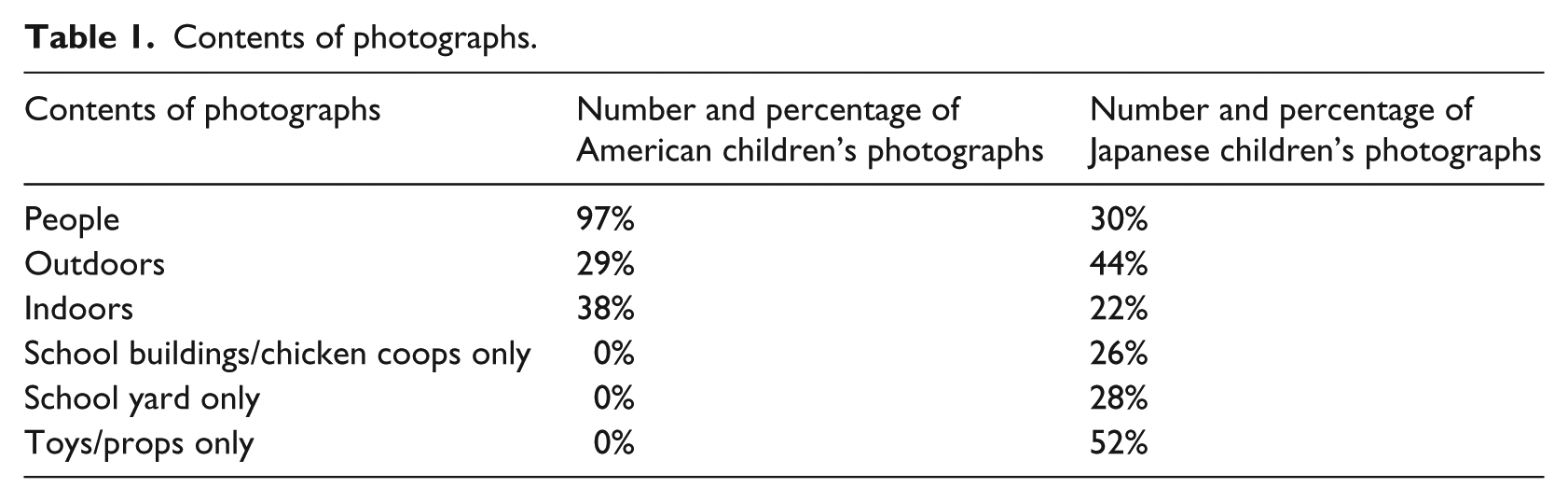
The first author translated Japanese children’s and teachers’ responses into English; two Japanese bilingual educators reviewed the responses, reaching consensus on translation (Izumi-Taylor et al., 2010a). Our data analysis consisted of content and thematic analyses. We reviewed the photographs combined with children’s responses as Ray and Smith (2011) recommended. We also counted people, items, toys/props, and buildings in each photograph (see Table 1). Regarding children’s responses, we followed Fivush’s coding (categorizing children’s reasons for taking photographs and their descriptions, “descriptions of the physical environments,” “descriptions of an affective state” (Fivush, 1984: 1700), and descriptions of favorite toys and props). We defined the descriptions of photographs using children’s explanations of what are in the photographs, such as, “This is my teacher” or “She is playing with blocks.” The descriptions of the physical environments included, “This is Yamato fort,” or “When the sun shines on our forest, we see birds.” An affective state referred to such statements as “They are playing together. They are my friends, “or “This is our forest, and we are proud.” The descriptions of favorite toys or props included, “We play with this toy all the time,” or “Every day I play with this.”
Contents of photographs.
We coded each response “according to its relevance to the study, and multiple category codings were counted as separate responses” (Izumi-Taylor et al., 2010a: 412). We discarded irrelevant responses, such as “This is my photo” and coded some responses more than once.
Results
Table 1 indicates photographic contents, and both American and Japanese children took more photographs outdoors. Ninety-seven percent of American and 30% of Japanese children photographed people. Forty-four percent of Japanese children and 29% of American children took photographs outdoors; while American and Japanese children took photographs indoors (38% and 22% respectively). Japanese children photographed school buildings, chicken coops, school yards, and toys/props without people, whereas no American children did.
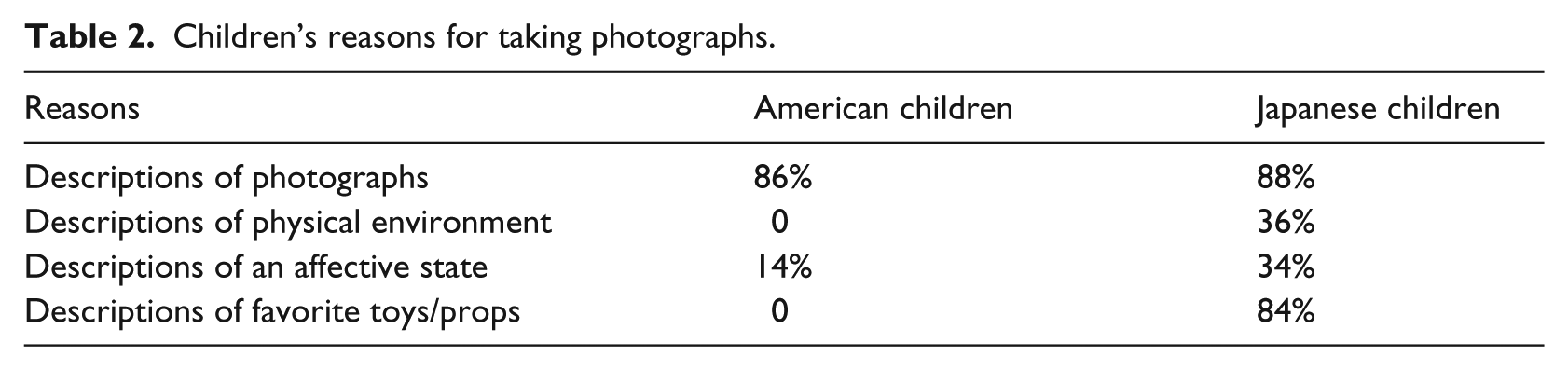
Qualitative analyses of data concerning their reasons revealed three themes: interactions with others; preferred environments; and favorite toys/props. Children’s interactions with others meant their photographs and explanations indicated children engaging in activities. Children’s preferred environments referred to places that children enjoyed. Children’s favorite toys/props were defined as items giving pleasure. Table 2 delineates how each response was categorized according to Fivush’s (1984) coding.
Children’s reasons for taking photographs.
Interactions with others
The interactions with others theme emerged through participants’ photographs as their reasons in 97% of American and 30% of Japanese children’s photographs. However, only Japanese children explained their reasons were as included friendships, indicating an affective state. Of the 34% of Japanese children who photographed friends, one girl said, “I took this because they’re my friends.” Another girl explained, “My friend and I play together.” One Japanese boy photographed another boy’s face said, “Is this a funny face to you? This child is good at making funny faces and showing us.” One American and four Japanese children photographed their teachers, but only Japanese children reasoned, “He is my teacher,” and “My friend and teacher are talking.” No American children mentioned their teachers.
American children also photographed other children’s interactions, and their reasons were related to climbing, swinging, or spinning. Thus, their reasons coincided with their descriptions. One American girl who photographed a girl on a structure referenced her, “She was climbing.” Another girl described children on monkey bars, “They were jumping and talking to each other, and doing really cool stuff.” Another American girl explained her photograph of a girl on the structure, “She is having fun.” Another girl commented about a different girl, “She is having some fun.” Two other American children named children in their photographs to justify their reasons for photographing them: “Playing with Joshua; playing with a football,” “Sean is doing tricks, and that is playing to me.” These were the American children’s statements relating to an affective state (Figure 1).
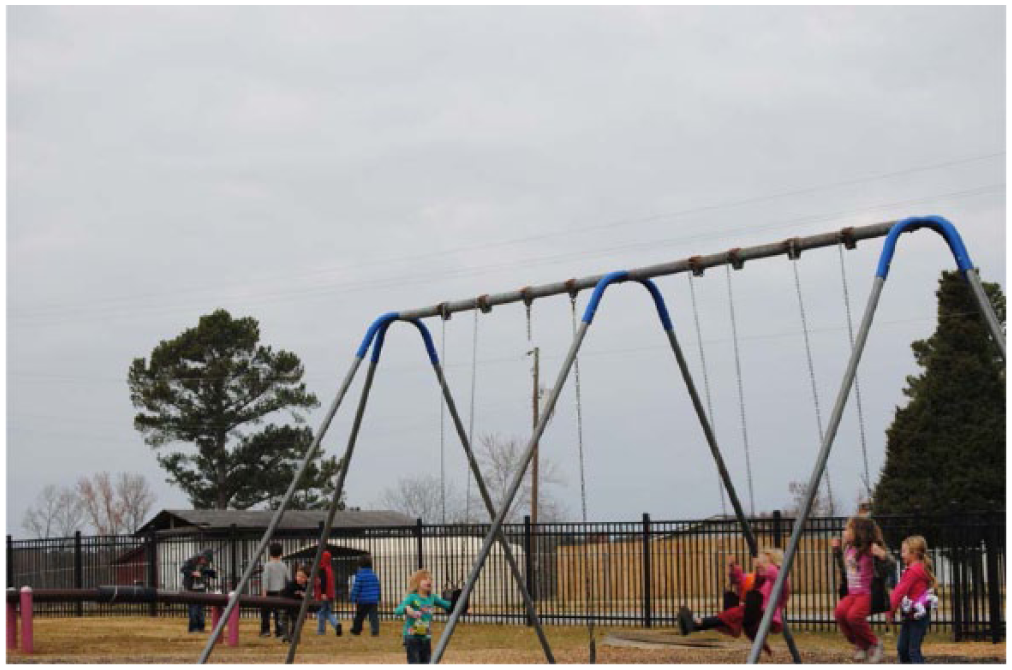
An American girl said, “Swinging because they are going up high.”
A Japanese boy who photographed two boys lying on the grass with one smiling, explained, “I took this because they look like they are enjoying themselves.” Another photograph of children smiling was taken by a Japanese girl who said, “I took this because my friends are playing, and we are good to each other.” These Japanese children’s comments represented descriptions of the photographs and an affective state. American children’s photographs also captured smiles. One girl whose picture showed a group of girls smiling while swinging commented, “Swinging because they are going way up high.” Another American girl photographed two boys smiling while riding a tire swing, explaining “Playing, just a game ‘cause they are on the tire swing. They are riding.”
Preferred environments
Both American (29%) and Japanese (44%) children took more photographs of outdoor play. Although American children did not specify a preference for outdoor play, most photographs showed outdoor activities with others. The American teachers’ interviews indicated a preference for outdoor play. One teacher asserted, “They like outdoor toys better than inside toys.” One American girl photographed children on a tall structure, explaining, “They are climbing.” An American boy photographed children on swings and said,“ They are swinging.” Their comments were descriptions of the photographs.
A Japanese girl who photographed one boy on the Jungle Gym noted, “This is my favorite place to be.” A Japanese boy said, “This mountain top is my favorite place,” explaining his photograph of the hill with many trees. These Japanese children’s comments seemed associated with descriptions and an affective state.
Japanese children’s photographs of preferred environments were different from their American counterparts because some Japanese children’s photographs showed places without people, including school buildings, playgrounds, tree tops, sunlight through trees, flowers, frosty playgrounds, gardens, play structures, forts, slides, Jungle Gyms, chicken coops, and trains. A Japanese boy described his photograph of trees, “It will be more sun here and birds will also come here” (Figure 2).
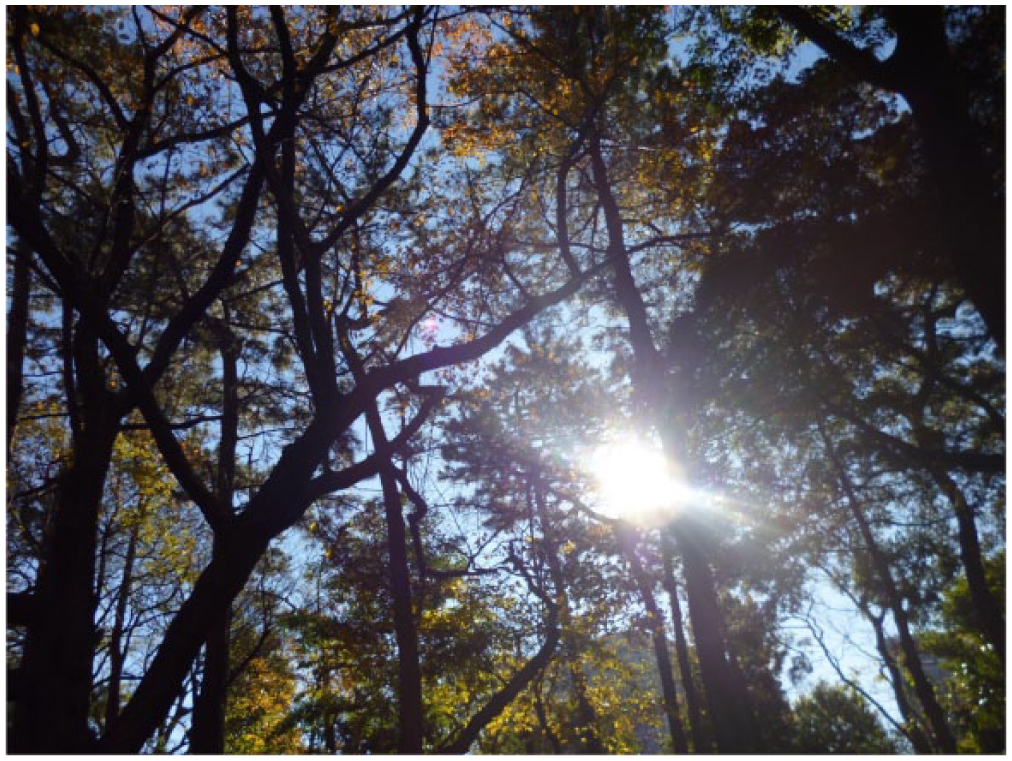
A Japanese boy said, “It will be more sun here and birds will also come here.”
The following Japanese children’s reasons appeared to represent their descriptions of physical environments and affective states: One Japanese boy who photographed trains passing the school without people remarked, “I like trains and like to watch them over the school fence.” A girl who photographed a slide from above without others said, “I took this picture of the slide from the top; isn’t it interesting?” Another girl took a photograph of only the garden, saying “I like this place. Don’t green leaves look pretty to you?” A boy’s photographs of the school building in the sun not including others were taken from a low point. He claimed, “The sun is pretty, and I wanted to photograph both my school and the sun.” The results of the interviews with Japanese teachers were congruent with their students’ preference for outdoor environments that are rich in nature. One teacher explained, “We provide children environments where they can create their own activities. We offer environments where children can enjoy nature, climb trees, plant flowers, care for chickens, and play ballgames.”
The American children’s photograph layouts were associated with schools, the sky, trees over fences, classroom bulletin boards, and buildings beyond fences with others. One girl’s photograph was of a busy classroom with children engaged in various activities and included tables, chairs, computers, bulletin boards, a spacious carpeted room, and a rocking chair. She described the pretend play of two girls, “She is playing kitty.” Another photograph by a boy also revealed a classroom with two windows where housing and trees could be seen. His photograph was a brightly lit classroom with open space including others. He explained, “Looking at a puzzle.” These American children’s comments resembled descriptions of the photographs.
Favorite toys and props
Some Japanese children’s photographs were differentiated from those of their American counterparts because 52% photographed only props/toys without people. Although no American children photographed only toys/props claiming them as favorites, the teachers indicated that these children liked monkey bars, swings, slides, and tire swings. Two teachers claimed their students’ favorite activities to be: “Swings and the tire swing, ”or “Monkey bars.” Many children took photographs of these play props with other children playing on them.
A Japanese girl captured her drawing of a dress without others, saying, “I designed this dress all by myself.” Another Japanese girl described her photograph of a bulletin board decorated with stars and Saturn absent of others, “We decorated this with stars we made. Doesn’t it look like the sky?” Another Japanese girl photographed only a table serving as an ice cream stand in the playground, saying, “This is our ice cream store. Today, four-year olds are pretend playing.” Their explanations for the photographs seemed related to their descriptions.
The following Japanese children’s reasons for taking photographs apparently demonstrated an affective state, involving joyful emotions: a Japanese girl’s photograph showed only a chicken in its cage; she boasted, “I took this picture because I like chickens.” A Japanese boy who photographed his decorated pine cone without other children commented, “I created this and think I did well!”
Some Japanese children took photographs of only outdoor play props, including sand and water play equipment, wagons, soccer balls, Jungle Gyms, forts, monkey bars, chickens, tree swings, structures, tables with wooden housekeeping items, a top, and an egg. One girl who took a photograph of an empty Jungle Gym said, “I photographed this Jungle Gym because I like it.” Another girl who photographed chickens in a cage not including others claimed, “I took this picture because I love chickens.” These children’s comments appeared to denote their descriptions of the photographs, of favorite toys/props, and of an affective state (Figure 3).
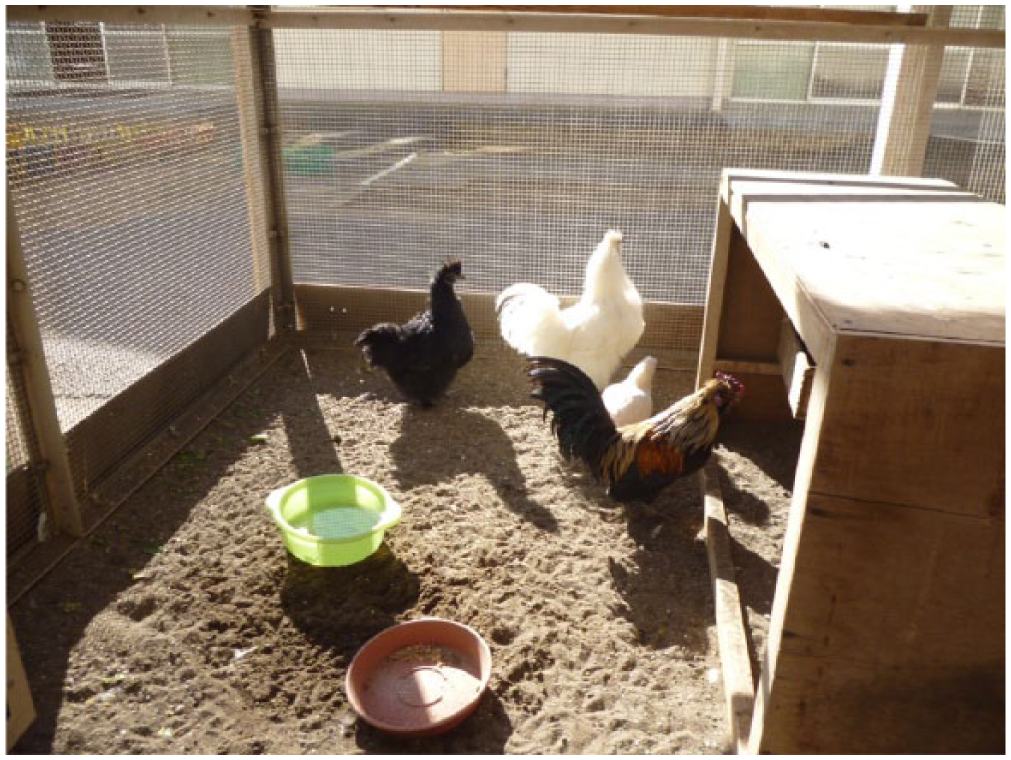
A Japanese girl explained, “I took this because I love chickens.”
The layout of the Japanese children’s photographs of favorite toys/props suggested focus on individual items. A girl took a photograph of an egg in someone’s hand explaining, “I’ve been taking care of these chickens; we get to keep their eggs.” Another girl discussed her photograph of a roof-like structure with a sign containing drawings of snails with no people, indicating it was the “Snail Institute.” She lectured, “Can you see what it says here? It says, ‘Snail Institute,’ and this is where we study them. We created the sign, drew these pictures and wrote the name.” The focus of her photograph was the sign. A Japanese boy photographed only eight soccer balls in a basket, noting,” These are our soccer balls, and when the weather is nice, we play soccer.” These children’s remarks related their descriptions of the photographs.
Some American children’s photographs of favorite toys/props included other children. One girl said “They are spinning around,” referencing children on the tire swing. A boy discussed his photograph of children on swings, “They are swinging.”
Although some Japanese children’s photographs of favorite toys/props showed no children, those taken by their American counterparts included others. Photographs by American children suggested active engagement and involvement. Some American children in pictures seemed focused on their activities; however, none of the photographers expressed their opinions about toys/props.
Discussion
The thematic analysis of results reveals how American and Japanese kindergartners view play. Their perceptions of play are related to interactions with other children, preferred environments, and favorite toys or props. The following discussion addresses the previous two research questions simultaneously.
American and Japanese kindergartners’ views of play
Similarities and differences
Both American and Japanese children were able to photograph their views of play and provide reasons for the photographs. They took more photographs outdoors than indoors. More American children’s photographs captured people than those of the Japanese. Only Japanese children took photographs of just school buildings, chicken coops, school yards, and toys/props.
Many American and Japanese children’s pictures captured their interactions with others, and their reasons for taking such photographs coincided with their descriptions of them. The notion of play being related to interaction with others is congruent with Fivush’s (1984) study that children think it is play if they play with others. Likewise, American preschoolers’ photographs showed interaction when photographing zoo animals (DeMarie, 2001). Children tended to say it is play when they are interacting with their friends (Ramazon et al., 2012). Teramoto and Ohnishi (1995) found that Japanese children photographed their preferred play environments where they interact with their peers. When asked to photograph their lives, children tended to take photographs of play with others (Clark-Ibanez, 2004).
Only Japanese children captured outdoor environments without people but included flowers, trees, chicken coops, and frosty playgrounds. Young children tended to photograph familiar and important things in preschool environments (DeMarie, 2001). Also, these Japanese children appeared to be sensitized to their surroundings, and some reasons for taking such photographs were related to their feelings. Such play perceptions of Japanese children might be influenced by their culture because the Japanese teachers in this study offer natural environments where children can appreciate flowers, trees, chickens, and frosty playgrounds. The NCSK recommend that children should experience nature to develop rich emotions and to understand how to care for living things (Ministry of Education, Culture, Sports, Science, and Technology, 2008). In contrast to the Japanese children’s reasons for taking outdoor photographs, American children did not provide such reasons; however, the American teachers explained that their students preferred outdoor play. When asked to photograph their views of school, many American children photographed playgrounds (DeMarie, 2010).
The NCSK states that children must play outdoors by “leading a life close to nature, being aware of its grandeur, beauty, and wonder” (Ministry of Education, Culture, Sports, Science, and Technology, 2008: 9). These Japanese children photographed environments where they can play in nature and with live animals. When asked to photograph animals at the zoo, American children’s photographs were not limited to animals, but included things important to them such as environments (DeMarie, 2001). Natural environments can provide children ample opportunities for play (Rivkin and Schein, 2014).
Japanese children gave more detailed explanations for their photographs than their American counterparts. When children elaborate on their photographs, “they add another dimension to” their school activities (DeMarie and Ethridge, 2006: 102). More Japanese children presented both the descriptions of the photographs and an affective state than did American children. When the Japanese children described their photographs, they discussed their friends, interests, and preferences. The NCSK (Ministry of Education, Culture, Sports, Science, and Technology, 2008) might provide a partial explanation for the phenomena found in this study, citing the importance of children developing their social and emotional skills through playing with others, and of children building positive relationships with their peers and teachers. Similarly, DeMarie (2010) found American children’s photographs included the theme of friends in photographs of their schools.
Regarding the theme of favorite toys/props, many Japanese children and few American teachers voiced such opinions. Such perceptions of Japanese children might be associated with the NCSK, describing that children need to take care of play materials and equipment (Ministry of Education, Culture, Sports, Science, and Technology, 2008). Although children will play in various environments, their play will be different if their environments offer no play materials or toys (Fromberg and Bergen, 1998). The kinds of toys teachers provide can influence play quality (Levin, 2013).
Implications and limitations
Photography can provide educators with students’ perspectives of their school lives. Through PEIs, students can represent their thoughts, feelings, actions, and memories that they might not be able to otherwise convey. Educators can use PEIs to not only assess and record students’ learning and development but also to understand their true sense of their school environments.
Cultures and educational environments influence children’s play perspectives, and educators must understand these influences. Although both schools value play in this study, Japanese children have more opportunities to engage in group activities than their American counterparts who follow individualized instructions and have less time to interact with others. Because children can learn in varied environments, learning occurs best in playful, child-initiated activities with favorite props. When educators recognize play as a cultural phenomenon, they can appreciate the cultural features of play.
The results of this study must be considered limited given the size and particularity of the two samples, and because some Japanese children took more photographs than their American counterparts, this could have influenced our interpretations of children’s views of play. Although both nations’ children had complete freedom to photograph their views of play without adults accompanying them, the possibility exists that children may have taken the photographs that they think that the authors wanted to see.
Footnotes
Declaration of Conflicting Interests
The author(s) declared no potential conflicts of interest with respect to the research, authorship, and/or publication of this article.
Funding
The author(s) received no financial support for the research, authorship, and/or publication of this article.