




Abstract
This article reveals the results of a research study that was carried out in Spain in 2012 with the purpose of discovering the influence of the gender variable on the incorporation of the Internet in the educational programmes of primary and secondary public education centres. By using a multiple case study carried out in situ, the research team has gathered information from the teaching staff entrusted with the process of incorporating the Internet into the educational programme at each school. It has also studied the way in which the use of the Internet in the classroom is specified. These sources have been subjected to triangulation techniques in order to increase the reliability of the results, which has enabled us to define the extent to which the gender of those running the educational implementation of the Internet in Spanish centres is influential. The results show that there are no significant differences between men and women as regards the introduction of the Internet into the educational programmes at the centres used in this study.
Study subject matter
The United Nations World Conference on Women, held in Beijing in 1995, defined information media and new technologies as a crucial sector to achieving greater equality, democracy and social justice. Following the conclusions reached in Beijing, the relationship between gender and information and communication technologies (ICT) began to be researched from a sociological perspective, concluding that there are differences between men and women in the use of the Internet (Gargallo et al., 2003).
In Spain, women’s participation in the information society is low (Castaño, 2007; Ministerio de Industria, Turismo y Comercio y Ministerio de Igualdad, 2009). Proof of this can be found in the conclusions reached by the Spanish Women’s Institute (Peris, 2007), which reveal that only 20% of people working in the telecommunications sector in Spain are women. The Spanish Statistics Institute (Instituto Nacional de Estadística (INE), 2009) confirms this data and goes a step further, stating that the digital gender divide affects women mainly in their access to the Internet. The percentage of female Internet users is still almost nine points behind the corresponding figure for men. The public institutions in Spain recognise this gender inequality in ICT and are promoting a number of state plans to attempt to reduce these differences.
The question that the authors of this article raise is this: Are there any differences in the way the Internet is incorporated into the classroom depending on the teacher’s gender?
Traditionally, computer tools have been associated with the male role in the school context (Cabero et al., 2011; Vázquez et al., 2007). Consequently, the amount of time boys use a computer at school is greater (Plomp, 1996). According to studies carried out by Kerr (1996), these school experiences with computers determine women’s interest and relationship with the Internet during secondary education.
According to data published by the Spanish Government (INE, 2009), the gender divide is inversely proportionate to the level of education; that is, the digital gender divide is lower between men and women who have studied at university. This is why it would be interesting to find out whether the gender inequality that is noticeable in society is extended to schools. According to some previous research studies (Castells, 2000; Kerrey, 2000; Marina, 1999; Rhode and Shapiro, 2000; Shasshaani and Khalili, 2001; Ursini et al., 2004), female teachers use technologies in the classroom in a different way to their male colleagues.
Review of the state of affairs
In the 1970s, the bases were set that would favour the development of research studies in this field. This decade saw the creation and consolidation of professional and academic associations that were held in high international regard, such as the Association for Educational and Training Technology (AETT), Association for Educational Communication and Technology (AECT), Association of Media and Technology in Education (AMTEC), American Educational Research Association (AERA) and the American Society for Training and Development (ASTD). Numerous conferences, seminars and congresses were held on educational technology. Several specialist journals were published to spread the word about educational technology, including the British Journal of Educational Technology, Educational Communication and Technology, AV Communication Review, Educational Technology, Instructional Science, Programmed Learning and Educational Technology and Instructional Technology. Furthermore, educational technology as a field of study and action broke away from the English-speaking environment to extend to many other countries around the world (Chile, Argentina, Brazil, Spain, Poland, India, Japan, etc.).
McMillan et al. (1999) state that the first studies in the 60s and 70s were concerned with the distribution of computers in schools and with the results obtained by students when they worked with this medium. Most research projects on this subject conclude that teaching with IT support has a positive effect.
In the 80s, educational technology, and the PC in particular, began to have a notable presence in schools. This increased the number of research studies and stirred interest in analysing the integration of educational technology into educational programmes (Area, 2004; Area 2009). Following the conclusions obtained, the first criticism of the evolution of educational technology and its validity for education appeared (Barroso and Cabero, 2010). Different authors (Area, 1991; Chadwick, 1979; Kempt, 1987; Megarry, 1983; Spitzer, 1987) argued their positions, alluding to reasons such as: the small impact on long-term planning documents; the too empirical application procedures; a lack of agreement on a conceptual level; the major gap between the school’s real needs and the provisions of technologies; etc.
The boom of the Internet in the 90s brought about a change in research lines. Computers, and particularly their connectivity, took on much greater importance. Of all the prolific scientific activity regarding the web, the following works are particularly worth mentioning: Solomon (2000); Kellner (2000); De Pablos (2001); Buckingham (2002) and Voithofer and Foley (2002), which all focused on analysing the cultural impact of the new communication networks.
In Spain, the study of the Internet in an educational context has been centred on the search for applications and spaces that allow teachers to make the most of their huge communication and documentary potential to develop teaching and learning processes, as shown in the works by Del Moral et al. (1998), Beltrán (2001), Castells and Díaz (2001), Gallego (2001), Gargallo et al. (2004), Marchesi and Martín (2003), Peñalva (2007) and Sánchez (2010). All these works are associated with a new line of research: the Internet as a resource in schools and its effect on educational processes. The theoretical grounds on which this new line is based state that: On changing the teaching environment and the tasks to be completed by the students, significant changes will be brought about in the processes of relation, perception, analysis, reasoning, argument, etc., regarding the same. One way of doing this is to change one of its elements: the means. (Bautista, 2004: 22)
In Europe, the most significant research studies are those within the EC. The European Commission’s report on new learning environments in education (Grünbaum et al., 2004) is particularly worthy of mention. It studies innovations in education centres and concludes that the new learning environments are not only conditioned by whatever knowledge the education agents may have about the Internet, but also by the necessary organisational restructuring of educational and training contexts and by the teaching programme’s adaptation to the new tools provided by the Internet. Other significant studies and research projects by the European Commission are those on information and communication technologies in European education systems and the Eurydice network (2001); the CEOForum report (2001) on integrating digital content in schools; and those studies carried out by the Organisation for Economic Co-operation and Development on the impact of the Internet in teaching and in schools (OECD, 2001) and on the policies of member countries regarding the integration of the Internet in education, among others. The studies carried out by Cuban (2003) in the Americas come to similar conclusions.
These studies show a new line of research in which the means are moved to one side as the focus of interest, in favour of participation not just as regards interaction but, above all, the representation of all the bodies and members of the community in the management of education centres. This participation also brings with it a creation of knowledge and skills, considered as a social construction that emanates from that human interaction. The main study cores are made up of the teachers and the students. Sánchez and Ruiz (2010) have detected changes in the attitudes and study habits of students who take part in projects to incorporate the Internet into their centre.
Aires et al. (2006) present an analysis of the emotional interactions in virtual learning communities that prove to be very useful for guiding orientation and recommendations for what to put into educational practice. On the same line, Barragán (Rebollo et al., 2008) has tried out interaction mechanisms and strategies applied to two activity models, identifying the affective regulation between the main forms of online regulation associated with the students’ satisfaction.
However, as Braak (2001) points out, it is the teachers’ participation and their attitude to the Internet that have captured most of the attention in research studies in this field. Numerous studies have been carried out in order to identify the teachers’ perspectives regarding the Internet and its incorporation into teaching. De Pablos (1996) expanded on the degree of implementation of the Internet in primary and secondary schools, following three conceptual categories: introduction, application and integration. Cabero (2010) and Gallego (1994) has contributed interesting conclusions about the state of use of the technological resources in Andalusian centres.
Other studies in this field have been carried out by Rodríguez Mondéjar (2000), who looked into primary education teachers’ opinions. Fernández and Cebreiro (2003) developed a study in which teachers were interviewed, exploring their views on the use of audiovisual and IT resources with regard to four dimensions: presence of TIC and resources in education centres; organisational aspects to integrate the resources; uses that the teachers make of the resources in their practice and training for the teachers to be able to use them (Castaño et al., 2004).
To a lesser extent, the position of coordinator for the Internet implementation projects has also been studied. Among the few studies found, the work by Area on the use of the Internet in Canary Island education centres is particularly noteworthy, particularly his conclusion that ‘the position of coordinator is (…) a fundamental element in centres to promote the integration of information and communication technologies in schools’ (Area, 2008: 18).
From the start of the 21st century, the understanding that information technology has an influence on social inequality phenomena, particularly in the economic and gender areas, takes on greater importance (Cabello and Levis, 2007). A good example of this line of research can be found in the work of Tezanos (2001) about the use of the Internet in the work environment, and the work of Bautista (2004) on the same subject, but limited to the education environment.
Bostock and Lizhi (2005) analyse and compare the quality and type of discourse according to gender and group in the training experiences that use the Internet as a main resource characteristic. The conclusions indicate that a preference for online communication, as well as higher expectations with regard to learning, appear to guide this tendency. The data obtained from online interaction in mixed groups reveals that, while boys improve their communication capacity, girls inhibit their interventions. The analysis of the content of messages in the discussion forums is particularly interesting, in which the authors consider five dimensions: participative, social, interactive, cognitive and metacognitive.
All the aforementioned lines of research are open. The proposed study comes under the analysis of participation from a gender perspective. For this reason, it could be said to be situated in the last two tendencies.
Scope of research
To carry out this research project, the Spanish province of Malaga, which has average levels as regards academic results, was selected. The area has 251 schools in the province that are dependent on the state and which are applying an ICT incorporation project for teaching.
To select the sample, non-probabilistic sampling techniques were used. The sample is made up of 75 schools in the province, ensuring the basic conditions of size and representability are met.
Working hypothesis
The working hypothesis was to verify the existence, or non-existence, of differences in the strategies for implementing the Internet in education in public centres, according to the gender of the person in charge of coordinating the incorporation of ICT at each school.
Reference methodology
The chosen work method is ‘case study’, a highly used technique to describe and understand the social and educational reality of a context, and which is defined by an interest in the case (Fox-Wolfgramm, 1997; Stake, 1999; Yin, 1984)). To this effect, Stenhouse (1990: 644) considers the case study to be ‘a method that entails gathering and registering data on a case or cases, and preparing a report or presentation of the case’.
In our study, the case is the procedure that is followed to incorporate the Internet in the classroom in the selected education centres. Several cases were used at the same time to study the reality to be described, which is known as a ‘multiple case study’.
Data collection
A member of the research team went to the schools in question and the data was collected directly at the centres (Alonso, 1999). There were three data sources:
The person in charge of introducing the Internet at each centre.
The teachers who have classrooms fitted with IT equipment for students and an Internet connection.
The education centre as an entity, through the documents in which agreements and action related to the incorporation of the Internet in the centre’s educational processes are recorded.
To make use of each of the sources of data, different information collection techniques have been combined (Cabero, 2000): questionnaires, personal interviews and a review of documents (education programmes, minutes from meetings and online education resources).
The information collection has been planned following a series of actions that commence with the search for education centres with teaching staff that are willing to take part in the research study. This process leads to the fundamental stage: field work, involving an immersion in the context to take note of the socio-educational reality of the school in question. The data collection concludes with a review of the organisational and functional resources that the teachers use to incorporate the Internet into their school’s education programme.
Information analysis and interpretation
The results focus on specifying how the Internet has been integrated into the education programmes from a gender perspective, that is, according to whether the process has been run by a man or a woman. The data coming from the people in charge of organising technologies at each school (hereafter ‘coordinators’) indicates that women register a higher score on average, in other words, they are better at integrating the Internet into education programmes. However, when the individual position indexes are observed, we understand that, despite the fact that women obtain higher values in the mean and median, there is also a high degree of variability, as noted by the variance and standard deviation. In our opinion, this circumstance offsets the mean and median values. This interpretation is reaffirmed when the whole set of questionnaires is broken down and associated to each centre. After carrying out this action, it is revealed that some centres show very high values and others show very low values in the female group (see Figure 1).
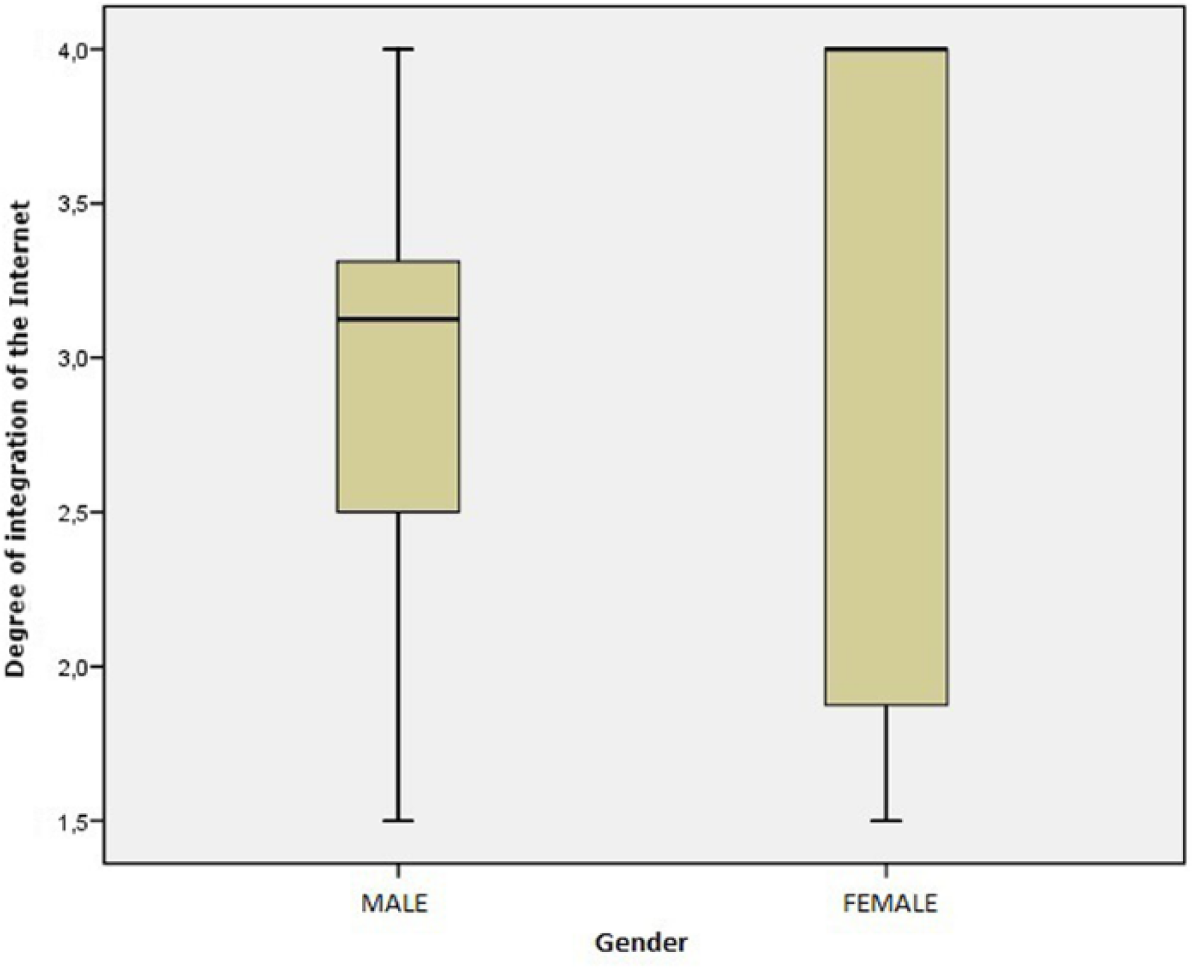
Perception of the coordination of the integration of the Internet into education programmes.
When the ANOVA test is applied to the data collected from the coordinators, a negative result is obtained (with a value of 0.352), which indicates that there is no statistical evidence of unequal variance.
The data collected from the second source, the teachers, does not consider major differences in the integration of the Internet in the education programme according to the coordinator’s gender (Figure 2). This point is corroborated when the ANOVA test is applied, with a result (a value of 0.350) that indicates that there is no statistical evidence of an unequal variance.
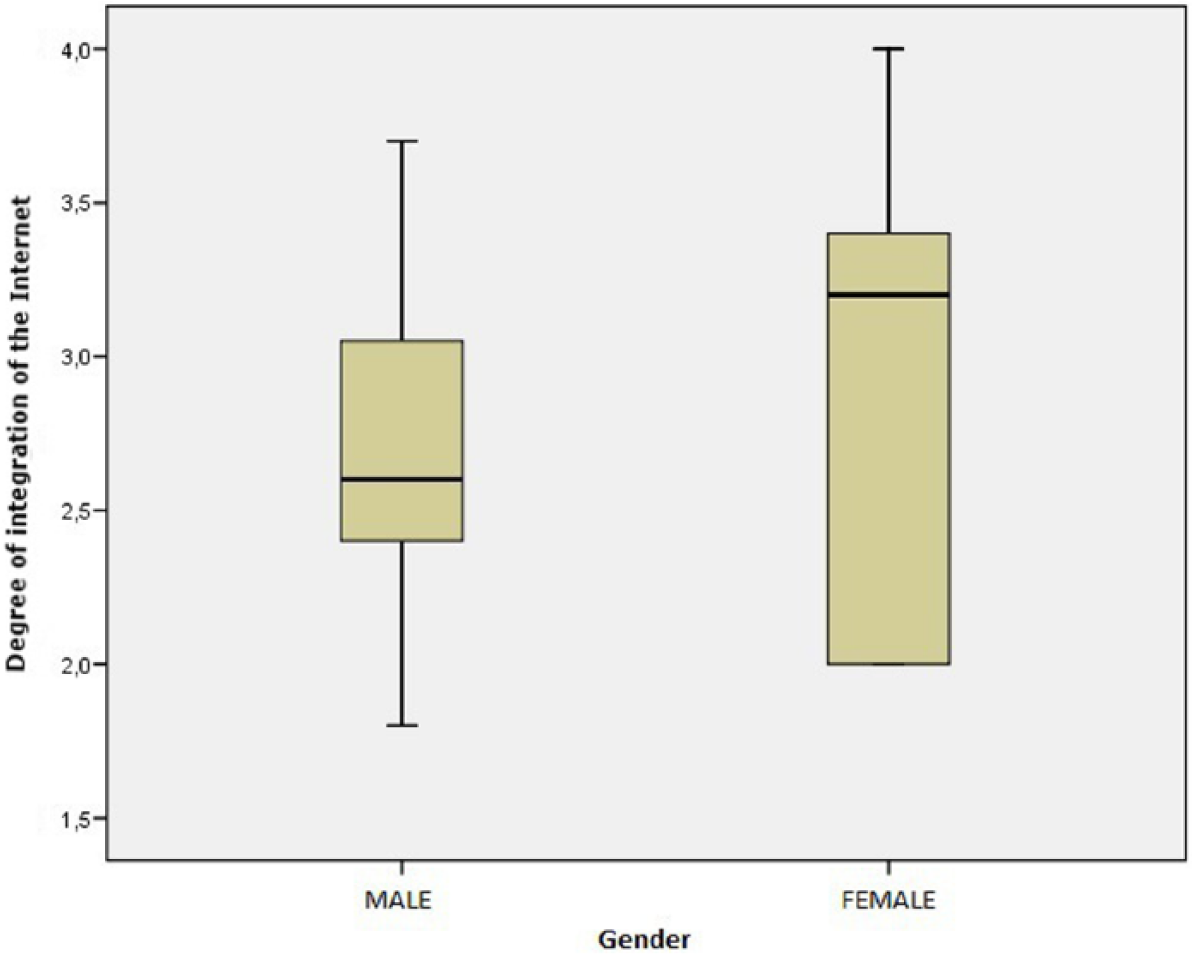
Perception of teachers on the integration of the Internet into education programmes.
When we triangulate the two sources of data (coordinators and teachers), a difference of degree is noticed (Figure 3). In other words, the group of coordinators gives the curricular integration of the Internet higher scores than the group of teaching staff. The median of the scores given by the female coordinators is higher than that given by the male coordinators. Furthermore, the interquartile range is very wide, which suggests that the variability of the scores in the centres that are coordinated by women is greater.
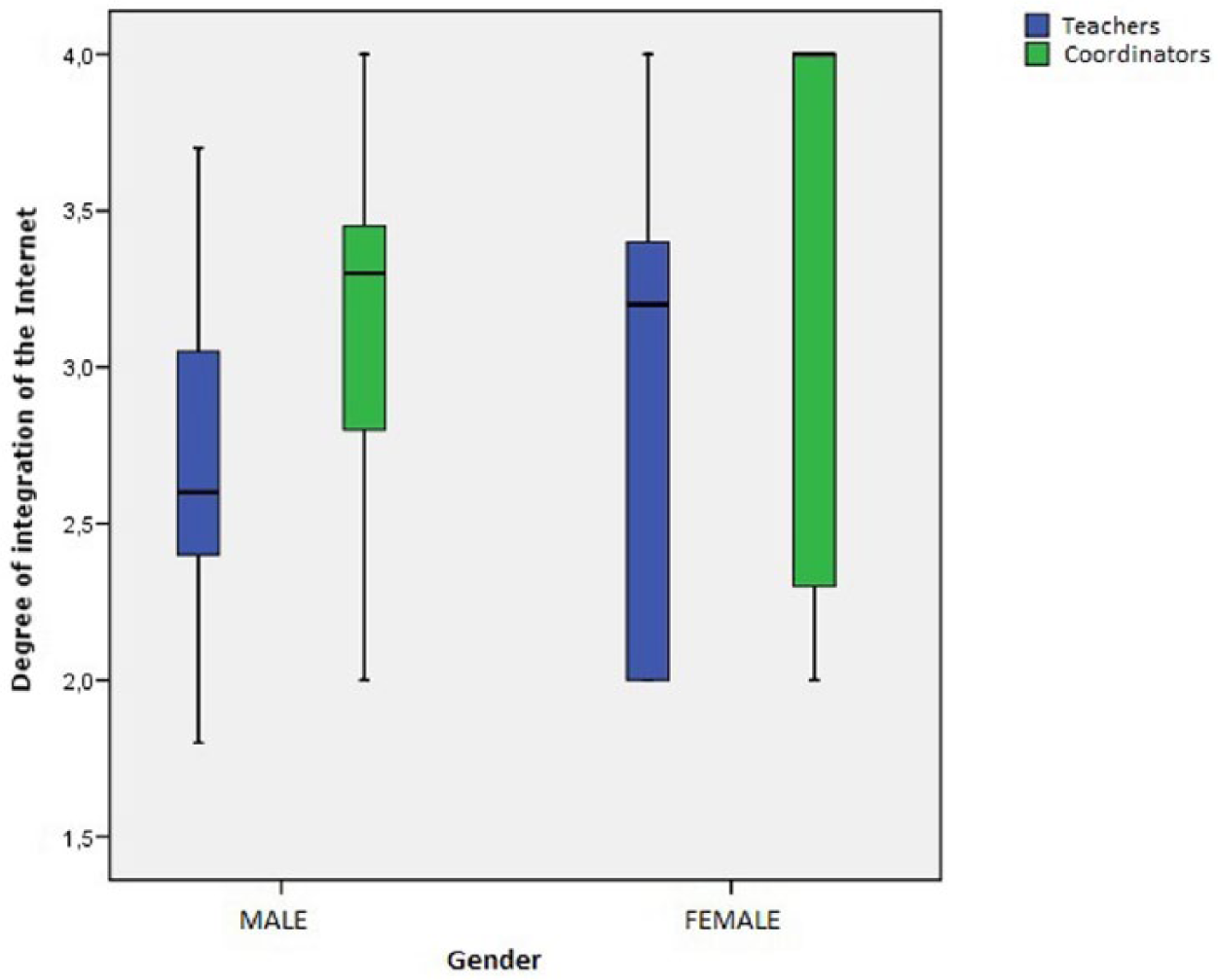
Comparison between the perspectives of coordinators and teachers.
The similarity between the data taken from the teachers’ and the coordinators’ questionnaires is a factor that ensures that the evaluations of each group respond to the analysed reality.
The data collected in the interviews and in the documentary analysis confirm the sense of the responses given in the questionnaires. In general, there are no significant differences in the curricular integration of the Internet according to the gender of the project coordinators. Proof of this is that the projects to incorporate the Internet, regardless of the sex of the person preparing that project, show similarities in the following three areas:
The use of the Internet in instrumental areas. In many of the analysed projects, the opportunity awarded by the Internet to promote reading and writing through the use of digital publications, and through participation in interactive environments such as debate forums and blogs, stands out.
The use of the Internet as a resource to respond to diversity. This refers to the need to respond to different learning paces, to the proposal of activities that strengthen curricular contents and of individualised proposals for students with specific educational support requirements.
The need to use the Internet as a resource to compensate for shortcomings in the text books regarding the centre’s own environment or relevant current affairs. An example of this is that several centres use the Internet for activities prior to an outing.
Conclusions
The conclusions may be summed up in one phrase: ‘there are no significant differences between men and women with regard to the introduction of the Internet in education programmes at the centres used in this study’. However, we believe it appropriate to go further into the particular features that a study of the hypothesis reveals. In this way, the maximum possible contribution of this research to scientific knowledge on this matter can be ensured.
Both the planning documents and the performance in the classroom highlight the fact that, in the schools taking part in this research study, the Internet is an integrated part of the teaching programme. The degree of integration is medium–high, and there is no significant difference according to the gender variable. Nevertheless, it is worth pointing out that the centres that are coordinated by women show a notable difference in values that, on the whole, reflect the application of innovative measures to integrate the Internet into the curriculum in the schools in which a woman is responsible for ICT.
From the coordinators’ perspective, the curricular integration is understood to be higher than the value given by the rest of the teaching staff. This is due to the fact that, in their responses, they take their teaching practice as a reference. In this sense, differences are, indeed, noticeable: the coordinators, as part of their teaching duty, integrate the Internet to a greater degree in the curriculum than the rest of the teaching staff.
It is clear that each centre is autonomous and treats the integration of the Internet differently. However, such differences are not related to the gender of the person in charge of the introductory process, but to the idiosyncrasy of the centre itself, and on many occasions, to the governing board’s attitude to ICT (Blázquez et al., 2000; Orellana et al., 2004).
The centres that include the integration of educational technology in their general planning documents obtain a greater evaluation than those that do not, or those that award it a less significant treatment. Therefore, the centre project is a valuable instrument for integrating the Internet from a more general perspective.
Recommendations and new lines of work
The conclusions obtained are in keeping with the tendency for gender differences to be reduced, as regards the Internet, which is currently the trend in Europe. Aguaded and Tirado (2010) reach similar conclusions in their paper on the adaptation to the use of the Internet among the youth population. A recent study by Fundación Telefónica draws attention to the same point: ‘Among the youngest sector (16-24 years) the gender divide regarding access to the Internet has been overcome, in fact, women even connect more than men (2 percentage points more access)’ Fundación Telefónica (2012: 44). In spite of this, it is not advisable to rule out the existence of differences associated with gender in the ways in which the Internet is introduced in the education programme. Other papers suggest different behaviour between men and women in carrying out the responsibilities inherent in an educational position. Some research studies (Bardisa, 1995; Barquín and Melero, 1994; Padilla, 2008) have verified that ‘in many of the cases in which women access positions of responsibility in education centres or as inspectors, they exercise the responsibility and power that come with those positions in a very different way to men’ (Padilla, 2008: 4).
We believe that differences according to the gender variable could be researched in other areas related to the Internet and schools, as there are signs that this is a question in the middle of a full process of change and consequently it is scientifically relevant. By way of example, it would be worth recalling that several research studies (for example Almerich et al., 2005; Vázquez et al., 2007) have stressed that male teachers’ knowledge and skills in technological resources are wider than their female colleagues’ skills in the same area. We should also not overlook the acknowledged ‘digital gender divide’, which affects all levels of society and which, undoubtedly, has an impact on the level of knowledge and attitude with which the relationship with educational technologies is faced: One of the general conclusions to the different areas that were researched is that women’s access to the world of IT comes about at a later stage than for men, and in most cases, it is conditioned by needs imposed on them at an occupational or academic level, to which they have accessed without having sufficient IT skills and, therefore, with a sense of fear and insecurity. (Vázquez et al., 2007: 4)
Like Salomé (2010), we have verified that, beyond the gender perspective, there are different models of incorporating the Internet in education centres. We feel that it would be highly appropriate to investigate the data obtained through different models, as well as the teachers’ and students’ evolution over time, given that they are the main players in the education processes. It may also prove to be relevant to analyse that evolution, from the particular nature of each centre, taking the commencement of the Internet integration process as a starting point.
We hope that all these arguments will enable the old mechanisms still existing in some institutions to be roused so that the Internet can be implemented in teaching practices in a more efficient and satisfactory way.
The educational implementation of the Internet undoubtedly offers many more research possibilities than those considered here, and which we have been unable to tackle due to the limitations of our work. They do, however, form part of a line of ethnographic research with many points of analysis (collaborative work, good practice, impact, etc.) that will open new approaches and lines of work in the future. We hope to continue working on this and encouraging other researchers to do so, to achieve improvements in the quality of education at our public institutions.
In short, as Fernández and Mena (2011) state, this type of work is in keeping with this line of research’s early stages of development and provides data that prepares the way for future research.
Footnotes
Declaration of Conflicting Interests
The author(s) declared no potential conflicts of interest with respect to the research, authorship, and/or publication of this article.
Funding
The author(s) disclosed receipt of the following financial support for the research, authorship, and/or publication of this article: This research was funded by the Autonomous Government of Andalusia.