



Abstract
The German labour market has seen substantial structural changes, especially over the past decades: there has been a major shift in labour market policy, the service industry is booming and skills requirements have changed dramatically. This article discusses these trends, offering an empirical analysis of the extent to which the German dual VET system is prepared to meet them. For this purpose, the article explores representative data for Germany and looks at the labour market integration of dual VET graduates. The basic assumption is that a mismatch between the dual VET system and the labour market will also become evident at the micro level of individuals. The results show that dual VET graduates enjoy far better protection against unemployment than people without a vocational training qualification. Likewise, they are far less likely to work in temporary employment. The dual VET system thus functions as a ‘safety net’. At the same time, however, the earnings of dual VET graduates are markedly lower than those of higher education graduates. The article concludes by discussing some of the future challenges and opportunities facing the dual VET system.
Introduction
Since the 2008 financial crisis, which the German economy weathered comparatively well, Germany’s dual system of vocational education and training (VET) has risen to prominence once more. In recent years, Germany has entered into various collaborations with countries weakened by the crisis to facilitate knowledge transfer or to provide concrete support with building a VET system based on the German model. Scientific studies find that the dual VET system has strong potential to prevent youth unemployment (e.g. Breen, 2005; Eurofound, 2014; Gangl, 2001). At the same time, the OECD has repeatedly pointed out that the rate of tertiary education attainment is comparatively low in Germany (see also Wolter and Kerst in this issue). According to OECD researchers, this might put the country’s current competitive advantages at risk. 1
The question of which type of education is most suited for tomorrow’s workplace is of crucial importance not only for policymaking and society but also for research. The present article aims to present current trends in the German labour market and to explore the degree to which the dual VET system has adapted to the needs of a changing labour market. Doing so is an extremely complex task, as the skills output of education systems is difficult to measure, making it almost impossible to say anything about how well these skills actually match the requirements of the labour market. One way to solve this problem is to identify the match between VET system and labour market by examining how well VET graduates are integrated into the labour market. If many qualification holders are not part of the workforce but unemployed, or if their affiliation with firms is only a loose one (temporary employment), this indicates that the match between the two systems is suboptimal. Likewise, examining wage structures gives us an idea of how high the demand for specific types of education is. This article, therefore, not only presents trends from a macro-sociological perspective but also includes micro level analyses of labour market inequalities to draw conclusions regarding the match between the VET system and the labour market.
The article is structured as follows: It begins with an account of the German model of production from an institutional point of view. Employer associations, trade unions and the state have a strong influence on market outcomes in Germany. As collective actors they are also involved in the governance of the German dual VET system. The article goes on to discuss recent trends in the German labour market. On the supply side, these include the academization of the workforce and potential skills shortages due to demographic change; on the demand side, sectoral and industry-related changes, as well as changing skills requirements, are discussed. On the policy side, the so-called Hartz reforms have substantially changed the situation of employed and unemployed people. The following section is devoted to the labour market status of VET graduates. Does dual VET offer protection against unemployment and temporary employment? That is, does it still function as a safety net (Arum and Shavit, 1995; Shavit and Müller, 2000)? Finally, how do the earnings of dual VET graduates compare to those of other educational attainment groups? Does dual training pay off in terms of financial benefits? The article concludes with a discussion of findings and an outlook on the opportunities and risks facing the dual VET system.
The German production model: an institutional perspective
Labour market outcomes and inequalities are highly dependent on the institutional structure of the economy and the education system. Compared to liberal market economies such as the UK or the US, a coordinated market economy such as Germany’s is characterized by major interventions into free market mechanisms (see Hall and Soskice, 2001 for the varieties of capitalism approach). Employer associations serve the important function of creating transparency and exchange between German firms, with the aim of pushing for a long-term strategic coordination of the German economy. In most industries, wages are negotiated between capital (employer associations) and labour (trade unions) by means of collective bargaining and laid down in collective bargaining agreements. As a consequence, income inequalities tend to be rather small in coordinated market economies (DiPrete and McManus, 1996).
One crucial element of the German production model is its dual vocational training system. The duality of learning sites is emphasized in many studies: whereas vocational schools teach theoretical and abstract knowledge in a classroom setting, trainees also acquire practical experience at the workplace. However, much more importantly, the German dual VET system is jointly governed by the federal government and the business community, a model which can be labelled ‘dual corporatist’ (Greinert, 2005; see also Kuhlee in this issue). On the one hand, the government defines the general legislative framework and a set of training standards via the Vocational Training Act (Berufsbildungsgesetz, BBiG) and the Trade and Crafts Code (Handwerksordnung, HwO). On the other, the business sector also has a direct influence on vocational training, as the social partners (employer associations and trade unions) jointly determine the curricula and conditions for each training occupation. Compared to other VET models in Europe, this dual corporatist mode has at least two key advantages. First, the involvement of the business sector helps ensure that training curricula contain the knowledge and skills required at the workplace. This is not so much the case in France, for example, where the focus is on full-time school-based training guided by state-designed curricula. Second, government intervention through the BBiG and the HwO has the advantage of forcing employers to adhere to certain rules when training new workers. The training curricula are laid down in training regulations as well. This kind of ‘standardization’ provides a clear advantage over liberal and unstandardized training systems (see e.g. Keep in this issue), which are traditionally often little more than training-on-the-job schemes (Allmendinger, 1989). Currently, there are more than 300 recognized skilled occupations in Germany, which makes vocational training highly occupation-specific (Müller and Shavit, 1998). Firms adapt the organization of work tasks and personnel recruitment strategies to the output of the VET system. This strong linkage between the vocational training system and the corresponding organization of jobs has led to Germany being labelled as an ‘occupational labour market’ (Marsden, 1990). The skilled worker and the ‘diversified quality production’ (Streeck, 1991) are commonly hailed as essential for Germany’s successful export of high-priced industrial goods.
Developments in the German labour market: structural trends and policies
The German labour market is shaped by various trends. Some of them will be discussed below, beginning with a description of changes in labour supply and labour demand, followed by an outline of recent labour market policies (see Laczik and Mayhew in this issue).
Changes in labour supply: the academization of the workforce and demographic change
According to representative data (German Microcensus), the share of people without a formal VET qualification was 17% in the adult working age group (25 to 64 years) in 2011. This also includes people who only completed a shorter vocational programme (usually up to 1 year) not leading to a recognized skilled occupation. The majority of people in Germany (58%), however, have earned an upper secondary VET qualification, either via the dual training system or (mainly in the health sector) via full-time vocational schools with some minor practical training, for instance in hospitals. After completing their dual VET programme, qualification holders also have the opportunity to continue their education in a formal context. The non-academic formal continuing education sector (tertiary level B) features programmes leading to qualifications such as Meister (master craftsman), Industriemeister (master tradesman in industry), Fachwirt (senior clerk) or Techniker (technician). In 2011 the share of tertiary level B qualification holders was 8%. In addition, more and more people in Germany hold a higher education degree (tertiary level A); the share was 17% in 2011. The ongoing trend of academization also means a shift in the skills of the future labour supply. First-year higher education enrolment increased from 28% in 1995 to more than 50% in 2013 (Autorengruppe Bildungsberichterstattung, 2014: 297) (for higher education expansion in England, see Parry and Laczik and Mayhew in this issue). But it is unclear what this trend will mean for the labour market in general and the situation of dual VET graduates in particular. In principle, three lines of argument can be distinguished (see also Handl, 1996). Proponents of the first argument claim there will be a proletarianization of individuals with a higher education degree. As there are not enough jobs for this group, they either have to face rising unemployment or work in lower status positions (the classic stereotypical example of this phenomenon in Germany is the taxi driver with a PhD, e.g. Schlegelmilch, 1987). The second line of argument describes a displacement of people with a dual VET qualification and low-skilled people, suggesting that they increasingly become unemployed, are working in temporary employment or have to suffer wage losses. According to the third line of argument, the employment prospects of higher education graduates, dual VET graduates and low-skilled people do not change relative to each other, because the labour market, as a system, will functionally adapt to changes in the education system (or vice versa).
The qualitative change of labour supply – ongoing academization – is accompanied by a quantitative change. For several decades, birth rates in Germany have remained at a low level. In 2013 the total fertility rate (TFR) was about 1.5 children per woman, which is far below the replacement rate, that is, the TFR at which population levels remain constant. This means that population figures and the quantity of labour supply are going to shrink. Projections indicate that this might lead to skills shortages in some regions and industries, where labour demand is high (Zika et al., 2015; see also Granato et al. in this issue). Skills shortages are expected in the northern and particularly in the eastern parts of Germany. Industry-specific trends and general skills requirements are also very much dependent on the changes in labour market demand, which will be discussed in the following section.
Changes in labour demand: sectoral shifts and skills requirements
As early as the 1960s, Jean Fourastié (1969) showed how economies evolve from agrarian via manufacturing to service economies, due to increases in productivity. The following example illustrates this point.
Time needed to harvest 100 square metres of wheat:
1800 1 hour with a sickle 1850 15 minutes with a scythe 1900 2 minutes with a reaper-binder 1920 40 seconds with a reaper-binder and a tractor 1945 35 seconds with a harvester-thresher (1969: 27, current author’s translation)
As a consequence of technological innovations and the concomitant increase in productivity, more and more farm workers lost their jobs and found new employment in the manufacturing industries (secondary sector). Industrialization further promoted rationalization by means of standardized and automated procedures, as well as a focus on the division of labour. Since the demand for services increased steadily among the population as well, more and more people started working in this tertiary sector (Bosch and Wagner, 2003). In 2013, according to the OECD, only about 2% of the German labour force worked in agriculture, compared to 28% in manufacturing and 70% in the service industry. Projections for Germany indicate that the shift towards the service sector will continue in the future, whereas the demand for employees in the manufacturing sector is going to further decline due to technological innovations (Zika et al., 2012). Since the ‘classic’ division of the economy into three sectors is very rough, labour market researchers today tend to refer more to changes in industries or occupations. As it is anything but easy to extrapolate present trends into the future, and ‘external shocks’, such as economic crises or new technologies, will repeatedly occur, it is reasonable to describe general trends. The volume of work in the area of ‘sales, maintenance and repair of vehicles and consumer goods’ is declining, for example; the same is true of ‘public administration, defence and social security’. Rising demand, by contrast, is expected in the area of business-related services; likewise, excellent employment prospects emerge in health care and social work. The latter is a consequence of Germany’s strongly ageing population.
These sectoral shifts, but also changes in technology and society in general, have an impact on the skills requirements of the future workforce. One trend that has already caused substantial changes in the skill set that workers are expected to demonstrate is the increasing use of computers and information and communication technology (ICT) in the workplace (Jovanovic and Rousseau, 2005). Proficiency in these technologies has therefore become a key skill. But computers have also come to substitute human labour. Autor et al. (2003) distinguish between routine tasks and non-routine tasks. Routine tasks are workplace tasks that can be accomplished by machines and computers (e.g. picking, sorting, repetitive assembly, record-keeping, calculation or repetitive customer service (e.g. bank teller)). Non-routine tasks are much harder to be substituted by computers. Examples are janitorial services, persuading/selling, managing others, forming hypotheses and so on (Autor et al., 2003: 1286). With computer prices declining steadily (and firms aiming at higher profits), routine tasks are very likely to be further substituted by machines and computers in the future.
Two further trends that will be discussed briefly are globalization and the rising level of flexibility in the labour market. The advance of globalization leads to increasing transnational exchanges in a diverse range of social spheres, including work, goods, capital and knowledge (Alasuutari, 2000). The rising need for social and communicative skills is certainly a consequence of the increase in interpersonal exchanges. Proficiency in foreign languages has gained new significance. Getting by without English, the world’s lingua franca, is next to impossible. The rising level of flexibility in the labour market and a trend towards the destandardization of work histories requires workers to have even more economic and entrepreneurial skills, as well as the ability to independently acquire new knowledge on an ongoing basis, combined with an increased capacity for self-management (Murnane and Levy, 1996; Gallie et al., 2004).
Taken together, the aforementioned shifts in occupations and workplace tasks, in particular the further substitution of routine tasks by computers, should primarily diminish the labour market opportunities of low-skilled workers. The increasing demand for social and communicative skills, higher flexibility, as well as a rising need for analytical, problem-solving and deductive reasoning skills might benefit higher education graduates more than dual VET graduates (Liu and Grusky, 2013).
Recent labour market reforms
Traditionally, the German market economy has been supported by a welfare state regime providing a relatively high degree of decommodification for employees, meaning they are well protected in the case of unemployment or illness. In his welfare state typology, Esping-Andersen (1990) describes the German welfare state model as ‘conservative’. In keeping with the social insurance tradition initiated by Bismarck, government transfer payments continue to depend on the duration and earnings achieved in previous employment. As a consequence, the system tends to perpetuate status differences (see also Offe, 1972). Over the decades, German legislators repeatedly passed labour market reforms. One of the most sweeping series of labour market reforms, the so-called Hartz reforms, were implemented in the early 2000s. The reforms are named after Peter Hartz, at that time Volkswagen’s leading human resources executive, who headed a commission on labour market reform installed by the federal government under Chancellor Gerhard Schröder. The Hartz reforms were a reaction to ongoing high (long-term) unemployment and a lack of transparency and inefficiencies of the federal employment agency. Accordingly, major reform goals were to reduce unemployment and restructure the federal employment agency (Klinger et al., 2013). The organizational overhaul also involved a renaming of institutions: The Federal Labour Office (Bundesanstalt für Arbeit) for instance, became the Federal Labour Agency (Bundesagentur für Arbeit), putting the emphasis on its function as an agency for the unemployed to find work. With the so-called Hartz IV reform, unemployment assistance (Arbeitslosenhilfe) and social welfare benefits (Sozialhilfe) were consolidated into one flat sum called ‘unemployment benefit II’ (Arbeitslosengeld II). This meant that individuals were no longer entitled to receive the traditional, income-based unemployment assistance benefits for an unlimited period of time after losing their job. In other words, the degree of decommodification in Germany has dropped to a lower level as a result of the Hartz reforms (‘activation’ is the buzzword here). Another important aspect of the reform to better integrate the unemployed was to make it easier for employers to hire workers on a marginal and temporary basis. This new form of flexibility for firms led to increasing segmentation of the workforce. On the one hand, there was a core workforce (Kernbelegschaft) with permanent work contracts enjoying high employment protection by law. On the other, there was a non-core workforce (Randbelegschaft) consisting of temporary workers with high employment insecurities, who will be the first to be laid off during recessions. Whereas lowering unemployment was a clear policy objective, the described increased segmentation was rather an unintended effect of the labour market reforms. Likewise, rising wage inequalities have been observed for Germany over the last decades (Card et al., 2013). One of the most recent reforms – not part of the Hartz reforms – was the introduction of a national minimum wage in 2015. From now on, every employee is guaranteed payment of €8.50 per hour, with some exceptions including people in vocational education and training, university students doing a compulsory internship, internships lasting less than 3 months, measures by the federal employment agency and the long-term employed (more than one year), who are not entitled to the minimum wage for their first six months in employment (BMAS, 2015).
The following empirical section will cover three core dimensions of labour market inequalities, which were addressed by the aforementioned labour market reforms: unemployment, temporary employment and wage structure.
The labour market status of VET graduates
The section below looks at how well people who have completed a VET programme are integrated into the German labour market. It begins with a description of how the risk of unemployment has evolved in general and for different educational groups over several decades, drawing on official statistics. Do we see an emerging disconnect between the dual VET system and the employment system? The section concludes with an examination of how the wages of VET graduates and their risk of working on temporary employment contracts compare with those of people with different educational attainment levels, especially those without a vocational training qualification and those with a higher education degree. The analyses (wages, temporary contracts) draw on the 2012 Erwerbstätigenbefragung, or ‘labour force survey’, a collection of representative data by the Federal Institute for Vocational Education and Training (BIBB) and the Federal Institute for Occupational Safety and Health (BAuA) (Rohrbach-Schmidt and Hall, 2013). The data set consists of some 20,000 core earners, that is people who are at least 15 years old and in gainful employment of at least 10 hours per week. The survey questions cover their current employment, income, work contract details, workplace tasks, employer information, industry and occupation. In addition to standard demographics (gender, age, etc.), the survey provides detailed information on respondents’ educational attainment.
Unemployment
To many people, employment means more than financial security and prospects, it is also a status marker, it fosters regular activity and contacts outside of the nuclear family, and it provides individuals with meaning and identity (Jahoda et al., 1975). Unemployment, by contrast, is not only a negative experience for individuals, it is also a problem for the national economy. It deprives the state of revenue while burdening the public budget with social security expenses. Moreover, it indicates that the labour market has little integrative power.
Figure 1 shows the development of unemployment in West Germany since 1950. After World War II, production in Germany declined dramatically, resulting in high unemployment and little demand for workers. However, the German economy recovered quickly, accompanied by steadily declining unemployment rates. 2 The 1960s saw the beginning of what is known as the German Wirtschaftswunder, or ‘economic miracle’, 3 which lasted for more than ten years. During this phase, Germany was marked by full employment, 4 with unemployment rates significantly below 3% for the most part. It was not until the 1973 and 1979 oil shocks that this positive development came to a halt. From then on, a high level of persistent unemployment began to build up. German reunification in 1989/90 presented West Germany with the challenge of integrating the (formerly) socialist East German part, whose economic power and competitiveness were small. Even if the two parts have now become largely similar in many areas of social life, the unemployment rate in East Germany (2014: 9.8%) continues to be almost twice as high as that in the West (2014: 5.9%).
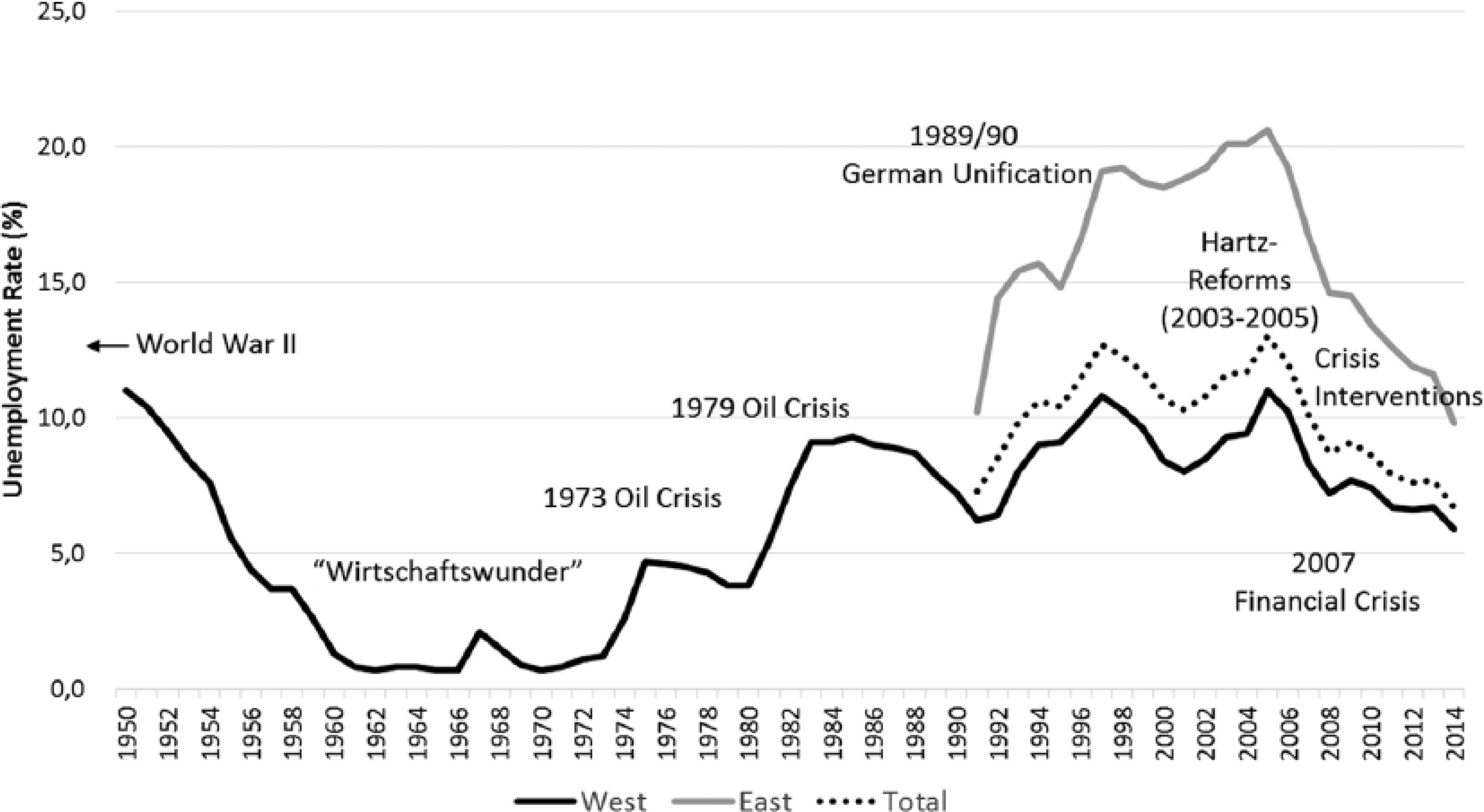
Unemployment rates (1950–2014), Critical events and labour market policies in Germany.
Although economists largely agree that the Hartz reforms at the beginning of 2000 did help bring down unemployment in Germany (Klinger et al., 2013), there are other reasons as well why unemployment levels have remained relatively low compared to other countries in the aftermath of the 2008 financial crisis. Right at the outset of the crisis, for instance, the German government passed a variety of measures known as economic stimulus packages, featuring tax cuts and simplified lending procedures for enterprises, funding for infrastructure measures, ‘scrappage’ premiums encouraging consumers to get rid of old cars and buy new, eco-friendly models, investments in education and educational infrastructure, as well as allowances for part-time work enabling employers to keep their workers employed part time with the help of government subsidies for a limited period of time. This measure helped prevent lay-offs and enabled employers to keep valuable staff and their expertise on board rather than forcing them to go to great lengths recruiting new workers once the economy was on the upswing again. This is presumably another reason why the German economy was so quick to recover in the aftermath of the crisis.
Another question is whether the risk of being unemployed differs between educational groups. Concerns about the lack or oversupply of university graduates have been a cyclical feature of public debate in Germany since the early 19th century (Titze, 1990). In fact, higher education enrolments have been increasing for quite some time now, as described above. Looking at the official statistics provides some interesting insights. Figure 2 shows the unemployment rates of people without a vocational training qualification, those with a vocational training qualification (primarily in the dual system) and those with a higher education degree. Based on the unemployment rates, almost all higher education graduates in Germany are part of the workforce. Until German reunification, the unemployment rate of dual VET graduates in West Germany was about as low as that of higher education graduates. Since then, dual VET graduates have been somewhat more likely to experience unemployment. In recent years, however, especially towards the end of the time period considered here, the unemployment rate of dual VET graduates has come closer to that of higher education graduates again. What is particularly striking is the evolution of unemployment among people without a vocational training qualification. In the mid-1970s, their labour market prospects were still quite good, but, since then, their risk of unemployment has sky-rocketed. In 2013 the unemployment rate for this group was 20% (Hausner et al., 2015: 2), which is four times as high as that for VET graduates (5.1%; higher education: 2.5%). In other words, completing a vocational training programme also serves as a ‘safety net’ against unemployment in Germany.
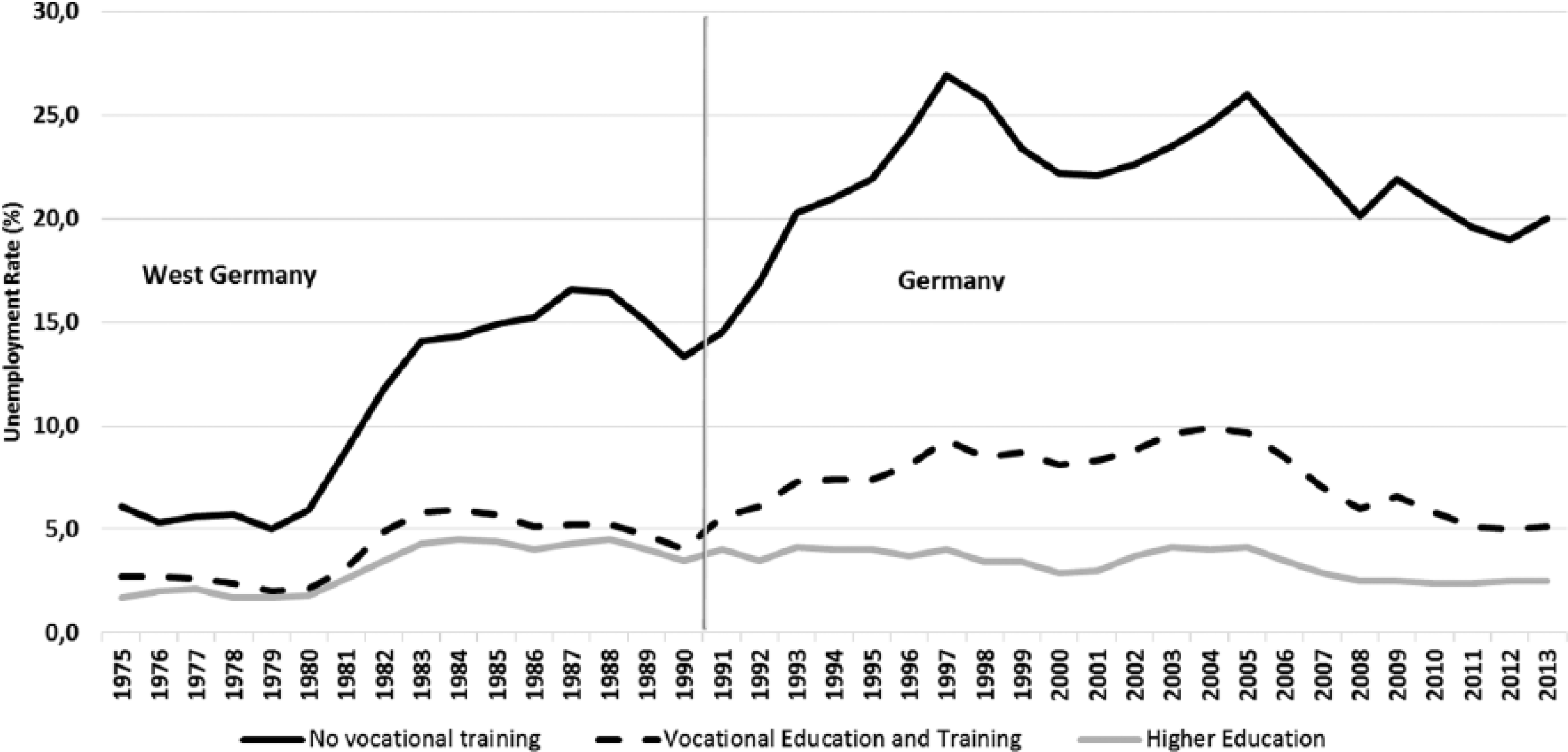
Unemployment rates in Germany (1975–2013), by educational qualification.
Wage inequalities
The following empirical investigation is devoted to earnings. Generally, Germany has seen some increase in wage inequalities over time (Card et al., 2013). Recent monetary returns on investments in a certain type of formal vocational education will be described below, analysing the latest wave of the BIBB/BAuA labour force survey (Erwerbstätigenbefragung) from 2012.
Assumptions regarding the association between vocational education and wages
According to human capital theory (Becker, 1964), greater investments in human capital help increase a worker’s productivity, resulting in higher wages. Workers are thus likely to be paid in accordance with the formal hierarchy described in the International Standard Classification of Education (ISCED), for example. This would mean that workers with no vocational training qualification (ISCED 0–2) earn the least, followed by dual VET qualifications/full-time school-based training programmes (ISCED 3 and 4), vocational continuing education such as master craftsman or technician (ISCED 5B), and higher education degrees (ISCED 5A). Nonetheless, wages are not only determined by individual education investments. A worker’s positioning in the labour market also depends on whether educational programmes match the needs of the labour market from a structural point of view, that is, the demand side (Allmendinger, 1989; Müller and Shavit, 1998). Proponents of signalling theory (Spence, 1973, 1974; Stiglitz, 1975) and theories informed by social psychology (Correll and Ridgeway, 2003) point out that what matters in hiring decisions and promotions is often employers’ expectations of a candidate’s performance, and these expectations depend on the type of vocational education programme a candidate has completed. On the one hand, in an ‘occupational labour market’ (Marsden, 1990) such as Germany’s, jobs are tailored to the skills of dual VET graduates, based on what is mandated by the training regulations. On the other, studies point out that corporate training strategies have changed over the last few decades and that they do not fully follow the occupational principle any more: training has become firm-specific rather than occupation-specific (Baethge, 2014; Thelen and Busemeyer, 2012). Moreover, employers might expect higher education graduates to be more likely than dual VET graduates to have the general skills required for today’s labour market, such as analytical, critical thinking, problem-solving or self-management skills.
Results
The dependent variable to be studied is respondents’ gross monthly wages in euros. The advantage of looking at the gross wage rather than the net wage is that the gross wage does not yet contain any deductions for taxes and social security expenses. It thus represents the direct monetary value of the work performed. Furthermore, the logarithm of the gross wage is used for the analysis. This transformation has two advantages: it takes account of the right-skewed distribution of earnings, and it enables us to interpret the values in the analyses almost as percentage changes. 5
Table 1 shows the results of OLS regression analyses regarding the wages of various educational attainment groups in Germany. Respondents’ highest level of educational attainment is categorized as follows: no vocational training, VET (reference category), vocational continuing education, higher education. According to model 1, people without a vocational training qualification earn on average about one quarter (26% [e0.232]) less than dual VET graduates. However, graduates of higher education institutions earn substantially higher wages than dual VET graduates (47% [e0.382]). Apparently, one obvious way for dual VET graduates to increase their income is obtaining a continuing education qualification. But even if they do so, their earnings still tend to be notably below those of university graduates. Model 2 includes controls for socio-demographics, region, firm size and industry. 6 The results show that such factors account for a substantial part of the differences in wages between VET graduates, people with no vocational training and people with continuing education qualifications, but do almost nothing to explain the wage difference between dual VET graduates and university graduates. Thus, the basic pattern largely remains the same: people with a dual VET qualification earn substantially higher wages than people without a vocational training qualification, but they earn markedly less than people with a university degree. Aside from education, a host of other factors have an impact on how much people can earn. For example, wages tend to increase with age and firm size. Among those who earn comparatively low wages are women, especially if they have children, and people living in East Germany. Moreover, workers whose native language is not German face wage disadvantages. The final model 3 addresses the question of whether wage inequalities between education groups can be explained by frequently performed job tasks. In fact, job tasks are an additional explanatory factor. Even though the hierarchy of formal educational levels still applies, wage differences have become smaller. This also helps explain the wage difference between dual VET graduates and graduates from higher education to a substantial part, even though a wage advantage of higher education graduates is still obvious (25% [e0.219]). The model proves that job tasks have an effect on wages besides education, socio-demographics, region, firm and industry-level determinants. Whereas typical manual tasks such as shipping, storing, cleaning and recycling (but also promoting and marketing) have negative wage effects; positive wage effects can be found for tasks such as consulting, advising, teaching, educating, organizing others and gathering information. The relevance of computers and digital communication becomes obvious, as related workplace tasks also lead to a wage premium. Expertise in foreign languages and the capacity for self-management are also rewarded in the labour market.
Education and wages in Germany 2012.
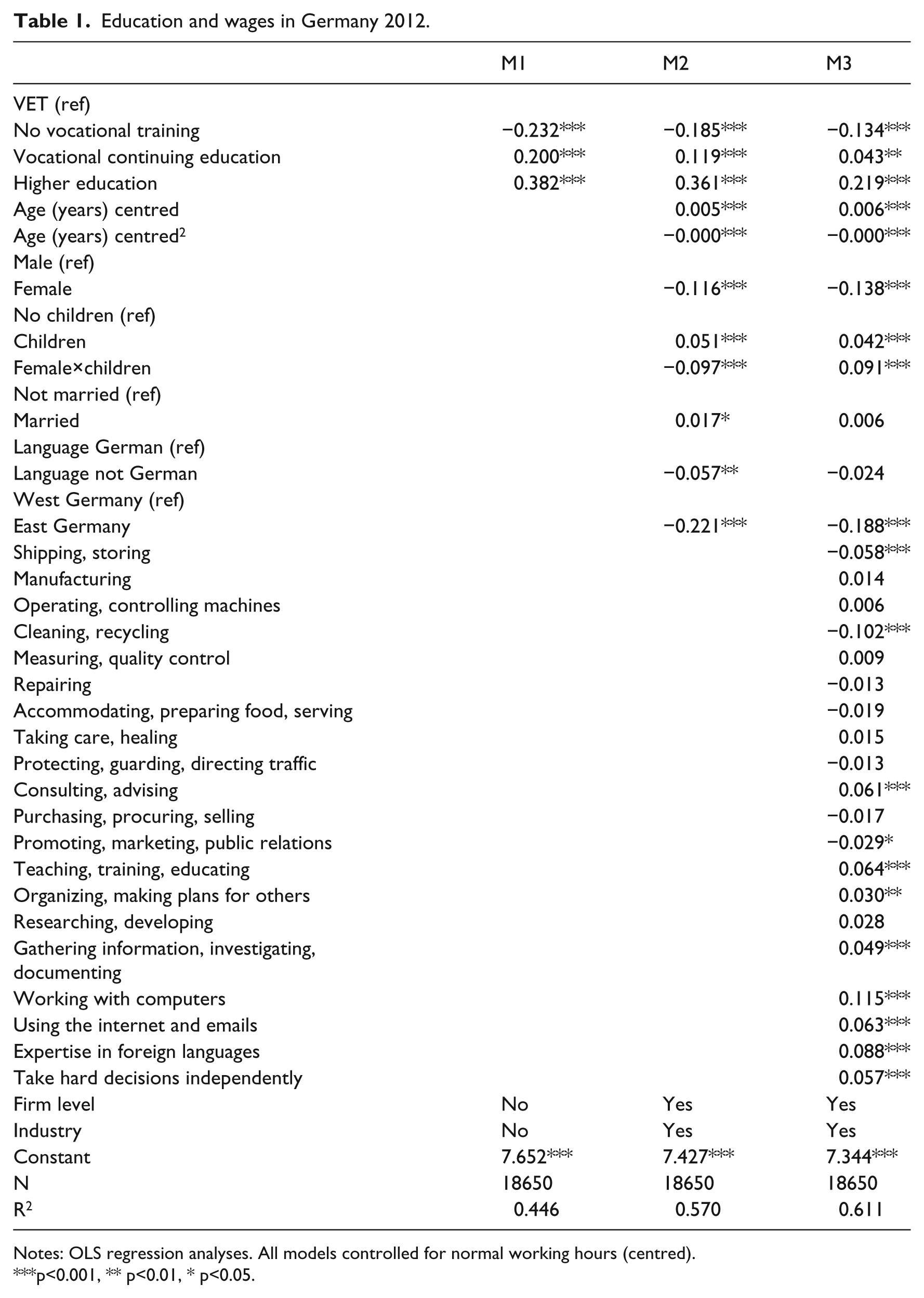
Notes: OLS regression analyses. All models controlled for normal working hours (centred).
p<0.001, ** p<0.01, * p<0.05.
Temporary employment
The Hartz reforms have made it easier for employers to hire workers on temporary work contracts. Therefore, one aspect to be considered is whether completing a dual VET programme also serves as protection against temporary employment. If a large number of dual VET graduates are found to work in temporary positions, however, that may indicate a mismatch between the dual VET system and the labour market; at least one of the two sides – supply or demand – still has reservations about making a long-term commitment.
Assumptions regarding the association between vocational training and temporary employment
If the assumptions of human capital theory (Becker, 1964) are correct, greater investments in human capital will raise individual productivity, which then makes workers more attractive for firms. Accordingly, people with higher formal education should have lower risks of working on a temporary contract. At least for two reasons, however, it can be expected that dual VET graduates will not have a higher risk of temporary employment than university graduates. First, the ‘occupational labour market’ argument (Marsden, 1990) would predict that firms create positions for dual VET graduates within the core workforce, meaning the risk of temporary employment should be rather low. Second, trainees and employers have an early opportunity to get to know each other during the workplace-based components of the dual training programme. This prolonged, multi-year screening phase (Riley, 1976) is one reason why dual VET graduates are unlikely to be offered a temporary employment contract.
Results
The binary dependent variable to be studied is respondents’ risk of temporary employment (reference category: no temporary employment). The statistical method of analysis is estimating linear probability models (Mood, 2010). These are preferred to logistic regression analyses, because the latter are affected by omitted variables, which means that log-odds ratios or odds ratios cannot be compared across models with different independent variables.
Table 2 shows the likelihood of temporary employment of various educational attainment groups in Germany. The likelihood of being employed on a temporary contract is around 9% (see constant) for dual VET graduates (model 1). People without a vocational training qualification are 6 percentage points more likely (i.e. 15% likelihood) to be in temporary employment, whereas there is no significant difference for people with a university degree. People with a continuing education qualification (master craftsman, technician, etc.) are even 3 percentage points less likely to be in temporary employment, resulting in a share of only 6% in temporary employment in this group. One way for dual VET graduates to decrease their risk of temporary employment, therefore, seems to be obtaining a continuing education qualification. When looking at model 2, we see that the advantages of people with continuing education qualifications can be explained by socio-demographic composition and their allocation to different industries and firms. People without a vocational training qualification continue to face a higher risk of temporary employment, whereas graduates of higher education face the same risk of being in temporary employment as dual VET graduates. With regard to socio-demographic characteristics, people whose native language is not German, and people living in East Germany are more likely to be in temporary employment. Married people, by contrast, are less likely to be temporarily employed than unmarried people; likewise, the risk of temporary employment decreases for women and with age. Workplace tasks and demands are included in model 3. People whose job consists of measuring and quality control, or whose focus is on teaching, training and education are less likely to be in temporary employment – for the latter, this might be due to their stable civil servant status. 7 In contrast, workplace tasks such as promotion, marketing and public relations go along with higher risks of temporary employment. Increased job security in terms of a permanent contract is also obvious for job tasks such as working with computers or making hard decisions on one’s own.
Education and temporary employment in Germany 2012.
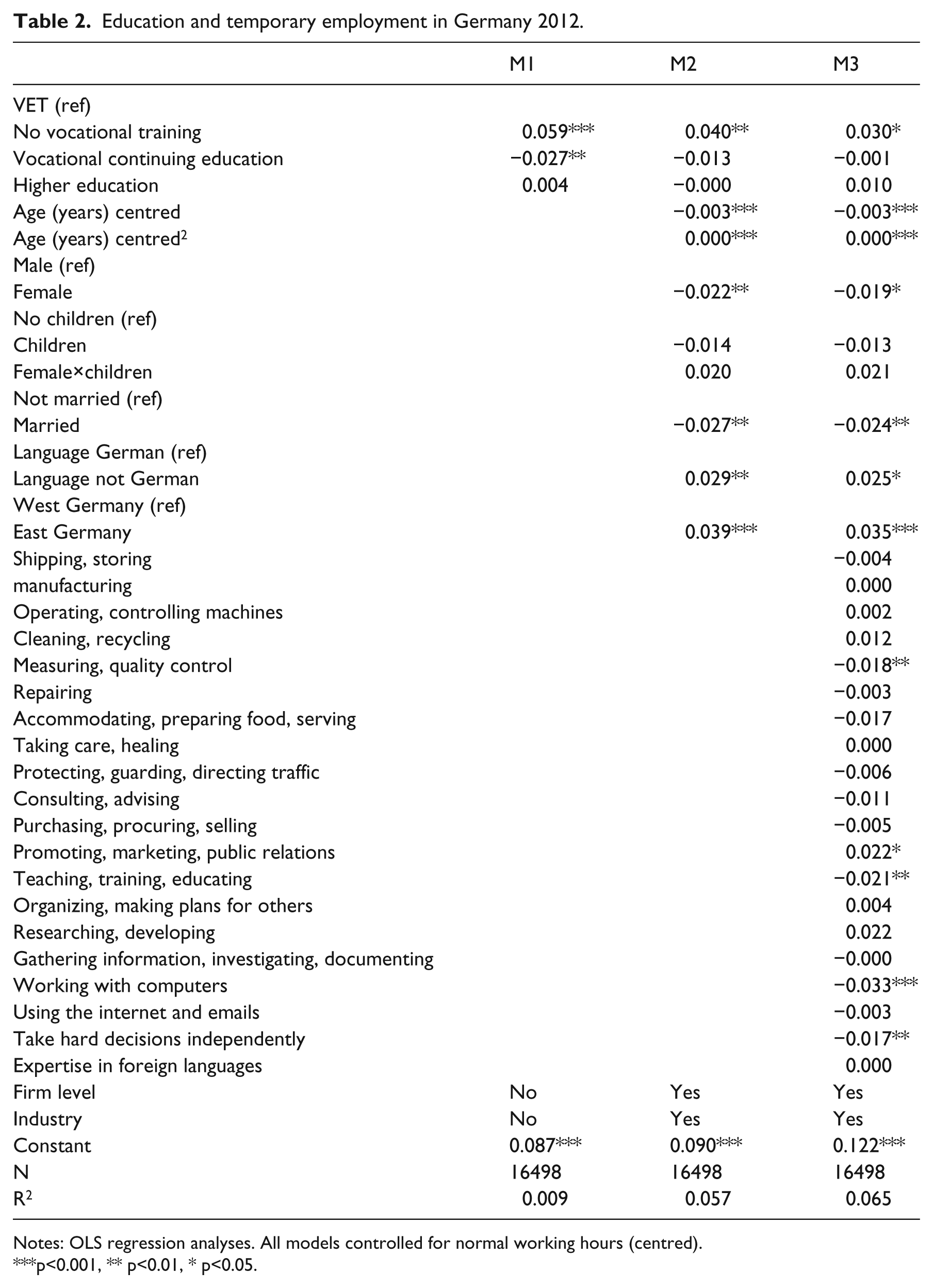
Notes: OLS regression analyses. All models controlled for normal working hours (centred).
p<0.001, ** p<0.01, * p<0.05.
Discussion and outlook
The aim of this article was to describe ongoing changes in the German labour market and to determine their relevance with regard to the dual system of VET. For many years, fighting unemployment was the top priority on the political agenda. Many of the major reforms were designed either to quickly reintegrate unemployed people into the workforce (e.g. Hartz reforms) or to prevent unemployment and lay-offs in the first place (e.g. via subsidized part-time work or economic stimulus packages during the financial crisis). Although Germany emerged from the crisis relatively unscathed in terms of unemployment, workers in Germany continue to face very different risks of unemployment, depending on their level of educational attainment. Whereas unemployment rates among people with tertiary degrees and dual VET graduates appear to be comparatively low, people without a vocational training qualification are heavily affected by unemployment. In terms of temporary employment, the analysis revealed that dual VET graduates have a relatively low risk of temporary employment – in fact, their risk is not higher than that of university graduates. Again, those without a vocational training qualification emerged as being at the highest risk of temporary employment. One initial conclusion to be drawn from this is that the dual VET system continues to function as a ‘safety net’ against unemployment and temporary employment, and that the match between VET system and employment system can still be considered ‘intact’. In terms of earnings, dual VET graduates on average earned significantly higher wages than people without a vocational training qualification, but also lagged far behind the income opportunities of higher education graduates. One way for dual VET graduates to significantly increase their earnings is by pursuing a continuing education programme to become a master craftsman or technician (tertiary level B). But even that does not lift them into the income bracket typical of higher education graduates. One reason for this clear income disadvantage may be that employers associate the skills that are increasingly important in the labour market more with higher education graduates than with VET graduates.
It is difficult to predict how this picture will look in the future. In fact, it is almost impossible to give precise numbers on upcoming labour market opportunities for dual VET graduates. Nevertheless, as an outlook, possible effects of the above-described labour market trends and reforms on dual VET graduates shall be discussed. Starting with demographic change, a decreasing supply of workers can result in a substantial shortage of skilled workers in Germany. This may also mean better employment and bargaining prospects for dual VET graduates. The impact of mass immigration on the German labour market—the numbers of refugees are increasing steadily at the moment—cannot be foreseen at this point of time. Ongoing academization, on the other hand, bears the risk of displacing people with a dual VET qualification. At least three aspects should be the focus of future studies. First, at the moment it is still unclear to what extent the three-year bachelor’s studies introduced during the Bologna process will compete heavily with the traditional three-year dual VET programmes. Second, differential effects should be analysed for higher education graduates from the more practice-orientated universities of applied sciences and those from traditional universities. Third, we can observe further institutional differentiation within the German higher education sector with the rise of dual courses of study (duales Studium), which combine higher education with practical in-company training periods and thus borrow some crucial element from classical dual VET (Ebner et al., 2013; see for more detail Wolter and Kerst in this issue).
More general projections assume that the situation for people with vocational training might become better, whereas academics will face increasing risks of over-qualification (Zika et al., 2015). Researchers largely agree, however, that people without any formal vocational training should face even worse labour market prospects than they do at the moment. They face the highest risk of being replaced by machines and computers in the future, which as a consequence should make them more vulnerable to unemployment, temporary employment and low wages. At least with regards to wages, a legally binding lower limit has been introduced with the national minimum wage. In spite of this measure, there is an urgent need for policy makers to initiate a training strategy for low-skilled individuals (see the contribution by Granato et al. in this issue).
Many other issues could only be touched upon briefly here and will need to be examined in future studies. Some developments at the institutional level of the economy may well be regarded as a threat to the dual VET system. Union membership is declining, as is the proportion of companies involved in employer associations or bound by collective bargaining agreements. The dual VET system is part of the German production model. Many of the dual system’s unique features would hardly be conceivable without this institutional framework. The withdrawal of collective actors that are crucial to maintaining the dual training system should be regarded as a warning sign. In addition, if young people do not find ‘wage guarantees’ defined in collective agreements or permanent employment contracts, the system itself might become less and less attractive (Estevez-Abe et al., 2001: 150).
Footnotes
Acknowledgements
The author would like to thank the anonymous reviewers for their helpful comments, which resulted in major improvements to this article. I would also like to thank the editors, Dina Kuhlee and Andrea Laczik, for their comments and support during the review process.
Funding
This research received no specific grant from any funding agency in the public, commercial, or not-for-profit sectors.