



Abstract
This paper is based on educational anthropology, and presents the initial findings of a three-year international comparative study of primary school children’s learning-processes during travel and cross-cultural encounters. A French-German research team investigated and here reports on primary school exchange programmes. Open coding of the ethnographic video material is evaluated in reference to intercultural education, as addressed in French and German primary school lessons in the social sciences.
Keywords
Introduction
This study examined group- and body-related learning practices in intercultural encounters. According to current research into childhood education, each child is a social actor, constructing his or her own learning process (Heinzel, 2010). In order to capture the interactions between children, in particular spontaneous moments of play and self-portrayal (Stauber, 2006) in small groups, the data collection process involved participant observation, field reports (Geertz, 2003) and video-ethnography. These methods also allowed for the reconstruction of observable learning practices (Breidenstein, 1996) in formal and informal settings (Dewey, 1997) throughout the student exchange programmes. In cooperation with their teachers, groups of children were observed in everyday school situations, in the classroom; in particular, in the context of the student exchange programme, with the class from the other country (Hecht, 2009). Recordings of the children’s contacts with one another are logged in the video evidence. Observation of the children also included spontaneous interactions (Nohl, 2006); for example, during breaks or trips when the children were not necessarily involved in an official extracurricular programme. As the primary school children did not have sufficient language skills to communicate with each other, the exchanges placed them in crisis situations, forcing them to find modes of intercultural communication to facilitate their encounters. These communicative crises produced significant data.
This paper describes and encodes comparative interpretations of the data collected, based on grounded theory (Strauss and Corbin, 1996). In the video footage, the students demonstrated their ability to deal with the challenges presented by a lack of common language with objects and animals that acted as mediators in the forging of relationships, the expression of competition and the resolution of conflicts between them, providing them with the tools to experiment within their environment. They also used body-related expressions to create implicit understanding; this is linked with the ability to structure an interactional space, affording individuals a role according to choreographic elements. The children included in the sample showed skill in developing a social stage, on which various types of interactions could then occur. Thus, this study contributes to discussions about the instructional components of intercultural education for primary school children.
Theoretical background to the video ethnographic study
Ethnographic researchers generally aim to accompany their participants in their everyday lives over an extended period. This means that, going beyond the mere collection of data, ethnographic researchers themselves help to generate experiences in which they participate (Friebertshäuser, 2012). This close relationship with the field of study is evident in the international, comparative, video ethnographic study, concerning the ‘Intercultural informal learning of children’ (Interkulturelles informelles Lernen von Kindern) discussed here. The study is in process and is being conducted between 2013 and 2015 by a French–German research team. The study focuses on children’s learning processes, within the context of student exchange programmes. Six researchers form the two research groups based at the universities of Paris XII and Siegen; they accompanied 10 French and 10 German elementary school classes on behalf of the Franco-German Youth Office. The German side of the exchange concentrates on primary school ‘Sachunterricht’, or social science teaching within the framework of institutional mobility. The one week trip to France is prepared for and followed up on by social studies teachers. On the French side, the issues of informal learning and experiential knowledge are the main points of interest. The French institutional context values behavioural aptitude, and relates to the ‘socle commun des connaissances et des compétences’ programme, launched by the French Ministry of Education in 2013.
Intercultural education is a predominant and timely issue within the German school system. However, it has not yet been fully anchored into the curriculum. It is observed that intercultural issues require greater attention in schools, particularly in primary schools, where relevant studies suggest that individual and social heterogeneity is more pronounced (Stoklas, 2004). Christiane Montandon (2008) raised similar intercultural issues in the context of France. Due to the linguistic and cultural heterogeneity of the students pre-selected for this research, it is obvious that some intercultural themes have already been negotiated within the participating classes. The students are prepared to deal with issues related to encounters with the foreign and the familiar, cultural diversity, migration and globalization. A previous research within the framework of the EU-funded Comenius-Regio projects suggests these learning processes can be strengthened by student exchanges (Vatter et al., 2011). At the primary level of schooling, exploration is encouraged and children experience a broadening of their learning horizons, and overarching issues like intercultural education, civic education, and media education are addressed (KMK, 1996). The innovative character of social science teaching at the primary school level lends itself to exemplary teaching approaches (Pech, 2007). It also implied that issues of intercultural education can be considered in the context of student exchange programmes. Student exchange programmes encourage debates about cultural difference and offer a variety of other tangible learning opportunities based on experiences and self-participation; for example, in spontaneous interactions that may include dramaturgical elements.
This French–German research focuses on the exchange process, emphasizing environmental experiences that enable performative interactions between the children (Wulf et al., 2001). The German research group also works on social studies teaching in the German subject Sachunterricht, which is meant to cover intercultural education. The French research group focuses on implicit knowledge. The aim is to explore the possibilities of more space and recognition of concrete experiences in French schools, based mostly on rational and linguistic approaches to how learning is organized in classrooms. Together, the French–German research group will examine how children automatically create tangible learning opportunities in intercultural encounters. In this video ethnographic study, performative appropriation and learning are considered through the medium of intercultural communication. This is understood within Judith Butler’s (1991) framework, which suggests that gestures and performances, far more than simply expressing physical signs, prove identity or enable discoveries and fabrications. 1 Thus, to ensure thorough understanding of the participants, the researchers first familiarized themselves with the classes involved, and examined existing group structures and individual ways of managing intercultural issues. Then the class was observed participating in contact situations during the student exchange, while the researchers noted group action and play. Playful productions, such as spontaneous contact, inclusion in groups, games, and recreational activities, were opportunities to identify moments of informal learning. In this endeavour, the children were observed to focus on self-portrayal. As part of this self-portrayal, group memberships were created through body-related expressions and confirmations. The children tested their ability to act in playful self-portrayals, which included movement, body, clothing, and language games. The result was self-organized formation of instances when boundaries and resistors were experienced. Through self-portrayal, the participating children open up a subject-related, self-organized educational space. This interactive intercultural learning in the French and German schools, and in meetings, is then comparatively evaluated. Advice on how teachers can adopt childlike ways of experiencing group-related learning is then developed with the help of video sequences. These show how children teach one another through communicative interactions and games involving motion, what they cannot express in words. Creative imitation processes can be understood as a form of mimetic learning. These processes are not simply imitation, but are rather subjectively brought forth, including imaginative expressions and interpretations. Mimetic processes (Gebauer and Wulf, 1992) are a necessary condition of development and learning, and this video ethnographic study contributes to the description of mimetic learning processes among children in cross-cultural encounters. The study proceeds from the assumption that children regularly encounter heterogeneity or diversity, and have innate ways of dealing with intercultural situations, i.e. through mimetic learning. In order to uncover the action-related learning practices of children, the 12 participating researchers employed ethnographic methods to focus on the behavioural practices of children during student exchange activities, which typically included shared schooldays and several shared bus tours funded by the Franco-German Youth Office.
Methodology: video ethnographic evidence in school exchange programmes
Video ethnography as a methodological approach enables the reconstruction of observable interactions between children in binational encounters. The praxeological focus and reflections on corporal presence in the field are the main viewpoints considered in this comparative analysis, in connection with grounded theory. The filmed groups’ interactions and those with objects are seen as performances (Wulf et al., 2001), as the theatrical representations of acting between children within groups; 2 these performances can be identified in the videos produced in cross-cultural settings. However, the data selection process is not an easy undertaking. A single ethnographic researcher naturally sees their own perspective reflected in the collected data. In this research, the video editors’ (i.e. the French–German research team responsible for the comparative analyses) preferences are inserted throughout the cutting and editing processes. Moreover, the teachers in France and Germany (who will be the recipients of the produced video) were also involved through their work with the participating classes and the planned teacher training programmes. The processes undertaken to obtain data including visible and invisible elements pertaining to the implicit cultural knowledge of children in binational encounters, were conducted as described below.
In order to obtain a comparable set of materials, the French–German research group held a camera workshop for the 12 researchers. To represent the French–German research team in the field, two researchers from France and Germany filmed the exchange weeks. During the exchange programmes, the researchers collected video data to show what was happening in the groups, either from a distance or from a close vantage point. When writing up the field protocols and analysing the video-data, the researchers reflected on their own involvement in the experimental field (Amann and Hirschauer, 1997). The post-production process started with the two researchers screening and discussing the video-material. Each researcher examined his own material for relevant scenes, with value in terms of content. These scenes are then extracted and documented in a chart. Then the raw materials were assembled and pre-sorted. From each documented sequence, still images were exported, and inserted into the chart as a reference from which to arrange the sorted material more clearly. The material is pre-sorted mainly according to observable interactions between groups of children. However, it is also examined for its technical and aesthetic quality. After this, in discussion with the French–German research team, the video editor cut the sequences for use in comparative analysis and to deliver professional training to the teachers. Some takes were good in respect to content but had technical defects, such as too little contrast in the picture or significant acoustic background noise caused by strong wind. In such cases the video editor tried to improve the quality using filters or other methods, so the take could be used for interpretation and further editing. However, the team tried to gather takes of high quality and strong diversity during the data acquisition phase, to ensure the greatest amount of significant and workable film-data. When there were multiple different takes depicting the same situation a more detailed interpretation was needed. Depending on the situation being filmed, the researcher was free to choose the best possible mode for filming to reveal his or her observations.
The editing process involved sequencing the video data, which had been filmed over long periods. The researchers employed a step-by-step approach as this was essential to correctly encode the film material. Gradually, the unimportant and unnecessary portions of the data were excised and the remaining centrepieces tabulated and discussed in the context of the encoding paradigms (Strauss and Corbin, 1996). Together, the field protocols, which included dense descriptions of interactions in the classrooms, and the video ethnographic observation of the exchange weeks by the French and German researchers, created extensive data sets. Processing the huge volume of video data that emerged from the many hours of filming from different angles (group and individual takes) during the exchange weeks represented a challenge. On the one hand, it was not easy to store the data properly; but on the other hand, the research process is tedious and interpretative discussions are not easily generated because of the heterogeneity of the data. Comprehensive video data collection tools were analysed by the French and German research team, and contextualized with the long-term field protocols.
Once prepared, the video material was previewed by the two binational researchers, then cut by the French–German research team into thematic sequences and sorted using comparative techniques. Multiple observable sequences in the film were interpreted in a comparative open encoding process (Muckel, 2007). From the video material, four separate one-week meetings were singled out. The sequences in this material focused particularly on interactions. Children’s methods for dealing with nature and artefacts in particular were seen as quite important. The first three encodings revealed that language is not necessarily the dominant field of interaction among participating primary school children. The ethnographic video sequences rather suggest that, parallel to linguistic communication, body-related testing and object-oriented products, as created by children are increasingly the focus of attention of participating students. All the selected sequences contain interactions between children in groups, and show that they simultaneously speak French and German. The data show numerous sequences in which children arrange group configurations. Observable and intensive body-related forms of communication are presumably made possible through mimetic approaches between the groups of children. These processes can similarly be found in other video sequences, supporting the first open encoding of material, and postulating that the affiliations of groups or school classes in the sample are negotiated through performative interaction in situations where intercultural contact takes place.
Sequencing of the video ethnographic material in open coding
The cross-cultural research team has to manage a huge amount of data. Moreover ‘most pictures have a wealth of detail, and a degree of specificity, that makes it all but impossible to provide even an approximate linguistic rendition of the information the picture carries’ (Dretske, 1981: 138). Therefore, the research team has to reduce the range of possible visual cues given in the pictures. Nevertheless, it is important to retain the heuristic power of the depiction (Goodman, 1976) by always returning to pictures. This frequently repeated comparative approach has offered a way to conduct extensive discussions between French and German researchers.
Sport related games and creating spaces in the video sequences See-saw and Athletic Contest
The sequence selected from 18 April 2013, shows children mingling and testing options for communication in the playground. The children arrange themselves into changing French–German group formations when using the see-saw (see Figure 1). At the beginning of the sequence, six children, mainly girls, can be seen on the left of the see-saw and seven boys on the right side. The German and French students are mixed. The see-saw leans to the left. As time passes, the number of children on the see-saw increases. The girls seem to go on the left side, the boys on the right. The children on the see-saw ask the others to join them. The see-saw leans toward the left. The boys try to jump on the platform to increase the weight. A German boy tries to organize the group during the contest. He shouts: ‘The Germans here!’, indicating the right side, and ‘The French there!’, indicating the left side. A girl (probably German), moves down the platform to follow the boy’s instructions. Then she appears to change her mind and hesitates, returning to the girls’ side. It can be seen that by the end the see-saw leans more heavily to the right side. In this example, after a process of negotiation the social space is organized according to gender difference. The play object, the see-saw, in this informally framed situation, offers the opportunity to promote a contest between girls and boys. Even when the boy tries to change the nature of the contest, making it French versus German, the children in the sample prefer gender as a way to distinguish group memberships over nationality.
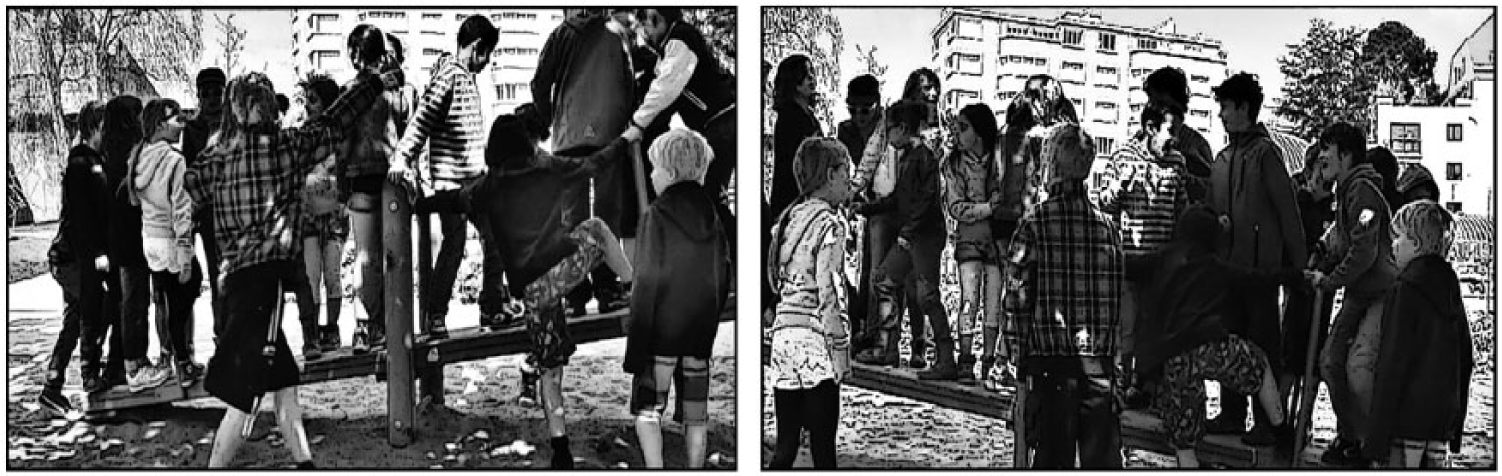
On the seesaw; two processed video stills by Swaantje Brill (2013, Universität Siegen).
After this short informal game, the children returned to the existing groups already described in the field protocols to follow the official exchange programme. The sequence presented also supports open encoding of the video material; students in the sample group negotiate membership for themselves spontaneously. As the students act performatively, it is likely that they already have experiences in negotiating moments of intercultural contact and creating encounters. These experiences are used as examples because the language barrier forces the participating students to return to these methods. The negotiations are clearly visible in other video clips of international student exchange situations, and are situationally oriented. Bodily performative productions are shown to be of great importance in games building acquaintance, as the children become friendly with each other. Other video sequences show body-related trials and explorations by the students. These are usually initiated with gossip and movement games. For example, in the exchanges between St Arnoult-Freudenberg and between St Philbert-Meerbusch, spontaneous balancing games occurred during the respective visits and return visits. The athletic contests usually involved the students in encounters outside of their usual groups. This was demonstrated in another video sequence Athletic Contest recorded on 19 April 2013, in which three girls from a visiting German group and a French boy group climb on top of three climbing bars of different heights in front of groups of watching students (Figure 2).
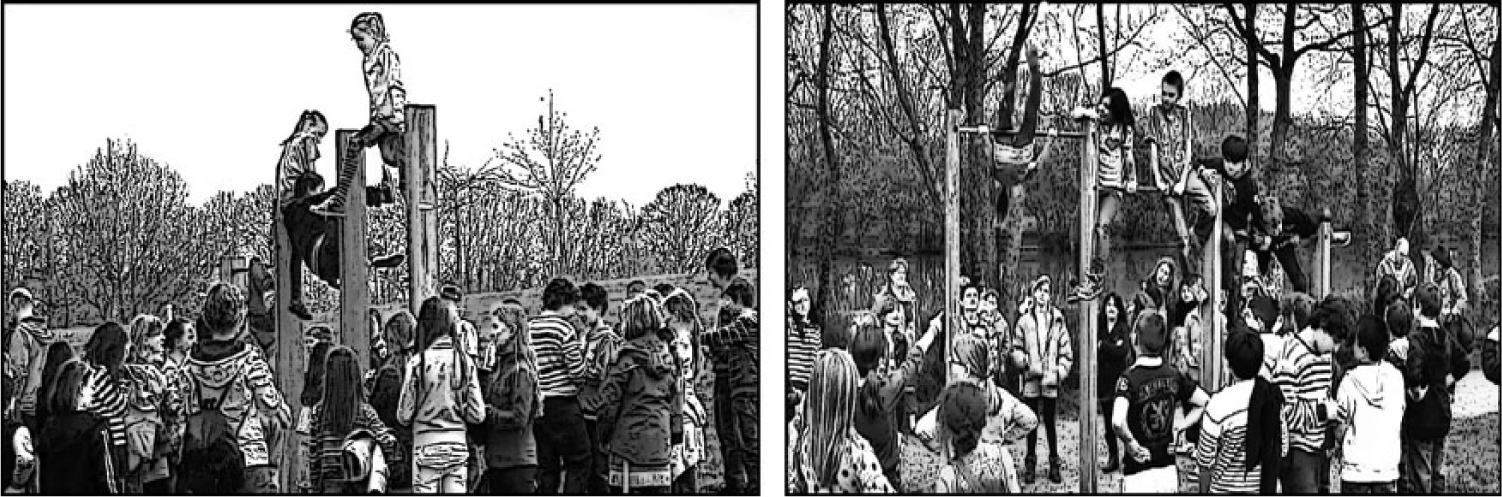
Sequence Athletic Contest; two processed video stills by Swaantje Brill (2013, Universität Siegen).
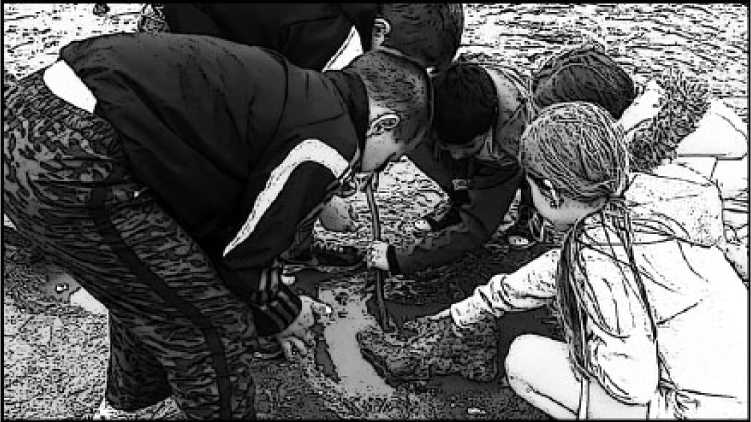
Children digging for crabs; processed video still by Swaantje Brill (2013, Universität Siegen).
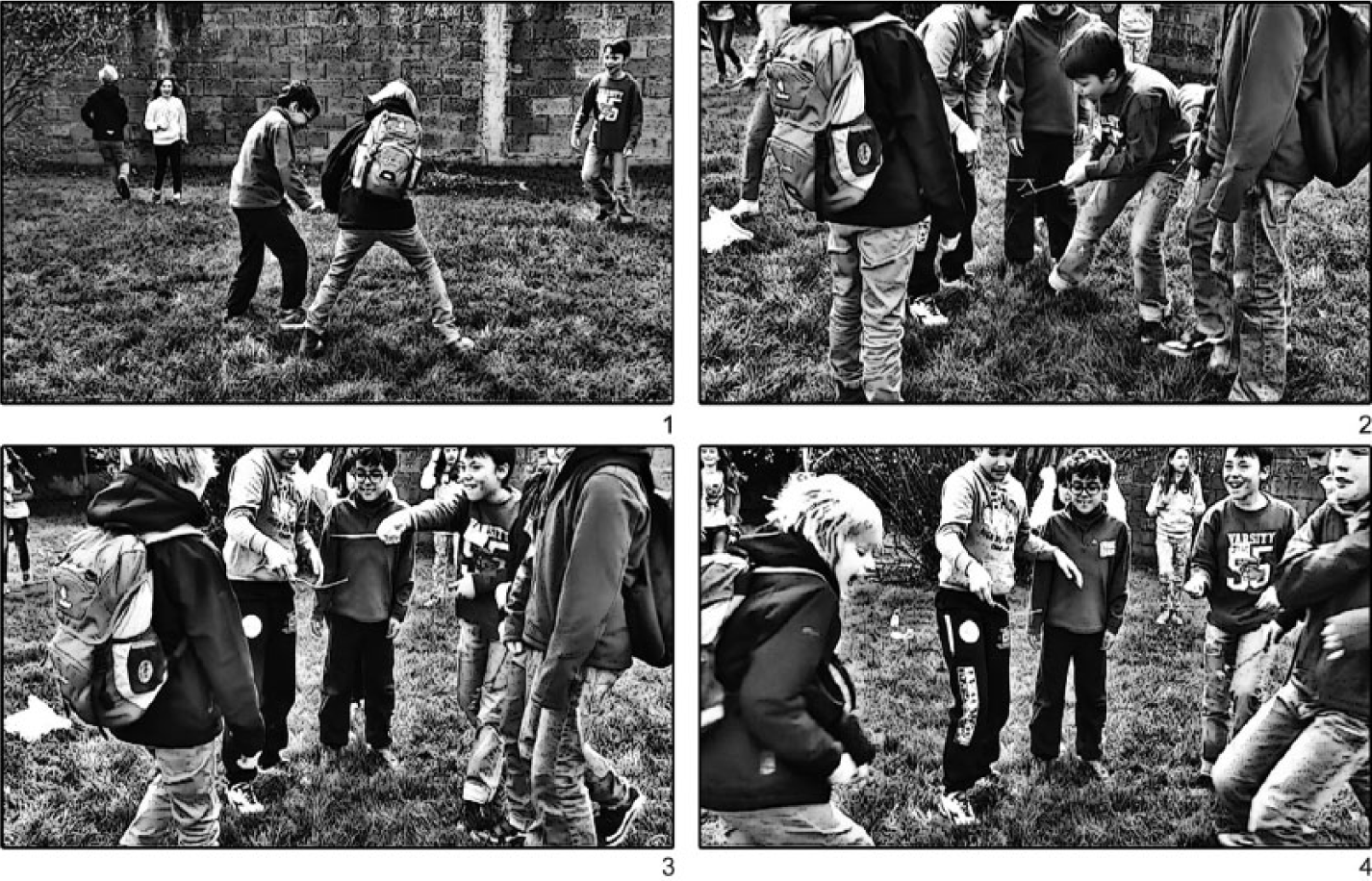
Children and the earthworm; four processed video stills by Julie Demeslay (2014, Université Paris XII).
In this example, the bars create a central point of public interest. Four children, who are climbing and using the bars in a kind of performance, draw the attention of the other students. The other students and teachers are mixed together in the group of observers, with no formal relational structures visible. Not everybody is looking at what is happening on the bars. Some students are talking to each other, some are taking pictures, and some are simply observing the scene. They have encircled the bars, opening a space with limited boundaries. Inside this space, a social event in the form of a sports show is taking place. One of the girls performs a gymnastic movement on the bar. The surrounding group acts like an audience, and the group members accept the leading role of the performers. The performed show creates performing experts and a public. The performance also assigns group-related membership to the spectators. In the constructed social group, all the children filmed in the sequence are admitted, and no difference is apparent between the French and German students. The bars, however, are reserved exclusively for the experts. The girl who is on the upper bar is obviously someone who is a practitioner and has achieved mastery over some gymnastic exercises. This gives her the right to perform on the pieces before others and to be admired. Another girl on the second bar, which is lower, tries to copy her movement. Imitational interactions take place and one could perhaps reference this as a vicarious learning process (Bandura, 1977). It is not, in fact, merely a simple imitation. The girls on the bars, who are watching the expert who is also a peer, are motivated to show their own skills and this reinforces their sense of empowerment. The processes are combined with actions: climbing on bars of different heights; and learning about the newly introduced gymnastic movements.
In the sequence presented, the girls led and performed gymnastic actions. The boys also tried to imitate them. However, they did not take centre stage, waiting for the girls to finish, and using the spaces the girls were not occupying. A short episode illustrates this observation. The interaction was situated on the second bar, with a girl and a boy as protagonists. The French boy is gently smiling at a girl who seems to be German. A kind of seduction process can be observed; this is suddenly ended when the girl hurts the boy for no obvious reason. There is also no visible reaction from the spectator group. However, this interaction was intended to be noticed by the observers. Thus, the contests on the bars also give an opportunity for the performance of situations that may be meaningful for the French–German group. Unfortunately, it is difficult to perceive what the children say, as only one sentence is easily discernible: ‘It’s my pen friend!’ The sentence is said when the German girl is performing the gymnastic movement. This signifies that the French boy rehearsing the gymnastic exercises finds himself identifying with the German girl, who acts in this moment as his mentor in gymnastics. A double identification takes place; on the one hand, an apprentice–expert relationship and on the other hand, a gender-related contact between a French boy and a German girl. This example shows the complexity of the interactions, which require many skills. Another interaction occurs later with a different French boy, who says: ‘This one is mine, it’s my pen friend!’, when talking about a German boy who is exercising on a bar. The German boy is not visibly interacting or doing anything special. It seems, rather, to be a way of expressing a link felt between the two boys, produced by bodily exercises and interactions. The French boys who are performing also speak to the group. They perform their relationship with the two German children in front of the group. At the level of body-related expressions, looking at and staying next to, are the main behaviours made visible. These behaviours signify interest and emotional motives that are proven in the video material through the use of eye contact and bodily interactions. Because of the language barrier, the students pay more attention to interactions in contests and games, thereby creating an atmosphere involving group-related negotiations. Passivity on the side of the spectators and activity on the side of the performers is evident. The developed game consists of an opposition between movement and immobility. Different relationships can be identified between the children on the bars, among the group gathering next to them, and within the spectator group as a whole.
The research team argued that, in this sequence, a place for the French–German group is symbolically created, and group-related meanings are embodied and enacted by the children. The girls share a situation in which group constellations have not yet formed and in which a space is open to them, in which they may perform acrobatic skills. Meanwhile, they unify the focus of attention of the larger student group, producing a shared reality. In the following video sequence, the other children felt encouraged to demonstrate their own skills. There was a small demonstration of rehearsed tricks, and performances were rewarded with applause from the other children. The activities created shared experiences and also developed into a competitive game. The athletic competitions, in particular, offered children the opportunity to avoid reliance on adults. Another example is the sequence, Breakdance Practice, in which the student demonstrates dancing in a gym and then small groups are encouraged to exercise with spontaneous dance moves. The dance movements are imitated quasi-automatically, with a high degree of interaction and communication.
Contrasting video footage of very formal planned situations, including a dance class, where the children were taught a traditional Breton dance, showed little interaction between the students. The formal setting reduces opportunities for competition between the children as no communication opportunities (Kaiser, 2004) arise within the student groups. The examples presented lead to the first open encoding of the video material. In the comparative analysis between the French–German research team, it was shown through the discussion of selected sequences that communicative approaches are increasingly possible in informal situations.
Animals as trigger for group interactions in the video sequences Crab Discovered and The Earthworm
Another theme revealed in several of the processed video sequences, involved children dealing extensively with natural objects or animals. These scenes occurred in informal situations and often reflected longer-term, revisited figuring-out processes. Particularly noteworthy was the sequence showing a walk in the Wadden Sea of Brittany, during which extensive movement elements and interactions take place. The video sequence Crab Discovered, from 17 April 2013, shows the larger French–German group of children divided into 12 smaller groups. The starting point for this scene is a ditch where the crab is found in a puddle.
In this example, the relationship between three boys can be observed. At the beginning of the video sequence, one of the boys remains passively to one side. It seems as though he has chosen the role of witness. The other two boys are the main protagonists in the scene. A German boy is in the role of discoverer. The French boy seems to find himself in a familiar situation. The German boy is the first to discover a crab but is afraid to touch it, and does not know how to catch it. The French boy speaks to him in French and tells him that he can pick up the crab because it is helpless when it is lying on its back. The German boy repeats the words the French boy has just said, enabling him time to prepare an interactive approach. Then he tries but fails, to touch the animal and so decides to use a wooden stick to move the animal. This requires a difficult movement and does not work either. Meanwhile, the French boy searches and finds a shell that he can use to carry the crab. Looking in another pool of water, the French boy identifies a second living and moving crab. He attracts the German boy’s attention by yelling and pointing to the animal with the hand in which he is holding the shell. It seems that he wants to leave, but the German boy is very excited by the situation. The German boy with a commanding tone, using his own language, asks the French boy to give him the shell. The second French boy observes the scene while the German boy attempts to seize the crab. Using a stick, the German boy succeeds in catching the animal. The French boy, who has performed the role of witness until this point, then leaves. He seems not to be interested anymore. This is likely to be because he is neither a protagonist in the scene nor able to interact with the German boy who is fascinated by the crab. However, he continues to wander about, without engaging in collaboration interaction with the others. The German boy then uses the crab, which he has finally grabbed with his hand to scare a group of girls. The three boys then join in mutual complicity laughing together. The laughter seems to emerge as a result of the shared gender-based collusion.
In the scene, the French boy, as the native, acted as a host, welcoming and giving insights to the German boy. He helped the German boy to discover the Wadden Sea, which is a familiar world to him. The French boy is interested in watching how the German boy copes with the situation. He initiates the German boy’s actions, by giving him clues so that he can meet his goals; i.e. catch a crab. The French boy acts as a teacher, educating the German boy in handling animals and artefacts. One can categorize this behaviour as a kind of gift (Mauss, 1990), denoting the creation of a relationship, as the German boy accepts the French boy’s help. It may also be a strategy to prevent conflicts of influence, as the French boy shows his power through his knowledge and leaves the power to act to the German boy. This strategy is not necessarily specific to intercultural learning, but links to a combination of social skills, that can be combined with adaptive intelligence to ensure peaceful cooperation.
The children observe the crab running sideways and share expertise about how to provoke it. The topic is addressed several times during the exchange week, including imitating the crab by running sideways. The situation has a content-based approach, but the priority is situational, body-related action. The video sequence Crab Discovered makes it clear that the students perform small experiments, aligning themselves with various groups to facilitate intercultural exchange. In this way, the children deal with the materiality of their environment (Dörpinghaus and Nießeler, 2012). This type of experiential learning is a theme also integrated in German primary school social science teaching. The learning activities of the children in the exchange programme can therefore be deepened with an integrative approach, combining the humanities and natural sciences. In addition, the spontaneous production and deduction processes undertaken by the children contribute to an understanding of the value of diversity and heterogeneity among the groups of children. Negotiations between the various groups are also shown in a second film sequence with an animal: The Earthworm, from 19 May 2014. While they are waiting a French boy and a German boy play with a stick. Both hold onto it whilst catching an earthworm. The German boy takes the stick from the French boy’s hand and plays with the earthworm. The French boy does not resist and watches the German boy with an expression of complicity and collusion. The French boy remains in an exterior position, not directly interacting with the scene. A second French boy enters the scene. He tries to take the stick from the hand of the resisting German, who then begins to jab at and crush the earthworm. In the end, he throws the animal away. Another German boy also enters the scene and pushes the French actor back, but he returns and stays at the periphery of the action. The main interaction is still between the German boy and the second passive French boy. A third German boy enters in the scene and takes the stick from the second German boy. He begins to play with the stick, and the first German boy begins to jab at the earthworm.
The second French boy fights to take the stick back. Meanwhile, a girl – who is observing the scene – says: ‘It’s too cruel!’ The first French boy responds to her by saying: ‘It’s you who is cruel!’ The spoken interaction is not in the foreground of the scene, which shows the children focusing on interaction with the object. What then occurs is that an object is thrown after the girl and she cries, but comes back to fight and resolve the conflict. The French boy does not pay much attention to her. He returns to his main interest, the exclusively boyish play with the earthworm. Meanwhile, the second French boy and the third German boy stop fighting for possession of the stick, and resolve to split it into two pieces. The group dynamic changes from opposition to cooperation. As Sennett (2014) points out, competition and cooperation cannot be separated. Shared rituals that save face on both sides can reinforce cooperation. Splitting the stick is a kind of sharing ritual that puts an end to the opposition between the boys. Together, they succeed in catching the earthworm and then throw it to the second German boy. Finally, all the boys laugh. This emotional expression underlines the group’s experience as broader than the previously observed dual interactions. The participating children created a shared group experience, finding a non-verbal and gender-related way to coalesce the French and German students.
Conclusions: children as actors in situations of binational encounter
The comparative analysis of the video sequences by the French–German research team passed through different stages of discussion. More individually pronounced arguments than interpretations influenced by national differences came to the forefront of discussion during the analysis process. Although no patterns of linear, nationally-bound arguments could be recognized, different institutional views regarding the scenes were expressed in the research discussions. 3 The video material described offers a praxeological approach to the space. The study also offers insights into the activities of the children that are dependent on space as well as the generation of spaces through the children’s activities; 4 in the examples described, the interactions in sporting contest and with animals provide hints on how social spaces are developed. They focus on how attraction and interest structure the spaces in which interactions occur, and how these are organized according to students’ movements and actions. The idea of an interactional space constituted by the way bodies are arranged together during and for interaction purposes can be observed (Goffman, 1968). This means there is a spatial structuration of the participants in the interaction (Goodwin and Goodwin, 2004). In particular in the video sequence, Athletic Contest, it was observed how a group emerges when individuals create a common space. A physical and a symbolic level can be identified in this sequence. Space is defined by the physical interactions and organized movements. It can also be interpreted as a stage, limited by the spectators who form a circle to watch the performance. This ability to organize a common space and to build a group with its own dynamics and meaningful interactions is linked to communicative skills. Communication is not merely the transmission of information (Quéré, 1991), but a united activity, which constructs the common perspective of a shared point of view on the basis of inferences and actions. This common perspective affords an opportunity to mould a common world of embodied and embedded significations. In the video material, sensitive interactions can be seen as ways of connecting each other with mutual expectations and intended communicative content. Body-related expressions do not seem to be used to compensate for the lack of verbal communication. The video material, perhaps in particular the sequence Crab Discovered, shows that the children in the sample use forms of body-related communication as a matter of course, combining them with different languages. The communicative exchange is processed through joint activity (Mead, 2006) based on symbolic sharing, which does not necessarily denote a specific meaning. In the space they have created the children come together, building a relationship with the world and others, and organizing mutual actions. These points are important considerations when exploring ways to incite and reinforce intercultural exchanges. The study demonstrates that formal approaches to intercultural education can benefit from a connection to practical knowledge that has already been gained in encounter situations.
In the video material, the interactions mainly comprise the children’s activities. The children in the small sample express desire, which encourages them to move and create a space in which movement can take place. Through these movements, the children can participate in what is happening and play a role as individuals. The interactive space incorporates rules, regulations, organization, and federation. It is an aesthetic state of social organization, which can be categorized as a stage. In the sequence Athletic Contest, for example, four children decide to climb the bars, using them for a performance to be shown to the public. This aesthetic state of social organization as a stage is based on a triad composed between the active protagonists, passive protagonists, and spectators as witnesses. The sequence Athletic Contest reveals that the children can be either on or off stage. They can act in the foreground or from the periphery. Changes in leadership related to the initiation of movements are also noticeable. These changes can be, in some sequences, a sign of a kind of politeness or civility. Thus, it can be observed that the leading children step back or aside, opening up space to others by moving to the periphery. This politeness is not a formal expression of cultural tradition but rather a way of taking others into account; in particular, their needs and desires. This is also apparent in the sequence with the crab. A student, playing the role of facilitator or initiator, performs on the periphery of the stage, facilitating others to experiment with a closer performative relationship with the animal involved, sometimes returning to the foreground to progress the action. These changes can also be linked to conflicts and competition. Some students, in the earthworm sequence, for example, are forced to leave the foreground because another one wishes to take over responsibility for the activity, and does not want to share the space. These oppositions did not give way to violence, even in cases where there was some level of confrontation, because, ultimately, the students accept stepping back. These changes in leadership and position are mostly negotiated through body-related expressions, namely by movement and tone of voice.
The children are experts at creating this type of social stage, on which interactions can happen, especially through games. The rules of these games are not necessarily widely known, and so must be negotiated within the groups. The intercultural situations experienced by the children promote ways to share their expertise. Thus, in the context of intercultural encounters, informal activities are important in enabling the students to experiment with their agency. These practices show that children are experts of interity or between-ness. Interity is a concept developed by Demorgon (2005), to emphasize an often unrecognized anthropological characteristic at the root of interaction and interculturality. Interity consists of the ability to contend with diversity and negotiate a common frame of reference and action, through what Demorgon calls pre-adaptive opposites. 5 The group dynamics which are described as ranging from opposition to cooperation, as shown in the Earthworm sequence, illustrate the theoretical point that students have the experience and ability to face conflicts, and to find adjustments to group dynamics without relying on imposed formal rules. Culture (Demorgon, 2004) is related to how human beings constantly adapt to their environment, trying to establish a long and stable relationship between the inner and outer world. Therefore, culture can be seen, at the same time, as closing and opening a system. It is based on human activities, which are continually involved in the production process. In this context, culture is understood to be a human construct, which depends on a specific context and a unique situation, resulting from both diachronic and synchronic processes. The diachronic processes connect the students with experiences based on their national cultural backgrounds, and the synchronic processes promote performative interactions, that spontaneously arise in bicultural encounters. The students in the sequences described find themselves involved in cultural productions that may represent expressions that are not necessarily nationally bound.
Pedagogical implications in reference to the French and German school system
The insights gained from the study point to the children’s existing and acquired horizons in the sphere of intercultural learning. The findings should sensitize teachers in primary schools to the importance of prior experiences in everyday life, and incorporate communication of this type of knowledge into their teaching plans (Prengel, 2011). Students negotiate the meaning of belonging, and embody an action-oriented performativity through games and productions in situations where there is intercultural contact (Wagner, 2010, 2014). They demonstrate different ways of getting to know one another and of formulating groups. In the small sample of 20 classes, it was apparent how spontaneous moments of intercultural communication are often associated with confusion or misunderstanding. The video sequence showing the crab exemplifies a group-related interpretation of such confusion. It also points to the possibility of continuing experiences of action-oriented engagement for students within formal school settings. In the video material, there are numerous concrete examples that invite reflection on intercultural encounters. For this reason, the material is being made available to the participating schools for follow-up. In addition, the video recordings created for the study will be treated not only as research data, but also as application-oriented training material for teachers. The video recordings show how student exchange programmes address the experiential nature of intercultural education in children’s everyday life. Primary school children are offered important informal, body-related group experiences, involving discussion (Montandon, 2010). As Ludwig Duncker and Corinna Kremling (2010) point out, this will help to prepare abstract and conceptual learning from participants. Video sequences indicate high levels of motivation for participating students and teachers, which can be seen as a reason for the long-term continuation of exchange activities in participating schools. In Germany, the results of the study are not only incorporated into teacher education, but also inform curricular design in order to implement school exchange programmes; not only as voluntary projects, but as an integrated component of school programmes and teaching methodology. During exchange activities, children’s ability to deal with cultural diversity and globalization are strengthened. The idea of inclusion can be supported in social science education by expanding the existing centre of gravity. Theoretically, this means the inclusion of structural changes and a discussion of structural exclusion, which has, in Germany, happened almost exclusively in reference to sociological discourse without recognition in the pedagogical field. Predominant German pedagogical thought denotes a near-sighted understanding of inclusion, according insufficient attention to the heterogeneity of the student body. Social science and its teaching as a discipline provide an opportunity for the development of inclusive, participatory educational strategies (Wagner, 2013).
By contrast, in French primary schools, citizenship-related education is very important and is taught through discussion and respect for formal and moral rules. Teachers do not use the anthropological capacity for interity. This approach gives way to a better understanding of abstract themes, as it relates to perceptible and sensitive experiences. Instead of appealing to abstraction and verbal interactions, teaching staff prefer to take body-related expressions and concrete situations of negotiation into account. As suggested in this paper, the implementation and reviewing of student exchange programmes portrays the value of cultural diversity and pluralism (Krüger-Potratz, 2011). The participation of children in such programmes can, and should be, formulated within the framework of international comparative studies; thus, not only contributing to the addition of intercultural elements to social studies instruction (Sachunterricht in Germany), but also to the development of inclusive strategies and adequate didactic teaching.
Footnotes
Funding
This research received funding from Franco-German Youth Office.