



Abstract
This paper briefly reviews theories of embodiment and then provides an example from our recent work on how we use video in our comparative studies of preschools to highlight embodied and implicit cultural pedagogies. The example we present focuses on how Japanese preschool teachers use the Japanese cultural practice of mimamoru (teaching by watching and waiting) as an embodied technique that combines gaze, location, posture, and touch. We demonstrate how a microanalysis of video footage, when used in conjunction with ethnographic interviews, can draw attention to culturally patterned embodied practices that may otherwise be difficult to perceive.
Introduction
There is a growing interest in theorizing and studying the body and embodiment across a range of disciplines, and video as a medium of communication is increasingly a part of everyday life. Making, editing, storing, and circulating video has become more economical in recent years, and the technology is increasingly widespread. In modern life, we are often filmed, knowingly or unknowingly, and people commonly document their own and others’ lives using the video feature on their mobile phones, and post these videos online. These two phenomena inform the present research, which uses video to study teaching as an embodied practice.
This paper presents a short review of some theories of embodiment followed by an example from our recent work on how we use video in our comparative studies of preschools to highlight embodied and implicit cultural pedagogies. The example is an ethnographically-informed microanalysis of a scene in a video of a Japanese preschool teacher’s use of body language as a pedagogical technique, including gaze, facial expressions, posture, and location, to deal with an argument between her students. The example will demonstrate how the microanalysis of video footage, when used in conjunction with ethnographic interviews, can draw attention to culturally patterned embodied practices that may otherwise be difficult to perceive.
Body language as a pedagogical technique
Because teaching is typically construed as an activity of the mind rather than the body, studies of the embodied aspects of teaching make up only a small proportion of the educational research corpus (Hwang and Roth, 2011). During the process of teacher development, as in research on teaching, attention is often placed primarily on the verbal and written aspects of teaching practice, as if teaching can only be made real, teachable, assessable, and researchable when it is represented in words or texts, such as performance standards, curriculum guidelines, textbooks, lesson plans, reflective journals, and interview transcripts.
This is not a problem unique to the study of teaching. In domains such as dancing, martial arts, and football, which are, by definition, physical, studies of embodied practice are not uncommon. However, in fields which are assumed to be more intellectual/cognitive than physical/embodied, such as education, bodily practices are often neglected. Recent scholarship in sociology, anthropology, and philosophy calls for a shift towards a more bodily focus and increased attention on the use of body language by practitioners in such fields as medicine (Heath and Hindmarsh, 2002), piloting (Hutchins and Klausen, 1998), and conducting business (Norris, 2006).
The new bodily focus in recent scholarship can be located within a larger intellectual trend turning away from the mind and words towards materiality. This shift has taken several forms: ‘post-human’ work on the interface between people and machines and people and animals (Harroway, 1985; 2003); new-materialist philosophy (Barad, 2007); and ‘thing theory’ (Miller, 2005). What these theories share is a decentring of the self-conscious, thinking, talking, and writing individual human subject.
Work on embodied teaching can include not just the literal use of the body as a pedagogical tool (as, for example, in studies of how teachers use facial expressions and gestures to clarify mathematics principles to students), but also how teachers’ bodies extend to the materiality of the classroom (as in studies of how they use manipulatives to teach elementary arithmetic or write on the blackboard and then point at figures in equations in secondary mathematics classes) (Alibali and Nathan, 2007).
Some scholars use Deleuze’s concept of ‘assemblages’ (Boldt and Valente, 2014; De Frietas, 2013) and Latour’s ‘actor networks’ (Hayashi and Tobin, 2015) to visualize teaching as emerging out of the interaction of minds, bodies, things, ideas, and contexts. These post-human, new materialist, and networked theories of embodiment call into question the mind/body binary and suggest that we need not choose between viewing teaching as an activity that is either conscious and verbal or tacit and embodied.
Teachers, like practitioners in other fields, often find it difficult to describe how and why they use their bodies in certain ways to achieve certain effects. These embodied practices are not mindless but usually tacit, non-verbalized, and not easily made conscious. As Nick Crossley (2007) writes:
From the point of view of consciousness, culturally appropriate bodily action and coordination ‘just happens’ and falls below the threshold of perception and reflective knowledge. . . . In action my embodiment is largely absent from experience. I do bodily things and my being consists in these bodily doings but both consciousness and action are directed at the world in which I am acting. I notice my effects upon the world but am not conscious of what I do in order to generate them. . . . And for the world to be perceived by me it is necessary that my body, as a site of experience, sinks into the background and does not become the object of its own experience. (83–84)
This presents a practical problem for research on teaching. Most such research focuses on the planned, verbal, and reflective aspects of teaching because these are the most accessible to researchers. Aspects of teaching that are performed without planning or conscious reflection are difficult for teachers, and therefore also for researchers, to access.
As Nick Crossley (2007) suggests, perhaps the most useful construct for studying embodied aspects of pedagogical practice can be found in Marcel Mauss’s (1934) lecture, ‘Techniques of the body’. Crossley (2007) writes:
‘The body’ and ‘embodiment’, despite their concrete connotation, are very vague, broad and abstract concepts that do not define a researchable object. ‘Body techniques’, by contrast, does. More importantly, it effectively translates ‘embodiment’ into a researchable format. (86–87)
The word ‘technique’ in Mauss’s concept of ‘techniques of the body’ suggests that a teacher’s bodily movements are not merely physical and natural but also mental and acquired. As teachers develop in their practice, moving from preparatory programmes to their first years in the classroom, they acquire not only content and pedagogical knowledge, but also bodily techniques. As Jane White (1989) writes in her analysis of student teaching in the US:
Much of the knowledge acquired at the very beginning of student teaching is physical and imitative—eye gaze, posture, pitch of voice, intonation, and has to do with how to talk as a teacher. Much of what is learned has to do with space and time: learning where to stand, learning how to pace and sequence questions, learning what to do when a child gives a wrong answer. . . . The student teachers physically imitate the posture, the voice tones, the ‘dirty looks’ and the ways their [mentor] teachers use space to establish a commanding presence. (193)
Mauss’s approach provides a conceptual framework for explaining certain aspects of teaching. For example, it can be surmised that new teachers may be more physically awkward (and, not coincidentally, generally less effective) than experienced teachers, because it takes time to internalize and master a repertoire of bodily techniques and to know which of these will be most effective in a given teaching situation.
Techniques of the body in comparative/international research
The concept of techniques of the body is especially useful for conducting comparative/international educational research. As Mauss (1973) suggests, such techniques are not idiosyncratic but are shared by members of a profession, class, and culture and ‘vary between societies, educations, proprieties and fashions, prestiges (101). Bourdieu (2000) makes a parallel argument for bodily ‘habitus’:
Social agents are endowed with habitus, inscribed in their bodies by past experiences. These systems of schemes of perception, appreciation and action enable them to perform acts of practical knowledge, based on the identification and recognition of conditional, conventional stimuli to which they are predisposed to react; and, without any explicit definition of ends or rational calculation of means, to generate appropriate and endlessly renewed strategies, but within the limits of the structural constraints of which they are the product and which define them. (138)
One implication of these theories is that the techniques of the body employed by Japanese preschool teachers may be characteristic not only of their gender and age but also their profession and culture. Experienced Japanese preschool teachers have idiosyncratic habits of using their bodies, but they also share with their peers a bodily ‘habitus’ that makes them more like one another than like non-teachers, primary and secondary teachers, less experienced preschool teachers, and preschool teachers in other countries. Studies of embodied aspects of teaching that have a comparative/international perspective can help to denaturalize and defamiliarize bodily practices that are invisible, because they are so often taken for granted in most domestic studies.
Strategies for using video to study embodied cultural practice
Tobin et al.’s (1989) Preschool in Three Cultures, and Tobin et al.’s (2009) Preschool in Three Cultures Revisited both employ the same method: ‘video-cued multivocal ethnography’. The method involves the video recording of typical days in preschools, and these videos are then used as interviewing cues with teachers, directors, and early childhood education experts to identify cultural beliefs and practices.
The new research builds on and departs from this video-cued interviewing research method. These two Pre Schools in Three Cultures ‘PSin3C’ books identify and present the cultural logic behind common pedagogical practices based on video-cued interviews with teachers. However, the previous books did not ask or answer the question that is central to the new book by Hayashi and Tobin (2015): How do Japanese teachers implement cultural practices? It is suggested that Japanese teaching strategies require the deployment of a repertoire of culturally and professionally characteristic bodily techniques. This new work changes the emphasis from what teachers believe to what they do.
The forthcoming book by Hayashi and Tobin, Teaching Embodied: Japanese Preschool Teaching as Cultural Practice (2015) introduces several innovative visual methods that can aid in the understanding of tacit and embodied aspects of teaching. One of these methods is to show experienced teachers a video of themselves teaching ten years earlier, and use this video as a cue for them to reflect on how their body language and physical presence in the classroom has changed over time.
Another strategy employed in the new book is to perform microanalyses of key scenes from the videos by systematically recentring our attention (Hayashi and Tobin, 2012). The majority of the shots in the videos made for the ‘PSin3C’ projects were close-up to medium-range shots, designed to draw the viewer’s attention to the faces and bodies of the teachers and children assumed to be each scene’s protagonists.
However, one day several years ago one of the key informants, Director Kumagai of Senzan Kindergarten in Kyoto, was shown a scene of a group of four-year-old girls fighting over a teddy bear, she commented, ‘Look, there is a gyarari [gallery]. Fights are important for the children who are not fighting. Teachers should pay attention to them, and consider what they are learning’.
This comment was revelatory. The teddy bear fight scene had been viewed hundreds of times without attending to the children on the periphery of the scene – the ‘gallery’ of spectators who were, in fact, not merely passive bystanders but also important participants in the argument in their own right, were learning things by watching and contributing to the resolutions of these disputes by providing emotional support and what the Japanese informants call seken no me [the eyes of society]. This moment is described in Hayashi and Tobin’s (2012) paper in Visual Anthropology Review:
Director Kumagai’s comment started us down a path that led us to come to see a limitation in the Preschool in Three Cultures’ videos and in the analysis of these videos presented in the book, a limitation based on a literally narrow perspective that centers attention on individual protagonists in the fights and leaves on the edges of our vision and attention other people participating. (p. 17)
This line of thought led us to a reframing and recentring of attention by using video editing software to move children on the periphery of the shot to the centre of the frame; such refocusing can produce new meanings.
A third new method employed in the new study is to take a key emic pedagogical concept that was uncovered by the video-cued interviews in the ‘PSin3C’ books and perform microanalyses of certain scenes to illustrate how teachers use their bodies to enact this pedagogical concept. The following section of this report will provide a demonstration of how this third method works. The Japanese pedagogical practice of mimamoru, which involves holding back as much as possible from intervening in children’s fights and other struggles, was explained by Japanese preschool teachers, based on video-cued interviews. Still images from one of the videos will then be used to illustrate how a Japanese preschool teacher ‘does’ mimamoru by employing techniques of the body.
In the new book, close readings of video recordings of typical days in three Japanese preschools are presented. Two of these preschools, Komatsudani and Madoka, were the focal Japanese preschools in ‘PSin3C’. The third is a preschool classroom in Meisei Gakuen, a private school for the deaf in Tokyo that was the focal school for another study the authors are conducting (‘Deaf Kindergartens in Three Countries’). In the new book, as in this paper, Meisei is viewed not as a deaf school but as a Japanese preschool whose pedagogical beliefs and practices are much the same as in other Japanese preschools, apart from the fact that the children and teachers sign rather than speak.
Mimamoru as cultural practice
A key finding from the Preschool in Three Cultures studies was a specific hesitancy, on the part of Japanese preschool teachers compared to their counterparts in the United States and China, to intervene in children’s disputes. For example, a scene in the original Preschool in Three Cultures study portrays a four-year-old boy, Hiroki, who steps on his classmate Satoshi’s hand, making him cry. A classmate, Midori, tells the teacher, Fukui-sensei, what Hiroki has done, and Fukui-sensei tells her, ‘If you are concerned, you do something about it’. Midori then leads Satoshi away from Hiroki and advises him to avoid playing with Hiroki in the future. When asked later why she did not intervene, Fukui-sensei explained that by holding back she provided not only the fighting children but also other children in the class opportunities to experience emotions and deal with the kind of interpersonal conflict they may not often experience at home.
In Preschool in Three Cultures Revisited, there is a scene in which three girls pull and tug on a teddy bear until they fall into a struggling heap on the floor. During this struggle, the only visible and audible reaction from the classroom teacher, Morita-sensei, is to call out from across the room, ‘Kora, Kora’ (which can be translated as something like ‘Hey there!’). When asked about this scene, Morita-sensei explained that this is typical of her approach – watching children and letting them know that they are being watched, but otherwise avoiding intervention.
To describe this strategy of supporting children’s social–emotional development by holding back and watching without intervening, Morita-sensei used the term mimamoru. ‘Mi’ literally means ‘to watch’ and ‘mamoru’ means ‘to guard’. Together, when used in the context of preschool, the words describe a Japanese pedagogical strategy, which can be translated as ‘teaching by watching and waiting’. This strategy is a component of a larger pedagogical approach termed ‘machi no hoiku’ (‘caring for children by waiting’).
Japanese educators explain that the underlying rationale behind non-intervention is to give both children directly involved in a fight as well as other children who may be observing it the opportunity to handle problems on their own, with minimum assistance from teachers or other adults (Hayashi et al., 2009: 44; Hayashi and Tobin, 2011: 160–161).
This explanation was given by a range of Japanese early childhood educators in both of the Preschool in Three Cultures studies as well as the new study. For example, Fukui-sensei, the focal Japanese teacher in the first ‘PSin3C’ study, explained that when adults intervene too quickly or aggressively it gives young children the misguided message that they are not responsible for controlling their own behaviour, and that the class as a community is not able to handle disputes without the intervention of an adult.
Embodied techniques of Mimamoru
When Japanese teachers do mimamoru, they use their body as their principal instrument of communication. Mimamoru is not merely or primarily a cultural belief held by Japanese preschool teachers but also an embodied performance of attention and inattention in space. A teacher’s strategic use of gaze, facial expression, posture, and location to ‘do’ mimamoru can be seen clearly in a scene filmed of a tug of war on the Meisei playground.
In the Meisei video there is a scene of children playing tug of war on the Meisei playground.
Tug of war (tsunahiki) is a common playground activity in Japanese preschools and elementary schools. In the scene, a cluster of five children holds one end of a rope, and the assistant teacher, Kurihara-sensei, stands alone on the other side, holding the other end. The head teacher, Ikeda-sensei, stands in the middle, ready to announce the beginning of the contest. A four-year-old girl, Mika, approaches Kurihara-sensei, takes the end of the rope from her, throws it on the ground, and stomps away. The following interchange ensues:
It’s not fair. My team will lose. The other team has more players on their side.
(Satoshi, a five-year-old boy holding on to the other end of the rope, comes over to Mika and vigorously disagrees with her assessment).
But your team has Kurihara-sensei. She is big and strong. And my team has many girls, who are weak.
This argument continues for five minutes or so, and another four-year-old girl, Chika, approaches to say something to Mika. Satoshi pushes her away and angrily tells her not to interrupt. Chika, with tears in her eyes, walks away, and then signs, ‘I’m sad’. Towards the end of Mika and Satoshi’s heated discussion, Ikeda-sensei sits on a bench, ten metres away from the argument. Chika eventually comes over and stands near her. Ikeda-sensei explains to Chika that Satoshi has a tendency to dominate conversations. Finally, the tug of war begins and, as Satoshi predicted, Kurihara-sensei’s team wins. Mika and Satoshi then discuss what has transpired.
Now how do you feel?
I see now that you are right that the red team sometimes wins and I shouldn’t quit.
I am sorry.
I am sorry.
After the children apologise to each other, Satoshi says to Mika, ‘I did a bad thing to Chika, and I need to go talk to her’. Instead of apologising, however, he tells Chika that she should not have interrupted. Chika responds by explaining that she had only wanted to say ‘one little thing’ and that he had hurt her feelings. Ikeda-sensei, sitting just a few feet away, waits and watches, nodding in approval as Chika makes her point. At no point in the ten-minute scene does either of the two teachers intervene in the children’s argument.
Teachers can moderate the degree to which they are present to children by adjusting their location and the attitude of their body in the classroom; an individual’s posture can communicate attention, concern, casualness, or distraction. A skilled teacher strategically performs various ‘levels’ of paying attention. If children seem too aware of and dependent on her, the teacher can adjust her gaze and posture to appear too busy with a task to pay careful attention to them. In contrast, when a teacher senses that children are about to spin out of control, she can adjust her appearance to seem to be paying more attention. In addition to their gaze, teachers also use posture – head tilting, touching, and other bodily adjustments – to signal different levels of attention/inattention.
The teachers’ pedagogical approach in the scene described above can be analysed by focusing on each category of bodily technique in turn.
Gaze
At the beginning of the tug of war dispute, Ikeda-sensei stands several metres away from Mika and Satoshi, looking directly at them. Her only intervention (other than her fixed gaze) comes at a point when their discussion seems to be slowing down – she says to them, ‘Keep talking’. Once Mika and Satoshi are again fully engaged in their argument, Ikeda-sensei turns her face and looks away, as if to communicate that she is not available to mediate the dispute and that they are on their own (Figure 1).
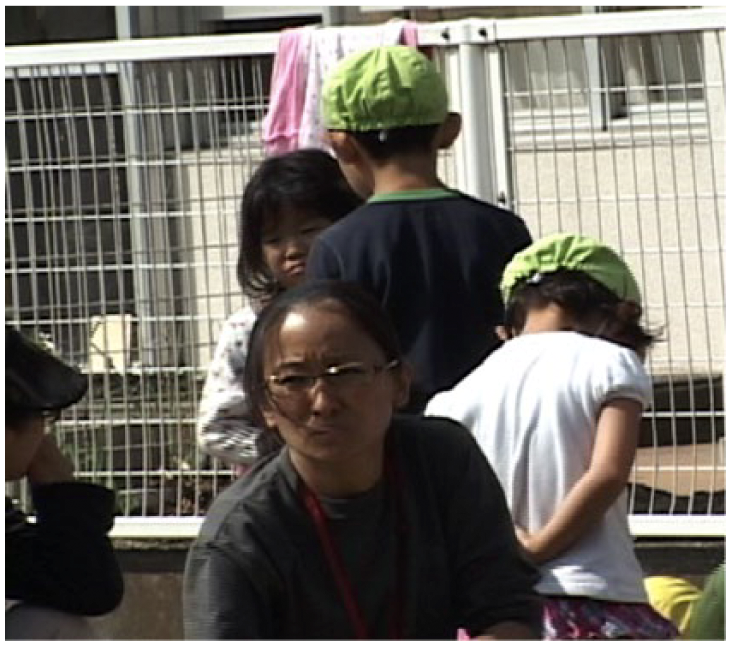
Ikeda-sensei turns away from the arguing children.
As Mika and Satoshi continue arguing, Ikeda-sensei moves to a bench to chat with Chika, who is sulking after being pushed away by Satoshi. During her long conversation with Chika, Ikeda-sensei alternates between making eye contact with Chika and turning away to watch the ongoing discussion between Mika and Satoshi (Figure 2). This allows her both to check in to make sure that the negotiation is continuing and to give Mika and Satoshi a reminder that although she is no longer standing near them, she is still aware of what is going on.
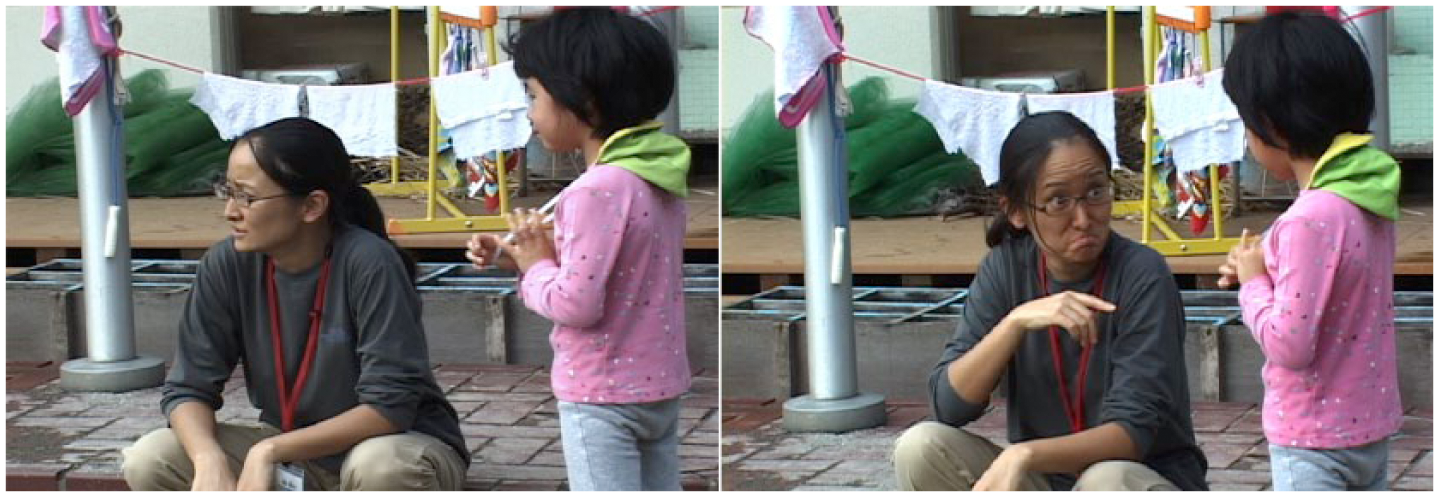
Ikeda-sensei turning her attention back and forth.
Space and location
In a follow-up interview, when Ikeda-sensei was shown the tug of war scene and asked why she did not intervene in Mika and Satoshi’s argument, she replied in Japanese Sign Language (JSL) (figure 3):
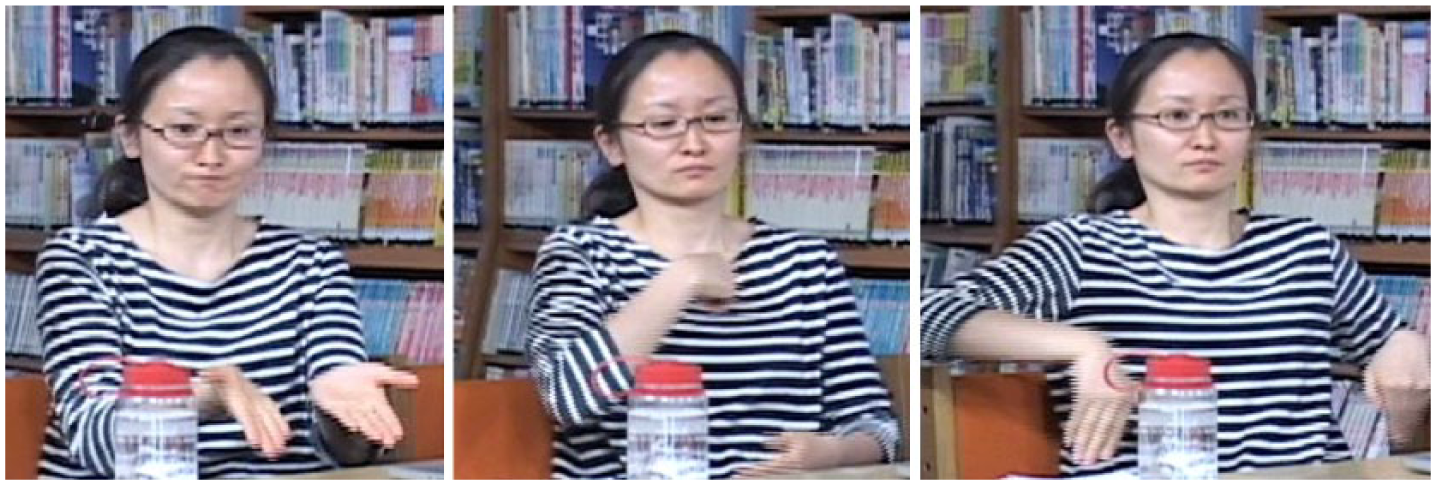
‘You handle it’. ‘I am staying out of it.
Our JSL interpreter translated these signs into Japanese as the single word ‘mimamoru’. When a follow-up question was asked, ‘You call this approach mimamoru?’ Ikeda responded, ‘I don’t know how to say it other than maybe [repeating the same series of signs]’, which can be literally translated as ‘It’s yours. I am on the other side of the wall’.
Whether Ikeda’s signs here are translated as mimamoru or as ‘Handle yourself. I am staying over here’, Ikeda’s JSL explanation provides added insight into the logic and functioning of Japanese preschool teachers’ non-intervention strategy. In Ikeda’s signed explanation, for example, there is no allusion to ‘seeing’ or ‘guarding’ as there is in the spoken and written version of mimamoru. Ikeda instead emphasized a spatial relationship, a dramatic ‘walling off’ and distancing between herself and the fighting children – a location she chooses to occupy, behind a metaphoric barrier, which precludes her stepping in to intervene and compels the children to deal with the situation themselves. It could be argued that a sense of spatial remove is also subtly present in the written and spoken term; the second part of the word, ‘mamoru’ (‘to guard’), implies watching and protecting from a distance. However, this spatial remove is much more explicit in the signed version of the term than the verbal one.
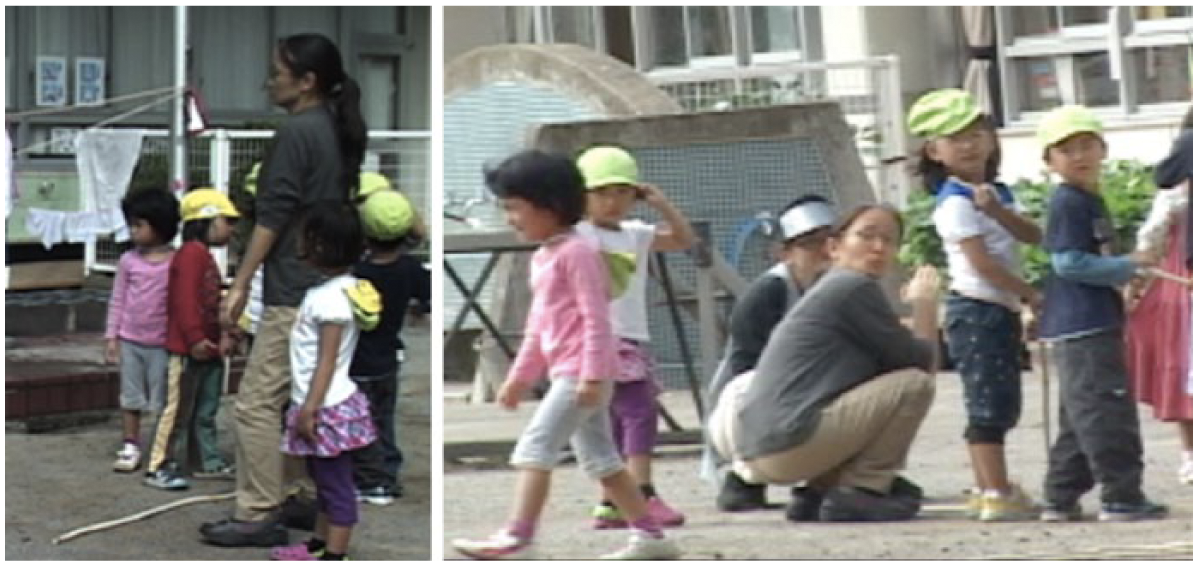
Throughout this interaction at Meisei, Ikeda-sensei adjusts her distance from the fighting children making herself alternately more and less present (Figure 4).
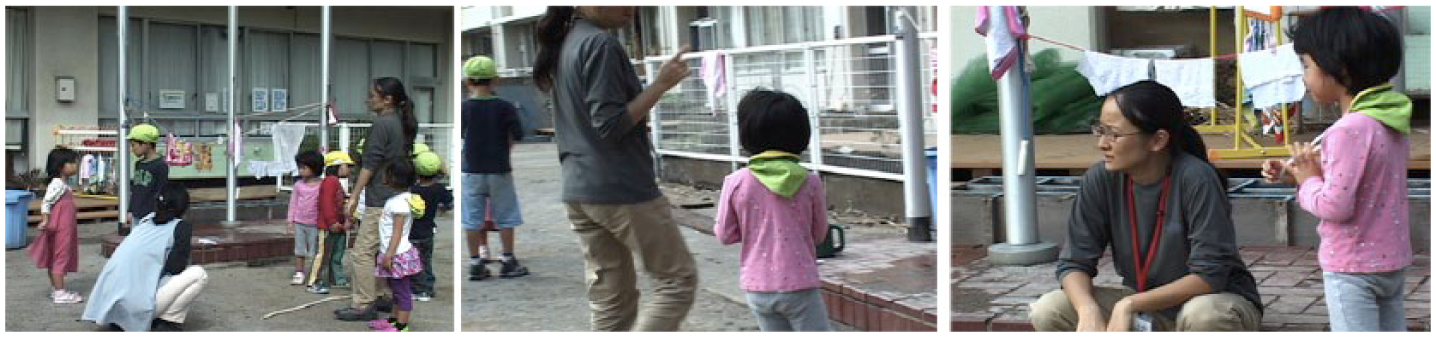
Ikeda-sensei watches the dispute from nearby, changes location, and then watches the dispute from afar.
Posture
At times during this scene, Ikeda-sensei and her assistant teacher, Kurihara-sensei, are seen squatting amongst the tug of war participants, a posture that suggests willingness to wait for as long as it may take for Mika and Satoshi to settle their disagreement. In the middle of argument, Ikeda-sensei shifts from watching while standing, to squatting, to sitting on a low step. Her squatting position, like Kurihara’s, indicates to the children that she does not plan to intervene and is prepared for the interaction to continue for some time (Figures 5 and 6).
Ikeda standing and squatting.
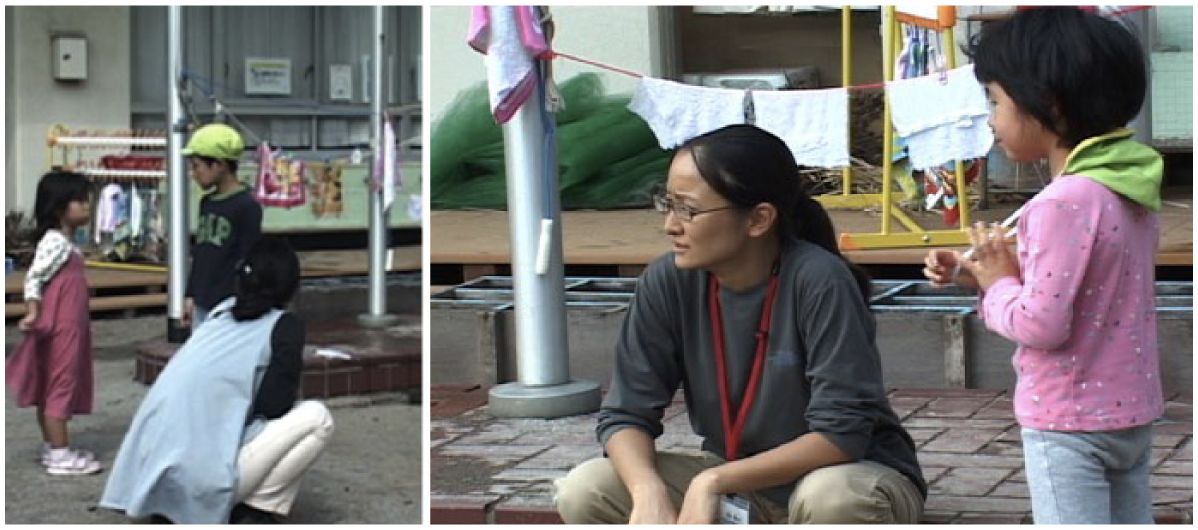
Kurihara squatting. Ikeda sitting on a low step.
Touch
Ikeda uses posture, location, and touch to provide children with the support they need to persevere throughout this long, emotion-filled negotiation. She did not intervene during the fighting among the children, but she squatted close to the children, alongside Chika, who drew moral support from stroking her teacher’s hair throughout the argument (Figure 7). This suggests that touch in preschool pedagogy can take the form not only of a teacher touching a child to offer support but that allowing touch to be initiated by the child is also seen as an accepted means of reassurance.
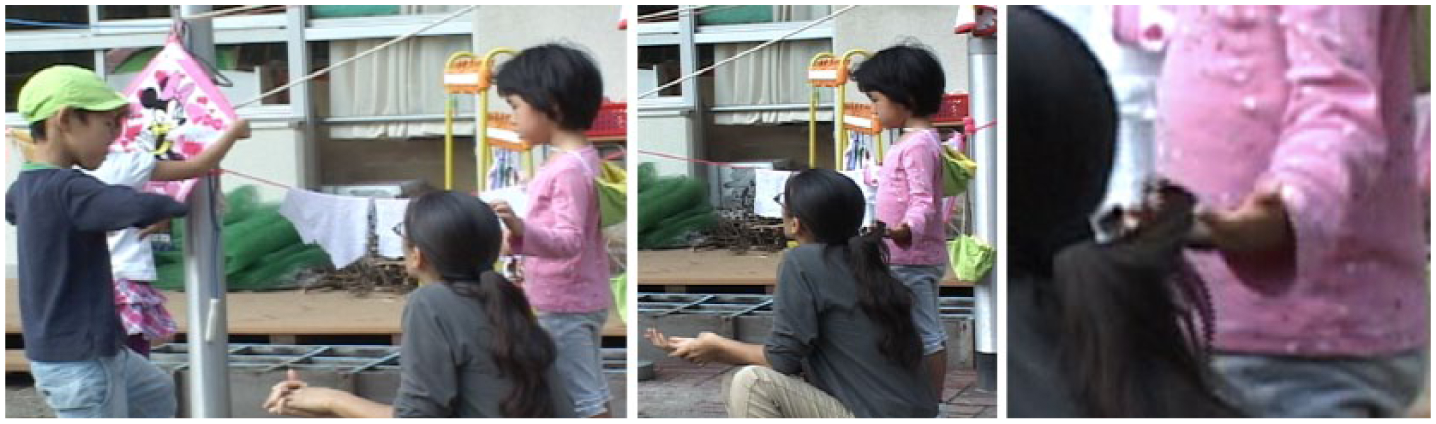
Chika getting reassurance from stroking Ikeda-sensei’s hair.
Conclusion
There are many methods for analysing videos of teaching. This paper has not considered approaches such as a visual version of conversation analysis (e.g. Charles Goodwin’s (2000) ‘Action and embodiment within situated human interaction’) or quantitative approaches based on coding large video archives of teaching behaviours. The approach in this paper follows the ethnographic tradition of thick description of an event that is considered culturally representative by an anthropologist (such as Clifford Geertz’s (1973) ‘thick description’ of a Balinese cock fight). The main difference is that here video is used to focus more on techniques of the body rather than a linguistic analysis.
It should also be pointed out that while here video is used as the primary research instrument, these analyses combine the description of bodily techniques with post-hoc verbal reflections of teachers and directors. The microanalysis of Ikeda’s body language in the tug of war scene could not have been performed without first having interviewed her and other Japanese teachers.
Teachers often have difficulty providing detailed comments about how they use their bodies in the classroom, but they can usually comment more insightfully on the larger meanings of recorded scenes, and on their intentionality. The explanations for their actions they provide after the fact, when they are shown a video and interviewed, should not be assumed to have guided their actions at the time. These post-hoc explanations, however, illustrate the context for their actions, and they alert us to the types of bodily techniques that may be observed.
If, as Ikeda and other Japanese preschool teachers suggest, their pedagogical response to children’s arguments is guided by their implicit belief in the value of mimamoru – a Japanese emic concept that can be translated into English as minimal intervention informed by careful observation – this begs the question of how they go about it and with what techniques of the body. This is a question that can be addressed, as in this paper, with microanalysis guided by cultural insights.
Footnotes
Funding
The authors would like to acknowledge the support of the Spencer Foundation, who funded both the Preschool in Three Cultures Revisited and the Deaf Kindergarten in Three Countries studies.