



Abstract
Educational progress and advancement is essential to the social and economical growth in Nepal. With 2015 as the goal date for the Dakar Framework for Action, identification of methods to improve student outcomes is fundamental to this goal. Assessing student learning behaviors in order to strengthen and/or remediate a student’s approach to learning facilitates academic achievement. The Learning Behaviors Scale (LBS) provides a behaviorally based assessment instrument for exploring students’ behaviors in the classroom. This study investigated the factor structure, multidimensional structure, and item endorsement of the LBS for a sample of 223 school-aged Nepalese students. A four-factor structure was revealed for this population. The four factors represent: task approach; emotional negativity/sojho; task engagement/thiken; and self-control. In addition, two dimensions of learning behaviors emerge. These represent task approach and level of engagement. Finally, a comparative analysis of the data identified similarities between the US sample and the Nepalese sample. The results of this study indicate a pattern of learning behaviors, as identified by the LBS, which is similar across the two cultures.
Introduction
Nepal is one of the poorest countries in the world. Nepalese children face a lifetime of hardship that includes severe economic poverty, discriminatory social practices, marked gender inequities, poor nutrition, restricted access to health care, limited employment opportunities, and a socioeconomic infrastructure that offers few opportunities to make life-changing choices (DeGroot, 2007; Neuman et al., 2008; Panthe and Hinchliffe, 2001). Like many developing countries, Nepalese government officials herald education as a critical tool for overcoming adversities and empowering children to become contributing members of society. For example, Nepal’s National Curriculum Framework for School Education holds education as the “fundamental right of all people and an investment for economic, social and political advancement” (Ministry of Education and Sports, 2005: 1). From this perspective, education of a single child becomes an investment in the country’s economic progress and position in the global knowledge economy (Carney, 2011; Carr-Hill et al., 2014).
Education and reform in Nepal: a brief summary 1
Efforts to reform Nepal’s educational system began in the early 1950s with the overthrow of the Rana regime in which education was considered to be an aristocracy-only privilege. During the 1960s, the government established several major collaborative efforts, all charged with promoting educational reform. In the 1970s, the concept of education as a fundamental right for all citizens became an underlying force in reform efforts. Coupled with this was the idea that education could serve as a means to address the needs of society and promote national development (DeGroot, 2007). The 1980s saw an increased focus on expanding educational opportunities to girls and disadvantaged children (Ministry of Education and Sports, 2007). In the early 1990s, the formal adoption of a democratic, multiparty system of government and the Education for All declaration of the United Nations, led to a host of educational reform initiatives geared to opening classroom doors to all Nepal’s children. Guided by the vision of inclusion, democracy and material progress, efforts to promote universal education, at least at the primary level, gained momentum (Ministry of Education and Sports, 2006). Two of these initiatives, the Basic and Primary Education Project (BPEP) and the Primary Education Development Project (PEDP) provided important support for a range of reform activities. For example, efforts were made to upgrade the curriculum and get textbooks and instructional materials into the schools. Classrooms and school buildings were targeted for structural improvements. Training programs for teachers and schools managers were developed. Primary education was made free and scholarship programs were implemented for higher education. Gender disparities were recognized and addressed by requiring at least one female teacher in each school (Khaniya and Williams, 2004; Shiwakiot, 2004). In 2001, the Amendment to the Education Act began the process of transferring the administration of government schools to local communities. Subsequently, school management committees (SMCs) comprised of parents, local stakeholders, and district education representatives expanded educational opportunities to children living in even the most rural and mountainous areas of the country (Carney, 2005; Carney et al., 2007).
Yet despite these reform efforts, inequalities in educational outcomes and employment opportunities continued, with discrimination occurring by caste, gender, ethnicity, and residence (rural/urban divides) (Pherali and Garratt, 2014; Shields and Rappleye, 2008a). In 1996, the declaration of a “people’s war” by the Maoists Party brought about 10 years of violent, civil unrest and longstanding social inequality over exclusionary educational policies and practice (Murshed and Gates, 2005). For example, the drive toward a shared national identity favored those who came from upper-caste groups by calling for instruction to be only in Nepalese (Pherali and Garrett, 2014). However, children from more rural, ethnic communities, whose primary language was grounded in the local community, became marginalized (Yadava, 2007). The Comprehensive Peace Accord (2006) brought an official end to this war but the social inequalities and political tensions continued and remain a significant part of educational reform in Nepal (Pherali, 2012; Shields and Rappleye, 2008b).
Current reform efforts
Much is being said about educational reform in “post-conflict societies” (Pherali, 2012; Rappleye and Paulson, 2007). However, in Nepal, “post-conflict” is being described as an absence of physical violence on school grounds, but not the cessation of political conflict over educational reform (Shields and Rappelye, 2008a). Despite ongoing political tensions, new ideas and critical discussions emerge, highlighting the possibility of a “New Nepal” in which diversity and inclusion are a central part of educational reform (Pherali and Garratt, 2014). For example, the current School Sector Reform Program (SSRP) calls for the implementation of multilingual education in 7500 schools in 2015 (Ministry of Education and Sports, 2009), and is thus a positive attempt to address the learning needs of children whose first language is not Nepalese.
Assessing the impact of educational reform
Hand in hand with educational reform came attempts to measure the impact of change across different variables. The following is a sample of what has been done to assess progress across four different variables.
Increased enrollments
Initially, educational reform initiatives were assessed in terms of how many children became enrolled in school programs. Between 1951 and 1971 enrollment increases at the primary, secondary, and tertiary level averaged over 20% per year. Between 1971 and 1997, primary school enrollments (classes 1 to 5) grew from 400,000 to 500,000. In the same time frame, lower secondary school enrollments (classes 6 to 8) increased from 120,000 to 1,190,000 (Panthe and Hinchliffe, 2001). In 1991, the net enrollment of children in primary school was 63%. By 2007, that figure had grown to 76% (UNESCO, 2009); and in 2009, net enrollments were reported at 92% (Bajracharya and Shrestha, 2010).
Literacy rates
Soon after enrollment information was documented and children began to progress in school, literacy rates became a viable measure of educational reform. Between 1991 and 2009 literacy rates for young people aged 15 to 24 years increased for males from 49.6% to 82% and for females from 32.7% to 76.7 %. Adult literacy rates for the same time period grew from 49.2% to 72% for males and 17.4% to 46.9% for females (UNESCO, 2009). In 1951, only 1% of Nepal’s population was considered literate; however, by 2009 Nepal’s overall literacy rate was estimated at 62.3% (UNESCO, 2009). Whereas Nepal’s literacy rates remain low in comparison to industrialized nations, especially for females, the growing percentage of Nepalese individuals who are able to read, write and understand short, simple, sentences relating to daily life, communicate with others, and perform simple calculations attests to the country’s efforts toward making education available to all.
Completion rates
With more children attending school, assessment of educational reform has moved to the completion rate for educational programs. In 1996, the completion rate for primary school children was 52% (UNESCO, 1997). By 2007, that rate had grown to 61% (UNESCO, 2009). Unfortunately, while the numbers of children completing primary school has increased, overall completion rates remain low. While this phenomenon may be related to the implementation of reform initiatives and the individual child’s academic abilities, a broader consideration of the Nepali culture must be taken into account when measuring this variable. For example, some children cannot afford to attend school or still live too far, perceptually if not geographically, from a school, while others may be subject to discrimination based on caste or religion. Others may have parents who are not acclimated to the potential advantages of education and, as a result, do not make sending the child to school a priority. Some children may be needed at home to perform household chores or work that contributes to the family’s income. Thus, attending school becomes an added financial burden to a family already strained in providing basic essentials (DeGroot, 2007).
Achievement outcomes
Despite significant government inputs into educational reform, a corresponding gain in academic achievement has not yet been realized. Unlike the gains found when using enrollments, literacy, and completion rates as outcome variables, research assessing achievement outcomes is mixed. For example, the 2001 National Assessment of Class 3 Students initiative measured achievement in Nepali, mathematics, and social studies. The results were compared to a baseline of data established in 1997 through the National Achievement Level of Class 3 Students assessment project. No significant gains were found in literacy and math among these students (Khaniya and Williams, 2004).
A Class 5 study, carried out during the 2000 Education for All Assessment (EAA), showed means scores of 51.46 in Nepali, 41.79 in social studies and 27.25 in mathematics. Using a 30% cutoff score as a standard minimum score, the researchers cited mathematics achievement as poor and overall skills and abilities as falling short of national expectations (World Education Forum, 2000). A second Class 5 study assessed the performance of students in the core subjects of Nepali, mathematics, social studies, english, science, and environmental education. Findings from this study showed achievement gains in mathematics and social studies when compared to previous studies. Lastly, a 2008 study of Class 8 students evaluated student achievement in Nepali, English, mathematics, social studies, science, health and physical education, and population and environment education. Citing mathematics in particular, the study concluded that the achievement of students across subjects is below expectation (Ministry of Education and Sports, 2009).
All of these studies point to the need for a broader conceptualization of achievement, especially in terms of the potential factors that might confound or enhance the learning process. In addition to the types of evaluation used, these studies advised: (a) assessing the actual process of education; (b) examining the external factors that may inhibit achievement (e.g. politics and political insurgencies, poor implementation and management of programs, teacher training, diversity of students, and home environment); and (c) exploring the facilitative conditions in the classroom and individual learning styles (Carney, 2011; Khaniya and Williams, 2004). In response to this call for further information on the learning process, this study focused on the learning behaviors of children in Kathmandu, Nepal.
Purpose of the study
Pangeni (2014) writes “child characteristics such as motivation, academic effort, involvement in household chores, homework and gender influence academic outcomes” (Pangeni, 2013: 30). In a study of 762 students in Nepal, Pangeni (2013) found that student characteristics, such as academic motivation, were significantly correlated with learning outcomes. These sources recognize that academic achievement is influenced by both what and how a child learns. Gaining knowledge about what a child learns can be accomplished through formative and summative assessment of progress in subject areas as well as national standardized tests. Assessing how a child learns includes psychological testing, structured interviews, teacher observations, and behavior checklists and rating scales. These methods expand the understanding of a child’s fundamental approach to learning and provide insight into the child’s specific learning or task approach style (Cerbin, 2012). By learning more about how a child approaches and completes tasks, teachers can nurture facilitative conditions in the classroom by designing activities that maximize the learning process, thus increasing achievement scores.
When examining how a child learns, context is paramount. Comparative educational research is often used to examine educational questions from an international context and comparative perspective. Noah (1984) identified four objectives of comparative educational research. These objectives are: to describe educational processes or outcomes; to assist in the development of educational practice; to highlight the relationships between education and society; and to establish statements about education that are valid in more than one country. In addition, UNICEF (2009) recommends a contextual, child-centered framework in order to improve the quality of education for all children. Specifically, Barrett (UNICEF 2009) reports that “the ‘child-centered’ principle is referred to as ‘perhaps the most important principle’ and described as making the interests of the child central to all decision-making in education” (UNICEF, 2009: 12). This is explicitly linked to child-centered processes of teaching and learning in which children are active agents. So, the objectives of comparative educational research, coupled with learning from the perspective of the child, investigating the learning behaviors of children in varied contexts, provides unique insight into how children learn, which, in turn, can shed light on the instructional practices that may work best to advance children’s knowledge and skills.
Consistent with the focus on educational reform and assessment, the purpose of this study was to explore how Nepali children approach learning tasks as measured by the Learning Behaviors Scale (LBS). The research questions were: (a) What is the factor structure of the LBS when assessing the learning behaviors of Nepali children? (b) What, if any, unique learning behaviors or characteristics can be seen in the Nepali sample? (c) What, if any, similarities exist between the learning behaviors in the Nepalese sample and the United States normative sample?
Participants
Thirteen schools in Kathmandu, Nepal, were targeted for inclusion in this study and selected according to geographic location to ensure a range of coverage. Six of the schools were public and seven were private, and efforts were made to include schools with higher ethnic minority enrollments. The structure of classes in each school is distinct, with some offering classes 1 through 8, others holding classes 1 through 10, and still others teaching classes 1 through 12. Two hundred and twenty three students were randomly selected as participants with the following representation across schools, levels, and gender. Of the participants, 136 were male and 148 were female (class designations were missing for eight males and 12 females). Given the highly complex caste/ethnic classification system of 126 ethnicities utilized in the Nepal national census (Central Bureau of Statistics, 2012), a simplified, 20-category classification was used. The sample included 17.7% (compared to 16.6% of national census) Chhetri, 16.4% (5%) Newar, 16.1% (12.2%) Brahman-Hill, 13.5% (5.8%) Tamang, 5.5% (1.9%) Gurung, 5.1% (7.1%) Magar, and less than 5% (0.1 to 4.4%) each of Tharu, Muslim, Kami, Yadav, Rai, Dama, Limbu, Thakuri, Sarki, and other Hill (i.e. foothill) and Terai (i.e. lowland plains) ethnic minorities.
Procedure
Within the 13 schools, classes were randomly chosen using either pure random selection or blocked selection, depending on how the school offered the different classes, participants were also randomly chosen using the same selection methods. Students’ families were provided the necessary documents and informed consent forms. Information requested from the families included type of residence as well as the age, grade, and gender of the student. Three trained Nepali examiners, two females and one male, administered the LBS. Each participating school received the equivalent of US$100 in supplies and materials. Children who took the paperwork home were rewarded with pencils and those who returned the paperwork were given erasers. Children who actually participated in the study received a book.
Measure
This study is the first step in exploring the use of the LBS in the culturally complex and diverse population of Kathmandu, Nepal. Currently the LBS is normed on a United States population. The LBS is designed to measure constructs such as motivation. Additionally, learning behaviors are positively correlated with learning outcomes. Hence, the LBS was identified for use in this study because of its focus on observable learning behaviors of students.
The LBS (McDermott et al., 1999) is a standardized rating instrument on which teachers report how individual students respond to classroom learning situations. The items on the scale describe levels of observable and modifiable learning-related behaviors in the classroom environment (McDermott and Beitman, 1984). The LBS has 29 items, each representing a specific learning-related behavior (e.g. “Is willing to be helped when a task proves too difficult;” “Has enterprising ideas which often don’t work out;” “Follows peculiar and inflexible procedures in tackling tasks;” and “Carries out tasks according to own ideas rather than in the accepted way”). Each learning-related behavior is rated as either most often applies, sometimes applies, or doesn’t apply to describe the student’s typical classroom behavior over a period of 2 months. Based on multiple exploratory and confirmatory factor analyses, observer ratings for the 29-item form and four learning-style dimensions—competence/motivation; attitude toward learning; attention/persistence; and strategy/flexibility.
For this study, the LBS was translated into Nepali by a native-speaking, certified Nepali translator, then back translated by a native-speaking clinical psychology graduate student. The back translation was reviewed by Nepali research assistants and the investigators to ensure that the intended meaning of the items was maintained in translation.
Results
The data were analyzed using Statistical Analysis Software (SAS). Data were screened for incomplete or missing input. Descriptive statistics were examined, with item mean scores ranging from 0.86 to 1.74. Item statistics were also examined for non-normality. Skewness values for this data set ranged from -0.02 to -2.04 and kurtosis values ranged from -1.24 to 3.19. Skewness and kurtosis values that fall within the range of +/-2 are generally considered normal (West et al., 1995
Principal factor structure for learning behavior factors in the LBS Nepal sample.
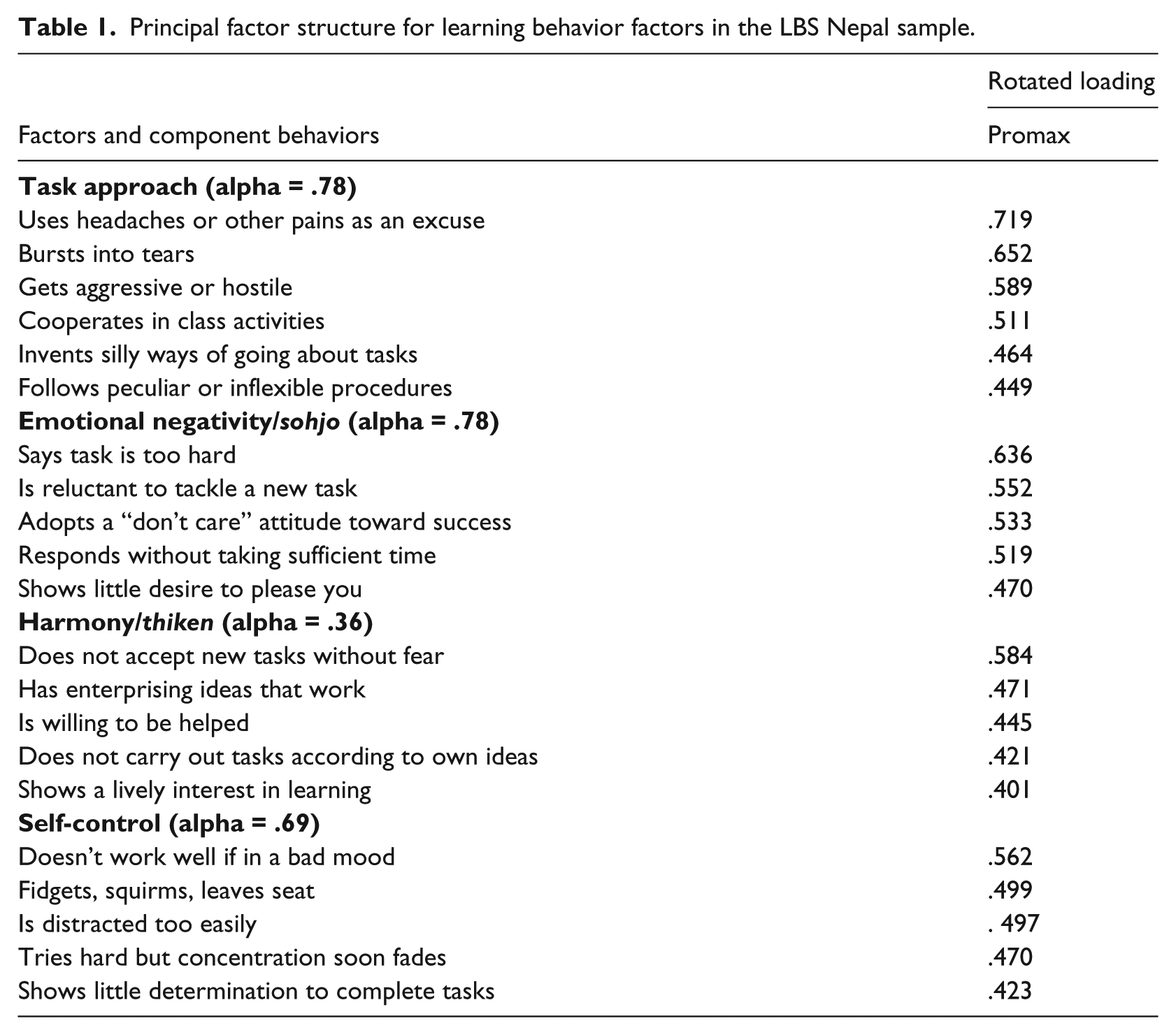
The observer ratings of the Nepalese student population form four learning-style factors. The third factor is statistically weak; however, it has a strong cultural foundation. The items in each factor do not replicate the factor structure of the LBS US national standardization sample; however, similarities with the prior American findings exist and will be discussed later in this article. The first factor represents task approach in observed learning behaviors in Nepalese students; the second factor represents emotional negativity/sojho; the third factor represents task engagement/thiken; and the fourth factor represents self-control.
Multidimensional scaling (MDS) was then used to explore the structure underlying the factor analyses. This allowed for examination of the unique aspects of the LBS when used with this sample of Nepali children.
The squared Euclidean distance matrix was used as input into ALSCAL (as implemented in SPSS) and two-dimensional solutions were sought. The stress value (.16192) and RSQ of .93159 suggest that the proportion of variance accounted for was 93%, making this two-dimensional solution appropriate. A graphic representation of the two-dimensional aggregated solution is presented in Figure 1.
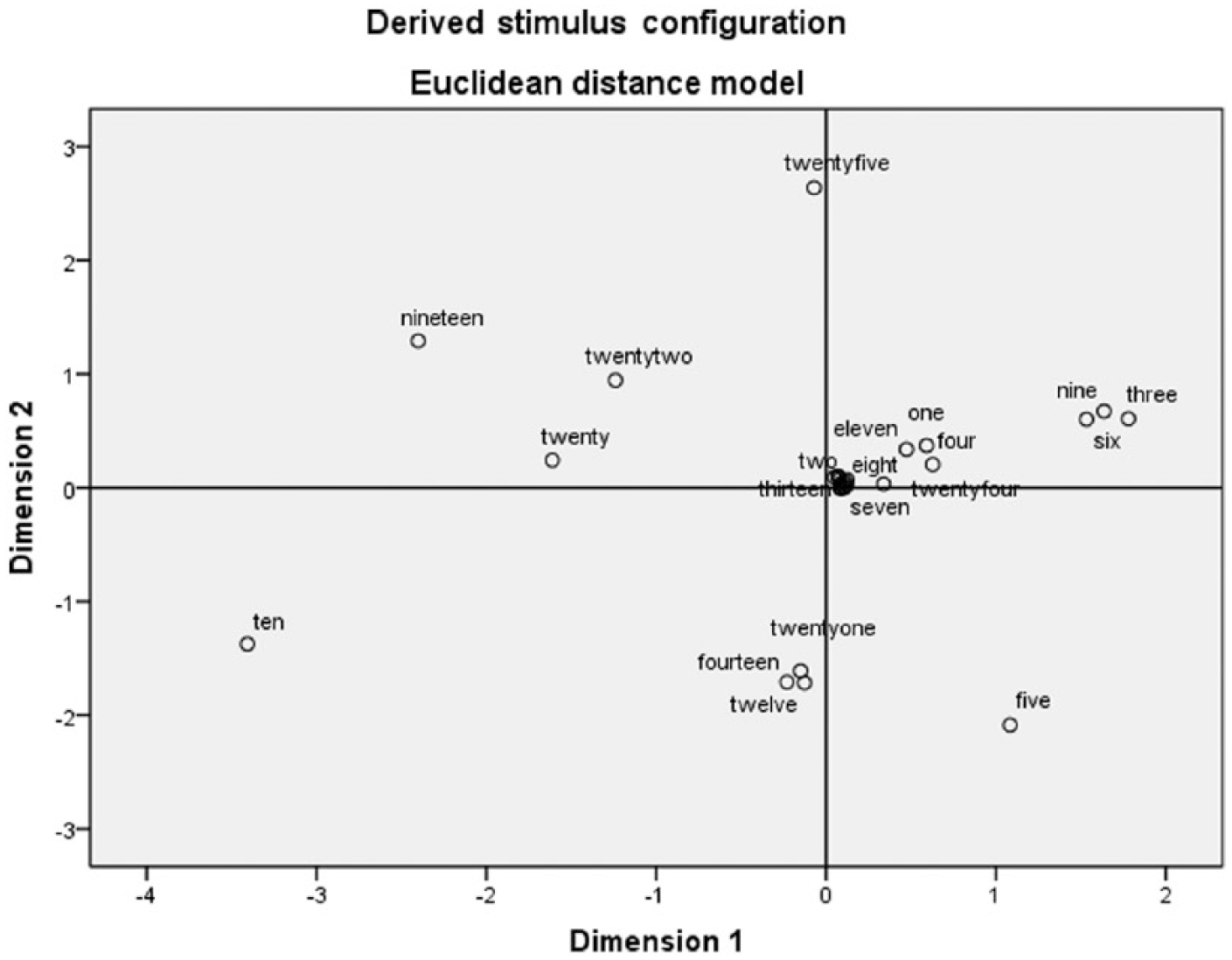
MDS of Learning Behavior Scale items.
Dimension 1
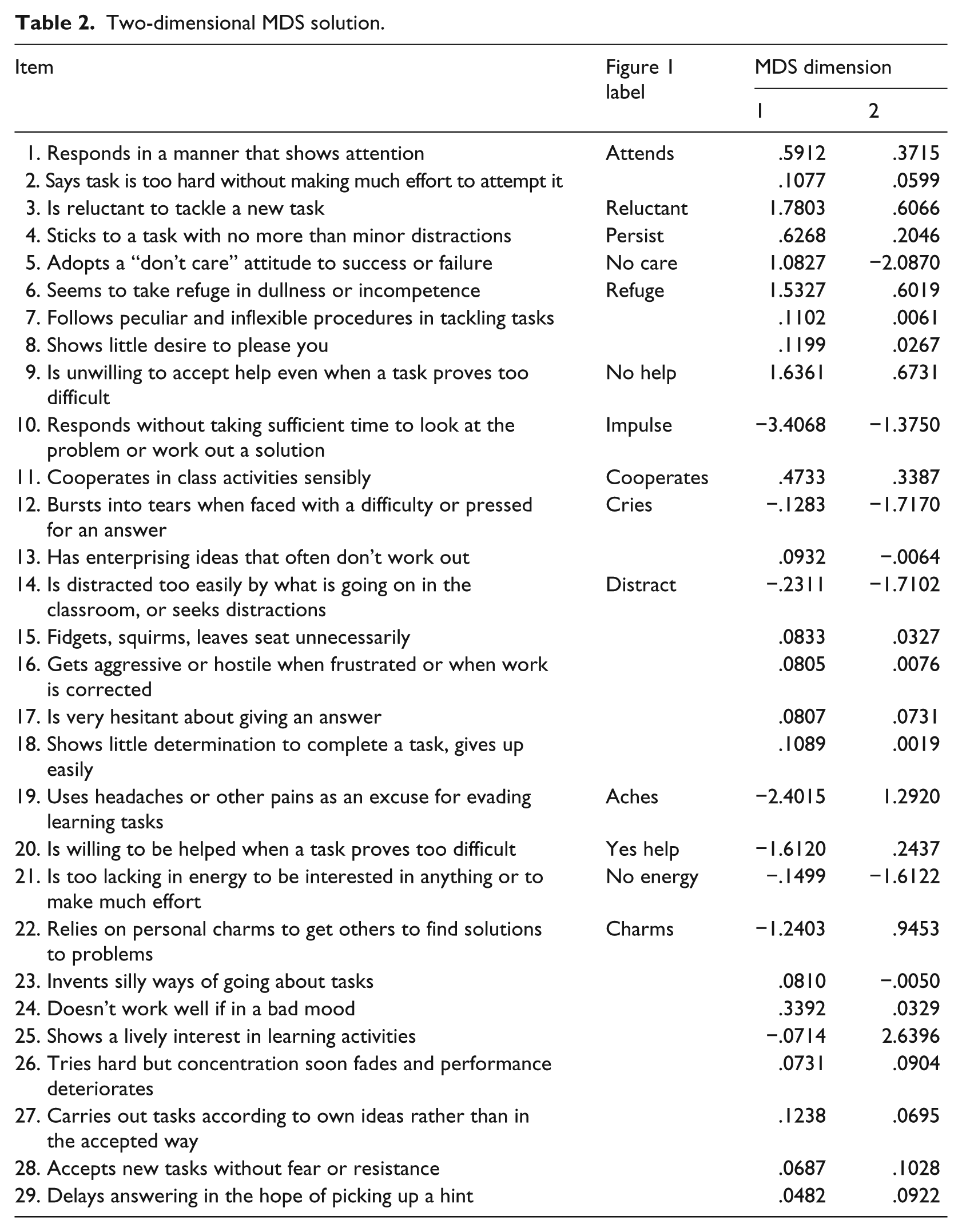
An examination of the placement of the items on the first dimension reveals contrasting levels of how students in this study appraise and approach classroom tasks (See Table 2). One end of the dimension suggests an appraisal that results in a more passive or impulsive approach, with the student giving little thought to the cognitive processes involved in approaching the task at hand. Items here include “Is too lacking in energy to be interested in anything or to make much effort;” “Relies on personal charm to get others to find solutions to problems;” “Uses headaches or other pains as an excuse for evading learning tasks;” “Bursts into tears when faced with difficulty or pressed for an answer;” “Responds without taking time to look at the problem or work out a solution.” On the other side of the dimension is a task approach that is more deliberate, with the student appraising the task in either a positive or a negative manner and responding in kind. Items here include “Responds in a manner that shows attention;” “Sticks to a task with no more than minor distractions;” “Is reluctant to tackle a new task;” “Seems to take refuge in dullness or incompetence;” “Is unwilling to accept help even when a task proves too difficult;” and “Adopts a ‘don’t care’ attitude to success or failure.” This dimension was named task appraisal/approach behaviors.
Two-dimensional MDS solution.
Dimension 2
The second dimension appears to order the items according to student level of engagement in a learning task. On one side are items that suggest higher levels of engagement in both active and passive forms. Active engagement items include “Responds in a manner that shows attention;” “Is willing to be helped when a task proves too difficult;” and “Sticks to a task with no more than minor distractions.” More passive engagement is reflected in “Is reluctant to tackle a new task;” “Is unwilling to accept help even when a task proves to difficult;” “Seems to take refuge in dullness or incompetence;” “Relies on personal charm to get others to find solutions to problems;” and “Uses headaches or other pains as an excuse for evading learning tasks.” On the other side are items that suggest low levels of engagement. These items include “Is too lacking in energy to be interested in anything or to make much effort;” “Is distracted too easily by what is going on in the classroom or seeks distractions;” “Adopts a ‘don’t care’ attitude to success or failure;” “Bursts into tears when faced with difficulty or pressed for an answer;” and “Responds without taking time to look at the problem or work out a solution.” This dimension was named “task engagement.”
The results of this study investigated the factor structure, multidimensional structure, and item endorsement of the LBS for a sample of 223 school-aged Nepalese students. A four-factor structure emerged for this population. The four factors represent: task approach; emotional negativity/sojho; task engagement/thiken; and self-control. Further investigation revealed two dimensions: task appraisal/approach behaviors and task engagement. Building on the broader view of the learning behaviors of the children in this study provided by the factor analysis and the MDS, item analyses compared those endorsed by the Nepal sample and the US sample, respectively. This provided the opportunity to compare the responses provided by the two samples.
Discussion
The results of this study are informative on multiple levels by providing (a) information regarding learning behaviors of students in their classrooms in Kathmandu; (b) psychometric characteristics for scores from a behavioral assessment instrument with potential use on an international level; and (c) a view into the learning behaviors of students in this study’s sample in comparison with the United States normative sample.
Fundamental to understanding children’s learning behaviors is an understanding of the cultural influences in task approach and task engagement. In this study, when children experienced stress, they tended to avoid a task by acting silly or somatizing their stress. In addition, when faced with engaging in a task, they tended to respond by indicating that the task was “too hard” or adopting an “I don’t care” attitude. The question remains, how might these responses be a representation of what Mahat and Scoloveno (2006) and Cole et al. (2002) describe as the Nepalese national cultural norms of collectivism—valuing group harmony and respecting authority—and how are these more global norms modified by the children’s local community. Additionally, how might the way that students communicated stress and their attitude to learn be representations of what Cole et al. (2002) refer to as sojho.
From a psychometric perspective, the LBS provided a behaviorally based assessment of students’ behaviors in the classroom. From this measure, there were four significant factors and two important dimensions providing insight into how the children in this sample learn. For example, the children demonstrated a considerable level of persistence when faced with unfamiliar tasks. In addition, they were also willing to accept new tasks. This initial investigation identified the factor structure, multidimensional structure, and item endorsement of the LBS for a sample of 223 school-aged Nepalese students. The classroom behaviors of these children fell into four categories. These categories were labeled: task approach; emotional negativity/sojho; task engagement/thiken; and self-control. When the factors of the LBS were further investigated, two dimensions were identified: task appraisal/approach behaviors and task engagement.
The view into the learning behaviors of this sample as compared to the United States sample demonstrated that certain universal human behaviors and developmental patterns exist and can be seen across cultures. For example, attending skills were seen in both samples and are relevant behaviors in both classrooms (See Table 3). Students in both samples demonstrated behaviors such as becomes easily distracted or seeks distraction; fidgets, squirms, leaves seat; and tries hard but concentration soon fades. These mutually endorsed constructs are behaviorally driven and identified as of importance to the learning process.
Items analysis.
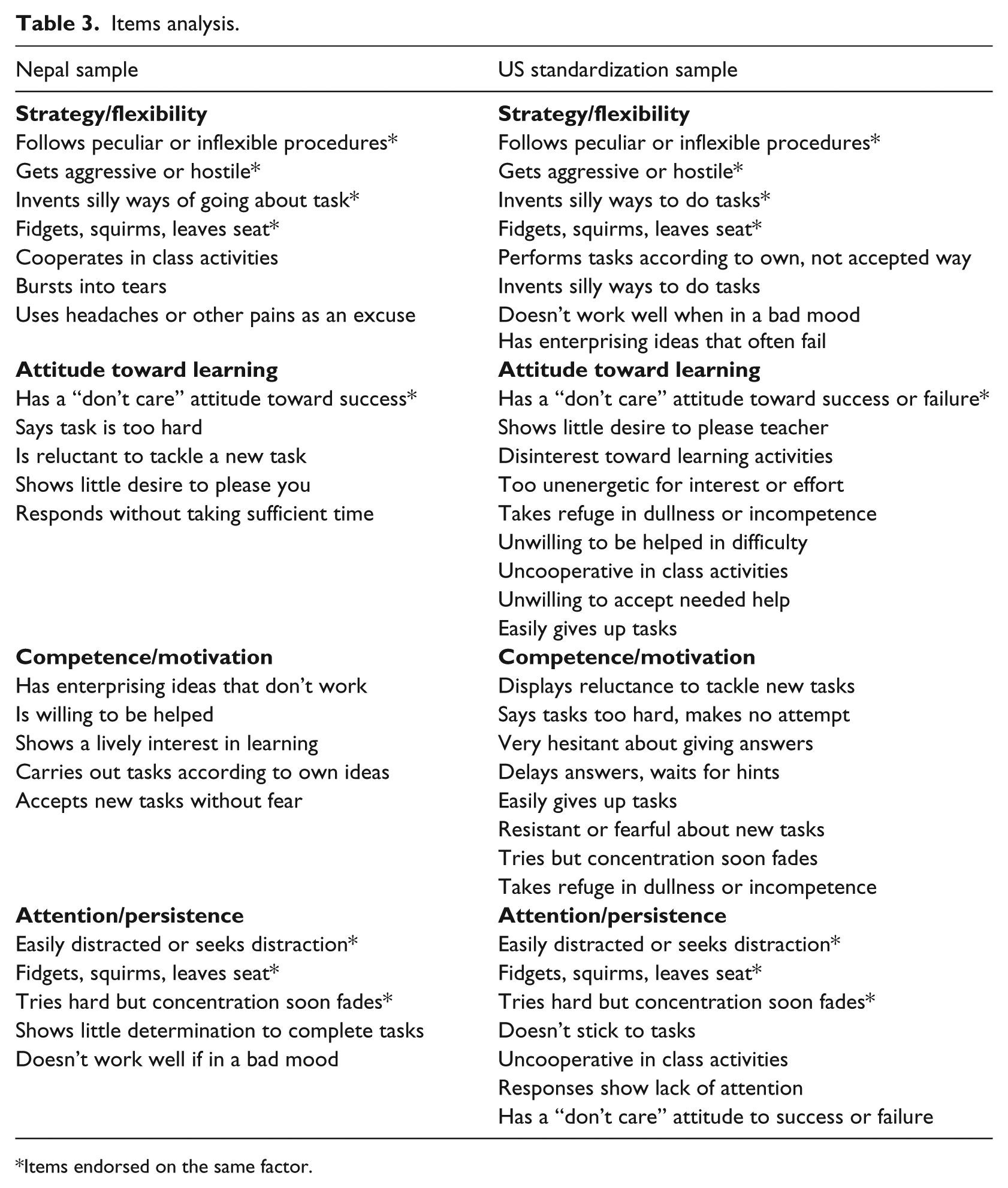
Items endorsed on the same factor.
From an international perspective, the call for multicultural assessment is imperative in the 21st century. As Auchenbach et al. (2008: 1) wrote: “economical, evidence-based culturally robust assessment is needed for research, for answering public health questions, and for evaluating immigrant, refugee, and children.” Establishing the efficacy of an assessment instrument in multicultural settings is essential to the ethical and appropriate assessment of students. The importance of culture is a fundamental tenet in the educational process. Along with this fundamental tenet is the acknowledgement that we as humans follow similar developmental patterns. The results of this study indicate a pattern of behavior, as identified by the LBS, which is similar across the two cultures while allowing for cultural differences.
Limitations of the study
As with any quantitative research study, the sample size and representativeness can always be improved. Also, although the LBI shows promise for adaptation to multicultural populations, the current norming information is restricted to US children. In addition, the Nepalese sample was taken from children attending school in Kathmandu, which is considered the richest and most urbanized part of Nepal. This limits the generalizability of the results to children attending school in this area. In addition, the quantitative nature of the study, especially the factor analysis, provides only a limited understanding of the children’s experience.
Certainly, the incorporation of more qualitative research strategies (i.e. interview, focus groups, participant observation) would provide more insight and a richer description of the childrens’ experience within their the school culture. This information would also further enlighten researchers as to the broader cultural influences on a child and on the educational system. In terms of the LBS, future research should focus on developing culture-based norms.
Nonetheless, this study allowed for a glimpse into Nepalese children’s learning behaviors and established the initial psychometric properties of an evidence-based measure of student learning behaviors. This information can be used to strengthen or remediate a student’s approach to learning which, in turn, can facilitate academic achievement.
As history and reform illustrate, educational progress and advancement is essential to the social and economic growth in Nepal. For educational development practitioners, a guiding force in educational reform is the Dakar Framework for Action. This document holds a primary goal of ensuring that by 2015 “all children, particularly girls, children in difficult circumstances and those belonging to ethnic minorities, have access to and complete, free and compulsory primary education of good quality” (World Education Forum, 2000: 8). In addition to access, these children must be afforded instructional practices and curricula that are developed with a clear understanding of their learning behaviors. This includes how they approach a task, engage in learning, maintain the self-control necessary to follow the learning process, and deal with emotional states that may interfere with their learning goals. Instructional approaches based on an understanding of a single child’s learning behaviors can be a key to helping Nepalese children gain the knowledge and skills to better negotiate the historical cultural hardships and, thus, enjoy a wider array of life choices. Only in this way can we achieve Carney’s (2011) ideal of promoting Nepal’s economic progress and position in the global economy through the investment in a single child.
Footnotes
Funding
This research was funded by a University of Penn State Research Initiation Grant.